
Submitted:
06 March 2025
Posted:
10 March 2025
Read the latest preprint version here
Abstract
This paper seeks to enhance and strengthen existing theoretical frameworks or potential new theories by proposing an innovative theoretical framework know as Information-Processing Universe hypothesis, which reconceptualizes the universe as intrinsically informational, anchored in a "Hidden Informational Dimension". By positing that the fundamental structure of the universe is underpinned by informational dynamics, I explore how conventional concepts of spacetime should be perceived as a manifestation emerging from informational interactions [1,2], which intrinsically entails a specific extent of information loss. I also propose a cyclic universe model with alternating energy states, emphasizing energy conservation and complex interactions between information and matter. The framework connects gravitational effects and time dilation to informational dynamics, integrating quantum mechanics with information theory, particularly via Bell's theorem, and opens new avenues for understanding reality's fundamental nature.
Keywords:
theoretical physics
; information processing
; informational dimension
; loss of information
; spacetime emergence
; cyclic universe
1. Theoretical Framework
The Information-Processing Universe (IPU) hypothesis discusses a paradigm shift in the conceptualization of the universe. It posits that our spacetime is a manifestation of a hidden-dimensional information space, which we term the "Hidden-Informational Dimension (HID)". The HID comprises two integral components: information and the laws governing the processing of the information. The informational content resides within the HID, while our spacetime represents the tangible manifestation of the information processed according to these governing laws.
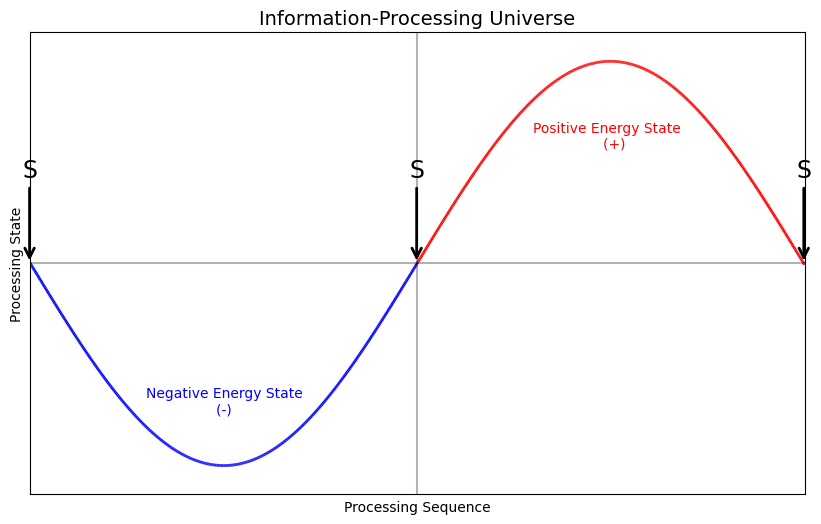
This manuscript further delineates a framework for IPU that functions in a cyclic manner (see Figure 1), incorporating a positive energy state and a negative energy state, with singularities denoting transitional points between these energy states, which can be articulated according to its own waveform grounded in the concept of HID (also known as its eigenstate). The notion of a cyclical universe has been rigorously examined by physicists, leading to the development of various cyclic models[3,4]. The specific mechanisms and foundational principles articulated in this paper propose phases of negative energy processing while the overall energy of IPU remains conserved and invariant throughout repeated cycles, notwithstanding the period of the phases.
I contend that this manifestation, while persistent, is not an impeccable representation of the HID; it inherently entails a certain degree of information loss as a consequence of dimensionality reduction. This dimensionality reduction initiates at the start of each IPU cycle at the singularities[5]. At every singularity, all conserved energy undergoes transformation and is subsequently redistributed to each Information Unit (IU) originating from the HID through integrations, culminating in the emergence of particles within our spacetime continuum. IU is utilized here instead of “bit”, “qubit” or “qudit” because this framework posits the information from HID is continuous and infinite, while our spacetime is discrete and finite. Although “Unit” itself may not be a perfect term in this context, it aptly conveys the notion of discrete segments that arise from an otherwise continuous source, highlighting the interplay between the infinite potential of information and the limitations imposed by our physical universe.
The Planck constant is regarded as the fundamental energy unit in spacetime in this document. Given that the total energy of IPU is conserved, and the information transmitted into spacetime via the Planck constant transitions from a continuous perspective to a discrete one, this phenomenon results in the loss of information. All information within HID can be delineated as waveforms, which subsequently engender manifestations in accordance with their respective governing laws, alongside the requisite action principle within spacetime that facilitates energy.
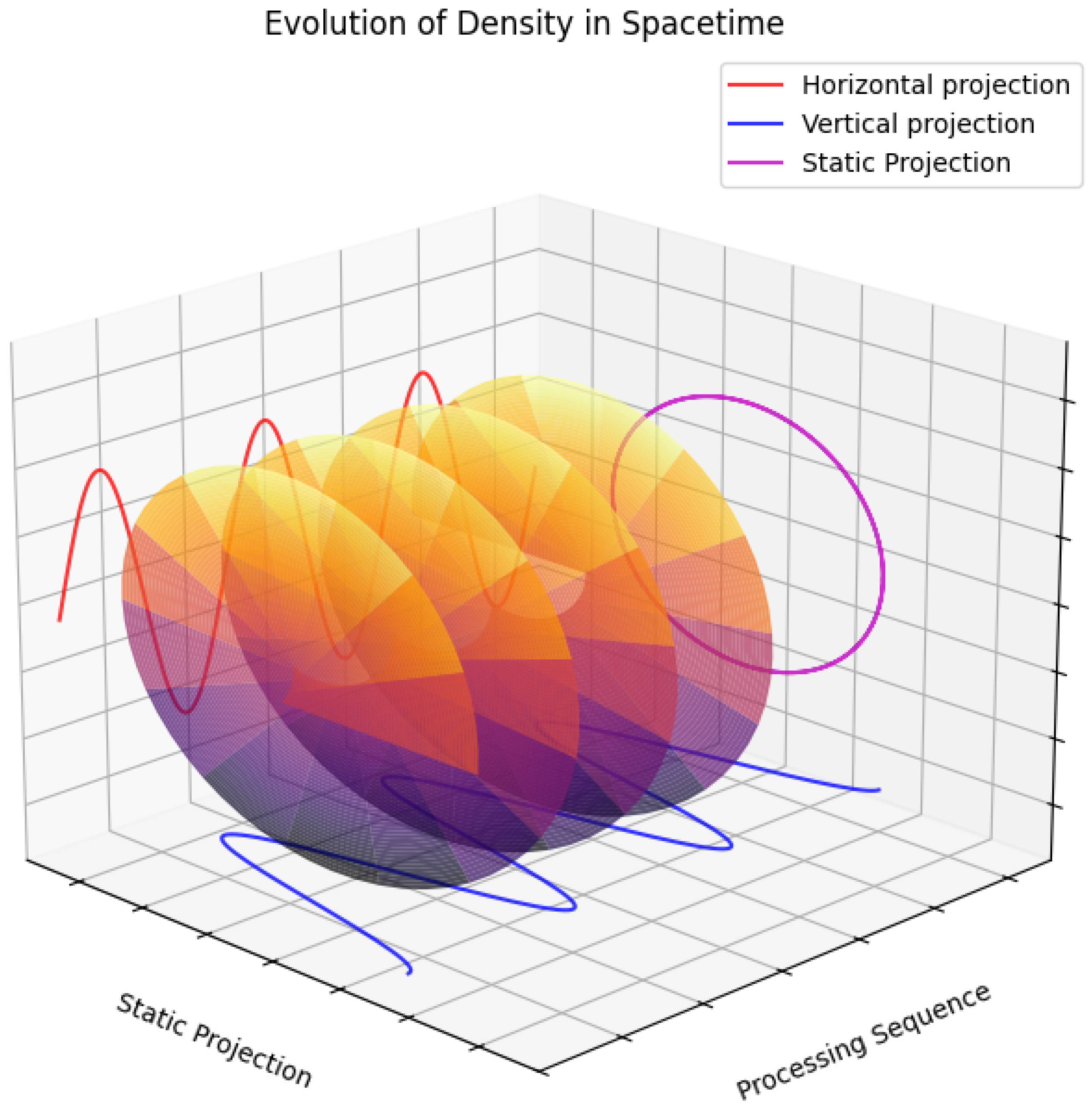
The ratio associated with the loss of information remains constant and is integrated alongside the density of the space. I posit that the space of IPU is conversed, and the spatial density undergoes continuous change in accordance with the processing sequence. Figure 2 depicts a spiral ramp that illustrates the evolution of density in our spacetime, which constitutes the waveform of the universe in accordance with a processing sequence. The waves are projected onto multiple surfaces, while the circle indicates that without the processing sequence, it takes on a circular shape. Nevertheless, when observed from the side and beneath, it presents itself as a wave, serving as a 2D representation of the 3D ramp. It is a Riemann surface of log z, depicted as a horizontal spiral ramp.
At points of singularity, thermal energies ascend to extraordinarily high magnitudes, and all energy is contained within, resulting in no information loss due to the infinite density of space. As the event of the big bang inaugurates each successive cycle (irrespective of whether it is characterized by a positive or negative phase), the information derived from HID is disseminated into spacetime via integrational phenomena, transforming from a continuous perspective in HID to a discrete perspective in spacetime, gradually culminating in the loss of information as the sequence of the processing progress due to the change of density of the space. As thermal energy diminishes, energy is transmuted into matter, whereby all matter engages in interactions with one another, reflecting their respective eigenstates in HID. The phenomenon of information loss is directly proportional to the escalation of entropy, encompassing both informational and thermodynamic dimensions.
This framework also presents a unique perspective on quantum mechanics, re-interpreting its seemingly paradoxical phenomena through the lens of information processing and the information dimension. Bell’s theorem, which illustrates the fundamental incompatibility between local hidden variable theories and the principles of quantum mechanics, is inherently examined within the context of our theoretical framework. HID serves as a non-local source of information capable of elucidating the correlations manifested in Bell test experiments. The "additional" degree of correlation observed in these empirical investigations, surpassing the classical threshold, may signify the influence of non-local information emanating from HID, potentially linked to the changing density of the space and the associated information loss.
Since the 1960s, numerous experiments have demonstrated violations of Bell’s inequality[6,7,8,9,10,11]. These experimental results align with the IPU framework, where entanglement is understood as a manifestation of shared information accessed instantaneously from HID. This non-local information space allows for correlations between entangled particles that defy classical explanations, providing a natural explanation for the observed violations of Bell’s inequality.
In the IPU hypothesis, particles are not independent entities but rather eigenvalues of their corresponding eigenstates in the HID. The IPU framework posits that the trajectory is determined by the space density and the corresponding local processing frequency at a given location within spacetime.
The formulation concerning the emergence of particles initiates with the Planck constant equation; for convenience, the equation of the photon is presented as follows:
where E signifies energy, f represents the frequency of a photon, and h indicates the Planck constant.
In relation to the waveform of the IU, it is denoted as using Euler’s formula, reflecting the manifestation of IU upon the nature of the information; thus, we can express:
The IU transmits unadulterated information associated with the Planck constant, which already acts as a fundamental discretization constraint setting the lowest bound on information granularity of our spacetime. This delineates the energy characteristics of the IU and the dynamics of our spacetime continuum.
The density of space and its continuous evolutions might not influence our spacetime on a large scale, yet they do impact energy and matter at a microscopic level. Consequently, determining the density at a specific time T is essential for calculating the trajectory according to the action principle that align with its HID waveform.
We now define loss in terms of:
- : The universe’s density at time t, representing how much information is available for projection.
- : Initial density at , setting the baseline for information projection.
- : A proportionality constant representing how information is lost due to discretization and interaction with spacetime.
A natural loss function L(t) could be presented as :
where the loss is relative to the initial density , emphasizing how much information is being filtered out associated with h at any given time. Thus, the energy equation with loss becomes:
where
- When , loss is at its reference level
- When , and all available information remains in the system.
- The factor ensures that loss scales with cosmic evolution.
The real part represents observable energy, the imaginary part may encode the information from HID before loss is applied, and the decay term ensures that as information integrates into spacetime, only part of it survives.
2. Quantum Phenomena
Certain quantum phenomena may be elucidated within the contextual framework:
Superposition, as per the Copenhagen interpretation, is the ability of a quantum system to exist in multiple states simultaneously and is often described as one of the most counterintuitive aspects of quantum mechanics. The wavefunction, which mathematically describes the eigenstate of HID, can be viewed as a stopgap of this lack of complete information. The "probability" itself serves as an approximation and an ambiguous reflection of the dimensionality reduction that occurs during the integration from HID to our spacetime. Within our framework, superposition is not an accurate reflection of reality but rather a result of our restricted access to the comprehensive information embedded in HID due to information loss.
As we assess information loss by examining elements like loss ratio and space density at the local processing frequency, our measurements compel the information to merge into our spacetime, resulting in the waveform of a particle from HID to "collapse" into a singular, definitive state in spacetime via the loss function. In essence, since we exist within discrete spacetime, we are limited to using an inherently flawed approach to perceive information from the continuous dimension, thus lacking access to the entirety of the information. This collapse is not an arbitrary occurrence but rather a deterministic outcome of retrieving partial information from HID, arising from the information loss transitioning from continuous HID to discrete spacetime.
Following the collapse of the wavefunction, the particle adheres to Richard Feynman’s path integral approach[12], which is fundamentally predicated on the spatial density at a specific time and the corresponding position on the Riemann surface, as illustrated in Figure 2. Feynman’s path integral formulation posits that, between measurements, a quantum particle does not traverse a singular trajectory; rather, it explores all conceivable paths, each weighted by its action. Within this framework, two pivotal rules are established: firstly, the classical trajectory represents the most probable path, identified as the path of least action; secondly, in the absence of measurement, the wavefunction undergoes a dispersion, thereby encoding a multitude of potential outcomes.
In addition, quantum entanglement, where two or more particles exhibit correlations that persist regardless of spatial separation, has historically challenged classical interpretations of physics. Within our framework, entanglement is a natural consequence of the nonlocal structure of HID, where entangled particles share a common eigenstate within.
Rather than invoking faster-than-light communication or hidden variables, the IPU model suggests that entangled particles remain interconnected via their shared wave function in HID. Since information in HID exists beyond the spatial limitations of our spacetime, any modification to the shared information state in HID is instantaneously reflected in all entangled particles. Because this global wavefunction exists outside conventional spacetime constraints, any change to the state of one particle does not require a physical transmission of information — it is merely the result of accessing the same continuous information source from HID. This provides an explanation for the instantaneous correlation observed in entangled systems without violating the principles of relativity.
Quantum tunnelling, a phenomenon in which a particle traverses a potential barrier despite possessing insufficient classical energy, poses a fundamental challenge to conventional physics. Within the framework of IPU, this process can be interpreted through the temporary disintegration and reintegration of the particle’s information state. Specifically, during tunnelling, the particle’s information undergoes a transient disintegration within HID, effectively bypassing the spatial constraints imposed by the potential barrier. This process is governed by the local space density and a corresponding loss function, which determines the probabilistic final position of the reintegrated particle.
This mechanism can be further understood in light of Heisenberg’s uncertainty principle, which states that the product of uncertainties in energy and time must satisfy:
Since the process of disintegration and reintegration occurs within an extremely short time interval , the uncertainty in energy correspondingly diverges, allowing the system to transiently acquire an energy , where U is the potential barrier height. This excess energy effectively enables the particle to overcome the barrier without violating energy conservation on macroscopic scales.
A similar principle applies to quantum fluctuations. Within our framework, these fluctuations are not spontaneous creations from "nothing" but rather emergent phenomena from HID. The eigenstates of particles, represented by their intrinsic wavefunctions, reside within HID and necessitate sufficient energy input—achieved through disintegration—to integrate into observable spacetime.
3. Entropy
Furthermore, the theoretical framework posits that the loss of information is directly proportional to the increase in entropy, as viewed through both an information-theoretic and thermodynamic lens. This phenomenon adheres to a cyclic pattern, reinstating itself upon the conclusion of each transformation cycle[13].
In the context of Shannon entropy, the loss of information corresponds to an increase in uncertainty (entropy). This relationship can be expressed as:
where:
- represents the loss of information units (IU).
- represents the increase in information entropy.
In thermodynamics, erasing information requires energy dissipation, as described by Landauer’s Principle[14], which states that the minimum energy required to erase one bit of information is given by:
where E is the energy dissipated as heat. This principle suggests that information loss contributes directly to the thermodynamic entropy of a system. The relationship can be extended as:
where:
- represents the increase in thermodynamic entropy (measured in Joules per Kelvin),
- represents the loss of information units (IU),
- E represents the energy transformed in spacetime (measured in Joules).
4. Gravitation
Last but not least, within the framework of the IPU hypothesis, gravitation is not exclusively ascribed to the curvature of spacetime as delineated by General Relativity. Rather, it arises from a more fundamental phenomenon: the intrinsic eigenstate of the mass-continuum derived from HID. This "mass wave" represents a collective effect emanating from a multitude of interactions between energy and matter, culminating in a unified waveform in HID. Within the realm of spacetime, the mass-continuum is constituted by all particles interconnected through the strong force. Consequently, gravitation can be construed as the manifestation of this waveform.
This mass wave permeates spacetime, thereby affecting the spatial density and the frequency of the corresponding local processing sequence, which results in phenomena such as length contraction and time dilation. In this context, time is conceptualized as a processing sequence to accurately represent the characteristics of IPU. The fundamental tenet is as follows: Regions characterized by an elevated intensity of the mass wave demonstrate pronounced gravitational influences, augmented spatial density, and a decelerated rate of information processing. Consequently, I deduce that the intensity of the mass wave is directly proportional to gravitation and spatial density, while being inversely proportional to the relevant local processing frequency.
As the information contained within HID is perpetually continuous, and given that the Planck constant establishes the minimum threshold for information granularity, the spatial density is a determinant of the degree of information loss at a particular temporal juncture. At the points of singularity, the spatial density tends toward infinity, precipitating infinite gravitational forces and the suspension of processing sequences. An alternative interpretation is that gravitational phenomena emerge as a result of variances in the levels of information loss: a greater degree of loss corresponds to a diminished gravitational effect. As the cosmos undergoes expansion and its spatial density decreases, the aggregate intensity lessens, culminating in an accelerated processing frequency. This elucidates the phenomenon whereby celestial bodies in the expanse of outer space appear to exhibit increased velocities as the universe undergoes its evolutionary processes.
5. Experiment Proposal
This experiment intends to examine how the lack of strong gravity impacts quantum effects by performing quantum tests in low-gravity settings. The goal is to determine if weaker gravity alters quantum actions in ways that support the theory. To achieve this, one will need to establish the experimental apparatus to test Bell inequality violations both on Earth and aboard the International Space Station (ISS), conducting identical tests in both environments.
I anticipate that the magnitude of the violation will exceed 2 and be greater in the ISS environment. The reasoning behind this expectation lies in the theoretical framework suggesting that the lack of certain information in the ISS is more pronounced due to the lower intensity of mass waves. This results in a less gravity-affected environment, characterized by lower spatial density and higher processing frequency, ultimately leading to greater information loss. Consequently, the expectation of the added magnitude of the result over 2 is larger in the ISS environment than on Earth.
6. Summary
In conclusion, the IPU hypothesis offers a paradigm-shifting viewpoint regarding the essence of the universe, asserting that spacetime is intrinsically an emergent representation of HID. This theoretical framework not only reconceptualizes both classical and quantum phenomena but also synthesizes notions of information loss and entropy, clarifying their significance in the interplay of spacetime and gravitation. By asserting that the universe functions through cycles of energy states and information processing, the IPU hypothesis is congruent with established theories while providing alternate perspectives on quantum mechanics, encompassing superposition, entanglement, and tunnelling. The ramifications of this hypothesis extend to empirical verification, particularly through the examination of Bell inequality violations across diverse gravitational scenarios, which may further corroborate the association between information dynamics and the fundamental architecture of reality. Ultimately, the IPU framework encourages a critical reassessment of our comprehension of the cosmos, positing that the relationship between information and physical laws is integral to the very fabric of existence.
References
- R. Landauer, "Irreversibility and Heat Generation in the Computing Process,". [CrossRef]
- Barbour, J. The End of Time: The Next Revolution in Physics. Oxford University Press (1999).
- Tegmark, M. "The Mathematical Universe." Foundations of Physics, 38(2), 101-150 (2007). [CrossRef]
- Penrose, R. Before the Big Bang: The Prehistory of the Universe. Oxford University Press (2010).
- Steinhardt, P. J., & Turok, N. "A Cyclic Model of the Universe." Science, 296, 1436–1439 (2002). [CrossRef]
- Penrose, R. "Singularities and Time-Asymmetry." In S. W. Hawking & W. Israel (Eds.), General Relativity: An Einstein Centenary Survey (pp. 581-638). Cambridge University Press (1979) Freedman, S. J., & Clauser, J. F. "Experimental Test of Local Hidden-Variable Theories." Physical Review Letters, 28(14), 938-941 (1972).
- Aspect, A., Dalibard, J., & Roger, G. "Experimental Test of Bell’s Inequalities Using Time-Varying Analyzers." Physical Review Letters, 49(25), 1804-1807 (1982). [CrossRef]
- Weihs, G., Jennewein, T., Simon, C., Weinfurter, H., & Zeilinger, A. "Violation of Bell’s Inequality Under Strict Einstein Locality Conditions." Physical Review Letters, 81(23), 5039-5043 (1998). [CrossRef]
- Rowe, M. A., Kielpinski, D., Meyer, V., Sackett, C. A., Itano, W. M., Monroe, C., & Wineland, D. J. "Experimental Violation of a Bell’s Inequality with Efficient Detection." Nature, 409(6822), 791-794 (2001). [CrossRef]
- Hensen, B., Bernien, H., Dréau, A. E., Reiserer, A., Kalb, N., Blok, M. S., ... & Hanson, R. "Loophole-Free Bell Inequality Violation Using Electron Spins Separated by 1.3 km." Nature, 526(7575), 682-686 (2015). [CrossRef]
- Giustina, M., Versteegh, M. A. M., Wengerowsky, S., Handsteiner, J., Hochrainer, A., Phelan, K., ... & Zeilinger, A. "Significant-Loophole-Free Test of Bell’s Theorem with Entangled Photons." Physical Review Letters, 115(25), 250401 (2015). [CrossRef]
- Feynman, R. P. "Space-Time Approach to Non-Relativistic Quantum Mechanics." Reviews of Modern Physics, 20(2), 367-387 (1948). [CrossRef]
- Penrose, R. Cycles of Time: An Extraordinary New View of the Universe. Bodley Head (2010).
- Landauer, R. "Irreversibility and Heat Generation in the Computing Process." IBM Journal of Research and Development, 5(3), 183-191 (1961). [CrossRef]
Figure 1.
IPU presented as a waveform.
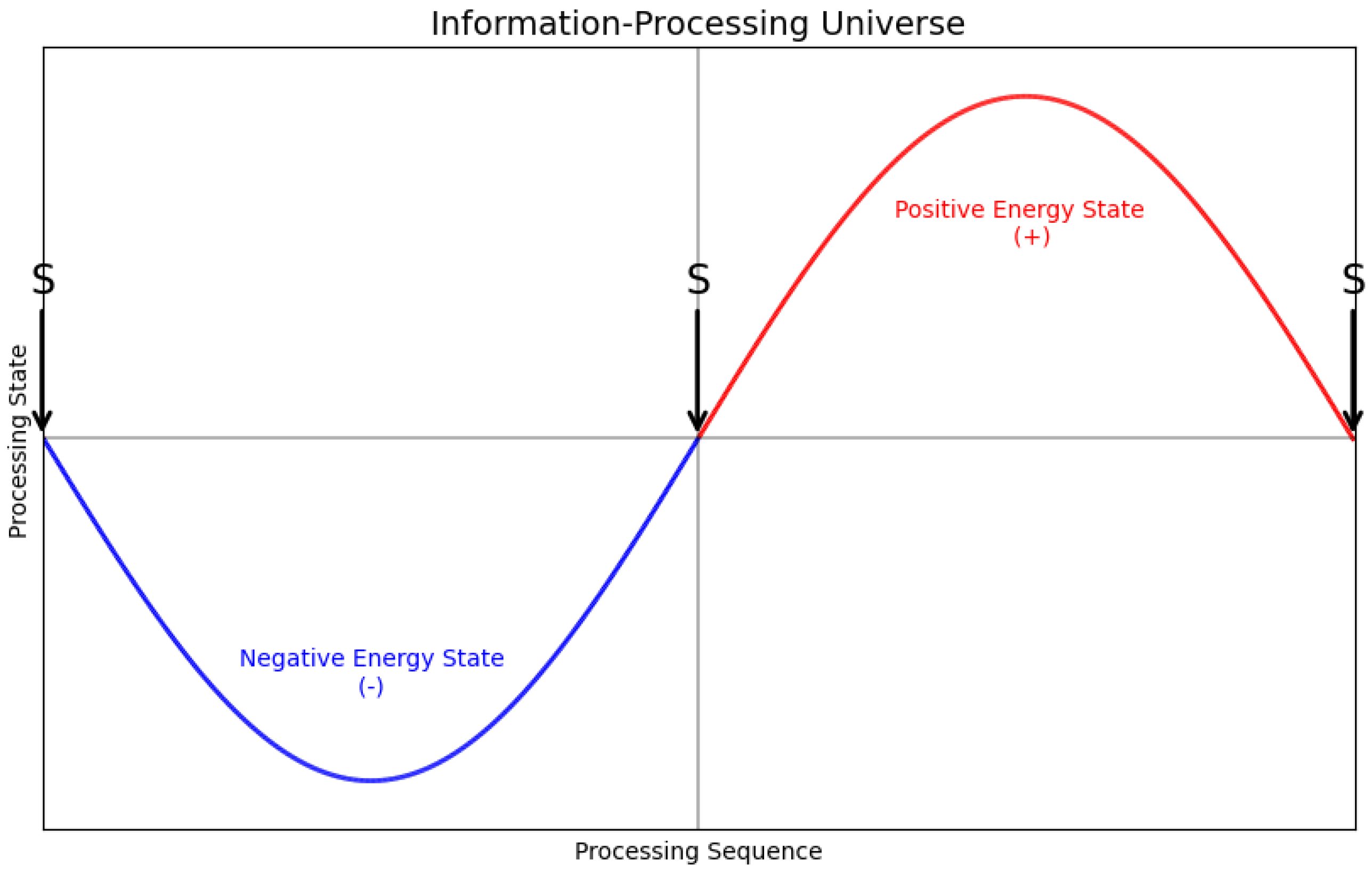
Figure 2.
Evolution of spatial density in spacetime.
Disclaimer/Publisher’s Note: The statements, opinions and data contained in all publications are solely those of the individual author(s) and contributor(s) and not of MDPI and/or the editor(s). MDPI and/or the editor(s) disclaim responsibility for any injury to people or property resulting from any ideas, methods, instructions or products referred to in the content. |
© 2025 by the authors. Licensee MDPI, Basel, Switzerland. This article is an open access article distributed under the terms and conditions of the Creative Commons Attribution (CC BY) license (http://creativecommons.org/licenses/by/4.0/).
Copyright: This open access article is published under a Creative Commons CC BY 4.0 license, which permit the free download, distribution, and reuse, provided that the author and preprint are cited in any reuse.