Preprint
Article

This version is not peer-reviewed.

Genome Mining Reveals Pathways for Terpene Production in Aerobic Endospore-Forming Bacteria Isolated from Brazilian Soils

A peer-reviewed article of this preprint also exists.

Submitted:

07 March 2025

Posted:

10 March 2025

You are already at the latest version

Abstract

Terpenes are the largest category of specialized metabolites. Aerobic endospore-forming bacteria (AEFB), a diverse group of microorganisms, can thrive in various habitats and produce specialized metabolites, including terpenes. This study investigates the potential for terpene biosynthesis in 10 AEFB strain whole-genome sequences by performing bioinformatics analyses to identify genes associated with these isoprene biosynthesis pathways. Specifically, we focused on the sequences coding for enzymes in the methylerythritol-phosphate (MEP) pathway and the polyprenyl synthase family, which play crucial roles in synthesizing terpene precursors together with terpene synthases. Comparative analysis revealed a unique genetic architecture of these biosynthetic gene clusters (BGCs). Our results indicated that some strains possessed the complete genetic machinery required to produce terpenes such as squalene, hopanoids, and carotenoids. We also reconstructed phylogenetic trees based on the amino acid sequences of terpene synthases, which aligned with the phylogenetic relationships inferred from the whole-genome sequences, suggesting the production of terpenes is an ancestor property in AEFB. Our findings highlight the importance of genome mining as a powerful tool for discovering new biological activities. Furthermore, this research lays the groundwork for future investigations to enhance our understanding of terpene biosynthesis in AEFB and the potential applications of these Brazilian environmental strains.

Keywords: 
;  ;  ;  ;  ;  ;  ;  ;  

1. Introduction

Specialised or secondary metabolites are not essential for growth. Nevertheless, they play a relevant ecological role by providing nutrients in competitive environments and offering adaptive advantages to the producing organism [1,2]. Terpenes are hydrocarbons of linked five-carbon units of isoprene [3] and are the largest category of specialised metabolites, with over 80,000 known structures [4]. These molecules present a wide range of applications in pharmaceuticals, food, and cosmetics, among other relevant industries [3,4].
Originally thought to be exclusively produced by plants, nowadays, terpenes are known to be synthesised by a diversity of organisms, including bacteria, fungi, protozoa, and invertebrates [5,6,7,8]. In plant tissues, terpenes are pigments and scents that protect against predation and attract predators of herbivorous parasites [7,9]. They also act as signalling structures and plant hormones. In bacteria, terpenes such as the antimicrobial albaflavenone [10], germacrene D and pentalenene [7] have been described. Nonetheless, the physiological and ecological functions of terpenes in this domain of life are still largely unknown [11,12].
The production of terpenes occurs through diverse biochemical pathways, which can be independent or integrated [13]). The synthesis of these isoprenes starts from the precursor isopentenyl pyrophosphate (IPP), produced via either the mevalonate (MVA) or the methylerythritol-phosphate (MEP) pathways [14]. Both plants and fungi utilise the MVA and MEP pathways for terpene synthesis, while most bacteria rely solely on the MEP route [14]. The enzyme isopentenyl pyrophosphate isomerase (IDI) converts IPP into dimethylallyl pyrophosphate (DMAPP), an IPP isomer. Subsequently, geranyl pyrophosphate synthase (GPPS) condenses these two isomers to produce geranyl pyrophosphate (GPP), which serves as monoterpenes' precursor. GPPS belongs to the enzyme family polyprenyl synthase (PPS), which includes farnesyl pyrophosphate synthase (FPPS) and geranyl geranyl pyrophosphate synthase (GGPPS). FPPS is responsible for the sesquiterpenes and triterpenes syntheses, and GGPPS is involved in diterpene and tetraterpene precursors. An overview of the substrates for the MEP pathway, the enzymes of the PPS family, and their corresponding products is provided in Table 1.
Endosporulation is an outstanding differentiation mechanism that evolved to help some bacteria survive adverse conditions [15,16]. The resulting dormant spore remains sensitive to environmental changes and can germinate to return to active metabolism and reproduction [16]. The ability to form spores has been observed only inside the phylum Firmicutes, recently renamed Bacillota [17]). This phylum allocates low G+C bacteria, most of which have Gram-positive cell wall structures, distributed in eight classes [18]. Endosporulation is not a universal characteristic inside Bacillota, but endospore-formers share a minimal homologous gene set involved in this event [18]. Endosporulation is widespread in the two Bacillota major classes—Bacilli, which are aerobic or facultative and Clostridia, anaerobic [17,18].
Species allocated in the genus Bacillus and related genera—whether assigned to the same or different families and orders inside Bacilli—are referred to as aerobic endospore-forming bacteria (AEFB), and soil is their major reservoir [19,20,21]. These bacteria can thrive across large temperatures and pH levels, exhibit metabolic diversity, and demonstrate remarkable spore resistance. These traits contribute to their ubiquity. Researchers extensively study these exceptional characteristics applied in various industrial contexts [22]. AEFB are known to synthesise a diverse array of specialised metabolites, which includes terpenes [20,22,23,24,25]. The ecological and socioeconomic significance of these metabolites is well recognised, as they can promote plant growth, manage insect pests and disease vectors, and possess immunosuppressive, antimicrobial, and antitumor activities [22,25,26,27]). Despite their potential importance, the terpene biosynthetic pathways in AEFB remain largely unexplored.
To acquire knowledge on AEFB and gain insights into their potential as a source of novel bioactive compounds as terpenes, we previously isolated 312 strains through heat-shocking soil samples collected at random areas of the Federal District, Midwest region of Brazil. These environmental strains are designated SDF0001-SDF0312 and are deposited at the Coleção de Bactérias aeróbias formadoras de endósporos (CBafes, or AEFB Collection–AEFBC). The CBafes is hosted at the University of Brasilia and is currently undergoing taxonomic classification using a polyphasic approach [28,29,30,31].
Genome prediction offers a powerful means for identifying and characterising the genetic basis of terpene production in bacteria. Here, we used a genome mining approach to investigate the potential for terpene biosynthesis in the whole genome of 10 SDF strains (Table 2). We focused on identifying the key genes involved in the MEP pathway and the enzyme of the PPS family by examining 16 BGCs, we previously identified in these genomes employing the antiSMASH in-silico pipeline [32]. We also sought to identify genes encoding terpene synthases (TSs), the enzymes responsible for the final steps in terpene biosynthesis. Finally, we reconstructed phylogenetic trees based on corresponding amino acid sequences of the TSs found to liken phylogenetic relationships based on whole genomes of the respective SDF strains. Our findings provide new insights into the diversity and evolution of terpene biosynthesis in AEFB and highlight the potential of these environmental strains as a source of novel terpenes with valuable applications.

2. Materials and Methods

Bacterial Strains

The 10 SDF strains evaluated in this study (Table 2) are deposited at the Coleção de Bactérias aeróbias formadoras de endósporos (CBafes, or Aerobic Endospore-Forming Bacteria—AEFB Collection), hosted at the University of Brasilia, Brazil. They were isolated from Brazilian soils, preserved as dry spores in filter paper, and stored at room temperature as described in Orem et al., 2019 [28] and Cavalcante et al., 2019 [29]. Six genomes were sequenced specifically for this study, plus four previously sequenced genomes, from the same culture collection, accessible at the NCBI.

Ethics Statement

Specific permissions required to collect the SDF strains used in this study were endorsed by the Federal Brazilian Authority (CNPq; Authorisation of Access and Sample of Genetic Patrimony n° 010439/2015-3). Sampling did not involve endangered or protected species.

Sequencing, Assembly, Annotation, and Data Availability

The total DNA of the six SDF strains sequenced specifically for this study (Table 2) was extracted and purified using the Wizard genomic kit (Promega) following the manufacturer’s instructions and sequenced using an Illumina Miseq PE platform at the Catholic University of Brasilia (Brazil). MiSeq reads were evaluated for quality control using FASTQC 0.12.0 (http://www.bioinformatics.babraham.ac.uk/projects/fastqc/), followed by trimming and assembly into contigs/scaffolds using the AS-miseq pipeline [33]. This pipeline automatically processes adapter trimming, quality filtering, error correction, contig, scaffold generation, and misassemble detections. The genomes were deposited at the NCBI (Table 2). Gene annotation was performed using the NCBI prokaryotic genome annotation pipeline [34].

Whole Genome-Based Features and Phylogeny

Whole genome-based phylogeny analysis was performed using the OrthologSorter tool [35]; available in https://git.facom.ufms.br/bioinfo/orthologsorter. Orthologsorter generates, among other data, protein families shared across all genomes (core genome). Orhtologsorter employs BLASTp [36] and OrthoMCL [37] tools with default parameters to determine orthology. For our set of the 10 SDF strain genomes, plus the included outgroup Staphylococcus pseudintermedius, 918 core families have been found. These families were aligned and, after removing poorly aligned positions and divergent regions, using GBlocks [38], the resulting whole alignment was used to build the phylogenetic tree with RAxML [39] with PROTCATJTT substitution model, rapid bootstrapping (1,000 replicates), and a subsequent Maximum Likelihood search.

BGC Predictions

To identify BGCs linked to terpene synthesis, the antiSMASH 6.0 bacterial standalone version [40] optimised for prokaryotic sequences (https://antismash.secondarymetabolites.org/#!/start) was run over the 10 genomes of the SDF strains (Table 2). The accuracy parameter of the detected clusters was relaxed (Full featured-run) with algorithms provided by the antiSMASH platform (KnownClusterBlast, ActiveSiteFinder, ClusterPfam, ClusterBlast, and Pfam-based GO term annotation). The BGC similarity level (0-100%) reported for a specific metabolite was obtained by crossing over data available in the Minimum Information about a Biosynthetic Gene cluster (MiBig) platform (https://mibig.secondarymetabolites.org). The percentage index indicates the number of the gene sequences within a BGC that have a hit to any gene in a particular BGC at the MiBiG’s reference strain related to terpene production.

MEP Pathway Reconstruction

The Pathway Tools 26.5, a systems-biology software—associated with the BioCyc Pathway/Genome Database Collection (http://bioinformatics.ai.sri.com/ptools/) was used to predict the gene sequences coding for the MEP pathway catalysts (Table 1). The algorithm PathoLogic was used to create a Pathway/Genome Database (PGDB) containing the predicted metabolic pathways of the respective strain. The PGDB was built using a cutoff score of 0.15, and the inference tools Transport Inference Parser, Pathway Hole Filler, Operon Predictor, and Protein Complex Predictor in the activated mode. The Omics Dashboard tool was used to orient metabolomic data to create one diagram showing the aggregated system-oriented view of the metabolic routes of the 10 SDF strains.

Detection of Polyprenyl Synthase Enzymes

Data from NCBI platform (https://ncbi.nlm.nih.gov) were used to investigate the presence of sequences coding for PPS enzymes (Table 1) in the 10 SDF strains studied (Table 2). To this end, a database containing 6,146 files of amino acid sequences (.fasta) of polyprenyl synthases—obtained from species allocated in the four orders explored in this study and deposited at NCBI—was built. The extraction of protein sequences from each SDF strain genome (.gbk) was accomplished using the script available in Bogdanove et al., 2011 [41]. The alignment and comparison of the amino acid sequences among the database created and SDF genome sequences were achieved using BLASTp. Amino acid sequences with the highest hits were considered to detect the enzyme presence in the SDF strains.

Similarity of the Enzyme Set for Terpene Production

The putative SDF producers and the enzymes of MEP pathway and PPS family (Table 1) in addition to TSs detected for each strain were arranged in heatmaps [42] using the software R. The dichotomous values 0 (for the absence of catalyst) and 1 (for the presence of catalyst) were taken as binary variables representing these associations. Pearson’s correlation was employed to cluster the SDF strains, taking a similar set of enzyme results [43].

Phylogenetic Tree Reconstruction Based on Terpene Synthase Contents

The amino acid sequences of the TSs identified were extracted from the corresponding BGC obtained by the antiSMASH 6.0 [40] and performed using an in-house script in the Biopython programming language (http://biopython.org/DIST/docs/tutorial/Tutorial.html). Inside MEGA software version 11, the amino acid sequences (.fasta) obtained were aligned using ClustalW with default parameters (https://www.megasoftware.net/ClustalW). The file generated (.mas) was used to reconstruct phylogenetic trees employing the maximum-likelihood statistical method based on 1,000 bootstrap replicates.

3. Results

3.1. SDF Strain Genome Features

This study describes genomic resources for 10 cultivable environmental-AEFB samples designated SDF strains (Table 2). We presented high-quality whole-genome sequences from 10 SDF strains based on Illumina. These samples corresponded to four orders, four families, six genera, and nine species allocated in the phylum Bacillota, class Bacilli (Table 2). Six samples were assigned to order Bacillales, family Bacillaceae. Among them, four strains belonged to three different Bacillus spp.: Bacillus pumilus SDF0011, Bacillus safensis SDF0016, Bacillus velezensis SDF0141, and Bacillus velezensis SDF0150. Family Bacillaceae was also represented by two other genera and species named strains Heyndrickxia oleronia SDF0015 and Peribacillus simplex SDF0024, referred to here as Pe. simplex SDF0024. Inside the order Caryophanales, family Caryophanaceae, genus Lysinibacillus were represented by two strains Lysinibacillus fusiformis SDF0005 and Lysinibacillus sphaericus SDF0037. The strains Paenibacillus popilliae SDF0028 belonged to the order Paenibacillales, family Paenibacillaceae, and genus Paenibacillus. Finally, Brevibacillus brevis SDF0063 was allocated in the order Brevibacillales, family Brevibacillaceae and is referred to here as Br. brevis SDF0063. Genome analysis of the SDF strains uncovered considerable differences in genome size, scaffold number, N50, GC content, coding sequences (CDS), protein-coding regions, pseudo genes, rRNAs, and tRNAs, as detailed in Table 2. Briefly, genome sizes ranged from 3,674,191 to 6,580,875 bp, with the scaffold numbers varying from 15 up to 75 and GC content (%) spanning from 34.7 to 47.3.
A Maximum Likelihood method was applied to reconstruct a phylogenetic tree based on the results of the OrthologSorter tool [35]; available in https://git.facom.ufms.br/bioinfo/orthologsorter in 10 SDF strain whole-genomes (Table 2) and S. pseudintermedius as an outgroup (Figure 1), that resulted into two major clades. The Lysinibacillus spp., L. fusiformis SDF0005 and L. sphaericus SDF0037 clustered together in the most distinct branch. The genomes of H. oleronia SDF0015 and Pe. simplex SDF0024 formed a branch that also included the four Bacillus strains: B. pumilus SDF0011, B. safensis SDF0016, Bacillus velezensis SDF0141, and Bacillus velezensis SDF0150 on the second major clade. Additionally, the strains P. popilliae SDF0028 and Br. brevis SDF0063 were positioned as the most distinct SDF strains analysed.

3.2. MEP Pathway Reconstruction

BGCs are a locally clustered group of two or more genes in a particular genome. The antiSMASH is an in-silico pipeline offering detection and analysis of many BGC types (40). These gene clusters encode biosynthetic pathways for specialised metabolite production with diverse functions, including chemical variants [44]. Previously, using the antiSMASH 6.0 bacterial standalone version [40] we identified 153 putative BGCs codifying for 20 different classes of specialised metabolites synthesis in 10 SDF strains (Table 2) deposited at CBafes [32]. Among these, 16 were related to terpene synthesis. In this work, the potential of these SDF strains for terpene biosynthesis was further addressed by taking advantage of these 16 high-quality BGC sequences.
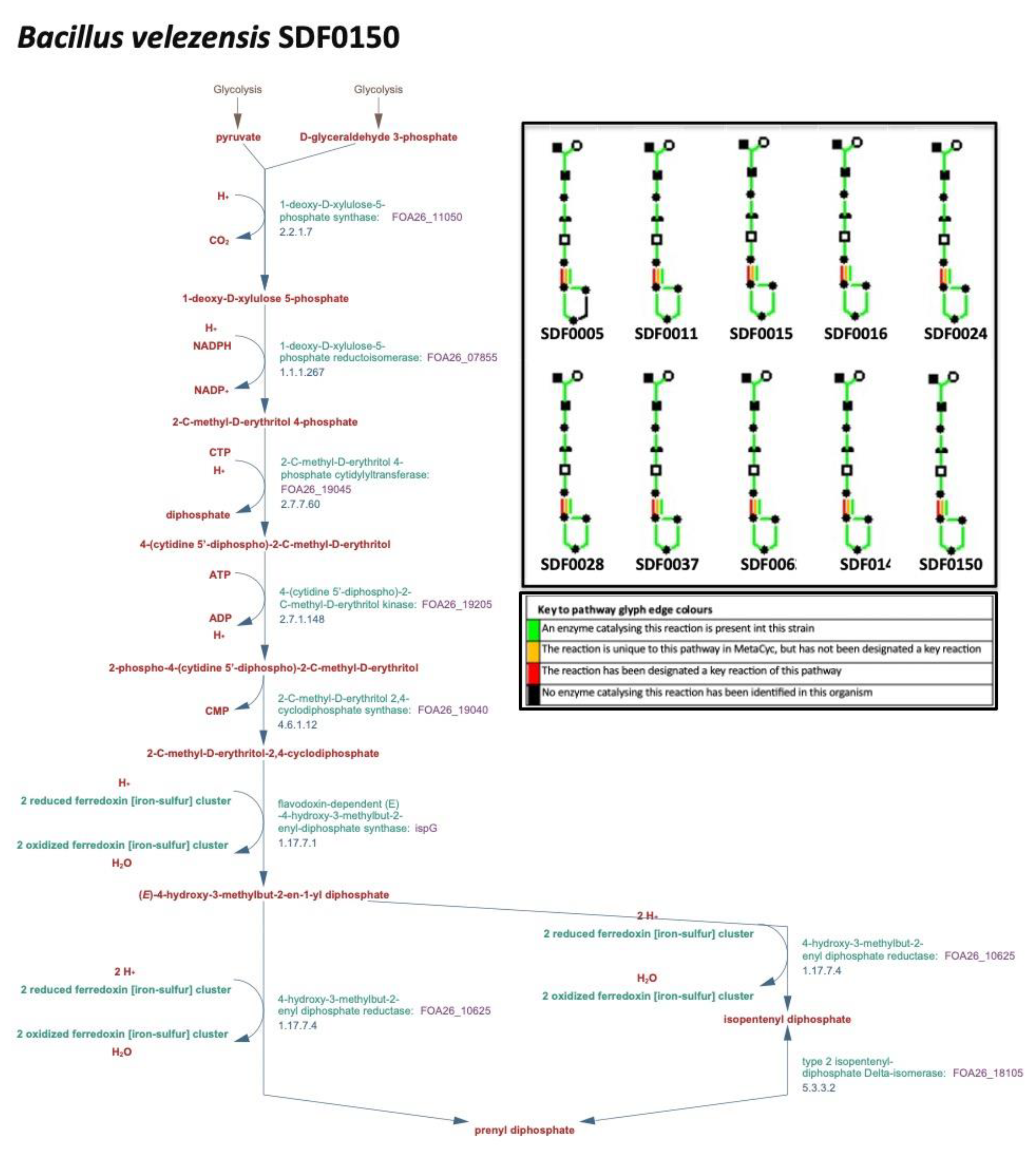
The algorithmic PathoLogic (http://bioinformatics.ai.sri.com/ptools/) predicted that all the corresponding gene sequences coding for the seven enzymes ( DXS, DXR, MCT, CMK, MDS, HDS, and HDR) that catalyse the MEP pathway reactions (Table 1) were found among the 10 SDF genomes (Table 2). The PGDB obtained is represented in a diagram aggregating a system-oriented view of the metabolic routes of the 10 SDF strains generated by the Omics Dashboard tool (Figure 2). In addition to MEP route enzymes, this tool also detected the enzyme IDI (Table 1) responsible for both IPP isomerization to DMAPP and subsequent IPP and DMAPP condensation that generates the first substrate in the terpenes’ production (Table 1). The information coding for the enzyme IDI was present in all SDF strains analysed, except for the L. fusiformis SDF0005 strain (Figure 2).

3.3. Detection of Polyprenyl Synthase Enzymes

Using BLASTp, the alignment and comparison of the amino acid sequences among the database we created (6,146 files; see material and methods section) and SDF sequences revealed the presence of the PPS family —the enzymes responsible for the conversion of IPP to GPP, FPP, and GGPP (Table 1). The strains L. fusiformis SDF0005; H. oleronia SDF0015; Pe. simplex SDF0024; B. velezensis SDF0141, and B. velezensis SDF0150 presented >98% amino acid similarity, while H. oleronia SDF0015 exhibited 67.86% (Table 3). The amino acid sequences for PPS were not detected in the remaining SDF strains.

3.4. Prediction of Biosynthetic Gene Clusters Associated with Terpenes Synthesis

At least three gene sequences inside the 16 BGCs uncovered by the antiSMASH [32] directed the synthesis of three TS: (i) an sqhC gene, coding for a squalene-hopene cyclase (SHC); (ii) a gene encoding undetermined activity related to the production of the phytoene and/or squalene synthase (PSS), and (iii) a crti gene, coding for a phytoene desaturase (PDS). Table 3 outlines the TS coding sequences for the strains used in this study.
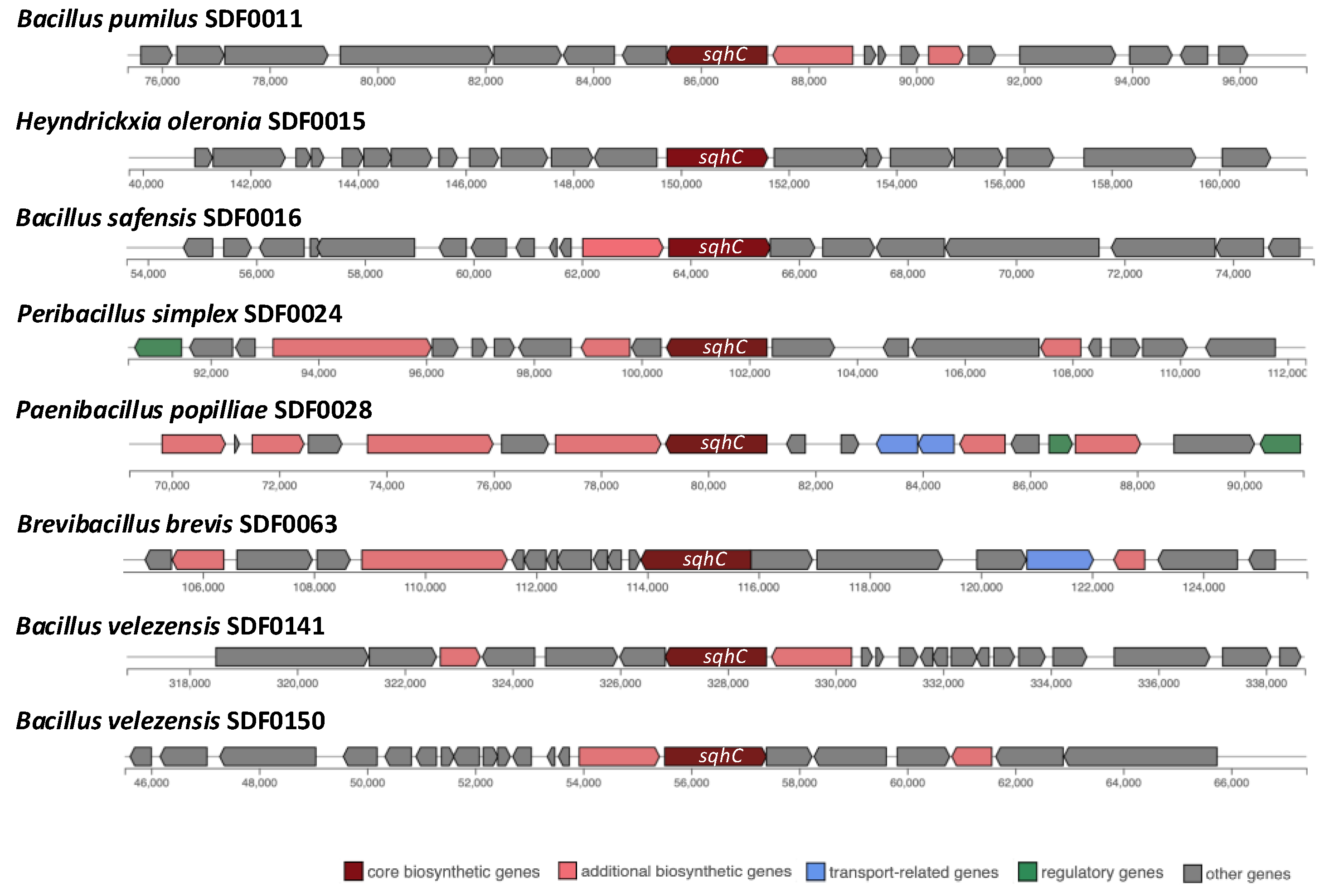
Out of these 10 SDF strains, the sequences coding for the SHC were detected in eight genomes: B. pumilus SDF0011; H. oleronia SDF0015; B. safensis SDF0016; Pe. simplex SDF0024; P. popilliae SDF0028; Br. brevis SDF0063; B. velezensis SDF0141, and B. velezensis SDF0150 (Table 4; Figure 3).
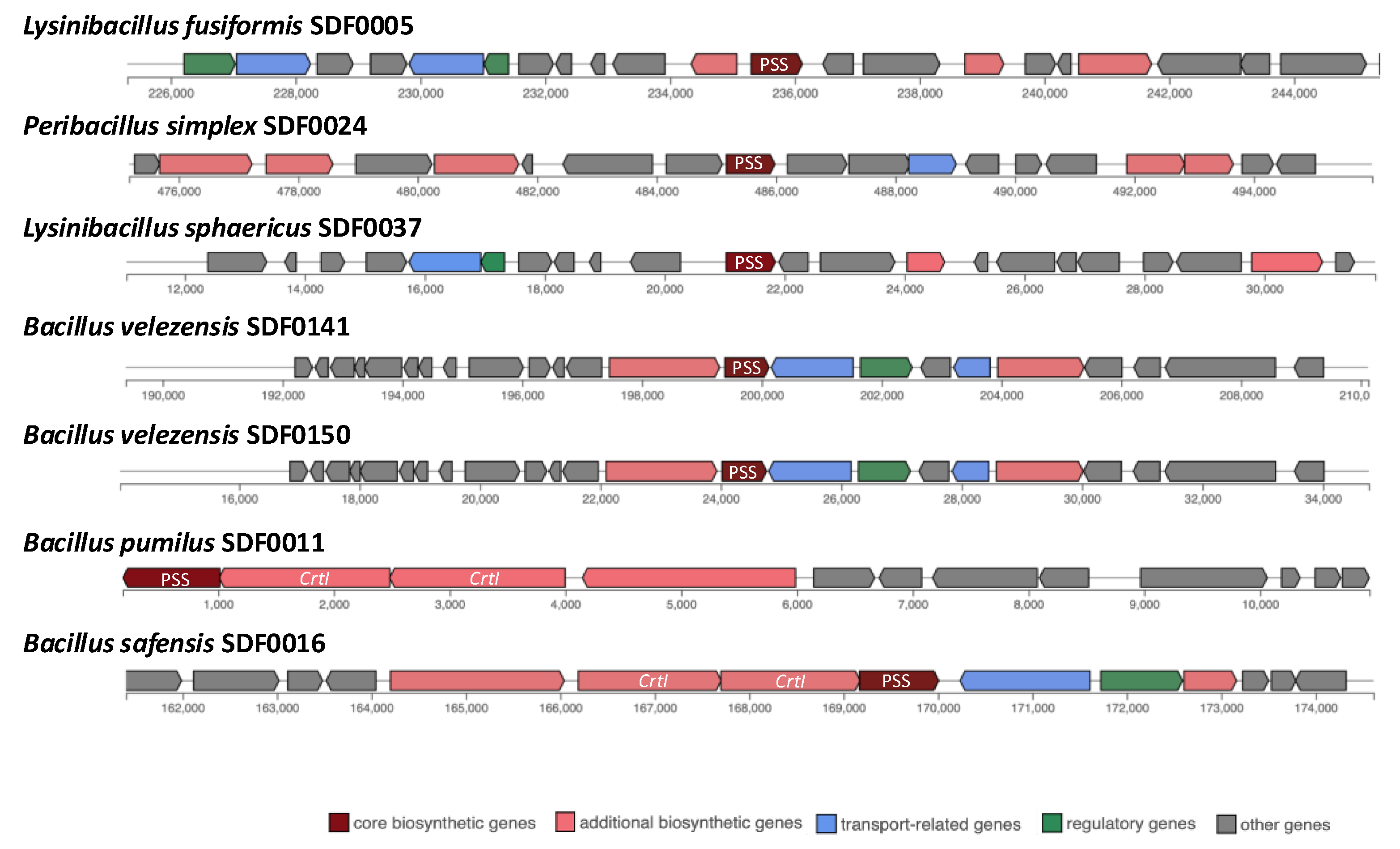
The sequences coding for the enzymes of the PSS synthase family were found in seven genomes: L. fusiformis SDF0005, B. pumilus SDF0011, B. safensis SDF0016, Pe. simplex SDF0024, L. sphaericus SDF0037, B. velezensis SDF0141, and B. velezensis SDF0150 (Table 4; Figure 4). In the genomes of B. pumilus SDF0011 and B. safensis SDF0016, these sequences were adjacent to two copies of the gene crtI coding for a PDS (Figure 4). The BGC containing these two gene copies in the genomes of these two strains are reported to take part in a carotenoid production [45]. Furthermore, these latter BGC presented 50% similarity compared to the corresponding sequence described for strain Halobacillus halophylus DSM2266 in the MIBiG platform (reference number BGC0000645) used by antiSMASH as a reference to predict this metabolite. The similarity percentages (0-100%) indicate the number of genes within the reference that have a hit to any genes in a particular BGC related to terpenes production and were recognised by the antiSMASH.

3.5. Distribution of the Enzyme Set for Terpene Production Among the 10 SDF Strains

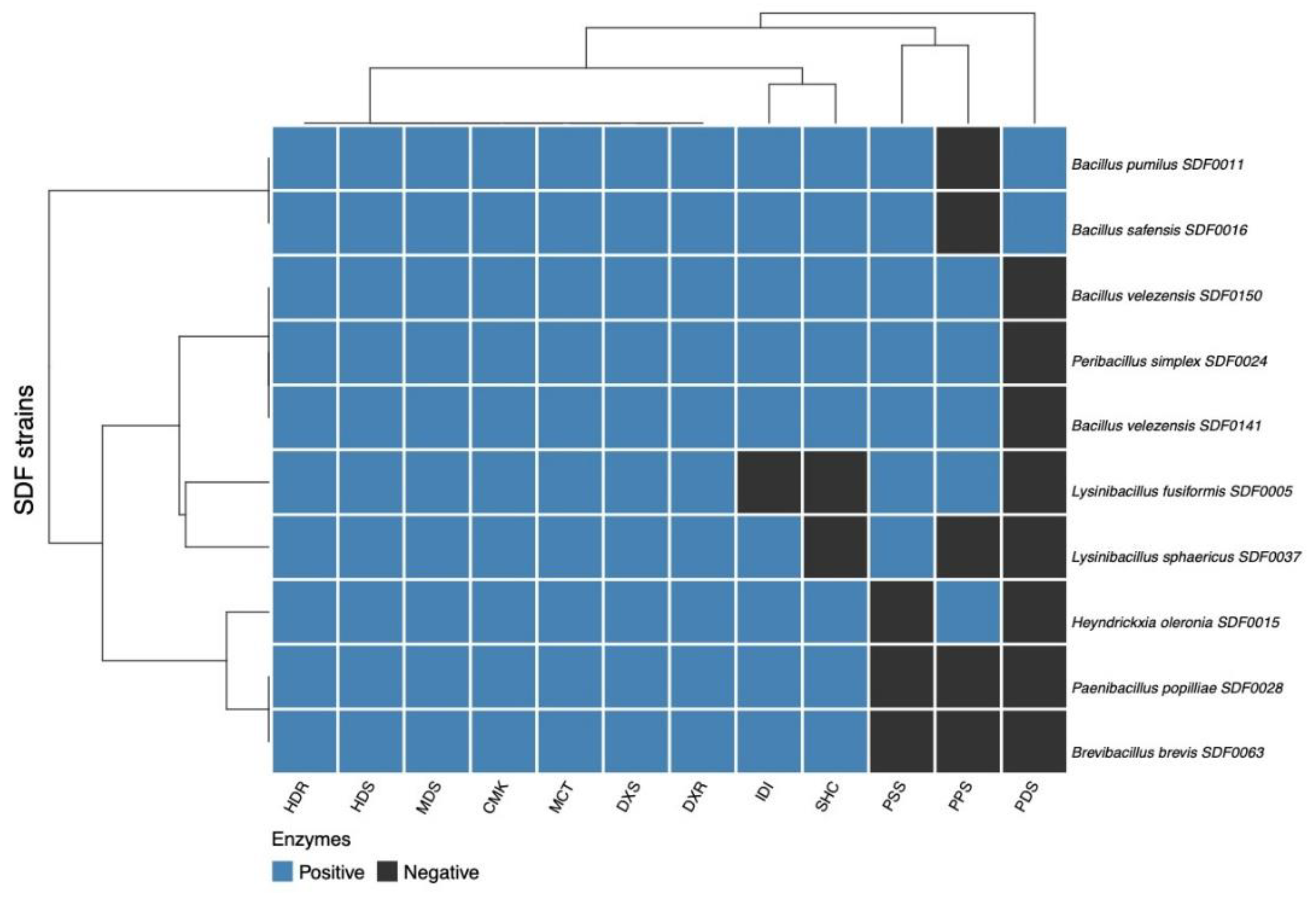
The distribution of the predicted enzymes obtained from in silico translation of the corresponding gene sequences coding for the seven MEP pathway enzymes (DXS, DXR, MCT, CMK, MDS, HDS, and HDR), along with the enzyme IDI were also analysed in the SDF strain genomes. PPS family, the three TS enzymes SHC, PSS, and PDS were also included. To this end, Pearson correlation [43] was employed to cluster the 10 SDF strains (Table 2; Figure 5) based on the ensemble of enzymes engaged in the terpene's synthesis detected. We constructed a heatmap [42] representing the presence or absence of an enzyme in a particular strain to enhance the potential visual distribution of the enzyme distributions among the strains. Two major clades were distinguished (Figure 5). The first comprised B. pumilus SDF0011 and B. safensis SDF0016, which shared an identical profile, or 11 out of the 12 enzymes detected. The second major clade was further split. Pe. simplex SDF0024; B. velezensis SDF0141, and B. velezensis SDF0150 also shared the same profile, bearing the equivalent set of 11 enzymes (Figure 5). The next subclade embraced Lysinibacillus sphaericus SDF0037 and L. fusiformis SDF0005 despite the dissimilar enzymatic profiles (Figure 5). Although the H. oleronia SDF0015 is the only representative of a subclade, the correlation showed that the enzymatic set for terpenes production in this strain was compatible with the subclade encompassed by P. popilliae SDF0028 and Br. brevis SDF0063, except that one out of nine enzymes was missing.

3.6. SDF Strains Evolutionary Relationship Based on Two TS Amino Acid Sequences

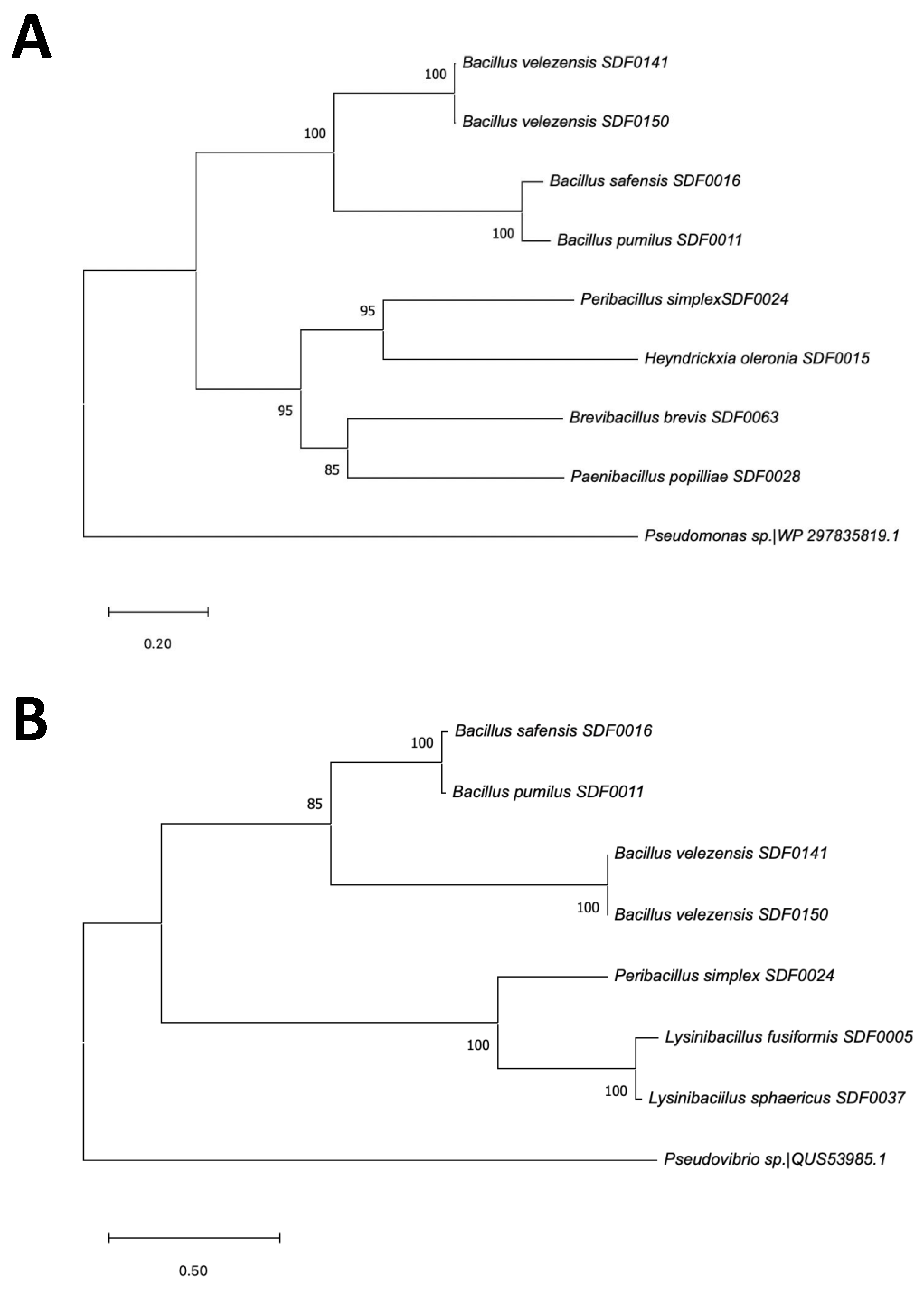
As described above, the BGC sequences involved in the terpenes’ production detected by the antiSMASH tool encompassed three TS enzyme gene sequences (Table 4). A phylogenetic tree was reconstructed based on multiple alignments of the eight SHC amino acid sequences obtained by the in-silico translation from the corresponding gene sequence of these SDF strains (Figure 6A). The respective amino acid sequence of Pseudomonas sp. was included as an outgroup. The inferred evolutionary relationship among these SDF strains was clustered in two main clades. In the first, the respective SHC sequences found in the strains B. velezensis SDF0141 and B. velezensis SDF0150 were equivalent. This enzyme sequence obtained for B. pumilus SDF0011 was very close to that obtained for B. safensis SDF0016. The SHC sequences from H. oleronia SDF0015 and Pe. simplex SDF0024 revealed the highest evolutionary relationship in the second main clade generated (Figure 6A). The molecular correlation between the SHC primary chains of these two strains was closer to the corresponding sequences obtained to the strains P. popilliae SDF0028 and Br. brevis SDF0063, also positioned in the second clade (Figure 6A).
Likewise, the phylogenetic tree generated from seven amino acid sequences corresponding to the PSS enzyme family genomes and Pseudovibrio brasiliensis as an outgroup also divided these seven SDF strains into two main clades (Figure 6B). The first was further separated into two subclades. The sequences of this enzyme obtained for the strains B. velezensis SDF0141 and B. velezensis SDF0150 pointed out a close evolutionary relationship. The sequences of the strain B. pumilus SDF0011 and B. safensis SDF0016 positioned in the other subclade also displayed a high-level molecular relationship (Figure 6B). The second clade showed that the strains L. fusiformis SDF0005 and L. sphaericus SDF0037 presented amino acid sequences with the highest molecular relationship. Strain Pe. simplex SDF0024 was positioned apart from the other two inside this clade (Figure 6B). Because the gene sequence of PDS was found in two out of 10 SDF strains, it was not considered for further phylogenetic analyses.

4. Discussion

The phylum Firmicutes was recently renamed Bacillota (17). Inside class Bacilli, the order Bacillales, which allocated AEFB species, displayed an immense diversity, spanning several families, genera, and species [18,22]. Lately, new taxa have been established to reposition strains otherwise considered members of the order Bacillales [46]; https://www.bacterio.net. This reorganization considers the family Bacillaceae the only member of this order, includes Bacillus as the type-genus of these taxa, and Bacillus subtilis remains the type-species of the genus Bacillus.
Historically, the genus Bacillus represented a large assemblage of genetically and evolutionarily unrelated microorganisms. Thus, the genus has long been recognized as house members exhibiting extensive polyphyly and apportion very little in common with each other [18,46,47,48]. To more adequately represent the overall genetic diversity within this genus, it was proposed that the vast majority of Bacillus spp. needed to be reclassified into other genera, families, and orders. The revision of the genus Bacillus led to reallocating, not limited to, two Bacillus spp. to novel genera that better accommodate them. The former Bacillus oleronius is now designated Heyndrickxia oleronia [49]. Likewise, Bacillus simplex was reallocated into a novel genus designated Peribacillus, species Peribacillus simplex [50].
Other misclassified Bacillus spp. were transferred to specific genera and reallocated to the family Caryophanaceae, which in turn were transferred to the order Caryophanales, including the genus Lysinibacillus [47]. In this standpoint, the genera Paenibacillus and Brevibacillus were moved from the genus Bacillus, family Bacillaceae, being the genus Paenibacillus to the family Paenibacillaceae, order Paenibacillales, and the genus Brevibacillus to the novel family Brevibacillaceae, order Brevibacillales [48].

4.1. Uncovering Enzymes from the MEP Pathway and the Polyprenyl Synthase Family in the SDF Strains

We previously identified 153 putative BGCs in the genomes of 10 SDF strains (Table 2). Among these, 20 different classes of specialised metabolites were identified [32]. In the current work, we focused on 16 BGCs, which were linked to terpene synthesis, to assess the genomic potential of these environmental AEFB for the biosynthesis of these molecules. Bacteria can produce terpenes through the MEP pathway by synthesising IPP, a precursor for these isoprenes [14]. Therefore, we evaluated the putative genetic information associated with the biosynthesis of essential terpene precursors within the MEP pathway. Through Pathways tools, our study has uncovered that all the 10 SDF strains (Table 2) examined contain a significant number of genetic determinants encoding the enzymes DXS, DXR, MCT, CMK, MDS, HDS, and HDR, which are associated with the MEP pathway (Table 1; Figure 2). These findings suggest that the genetic information coding for these pathway enzymes was conserved among these SDF strains, which can be carriers of the basic apparatus for terpene production. This compelling data underscores the necessity for further investigation to explore the potential implications of these fundamental genetic determinants in terpene biosynthesis within AEFB.
The PPS family, which includes the GPPS, FPPS, and GGPPS enzymes (Table 1) produces template molecules derived from IPP (14). These products are subsequently transformed into terpenes by TS enzymes. Specifically, the GPPS enzyme catalyses the conversion of IPP and DMAPP into GPP, the precursor for monoterpenes. DMAPP, an isomer of IPP, is synthesized by the enzyme IDI (Table 1). Using Pathways tools, we identified the IDI genetic information in all 10 SDF strains, except for the L. fusiformis SDF0005 genome (Figure 2). These findings suggested that the latter strain might experience some impairment in terpene biosynthesis, possibly affecting the subsequent steps catalysed by PPS family enzymes to synthesize isoprene.
This result revealed a high similarity (>98% identity) among the amino acid sequences in four SDF strains, supporting the occurrence of genetic information codifying for the PPS family enzyme in the respective genomes. H. oleronia SDF0015 exhibited 67.86% identity (Table 3). These findings suggested that this strain may lack the genetic information necessary for synthesizing the PPS family enzyme or possesses a structurally distinct catalyst compared to those found in AEFB, likely due to these unique characteristics associated with H. oleronia. Consequently, it is reasonable to infer that the remaining SDF strains lacking at least one enzyme from the PPS family may experience limitations in terpene production, as they do not possess the necessary enzymatic machinery to synthesize intermediates for isoprene precursors.

4.2. Genomic Potential of Selected SDF Strains for Terpene Production

GPP, FPP, or GGPP are used as precursor molecules in natural terpene syntheses by different TSs. The antiSMASH identified the sequence encoding the enzyme of the PSS in at least seven SDF strains (Figure 4; Table 4). Phytoene and squalene molecules are constructed from two molecules of FPP and two GGPP molecules, respectively [51,52]. The enzymes squalene synthase (SQS) and phytoene synthase (PHS) are closely related [52], and SQS is also reported to the synthesis of phytoene [51]. This connection between these enzymes may explain why antiSMASH did not discriminate the genetic sequences for phytoene and squalene productions. The SDF strains containing genes that encode enzymes from the PPS family and PSS putative presented the necessary genetic apparatus to produce either phytoene or squalene, as illustrated in the genomes of Pe. simplex SDF0024, B. velezensis SDF0141, and B. velezensis SDF0150.
Squalene is known for its antioxidant and antitumor properties, and this terpene also enhances the human immune system, as reported by Sanchez-Quesada et al. 2018 ([53]. This specialised metabolite is commonly used as an additive and supplement in the food and personal care industries [54]. The squalene synthesis has been documented for various organisms, including AEFB, which corroborates the findings in this study. Beyond its benefits, squalene serves as an intermediate compound in the biosynthetic pathway of sterols, such as hopanoids [55].
Hopanoids are synthesised from squalene by the enzyme SHC [55]. The sqhC gene sequence encodes the SHC enzyme and was identified by antiSMASH in eight SDF strains (Figure 3; Table 4). These data indicate that the SDF strains qualified to produce SHC and the PSS possess the required components for the final enzymatic reactions in hopanoid biosynthesis. This condition was observed in three SDF genomes, specifically Pe. simplex SDF0024, B. velezensis SDF0141, and B. velezensis SDF0150 (Table 4). Hopanoids play a crucial role by integrating into the biological membranes of the producing cells, regulating fluidity and permeability [55,56]. Consequently, these terpenes maintain the bacterial cytoplasmic membrane stable, which is particularly significant given the absence of cholesterol in the membranes of these prokaryotes. While a lack of hopanoids does not hinder bacterial growth, it does affect tolerance to stressful conditions, such as high temperatures and anaerobic or acidic environments [57].
Interestingly, the antiSMASH analysis revealed that the organisation of hopanoid biosynthesis genes in the SDF strains deviated from the typical BGC pattern. While the sqhC gene encoding SHC was identified in eight strains, and genes encoding PSS enzymes were found in seven, these genes were not consistently clustered with other hopanoid biosynthesis genes (Figure 3 and Figure 4). This variability suggests that the genetic architecture of hopanoid biosynthesis in SDF strains might be more complex and diverse than previously recognised. Further investigation into the arrangement and regulation of these genes may shed light on this variation in its evolutionary and functional significance. Despite this variability, key hopanoid biosynthesis gene identifications in the genomes of these strains underscore the potential of AEFB as a source of these important membrane components.
The software antiSMASH detected 50% similarity in the BGC sequence involved in the carotenoid’s synthesis in the genomes of B. pumilus SDF0011 and B. safensis SDF0016. The reference strain employed for comparison was Halobacillus halophilus DSM2266 (reference number BGC0000645), available through the MIBiG platform. Although the SDF strains did not share the same genetic framework as the reference strain, they possessed the essential genetic information required to express the final enzymatic activities involved in lycopene synthesis. Lycopene, which closely resembles beta-carotene and is widely produced by plants [58], imparts the reddish pigmentation characteristic of tomatoes and watermelons, among other vegetables [59]. This terpene is known for its antioxidant, anti-inflammatory, and antitumor attributes, making it valuable for various applications in the pharmaceutical and food industries.
It is noteworthy that lycopene synthesis in AEFB has been reported in the context of heterologous expression in B. amyloliquefaciens and B. subtilis, as documented by Zou et al., 2022 [60] and Luo, Bao, and Zhu, 2023 [61]. Additionally, studies have explored natural lycopene production in other AEFB species. For instance, Osawa et al., 2013 [62] investigated the synthesis of an oxidised lycopene in Cytobacillus firmus [50], former Bacillus firmus [63], while Hwang et al., 2022 [64] also detected genes for lycopene synthesis in Metabacillus flavus. The findings of our study are consistent with these previous reports and underscore the potential of AEFB as a source of lycopene. Further investigation is needed to fully elucidate these mechanisms and the evolutionary significance of lycopene production in these bacteria.
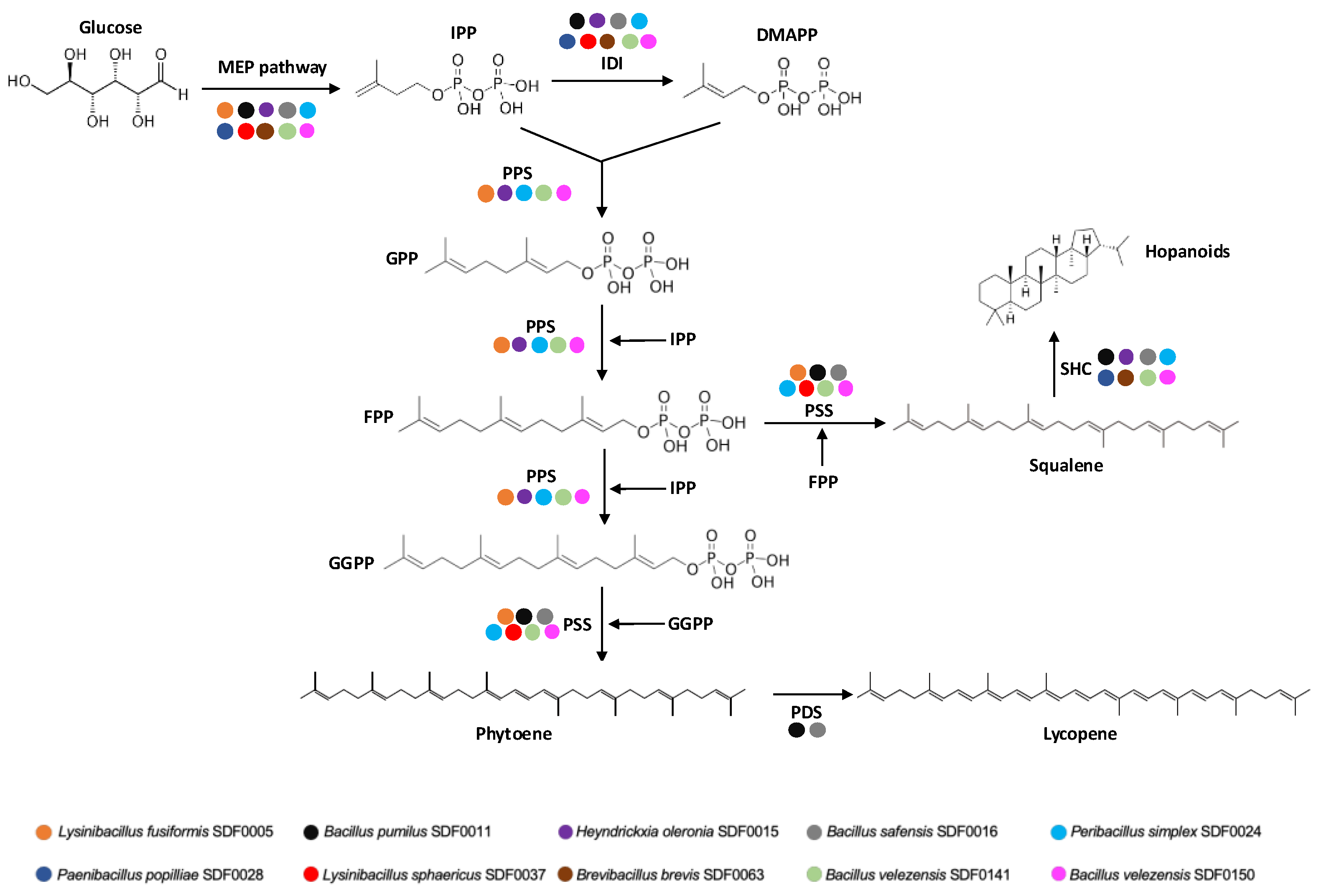
Figure 7 summarises the catalytic steps required for terpene production from the MEP pathway to the final reactions by different TSs and the SDF strain carriers for their respective enzymes. Nonetheless, it is essential to note that even though a specific strain of SDF may lack a particular enzyme required for terpene synthesis, this does not automatically imply that the cell is a non-terpene producer. Our study concentrated on the genomic potential of the SDF strain to generate terpenes. Therefore, any inaccuracies in the prior steps, such as purification, extraction, sequencing, and annotation of genome sequences may lead to erroneous results. Additionally, the biosynthetic pathways of terpenes entail multiple enzymatic reactions [65]. Even if the information for a specific enzyme is not detected, the SDF strains examined might still be able to synthesise the predicted terpene because of the promiscuous nature of the enzymes found within the pathway. Otherwise, a complete enzymatic route detection for a given terpene molecule does not assure the synthesis of the corresponding product by this SDF strain due to the complex mechanisms of gene expression. Further research could reveal the synthesis in vitro of the respective molecules detected in this study.

4.3. The Evolutionary Nature of Terpene Production in the SDF Stains

To explore the evolutionary nature of the enzymes involved in terpene production in the evaluated SDF strains, we aligned the amino acid sequences of the SHC (Figure 3) and PSS enzymes (Figure 4) obtained through in silico translation from the gene sequences inside the BGC identified by antiSMASH in this study. This alignment was used to generate phylogenetic trees, as shown in Figure 6A,B. However, we did not reconstruct the phylogenetic tree for the PDS enzyme, as it was detected only in two SDF strains analysed (Table 4).
The primary sequences of SHC (Figure 6A) and PSS (Figure 6B) enzymes of B. velezensis SDF0140 and B. velezensis SDF0150 exhibited a robust molecular relationship, as both strains belong to the same species. In contrast, the strains B. pumilus SDF0011 and B. safensis SDF0016 showed a significant evolutionary relationship based on their TS amino acid sequences. These two latter species are of biotechnological and pharmaceutical significance and are closely related according to classical phenotypic characteristics and 16S rRNA gene sequences. Consequently, they are challenging to distinguish by these conventional methodologies [28,30,31,66]. In fact, both species comprise a clonally diverse population inside the B. subtilis complex [66]. Furthermore, the phylogenetic trees generated using both SHC (Figure 6A) and PSS (Figure 6B) enzymes revealed similar topologies among the B. pumilus SDF0011, B. safensis SDF0016, B. velezensis SDF0141, and B. velezensis SDF0150. This result indicates that these four Bacillus spp. demonstrate a high level of molecular correlation in their respective TS analyses. Their classification within the same genus likely contributes to this significant conservation of catalytic properties.
In the heatmap (Figure 5), the enzymatic profiles for terpene production in the SDF strains highlighted a strong molecular relationship between B. pumilus SDF0011 and B. safensis SDF0016, as they share the same enzymatic set. Figure 5 also reveals that B. velezensis SDF0141 and B. velezensis SDF0150 possess identical catalyst set for terpene production. These results reinforce the molecular relationship among these SDF strains, although the disposition of SDF strains belonged to Bacillus spp. did not display the same distribution observed in the phylogenetic tree of TS amino acid sequences (Figure 6).
The strains H. oleronia SDF0015 and Pe. simplex SDF0024 exhibited a high degree of molecular similarity in their respective amino acid sequences of the SHC enzyme (Figure 6A). The amino acid sequences of SHC from H. oleronia SDF0015 and Pe. simplex SDF0024 displayed a superior evolutionary distance compared to SHC sequences obtained from the SDF strains within the genus Bacillus, therefore positioned in different clades (Figure 6A). Bacillus, Heyndrickxia, and Peribacillus are all classified within the family Bacillaceae and species in these genera present significant levels of polyphyly [47]. This observation further corroborated phylogenetic relationships derived from the SHC amino acid sequences (Figure 6A).
P. popilliae SDF0028 and Br. brevis SDF0063 presented the highest molecular relationship in their SHC amino acid sequences if compared to the SHC sequences of the remaining six SDF strains analysed (Figure 6A). Genera Bacillus, Peribacillus, and Heyndrickxia, which are part of the family Bacillaceae, belong to the order Bacillales, while the genera Paenibacillus and Brevibacillus are classified under orders Paenibacillales and Brevibacillales, respectively [48,49]. Therefore, the minimal molecular relationship between the SHC amino acid sequences of the P. popilliae SDF0028 and Br. brevis SDF0063 and the other SDF strains aligns with the anticipated evolutionary distance for these species. Additionally, the same enzymatic set for terpene production was observed between these two SDF strains (Figure 5), supporting even more the phylogenetic relationship obtained by the sequence of SHC of P. popilliae SDF0028 and Br. brevis SDF0063 (Figure 6A). Notably, the amino acid sequences of SHC from H. oleronia SDF0015 and Pe. simplex SDF0024 were recognised to be evolutionarily closer to those of P. popilliae SDF0028 and Br. brevis SDF0063 than the SHC sequences from SDF strains within the genus Bacillus (Figure 6A).
L. fusiformis SDF0005 and L. sphaericus SDF0037 shared highly conserved PSS amino acid sequences (Figure 6B). This commonality might be attributed to the two SDF strains from the genus Lysinibacillus. The phylogenetic tree generated using the sequences revealed a clear distinction between the SDF strains of the genus Bacillus, which grouped in one clade, and the SDF strains of the genus Lysinibacillus, which formed a separate clade (Figure 6B). These results discriminated the members of the families Bacillaceae and Caryophanaceae based on the amino acid sequence of this catalyst. Furthermore, a relevant molecular relationship for terpene production enzymatic set was already observed between the Lysinibacillus spp. as shown in the heatmap (Figure 5). Markedly, the sequences of L. fusiformis SDF0005 and L. sphaericus SDF0037 demonstrated a closer evolutionary relationship with the sequence of the Pe. simplex SDF0024, which is allocated within the family Bacillaceae.
The phylogenetic trees derived from the molecular analyses of the TSs detected in the SDF strains examined in this study agreed with the phylogenetic relationships for complete genomes of the SDF strains evaluated (Figure 1). The results indicated that the TS enzymes responsible for terpene production in these environmental strains investigated are evolutionarily conserved. In addition, the production of terpenes—strikingly squalene and hopanoids—appears to be an ancestral characteristic of the AEFB evaluated in this study.
As mentioned above, the phylogenetic trees derived from the amino acid sequences of TS enzymes (Figure 6A,B) indicated a closer molecular relationship between B. velezensis SDF0141 and B. velezensis SDF0150 to B. pumilus SDF0011 and B. safensis SDF0016. In contrast, the heatmap (Figure 5) groups these two B. velezensis strains with Pe. simplex SDF0024, along with L. fusiformis SDF0005 and L. sphaericus SDF0037. Additionally, the strains P. popilliae SDF0028 and Br. brevis SDF0063 demonstrated similar enzyme content for terpene production and clustered with the strain H. oleronia SDF0015 (Figure 5).
The cluster of catalysts implicated in terpene production shown in Figure 5 shares similarities with the phylogenetic trees generated from the TS amino acid sequences (Figure 6A,B). Nevertheless, the cluster does not fully align with the expected evolutionary relationships among these species. This analysis suggested that the ability to produce terpene molecules may vary among the SDF strains and might not be influenced by phylogenetic factors. Furthermore, the enzyme set involved in terpene production cannot be used as a molecular marker to establish evolutionary relationships among the SDF strains analysed and, by extension, for AEFB.

5. Conclusions

The AEFB are ubiquitous and characterised by producing several specialised metabolites, including terpenes, a significant class. While the synthesis of terpenes has been demonstrated in prokaryotes, research addressing specifically the production of these compounds in AEFB is still scarce. In this study, in silico analysis revealed that strains belonging to these taxa possess the genetic information required to synthesise at least three terpenes: squalene, hopanoids, and lycopene. The metabolic pathway information for synthesising terpene precursors was identified in the genomes of the 10 SDF strains evaluated, and the amino acid sequences of terpene synthases detected revealed a functional equivalence among these catalysts. Although the identified terpene classes represent a small fraction of these isoprene molecules, our findings can support future investigations to broaden the understanding of the physiological and ecological terpene roles in AEFB. Furthermore, our results can help enhance the industrial application of these molecules.

Author Contributions

Conceptualization, Felipe Mesquita, Waldeyr Silva and Marlene DE-SOUZA; Data curation, Felipe Mesquita, Waldeyr Silva, Marcelo Brigido, Bruna Fuga and Marlene DE-SOUZA; Formal analysis, Felipe Mesquita, Waldeyr Silva, Taina Raiol, Nalvo Almeida, Bruna Fuga, Danilo Cavalcante and Marlene DE-SOUZA; Funding acquisition, Marcelo Brigido and Nalvo Almeida; Investigation, Felipe Mesquita, Waldeyr Silva and Marlene DE-SOUZA; Methodology, Felipe Mesquita, Waldeyr Silva, Taina Raiol, Marcelo Brigido, Nalvo Almeida, Bruna Fuga, Danilo Cavalcante and Marlene DE-SOUZA; Project administration, Marlene DE-SOUZA; Resources, Felipe Mesquita, Waldeyr Silva, Danilo Cavalcante and Marlene DE-SOUZA; Software, Felipe Mesquita, Waldeyr Silva, Taina Raiol, Marcelo Brigido, Nalvo Almeida and Bruna Fuga; Supervision, Marlene DE-SOUZA; Validation, Felipe Mesquita, Waldeyr Silva, Nalvo Almeida and Marlene DE-SOUZA; Writing – original draft, Marlene DE-SOUZA; Writing – review & editing, Felipe Mesquita, Waldeyr Silva and Marlene DE-SOUZA.

Funding

This work was funded by the Brazilian agencies: NA acknowledges funding from National Council for Scientific and Technological Development (CNPq) grant 304423/2022-04; MB acknowledges funding from Fundação de Amparo a Pesquisa do Distrito Federal (FAP-DF) (FAP-DF) grant 0193-000.560/2009. FM and DC acknowledge CNPq felowships.

Conflicts of Interest

The authors declare no conflict of interest.

References

  1. Singh, B.P.; Rateb, M.E.; Rodriguez-Couto, S.; Polizeli, M.D.L.T.D.M.; Li, W.-J. Microbial Secondary Metabolites: Recent Developments and Technological Challenges. Frontiers in Microbiology 2019, 10, 914. [Google Scholar] [CrossRef] [PubMed]
  2. Bills, G.F.; Gloer, J.B. Biologically Active Secondary Metabolites from the Fungi. Microbiology Spectrum 2016, 4, 10.1128. [Google Scholar] [CrossRef]
  3. Perveen, S.; Al-Taweel, A. Terpenes and Terpenoids; IntechOpen: London, United Kingdom, 2018; pp. 01–152. ISBN 978-1-83881-529-5.
  4. Rudolf, J.D.; Aslup, T.; Xu, B.; Li, Z. Bacterial Terpenome. Natural Product Reports 2021, 38, 905–980. [Google Scholar] [CrossRef] [PubMed]
  5. Quin, M.B.; Flynn, C.M.; Schimidt-Dannert, C. Traversing the Fungal Terpenome. Natural Product Reports 2014, 31, 1449–1473. [Google Scholar] [CrossRef]
  6. Hegazy, M.E.F.; Mohamed, T.A.; Alhammady, M.A.; Shaheen, A.M.; Reda, E.H.; Elshamy, A.I.; Aziz, M.; Paré, P.W. Molecular Architecture and Biomedical Leads of Terpenes from Red Sea Marine Invertebrates. Marine Drugs 2015, 13, 3154–3181. [Google Scholar] [CrossRef] [PubMed]
  7. Yamada, Y.; Kuzuyama, T.; Komatsu, M.; Ikeda, H. Terpene Synthases are Widely Distributed in Bacteria. PNAS 2015, 112, 857–862. [Google Scholar] [CrossRef] [PubMed]
  8. Morandini, L.; Caulier, S.; Bragard, C.; Mahillon, J. Bacillus cereus sensu lato Antimicrobial Arsenal: An Overview. Microbiological Research 2024, 283, 127697. [Google Scholar] [CrossRef]
  9. Pinto-Zevallos, D.M.; Hellén, H.; Hakola, H.; Nouhuys, S.V.; Halopainen, J.K. Induced defenses of Veronica spicata: Variability in herbivore-induced volatile organic compounds. Phytochemistry Letters 2013, 6, 653–656. [Google Scholar] [CrossRef]
  10. Zheng, D.; Ding, N.; Jiang, Y.; Zhang, J.; Ma, J.; Chen, X.; Liu, J.; Han, L.; Huang, X. Albaflavenoid, a New Tricyclic Sesquiterpenoid from Streptomyces violascens. The Journal of Antibiotics 2016, 69, 773–775. [Google Scholar]
  11. Netzker, T.; Shepherdson, E.M.F.; Zambri, M.P.; Elliot, M.A. Bacterial Volatile Compounds: Functions in Communication, Cooperation, and Competition. Annual review of microbiology 2020, 74, 409–430. [Google Scholar] [CrossRef]
  12. Tyc, O.; Song, C.; Dickschat, J.S.; Vos, M.; Garbeva, P. The Ecological Role of Volatile and Soluble Secondary Setabolites Produced by Soil Bacteria. Trends in microbiology 2017, 25, 280–292. [Google Scholar] [CrossRef] [PubMed]
  13. Twaij, B.M.; Hasan, M.N. Bioactive Secondary Metabolites from Plant Sources: Types, Synthesis, and Their Therapeutic Uses. International Journal of Plant Biology 2022, 13, 4–14. [Google Scholar] [CrossRef]
  14. Liang, Z.; Zhi, H.; Fang, Z.; Zhang, P. Genetic engineering of yeast, filamentous fungi and bacteria for terpene production and applications in food industry. Food research international 2021, 147, 110487. [Google Scholar] [CrossRef]
  15. Driks, A.; Eichenberger, P. The Bacterial Spore: From Molecules to Systems; ASM Press: Washington, DC, United States of America, 2016; pp. 01–397. ISBN 9781555816759.
  16. Christie, G.; Setlow, P. Bacillus spore germination: Knowns, unknowns and what we need to learn. Cellular signaling 2020, 74, 109729. [Google Scholar] [CrossRef]
  17. Oren, A.; Garrity, G.M. Valid publication of the names of forty-two phyla of prokaryotes. International journal of systematic and evolutionary microbiology 2021, 71, 005056. [Google Scholar] [CrossRef]
  18. Galperin, M.Y.; Yutin, N.; Wolf, Y.I.; Alvarez, R.V.; Koonin, E.V. Conservation and Evolution of the Sporulation Gene Set in Diverse Members of the Firmicutes. Journal of Bacteriology 2022, 204, e00079-22. [Google Scholar] [CrossRef] [PubMed]
  19. Fritze, D. Taxonomy of the Genus Bacillus and Related Genera: The Aerobic Endospore-Forming Bacteria. Phytopathology 2004, 94, 1245–1248. [Google Scholar] [CrossRef]
  20. Mandic-Mulec, I.; Prosser, J.I. Diversity of Endospore-forming Bacteria in Soil: Characterization and Driving Mechanisms. In Endospore-forming Soil Bacteria, 1st ed.; Logan, N.A., Vos, P., Eds.; Springer-Verlag: Berlin, Germany, 2011; Volume 27, pp. 31–59. ISBN 978-3-642-19577-8. [Google Scholar]
  21. Logan, N.A. Bacillus and relatives in foodborne illness. Journal of Applied Microbiology 2012, 112, 417–429. [Google Scholar] [CrossRef] [PubMed]
  22. Harirchi, S.; Sar, T.; Ramezani, M.; Aliyu, H.; Etemadifar, Z.; Nojoumi, S.A.; Yazdian, F.; Awasthi, M.K.; Taherzadeh, M.J. Bacillales: From Taxonomy to Biotechnological and Industrial Perspectives. Microorganisms 2022, 10, 2355. [Google Scholar] [CrossRef]
  23. Sumi, C.D.; Yang, B.W.; Yeo, I.-C.; Hahm, Y.T. Antimicrobial peptides of the genus Bacillus: a new era for antibiotics. Canadian journal of microbiology 2015, 61, 93–103. [Google Scholar] [CrossRef]
  24. Heilbronner, S.; Krismer, B.; Brötz-Oesterhelt, H.; Peschel, A. The microbiome-shaping roles of bacteriocins. Natures Reviews Microbiology 2021, 19, 726–739. [Google Scholar] [CrossRef]
  25. Salazar, B.; Ortiz, A.; Keswani, C.; Minkina, T.; Mandzhieva, S.; Singh, S.P.; Rekadwad, B.; Borriss, R.; Jain, A.; Singh, H.B.; et al. Bacillus spp. as Bio-factories for Antifungal Secondary Metabolites: Innovation Beyond Whole Organism Formulations. Microbial ecology 2023, 86, 1–24. [Google Scholar] [CrossRef] [PubMed]
  26. Mondol, M.A.M.; Shin, H.J.; Islam, M.T. Diversity of Secondary Metabolites from Marine Bacillus Species: Chemistry and Biological Activity. Marine Drugs 2013, 11, 2846–2872. [Google Scholar] [CrossRef] [PubMed]
  27. Falqueto, S.A.; Pitaluga, B.F.; Sousa, J.R.; Targanski, S.K.; Campos, M.G.; Mendes, T.A.O.; Silva, G.F.; Silva, D.H.S.; Soares, M.A. Bacillus spp. metabolites are effective in eradicating Aedes aegypti (Diptera: Culicidae) larvae with low toxicity to non-target species. Journal of invertebrate pathology 2021, 179, 107525. [Google Scholar] [CrossRef]
  28. Orem, J.C.; Silva, W.M.C.; Raiol, T.; Magalhães, M.I.; Martins, P.H.; Cavalcante, D.A.; Kruger, R.H.; Brigido, M.M.; De-Souza, M.T. Phylogenetic diversity of aerobic spore-forming Bacillales isolated from Brazilian soils. International Microbiology 2019, 22, 511–520. [Google Scholar] [CrossRef]
  29. Cavalcante, D.A.; De-Souza, M.T.; Orem, J.C.; Magalhães, M.I.A.; Martins, P.H.; Boone, T.J.; Castillo, J.A.; Driks, A. Ultrastructural analysis of spores from diverse Bacillales species isolated from Brazilian soil. Environmental Microbiology Reports 2019, 11, 155–164. [Google Scholar] [CrossRef]
  30. Martins, P.H.R.; Silva, L.P.; Orem, J.C.; Magalhães, M.I.A.; Cavalcante, D.A.; De-Souza, M.T. Protein profiling as a tool for identifying environmental aerobic endospore-forming bacteria. Open Journal of Bacteriology 2020, 4, 001–007. [Google Scholar]
  31. Martins, P.H.R.; Rabinovitch, L.; Orem, J.C.; Silva, W.M.C.; Mesquita, F.A.; Magalhães, M.I.A.; Cavalcante, D.A.; Vivoni, A.M.; Oliveira, E.J.; Lima, V.C.P.; et al. Biochemical, physiological, and molecular characterisation of a large collection of aerobic endospore-forming bacteria isolated from Brazilian soils. Neotropical Biology and Conservation 2023, 18, 53–72. [Google Scholar] [CrossRef]
  32. Mesquita, F.A.; Silva, W.M.C.; De-Souza, M.T. In silico Analysis of the Genomic Potential for the Production of Specialized Metabolites of Ten Strains of the Bacillales Order Isolated from the Soil of the Federal District, Brazil. In Advances in Bioinformatics and Computational Biology, 1st ed.; Scherer, N.M., Melo-Minardi, R.C., Eds.; Springer-Verlag: Brazil, 2022, Volume 13523; pp. 158–163. ISBN 978-3-031-21175-1. [Google Scholar]
  33. Coil, D.; Jospin, G.; Darling, A.M. A5-miseq: an updated pipeline to assemble microbial genomes from Illumina Miseq data. Bioinformatics 2015, 31, 587–589. [Google Scholar] [CrossRef]
  34. Tatusova, T.; DiCuccio, M.; Badretdin, A.; Chetvernin, V.; Nawrocki, E.P.; Zaslavsky, L.; Lomsadze, A.; Pruitt, K.D.; Borodovsky, M.; Ostell, J. NCBI prokaryotic genome annotation pipeline. Nucleic Acid Research 2016, 44, 6614–6624. [Google Scholar] [CrossRef]
  35. Setubal, J.C.; Almeida, N.F.; Wattam, A.R. Comparative Genomics for Prokaryotes. Methods in Molecular Biology 2018, 1704, 55–78. [Google Scholar] [CrossRef] [PubMed]
  36. Camacho, C.; Coulouris, G.; Avagyan, V.; Ma, N.; Papadopoulos, J.; Bealer, K.; Madden, T.L. BLAST+: architecture and applications. BMC Bioinformatics 2009, 10, 421. [Google Scholar] [CrossRef]
  37. Li, L.; Stoeckert Jr, J.; Roos, D.S. OrthoMCL: identification of ortholog groups for eukaryotic genomes. Genome Research 2003, 13, 2178–2189. [Google Scholar] [CrossRef] [PubMed]
  38. Castresana, J. Selection of conserved blocks from multiple alignments for their use in phylogenetic analysis. Molecular Biology and Evolution 2000, 17, 540–552. [Google Scholar] [CrossRef]
  39. Stamatakis, A. RAxML version 8: a tool for phylogenetic analysis and post-analysis of large phylogenies. Bioinformatics 2014, 30, 1312–1313. [Google Scholar] [CrossRef]
  40. Blin, K.; Shaw, S.; Kloosterman, A.M.; Charlop-Powers, Z.; vanWezel, G.P.; Medema, M.H.; Weber, T. antiSMASH 6.0: improving cluster detection and comparison capabilities. Nucleic Acids Research 2021, 49, W29–W35. [Google Scholar] [CrossRef]
  41. Bogdanove, A.J.; Koebnik, R.; Lu, H.; Furutani, A.; Angiuoli, S.V.; Patil, P.B.; Sluys, M.A.V.; Ryan, R.P.; Meyer, D.F.; Han, S.-W.; et al. Two New Complete Genome Sequences Offer Insight into Host and Tissue Specificity of Plant Pathogenic Xanthomonas spp. Journal of Bacteriology 2011, 193, 5450–5464. [Google Scholar] [CrossRef]
  42. Gu, Z.; Eils, R.; Schlesner, M. Complex heatmaps reveal patterns and correlations in multidimensional genomic data. Bioinformatics 2016, 32, 2847–2849. [Google Scholar] [CrossRef] [PubMed]
  43. Hummel, M.; Edelmann, D.; Kopp-Schneider, A. Clustering of samples and variables with mixed-type data. PLoS ONE 2017, 12, e0188274. [Google Scholar] [CrossRef]
  44. Medema, M.H.; Kottmann, R.; Yilmaz, P. Minimum Information about a Biosynthetic Gene cluster. Nature Chemical Biology 2015, 11, 625–631. [Google Scholar] [CrossRef] [PubMed]
  45. Köcher, S.; Breitenbach, J.; Müller, V.; Sandmann, G. Structure, function and biosynthesis of carotenoids in the moderately halophilic bacterium Halobacillus halophilus. Archives of Microbiology 2009, 191, 95–104. [Google Scholar] [CrossRef] [PubMed]
  46. Xu, X.; Kóvacs, A.T. How to identify and quantify the members of the Bacillus genus? Environmental Microbiology 2024, 26, e16593. [Google Scholar] [CrossRef] [PubMed]
  47. Gupta, R.S.; Patel, S. Robust Demarcation of the Family Caryophanaceae (Planococcaceae) and Its Different Genera Including Three Novel Genera Based on Phylogenomics and Highly Specific Molecular Signatures. Frontiers in Microbiology 2020, 10, 2821. [Google Scholar] [CrossRef]
  48. Chuvochina, M.; Mussig, A.J.; Chaumeil, P.-A.; Skarkshewski, A.; Rinke, C.; Parks, D.H.; Hugenholtz, P. Proposal of names for 329 higher taxa defined in the Genome Taxonomy Database under two prokaryotic codes. FEMS Microbiology Letters 2023, 370, 1–33. [Google Scholar] [CrossRef] [PubMed]
  49. Gupta, R.S.; Patel, S.; Saini, N.; Chen, S. Robust demarcation of 17 distinct Bacillus species clades, proposed as novel Bacillaceae genera, by phylogenomics and comparative genomic analyses: description of Robertmurraya kyonggiensis sp. nov. and proposal for an emended genus Bacillus limiting it only to the members of the Subtilis and Cereus clades of species. International Journal of Systematic and Evolutionary Microbiology 2020, 70, 5753–5798. [Google Scholar] [CrossRef]
  50. Patel, S.; Gupta, R.S. A phylogenomic and comparative genomic framework for resolving the polyphyly of the genus Bacillus: Proposal for six new genera of Bacillus species, Peribacillus gen. nov., Cytobacillus gen. nov., Mesobacillus gen. nov., Neobacillus gen. nov., Metabacillus gen. nov. and Alkalihalobacillus gen. nov. International Journal of Systematic and Evolutionary Microbiology 2020, 70, 406–438. [Google Scholar] [CrossRef]
  51. Nakashima, T.; Inoue, T.; Oka, A.; Nishino, T.; Osumi, T.; Hata, S. Cloning, expression, and characterization of cDNAs encoding Arabidopsis thaliana squalene synthase. PNAS 1995, 98, 2328–2332. [Google Scholar] [CrossRef]
  52. Tansey, T.R.; Shechter, I. Squalene synthase: Structure and regulation. Progress in Nucleic Acid Research and Molecular Biology 2000, 65, 157–195. [Google Scholar] [CrossRef]
  53. Sánchez-Quesada, C.; López-Biedma, A.; Toledo, E.; Gaforio, J.J. Squalene Stimulates a Key Innate Cell to Foster Wound Healing and Tissue Repair. Evidence-Based Complementary and Alternative Medicine 2018, 2018, 9473094. [Google Scholar] [CrossRef]
  54. Song, Y.; Guan, Z.; Merkerk, R.V.; Pramastya, H.; Abdallah, I.I.; Setroikromo, R.; Quax, W.J. Production of Squalene in Bacillus subtilis by Squalene Synthase Screening and Metabolic Engineering. Journal of Agricultural and Food Chemistry 2020, 68, 4447–4455. [Google Scholar]
  55. Siedenburg, G.; Jendrossek, D. Squalene-Hopene Cyclases. Applied and Environmental Microbiology 2011, 77, 3905–3915. [Google Scholar] [CrossRef] [PubMed]
  56. Iqbal, S.; Begum, F.; Rabaan, A.A.; Aljeldah, M.; Al Shammari, B.R.; Alawfi, A.; Alshengeti, A.; Sulaiman, T.; Khan, A. Classification and Multifaceted Potential of Secondary Metabolites Produced by Bacillus subtilis Group: A Comprehensive Review. Molecules 2023, 28, 927. [Google Scholar] [CrossRef] [PubMed]
  57. Belin, B.J.; Busset, N.; Giraud, E.; Molinaro, A.; Silipo, A.; Newman, D.K. Hopanoid lipids: from membranes to plant-bacteria interactions. Nature Reviews Microbiology 2018, 16, 304–315. [Google Scholar] [CrossRef] [PubMed]
  58. Sabio, E.; Lozano, M.; Espinosa, V.M.; Mendes, R.L.; Pereira, A.P.; Palavra, A.F.; Coelho, J.A. Lycopene and β-Carotene Extraction from Tomato Processing Waste Using Supercritical CO2. Industrial and Engineering Chemistry Research 2003, 42, 6641–6646. [Google Scholar] [CrossRef]
  59. Li, L.; Liu, Z.; Jiang, H.; Mao, X. Biotechnological production pf lycopene by microorganisms. Applied Microbiology and Biotechnology 2020, 104, 10307–10324. [Google Scholar] [CrossRef] [PubMed]
  60. Zou, D.; Ye, C.; Min, Y.; Li, L. Production of a novel lycopene-rich soybean food by fermentation with Bacillus amyloliquefaciens. Food Science and Technology 2022, 153, 112551. [Google Scholar] [CrossRef]
  61. Luo, H.; Bao, Y.; Zhu, P. Development of a novel functional yogurt rich in lycopene by Bacillus subtilis. Food Chemistry 2023, 407, 135142. [Google Scholar] [CrossRef]
  62. Osawa, A.; Iki, K.; Sandmann, G.; Shindo, K. Isolation and identification of 4,4’-diapolycopene-4,4’-dioc acid produced by Bacillus firmus GB1 and its singlet oxygen quenching activity. Journal of Oleo Science 2013, 62, 955–960. [Google Scholar] [CrossRef]
  63. Werner, W. Botanische Beschreinbung häufiger am Buttersäureabbau beteiligter sporenbildender Bakteriensspezies. Zentralblatt für Bakteriologie, Parasitenkunde, Infektionskrankheiten und Hygiene. Abteilung II 1933, 87, 446–475. [Google Scholar]
  64. Hwang, C.Y.; Cho, E.-S.; Yoon, D.J.; Cha, I.-T.; Jung, D.-H.; Nam, Y.-D.; Park, S.-L.; Lim, S.-I.; Seo, M.-J. Genomic and Physiological Characterization of Metabacillus flavus sp. nov., a Novel Carotenoid-Producing Bacilli Isolated from Korean Marine Mud. Microorganisms 2022, 10, 979. [Google Scholar] [CrossRef]
  65. Vattekkatte, A.; Garms, S.; Brandt, W.; Boland, W. Enhanced structural diversity in terpenoid biosynthesis: enzymes, substrates and cofactors. Organic and Biomolecular Chemistry 2018, 16, 348–362. [Google Scholar] [CrossRef]
  66. Branquinho, R.; Meirinhos-Soares, L.; Carriço, J.A.; Pintado, M.; Peixe, L.V. Phylogenetic and clonality analysis of Bacillus pumilus isolates uncovered a highly heterogeneous population of different closely related species and clones. FEMS Microbiology Ecology 2014, 90, 689–698. [Google Scholar] [CrossRef]
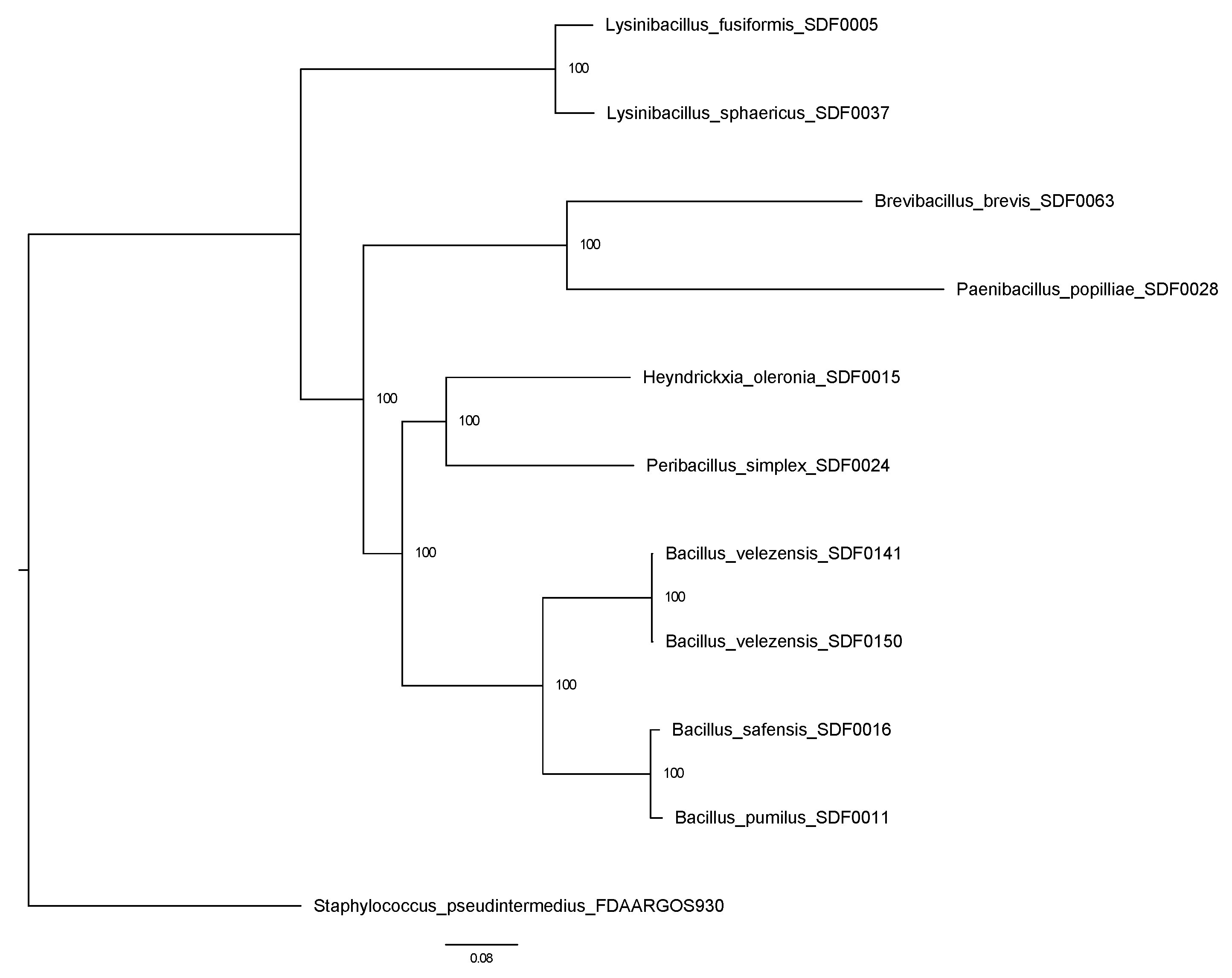
Figure 1. Whole-genome phylogenetic relationship of the 10 SDF strains. Whole genome-based unrooted phylogeny built by using RAxML with PROTCATJTT substitution model, rapid bootstrapping, and a subsequent Maximum Likelihood search, having as input 918 core protein families of our 10 SDF strains plus Staphylococcus pseudintermedius, as an outgroup. The tree nodes show bootstrap values as percentages of 1,000 replications. SDF strain classifications are indicated in the branches, and the distance scale bar is displayed at the bottom.
Preprints 151686 g001
Figure 2. Methylerythrotol-phosphate pathway reconstruction. The Pathway Tools software created a Pathway/Genome Database (PGDB) that includes the predicted metabolic pathways of the respective strain. The Omics Dashboard tool was then applied to align metabolomic data, generating diagrams to provide the aggregated system-oriented view of the predicted metabolic route information found in the genome of Bacillus velezensis SDF0150 (larger diagram). Smaller diagrams representing these routes in Bacillus velezensis SDF0150 and the remaining nine strains are displayed in the top right corner. The key to the colours of pathway glyph edges are indicated. The SDF strain designation is indicated: Lysinibacillus fusiformis SDF0005, Bacillus pumilus SDF0011, Heyndrickxia oleronia SDF0015, Bacillus safensis SDF0016, Peribacillus simplex SDF0024, Paenibacillus popilliae SDF0028, Lysinibacillus sphaericus SDF0037, Brevibacillus brevis SDF0063, and Bacillus velezensis SDF0141.
Preprints 151686 g002
Figure 3. Structure of biosynthetic gene clusters involved in the squalene hopene cyclase expression in the genome of the SDF strains evaluated. The gene sqhC that directs the squalene hopene cyclase (SHC) production was identified as a core biosynthetic gene (brown) inside the BGCs detected in eight SDF genomes by the antiSMASH. The colour boxes (bottom) indicate the predicted gene functions in the biosynthesis of terpenes.
Preprints 151686 g003
Figure 4. Structure of biosynthetic gene clusters involved in the phytoene/squalene synthase and phytoene desaturase the genome of the SDF strains evaluated. A gene sequence that directs the phytoene and/or squalene synthase (PSS) family enzyme production was identified as a core biosynthetic gene (brown) inside the BGCs detected in seven SDF genomes by the antiSMASH. In Bacillus pumilus SDF0011 and Bacillus safensis SDF0016 the gene for PSS were located adjacent to a copy for gene crtI, codifying a phytoene desaturase. The colour boxes (bottom) indicate the predicted gene functions in the biosynthesis of terpenes.
Preprints 151686 g004
Figure 5. Distribution of the ensemble of enzymes engaged in the terpenes’ synthesis among the ten SDF strains. A heatmap depicting the association obtained using the Person correlation-based method among the ten SDF strains (right) and 12 genes coding for enzymes involved in terpenes’ synthesis (bottom) was constructed. The protein set (Table 1) includes catalysts of the MEP route detected by the Pathways tools, along with polyprenyl synthase family (PPS) detected by BLASTp, and the TS squalene hopene cyclase, phytoene and/or squalene synthase (PSS), and phytoene desaturase (PDS) identified (described on the bottom) by the antiSMASH. The top dendrogram clustered the SDF strains into two sections based on presence (blue squares) or absence (black squares) of the respective gene coding for the enzyme in a particular species (right) genomes.
Preprints 151686 g005
Figure 6. Phylogenetic relationship of the SDF strains based on terpene synthase sequences. The evolutionary history of SDF strains was determined by aligning deduced amino acid sequences of two terpene synthases using the ClustalW. The sequences were obtained by translating the respective SDF gene sequence in silico. Phylogenetic trees were reconstructed using the maximum-likelihood method in MEGA version 11.0. The tree nodes show bootstrap values as percentages of 1000 replications. SDF strain designations are indicated in the branches. The distance scale bar is displayed at the bottom. The evolutionary relationships among (A) eight SDF strains based on the amino acid sequence of the SHC enzyme and the homolog amino acid sequence of Pseudomonas sp. as an outgroup and (B) seven SDF strains based on the amino acid sequence of the phytoene/squalene synthase family (PSS) and the homolog amino acid sequence of Pseudovibrio brasiliensis as an outgroup..
Preprints 151686 g006
Figure 7. Putative biosynthetic pathway of methylerythritol phosphate and terpenes biosynthesis metabolic pathways in the ten SDF strains studied. The reaction steps to synthesize terpenes from isopentenyl diphosphate (IPP), the final product of the methylerythritol phosphate (MEP) route, and the respective catalysts are indicated. The coloured dots indicate the gene sequence coding for an enzyme detected in a particular SDF strain described at the bottom. DMAPP: dimethylallyl pyrophosphate. IDI: isopentenyl diphosphate isomerase. GPP: geranyl pyrophosphate. FPP: farnesyl pyrophosphate. GGPP: geranyl-geranyl pyrophosphate. PSS: phytoene and/or squalene synthase. SHC: squalene hopene cyclase. PDS: phytoene desaturase.
Preprints 151686 g007
Table 1. Terpene precursors’ enzymes. Profile of MEP pathway and polyprenyl synthase family molecules.
Substrate Enzyme code* Enzyme name (abbreviation) Product (abbreviation)
Pyruvate and G3P 2.2.1.7 1-deoxy-D-xylulose-5-phosphate synthase (DXS) 1-deoxy-D-xylulose-5-phosphate (DXP)
DXP and NADPH 1.1.1.267 DXP reductorisomerase (DXR) methylerythritol-phosphate (MEP)
MEP 2.7.7.60 MEP cytidylyltransferase (MCT) 4-(cytidine 5′-diphospho)-2-C-methyl-D-erythritol (CD-ME)
CD-ME and ATP 2.7.1.148 CD-ME kinase (CMK) 4-difosfocitidil-2-C-metil-Deritritol 2-fosfato (CD-MEP)
CD-MEP 4.6.1.12 2C-methyl-D-erythritol-2,4-cyclodiphosphate synthase (MDS) 2C-methyl-D-erythritol-2,4-cyclodiphosphate (MEC)
MEC and NADPH 1.17.7.3 1-hydroxy-2-methyl-2-(E)-butenyl 4-diphosphate synthase (HDS) 1-hydroxy-2-methyl-2-(E)-butenyl 4-diphosphate (HMBPP)
HMBPP and NADPH 1.17.7.4 HMBPP reductase (HDR) isopentenyl pyrophosphate (IPP)
IPP 5.3.3.2 isopentenyl diphosphate isomerase (IDI) dimethylallyl pyrophosphate (DMAPP)
IPP and DMAPP 2.5.1.1 GPP synthase (GPPS)** geranyl diphosphate (GPP)
GPP and IPP 2.5.1.10 FPP synthase (FPPS)** farnesyl diphosphate (FPP)
FPP and IPP 2.5.1.29 GGPP synthase (GGPPS)** geranylgeranyl diphosphate (GGPP)
*Kyoto Encyclopedia of Genes and Genomes (https://www.genome.jp/kegg/). **GPPS, FPPS, and GGPPS are enzymes belonging to the polyprenyl synthase family (PPS).
Table 2. General genomic features of the ten SDF strains analysed.
Strain Size (bp) Scaffold # N50 (bp) GC content (%) CDS # Protein coding regions Pseudo genes (total) rRNA genes
(5S; 16S; 23S)
tRNA genes GenBank accession #
Lysinibacillus fusiformis SDF0005 4,472,771 24 392,231 37.6 4,369 4,328 41 13; 7; 7 85 VKHW00000000.1
Bacillus pumilus SDF0011 3,686,817 56 143,274 41.2 3,688 3,617 71 7; 3; 2 73 VKHY00000000.1
Heyndrickxia oleronia SDF0015 5,267,437 75 151,790 34.7 5,127 5,018 109 10; 14; 7 129 VKHZ00000000.1
Bacillus safensis SDF0016 3,674,191 25 484,434 41.6 3,688 3,640 48 4; 1; 1 74 SADW00000000.1
Peribacillus simplex SDF0024 5,376,271 45 497,961 40.2 5,204 5,007 197 14; 7; 6 81 VKHX00000000.1
Paenibacillus popilliae SDF0028 6,580,875 39 611,008 46.5 5,684 5,519 165 2; 2; 3 62 SADY00000000.1
Lysinibacillus sphaericus SDF0037 5,122,785 71 215,682 36.5 4,869 4,643 226 5; 7; 2 71 SADV00000000.1
Brevibacillus brevis SDF0063 6,239,737 31 471,412 47.3 5,789 5,602 187 1; 16; 9 89 SADX00000000.1
Bacillus velezensis SDF0141 3,945,527 15 962,078 46.4 3,887 3,780 107 8; 3; 2 78 VKIB00000000.1
Bacillus velezensis SDF0150 3,927,067 21 271,062 46.4 3,870 3,763 107 8; 6; 2 82 VKIC00000000.1
Table 3. Polyprenyl synthase family occurrence in the ten SDF strains analysed.
Strain Occurrence identity (%)* Reference species GeneBank reference sequence#
Lysinibacillus fusiformis SDF0005 + 99.66 Lysinibacillus fusiformis KAB0443654.1
Bacillus pumilus SDF0011 - NA NA NA
Heyndrickxia oleronia SDF0015 + 67.86 Bacillus pumilus WP_268443628.1
Bacillus safensis SDF0016 - NA NA NA
Peribacillus simplex SDF0024 + 98.65 Peribacillus sp. WP_241589686.1
Paenibacillus popilliae SDF0028 - NA NA NA
Lysinibacillus sphaericus SDF0037 - NA NA NA
Brevibacillus brevis SDF0063 - NA NA NA
Bacillus velezensis SDF0141 + 100 Bacillus velezensis ASK59031.1
Bacillus velezensis SDF0150 + 99.65 Bacillus velezensis QWC45887.1
*Highest identity level from the alignments between each SDF amino acid sequence obtained by in silic translation and NCBI reference sequence obtained by Blast. The symbols indicate the presence (+) or absence (-) of the corresponding coding gene in the genomes. NA: not applicable.
Table 4. Genes coding for the TS enzymes identified by antiSMASH in the ten SDF strains analysed.
Strain Gene/TS enzyme
sqhC/SHC Phytoene and/or squalene synthase family gene/PSS crti/PDS
Lysinibacillus fusiformis SDF0005 - + -
Bacillus pumilus SDF0011 + + +
Heyndrickxia oleronia SDF0015 + - -
Bacillus safensis SDF0016 + + +
Peribacillus simplex SDF0024 + + -
Paenibacillus popilliae SDF0028 + - -
Lysinibacillus sphaericus SDF0037 - + -
Brevibacillus brevis SDF0063 + - -
Bacillus velezensis SDF0141 + + -
Bacillus velezensis SDF0150 + + -
The symbols indicate the presence (+) or absence (-) of the corresponding gene sequence coding for a TS in the genomes.
Disclaimer/Publisher’s Note: The statements, opinions and data contained in all publications are solely those of the individual author(s) and contributor(s) and not of MDPI and/or the editor(s). MDPI and/or the editor(s) disclaim responsibility for any injury to people or property resulting from any ideas, methods, instructions or products referred to in the content.
Copyright: This open access article is published under a Creative Commons CC BY 4.0 license, which permit the free download, distribution, and reuse, provided that the author and preprint are cited in any reuse.
Prerpints.org logo

Preprints.org is a free preprint server supported by MDPI in Basel, Switzerland.

Subscribe

Disclaimer

Terms of Use

Privacy Policy

Privacy Settings

© 2025 MDPI (Basel, Switzerland) unless otherwise stated