
1. Introduction
This paper proposes a scaled model of the universe, capable of providing answers for the entirety of physics. It starts from the hypothesis that the field of physics represents only a small part of the universe and that its structure is influenced by interactions originating from undetectable scales, yet of the same fundamental nature. Even the space between accumulations consists of smaller sub-accumulations of matter, organized in a coherent structure with properties specific to each component entity.
In this work, the study of the universe is based on identifying similarities between its scales and analyzing the interaction between matter accumulations of different sizes. Primarily, the structure of quarks is investigated, seeking fundamental energetic particles that underlie the formation of charge properties. If the nature of charges is discovered, then electromagnetic forces can also be described within a framework related to the universe. Thus, along with the analysis of quark division, a deeper understanding of charges is pursued, which are currently considered fundamental.
The research is conducted by analyzing the detectable universe, and observations are extrapolated to undetectable scales. In this model, the similarities between scales are:
The ejection of subatomic particles (lower-scale accumulations) by energetic accumulations. For example, stars expel approximately 85% of their mass into space over their lifetime. These ejected particles form open fluxes within their internal systems, generating energies transmitted through field waves. On a cosmic scale, this effect is minimal, but on smaller scales, process speeds are faster, and the effects are more pronounced for the nature of physics.
Absorption into molecular nebulae. It is assumed that at each scale, structures resembling "nests" are formed, where the remnants of accumulations from local inter-accumulation environments contribute to the formation of new accumulations.
At the lower end of any scale, the speed of similar processes increases by billions of times. For example, galaxy vibrations are much slower compared to atomic vibrations, and the division of an atom occurs in an incomparably shorter time than the division of a galaxy. It is estimated that energetic accumulations in quarks have such a short lifespan that current physics detectors cannot measure them, explaining the difficulty in dividing quarks.
It is observed that stars coexist only in galaxy groups, and this observation is extrapolated to any scale.
Throughout the description of this model, an attempt is made to correctly indicate the reference framework to which the analyses refer, since in the entire universe, multiple natures and relativities exist. If the universe is finite, there are primary particles that create the entire universe, the detectable universe, and physics. Thus, the parts forming the universe, called active accumulations here, are relative realities specific to the chosen reference framework. An example is that in physics, mass transforms into energy, but in the universe, defective mass transforms into lower-scale accumulations. At high motion speeds, the amount of matter forming mass does not change, only the internal kinetic energy does. Any matter accumulation is a relative accumulation concerning its lower parts but is also a particle of a higher-level accumulation. The term "matter accumulations" implies that certain forces have led to these accumulations, and each accumulation conceals a system within itself (or even a sub-universe, as it has its own closed life processes). Matter at scales smaller than atoms is only relevant locally and not for the nature of physics, which confines its mathematics to its chosen reference systems.
Each scale introduces a new and distinct nature into the universe because energetic accumulations activate a new type of organization at lower scales. For example, in stars, atoms activate as a system, but within atomic nuclei, the sub-scales are not atoms but pre-existing matter accumulations. For this reason, each scale brings a unique activation into the universe, giving it specific characteristics. Matter in the universe exists as groupings of different scales and, as a whole, represents a relative reality to physics, being a broader nature since physics deals only with the perception of detections in our proximity. Therefore, to correctly discover physics, the platform on which physics exists must be identified, estimated at approximately ten lower scales.
In physics, starting with the standard model of elementary particles and those smaller than them, matter no longer exists as such but only in the form of energy waves, fields, or interaction mediators. This is correct concerning the laws of physics, which explain phenomena based on the chosen coordinate system. However, physics occupies a limited and narrow place in the universe, which is why universe research must partially transcend physics, considering other reference systems. From an expanded perspective on the entire universe, the concept of "matter" is relative depending on the chosen scale and neighboring scales. As scales transition, both the dimension and nature of interactions change, enabling phenomena such as matter penetration—for example, neutrinos can pass through planets without significantly interacting with them.
To understand physics, only rare invocations of the nature behind physics are necessary. However, knowledge of the universe beyond physics is essential because current physics contains many uncertainties and crises. A possible solution lies in expanding fundamental notions, achievable through the hypothetical exploration of much smaller scales.
2. Methods
In this paper, we theoretically explore a model of the universe by analyzing observable realities and attempting to generalize them across different cosmological scales. The adopted methodology consists of evaluating hypotheses through an iterative process: if a hypothesis remains valid within the analysis applied to the entire universe, it is maintained; otherwise, it is adjusted or discarded.
The use of mathematics is minimized in the initial stage, as the priority is to identify a coherent conceptual framework of reality, upon which appropriate mathematical models can later be applied. This approach facilitates a clearer understanding of fundamental principles, providing a solid foundation for the development of a formalized framework.
3. Results and Discussion
3.1. The Matter Accumulations of the Universe
The concept presented in this paper is based on the idea that all massive particles in subatomic physics are further divisible into many lower scales, similar to the visible universe, and each scale contains energetic accumulations similar to stars but on smaller scales.
According to this model and string theories, nature, as described in physics, still has approximately ten smaller active scales, dimensions, or undiscovered elements. In this model, the research limit consists of these ten still-hypothetical subscales. The universe in this model is composed of primary particles ("Scale -10" in
Figure 2) and a series of scales. However, each scale contains three main levels:
- (a)
Energetic accumulations: On a cosmic scale, these are stars and are currently the only ones detected. Energetic accumulations coexist only within semi-energetic accumulations (on a cosmic scale, within galaxies) and form several properties. One such property is the ejection and absorption of subparticles from the local vacuum of the given scale (
Figure 1).
Figure 1.
illustrates the processes occurring in galaxies that make them dynamic and renewable, including the emission and absorption of particles in intergalactic space. This model suggests that this process exists at every scale.
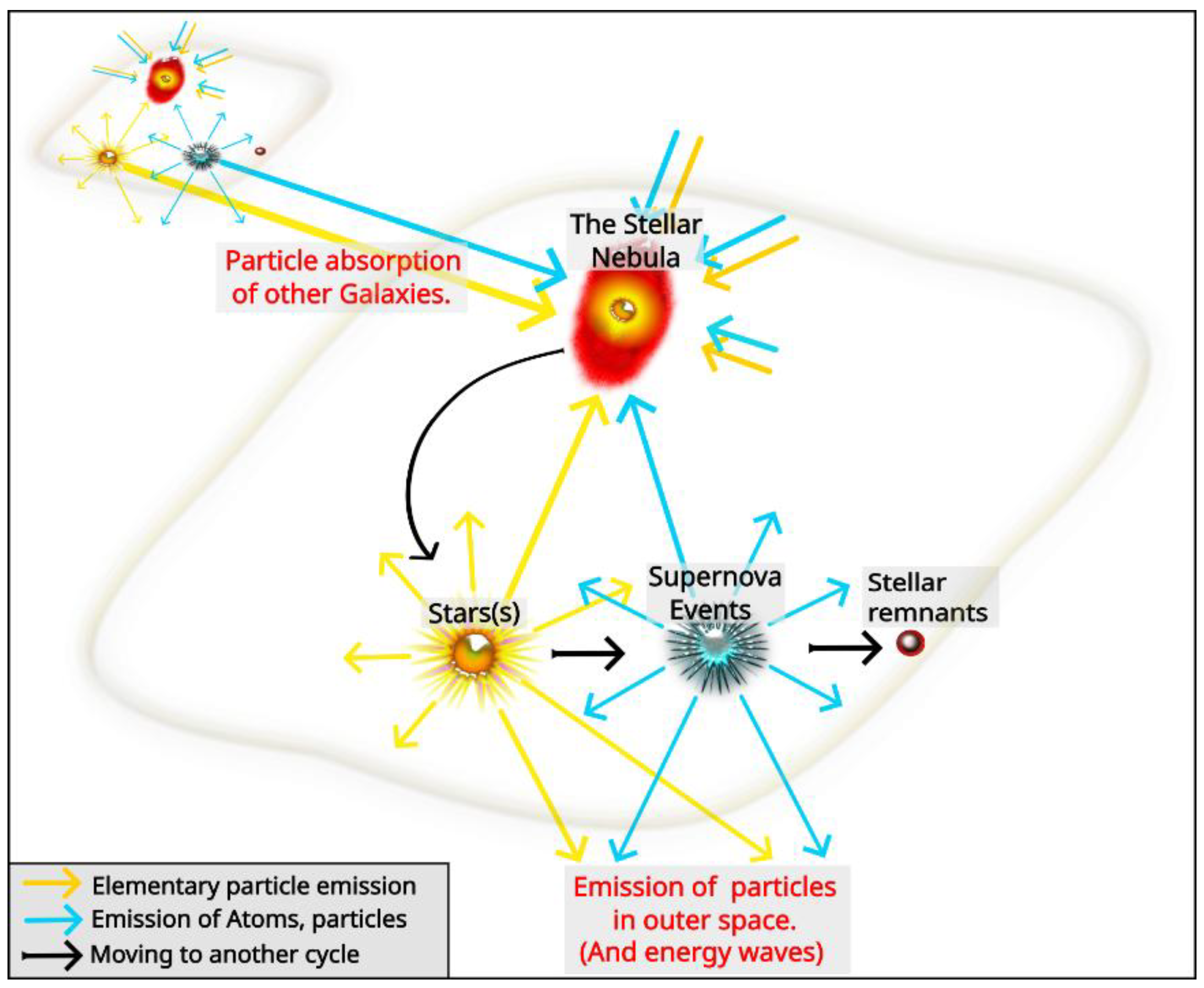
Figure 1.
illustrates the processes occurring in galaxies that make them dynamic and renewable, including the emission and absorption of particles in intergalactic space. This model suggests that this process exists at every scale.
Figure 2.
The scales of the universe that form the nature of current physics. The horizontal groups represent the scales, but the vertical groups represent the levels into which the scales are divided.
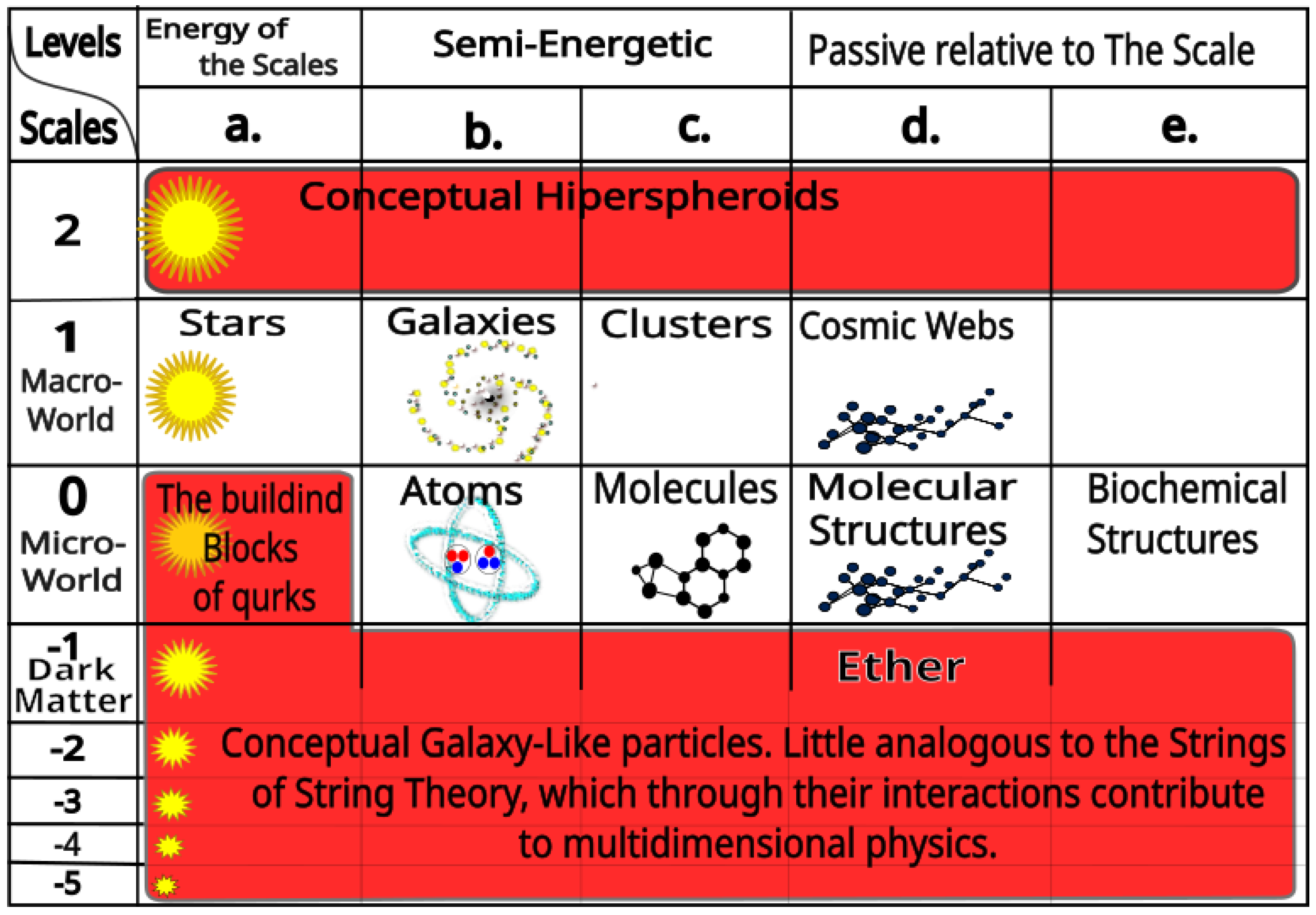
Figure 2.
The scales of the universe that form the nature of current physics. The horizontal groups represent the scales, but the vertical groups represent the levels into which the scales are divided.
- (b)
level of semi-energetic accumulations: On a macroscopic scale, semi-energetic accumulations are galaxies, while at the atomic scale, they are protons, neutrons, and partially atoms and molecules. This separate classification is necessary for the emergence of forces. In this concept, the fifth force is considered to originate in stars but manifests at the galaxy level, and this pattern repeats at every scale.
- (c)
One or more levels of passive accumulations: In the macroscopic world, passive accumulations are planets and galaxy clusters. In the microscopic world, passive accumulations include molecules (partially) and bodies. Passive accumulations consist of active accumulations of the same scale, but as accumulations, they do not participate in the dynamics of the universe; rather, only their active accumulations contribute directly.
3.1.1. The Primary Particles of the Universe
It is evident that the universe must originate from some point, meaning that primary particles must exist to create the first scales, from which larger scales emerge.
If the reality is that the universe is finite, it is assumed that primary particles exist. However, for them to form the first accumulations of the scaled universe, they must possess certain properties that cannot be directly investigated because they lack direct connections and influences with our observable nature. Instead, their influence is felt only after several scaling stages in physical nature.
The size of the scaled universe remains unknown—whether it is finite or infinite—but for a "theory of everything," it is sufficient to approximate a depth of about ten smaller scales. These lower scales are of the same nature as the macroscopic scale, which can be studied for similarities. Thus, the primary particles of multidimensional physics are accumulations similar to those at micro and macro scales. In this model, the primary particles of the universe correspond to "Scale -5" in
Figure 1.
The properties of these primary scales of the detectable universe are of the same nature as the scales in the observable universe. Hawking radiation from matter regeneration through black holes serves as an example of how detectable scales transform into much lower scales. It is estimated that at each scale, molecular nebulae form, where matter reaccumulates.
Dark energy, quantum fluctuations, virtual particles, neutrinos, and various quantum fields—through their activity and formation via regeneration—all indicate that they may simply be accumulations containing energetic accumulations present at every scale. The permeability and permittivity of the vacuum suggest that interstellar space is composed of similar accumulations, as electromagnetism is fundamentally based on charged particles, and charges exist only on particles. The particles of the vacuum are smaller than electrons and quarks, which are considered indivisible. In other words, vacuum particles are accumulations from much lower scales of so-called indivisible particles. In the vacuum, they form a granularity structured according to the laws of these local accumulations and can propagate waves for interactions such as electromagnetic waves. Even Albert Einstein suggested that there must be particles in the vacuum responsible for magnetic permeability and electrical permittivity.
Interactions occur through energetic waves, and energy forms due to potential differences between sub-universes. The propagation of these waves by vacuum particles indicates that they are accumulations of matter with properties similar to detectable scales, making them subject to study. Therefore, the primary particles of the observable universe are similar to known scales.
The properties of the universe that cannot be described within ten lower scales, but are instead attributed to much smaller scales or an unknown nature influencing the universe and physics, include:
The right-hand rule for electric and magnetic fields,
The law of rotation direction and propagation,
The speed at which processes unfold at the first scale.
3.1.2. Energy Accumulations Inspired by Stars
Energy accumulations are inspired by stars that produce constant energy at the cosmic scale. The aspects inspired by stars for all other scales can be found in
Figure 1. These energy accumulations also exist at any scale in this universe model, as it is evident from multiple observations that: the dynamics and interactions of subatomic particles, theoretical analyses such as the accumulations of matter, and as volume increases, internal pressure rises, creating this class of energy accumulations.
Energy accumulations, such as stars, exist at every scale of the universe because they maintain the continuation of the formation of new scales in the universe. If, under the pressure of gravitational force attraction, no internal reactions of lower scales would begin, where they would become energy-releasing, then the entire universe, from macrolume to subatomic scales, would accumulate only into a star. Thus, energy accumulations limit the size of clusters, and once many clusters form, they, in turn, form larger clusters in a continuous repetition.
Energy accumulations in the atomic component are not experimentally detectable because their size is comparable to elementary particles released by stars compared to galactic clusters or even galaxy groups. They interact with their local particles, which are two scales smaller than the atom, because at a scale smaller than the atom, there are only particles that emit and generate energies and forces.
Once the processes in stars, where increasing mass also increases internal pressure that triggers internal reactions, are what limit the size of atomic accumulations, no larger than stars, these processes of emergence and existence similar to stars are found at every scale of the universe because, at any scale, the sizes of particles are approximately the same.
Stars are the only "observable energy accumulations." At the microlume, energy accumulations similar to stars are only theoretically possible to find. Although with few indications, this paper proceeds and proposes that, like in the microlume, the rest of the universe is structured in different scales that are initiated by matter accumulations that generate energy and limit sizes similar to stars.
Energy accumulations similar to stars are estimated to have approximately the following properties:
They transform their subscales from one state to another, producing energy, and eject it into the local space of the scale taken.
They interact at distances if a potential difference occurs, either when appearing in locations where their interactions enter contact zones, or accumulations open up as internal processes that are closed inside.
They are formed from accumulations of lower scales.
They become active like stars when internal pressure increases due to attractive forces.
3.2. Scaling of the Universe
The similarity from scale to scale is very limited, but it carries the essential properties of matter grouping. From the detectable universe, it is evident that matter groups up to certain limit volumes, and then these groupings form larger scale groupings. This is also true at the atomic scale and smaller scales, as it is known that stars and black holes decompose into elementary particles, which then regenerate through molecular nebulae. Therefore, it is hypothesized that the universe represents scaling groupings, starting with the smallest particles of its components.
For the formation of this model of the universe, a numbering of matter accumulations is done according to their scale (
Figure 2). The numbering is similar to the scaling of thermometers, meaning the numbering starts from zero and continues toward both positive and negative scales, so it can be easily modified or completed later. The atomic scale is numbered as zero, larger scales are numbered with positive numbers, and smaller scales with negative numbers.
Each scale is formed from a level of active groupings similar to stars, which form a few levels of passive groupings. For scales larger than the atomic scale, positive numbers are assigned, while for smaller scales, negative numbering is used. For the scale level, the initials SL (Scale and Level) will be used.
In the image in
Figure 2 the observable and hypothetical scales of the universe in the model in this paper are represented and they are described as:
"Scale 2 (SL 2)”, which represents the Hyperspheres already proposed by other authors, where it is assumed that cosmic structures in theoretical quantities of > 1000 billion light-years group together.
"SL 1" Represents the cosmic scale, from which most inspirations for extrapolations to other scales are drawn. It is observed that the similarity is not directly equal. But theoretically it is found that the some laws of formation and general manifestation persist at the other scales, although with considerable changes.
"SL 0" At the atomic scale, scaling is hidden by the properties of the electric charges of elementary particles and the electromagnetic effects, which are a nature of expansion through interactions compared to the nature of scaled matter groupings, and affect the real detection of how matter accumulates at this scale. However, the speed of manifestation of similarities between the micro and macro scales is different. Even though the scales vary greatly, the similarities are hidden in the speed of manifestation and limited detection.
Atoms are also accumulations of matter, and this table is an extension of Mendeleev's table for the entire universe. If atoms are found in the "SL 0.a" position, then different atoms are included based on their order number: "SL 0.a1" Hydrogen, "SL 0.a2" Helium, NS -1a3 Lithium,...
Once this research proposes through this scaling of the universe, "The Theory of Everything" in the matter grouping table of scaled matter in
Figure 2, it is expected to include SL 0.c Molecules, SL 0.d Objects, SL 0.e Biomolecules. Through an extension, these will be followed by cells, organisms, and groups of organisms.
"SL -1" are the lower scales of "SL 0," and together with even smaller scales, through emissions from stars and black holes, they become the hypothetical dark matter, Higgs field particles, and so on.
"SL -2," "SL -3," ... Theoretically, more lower scales are found. They are sources of energetic fields that form different dimensions (the equivalent of strings in string theories, which produce vibrations for multidimensional spaces). These are the lower scales of "SL -1," and at the same time, they meet as particles from the flux released from the energy accumulations that are emitted from "SL -1," "SL 0." The energy accumulations from these scales emit accumulations of lower local scales that propagate these local waves of the scale in question and make the entire universe elastic, both for mechanical waves and different interaction waves.
Any accumulation is made up of accumulations of lower scales, meaning "SL 1a" (Stars) is made from an accumulation of "Scale 0." This scaling continues for approximately 9 lower scales, according to estimates for the explanation of the nature of physics and the studies of string theories and adjacent theories.
Accumulations from different scales are 3D, which interact with each other through quantized 1D energy (relative to the scale taken). Subuniverses in the nature of physics additionally have these 10 dimensions, but they belong to interactions. Within the entire universe, their number decreases or increases with the decrease or increase of the scale levels, as each scale brings a new nature of interactions.
Accumulations form on different principles, but all are accumulations of lower accumulations, and they, from any scale, are accumulations of accumulations from lower scales. Accumulations of any scale accumulate with forces from small to large as volume, once they are quantities of matter with kinetic energy, and they have their mass, which increases as they transition from one SL to another. If m is the mass, then
m(SL -1) < m(SL 0) < m(SL 1),…
Accumulations of scales smaller than the particles that make up atoms are extremely small, and they cannot be detected, nor can their interactions; they can only be theoretically assumed for clarity in the surface nature of physics.
3.3. Time and Speed of Internal Processes in Subuniverses
Time in the universe is known to be the same for all scales of the universe. In the framework of relativity theories, time fluctuates with the motion of matter. However, in this scaled universe reference frame, similarities are sought at the lowest temperatures and motions of matter. Nevertheless, if a coordinate system with a stationary scale is considered, its subscales remain active because the speeds of processes are much higher, and the dynamic nature of subscales forms the larger scales.
When studying the similarities between scales, it is essential to consider that accumulations at different scales exhibit different speeds of internal processes. If the internal speed of processes is denoted as V intern.process, then:
V intern.process (SL 1) < V intern.process (SL 0) < V intern.process (SL -1), ...
An example is the similarity between galaxies and atoms, where a particle leaves an atom much faster than a star leaves its galaxy. Similarly, when two atoms merge, the process occurs within milliseconds, whereas collisions between stars or galaxies take millions of years.
The similarities between scales are hidden by differences in the manifestation speeds of similar processes, as physics is relative to its own time. For instance, a particle acquires charge properties when its closed system opens. (Particles with constant charge maintain these properties continuously because each scale contains energetic accumulations similar to stars.) This process of opening closed systems also occurs at the cosmic scale but is very weak because the charge of galaxies or stars must be calculated over billions of years in the context of the similarities between atoms and galaxies.
3.3.1. Lifespan of Matter Accumulations
The lifespan of energetic accumulations varies depending on scale; the smaller the scale, the shorter the lifespan. However, atoms are semi-energetic accumulations and follow the same continuous cycle of life as galaxies, where stars die and are born randomly, but galaxies continue to exist with new generations of stars.
The lifespan of semi-energetic accumulations, such as galaxies, is similar to that of populations of organisms. At any scale, if:
N(t) represents the number of individuals in a population or the number of energetic accumulations in a semi-energetic grouping such as galaxies,
B is the birth rate,
D is the death rate, then:
If B = D, the population remains constant.
If B > D, the population increases.
If B < D, the population decreases.
And since galaxies and quarks have a very long lifespan, it follows that B = D.
According to
Figure 1, nebulae form new stars not only from the dust of local galaxies but also from the dust of distant galaxies. Therefore, although galaxies produce energy, their lifespan is not affected. In this model, galaxies are classified as semi-energetic accumulations that are assumed to exist at any scale.
3.4. The Problem of Quark Division into Smaller Particles and the Search for Star-Like Energetic Accumulations in Atoms
The size of energetic accumulations within atoms is approximately equal to that of electrons, and it is estimated that they can be detected.
Quarks are studied indirectly, and observations about them are made through physics, which is both relative and limited in several aspects. Quarks do not fit well into this scaled model, but at the atomic scale, the appearance of charges followed by electromagnetic forces prevails.
This scaled universe model seeks, within each scale, energetic accumulations similar to stars, which are found in the nuclei of atoms, regardless of whether smaller scales such as protons, neutrons, or quarks exist.
Accumulations at any scale are characterized by the fact that they can be moved as whole objects, provided their movement speed does not exceed the speed of their internal processes. For instance, if the Sun receives an impulse, it can be moved along with its planets as a whole object, but this impulse must not cause the Sun to move faster than its gravitational forces can maintain the planets in orbit.
Thus, any accumulation of matter represents a system that maintains its structure through attractive forces. Similarly, atomic nuclei cannot be divided because the nature of strong nuclear forces surpasses the fundamental constant "C" (the speed of light).
Therefore, the indivisibility of quarks is due to the limits of impulses that can be applied. In other words, atomic nuclei exist at a scale where the speed of light prevails. However, according to this model and modern physics, at smaller scales, speeds increase. In particle accelerators, quark division could be possible at higher energies because the subscales of colliding particles become active.
Energetic accumulations within atomic nuclei have a very short lifespan because atomic-scale processes occur billions of times faster than at the cosmic scale.
According to P. 3.3.1, the lifespan of scales is equal to the lifespan of the universe. However, scales smaller than the atomic scale can only be theoretically identified, as their dimensions are approximately to atoms what atoms are to galaxies.
3.5. Forces and Force Propagation Particles
Albert Einstein argued that vacuum particles are not necessary within the framework of relativity theories, but in the vacuum, there must be particles responsible for magnetic and electric permeability.
The space between matter accumulations (the vacuum) at any scale is occupied by subscales emitted from energy accumulations similar to stars. On a cosmic scale, it is known that stars eject approximately 85% of their mass into interstellar space throughout their lifetime. In this model, these particles exist at every scale and represent accumulations of smaller scales relative to the considered scale but are generally of the same nature as any accumulation. The propagation of interaction waves is not carried out by the particles of the mechanical vacuum but by their fields, which fluctuate differently depending on the type of wave being propagated.
Matter accumulations are complex systems with multiple lower scales, which is why they can propagate different interactions. All interaction quanta—whether photons, gravitons, or the Higgs field—differ in the nature of their fluctuations, not in the particles of the vacuum but in their fields. Even the same vacuum particles can propagate different types of interactions. Thus, there are no distinct particles for each interaction; rather, the same vacuum particle fields fluctuate, but the fluctuations differ according to the interaction being propagated. Interactions are not propagated by a "luminiferous ether" but by its fields, which is why propagation does not depend on the movement of the "luminiferous ether" (vacuum particles). Due to the complexity of the universe, the current level of physics can control the speed of light only within spacetime, using a coordinate system initiated by the observer. However, for smaller scales, other coordinate systems must be found, and this model seeks to approach as closely as possible any accumulation and fluctuation in the universe.
The wave-particle duality also includes the complexity observed in stars, meaning that energy accumulations at any scale not only produce energy waves but also eject particles. Likewise, vacuum particles receive a motion impulse in the same direction.
3.5.1. Expressing Physics by Invoking Smaller Scales
An example is that planets possess gravity because they are made up of atoms that already have gravity, and atoms, in turn, possess gravity because they represent an accumulation of smaller-mass particles, and so on.
Gravity, and partially any other force in this model, aligns with Isaac Newton’s hypothesis that all interactions in the universe originate from the universe's primary particles. Although other forces were unknown in Newton's time, this universe model, based on the observation that matter is regenerative, supports the idea that all interactions begin with primary particles. However, other known forces are secondary in nature and local at different scales, representing various activations of primary particles as systems form.
All interactions in the universe are due to the smallest primary particles, as everything is composed of them. They are similar in that they have an attractive force and form accumulations, which constitute primary scales (approximately scale -5 in
Figure 2). To fully explain physics, about five additional smaller scales must be understood, as they form the platform upon which physics is based.
Therefore, for any interaction, if the chosen coordinate system leaves questions unanswered, one can invoke subscales. Similarly, when explaining how matter accumulations interact, one can invoke the lower level of sub-accumulations repeatedly until reaching the primary particles. For example, in physics, it is stated that a field is a sum of quantum states of particles, meaning the field is an extension and alignment of lower particles that already possess forces.
3.5.2. The Nature of Forces in the Universe
The first nature of interactions comes from the much lower scales. The second nature of interactions in the universe arises from energy accumulations. These are similar to stars, where, as known, fusion reactions begin due to increasing internal pressure. In this analogy, for any scale, fusion is considered a process of decomposition into lower-scale accumulations within its composition essentially, the opening of systems that formed the accumulation. When systems maintaining accumulations are closed, the accumulation remains passive (Levels d. and e. in
Figure 2). However, when these systems open, they generate a local force. Since it is assumed that energy accumulations similar to stars exist at every scale, these activities generate forces at each scale, which also influence larger scales. In the physical nature of the universe, stars act as energy sources, but within the universe, stars with their constant energy represent interactions because the universe adopts different reference systems depending on the inquiry.
Since electromagnetic forces are formed by semi-energetic accumulations (
Figure 2), it is assumed that similar forces can appear at any scale and result from the opening of systems maintaining these semi-energetic accumulations.
Conclusion
In conclusion, this model, in its entirety, forms a description of the universe. Although largely hypothetical, this description creates a model that can provide answers to almost any question about the nature of the observable world. The model proposes that, in addition to the known detectable scales, there are several other scales that contribute to the formation of the nature described by physics. Physics occupies a limited space and has a relative nature, with different coordinate systems taken only from the surface of the universe that is detectable from the same surface.
The universe is much broader, and fundamental elementary particles still have many subscales. The universe that contributes to the formation of the physical nature is built from primary particles of the same nature at any scale, forming the initial scales of the multiscale universe. The detectable universe is only a small part of this vast scaling system but originates from and is supported by these smaller scales.
Matter accumulations (sub-accumulations at different scales) interact with each other through energetic waves from multiple lower scales of the universe in real-time as these waves propagate. However, interactions occur in parallel with the dynamics of the universe, where matter is constantly transformed through energy accumulations at any scale, similar to stars. Therefore, the ejection of sub-accumulations is part of these interactions. Ejection is also responsible for opening the systems from which these accumulations were expelled, and as energy accumulations undergo continuous dissipation, they generate forces within the universe.
All matter in the universe is generally of the same nature. Cosmic vacuum consists of products ejected from energetic accumulations, which regroup into atoms and then into stars. Thus, absolutely all particle sets in subatomic physics share common characteristics defined within this model. All particles represent:
a) Accumulations of sub-accumulations.
b) Their fluctuations caused by deviations from systemic laws. The graviton, for example, differs from other particles in that it is a specific fluctuation of gravity, but it is not itself a fundamentally unknown entity.
c) The propagation of energetic waves in a vacuum is not mechanical but consists of fluctuations in the systemic laws of vacuum particles. Therefore, wave propagation does not depend on the motion of these vacuum particles. This explains why ether drift experiments have yielded no results. Spacetime is another relative reality among the many natures of the universe, adopting different coordinate systems.
Big Bang theories, derived from the expansion of the universe and lacking information beyond its current boundaries, can be explained in this model as an expansion of the hyperspheroid. The probability that we are exactly at the center of the visible universe is very low, and since it appears homogeneous in all directions, this suggests that the cosmic scale is much larger, where fluctuations and forces emerge at greater scales, forming a hyperspheroid.
The model presented in this paper is still in development. Although it is not the first of its kind in describing the universe as accumulations of matter, it is proposed that this model has irreplaceable perspectives compared to other research methods.
References
- Davies, P. (1984). Superforce: The search for a grand unified theory of nature. Simon & Schuster.
- Mandelbrot,B.B. (1982). The Froctal Geometry of Nature.
- arXiv:0711.0770.Lisi, A. G. (2007). An Exceptionally Simple Theory of Everything. arXiv:0711.0770. [CrossRef]
- arXiv:1807.05486.Yock, P. (2018). Newton's hypotheses on the structure of matter. arXiv:1807.05486. [CrossRef]
- Gell-Mann, M. (2009). Nature conformable to herself. (World Scientific Series in 20th Century Physics 40, 378 – 381).
- Deutsch, David, and Chiara Marletto. The Constructor Theory. Allen Lane, 2021.
- P. J. E. Peebles - Principles of Physical Cosmology (1993).
- Griffiths, D. (2008). Introduction to Elementary Particles (2nd ed.). Wiley-VCH.
- D. Griffiths, Introduction to Elementary Particles, Wiley-VCH, 1987.
- Richard P. Feynman - The Feynman Lectures on Physics (1964).
- P. J. E. Peebles - Principles of Physical Cosmology (1993).
- H. Yukawa, "On the Interaction of Elementary Particles," Proc. Physico-Math. Soc. Japan, vol. 17, pp. 48-57, 1935.
- Prigogine, I. (1980). From Being to Becoming: Time and Complexity in the Physical Sciences. W. H. Freeman.
- Michio Kaku - Hyperspace: A Scientific Odyssey Through Parallel Universes, Time Warps, and the 10th Dimension (1994).
- Price, H. (1996). Time's Arrow and Archimedes' Point: New Directions for the Physics of Time. Oxford University Press.
- Peskin, M. E., & Schroeder, D. V. (1995). An Introduction to Quantum Field Theory.
- Lisa Randall - Warped Passages: Unraveling the Mysteries of the Universe’s Hidden Dimensions (2005).
- Brian Greene - The Elegant Universe: Superstrings, Hidden Dimensions, and the Quest for the Ultimate Theory (1999).
- Frank Close - The Infinity Puzzle: Quantum Field Theory and the Hunt for an Orderly Universe (2011).
- David Griffiths - Introduction to Elementary Particles (1987, 2008, 2nd ed.).
- S. Weinberg, Quantum Theory of Fields, vol I, Cambridge university press, 1995.
- A. Pais, Inward Bound: Of Matter and Forces in the Physical World, Oxford University Press, 1986.
|
Disclaimer/Publisher’s Note: The statements, opinions and data contained in all publications are solely those of the individual author(s) and contributor(s) and not of MDPI and/or the editor(s). MDPI and/or the editor(s) disclaim responsibility for any injury to people or property resulting from any ideas, methods, instructions or products referred to in the content. |
© 2025 by the authors. Licensee MDPI, Basel, Switzerland. This article is an open access article distributed under the terms and conditions of the Creative Commons Attribution (CC BY) license (http://creativecommons.org/licenses/by/4.0/).