
Submitted:
03 March 2025
Posted:
05 March 2025
You are already at the latest version
Abstract
Recent findings have demonstrated that the desalination and purification of contaminated water, and the separation of ions and gases, besides solutions to other related issues, may all be achieved with the use of membranes based on artificial nanoporous materials. Before the expensive stages of production and experimental testing, the optimum size and form of membrane nanopores could be determined using computer-aided modeling. The notion that rectangular nanopores created in a multilayered hexagonal boron nitride (h-BN) membrane in a way that results in different inner lining atoms would exhibit unique property in terms of water penetration rate is put forth and examined in the current study. Nanopores in Boron nitride sheets can be generated with the inner lining of boron atoms (B-edged), nitrogen atoms (N-edged), or both boron and nitrogen atoms (BN-edged). In this study, we compared the three different inner-lined nanopores of boron nitride nanosheets to a comparable-sized graphene nanopore and evaluated the water conduction.
Keywords:
Boron nitride nanosheet
; water transport
; molecular dynamics simulation
1. Introduction
Due to the rapid increase in the world's population, industrialization picking up speed, and environmental pollution, the recent clean water issue has garnered a lot of attention around the world [1,2,3,4]. One of the most significant issues of our time is finding adequate and clean water supplies [5]. Desalination of saltwater and decontamination of contaminated water are two processes that have recently attracted a lot of attention. There are several different techniques for decontaminating water, including flocculation, adsorption, chemical oxidation, and photo catalysis [6,7,8,9]. For desalination, there are three basic categories of water purification technologies namely membrane technologies, distillation processes (thermal technologies), and chemical approaches [10]. Membrane technologies use either pressure-driven or electrical-driven type. Technologies utilizing pressure-driven membranes include reverse osmosis (RO), nanofiltration (NF), ultrafiltration (UF), and microfiltration (MF) [11]. The RO method has the benefits of no phase transitions, minimal energy usage, and high desalination efficiency among pressure-driven membrane methods [12]. The commercial RO method membrane design commonly uses the polyamide membranes and cellulose acetate membranes. Polyamide membranes composites that are used in the commercial RO method were developed thirty years ago. The water flux of the material has only increased about two-fold in the past 20 years and the performance of commercial RO membranes has not improved significantly in terms of selectivity and permeability [13,14,15,16]. To increase the water flux of RO membranes, wide range of nanomaterials have been tested. Nanomaterials such as graphene, carbon nanotubes (CNT’s), boron nitride nanotube (BNNT’s) and boron nitride sheets are the commonly studied nanomaterials for desalination as they show improved water flux.
Researchers have discovered that single-layer porous graphene membranes produce significant levels of water flux [17,18,19]. But making single-layer graphene membranes was difficult and the cost of creating large-area single-layer graphene membranes is still very high. Also, the single layer material is prone to cracks and overlap of graphene sheets, which prevents the practical application of single-layer porous graphene membranes in RO seawater desalination. This is true even though many studies have looked into the continuously improving preparation methods of graphene, such as particle bombardment and chemical etching [20,21,22]. This holds true even when producing single layer boron nitride nanosheets (BNNS’s) for RO membranes. The BNNSs' mechanical characteristics are comparable to those of graphene sheets [23]. Compared to single-layer sheet membranes, multilayer membranes are easier to prepare, have higher efficiency, and are less expensive [16]. A research conducted in 2013 showed that the multilayered graphene exhibits hydrophobicity larger than single layered graphene. They also showed that multilayered graphene membranes can trap salt ions and also they exhibit better salt ion rejection when compared to the single layered membranes [24]. To study their desalination potential, many molecular dynamics (MD) investigations have been conducted on single-layered graphene, multilayered graphene, and single-layered boron nitride sheets; however, the number of studies on multilayered boron nitride is minimal.
A recent study conducted on Ultrafiltration grade polysulfone-based mixed matrix membranes (MMMs) incorporating two-dimensional boron nitride nanosheet (BNNS) revealed that by adding BN to the membrane matrix, water permeability and humic acid rejection significantly increased as a result of an increase in pore size and surface negative charge [25]. The presence of grain boundaries and surface charge can cause a decrease in the water permeation performance of hBN membranes, according to recent research on water transport through nanopores in bi-crystalline hBN [26]. A 2018 study found that adding hydrophilic chemical functionalities like fluorine (-F) and hydroxyl (-OH) to nanoporous boron nitride nanosheet membranes (BNNS) can increase water permeability even at low pressures [27]. According to another study conducted in 2018, the C-doped BN membranes can be favorably compared to the MoS2 membranes. The C-doped BN's high carbon content clusters water molecules at membrane pores, which lowers the hydration-free energy and pore energy barriers and increases water flux through the pore [28].
The structural analogs of graphene are hexagonal BN sheets [29,30]. Multilayered boron nitride nanosheets have a graphite-like structure in a regularly stacked planar network of BN hexagons. An h-BN has an equal number of boron and nitrogen atoms [29]. It differs from graphene in that it is resistant to heat, chemically inert, and does not conduct electricity. The fact that it appears white gives it the name "white graphite," as well [31,32,33]. In a study published in 2020, researchers discovered that the water transport processes of the armchair and zigzag Hexagonal Boron Nitride (hBN) nanosheets with slit-like orifices are sensitive to edge patterns and are caused by fascinating electrostatic interactions between hBN and solution particles. The armchair nanoslits hardly distinguish between ions and water molecules, while the nanoslits with zigzag edges function together to prevent ion permeation and enable rapid water conduction [34]. In comparison to the pore with nitrogen atoms on the edge functionalized with hydrogen atoms, the boron nitride sheet with a nanopore with boron atoms on the edges functionalized with hydrogen atoms of the pore demonstrated improved desalination performance in terms of increased water flux [35]. In an investigation carried out to remove Hg2+ from industrial wastewater contaminated with Hg2+ using a triangle-shaped nanoporous boron nitride membrane, the researchers discovered that the N-edged pore encourages water molecules to pass through the nanopore when compared to the B-edged triangular pore [36].
As mentioned earlier, the previous work [34] was carried out on armchair and zigzag membranes with rectangular pores, the pores that have both boron and nitrogen inner lining. The other work [36] which used a triangular pore shape has investigated only the boron inner-lined and nitrogen inner-lined nanopores. It is possible to create nanopores in boron nitride sheets with either a boron edge (B-edged), a nitrogen edge (N-edged), or both boron and nitrogen edge (BN-edged). So in this work, we have investigated the B-edged, N-edged, and BN-edged multilayered boron nitride nanosheet membrane with rectangular pores for water transport and have compared the results with that of the multilayered graphene membrane with a rectangular pore of similar size.
2. Simulation Model and Methods
In this study, SAMSON (Software for Adaptive Modeling and Simulation of Nanosystems) software [37] was utilized to model the nanoporous multilayered membranes used in this investigation. The nanoporous multilayered membrane system used in this study consists of 5 layers. With a 3.5 Å interlayer space between the layers, these membrane layers are densely packed. On both sides of the nanoporous multilayered membrane structure, there are water molecules followed by the pistons. The graphene sheets that serve as the pistons on both the ends have a ≈ 30 x 30 Å size. In order to reduce the computational expense, the nanoporous membrane used in this simulation was kept frozen. Figure 1 depicts the simulation setup that was employed in this investigation.
The size of the overall simulation box used in this study has a dimension of 30 Å X 30 Å X 210 Å. When the system is modelled for the investigation that involves fresh water, a total of 2140 water molecules were used, of which 1712 water molecules are in the feed region and 428 water molecules in the permeate region. For the investigation that involves the saline water, a total of 2052 water molecules are used, of which 1624 are in the feed region along with 16 Na+ ions and 16 Cl- ions. In this investigation, we used the TIP3P water model in this study. Table 1 shows the list of the force field parameters employed in this investigation.
To determine the Lennard-Jones (L-J) interactions between the various atoms employed in this work, we applied the Lorentz-Berthelot mixing rule. The simulations were run for 10 nanoseconds with a timestep of 1 femtosecond. To determine the long-range electrostatic interactions, we employed a pppm style (particle-particle particle-mesh) solver [38]. The L-J interaction cutoff employed in this investigation is 10 Å. The simulations are performed using the LAMMPS software [39]. For the visualization of the simulation system, we used VMD (visual molecular dynamics) software [40]. In this work, the canonical ensemble NVT and the Nosé-Hoover thermostat [41] are used along with SHAKE algorithm to constrain water molecules [42].
In this study to simulate the pressure-driven flow, the piston at the end of feed area is subjected to a pressure of approximately 150 MPa, while the piston at the end of permeate region is maintained at atmospheric pressure [43]. Since the time scales for flow scale linearly with applied pressure, prior studies [19] have demonstrated that the results will be true at low pressures as well, despite a pressure of 150 MPa being substantially higher than the average desalination system, which is only a few MPa. In this study, two crucial characteristics for water transport were examined: pore size and inner lining atoms of the pore. We have used two different pore sizes for our investigation each with B-edged boron nitride membrane, N-edged boron nitride membrane, BN–edged boron nitride membrane and C-edged graphene membrane. The schematic of the pores used in this work is given in the Figure 2. The larger pore is created by the removal of 30 atoms per layer of the membrane and the smaller pore is created by the removal of 20 atoms per layer of the membrane. We have also used both porous boron nitride nanosheets as well as the porous graphene nanosheets for the membrane construction. As the bond length of the carbon atoms in the graphene sheet is different from the bond length between the boron and nitrogen atom of the boron nitride nanosheets, the effective pore size also varies between the pore created in the graphene to the pore created in the boron nitride nanosheets. The dimensions of the rectangular nanopores used in this work are listed in the table below.
3. Results and Discussions
3.1. Occupancy and Free Energy of Occupancy Fluctuations:
The occupancy of water molecules inside the nanopore aids in our understanding of the free energy within [44]. The shape and structure of the pore have a considerable impact on the water occupancy inside it. Figure 3 depicts how many water molecules are found inside each nanopore of the various membranes. It is evident that there are significantly more water molecules inside the nanoporous boron nitride nanosheet instances than their graphene counterparts. The fact that the effective pore volume of the graphene nanopore is smaller than that of the boron nitride nanopore is a major factor in this. When compared to the nanopores of boron nitride nanosheets, the effective pore area of graphene's pores is roughly 3.7% less.
The Free energy of occupancy fluctuations of water molecules inside the nanopore of different membranes used in this study are given in Figure 4. Free energy of occupancy changes have been extensively discussed in numerous earlier works [44,45,46,47,48]. For the smaller pore configurations, the highest number of water molecule occupancy inside the nanopore is observed in the N-edged nanopore with its feed region having ions with 21 water molecules. While the graphene nanopore exhibited numerous empty states. All the BN configurations showed partial and fully filled states. No empty states were observed in these configurations. The most probable number of water molecules varied from case to case. The larger pore also exhibited the similar kind of occupancy states to that of the smaller pore configurations. The highest number of water molecules observed inside the nanopore is 31. Similar to the small pore configuration, only the graphene nanoporous membrane showed empty states. This shows that the flow of water molecules through the multilayered nanoporous graphene membrane is in a pulse-like manner.
3.2. Density Profiles
Density profiles of the oxygen atoms inside the nanopore for the different membranes and pore sizes used in this study are shown in Figure 5. From these density profiles, we can observe significant peaks in oxygen density at various locations inside the nanopore. These peaks are due to the stagnation of the water molecules inside the pore due to the ions that get trapped inside the membrane. The trapped ions not only reduce the effective volume of the nanopore but also slow down the movement of water molecules due to the increase of the energy barrier inside the nanopore. Consequently, this results in the clogging of the nanopore. Even though the clogging observed inside the BN-edged nanopore is relatively less, the clogging observed inside the B-edged, and N-edged nanopore is relatively high.
3.3. Water Conduction
The plot of the amount of water molecules filtered by nanoporous boron nitride with different inner lining atoms to the graphene nanopore for two different pore sizes is given in Figure 6. From the plot we can observe that the pore with N-edged shows better water transport than the B-edged pore. This is similar to the observation carried out in a previous study [36] as the Nitrogen atoms of the porous boron nitride nanosheet and water molecules have a greater van der Waals (vdW) interaction than Boron atoms. Another key observation is the decrease in the amount of water filtered when the ions are introduced in the feed region of the boron nitride cases. This reduction is due to the ions that get trapped inside membrane pore. In the B-edged pore, we found that numerous Cl- ions were trapped inside the pore, whereas the Na+ ions get trapped easily inside the N-edged pore. These observations are similar to a previously reported work [49]. The occluded pore was the significant reason for reducing the transport of the water molecules in the BN-edged large pore membrane. The armchair edges of the pore are another major contributing factor the reduction of the water transport through the membrane [50]. Previous studies discovered that nanoporous multilayered BN has lower water surface tension than nanoporous multilayered graphene [51]. The long-range wetting of the interfacial water that causes this decrease in surface tension also causes a reduction in water transport through the multilayered BN nanopore as compared to multilayered graphene nanopore.
4. Conclusion
In this work, we performed non-equilibrium molecular dynamics simulations to understand the water transport and ion rejection of nanoporous multilayered boron nitride sheets with the pores having different inner lining atoms. Our study shows that the water transport through the membrane is contingent on the atomic type of the inner lining atoms of the boron nitride pores. As the BN nanosheets are formed with Boron and nitrogen atoms, which have partial charges, the nanopores that are created have unique characteristics. Consequently, this also leads to undesirable qualities such as trapping of ions inside the pore which results in clogging of the pore. By properly functionalizing the pore, undesired properties like the trapping of ions can be altered into desirable unique properties. By increasing the interlayer spacing of the nanosheets, it is conceivable to enhance the water transport phenomenon of the multilayered nanoporous boron nitride sheets.
References
- Alamaro, M. Water Politics Must Adapt to a Warming World. Nature 2014, 514 (7520), 7–7. [CrossRef]
- Eliasson, J. The Rising Pressure of Global Water Shortages. Nature 2015, 517 (7532), 6–6. [CrossRef]
- Elimelech, M.; Phillip, W. A. The Future of Seawater Desalination: Energy, Technology, and the Environment. Science 2011, 333 (6043), 712–717. [CrossRef]
- Vörösmarty, C. J.; Green, P.; Salisbury, J.; Lammers, R. B. Global Water Resources: Vulnerability from Climate Change and Population Growth. Science 2000, 289 (5477), 284–288. [CrossRef]
- Elimelech, M. The Global Challenge for Adequate and Safe Water. Journal of Water Supply: Research and Technology-Aqua 2006, 55 (1), 3–10. [CrossRef]
- Zhang, H.; Han, X.; Yu, H.; Zou, Y.; Dong, X. Enhanced Photocatalytic Performance of Boron and Phosphorous Co-Doped Graphitic Carbon Nitride Nanosheets for Removal of Organic Pollutants. Separation and Purification Technology 2019, 226, 128–137. [CrossRef]
- Manan, S.; Ullah, M. W.; Ul-Islam, M.; Atta, O. M.; Yang, G. Synthesis and Applications of Fungal Mycelium-Based Advanced Functional Materials. Journal of Bioresources and Bioproducts 2021, 6 (1), 1–10. [CrossRef]
- Shao, J.; Ni, Y.; Yan, L. Oxidation of Furfural to Maleic Acid and Fumaric Acid in Deep Eutectic Solvent (DES) under Vanadium Pentoxide Catalysis. Journal of Bioresources and Bioproducts 2021, 6 (1), 39–44. [CrossRef]
- Nasrollahi, N.; Ghalamchi, L.; Vatanpour, V.; Khataee, A. Photocatalytic-Membrane Technology: A Critical Review for Membrane Fouling Mitigation. Journal of Industrial and Engineering Chemistry 2021, 93, 101–116. [CrossRef]
- Younos, T.; Tulou, K. E. Overview of Desalination Techniques. Journal of Contemporary Water Research & Education 2005, 132 (1), 3–10. [CrossRef]
- Shon, H. K.; Phuntsho, S.; Vigneswaran, S.; Cho, J. Nanofiltration for Water and Wastewater Treatment - A Mini Review. Drinking Water Engineering and Science 2013, 6, 47–53. [CrossRef]
- Shenvi, S. S.; Isloor, A. M.; Ismail, A. F. A Review on RO Membrane Technology: Developments and Challenges. Desalination 2015, 368, 10–26. [CrossRef]
- Ahmad, A. L.; Ooi, B. S.; Choudhury, J. P. Preparation and Characterization of Co-Polyamide Thin Film Composite Membrane from Piperazine and 3,5-Diaminobenzoic Acid. Desalination 2003, 158 (1), 101–108. [CrossRef]
- Shawky, H. A. Performance of Aromatic Polyamide RO Membranes Synthesized by Interfacial Polycondensation Process in a Water–Tetrahydrofuran System. Journal of Membrane Science 2009, 339 (1), 209–214. [CrossRef]
- Park, H. B.; Kamcev, J.; Robeson, L. M.; Elimelech, M.; Freeman, B. D. Maximizing the Right Stuff: The Trade-off between Membrane Permeability and Selectivity. Science 2017, 356 (6343), eaab0530. [CrossRef]
- Zhang, Z.; Zhang, F.; Liu, Z.; Cheng, G.; Wang, X.; Ding, J. Molecular Dynamics Study on the Reverse Osmosis Using Multilayer Porous Graphene Membranes. Nanomaterials 2018, 8 (10). [CrossRef]
- Wang, Y.; He, Z.; Gupta, K. M.; Shi, Q.; Lu, R. Molecular Dynamics Study on Water Desalination through Functionalized Nanoporous Graphene. Carbon 2017, 116. [CrossRef]
- Konatham, D.; Yu, J.; Ho, T. A.; Striolo, A. Simulation Insights for Graphene-Based Water Desalination Membranes. Langmuir 2013, 29 (38), 11884–11897. [CrossRef]
- Cohen-Tanugi, D.; Grossman, J. C. Water Desalination across Nanoporous Graphene. Nano Lett. 2012, 12 (7), 3602–3608. [CrossRef]
- Ning, G.; Fan, Z.; Wang, G.; Gao, J.; Qian, W.; Wei, F. Gram-Scale Synthesis of Nanomesh Graphene with High Surface Area and Its Application in Supercapacitor Electrodes. Chem. Commun. 2011, 47 (21), 5976–5978. [CrossRef]
- Yan, J.; Fan, Z.; Wei, T.; Qian, W.; Zhang, M.; Wei, F. Fast and Reversible Surface Redox Reaction of Graphene–MnO2 Composites as Supercapacitor Electrodes. Carbon 2010, 48 (13), 3825–3833. [CrossRef]
- Yang, R.; Wu, S.; Wang, D.; Xie, G.; Cheng, M.; Wang, G.; Yang, W.; Chen, P.; Shi, D.; Zhang, G. Fabrication of High-Quality All-Graphene Devices with Low Contact Resistances. Nano Research 2014, 7 (10), 1449–1456. [CrossRef]
- Liang, Y.; Qin, H.; Huang, J.; Huan, S.; Hui, D. Mechanical Properties of Boron Nitride Sheet with Randomly Distributed Vacancy Defects. 2019, 8 (1), 210–217. [CrossRef]
- Schneider, G. F.; Xu, Q.; Hage, S.; Luik, S.; Spoor, J. N. H.; Malladi, S.; Zandbergen, H.; Dekker, C. Tailoring the Hydrophobicity of Graphene for Its Use as Nanopores for DNA Translocation. Nature Communications 2013, 4 (1), 2619. [CrossRef]
- Tang, C. Y.; Zulhairun, A. K.; Wong, T. W.; Alireza, S.; Marzuki, M. S. A.; Ismail, A. F. Water Transport Properties of Boron Nitride Nanosheets Mixed Matrix Membranes for Humic Acid Removal. Heliyon 2019, 5 (1), e01142. [CrossRef]
- Sharma, B. B.; Govind Rajan, A. How Grain Boundaries and Interfacial Electrostatic Interactions Modulate Water Desalination via Nanoporous Hexagonal Boron Nitride. J. Phys. Chem. B 2022, 126 (6), 1284–1300. [CrossRef]
- Jafarzadeh, R.; Azamat, J.; Erfan-Niya, H.; Hosseini, M. Molecular Insights into Effective Water Desalination through Functionalized Nanoporous Boron Nitride Nanosheet Membranes. Applied Surface Science 2019, 471, 921–928. [CrossRef]
- Loh, G. C. Fast Water Desalination by Carbon-Doped Boron Nitride Monolayer: Transport Assisted by Water Clustering at Pores. Nanotechnology 2018, 30 (5), 055401. [CrossRef]
- Wang, X.; Zhi, C.; Weng, Q.; Bando, Y.; Golberg, D. Boron Nitride Nanosheets: Novel Syntheses and Applications in Polymeric Composites. Journal of Physics: Conference Series 2013, 471 (1), 012003. [CrossRef]
- Golberg, D.; Bando, Y.; Huang, Y.; Terao, T.; Mitome, M.; Tang, C.; Zhi, C. Boron Nitride Nanotubes and Nanosheets. ACS Nano 2010, 4 (6), 2979–2993. [CrossRef]
- Geick, R.; Perry, C. H.; Rupprecht, G. Normal Modes in Hexagonal Boron Nitride. Phys. Rev. 1966, 146 (2), 543–547. [CrossRef]
- Cartamil-Bueno, S. J.; Cavalieri, M.; Wang, R.; Houri, S.; Hofmann, S.; van der Zant, H. S. J. Mechanical Characterization and Cleaning of CVD Single-Layer h-BN Resonators. npj 2D Materials and Applications 2017, 1 (1), 16. [CrossRef]
- Alem, N.; Erni, R.; Kisielowski, C.; Rossell, M. D.; Gannett, W.; Zettl, A. Atomically Thin Hexagonal Boron Nitride Probed by Ultrahigh-Resolution Transmission Electron Microscopy. Phys. Rev. B 2009, 80 (15), 155425. [CrossRef]
- Liu, L.; Liu, Y.; Qi, Y.; Song, M.; Jiang, L.; Fu, G.; Li, J. Hexagonal Boron Nitride with Nanoslits as a Membrane for Water Desalination: A Molecular Dynamics Investigation. Separation and Purification Technology 2020, 251, 117409. [CrossRef]
- Gu, Z.; Liu, S.; Dai, X.; Chen, S. H.; Yang, Z.; Zhou, R. Nanoporous Boron Nitride for High Efficient Water Desalination. bioRxiv 2018, 500876. [CrossRef]
- Du, J.; Zhang, Y.; Han, L.; Ma, X.; Li, C.; Li, Q. Insights into Water Permeability and Hg2+ Removal Using Two-Dimensional Nanoporous Boron Nitride. New J. Chem. 2020, 44 (41), 18084–18091. [CrossRef]
- OneAngstrom. SAMSON, 2020. https://www.samson-connect.net/.
- Hockney, R. W.; Eastwood, J. W. Computer Simulation Using Particles; 1988.
- Thompson, A. P.; Aktulga, H. M.; Berger, R.; Bolintineanu, D. S.; Brown, W. M.; Crozier, P. S.; in ’t Veld, P. J.; Kohlmeyer, A.; Moore, S. G.; Nguyen, T. D.; Shan, R.; Stevens, M. J.; Tranchida, J.; Trott, C.; Plimpton, S. J. LAMMPS - a Flexible Simulation Tool for Particle-Based Materials Modeling at the Atomic, Meso, and Continuum Scales. Computer Physics Communications 2022, 271, 108171. [CrossRef]
- Humphrey, W.; Dalke, A.; Schulten, K. VMD: Visual Molecular Dynamics. Journal of Molecular Graphics 1996, 14 (1), 33–38. [CrossRef]
- Evans, D. J.; Holian, B. L. The Nose–Hoover Thermostat. J. Chem. Phys. 1985, 83 (8), 4069–4074. [CrossRef]
- Ryckaert, J.-P.; Ciccotti, G.; Berendsen, H. J. C. Numerical Integration of the Cartesian Equations of Motion of a System with Constraints: Molecular Dynamics of n-Alkanes. Journal of Computational Physics 1977, 23 (3), 327–341. [CrossRef]
- Chogani, A.; Moosavi, A.; Bagheri Sarvestani, A.; Shariat, M. The Effect of Chemical Functional Groups and Salt Concentration on Performance of Single-Layer Graphene Membrane in Water Desalination Process: A Molecular Dynamics Simulation Study. Journal of Molecular Liquids 2020, 301, 112478. [CrossRef]
- Hummer, G.; Rasaiah, J. C.; Noworyta, J. P. Water Conduction through the Hydrophobic Channel of a Carbon Nanotube. Nature 2001, 414 (6860), 188–190. [CrossRef]
- Robinson, F.; Shahbabaei, M.; Kim, D. Deformation Effect on Water Transport through Nanotubes. Energies 2019, 12 (23). [CrossRef]
- Robinson, F.; Park, C.; Kim, M.; Kim, D. Defect Induced Deformation Effect on Water Transport through (6, 6) Carbon Nanotube. Chemical Physics Letters 2021, 778, 138632. [CrossRef]
- Park, C.; Robinson, F.; Kim, D. Effect of Layer Orientation and Pore Morphology on Water Transport in Multilayered Porous Graphene. Micromachines 2022, 13 (10). [CrossRef]
- Park, C.; Robinson, F.; Kim, D. On the Choice of Different Water Model in Molecular Dynamics Simulations of Nanopore Transport Phenomena. Membranes 2022, 12 (11). [CrossRef]
- Davoy, X.; Gellé, A.; Lebreton, J.-C.; Tabuteau, H.; Soldera, A.; Szymczyk, A.; Ghoufi, A. High Water Flux with Ions Sieving in a Desalination 2D Sub-Nanoporous Boron Nitride Material. ACS Omega 2018, 3 (6), 6305–6310. [CrossRef]
- Tsukanov, A. A.; Shilko, E. V. Computer-Aided Design of Boron Nitride-Based Membranes with Armchair and Zigzag Nanopores for Efficient Water Desalination. Materials 2020, 13 (22). [CrossRef]
- Garnier, L.; Szymczyk, A.; Malfreyt, P.; Ghoufi, A. Physics behind Water Transport through Nanoporous Boron Nitride and Graphene. J. Phys. Chem. Lett. 2016, 7 (17), 3371–3376. [CrossRef]
Figure 1.
Simulation Domain [Magenta – Boron atoms, Blue – Nitrogen atoms, Cyan – Carbon atoms, Yellow – Cl- ions, Green – Na+ ions, Red – Oxygen atoms, White – Hydrogen atoms].
Figure 1.
Simulation Domain [Magenta – Boron atoms, Blue – Nitrogen atoms, Cyan – Carbon atoms, Yellow – Cl- ions, Green – Na+ ions, Red – Oxygen atoms, White – Hydrogen atoms].
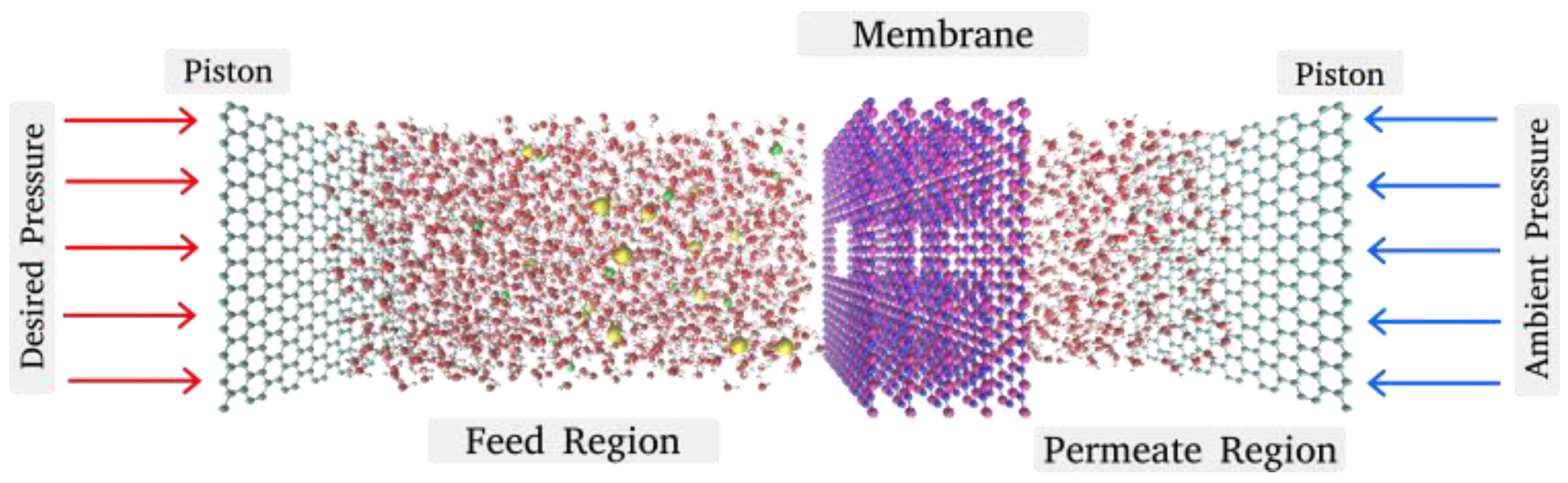
Figure 2.
Schematics of the pores (a–d) small pore (e–h) large pore (a,e) B-edged Boron nitride (b,f) N-edged Boron nitride (c,g) BN-edged Boron nitride (d,h) C-edged graphene [Magenta – Boron atoms, Blue – Nitrogen atoms, Cyan – Carbon atoms].
Figure 2.
Schematics of the pores (a–d) small pore (e–h) large pore (a,e) B-edged Boron nitride (b,f) N-edged Boron nitride (c,g) BN-edged Boron nitride (d,h) C-edged graphene [Magenta – Boron atoms, Blue – Nitrogen atoms, Cyan – Carbon atoms].
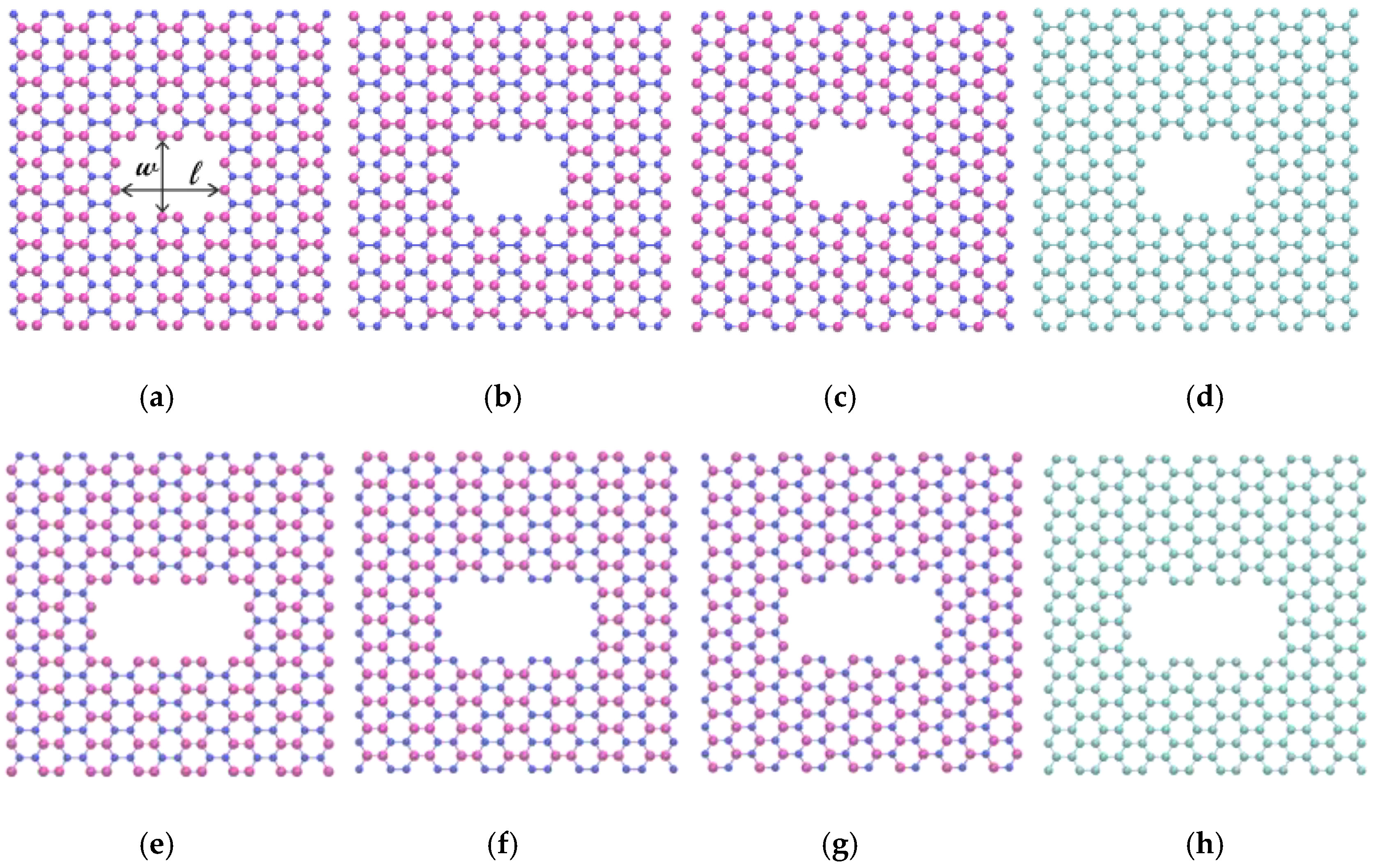
Figure 3.
Number of water molecules inside different porous membrane; (a) B-edged small pore, (b) N-edged small pore, (c) BN-edged small pore, (d) C-edged small pore, (e) B-edged small pore with ions, (f) N-edged small pore with ions, (g) BN-edged small pore with ions, (h) C-edged small pore with ions, (i) B-edged large pore, (j) N-edged large pore, (k) BN-edged large pore, (l) C-edged large pore, (m) B-edged large pore with ions, (n) N-edged large pore with ions, (o) BN-edged large pore with ions and (p) C-edged large pore with ions.
Figure 3.
Number of water molecules inside different porous membrane; (a) B-edged small pore, (b) N-edged small pore, (c) BN-edged small pore, (d) C-edged small pore, (e) B-edged small pore with ions, (f) N-edged small pore with ions, (g) BN-edged small pore with ions, (h) C-edged small pore with ions, (i) B-edged large pore, (j) N-edged large pore, (k) BN-edged large pore, (l) C-edged large pore, (m) B-edged large pore with ions, (n) N-edged large pore with ions, (o) BN-edged large pore with ions and (p) C-edged large pore with ions.
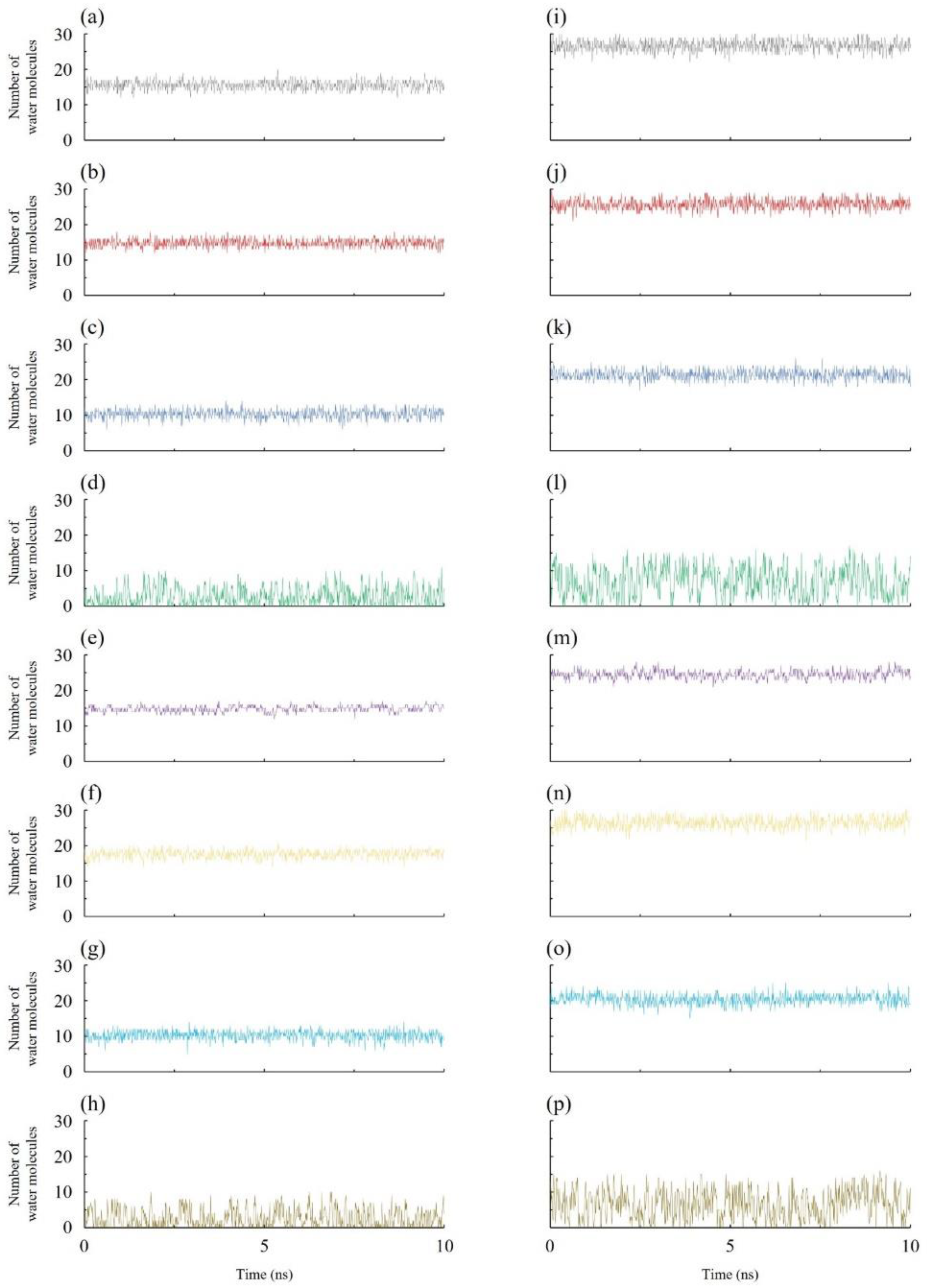
Figure 4.
Free energy of occupancy fluctuations of water molecules inside different porous membrane (a) small pore (b) large pore.
Figure 4.
Free energy of occupancy fluctuations of water molecules inside different porous membrane (a) small pore (b) large pore.
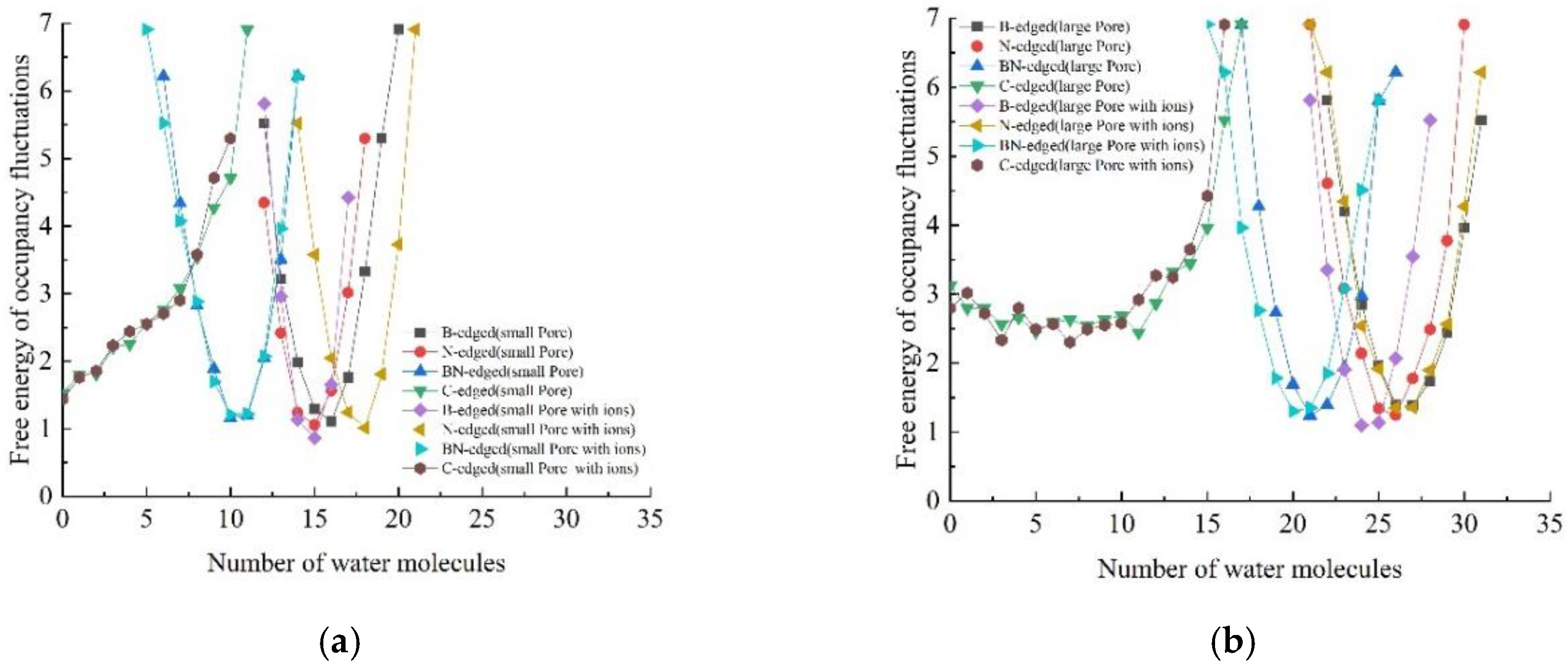
Figure 5.
Density of oxygen atoms inside different porous membrane (a) small pore (b) large pore.
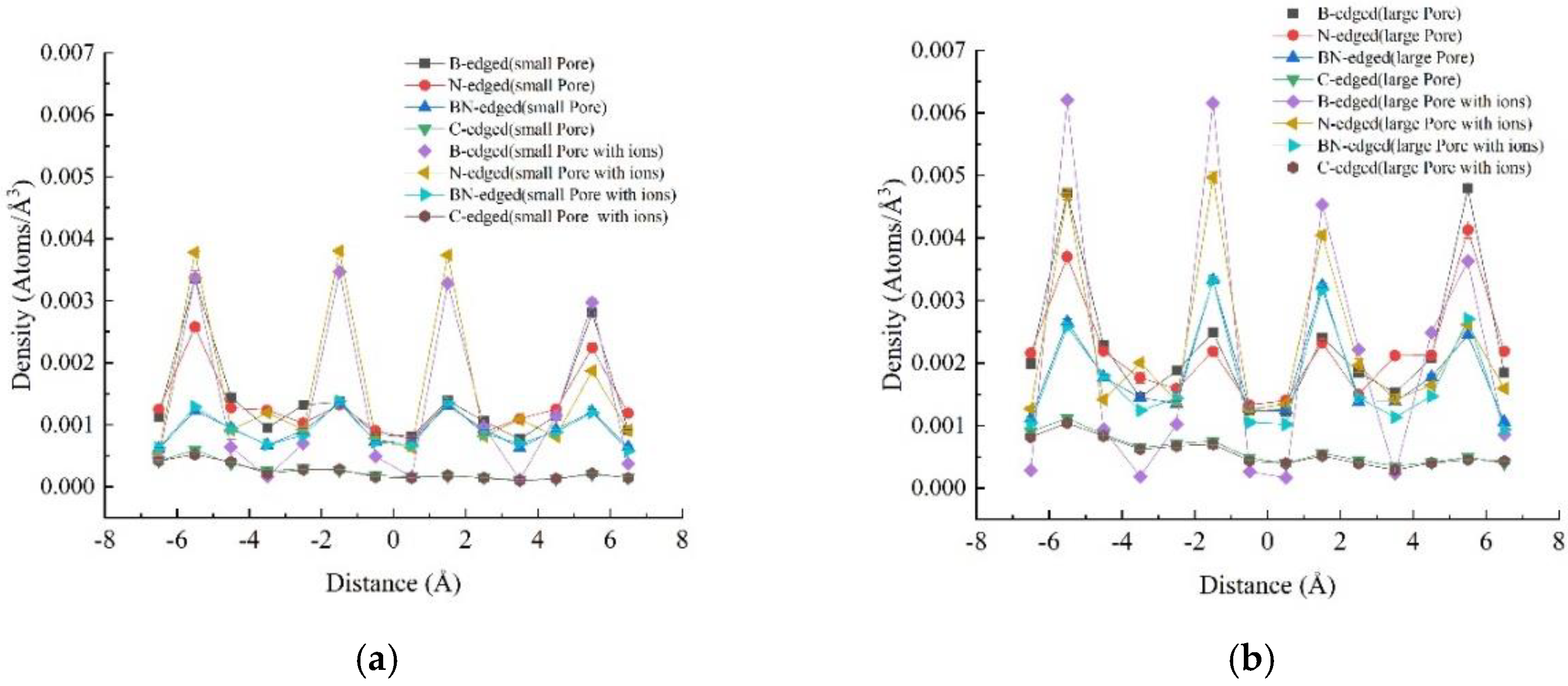
Figure 6.
Water molecules filtered using different porous membrane (a) small pore (b) large pore.
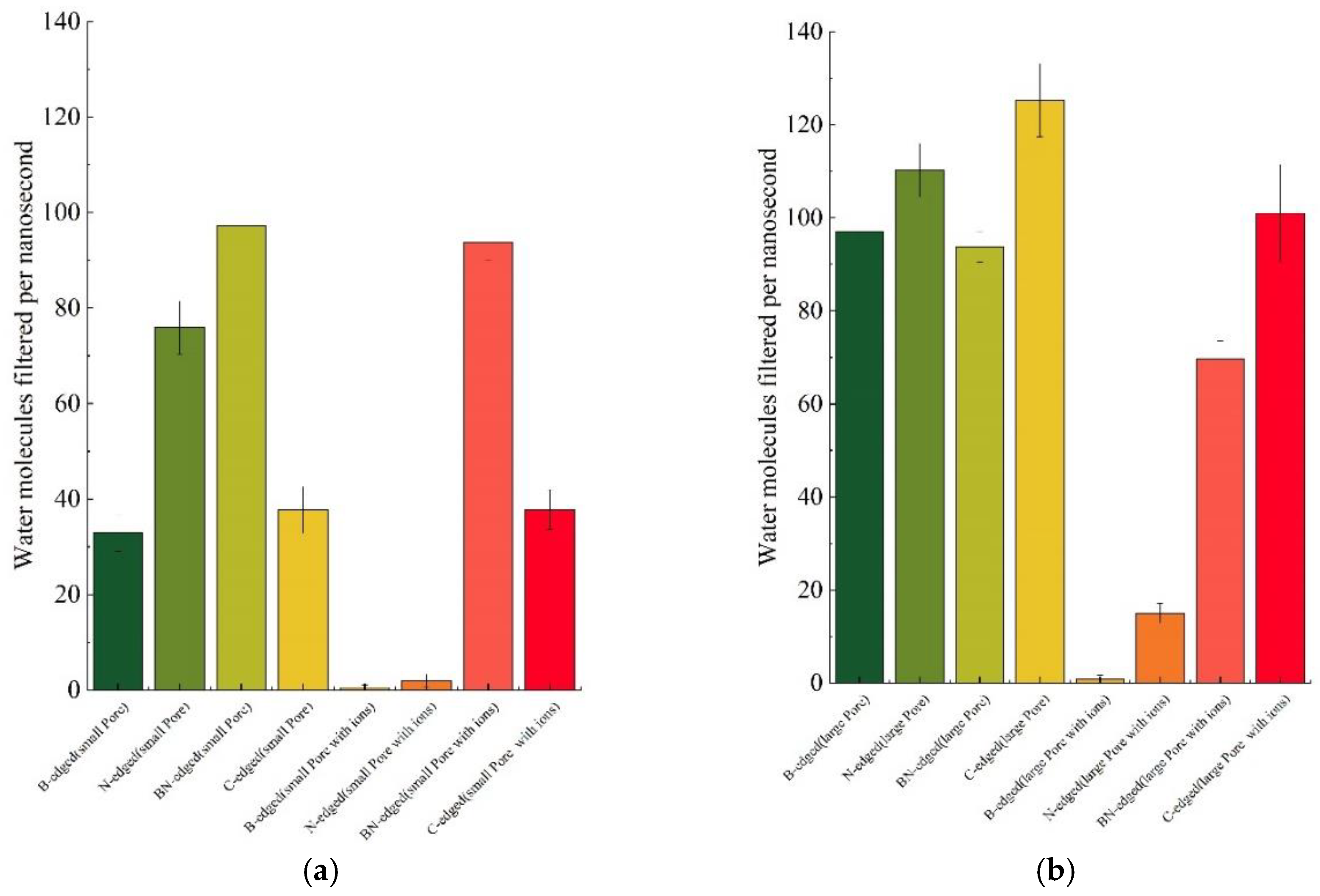

Table 1.
Force Field parameters.
| σ (Å) | ε (kcal/mol) | |
| O | 3.178 | 0.15587 |
| B | 3.453 | 0.0949 |
| N | 3.365 | 0.1448 |
| C | 3.3997 | 0.0859 |
| Na | 2.217 | 0.3519 |
| Cl | 4.849 | 0.01838 |
Table 2.
Dimensions of the pore used in this study.
| Type | Length (Å) | Width (Å) |
| B-edged (Small pore) | 10.12 | 7.51 |
| N-edged (Small pore) | 10.12 | 7.51 |
| BN-edged (Small pore) | 10.12 | 7.51 |
| C-edged (Small pore) | 9.93 | 7.37 |
| B-edged (Large pore) | 14.46 | 7.51 |
| N-edged (Large pore) | 14.46 | 7.51 |
| BN-edged (Large pore) | 14.46 | 7.51 |
| C-edged (Large pore) | 14.18 | 7.37 |
Disclaimer/Publisher’s Note: The statements, opinions and data contained in all publications are solely those of the individual author(s) and contributor(s) and not of MDPI and/or the editor(s). MDPI and/or the editor(s) disclaim responsibility for any injury to people or property resulting from any ideas, methods, instructions or products referred to in the content. |
© 2025 by the authors. Licensee MDPI, Basel, Switzerland. This article is an open access article distributed under the terms and conditions of the Creative Commons Attribution (CC BY) license (http://creativecommons.org/licenses/by/4.0/).
Copyright: This open access article is published under a Creative Commons CC BY 4.0 license, which permit the free download, distribution, and reuse, provided that the author and preprint are cited in any reuse.


