

Submitted:
03 March 2025
Posted:
04 March 2025
You are already at the latest version
Abstract
The recent fast advances in consumer electronics, especially in cell phones and displays, have led to the development of ultrathin, hence flexible, glasses. Once available, such flexible glasses have proven to be of great interest and usefulness in other fields, too. Flexible photonics, for instance, has quickly taken advantage of this new material. At first sight, “flexible glass” appears to be an oxymoron. Glass is, by definition, fragile and highly breakable: its structure has puzzled scientists for decades, but it is evident that in most conditions it is a rigid material, so how can it bend? This possibility, however, has aroused the interest of artists and craftsmen since ancient times: thus, in Roman times the myth of flexible glass was born. Furthermore, the myth appeared again in the Middle Age, connected to a religious miracle. Today, however, flexible glass is no more a myth but a reality, due to the fact that current technology permits to produce micron-thick glass sheets, and any ultrathin material can be bent. Flexibility is coming from the present capability to manufacture glass sheet at a tens of microns thickness coupled with the development of strengthening methods; it is also worth highlighting that, at nanometric scale, silicate glass presents plastic behavior. The most significant application area of flexible glass is consumer electronics, for the displays of smartphones and tablets, and for wearables, where flexibility and durability are crucial. Automotive and medical sectors are also gaining importance. A very relevant field, both for the market and the technological progress, is solar photovoltaics; mechanical flexibility and lightweight have allowed solar cells to evolve toward devices that possess the advantages of conformability, bendability, wearability, and moldability. The mature roll-to-roll manufacturing technology also permits to achieve high-performance devices at low cost. Here, a brief overview of the history of flexible glass and some examples of its application in solar photovoltaics are presented.
Keywords:
glass
; flexible glass
; photonic materials
; solar photovoltaics
1. Introduction
Flexibility limits of a material are related to its modulus of elasticity and thickness and are established by its strength or yield stress characteristics. Silicate glass is generally considered a brittle solid without plastic behavior. While this is true at macroscopic level, at nanometric scale it may present plastic yielding [1]. In technological applications of flexible glass, yielding effects can be neglected while strength limit shall be evaluated by looking at some modern capabilities of chemical strengthening by ion exchange [2].
Flexible glass, as we understand it today, is a modern invention associated with advanced technology and materials science. However, the concept of glass that bends or has some degree of flexibility has roots in ancient civilizations, where artisans were already experimenting with glass properties. Indeed, the idea of flexible glass is steeped in legend, blending history, mythology, and speculative technology. While no definitive archaeological evidence has confirmed its existence, references to ‘flexible’ glass appear in ancient writings, notably from Roman sources, and there are intriguing links to ancient Egypt's advanced glass-making techniques. This article wishes to shed light on some of these ancient legends, still leaving during the Renaissance, and then to discuss some of the recent advances in the fabrication and applications of real flexible glasses.
1.1. Flexible Glass in Egyptian and Roman Tales
The most famous accounts of flexible glass in antiquity come from the Roman historian Pliny the Elder (AD c. 23–79) and the writer Gaius Petronius Arbiter (AD c. 27–66). Pliny the Elder authored an extensive Natural History in 37 books, documenting the Romans’ knowledge of the natural world. The first 10 books were published in AD 77, but Pliny’s sudden death during the eruption of Vesuvius in 79 prevented him from revising the remaining volumes. These were posthumously edited and published by his nephew, Pliny the Younger (AD 61–c. 113), who praised the work as “a comprehensive and learned treatise, encompassing as much as Nature herself.” In Book 36, Pliny recounts a tale of a craftsman presenting Emperor Tiberius (AD 14–37) with a cup made of flexible glass (vitrum flexile) [3]. When the cup was left falling to ground, it was not breaking but merely dented, and the craftsman promptly restored it with a small hammer. A scientific notation to be highlighted from a modern perspective would be “denting” and “denting repair with the hammer”. This last element suggests a plastic behavior of the invented glass behaving like a metal with yielding properties: in some way this is more remarkable than the un-breakability condition. Tiberius, concerned that such an extraordinary material might devalue precious metals like gold and silver, allegedly ordered the artisan’s execution. Notably, Pliny approached the story with skepticism. He introduced it with the term ferunt (“it is said”) and concluded the narration with the phrase eaque fama crebrior diu quam certior fuit (“that rumor was long more widespread than reliable”).
A similar version of this story appears in Satyricon, a work of fiction by Petronius Arbiter: Fuit tamen faber, qui fecit fialam vitream, quae non frangebatur (“There was, however, an artisan who made a glass vial that could not be broken”) [4]. Like in Pliny’s account, this tale ends with the artisan’s execution rather than reward. Such narratives may have served as metaphors for the dangers that innovation may pose to established power and traditions.
The legend of flexible glass proved captivating and endured through the centuries. Petronius’s account is referenced in later works, such as Etymologiae (or Origines), an encyclopedia compiled by Isidore of Seville in the VII century, and Policraticus (or Polycraticus), an advice manual for rulers written in 1159 by John of Salisbury, a philosopher and bishop of Chartres, France. These enduring references highlight the story’s resonance as a symbol of both ingenuity and its potential perils.
An intriguing reference to flexible glass surfaced in much later writings, with connections to Egyptian history. In a book published in 1883 [5], Wallace-Dunlop mentions accounts by some Arab historians describing the activities of the Caliph Abdullah Al Ma'mun, son of Harun al-Rashid. Known for his intellect and passion for books, Al Ma'mun visited the pyramids of Giza around AD 832. Driven by a desire to uncover their secrets, he instructed his accompanying scholars to create a passage into the Great Pyramid of Khufu (Cheops). Their efforts succeeded, making Al Ma'mun the first person historically documented to enter this ancient monument. Today, visitors to the Great Pyramid still use the entrance originally opened by his team. However, according to these accounts, Al Ma'mun's exploration was met with disappointment. Instead of the books he hoped to find, he reportedly encountered only some gold and a few jewels. Wallace-Dunlop, on the contrary, cites the Arab historian Ibn-abd-Alkhom (possibly referring to Ibn ʿAbd al-Ḥakam, an eminent Egyptian historian and jurist of the IX century) as a source. Ibn-abd-Alkhom's writings suggest that in the west pyramid—believed to be that of Khafre (Chephren)—great treasures were once stored, including "arms which rust not, and glass that might be bent without breaking1." While fascinating, these claims are likely intertwined with myth. Historical evidence suggests that the pyramid may have been looted during the First Intermediate Period (c. 2181–2040 BC). Additionally, another Arab historian, Ibn Abd al-Salam, dates the first recorded opening of the Khafre pyramid to AD 1372. Nevertheless, these tales fuel speculation, with rust-resistant steel and flexible glass supposedly existing over 4,500 years ago. As James Gardiner wryly remarked in 1926: “Those ancients have a most exasperating way of anticipating our new ideas.” [6].
The existence of flexible, unbreakable glass was also mentioned in the Kenyon Papyrus (AD III century) [7]. Certainly, Egypt, a hub of advanced glass-making techniques since the 18th Dynasty (c. 1550 BC), played a significant role in early glass production. Egyptians pioneered core-forming, a method used to create hollow vessels such as flasks and vases. Their mastery over glass coloration and form demonstrates their exceptional skill. Their glass, however, were typically soda-lime silica akin to modern compositions, hence inherently brittle and without the flexibility described in these legends. It appears clear that their techniques primarily aimed to imitate precious stones rather than to innovate structural properties like flexibility.
Ancient accounts of "flexible glass" might perhaps have referred to extremely thin, malleable sheets of glass, mica, or early laminates. Alternatively, they could allude to glass treated with heat or chemicals to reduce brittleness, though such methods would have been improbable in the ancient world. During Roman times, glassmakers' techniques, including blowing and molding, produced highly refined glassware used for everyday purposes and luxury items. The properties of Roman glass often made it more resistant to shattering under mild stress compared to other materials of the time, but the notion of flexibility likely falls short of any significant measurable property resembling malleability.
1.2. Legend of Non-Breakable Glass in the Middle Age
In the 13th century, a new legend of unbreakable glass emerged, this time linked to a religious miracle. According to the account, a drinking glass miraculously remained intact after being thrown to the ground by a heretical knight named Aleardino da Salvaterra. This dramatic gesture formed part of a public challenge to Saint Anthony of Padua, demanding proof of his sainthood. The event is immortalized in a marble relief, crafted in 1529 and housed in the Chapel of St. Anthony within the Basilica of S. Antonio in Padua. Lucchini’s paper [8] provides a compelling analysis of this episode and other alleged glass-related miracles, offering insight into the cultural and symbolic importance of glass in medieval religious contexts.
2. Recent History of Flexible Glass
Although flexibility was almost certainly not a characteristic of any ancient glass, early experiments with glassblowing, casting, and layering techniques laid the foundation for later innovations. Lattermann [7] offers an intriguing review of tales and discussions from the 16th to 19th centuries about the alchemical pursuit of malleable glass. Based on the documents examined, the author deduces that alchemists interested in vitrum malleabile were likely searching for a material that combined two key properties: softness and deformability at room temperature or slightly higher, along with optical transparency. These properties did not necessarily align with the chemical definition of glass. A comparable result was achieved much later, with the development of silicone-based materials, which has its roots in 20th-century chemistry. Frederick Stanley Kipping (1863-1949) was an English chemist who did much of the pioneering work on silicon polymers and coined the term silicone, while in the 1930s James Franklin Hyde (1903-1999) laid the groundwork for their commercial production, which has included squishy glassware. Figure 1 shows the artist’s sketch of a silicone water glass bouncing back from the floor.
Only recently, the advances in flat glass manufacture led to the production of high-quality thin and ultra-thin glasses. The former definition typically refers to glass with a thickness ranging between 1.1 mm and 2 mm; actually, thin glasses production may be dated back to Roman period, but uniformly thin flat glasses started to be available during the medieval period, and their quality and clearness were much improved in the 19th century. Nowadays, thin glass is widely used in applications like lightweight glazing, solar panels, and display screens. Ultra-thin glass (UTG), on the other hand, has a thickness of less than 1 mm, often going down to as little as 0.05 mm (50 microns) or even less; its production begun in the mid-20th century. Any ultra-thin material becomes flexible and UTG is efficiently used in advanced technologies such as foldable displays, flexible electronics, and micro-optics. More precisely, at least for discussion purposes, it is convenient to name ‘flexible’ a glass that is 200 µm or thinner. This category is not rigidly standardized but is commonly recognized across industries.
As technology progressed, especially in the development of flexible electronics, thinner glass has been engineered with enhanced properties to meet specific performance requirements. Indeed, also the pursuit of flexible glass received renewed momentum toward the end of the 20th century with the advent of flexible electronics and, later, of flexible photonics [9]. This technological shift demanded materials with a unique combination of mechanical flexibility, transparency, and durability, driving innovations that bridged the gap between ancient myths and modern scientific capabilities. Two domains, in particular, have benefited from the development of flexible devices: flexible displays and flexible integrated optics.
The technology of flexible displays had its origins in the mid-20th century but gained significant traction toward the late 20th and early 21st centuries. The theoretical foundations were laid in 1960s-1970s, with the research on thin-film transistors (TFTs) and organic light-emitting diodes (OLEDs): these technologies would later form the backbone of flexible displays. In 1987, at Eastman Kodak, Tang and Van Slyke built the first OLED device operated at sufficiently low voltages paving the way for the commercialization of OLED technology [10]. Since then, research has continuously progressed, and the interested reader is referred to the rich report on the development of OLEDs in industry and of OLED emitters in academia by Hong et al. [11], as well as to the continuously updated OLED history available on the web [12]. Adding flexibility to OLEDs could create new possibilities in functionality and design of displays, and indeed it was the subject of a new wave of research.
Two major types of substrates could be used for flexible OLEDs and more generally for photonic applications: polymers and ultrathin glass. At a first glance, polymer sheets are the materials of choice for flexible substrates and for electronic circuits because they can sustain far greater strains than glass, but in general they suffer from thermal instability as well as from high permeation rates for gases and water and hence chemical stability. In contrast, standard glass is a good barrier material but is brittle and can only sustain small strains, thus strongly limiting the flexibility of the device. A solution combining chemical and mechanical resistance with flexibility was offered by the development of UTGs. The research in this field, however, had started well before many can guess. At this regard, an interesting story was told by the Japanese glass producer NSG (Nippon Sheet Glass) [13]: from around 1965, NSG began receiving numerous orders for thin glass for use in photographic plates but also wristwatches and liquid crystal panels. At the beginning, NSG produced thin flat glass ~ 1.2 to 1.4 mm in thickness by using the Coburn glass sheet draw process, and fulfilled orders for even thinner 1.1 mm flat glass by importing it from the Belgian company Glaverbel. From around 1975, demand for wristwatch and liquid crystal panel glass grew in earnest, and NSG began development of ultra-thin flat glass. The development team succeeded in mass production in 1978 of 0.7 mm - 0.55 mm soda-lime flat glass, that was named Ultra Fine Flat (UFF®); in the following years, the quality and yield were improved by using the float glass production process. UFF is now available in a wide range of thicknesses, from 0.28 mm up. Eventually, in 2015, mass production was initiated of a new clear chemically strengthened composition glass, named Glanova®, that utilized the advantages of the thin sheet float process while being low cost and stronger than conventional soda lime glass [14].
More generally, the years 2000 saw the growth of investigations on the mechanical behavior of ultrathin glass in view of its use as a substrate and encapsulating cover for flexible displays. One of the first published works reported, in 2002, a limited number of tests, not sufficient to perform any statistical analysis, carried out on 50 µm thick AF45 and D263® Schott glasses [15]. There was some indication that thin coatings do improve the fracture strain. Three simulated smartcards with an embedded OLED device on 22×11 mm glass substrates with surface coatings all withstood 1000 cycles that produced a minimum radius of curvature of 35 mm (in the Credit card standard is 29 mm), which is equivalent to a maximum strain of 0.14%. Almost at the same time, it was also demonstrated that OLED devices with certain flexibility can be reliably built on ultra-thin glass substrates; comparison was made of devices obtained with UTG or polymeric foils [16]. In December 2003, a Schott group [17] reported the development of flexible glass substrates down to a thickness of 50 μm and showed that the deposition of an organic coating could overcome significantly the lack of mechanical stability, concluding that these flexible glass substrates were suited for production of flexible printed circuit boards (PCBs). Similar results were published two years later by another group, which showed that an UTG sheet with an optimal reinforcement polymer layer was a suitable substrate choice for flexible OLEDs/PLEDs [18]. The minimum radius of curvature of a 50 µm thick D263 glass can reach to a value of 8 mm, but, due to the flaws or imperfections of the glass edges and corners, the observed minimum radius of curvature was still more than 30 mm.
At Corning, another leading glass manufacturer, the leap toward developing ultra-thin glass began in early 2007, sparked by discussions between Corning's CEO, Wendell Weeks, and Apple's CEO, Steve Jobs [19]. Jobs reached out to Weeks with a bold request: to create a scratch-resistant and durable glass cover for a new Apple product within just six months. Initially hesitant, Weeks knew it would be a significant challenge. Corning had been working on a highly durable glass, internally known as 0317 and later marketed as Chemcor®. This glass, strengthened through an ion-exchange process, could endure extraordinary bending, twisting, and pressure—up to 7 tonnes per square centimeter—but was only available in a 4 mm thickness. Apple, however, required massive quantities of glass just 1.3 mm thick—something that had never been developed or produced before. Despite the hurdles, Weeks accepted the challenge, and as a result, the first iPhone, launched in the United States on June 29, 2007, featured a Gorilla® glass cover—the name given to this groundbreaking product [20].
Since then, some papers have been published dealing with the characteristics of UTGs, but the focus of R&D has been continuously moving onto their applications, which will be the subject of the next section in this paper. It shall be highlighted that, even though strengthening of UTG by ion exchange significantly increases strength limit and allows an extraordinary reduction of bending radius limit, significant modifications of refractive index due to the polarizability of exchanging ions impose limits in optical waveguides’ applications [2]. An excellent source of information on properties, fabrication, coating and applications of flexible glass is constituted by the book edited by S.M. Garner and published in 2017 [21]. Due to his long activity in Corning, throughout the book, Garner used Corning Willow® Glass as an example of a flexible glass substrate.
On the market side, Corning surely is one of key players. Currently, however, the global production of UTG is dominated by several leading manufacturers, each catering to diverse industries like electronics, automotive, and renewable energy. An alphabetical list of key players include:
- -
- Asahi Glass Co. (AGC) (Japan): Innovated ultra-thin glass for next-generation displays, including foldable screens.
- -
- Central Glass Co., Ltd. (Japan): Specializes in ultra-thin glass for solar panels and electronics.
- -
- Corning Inc. (USA): Renowned for its Gorilla Glass, Corning has expanded into ultra-thin glass for foldable devices and flexible electronics applications.
- -
- Emerge Glass (India): A key player in the South Asian market, offering specialized ultra-thin glass products.
- -
- Luoyang Glass Co., Ltd. (China): Focuses on ultra-thin glass for various industrial applications.
- -
- Nippon Electric Glass Co., Ltd., NEG (Japan): Produces ultra-thin glass for touchscreens and advanced display technologies.
- -
- Nippon Sheet Glass Co., Ltd., NSG (Japan): Produces ultra-thin UFF and Glanova glasses widely used in the automobile industry and in the liquid crystal industry.
- -
- Schott AG (Germany): Offers products such as the ultra-thin Schott AS 87 Eco, designed for use in consumer electronics, particularly in smartphones and wearable devices.
- -
- Xinyi Glass Holdings (Hong Kong): Supplies ultra-thin glass for electronics and the solar energy industry.
These manufacturers are at the forefront of research and development, pushing boundaries in materials engineering to meet the growing demand for flexible and durable ultra-thin glass in cutting-edge technologies. Table 1 summarizes the main technical characteristics of some of the most diffuse types of UTGs.
Here, the indications by manufacturers on possible applications of their products are reported:
{A} Electronics (Smartphones, tablets, laptops, interactive displays, et.) – Transportation (trains, aerospace, automotive, etc. (interior and exterior)) – Building (lightweight assemblies, creative designs, etc.)
{B} Ideal protective cover material for the front and back of all electronic devices: smartphones, notebook PCs, tablets, smartwatches and wearables, smart home devices, cameras, commercial and point of sale displays
{C}Willow Glass is also used in architectural applications to provide a high gloss, durable surface finish that can withstand the effects of commercial cleaning agents.
{D} G-Leaf is a next-generation material that holds excellent potential for applications such as electronics, energy-related products, medical-use products, and lighting.
{E}Glanova is an ultra-thin sheet glass for chemical strengthening that is ideal for use as cover glass for automotive CIDs, clusters, and electronic devices.
{F} AS 87-neo meets the high demands of modern high-performance technology for robustness, offering exceptional impact and bending strength. The specialty glass enables foldable, well-protected devices without compromising touch sensitivity or functionality.
{G} Schott D 263 performs consistently well in demanding conditions. Its high chemical resistance makes it particularly resilient in the consumer electronics, semiconductor and biotech fields. Variants of D 263 focus on specific requirements in particular applications. D 263 bio is suited to medical diagnostics, while D 263 M provides accurate microscopy cover slips. Schott D 263 T eco is used in imaging, sensing and semiconductors, as well as RF / HF applications, and D 263 LA eco is effective in image sensor systems.
Finally, to testify the scientific interest in the characterization and application of flexible glasses, Figure 2 shows the data extracted from a search in the Clarivate Web of Science for papers containing in their title the terms ‘flexible’ <and> ‘glass’. Even if with oscillations, the growth of number of publications since the years 2000 is evident.
3. Photonic Applications of Flexible Glasses
Photonics is the science of light generation, manipulation, and detection. Flexible photonics, as well as flexible optoelectronics, is a rapidly advancing field at the intersection of photonics and flexible electronics [9,29,30,31], and allow us to extend the light managing capabilities to bendable, stretchable, or conformal platforms. It involves the integration of optical components and systems onto flexible substrates, enabling applications in areas where traditional rigid photonic devices are impractical or poorly efficient. By leveraging flexible substrates and innovative material systems, photonic devices can maintain their functionality under mechanical deformation. Two key characteristics concern waveguiding, i.e., the capability of ensuring efficient light transmission through deformable waveguides, and optoelectronic integration, i.e., the combination of flexible photonic components with electronic circuits for advanced functionalities. On the mechanical side, materials and structures must be able to withstand repeated bending or stretching without degradation.
Materials, of course, play a critical role in the development of flexible photonic devices. Durability and fabrication scalability are two main challenges. Polymers, metals and dielectrics, liquid crystals and 2D materials have all effectively contributed to the advances of flexible devices across various domains, such as photovoltaic systems [32,33], flexible displays and lighting devices [18,34,35,36], optical communication and sensing [37,38,39,40], biomedical devices and wearable technology [41,42].
In some applications, however, e.g., in the fabrication of OLEDs and polymer light emitting devices (PLEDs), the use of an UTG substrate has the great advantage of effectively protecting the organic layers from the diffusion of chemically reactive oxygen and water molecules. An early work [18] suggested to increase the robustness of the UTG and reduce the risk of cracks by depositing on it a reinforcement polymer layer; a properly diluted polydimethylsiloxane (PDMS), with the addition of aluminum 2,4-pentanedionate (C15H21AlO6) to control the polymer’s shrinkage, was deposited by spin coating on a 50 mm thick Schott D263 substrate. In a 1000-cycle bending test, more than ~94% of the polymer-reinforced UTG sheets passed under 30-mm or higher length compression, in comparison to only 30% of uncoated samples under the same conditions. As a conclusion, the authors claimed that polymer-reinforced UTG was suitable for fabrication of flexible or preshaped OLEDs/PLEDs. A recent work, however, has proved that, with proper processing technologies, a standard Corning Willow UTG (thickness below 300 µm) is suitable to fabricate bendable OLEDs [36]. The process is explained for a bendable OLED automotive taillight and includes several steps: bonding and debonding of the UTG to a carrier glass, UTG panel edge finishing, and UTG panel lamination on a holder. The authors also suggest that the UTG process may be used for bendable general lighting.
Due to the many different R&D fields and the large number of applications of UTG substrates, here we are forced to limit ourselves to report on the advances only in a single field, and we considered solar cells on flexible glass as a topic worth of description.
3.1. Flexible Solar Photovoltaic Systems
Solar cells (SCs) were among the first devices to showcase the benefits of mechanical flexibility in photonic applications. In fact, a flexible array of solar cells was proposed as early as 1967 for satellite power generation in space. This design utilized dendritic web silicon solar cells measuring 1×30 cm with a thickness of approximately 250 μm. The substrate was Teflon-impregnated fiberglass material, approximately 37.5 mm thick [32].
In the last few decades, the evolution of solar cells developed incredibly fast, thanks to both a multiplication of different technologies driven by the synthesis and optimization of novel materials and a continuous increase of efficiency, made possible by proper structure design and light management strategies [43]. Figure 3 summarizes the main types of solar cells developed so far, classified according to the active (i.e., the primary light absorbing) material [44]. The structure of most of the thin film SCs is based on an insulating substrate, polymers and glass being the most common.
Space applications of SCs remain of great interest even today, aboard satellites both for inner planets missions (e.g., Venus and Mars) and for travels to outer planets (e.g., Saturn and Jupiter) or into deep space; for missions lasting years, only SCs or nuclear power systems in conjunction with rechargeable batteries may guarantee uninterrupted and stable electrical power. A few excellent review papers provide an overview of the development and perspectives of solar photovoltaics in space [45,46,47,48.49,50].
Flexible and lightweight solar cells have attracted a continuously growing attention not only for use in spacecrafts and aircrafts, but also for portable or wearable power sources, or on curved surfaces in building and automotive industries. Figure 4 shows how the technological advances have led to produce more and more efficient power-per-weight ultra-thin (flexible) solar cells; thanks to the high absorption coefficient, the active perovskite layer in a cell may be very thin, typically below 1 μm. In the plot, the best result refers to a perovskite solar cell (PSC), used to power aviation models, which weighs 5.2 g m-2 and has 3 µm thickness, including a polyethylene terephthalate (PET) substrate, electrodes and a protective encapsulating layer; it exhibits a stabilized 12% efficiency and a power-per-weight as high as 23 W g-1 [51].
In most of the structures considered in Figure 4, the substrate is a very thin polymeric material, but the use of UTG substrates is gaining consideration, due to their robustness, thermal and chemical resistance. Figure 5 summarizes in a graphical way the strengths and the weaknesses of the different types of substrate material, in terms of flexibility, portability, optical properties, as well as thermal and environmental stability [52]. With particular reference to glass, which offers excellent optical and thermal properties, high mechanical strength, and durability, the rigid substrates, that possess notable chemical stability and robust resistance against environmental factors like moisture and oxidation, must face the challenges of brittleness and weight. On the other hand, the UTG substrates, too, are inherently fragile and prone to cracking or breaking under mechanical stress, so to require specialized techniques in the manufacturing and processing stages. Moreover, in terms of moisture sensitivity, ultrathin glasses may be more vulnerable than their rigid counterparts to moisture penetration.
In the space, one of the challenges is also concerning the impact of high-energy particles, first of all electrons and protons, which change the electrical properties of the cells and cause degradation [50,53-55]. Glass substrates, too, are deeply affected, with a significant decrease in the transparency, particularly in the 300-600 nm range. This decrease is attributed to the creation of color centers, due to ionization-generated carriers being bound in vacancies or impurities. It is well known, however, that cerium-doped glass is very effective in absorbing high intensity radiation that would darken any conventional glass [53], and SCs often adopt a Ce-doped glass as a protective cover. In a work by Yang et al., proton irradiation resistance of ultralightweight CdS/CdTe thin film solar cells was investigated, and the use of ultra-thin alkali-free Corning borosilicate glass 100 µm thick was tested [54]. As expected, transmittance loss of the glass significantly increased at lower wavelengths, and a transmittance reduction of 3 % was observed at 550 nm; despite of it, the specific power produced by the cell after proton irradiation was still valuable and higher than the reported values of some other unirradiated SCs. An innovative solution was proposed in 2017 by Lamb et al. [55], who, using metal organic chemical vapour deposition (MOCVD), deposited thin CdTe film onto a 100-µm chemically toughened and cerium-doped cover glass, supplied by Qioptic Space Technology (now part of Excelitas Technologies Company [56]). The superstrate configuration of the cell (i.e., with the sunlight coming through the glass) is shown in Figure 6. Samples proton-irradiated at 0.5 MeV and fluence 1 × 1012 cm-2, i.e., a dose reasonably close to the value expected in a 20-year geosynchronous earth orbiting (GEO) mission, exhibited a decrease of the relative efficiency of the SC by only 5%. This excellent response was attributed to the use of Ce-doped cover UTG, that remained fully transparent whilst protecting the underlying cells from the high energy protons and electrons. The photovoltaic performance of this kind of SC was tested onboard the AlSat-1N CubeSat in low earth orbit. The data collected over some 17,000 orbits by the CubeSat in a 3-year period have shown no signs of delamination, no deterioration in short circuit current or series resistance [57].
Even if rigid silicon and III-V semiconductors still dominate the overall photovoltaic market, flexible SCs based on thin-film technologies and UTG substrates are gaining room. Let us provide some examples of promising achievements.
3.1.1. CdTe Solar Cells onto UTG Substrates
CdTe must be considered a very promising solar cell material, especially for thin-film structures. In fact, it exhibits a forbidden gap of 1.45 eV very close to the maximum of solar energy conversion and, as its gap is direct, its absorption coefficient is very high, so that only a few microns of material are enough to absorb all the light at wavelengths higher than bandgap [58,59]. Thus, there has been a growing interest for the development of fully flexible CdTe/CdS SCs [58-66]. An additional study of the CdTe SC based on a 100 µm thin Ce-doped glass, already mentioned in the above section [55-57], has shown that bending the cell with 40 mm radius did not significantly affect the J-V characteristics of the cell [60]. Furthermore, the measurements of two cells (labeled A2 and B2, respectively) located in different positions in the 60 × 60 mm glass substrate and subjected to repeated bending didn’t show any degradation within experimental error. A static 32 mm bending test was performed for 168 h; the J-V was measured before and after bending at 0, 24, 48, 120, 144 and 168 h. The mean value of efficiency for all the 8 solar cells in the sample was 13.7% with a best cell performance of 14.1% for the best cell. Table 2 compares the measured values of the parameters at the initial flat state and at when the sample was reset to a flat state after the 168-h test; the performance is almost identical, within experimental error.
Some other papers have reported on CdTe SCs using the Corning Willow UTG as a substrate [61,62,63,66,67]. The excellent transmittance of Willow glass is shown in Figure 7, where it is compared with two rigid glasses (soda-lime and Corning 7059) and DuPont Kapton® polyimide. Kapton has lower transparency (practically zero below 400 nm) due to material’s absorption, whereas the lower transmission of rigid glasses below 300 nm may be attributed to their larger thickness [61].
The performance of a solar cell depends, among various factors, also on the quality of the transparent conducting oxide (TCO) used for electrical contact. TCOs are electrically conductive materials with low absorption at visible and near infra-red wavelengths; various materials are used, including fluorine doped tin oxide (FTO), indium tin oxide (ITO), and aluminum-doped zinc oxide (AZO). Liyanage et al. [63] aimed to develop an efficient process for the fabrication of CdTe SCs using as a CTO a layer of cadmium stannate (CTO); they deposited ≈ 300-nm-thick CTO layer on a 200 µm Willow glass by using reactive RF-sputtering and found that this material has an excellent compatibility with the closed space sublimation (CSS) process [64,65] used for the CdTe deposition. As a result, a best efficiency of 14.4% under AM1.5 illumination was achieved with the flexible Willow glass substrate, compared with 11.7% with a rigid soda-lime substrate. A more recent paper reported an efficiency of 17.2% and 14.6% under AM1.5G and AM0, respectively (AM1.5G represents the standard spectrum at the Earth’s surface), by employing the latest advances in device fabrication. The superstrate was a 100 µm Willow glass and sputtered CTO was used as a transparent conductor [67].
The CSS deposition process of CdTe is particularly attractive due to ease of use and cost effectivity; ultra-thin glass substrates are desirable because they withstand very well the high temperatures (> 500 °C) reached in the process. Doroody et al. [64] investigated the effect of the deposition temperature on the properties, e.g., grain growth and surface morphology, of CdTe thin films grown onto 100 µm thick Schott D263T flexible glass substrates. Figure 8 shows the images of a 3 × 3 cm 100-µm thick Schott D263T glass: (a) before processing, (b) after RF-sputtering of a ≈ 150 nm thick CdS layer, and (c) after CSS-deposited CdTe film (samples had thickness in the range 6 to 45 µm, depending on the process temperature).
In another work, by Amin et al., an in-depth analysis is presented of the influence of pressure on the CSS growth of CdTe onto 100 µm thick Schott D263T glass [65]. In this case, the source and substrate temperature during the process were fixed at 600 °C and 500 °C, respectively, whereas different samples were processed at ambient (Argon) pressure in the range 1 to 200 Torr. The study demonstrated that the ultra-thin substrate did not show any deformation or structural change during the process. According to the measurements, a Torr pressure of about 1 to 5 Torr may be the optimum deposition condition for CdTe layer on a Schott D263T substrate.
3.1.2. CIGS and Perovskite Solar Cells onto Flexible Glass Substrates
Among thin film solar cells, those based on CIGS (Copper Indium Gallium Selenide) and perovskite materials represent prominent technologies, boasting some of the highest efficiencies, often exceeding 23% in laboratory. As to the former material, the current efficiency record of 23.6% was obtained in 2024 at Uppsala University for a (Ag,Cu)(In,Ga)Se2 (ACIGS) composition, thanks to the introduction of a relatively high amount of silver into the absorber and the implementation of a ‘hockey stick’-like gallium profile with a high concentration of Ga close to the molybdenum back contact onto a soda-lime substrate [69]. A slightly lower efficiency of 22.2% had been achieved at Swiss Federal Laboratories for Materials Science and Technology for a flexible ACIGS solar cell with a different Ga profile (V-shaped) on a polymer substrate [70].
To be commercially competitive, the manufacturing route for a solar cell needs to be economical. The CIGS material has a direct bandgap and high absorption coefficient, so that layers as thin as 1 µm are enough to guarantee efficient sunlight absorption. Additionally, its optoelectronic properties can be tuned by varying composition in a wide range. Several solution-based techniques for CIGS, like spin coating, doctor blade technique and ink jet printing for absorber layer deposition are being widely explored; they are low-cost approaches, compared to the vacuum based sputtering and co-evaporation routes. Flexible CIGS SCs have great potential for terrestrial and space applications, and the search for proper flexible substrates instead of the widely used 0.3 mm soda-lime glass has begun quite early; one of the first approaches concerned the use of a Ti foil [71]. In a slightly later paper, 0.5-2 mil (i.e., 12.7-50.8 µm) thick Al, Ti and Mo foils were investigated as possible substrates for CuInSe2 layers and all three appeared compatible with the necessary selenization process, provided that a Mo layer of good mechanical integrity was interposed between the foil surface and the growing CuInSe2 film [72]. Various other flexible substrates such as stainless steel, polyimide and other plastics have been explored and used for CIGS flexible solar cells but they possess inadequate thermal stability and low chemical inertness.
Since 2010, the attention has moved toward chemically inert, stable, and light weight flexible substrates such as ultra-thin ceramics [73] and glasses [74-80]. CIGS solar cells grown onto 50-µm thick flexible zirconia sheets, covered by a RF-sputtered layer of soda-lime glass some 100-120 nm thick, achieved an efficiency over 16% [73]. To demonstrate the feasibility of a non-vacuum process, films made from a mixture of CIGS powder and polyethylene were applied by the doctor blade technique on Mo-coated flexible 150-µm Willow glass substrates; the films were then post-treated using an intense pulsed light (IPL) and their good quality as thin-film absorbers was confirmed by the structural and morphological characterization [74].
Looking for an ultra-thin glass with thermal stability over 550 °C and a coefficient of thermal expansion (CTE) as close as possible to the CTE of CIGS (in the range 5 to 12 10-6 K-1), to avoid cracks and adhesion problems, Gerthoffer et al. [75] choose to fabricate solar cells onto 100-µm thick Schott D263T substrates, having a CTE equal to 7.2 10-6 K-1. The 2 µm CIGS absorber layer was grown by a three-stage co-evaporation process and the 50 nm CdS buffer layer was produced by chemical bath deposition. Reference samples were also fabricated onto 1-mm-thick soda-lime glass (SLG) with the same fabrication process. The best measured efficiency of the solar cell in flat state was 11.2% for the flexible device and higher than 12% for the device on SLG; this difference was attributed to the lower presence of sodium in the CIGS layer, due to the fact that there cannot be Na diffusion from the UTG, which is alkali-free. By subjecting the device to bending tests, the results indicated a significant drop of efficiency with the increase of curvature and that performance was not recovered when resetting the device to flat state. Later, the same research group made an in-depth study of mechanical characteristics and strain of the CIGS SC on Schott D263T substrate, also measuring for the first time the CIGS hardness. A relative efficiency decrease of 20% was measured after three bending cycles with a ≈ 50 mm radius of curvature. By comparing these results with those for a 25 µm thick polyimide substrate it was evident that, due to smaller thickness and lower Young modulus, the latter induced less strain at a given radius of curvature.
Very recently, flexible CIGS solar cell with CdS buffer were fabricated on an 89-µm-thick UTG using a well-known three-stage process, achieving a high 18.1% efficiency [79]. The authors found that the stress induced by the high temperatures (>600°C) made the UTG substrate brittle and losing its flexibility. To avoid these problems, which are attributed to thermal reorganization of potassium, a thin Ag precursor layer was introduced, that enabled effective grain growth at reduced temperatures (<500°C). The optimized Ag doping (~1 at%) enhanced grain structure and device efficiency, allowing them to reach up to 17.45% efficiency at a lower temperature.
As to perovskite solar cells (PSCs), they are a relatively new class of photovoltaic technology based on hybrid organic-inorganic materials with the perovskite crystal structure (ABX₃) [81]. Their development has been remarkably fast compared to other solar technologies: after 2006 initial exploration, the rapid advancements since 2015 pushed lab-scale efficiencies above 25%, making PSCs competitive with traditional silicon cells. One of the main issues of perovskite SCs is stability, but great progresses have been made also at this regard; a recent review paper presents the current status and the achievements in stability from 2022 to July 31st, 2024 [82]. Like with other materials [83], the outstanding potential in combining the high efficiency of perovskite materials with the adaptability of flexible substrates has pushed the research for the development of flexible devices (FPSCs) [84]. UTG substrates have therefore been investigated to that purpose [85-93].
One of the early works concerning FPSCs used a two-step thermal evaporation method to deposit an organo-halide perovskite film onto a 50-µm-thick Willow glass, obtaining a conversion efficiency up to 12.06%, which was decreased by only 4% after 200 mechanical bending cycles [85].
To improve the light trapping capability of the device, an array of nanocones was fabricated in a polydimethylsiloxane (PDMS) 0.2 mm thick film; such a structure combined anti-reflection, water-repellent and self- cleaning functions at the same time. Thanks to the strong van der Waals interaction of PDMS with glass, PDMS can be easily attached to the Willow glass. The efficiency of the flexible PSC with the nanocones increased to 13.14%. A test of bendability of the solar cells was also performed using a solar cell 3 cm long and bending it to a radius of 40 mm during 200 cycles; the SC performance was measured after each cycle. Figure 9 shows (a) a photograph of the FPSC onto Willow glass and (b) the good stability of operational parameters during the test. The maximum bending angle, shown in Figure 9a, was found to be 90°; beyond that, the flexible glass substrate is prone to break. Overall, at the end of the 200 bending cycles, the efficiency only decreased from 11.7 to 11.24%.
A further step forward in the efficiency of a FPSC on a flexible glass substrate was made by Dou et al. [88], who optimized the cell structure by testing three different TCOs, namely, AZO, ITO and IZO. Their study demonstrated that the chemistry of the perovskite active layer can be strongly affected by the choice of the TCO on which it is grown; it came out that IZO layers are the most effective, enabling to reach power conversion efficiency over 18%. Figure 10 shows the complete structure of the FPSC under test and the photographs of the cell in a flat and bent condition.
Most of the reported results refer to small-area cells, often much smaller than 1 cm2, and is expected that large-area cells exhibit lower power conversion efficiency due to the greater difficulty of realizing a homogeneous and densely packed perovskite film over a large area and to the series resistance of the transparent conductor electrode. An excellent performance was obtained by Dai et al., who deposited perovskite films by gas-assisted blade coating on ITO coated Willow glass; by adding ammonium chloride (NH4Cl) to the precursor solution, they improved the perovskite film morphology [89]. Thus, a PCE of 15.86% was measured in photovoltaic modules with aperture of 42.9 cm2. A photo of the flexible module is shown in Figure 11b, whereas Figure 11a illustrates the structure of the device.
Among the applications of flexible solar cells, a noticeable growth is expected for indoor devices able to supply energy sufficient for autonomous wireless sensors, low-power consumer electronics and, more generally, the internet of things system. SCs must be energy-efficient, light-weight, bendable and conformable, and flexible perovskite SCs appear to fit well such requirements. Thanks to the possibility of roll-to-roll manufacturing and processing ultra-thin glass sheets, the requirement of low cost may be fulfilled as well. Castro-Hermosa et al. reported indoor power generation by FPSCs grown on a roll of 100-µm-thick AF32 Schott glass; ITO was chosen as a TCO and a ≈ 140 nm ITO layer was roll-to-roll coated on the flexible glass [90]. The other layers of the cell, except for the thermally evaporated gold contact, were also deposited in chemical-physical conditions fully compatible with roll-to-roll technology. Two types of FPSCs were fabricated and tested, which were labeled as ‘planar’ and ‘mesoscopic’, the difference being the inclusion in the latter type of ≈ 150 nm UV-irradiated mesoporous TiO2 scaffold. Both types showed high power conversion efficiency (PCE); as shown in Figure 12B, under standard test conditions (STC: 1000 W m-2, AM1.5G, 25°C) the mesoporous cells exhibited slightly higher PCE (14.4%) than planar cells (13.4%).
The beneficial effect of the TiO2 mesoporous scaffold clearly emerged when testing the cells under indoor illumination, i.e., an OSRAM P25 white light LED. Best PCE values were 20.6% and 22.6% under 200 lux and 400 lux illuminance, respectively, for the mesoscopic sample, whereas the planar sample attained PCEs of 2.3% and 2.8%, respectively. Table 3 presents a comparison of some characteristics between the present FPSC, grown on flexible glass (FG-PSC), with perovskite solar cells grown on PET and rigid glass (labeled PET-PSC and Glass-PSC, respectively). Specific power was calculated as the ratio of power output to the weight of the solar cell, in the three illumination conditions. PET-PSC turns out to be better performing than FG-PSC only under STC, due to its lower density. Currently, PET-PSC is also more economically convenient since the estimates for industrial scale production are in the range 6-9 $/m2 for PET and around 40 $/m2 for UTG. These values, however, may change according to further innovations and market volumes.
4. Conclusions
The tale of vitrum flexile (flexible glass), as recounted by the famous Roman historian Pliny the Elder and the writer Gaius Petronius Arbiter in the AD first century, has endured through the centuries. By the 16th and 17th centuries, it remained a topic of debate. As art historian Vera Keller observes, “(In the seventeenth century) malleable glass became a prestigious scientific object. Appearing in numerous utopias, it stimulated a participatory public of scientific amateurs. Such storied objects served as vectors for spreading experimental culture, yet declined as new professions emerged.” [94].
Flexible glass, long considered a utopian concept, became a reality in the 20th century when scientists—rather than artisans—demonstrated that glass could indeed be made flexible when manufactured in ultra-thin sheets and that its strength can be further increased by ion exchange processes.
Today, the advent of both polymeric materials and flexible glass has propelled scientific research to new heights. The emerging field of flexible photonics marks a paradigm shift in optical system design and applications, enabling unprecedented functionalities in wearable devices, healthcare, and beyond. While challenges persist, advances in materials, fabrication methods, and integration strategies are steadily driving the field toward a future where photonics seamlessly integrates into everyday life.
Flexible glass’s compatibility with roll-to-roll fabrication and scalable solution-coating techniques facilitates high-throughput, high-speed manufacturing. This scalability supports a growing range of applications, from spacecraft components to wearable sensors and portable audiovisual devices. To realize this vision, significant breakthroughs have already been achieved across various photonics domains. Notably, the use of ultra-thin flexible glass substrates in flexible photovoltaics has demonstrated clear advantages. Despite ongoing challenges—such as fragility and production costs—the future of flexible glass has firmly transitioned from myth to reality.
Author Contributions
Conceptualization, G.C.R. and M.F.; investigation, G.C.R., M.F., A.L., G.M.; writing—original draft preparation, G.C.R.; writing—review and editing, M.F., A.L., G.M.; supervision, G.C.R. All authors have read and agreed to the published version of the manuscript.
Acknowledgments
The technical support of Stefano Varas, IFN CNR – CSMFO Lab., is gratefully acknowledged.
Conflicts of Interest
The authors declare no conflicts of interest.
| 1 | In Italic in the book by Wallace-Dunlop [5]. She also inserted the footnote ‘This is surely the first attempt at describing flexible glass.’ |
References
- Varshneya, A.K.; Macrelli, G.; Yoshida, S.; Kim, S.H.; Ogrinc, A.L.; Mauro, J.C. Indentation and abrasion in glass products: lessons learned and yet to be learned. Int. J. Appl. Glass Sci. 2022, 13, 308–337. [Google Scholar] [CrossRef]
- Macrelli, G.; Varshneya, A.K.; Mauro, J.C. Ultra-thin glass as a substrate for flexible photonics. Opt. Mater. 2020, 106, 109994. [Google Scholar] [CrossRef]
- Pliny the Elder, Natural History 36.LXVI.195. https://penelope.uchicago.edu/Thayer/L/Roman/Texts/Pliny_the_Elder/36*.html.
- Caius Petronius Arbiter, Satiricon Liber. LI. https://www.thelatinlibrary.com/petronius1.html.
- Wallace-Dunlop, M.A. Glass in the Old World. Field & Tuer: London, U.K., 1883.
- Gardiner, J.H. Rustless steel and flexible glass 5000 years ago? Nature 1926, 117, 791. [Google Scholar] [CrossRef]
- Lattermann, G. The malleable glass of the ancients. E-Plastory 2017, N. 6.
- Lucchini, F. Aleardino’s glass. Art History 2013, 36, 498–517. [Google Scholar] [CrossRef]
- Righini, G.C.; Krzak, J.; Lukowiak, A.; Macrelli, G.; Varas, S.; Ferrari, M. From flexible electronics to flexible photonics: a brief overview. Opt. Mater. 2021, 115, 111011. [Google Scholar] [CrossRef]
- Koden, M. OLED Displays and Lighting. John Wiley & Sons: New York, USA, 2016.
- Hong, G.; Gan, X.; Leonhardt, C.; Zhang, Z.; Seibert, J.; Busch, J.M.; Brase, S. A brief history of OLEDS – Emitter Developments and Industry Milestones. Adv. Mater. 2021, 33, 2005630. [Google Scholar] [CrossRef]
- OLED history: A ‘guided tour’ of OLED highlights from invention to application. https://www.oled-info.com/history (Accessed on 15 January 2025).
- UFF™ and glanova® - Thin Glass Manufacturing Technology and Material Development Capabilities. https://100th.nsg.com/story/12/ (Accessed on 15 January 2025).
- https://hpm.nsg.com/en/products/glanova/index.html (Accessed on 15 January 2025).
- Auch, M.D.J.; Soo, O.K.; Ewald, G.; Soo-Jin, C. Ultrathin glass for flexible OLED application. Thin Solid Films 2002, 417, 47–50. [Google Scholar] [CrossRef]
- Guenther, E.; Kumar, R.S.; Zhu, F.; Low, H.Y.; Ong, K.S.; Auch, M.D.J.; Zhang, K.; Chua, S.-J. Building blocks for ultrathin flexible organic electroluminescent devices. In Kafafi, Z.H., Editor, Organic Light-Emitting Materials and Devices V, vol. 4464, 23-33. SPIE: Bellingham, USA, 2002.
- Plichta, A.; Weber, A.; Habeck, A. Ultra Thin Flexible Glass Substrates. MRS Online Proc. Library 2003, 769, 91. [Google Scholar] [CrossRef]
- Ong, K.S.; Hu, J.; Shrestha, R.; Zhu, F.; Chua, S.J. Flexible polymer light emitting devices using polymer-reinforced ultrathin glass. Thin Solid Films 2005, 477, 32–37. [Google Scholar] [CrossRef]
- Gardiner, B. Glass Works: How Corning Created the Ultrathin, Ultrastrong Material of the Future. Wired, 24 September 2012. https://www.wired.com/2012/09/ff-corning-gorilla-glass/ (accessed on January 23, 2025).
- https://www.corning.com/gorillaglass/worldwide/en.html (accessed on January 23, 2025).
- Garner, S.M. , Editor, Flexible Glass Enabling Thin, Lightweight, and Flexible Electronics. Wiley: Hoboken, NJ, USA, 2017.
- https://www.agc-yourglass.com/sites/default/files/agc_docs/Falcon_0420_EN.pdf (accessed on 30 January 2025).
- https://www.corning.com/microsites/csm/gorillaglass/PI_Sheets/2020/Corning Gorilla Glass 6_PI Sheet.pdf (accessed on 30 January 2025).
- https://www.corning.com/media/worldwide/Innovation/documents/WillowGlass/Corning Willow Glass Fact Sheets_August2019.pdf (accessed on 30 January 2025).
- https://www.neg.co.jp/en/assets/file/product/dp/en-g-leaf.pdf (accessed on 7 February 2025).
- https://hpm.nsg.com/en/products/glanova/index.html (accessed on 7 February 2025).
- https://www.schott.com/en-gb/products/as-87-neo-p1000312/technical-details (accessed on 7 February 2025).
- https://www.schott.com/en-gb/products/d-263-p1000318/downloads; https://www.schott.com/en-gb/products/d-263-p1000318/technical-details. (accessed on 7 February 2025).
- Hu, J.J.; Li, L.; Lin, H.; Zhang, P.; Zhou, W.; Ma, Z. Flexible integrated photonics: where materials, mechanics and optics meet. Opt. Mater. Express, 2013, 3, 1313–1331. [Google Scholar] [CrossRef]
- Li, H.; Cao, Y.; Wang, Z.; Feng, X. Flexible and stretchable inorganic optoelectronics. Opt. Mater. Express, 2019, 9, 4023–4049. [Google Scholar] [CrossRef]
- Ma, Z.; Liu, D. , Editors, Inorganic Flexible Optoelectronics. Wiley: Weinheim, Germany, 2019.
- Ray, K.A. Flexible Solar Cell Arrays for Increased Space Power, IEEE Trans. AES 1967, AES-3, 107-115. [CrossRef]
- Gupta, R.K.; Ngujen, T.A. , Editors, Smart and Flexible Energy devices. CRC Press: Boca Raton, FL, USA, 2022.
- Cairns, D.R.; Broer, D.J.; Crawford, G.P. , Editors, Flexible Flat Panel Displays. Wiley (second edition): Weinheim, Germany, 2023.
- Zhao, Z.; Liu, K.; Liu, Y.; Guo, Y.; Liu, Y. Intrinsically flexible displays: key materials and devices. Nat. Sci. Rev. 2022, 9, nwac090. [Google Scholar] [CrossRef]
- Kong, B.; Lee, J.-y.; Jo, H.-h.; Chowdhury, D. Ultrathin Glass Processing Technologies for Bendable OLED Taillight: Innovative Ultrathin Glass Solutions for OLED Lighting Application. IEEE Electron Dev. Mag. 2024, 2, 44–50. [Google Scholar] [CrossRef]
- Li, L.; Lin, H.; Michon, J.; Geiger, S.; Li, J.; Zheng, H.; Huang, Y.; Yadav, A.; Richardson, K.A.; Gu, T.; Hu, J.J. Mechanically Flexible Integrated Photonic Systems for Sensing and Communications. ECS Trans. 2017, 77, 37. [Google Scholar] [CrossRef]
- Sayginer, O.; Iacob, E.; Varas, S. , Szczurek, A.; Ferrari, M.; Lukowiak, A.; Righini, G.C.; Bursi, O.S.; Chiasera, A. Design, fabrication and assessment of an optomechanical sensor for pressure and vibration detection using flexible glass multilayers. Opt. Mater. 2021, 115, 111023. [CrossRef]
- Zuo, H.; Yu, S.; Hu, J.J. Low loss, flexible single-mode polymer photonics. Opt. Express 2019, 27, 11152–11159. [Google Scholar] [CrossRef]
- Serpe, M.J.; Kang, Y.; Zhang, Q.M. , Editors, Photonic Materials for Sensing, Biosensing and Display Devices. Springer International Publishing: Cham, Switzerland, 2016.
- Takei, K. , Editor, Flexible and Stretchable Medical Devices. (2018). Wiley: Weinheim, Germany, 2018.
- Zhang, C.; Zhao, Y.S. Flexible Photonic Materials and Devices: Synthetic Strategies, Sensing Properties, and Wearable Applications. Adv. Mater. 2024, 2415856. [Google Scholar] [CrossRef]
- Enrichi, F.; Righini, G.C. , Editors, Solar Cells and Light Management. Elsevier: Amsterdam, Netherlands, 2020.
- Ibn-Mohammed, T.; Koh, S.C.L. , Reaney, I. M.; Acquaye, A., Schileo, G., Mustapha, K.B.; Greenough, R. Perovskite solar cells: An integrated hybrid lifecycle assessment and review in comparison with other photovoltaic technologies, Renew. Sust. Energ. Rev. 2017, 80, 1321–1344. [Google Scholar] [CrossRef]
- Brown, C.R.; Eperon, G.E.; Whiteside, V.R.; Sellers, I.R. Potential of High-Stability Perovskite Solar Cells for Low-Intensity–Low-Temperature (LILT) Outer Planetary Space Missions. ACS Appl. Energy Mater. 2019, 2, 814–821. [Google Scholar] [CrossRef]
- Li, J.; Aierken, A.; Liu, Y. ; Zhuang,Y.; Yang, X.; Mo, J.H.; Fan, R.K.; Chen, Q.Y.; Zhang, S.Y.; Huang, Y.M.; Zhang, Q. A Brief Review of High Efficiency III-V Solar Cells for Space Application. Front. Phys. 2021, 8, 631925. [CrossRef]
- Verduci, R.; Romano, V.; Brunetti, G. , Nia, N.Y.; Di Carlo, A.; D'Angelo, G.; Ciminelli, C. Solar Energy in Space Applications: Review and Technology Perspectives. Adv. Energy Mater. 2022, 12, 2200125. [Google Scholar] [CrossRef]
- Pessoa, R.S.; Amorim Fraga, M. Recent Advances in Solar Cells for Aerospace Applications: Materials and Technologies. J. Aerosp. Technol. Manag. 2023, 15. [Google Scholar] [CrossRef]
- Angmo, D.; Yan, S.; Liang, D. , Scully, A.D.; Chesman, A.S.R.; Kellam, M.; Duffy, N.W.; Carter, N.; Chantler, R., Chen, C.; Gao, M. Toward Rollable Printed Perovskite Solar Cells for Deployment in Low-Earth Orbit Space Applications. ACS Appl. Energy Mater. 2024, 7, 1777–1791. [Google Scholar] [CrossRef]
- Li, Y.; Kamaraj, K.; Silori, Y.; Zhao, H. , Arneson, C.; Liu, B.; Ogilvie, J.; Forrest, S.R. Radiation hardness of organic photovoltaics. Joule, 2025, 101800. [CrossRef]
- Kaltenbrunner, M.; Adam, G.; Głowacki, E.; Drack, M.; Schwödiauer, R.; Leonat, L.; Apaydin, D.H.; Groiss, H.; Scharber, M.K.; White, M.S.; Sariciftci, N.S.; Bauer, S. Flexible high power-per-weight perovskite solar cells with chromium oxide–metal contacts for improved stability in air. Nature Mater. 2015, 14, 1032–1039. [Google Scholar] [CrossRef]
- Ahmad, N.I.; Kar, Y.B.; Doroody, C.; Kiong, T.S.; Rahman, K.S. , Harif, M.N.; Amin, N. A comprehensive review of flexible cadmium telluride solar cells with back surface field layer. Heliyon 2023, 9, e21622. [Google Scholar] [CrossRef]
- Haynes, G.A. Effect of radiation on cerium-doped solar-cell cover glass. NASA Techn. Note 1970, TN D-6024. https://ntrs.nasa.gov/api/citations/19710002803/downloads/19710002803.pdf.
- Yang, G.; Cho, E.W.; Hwang, Y.J.; Min, B.K.; Kang, Y.; Kim, D.; Kim, J. Radiation-Hard and Ultralightweight Polycrystalline Cadmium Telluride Thin-Film Solar Cells for Space Applications. Energy Technol. 2016, 4, 1463. [Google Scholar] [CrossRef]
- Lamb, D.A.; Underwood, C.I.; Barrioz, V.; Gwilliam, S.; Hall, J.; Baker, M.A.; Irvine, S.J.C. Proton irradiation of CdTe thin film photovoltaics deposited on cerium-doped space glass. Prog. Photovolt. Res. Appl. 2017, 25, 1059–1067. [Google Scholar] [CrossRef]
- https://www.excelitas.com/file-download/download/public/58456?filename=Qioptiq_Space-Qualified_Cover_Glass_Datasheet.pdf. (accessed on 6 February 2025).
- Lamb, D.A.; Irvine, S.J.C.; Baker, M.A.; Underwood, C.; Mardhani, S. Thin film cadmium telluride solar cells on ultra-thin glass in low earth orbit–3 years of performance data on the AlSat-1N CubeSat mission. Prog. Photovolt. 2021, 29, 1000–1007. [Google Scholar] [CrossRef]
- Bonnet, D.; Henrichs, B.; Richter, H. High-rate deposition of high-quality CdTe films for high-efficiency solar cells. In The Conference Record of the Twenty-Second IEEE Photovoltaic Specialists Conference, Las Vegas, USA, 1991, vol.2, 1165-1168. [CrossRef]
- Romeo, A.; Artegiani, E. CdTe-Based Thin Film Solar Cells: Past, Present and Future. Energies 2021, 14, 1684. [Google Scholar] [CrossRef]
- Teloeken, A.; Lamb, D.; Dunlop, T.; Irvine, S. Effect of bending test on the performance of CdTe solar cells on flexible ultra-thin glass produced by MOCVD. Sol. Energy Mater. Sol. Cells 2020, 211, 110552. [Google Scholar] [CrossRef]
- Rance, W.L.; Burst, J.M.; Meysing, D.M.; Wolden, C.A.; Reese, M.O.; Gessert, T.A.; Metzger, W.K.; Garner, S.; Cimo, P.; Barnes, T.M. 14%-efficient flexible CdTe solar cells on ultra-thin glass substrates, Appl. Phys. Lett. 2014, 104, 827. [Google Scholar] [CrossRef]
- Mahabaduge, H.P.; Rance, W.L.; Burst, J.M.; Reese, M.O.; Meysing, D.M. , Wolden, C.A.; Li, J.; Beach, D.; Gessert, T.A.; Metzger, W.K.; Garner, S.; Barnes, T. M. High-efficiency, flexible CdTe solar cells on ultra-thin glass substrates. Appl. Phys. Lett. 2015, 106, 133501. [Google Scholar] [CrossRef]
- Liyanage, G.K.; Grice, C.R.; Phillips, A.B.; Song, Z.; Watthage, S.C.; Franzer, N.D.; Garner, S.; Yan, Y.; Heben, M.J. RF-sputtered Cd2SnO4 for flexible glass CdTe solar cells. In IEEE 43rd Photovoltaic Specialists Conference (PVSC), Portland, USA, 2016, pp. 0450-0453. [CrossRef]
- Doroody, C.; Rahman, K.; Abdullah, S.; Harif, M.; Rosly, H.; Tiong, S.; Amin, N. Temperature difference in close-spaced sublimation (CSS) growth of CdTe thin film on ultra-thin glass substrate. Results Phys. 2020, 18, 103213. [Google Scholar] [CrossRef]
- Amin, N.; Karim, M.R.; ALOthman, Z.A. An In-Depth Analysis of CdTe Thin-Film Deposition on Ultra-Thin Glass Substrates via Close-Spaced Sublimation (CSS). Coatings 2022, 12, 589. [Google Scholar] [CrossRef]
- Ahmad, N.I.; Kar, Y.B.; Doroody, C.; Kiong, T.S.; Rahman, K.S.; Harif, M.N.; Amin, N. A comprehensive review of flexible cadmium telluride solar cells with back surface field layer. Heliyon 2023, 9, e21622. [Google Scholar] [CrossRef]
- Jamarkattel, M. K.; Abbas, A.; Mathew, X.; Neupane, S.; Bastola, E.; Li, D. B.; Seibert, S.; Patel, A.P.; Song, Z.; Liu, X.; Walls, J.M.; Garner, S.M.; Phillips, A.B.; Ellingson, R.J.; Yan, Y.; Heben, M. J. 17.2% Efficient CdSexTe1− x solar cell with (InxGa1− x)2O3 emitter on lightweight and flexible glass. Appl. Phys. Lett. 2024, 124, 080601. [Google Scholar] [CrossRef]
- Huang, K.; Wu, Q.; Liu, X. Picosecond pulsed laser scribing of Cd2SnO4-based CdTe thin-film solar cells on flexible glass. Solar Energy 2024, 283, 112999. [Google Scholar] [CrossRef]
- Keller, J.; Kiselman, K.; Donzel-Gargand, O.; Martin, N.M.; Babucci, M.; Lundberg, O.; Wallin, E.; Stolt, L.; Edoff, M. . High-concentration silver alloying and steep back-contact gallium grading enabling copper indium gallium selenide solar cell with 23.6% efficiency. Nat. Energy 2024, 9, 467–478. [CrossRef]
- Friedlmeier, T.M.; Jackson, P.; Bauer, A.; Hariskos, D.; Kiowski, O.; Wuerz, R.; Powalla, M. Improved Photocurrent in Cu(In,Ga)Se2 Solar Cells: From 20.8% to 21.7% Efficiency with CdS Buffer and 21.0% Cd-Free. IEEE J. Photovolt. 2015, 5, 1487–1491. [Google Scholar] [CrossRef]
- Dursch, H.W. CdS/CuInSe2 solar cells with Ti foil substrate, U.S. Patent 4, 703, 131 1987. [Google Scholar]
- Başol, B.M.; Kapur, V.K.; Halani, A.; Leidholm, C. Copper indium diselenide thin film solar cells fabricated on flexible foil substrates. Sol. Energ Mater. and Sol. Cells 1993, 29, 163–173. [Google Scholar] [CrossRef]
- Ishizuka, S.; Yamada, A.; Matsubara, K.; Fons, P.; Sakurai, K.; Niki, S. Development of high-efficiency Cu(InGa)Se2 solar cells: A study of alkali doping effect on CIS, CIGS and CGS using alkali-silicate glass thin layers. Curr. Appl. Phys. 2010, 10, S154–S156. [Google Scholar] [CrossRef]
- Badgujar, A.C.; Madhuri, K.; Garner, S.; Dhage, S.R.; Joshi, S.V. Non-vacuum route for CIGS thin film absorber on flexible glass substrates. In IEEE 42nd Photovoltaic Specialist Conference (PVSC), New Orleans, LA, USA, 2015, 1-4. [CrossRef]
- Gerthoffer, A.; Roux, F.; Emieux, F.; Faucherand, P.; Fournier, H.; Grenet, L. , Perraud, S. CIGS solar cells on flexible ultra-thin substrates: Characterization and bending test. Thin Solid Films 2015, 592 A, 99–104. [CrossRef]
- Gerthoffer, A.; Poulain, C.; Roux, F.; Emieux, F.; Grenet, L.; Perraud, S. CIGS solar cells on ultra-thin glass substrates: Determination of mechanical properties by nanoindentation and application to bending-induced strain calculation. Sol. En. Mater. Sol. Cells. 2017, 166, 254–61. [Google Scholar] [CrossRef]
- Chen, J.; Shen, H.; Zhai, Z.; Liu, F.; Zhu, Z.; Luo, M. Performance and stability enhancement of Cu(InGa)Se2 solar cells on ultrathin glass by potassium incorporation. Mater. Lett. 2020, 271, 127749. [Google Scholar] [CrossRef]
- Kim, D.; Shin, S.S.; Lee, S.M.; Cho, J.S.; Yun, J.H.; Lee, H.S.; Park, J.H. (2020). Flexible and semi-transparent ultra-thin CIGSe solar cells prepared on ultra-thin glass substrate: a key to flexible bifacial photovoltaic applications. Adv. Funct. Mater. 2020, 30, 2001775. [CrossRef]
- Amare, A.M.; Hwang, I.; Jeong, I.; Park, J.H.; An, J.G.; Song, S.; Eo, Y.-J.; Cho, A.; Cho, J.-S.; Ahn, S. K.; Ahn, S.; Gwak, J.; Rehan, M.; Park, H.-W.; Jae, H.Y.; Jae, H.Y.; Kim, K.; Shin, D. High-Efficiency Cadmium-Free Cu(In,Ga)Se2 Flexible Thin-Film Solar Cells on Ultra-Thin Glass as a Novel Substrate. Available at SSRN, 2024. [CrossRef]
- Hamtaei, S.; Debot, A.; Scaffidi, R.; Brammertz, G.; Cariou, E.; Garner, S. M.; Aguirre, A.; Poortman, J. ; Dale,P.J.; Vermang, B. Fabrication of bendable and narrow bandgap Cu (In, Ga)(S, Se)2 for tandem photovoltaics. Commun. Mater. 2025, 6, 2. [CrossRef]
- Nia, N.Y.; Saranin, D.; Palma, A.L.; Di Carlo, A. Perovskite solar cell. In Enrichi, F.; Righini, G.C., Editors, Solar Cells and Light Management. Elsevier: Amsterdam, Netherlands, 2020; pp. 163–228. [Google Scholar] [CrossRef]
- Harito, C.; Abrori, S.A.; Khalil, M.; Yuliarto, B.; Erten-Ela, S. Current progress of perovskite solar cells stability with bibliometric study. Curr. Opin. Colloid Interface Sci. 2024, 74, 101862. [Google Scholar]
- https://doi.org/10.1016/j.cocis.2024.101862.
- Huang, S.; Qian, C.; Liu, X.; Zhang, L.; Meng, F.; Yan, Z.; Zhou, Y.; Du, J.; Ding, B.; Shi, J.; Han, A.; Zhao, W.; Yu, J.; Song, X.; Liu, Z.; Liu, W. A review on flexible solar cells. Sci. China Mater. 2024, 67, 2717–2736. [Google Scholar] [CrossRef]
- Aftab, S.; Hussain, S. , Kabir, F.; Aslam, M., Rajpar, A.H., Eds.; Al-Sehemi, A.G. Advances in flexible perovskite solar cells: A comprehensive review. Nano Energy 2024, 120, 109112. [Google Scholar] [CrossRef]
- Tavakoli, M.M.; Tsui, K.-H.; Zhang, Q.; He, J.; Yao, Y.; Li, D.; Fan, Z. Highly Efficient Flexible Perovskite Solar Cells with Antireflection and Self-Cleaning Nanostructures. ACS Nano 2015, 9, 10287–10295. [Google Scholar] [CrossRef]
- Kaltenbrunner, M.; Adam, G.; Glowacki, E.D.; Drack, M.; Schwödiauer, R.; Leonat, L.; Apaydin, D.H.; Groiss, H.; Scharber, M.C.; White, M.S.; Sariciftci, N.S.; Bauer, S. Flexible high power-per-weight perovskite solar cells with chromium oxide–metal contacts for improved stability in air. Nat. Mater. 2015, 14, 1032–1041. [Google Scholar] [CrossRef]
- Ballipinar, F.; Rastogi, A.C.; Garner, S.M.; Darling, S.B. Planar mixed halide perovskite-PCBM solar cells on flexible glass substrates processed at low temperature without ITO. IEEE 43rd Photovoltaic Specialists Conference (PVSC), Portland, OR, USA, 2016, pp. 1611-1616. [CrossRef]
- Dou, B.; Miller, E.M.; Christians, J.A.; Sanehira, E.M.; Klein, T.R.; Barnes, F.S.; Shaheen, S.E.; Garner, S.M.; Ghosh, S.; Mallick, A.; Basak, D.; van Hest, M.F.A.M. High-Performance Flexible Perovskite Solar Cells on Ultrathin Glass: Implications of the TCO. J. Phys. Chem. Lett. 2017, 8, 4960–4966. [Google Scholar] [CrossRef]
- Dai, X.; Deng, Y.; Van Brackle, C.H.; Chen, S.; Rudd, P.N.; Xiao, X.; Lin, Y.; Chen, B.; Huang, J. Scalable Fabrication of Efficient Perovskite Solar Modules on Flexible Glass Substrates. Adv. Energy Mater. 2019, 10, 190 3108. [CrossRef]
- Castro-Hermosa, S.; Lucarelli, G.; Top, M.; Fahland, M.; Fahlteich, J.; Brown, T.M. Perovskite photovoltaics on roll-to-roll coated ultra-thin glass as flexible high-efficiency indoor power generators. Cell Rep. Phys. Sci. 2020, 1, 100045. [Google Scholar] [CrossRef]
- Tang, G.; Yan, F. Recent progress of flexible perovskite solar cells. Nano Today 2021, 39, 101155. [Google Scholar] [CrossRef]
- Goje, A.A.; Ludin, N.A.; Fahsyar, P.N.A.; Syafiq, U.; Chelvanathan, P.; Syakirin, A.D. Al-G.; Teridi, M.A.;· Ibrahim, M.A.; · Su’ait, M.S.; Sepeai, S.; Yasir, A.S.H.M. Review of flexible perovskite solar cells for indoor and outdoor applications. Ren. Sustain. Energy 2024, 13, 155–179. [Google Scholar] [CrossRef]
- Tian, R.; Zhou, S.; Meng, Y.; Liu, C.; Ge, Z. Material and device design of flexible perovskite solar cells for next-generation power supplies. Adv. Mater. 2024, 36, 202311473. [Google Scholar] [CrossRef]
- Keller, V. Storied Objects, Scientific Objects, and Renaissance Experiment: The Case of Malleable Glass. Renaissance Quarterly. 2017, 70, 594–632. [Google Scholar] [CrossRef]
Figure 1.
Artist’s rendering of an unbreakable transparent silicone water glass bouncing back after hitting the floor.
Figure 1.
Artist’s rendering of an unbreakable transparent silicone water glass bouncing back after hitting the floor.

Figure 2.
Number of publications (y-axis on the left) and of citations (y-axis on the right) having the terms ‘flexible’ <and> ‘glass’ in the title. Data from Clarivate Web of Science, accessed on 10 February 2025.
Figure 2.
Number of publications (y-axis on the left) and of citations (y-axis on the right) having the terms ‘flexible’ <and> ‘glass’ in the title. Data from Clarivate Web of Science, accessed on 10 February 2025.
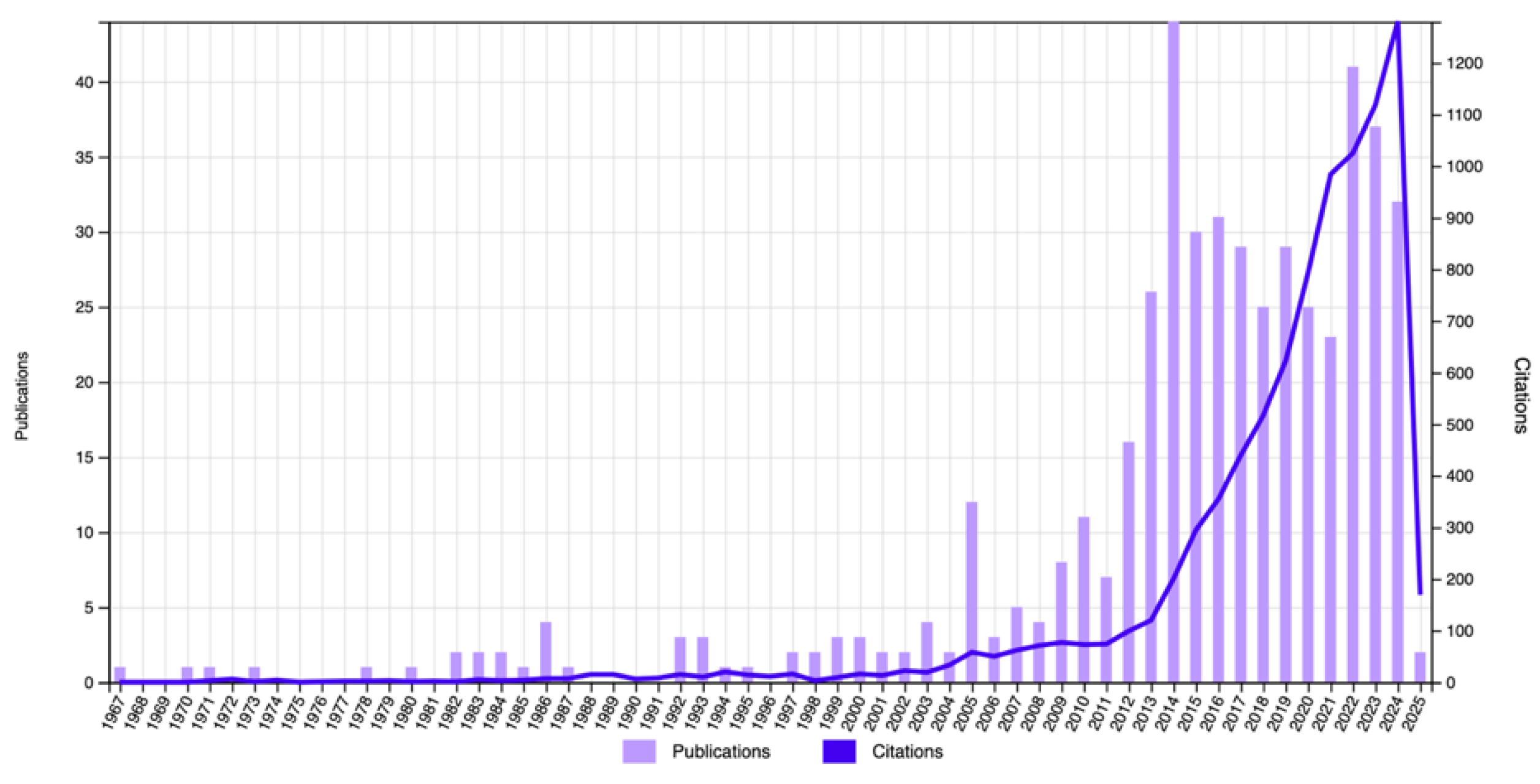
Figure 3.
Classification of existing solar cell technologies. The structure may be wafer-based or thin-film. Reproduced from [44] under the CC-BY-NC-ND license.
Figure 3.
Classification of existing solar cell technologies. The structure may be wafer-based or thin-film. Reproduced from [44] under the CC-BY-NC-ND license.
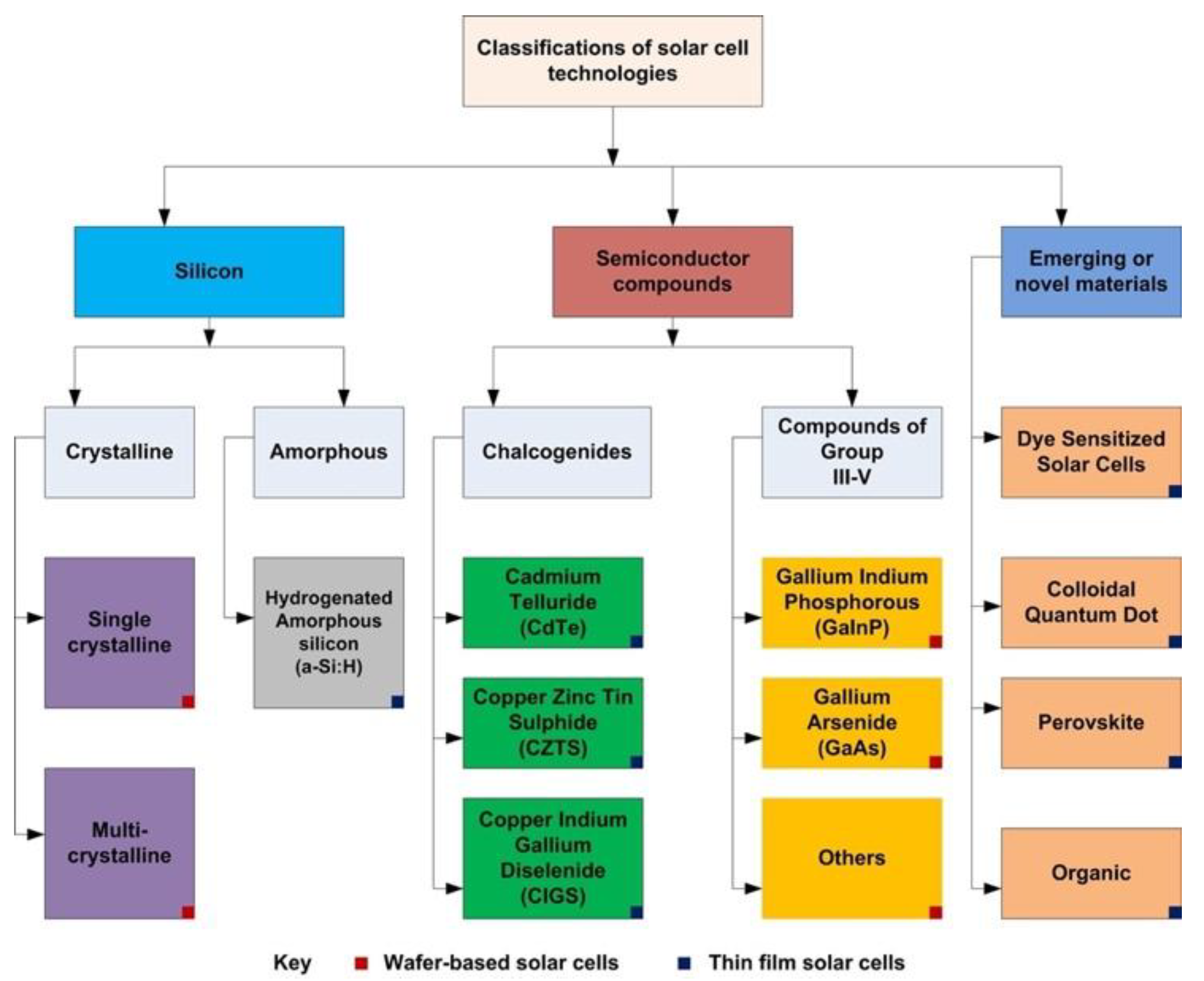
Figure 4.
The power-per-weight of ultrathin perovskite solar cells (UT-PSCs) is more than double the nearest competing photovoltaic technology (data cover the period up to 2015). Abbreviations: CIGS, copper indium gallium selenide; OPV, organic photovoltaic. Reproduced from [51] with permission of Springer Nature.
Figure 4.
The power-per-weight of ultrathin perovskite solar cells (UT-PSCs) is more than double the nearest competing photovoltaic technology (data cover the period up to 2015). Abbreviations: CIGS, copper indium gallium selenide; OPV, organic photovoltaic. Reproduced from [51] with permission of Springer Nature.
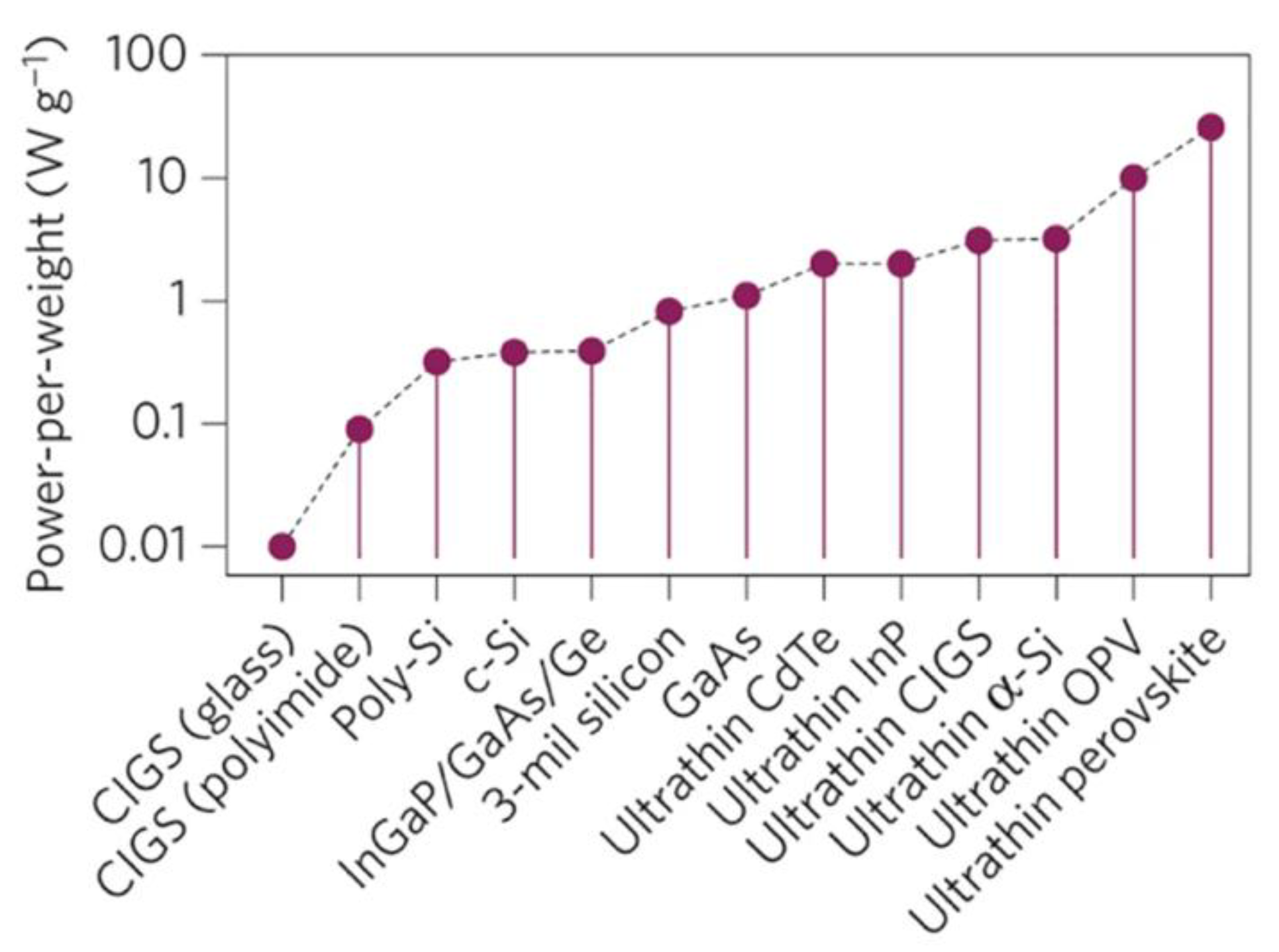
Figure 5.
Summary of prospective substrate materials used in CdTe solar cells. (a) rigid glass, (b)ultra-thin glass, (c) metal foil, and (d) polyimide substrates. Reproduced from [52] under CC-BY license.
Figure 5.
Summary of prospective substrate materials used in CdTe solar cells. (a) rigid glass, (b)ultra-thin glass, (c) metal foil, and (d) polyimide substrates. Reproduced from [52] under CC-BY license.
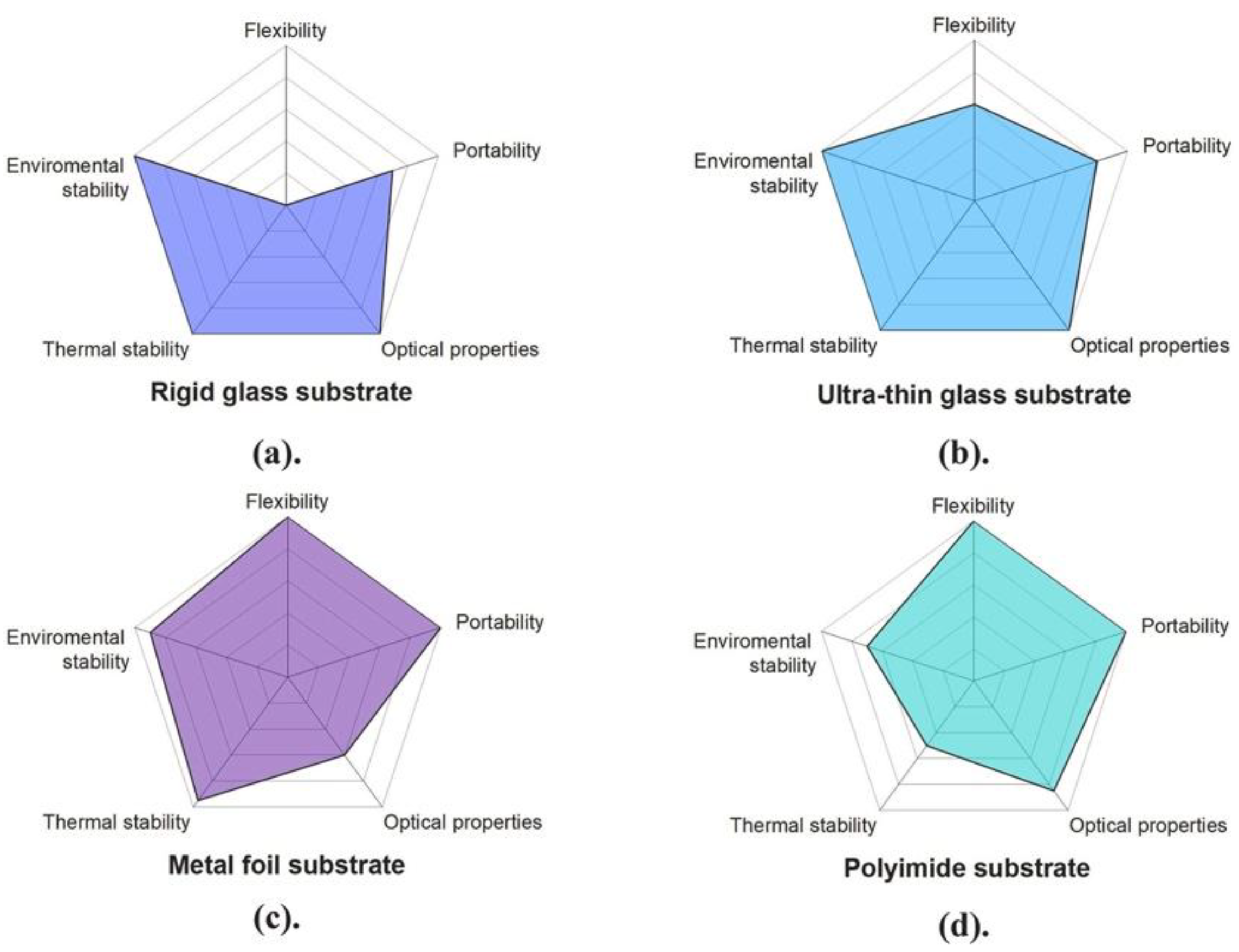
Figure 6.
Structure of CdTe solar cell on ultra-thin (approximately 100 µm thick) cerium-doped cover glass. Underlying layers: 800 nm of Al-doped ZnO (AZO); 100 nm of undoped ZnO; 25-nm CdS seed layer; 125 nm CdZnS window layer; 3.25 μm of graded As-doped CdTe absorber layer; etched gold layer. Reproduced from [55] under CC BY license.
Figure 6.
Structure of CdTe solar cell on ultra-thin (approximately 100 µm thick) cerium-doped cover glass. Underlying layers: 800 nm of Al-doped ZnO (AZO); 100 nm of undoped ZnO; 25-nm CdS seed layer; 125 nm CdZnS window layer; 3.25 μm of graded As-doped CdTe absorber layer; etched gold layer. Reproduced from [55] under CC BY license.
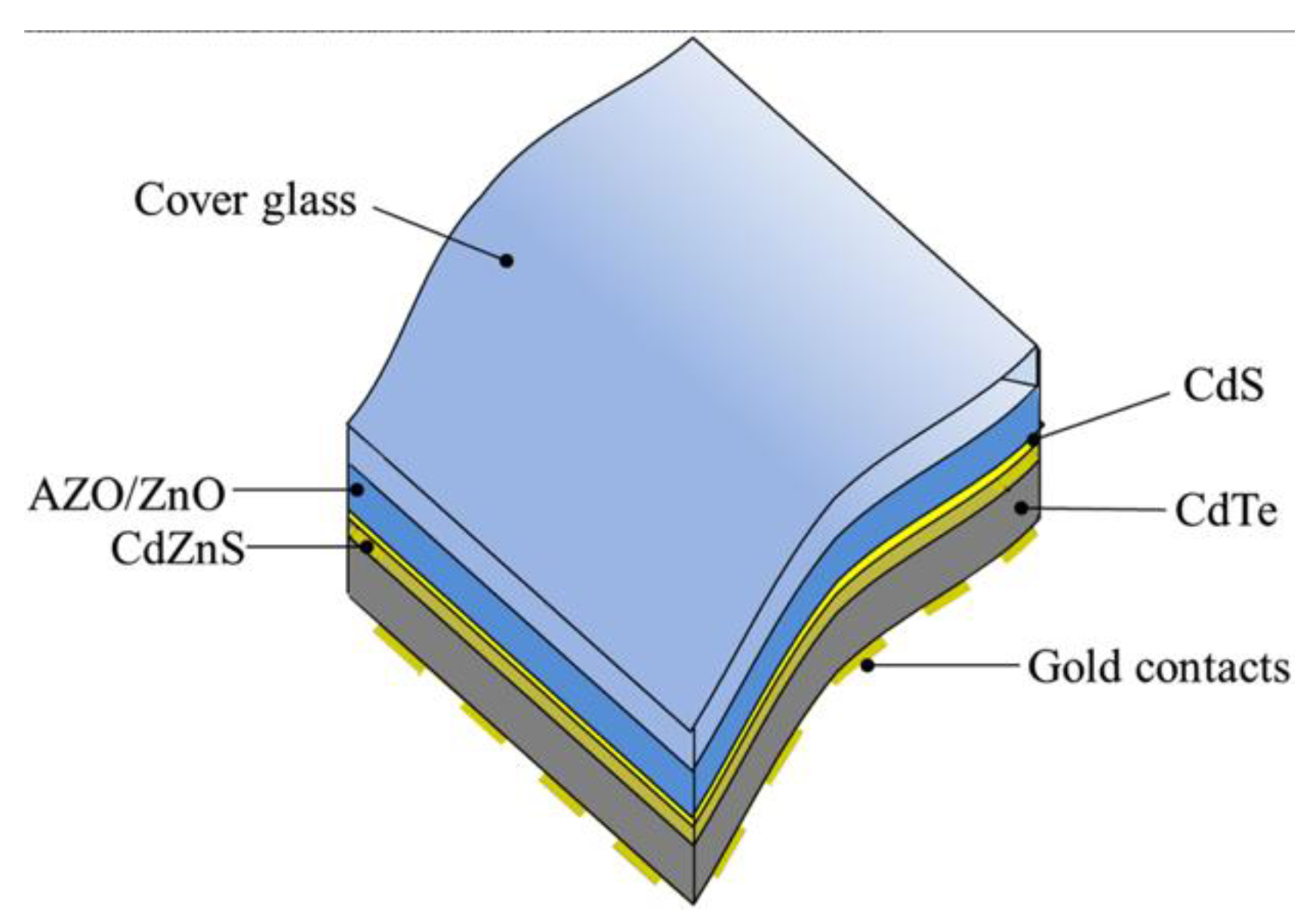
Figure 7.
Transmittance of 100 µm thick Willow glass compared with 1.1 mm thick Corning 7059 glass, 3.8 mm soda-lime glass, and 7.5 µm thick Kapton. Reproduced from [61] with permission of AIP Publisher.
Figure 7.
Transmittance of 100 µm thick Willow glass compared with 1.1 mm thick Corning 7059 glass, 3.8 mm soda-lime glass, and 7.5 µm thick Kapton. Reproduced from [61] with permission of AIP Publisher.
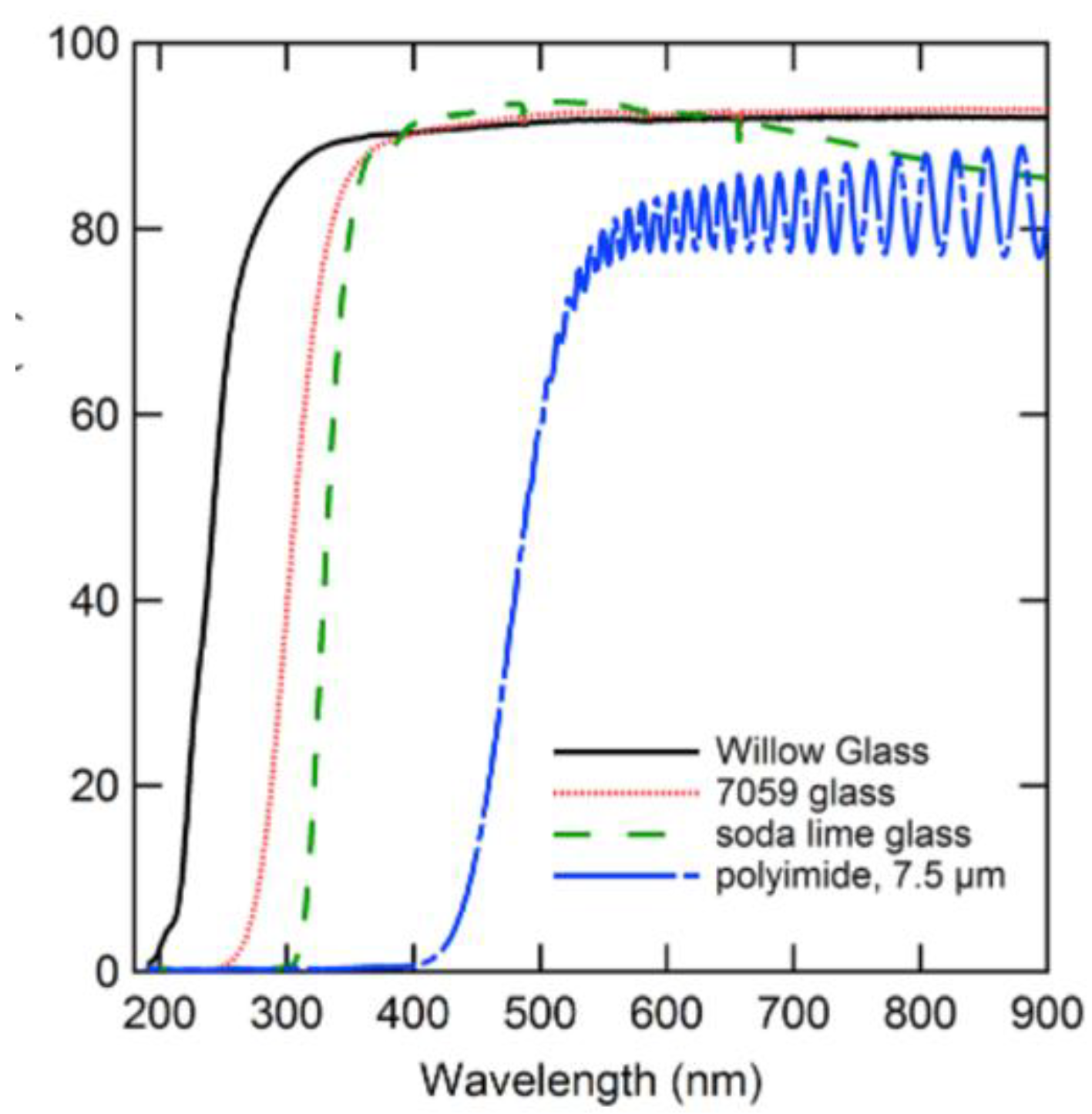
Figure 8.
Photographs of the ultra-thin Schott D263T substrate before deposition (a), after sputtering a CdS layer (b), and after CSS growth of CdTe thin film (c). Reproduced from [64] under CC-BY license.
Figure 8.
Photographs of the ultra-thin Schott D263T substrate before deposition (a), after sputtering a CdS layer (b), and after CSS growth of CdTe thin film (c). Reproduced from [64] under CC-BY license.
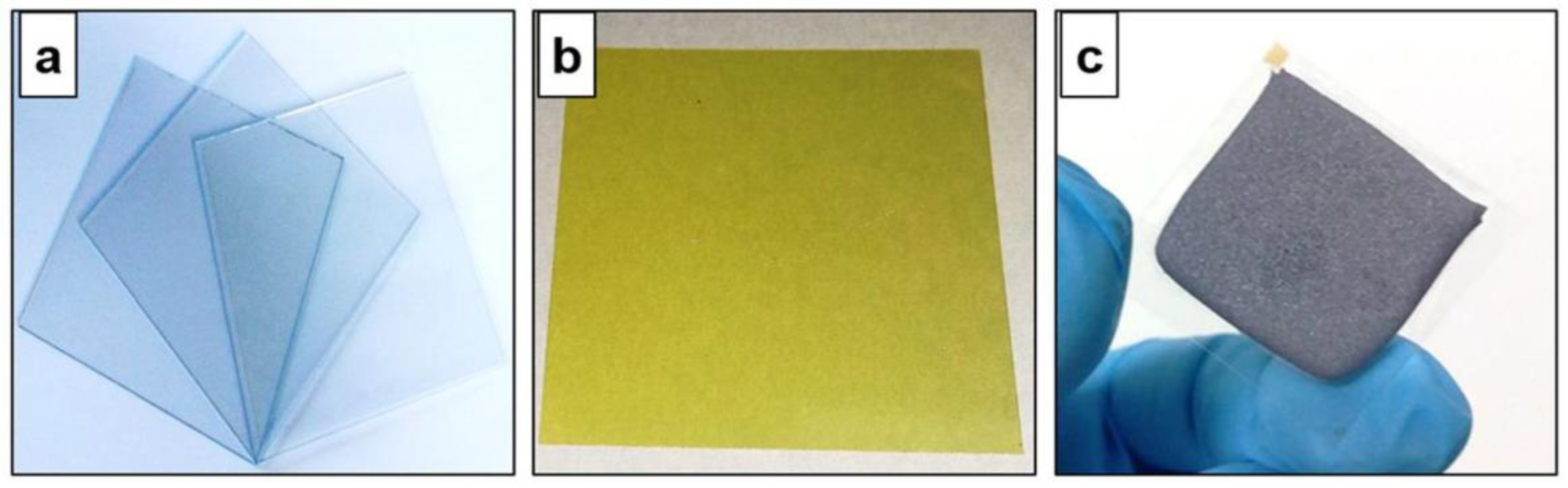
Figure 9.
Photograph of the flexible perovskite solar cell on a 50-µm thick Willow glass (a); photovoltaic parameters of the FPSC measured after each bending cycle. Reproduced from [85] with permission of American Chemical Society.
Figure 9.
Photograph of the flexible perovskite solar cell on a 50-µm thick Willow glass (a); photovoltaic parameters of the FPSC measured after each bending cycle. Reproduced from [85] with permission of American Chemical Society.
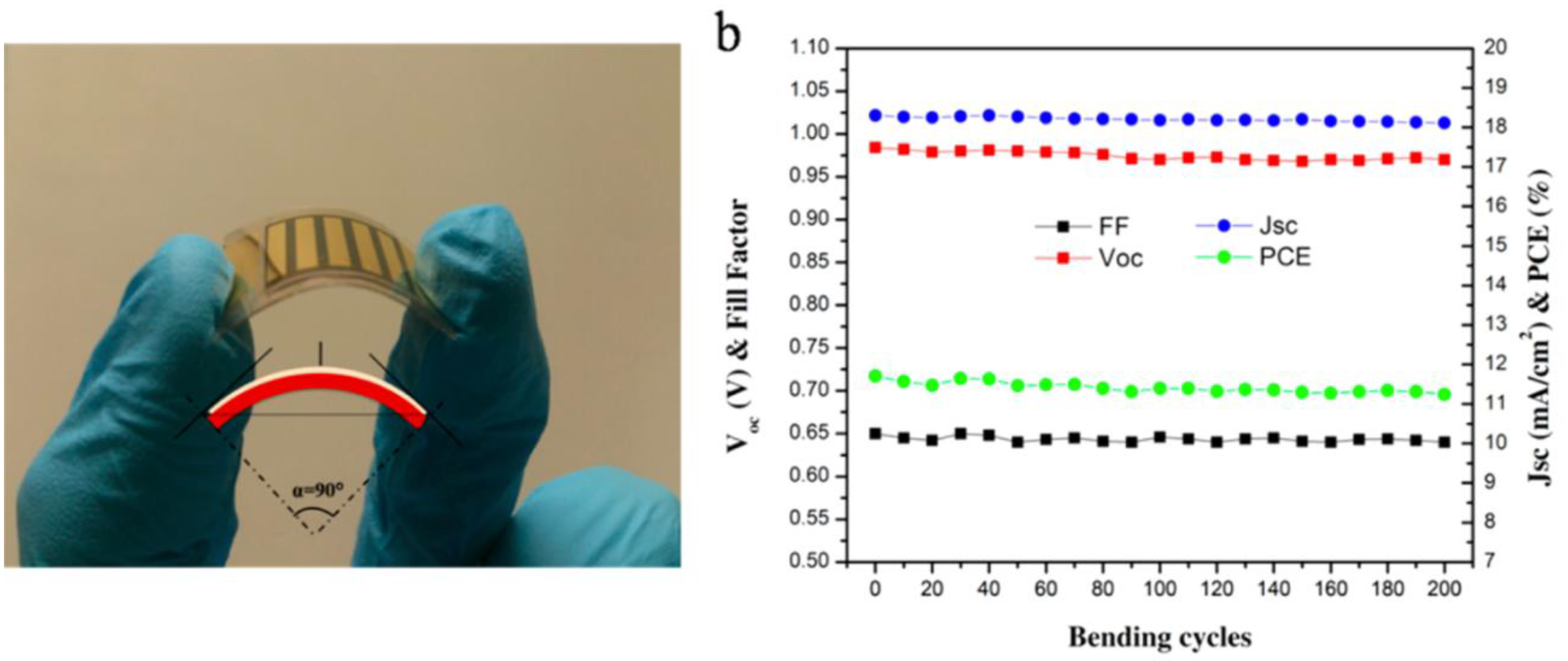
Figure 10.
(a) Structure of the perovskite solar cell grown on a 100-µm-thick Willow glass substrate. Different cells were fabricated using different TCOs (ITO, IZO or AZO). (b) Photos of the FPSC in a flat and bent status. Reprinted with permission from [88]. Copyright 2017 American Chemical Society.
Figure 10.
(a) Structure of the perovskite solar cell grown on a 100-µm-thick Willow glass substrate. Different cells were fabricated using different TCOs (ITO, IZO or AZO). (b) Photos of the FPSC in a flat and bent status. Reprinted with permission from [88]. Copyright 2017 American Chemical Society.
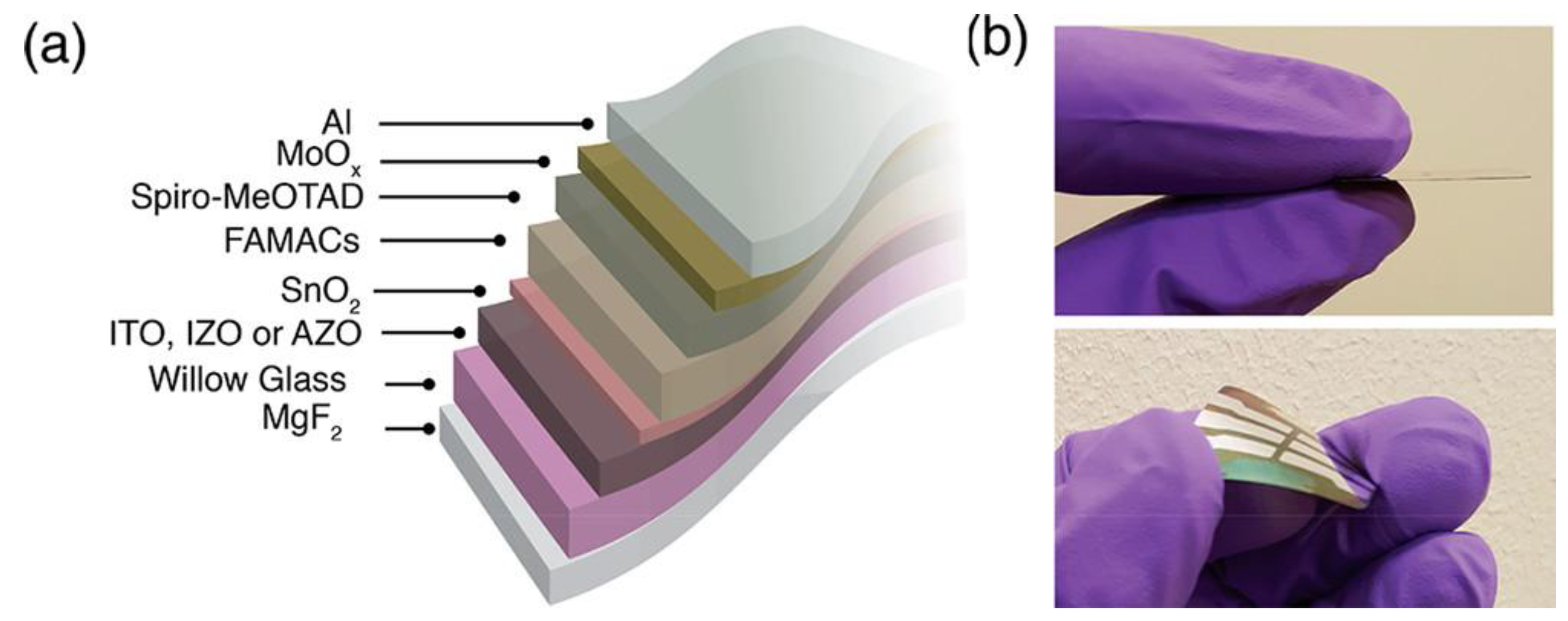
Figure 11.
a) Schematic view of the structure of a flexible large-area perovskite solar cell on Willow glass substrate. b) Photograph of the solar module with aperture of 42.9 cm2 and PCE of 15.86%.
Figure 11.
a) Schematic view of the structure of a flexible large-area perovskite solar cell on Willow glass substrate. b) Photograph of the solar module with aperture of 42.9 cm2 and PCE of 15.86%.
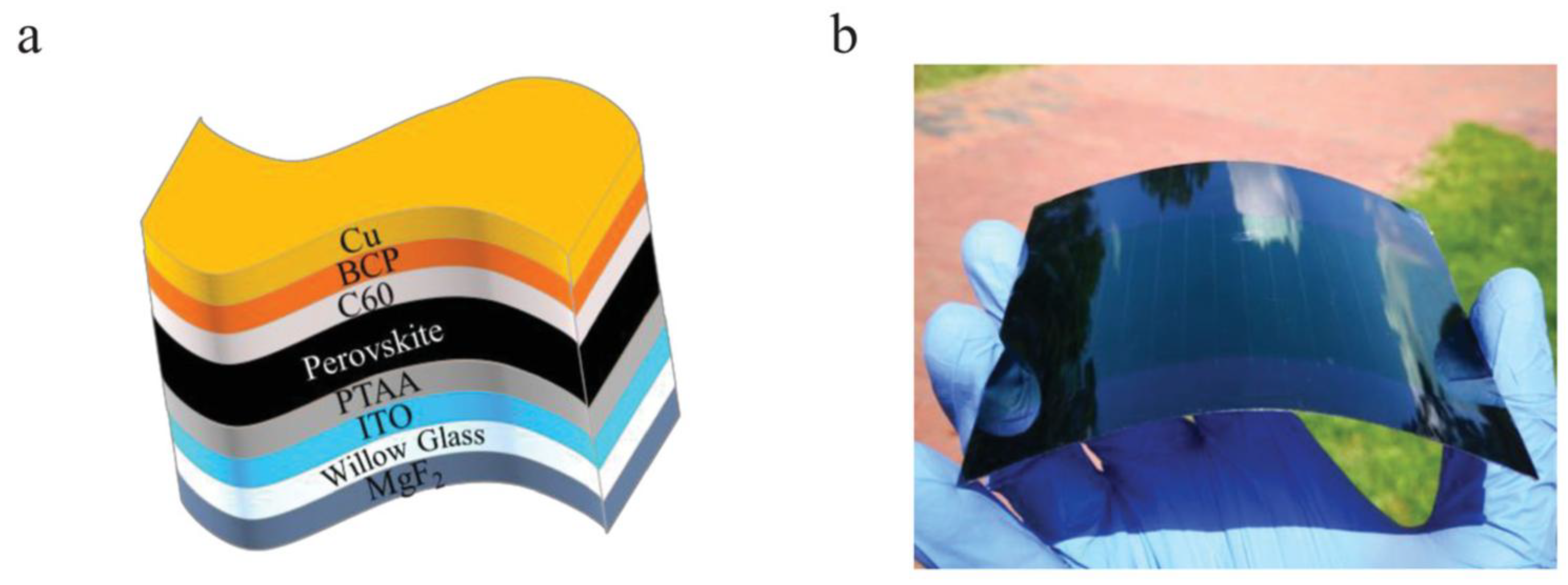
Figure 12.
A. picture of a FPSC on 100 µm AF32 Schott glass. B. J-V photovoltaic curves of planar and mesoscopic samples at STC. Adapted from [90] under CC-BY license.
Figure 12.
A. picture of a FPSC on 100 µm AF32 Schott glass. B. J-V photovoltaic curves of planar and mesoscopic samples at STC. Adapted from [90] under CC-BY license.
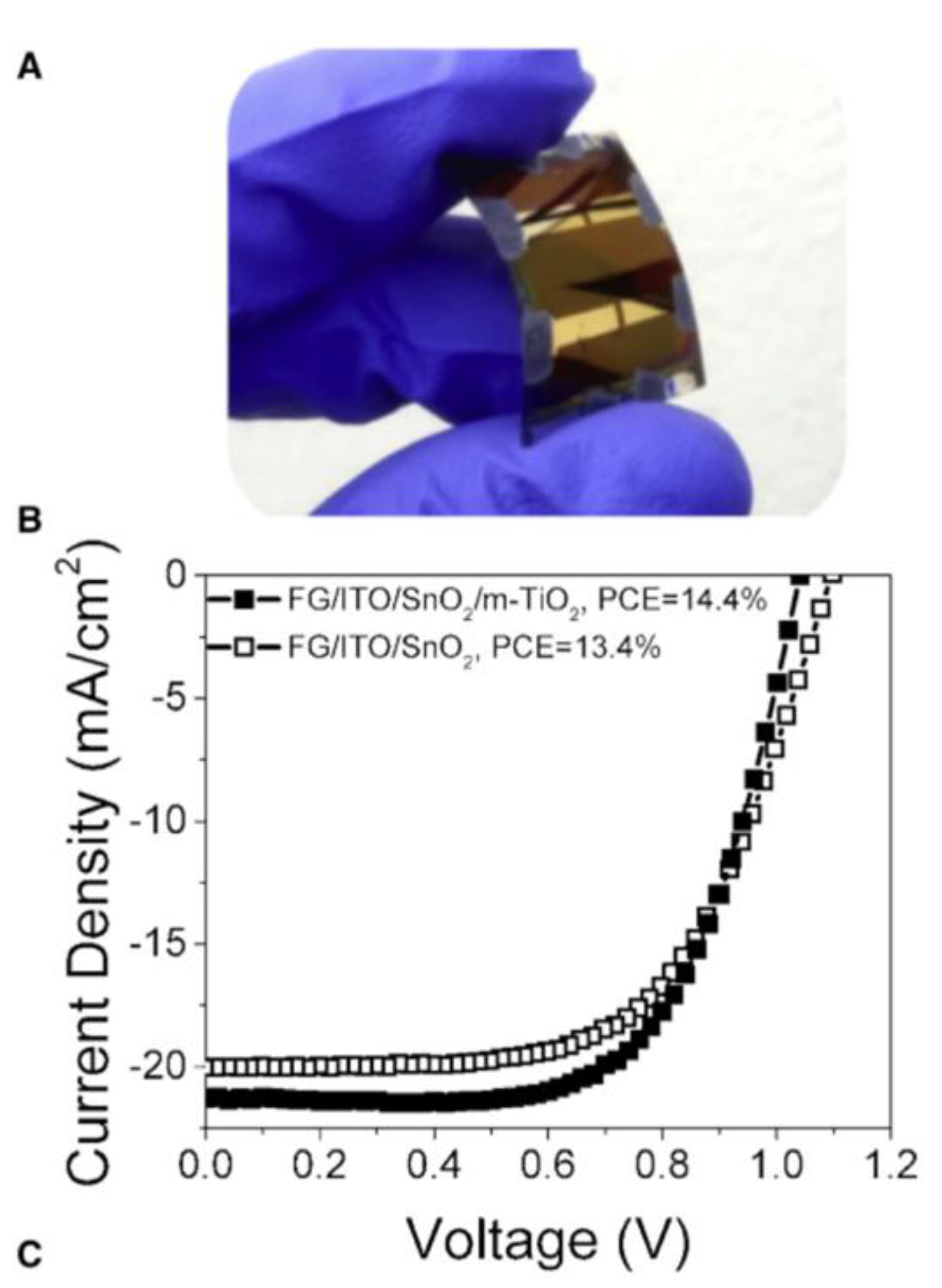

Table 1.
Physical and chemical properties of some commercial ultrathin glasses. Data are extracted from Companies’ technical sheets. Numbers in square brackets refer to samples’ thickness.
Table 1.
Physical and chemical properties of some commercial ultrathin glasses. Data are extracted from Companies’ technical sheets. Numbers in square brackets refer to samples’ thickness.
| Brand name | Unit | AGC Falcon® [22] |
Corning Gorilla®6 [23] |
Corning Willow® [24] | NEG G-Leaf TM [25] |
NSG Glanova® [26] |
Schott AS87 eco [27] |
Schott D263® [28] |
|---|---|---|---|---|---|---|---|---|
| Glass type | Als | Alkali-Als | Alkaline earth BAls | Green Glass (As, Sb free) | Als | Als | Bs | |
| Minimum COTS | µm | 50 | 400 | 100 | 30 ± 10% | 330 | 75 | 30 |
| TL D65 | % | > 91.5 | ≥90.5 [600 µm] |
> 90 | 92 @λ=550 nm |
≥ 91 | ≥ 92 [330 µm] |
91.7 [300 µm] |
| Refractive index nd (@587.6 nm) |
1.515 ± 0.005 | 1.50 core 1.51 clad |
1.52 | 1.51 | 1.5044 ± 0.0015 | 1.5231 ± 0.0015 | ||
| PEC | (nm/cm)/MPa | 27.600 | 29.8 | 29 | 34.7 | |||
| Density | g/cm3 | ≈ 2.48 | 2.40 | 2.56 | 2.46 | 2.48 | 2.46 | 2.51 |
| Young’s modulus | GPa | ≈ 70 | 77 | 78.7 | 73 | 75.4 | 71.9 | 72.9 |
| Poisson’s ratio | ≈ 0.21 | 0.21 | 0.23 | 0.2 | 0.24 | 0.216 | 0.21 | |
| Shear modulus | GPa | ≈ 30 | 31.9 | |||||
| Hardness(bct) | Kgf/mm2 | KH 450 | VH 611 (200 g load) |
KH 588 (2000 g load) | VH 600 | VH 528 | KH 490 VH 560 |
KH 470 VH 510 |
| Hardness (act) | Kgf/mm2 | KH 546 | VH 678 (200 g load) |
VH 583 | KH 560 VH 630 |
|||
| CS | MPa | 600-800 | 1000 [330 µm] |
290 | ||||
| DOL | µm | 15-25 | ||||||
| Softening point | °C | ≈ 665 | 742 | 855 | 736 | |||
| Tg | °C | ≈ 575 | 554 | 598 | 557 | |||
| Strain point | °C | 725 | 508 | 577 | 529 | |||
| Annealing point | °C | 781 | 552 | 616 | 557 | |||
| CTE ×10-7 | /°C | ≈ 90 25-300°C |
75.2 0-300 °C |
31.7 0-300 °C |
91.8 50-350 °C |
92 20 – 300 °C |
||
| Thermal conductivity | W/(m×K) | ≈ 1.19 * | ||||||
| Dielectric constant | 5.3 (1 MHz, 25 °C) |
8.4 (1 MHz, 25 °C) | 6.7 (1MHz, 25 °C) |
|||||
| Notes | ♣ | ♦ | ♥ | |||||
| Suggested applications | See notes: | {A} | {B} | {C} | {D} | {E} | {F} | {G} |
Abbreviations: Als, aluminosilicate; Bals, boro-alluminosilicate; Bs, borosilicate; COTS, commercial off the shelf; TL D65, light transmission indicating the percentage of sunlight passing through the glass, where D65 refers to the illuminant according to DIN 67 507; cl, compression layer; PEC, photoelastic constant; bct, before chemical strengthening by ion-exchange; act, after chemical strengthening by ion-exchange; KH, Knoop hardness; VH, Vickers hardness; CS, compressive stress (surface compressive stress); DOL, depth of layer; Tg, transformation temperature; CTE, Coefficient of thermal expansion. Notes: ♣ AGC in 2014 claimed having successfully rolled ultra-thin sheet glass SPOOLTM into a roll 1,150 mm wide and 100 m long, with 50 µm thickness, at that time the world’s thinnest glass manufactured using the float process. ♦ In Corning lab tests, Gorilla Glass 6 survived drops from up to 1.6 meters onto hard, rough surfaces. That was the average worldwide height. ♥Corning is also producing a Willow glass based on an alkali-free borosilicate.
Table 2.
h) bending tests. η conversion efficiency, Jsc short-circuit current density, Voc open circuit voltage, FF fill factor, Rs series resistance and Rshunt shunt resistance. Data taken from [60] under CC-BY license.
Table 2.
h) bending tests. η conversion efficiency, Jsc short-circuit current density, Voc open circuit voltage, FF fill factor, Rs series resistance and Rshunt shunt resistance. Data taken from [60] under CC-BY license.
| Solar Cell | Time (hrs) | η (%) | Jsc (mA/cm2) |
Voc (mV) | FF (%) | Rs (Ω cm2) |
Rshunt (Ω cm2) |
|---|---|---|---|---|---|---|---|
| A2 | 0 | 14.1 ± 0.3 | 25.4 | 747 | 74 | 2.4 | 3233 |
| 168 | 13.8 ± 0.3 | 24.7 | 745 | 75 | 2.4 | 3254 | |
| B2 | 0 | 14.1 ± 0.3 | 25.4 | 752 | 74 | 2.4 | 3627 |
| 168 | 14.2 ± 0.3 | 25.7 | 751 | 74 | 2.5 | 5122 |
Table 3.
Under CC-BY license.
| Specific Power (W g-1) | Area density(g/cm2) | Thickness (µm) | |||
| STC | 400 lx | 200 lx | |||
| FG-PSC | 0.58 | 1.4 x 10⁻³ | 0.7 x 10⁻³ | 251 | 100 |
| PET-PSC | 0.74 | 0.9 x 10⁻³ | 0.5 x 10⁻³ | 198 | 125 |
| Glass-PSC | 0.07 | 1.5 x 10⁻⁴ | 0.7 x 10⁻³ | 2,761 | 1,100 |
Disclaimer/Publisher’s Note: The statements, opinions and data contained in all publications are solely those of the individual author(s) and contributor(s) and not of MDPI and/or the editor(s). MDPI and/or the editor(s) disclaim responsibility for any injury to people or property resulting from any ideas, methods, instructions or products referred to in the content. |
© 2025 by the authors. Licensee MDPI, Basel, Switzerland. This article is an open access article distributed under the terms and conditions of the Creative Commons Attribution (CC BY) license (http://creativecommons.org/licenses/by/4.0/).
Copyright: This open access article is published under a Creative Commons CC BY 4.0 license, which permit the free download, distribution, and reuse, provided that the author and preprint are cited in any reuse.