1. Introduction
Wireless Sensor Networks (WSNs) represent a revolutionary advancement in modern technology, transforming how the physical world is monitored and interacted with. These networks consist of small sensor nodes equipped with the ability to sense, process, and transmit data [
1]. The foremost across a multitude of domains, encompassing environmental surveillance, healthcare, industrial objective of WSNs is to gather environmental data and transmit it to a centralized locus, such as a base station, for subsequent analysis and informed decision-making. WSNs have found application automation, and military operations [
2]. By deploying sensors in remote or perilous locales, the facilitation of real-time data acquisition is achieved, enhancing operational efficacy and yielding significant insights into various phenomena [
3]. Furthermore, their wireless communication features and scalability render them particularly advantageous for contexts in which conventional wired networks are unfeasible [
4].
As the Internet of Things (IoT) continues to evolve rapidly, Wireless Sensor Networks (WSNs) have become more integrated than ever, unlocking new possibilities and expanding their range of applications. By connecting to the internet through IoT, sensor nodes facilitate seamless data exchange on a global scale and interact with other IoT devices. This connectivity paves the way for advanced applications such as smart cities, precision agriculture, and intelligent healthcare. The fusion of WSNs and IoT forms a highly connected ecosystem where real-time data drives predictive analysis, automation, and smarter decision-making [
5] [
6].
Routing plays a significant role in the efficiency, scalability and lifespan of WSNs. Due to the sensor nodes' limitations, such as constrained energy, processing capability, and memory, the routing processes need to make data transmission efficient, latency reduced, and the lifespan enhanced. Energy efficiency, scalability, topology adaptation for changes, and Quality of Service (QoS) requirements need consideration when the WSN routing protocols are being designed [
7]. Development improvements in the nature of the WSN and their incorporation into the Internet of Things (IoT) has also enhanced the need for efficient routing processes for the handling of the increased data load and complex topology structures [
8].
This review provides a wider classification of WSN routing protocols by analyzing and merging taxonomies from multiple research studies. Unlike previous surveys that either delve into excessive detail or remain too general, this work maintains a balance by offering a comprehensive yet non-exhaustive analysis that remains accessible and engaging. The objective is to present an informative and structured overview without excessive complexity, making it suitable for both researchers and practitioners seeking insights into WSN routing.
The remainder of this paper is organized as follows: Section II elaborates a motivation to this study, highlighting the significance of routing in WSNs and the continuous evolution of routing protocols based on recent research trends. Section III presents a comprehensive review of WSN routing protocols, categorizing them based on multiple classification criteria. The section begins by discussing the key challenges facing WSN routing followed by analyzing multiple routing approaches, highlighting their design principles, operational methodologies, and suitability for different WSN applications. Finally, Section IV provides the conclusion of this study and future works
2. Motivation
Wireless Sensor Networks (WSN) provide the backbone for modern-day technology, being utilized for environmental monitoring, medicine, and urban cities [
9]. Because of their dynamism and inherent limitations such as low processing capacity and energy constraints, continuous research has focused on enhancing their efficiency. One of the primary areas of investigation in WSNs is routing, given its significant impact on network performance and longevity [
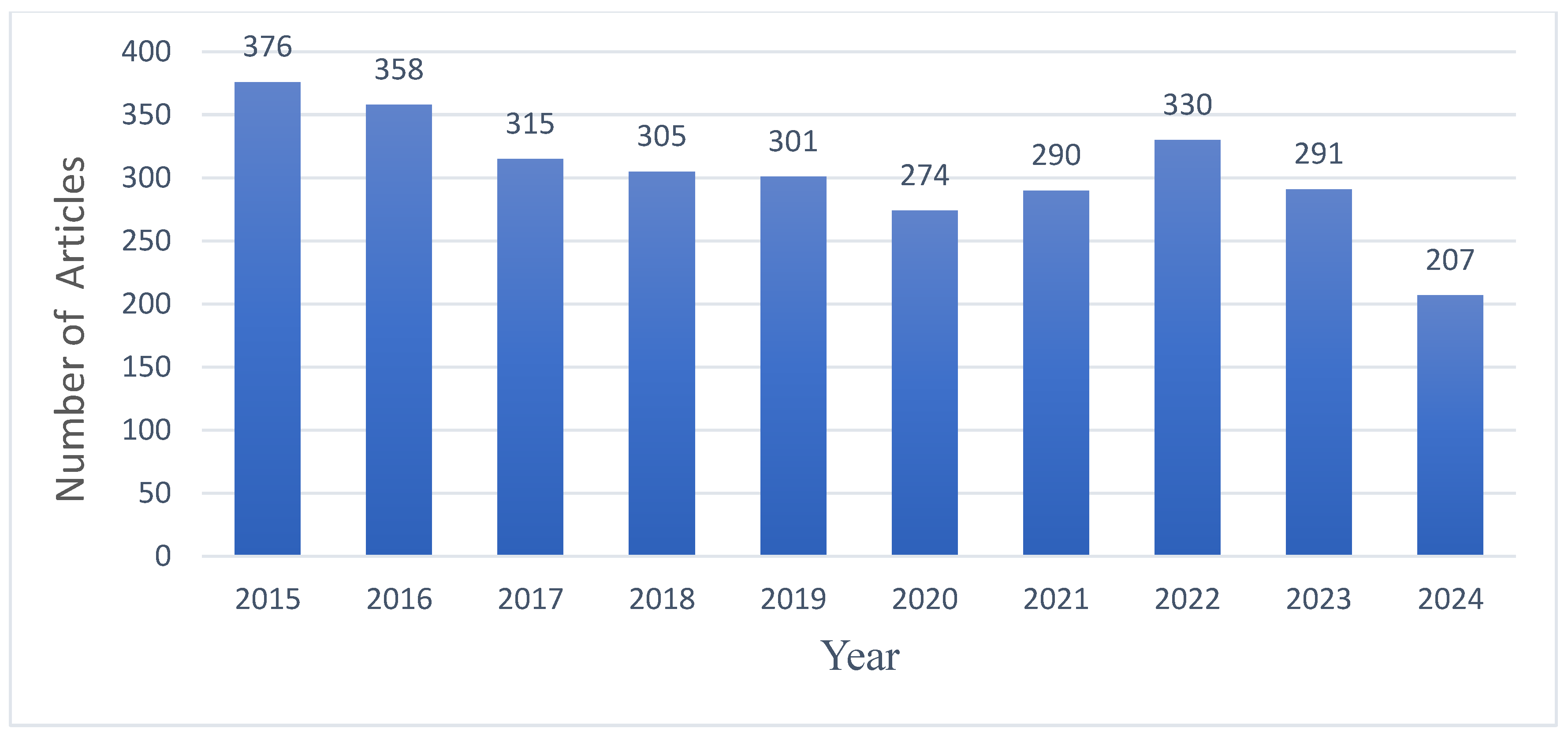
10]. To assess the latest research efforts in this field, data from Google Scholar was collected and analyzed for the period between 2015 and 2024. The objective was to quantify the number of newly proposed routing protocols introduced each year, showcasing the ongoing advancements in this domain. The dataset was compiled using a refined search strategy with the following Boolean search expression:
intitle:"wireless sensor networks" OR intitle:"WSN" AND intitle:"routing" AND (intitle:"protocol" OR intitle:"algorithm") -intitle:"review" -intitle:"survey" -intitle:"study"
This approach ensured that only studies proposing new routing algorithms or protocols were included while filtering out surveys, reviews, and general studies. Between 2015 and 2024, Google Scholar yielded a total of 3,047 relevant articles. These findings highlight the steady progress in WSN routing research, with new protocols emerging annually, refinements being made to existing ones, and ongoing challenges being addressed.
Figure 1 illustrates these trends, emphasizing the continuous evolution of routing strategies for WSNs.
While the Boolean search provided a targeted dataset, the selected keywords were intentionally limited for specificity. The inclusion of additional terms such as "SCHEM," "MODEL," "SELECTION," "NOVEL," "STRATEGY," "TECHNIQUES," "APPROACH," "PLAN,""SOLUTION," or "PROPOSED" could have captured a broader range of studies. This suggests that the actual number of new routing protocols introduced during this period is likely even higher.
Figure 1.
Yearly Trend of Google Scholar Articles on WSN Routing Protocols (2015-2024).
Figure 1.
Yearly Trend of Google Scholar Articles on WSN Routing Protocols (2015-2024).
3. Classification and Mechanisms of WSN Routing
Wireless Sensor Networks (WSNs) are comprised of spatially dispersed autonomous sensors that monitor various physical or environmental parameters, including temperature, acoustic levels, or pressure, and collaboratively relay their collected data throughout the network to a designated central node [
11]. The process of routing within WSNs is critical for facilitating effective data transmission between sensor nodes and a base station or sink node. Given the intrinsic constraints of sensor nodes, which include limited energy resources, processing capabilities, and memory constraints, it is imperative that WSN routing protocols are meticulously designed to enhance energy efficiency, prolong network longevity, and guarantee dependable data transmission [
12]. The primary challenges associated with routing in Wireless Sensor Networks are:
Energy Efficiency: Since sensor nodes typically operate on batteries, energy conservation is a top priority [
13]. Routing protocols should aim to minimize energy consumption to enhance network longevity [
14] .
Scalability: WSNs can consist of hundreds or even thousands of nodes, requiring routing protocols that efficiently scale with the network's size [
15].
Dynamic Topology: Nodes may fail, move, or new nodes may be added, causing frequent changes in network topology. Routing protocols must be adaptive to these fluctuations [
16].
Data Aggregation: To reduce energy consumption, routing protocols often integrate data aggregation techniques, combining data from multiple nodes before transmission [
17].
Quality of Service (QoS) Requirements: Certain applications demand specific performance criteria, such as minimal delay, high throughput, or reliability. Routing protocols should be capable of meeting these QoS standards [
18].
Security: WSNs are susceptible to cyber threats like node capture and eavesdropping [
19]. Routing protocols should incorporate security measures to ensure data integrity and confidentiality [
20].
Lack of a Global Addressing Scheme: Unlike traditional networks, WSNs do not usually follow a global addressing framework, making node identification and data routing challenging. Consequently, location-based or data-centric routing methods are commonly employed [
15] .
A comprehensive understanding of the classification of WSN routing protocols is vital for the evaluation of their design principles, operational methodologies, and practical applications. The most widely acknowledged classification system categorizes routing protocols based on the structure of the network, delineating them into hierarchical, flat, and location-based routing categories [
21] [
17] [
22]. These categories are defined as follows:
Flat Routing: All nodes have the same status and transmit data through multi-hop communication. While simple, these protocols suffer from high redundancy and excessive energy consumption. Examples include Flooding, Gossiping, and SPIN routing protocols [
23].
Hierarchical Routing: Nodes are organized into clusters where cluster heads aggregate and forward data, reducing energy consumption and improving scalability. Examples include LEACH and PEGASIS [
23] .
Location-Based Routing: These protocols leverage geographical information to enhance data routing efficiency by forwarding data through nodes closest to the destination. Notable examples include GEAR and GPSR [
24].
Beyond these conventional classifications, researchers have proposed expanded categorization schemes to address specific challenges in WSNs and gain deeper insights into routing strategies [
25] [
26] [
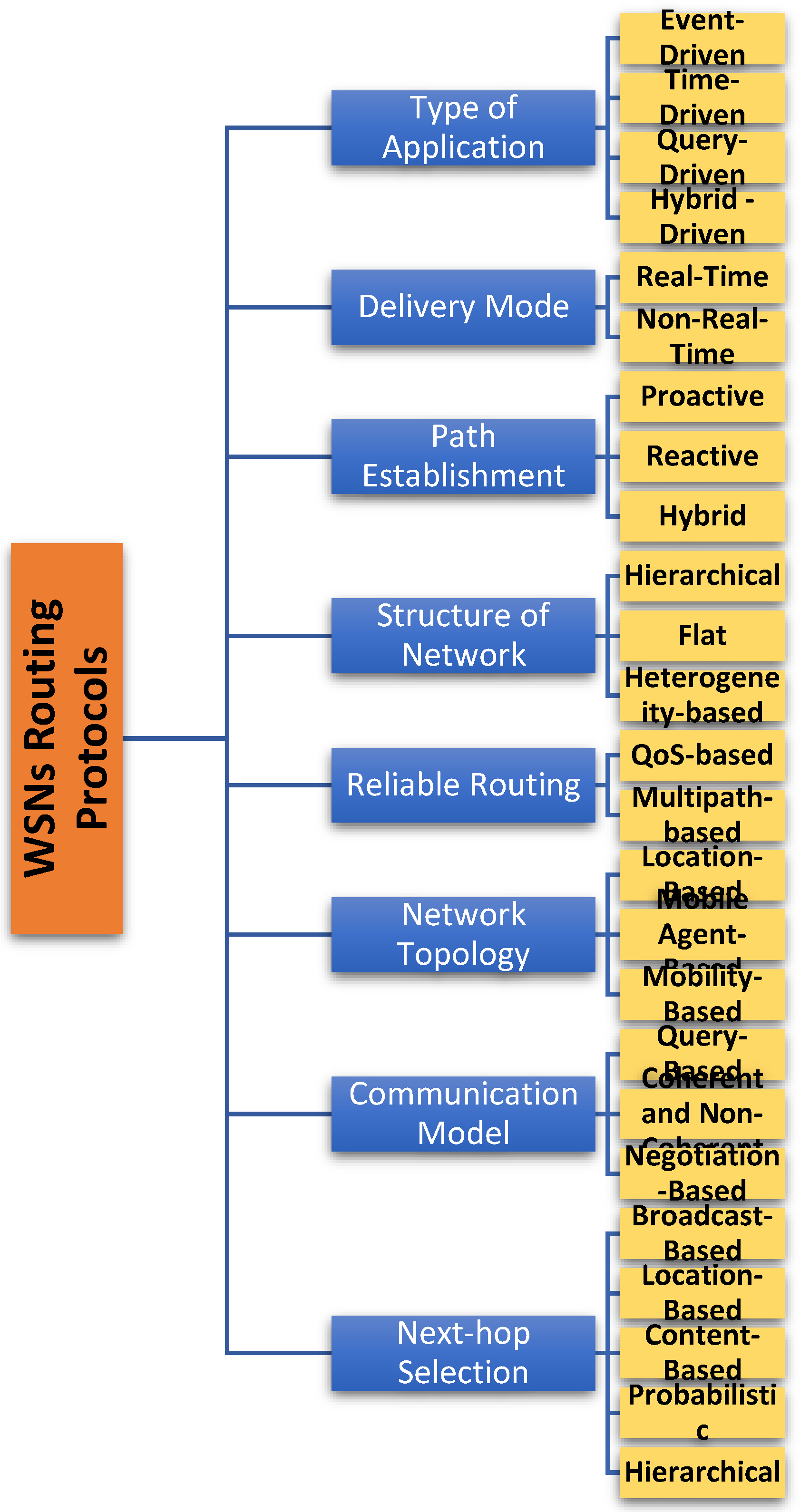
27]. Based on these studies, WSN routing protocols can also be classified based on application type, delivery mode, path establishment, network structure, reliable routing, network topology, communication model, and next-hop selection, as illustrated in
Figure 2. These classifications give a deeper insight and view of how these protocols act in different situations.
For instance, Application-driven protocols in WSNs can be time-driven, event-driven, query-driven, or hybrid-driven, each designed to optimize data collection based on specific triggers. Delivery modes differentiate between real-time and non-real-time protocols to ensure appropriate latency and accuracy levels. Route establishment strategies, whether proactive, reactive, or hybrid, govern how routes are discovered and maintained. Similarly, topology-based classifications, including hierarchical, flat, and heterogeneous networks, influence network performance and efficiency. To enhance resilience in data transmission, reliable routing relies on QoS-based or multipath-based approaches. Communication models, such as query-based, coherent or non-coherent, or negotiation-based mechanisms, regulate data exchange between nodes. Lastly, next-hop selection strategies, such as broadcast-based, location-based, content-based, probabilistic, and hierarchical approaches, determine how data moves through the network. These classifications collectively illustrate the ongoing evolution of WSN routing strategies to address emerging technological and application-driven challenges, as detailed in the following sections.
Figure 2.
The classification of Routing Protocols as Adopted in this Review Paper.
Figure 2.
The classification of Routing Protocols as Adopted in this Review Paper.
3.1. Type of Application
Routing protocols can be broadly divided into two categories based on their application:
Event-Driven Protocols
The initiation of routing within these protocol types only commences upon the detection of a significant event within a designated sensing region. Such protocols present several notable advantages, including the instantaneous identification of events and the optimized utilization of energy, as communication is activated solely upon the triggering of an event. Nonetheless, these protocols are not without their limitations, such as the uneven distribution of workload, which arises from the stochastic nature of event occurrences, resulting in the overexertion of certain nodes in comparison to others, thereby hastening the depletion of these nodes and leading to the formation of isolated regions [
25]. Usual applications of this model encompass emergencies and disaster recovery scenarios in health crises, wildfires, seismic activities, air quality assessments, tracking of animal movements, rainfall, lava flows, military operations, and volcanic eruptions. In an event-driven framework, data collection transpires exclusively upon the occurrence of such events rather than through periodic or routine intervals. Given the inherent urgency associated with these scenarios, the event-driven model necessitates a high degree of dependability and promptness in data delivery to effectively address the exigencies presented by the emergency at hand [
26]. There are numerous examples of this type of routing protocol including [
28] [
29] .
3.2. Time-Driven Protocols
In contrast, the Time-Driven Protocols facilitate a systematic and periodic transmission of acquired sensory data, subsequently adopting an application-specific reporting interval for further transmission. The inherent advantages of these protocols include a reduction in complexity, which in turn simplifies their implementation, alongside a guarantee of energy efficiency by permitting nodes to enter sleep mode between consecutive transmission intervals [
25]. Typically, a time-driven network experiences dynamic fluctuations pertaining to the physical environment it monitors. Such dynamics may exhibit a tendency to either lag behind or accelerate over time. From a broader analytical perspective, the consequences or implications of these changes that define Wireless Sensor Networks (WSN) often manifest as the generation of excessive raw data or redundancy. On a larger scale, the prevalent issues encountered within WSN encompass, but are not limited to, packet loss, elevated energy consumption, data redundancy and inaccuracies, network congestion, high transmission costs, delays, and diminished Data Delivery Ratios. Over recent years, various studies and methodologies have been proposed to address these pressing challenges [
26]. Examples of this type of routing protocols are [
30] [
31].
3.3. Query- Driven Protocols
In WSN, the query-driven model is utilized when the users require data based on their needs. Here, the request is sent by the user to sensor nodes in the region of interest. These regions may vary in nature and include applications such as environmental monitoring, agriculture, healthcare, military operations, and forest surveillance[
26]. Protocols [
32] [
33] are examples on this type.
3.4. Hybrid -Driven Protocols
the hybrid-driven model integrates the principles of event-driven, query-driven, and time-driven methodologies for data collection and transmission. Upon the occurrence of an event, sensors are tasked with the acquisition and transmission of data pertinent to that event; subsequent to the conclusion of the event, the nodes revert to a periodic mode of data collection and transmission analogous to that of time-driven models. Moreover, in instances where a user submits a query, the sensor nodes are obligated to furnish the requested data. The hybrid model possesses the capacity to render sensor nodes dynamic, enabling them to modify their processing in accordance with the nature of the event or user specifications by employing the most appropriate data-driven framework [
26]. The researchers cited in [
34] have put forth routing algorithms that are congruent with this particular model.
2. Delivery Mode
In certain applications, the acquired data may be transmitted devoid of temporal limitations, and such data may retain its utility over an extended duration. Conversely, specific applications necessitate enhanced precision and require real-time communication. Consequently, routing protocols can be delineated into categories of real-time and non-real-time protocols. The intricacies of these two types of message transmission requirements are elaborated upon in the subsequent sections.
2.1. Real-Time Delivery
A considerable segment of Wireless Sensor Network (WSN) applications, including radiation monitoring, fire detection, and medical surveillance, function in real-time and necessitate a high degree of temporal precision. In these instances, the sensed data becomes irrelevant or its significance wanes if it is not transmitted within a predetermined time interval. Such applications are designated as real-time applications. Within WSNs, the latency of communication is generally regarded as more critical than the delays associated with processing, thereby underscoring the necessity to guarantee bounded communication latency to facilitate real-time data transmission. As exemplified by this category [
35] [
36].
2.2. Non-Real-Time Delivery
In addition to real-time applications, there exists a plethora of applications within sensor networks, which encompass environmental monitoring systems such as water quality assessment, soil analysis, and habitat surveillance that do not impose rigorous temporal constraints on data transmission. Such applications are classified as non-real-time applications. Any protocol that lacks the capability to facilitate real-time data delivery can be categorized as a non-real-time protocol. These protocols prioritize factors such as energy efficiency or network longevity over the imperative of real-time data transmission, similar to the protocol in [
37].
2.3. Path Establishment - Route Discovery
Routing protocols can be categorized based on their methods for learning or discovering potential routes: proactive, reactive, or hybrid.
3. Table-Driven or Proactive Protocols
These protocols establish a comprehensive routing table at each node in advance, encompassing all conceivable routes prior to their actual necessity. In proactive protocols, regular updating of routing information is performed to ensure precision. Illustrative examples of protocols within this classification are [
38] [
39].
3.1. On-Demand or Reactive Protocols
In contrast to proactive protocols, these do not construct any routing tables. The computation of routes occurs solely upon request. Some protocols that are classified under this category include [
40] [
41] [
42].
3.2. Hybrid Protocols
These protocols leverage the advantages of both proactive and reactive routing methodologies. For instance, at the local level, they employ proactive protocols to facilitate rapid responses, whereas at the inter-local level, they utilize reactive protocols to enhance efficiency and mitigate energy consumption. This category encompasses protocols such as [
43] [
44].
4. Structure of Network
Another categorization of routing protocols is predicated on the architecture of the network, commonly referred to as topology. Within this classification, five overarching subcategories are delineated, each possessing distinct functionalities: flat, hierarchical, mobility-based, heterogeneity-based, and geo-routing protocols. A comprehensive explanation of each of these categories is provided in the subsequent sections.
4.1. Hierarchical Schemas
Hierarchical schemas delineate a specifically organized topology within wireless sensor networks. They partition sensor nodes into several groups termed clusters, with a specially designated node in each group referred to as the Cluster Head (CH). These CHs orchestrate activities within their respective clusters and facilitate direct communication with other CHs or with the Base Station (BS). Numerous strategies are employed to ascertain the selection of a CH; for instance, the node exhibiting the highest energy level or the one possessing the greatest number of neighbors within a cluster may be selected. Hierarchical routing represents an energy-efficient paradigm aimed at optimizing network longevity and ensuring scalability through its structured hierarchy [
45]. Notable protocols representative of this classification include [
46] [
47], [
48] .
4.2. Flat
Flat routing protocols implement a network topology wherein all sensor nodes are regarded as equivalent, possessing identical functionalities. This approach is particularly advantageous for networks characterized by a substantial quantity of sensors, for which the implementation of a global identification system would not be feasible. Analogous to data-centric routing, flat routing protocols also necessitate the incorporation of mechanisms that involve the naming of data and their corresponding descriptions in queries. Proactive, reactive, and hybrid protocols previously discussed serve as examples of flat routing protocols [
14].
4.3. Heterogeneity-Based
Heterogeneity-based routing protocols are formulated for network topologies comprising a diverse array of sensor types, each endowed with distinct capabilities. For example, a subset of sensor nodes may be powered by batteries, thereby possessing a restricted operational lifespan, while alternative nodes may be powered through direct electrical sources and thus face no energy constraints. These protocols leverage those nodes endowed with unlimited or superior energy levels to facilitate optimal routing and extend the operational lifespan of the entire network. In scenarios where two energy levels exist within the sensors, the network is classified as exhibiting two-level heterogeneity. Conversely, when the network encompasses three or more types of sensors with varying energy levels, it is categorized under networks characterized by three or more levels of heterogeneity [
25]. Protocols that align with this classification include [
49] [
50].
5. Reliable Routing
Within the Reliable Routing framework, protocols can be further categorized into two distinct subclasses: those that facilitate Quality of Service (QoS) and those that employ multiple pathways. While QoS-oriented protocols primarily concentrate on fulfilling specific performance-related metrics, multipath-oriented protocols are engineered to guarantee the resilient delivery of data in the event of link or path disruptions.
5.1. QoS-Based Routing Protocols
these protocols endeavor to satisfy the demands of Quality of Service while concurrently minimizing energy expenditure within the network. They are designed to ensure that essential metrics, such as reliability, latency, and bandwidth, are achieved throughout the routing process of data packets toward their designated endpoints. The protocols referenced previously in the real-time subcategory [
35] [
34] [
36] serve as exemplars of this class, augmented by the following supplementary examples [
51] [
52] .
5.2. Multipath-Based
Generally, multipath-oriented protocols utilize multiple routing pathways for the transmission of data between communicating nodes rather than relying on a singular pathway. This strategy can confer upon the network enhanced resilience against route failures, improved traffic load distribution, and capabilities for minimizing end-to-end latency. Furthermore, performance enhancement within such protocols is accomplished through path selection mechanisms that endeavor to reduce costs while adhering to the stipulations of network latency. Illustrative examples of routing protocols that incorporate multipath functionality include the following [
53] [
54].
6. Network Topology
Routing protocols within this classification are categorized into four distinct subcategories predicated upon the methodology employed for data routing: the utilization of locational data, tree-based configurations, mobile sinks, or mobile agents. These subcategories encompass: Location-Based, Tree-Based, Mobile Agent-Based, and Mobile Sink-Based protocols.
6.1. Location-Based
In the majority of protocols pertinent to Wireless Sensor Networks (WSN), the locational data of nodes is pivotal for calculating inter-node distances, thereby facilitating energy consumption estimations. Given that sensor networks are predominantly deployed spatially within a defined region and lack a conventional addressing schema such as Internet Protocol (IP) addresses, locational data is leveraged to route data with optimal efficiency. In these protocols, each node possesses knowledge of the positional coordinates of its neighboring nodes, and it is conventionally presumed that the sources of messages are cognizant of the destination's location; thus, efficient data routing becomes achievable [
24]. Protocols cited in [
55] [
56] serve as example of this type of routing.
6.2. Mobile Agent-Based Routing
This category of routing is characterized by the incorporation of Mobile Agents, which are autonomous programs capable of migrating from one node to another within the network. These agents operate independently to execute tasks in accordance with the environmental conditions they encounter at each node. Consequently, protocols predicated on mobile agents are meticulously designed to enhance network efficiency by executing data collection, processing, or routing decisions while concurrently minimizing energy expenditure. Protocols exemplified in [
57] [
58] illustrate this methodology effectively.
6.3. Mobility-Based Protocols
In certain applications, sensor nodes may alter their geographical position post-deployment due to various factors including mobile platforms, environmental influences, security considerations, and manual relocation. Additionally, sinks may exhibit mobility aimed at fulfilling the requirements associated with coverage or connectivity. Several protocols exemplifying this approach include [
59] [
60].
7. Communication Model
This category of protocols facilitates the interchange of information among neighboring nodes, typically depending upon single-hop routing methodologies. Such protocols operate under a power-efficient framework for data transmission and are capable of conveying substantial quantities of information while conforming to energy constraints; nevertheless, this methodology does not guarantee the reliable delivery of data. Furthermore, this category can be further delineated into three distinct subclasses pertaining to data exchange methodologies: Query-Based, Coherent/Non-Coherent, and Negotiation-Based protocols.
7.1. Query-Based
The protocols encompassed within this subset navigate data flows through the utilization of queries. When a node within the network necessitates data, it disseminates a query message to solicit the retrieval of information from the corresponding node that possesses said data. Consequently, the node that retains the requested data transmits the pertinent information back to the querying node to fulfill the request. Among the protocols exemplifying this classification are [
61] [
62].
7.2. Coherent and Non-Coherent
In this classification, the processing activities at the node level precede the routing operations. In Coherent protocols, the assimilated data undergoes minimal processing prior to being relayed by the nodes. Conversely, in Non-Coherent protocols, the acquired data is subjected to preliminary processing at the nodes before being forwarded for additional processing to specific aggregator nodes. This approach guarantees that the data is managed proficiently in accordance with the requirements and capabilities of the network. The authors of [
63] introduced the Single Winner Election (SWE) algorithm for non-coherent processing, as well as the Multiple Winner Election (MWE) algorithm for coherent processing.
7.3. Negotiation-Based
The negotiation-based routing protocols are grounded in a negotiation mechanism among neighboring nodes. Prior to data transmission, the data is appropriately labeled using high-level descriptors to mitigate the occurrence of redundant information transfer throughout the network. This approach effectively diminishes energy consumption while optimizing the transmission of data. The authors of [
64] present a comprehensive suite of negotiation-based protocols, as do the authors of [
65].
8. Next-Hop Selection
In routing protocols, each sensor determines the subsequent hop towards the intended destination predicated on established criteria. Various selection methodologies are available, encompassing the following strategies: broadcast-based, location-based, content-based, probabilistic, and hierarchical-based protocols. These methodologies will be elaborated upon in the following sections.
8.1. Broadcast-Based
In this approach, every node within the Wireless Sensor Network (WSN) disseminates packets to its neighboring nodes. Subsequently, each node, after the process of rebroadcasting, transmits the received packet to its adjacent nodes, thereby facilitating the diffusion of these packets throughout the entirety of the network[
66].
8.2. Location-Based
Location-based routing protocols leverage geographic information to determine the next hop for data relaying towards its destination. This methodology has notably diminished the frequency of transmissions, thereby enhancing the overall efficiency of the network. A few representative examples of this category have been elucidated in this study, such as [
56].
8.3. Content-Based Routing
In the realm of content-based routing, messages do not explicitly contain destination addresses. Instead, the destination is inferred from the content or sensed data encapsulated within the message for the purpose of next-hop selection or routing determinations, rendering it dynamic and data-centric. Although numerous examples of this methodology have been previously addressed in this study, the protocol referenced in [
67] serves as a specific illustration of this routing type.
8.4. Probabilistic
Probabilistic protocols operate under the assumption that all nodes possess analogous characteristics and engage in random broadcasting, thereby selecting the subsequent jump randomly among the available sensors to ensure load balancing and enhanced robustness. The reference [
68] delineates a routing protocol that falls within this category.
8.5. Hierarchical Routing
Hierarchical-based routing protocols implement a structured hierarchy to facilitate the organization of next-hop selection. This hierarchy is consistently maintained throughout the established routing paths, as previously articulated, guaranteeing efficient and scalable data transmission. Numerous instances of this routing type have been presented in earlier sections of this study, such as [
69].
In summary, WSN routing protocols have been classified based on multiple criteria, including network structure, data delivery mode, path establishment, application-specific requirements, and next-hop selection strategies. Each classification framework addresses specific challenges such as energy efficiency, scalability, topology dynamics, and reliability. The diverse nature of these classifications reflects the continuous evolution of routing strategies to meet the growing demands of modern WSN applications. While theoretical advancements have provided a broad spectrum of routing solutions, their practical applicability in real-world scenarios remains a key area for further exploration. The following section presents the conclusion and discusses future directions for WSN routing research.
9. Conclusions
Wireless Sensor Networks (WSNs) play a crucial role in modern applications, ranging from environmental monitoring and healthcare to smart cities and industrial automation. Given the resource constraints of sensor nodes, efficient routing is essential to optimize energy consumption, enhance scalability, and ensure reliable data transmission. Over the years, numerous routing protocols have been proposed, each addressing different network requirements and challenges. This study provided a comprehensive yet concise review of WSN routing protocols, integrating multiple classification frameworks from existing literature to offer a broader perspective. By categorizing routing protocols based on network structure, data delivery mode, path establishment, application type, and next-hop selection strategies, this review highlighted the diverse approaches taken to address WSN routing challenges. Additionally, key issues such as energy efficiency, security, and dynamic topology adaptation were discussed to emphasize the evolving nature of WSN routing research. By merging and refining multiple taxonomies, this study aims to assist researchers and practitioners in gaining a structured and insightful understanding of WSN routing protocols.
While significant advancements have been made in designing and evaluating WSN routing protocols, most of these protocols have been developed and analysed in simulation environments rather than real-world testbeds. Future research should focus on assessing the feasibility and performance of these routing protocols on actual WSN and IoT platforms, ensuring their practical applicability beyond theoretical and simulated scenarios. Conducting real-world deployments and experimental evaluations will be crucial in understanding the limitations, scalability, and effectiveness of these protocols in dynamic and resource-constrained environments.
References
- Fahmy, H.M.A. ; Concepts; Applications, Experimentation and Analysis of Wireless Sensor Networks. in Signals and Communication Technology. Cham: Springer International Publishing, 2021. [Google Scholar] [CrossRef]
- Ojeda, F.; Mendez, D.; Fajardo, A.; Ellinger, F. On Wireless Sensor Network Models: A Cross-Layer Systematic Review. J. Sens. Actuator Netw. 2023, 12, 50. [Google Scholar] [CrossRef]
- Ali, Q.I. Realization of a Robust Fog-Based Green VANET Infrastructure. IEEE Syst. J. 2023, 17, 2465–2476. [Google Scholar] [CrossRef]
- Adu-Manu, K.S.; et al. WSN Architectures for Environmental Monitoring Applications. J. Sens., 2022, 7823481, 2022. [Google Scholar] [CrossRef]
- Gulati, K.; Boddu, R.S.K.; Kapila, D.; Bangare, S.L.; Chandnani, N.; Saravanan, G. A review paper on wireless sensor network techniques in Internet of Things (IoT). Mater. Today Proc. 2022, 51, 161–165. [Google Scholar] [CrossRef]
- Alhabib, M.H.; Ali, Q.I. Internet of autonomous vehicles communication infrastructure: a short review. Diagnostyka 2023, 24. [Google Scholar] [CrossRef]
- Basha, A.R. A Review on Wireless Sensor Networks: Routing. Wirel. Pers. Commun. 2022, 125, 897–937. [Google Scholar] [CrossRef]
- Marietta, J.; Mohan, B.C. A Review on Routing in Internet of Things. Wirel. Pers. Commun. 2020, 111, 209–233. [Google Scholar] [CrossRef]
- Kandris, D.; Nakas, C.; Vomvas, D.; Koulouras, G. Applications of Wireless Sensor Networks: An Up-to-Date Survey. Appl. Syst. Innov. 2020, 3. [Google Scholar] [CrossRef]
- Goud, H.; Anitha, R. A Comprehensive Survey on the Advancements in Routing Protocols for Wireless Sensor Networks. Feb. 15, 2024, Social Science Research Network, Rochester, NY: 4727234. [CrossRef]
- Akyildiz, I.F.; Su, W.; Sankarasubramaniam, Y.; Cayirci, E. Wireless sensor networks: a survey. Comput. Netw. 2002, 38, 393–422. [Google Scholar] [CrossRef]
- Al-Karaki, J.N.; Kamal, A.E. Routing techniques in wireless sensor networks: a survey. IEEE Wirel. Commun. 2004, 11, 6–28. [Google Scholar] [CrossRef]
- Ali, Q.I.; Jalal, J.K. Practical Design of Solar-Powered IEEE 802.11 Backhaul Wireless Repeater. in 2014 6th International Conference on Multimedia, Computer Graphics and Broadcasting, Dec. 2014, pp. 9–12. [CrossRef]
- Nakas, C.; Kandris, D.; Visvardis, G. Energy Efficient Routing in Wireless Sensor Networks: A Comprehensive Survey. Algorithms 2020, 13, 72. [Google Scholar] [CrossRef]
- Akkaya, K.; Younis, M. A survey on routing protocols for wireless sensor networks. Ad Hoc Netw. 2005, 3, 325–349. [Google Scholar] [CrossRef]
- Rady, A.; El-Rabaie, E.L.-S.M.; Shokair, M.; Abdel-Salam, N. Comprehensive survey of routing protocols for Mobile Wireless Sensor Networks. Int. J. Commun. Syst. 2021, 34, e4942. [Google Scholar] [CrossRef]
- Anisi, M.H.; Abdullah, A.H.; Razak, S.A.; Ngadi, M.A. Overview of Data Routing Approaches for Wireless Sensor Networks. Sensors 2012, 12, 3964. [Google Scholar] [CrossRef]
- Uthra, R.A.; Raja, S.V.K. QoS routing in wireless sensor networks—a survey. ACM Comput Surv 2012, 45, 9:1–9:12. [Google Scholar] [CrossRef]
- Ali, Q.I. Securing solar energy-harvesting road-side unit using an embedded cooperative-hybrid intrusion detection system. IET Inf. Secur. 2016, 10, 386–402. [Google Scholar] [CrossRef]
- Batool, R.; Bibi, N.; Alhazmi, S.; Muhammad, N. Secure Cooperative Routing in Wireless Sensor Networks. Appl. Sci. 2024, 14, 5220. [Google Scholar] [CrossRef]
- Singh, S.P.; Sharma, S.C. A Survey on Cluster Based Routing Protocols in Wireless Sensor Networks. Procedia Comput. Sci. 2015, 45, 687–695. [Google Scholar] [CrossRef]
- Radi, M.; Dezfouli, B.; Bakar, K.A.; Lee, M. Multipath Routing in Wireless Sensor Networks: Survey and Research Challenges. Sensors 2012, 12, 650. [Google Scholar] [CrossRef]
- Liu, X. A Survey on Clustering Routing Protocols in Wireless Sensor Networks. Sensors 2012, 12, 11113. [Google Scholar] [CrossRef]
- Kumar, A.; Shwe, H.Y.; Wong, K.J.; Chong, P.H.J. Location-Based Routing Protocols for Wireless Sensor Networks: A Survey. Wirel. Sens. Netw. 2017, 9. [Google Scholar] [CrossRef]
- Zagrouba, R.; Kardi, A. Comparative Study of Energy Efficient Routing Techniques in Wireless Sensor Networks. Information 2021, 12, 42. [Google Scholar] [CrossRef]
- Sahar, G.; Bakar, K.A.; Rahim, S.; Khani, N.A.K.K.; Bibi, T. Recent Advancement of Data-Driven Models in Wireless Sensor Networks: A Survey. Technologies 2021, 9, 76. [Google Scholar] [CrossRef]
- Biswas, P.; Samanta, T. True Event-Driven and Fault-Tolerant Routing in Wireless Sensor Network. Wirel. Pers. Commun. 2020, 112, 439–461. [Google Scholar] [CrossRef]
- Tabassum, M.; Razzaque, M.; Miazi, N.S.; Hassan, M.; Alelaiwi, A.; Alamri, A. An energy aware event-driven routing protocol for cognitive radio sensor networks. Wirel. Netw., pp. 1–14, Aug. 2015. [CrossRef]
- Sutagundar, A.V.; Manvi, S.S. Location aware event driven multipath routing in Wireless Sensor Networks: Agent based approach. Egypt. Inform. J. 2013, 14, 55–65. [Google Scholar] [CrossRef]
- Cengiz, K.; Dag, T. Energy Aware Multi-Hop Routing Protocol for WSNs. IEEE Access 2018, 6, 2622–2633. [Google Scholar] [CrossRef]
- Shahraki, A.; Kuchaki, M.; Borumand, A. Hierarchical distributed management clustering protocol for wireless sensor networks. Telecommun. Syst. 2017, 65, 193–214. [Google Scholar] [CrossRef]
- Jain, S.; Pattanaik, K.K.; Shukla, A. QWRP: Query-driven virtual wheel based routing protocol for wireless sensor networks with mobile sink. J. Netw. Comput. Appl. 2019, 147, 102430. [Google Scholar] [CrossRef]
- Khan, A.W.; Bangash, J.I.; Ahmed, A.; Abdullah, A.H. QDVGDD: Query-Driven Virtual Grid based Data Dissemination for wireless sensor networks using single mobile sink. Wirel. Netw. 2019, 25, 241–253. [Google Scholar] [CrossRef]
- Huang, C.; Wang, G. Contention-Based Beaconless Real-Time Routing Protocol for Wireless Sensor Networks. Wirel. Sens. Netw. 2010, 2, 7. [Google Scholar] [CrossRef]
- Li, Y.; Chen, C.S.; Song, Y.-Q.; Wang, Z.; Sun, Y. Enhancing Real-Time Delivery in Wireless Sensor Networks With Two-Hop Information. IEEE Trans. Ind. Inform. 2009, 5, 113–122. [Google Scholar] [CrossRef]
- He, T.; Stankovic, J.A.; Lu, C.; Abdelzaher, T. SPEED: a stateless protocol for real-time communication in sensor networks. in 23rd International Conference on Distributed Computing Systems,2003. Proceedings., May 2003, pp. 46–55. [CrossRef]
- Al-Karaki, J.N.; Al-Mashaqbeh, G.A. Energy-centric routing in wireless sensor networks. Microprocess. Microsyst. 2007, 31, 252–262. [Google Scholar] [CrossRef]
- Liu, X.; Zhao, H.; Yang, X.; Li, X. SinkTrail: A Proactive Data Reporting Protocol for Wireless Sensor Networks. IEEE Trans. Comput. 2013, 62, 151–162. [Google Scholar] [CrossRef]
- Jacquet, P.; Muhlethaler, P.; Clausen, T.; Laouiti, A.; Qayyum, A.; Viennot, L. Optimized link state routing protocol for ad hoc networks. in Proceedings. IEEE International Multi Topic Conference, 2001. IEEE INMIC 2001. Technology for the 21st Century., Dec. 2001, pp. 62–68. [CrossRef]
- Perkins, C.E.; Royer, E.M. Ad-hoc on-demand distance vector routing. in Proceedings WMCSA’99. Second IEEE Workshop on Mobile Computing Systems and Applications, Feb. 1999, pp. 90–100. [CrossRef]
- Lim, H.; Kim, C. Flooding in wireless ad hoc networks. Comput. Commun. 2001, 24, 353–363. [Google Scholar] [CrossRef]
- Yu, F.; Li, Y.; Fang, F.; Chen, Q. A New TORA-based Energy Aware Routing Protocol in Mobile Ad Hoc Networks. in 2007 3rd IEEE/IFIP International Conference in Central Asia on Internet, Sep. 2007, pp. 1–4. [CrossRef]
- Haas, Z.J. A new routing protocol for the reconfigurable wireless networks. in Proceedings of ICUPC 97 - 6th International Conference on Universal Personal Communications, 1997, 2, 562–566. [Google Scholar] [CrossRef]
- Singh, R.; Verma, A.K. Energy efficient cross layer based adaptive threshold routing protocol for WSN. AEU - Int. J. Electron. Commun. 2017, 72, 166–173. [Google Scholar] [CrossRef]
- Manuel, A.J.; Deverajan, G.G.; Patan, R.; Gandomi, A.H. Optimization of Routing-Based Clustering Approaches in Wireless Sensor Network: Review and Open Research Issues. Electronics 2020, 9, 1630. [Google Scholar] [CrossRef]
- Handy, M.J.; Haase, M.; Timmermann, D. Low energy adaptive clustering hierarchy with deterministic cluster-head selection. in 4th International Workshop on Mobile and Wireless Communications Network, Sep. 2002, pp. 368–372. [CrossRef]
- Han, R.; Yang, W.; Wang, Y.; You, K. DCE: A Distributed Energy-Efficient Clustering Protocol for Wireless Sensor Network Based on Double-Phase Cluster-Head Election. Sensors 2017, 17, 998. [Google Scholar] [CrossRef]
- Ke, W.; Yangrui, O.; Hong, J.; Heli, Z.; Xi, L. Energy aware hierarchical cluster-based routing protocol for WSNs. J. China Univ. Posts Telecommun. 2016, 23, 46–52. [Google Scholar] [CrossRef]
- Javaid, N.; Qureshi, T.N.; Khan, A.H.; Iqbal, A.; Akhtar, E.; Ishfaq, M. EDDEEC: Enhanced Developed Distributed Energy-efficient Clustering for Heterogeneous Wireless Sensor Networks. Procedia Comput. Sci. 2013, 19, 914–919. [Google Scholar] [CrossRef]
- Qureshi, T.N.; Javaid, N.; Khan, A.H.; Iqbal, A.; Akhtar, E.; Ishfaq, M. BEENISH: Balanced Energy Efficient Network Integrated Super Heterogeneous Protocol for Wireless Sensor Networks. Procedia Comput. Sci. 2013, 19, 920–925. [Google Scholar] [CrossRef]
- Faheem, M.; Tuna, G.; Gungor, V.C. QERP: Quality-of-Service (QoS) Aware Evolutionary Routing Protocol for Underwater Wireless Sensor Networks. IEEE Syst. J. 2018, 12, 2066–2073. [Google Scholar] [CrossRef]
- Xue, X.; Shanmugam, R.; Palanisamy, S.; Khalaf, O.I.; Selvaraj, D.; Abdulsahib, G.M. A Hybrid Cross Layer with Harris-Hawk-Optimization-Based Efficient Routing for Wireless Sensor Networks. Symmetry 2023, 15, 438. [Google Scholar] [CrossRef]
- Maratha, P.; Gupta, K.; Kuila, P. Energy balanced, delay aware multi-path routing using particle swarm optimisation in wireless sensor networks. Int. J. Sens. Netw. 2021, 35, 10. [Google Scholar] [CrossRef]
- Guo, Y.; Hu, G.; Shao, D. Multi-Path Routing Algorithm for Wireless Sensor Network Based on Semi-Supervised Learning. Sensors 2022, 22, 7691. [Google Scholar] [CrossRef]
- Kim, K.; Yun, J.; Yun, J.; Lee, B.; Han, K. A location based routing protocol in mobile sensor networks. in 2009 11th International Conference on Advanced Communication Technology, Feb. 2009, pp. 1342–1345. Accessed: Dec. 05, 2024. [Online]. Available: https://ieeexplore.ieee.org/document/4809662.
- Guo, W.; Zhu, M.; Yang, B.; Wu, Y.; Li, X. Design of a Self-Organizing Routing Protocol for Underwater Wireless Sensor Networks Based on Location and Energy Information. J. Mar. Sci. Eng. 2023, 11, 1620. [Google Scholar] [CrossRef]
- Aloui, I.; Kazar, O.; Kahloul, L.; Servigne, S. A new Itinerary Planning Approach Among Multiple Mobile Agents in Wireless Sensor Networks (WSN) to Reduce Energy Consumption. Int. J. Commun. Netw. Inf. Secur. IJCNIS, vol. Vol.7, n°2, p. p.116-122, Aug. 2015.
- Alsboui, T.; et al. A Dynamic Multi-Mobile Agent Itinerary Planning Approach in Wireless Sensor Networks via Intuitionistic Fuzzy Set. Sensors 2022, 22, 8037. [Google Scholar] [CrossRef]
- Akbar, M.; et al. Towards Network Lifetime Maximization: Sink Mobility Aware Multi-hop Scalable Hybrid Energy Efficient Protocols for Terrestrial WSNs. Int. J. Distrib. Sens. Netw., vol. 2015, Jul. 2015. [CrossRef]
- Taleb, A.A.; Al-Haija, Q.A.; Odeh, A. Efficient Mobile Sink Routing in Wireless Sensor Networks Using Bipartite Graphs. Future Internet, vol. 15, no. 5, Art. no. 5, May 2023. [CrossRef]
- Intanagonwiwat, C.; Govindan, R.; Estrin, D. Directed diffusion: a scalable and robust communication paradigm for sensor networks. in Proceedings of the 6th annual international conference on Mobile computing and networking, in MobiCom ’00. New York, NY, USA: Association for Computing Machinery, 2000, pp. 56–67. [CrossRef]
- Sadagopan, N.; Krishnamachari, B.; Helmy, A. Active query forwarding in sensor networks. Ad Hoc Netw. 2005, 3, 91–113. [Google Scholar] [CrossRef]
- Sohrabi, K.; Gao, J.; Ailawadhi, V.; Pottie, G.J. Protocols for self-organization of a wireless sensor network. IEEE Pers. Commun. 2000, 7, 16–27. [Google Scholar] [CrossRef]
- Kulik, J.; Heinzelman, W.; Balakrishnan, H. Negotiation-Based Protocols for Disseminating Information in Wireless Sensor Networks. Wirel. Netw. 2002, 8, 169–185. [Google Scholar] [CrossRef]
- Rehena, Z.; Roy, S.; Mukherjee, N. A modified SPIN for wireless sensor networks. in 2011 Third International Conference on Communication Systems and Networks (COMSNETS 2011), Jan. 2011, pp. 1–4. [CrossRef]
- Sheu, J.-P.; Hsu, C.-S.; Chang, Y.-J. Efficient broadcasting protocols for regular wireless sensor networks. Wirel. Commun. Mob. Comput. 2006, 6, 35–48. [Google Scholar] [CrossRef]
- Shi, L.; Zhang, B.; Mouftah, H.T.; Ma, J. DDRP: An efficient data-driven routing protocol for wireless sensor networks with mobile sinks. Int. J. Commun. Syst. 2013, 26, 1341–1355. [Google Scholar] [CrossRef]
- Loh, P.K.K.; Long, S.H.; Pan, Y. An efficient and reliable routing protocol for wireless sensor networks. in Sixth IEEE International Symposium on a World of Wireless Mobile and Multimedia Networks, Jun. 2005, pp. 512–516. [CrossRef]
- Tyagi, S.; Gupta, S.K.; Tanwar, S.; Kumar, N. EHE-LEACH: Enhanced heterogeneous LEACH protocol for lifetime enhancement of wireless SNs. in 2013 International Conference on Advances in Computing, Communications and Informatics (ICACCI), Aug. 2013, pp. 1485–1490. [CrossRef]
|
Disclaimer/Publisher’s Note: The statements, opinions and data contained in all publications are solely those of the individual author(s) and contributor(s) and not of MDPI and/or the editor(s). MDPI and/or the editor(s) disclaim responsibility for any injury to people or property resulting from any ideas, methods, instructions or products referred to in the content. |
© 2025 by the authors. Licensee MDPI, Basel, Switzerland. This article is an open access article distributed under the terms and conditions of the Creative Commons Attribution (CC BY) license (https://creativecommons.org/licenses/by/4.0/).