Preprint
Article

This version is not peer-reviewed.

Deduction and Application of Novel IHD-Like Equations for the Calculation of Covalent Bonds in Cyclic Unsaturated Molecules

Submitted:

01 March 2025

Posted:

04 March 2025

You are already at the latest version

Abstract

Currently in order to calculate the number of covalent bonds for cyclic unsaturated organic molecules there are equations that include the index of hydrogen deficiency (IHD), a σ-bonds derivation from the Euler characteristic for planar graphs and other empirical formulations. However the IHD which is also known as the degree of unsaturation (DOU) requires to assign a numerical value for the pi(π) bonds and rings without knowing their precise number in a molecule, and all the other equations that are used to determine the numerical value of sigma(σ) and single bonds are made up of variables such as the number of rings, double and triple bonds. In this manuscript we present a novel type of mathematical model that was deduced by using chemical graph theory and can be applied to calculate the value of covalent bonds and rings for cyclic organic molecules with double or triple bonds only knowing the number of atoms, their corresponding valences and a new chemical concept which we called total unsaturation (TU) that represents the degree of unsaturation expressed as a percentage. The objective of this study is to highlight a deeper mathematical relationship formed by multiple structural elements of a molecule in order to enhance the correlations between graph theory and organic chemistry from a different perspective that is primarly focused on the number of bonds.

Keywords: 
;  ;  ;  ;  

1. Introduction

For decades now, chemical graph theory [1,2,3,4] is used to deepen our understanding of molecular structures, chemical reactions, stereochemistry mechanisms, and many other chemical phenomena that take place at both microscopic and macroscopic levels. This study aims to present a novel mathematical model that utilizes chemical graph theory for the calculation of the number of covalent bonds and rings for the vast majority of cyclic unsaturated molecules. First of all, our model is based on Lewis theory of chemical bonding [5] and valence bond theory [6], and can only be applied to neutral molecules that are made up by non-metallic elements. The current formalisms that are used in order to calculate the number of bonds and rings for organic compounds which adheres to the previous enumerated chemical restraints include: the index of hydrogen deficiency also known as the degree of unsaturation [7], an equation to calculate the number of sigma(σ) bonds based on the number of atoms and rings within a molecule [8], a theoretical framework for the calculation of the number of covalent bonds in unsaturated organic compounds [9], and two particular models for the calculation of covalent bonds in aliphatic unsaturated open chain and cycloalkynes [10], and for the calculation of covalent bonds in open chain alcohols and cycloamines [11]. In our last publication that treated this subject [9], we have presented original equations for all acyclic unsaturated molecules with double or triple bonds and a few specific general equations for cyclic molecules with double or triple bonds where the number of pi(π) bonds is equal to the number of rings. However for the vast majority of organic molecules the number of pi(π) bonds is not equal to the number of rings, therefore in this manuscript we will show thirteen novel equations that were used to deduce more than thirty new specific general equations for multiple cases of inequalities between pi (π) bonds and rings. Additionally our equations can potentially offer novel insights in areas such as computational chemistry applications [12] for: IR spectroscopy [13,14], NMR spectroscopy [15,16], mass spectrometry [17,18] and aromaticity predictions [19,20] by integrating them with the currently existing techniques.

2. Materials and Methods

At present all the existing equations that include the IHD [7] and any other formulas for sigma(σ) [8] or single bonds have multiple downsides both chemically and mathematically speaking.
I H D = 1 + 1 2 ( i n i ( v i 2 ) )     a n d     n π + n r = 1 + 1 2 ( i n i ( v i 2 ) )
n σ = n i + n r 1     a n d     n s = n i + n r n d 1     o r     n s = n i + n r n t 1
Every single equation from above has two particular downsides and they share a common general one. First the index of hydrogen deficiency equation cannot be used to differentiate between the number of pi(π) bonds and the number of rings, moreover, it doesn’t work for sigma(σ) and single bonds. Second the equations for sigma(σ) and single bonds do not include the valences of the chemical elements of a molecule and also they require to exactly know the number of rings, double or triple bonds in order to be applied. The general downside is represented by the fact that these equations have different kind of structures and do not share the same variables between all of them. However in this manuscript we have managed to solve these five problems by inventing 12 novel equations for covalent bonds and rings alongside a new chemical concept which we called total unsaturation. The total unsaturation is the index of hydrogen deficiency expressed as a percentage where TU is always equal with 100% and the sum between the percentage of pi(π) bonds and the percentage of rings is equal with TU. In the upcoming section of this article, all of these equations will be applied to deduce 36 new specific general equations for sigma(σ) bonds, pi(π) bonds, single bonds, double bonds, triple bonds and rings. Furthermore, to validate and verify our equations we used computer programs [21,22] alongside manual calculations [23,24] and both of these methods were applied on many molecular formulas that correspond to real and theoretical cyclic unsaturated organic compounds. Therefore in this research we will present a total of 49 original equations in a simple and elegant manner that can unlock novel ideas related to molecular structures [25].

3. Results and Discussion

Firstly, this section will contain many variables that have the following meanings and notations: the number of sigma bonds in a molecule ( n σ ) , the number of single bonds in a molecule ( n s ) , the number of pi bonds in a molecule ( n π ) , the number of double bonds in a molecule   ( n d ) , the number of triple bonds in a molecule   ( n t ) , the number of chemical elements in a molecule   ( i ) , the number of atoms that correspond to a chemical element ( n i ) , the valence of a chemical element ( v i ) , the number of rings in a molecule ( n r ) , the percentage of pi bonds from TU in a molecule ( p π ) , the percentage of rings from TU in a molecule ( p r ) . Also, all the molecular formulas will have two ( C, H are mandatory), or more of the following chemical elements: S, P, C, N, O, H, Cl. For each element we chose a fixed valence in order to keep our calculations as simple as possible:
v S = 6     ;     v P = 5     ;     v C = 4     ;     v N = 3     ;     v O = 2     ;     v H = 1     ;     v C l = 1
Additionally, thirteen novel mathematical equations ( including the total unsaturation ) that we used to calculate the number of covalent bonds and rings for cyclic molecules with double or triple bonds by deducing thirty-six specific general equations which have as variables the number of atoms and their valences will be presented in four cases throghout this section with two solved examples for each one of them and a total of eight tables, one for every ratio established between p π     a n d     p r from TU.
1)
For cyclic unsaturated molecules with double bonds in which p π > p r
p π + p r = T U and p π + p r = 100 %
0 % < p r < 50 % and 50 % < p π < 100 %
2)
For cyclic unsaturated molecules with double bonds in which p r > p π
p π + p r = T U and p π + p r = 100 %
0 % < p π < 50 % and 50 % < p r < 100 %
3)
For cyclic unsaturated molecules with triple bonds in which p π > p r
p π + p r = T U and p π + p r = 100 %
0 % < p r < 50 % and 50 % < p π < 100 %
4)
For cyclic unsaturated molecules with triple bonds in which p r > p π
p π + p r = T U and p π + p r = 100 %
0 % < p π < 50 % and 50 % < p r < 100 %

3.1. Cyclic unsaturated molecules with double bonds in which p π > p r

For all the cyclic unsaturated molecules that contain σ-bonds, π-bonds, single bonds and double bonds where the number of π-bonds is always greater than the number of rings, we have invented four mathematical equations to be able to deduce many other specific general equations for covalent bonds and rings:
n σ = i n i v i + 2 + 2 p π p r 1 n i 1 2 4 + 2 p π p r 1
n s = 4 n i 1 p π p r 1 i n i v i 4 + 4 4 + 2 p π p r 1
n π = n d = i n i v i 2 + p π p r 1 i n i v i 2 + 2 + 2 4 + 2 p π p r 1
n r = i n i v i 2 + 2 4 + 2 p π p r 1
In order to find any percentages for π-bonds and rings that correspond to cyclic unsaturated molecules with double bonds in which p π > p r ; 0 % < p r < 50 % and 50 % < p π < 100 % , we can start by choosing a molecular structure where n π > n r , write it’s molecular formula and calculate the correlated degree of unsaturation. Afterwards, the number of π-bonds and rings will be converted into percentages using the rule of three, and those numerical values will be substituted into the main mathematical equations to deduce other specific general equations that have as variables only the number of atoms and their valences, and work for molecules that share the same values of p π and p r as our chosen molecular structure.

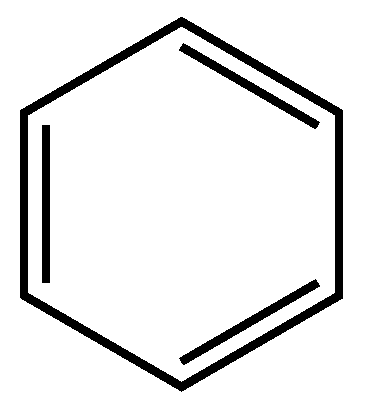
3.1.1. First example

Figure 1. 1,3,5-Cyclohexatriene C 6 H 6
Preprints 150975 g001
n π + n r = D O U     a n d     n π + n r = 1 + 1 2 i n i v i 2
n π + n r = 1 + 1 2 n C 4 2 + 1 2 n H 1 2 = > n π + n r = 4         a n d     n π = 3     ;     n r = 1
p π + p r = T U     a n d     p π + p r = 100 %
p π = 3 · 100 % 4 = 75 %         a n d       p r = 1 · 100 % 4 = 25 %
Now we will substitute p π and p r in all the presented equations with percentages using the total unsaturation formula, where p π = 75 % of TU and p r = 25 % of TU.
p π + p r = T U
p π + p r = 100 %       ;       75 % + 25 % = 100 %
n σ = i n i v i + 2 + 2 75 % 25 % 1 n i 1 2 4 + 2 75 % 25 % 1
n σ = i n i v i + 2 + 4 n i 4 2 4 + 2 · 2
n σ = i n i v i + 6 6 8
n s = 4 n i 1 75 % 25 % 1 i n i v i 4 + 4 4 + 2 75 % 25 % 1
n s = 4 n i 4 2 i n i v i 4 8 4 + 2 · 2
n s = 2 i n i v i 6 12 8 = > n s = i n i v i 6 6 4
n π = n d = i n i v i 2 + 75 % 25 % 1 i n i v i 2 + 2 + 2 4 + 2 75 % 25 % 1
n π = n d = i n i v i 2 + 2 i n i v i 2 + 4 + 2 4 + 2 · 2
n π = n d = 3 i n i v i 2 + 6 8 = > n π = n d = i n i v i 2 + 2 2.666666667
n r = i n i v i 2 + 2 4 + 2 75 % 25 % 1
n r = i n i v i 2 + 2 4 + 2 · 2
n r = i n i v i 2 + 2 8
After deducing the specific general equations for the calculation of the number of covalent bonds and rings for all the cyclic unsaturated organic molecules with double bonds where p π = 75 % and p r = 25 % , we will apply them on a molecular formula as an example: C 12 H 12 N 2 O 3
n σ = i n i v i + 6 6 8
n σ = n C 4 + 6 + n N 3 + 6 + n O 2 + 6 + n H 1 + 6 6 8
n σ = 120 + 18 + 24 + 84 6 8   = > n σ = 30
n s = i n i v i 6 6 4
n s = n C 4 6 n N 3 6 n O 2 6 n H 1 6 6 4
n s = 24 + 6 + 12 + 60 6 4   = > n s = 24
n π = n d = i n i v i 2 + 2 2.666666667
n π = n d = n C 4 2 + n N 3 2 + n O 2 2 + n H 1 2 + 2 2.666666667
n π = n d = 24 + 2 + 0 12 + 2 2.666666667   = > n π = n d = 6
n r = i n i v i 2 + 2 8
n r = n C 4 2 + n N 3 2 + n O 2 2 + n H 1 2 + 2 8
n r = 24 + 2 + 0 12 + 2 8   = >   n r = 2
Other molecular formulas where their corresponding molecules can have p π = 75 % of TU and p r = 25 % of TU, will be presented in the following table:
Table 1. Calculation of covalent bonds and rings for unsaturated cyclic molecules with double bonds
p π = 75 %     a n d   p r = 25 %
Examples of Unsaturated Cyclic Molecules with double bonds σ-bonds
3 4 + 1 8 ( i n i v i + 6 )
Single bonds
3 2 + 1 4 ( i n i v i 6 )
π-bonds and double bonds
2 2 . 6 ¯ + 1 2 . 6 ¯ ( i n i v i 2 )
Ring/Rings
1 4 + 1 8 ( i n i v i 2 )
C 6 H 6 12 9 3 n π ; 3 n d 1
C 12 H 12 N 2 O 3 30 24 6 n π ; 6 n d 2
C 12 H 13 N 3 29 23 6 n π ; 6 n d 2
C 14 H 10 S 2 O 6 C l 4 38 29 9 n π ; 9 n d 3
C 16 H 10 O 5 33 24 9 n π ; 9 n d 3
C 22 H 12 N 3 O 3 C l 5 48 36 12 n π ; 12 n d 4
C 20 H 22 P 4 O 8 57 45 12 n π ; 12 n d 4
C 24 H 26 S 4 O 9 67 52 15 n π ; 15 n d 5
C 27 H 16 O 10 57 42 15 n π ; 15 n d 5
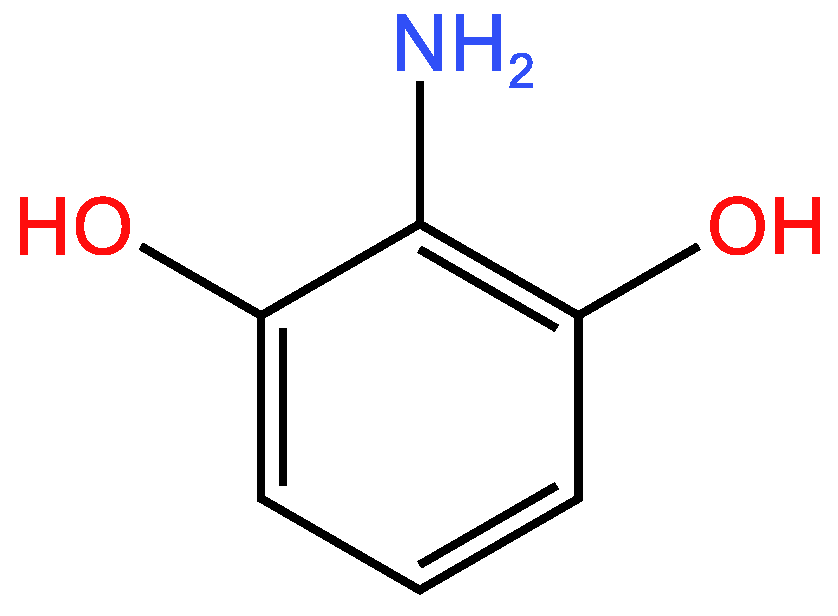
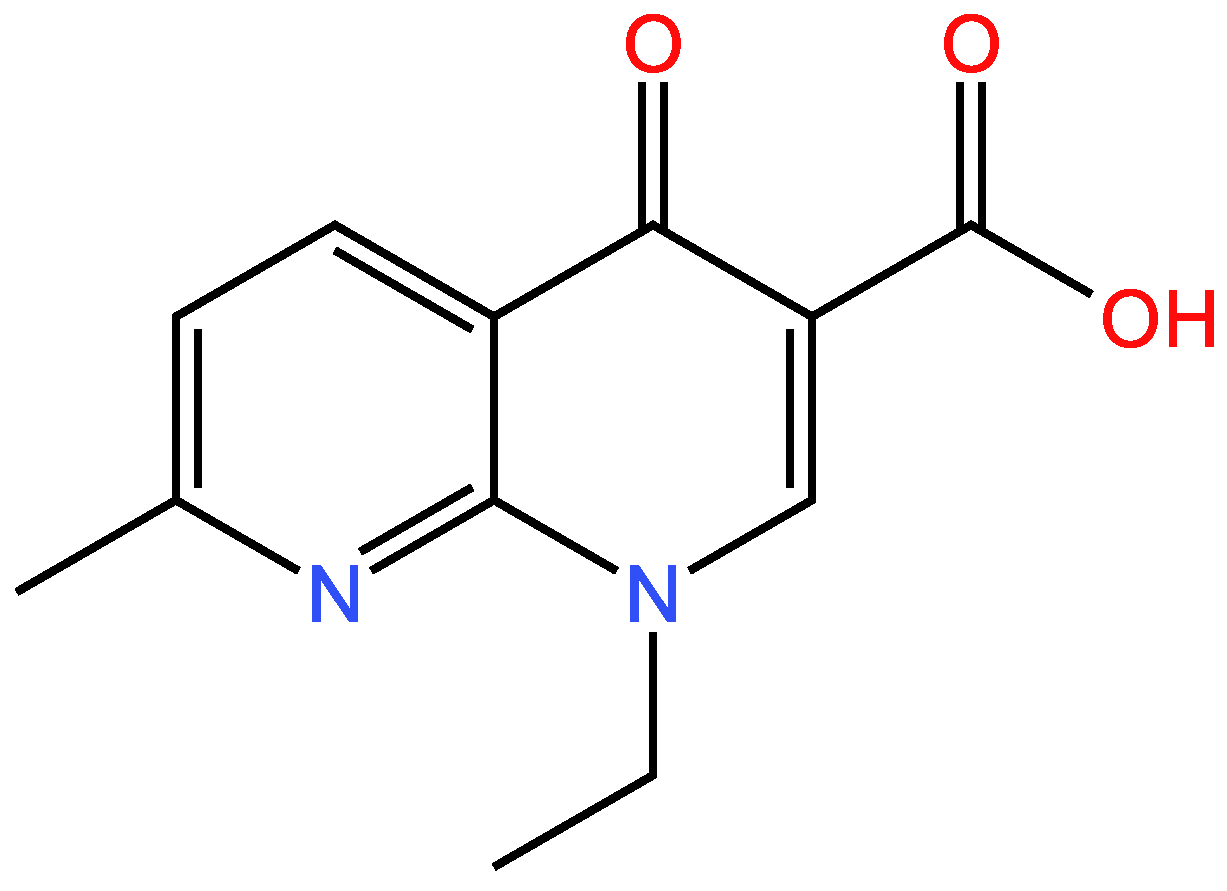
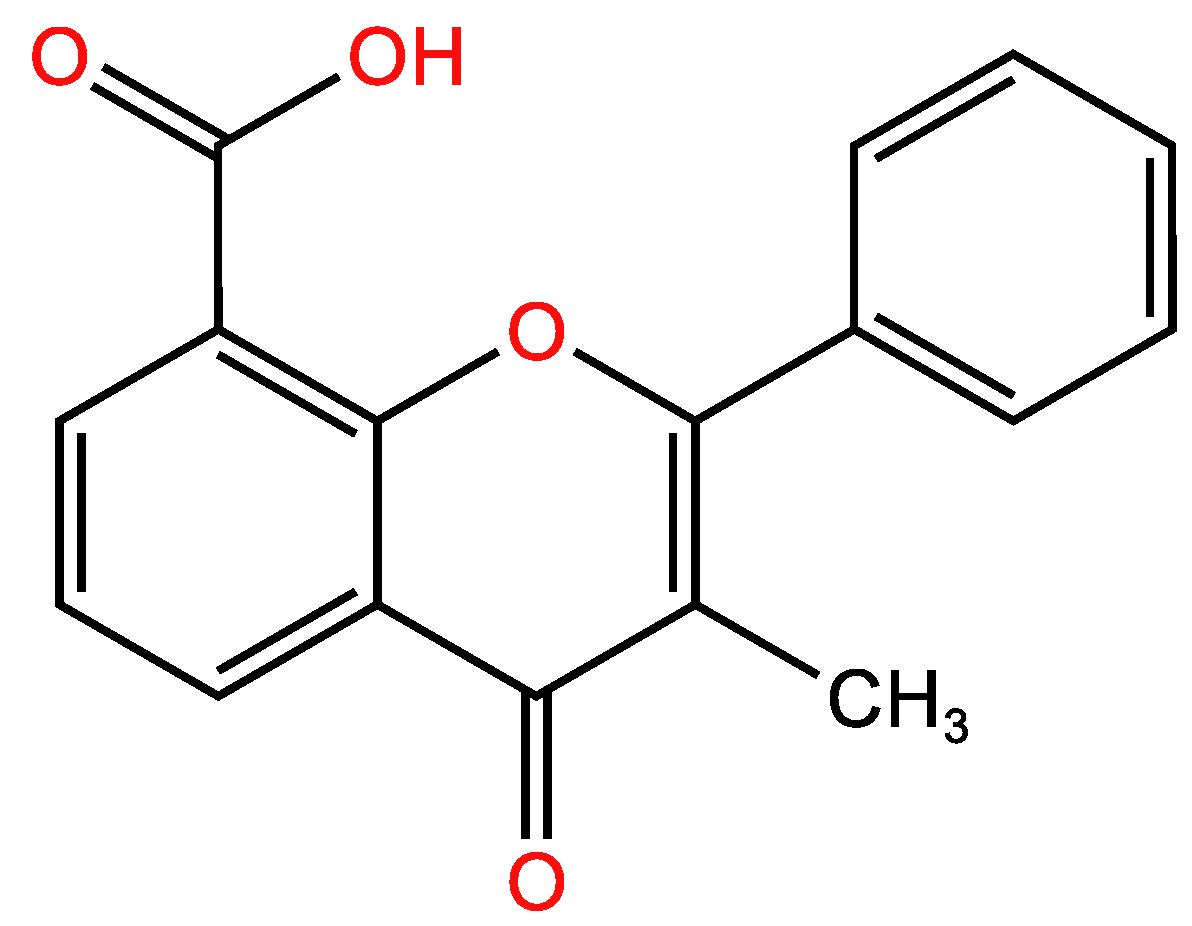
Some examples of molecular structures for cyclic unsaturated molecules with double bonds where p π > p r and p π = 75 %     ;     p r = 25 % from the total unsaturation are the following ones:
Figure 2. 2-amino benzene-1,3-diol.
Preprints 150975 g002
Figure 3. 1-Ethyl-7-methyl-4-oxo-1,8-naphthyridine-3-carboxylic acid.
Preprints 150975 g003
Figure 4. 3-Methyl-4-oxo-2-phenyl-4H-chromene-8-carboxylic acid.
Preprints 150975 g004

3.1.2. Second example

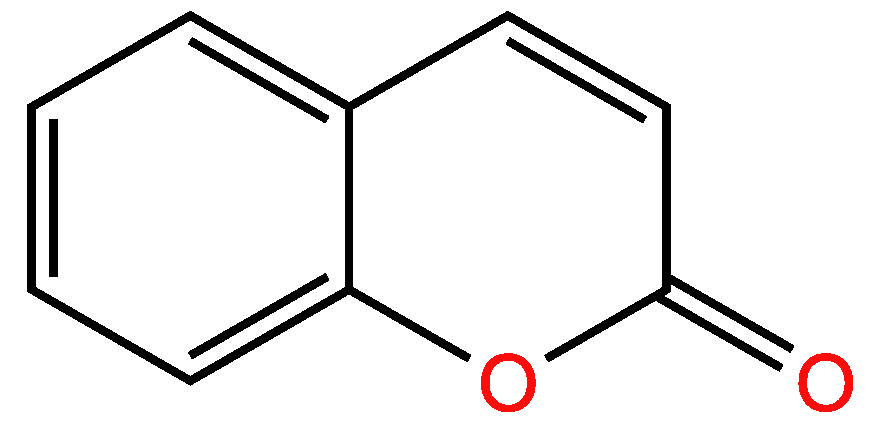
Figure 5. 2H-Chromen-2-one C 9 H 6 O 2 .
Preprints 150975 g005
n π + n r = D O U     a n d     n π + n r = 1 + 1 2 i n i v i 2
n π + n r = 1 + 1 2 n C 4 2 + 1 2 n O 2 2 + 1 2 n H 1 2 = > n π + n r = 7         a n d     n π = 5     ;     n r = 2
p π + p r = T U     a n d     p π + p r = 100 %
p π = 5 · 100 % 7 = 71.42857143 %         a n d       p r = 2 · 100 % 7 = 28,57142857 %
Now we will substitute p π and p r in all the presented equations with percentages using the total unsaturation formula, where p π = 71.42857143 % of TU and p r = 28.57142857 % of TU.
p π + p r = T U
p π + p r = 100 %       ;       71.42857143 % + 28.57142857 % = 100 %
n σ = i n i v i + 2 + 2 71.42857143 % 28.57142857 % 1 n i 1 2 4 + 2 71.42857143 % 28.57142857 % 1
n σ = i n i v i + 2 + 3 n i 3 2 4 + 2 · 1.5
n σ = i n i v i + 5 5 7
n s = 4 n i 1 71.42857143 % 28.57142857 % 1 i n i v i 4 + 4 4 + 2 71.42857143 % 28.57142857 % 1
n s = 4 n i 4 1.5 i n i v i 4 6 4 + 2 · 1.5
n s = 1.5 i n i v i 6.666666667 10 7 = > n s = i n i v i 6.666666667 6.666666667 4.666666667
n π = n d = i n i v i 2 + 71.42857143 % 28.57142857 % 1 i n i v i 2 + 2 + 2 4 + 2 71.42857143 % 28.57142857 % 1
n π = n d = i n i v i 2 + 1.5 i n i v i 2 + 3 + 2 4 + 2 · 1.5
n π = n d = 2.5 i n i v i 2 + 5 7 = > n π = n d = i n i v i 2 + 2 2.8
n r = i n i v i 2 + 2 4 + 2 71.42857143 % 28.57142857 % 1
n r = i n i v i 2 + 2 4 + 2 · 1.5
n r = i n i v i 2 + 2 7
After deducing the general equations for the calculation of the number of covalent bonds and rings for all the cyclic unsaturated organic molecules with double bonds where p π = 71.42857143 % and p r = 28.57142857 % , we will apply them on a molecular formula as an example: C 8 H 4 O 3
n σ = i n i v i + 5 5 7
n σ = n C 4 + 5 + n O 2 + 5 + n H 1 + 5 5 7
n σ = 72 + + 21 + 24 5 7   = > n σ = 16
n s = i n i v i 6.666666667 6.666666667 4.666666667
n s = n C 4 6.666666667 n O 2 6.666666667 n H 1 6.666666667 6.666666667 4.666666667
n s = 21.33333334 + 14 + 22.66666667 6.666666667 4.666666667   = > n s = 11
n π = n d = i n i v i 2 + 2 2.8
n π = n d = n C 4 2 + n O 2 2 + n H 1 2 + 2 2.8
n π = n d = 16 + 0 4 + 2 2.8   = > n π = n d = 5
n r = i n i v i 2 + 2 7
n r = n C 4 2 + n O 2 2 + n H 1 2 + 2 7
n r = 16 + 0 4 + 2 7   = >   n r = 2
Other molecular formulas where their corresponding molecules can have p π = 71.42857143 % of TU and p r = 28.57142857 % of TU, will be presented in the following table:
Table 2. Calculation of covalent bonds and rings for unsaturated cyclic molecules with double bonds
p π = 71.42857143 %       a n d       p r = 28.57142857 %
Examples of Unsaturated Cyclic Molecules with double bonds σ-bonds
5 7 + 1 7 ( i n i v i + 5 )
Single bonds
6 . 6 ¯ 4 . 6 ¯ + 1 4 . 6 ¯ ( i n i v i 6 . 6 ¯ )
π-bonds and double bonds
2 2.8 + 1 2.8 ( i n i v i 2 )
Ring/Rings
2 7 + 1 7 ( i n i v i 2 )
C 9 H 5 N O C l 2 19 14 5 n π ; 5 n d 2
C 19 H 12 O 4 38 28 10 n π ; 10 n d 4
C 16 H 10 N 4 O 3 36 26 10 n π ; 10 n d 4
C 30 H 10 C l 10 55 40 15 n π ; 15 n d 6
C 33 H 42 S 4 O 9 93 78 15 n π ; 15 n d 6
C 33 H 29 P 4 N 5 O 8 86 66 20 n π ; 20 n d 8
C 37 H 32 N 12 88 68 20 n π ; 20 n d 8
C 46 H 46 P 8 O 13 122 97 25 n π ; 25 n d 10
C 54 H 32 O 7 C l 8 110 85 25 n π ; 25 n d 10
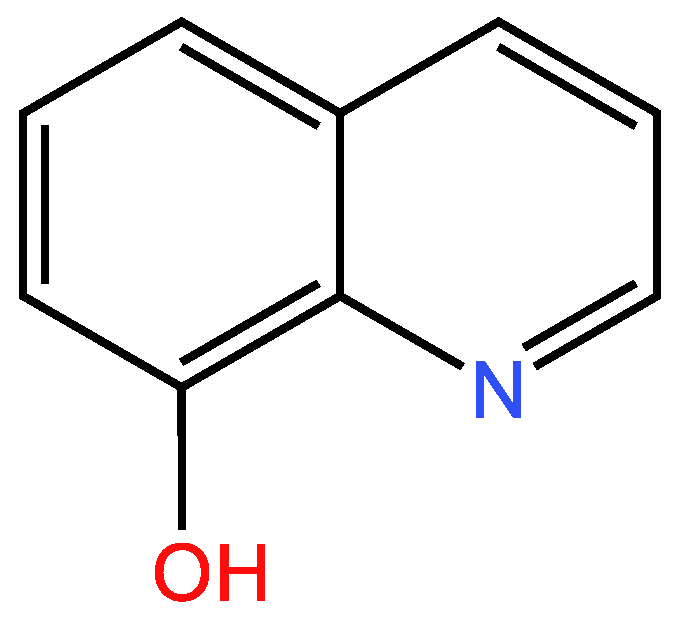
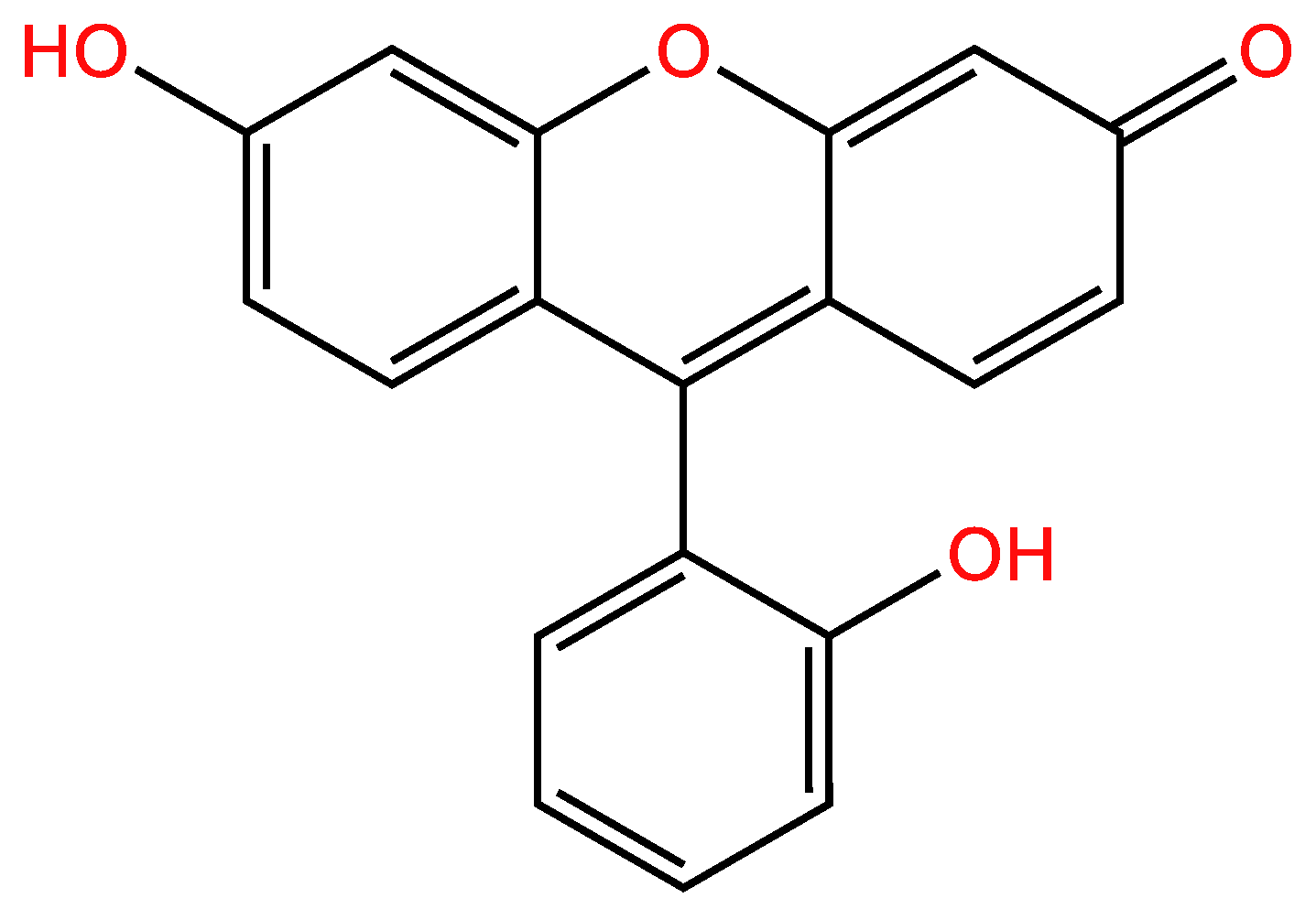
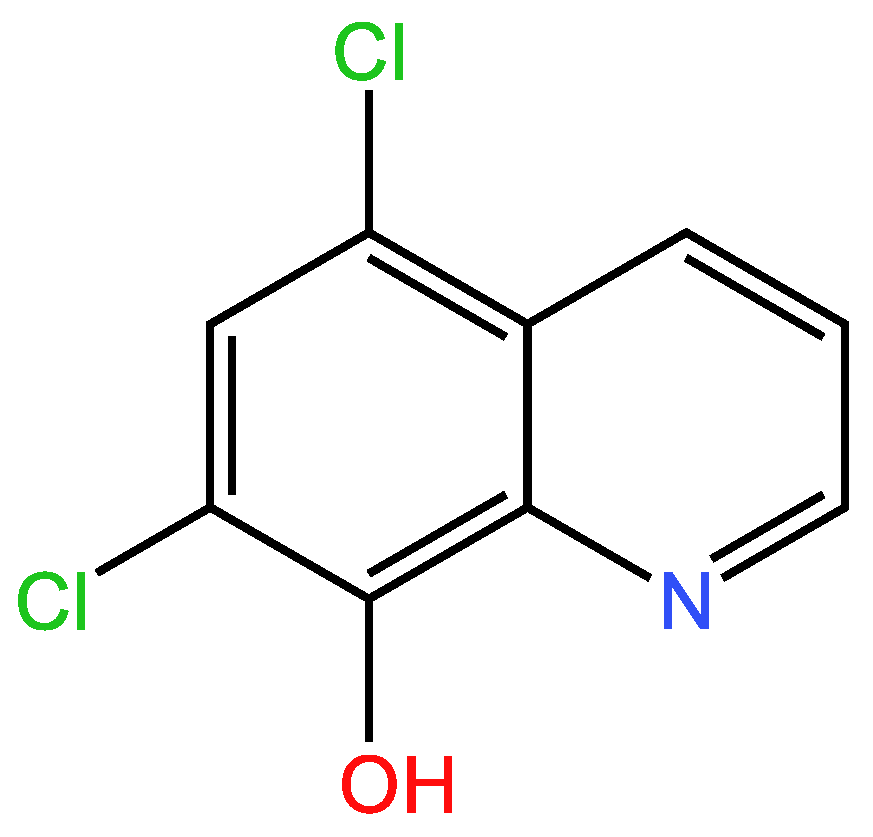
Some examples of molecular structures for cyclic unsaturated molecules with double bonds where p π > p r and p π = 71.42857143 %     ;     p r = 28.57142857 % from the total unsaturation are the following ones:
Figure 6. 8-quinolinol.
Preprints 150975 g006
Figure 7. 6-hydroxy-9-(2-hydroxyphenyl)xanthen-3-one.
Preprints 150975 g007
Figure 8. 5,7-dichloro-8-quinolinol.
Preprints 150975 g008

3.2. Cyclic unsaturated molecules with double bonds in which p r > p π

For all the cyclic unsaturated molecules that contain σ-bonds, π-bonds, single bonds and double bonds where the number of rings is always greater than the number of π-bonds, we have invented four mathematical equations to be able to deduce many other specific general equations for covalent bonds and rings:
n σ = i n i v i + 2 + p r p π 1 i n i v i 2 4 + 2 p r p π 1
n s = 4 n i 1 + p r p π 1 i n i v i 4 + 2 p r p π 1
n π = n d = i n i v i 2 + 2 4 + 2 p r p π 1
n r = i n i v i 2 + p r p π 1 i n i v i 2 + 2 + 2 4 + 2 p r p π 1
In order to find any percentages for π-bonds and rings that correspond to cyclic unsaturated molecules with double bonds in which p r > p π ; 0 % < p π < 50 % and 50 % < p r < 100 % , we can start by choosing a molecular structure where n r > n π , write it’s molecular formula and calculate the correlated degree of unsaturation. Afterwards, the number of π-bonds and rings will be converted into percentages using the rule of three, and those numerical values will be substituted into the main mathematical equations to deduce other specific general equations that have as variables only the number of atoms and their valences, and work for molecules that share the same values of p π and p r as our chosen molecular structure.

3.2.1. First example

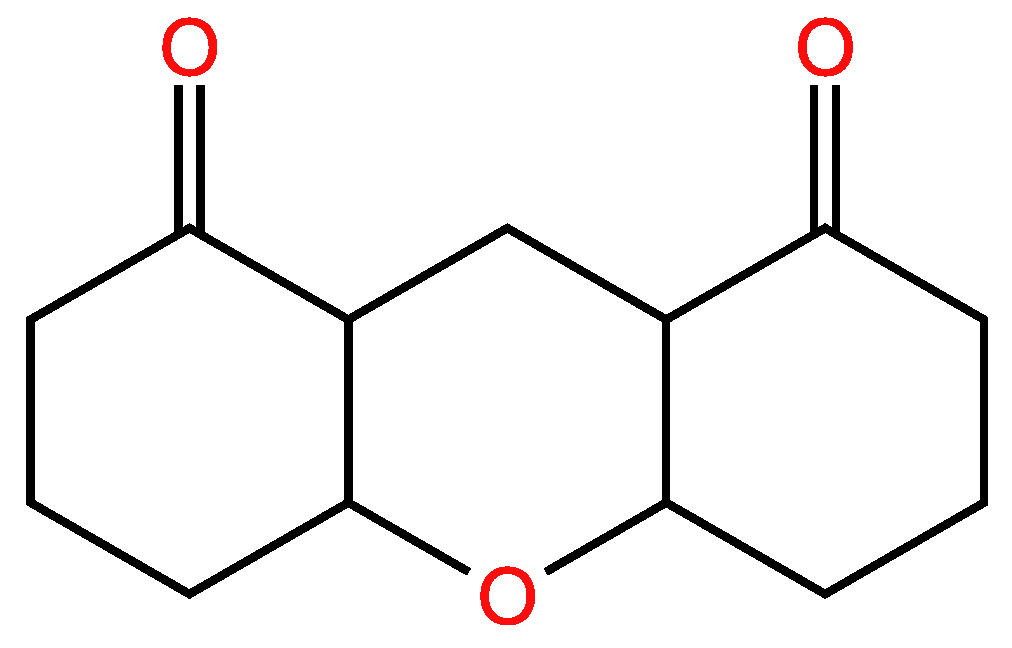
Figure 9. 3,4,4a,5,6,7,8a,9,9a,10a-decahydro-2H-xanthene-1,8-dione C 13 H 18 O 3 .
Preprints 150975 g009
n π + n r = D O U     a n d     n π + n r = 1 + 1 2 i n i v i 2
n π + n r = 1 + 1 2 n C 4 2 + 1 2 n O 2 2 + 1 2 n H 1 2 = > n π + n r = 5         a n d     n π = 2     ;     n r = 3
p π + p r = T U     a n d     p π + p r = 100 %
p π = 2 · 100 % 5 = 40 %         a n d       p r = 3 · 100 % 5 = 60 %
Now we will substitute p π and p r in all the presented equations with percentages using the total unsaturation formula, where p π = 40 % of TU and p r = 60 % of TU.
p π + p r = T U
p π + p r = 100 %       ;       40 % + 60 % = 100 %
n σ = i n i v i + 2 + 60 % 40 % 1 i n i v i 2 4 + 2 60 % 40 % 1
n σ = i n i v i + 2 + 0.5 i n i v i 2 4 + 2 · 0.5
n σ = i n i 1.5 v i + 2 2 5
n s = 4 n i 1 + 60 % 40 % 1 i n i v i 4 + 2 60 % 40 % 1
n s = 4 n i 4 + 0.5 i n i v i 4 + 2 · 0.5
n s = 0.5 i n i v i + 8 4 5 = > n s = i n i v i + 8 8 10
n π = n d = i n i v i 2 + 2 4 + 2 60 % 40 % 1
n π = n d = i n i v i 2 + 2 4 + 2 · 0.5
n π = n d = i n i v i 2 + 2 5
n r = i n i v i 2 + 60 % 40 % 1 i n i v i 2 + 2 + 2 4 + 2 60 % 40 % 1
n r = i n i v i 2 + 0.5 i n i v i 2 + 1 + 2 4 + 2 · 0.5
n r = 1.5 i n i v i 2 + 3 5 = > n r = i n i v i 2 + 2 3.333333333
After deducing the general equations for the calculation of the number of covalent bonds and rings for all the cyclic unsaturated organic molecules with double bonds where p π = 40 % and p r = 60 % , we will apply them on a molecular formula as an example: C 14 H 20 O 2
n σ = i n i 1.5 v i + 2 2 5
n σ = n C 1.5 · 4 + 2 + n O 1.5 · 2 + 2 + n H 1.5 · 1 + 2 2 5
n σ = 112 + 10 + 70 2 5   = > n σ = 38
n s = i n i v i + 8 8 10
n s = n C 4 + 8 + n O 2 + 8 + n H 1 + 8 8 10
n s = 168 + 20 + 180 8 10   = > n s = 36
n π = n d = i n i v i 2 + 2 5
n π = n d = n C 4 2 + n O 2 2 + n H 1 2 + 2 5
n π = n d = 28 + 0 20 + 2 5   = > n π = n d = 2
n r = i n i v i 2 + 2 3.333333333
n r = n C 4 2 + n O 2 2 + n H 1 2 + 2 3.333333333
n r = 28 + 0 20 + 2 3.333333333   = >   n r = 3
Other molecular formulas where their corresponding molecules can have p π = 40 % of TU and p r = 60 % of TU, will be presented in the following table:
Table 3. Calculation of covalent bonds and rings for unsaturated cyclic molecules with double bonds
p π = 40 %       a n d       p r = 60 %
Examples of Unsaturated Cyclic Molecules with double bonds σ-bonds
2 5 + 1 5 ( i n i 1.5 v i + 2 )
Single bonds
4 5 + 1 10 ( i n i v i + 8 )
π-bonds and double bonds
2 5 + 1 5 ( i n i v i 2 )
Ring/Rings
2 3 . 3 ¯ + 1 3 . 3 ¯ ( i n i v i 2 )
C 14 H 20 O 2 38 36 2 n π ; 2 n d 3
C 14 H 20 36 34 2 n π ; 2 n d 3
C 13 H 19 N O 2 37 35 2 n π ; 2 n d 3
C 25 H 28 O 5 C l 4 67 63 4 n π ; 4 n d 6
C 24 H 36 N 6 71 67 4 n π ; 4 n d 6
C 38 H 68 S 5 O 14 133 127 6 n π ; 6 n d 9
C 32 H 57 P 5 N 6 O 17 125 119 6 n π ; 6 n d 9
C 50 H 86 P 8 O 16 171 163 8 n π ; 8 n d 12
C 46 H 79 S 9 O 19 C l 11 175 167 8 n π ; 8 n d 12
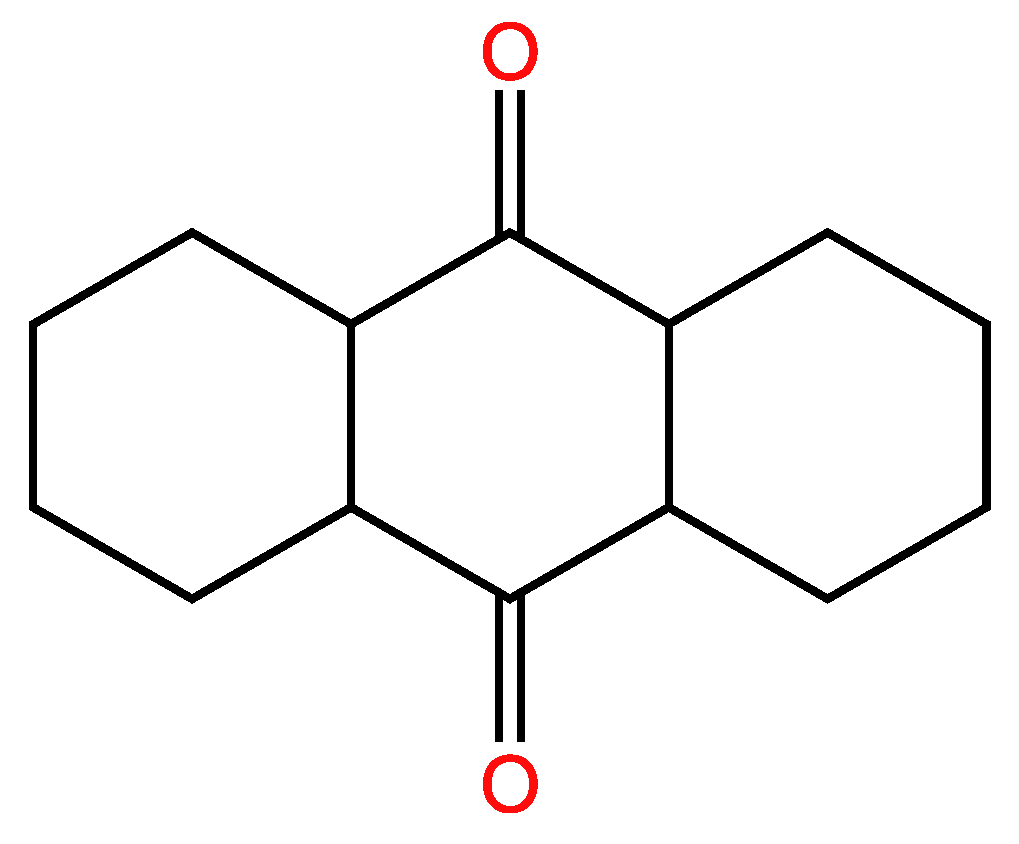
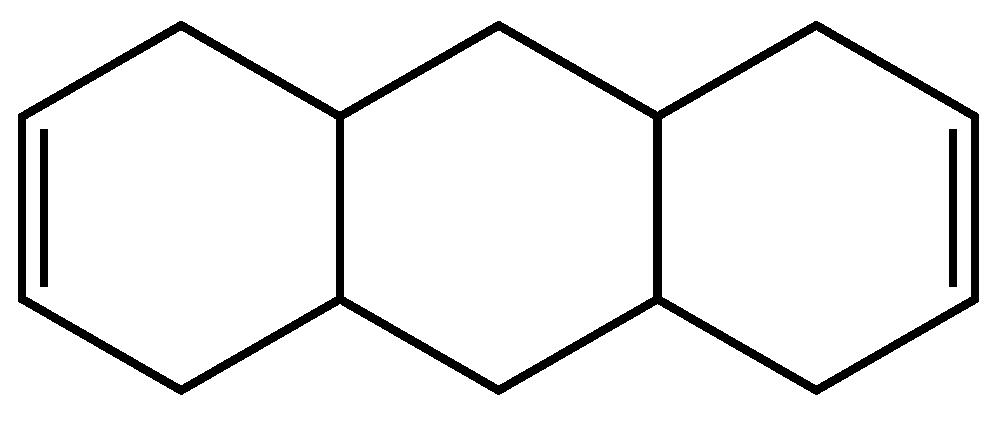
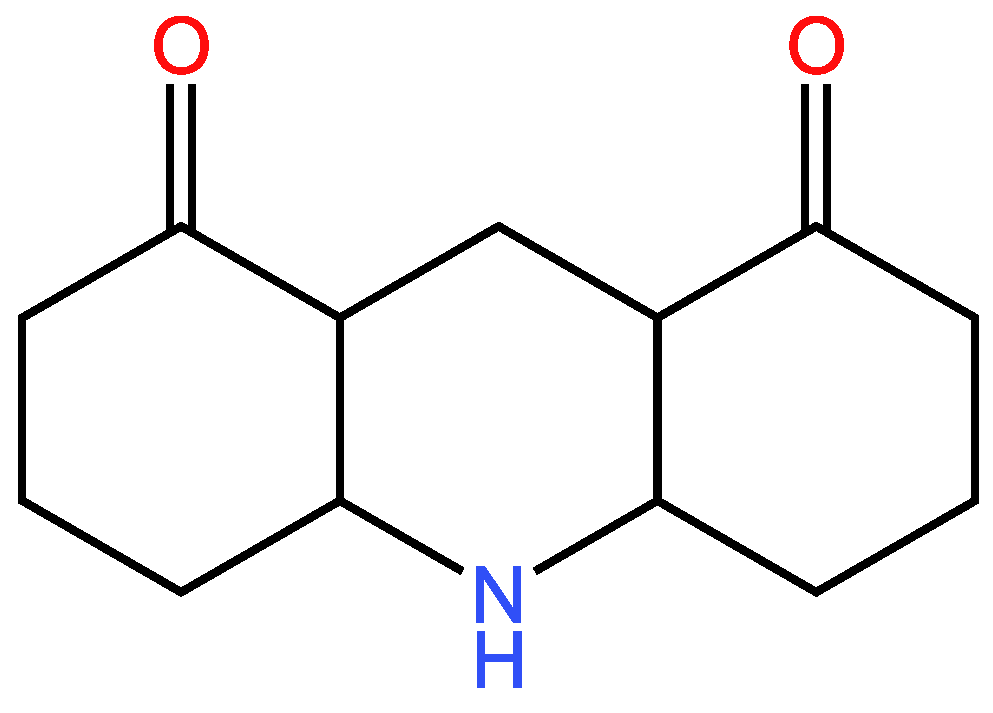
Some examples of molecular structures for cyclic unsaturated molecules with double bonds where p r > p π and p π = 40 %     ;     p r = 60 % from the total unsaturation are the following ones:
Figure 10. 1,2,3,4,4a,5,6,7,8,8a,9a,10a-dodecahydroanthracene-9,10-dione.
Preprints 150975 g010
Figure 11. 1,4,4a,5,8,8a,9,9a,10,10a-decahydroanthracene.
Preprints 150975 g011
Figure 12. 2,3,4,4a,5,6,7,8a,9,9a,10,10a-dodecahydroacridine-1,8-dione.
Preprints 150975 g012

3.2.2. Second example

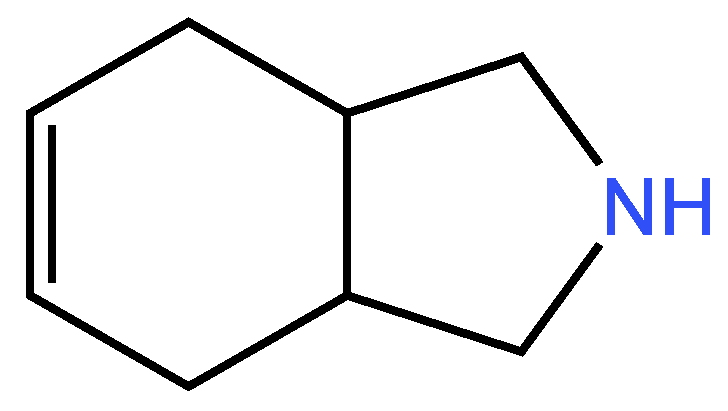
Figure 13. 2,3,3a,4,7,7a-hexahydro-1H-isoindole C 8 H 13 N .
Preprints 150975 g013
n π + n r = D O U     a n d     n π + n r = 1 + 1 2 i n i v i 2
n π + n r = 1 + 1 2 n C 4 2 + 1 2 n O 2 2 + 1 2 n H 1 2 = > n π + n r = 3         a n d     n π = 1     ;     n r = 2
p π + p r = T U     a n d     p π + p r = 100 %
p π = 1 · 100 % 3 = 33.33333333 %         a n d       p r = 2 · 100 % 3 = 66.66666667 %
Now we will substitute p π and p r in all the presented equations with percentages using the total unsaturation formula, where p π = 33.33333333 % of TU and p r = 66.66666667 % of TU.
p π + p r = T U
p π + p r = 100 %       ;       33.33333333 % + 66.66666667 % = 100 %
n σ = i n i v i + 2 + 66.66666667 % 33.33333333 % 1 i n i v i 2 4 + 2 66.66666667 % 33.33333333 % 1
n σ = i n i v i + 2 + i n i v i 2 4 + 2 · 1
n σ = 2 i n i v i + 1 2 6 = > n σ = i n i v i + 1 1 3
n s = 4 n i 1 + 66.66666667 % 33.33333333 % 1 i n i v i 4 + 2 66.66666667 % 33.33333333 % 1
n s = 4 n i 4 + i n i v i 4 + 2 · 1
n s = i n i v i + 4 4 6
n π = n d = i n i v i 2 + 2 4 + 2 66.66666667 % 33.33333333 % 1
n π = n d = i n i v i 2 + 2 4 + 2 · 1
n π = n d = i n i v i 2 + 2 6
n r = i n i v i 2 + 66.66666667 % 33.33333333 % 1 i n i v i 2 + 2 + 2 4 + 2 66.66666667 % 33.33333333 % 1
n r = i n i v i 2 + i n i v i 2 + 2 + 2 4 + 2 · 1
n r = 2 i n i v i 2 + 4 6 = > n r = i n i v i 2 + 2 3
After deducing the general equations for the calculation of the number of covalent bonds and rings for all the cyclic unsaturated organic molecules with double bonds where p π = 33.33333333 % and p r = 66.66666667 % , we will apply them on a molecular formula as an example: C 9 H 16 N 2
n σ = i n i v i + 1 1 3
n σ = n C 4 + 1 + n N 3 + 1 + n H 1 + 1 1 3
n σ = 45 + 8 + 32 1 3   = > n σ = 28
n s = i n i v i + 4 4 6
n s = n C 4 + 4 + n N 3 + 4 + n H 1 + 4 4 6
n s = 72 + 14 + 80 4 6   = > n s = 27
n π = n d = i n i v i 2 + 2 6
n π = n d = n C 4 2 + n N 3 2 + n H 1 2 + 2 6
n π = n d = 18 + 2 16 + 2 6   = > n π = n d = 1
n r = i n i v i 2 + 2 3
n r = n C 4 2 + n N 3 2 + n H 1 2 + 2 3
n r = 18 + 2 16 + 2 3   = >   n r = 2
Other molecular formulas where their corresponding molecules can have p π = 33.33333333 % of TU and p r = 66.66666667 % of TU, will be presented in the following table:
Table 4. Calculation of covalent bonds and rings for unsaturated cyclic molecules with double bonds
p π = 33.33333333 %       a n d       p r = 66.66666667 %
Examples of Unsaturated Cyclic Molecules with double bonds σ-bonds
1 3 + 1 3 ( i n i v i + 1 )
Single bonds
2 3 + 1 6 ( i n i v i + 4 )
π-bonds and double bonds
1 3 + 1 6 ( i n i v i 2 )
Ring/Rings
2 3 + 1 3 ( i n i v i 2 )
C 8 H 12 O 22 21 1 n π ; 1 n d 2
C 11 H 18 O 2 32 31 1 n π ; 1 n d 2
C 9 H 14 O 2 26 25 1 n π ; 1 n d 2
C 15 H 29 P 2 N 3 O 4 56 54 2 n π ; 2 n d 4
C 18 H 32 S 2 O 6 C l 2 63 61 2 n π ; 2 n d 4
C 24 H 37 N 5 71 68 3 n π ; 3 n d 6
C 26 H 48 P 4 O 12 95 92 3 n π ; 3 n d 6
C 34 H 38 C l 8 87 83 4 n π ; 4 n d 8
C 30 H 42 N 4 O 7 90 86 4 n π ; 4 n d 8
Some examples of molecular structures for cyclic unsaturated molecules with double bonds where p r > p π and p π = 33.33333333 %     ;     p r = 66.66666667 % from the total unsaturation are the following ones:
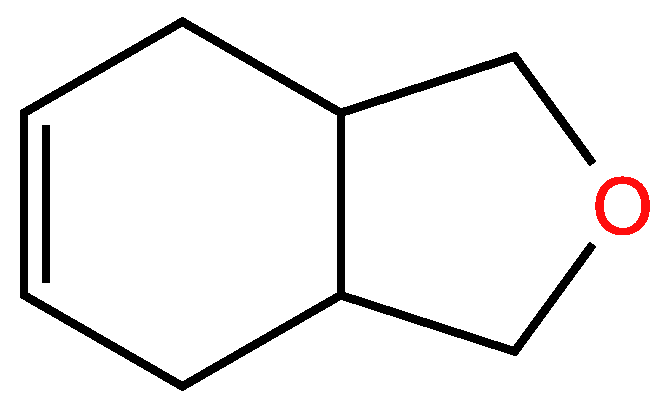
Figure 14. 1,3,3a,4,7,7a-hexahydro-2-benzofuran.
Preprints 150975 g014
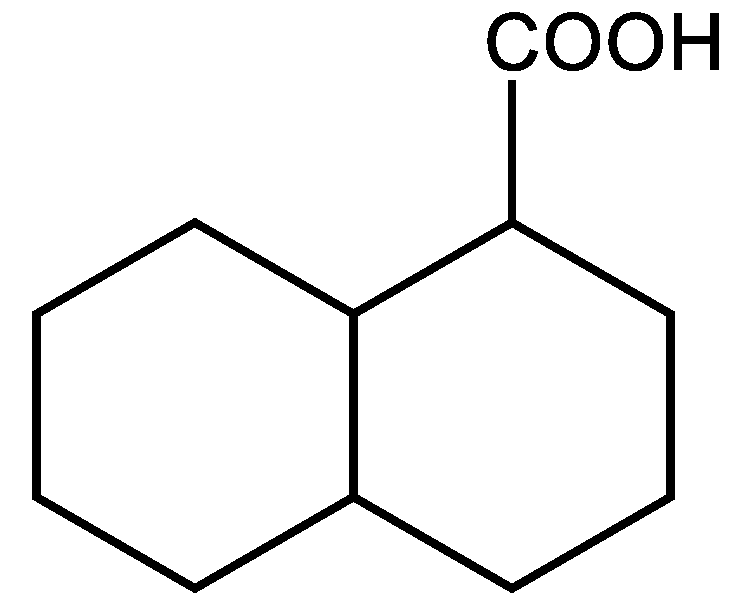
Figure 15. 1,2,3,4,4a,5,6,7,8,8a-decahydronaphthalene-1-carboxylic acid.
Preprints 150975 g015
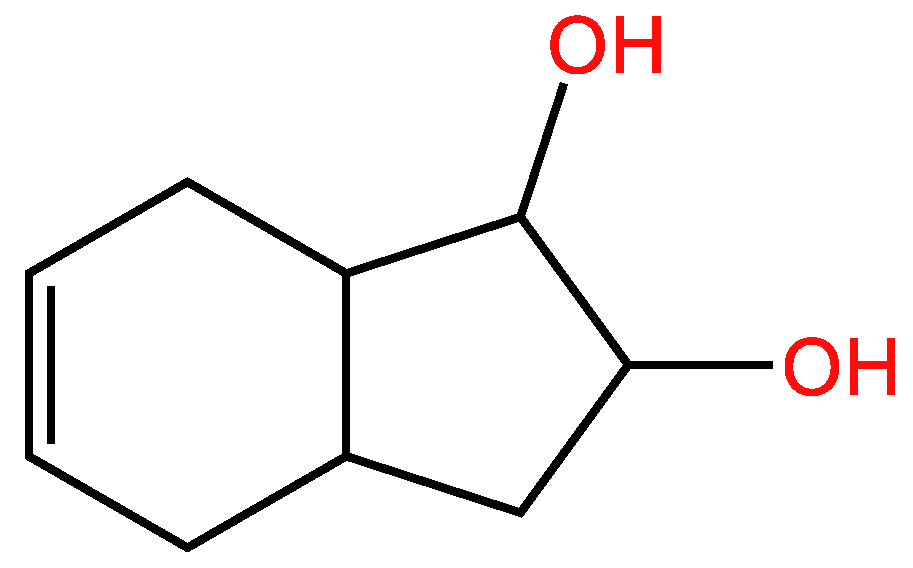
Figure 16. 2,3,3a,4,7,7a-hexahydro-1H-indene-1,2-diol.
Preprints 150975 g016

3.3. Cyclic unsaturated molecules with triple bonds in which p π > p r

For all the cyclic unsaturated molecules that contain σ-bonds, π-bonds, single bonds and triple bonds where the number of π-bonds is always greater than the number of rings, we used two newly invented mathematical equations and another three previously shown for cyclic unsaturated molecules with double bonds ( p π > p r ) to deduce many other specific general equations for covalent bonds and rings:
n σ = i n i v i + 2 + 2 p π p r 1 n i 1 2 4 + 2 p π p r 1
n s = i n i v i + 6 + p π p r 1 i n i 6 v i 6 6 8 + 4 p π p r 1
n π = i n i v i 2 + p π p r 1 i n i v i 2 + 2 + 2 4 + 2 p π p r 1
n r = i n i v i 2 + 2 4 + 2 p π p r 1
n t = i n i v i 2 + p π p r 1 i n i v i 2 + 2 + 2 8 + 4 p π p r 1
In order to find any percentages for π-bonds and rings that correspond to cyclic unsaturated molecules with triple bonds in which p π > p r ; 0 % < p r < 50 % and 50 % < p π < 100 % , we can start by choosing a molecular structure where n π > n r , write it’s molecular formula and calculate the correlated degree of unsaturation. Afterwards, the number of π-bonds and rings will be converted into percentages using the rule of three, and those numerical values will be substituted into the main mathematical equations to deduce other specific general equations that have as variables only the number of atoms and their valences, and work for molecules that share the same values of p π and p r as our chosen molecular structure.

3.3.1. First example

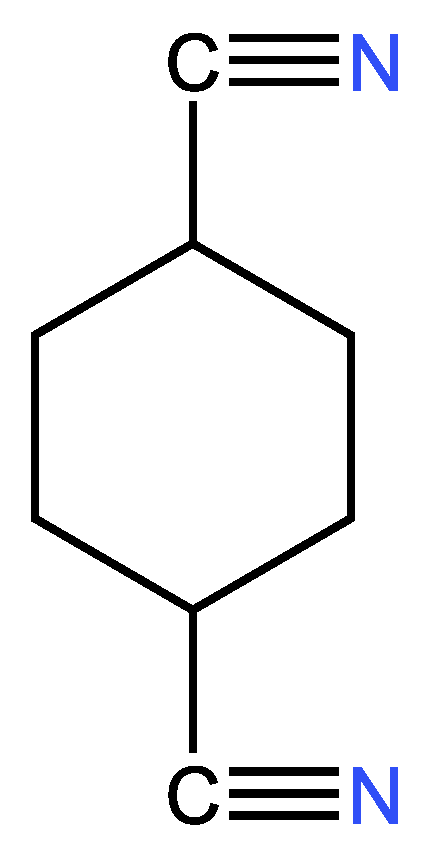
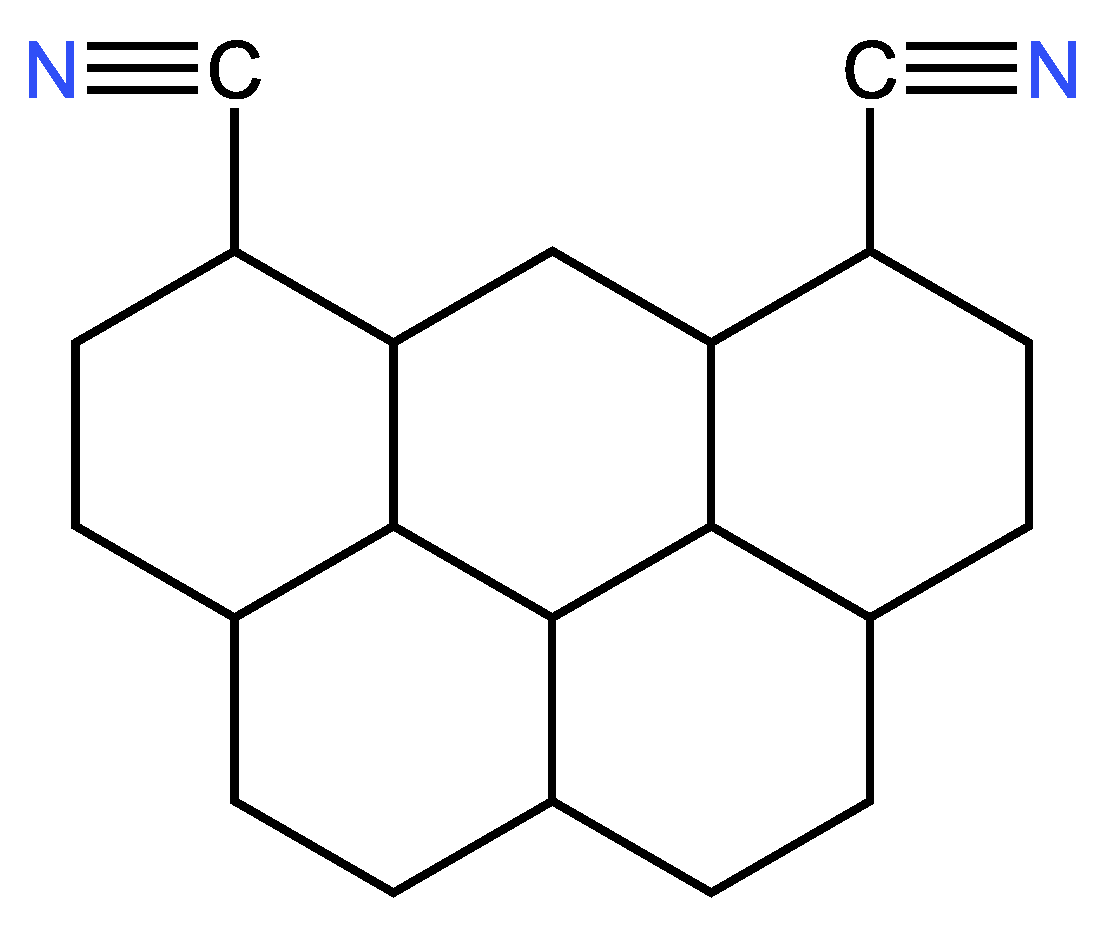
Figure 17. cyclohexane-1,4-dicarbonitrile C 8 H 10 N 2
Preprints 150975 g017
n π + n r = D O U     a n d     n π + n r = 1 + 1 2 i n i v i 2
n π + n r = 1 + 1 2 n C 4 2 + 1 2 n H 1 2 = > n π + n r = 5         a n d     n π = 4     ;     n r = 1
p π + p r = T U     a n d     p π + p r = 100 %
p π = 4 · 100 % 5 = 80 %         a n d       p r = 1 · 100 % 5 = 20 %
Now we will substitute p π and p r in all the presented equations with percentages using the total unsaturation formula, where p π = 80 % of TU and p r = 20 % of TU.
p π + p r = T U
p π + p r = 100 %       ;       80 % + 20 % = 100 %
n σ = i n i v i + 2 + 2 80 % 20 % 1 n i 1 2 4 + 2 80 % 20 % 1
n σ = i n i v i + 2 + 6 n i 6 2 4 + 2 · 3
n σ = i n i v i + 8 8 10
n s = i n i v i + 6 + 80 % 20 % 1 i n i 6 v i 6 6 8 + 4 80 % 20 % 1
n s = i n i v i + 6 + 3 i n i 6 v i 18 6 8 + 4 · 3
n s = 2 i n i 12 v i 24 20 = > n s = i n i 12 v i 12 10
n π = i n i v i 2 + 80 % 20 % 1 i n i v i 2 + 2 + 2 4 + 2 80 % 20 % 1
n π = i n i v i 2 + 3 i n i v i 2 + 6 + 2 4 + 2 · 3
n π = 4 i n i v i 2 + 8 10 = > n π = i n i v i 2 + 2 2.5
n r = i n i v i 2 + 2 4 + 2 80 % 20 % 1
n r = i n i v i 2 + 2 4 + 2 · 3
n r = i n i v i 2 + 2 10
n t = i n i v i 2 + 80 % 20 % 1 i n i v i 2 + 2 + 2 8 + 4 80 % 20 % 1
n t = i n i v i 2 + 3 i n i v i 2 + 6 + 2 8 + 4 · 3
n t = 4 i n i v i 2 + 8 20 = > n t = i n i v i 2 + 2 5
After deducing the specific general equations for the calculation of the number of covalent bonds and rings for all the cyclic unsaturated organic molecules with triple bonds where p π = 80 % and p r = 20 % , we will apply them on a molecular formula as an example: C 8 H 10 N 2
n σ = i n i v i + 8 8 10
n σ = n C 4 + 8 + n N 3 + 8 + n H 1 + 8 8 10
n σ = 96 + 22 + 90 8 10   = > n σ = 20
n s = i n i 12 v i 12 10
n s = n C 12 4 + n N 12 3 + n H 12 1 12 10
n s = 64 + 18 + 110 12 10   = > n s = 18
n π = i n i v i 2 + 2 2.5
n π = n C 4 2 + n N 3 2 + n H 1 2 + 2 2.5
n π = 16 + 2 10 + 2 2.5   = > n π = 4
n r = i n i v i 2 + 2 10
n r = n C 4 2 + n N 3 2 + n H 1 2 + 2 10
n r = 16 + 2 10 + 2 10   = >   n r = 1
n t = i n i v i 2 + 2 5
n t = n C 4 2 + n N 3 2 + n H 1 2 + 2 5
n t = 16 + 2 10 + 2 5   = > n t = 2
Other molecular formulas where their corresponding molecules can have p π = 80 % of TU and p r = 20 % of TU, will be presented in the following table:
Table 5. Calculation of covalent bonds and rings for unsaturated cyclic molecules with triple bonds
p π = 80 %       a n d       p r = 20 %
Examples of Unsaturated Cyclic Molecules with triple bonds σ-bonds
4 5 + 1 10 ( i n i v i + 8 )
Single bonds
6 5 + 1 10 ( i n i 12 v i )
π-bonds and triple bonds
2 2.5 + 1 2.5 ( i n i v i 2 )  
2 5 + 1 5 ( i n i v i 2 )
Ring/Rings
2 10 + 1 10 ( i n i v i 2 )
C 9 H 12 N 2 23 21 4 n π ; 2 n t 1
C 6 H 4 10 8 4 n π ; 2 n t 1
C 7 H 7 N 15 13 4 n π ; 2 n t 1
C 12 H 8 N 2 O 2 25 21 8 n π ; 4 n t 2
C 14 H 7 O 2 C l 3 27 23 8 n π ; 4 n t 2
C 18 H 24 S 4 O 8 56 50 12 n π ; 6 n t 3
C 20 H 16 N 4 O 5 47 41 12 n π ; 6 n t 3
C 30 H 16 C l 6 55 47 16 n π ; 8 n t 4
C 36 H 34 O 11 84 76 16 n π ; 8 n t 4
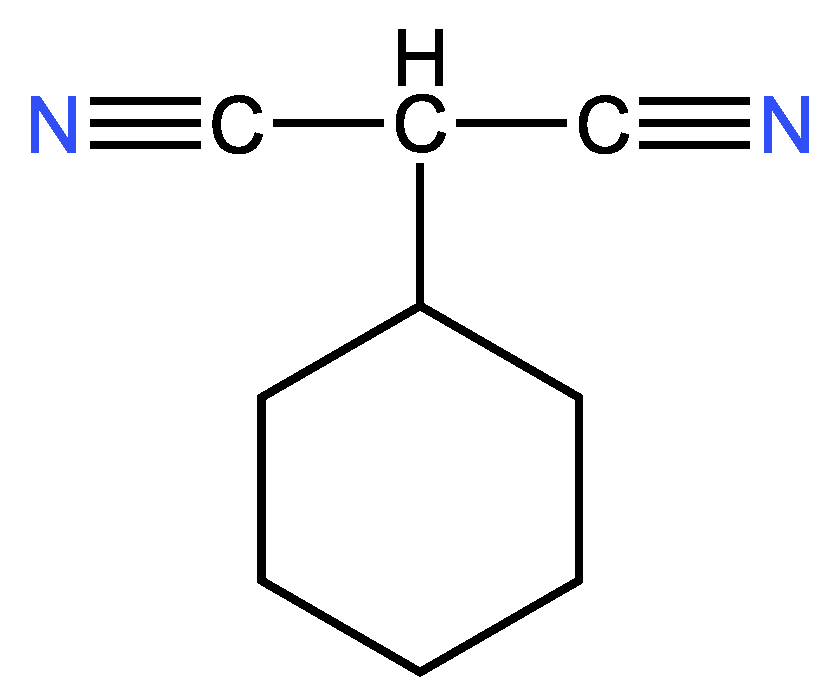
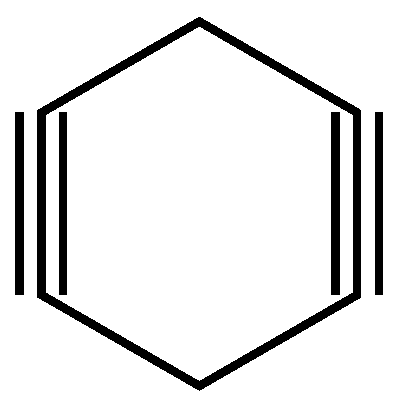
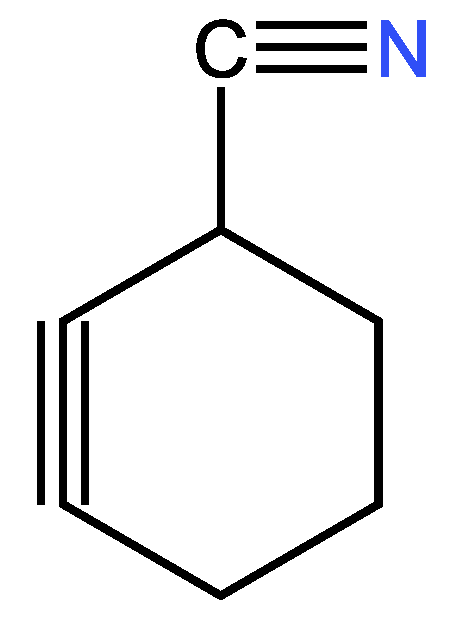
Some examples of molecular structures for cyclic unsaturated molecules with triple bonds where p π > p r and p π = 80 %     ;     p r = 20 % from the total unsaturation are the following ones:
Figure 18. 2-cyclohexyl propanedinitrile.
Preprints 150975 g018
Figure 19. cyclohexa-1,4-diyne.
Preprints 150975 g019
Figure 20. cyclohex2-yne-1-carbonitrile.
Preprints 150975 g020

3.3.2. Second example

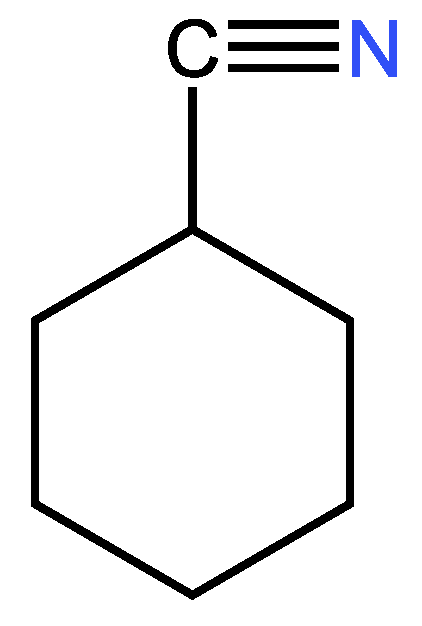
Figure 21. cyclohexanecarbonitrile C 7 H 11 N
Preprints 150975 g021
n π + n r = D O U     a n d     n π + n r = 1 + 1 2 i n i v i 2
n π + n r = 1 + 1 2 n C 4 2 + 1 2 n N 3 2 + 1 2 n H 1 2 = > n π + n r = 3         a n d     n π = 2     ;     n r = 1
p π + p r = T U     a n d     p π + p r = 100 %
p π = 2 · 100 % 3 = 66.66666667 %         a n d       p r = 1 · 100 % 3 = 33.33333333 %
Now we will substitute p π and p r in all the presented equations with percentages using the total unsaturation formula, where p π = 66.66666667 % of TU and p r = 33.33333333 % of TU.
p π + p r = T U
p π + p r = 100 %       ;       66.66666667 % + 33.33333333 % = 100 %
n σ = i n i v i + 2 + 2 66.66666667 % 33.33333333 % 1 n i 1 2 4 + 2 66.66666667 % 33.33333333 % 1
n σ = i n i v i + 2 + 2 n i 2 2 4 + 2 · 1
n σ = i n i v i + 4 4 6
n s = i n i v i + 6 + 66.66666667 % 33.33333333 % 1 i n i 6 v i 6 6 8 + 4 66.66666667 % 33.33333333 % 1
n s = i n i v i + 6 + i n i 6 v i 6 6 8 + 4 · 1
n s = 12 n i 12 12 = > n s = n i 1
n π = i n i v i 2 + 66.66666667 % 33.33333333 % 1 i n i v i 2 + 2 + 2 4 + 2 66.66666667 % 33.33333333 % 1
n π = i n i v i 2 + i n i v i 2 + 2 + 2 4 + 2 · 1
n π = 2 i n i v i 2 + 4 6 = > n π = i n i v i 2 + 2 3
n r = i n i v i 2 + 2 4 + 2 66.66666667 % 33.33333333 % 1
n r = i n i v i 2 + 2 4 + 2 · 1
n r = i n i v i 2 + 2 6
n t = i n i v i 2 + 66.66666667 % 33.33333333 % 1 i n i v i 2 + 2 + 2 8 + 4 66.66666667 % 33.33333333 % 1
n t = i n i v i 2 + i n i v i 2 + 2 + 2 8 + 4 · 1
n t = 2 i n i v i 2 + 4 12 = > n t = i n i v i 2 + 2 6
After deducing the general equations for the calculation of the number of covalent bonds and rings for all the cyclic unsaturated organic molecules with triple bonds where p π = 66.66666667 % and p r = 33.33333333 % , we will apply them on a molecular formula as an example: C 6 H 12 O 3 S
n σ = i n i v i + 4 4 6
n σ = n S 6 + 4 + n C 4 + 4 + n O 2 + 4 + n H 1 + 4 4 6
n σ = 10 + 48 + 18 + 60 4 6   = > n σ = 22
n s = n i 1
n s = n S + n C + n O + n H 1
n s = 1 + 6 + 3 + 12 1 = > n s = 21
n π = i n i v i 2 + 2 3
n π = n S 6 2 + n C 4 2 + n O 2 2 + n H 1 2 + 2 3
n π = 4 + 12 + 0 12 + 2 3   = > n π = 2
n r = i n i v i 2 + 2 6
n r = n S 6 2 + n C 4 2 + n O 2 2 + n H 1 2 + 2 6
n r = 4 + 12 + 0 12 + 2 6   = >   n r = 1
n t = i n i v i 2 + 2 6
n t = n S 6 2 + n C 4 2 + n O 2 2 + n H 1 2 + 2 6
n t = 4 + 12 + 0 12 + 2 6   = >   n t = 1
Other molecular formulas where their corresponding molecules can have p π = 66.66666667 % of TU and p r = 33.33333333 % of TU, will be presented in the following table:
Table 6. Calculation of covalent bonds and rings for unsaturated cyclic molecules with triple bonds
p π = 66.66666667 %       a n d       p r = 33.33333333 %
Examples of Unsaturated Cyclic Molecules with triple bonds σ-bonds
2 3 + 1 6 ( i n i v i + 4 )
Single bonds
n i 1
π-bonds and triple bonds
2 3 + 1 3 ( i n i v i 2 )  
1 3 + 1 6 ( i n i v i 2 )
Ring/Rings
1 3 + 1 6 ( i n i v i 2 )
C 6 H 8 O 2 16 15 2 n π ; 1 n t 1
C 7 H 9 N C l 2 19 18 2 n π ; 1 n t 1
C 7 H 10 O 18 17 2 n π ; 1 n t 1
C 11 H 15 N 3 O 2 32 30 4 n π ; 2 n t 2
C 14 H 14 C l 4 33 31 4 n π ; 2 n t 2
C 16 H 22 P 2 O 2 44 41 6 n π ; 3 n t 3
C 18 H 28 S 2 O 5 55 52 6 n π ; 3 n t 3
C 21 H 23 N 3 50 46 8 n π ; 4 n t 4
C 21 H 23 N 3 O 8 58 54 8 n π ; 4 n t 4
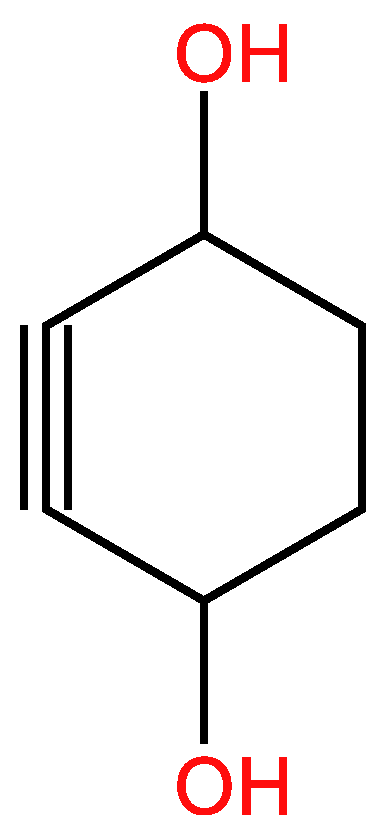
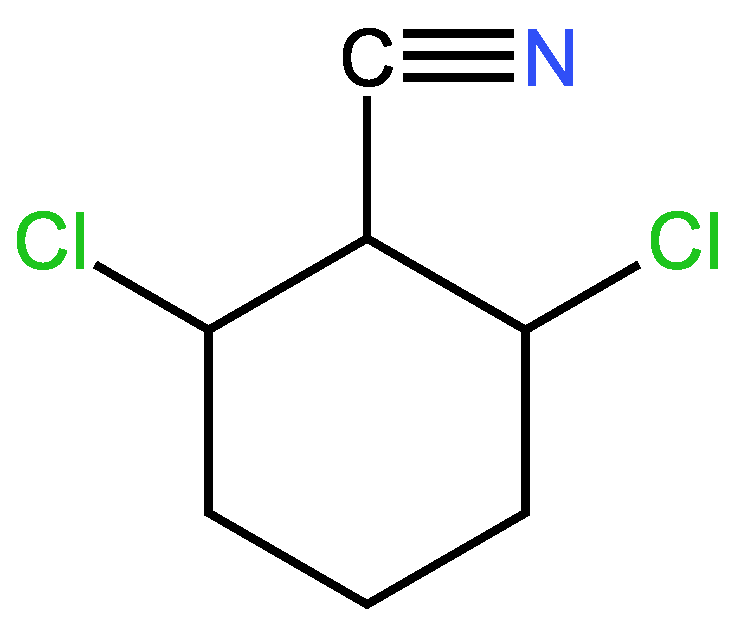
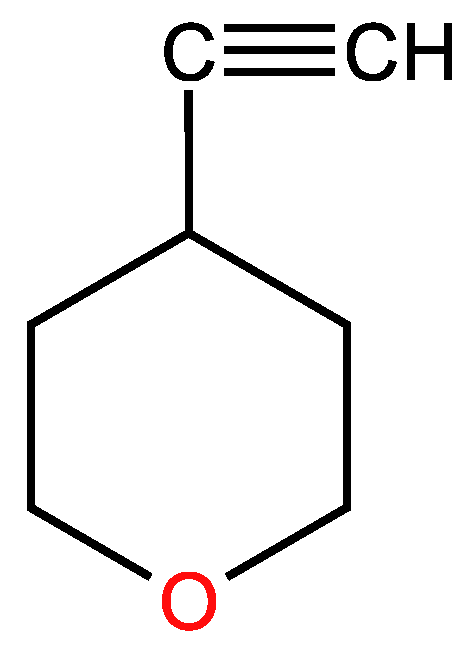
Some examples of molecular structures for cyclic unsaturated molecules with triple bonds where p π > p r and p π = 66.66666667 %     ;     p r = 33.33333333 % from the total unsaturation are the following ones:
Figure 22. cyclohex-2-yne-1,4-diol.
Preprints 150975 g022
Figure 23. 2,6-dichloro cyclohexane-1-carbonitrile.
Preprints 150975 g023
Figure 24. 4-ethynyloxane
Preprints 150975 g024

3.4. Cyclic unsaturated molecules with triple bonds in which p r > p π

For all the cyclic unsaturated molecules that contain σ-bonds, π-bonds, single bonds and triple bonds where the number of rings is always greater than the number of π-bonds, we used two newly invented mathematical equations and another three previously shown for cyclic unsaturated molecules with double bonds ( p r > p π ) to deduce many other specific general equations for covalent bonds and rings:
n σ = i n i v i + 2 + p r p π 1 i n i v i 2 4 + 2 p r p π 1
n s = i n i v i + 6 + 2 p r p π 1 i n i v i 6 8 + 4 p r p π 1
n π = i n i v i 2 + 2 4 + 2 p r p π 1
n r = i n i v i 2 + p r p π 1 i n i v i 2 + 2 + 2 4 + 2 p r p π 1
n t = i n i v i 2 + 2 8 + 4 p r p π 1
In order to find any percentages for π-bonds and rings that correspond to cyclic unsaturated molecules with triple bonds in which p r > p π ; 0 % < p π < 50 % and 50 % < p r < 100 % , we can start by choosing a molecular structure where n r > n π , write it’s molecular formula and calculate the correlated degree of unsaturation. Afterwards, the number of π-bonds and rings will be converted into percentages using the rule of three, and those numerical values will be substituted into the main mathematical equations to deduce other specific general equations that have as variables only the number of atoms and their valences, and work for molecules that share the same values of p π and p r as our chosen molecular structure. Additionally, because cyclic unsaturated molecules with triple bonds where n r > n π are less common, we will be using theoretical molecular structures as examples instead of real organic compounds.

3.4.1. First example

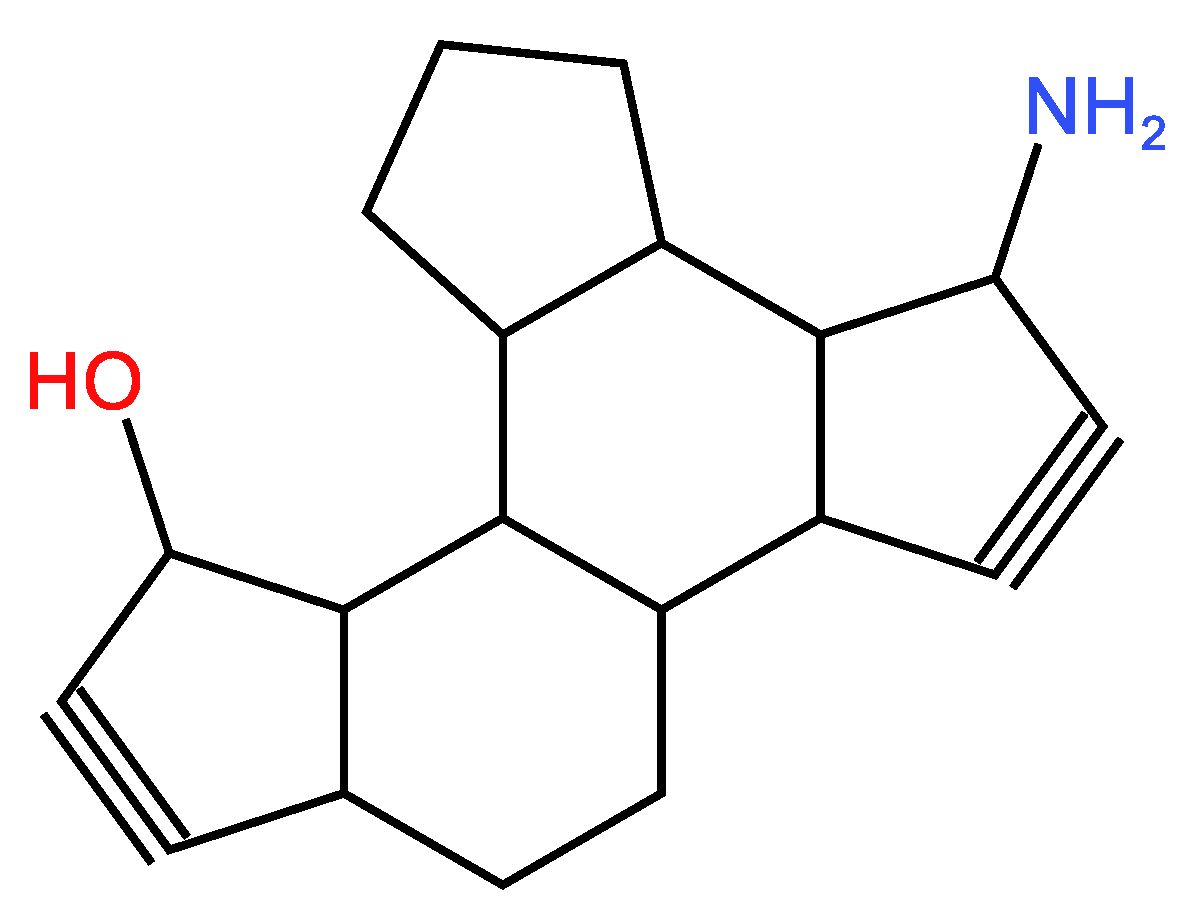
Figure 25. First theoretical molecular structure with rings and triple bonds C 28 H 35 N 3 .
Preprints 150975 g025
n π + n r = D O U     a n d     n π + n r = 1 + 1 2 i n i v i 2
n π + n r = 1 + 1 2 n C 4 2 + 1 2 n N 3 2 + 1 2 n H 1 2 = > n π + n r = 13         a n d     n π = 6     ;     n r = 7
p π + p r = T U     a n d     p π + p r = 100 %
p π = 6 · 100 % 13 = 46.15384615 %         a n d       p r = 7 · 100 % 13 = 53.84615385 %
Now we will substitute p π and p r in all the presented equations with percentages using the total unsaturation formula, where p π = 46.15384615 % of TU and p r = 53.84615385 % of TU.
p π + p r = T U
p π + p r = 100 %       ;       46.15384615 % + 53.84615385 % = 100 %
n σ = i n i v i + 2 + 53.84615385 % 46.15384615 % 1 i n i v i 2 4 + 2 53.84615385 % 46.15384615 % 1
n σ = i n i v i + 2 + 0.166666667 i n i v i 2 4 + 2 · 0.166666667
n σ = i n i 1.166666667 v i + 2 2 4.333333334
n s = i n i v i + 6 + 2 53.84615385 % 46.15384615 % 1 i n i v i 6 8 + 4 53.84615385 % 46.15384615 % 1
n s = i n i v i + 6 + 0.333333334 i n i v i 6 8 + 4 · 0.166666667
n s = i n i 1.333333334 v i + 6 6 8.666666668
n π = i n i v i 2 + 2 4 + 2 53.84615385 % 46.15384615 % 1
n π = i n i v i 2 + 2 4 + 2 · 0.166666667
n π = i n i v i 2 + 2 4.333333334
n r = i n i v i 2 + 53.84615385 % 46.15384615 % 1 i n i v i 2 + 2 + 2 4 + 2 53.84615385 % 46.15384615 % 1
n r = i n i v i 2 + 0.166666667 i n i v i 2 + 0.333333334 + 2 4 + 2 · 0.166666667
n r = 1.166666667 i n i v i 2 + 2.333333334 4.333333334 = > n r = i n i v i 2 + 2 3.714285714
n t = i n i v i 2 + 2 8 + 4 53.84615385 % 46.15384615 % 1
n t = i n i v i 2 + 2 8 + 4 · 0.166666667
n t = i n i v i 2 + 2 8.666666668
After deducing the general equations for the calculation of the number of covalent bonds and rings for all the cyclic unsaturated organic molecules with triple bonds where p π = 46.15384615 % and p r = 53.84615385 % , we will apply them on a molecular formula as an example: C 28 H 35 N 3
n σ = i n i 1.166666667 v i + 2 2 4.333333334
n σ = n C 1.166666667 · 4 + 2 + n N 1.166666667 · 3 + 2 + n H 1.166666667 · 1 + 2 2 4.333333334
n σ = 186.6666667 + 16.500000003 + 110.8333333 2 4.333333334   = > n σ = 72
n s = i n i 1.333333334 v i + 6 6 8.666666668
n s = n C 1.333333334 · 4 + 6 + n N 1.333333334 · 3 + 6 + n H 1.333333334 · 1 + 6 6 8.666666668
n s = 317.3333334 + 30.00000001 + 256.6666667 6 8.666666668   = > n s = 69
n π = i n i v i 2 + 2 4.333333334
n π = n C 4 2 + n N 3 2 + n H 1 2 + 2 4.333333334
n π = 56 + 3 35 + 2 4.333333334   = > n π = 6
n r = i n i v i 2 + 2 3.714285714
n r = n C 4 2 + n N 3 2 + n H 1 2 + 2 3.714285714
n r = 56 + 3 35 + 2 3.714285714   = >   n r = 7
n t = i n i v i 2 + 2 8.666666668
n t = n C 4 2 + n N 3 2 + n H 1 2 + 2 8.666666668
n t = 56 + 3 35 + 2 8.666666668   = >   n t = 3
Other molecular formulas where their corresponding molecules can have p π = 46.15384615 % of TU and p r = 53.84615385 % of TU, will be presented in the following table:
Table 7. Calculation of covalent bonds and rings for unsaturated cyclic molecules with triple bonds
p π = 46.15384615 %       a n d       p r = 53.84615385 %
Examples of Unsaturated Cyclic Molecules with triple bonds σ-bonds
2   4 . 3 ¯ + 1 4 . 3 ¯ ( i n i 1.1 6 ¯ v i + 2 )
Single bonds
6   8 . 6 ¯ + 1 8 . 6 ¯ ( i n i 1 . 3 ¯ v i + 6 )
π-bonds and triple bonds
2 4 . 3 ¯ + 1 4 . 3 ¯ ( i n i v i 2 )  
2 8 . 6 ¯ + 1 8 . 6 ¯ ( i n i v i 2 )
Ring/Rings
2 . 3 ¯ 4 . 3 ¯ + 1.1 6 ¯ 4 . 3 ¯ ( i n i v i 2 )
C 24 H 31 N 7 68 65 6 n π ; 3 n t 7
C 62 H 83 P 3 O 8 169 163 12 n π ; 6 n t 14
C 58 H 75 N 9 O 6 161 155 12 n π ; 6 n t 14
C 63 H 53 S 2 C l 5 143 134 18 n π ; 9 n t 21
C 57 H 39 N 4 C l 3 123 114 18 n π ; 9 n t 21
C 110 H 118 O 12 267 255 24 n π ; 12 n t 28
C 114 H 118 C l 8 267 255 24 n π ; 12 n t 28
C 135 H 163 P 7 339 324 30 n π ; 15 n t 35
C 142 H 192 S 9 377 362 30 n π ; 15 n t 35
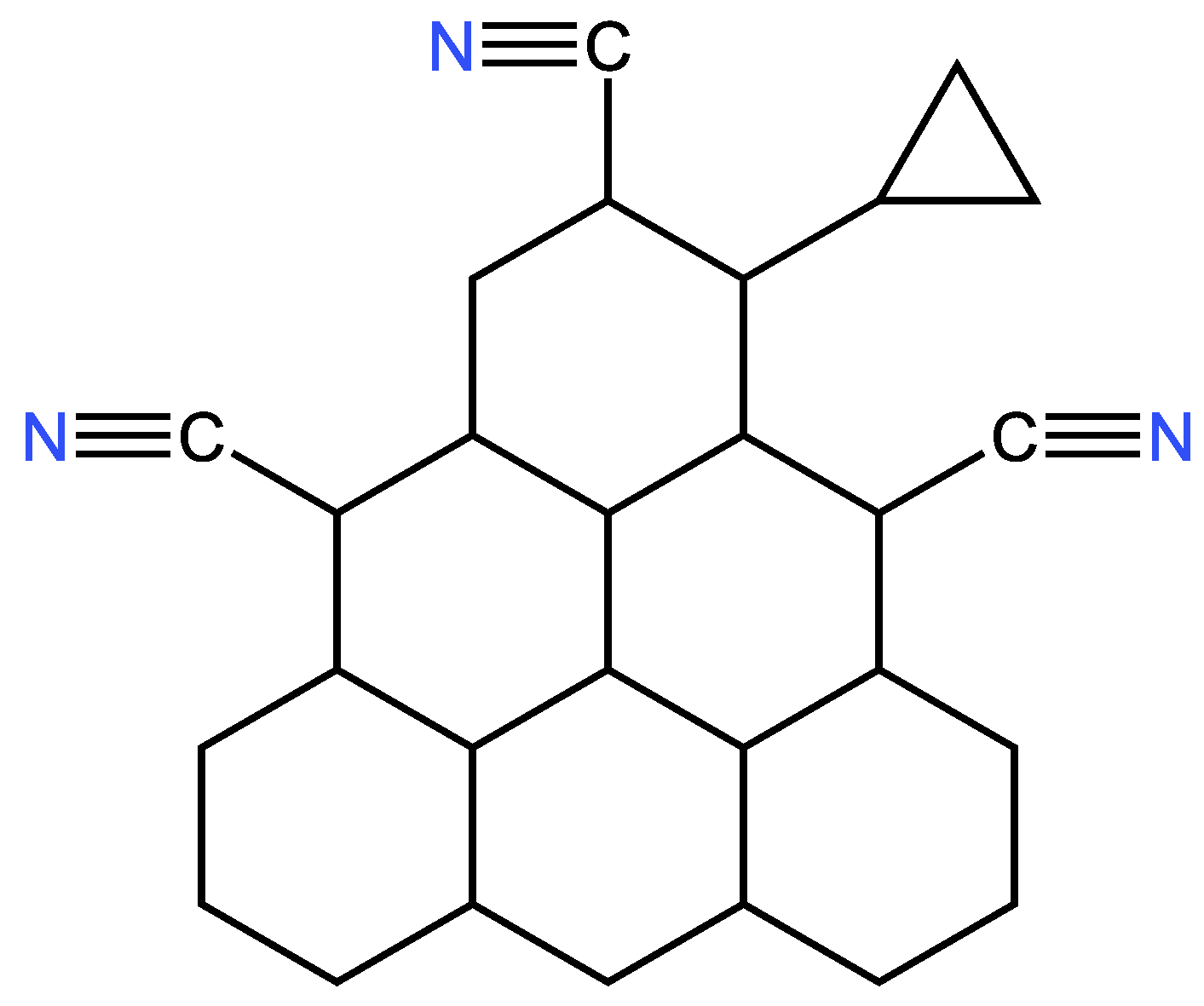
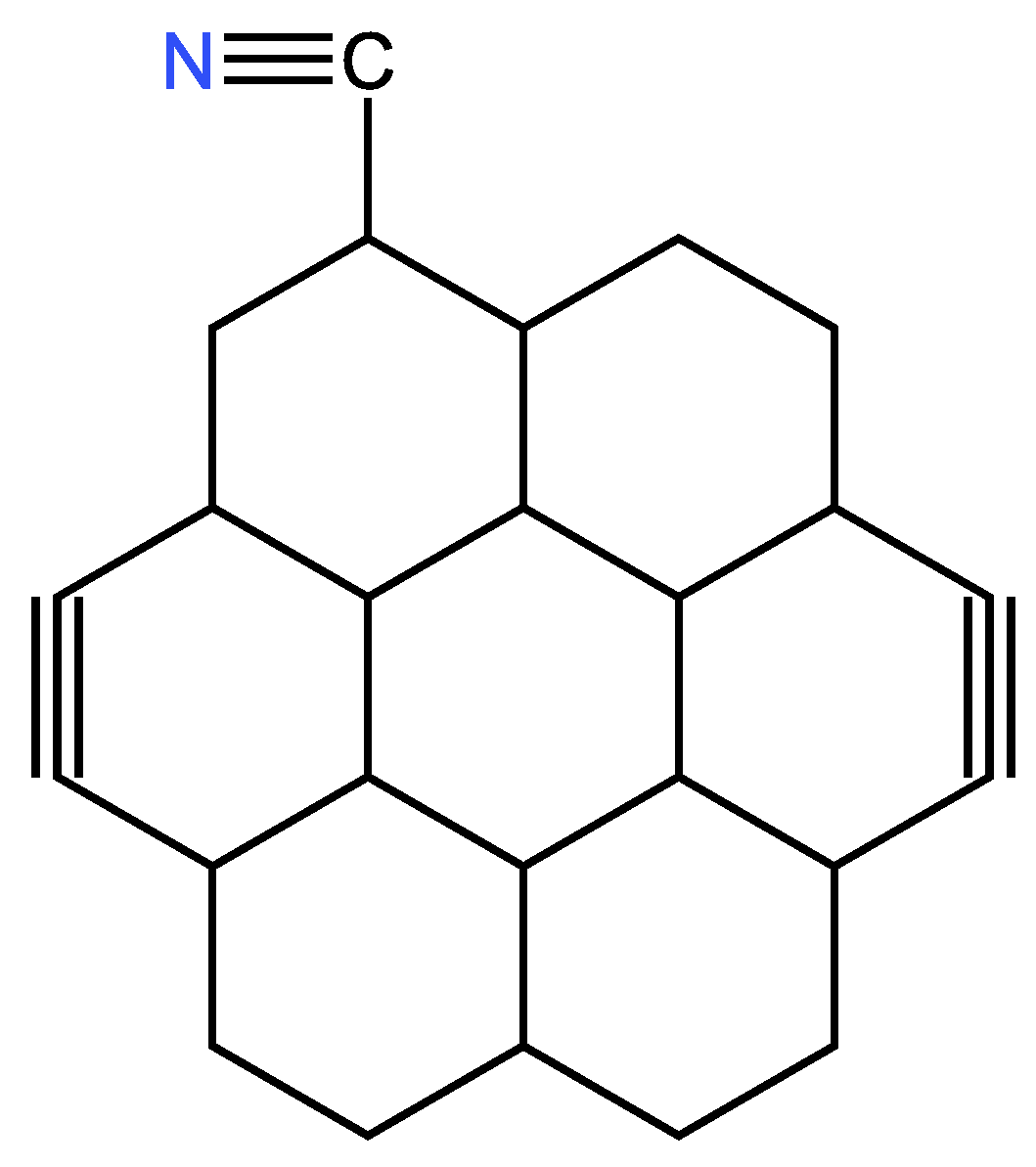
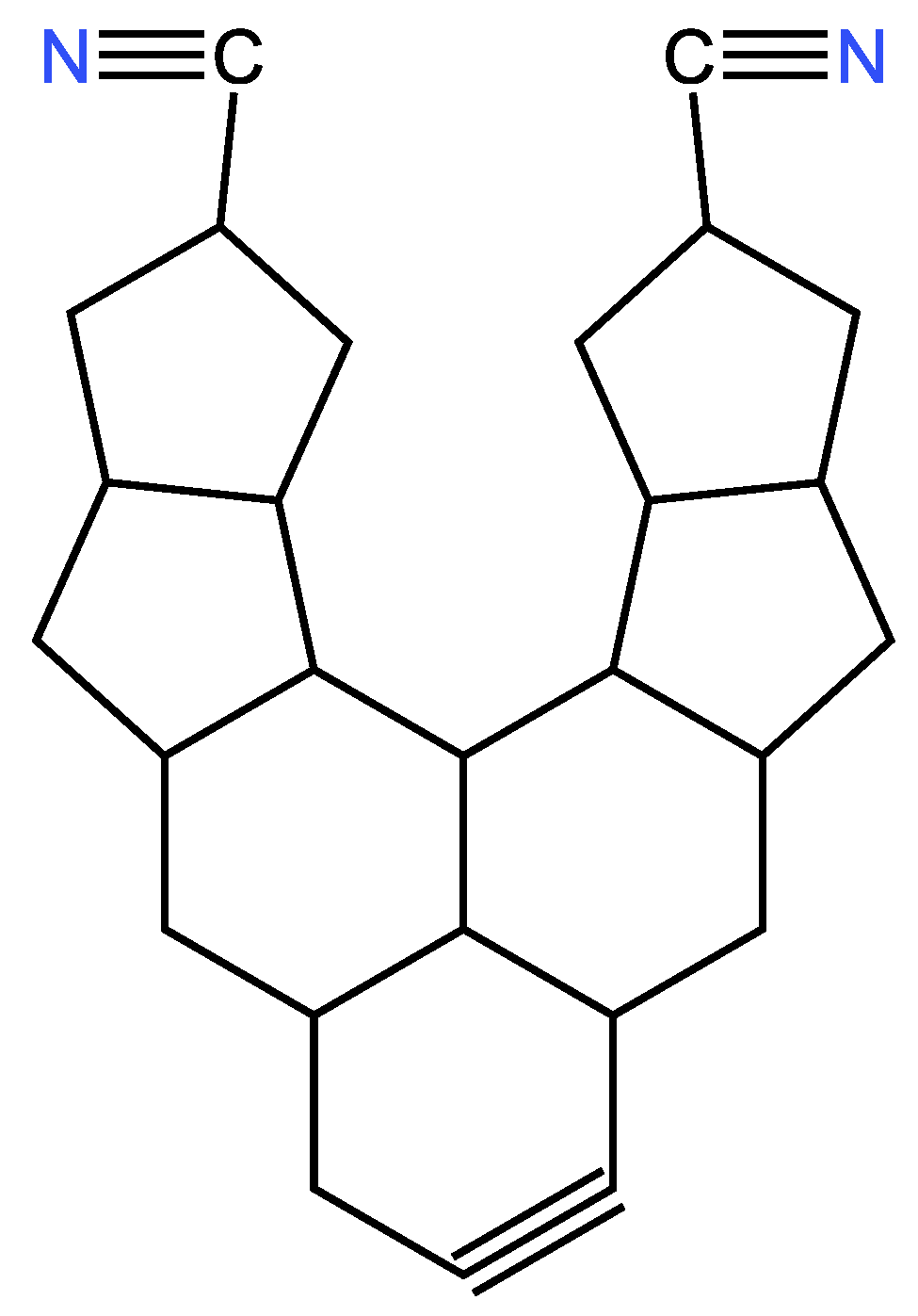
Some examples of molecular structures for cyclic unsaturated molecules with triple bonds where p r > p π and p π = 46.15384615 %     ;     p r = 53.84615385 % from the total unsaturation are the following ones:
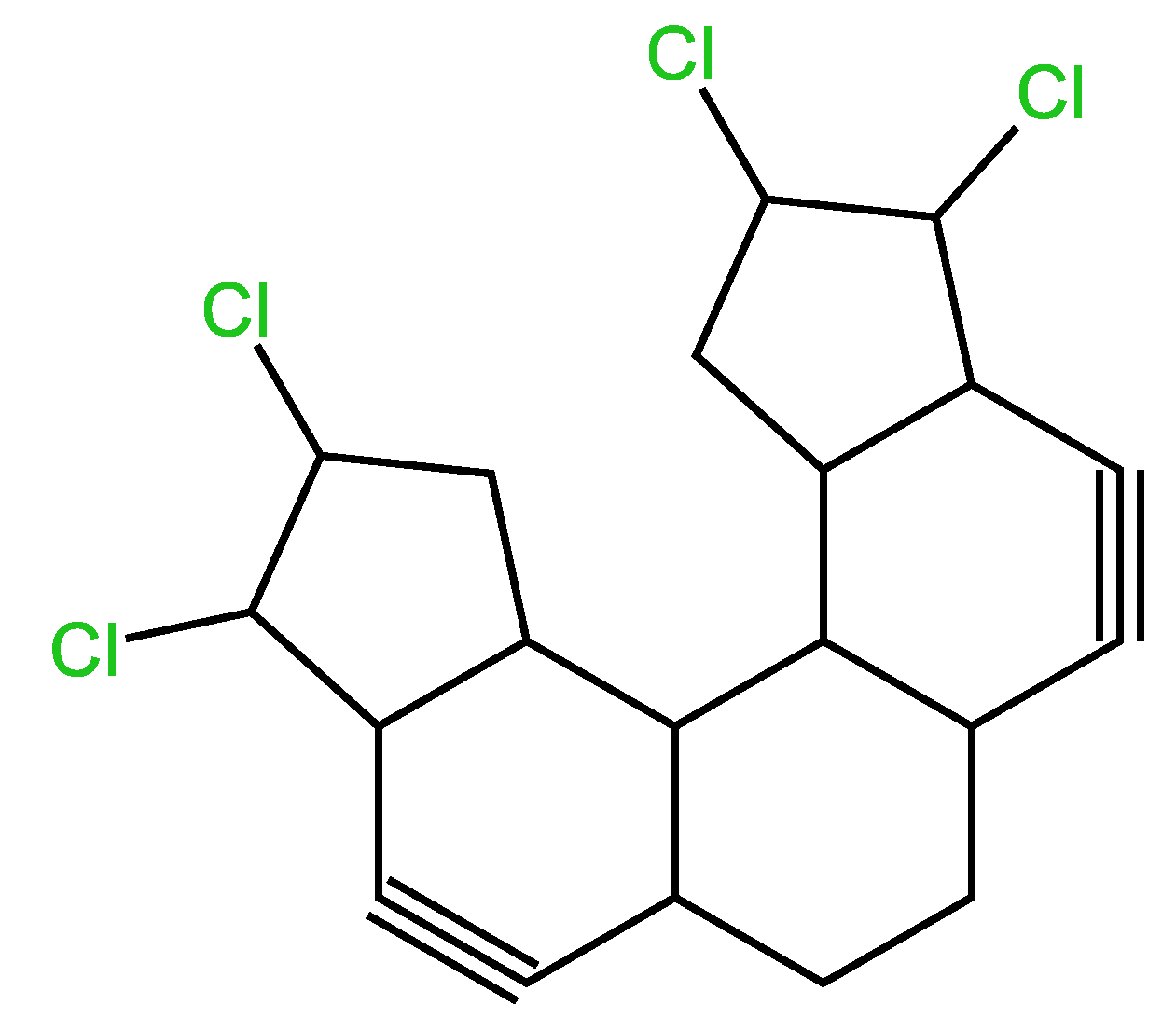
Figure 26. Second theoretical molecular structure with rings and triple bonds.
Preprints 150975 g026
Figure 27. Third theoretical molecular structure with rings and triple bonds.
Preprints 150975 g027
Figure 28. Fourth theoretical molecular structure with rings and triple bonds.
Preprints 150975 g028

3.4.2. Second example

Figure 29. First theoretical molecular structure with rings and triple bonds C 20 H 20 C l 4
Preprints 150975 g029
n π + n r = D O U     a n d     n π + n r = 1 + 1 2 i n i v i 2
n π + n r = 1 + 1 2 n C 4 2 + 1 2 n C l 1 2 + 1 2 n H 1 2 = > n π + n r = 9         a n d     n π = 4     ;     n r = 5
p π + p r = T U     a n d     p π + p r = 100 %
p π = 4 · 100 % 9 = 44.44444444 %         a n d       p r = 5 · 100 % 9 = 55.55555556 %
Now we will substitute p π and p r in all the presented equations with percentages using the total unsaturation formula, where p π = 44.44444444 % of TU and p r = 55.55555556 % of TU.
p π + p r = T U
p π + p r = 100 %       ;       44.44444444 % + 55.55555556 % = 100 %
n σ = i n i v i + 2 + 55.55555556 % 44.44444444 % 1 i n i v i 2 4 + 2 55.55555556 % 44.44444444 % 1
n σ = i n i v i + 2 + 0.25 i n i v i 2 4 + 2 · 0.25
n σ = i n i 1.25 v i + 2 2 4.5
n s = i n i v i + 6 + 2 55.55555556 % 44.44444444 % 1 i n i v i 6 8 + 4 55.55555556 % 44.44444444 % 1
n s = i n i v i + 6 + 0.5 i n i v i 6 8 + 4 · 0.25
n s = i n i 1.5 v i + 6 6 9
n π = i n i v i 2 + 2 4 + 2 55.55555556 % 44.44444444 % 1
n π = i n i v i 2 + 2 4 + 2 · 0.25
n π = i n i v i 2 + 2 4.5
n r = i n i v i 2 + 55.55555556 % 44.44444444 % 1 i n i v i 2 + 2 + 2 4 + 2 55.55555556 % 44.44444444 % 1
n r = i n i v i 2 + 0.25 i n i v i 2 + 0.5 + 2 4 + 2 · 0.25
n r = 1.25 i n i v i 2 + 2.5 4.5 = > n r = i n i v i 2 + 2 3.6
n t = i n i v i 2 + 2 8 + 4 55.55555556 % 44.44444444 % 1
n t = i n i v i 2 + 2 8 + 4 · 0.25
n t = i n i v i 2 + 2 9
After deducing the general equations for the calculation of the number of covalent bonds and rings for all the cyclic unsaturated organic molecules with triple bonds where p π = 44.44444444 % and p r = 55.55555556 % , we will apply them on a molecular formula as an example: C 23 H 36 P 2 O 4
n σ = i n i 1.25 v i + 2 2 4.5
n σ = n P 1.25 · 5 + 2 + n C 1.25 · 4 + 2 + n O 1.25 · 2 + 2 + n H 1.25 · 1 + 2 2 4.5
n σ = 16.5 + 161 + 18 + 117 2 4.5   = > n σ = 69
n s = i n i 1.5 v i + 6 6 9
n s = n P 1.5 · 5 + 6 + n C 1.5 · 4 + 6 + n O 1.5 · 2 + 6 + n H 1.5 · 1 + 6 6 9
n s = 27 + 276 + 36 + 270 6 9   = > n s = 67
n π = i n i v i 2 + 2 4.5
n π = n P 5 2 + n C 4 2 + n O 2 2 + n H 1 2 + 2 4.5
n π = 6 + 46 + 0 36 + 2 4.5   = > n π = 4
n r = i n i v i 2 + 2 3.6
n r = n P 5 2 + n C 4 2 + n O 2 2 + n H 1 2 + 2 3.6
n r = 6 + 46 + 0 36 + 2 3.6   = >   n r = 5
n t = i n i v i 2 + 2 9
n t = n P 5 2 + n C 4 2 + n O 2 2 + n H 1 2 + 2 9
n t = 6 + 46 + 0 36 + 2 9   = > n t = 2
Other molecular formulas where their corresponding molecules can have p π = 44.44444444 % of TU and p r = 55.55555556 % of TU, will be presented in the following table:
Table 8. Calculation of covalent bonds and rings for unsaturated cyclic molecules with triple bonds
p π = 44.44444444 %       a n d       p r = 55.55555556 %
Examples of Unsaturated Cyclic Molecules with triple bonds σ-bonds
2   4.5 + 1 4.5 ( i n i 1.25 v i + 2 )
Single bonds
2       3 + 1 9 ( i n i 1.5 v i + 6 )
π-bonds and triple bonds
2 4.5 + 1 4.5 ( i n i v i 2 )
  2 9 + 1 9 ( i n i v i 2 )
Ring/Rings
2 3.6 + 1 3.6 ( i n i v i 2 )
C 21 H 28 N 2 O 2 57 55 4 n π ; 2 n t 5
C 35 H 47 P 3 N 2 96 92 8 n π ; 4 n t 10
C 35 H 49 S 2 N 5 100 96 8 n π ; 4 n t 10
C 50 H 52 N 4 120 114 12 n π ; 6 n t 15
C 54 H 54 C l 2 124 118 12 n π ; 6 n t 15
C 62 H 74 S 5 O 10 170 162 16 n π ; 8 n t 20
C 63 H 71 P 5 O 10 168 160 16 n π ; 8 n t 20
C 78 H 68 O 3 173 163 20 n π ; 10 n t 25
C 71 H 57 N 7 C l 4 163 153 20 n π ; 10 n t 25
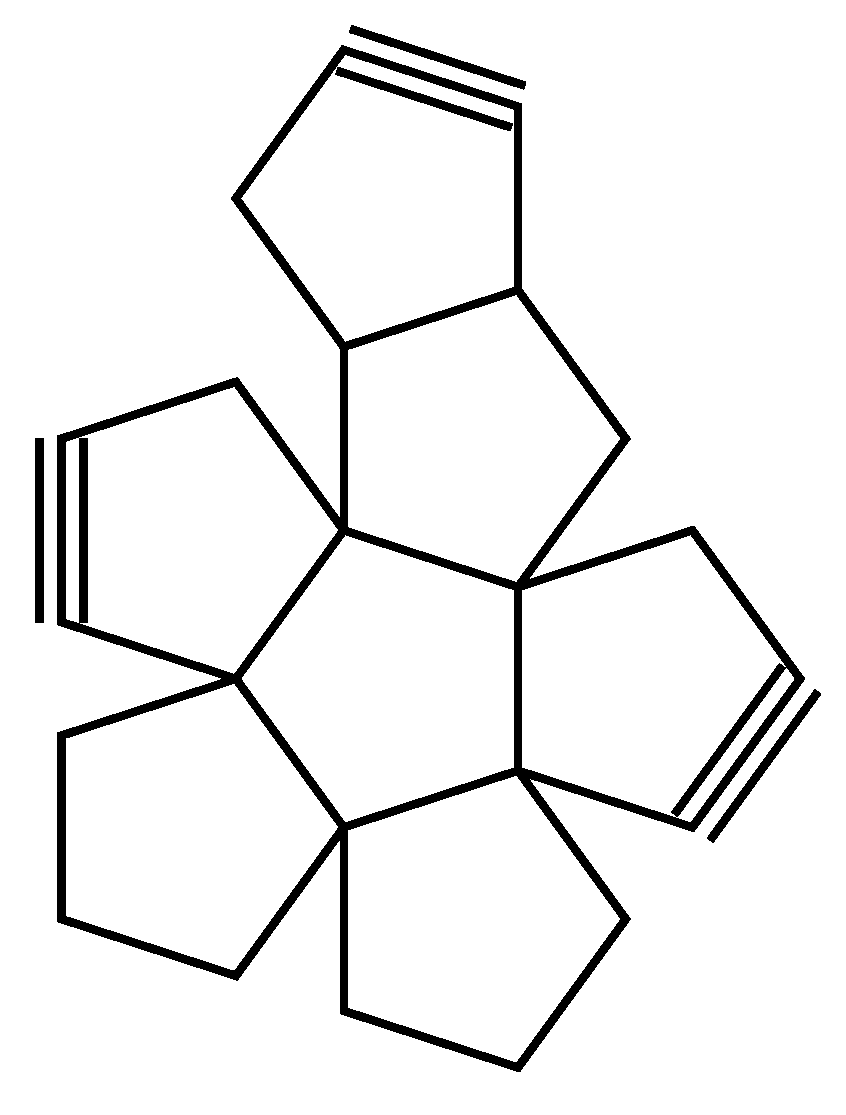
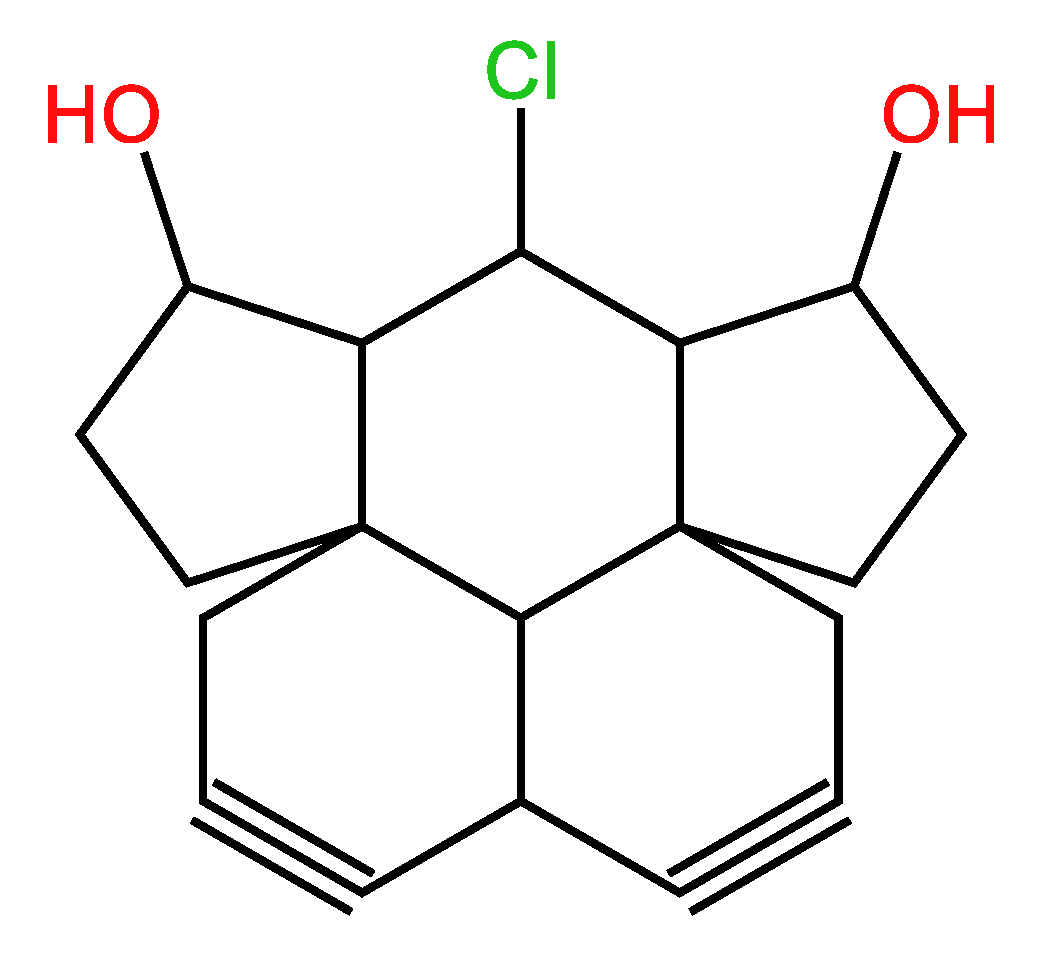
Some examples of molecular structures for cyclic unsaturated molecules with triple bonds where p r > p π and p π = 44.44444444 %     ;     p r = 55.55555556 % from the total unsaturation are the following ones:
Figure 30. Second theoretical molecular structure with rings and triple bonds.
Preprints 150975 g030
Figure 31. Third theoretical molecular structure with rings and triple bonds.
Preprints 150975 g031
Figure 32. Fourth theoretical molecular structure with rings and triple bonds.
Preprints 150975 g032

4. Conclusions

In this manuscript we have presented a new mathematical model for the calculation of covalent bonds and rings that can be used for any type of inequality established between p π and p r in cyclic unsaturated molecules with double or triple bonds, moreover, the model also works when p π and p r have the same values. Therefore, this research highlights a new methodology [26] that could serve as a starting point for multiple future studies based on ideas such as: similar equations for the calculation of covalent bonds in acyclic and cyclic unsaturated molecules with both double and triple bonds [27,28], integration of electric charges in order to account for anionic and cationic molecular species [29,30], taking into consideration delocalized π electrons [31,32] by modifying the numerical value of p π from the total unsaturation and the possibility of inventing other equations for ionic and coordinate covalent bonds [33,34]. Another important aspect of this study is represented by the complexity that arises from the simmetry [35] and simplicity of the primary twelve novel equations which are made up by the number of atoms, their valences, and the percentages of pi(π) bonds and rings from TU in a molecule. These equations share a common structure in order to be easy to understand and simplified for any type of real or theoretical cyclic unsaturated compound [36]. Lastly, the mathematical model that was shown in this article could be used in computational chemistry to create tables and databases [37,38] that rely solely on the molecular formula of an organic compound and it’s total unsaturation for the calculation of the number of covalent bonds and rings or to combine these equations with computer programs that already exist [39,40] in order to enhance the possibility of getting better results for certain theoretical approaches.

Author Contributions

The manuscript was conceptualized by Vlad Cristian Gavrilă, and investigation, review and editing processes were conducted by both authors. Both authors agreed to the final version of the manuscript.

Conflicts of Interest

The authors declare no conflicts of interest.

References

  1. Bonchev, D.; Rouvray, D.H. Chemical Graph Theory Introduction and Fundamentals. CRC Press LLC 2018. [Google Scholar]
  2. Gutman, I. Chemical Graph Theory—The Mathematical Connection. Adv. Quantum. Chem. 2006, 51, 125–138. [Google Scholar] [CrossRef]
  3. Leite, L.S.G.; Banerjee, S.; Wei, Y.; Elowitt, J.; Clark, A.E. Modern chemical graph theory. WIREs. Comput. Mol. Sci. 2024, 14. [Google Scholar] [CrossRef]
  4. Balaban, A.T. Applications of Graph Theory in Chemistry. J. Chem. Inf. Comput. Sci. 1985, 25, 334–343. [Google Scholar] [CrossRef]
  5. Zhao, L.; Schwarz, W.H.E.; Frenking, G. The Lewis electron-pair bonding model: the physical background, one century later. Nat. Rev. Chem. 2019, 3, 35–47. [Google Scholar] [CrossRef]
  6. Shaik, S.; Danovich, D.; Hiberty, P.C. Valence Bond Theory—Its Birth, Struggles with Molecular Orbital Theory, Its Present State and Future Prospects. Molecules 2021, 26, 1624. [Google Scholar] [CrossRef]
  7. Badertscher, M.; Bischofberger, K.; Munk, M.E.; Pretsch, E. A novel formalism to characterize the degree of unsaturation of organic molecules. J. Chem. Inf. Comput. Sci. 2001, 41, 889–893. [Google Scholar] [CrossRef]
  8. Raheja, L. ; Quick Calculation of Sigma and Pi bonds. AIJRA 2017, 2. [Google Scholar]
  9. Gavrilă, V. C.; Nicolescu, T. O. A Theoretical Framework for the Calculation of the Number of Covalent Bonds in Unsaturated Organic Compounds. Am. J. Phys. Chem. 2024, 13, 72–82. [Google Scholar] [CrossRef]
  10. Das, A.; Adhikari, S.; Pal, D.; Paul, B.; Sanjeev, R.; Jagannadham, V. Rapid Calculation of the Number of π-bonds, σ-bonds, Single and Triple Bonds in Aliphatic Unsaturated Open Chain and Cycloalkynes. World Journal of Chemical Education 2014, 2, 1–3. [Google Scholar]
  11. Gavrilă, V. C.; Nicolescu, T. O. New Equations for Rapid Calculation of π-bonds, σ-bonds, Single, Double and Triple Bonds in Open Chain Alcohols and Cycloamines. Int. J. chem. math. phys. 2024, 8, 9–15. [Google Scholar] [CrossRef]
  12. Xiaoyue, M. Development of Computational Chemistry and Application of Computational Methods. Journal of Physics: Conference Series 2022, 2386, 12005. [Google Scholar]
  13. Alberts, M.; Laino, T.; Vaucher, A.C. Leveraging infrared spectroscopy for automated structure elucidation. Commun. Chem. 2024, 7. [Google Scholar] [CrossRef]
  14. Reguant, A.I.; Reis, H.; Medved, M.; Luis, J.M.; Zaleśny, R. A new computational tool for interpreting the infrared spectra of molecular complexes. Phys. Chem. Chem. Phys. 2023, 25, 11658–11664. [Google Scholar] [CrossRef]
  15. Leniak, A.; Pietruś, W.; Kurczab, R. From NMR to AI: Designing a Novel Chemical Representation to Enhance Machine Learning Predictions of Physicochemical Properties. J. Chem. Inf. Model. 2024, 64, 3302–3321. [Google Scholar] [CrossRef] [PubMed]
  16. Hu, F.; Chen, M. S.; Rotskoff, G. M.; Kanan, M. W.; Markland, T. E. Accurate and Efficient Structure Elucidation from Routine One-Dimensional NMR Spectra Using Multitask Machine Learning. ACS Cent. Sci. 2024, 10, 2162–2170. [Google Scholar] [CrossRef] [PubMed]
  17. Scheubert, K.; Hufsky, F.; Böcker, S. Computational mass spectrometry for small molecules. J. Cheminform. 2013, 5. [Google Scholar] [CrossRef]
  18. Beck, A.G.; Muhoberac, M.; Randolph, C.E.; Beveridge, C.H.; Wijewardhane, P.R.; Kenttämaa, H.I.; Chopra, G. Recent Developments in Machine Learning for Mass Spectrometry. ACS Meas. Sci. Au 2024, 4, 233–246. [Google Scholar] [CrossRef]
  19. López, C.S.; Faza, O.N. Overview of the computational methods to assess aromaticity. Aromaticity 2021, 41–71. [Google Scholar] [CrossRef]
  20. Ponting, D.J.; Deursen, R.V.; Ott, M.A. Machine Learning Predicts Degree of Aromaticity from Structural Fingerprints. J. Chem. Inf. Model. 2020, 60, 4560–4568. [Google Scholar]
  21. Kumar, M.D. A Study on Importance of Microsoft Excel Data Analysis Statistical Tools in Research Works. Journal of Management & Educational Research Innovation 2023, 1, 76–83. [Google Scholar]
  22. Einax, J.W.; Crouch, S.R.; Holler, F.J. Applications of Microsoft® Excel in analytical chemistry, 2nd ed. Anal. Bioanal. Chem. 2013, 405, 7559–7560. [Google Scholar]
  23. Ferreira, C.T.T.; Silva, C.C. The Roles of Mathematics in the History of Science: The Mathematization Thesis. Transversal: International Journal for the Historiography of Science 2020, 6, 6–25. [Google Scholar]
  24. Miller, D.D. Chapter 7 - The calculated uncertainty of scientific discovery: From Maths to Deep Maths. Handbook of Statistics 2023, 49, 203–226. [Google Scholar] [CrossRef]
  25. Liu, J.B. Novel Applications of Graph Theory in Chemistry and Drug Designing. Combinatorial Chemistry & High Throughput Screening 2022, 25, 439–440. [Google Scholar] [CrossRef]
  26. Lê, J. K.; Schmid, T. The Practice of Innovating Research Methods. Organ. Res. Methods 2022, 25, 308–336. [Google Scholar]
  27. Wang, Z.X.; Livingstone, K.; Hümpel, C.; Daniliuc, C.G.; Lichtenfeld, C.M.; Gilmour, R. Regioselective, catalytic 1,1-difluorination of enynes. Nat. Chem. 2023, 15, 1515–1522. [Google Scholar] [CrossRef]
  28. Kitazawa, Y.; Kochi, T.; Kakiuchi, F. Hydroarylative cyclization of enynes with aromatic ketones catalyzed by a low-valent iron-phosphine complex. Tetrahedron Letters 2025, 155. [Google Scholar] [CrossRef]
  29. Sharma, B.; García, L.P.; Chaudhary, G.R.; Kaur, G. Innovative approaches to cationic and anionic (catanionic) amphiphiles self-assemblies: Synthesis, properties, and industrial applications. Adv. Colloid Interface Sci. 2025, 337. [Google Scholar] [CrossRef]
  30. Gao, H.; Jiang, J.; Huang, Y.; Wang, H.; Sun, J.; Jin, Z.; Wang, J.; Zhang, J. Synthesis of hydrogels for adsorption of anionic and cationic dyes in water: ionic liquid as a crosslinking agent. SN Appl. Sci. 2022, 4, 118. [Google Scholar] [CrossRef]
  31. Bradley, D.; Branley, C.P.; Peeks, M.D. A straightforward method to quantify the electron-delocalizing ability of π-conjugated molecules. Phys. Chem. Chem. Phys. 2022, 24, 11486–11490. [Google Scholar] [CrossRef] [PubMed]
  32. Box, V.G.S.; Yu, H.W. Pi-Electron Delocalization in Organic Molecules with C-N Bonds. Journal of Chemical Education 1997, 74, 1293. [Google Scholar] [CrossRef]
  33. Walton, J.R.; Rivera, L.A.R.; Lucchese, R.R.; Bevan, J.W. Is there any fundamental difference between ionic, covalent, and others types of bond? A canonical perspective on the question. Phys. Chem. Chem. Phys. 2017, 19. [Google Scholar] [CrossRef]
  34. Hei, X.; Liu, W.; Zhu, K.; Teat, S.J.; Jensen, S.; Li, M.; O’Carroll, D.M.; Wei, K.; Tan, K.; Cotlet, M.; Thonhauser, T.; Li, J. Blending Ionic and Coordinate Bonds in Hybrid Semiconductor Materials: A General Approach toward Robust and Solution-Processable Covalent/Coordinate Network Structures. J. Am. Chem. Soc. 2020, 142, 4242–4253. [Google Scholar] [CrossRef]
  35. Yanofsky, N.S.; Zelcer, M. The Role of Symmetry in Mathematics. Found. Sci. 2017, 22, 495–515. [Google Scholar]
  36. Tantillo, D.J.; Applied Theoretical Organic Chemistry. WORLD SCIENTIFIC (EUROPE), 2018.
  37. Mitchell, J. M.; Flight, R. M.; Moseley, H. N. B. Deriving Lipid Classification Based on Molecular Formulas. Metabolites 2020, 10, 122. [Google Scholar] [CrossRef]
  38. Feller, D. The role of databases in support of computational chemistry calculations. J. Comput. Chem. 1996, 17. [Google Scholar]
  39. Hasan, M.R.; Alsaiari, A.A.; Fakhurji, B.Z.; Molla, M.H.R.; Asseri, A.H.; Sumon, M.A.A.; Park, M.N.; Ahammad, F.; Kim, B. Application of Mathematical Modeling and Computational Tools in the Modern Drug Design and Development Process. Molecules 2022, 27, 4169. [Google Scholar] [CrossRef]
  40. Sadybekov, A.V.; Katritch, V. Computational approaches streamlining drug discovery. Nature 2023, 616, 673–685. [Google Scholar] [CrossRef]
Disclaimer/Publisher’s Note: The statements, opinions and data contained in all publications are solely those of the individual author(s) and contributor(s) and not of MDPI and/or the editor(s). MDPI and/or the editor(s) disclaim responsibility for any injury to people or property resulting from any ideas, methods, instructions or products referred to in the content.
Copyright: This open access article is published under a Creative Commons CC BY 4.0 license, which permit the free download, distribution, and reuse, provided that the author and preprint are cited in any reuse.
Prerpints.org logo

Preprints.org is a free preprint server supported by MDPI in Basel, Switzerland.

Subscribe

Disclaimer

Terms of Use

Privacy Policy

Privacy Settings

© 2025 MDPI (Basel, Switzerland) unless otherwise stated