

Submitted:
27 February 2025
Posted:
27 February 2025
You are already at the latest version
Abstract
The microorganisms living around and inside the human host in an extraordinary way for their morphologies often remind, microscopically we find every day foodstuffs that in our tables.
Background: Many food products “are similar” to bacteria, a sort of “convergent evolution” between the microscopic and the macroscopic. Here below, we present some “similarities“between bacteria and food suggesting “New Recipes” of the Abruzzo Region folk tradition in Central Italy, which handed down from father to son constituted the history of our land. We believe that the history of a people is the true identity of man and passion for their roots should never be circumvented. Passion that binds us to our traditions, the same that binds us to our work, microbiology, making it natural for us during lunch hour, in the laboratory, to speak of the particular similarities of bacteria found with the foods we consume daily. Methods: We compared to same macroscopic food products to the following bacteria: Helicobacter pylori, H. heilmannii, Neisseria meningitidis, Staphylococcus aureus, Leptospira interrogans, and Pseudomonas aeruginosa.
Results: In particular, we identified for each microorganism “similarities“with food and proposed New Recipes inspired for their “assonance” to microbial morphology and behavior and hence, suggest the following: “the Conversion”, “the Unidentical Fusilli Twins”, “the Dangerous Peaches”, “the Greek Grape Cluster Cake”, “the Black Cuttlefish Spirals sauce” and “the Biofilm Green Zucchini”.
Conclusions: Therefore, arriving at a “special” approach that wants to link the microscopic and macroscopic worlds underlining that each shape is not casual and that everything is connected.
Keywords:
Microbiology
; Bacteria
; Culinary Art
; Recipes
1. Introduction
The extraordinary way of microorganisms lives around and inside the human host and their morphologies often remind us, microscopically, of the foodstuffs we find everyday on our tables. In recent years’ consciousness that bacteria represent a part of the human host has been taken [1]. This strong association makes man and microorganisms very similar to each other; a similarity that makes a common ancestor come to mind. This concept, as we, a group of microbiologists and the authors of the text, has surprisingly led us to the fact that many microorganisms have “similarities” with the food that makes up our daily diet. The leavening of bread, wine and beer fermentation with Saccharomyces cerevisiae date back to ancient Egyptians [2], making us understand how, philosophically, bacteria have always been a part of human life.
As for “Food and History” [3], throughout time, there have been many confronted researchers, nutritionists and culinary experts that found correlations between food and daily life. Therefore, Culinary Arts was structured using a historical-scientific path enriching knowledge and human needs exactly as a real science [4,5]. Culinary Arts has many similarities with microbiology as precision in the execution of recipes that could be compared to laboratory experiments, study, passion and finally the objectives to be achieved: for microbiologists the scientific research, for the chef the mise en place for lunch. Additionally, many culture media for microorganisms, are composed of ingredients that we usually find on our tables such as olive oil, which has been assigned as one of the inductors of lipase production, eggs, sugar etc. showing a strong correlation between food and microbiology [6].
Just as research is world heritage in time, Culinary Art holds the wisdom and traditions of peoples; moreover, the preparation of new recipes, the need of experiments and tests in order to achieve the expected results are the same as in scientific studies.
Many food products macroscopically show “similarities” to the shape of bacteria. A kind of “convergent evolution” between the microscopic and the macroscopic world. This new perspective, the assonance in seeing our world with that of the “tiny one” apparently far from each other, but in reality are not as can be seen in the work proposed to present some “Similarities” between bacteria and food suggesting “New Recipes”. These Recipes come from the tradition and history of our Abruzzo Region, which handed down from father to son constituted the history of our land [4]. We feel that the history of a people is the true identity of man and passion for their roots should never be circumvented.
The passion that binds us to our traditions, is the same passion for our work, microbiology, and in the laboratory, during lunch we speak often of the particular similarities of bacteria found with the foods that we consume daily.
The bacteria examined are: Helicobacter pylori, H. heilmannii, Neisseria meningitidis, Leptospira interrogans, Staphylococcus aureus and Pseudomonas aeruginosa. For each microorganism tested identified were “similarities” with food and new recipes inspired by “assonance” of morphologies proposed. Next came “the Conversion” (H. pylori), “the Unidentical Fusilli Twins” (H. heilmannii), “the Dangerous Peaches” (Neisseria meningitidis), “the Spirals in Cuttlefish Black sauce” (Leptospira interrogans) “the Greek Grape Cluster Cake” (Staphylococcus aureus) and “the Biofilm Green Zucchini” (Pseudomonas aeruginosa).
In this study of similarity between the microbiology and the culinary arts we wanted to focus the scientific interest in these great sciences of which we are passionate.
2. Materials and Methods
2.1. Background of the Traditional Cuisine and Wines in Abruzzo
Abruzzo cuisine has had benefits for genuine local products and ingredients, from the Adriatic on one side and the Gran Sasso on the other.
Origin were poor ingredients. The economy of the region, for centuries, has allowed barely survive; agriculture and pastoralism gave no comfort. A socially modest area both economically and culturally, so much so that in the famous treatises of antiquity of Italian cuisine, local gastronomy, does not appear; absence resulting from the fact that the cuisine of this region was unknown beyond the borders. Only in the last century things have changed and the kitchen and the tradition of Abruzzo have crossed all boundaries. Very popular among the products offered by the region are those of sheep farming, especially the cheese: scamorza, caciocavallo, pecorino, offer perhaps the most intense flavors that are found in recipes, especially in the inland areas and mountains. The coast, it makes known the taste of the sea: blue fish and shellfish. Going into the interior of the region you can appreciate the beauty of the landscape and architecture, the dignified nobility, the ancient customs and civilization of a modest society where the cuisine and wines become important moments: every place has its own specialties, its flavors handed down for centuries, preserving their authenticity defeating the industrial advent.
2.2. Abruzzo Wines
Montepulciano red wine and Trebbiano white wine, are the wines from Abruzzo who are gradually become prominent worldwide since after the 60 were classified as “DOC”. The Cerasuolo wine is a little cherry red. Pecorino, a white wine made from an ancient vine grower who have revived in recent years, recently became one of the most incisive successes in the world of the Abruzzi viticulture.
2.3. Raw Materials and Sample Preparation
For this study, we used local produce zero kilometer. The peas, cuttlefish and all the ingredients were purchased in Abruzzo local markets of the provinces of Chieti and Pescara on the same day of execution of the recipes/experiment. The paste used in this study came from one of the most important Abruzzo pastaie Companies, De Cecco of Fara San Martino, famous worldwide for its quality and its particular types. Since 1886, the company De Cecco has pursued without compromising the tradition of pasta making it possible to bring on tables all over the world the authentic pleasure of Italian cuisine.
2.4. Equipment
To prepare recipes/experiments were used in pottery and copper utensils, while respecting the traditions and executed following the transcripts of an old cookbook, respecting the ingredients, high quality and times.
2.5. Microorganisms, New Recipes, Ingredients and Cooking Conditions
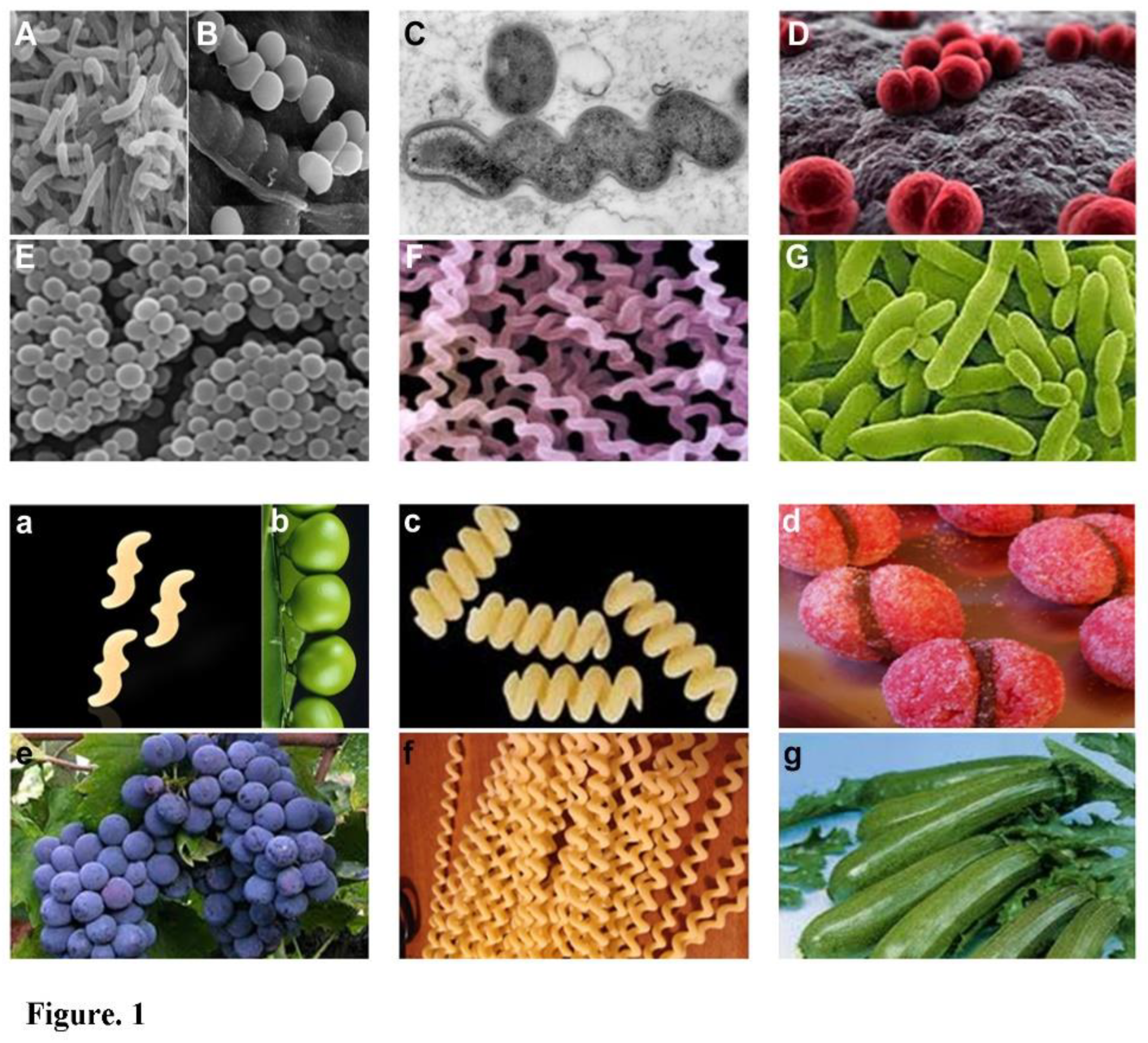
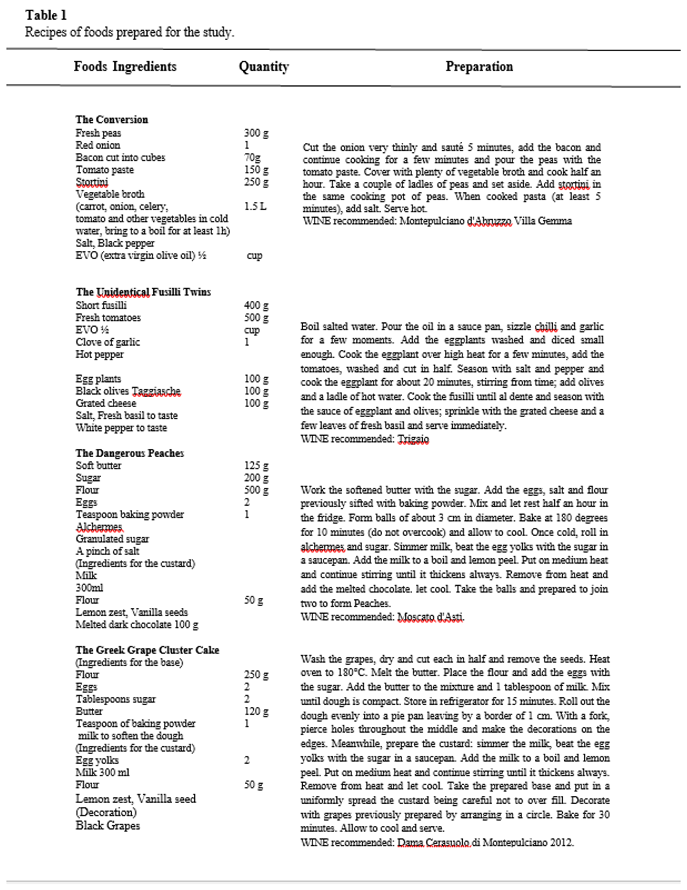
The first association carried out was with H. pylori, the causative agent of chronic gastritis and peptic ulcer active, described as a risk factor for gastric cancer [7]. Helicobacter pylori (Figure 1 top A, B) is a microorganism that responds to environmental stress conditions through morphological changes from rod-to coccoid forms [8,9,10]. The similarity is that we observed with Stortini and Peas (Figure 1 down a, b). As well as H. pylori changes in their morphological also been forming biofilm, so Stortini and Peas are mixed in an excellent dish, example of freshness and simplicity. The Recipe for “the Conversion” was shows in Table 1. Stortini and peas reminds farmers flavors, but simple gifts of a civilization, which in Spring, discovered anew the taste of being together around a table with the sweet taste of freshly picked peas and enrichment of a simple but passionate sauce. As well as H. pylori in its morphological were also aggregates forming biofilm, so Stortini and peas are mixed in an excellent dish, example of freshness and simplicity.
The second association was done with H. heilmannii Gram negative microorganism that colonizes the gastric mucosa of domestic animals, and in particular cats. Since the discovery of H. pylori as a human pathogen many studies have evaluated the link between the infection of Helicobacter spp. and gastric disease in animals. Figure 1 (C, top) shows an image at the transmission electron microscope of a typical helical bacterium coming from cat gastric biopsy [11,12]. The similarity we have observed is a type of pasta, short Fusilli (Figure 1 c, down). The Recipe for “the Unidentical Fusilli Twins”.was shows in Table 1. The recipe that we show, that blends the flavors of the South, certainly please everyone.
Let us now discuss of N. meningitides (Figure 1 D, top) Gram-negative bacterium in the coffee bean, the etiologic agent of bacterial meningitis [13]. Neisseria meningitidis is an important cause of morbidity and mortality worldwide. The similarity that we have observed, in addition to the coffee bean, is with it sweet peach, typically Abruzzese delicious biscuits (Figure 1 d, down. “the Dangerous Peaches”, recipe).
The Recipe for “the Dangerous Peaches “. was shows in Table 1. The famous peaches with alchermes have a sweet Abruzzo typical that brings us back to the ancient times of festivity and communions and marriages where, usually the landlady, saying the guests handing the tray: favorite!
Let us now consider S. aureus, Gram positive cocco, spherical, asporogenous and aerobic optional [14]. The bacterium is named after the ancient greek: Staphyle = cluster, coccus = sphere, resembling a bunch of grapes. Staphylococcus aureus (Figure 1 E, top) is capable of forming biofilms on biotic and abiotic surfaces with dynamic processes that involve different mechanisms. Just the mature biofilms of S. aureus can be compared to the cluster of grapes (Figure 1 e, down) with an outstanding likeness. From this the association with a sweet “the Greek Grape Cluster Cake” to evoke characteristic pairs, food/bacteria in this case grapes and S. aureus.
The Recipe for “the Greek Grape Cluster Cake”: this is a delicious custard pie topped with Grapes was shows in Table 1.
And still Leptospira interrogans (Figure 1 F, top) Gram-negative microorganism, aerobic obligated, ans mobile, etiologic agent of leptospirosis, a disease transmitted from animals to humans [15,16]. The extraordinary similarity we have observed is a type of pasta, the long Fusilli (Figure 1 f, down).
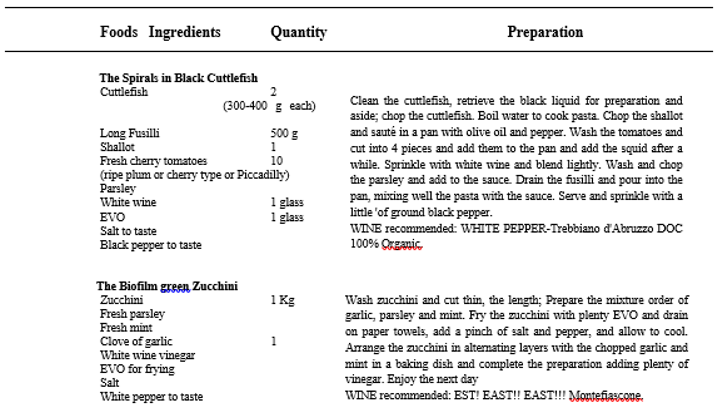
The Recipe for “the Spirals in Black Cuttlefish” was shows in Table 1.
Finally, we analyzed the similarity with P. aeruginosa (Figure 1 G, top), bacillus Gram-negative, flagellated, mobile non-fermenting [17,18] with zucchini (Figure 1 g, down). The recipe “the Biofilm Green Zucchini” is an ancient Jewish Ghetto of Rome in preparation for the world-famous, but that is renowned throughout Italy and in the world.
The Recipe for “the Biofilm green Zucchini” was shows in Table 1.
2.6. Scanning Electron Microscopy
For scanning electron microscopy (SEM) observation and image analysis of H. pylori, the samples were pre-fixed in a solution of 2.5% (vol/vol) glutaraldehyde with 0.1 M cacodylate buffer at pH 7.2 for 1h and then washed with cacodylate buffer solution. After washing with phosphate buffered saline (PBS) (Oxoid), the samples were post-fixed in 2% (w/v) osmium tetroxide and dehydrated in a series of graded ethanol in water solutions ranging from 50% to 100%. All the samples were sputter-coated (Emitech K 550) with gold. SEM examination (LEO 435 Vp) was performed using secondary electrons (SE1) with a current probe varying from 49 to 200 pA at 20.00_25.00 keV. The digitized images were stored in.tif format with N_M_1024_768 pixels per 8 bits. Each cell, represented by a pixel in the grid, was assigned a value of between 0 and 255 (0_black;255_white) [8].
3. Conclusions
Our recipes revisited in the title, morphologically associated bacteria, reflecting this great tradition of culture and passions, with the use of a zero-kilometer products respecting the territory. Moreover, all this makes us feel fiercely adhering to our roots.
With this a bit “special” approach we wanted to find in the world of “smaller ones” the counterpart that every day we emphasizing, mixing knowledge, Science, Art and Tradition.
Acknowledgements
The authors thank Olivetta Del Bianco for the English revision.
Author Contributions
writing—review and editing, L.C., E.D.C. and M.D.G.; data curation, S.D.L. and P.D.F.; formal analysis, S.D.A. anfd F.D. All authors have read and agreed to the published version of the manuscript
Competing interests
The authors declare no competing financial interests.
References
- Jones, M.L.; Ganopolsky, J.G.; Martoni, C.J.; Labbé, A.; Prakash, S. Emerging science of the human microbiome. Gut Microb. 2014, 5, 446–457. [Google Scholar] [CrossRef] [PubMed]
- Godlaski, T.M. Osiris of bread and beer. Subst. Use Mis. 2011, 46, 1451–1456. [Google Scholar]
- Marcus Gavio Apicius. Apicii De re Coquinaria. ca. 1891. 390/450. Ed. Guilermus Signerre Rothmagensis, Milano 1498 Bibliotheca Augustana Milano.
- Taucci, T. Enogastronomia abruzzese - Enogastronomy of Abruzzo. 2002, Ed. Amaltea Editrice, Lecce.
- Scappi, B. Opera. Dell’arte del cucinare (rist. anast. 1570). Ed. Forni, Bologna, 2003, collana Testi antichi di Gastronomia ed Enologia.
- Zarevúcka, M. Olive Oil as inductor of microbial lipase. 2012, 457–470 in: Olive Oil - constituents, quality, health properties and bioconversions, Dr. Dimitrios Boskou (Ed.), ISBN: 978-953-307-921-9, InTech, available from:http://www.intechopen.com/books/olive-oil-constituents-quality-health- properties-and bioconversions/olive-oilas-inductor-of-microbial-lipase.
- Cellini, L. Helicobacter pylori: a chameleon-like approach to life. World J. Gastroenterol. 2014, 20, 5575–5582. [Google Scholar] [CrossRef] [PubMed]
- Cellini, L.; Grande, R.; Di Campli, E.; Traini, T.; Di Giulio, M.; Lannutti, S.N.; Lattanzio, R. Dynamic colonization of Helicobacter pylori in human gastric mucosa. Scand. J. Gastroenterol. 2008, 43, 178–185. [Google Scholar] [CrossRef] [PubMed]
- Bessa, L.J.; Grande, R.; Di Iorio, D.; Di Giulio, M. , Di Campli, E.; Cellini, L. Helicobacter pylori free-living and biofilm modes of growth: behavior in response to different culture media. APMIS 2013, 121, 549–560. [Google Scholar] [PubMed]
- Di Fermo, P.; Di Lodovico, S.; Di Campli, E.; D’Arcangelo, S.; Diban, F.; D’Ercole, S.; Di Giulio, M.; Cellini, L. Helicobacter pylori Dormant States Are Affected by Vitamin C. Int. J. Mol. Sci. 2023, 17, 24–6. [Google Scholar] [CrossRef] [PubMed]
- Norris, C.R.; Marks, S.L.; Eaton, K.A.; Torabian, S.Z.; Munn, R.J.; Solnick, J.V. Associated with minimal gastritis ‘’Helicobacter heilmannii’‘ that is healthy cats are commonly colonized with minimal gastritis J. Clin. Microbiol. 1999, 37, 189–194. [Google Scholar] [CrossRef] [PubMed]
- Priestnall, S.L.; Wiinberg, B.; Spohr, A.; Neuhaus, B.; Kuffer, M.; Wiedmann, M.; Simpson, K.W. Evaluation of “Helicobacter heilmannii” subtypes in the gastric mucosas of cats and dogs. J. Clin. Microbiol. 2004, 42, 2144–2251. [Google Scholar] [CrossRef] [PubMed]
- Pizza, M.; Rappuoli, R. Neisseria meningitidis: pathogenesis and immunity. Curr. Opin. Microbiol. 2015, 23, 68–72. [Google Scholar] [CrossRef] [PubMed]
- Nostro, A.; Cellini, L.; Zimbalatti, V.; Blanco, A.R.; Marino, A.; Pizzimenti, F.; Di Giulio, M.; Bisignano, G. Enhanced activity of carvacrol against biofilm of Staphylococcus aureus and Staphylococcus epidermidis in an acidic environment. APMIS 2012, 120, 967–973. [Google Scholar] [CrossRef] [PubMed]
- Dupouey, J.; Faucher, B.; Edouard, S. , Richet, H.; Kodjo, A.; Drancourt, M.; Davoust, B. Human leptospirosis: an emerging risk in Europe? Comp. Immunol. Microbiol. Infect. Dis. 2014, 37, 77–83. [Google Scholar] [CrossRef] [PubMed]
- Filipe, J.; Lauzi, S.; Marinoni, V.; Servida, F.; Dall’Ara, P. Zoonoses and pet owners: a survey on risk perception in Northern Italy. Comp. Immunol. Microbiol. Infect. Dis. 2024, 112, 102224. [Google Scholar] [CrossRef] [PubMed]
- Savoia, D. New perspectives in the management of Pseudomonas aeruginosa infections. Fut. Microbiol. 2014, 9, 917–928. [Google Scholar] [CrossRef] [PubMed]
- de Sousa, T.; Silva, C. , Igrejas, G.; Hébraud, M.; Poeta, P. The interactive dynamics of Pseudomonas aeruginosa in global ecology. Review. J. Basic Microbiol. 2025, 19, e70004. [Google Scholar] [CrossRef]
Figure 1.
Bacteria (top panel) and food (down panel) “similarities”. Top: A, scanning electron micrograph of Helicobacter pylori, rod-shaped forms; B, scanning electron micrograph of ex vivo mature biofilm of H. pylori coccoid forms in gastric antrum (Cellini L et al. Scand J Gastroenterol. 2008, 43(2),178–185); C, transmission electron micrograph of H. heilmannii (Norris CR et al. J Clin Microbiol. 1999, 37(1),189–194); D, scanning electron micrograph of Neisseria meningitidis (http://bioquell.asia/technology/microbiology/neisseria-meningitidis); E, scanning electron micrograph of mature biofilm of Staphylococcus aureus (Nostro A et al. APMIS, 2012, DOI 10.1111/j.1600-0463.2012.02928.x); F, scanning electron micrograph of Leptospira interrogans (http://www.visualsunlimited.com/image/I00005u9fY3.FUh0); G, scanning electron micrograph of Pseudomonas aeruginosa (http://www.ca.globaltalentnews.com/sistema/aldia/232/La-UAB-lidera-un-projecte-europeu-per- combatre-bacteris-patogens-multiresistents-als-antibiotics.html). Down: a, Stortini (www.dececco.it); b, Peas; c, short Fusilli (www.dececco.it); d, Dangerous Peaches; e, grapes; f, long Fusilli; g, Zucchini. Scale Bars: 5μm.
Figure 1.
Bacteria (top panel) and food (down panel) “similarities”. Top: A, scanning electron micrograph of Helicobacter pylori, rod-shaped forms; B, scanning electron micrograph of ex vivo mature biofilm of H. pylori coccoid forms in gastric antrum (Cellini L et al. Scand J Gastroenterol. 2008, 43(2),178–185); C, transmission electron micrograph of H. heilmannii (Norris CR et al. J Clin Microbiol. 1999, 37(1),189–194); D, scanning electron micrograph of Neisseria meningitidis (http://bioquell.asia/technology/microbiology/neisseria-meningitidis); E, scanning electron micrograph of mature biofilm of Staphylococcus aureus (Nostro A et al. APMIS, 2012, DOI 10.1111/j.1600-0463.2012.02928.x); F, scanning electron micrograph of Leptospira interrogans (http://www.visualsunlimited.com/image/I00005u9fY3.FUh0); G, scanning electron micrograph of Pseudomonas aeruginosa (http://www.ca.globaltalentnews.com/sistema/aldia/232/La-UAB-lidera-un-projecte-europeu-per- combatre-bacteris-patogens-multiresistents-als-antibiotics.html). Down: a, Stortini (www.dececco.it); b, Peas; c, short Fusilli (www.dececco.it); d, Dangerous Peaches; e, grapes; f, long Fusilli; g, Zucchini. Scale Bars: 5μm.

 |
 |
Disclaimer/Publisher’s Note: The statements, opinions and data contained in all publications are solely those of the individual author(s) and contributor(s) and not of MDPI and/or the editor(s). MDPI and/or the editor(s) disclaim responsibility for any injury to people or property resulting from any ideas, methods, instructions or products referred to in the content. |
© 2025 by the authors. Licensee MDPI, Basel, Switzerland. This article is an open access article distributed under the terms and conditions of the Creative Commons Attribution (CC BY) license (http://creativecommons.org/licenses/by/4.0/).
Copyright: This open access article is published under a Creative Commons CC BY 4.0 license, which permit the free download, distribution, and reuse, provided that the author and preprint are cited in any reuse.


