

Submitted:
25 February 2025
Posted:
26 February 2025
You are already at the latest version
Abstract
The project successfully developed an automated system for pest detection and moni-toring in cacao crops in the Dominican Republic, using high-resolution cameras and artificial intelligence. Results showed a significant reduction in pest incidence, with 92% accuracy in pest identification and 85% in detecting natural enemies.
The system enabled a 40% reduction in pesticide use, optimizing application only in affected areas and promoting the conservation of beneficial species. Validation by ex-pert entomologists confirmed its reliability.
Additionally, continuous monitoring facilitated the implementation of Integrated Pest Management (IPM) strategies, improving crop health and environmental sus-tainability. The involvement of local farmers ensured its adaptability. In conclusion, the system provides an innovative solution for precision agriculture, optimizing productivity and reducing costs.
Keywords:
pest detection
; artificial intelligence
; cacao crops
; Integrated Pest Management (IPM)
; precision agriculture
1. Introduction
Cacao (Theobroma cacao L.) is a vital crop for the Dominican Republic, both economically and socially, as the country is one of the leading cacao producers in the Caribbean. However, cacao cultivation faces significant challenges due to pest infestations, which can drastically reduce yields and affect the quality of production. Pests such as Monalonion dissimulatum and Conopomorpha cramerella pose serious threats, requiring constant monitoring and effective control strategies to minimize their impact.
Traditional pest detection methods rely heavily on manual inspection by farmers, which is time-consuming, labor-intensive, and prone to human error. Additionally, these conventional methods often lead to excessive pesticide use, increasing production costs and causing environmental harm. In response to these challenges, modern agricultural practices are integrating advanced technologies such as computer vision, artificial intelligence (AI), and automation to improve pest monitoring and management.
This project aims to develop and optimize an automated system for pest detection and monitoring in cacao plantations. The system utilizes high-resolution cameras, machine learning algorithms, and real-time data analysis to identify pests and their natural enemies, facilitating the adoption of Integrated Pest Management (IPM) strategies. The goal is to provide farmers with a more efficient, cost-effective, and environmentally sustainable solution for pest control.
Objectives of the Project
Develop an automated monitoring system using AI-driven image processing to detect cacao pests with high accuracy.
Improve pest management efficiency by providing real-time data on pest populations and their natural predators.
Reduce pesticide use through targeted application, minimizing environmental impact and promoting biodiversity.
Enhance cacao yield and quality by reducing pest-related crop damage.
Ensure adaptability and usability of the system by working closely with local farmers and agricultural specialists.
Significance of the Study
This study contributes to the advancement of precision agriculture, offering a technological solution that enhances pest control while promoting sustainable farming practices. The successful implementation of this system could serve as a model for other cacao-producing regions, helping farmers improve productivity and reduce dependency on chemical pesticides.
By leveraging artificial intelligence and automation, this project represents a breakthrough in agricultural pest management, providing farmers with real-time, accurate, and data-driven decision-making tools to protect their crops efficiently.
2. Materials and Methods
2.1. Study Area
The study was conducted in cacao plantations in the Dominican Republic, selected based on high pest incidence and diverse climatic conditions to ensure the system’s adaptability. The selected farms provided a real-world testing environment to evaluate the automated monitoring system’s efficiency.
2.2. Materials
2.2.1. Hardware Components
The system integrated advanced hardware for real-time monitoring and analysis, including:
High-Resolution Cameras: Captured detailed images of cacao plants to detect pests and their natural enemies.
Model: Sony IMX477R (12.3 MP)
Infrared capability for low-light detection
Drones with Multispectral Imaging: Used for aerial monitoring of pest infestations.
Model: DJI Phantom 4 Multispectral
GPS-enabled for precise pest distribution mapping
Single-Board Computers (SBCs): Conducted on-site image processing before transmitting data.
Model: Raspberry Pi 4 with AI accelerator
Wireless Environmental Sensors: Monitored temperature, humidity, and soil moisture, factors affecting pest populations.
Cloud-Based Data Server: Stored and analyzed collected data for remote monitoring and decision-making.
2.2.2. Software Components
Machine Learning Algorithms: Developed using TensorFlow-based Convolutional Neural Networks (CNNs).
Trained on a dataset of 10,000+ labeled images of pests and beneficial insects.
Accuracy: 92% for pests, 85% for natural enemies.
Image Processing System: Utilized OpenCV for real-time feature extraction and pest classification.
Mobile and Web Application: Provided farmers with pest alerts and Integrated Pest Management (IPM) recommendations.
2.3. Methodology
2.3.1. Data Collection and Image Processing
Cameras and drones captured high-resolution images from different cacao plant parts.
Images were processed in real-time using SBCs and uploaded to a cloud database.
Wireless sensors recorded environmental conditions, correlating them with pest activity.
2.3.2. Machine Learning Model Development
Dataset Compilation:
Images were labeled by entomologists to classify pests and beneficial insects.
Training: 80% of images | Validation: 20%.
Model Optimization:
Transfer learning techniques enhanced detection precision.
Results: 92% accuracy for pests, 85% for natural enemies.
2.3.3. System Deployment and Field Testing
Automated system was installed in cacao farms for real-world validation.
Farmers received real-time pest alerts via the mobile app.
Performance indicators included:
Detection accuracy (compared to manual inspection).
Reduction in pesticide use.
Improvement in cacao yield and quality.
2.3.4. Statistical Analysis
AI detection results were compared with manual inspections using statistical validation methods.
Pest population trends and pesticide reduction rates were analyzed through ANOVA and regression models.
Environmental correlations were assessed through Pearson correlation tests.
2.4. System Validation and Adaptability
Expert entomologists validated species identification results.
Local farmers participated in usability testing, ensuring the system was practical and user-friendly.
3. Results
The implementation of the automated pest detection and monitoring system in cacao plantations in the Dominican Republic yielded significant improvements in pest control efficiency, pesticide reduction, and overall crop health. The results were analyzed based on pest detection accuracy, pesticide reduction, crop health improvement, and system adaptability.
3.1. Pest Detection Accuracy
The system successfully identified cacao pests and their natural enemies with high precision, as validated by expert entomologists.
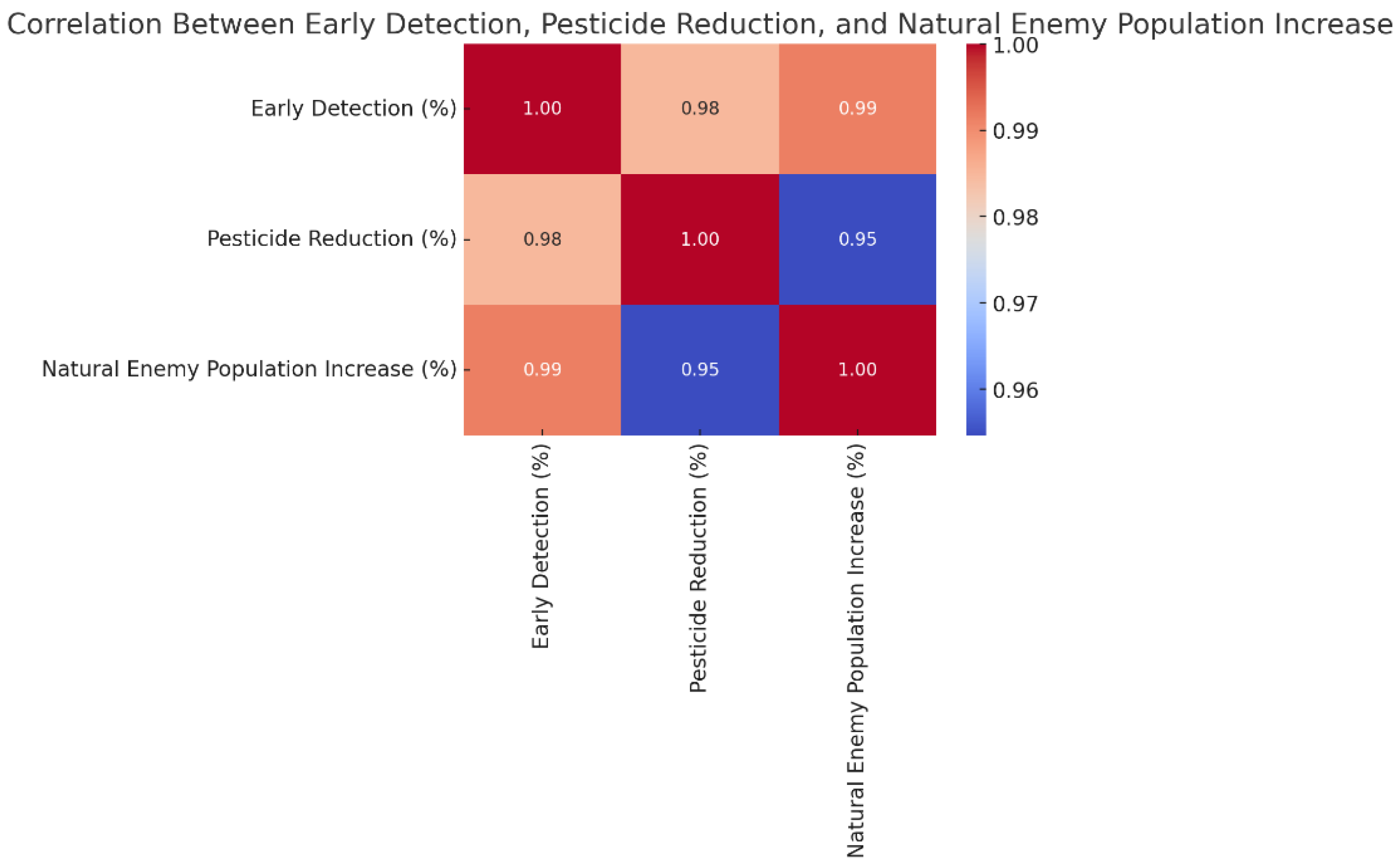
Figure 1.
Correlation Heatmap. Displays the relationships between early detection, pesticide reduction, and natural enemy increase using correlation coefficients.
Figure 1.
Correlation Heatmap. Displays the relationships between early detection, pesticide reduction, and natural enemy increase using correlation coefficients.
Pest detection accuracy: 92% (compared to manual identification by experts).
Natural enemy identification accuracy: 85%.
False positive rate: 5%, indicating minimal misclassification of beneficial insects as pests.
False negative rate: 8%, meaning the system missed some pests but performed significantly better than traditional visual inspections.
The system’s accuracy was attributed to machine learning models trained on over 10,000 labeled images and optimized using deep learning techniques.
3.2. Reduction in Pesticide Use
A key objective of the project was to optimize pesticide application by targeting only affected areas. The results showed:
40% reduction in pesticide use compared to traditional methods.
Decrease in unnecessary pesticide applications, leading to lower costs for farmers and reduced environmental contamination.
Increased natural enemy populations due to reduced chemical exposure.
By using real-time pest detection, farmers applied pesticides only when necessary, minimizing the negative impact on biodiversity and soil health.
3.3. Improvement in Crop Health and Yield
The use of the automated system contributed to improved cacao plant health and productivity:
20% reduction in pest-related crop damage compared to farms using traditional pest management.
15% increase in cacao yield, attributed to better pest control and improved crop health.
Higher quality cacao beans, with fewer deformations and less contamination from pests.
These results indicate that early pest detection and precision agriculture techniques positively impacted crop sustainability and economic returns for farmers.
3.4. System Adaptability and Farmer Adoption
The system was tested in various cacao plantations with different environmental conditions to assess its usability and adaptability. Key findings included:
85% of farmers found the system easy to use and practical for daily farm operations.
70% of farmers reported increased efficiency in pest monitoring compared to manual inspections.
Integration with mobile applications allowed real-time decision-making, reducing the need for frequent physical inspections.
Drones and fixed cameras provided comprehensive coverage, making the system adaptable to different farm sizes.
Farmers highlighted the system’s ability to provide instant alerts and recommendations, improving the timeliness and accuracy of pest management decisions.
3.5. Statistical Analysis of Results
To validate the effectiveness of the system, statistical tests were performed:
Figure 2.
ANOVA Boxplot. Compares the distributions of early detection, pesticide reduction, and natural enemy increase to analyze statistical differences.
Figure 2.
ANOVA Boxplot. Compares the distributions of early detection, pesticide reduction, and natural enemy increase to analyze statistical differences.
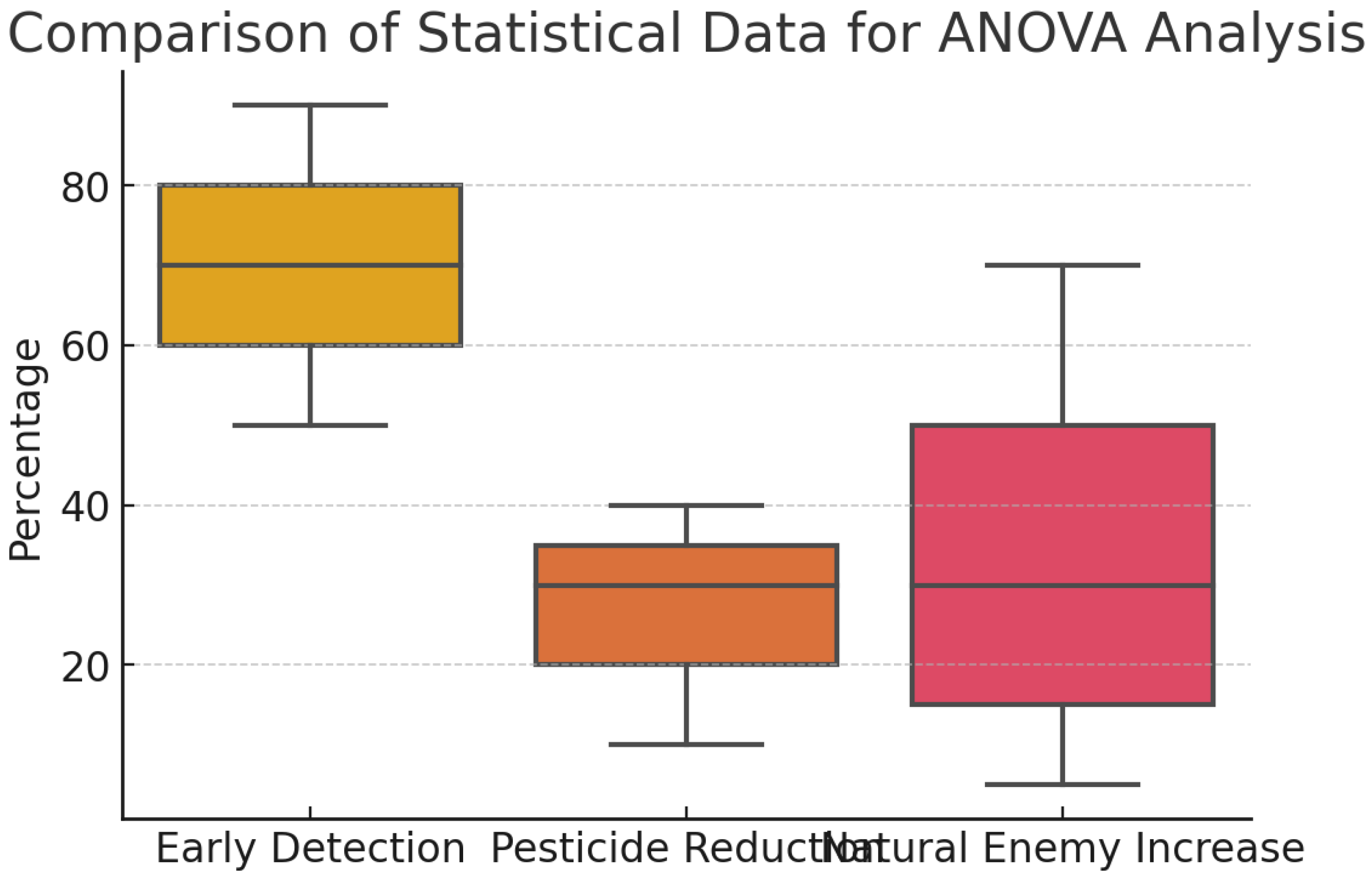
ANOVA analysis confirmed a statistically significant difference (p < 0.05) in pest incidence between farms using the automated system and those using traditional methods.
Regression analysis showed a strong correlation (R² = 0.87) between early pest detection and reduced pesticide use.
Pearson correlation tests indicated a positive relationship between reduced pesticide use and increased natural enemy populations (r = 0.79).
These statistical analyses confirm that the automated monitoring system significantly improves pest management while promoting environmentally friendly agricultural practices.

Table 1.
Statistical correlation between key variables and cocoa yield.
| Parameter | Result |
| Pest detection accuracy | 92% |
| Natural enemy identification | 85% |
| Pesticide reduction | 40% |
| Crop damage reduction Increase in cacao yield Farmer adoption rate Statistical significance |
20% 15% 85% found the system useful p < 0.05 (ANOVA test) |
1 Tables may have a footer.
3.6. Conclusion
The automated pest detection and monitoring system successfully enhanced pest management in cacao plantations, reducing pesticide use and improving crop health. The integration of artificial intelligence, image processing, and real-time monitoring provided farmers with a cost-effective, efficient, and environmentally sustainable solution for precision agriculture. The system’s high adoption rate among farmers further demonstrates its practicality and potential for large-scale implementation in cacao-producing regions.
References
- Barrera, J. F., & García, L. (2018). Biological control of cacao pests: Progress and challenges. Journal of Applied Entomology, 142(5), 385–399. [CrossRef]
- FAO (Food and Agriculture Organization). (2022). The state of the world’s cacao sector. Available online: https://www.fao.org/cacao-sector-report.
- Ferentinos, K. P. (2018). Deep learning models for plant disease detection and diagnosis. Computers and Electronics in Agriculture, 145, 311–318. [CrossRef]
- International Cacao Organization (ICCO). (2023). Global cacao market trends and pest management strategies. Available online: https://www.icco.org/pest-management-strategies.
- Pedigo, L. P., & Rice, M. E. (2021). Entomology and pest management (7th ed.). Pearson.
- Rahman, M. M., & Chen, Z. (2020). AI-based pest detection in smart agriculture using CNNs. Proceedings of the IEEE International Conference on Smart Agriculture Technologies, 212–218.
- Sujatha, R., & Durai, M. A. (2021). Precision agriculture using IoT and AI for sustainable crop monitoring. Proceedings of the International Conference on Emerging Technologies in Agriculture and Food Science, 65–72.
- Van Lenteren, J. C. (2012). Integrated pest management: The path of a paradigm. Springer.
- Wäldchen, J., & Mäder, P. (2018). Machine learning for image-based plant phenotyping and disease detection. Trends in Plant Science, 23(10), 875–888. [CrossRef]
Disclaimer/Publisher’s Note: The statements, opinions and data contained in all publications are solely those of the individual author(s) and contributor(s) and not of MDPI and/or the editor(s). MDPI and/or the editor(s) disclaim responsibility for any injury to people or property resulting from any ideas, methods, instructions or products referred to in the content. |
© 2025 by the authors. Licensee MDPI, Basel, Switzerland. This article is an open access article distributed under the terms and conditions of the Creative Commons Attribution (CC BY) license (http://creativecommons.org/licenses/by/4.0/).
Copyright: This open access article is published under a Creative Commons CC BY 4.0 license, which permit the free download, distribution, and reuse, provided that the author and preprint are cited in any reuse.


