1. Introduction
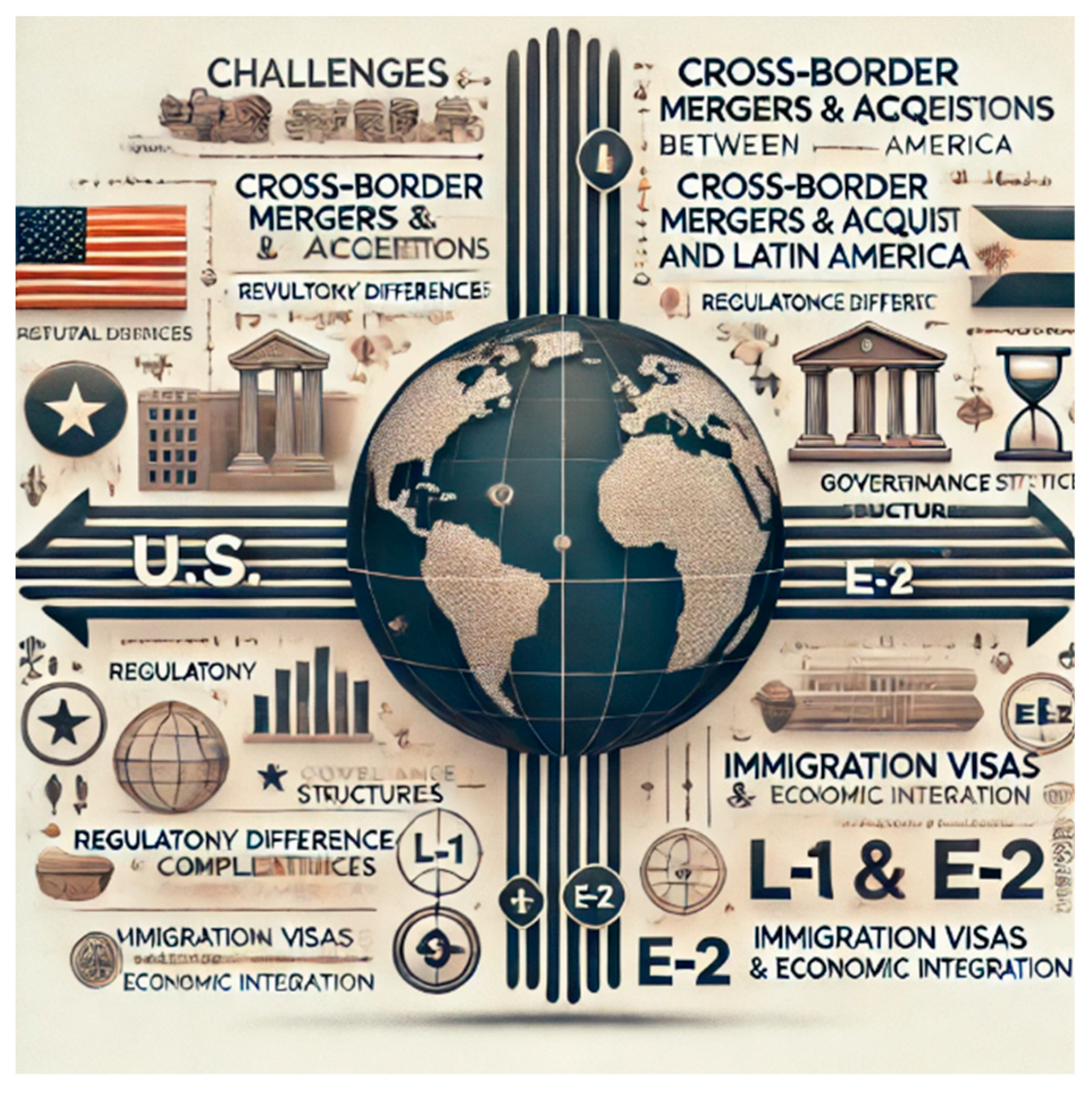
Cross-border mergers and acquisitions (M&A) between the United States and Latin America represent a growing phenomenon in the global economy, reflecting market expansion and corporate internationalization. However, these transactions do not occur without significant legal obstacles, which can directly impact their feasibility and effectiveness. This study seeks to fill a scholarly gap by analyzing not only the regulatory barriers and practical challenges faced by companies but also the role of executive mobility facilitated by L-1 and E-2 visas as a strategic tool for successful operations.
The novelty of this research lies in its comparative approach to the legal systems of Latin America and the United States, as well as its detailed analysis of the practical effects of regulation on M&A efficiency. Unlike previous studies, this article combines a literature review, case analysis, and empirical data observation to provide a comprehensive overview of the topic. The applied methodology will be detailed in the following section, outlining the criteria used for data collection and interpretation.
Thus, this research contributes to the academic debate by proposing a regulatory analysis model that objectively evaluates the legal impacts of international mergers and acquisitions.
2. Methodology
This study employs a qualitative approach, utilizing a literature review, comparative legal analysis, and case studies to examine the legal challenges of cross-border mergers and acquisitions. Primary sources include national legislations, international regulations, and reports from regulatory bodies such as the Federal Trade Commission (FTC) in the United States and the Administrative Council for Economic Defense (CADE) in Brazil. Additionally, academic publications and market studies addressing the regulatory impacts on the M&A sector were analyzed.
The research also incorporates data on the application of L-1 and E-2 visas in business operations, investigating how executive mobility can influence team integration and corporate governance. This holistic approach aims to provide a well-founded assessment of the challenges and opportunities surrounding M&A operations between the U.S. and Latin America.
3. Regulatory Differences and Legal Challenges
3.1. Corporate Structures and Governance
Differences in the legal frameworks of Latin American countries and the United States significantly impact M&A operations. In the U.S., company formation is characterized by flexibility and speed, whereas in countries like Brazil, bureaucratic processes can delay or hinder international transactions.
Modernizing corporate laws in Latin America is essential to strengthening economic integration and increasing investor interest. The reluctance of some countries to streamline their business regulations, under the guise of protecting domestic markets, ultimately results in reduced foreign investment and inefficiencies in expanding local companies into global markets.
3.2. Antitrust Regulation
Antitrust regulation plays a crucial role in defining the limits of mergers and acquisitions. In the United States, the FTC and the DOJ follow clear criteria, such as the Herfindahl-Hirschman Index (HHI), whereas in Latin America, regulatory processes tend to be slower and more unpredictable.
To overcome these difficulties, a joint effort by regulatory authorities is necessary to standardize procedures and reduce barriers that prevent efficient and fair international transactions.
3.3. Compliance and Due Diligence
Conducting a comprehensive due diligence process is essential to mitigating labor, environmental, and regulatory risks. Companies that overlook this stage may face serious challenges, particularly in international transactions involving multiple jurisdictions.
The extraterritorial application of the Foreign Corrupt Practices Act (FCPA) in the U.S. exemplifies the need for greater rigor in pre-transaction evaluations. U.S. companies can be held accountable for illicit practices by subsidiaries acquired in Latin America, reinforcing the importance of strong compliance frameworks.
4. Ethical Compliance and Conflict of Interest Statement
This study follows ethical principles of academic integrity and transparency. All sources used have been properly referenced, and the information analyzed is based on publicly available and accessible data. The authors declare no conflicts of interest regarding the content presented in this article.
5. Conclusion
Mergers and acquisitions between the United States and Latin America present complex regulatory challenges but also offer significant opportunities for companies that understand and manage the legal differences between these regions. The adoption of corporate mobility strategies through L-1 and E-2 visas, combined with a rigorous due diligence approach, can minimize risks and maximize success in these transactions.
Furthermore, the need for regulatory harmonization among markets is increasingly evident. Measures that promote greater predictability and legal security in cross-border operations can enhance foreign investment attractiveness and strengthen commercial relationships between the countries involved.
References
- USCIS - L-1 Intracompany Transferee.
- USCIS - E-2 Treaty Investors.
- U.S. Department of State - Treaty Trader and Investor Visas.
|
Disclaimer/Publisher’s Note: The statements, opinions and data contained in all publications are solely those of the individual author(s) and contributor(s) and not of MDPI and/or the editor(s). MDPI and/or the editor(s) disclaim responsibility for any injury to people or property resulting from any ideas, methods, instructions or products referred to in the content. |
© 2025 by the authors. Licensee MDPI, Basel, Switzerland. This article is an open access article distributed under the terms and conditions of the Creative Commons Attribution (CC BY) license (http://creativecommons.org/licenses/by/4.0/).