1. Introduction
There are numerous potential benefits of AI in education, which, in recent years, are increasingly supported by scientific evidence. AI allows, in fact, to create personalized learning paths, adapting educational content to the individual needs of students and providing real-time feedback [
1,
2]. In addition to the personalization of learning, AI can also intervene on teaching methods by offering advantages thanks to the use of intelligent tutoring systems and the provision of automated assessments, as well as increasing the efficiency and accessibility of educational interventions [
1,
3,
4]. AI can provide support in the management of administrative practices and processes, freeing up time for educators and allowing them to focus more on teaching [
2,
3]. Future educators see Artificial Intelligence (AI) as an opportunity to transform education, but they also recognize the challenges and limitations associated with its use. While there is a growing understanding of the benefits that AI can offer, on the other hand there is the awareness that it cannot replace the human role of teachers, as its intelligence is fundamentally different from that of humans [
5]. From an ethical and social point of view, the implementation of AI raises other concerns such as data privacy and equity in access to technologies [
1,
4], therefore it is crucial to implement security measures to prevent the abuse of AI technologies in education [
4]. In this reference scenario, where future educators recognize that AI has the potential to revolutionize education through personalization and efficiency, but emphasize the importance of addressing ethical challenges and ensuring that AI complements, rather than replaces, human teaching, the research described in this article is placed. It aims to gather the opinions of two types of actors who are the protagonists in the educational field, namely students and teachers active in some upper secondary schools in the Campania Region (Italy). They were asked to express their point of view on the very concept of AI, its potential benefits and the risks associated with its use.
2. Related Work
The integration of AI in schools has sparked diverse opinions among teachers and students. Their main concerns are both the potential benefits and associated risks. Several studies have explored these perspectives through surveys and empirical research. For example, one study highlighted the transformative potential of AI in education. It noted personalized learning opportunities and improved teaching outcomes, while also addressing ethical concerns and the need for increased AI literacy among stakeholders [
6]. Another research highlighted the nuanced understanding of the impact of AI on educational provision. The students and teachers involved acknowledged its benefits in personalized learning and efficiency, but expressed concerns about ethical use and data privacy [
7]. Teachers generally have a favorable view of AI, appreciating its potential to revolutionize teaching, but also express considerable apprehensions regarding privacy and ethical issues [
8]. Furthermore, AI is seen as a tool that can enrich student learning and complement teachers' work, although it poses risks such as reduced social interaction in learning [
9]. The potential for AI to change the roles of teachers and educational settings is also noted, with positive perceptions tempered by concerns about future teaching challenges [
10]. Overall, while AI offers substantial benefits in improving learning experiences and teacher effectiveness, it also presents challenges related to privacy, security, and ethical considerations, necessitating a balanced approach to its implementation in education [
11].
3. Materials and Methods
3.1. The Questionnaire
The questionnaire was prepared following the indications published in the work of Krosnick and Presser [
12] according to which the formulation of the questions must be clear and concise to avoid ambiguity and ensure reliable answers. It is divided into 4 sections. Section A (Table 1) to collect personal data of teachers and students. Section b (Table 3) to collect the agreement of teachers and students on the usefulness of AI. Finally, Section c (Table 4) to collect the agreement of teachers and students on the use of AI in education.
In both sections B and C the answers are collected on a 4-level Likert scale. The first (Yes) and the second (More Yes than No) highlight a positive perception. Conversely, the third (More No than Yes) and the last (More Yes than No) highlight a negative perception.
This questionnaire is very similar to those adopted in another investigation [
13].
Table 1.
Section A to collect general data of participants.
Table 1.
Section A to collect general data of participants.
| A1 |
Gender
(Woman; Man; I prefer not to answer) |
| A2 |
How old are you?
(15-18, 18-22; 23-27; 28-32; 33-37; 38-45; 46-55; over 55) |
| A3 |
Role in the School
(Teacher; Student) |
Table 2.
Section B to collect agreement of participants about the usefulness of AI.
Table 2.
Section B to collect agreement of participants about the usefulness of AI.
| |
Artificial Intelligence systems are useful for…
(answer to choose between: Yes; More Yes than No; More No than Yes; No) |
| B1 |
Improve learning in school |
| B2 |
Help with homework or individual study |
| B3 |
Assist in the transformation of an in-person course into a distance one |
| B4 |
Provide additional support for in-person learning |
| B5 |
Provide additional support for distance learning |
| B6 |
Acquire new skills |
| B7 |
Improve workplace training |
| B8 |
Improve children's learning (ages 0-6 years) |
| B9 |
Improve student learning (7-10 years) |
| B10 |
Improving student learning (11-14 years) |
| B11 |
Improve student learning (15-20 years old) |
| B12 |
Improving adult learning (over 20s) |
Table 3.
Section C to collect agreement of participants about the use of AI in education.
Table 3.
Section C to collect agreement of participants about the use of AI in education.
| |
I would use Artificial Intelligence in education to…
(answer to choose between: Yes; More Yes than No; More No than Yes; No) |
| C1 |
Individual study at home |
| C2 |
Support the frontal lesson (face to face) |
| C3 |
Improve learning |
| C4 |
Replace textbooks |
| C5 |
Replace the frontal lesson (face to face) |
| C6 |
Develop assessment tests that include various types of questions (multiple choice, true/false, short answer) |
| C7 |
Create customized assessment rubrics based on students' specific learning criteria |
| C8 |
Provide simulations and virtual labs for hands-on learning experiences |
| C9 |
Create immersive learning environments through augmented and virtual reality |
| C10 |
Develop interactive educational content such as animated videos or e-learning modules |
3.2. Tools
The administration of the questionnaire and the analysis of the collected data have been done by using applications of the Google platform. In particular, the questionnaire was administered in digital format using the Google Form. The analysis and elaboration of data have been completed by using Google Sheet. The collected data are completely anonymous.
3.3. Participants
The survey involved teachers and students of secondary schools in the Campania Region. The participants who were asked to answer the questions in the questionnaire were reached through contacts with principals and school directors of the institutes where training and professional development courses were held, or through word of mouth among friends, acquaintances and colleagues.
4. Results
4.1. Data About the Participants
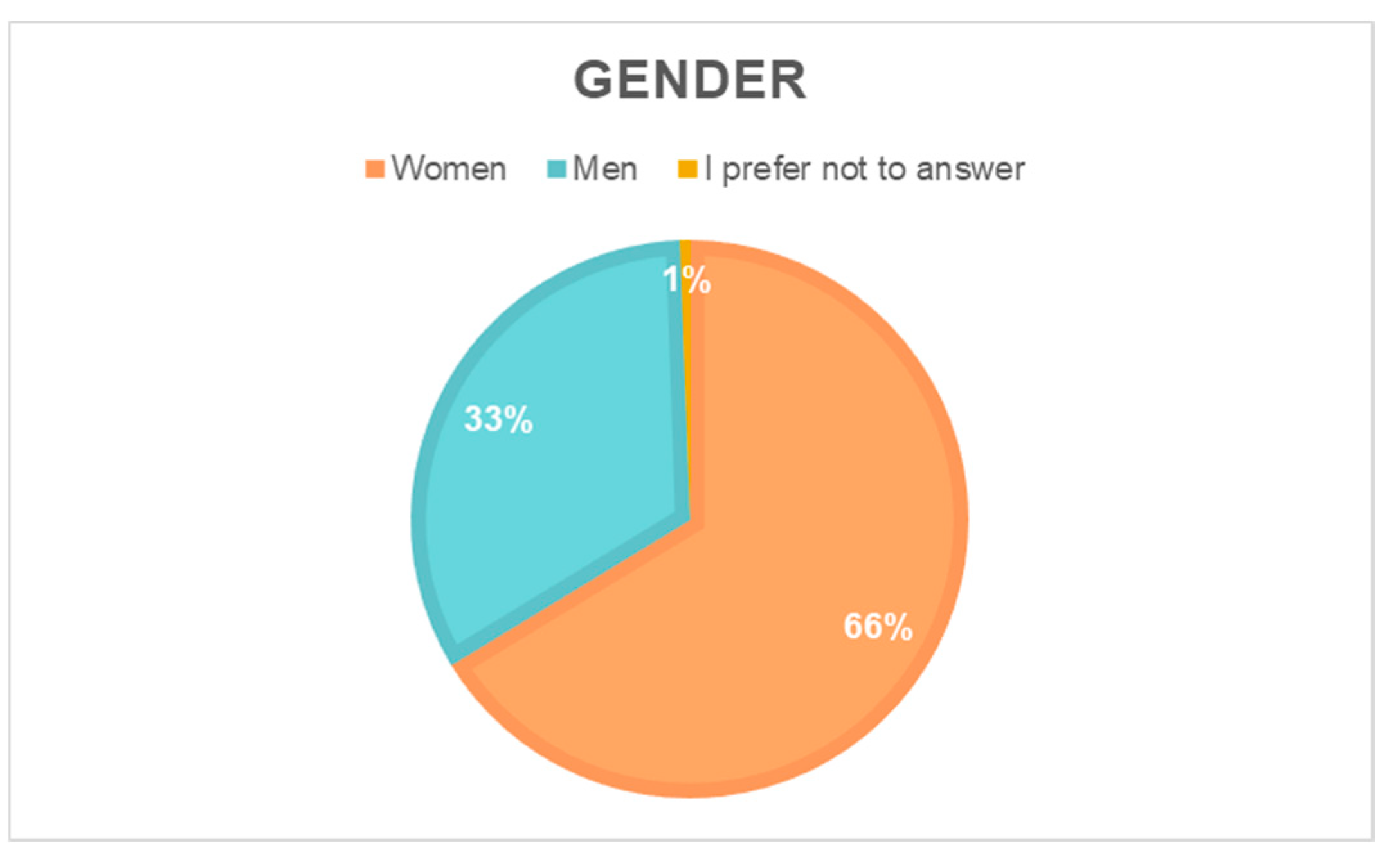
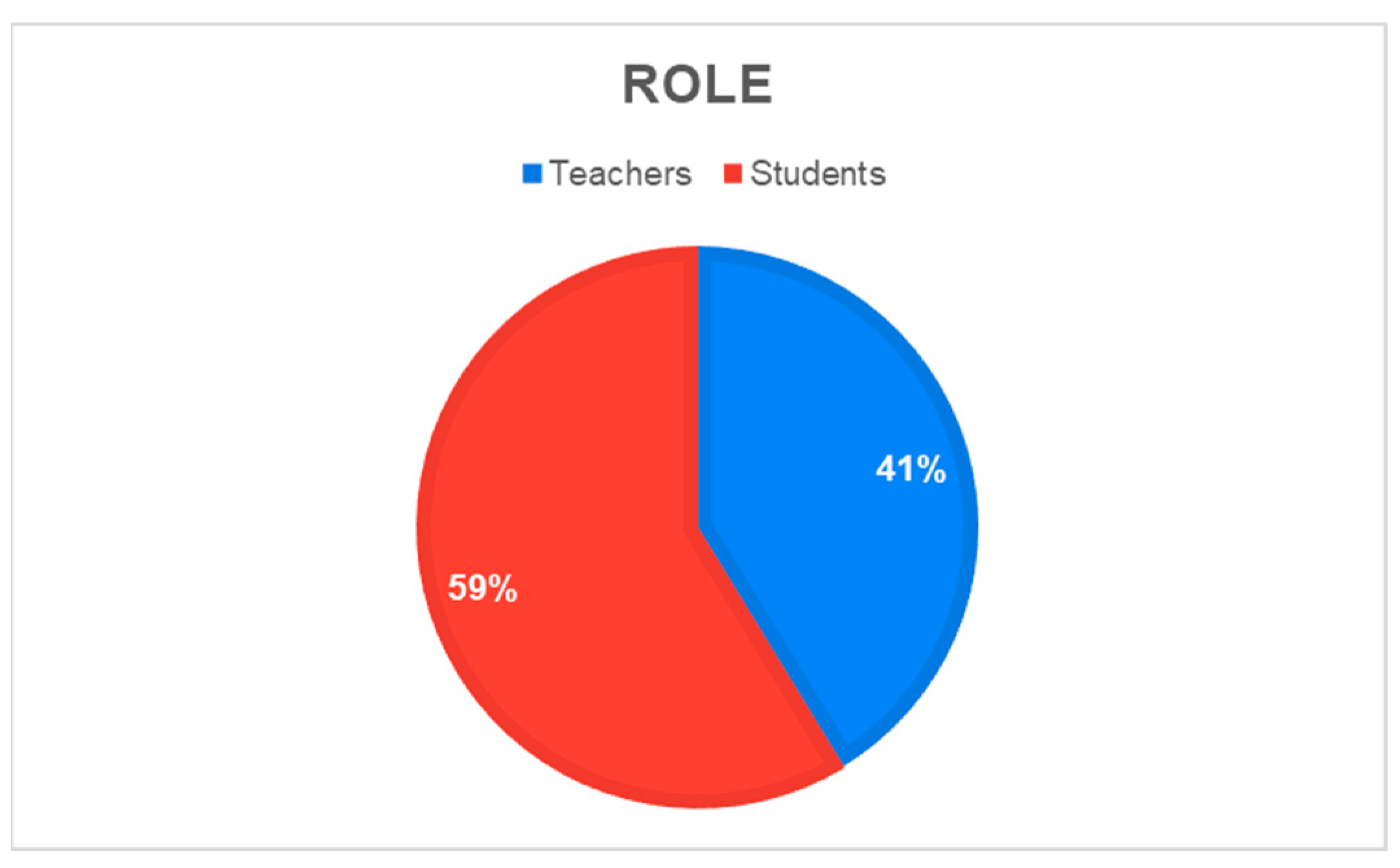
184 people answered the questionnaire. As shown in
Figure 1, 122 are women (66%), 61 are men (33%), and only 1 preferred not to answer. As shown in
Figure 2, 76 are teachers (41%) and 108 are students (59%).
4.3. The Usefulness of AI
Table 4 shows that teachers and students both recognize the usefulness of AI in improving learning in formal education contexts, helping with homework, acquiring new skills, and transforming in-person courses into distance ones. However, teachers tend to see more value in AI for providing additional support for distance learning, improving workplace training, and improving learning for different age groups, especially younger and adolescent students. Conversely, students are more optimistic about AI's usefulness for helping with homework and individual study.
Table 4.
The agreement of teachers and students about the usefulness of AI.
Table 4.
The agreement of teachers and students about the usefulness of AI.
| |
Artificial Intelligence systems are useful for… |
Teachers
(Yes / More Yes than No) |
% |
Students
(Yes / More Yes than No) |
% |
|
| B1 |
Improve learning in formal education contexts
(school and university) |
61 |
80% |
100 |
93% |
|
| B2 |
Help with homework or individual study |
41 |
54% |
81 |
75% |
|
| B3 |
Assist in the transformation of an in-person course into a distance one |
60 |
79% |
81 |
75% |
|
| B4 |
Provide additional support for in-person learning |
59 |
78% |
89 |
82% |
|
| B5 |
Provide additional support for distance learning |
65 |
86% |
47 |
44% |
|
| B6 |
Acquire new skills |
62 |
82% |
93 |
86% |
|
| B7 |
Improve workplace training |
61 |
80% |
11 |
10% |
|
| B8 |
Improve children's learning
(ages 0-6 years) |
25 |
33% |
3 |
3% |
|
| B9 |
Improve student learning
(7-10 years) |
29 |
38% |
14 |
13% |
|
| B10 |
Improving student learning
(11-14 years) |
37 |
49% |
14 |
13% |
|
| B11 |
Improve student learning
(15-20 years old) |
52 |
68% |
14 |
13% |
|
| B12 |
Improving adult learning
(over 20s) |
60 |
79% |
81 |
75% |
|
4.4. The Use of AI in Education
Table 5 shows that students are highly enthusiastic about using AI for individual study at home, supporting face-to-face lessons, and developing interactive and immersive learning experiences such as virtual labs and augmented reality environments. On the other hand, teachers are more inclined to use AI for developing assessment tests and customized rubrics. Both groups agree on the importance of AI in improving learning, but students show a stronger preference for using AI in self-directed and interactive learning scenarios.
Table 5.
The agreement of teachers and students about the use of AI in education.
Table 5.
The agreement of teachers and students about the use of AI in education.
| |
I would use Artificial Intelligence in education to… |
Teachers
(Yes / More Yes than No) |
% |
Students
(Yes / More Yes than No) |
% |
|
| C1 |
Individual study at home |
43 |
57% |
102 |
94% |
|
| C2 |
Support the frontal lesson
(face to face) |
50 |
66% |
100 |
93% |
|
| C3 |
Improve your learning |
59 |
78% |
95 |
88% |
|
| C4 |
Replace textbooks |
13 |
17% |
6 |
6% |
|
| C5 |
Replace the frontal lesson
(face to face) |
10 |
13% |
3 |
3% |
|
| C6 |
Develop assessment tests that include various types of questions (multiple choice, true/false, short answer) |
61 |
80% |
19 |
18% |
|
| C7 |
Create customized assessment rubrics based on students' specific learning criteria |
62 |
82% |
43 |
40% |
|
| C8 |
Provide simulations and virtual labs for hands-on
learning experiences |
62 |
82% |
108 |
100% |
|
| C9 |
Create immersive learning environments through augmented and virtual reality |
60 |
79% |
108 |
100% |
|
| C10 |
Develop interactive educational content such as animated videos or e-learning modules |
66 |
87% |
108 |
100% |
|
4. Discussion
As shown in Table 4, there is a significant difference in opinions between teachers and students regarding the usefulness of AI.
In particular, in providing additional support for distance learning, 86% of teachers believe AI is useful in this context, compared to only 44% of students. This could suggest that while teachers see the potential of AI in enhancing online education, students might not feel the same level of benefit or might have concerns about its effectiveness in their learning experience [
14,
15].
Another notable difference is in the perception of AI's usefulness in improving workplace training. 80% of teachers agree that AI is useful for this purpose, whereas only 10% of students share this view. Teachers see AI as a valuable tool for professional development and training, while students, who may have less experience in the workforce, might not yet see its relevance or potential impact in this area [
16].
The opinions diverge significantly when it comes to AI improving children's learning. 33% of teachers believe AI is useful for young children's education, compared to just 3% of students. This discrepancy might be due to teachers' professional insights into early childhood education and the potential benefits of AI, whereas students might not be as aware or convinced of its advantages for younger learners [
17].
A similar pattern is observed in the perception of AI's usefulness in improving learning for students aged 7-10 years. 38% of teachers find AI useful in this context, while only 13% of students agree. This difference could reflect teachers' broader understanding of AI's educational applications across different age groups compared to students' more limited perspectives. The difference remains pronounced for the 11-14 age group, with 49% of teachers believing AI is useful, versus 13% of students. This trend highlights that teachers, with their experience and awareness of educational technologies, might recognize AI's potential benefits more than students do. For students aged 15-20 years, 68% of teachers see AI as beneficial, compared to only 13% of students. This substantial difference might indicate that teachers are more optimistic about AI's role in supporting older students' learning, while students themselves may have reservations or lack awareness of its potential [
18].
These differences highlight the varying perspectives between teachers and students on the usefulness of AI in different educational contexts, with teachers generally seeing more potential benefits compared to students.
As shown in Table 5, there is a substantial difference in opinions between teachers and students on using AI in education.
In particular, for individual study at home, 94% of students are in favor, whereas only 57% of teachers agree. This indicates that students see great value in using AI for self-directed learning, finding it a beneficial tool for their studies at home. Teachers, on the other hand, might be more cautious or unsure about the effectiveness of AI in this context [
19].
Another notable difference is in the willingness to use AI to develop assessment tests. 80% of teachers agree on this use of AI, compared to only 18% of students. Teachers likely see AI as a useful tool for creating diverse and comprehensive assessment methods, while students may not fully appreciate or trust AI's role in their evaluations [
20].
There is also a significant difference regarding the use of AI to create customized assessment rubrics. 82% of teachers support this idea, but only 40% of students agree. This shows that teachers are more inclined to use AI to tailor assessments based on individual learning criteria, while students might be skeptical or unaware of how AI can benefit their personal assessment processes [
21].
Students show overwhelming support (100%) for using AI to provide simulations and virtual labs for hands-on learning experiences, compared to 82% of teachers. This enthusiasm from students suggests they are eager to engage with interactive and practical learning tools, while teachers also recognize the value but to a slightly lesser extent [
22]. Similarly, 100% of students are in favor of using AI to create immersive learning environments through augmented and virtual reality, compared to 79% of teachers. Students' strong preference highlights their interest in innovative and engaging learning experiences, while teachers are also positive but somewhat more reserved [
23].
These differences underscore the varying levels of enthusiasm and trust between teachers and students regarding the use of AI in education. Students tend to be more optimistic about AI's potential for self-directed and interactive learning, whereas teachers are more cautious and focus on AI's role in assessments and customized learning tools.
5. Conclusions
The survey described here involved secondary school teachers and students, asking them to express their opinions on AI. Significant differences emerged: both teachers and students recognize the potential benefits of AI, but their views differ on its use and ethics.
Specifically, teachers see AI as a valuable teaching aid rather than a replacement for traditional materials. They see AI as useful in administrative practices and in optimizing teaching time. This help allows them to focus more on the actual educational activity. However, teachers have reservations about AI's ability to replace them in teaching, emphasizing the fundamental nature of human interaction in education. From an ethical perspective, teachers pay attention to privacy protection and equal access to AI technologies, requiring adequate security measures to prevent abuse.
On the other hand, students are more enthusiastic about using AI to improve the quality of individual study and the effectiveness of learning. They see AI as a useful resource for studying and homework, for developing new skills. They show optimism towards the personalization of learning paths. On the other hand, they have less confidence in AI as a tool for distance learning than teachers.
In summary, the most evident differences between teachers and students concern the use of AI in distance learning, in children's learning and in professional training. Teachers largely recognize the value of AI in these areas, while students show greater reservations or a lower awareness of the potential benefits. Furthermore, while teachers are in favor of using AI for the creation of assessment tests and personalized rubrics, students are more interested in interactive and immersive learning experiences, such as simulations and augmented reality.
In summary, although both categories of participants recognize the benefits of introducing AI in education, some differences in perceptions and expectations regarding its use are evident. Bringing AI into education requires conscious and responsible interventions, obtained by taking into account technological benefits, human needs and ethical aspects. Only through a balanced approach, which values the irreplaceable role of teachers and addresses the concerns that have emerged, will it be possible to achieve an effective and sustainable integration of AI in the education of the future..
6. Patents
In accordance with the guidelines of the American Psychological Association (APA), participants were asked to give informed consent regarding the nature of the survey and its objectives exclusively for research purposes. Their participation was voluntary and was carried out by guaranteeing confidentiality and anonymity, since the data were collected in digital form without requesting the identity of the participants. Therefore, the data were collected in compliance with the European Regulation on Data Protection (GDPR n.679/2016) since they involve EU citizens anonymously and do not identify the participants in any way and irreversibly. No conflict of interest is connected to the survey conducted.
Author Contributions
Conceptualization, S.M.; methodology, S.M. and R.V.; formal analysis, S.M.; investigation, S.M. and R.V.; supervision, A.M. All authors have read and agreed to the published version of the manuscript.
References
- Tapalova, O., Zhiyenbayeva, N., & Gura, D. (2022). Artificial Intelligence in Education: AIEd for Personalised Learning Pathways. Electronic Journal of e-Learning 2022. [CrossRef]
- Chen, L., Chen, P., & Lin, Z. (2020). Artificial Intelligence in Education: A Review. IEEE Access 2020, 8, 75264-75278. [CrossRef]
- Zadorina, O., Hurskaya, V., Sobolyeva, S., Grekova, L., & Vasylyuk-Zaitseva, S.(2024). The Role of Artificial Intelligence in Creation of Future Education: Possibilities and Challenges. Futurity Education 2024, 4 (2). 163-185. [CrossRef]
- Kamalov, F., Calonge, D., & Gurrib, I. (2023). New Era of Artificial Intelligence in Education: Towards a Sustainable Multifaceted Revolution. Sustainability 2023. [CrossRef]
- Cope, B., Kalantzis, M., & Searsmith, D. (2020). Artificial intelligence for education: Knowledge and its assessment in AI-enabled learning ecologies. Educational Philosophy and Theory 2020, 53, 1229 - 1245. [CrossRef]
- Özer, M. (2024). Potential Benefits and Risks of Artificial Intelligence in Education. Bartın University Journal of Faculty of Education 2024. [CrossRef]
- Gluoksnyte, O., White, C., & Žitkus, M. (2024). Possible Impacts on Education Provision of the Transformative Role of Artificial Intelligence in Education: Current Student and Teacher Perspectives. International Conference on Trends and Innovations in Management, Engineering, Sciences and Humanities 2024. [CrossRef]
- Uygun, D. (2024). Teachers' perspectives on artificial intelligence in education. Advances in Mobile Learning Educational Research 2024. [CrossRef]
- Reiss, M. (2021). The use of AI in education: Practicalities and ethical considerations. London Review of Education 2021. [CrossRef]
- Gocen, A., & Aydemir, F. (2020). Artificial Intelligence in Education and Schools. Research on Education and Media 2020, 12, 13 - 21. [CrossRef]
- Tambuskar, S. (2022). Challenges and Benefits of 7 ways Artificial Intelligence in Education Sector. Review of Artificial Intelligence in Education 2022. [CrossRef]
- Krosnick, J.A., & Presser, S. (2010). Question and questionnaire design. In Handbook of Survey Research, 2nd ed.; Marsden, P.V., Wright, J.D., Eds.; Emerald Group Publishing Limited: Bingley, UK, 2010; pp. 263–313. [CrossRef]
- Miranda, S. (2025). Artificial Intelligence in Education: An Experimental Investigation to Gather the Opinion of Teachers, Students and Educators. Submitted to Education Sciences 2025. Currently under review.
- Chen, L., & Zhang, Y. (2022). Exploring the impact of artificial intelligence on online learning: Perspectives from educators and students. Journal of Educational Technology & Society 2022, 25(1), 45-58.
- Kizilcec, R. F., & Schneider, E. F. (2023). The role of AI in personalized learning: Student perceptions and outcomes. Computers & Education 2023, 198, 104-120.
- Yusuf, S. O., Abubakar, J. E., Durodola, R. L., Ocran, G., Paul-Adeleye, A. H., & Yusuf, P. O. (2024). Impact of AI on continuous learning and skill development in the workplace: A comparative study with traditional methods. World Journal of Advanced Research and Reviews 2024, 23(02), 1129-1140. [CrossRef]
- Su, J., & Yang, W. (2022). Artificial intelligence in early childhood education: A scoping review. Computers and Education: Artificial Intelligence 2022, 3, 100049. [CrossRef]
- Mustafa, M. Y., Tlili, A., Lampropoulos, G., Huang, R., Jandrić, P., Zhao, J., Salha, S., Xu, L., Panda, S., López-Pernas, S., & Saqr, M. (2024). A systematic review of literature reviews on artificial intelligence in education (AIED): A roadmap to a future research agenda. Smart Learning Environments 2024, 11(1), 59. [CrossRef]
- Marquardson, J. (2022). Embracing Artificial Intelligence to Improve Self-Directed Learning: A Cybersecurity Classroom Study. Journal of Information Technology Education: Research 2022, 21(1), 45-62. [CrossRef]
- González-Calatayud, V., Prendes-Espinosa, P., & Roig-Vila, R. (2021). Artificial Intelligence for Student Assessment: A Systematic Review. Applied Sciences 2021, 11(12), 5467. [CrossRef]
- Fernández-Sánchez, A., Lorenzo-Castiñeiras, J. J., & Sánchez-Bello, A. (2024). Navigating the Future of Pedagogy: The Integration of AI Tools in Developing Educational Assessment Rubrics. European Journal of Education 2024, 59(1), 45-62. [CrossRef]
- Dai, C.-P., Ke, F., Pan, Y., Moon, J., & Liu, Z. (2024). Effects of Artificial Intelligence-Powered Virtual Agents on Learning Outcomes in Computer-Based Simulations: A Meta-Analysis. Educational Psychology Review 2024, 36(1), 31. [CrossRef]
- Paulsen, L., Dau, S., & Davidsen, J. (2024). Designing for collaborative learning in immersive virtual reality: A systematic literature review. Virtual Reality 2024, 28(1), 63. [CrossRef]
|
Disclaimer/Publisher’s Note: The statements, opinions and data contained in all publications are solely those of the individual author(s) and contributor(s) and not of MDPI and/or the editor(s). MDPI and/or the editor(s) disclaim responsibility for any injury to people or property resulting from any ideas, methods, instructions or products referred to in the content. |
© 2025 by the authors. Licensee MDPI, Basel, Switzerland. This article is an open access article distributed under the terms and conditions of the Creative Commons Attribution (CC BY) license (http://creativecommons.org/licenses/by/4.0/).