Preprint
Article

This version is not peer-reviewed.

Chromotropism of Iron(II) Complexes with Non-Symmetric Heterocyclic Ligands: Polarity Sensing in Aqueous Urea Solutions

A peer-reviewed article of this preprint also exists.

Submitted:

24 February 2025

Posted:

26 February 2025

You are already at the latest version

Abstract

In this work, two pentacyanoferrate(II) complexes are synthesized and characterized, and their intense solvatochromic properties are examined in various solvents and solvent mixtures. These complexes feature ligands with flexible xylylene bridges and distinct heterocycles: one combining 4-dimethylaminopyridine (DMAP) with 4,4’-bipyridine, and the other isoquinoline with 4,4’-bipyridine. This structural diversity leads to intriguing solvatochromic behavior, enabling various intermolecular interactions and motifs in solution among the solvents and the complexes acting as solutes. The determined dipole moment changes between ground and excited states of both compounds highlight their sensitivity to small changes in dipolarity within polar media, such as water and polar organic solvents and mixtures thereof. Linear solvation energy relationships are employed to investigate their dependencies on solvent polarity and their responsiveness to different media. Additionally, the solvatochromic aptitude of the molecules examined is utilized to determine the polarity properties of aqueous solutions containing the bio-based molecule urea, a major player in bio-based resins and adhesives and other imminent applications.

Keywords: 
;  ;  ;  ;  ;  ;  

Introduction

Cyanoferrate(II) complexes have gained significant attention in recent years due to their versatile applications in various fields, including catalysis, [1], [2], [3] materials science, [4], [5], [6] and medicinal chemistry. [7] These complexes are particularly noted for their unique electronic properties and their ability to form stable complexes with a variety of ligands. [8][9][10] Recent trends in the study of cyanoferrate(II) complexes have focused on enhancing their functional properties through innovative ligand design and exploring their potential in new applications.[11] One of the key features in developing these complexes is the incorporation of 4,4’-bipyridine as a ligand.[12] 4,4’-Bipyridine is a bidentate ligand that can coordinate with metal centers to form robust, versatile structures. Its ability to undergo redox reactions and its electrochromic properties make it an attractive component in the design of multifunctional materials.xii The use of 4,4’-bipyridine in cyanoferrate(II) complexes has led to the development of compounds with enhanced stability, improved electronic properties, and increased responsiveness to environmental changes.[13], [14][15][16][17][18][19], [20]
Medium-responsive materials, which change their properties in response to external stimuli such as temperature, pH, or solvent polarity, constitute an exciting area of research of high scientific and technological relevance.[21], [22], [23] Pentacyanoferrate(II) complexes with 4,4’-bipyridine ligands have shown promising results as medium-responsive materials.xii These materials can exhibit significant changes in their optical and electronic properties when exposed to different solvents or solvent mixtures. This solvatochromic behavior is beneficial for sensing applications, where the material’s response to environmental changes can be used to detect and measure various parameters/properties of the environment. The combination of cyanometallate complexes with 4,4’-bipyridine and related ligands and their medium-responsive properties opens up new possibilities for the design of advanced materials.xii [24], [25] These materials can be tailored for specific applications, such as sensors [26] and smart coatings, [27] where their ability to respond to environmental changes can be harnessed for practical use. The ongoing research in this field aims to further understand the mechanisms behind these responses and to develop new materials with enhanced performance and broader applicability. For these reasons, various attempts have been made to investigate solvation effects in diverse media, with a special interest in solutions (aqueous or not) of molecules acting as modifiers. [28], [29]. However, studies on the alteration of the ionicity of solute indicators due to the dielectric effects of the medium remain scarce. Embracing these facts, this work features two pentacyanoferrate(II) complexes that are synthesized and fully characterized, exhibiting intense solvatochromic properties. Their solvatochromism is examined in various solvents and solvent mixtures. These complexes feature ligands with flexible xylylene bridges and distinct heterocycles: one bearing DMAP and 4,4’-bipyridine, and the other isoquinoline and 4,4’-bipyridine. This structural diversity leads to an interesting solvatochromic behavior, enabling various intermolecular interactions between solvents and these complexes as solutes. Linear solvation energy relationships are employed to investigate their dependencies on solvent polarity and their responsiveness to different media. A further goal of this work is to explore polarity sensing and solvation effects in aqueous urea. There are several reasons why urea has been chosen as a key polarity modifier in water. Firstly, urea is widely used in numerous processes and materials of industrial importance, most prominently in urea-formaldehyde [30], [31] and urea-phenol-formaldehyde resins, [32] which have immense applications in adhesives, xxxiv , xxxv and coatings of global technological significance.xxxvi,xxxvii Additionally, urea is considered a bio-based compound, and its use in new “green” adhesive formulations and polymers is currently being highly promoted [33-38]. To facilitate its use in novel applications, its properties as a solute require more investigation. Furthermore, the study of aqueous urea solutions is crucial for understanding their dielectric properties and the specific effects of H-bonding solute-solvent interactions. This study attempts to investigate the solvent-solute interactions in the presence of urea in water solutions of the title solvatochromic probes. FTIR and UV-Vis spectrophotometric experimental results and different mathematical models are employed to rationalize the complex solvation effects in aqueous urea solutions.

Results and Discussion

Synthesis and Characterization

The solvatochromic pentacyanoferrate(II) complex 5a has been synthesized and characterized before.xviii An analog of 5a lacking the polar dimethylamino functional group and further benzanullated (complex 5b involves an isoquinoline-bearing ligand , see Scheme 1) was synthesized for the first time.
Two different heterocyclic compounds were used for the synthesis of the ligands (4a-b). The 4-dimethylaminopyridine (2a) and isoquinoline (2b) reacted in a 1:2 ratio with α,α’-dichloro-p-xylene (1), while 4,4’-dipyridine (4) reacted in a 2:1 ratio to yield the respective products (4a-b). Through the reaction of products 3a and 3b with 4,4’-dipyridine, products 4a-b, which were subsequently used as “ligands,” were produced. The general synthesis method of the heterocyclic products 4a-b, as well as their structural evaluation, is described in the Materials and Methods section. Note: An excess of the electrophile was used to avoid di-substitution, as the introduction of the first heterocyclic group activates the other electrophilic carbon (of the chlorine).

Solvatochromism

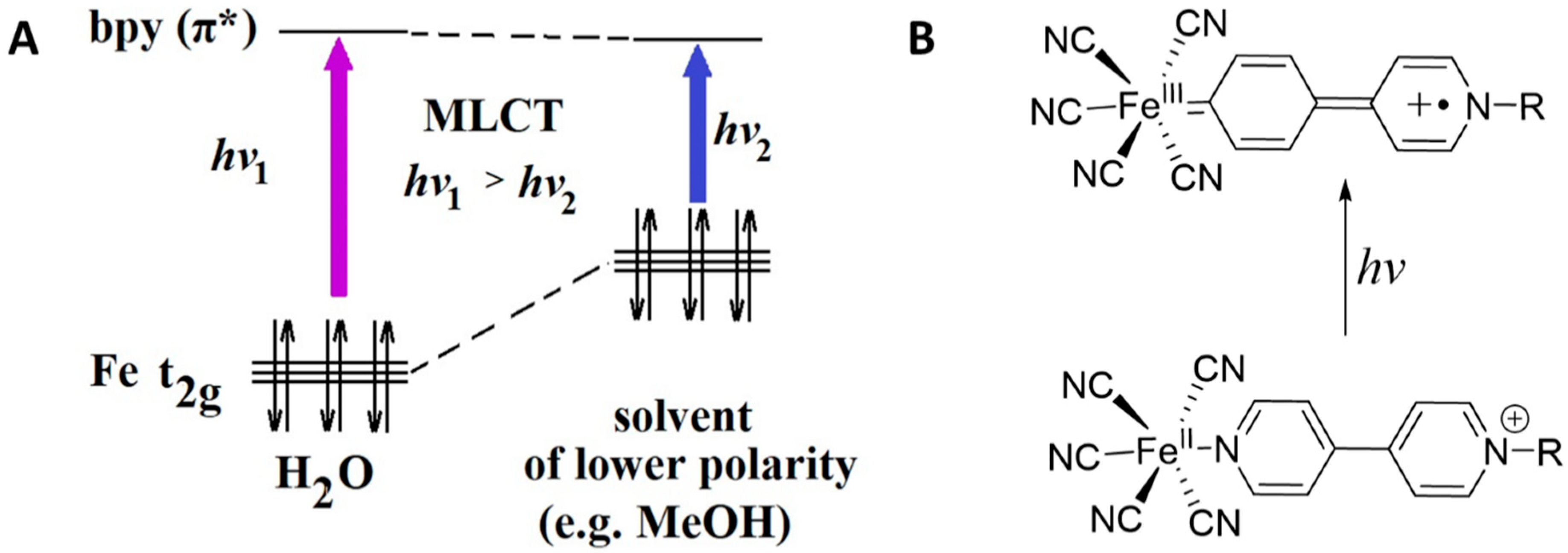
Compounds 5a and 5b exhibit marked solvatochromism, similar to other ferrocyanide(II) complexes encompassing 4,4’-dipyridine-based ligands (see recent works by Papadakis and coworkers xiii,xv,xvii,xviii,xx). What is noteworthy with compounds 5a and 5b is their ligands’ flexible backbone, which can potentially diversify solvent-solute interactions and give rise to unique solvation phenomena. Recently, the unique structural properties of 5a have been tested in the context of glucose sensing.xviii In a study by the author, it was shown that there is a bimodal chromotropic behavior: with one mode encountered in molecular solvents and their mixtures, and another mode in glucose solution associated with the attenuation of ionicity of 5a in aqueous glucose.xviii The solvatochromism of ferrocyanide(II) complexes encompassing 4,4’-dipyridine-based ligands is associated with the medium-influenced character of the F e I I ( d p ) π * ( b p y ) transition (see Scheme 2a). As shown in Scheme 2a, the energy gap between the ground and MLCT excited state of 5ab is larger in highly polar solvents such as water than in less polar solvents e.g. MeOH. This effect drastically influences the visible spectra of these compounds by inducing sizable bathochromic shifts in the vis spectra upon decreasing solvent polarity. The “solvatochromic backbone” experiencing this effect involves the 4,4’-bipyridinium part of the molecule and the pentacyanoiron(II) part of the complex (see Scheme 2b)
Here, the author attempts to go a step further and investigate the properties of a relative compound to 5a, which differs only in the use of an N-heterocycle opposite to 4,4’-dipyridine, specifically isoquinoline instead of DMAP (the latter appearing in the structure of 5a). Due to the lower dipolarity of isoquinoline compared to DMAP and the lack of hydrogen bonding possibilities, the chromotropic behaviour of 5b is anticipated to be influenced mostly by the dipolarity and likely by the polarizability of the medium. This can lead to a polarity indicator that encompasses only one hydrogen-bond sensing side, that of the -FeII(CN)5 moiety which plays a dominant role in the observed solvatochromism, and thus, this structural feature could attenuate the role of other sites of the molecule which give rise to solute-solvent interactions of lower importance for the core transition [e.g. the H-bonding of the type Sol-HNMe2py (where Sol: a solvent with H-Bond donating aptitude and NMe2py being DMAP)]. To have a meaningful comparison of the two complexes the same molecular media used for 5a previously were also used for 5b. More details about the used solvents and solvent mixtures are found in Table 1.
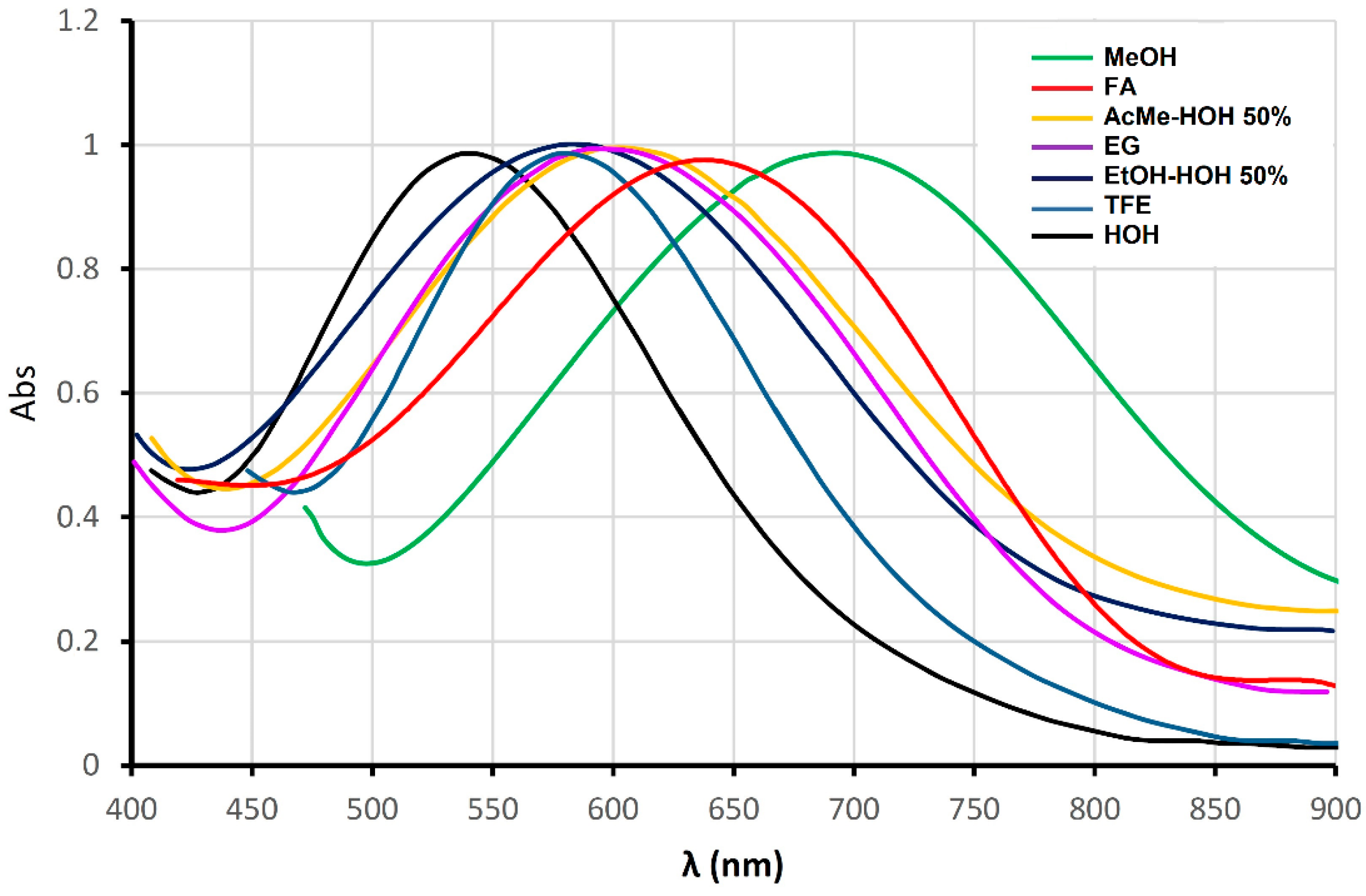
Through the spectrophotometric study of compounds 5a and 5b in various solvents and solvent mixtures, intriguing effects were observed. Qualitatively, the most noticeable observation is the negative solvatochromism of both compounds, corresponding to a bathochromic shift in the MCLT band as the solvent polarity decreases. Quantitatively, compound 5a exhibited a maximal bathochromic shift of Δ H O H N M F λ C T = 92   n m   (or Δ H O H N M F v ~ C T = 2766   c m 1 ) between water (the solvent with the highest ET(30) value in this study) and NMF (the solvent with the lowest ET(30) value). For compound 5b, the corresponding shift was 88 nm (or -2606 cm⁻¹). Interestingly, while NMF has the lowest ET(30) value in this study, it was not the solvent in which the highest solvatochromic shift was observed. Instead, MeOH exhibited the most significant shift, with Δ H O H M e O H λ C T = 137 n m   ( o r   Δ H O H M e O H v ~ C T = 3841   c m 1 ) ) for 5a and 153 nm (-4118 cm⁻¹) respectively for 5b. This is not surprising, as NMF, despite its low ET(30) value due to its low Lewis acidity (significantly lower than MeOH), also has one of the highest dielectric constants (ϵ = 182.4), indicating stronger dipolarity among molecular solvents (including water). Indeed the author has recently reported on an observation of the high-polarity-driven behaviour of NMF in binary solvent mixtures.xiii This finding suggests that both compounds are more influenced by dielectric effects than by the Lewis acidity of the medium. It furthermore underscores the importance of interpreting solvatochromic shifts using various scales and parameters (empirical or otherwise) to gain a better understanding of the dominant solute-solvent interactions.
Moreover, small but noticeable differences in the measured MLCT maxima wavelengths were observed when comparing 5a to 5b in different solvents. The most prominent differences are a 19 nm shift observed in neat MeOH and a 10 nm shift in FA, with the band of 5b being more redshifted than 5a in both cases. Additionally, the general observation in most solvents/mixtures examined, excluding NMF and EG, is that the visible MLCT band of 5b is either centered at an identical wavelength or redshifted compared to 5a. Although it is difficult to draw definitive conclusions from these observations, the DMAP group is likely capable of pushing electron density into the “solvatochromic backbone” of the molecule (i.e., 4,4’-bipyridine-FeII(CN)5) more effectively than isoquinoline. It has been shown earlier by Papadakis and Tsolomitisxx that electron-withdrawing substituents bound to the N-end of the 4,4’-bipyridine-FeII(CN)5 backbone result in redshifts in the visible spectra of compounds relative to 5a and 5b. For a thorough study focusing on these effects, please refer to the relevant literature. [xx]).
Table 2. Measured MLCT wavelength maxima of 5a and 5b in different solvents and corresponding MLCT wavenumbers.
Solvent λ C T 5 a (nm)* λ C T 5 b (nm) v ~ C T 5 a   ( 10 3 c m 1 ) v ~ C T 5 b   ( 10 3 c m 1 )
HOH 534 537 18.744 18.622
TFE 572 577 17.470 17.341
Glycerol 605 610 16.529 16.389
EtOH50% 585 585 17.094 17.094
EG 600 599 16.667 16.705
FA 628 638 15.923 15.664
MeOH 671 690 14.903 14.497
AcMe50% 599 604 16.694 16.564
NMF 626 625 15.978 16.009
* Data reported previously by the authorxviii. Measurements in TFE have not been previously reported for 5a. Results reported in this study.

Types of Solute-Solvent Interactions

Compounds 5a and 5b can interact with solvent molecules in various ways due to the diversity of their functional groups. Understanding these interactions is crucial for rationalizing solvation phenomena. This study identifies the following main types of solute-solvent interactions.
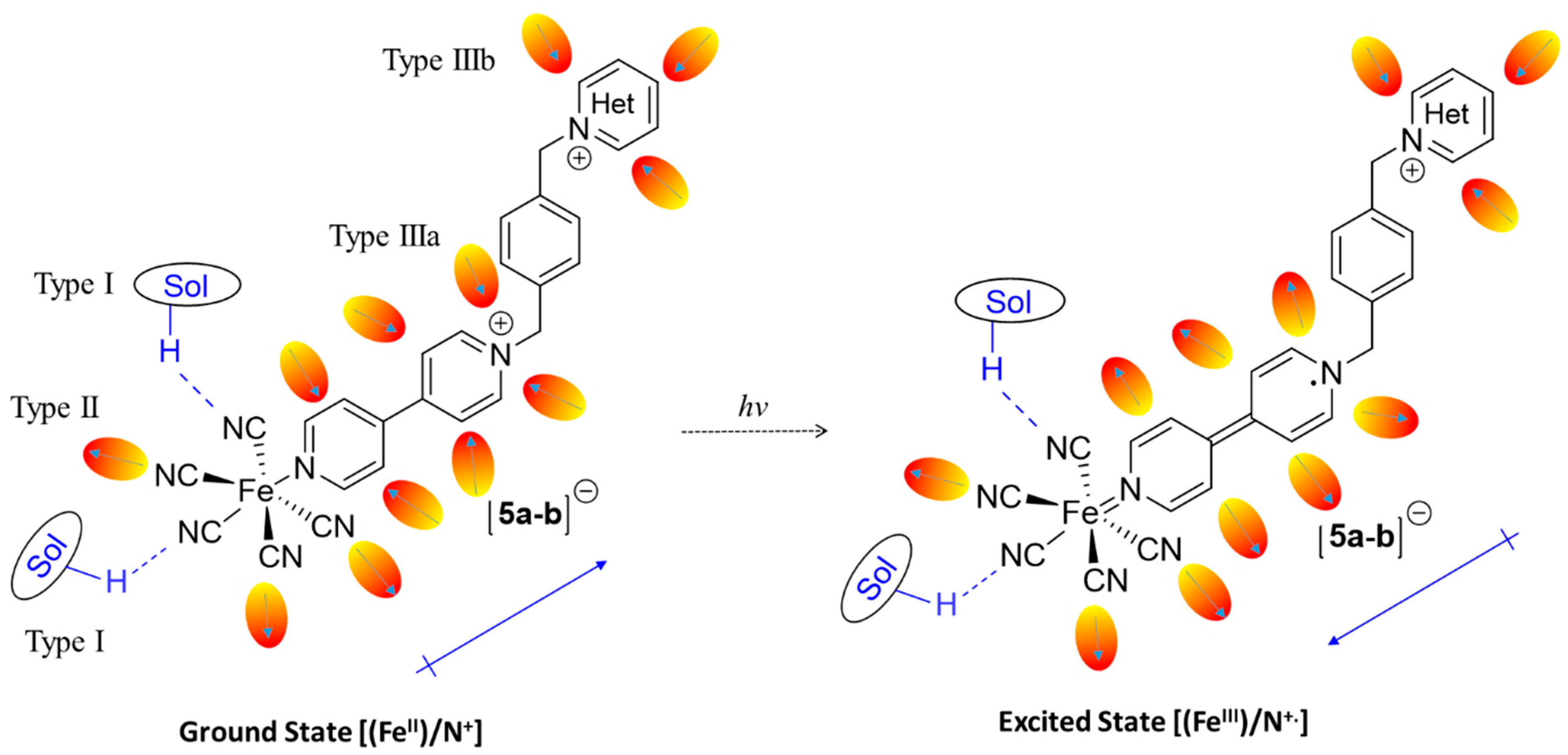
The (C N) groups of the pentacyanoferrate(II) “head” of the molecules can effectively hydrogen bond to a variety of hydrogen bond donor (HBD) molecules, such as hydroxylated solvents (e.g., water, alcohols) and amides (e.g., FA and NMF).xiii,xx This type of interactions is identified here as Type I; see Scheme 3. These interactions are highly relevant to the chromic behavior of pentacyanoferrates(II) since H-bonding attenuates the FeII-CN bond strength. Hence, MLCT becomes less efficient, and its energy increases. This has a direct impact on solvatochromism. Indeed Brønsted acids capable of protonating the CN groups while kept bound on the Fe(II) center, have been found to drastically change the chromic and non-linear-optical (NLO) properties of pentacyanoferrate(II) complexes.[42]
Moreover, the (C N) groups can also interact specifically with solvent dipoles (anion-dipole interactions; Type II interactions; Scheme 3). Such interactions clearly influence the MLCT energy and therefore the solvatochromism of 5a and 5b in a similar fashion as in Type I interactions i.e. by energetically disfavoring the MLCT.xx
The charged backbone of the ligand, i.e. the bipyridinium part adjacent to the pentacyanoferrate(II), also exhibits an aptitude to interact with the dipoles of solvent molecules through cation-dipole interactions (see Scheme 3). Support for this type of interactions has been provided through 1H-NMR studies on pyridinium salts.[43] These interactions (here called Type IIIa) can influence the solvatochromism of 5a and 5b by attenuating the electron-withdrawing aptitude of the bipyridinium positively charged core. Such interactions will obviously hamper the transfer of charge from iron(II) to the heterocycle (note: the MLCT transition is the F e I I ( d p ) π * ( b p y ) transition; vide supra).
On the other hand, not only bipyridinium but also the quaternized N-heterocycle (DMAPyridinium for 5a and quinolinium for 5b) is also capable of developing interactions cation-dipole interactions with dipoles of polar solvents. (Type IIIb interactions). In contrast to quinoline, DMAP can also develop hydrogen bonding with HBD-solvents such as water, formamide, and methanol (MeOH) as a result of the mild HBA-capacity of the dimethylamino group of DMAP (Type IV).
The latter two types (Type IIIb and IV) of interactions do not directly affect the core of the molecule and hence their contribution to the solvatochromic is rather minor. Nonetheless, as described above, small shifts in the visible spectra of 5a and 5b can be attributed to the heterocyclic substituent and could be explained based on Type IIIb and IV interactions, which are dependent on the nature of the side-heterocycle.

Using LSERs to Rationalize the Solvatochromic Effects

To elucidate the solute-solvent interactions that influence the solvatochromism of 5a and 5b, selected LSERs were employed (see Methods section). The choice of LSERs was based on a series of previous studies on pentacyanoferrate(II) complexes with variously substituted 4,4'-bipyridines as ligands.xiii,xiv,xvii,xviii,xix,xx
Correlations between measured v ~ C T values for 5a and 5b using the LSER models (Eq. 1-4) help in understanding the solvent polarity parameters that influence the observed solvatochromism of both compounds. The correlation between v ~ C T and E T N resulted in a good fit (r2=0.712 for 5a and r2=0.617 for 5b; see Table 3 for more details) with a positive slope of 10.54×103 cm−1 for 5a and 10.39×103 cm−1 for 5b (see Table 3). E T N is a polarity scale encompassing Lewis acidity and dipolarity/polarizability characterxxxix and these correlations are in line with the specific role of Lewis acidity of solvents in Type I interactions as well as with the role of dipolarity on Type II and Type III interactions and their overall influence on solvatochromism. Similar results have been shown by the author in a range of recent studies and are characteristic of ferrocyanides.xiv,xviii-xx The positive slopes in both cases indicate a negative solvatochromic effect, corresponding to bathochromism (lowering of v ~ C T ) when solvent polarity increases.
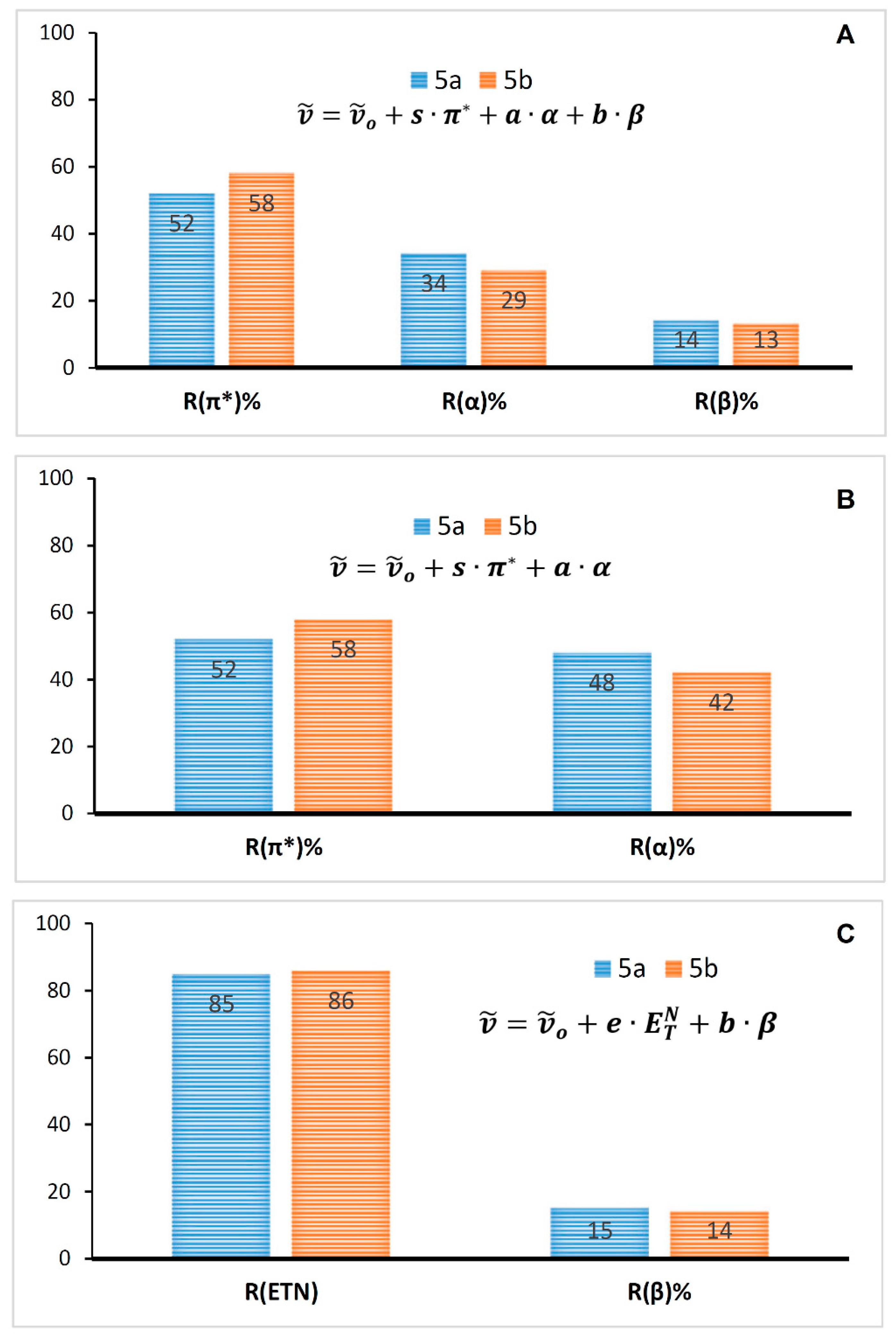
Due to the fact that Lewis acidity and dipolarity/polarizability are entangled in the empirical scale of Reichardt, E T N , Kamlet-Taft-Abboud (KAT) equation in its triparametric form (see Methods section; equation 2) can help to separate acidity (specifically HBD-acidity), basicity (HBA-basicity) and dipolarity/polarizability of solvents.[44] The triparametric linear fits of the spectrally obtained v ~ C T values to the three parameters π*, α, and β for 5a and 5b were satisfactory (r2=0.881 for 5a and 0.847 for 5b; see Table 3 for more details). A general observation for both 5a and 5b is that positive coefficients (also known as sensitivities) were obtained for π* and α, whereas negative ones were obtained for β (See Table 3). The positive coefficients s (corresponding to π*) are in line with the assumption of negative solvatochromism since the increase of dipolarity/polarizability triggers a hypsochromic effect in the vis-spectra of 5a and 5b (characteristic of most bipyridine-bearing pentacyanoferrate(II) complexes).xx The positive coefficient of α parameter (a) is also in line with the expected effect of HBD-acidity on 5a and 5b (see Type I interactions above). On the other hand, the negative response to changes in parameter β (reflected in the negative b values for both compounds; see Table 3) is potentially associated with the channelling of electron density towards the core of the complex induced by the interactions with solvent molecules acting as HBA/Lewis bases. Such an effect is expected to have an opposite impact compared to acidity or dipolarity, as it can enhance the electron-pushing towards the electron-deficient parts of compounds 5a and 5b. Additionally, solvents interacting with the pyridinium entities of 5a and 5b in a Type IIIa fashion (vide supra), for example, by interacting with the ortho-hydrogen atoms of the bipyridinium, could lead to further polarization, resulting in a more energetically favoured MLCT when basicity increases, inducing bathochromism while solvent-basicity increases. Such phenomena have not been extensively studied, yet there are indications of the effects of HBA- and Lewis-basicity on the solvatochromism of pentacyanoferrate(II) complexes.xix Nonetheless, the overall role of basicity on the studied solvatochromic effects was found to be statistically much less important than the role of dipolarity/polarizability and HBD-/Lewis acidity ( R β was determined to be 14% for 5a and 13% for 5b; see Table 4 and Fig 2A). For that reason, the author has recently attempted to employ a reduced form of the KAT equation having two parameters instead of three.xix This approach is attempted in this study too. Specifically, parameter β is neglected in the analysis of solvatochromism of 5a and 5b.In this study use of Equation 3 (involving merely π*, α; see methods section for details) resulted in very good fitting, being comparable to the triparametric KAT equation. Through the statistical analysis, it was found that parameter π* exhibits higher importance than parameter α and this effect is slightly more pronounced in compound 5b than 5a (see Table 4 and Figure 2B). This finding is in line with the structural diversity of 5a and 5b and specifically the difference in side-pyridinium substituents; DMAP for 5a and quinolinium for 5b. Because isoquinoline compared to DMAP lacks hydrogen bonding capacity, the chromotropic behavior of 5b is more significantly affected by the dipolarity and polarizability of the medium. Interestingly, the application of Equation 3 can be viewed as a disentanglement of Equation 1. While the latter (Eq. 1) fits the spectrally obtained v ~ C T to E T N , Equation 3 breaks down the fitting into the two components of E T N , namely Lewis acidity and dipolarity/polarizability, which are described in Eq. 3 through the linear combination of π* and α. Indeed, the connection of ET(30) to parameters π* and α has been reported in past (e.g.: ET(30) = 31.2 + 15.2.α + 11 5.π*, r2 = 0.9585)[45].
Finally, an LSER complementary to KAT-equation is further used (see Eq. 4). The latter involves E T N expressing a combination of dipolarity/polarizability and Lewis acidity with parameter β expressing HBA-basicity. This LSER can be regarded as analogous to the Krygowski-Fawcett equation.[46] In this form, Equation 4, provides the benefit of using KAT-parameter β which allows to draw a complementary conclusion to that of the KAT equation (Eq. 2). Interestingly, Equation 4, provides qualitatively the same results as KAT-equation. While positive sensitivities to E T N (10.14×103 cm−1 for 5a and 10.06×103 cm−1 for 5b) were obtained, negative sensitivities to KAT-parameter β were observed (-0.288×103 cm−1 for 5a and -0.238 for 5b). The interpretation of this finding is the same as in KAT-equation (vide supra). Additionally, the sensitivities to E T N were very close to those obtained through Equation 1 (involving solely Reichardt’s polarity scale; see Table 3 for details). This underlines the minimal role of parameter β which is moreover manifested through the very low relative importance of this parameter (15% and 14% respectively for 5a and 5b; see Table 4 and Fig.2c). The complementarity of Equations 2 and 4 is also manifested through the very close relative importance of parameters E T N and π* and α the latter two combined i.e. % R E T N = 85 %   % R π * + % R α = 52 % + 34 % = 86 %   for 5a and % R E T N = 86 %   % R π * + % R α = 58 % + 29 % = 87 %   for 5b. The overall interpretation of the qualitative and quantitative results obtained through Equations 1-4 indicates that the dipolarity/polarizability of the medium, along with HBD- and/or Lewis- acidity, are the most important solvent polarity features for the observed solvatochromic effects, in both compounds examined. The results clearly indicate a negative solvatochromic effect, and the impact of HBA-basicity is found to be of minor importance, given the set of solvent/solvent mixtures examined, which, interestingly, involves solvents of relatively high basicity.(e.g. NMF with β=0.80, glycerol with β=0.87, and MeOH with β=0.66).

Determination of Electronic Ground and Excited State Dipole Moments

Determining the dipole moments of solvatochromic dyes is essential for understanding their molecular polarity and optimizing their electronic properties. Knowledge of dipole moments in the ground and excited states can assist in enhancing the performance of these dyes in applications like sensorsxviii,[47] and molecular electronics,[48] where the precise tuning of electronic properties is crucial.[49] Additionally, it helps predict spectroscopic behavior, providing valuable insights into the electronic structure and bonding patterns of these dyes. Taking these facts into account, ground and excited state dipole moments of 5a and 5b were determined. The dipole moments were determined by employing a model introduced by Suppan and Tsiamis[50] (see Methods section; Equations 5-6) which allows the determination of ground and excited dipole moments of non-emissive solvatochromic compounds.[51] The author recently determined the dipole moment difference between the ground and MLCT-excited state of 5a, nonetheless,18 the current study included an additional molecular solvent (TFE) which was now also taken into account and for a complete comparison with the results obtained for 5b (also including TFE). The complete results of the application of the model for 5a and 5b are presented in Table 5. The obtained values for 5a were very close to the reported ones in a recent publication by the authors. Small differences in dipole moments between 5a and 5b were observed and 5b was found to exhibit a slightly more polar excited state than 5a as well as a larger difference μ e μ g which is in line with the overall more dipolar nature of 5b compared to 5a (see discussion above) with μ e = 1.423 μ g for 5a and μ e = 1.479 μ g for 5b. Qualitatively, the model predicts a higher dipolar moment for the MLCT excited state compared to the ground state in both cases of compounds which is in line with the hypothesis of negative-solvatochromism. Practically, an increase of “pure” dipolarity expressed by an increase of the function: g ϵ , n 2 = φ ϵ φ n 2 which excludes polarizability ( φ n 2 ) of the medium results in an increase of E C T i.e. it induces hypsochromism.
* k C : C o u l o m b s c o n s t a n t ; k C = 1 4 π ε o 8.988 10 9 N m 2 C 2

Polarity Sensing in Aqueous Urea

The intense solvatochromic behavior of compounds 5a and 5b can be conveniently used to quantify solvent polarity in aqueous solutions of polarity modifiers. The author has previously reported the sensing aptitude of compound 5a in aqueous glucose solutions.xviii In the current study, the author attempts to quantify and rationalize the behavior of the polarity sensors 5a and 5b in aqueous urea solutions. To the best of the author’s knowledge, studies on solvation effects in aqueous urea solutions are scarce and mainly focus on their dielectric properties.[52] Nonetheless, there are only a few studies pertaining to the use of solvent polarity indicators that could probe specific effects such as H-bonding solute-solvent interactions.xxix To shed more light on this, the influence of urea concentration on polarity in water-based solutions is investigated using compounds 5a and 5b.
Background studies: In the study of urea-water solutions, it has been observed that dimers of urea form up to a concentration of 2M, while above this concentration, urea aggregates into chain-like structures.[53] Rezus and Bakker, using polarization-resolved mid-infrared pump-probe spectroscopy, measured the orientational dynamics of water molecules and examined the rigidity of hydrogen bonds in urea-water mixtures. They found that water-structured networks are retained in the mixture, and urea interacts with only a few water molecules, leading to the formation of specific urea-water molecular arrangements[54]. Moreover, Soper, Castner, and Luzar reported that urea can form hydrogen bonds with either water or urea molecules without significant preference.[55] Additionally, quantitative analysis of spectra by Hayashi, et al. showed that the number of hydration water molecules is approximately two per urea molecule for concentrations below 5.0 M, while previous molecular dynamics studies predicted approximately six water molecules.lii Different authors have shown that there is a nearly linear increase of static permittivity with increasing urea content (see Table 6 and the ESI). Interestingly, moving from neat water to urea concentration of 9 M the static permittivity of aqueous urea solutions increases from 78.4 to nearly 102 at 25 oC, i.e. a static permittivity nearly as high as that of formamide.lii This marked dielectric properties alteration is presumably associated with the formation of H-bonded clusters of urea and unbound water molecules resulting in highly dipolar species contributing to a high static permittivity. Different researchers have concluded via theoretical and experimental observations that urea hardly breaks the structure of water and this holds true both in low concentration urea solutions as well as high.
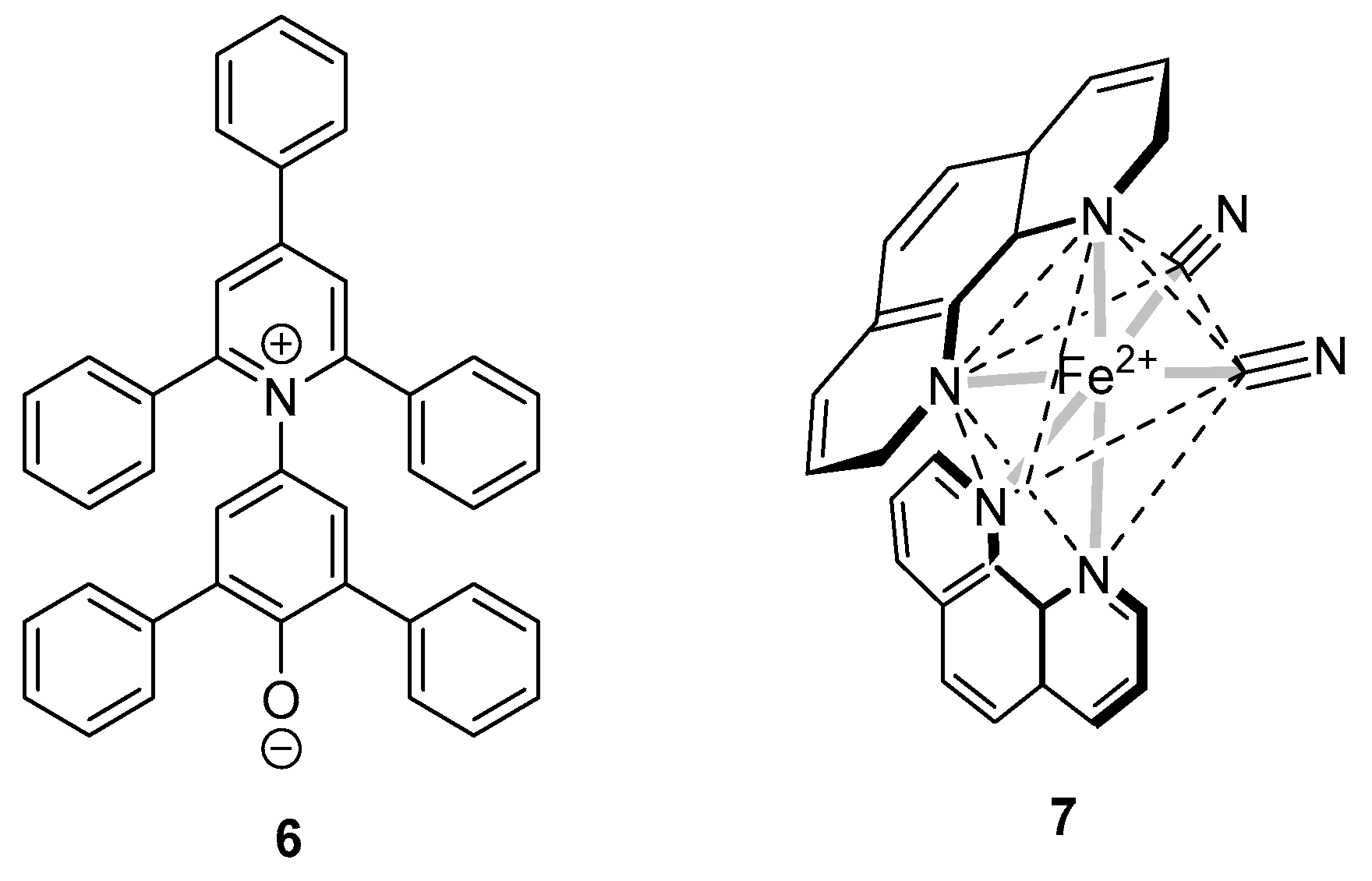
In terms of the polarity characteristics of aqueous urea solutions, apart from the aforementioned drastic increase of permittivity observed when increasing urea concentration, a milder yet sizable increase in the refractive index is also observed (see Table 6). However, using polarity parameter f(x) (see Methods section for details) the increase in dipolarity of aqueous urea as urea’s concentration increases (expressed through function f(ϵ)) is more subtle compared to the observed increase in polarizability expressed through f(n2); see the ESI for details). In turn, Dimroth-Reichardt’s polarity scale decreases upon the increase of urea’s concentration from 63.1 kcal/mol for neat water to 61.2 kcal/mol at a urea concentration of 500 mg/g (approx 9.5 M; see Table 6 for more data and the ESI for corresponding plots). The fact that ET(30) is a measure of Lewis acidity and dipolarity/polarizability of the medium the above-described observations on f(ϵ), f(n2), and ET(30) indicate a significant decrease of Lewis acidity with the increase in urea concentration. Additionally, another solvatochromic compound namely Dicyanobis(1,10-phenanthroline)iron(II) (7) has been shown to be responsive to urea in a concentration-dependent fashionxxix however of low sensitivity (vide infra). The observed response of 7 was recorded as a hypsochromic effect in its vis-spectra (specifically the MLCT band) upon increasing urea concentration.xxix
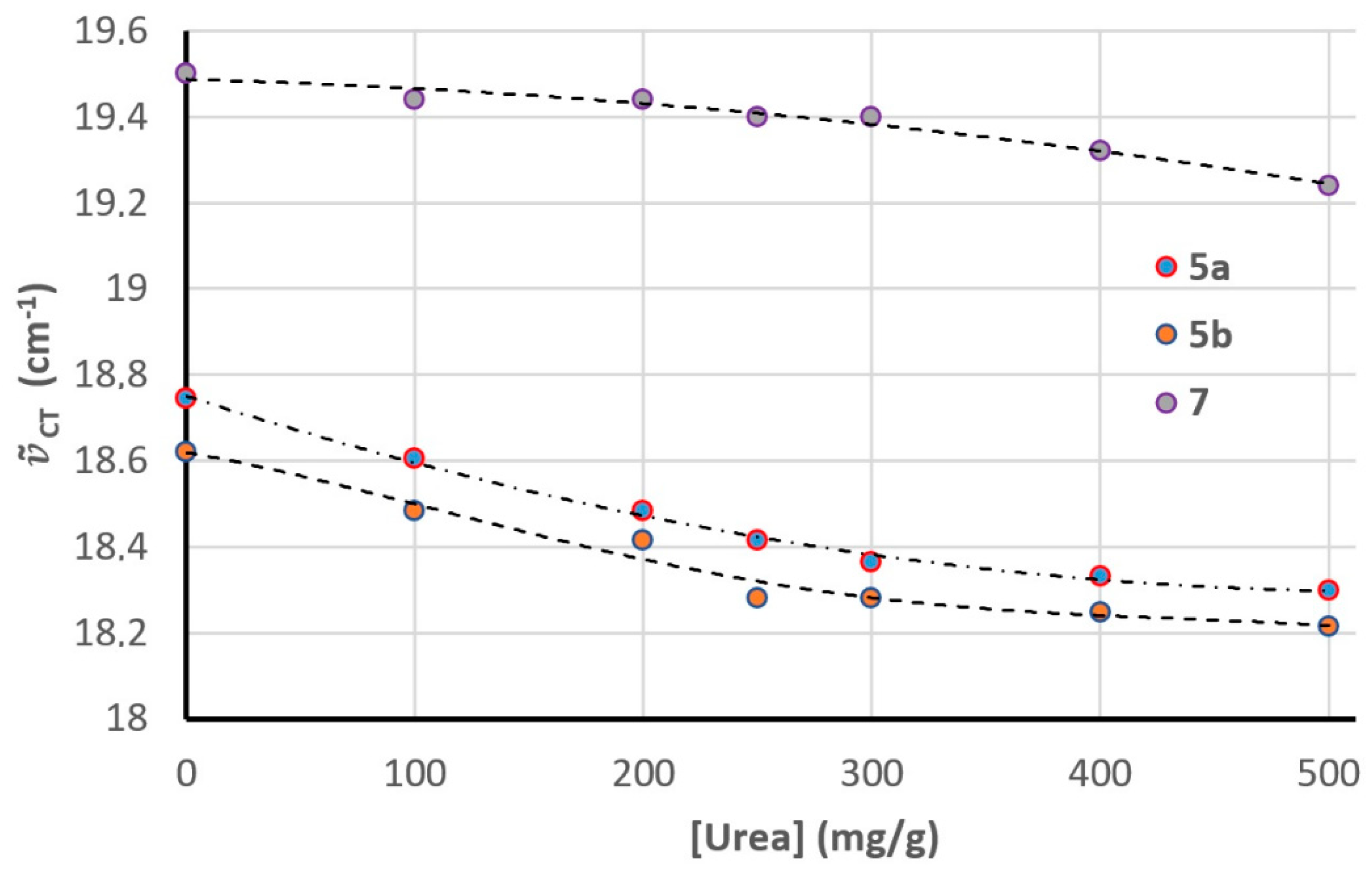
Taking into account these findings on aqueous urea, the present study focuses both on dilute solutions lower than 2M as well as solutions with urea concentration up to approx. 9.5 M. Notably, both compounds exhibited a mild response to polarity changes induced when increasing urea’s concentration (average 47.5 cm-1/M for 5a and 35.9 cm-1/M for 5b; see Table 7 and Figure 3 and 4B). Taking into account the positive solvatochromic response of 5a and 5b to the increase of f(ϵ) or f(n2) i.e. bathochromism upon the increase of dipolarity/polarizability the question that arises is “Is there an inversion of solvatochromism when moving from molecular solvents to aqueous urea?”.

An Inverted Solvatochromic Effect or a Pronounced Specific Effect?

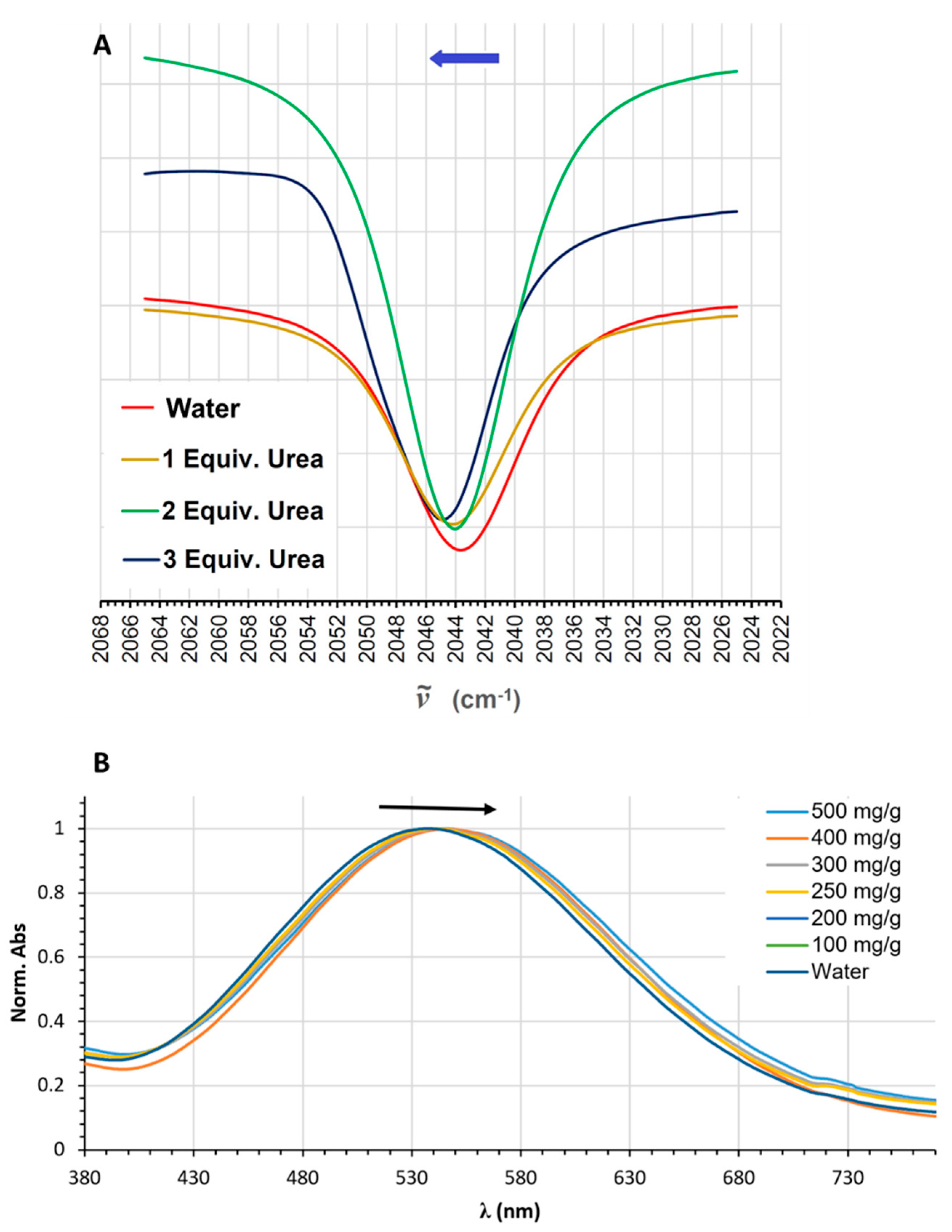
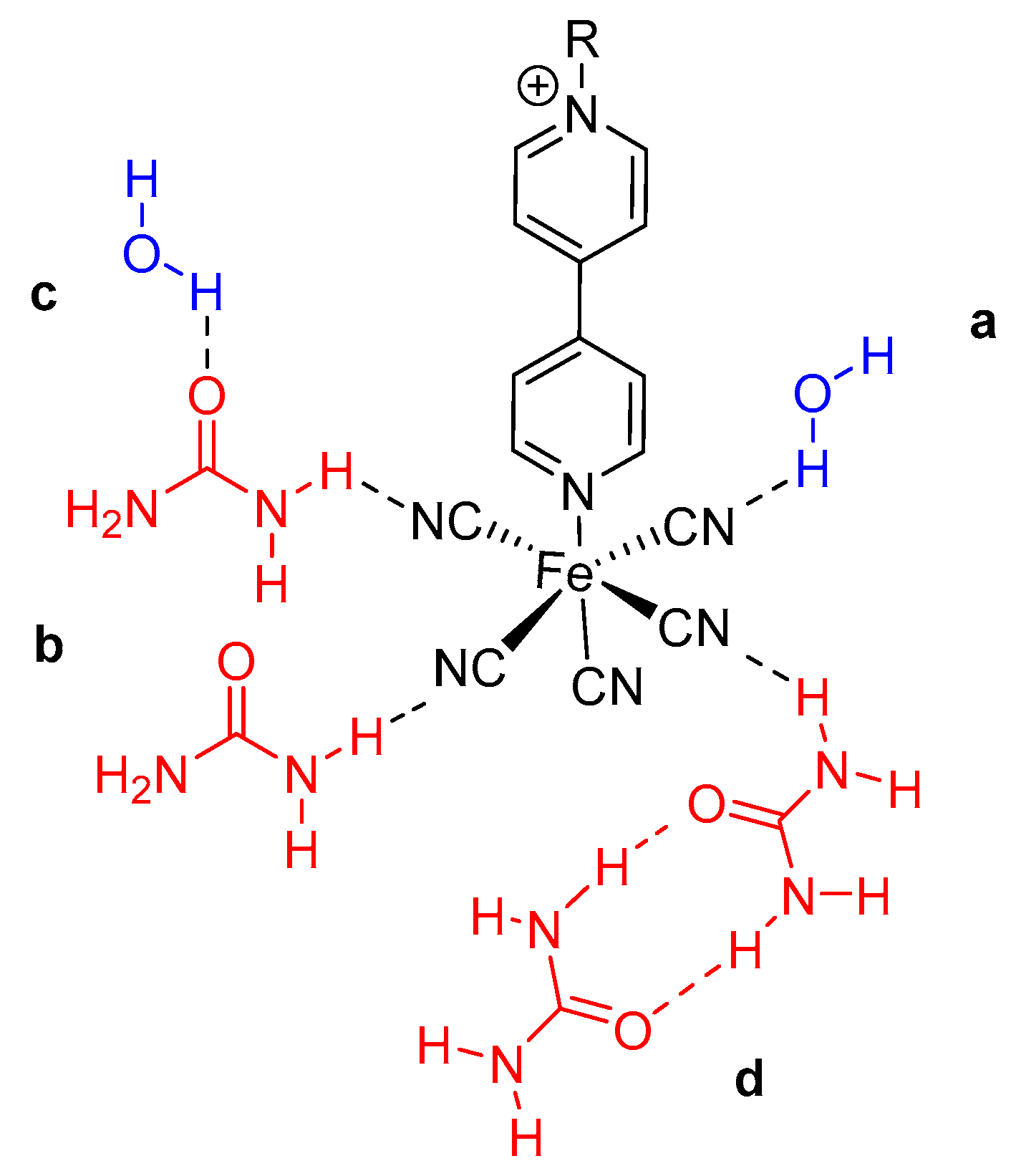
Answering this question is not trivial since it is not clear which type of interactions dominate at different urea concentrations. The author herein attempts an FTIR study (see experimental details) to complement this analysis. Through this study, small shifts and slight broadening of the C≡N stretching bands of 5ab were observed when varying urea concentration from 0 to 9.48 M. The shift in reference to water solution was as anticipated more obvious yet a clear shift was observed while increasing the concentration of urea in the aqueous phase (see Fig. 4A). The results for both 5a and 5b were very similar. Small but noticeable shifts in the C≡N stretching band of both compounds were observed while increasing the concentration of urea solutions. This effect is associated with the development of hydrogen bond interactions between an HBD molecule and the CN groups of a cyanoferrate. The aforementioned H-bonding interaction can cause a shift in the vibrational frequency of the CN stretching mode. This shift can be observed as a blue shift in the infrared or Raman spectra and as anticipated, the extent of this shift depends on the strength of the hydrogen bond and the nature of the hydrogen bond donor and acceptor.[56] In the case of 5ab, it was observed that, regardless of the concentration increase, no further shift of the C≡N stretching bands was detected when there was an excess of urea. Once complete hydrogen bonding between the CN-groups of 5ab and urea is achieved, any further changes in the dielectric properties of the solution have no significant effect on the C≡N stretching bands of the pentacyanoferrates. However, understanding how urea, water, and their complexes can hydrogen bond to pentacyanoferrates is not straightforward and is beyond the scope of this study. Potential H-bonding motifs are proposed in Figure 5 based on the background analysis (vide supra).
Setting a Suitable Equation Describing Aqueous Urea Polarity Sensing
A good way to represent the observed aqueous urea polarity sensing mathematically is through an equation involving parameters expressing key medium polarity properties. Unfortunately, there are no theoretical properties describing the acidity of such solutions, in contrast to dipolarity and polarizability.[57] In light of this, a hybrid equation involving the empirical ET(30) parameter by Reichardt and the functions f(ϵ) and f(n2) is employed (see Equation 10). Equation 10 attempts to represent the MLCT maxima wavenumbers v ~ C T in a very specific manner. It does so by subtracting dipolarity and polarizability from the empirical parameter ET(30) through the functions f(ϵ) and f(n2), thus removing their proportional contribution for the given medium (aqueous urea). The sensitivities m2 and m3 and the intercept m1 are determined through regression using the experimental v ~ C T   data (Table 7) and the corresponding values of ET(30), f(ϵ), and f(n2), at different urea concentrations (see Table 6; also for more details on the methodology see Materials and Methods Section).
Practically, Eq.10 provides v ~ C T as a function of Lewis acidity since the proportion of dipolarity that ET(30) imparts is removed by subtracting the function f(ϵ) - f(n2) expressing dipolarity of the medium.
The results of Eq. 10 for 5a and 5b are included in Table 8.
*r2 corresponds to the regression coefficient of the linear fit: v ~ C T ( e x p ) vs v ~ C T ( c a l ) where cal values correspond to calculated values obtained through Eq. 10 whereas exp values correspond to the experimentally obtained values.
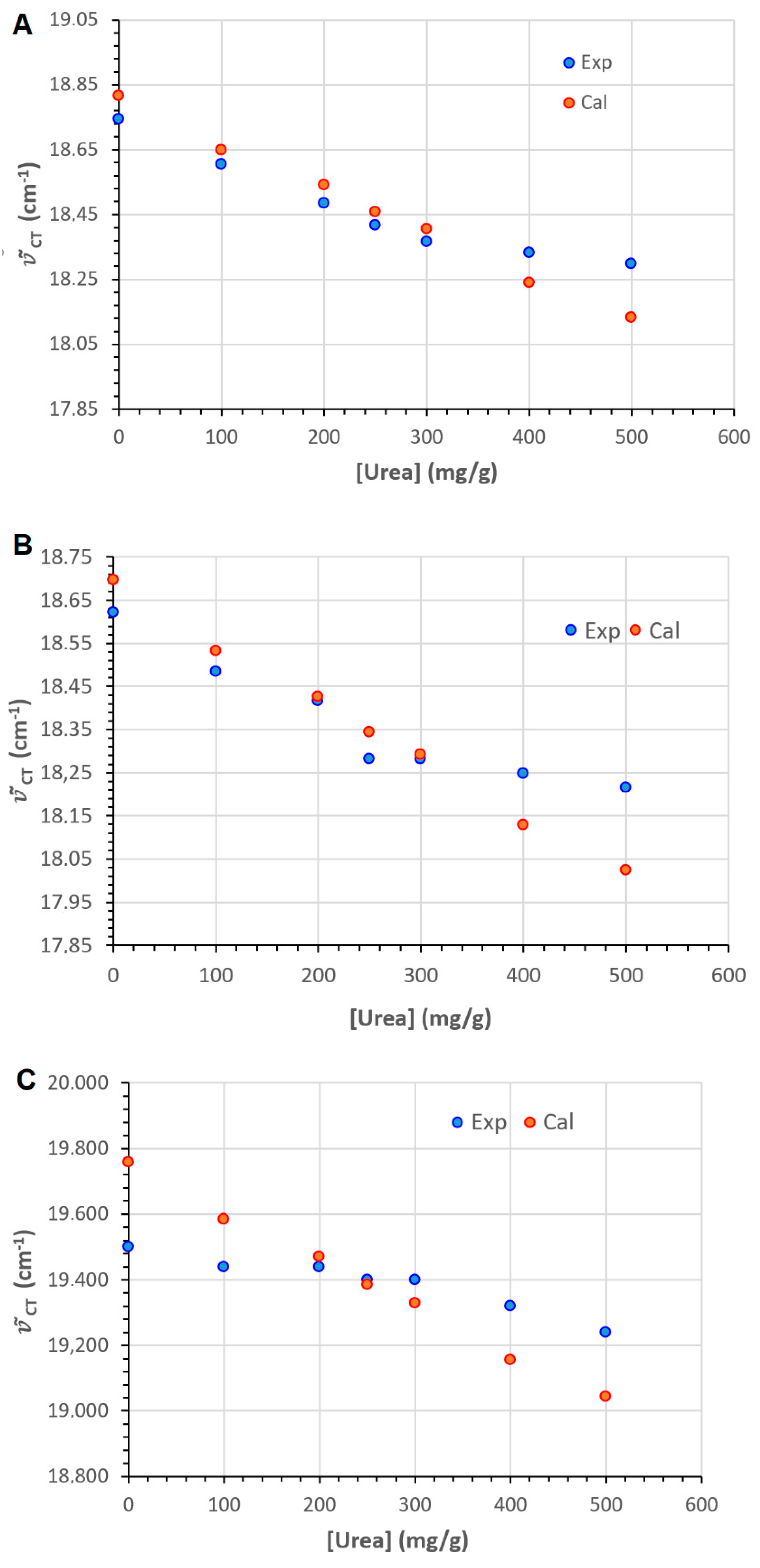
The obtained m 1 , m 2 , and m 3 values provide accurate predictions of the v ~ C T for both compounds as implied by the high regression coefficients of the linear fitting of experimental and calculated v ~ C T values (see Figure 6). The model's prediction of a positive dependency of the v ~ C T on ET(30) aligns with the assumption of a more stabilizing environment for the MLCT excited state of the compounds in aqueous urea when increasing urea concentration. This increase is associated with a decrease in Lewis acidity, as expressed by the ET(30) parameter. Additionally, the relative importance of ET(30) in the observed solvatochromism of both compounds was found to be the highest, around 60% in both cases (see Table 8) being slightly lower in the case of compound 5b. The negative sensitivity of v ~ C T to f(ϵ) - f(n2) observed in both cases (since m 3 was positive in both cases; Table 8 and Eq. 10), along with the very low contribution of dipolarity (expressed via f(ϵ) - f(n2)), suggests that the phenomenon should not be attributed to an inverted solvatochromism. Instead, it potentially indicates the dominance of specific interactions, particularly hydrogen bonding, in the cybotactic region involving compounds 5a and 5b as solutes.
Compound 7 (a dicyanoferrate(II) solvatochromic complex) on the other hand exhibited qualitatively the same behaviour as probes 5a and 5b i.e. a decrease of v ~ C T (hypsochomism) upon increasing urea concentration. Nonetheless, the sensitivity of 7 to the solvent polarity changes that the increase of urea concentration imparts to the medium, was lower than any of the compounds 5a or 5b (6 nm for 7, 13 nm, and 12 nm respectively for 5a and 5b within the range of urea concentration 0 and 9.48 M respectively). This finding underlies their superiority over this renowned solvatochromic compound. Model Eq. 10 was not as successful in describing the solvatochromic effect for 7 as compared to 5a and 5b (see Table 8 and Figure 6 for details).

Conclusions

Two intensely solvatochromic pentacyanoferrate(II) complexes were synthesized and characterized. Their solvatochromism was examined in a set of solvents, including both protic and non-protic solvents, and binary mixtures of molecular solvents. A strong negative solvatochromic effect was observed. Small differences between the two examined compounds were attributed to the structural diversity of the ligands.
Rationalization of the solvatochromic shifts in terms of solute-solvent interactions revealed a strong dependency on Lewis acidity as well as on the dipolarity/polarizability of the medium. This analysis was based on a well-defined set of LSERs, offering complementary information on specific and non-specific solute-solvent effects. Moreover, the dipole moments in the excited and ground states of both compounds were determined using the Suppan-Tsiamis method based on spectral data. It was found that compound 5b exhibits a more polar excited state as well as a larger difference between the excited and ground states than compound 5a. This effect was attributed to the different side-heterocycles, the only differing structural feature between the two compounds.
Additionally, the evaluation of the urea-sensing aptitude in aqueous solutions indicated that both compounds are prone to probe a significant difference in Lewis acidity upon an increase in urea concentration. However, the dipolarity of the medium exhibited a relatively lesser impact on the solvatochromic sensitivity of both compounds. Compared to compound 7, a known solvatochromic probe, compounds 5a and 5b were proved to be more sensitive to changes in urea concentration. The behavior of the two compounds is quantitatively comparable to Reichardt’s solvatochromic betaine 5.

Materials and Methods

Materials

Computations

Linear Solvation Energy Relationships (LSERs)
In the context of the study of correlations of v ~ C T with different solvent polarity parameters the following mono- and multi-parametric LSERs were employed:
v ~ C T = v ~ o + e E T N
v ~ C T = v ~ o + s π * + a α + b β
v ~ C T = v ~ o + s π * + a α
v ~ C T = v ~ o + e E T N + b β
Eq. 1 correlates v ~ C T with the normalized polarity scale by Reichardtxxxix, Eq. 2 is the so-called Kamlet,Taft and Abboud (KAT) equationxliv and Eq. 3its reduced form excluding parameter β .xix
Equation 4 is analogous to Krygowski-Fawcett equation which is often used to quantify and rationalize the effects of solvent polarity on a variety of physicochemical properties and spectroscopic data.xlvi In its original form the model employs Dimroth–Reichardt ET(30) parameter and the Gutmann’s donor numbers DN. In fact, the author has used in the past this equation encompassing normalized parameters (i.e. normalized Reichardt solvent polarity scale and DNN (normalized donor number) yet, here it is employed with parameter β instead of DNN.[58] One of the benefits of using the normalized versions is that both parameters involved are dimensionless and very within the same range i.e. 0 to 1. More details can be found in a recent publication where Equation 4 was utilized to rationalize solvatochromic data in binary solvent mixtures.xiv
All linear correlations (both mono- and multi-parametric) were performed using RStudio (ver: 2024.09.1+394). The calculations included the determination of standard errors for the parameters, as well as the calculation of the residual sum of squares (rss) and the coefficient of determination (r2). The RStudio environment provided the necessary tools and packages to accurately perform these statistical analyses.
Dipole Moment Calculations
For the determination of dipole moments in ground and MLCT excited states of compounds 5a and 5b the model by Suppan and Tsiamisl (Eq. 5) was used. The model is ideal for dyes that are not emissive.
E C T = 1 4 π ε o μ g μ g μ e a 3 φ ϵ φ n 2 + μ e 2 μ g 2 a 3 φ n 2
φ x = 2 ( x 1 ) 2 x + 1
The cavity terms (Van der Waals radii) of both compounds ( a (Å)) were determined using the following procedure: First, the structures were drawn in Chemtool 1.6.15 and then optimized using Molecular Mechanics on Avogadro 1.2.0. The UFF force field was used in both cases. The resulting configurations were further used as input for the determination of the Van der Waals radii using 3V:VossVolume Voxalator, available online. The latter was directly used as the cavity term.
  • Determination of Relative Importance (Contribution) of Each of the Parameters Involved in the LSERS
For the calculation of the relative importance (contribution) of each of the parameters involved in the LSERs and other equations (Eq. 1-4 and 10), the following methodology was employed. A general multiparametric LSER model can be assigned as in the general Equation the quantity Q with the parameters X1,…, Xi,…, Xn, according to Eq. 3 is assumedlix:
Q = Q o + i = 1 n ( x i X i )        
P X i = 100 x i ' i = 1 n x i '  
where
x i ' = x i j = 1 m ( X i j X i ¯ ) j = 1 m ( Q j Q ¯ )
In this equation, Qo is the regression value of the intercept of this linear model, and x1,…, xi,…, xn are the coefficients of the parameters X1,…, Xi,…, Xn, respectively. These coefficients reflect the sensitivity of the quantity Q to the parameters X1,…, Xi,…, Xn. The coefficients x1,…, xi,…, xn are obtained through linear multiparametric regression analysis. (In this work, n=3 for Eq. 2; n=2 for Eqs: 3-4). Furthermore, assuming that we have m series of data, e.g. m different cases of solvents (in the case of this work m= 9 solvents), the relative contribution of each one of the parameters Xi [symbolized as P(Xi)] to the quantity Q, can be calculated through Eq. 8. In Eq. 8, (xi)′ is calculated through Eq. 9, where X i ¯ and Q ¯ are the mean values of the parameter Xi and of the quantity Q, respectively, and finally |xi| is the absolute regression value of xi obtained from the regression analysis.
  • Model Describing Aqueous Urea Solvatochromic Sensing
v ~ C T = m 1 + m 2 E T 30 m 3 f ϵ f n 2
  w i t h   m 1 ,   m 2 , m 3 > 0 and f x = x 1 2 x + 1
from Kirkwood-Bauer-Mataga (KBM) equation.xxxix
Description on method: The R package nloptr (Version 2.1.1) was used to perform the optimization (see Eq. 10). An objective function was constructed to minimize the sum of squared residuals between the observed and predicted values. The function was defined to include the parameters of interest, and initial values for these parameters were set to c(1,1,1). The lower and upper bounds for the parameters were defined as c(0,0,0) and c(∞,∞,∞), respectively in order to ensure that m 1 ,   m 2 , m 3 > 0 . The optimization was performed using the NLOPT_LN_COBYLA algorithm with a relative tolerance of 1×10⁻⁶ . The optimized parameters aa, bb, and cc were extracted from the result object obtained after the optimization process (are listed in Table 8).

Spectroscopic and Analytical Methods

NMR spectra were obtained using a Varian Gemini 300 spectrometer (300 MHz 1H, 75 MHz 13C). Both 1H and 13C NMR spectra were recorded in DMSO-d6 at 25 ± 1 °C. The 1H NMR spectra were calibrated by using residual undeuterated solvent as an internal reference (4.79 ppm) and 13C NMR spectra were calibrated using the DMSO-d6 signal at 39.52 ppm.[59] Abbreviations used for multiplicity in the text: s = single; d = doublet; m = multiplet; arom = aromatic; Ph = phenyl.
Elemental Analyses were performed on a Perkin-Elmer Elemental Analyzer 2400 CHN.
UV-Vis spectra were recorded using a Varian CARY 1E UV–Vis spectrophotometer. Regarding the solvatochromism of compound 4, typically solutions with a concentration of 750 ppm (approx. 1 mM) were prepared right before any measurement, and measured at 25±1°C. Each measurement was repeated three times; therefore, each of the values of CT energies listed in Table 2 and Table 7 correspond to the average of three measurements (standard deviation 0.5 nm).
Fourier-transform infrared spectroscopy: Infrared spectrum were recorded using a Fourier-transform infrared spectrophotometer (Spectrum Two, Perkin-Elmer, Llantrisant, UK) equipped with a Universal Attenuated Total Reflectance diamond. All FTIR spectra were collected at a spectrum resolution of 4 cm−1, with 32 scans from 4000 to 500 cm−1.
Thermogravimetric analysis: Thermograms were made with a Mettler-Toledo TGA2 (Mettler Toledo, Greifensee, Switzerland), under nitrogen with a flow rate of 40 mL min−1, using alumina pans. 5 to 10mg of each sample were put in a standard TGA alumina crucible pan at a heating rate of 10 °C min−1.

Syntheses

General Method for the Synthesis of Products (3a-b)

In a solution of α,α’-dichloro-p-xylene (1) (171 mg, 1 mmol in 5 mL CHCl3), half the stoichiometric amount (0.5 mmol) of the heterocyclic compound (2a-b) is added. The solution is then left to boil under stirring for 10 hours, during which a white precipitate forms. This precipitate is filtered under vacuum and washed with CHCl3 and then with diethyl ether. The solids are dried under vacuum for several hours and stored in a vacuum desiccator in the presence of P2O.

2.-(4-(. chloromethyl)benzyl)isoquinolin-2-ium (3b)

White hygroscopic solid, 118 mg, 78%, mp > 250°C. 1H NMR (300 MHz, D2O): δ = 9.81 (s, 2H: isoq.), 8.56 (d, J = 6.3 Hz, 2H: isoq.), 8.39 (m, 3H, arom.), 8.17 (m, 3H, arom.), 7.98 (t, J = 5.7 Hz, 1H: isoq.), 7.65 (s, 2H: (-CH2)-isoq.), 6.00 (s, 2H: (-CH2)-Cl). 13C NMR (75 MHz, D2O/[D6]DMSO): 150.95, 139.25, 139.02, 136.38, 135.56, 133.13, 131.81, 131.56, 129.31, 128.82, 128.35, 65.35 (-(CH2)-py), 40.09 (-(CH2)-Cl).

Preparation of Products (4a-b)

Dissolve product 3a-b (0.427 mmol) in 5 mL of DMF. Addition of 4,4’-Dipyridine: An excess of 4,4’-dipyridine (135 mg, approximately 0.855 mmol, which is 2 times the amount of 3a-b was added to the solution. The solution was placed in an oil bath at a temperature of 100-110°C for 10 hours. 20 mL of anhydrous acetone was added to the solution, and immediately a white precipitate of product (4a-b) was formed. The solid was filtered with suction and washed several times with ethanol (to remove DMF) and diethyl ether. Finally, the product was dried under vacuum for several hours. Both products (4a-b) are highly hygroscopic and should be stored in a vacuum desiccator with P2O5.

2.-(4-([4,4'-. bipyridin]-1-ium-1-ylmethyl)benzyl)isoquinolin-2-ium: Ligand: Ligand 4b

Off-white hygroscopic powder, 140 mg, 72%, mp>250 oC. 1H NMR (300 MHz, D2O): δ =9.44 (d, J = 6.9 Hz, 2H: C5H4N), 9.36 (d, J = 6.9 Hz, 2H: C5H4N), 8.84 (d, J = 6.6 Hz, 2H: C5H4N), 8.75 (d, J = 7.2 Hz, 2H: C5H4N), 8.63 (d, J = 6.9 Hz, 1H: C5H4N), 8.55 (d, J = 6.9 Hz, 1H: isoq.), 8.42 (d, J = 6.3 Hz, 1H: isoq.), 8.10 (d, J = 6.3 Hz, 2H: isoq.), 7.99 (d, J = 6.9 Hz, 2H: C5H4N), 7.11 (d, J = 7.2 Hz, 4H: Ph), 5.93 (s, 4H, CH2).13C NMR (75 MHz, D2O/[D6]DMSO): 152.32, 149.85, 146.18, 144.89, 144.32, 142.77, 140.17, 131.42, 130.56, 128.92, 128.00, 127.36, 127.21, 126.23, 124.67, 121.39, 62.4 (CH2), 61.9 (CH2).

General Method for the Synthesis of Solvatochromic Products (5a-b)

In an aqueous solution of the heterocyclic ligand (5a-b) (0.450 mmol in 5 mL H2O), add 0.500 mmol (163 mg) of freshly prepared Na3[FeII(CN)5NH3]·3H2O salt. The solution immediately takes on a characteristic violet color (due to complex formation). The solution was stirred in the dark under an inert atmosphere (Ar) at room temperature for 6 hours. Then, add ethanol (EtOH) in a volume six times that of the solution (30 mL) and leave the mixture in the dark at 4°C for 12 hours, during which a colored precipitate forms in all cases. Collect the precipitate by vacuum filtration, and wash it sequentially with cold EtOH and diethyl ether (Et2O) several times. Finally, dry the product under vacuum at a temperature above 40°C.

Solvatochromic Complex 5b

Deep blue solid, 237 mg (0.305 mmol) 68% mp> 300 oC (dec.). 1H NMR (300 MHz, D2O):9.52 (d, J = 6.9 Hz, 2H: C5H4N), 9.42 (d, J = 6.9 Hz, 2H: C5H4N), 8.90 (d, J = 6.9 Hz, 2H: C5H4N), 8.83 (d, J = 6.9 Hz, 2H: C5H4N), 8.69 (d, J = 7.2 Hz, 1H: C5H4N), 8.59 (m, 2H: isoq.), 8.16 (d, J = 6.9 Hz, 2H: isoq.), 8.07 (d, J = 7.2 Hz, 2H: C5H4N), 7.21 (d, J = 9.2 Hz, 4H: Ph), 5.99 (s, 4H, CH2). 13C NMR (75 MHz, D2O/ [D6]DMSO): 172.34 (CΝ), 152.96, 150.15, 146.83, 144.99, 144.82, 143.17, 140.53, 132.02, 130.86, 129.12, 128.66, 127.82, 127.91, 126.79, 124.78, 121.94, 62.69 (CH2), 62.81 (CH2). ΤGA: loss of approx. 6 molecules of H2O.

Nomenclature

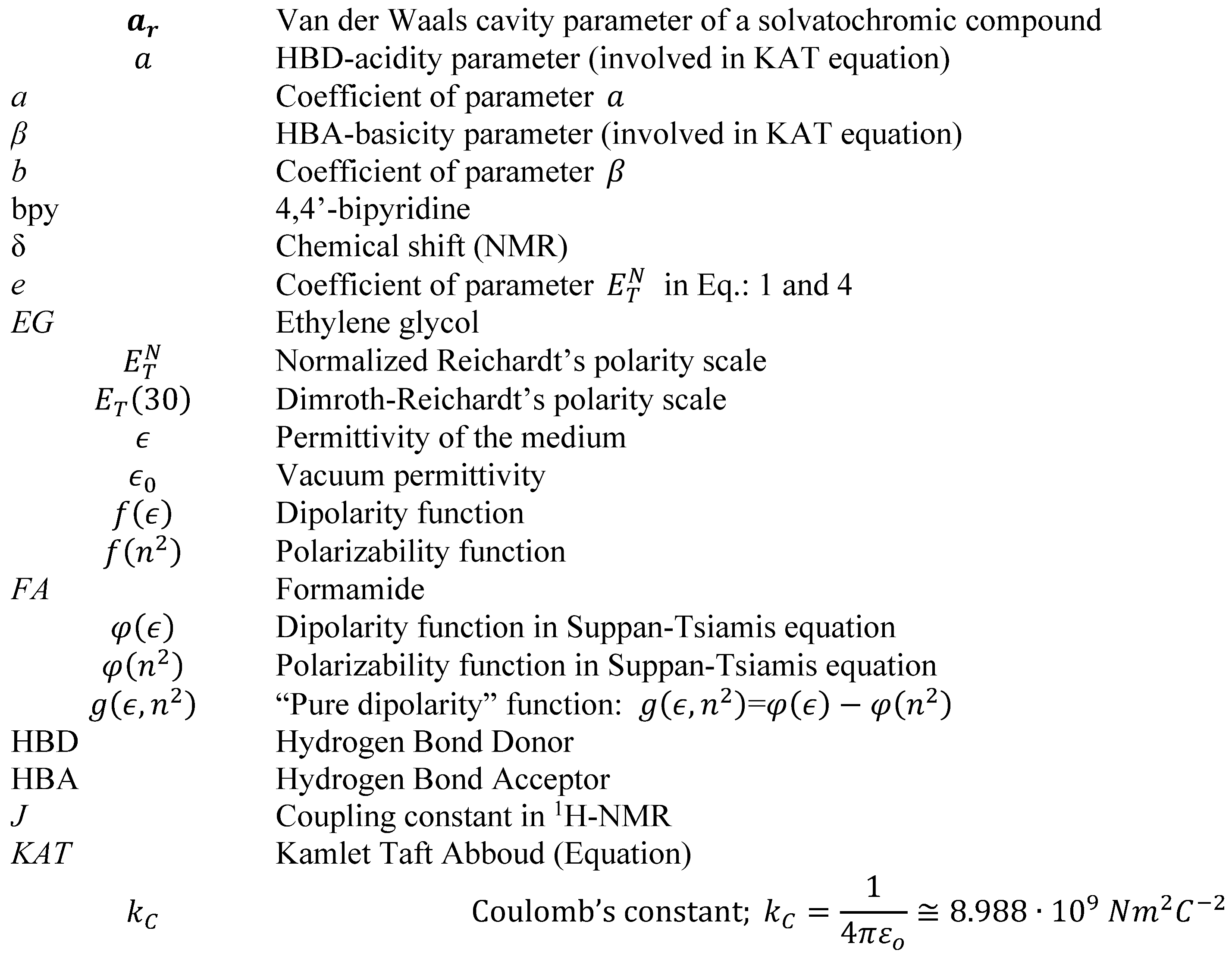
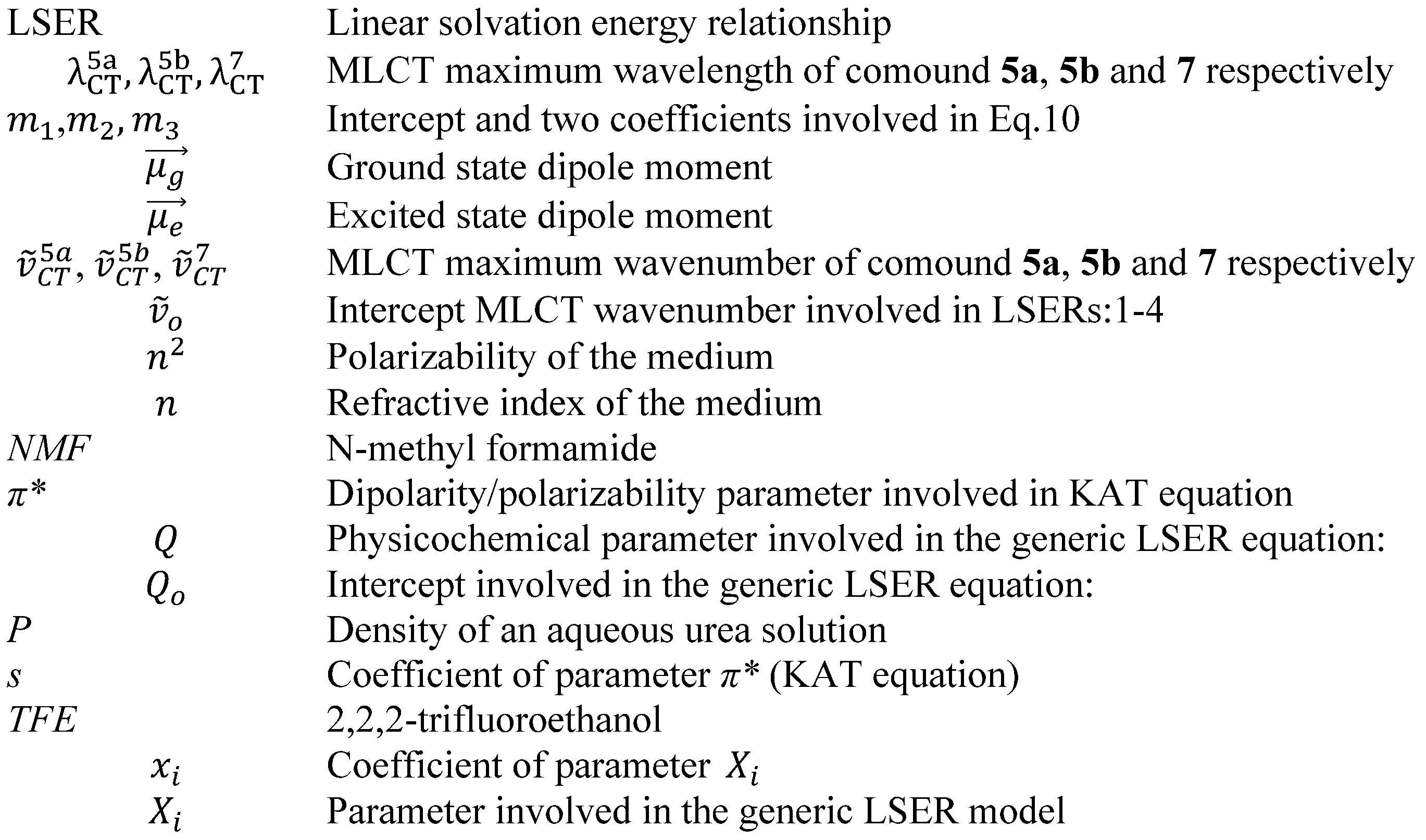
Preprints 150457 i1Preprints 150457 i2

References

  1. [1] Macartney, DH. Properties and reactions of substituted pentacyanoferrate (II) complexes. Rev Inorg Chem 1988;9(2-3):101-152. [CrossRef]
  2. [2]. Pires BM, Galdino FE, Bonacin JA. Electrocatalytic reduction of oxygen by metal coordination polymers produced from pentacyanidoferrate(II) complex. Inorganica Chim Acta. 2017;466:166-173. [CrossRef]
  3. [3]. M. Pires B, Hegner FS, Bonacin JA, Galán-Mascarós JR. Ligand effects of penta- and hexacyanidoferrate-derived water oxidation catalysts on BiVO4 photoanodes. ACS Appl Energy Mater. 2020;3(9):8448-8456. [CrossRef]
  4. [4]. Bratskaya SY, Privar YO, Korjakova OV, Mechaev AV, Pestov AV. Pentacyanoferrate(II) complexes with chitosan. Polym Eng Sci. 2014;54(10):2392-2397. [CrossRef]
  5. [5]. Bratskaya SY, Zheleznov VV, Privar YO, Mechaev AV, Zub YL, Pestov AV. Pentacyanoferrate(II) complexes with N-containing derivatives of chitosan and polyallylamine: Synthesis and cesium uptake properties. Colloids Surf A Physicochem Eng Asp 2014;460:145-150. [CrossRef]
  6. [6]. Zakaria MB, Chikyow T. Recent advances in Prussian blue and Prussian blue analogues: synthesis and thermal treatments. Coord Chem Rev. 2017;352:328-345. [CrossRef]
  7. [7]. Carvalho EM, de Freitas Paulo T, Saquet AS, et al. Pentacyanoferrate(II) complex of pyridine-4- and pyrazine-2-hydroxamic acid as source of HNO: investigation of anti-tubercular and vasodilation activities. J Biol Inorg Chem 2020;25(6):887-901. [CrossRef]
  8. [8]. Toma HE, Malin JM. Properties and reactivity of some pentacyanoferrate(II) complexes of aromatic nitrogen heterocycles. Inorg Chem, 1973;12(5):1039-1045. [CrossRef]
  9. [9]. Naik RM, Kumar B. The palladium(ii)-catalysed ligand exchange between hexacyanoferrate(ii) and 4-Cyanopyridine in aqueous acidic medium. Prog React Kinet Mech 2012;37(2):147-160. [CrossRef]
  10. [10]. Gou S, Renz F, Fukuda Y, Linert W. Cyano-bridged dinuclear iron complexes in different oxidation states. Inorganica Chim Acta. 1999;287(1):95-100. [CrossRef]
  11. [11]. Coe BJ, Foxon SP, Harper EC, et al. Nonlinear optical and related properties of iron(II) pentacyanide complexes with quaternary nitrogen electron acceptor units. Inorg Chem, 2009;48(4):1370-1379. [CrossRef]
  12. [12]. Papadakis R. Mono- and Di-quaternized 4,4’-bipyridine derivatives as key building blocks for medium- and environment-responsive compounds and materials. Molecules 2019;25(1):1. [CrossRef]
  13. [13]. Papadakis R. Preferential solvation of a highly medium responsive pentacyanoferrate(II) complex in binary solvent mixtures: Understanding the role of dielectric enrichment and the specificity of solute–solvent interactions. J Phys Chem B, 2016;120(35):9422-9433. [CrossRef]
  14. [14]. Papadakis R. Solute-centric versus indicator-centric solvent polarity parameters in binary solvent mixtures. Determining the contribution of local solvent basicity to the solvatochromism of a pentacyanoferrate(II) dye. J Mol Liq 2017;241:211-221. [CrossRef]
  15. [15]. Papadakis R, Deligkiozi I, Nowak KE. Study of the preferential solvation effects in binary solvent mixtures with the use of intensely solvatochromic azobenzene involving [2]rotaxane solutes. J Mol Liq. 2019;274:715-723. [CrossRef]
  16. [16]. Papadakis R, Deligkiozi I, Giorgi M, Faure B, Tsolomitis A. Supramolecular complexes involving non-symmetric viologen cations and hexacyanoferrate(II) anions. A spectroscopic, crystallographic and computational study. RSC Adv. 2016;6(1):575-585. [CrossRef]
  17. [17]. Deligkiozi I, Papadakis R. Probing solvation effects in binary solvent mixtures with the use of solvatochromic dyes. In: Dyes and Pigments - Novel Applications and Waste Treatment. IntechOpen; 2021. [CrossRef]
  18. [18]. Papadakis R. The solvatochromic behavior and degree of ionicity of a synthesized pentacyano (N-substituted-4,4′-bipyridinium) ferrate(II) complex in different media. Tuning the solvatochromic intensity in aqueous glucose solutions. Chem Phys 2014;430:29-39. [CrossRef]
  19. [19]. Papadakis R, Tsolomitis A. Solvatochromism and preferential solvation of 4-pentacyanoferrate 4′-aryl substituted bipyridinium complexes in binary mixtures of hydroxylic and non-hydroxylic solvents. J Solution Chem 2011;40(6):1108-1125, 1108. [CrossRef]
  20. [20]. Papadakis R, Tsolomitis A. Study of the correlations of the MLCT Vis absorption maxima of 4-pentacyanoferrate- 4′-arylsubstituted bispyridinium complexes with the Hammett substituent parameters and the solvent polarity parameters E and AN. J Phys Org Chem 2009;22(5):515-521. [CrossRef]
  21. [21]. Foretić B, Klaser T, Ovčar J, et al. The reversible electron transfer within stimuli-responsive hydrochromic supramolecular material containing pyridinium oxime and hexacyanoferrate (II) ions. Molecules. 2024;29(23). [CrossRef]
  22. [22]. Tanaka R, Okazawa A, Konaka H, Sasaki A, Kojima N, Matsushita N. Unique hydration/dehydration-induced vapochromic behavior of a charge-transfer salt comprising viologen and hexacyanidoferrate(II). Inorg Chem, 2018;57(4):2209-2217. [CrossRef]
  23. [23]. Abouelwafa AS, Mereacre V, Balaban TS, Anson CE, Powell AK. Photo- and thermally-enhanced charge separation in supramolecular viologen–hexacyanoferrate complexes. CrystEngComm 2010;12(1):94-99. [CrossRef]
  24. [24]. Deligkiozi I, Voyiatzis E, Tsolomitis A, Papadakis R. Synthesis and characterization of new azobenzene-containing bis pentacyanoferrate(II) stoppered push–pull [2]rotaxanes, with α- and β-cyclodextrin. Towards highly medium responsive dyes. Dyes Pigm 2015;113:709-722. [CrossRef]
  25. [25]. Li MH, You MH, Lin MJ. Photochromism- and photoluminescence-tunable heterobimetallic supramolecular hybrid isomers. Cryst Growth Des. 2021;21(5):2856-2867. [CrossRef]
  26. [26]. Parra-Alfambra AM, Casero E, Ruiz MA, Vázquez L, Pariente F, Lorenzo E. Carbon nanotubes/pentacyaneferrate-modified chitosan nanocomposites platforms for reagentless glucose biosensing. Anal Bioanal Chem 2011;401(3):883-889. [CrossRef]
  27. [27]. Filho UPR, Gushikem Y, Fujiwara FY, Stadler E, Drago V. Pentacyanoferrates(II) on the surface of organomodified silica gel: The matrix effect. Struct Chem 1994;5(2):129-133. [CrossRef]
  28. [28]. Li J, Robison T. Application of linear solvation energy relationships to guide selection of polar modifiers in normal-phase liquid chromatographic separations. Anal Chim Acta 1999;395(1-2):85-99. [CrossRef]
  29. [29]. Spange S, Keutel D. Untersuchungen zur Polarität wäßriger Harnstoff- und Zucker-Lösungen mit der Methode der vergleichenden Solvatochromie. Liebigs Ann Chem, 1993 ;1993(9):981-985. [CrossRef]
  30. [30]. Wibowo ES, Park BD, Causin V. Recent advances in urea–formaldehyde resins: Converting crystalline thermosetting polymers back to amorphous ones. Polym Rev (Phila Pa)2022;62(4):722-756. [CrossRef]
  31. [31]. Dorieh A, Selakjani PP, Shahavi MH, et al. Recent developments in the performance of micro/nanoparticle-modified urea-formaldehyde resins used as wood-based composite binders: A review. Int J Adhes Adhes, 2022;114(103106):103106. [CrossRef]
  32. [32]. Tomita B, Hse CY. Phenol–urea–formaldehyde (PUF) co-condensed wood adhesives. Int J Adhes Adhes 1998;18(2):69-79. [CrossRef]
  33. [33]. Laskowska A. Characteristics of the pressing process and density profile of MUPF-bonded particleboards produced from waste plywood. Materials (Basel). 2024;17(4):850. [CrossRef]
  34. [34]. Zhang Q, Yang C, Zhuo H, Lu W, Lu W. Study on the effect of urea-formaldehyde adhesive on the properties and microscopic characteristics of UF solidified foam. Constr Build Mater. 2024;450(138704):138704. [CrossRef]
  35. [35]. Yang H, Wang H, Du G, et al. Ureido hyperbranched polymer modified urea-formaldehyde resin as high-performance particleboard adhesive. Materials (Basel). 2023;16(11). [CrossRef]
  36. [36]. Zhang W, Wang C, Fang M, et al. Highly effective flame-retardant coatings consisting of urea-formaldehyde resin/aluminium hydroxide/boric acid for polystyrene foam: Properties and mechanisms investigation. Prog Org Coat, 2024;196(108766):108766. [CrossRef]
  37. [37]. Zotiadis C, Patrikalos I, Loukaidou V, Korres DM, Karantonis A, Vouyiouka S. Self-healing coatings based on poly(urea-formaldehyde) microcapsules: In situ polymerization, capsule properties and application. Prog Org Coat. 2021;161(106475):106475. [CrossRef]
  38. [38]. Xu Y, Zhang Q, Lei H, et al. A formaldehyde-free amino resin alternative to urea-formaldehyde adhesives: A bio-based oxidized glucose – urea resin. Ind Crops Prod. 2024;218(119037):119037. [CrossRef]
  39. [39]. Reichardt, C. [39]. Reichardt, C., & Welton, T. (2010). Solvents and Solvent Effects in Organic Chemistry. Wiley-VCH Verlag GmbH & Co. KGaA.
  40. [40]. D.R. Lide (Ed.), Handbook of Chemistry and Physics, 76th ed., CRC Press, Boca Raton, 1995.
  41. [41]. S. Budavari, The Merck Index, 11th ed., Merck and Co, Rahway, NJ, 1989.
  42. [42]. Coe BJ, Harries JL, Helliwell M, et al. Pentacyanoiron(II) as an electron donor group for nonlinear optics: medium-responsive properties and comparisons with related pentaammineruthenium(II) complexes. J Am Chem Soc. 2006;128(37):12192-12204. [CrossRef]
  43. [43]. Janjua, N. K. [43]. Janjua, N. K., Qureshi, R., Ahmed, S., Khan, A. Y., Muhammad, M., Subhani, M. S., & Iqbal, R. (2009). Solvent-oriented 1H NMR chemical shifts of pyridinium iodide and application of Buckingham equation. Journal of Molecular Structure, 919(1-3), 321-324. [CrossRef]
  44. [44]. Kamlet, M.J. Kamlet, M.J., Abboud, J.M., Taft, R.W.: An examination of linear solvation energy relationships. Prog. Phys. Org. Chem. 13, 485 (1981). [CrossRef]
  45. The properties of organic liquids that are relevant to their use as solvating solvents. Chemical Society Reviews. 22(6), 409–416. [CrossRef]
  46. [46]. Krygowski, T. M. [46]. Krygowski, T. M., & Fawcett, W. R. (1975). Complementary Lewis acid-base description of solvent effects. I. Ion-ion and ion-dipole interactions. Journal of the American Chemical Society, 97(8), 2143–2148. [CrossRef]
  47. [47]. Mulla, B. B. A. [47]. Mulla, B. B. A., Nesaragi, A. R., M, M. P. K., Kamble, R. R., & Sidarai, A. H. (2024). Exploration of coumarin derivative: Experimental and computational modeling for dipole moment estimation and thermal sensing application. Journal of Fluorescence, 34(4), 1719–1735. [CrossRef]
  48. Gsänger, M., Bialas, D., Huang, L., Stolte, M., & Würthner, F. (2016). Organic Semiconductors based on Dyes and Color Pigments. Advanced Materials (Deerfield Beach, Fla.), 28(19), 3615–3645. ( 28(19), 3615–3645. [CrossRef]
  49. [49]. Carsten, B. [49]. Carsten, B., Szarko, J. M., Son, H. J., Wang, W., Lu, L., He, F., et. al. (2011). Examining the effect of the dipole moment on charge separation in donor-acceptor polymers for organic photovoltaic applications. Journal of the American Chemical Society, 133(50), 20468–20475. [CrossRef]
  50. [50]. Suppan, P. [50]. Suppan, P., & Tsiamis, C. (1980). Absolute excited state dipole moments from solvatochromic shifts. Spectrochimica Acta. Part A: Molecular Spectroscopy, 36(11), 971–974. [CrossRef]
  51. [51]. C. Párkányi, Theoretical Organic Chemistry, vol. 5, Elsevier, Amsterdam, 1998, p. 248.
  52. [52]. Hayashi Y, Katsumoto Y, Omori S, Kishii N, Yasuda A. Liquid structure of the urea-water system studied by dielectric spectroscopy. J Phys Chem B. 2007;111(5):1076-1080. [CrossRef]
  53. [53]. Bandyopadhyay, D. [53]. Bandyopadhyay, D., Mohan, S., & Ghosh, S. K. (2014). Molecular Dynamics Simulation of Aqueous Urea Solution: Is Urea a Structure Breaker? The Journal of Physical Chemistry B, 118(40), 11579-11589. [CrossRef]
  54. Rezus, Y. L. A., & Bakker, H. J. (2006). Effect of urea on the structural dynamics of water. Proceedings of the National Academy of Sciences. J. ( 103(49), 18417–18420. [CrossRef]
  55. [55]. Soper, A. K. [55]. Soper, A. K., Castner, E. W. Jr., & Luzar, A. (2003). Impact of urea on water structure: a clue to its properties as a denaturant?. Biophysical Chemistry, 105(2–3), 649-666. [CrossRef]
  56. Warren, J. R., Gordon, J. A. (1951). On the Refractive Indices of Aqueous Solutions of Urea. Journal of Chemical Education, 28(6), 291-293. [CrossRef]
  57. Marcus, Y. (1998). The Properties of Solvents. Wiley.
  58. Papadakis, R. , Deligkiozi, I., & Tsolomitis, A. (2010). Spectroscopic investigation of the solvatochromic behavior of a new synthesized non symmetric viologen dye: study of the solvent-solute interactions. Analytical and Bioanalytical Chemistry, 397(6), 2253–2259. [CrossRef]
  59. Gottlieb, H. E. (1997). NMR Chemical Shifts of Common Laboratory Solvents as Trace Impurities. Journal of Organic Chemistry, 62(21), 7512-7515. [CrossRef]
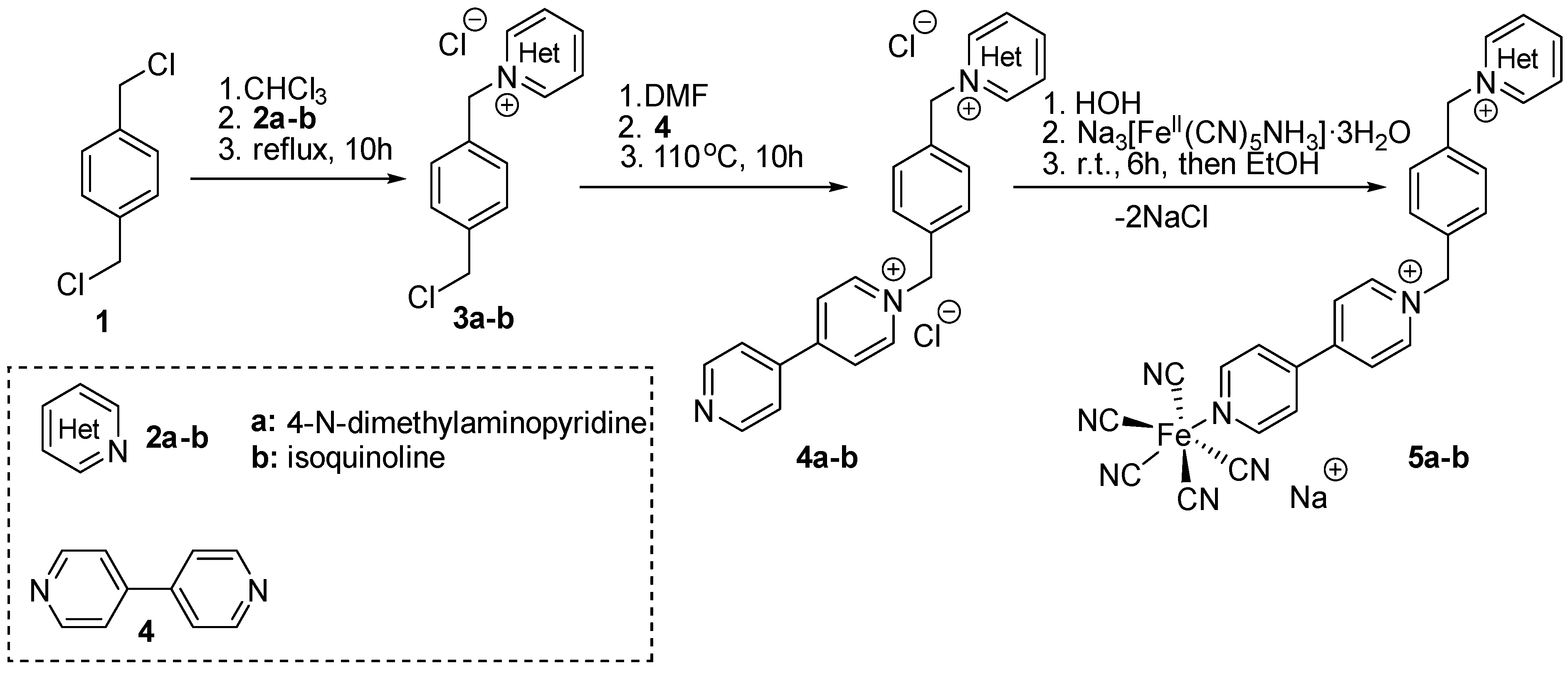
Scheme 1. Synthetic route to solvatochromic products 5a-b.
Preprints 150457 sch001
Scheme 2. A) Illustration of the F e I I ( d p ) π * ( b p y ) transition observed in complexes lige 5a-b and comparison of the energy gaps in two solvents of different polarity. B) Scheme depicting the “solvatochromic backbone” of compounds 5ab and the photoinduced MLCT transition and how the structure is influenced.
Preprints 150457 sch002
Figure 1. Normalized vis absorption spectra of compound 5b (MLCT band) in different solvents.
Preprints 150457 g001
Figure 2. Bar graphs depicting the relative importance of the polarity parameters involved in Equations 2 (A), 3 (B) and 4 (C).
Preprints 150457 g002
Scheme 3. Illustrations representing the interactions of compounds 5a and 5b with solvent molecules (dipoles) in ground and excited state after reorientation (Sol: corresponds to solvent).
Preprints 150457 sch003
Figure 3. Plots of measured v ~ C T of solvatochromic compounds 5a, 5b and 7 against urea concentration Lines in all cases are polynomial fits added for visualization purposes.
Preprints 150457 g003
Figure 4. (A) Partial FTIR spectra of 5a (C≡N stretching band) in water and in the presence of 1 (0.5 M), 2 (1 M), and 3 (1.5 M) equivalents of urea (at a constant 5a concentration of 0.5 M). The arrow indicates the slight blue shift of the band with increasing urea equivalents. (B) Partial normalized UV-Vis spectra of 5a in water at varying urea concentrations (0 to 9.48 M). .
Preprints 150457 g004
Figure 5. Plausible H-bonding motifs encountered in aqueous urea solutions of to 5a and 5b with low to intermediate urea concentration (< 5 M) (a: water molecule; b: urea molecule; c: a water-urea dimer; d: a urea dimer) R: substituent representing the remaining, non-displayed part of 5a/5b.
Preprints 150457 g005
Figure 6. Experimental and calculated through Eq. 10 v ~ C T values for solvatochromic compounds A) 5a, B) 5b and C) 7.
Preprints 150457 g006
Figure 7. Reference solvatochromic compounds.
Preprints 150457 g007
Table 1. Solvents and solvent mixtures used for the study of solvatochromism of 5a and 5b and corresponding solvent polarity parameters and functions.♠.
Solvent α[[39]] β[xxxix] π*[xxxix] ET30[xxxix] (kcal/mol) E T N ϵ [[40]] n [[41]] φ ( ϵ ) φ ( n 2 )
HOH 1.17 0.47 1.09 63.1 1.000 78.5 1.3325 0.9810 0.3408
TFE 1.51 0.00 0.73 59.8 0.898 26.7 1.2907 0.9449 0.3074
Glycerol 1.14 0.87 0.92 57.0 0.812 42.5 1.4746 0.9651 0.4391
EtOH50% 1.10 0.54 0.96 56.5 0.796 38.1 1.3617 0.9611 0.3628
EG 0.90 0.52 0.92 56.3 0.790 41.4 1.4318 0.9642 0.4118
FA 0.71 0.48 0.97 55.8 0.775 109.5 1.4475 0.9864 0.4220
MeOH 0.98 0.66 0.60 55.4 0.762 33.8 1.3264 0.9563 0.3361
AcMe50% 0.96 0.47 1.00 54.9 0.747 30.0 1.3583 0.9508 0.3603
NMF 0.62 0.80 0.90 54.1 0.722 182.4 1.4319 0.9918 0.4118
Solvents are displayed in decreasing ET(30) mode (top to bottom). †Calculated through equation 6 with x= ϵ   for φ ( ϵ ) and x= n 2 for φ ( n 2 ) . ‡ Determined through the interpolation method described in [xxiv]. Normalized Reichardt’s solvent polarity scalexxxix.
Table 3. Results of application of LSERs 1-4 to the spectrally determined MLCT energiesECT of 5a and 5b.
Solvent Parameter/Correlation coefficient
Compound/Equation # E T N π* A β
v ~ o (103.cm-1) e(103.cm-1) s(103.cm-1) a(103.cm-1) b(103.cm-1) r2 rse
5a/1 8.119 ± 2.064 10.54 ± 2.531 - - - 0.712 0.618
5a/2 9.547 ± 1.636 - 5.486 ± 1.151 9.547 ± 1.636 -0.730 ± 0.839 0.881 0.470
5a/3 8.733 ± 1.314 - 5.487 ± 1.127 2.972 ± 0.630 - 0.864 0.460
5a/4 8.594 ± 2.833 10.14 ± 3.090 - - -0.288 ± 1.072 0.716 0.664
5b/1 8.121 ± 2.525 10.39 ± 3.096 - - - 0.617 0.756
5b/2 9.052 ± 1.971 - 5.958 ± 1.387 2.509 ± 0.968 -0.731 ± 1.012 0.847 0.566
5b/3 8.238 ± 1.551 - 5.959 ± 1.330 2.928 ± 0.743 - 0.831 0.543
5b/4 8.513 ± 3.477 10.06 ± 3.792 - - -0.238 ± 1.315 0.619 0.815
Table 4. Relative Importance of paeameters E T N , π * , α ,   and β in LSERs 2,3, and 4 for compounds 5a and 5b.
Compound/Equation #
R E T N
R π *
R α
R β
5a/2 - 0.52 0.34 0.14
5a/3 - 0.52 0.48 -
5a/4 0.85 - - 0.15
5b/2 - 0.58 0.29 0.13
5b/3 - 0.58 0.42 -
5b/4 0.86 - - 0.14
Table 5. Results of application of Suppan-Tsiamis model in 5a and 5b.
a r (Å) k c * μ g μ g μ e a r 3 ( J ) k C μ e 2 μ g 2 a r 3 ( J ) μ g (D) μ e ( D ) r2 r s e
5a 5.01 4.408 10 19   ± 7.106 10 20       1.869 10 19   ± 1.107 10 19 15.1 21.5 0.997 2.168 10 20
5b 5.03           4.263 10 19   ± 7.538 10 20       2.044 10 19   ± 1.174 10 19 14.8 21.9 0.996 2.299 10 20
. rse: residual standard error (see details in materials and methods section).
Table 6. Physicochemical and polarity properties of the studied aqueous urea solutions.
Urea Conc. (mg/g) ρ (g/L)lii [Urea] (mol/L) ET(30)xxix(kcal/mol) v ~ C T 7 xxix ( 10 3 c m 1 ) ϵ lii n f ( ϵ ) f ( n 2 )
0 998.68 0.00 63.1 19.50 78.48 1.3310 0.4905 0.1706
100 1023.4 1.70 62.5 19.44 83.74 1.3472 0.4911 0.1760
200 1049.7 3.50 62.1 19.44 87.76 1.3621 0.4915 0.1816
250 1063.5 4.43 61.8 19.40 90.10 1.3698 0.4917 0.1844
300 1077.7 5.38 61.6 19.40 92.48 1.3778 0.4919 0.1873
400 1107.2 7.37 61.4 19.32 96.45 1.3943 0.4923 0.1931
500 1138.3 9.48 61.2 19.24 102.1 1.4118 0.4927 0.1992
General Polarity function: f x = x 1 2 x + 1 .
Table 7. Solvatochromic shifts observed in aqueous urea of compounds 5a and 5b.
Urea Concentration (mg/g) λ C T 5 a (nm) v ~ C T 5 a   ( 10 3 c m 1 ) λ C T 5 b (nm) v ~ C T 5 b
( 10 3 c m 1 )
0 533.5 18.744 537.0 18.622
100 537.5 18.605 541.0 18.484
200 541.0 18.484 543.0 18.416
250 543.0 18.416 547.0 18.282
300 544.5 18.365 547.0 18.282
400 545.5 18.332 548.0 18.248
500 546.5 18.298 549.0 18.215
Table 8. Results of application of the model Equation 10 in 5a and 5b.
v ~ C T = m 1 + m 2 E T 30 m 3 f ϵ f n 2
m 1 (cm-1) m 2 (cm-1.mol.kcal-1) m 3 (cm-1) *r2 %RET(30) %Rf(ϵ) -f(n2)
5a 0.988 0.291 1.750 0.849 63 37
5b 1.168 0.286 1.621 0.898 59 41
7 1.182 0.302 1.580 0.556 11 88
Disclaimer/Publisher’s Note: The statements, opinions and data contained in all publications are solely those of the individual author(s) and contributor(s) and not of MDPI and/or the editor(s). MDPI and/or the editor(s) disclaim responsibility for any injury to people or property resulting from any ideas, methods, instructions or products referred to in the content.
Copyright: This open access article is published under a Creative Commons CC BY 4.0 license, which permit the free download, distribution, and reuse, provided that the author and preprint are cited in any reuse.
Prerpints.org logo

Preprints.org is a free preprint server supported by MDPI in Basel, Switzerland.

Subscribe

Disclaimer

Terms of Use

Privacy Policy

Privacy Settings

© 2025 MDPI (Basel, Switzerland) unless otherwise stated