

Submitted:
22 February 2025
Posted:
24 February 2025
You are already at the latest version
Abstract
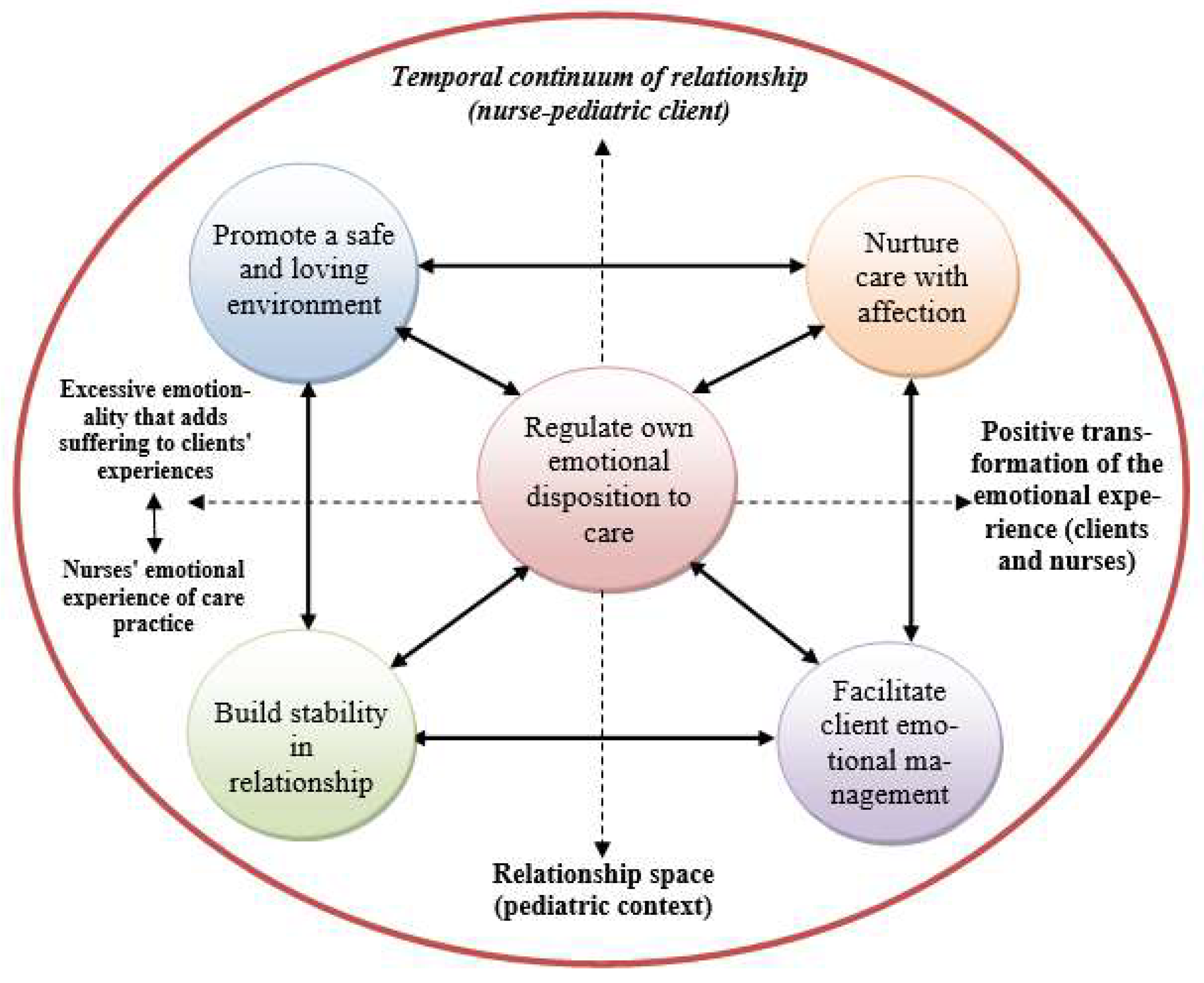
Background/Objectives: The health-disease processes experienced by children and their families are often accompanied by profound emotional distress, which can prove to be a significant challenge for the nurses entrusted with their care. The objective of this article is to introduce the Emotional Labor Model in Pediatric Nursing and demonstrate its applicability to improving care for children and families. Methods: A doctoral thesis (2010), with a qualitative approach and Grounded Theory methodolo-gy, led to the emergence of a medium-range theory, revealing how nurses use emotions as a therapeutic tool in pediatric hospitalization. Corbin and Strauss (2015) argue that from a medium-range theory emerges the formulation of a logical, systematic and ex-planatory model, that has been validated in different pediatric settings, through re-search, clinical internships and discussion with clinical nurses and expert academics. Results: This model provides guidance for operationalization emotional labor in the context of pediatric nursing and is characterized by “Promoting a safe and affectionate environment”, “Nurturing care with affection”, “Facilitating the management of the client's emotions”, “Building stability in the relationship” and “Regulating one's (nurses) emotional disposition to care”. The applicability of this model requires triple centrality: in the clients, in the nurses, and in the nurse-client relationship. Conclu-sions: Humanizing care is facilitated by an awareness of the emotional experiences of clients and the ability of nurses to manage emotionality. Research-based models of care are necessary to guide and empower pediatric nurses in this emotional dimension of nursing.
Keywords:
1. Introduction
2. Methodology
3. Results
3.1. The Emotional Labor Model in Pediatric Nursing is a care model
3.2. The conceptual framework
3.3. The theoretical concepts
3.4. The structural components
3.5. A practical case - reflexive recording of a nurse-child interaction in the context of pediatric oncology
3.6. The outcomes
4. Considerations, implications, and limitations
5. Conclusion
- It is imperative that pediatric healthcare institutions and nurses recognize the emotional dimension of nursing and its significance. By doing so, they can ensure that the emotional labor of nursing becomes a central focus of reflective practice, supported by scientific evidence.
- The development of care models is imperative to guide and empower nurses in addressing their emotional challenges in pediatric nursing and healthcare.
- The implementation of the Emotional Labor Model in Pediatric Nursing has the potential to stimulate discussion, research, and practice changes among pediatric nurses, administrators, researchers, and nursing education programs.
Author Contributions
Funding
Institutional Review Board Statement
Informed Consent Statement
Public Involvement Statement
Guidelines and Standards Statement
Use of Artificial Intelligence
Acknowledgments
Conflicts of Interest
References
- Parse, R.R. Illuminations: The human becoming theory in practice and research; Jones & Bartlett Learning, 1999. [Google Scholar]
- Watson, J. Human caring science: a theory of nursing, 2nd ed.; Jones and Bartlett Learning, LLC, 2012. [Google Scholar]
- Watson, J. Unitary caring science: The philosophy and praxis of nursing; University Press of Colorado, 2018. [Google Scholar]
- Dossey, BM. Theory of integral nursing. ANS Adv Nurs Sci 2008, 31, E52–E73. [Google Scholar] [CrossRef] [PubMed]
- Smith, P. Emotional Labour of Nursing revisit. Can nurses Still Care? 3rd ed.; Palgrave Macmillan, 2017. [Google Scholar]
- Wei, H.; Watson, J. Healthcare interprofessional team members' perspectives on human caring: A directed content analysis study. International Journal of Nursing Sciences 2019, 6, 17–23. [Google Scholar] [CrossRef]
- Freitas, B. H.; Costa, A. I.; Gaíva, M. A. Emotional labor in pediatric nursing considering the repercussions ofcovid-19 in childhood and adolescence. Rev Gaúcha Enferm. 2021, 42, e20200217. [Google Scholar] [CrossRef] [PubMed]
- Swanson, K. Nursing as informed caring for the well-being of others. Image Journal of Nursing scholarship 1993, 25, 352–357. [Google Scholar] [CrossRef]
- Meleis, A. I. Transitions Theory: Middle range and situation-specific theories in research and nursing practice; Springer Publishing Company, 2010. [Google Scholar]
- Morse, J. M.; Solberg, S. M.; Neander, W. L.; Bottorff, J. L.; Johnson, J. L. Concepts of caring and caring as a concept. Advances in Nursing Science 1990, 13, 19–31. [Google Scholar] [CrossRef]
- Diogo, P. Modelo de Trabalho Emocional em Enfermagem Pediátrica [Emotional Labor Model in Pediatric Nursing]; Lisbon International Press, 2023. [Google Scholar]
- Diogo, P.; Freitas, B.; Costa, A.I.; Gaíva, M.A. Care in pediatric nursing from the perspective of emotions: from Nightingale to the present. Revista Brasileira de Enfermagem 2021, 74, e20200377. [Google Scholar] [CrossRef] [PubMed]
- Badolamenti, S.; Sili, A.; Caruso, R.; Fida, F. R. What do we know about emotional labour in nursing? A narrative review. Br. J. Nurs 2017, 26, 48–55. [Google Scholar] [CrossRef]
- Pooja, A.; Bhoomadevi, A. Emotional Labour and its Outcomes Among Nurses at a Tertiary Hospital – A Proposed Model. International Journal of Experimental Research and Review 2023, 35, 83–95. [Google Scholar] [CrossRef]
- de Castro A., B.; Agnew, J.; Fitzgerald S., T. Emotional labor: relevant theory for occupational health practice in post-industrial America. AAOHN Journal 2004, 52, 109–15. [Google Scholar] [CrossRef]
- Mann, S. A health-care model of emotional labour: An evaluation of the literature and development of a model. Journal of Health Organization and Management 2005, 19, 304–317. [Google Scholar] [CrossRef]
- Alligood, M. R. Nursing Theory: Utilization & Application, 5th ed.; Elsevier Mosby, 2014. [Google Scholar]
- Meleis, A. I. Theoretical nursing: Development and progress, 6th ed.; Wolters Kluwer, 2018. [Google Scholar]
- Corbin, J.; Strauss, A. Basics of qualitative research. techniques and procedures for developing Grounded Theory, 4th ed.; SAGE Publications, Inc., 2015. [Google Scholar] [CrossRef]
- Diogo, P. Trabalho com emoções em enfermagem pediátrica: um processo de metamorfose da experiência emocional no ato de cuidar. 2nd ed. [Work with the emotions in the pediatric nursing: a process of metamorphosis of the emotional experience in the act of caring]; Lusodidacta, 2015. [Google Scholar]
- Brandão, M. A.; Martins, J. S.; Peixoto, M. A.; Lopes, R. O.; Primo, C. C. Reflexões teóricas e metodológicas para a construção de teorias de médio alcance de enfermagem. Texto Contexto Enferm 2017, 26, e1420017. [Google Scholar] [CrossRef]
- Fawcett, J. Fawcett, J., DeSanto-Madeya, S., Eds.; The structure of contemporary nursing knowledge. In Contemporary Nursing Knowledge: analysis and evaluation of nursing models and theories, 3rd ed.; F.A. Davis Company, 2013; pp. 3–25. [Google Scholar]
- Davidson, P., Halcomb, E., Hickman, L., Phillips, J., Graham, B. Beyond the rhetoric: What do we mean by a ‘model of care’? Australian Journal of Advanced Nursing 2006, 23, 47–55. [Google Scholar] [CrossRef]
- Leite, J. L., Erdmann, A. L., Carvalho, S. M., Pezzi, M. da C. S., Dantas, C. de C. O caminhar para a concepção de um modelo de cuidado ao cliente HIV positivo [Toward the design of a care model for HIV-Positive Clients]. Ciência, Cuidado e Saúde 2008, 6, 187–196. [Google Scholar] [CrossRef]
- Rocha, P. K., Prado, M. L. Modelo de cuidado ¿Qué es y como elaborarlo? Index Enferm 2008, 17, 128–132. [Google Scholar] [CrossRef]
- Fawcett, J. Knowledge contemporary nursing: Analysis and evolution of nursing models and theories, 2nd ed.; F. A. Davis Company, 2005. [Google Scholar]
- Wall, M. L. Características da proposta de cuidado de enfermagem de Carraro a partir da avaliação de teorias de Meleis [Tese de Doutoramento não publicada]. Universidade Federal de Santa Catarina, 2008. Available online: https://repositorio.ufsc.br/xmlui/handle/123456789/91835.
- Favero, L., Wall, M. L., Lacerda, M. R. Conceptual differences in terms used in the scientific production of Brazilian nursing. Texto Contexto Enferm 2013, 22, 534–542. [Google Scholar] [CrossRef]
- Galvão, C. Editorial. Níveis de Evidência. Acta paul. enferm 2006, 19. [Google Scholar] [CrossRef]
- Schneider, L. R., Pereira, R. P., Ferraz, F. Prática baseada em evidências e a análise sociocultural na atenção primária [Evidence-Based Practice and sociocultural analysis in Primary Care]. Physis: Revista de Saúde Coletiva 2020, 30, 1–18. [Google Scholar] [CrossRef]
- Fawcett, J. The metaparadigm of nursing: Present status and future refinements. Image - the journal of nursing scholarship 1984, 16, 84–89. [Google Scholar] [CrossRef]
- Kérouac, S., Pepin, J., Ducharme, F., Duquette, A., Major, F. El pensamiento enfermero; Elsevier Masson, 1996. [Google Scholar]
- Collière, M. Cuidar... A primeira arte da vida. 2nd. ed. [Caring... The first art of life]. Lusociência; 2003.
- Carper, B. A. Nicoll, L. H., Ed.; Fundamental Patterns of Knowing in Nursing. In Perspectives on nursing theory; Little Brown and Company, Little Brown and Company; pp. 23–33. [Google Scholar]
- Fawcett, J., Watson, J., Neuman, B., Walker. P. H., Fitzpatrick, J. J. On nursing theories and evidence. J Nurs Scholarsh 2001, 33, 115–119. [Google Scholar] [CrossRef]
- Wolf, Z. R., Bailey, D. N. Paterson and Zderad’s humanistic nursing theory: Concepts and applications. International Journal for Human Caring 2013, 17, 60–69. [Google Scholar] [CrossRef]
- Smith, P. Emotional Labour of Nursing Revisit. Can nurses Still Care? 2nd ed.; Palgrave Macmillan, 2012. [Google Scholar]
- Smith, P. The Emotional Labour of Nursing; Macmillan, 1992. [Google Scholar]
- Mazhindu, A. Ideal Nurses and the Emotional Labour of Nursing. Nurse Researcher 2009, 16, 91–94. [Google Scholar] [CrossRef] [PubMed]
- Hochschild, A. The Managed Heart; University of California Press, 1983. [Google Scholar]
- James, N. S. Barrett, C. Komaromy, M. Robb, Ed.; Divisions of Emotional Labour: disclosure and cancer. In Communication, Relationships and Care; Routledge, 2003. [Google Scholar] [CrossRef]
- Maunder, E. Z. The emotional labour of children’s nurses caring for life-limited children and young people within community and children’s hospice settings in Wales. Archdischil 2016, 101, A372. [Google Scholar] [CrossRef]
- Ashforth, B.; Humphrey, R. Emotional labor in service roles: The influence of identity. The Academy of Management Review 1993, 18, 88–115. [Google Scholar] [CrossRef]
- Diefendorff, J.; Gosserand, R. Understanding the emotional labor process: a control theory perspective. Journal of Organizational Behavior 2003, 24, 945–959. [Google Scholar] [CrossRef]

 |
 |
 |
 |
 |
Disclaimer/Publisher’s Note: The statements, opinions and data contained in all publications are solely those of the individual author(s) and contributor(s) and not of MDPI and/or the editor(s). MDPI and/or the editor(s) disclaim responsibility for any injury to people or property resulting from any ideas, methods, instructions or products referred to in the content. |
© 2025 by the authors. Licensee MDPI, Basel, Switzerland. This article is an open access article distributed under the terms and conditions of the Creative Commons Attribution (CC BY) license (http://creativecommons.org/licenses/by/4.0/).