Introduction
Wildland fire is necessary in many ecosystems globally to maintain critical levels of animal and plant diversity (He et al. 2019; McLauchlan et al. 2020). Land managers of fire-adapted ecosystems use prescribed fire to mimic low-intensity fires, which maintain forest structures and ecological processes while decreasing the chances of high-intensity stand-replacing fires (Ryan et al. 2013). The frequency and intensity of prescribed fires affect how a forest stand develops, later impacting the fire behavior experienced by the stand in subsequent burns (Fernandes and Botelho 2003; McLauchlan et al. 2020). To help ensure that fire goals are achieved, land managers rely on a suite of planning tools: short-term fire models to estimate fire behavior for day-of-burn conditions, and long-term ecosystem process models to simulate future stand development (Ryan et al. 2013). However, there are currently limited pathways for integrating these models to understand how a landscape's future fire conditions may be impacted by different fire regimes and weather forecasts. As land managers are increasingly considering these dynamics in their planning, the integration of short- and long-term prescribed fire planning tools has become crucial for restoring and maintaining fire-adapted ecosystems (Loudermilk et al. 2017; Jonko et al. 2024).
Ecosystem process modeling is a common tool used to capture elements of forest succession in response to various disturbance regimes (e.g., projections of climate variability, wildland fire, insects and diseases, land use change, and harvesting). LANDIS-II (Scheller et al. 2007) is a landscape-class ecosystem process model that has been widely used in long-term forest planning (Gustafson et al. 2007; Lin et al. 2023; Suárez-Muñoz et al. 2023). In addition to simulating nutrient fluxes and biomass changes in response to tree growth, death, and regeneration, LANDIS-II can also simulate the impact of fire on succession (Robbins et al. 2024). In the model, wildland fire is calibrated with empirical data and operates through strategic implementation (prescription management) and through semi-stochastic processes (wildfire ignition potential and fire weather) in two dimensions (Scheller et al. 2019). While useful for modeling landscape-scale fire effects, LANDIS-II does not simulate process-based fire behavior and cannot represent the fine-scale fire dynamics that arise from complex fuel structures, varied ignition patterns, and fire-atmospheric interactions. Consequently, LANDIS-II’s ability to inform nuanced fire management is constrained. Integrating LANDIS-II with a three-dimensional, physics-based fire model would enable the simulation of fire behavior and fire danger in response to changing environmental conditions, making the modeling more relevant for land management practices.
High-fidelity physics-based fire models incorporate three-dimensional (3D) fire-atmosphere interactions to simulate detailed fire behavior and effects, improving prescribed fire training and implementation (Parsons et al. 2023). QUIC-Fire (Linn et al. 2020) is a fast-running fire behavior model that takes in detailed 3D inputs of vegetation, weather conditions, and ignition patterns. QUIC-Fire outputs can be used to produce spatially explicit fire behavior simulations, aiding fire managers in developing burn plans that align with management objectives. Physics-based fire models like QUIC-Fire represent a promising future for operational prescribed fire planning but require detailed vegetation data to build the fine-scale 3D fuel inputs. This creates a major obstacle when converting the coarse-scale, two-dimensional (2D) outputs from LANDIS-II into a fine-scale, 3D input for QUIC-Fire. While the integration of QUIC-Fire and LANDIS-II has obvious utility, a thoughtful workflow is needed to address the scaling incompatibility issues between the two models. Linking LANDIS-II to a 3D, physics-based fire model like QUIC-Fire could give land managers a tool to understand how fire behavior and fire danger would change on their landscape as ecosystems experience succession and various land management scenarios.
Prescribed fire practitioners make the profound decision to manage our lands with fire and deserve the utmost support from research and development to continue to build useful tools for both short and long-term management (Hiers et al. 2020). Here, we contribute to that goal by presenting a novel method of linking LANDIS-II to QUIC-Fire, which we call L2-QF. By converting coarse-scale, 2D information on tree species-age classes from LANDIS-II into a dataset of individual tree characteristics, we were able to create fine-scale, 3D fuels inputs for QUIC-Fire and other next-generation fire models. We describe L2-QF, then provide a demonstration in an actively managed landscape, presenting an example of the method’s application and management-centered results that could be derived. We discuss how these coupled simulations are useful for long-term prescribed fire management and planning, as well as how this approach can be used to integrate other models with similar scales and processes.
Workflow Description
Overview
LANDIS-II (v7.0) (Scheller et al. 2007) integrates various ecosystem processes and disturbances at the landscape scale and over decadal or century periods. LANDIS-II uses a gridded landscape where each cell contains multiple species-age cohorts of plants whose growth and succession are governed by resource availability, dispersal, and disturbance resistance. At each time step, species composition, age, and biomass are calculated, which allows for the subsequent calculation of demographic and structural forest change. LANDIS-II has been successfully implemented for understanding ecosystem dynamics, succession, insects, fire, wind, dispersal, harvesting, fuel treatment effectiveness, and climate research (Syphard et al. 2011; Loudermilk et al. 2013, 2014, 2017; Robbins et al. 2023). L2-QF simulates forest succession through species-specific competition for light, water, and nutrients. It also simulates vegetation growth and response to disturbance, which is determined by unique species attributes (e.g., shade tolerance and growth rate). Dead biomass (woody and leaf litter) and soil organic carbon are also tracked, which crucially allow rough estimations of both above- and below-ground fuel components as the forest undergoes succession.
QUIC-Fire is a high-fidelity, physics-based fire behavior model designed to conduct detailed spatial fire behavior simulations. By representing 3D fuels, topography, and ignition patterns, then simulating how winds interact with fire-generated plumes and vegetation, QUIC-Fire captures complex, fine-scale fire behavior that empirical or quasi-empirical models cannot. This makes it ideal for quantifying how changes to atmospheric and fuel conditions impact fire behavior. QUIC-Fire combines the QUIC-URB wind solver (Singh et al. 2008) with a cellular automata fire spread model to simulate fire-atmospheric feedbacks without the need for solving computational fluid dynamics equations. This innovation allows QUIC-Fire to produce similar results to more complex models, like FIRETEC (Linn and Cunningham 2005) and FDS (Mell et al. 2007), with ~1/2000 the computational cost (Linn et al. 2020).
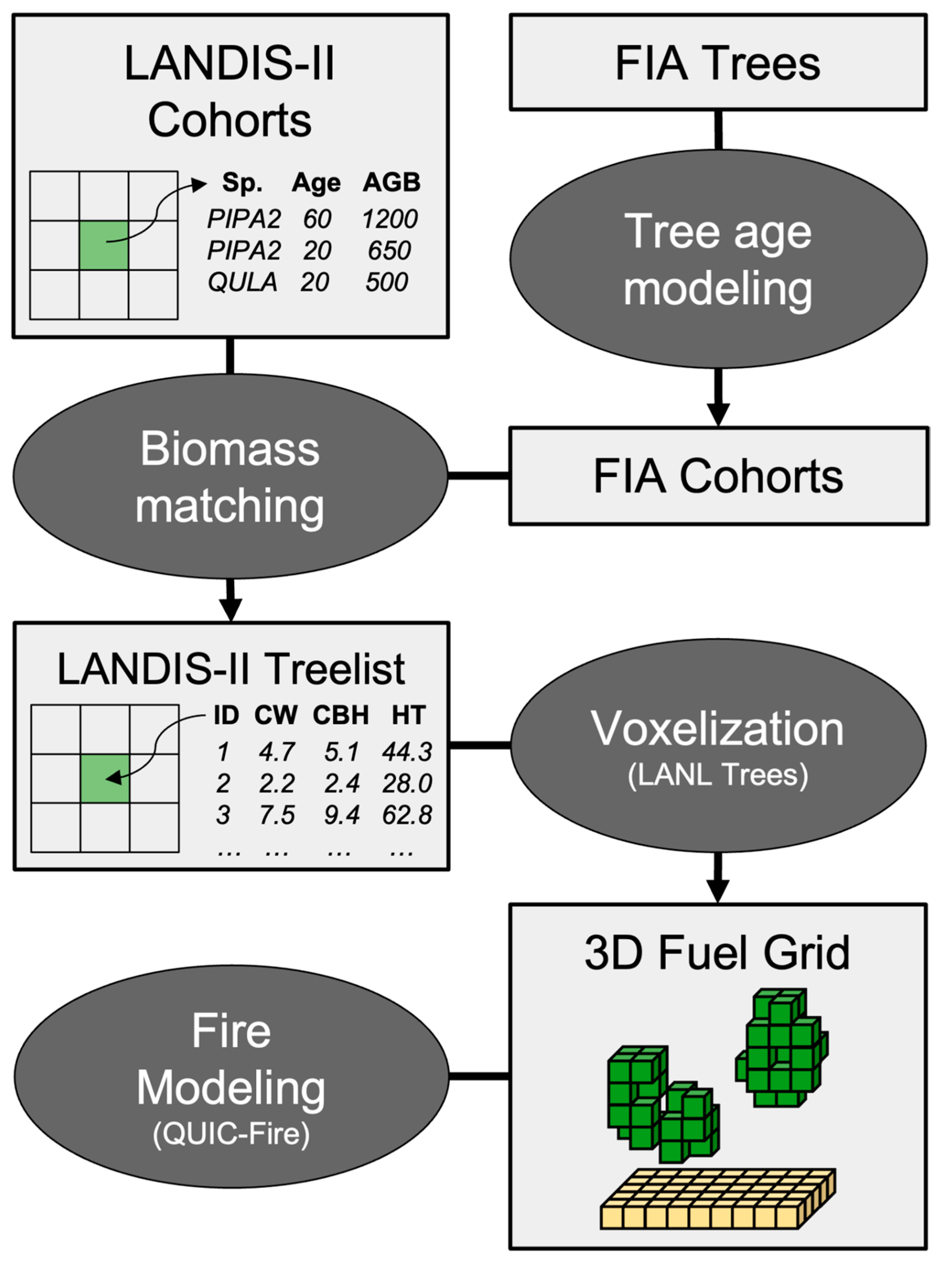
Connecting LANDIS-II and QUIC-fire requires a multi-step process to transform tree cohorts and carbon pools from LANDIS-II to the three-dimensional arrays of fuel parameters (i.e. bulk density and moisture content) required to run QUIC-Fire (
Figure 1). As it is not spatially explicit within a given cell, LANDIS-II presents tree cohorts in terms of aboveground biomass (g m
-2) grouped by species and age. In order to build an array of fuels to represent these cohorts, we developed a novel method for representing these cohorts as groups of individual trees with associated characteristics describing their shape, size, and location. We then used a tree canopy voxelization program (Los Alamos National Laboratory 2024) to create the necessary three-dimensional fuel inputs for QUIC-Fire. Alongside this process, the necessary surface fuels are interpolated from LANDIS-II litter outputs (g m
-2). The L2-QF workflow is described in detail below.
Parameterizing LANDIS-II
The L2-QF workflow assumes the user has already parameterized the LANDIS-II model to the necessary ecological phenomena of their study extent. The model requires inputs specifying the initial tree communities, climate data, and other input files for the succession plugin. Our workflow, currently in its first iteration, requires the LANDIS-II simulation to use the Net Ecosystem Carbon and Nitrogen (NECN) Succession extension (v4.2) (Scheller et al. 2011) the Net Ecosystem Carbon and Nitrogen (NECN) succession extension, which is widely used in LANDIS-II studies (Martin et al. 2015; Creutzburg et al. 2017; Flanagan et al. 2019; McDowell et al. 2021; Robbins et al. 2024; Jones et al. 2024). L2-QF also requires the Community Biomass Output extension (see Supplemental Material).
LANDIS-II to Treelist
A key challenge in linking LANDIS-II to QUIC-Fire is the difference in spatial scales. LANDIS-II was designed to simulate forest change at broad, landscape scales (10,000-100,000s of hectares), and the typical cell size is around or above 1 ha. QUIC-Fire, on the other hand, simulates coupled fire and atmospheric processes at a horizontal resolution of 1-2 m. Fuels data are read by QUIC-Fire in the form of volumetric pixels (voxels), arranged in 3D space to represent individual tree canopies and surface fuels. However, LANDIS-II tracks forest change not in terms of individual trees, but as cohorts of species-age-biomss classes. At these two disparate scales, fuels, especially trees, are characterized differently, which poses a challenge when downscaling from a LANDIS-II output to a QUIC-Fire input. To couple the two models, we developed a method to transform LANDIS-II cohort data into an arrangement of 3D voxels representing individual trees (
Figure 1). The first step in this process is to create a data frame of individual trees with associated attributes (hereafter, “treelist”) from the LANDIS-II cohorts.
Tree Age Modeling
LANDIS-II cohort data are presented in species-age-biomass classes and thus lack the individual tree component data required for QUIC-Fire. Therefore, these and other attributes must be estimated to create a 3D fuel structure. We used data from the US Forest Service Forest Inventory and Analysis program (FIA) (Smith 2002) to model the likely tree communities represented by LANDIS-II cohorts. We grouped trees of the same species-age class for each FIA plot, creating cohorts of trees that are analogous to LANDIS-II cohorts. Cohorts are grouped by tree age; however, tree age is not recorded uniformly across the FIA sampling (USDA 2023). Notably, tree age is only recorded in two FIA regions: the Pacific Northwest and Rocky Mountain regions. Moreover, age is not sampled for all trees. In the Pacific Northwest region, one tree of each species in each crown class for each site condition is sampled, and no timber hardwoods other than red alder (Alnus rubra) are sampled. In the Rocky Mountain region, one tree of each species and broad diameter class is sampled per plot. To address this data gap, we developed a method for predicting the age of every tree in the FIA dataset from the existing age data and other regularly included FIA data about the individual, the stand, and the plot location.
We built a statistical model characterizing the relationship between tree age and a suite of predictors for each of the four major species groups denoted by FIA (MAJOR_SPGRPCD column). We chose a Random Forest model framework because they are robust to correlated predictors and to nonlinear relationships between predictors and the response (Breiman 2001). The four models predicted tree age for major species groups: 1) Pines (
Pinus spp.), 2) other conifers (e.g.
Abies spp., Tsuga spp., Pseduotsuga spp., etc.), 3) soft hardwoods (e.g.
Fraxinus spp., Acer spp., Liriodendron spp.), and 4) hard hardwoods (e.g.
Fagus spp., Quercus spp.). For the response, we used total tree age (TOTAGE column in FIA) when available, else we used age measured at breast height (BHAGE column in FIA) plus ten. We chose seven predictor variables that affect tree growth (
Table S1) and constructed predictive age models in Python using
sklearn (Pedregosa
et al. 2011) and
skranger (Wright and Ziegler 2017; Flynn 2020). The hyperparameters for each model were tuned using 10-fold cross-validation for each major species group. The final model was trained on all the data, and validated using 10-fold cross-validation. This evaluation revealed that tree age was relatively well-predicted by our models for each of the four species groups, with R-squared values ranging from 0.70 to 0.74 (
Figure S4, S5). Root mean square error (RMSE) values were lowest for young trees, with all four models showing an RMSE of less than 20 (two 10-year age classes) for trees less than 50 years old (
Figure S6). Trees 100-150 years old never had an RMSE higher than 40 years, though trees over 200 years old were not well-predicted by our models (RMSE > 70 years). After evaluation was complete, we saved the resulting model fit Python object to be used in the workflow for predicting age for all trees in any FIA plot.
Forest Inventory and Analysis Matching
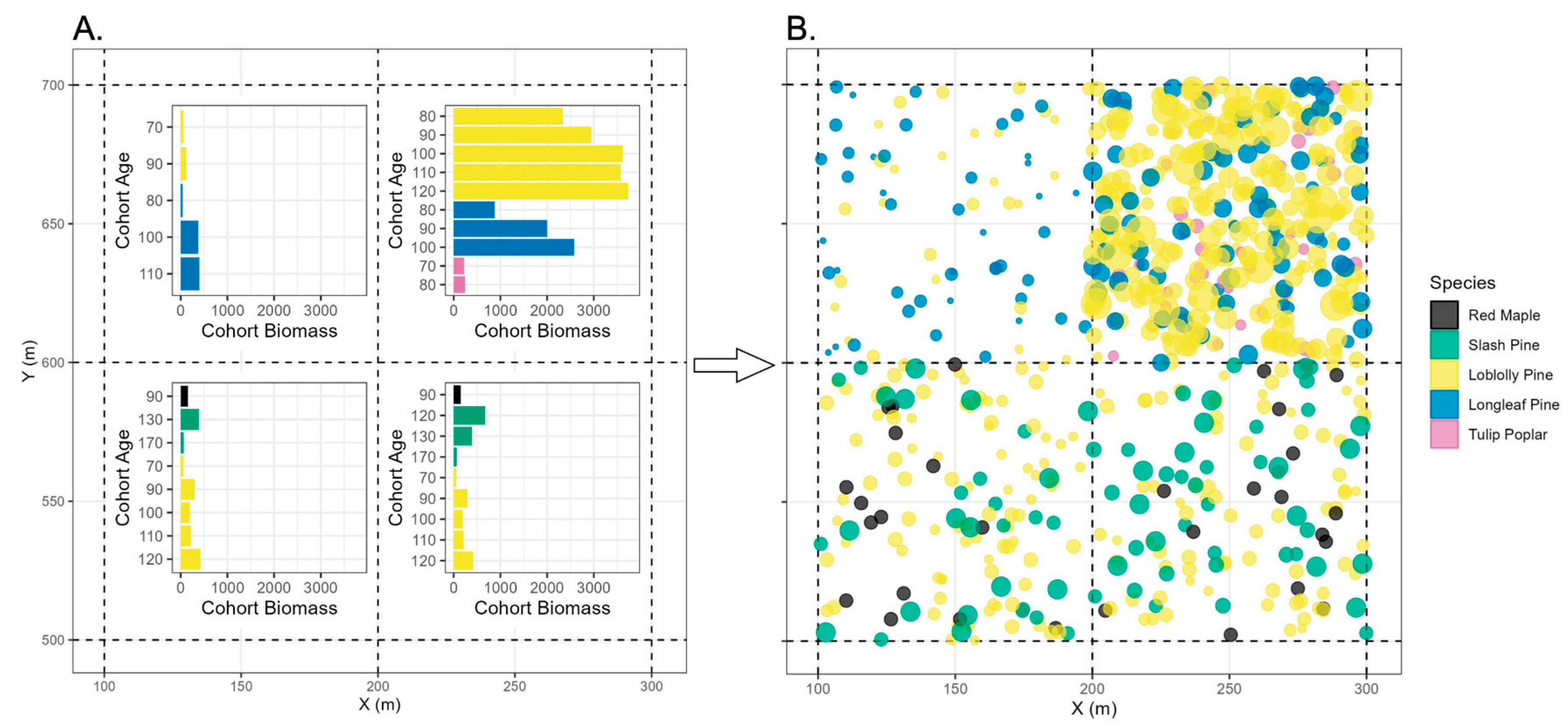
After grouping FIA trees into species-age cohorts, we compared the per-area biomass of each LANDIS-II cohort to the biomass of all FIA cohorts of the same species and age. We then used the cohort of FIA trees that was closest in biomass to represent that LANDIS-II cohort. Next, we replicated each individual tree based on the expansion factor between the FIA plot size (TPA_UNADJ column in FIA) and the LANDIS-II grid cell size, and placed the resulting trees at random x, y locations within the LANDIS-II cell (See
Figure 2 for example cells).
A majority of the tree biometric variables that are necessary for building a 3D fuels array are available from FIA. Tree height, diameter, and ocularly estimated height to crown base are all recorded for all trees in the FIA dataset. However, since crown width (diameter) is a required component for describing the shape of the canopies, we calculated it for each tree species of a given diameter. We used empirically established relationships of diameter at breast height (DBH) (Dixon 2002) to calculate crown diameter for all species.
Surface Fuels
In addition to tracking tree cohorts, LANDIS-II simulates nutrient fluxes, including carbon in discrete pools. The NECN succession plugin processes these carbon fluxes to produce grids of surface litter, which we use as surface fuel inputs for QUIC-Fire. We use bivariate spline interpolation to convert surface fuels to the QUIC-Fire resolution. At this time the workflow does not represent herbaceous fuel, since it is not tracked by LANDIS.
Voxelization of the Treelist
The result of the LANDIS-II output processing is a list of trees and associated attributes for the entire domain, along with a discreet location for each tree. The attributes and locations are then processed by an open-source software called
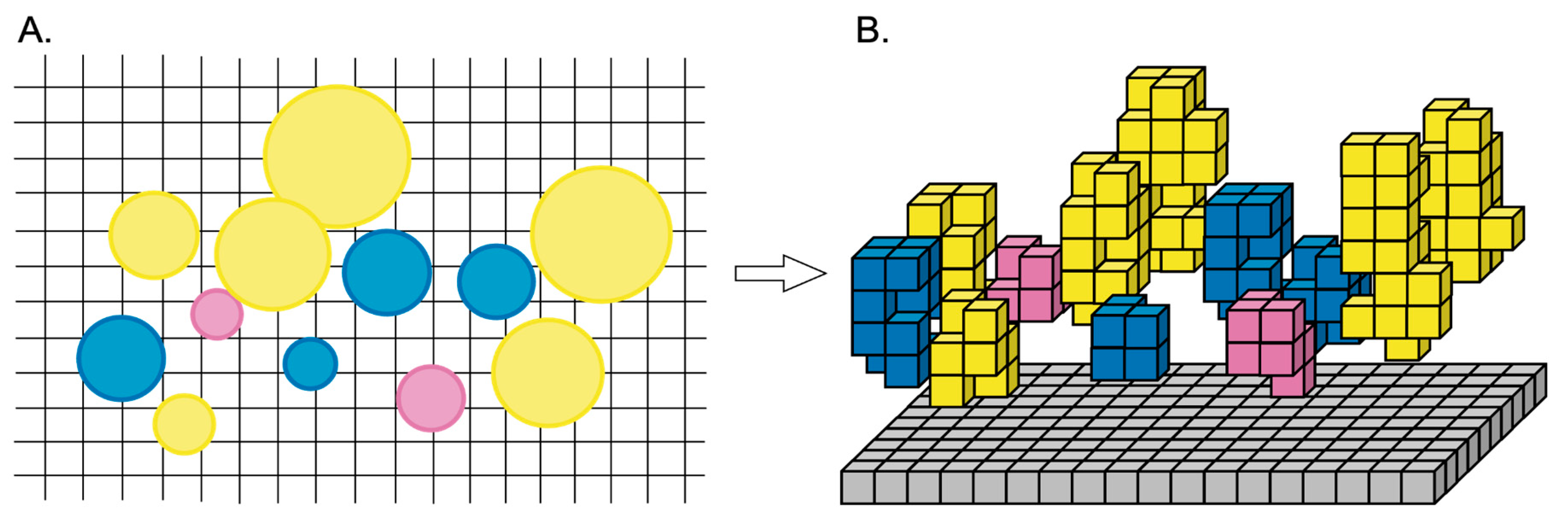
Trees, developed by the Los Alamos National Laboratory (2024) (hereafter, LANL Trees), which creates a voxelized three-dimensional array of canopy fine fuels. To define the shape of the canopy, it uses total tree height, height to crown base, crown width, and a species-specific factor defining at which height the canopy is widest (CL factor). These attributes are processed to produce a rotational solid for each tree crown. Once the shape is defined, user-defined attributes are applied to the crown fuels defining crown fuel bulk density, moisture, and optionally foliage size scale. These attributes, along with the CL factor, are defined by the user for each species prior to running the workflow. Last, the canopy geometries are voxelized to the QUIC-Fire grid by determining the fraction of each tree’s fine fuel that occupies each 3D cell (
Figure 3). The resulting files are ready to be used as inputs by QUIC-Fire or another physics-based fire model.
Fire Simulation
The flexibility in LANDIS-II parameterization is mirrored for the fire modeling step. Parameters governing the fire model such as wind speed, wind direction, and surface fuel moisture can be set by the user within the workflow code prior to starting the workflow. However, these and other fire modeling parameters such as topography and ignitions may be added to or modified in the fire simulation after the LANDIS-II outputs are converted to voxelized fuels.
Workflow Demonstration
Forest managers may want to evaluate the potential outcomes of different management plans under different projected climate scenarios. By coupling LANDIS-II with QUIC-Fire, these evaluations can include self-determining fire behavior. To demonstrate how this coupling might be used in a management planning scenario, we applied our framework to a real-life management unit that utilizes prescribed fire. Here, we simulated multiple forest succession scenarios and then used the outputs to parameterize fire behavior simulations, showing how fire behavior and outcomes may inform management decisions.
Study Area
Our demonstration landscape is Ft. Bragg (formerly Ft. Liberty) Army Base, Fayetteville, North Carolina, U.S.A. As an active military base, the land is managed with extensive prescribed fire and timber harvesting, which supports military training activities and environmental requirements. The resulting ecosystem is predominantly longleaf pine (Pinus palustris)-wiregrass (Aristida stricta) which was formerly common in the southeastern United States (Ware et al. 1993). Other important tree species include loblolly pine (P. taeda), shortleaf pine (P. echinata), and hardwoods (Quercus spp., Liquidambar styraciflua, Lirodendron tulipifera) (Fig S1). Additional benefits of the extensive forest management are a high floristic diversity (Sorrie et al. 2006) and the preservation of an ecosystem preferred by the red-cockaded woodpecker (Dryobates borealis), a federally listed endangered species. Ft. Bragg manages over 50 km2 of forests annually, making it an ideal location to demonstrate long-term fire management tools.
LANDIS-II Parameterization
The Fort Bragg landscape has been previously parameterized for LANDIS-II by Lucash et al. (2019) and used in Schrum et al. (2020) and Lucash et al. (2022). These parameterizations include initial tree communities, soil properties, climate projections, management units, and disturbance dynamics. We brought this parameterization in line with NECN v7 as it represents a more robust removal of prescribed fire fuels in concert with LANDIS-II fire models (see Supplemental Material). To demonstrate how a LANDIS-II to QUIC-Fire workflow can be used in a forest planning scenario, we compared prescribed fire behavior following four LANDIS-II simulations with varying climate and disturbance inputs. The Fort Bragg simulations included two climate projections: a high temperature, low precipitation scenario (hereafter, Hot-Dry) and a high temperature, high precipitation scenario (hereafter, Hot-Wet). Prescribed fire treatments were applied in the LANDIS-II simulation using the Social Climate Related Fire (SCRPPLE) extension (Scheller
et al. 2019) under a two year and five-year fire return interval. These climate and prescribed fire scenarios were applied as a 2x2 factorial design for a total of four LANDIS-II scenarios (
Table 1). Each LANDIS-II run was simulated for 50 years.
QUIC-Fire Simulations
We evaluated fire behavior after each of the four LANDIS-II runs under uniform burn conditions. We chose a 500 x5 00 m square burn plot in a forest type representative of prescribed burning areas in Fort Bragg (Sorrie
et al. 2006) (
Figure S1, S2). We added a 50 m buffer on all sides of the burn plot to minimize simulation edge effects. We set an 8 m control line around the plot where surface fuels were removed (
Figure S3). Winds were set to a constant speed of 2.23 ms
-1 at 6.1 m, and wind direction was set to 270 degrees for the entire simulation. Fuel moisture and wind conditions were held constant in all simulations, using values judged to be reasonable by local experts (Table 2). Topography was acquired from the USGS 3D Elevation Program (U.S. Geological Survey 2023). Fuels were ignited along the upwind border of the burn plot (
Figure S3). All fuel arrangement, loading, and height were output from the workflow, and was the only input that varied between QUIC-Fire simulations. Simulations were set to run for 10,800 s (3 hr) and were halted when all fire and plume activity ceased. Fire and wind dynamics were calculated by the model every in-simulation second, and metrics were output every 30 simulation seconds.
Fire Behavior Analyses
QUIC-Fire includes outputs describing fuel conditions (density, moisture), wind conditions during the fire (u-, w-, and v-directions), emissions (CO, PM2.5, water), and energy dynamics (fire reaction rate, energy to atmosphere, energy release at the surface). To demonstrate how the results of a LANDIS-II to QUIC-Fire coupling could be used to inform prescribed fire management, we chose to primarily focus on fuel consumption, as consumption outcomes represent an important planning target and evaluation metric. We summarized fuel consumption by finding the percent reduction of initial fuel loading at each 30 s output timestep. To investigate which canopy fuels burned, we also calculated the final percent consumption for each 1 m vertical layer. We divided our analyses of the fuels into surface (< 1 m) and canopy (≥ 1 m) since they represent different vegetation types, fire behavior dynamics, management targets, and methods of model parameterization. Managers may also be interested in the height at which canopy fuels are consumed, since most burning prescriptions aim to leave large trees undamaged.
QUIC-Fire Results
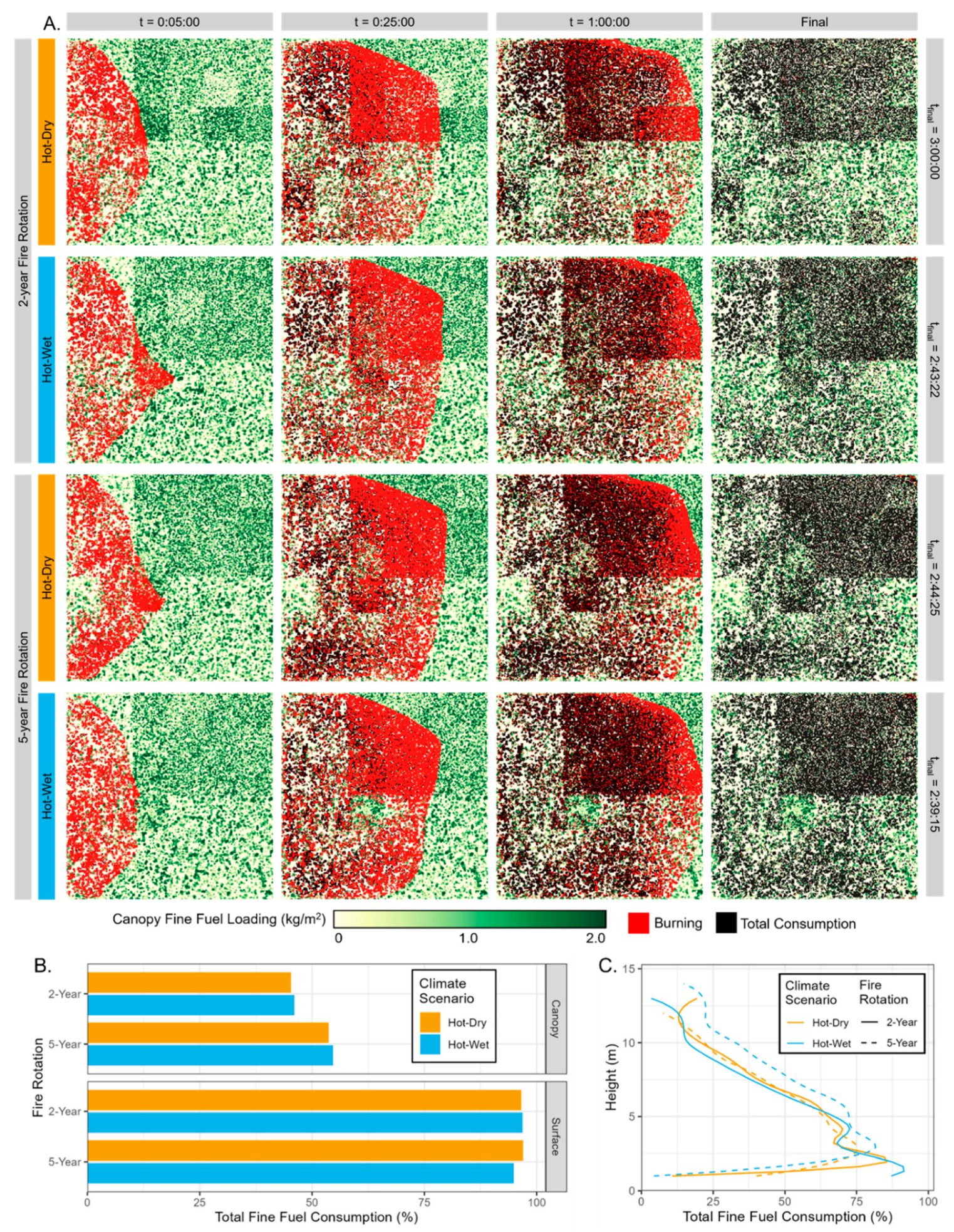
Varying prescribed burn rotations and climate scenarios in LANDIS-II led to differences in simulated prescribed burn effects in QUIC-Fire, though overall fire behavior was similar (
Figure 4A). All four scenarios showed near-total consumption of surface fuels (
Figure 4B), which is expected since surface fuel moisture was relatively low (10%) for all simulations (
Table 1). Canopy fuel consumption was most affected by burn rotation, with a 5-year rotation leading to higher rates of canopy consumption (53-54%) than a 2-year rotation (45-46%) (
Figure 4B). The combination of a 5-year fire rotation in the Hot-Wet climate scenario led to increased consumption of canopy fuels above 5 m: 33% greater than the next highest (2-year fire rotation in Hot-Dry climate scenario) and about 45% greater than the other two scenarios (
Figure 4C).
Discussion
The L2-QF workflow was intended specifically for prescribed fire practitioners in fire-adapted ecosystems. By bringing projections about future forest succession into current fire management planning, fire practitioners can identify potential future threats to this critical habitat. This is vital because many burn programs, especially in the southeast US, maintain habitat that is threatened by uncertain drought patterns and interacting disturbances, such as hurricanes, wildfires, invasive species, or insect outbreaks (Mitchell et al. 2014). Prescribed fire practitioners are increasingly interested in how QUIC-Fire could help to inform their long-term prescribed fire planning through initiatives such as the Innovation Landscape Network –a collaborative effort between fire practitioners and researchers to innovate and support prescribed fire management. This research expands the potential application space for QUIC-Fire to support these initiatives with a successional component now included. Prescribed fire practitioners currently have no analog to indicate how their forests may respond to variable weather or drought patterns, or how that could create unique fuel conditions. Our framework provides a path to understanding these changes, where LANDIS-II simulates future forest changes and QUIC-Fire illustrates how these changes can influence fire intensity and fire spread. Because our workflow places few restrictions on LANDIS-II or QUIC-Fire parameterization, the user has the flexibility to incorporate any level of landscape complexity necessary.
Our demonstration of L2-QF is purposefully straightforward to illustrate that even basic changes in future conditions (in this case fuel loading) can have distinct differences in fire intensity, spread, and crown fire transition. Our results show simulated changes in precipitation and temperature can influence fire behavior and fire effects, especially related to tree canopy biomass consumption. For example, a 5-year burn rotation led to surface fuel buildup and increased tree regeneration that contributed to ladder fuel conditions and ultimately more canopy consumption (Wagner 1977; Hakkenberg
et al. 2024). Increased tree regeneration was seen even more strongly in the Hot-Wet climate scenario (
Figure S2), leading to more crown fire in large, mature trees. In total, these results could indicate that a 2-year fire rotation would be better for maintaining desired prescribed fire behavior and resulting fire effects, and could be especially important to consider in hotter and wetter conditions.
Because of the broad applicability of both LANDIS-II and physics-based fire models, we anticipate a variety of use cases for our workflow. Thus, our workflow can be used to produce inputs for multiple physics-based fire behavior models. While QUIC-Fire is explicitly included as the endpoint of our framework and demonstration, the process of creating and voxelizing a treelist can be used to create inputs for a number of other 3D fire simulation models, such as FIRETEC or FDS. Additionally, because the treelist is output as a separate file, it can be used in any voxelization platform that takes a treelist as an input, including FastFuels (Marcozzi et al. 2025).
The coupling of LANDIS-II and QUIC-Fire is promising for long-term prescribed fire planning, but there are considerations to examine. Among the main innovations in our workflow was the age modeling of all trees in the FIA dataset. Though trees of the same size can vary greatly in age (Coomes and Allen 2007), the models performed reasonably well for grouping trees into 10- to 20-year age cohorts, especially in younger trees where errors in age prediction are more consequential. The models also performed better for hardwoods than for conifers (
Figure S5), even though training data for hardwoods was more limited. Though the models were trained on data in the western US, the models performed relatively well even when predicting across a wide range of species that were not present in the training data. This gives us confidence that predictions for species of the same taxa should be similarly well-predicted in different regions, yet a focused effort for examining variations among regional tree species could be explored.
Our current workflow distributes trees randomly within a LANDIS-II grid cell. We did not integrate a method to clump or disperse the trees because those dynamics can vary within and between study sites. However, because the tree list that results from the FIA cohort matching is simply a data frame of trees with associated coordinates, a user can alter those coordinates however they see fit before using the list to construct a fuel array. Furthermore, L2-QF creates surface fuel inputs from tree leaf litter simulated in LANDIS-II, which may not encompass all fire-carrying surface fuel, such as grasses or shrubs that are often abundant in frequently burned systems. Thus, tree distributions and surface fuels should be examined before QUIC-Fire simulations are conducted.
Conclusion
Here we present a new linkage between a widely used forest succession model LANDIS-II, and a physics-based fire behavior model, QUIC-Fire. By developing crosswalks with the FIA database and a recently developed tree canopy voxelization software, we present the first formalized method of converting LANDIS-II species-age cohorts to discretized trees with unique size and shape characteristics. Though we chose to demonstrate a linkage to QUIC-Fire, the workflow is generalizable and can link to any fire or fuel modeling method that receives a list of tree characteristics or voxelized representation of fine fuel. Our demonstration highlights the ability of our workflow to assess fire behavior and effects in response to different management scenarios and climate scenarios, which could provide managers and researchers with a novel tool for understanding the complexities of fire and changing fuel conditions.
Supplementary Materials
The following supporting information can be downloaded at the website of this paper posted on Preprints.org.
Funding
This work is the result of projects funded by the Department of Defense Strategic Environmental Research and Development Program (SERDP: RC18-1346).
Data Availability Statement
Data and code will be made available upon reasonable request.
Acknowledgements
We thank Daniel Giron Rosales for offering input and guidance during the early stages of this project. We are grateful to Scott Pokswinski who supported our efforts throughout the project. Thanks to Charles Maxwell for providing code that was a critical starting point for the FIA plot matching procedure. We are grateful for the support of the U.S. Department of Agriculture Forest Service, Southern Research Station. The findings and conclusions in this publication are those of the authors and should not be construed to represent any official USDA or U.S. Government determination or policy.
Conflicts of Interest
The authors declare no conflicts of interest.
References
- Breiman, L. Random forests. Machine Learning 2001, 45, 5–32. [Google Scholar] [CrossRef]
- Coomes, D.A.; Allen, R.B. Effects of size, competition and altitude on tree growth. Journal of Ecology 2007, 95, 1084–1097. [Google Scholar] [CrossRef]
- Creutzburg, M.K.; Scheller, R.M.; Lucash, M.S.; LeDuc, S.D.; Johnson, M.G. Forest management scenarios in a changing climate: trade-offs between carbon, timber, and old forest. Ecological Applications 2017, 27, 503–518. [Google Scholar] [CrossRef]
- Dixon GE (2002) ‘Essential FVS: A user’s guide to the Forest Vegetation Simulator.
- Fernandes, P.M.; Botelho, H.S. A review of prescribed burning effectiveness in fire hazard reduction. International Journal of Wildland Fire 2003, 12, 117–128. [Google Scholar] [CrossRef]
- Flanagan, S.A.; Bhotika, S.; Hawley, C.; Starr, G.; Wiesner, S.; Hiers, J.K.; O’Brien, J.J.; Goodrick, S.; Callaham, M.A.; Scheller, R.M.; Klepzig, K.D.; Taylor, R.S.; Loudermilk, E.L. Quantifying carbon and species dynamics under different fire regimes in a southeastern U.S. pineland. S. pineland. Ecosphere 2019, 10, e02772. [Google Scholar] [CrossRef]
- Flynn C (2020) skranger. https://github.com/crflynn/skranger.
- Gustafson EJ, Sturtevant BR, Shvidenko AZ, Scheller RM (2007) Supporting landscape ecological decisions using the LANDIS-II forest dynamics simulator. In ‘Proc IUFRO Conf. For. Landsc. Restor. ’, 73–75 https://www.iufro.org/download/file/3323/1458/10100-et-al-seoul07-stanturf.pdf#page=91. 14–19 May.
- Hakkenberg, C.R.; Clark, M.L.; Bailey, T.; Burns, P.; Goetz, S.J. Ladder fuels rather than canopy volumes consistently predict wildfire severity even in extreme topographic-weather conditions. Communications Earth & Environment.
- He, T.; Lamont, B.B.; Pausas, J.G. Fire as a key driver of Earth’s biodiversity. Biological Reviews 2019, 94, 1983–2010. [Google Scholar] [CrossRef]
- Hiers, J.K.; O’Brien, J.J.; Varner, J.M.; Butler, B.W.; Dickinson, M.; Furman, J.; Gallagher, M.; Godwin, D.; Goodrick, S.L.; Hood, S.M.; Hudak, A.; Kobziar, L.N.; Linn, R.; Loudermilk, E.L.; McCaffrey, S.; Robertson, K.; Rowell, E.M.; Skowronski, N.; Watts, A.C.; Yedinak, K.M. Prescribed fire science: the case for a refined research agenda. Fire Ecology, 4240; 11. [Google Scholar] [CrossRef]
- Jones GM, Stanley CK, Peery MZ, Maxwell C, Wilson KN (2024) Accelerated forest restoration may benefit spotted owls through landscape complementation. Animal Conservation acv.1 2976. [CrossRef]
- Jonko, A.; Oliveto, J.; Beaty, T.; Atchley, A.; Battaglia, M.A.; Dickinson, M.B.; Gallagher, M.R.; Gilbert, A.; Godwin, D.; Kupfer, J.A. How will future climate change impact prescribed fire across the contiguous United States? Npj Climate and Atmospheric Science 2024, 7, 96. [Google Scholar] [CrossRef]
- Lin, Y.; Xiao, J.-T.; Kou, Y.-P.; Zu, J.-X.; Yu, X.-R.; Li, Y.-Y. Aboveground carbon sequestration rate in alpine forests on the eastern Tibetan Plateau: impacts of future forest management options. Journal of Plant Ecology 2023, 16, rtad001. [Google Scholar] [CrossRef]
- Linn, R.R.; Cunningham, P. Numerical simulations of grass fires using a coupled atmosphere–fire model: Basic fire behavior and dependence on wind speed. Journal of Geophysical Research: Atmospheres, 2004. [Google Scholar] [CrossRef]
- Linn RR, Goodrick SL, Brambilla S, Brown MJ, Middleton RS, O’Brien JJ, Hiers JK. QUIC-fire: A fast-running simulation tool for prescribed fire planning. Environmental Modelling & Software, 1046. [CrossRef]
- Los Alamos National Laboratory (2024) Trees. www.github.com/lanl/trees.
- Loudermilk, E.L.; Scheller, R.M.; Weisberg, P.J.; Kretchun, A. Bending the carbon curve: fire management for carbon resilience under climate change. Landscape Ecology 2017, 32, 1461–1472. [Google Scholar] [CrossRef]
- Loudermilk, E.L.; Scheller, R.M.; Weisberg, P.J.; Yang, J.; Dilts, T.E.; Karam, S.L.; Skinner, C. Carbon dynamics in the future forest: the importance of long-term successional legacy and climate–fire interactions. Global Change Biology 2013, 19, 3502–3515. [Google Scholar] [CrossRef] [PubMed]
- Loudermilk, E.L.; Stanton, A.; Scheller, R.M.; Dilts, T.E.; Weisberg, P.J.; Skinner, C.; Yang, J. Effectiveness of fuel treatments for mitigating wildfire risk and sequestering forest carbon: a case study in the Lake Tahoe Basin. Forest Ecology and Management 2014, 323, 114–125. [Google Scholar] [CrossRef]
- Lucash MS, Scheller RM, Duveneck MJ (2019) Ecosystem model comparison at multiple scales and sites. Final Report RC-201702. https://github.com/LANDIS-II-Foundation/Project-Fort-Bragg-NC/blob/master/ESTCP%20RC-201702%20Final%20Report.pdf.
- Lucash, M.S.; Weiss, S.; Duveneck, M.J.; Scheller, R.M. Managing for red-cockaded woodpeckers is more complicated under climate change. The Journal of Wildlife Management 2022, 86, e22309. [Google Scholar] [CrossRef]
- Marcozzi, A.; Wells, L.; Parsons, R.; Mueller, E.; Linn, R.; Hiers, J.K. FastFuels: Advancing wildland fire modeling with high-resolution 3D fuel data and data assimilation. Environmental Modelling & Software, 1062. [Google Scholar] [CrossRef]
- Martin, K.L.; Hurteau, M.D.; Hungate, B.A.; Koch, G.W.; North, M.P. Carbon Tradeoffs of Restoration and Provision of Endangered Species Habitat in a Fire-Maintained Forest. Ecosystems 2015, 18, 76–88. [Google Scholar] [CrossRef]
- McDowell, N.G.; Tan, Z.; Hurteau, M.D.; Prasad, R. Trade-offs of forest management scenarios on forest carbon exchange and threatened and endangered species habitat. Ecosphere 2021, 12, e03779. [Google Scholar] [CrossRef]
- McLauchlan, K.K.; Higuera, P.E.; Miesel, J.; Rogers, B.M.; Schweitzer, J.; Shuman, J.K.; Tepley, A.J.; Varner, J.M.; Veblen, T.T.; Adalsteinsson, S.A.; Balch, J.K.; Baker, P.; Batllori, E.; Bigio, E.; Brando, P.; Cattau, M.; Chipman, M.L.; Coen, J.; Crandall, R.; Daniels, L.; Enright, N.; Gross, W.S.; Harvey, B.J.; Hatten, J.A.; Hermann, S.; Hewitt, R.E.; Kobziar, L.N.; Landesmann, J.B.; Loranty, M.M.; Maezumi, S.Y.; Mearns, L.; Moritz, M.; Myers, J.A.; Pausas, J.G.; Pellegrini, A.F.A.; Platt, W.J.; Roozeboom, J.; Safford, H.; Santos, F.; Scheller, R.M.; Sherriff, R.L.; Smith, K.G.; Smith, M.D.; Watts, A.C. Fire as a fundamental ecological process: Research advances and frontiers (G Durigan, Ed.). Journal of Ecology, 2047. [Google Scholar] [CrossRef]
- Mell, W.; Jenkins, M.A.; Gould, J.; Cheney, P. A physics-based approach to modelling grassland fires. International Journal of Wildland Fire 2007, 16, 1–22. [Google Scholar] [CrossRef]
- Mitchell, R.J.; Liu, Y.; O’Brien, J.J.; Elliott, K.J.; Starr, G.; Miniat, C.F.; Hiers, J.K. Future climate and fire interactions in the southeastern region of the United States. Forest Ecology and Management 2014, 327, 316–326. [Google Scholar] [CrossRef]
- Parsons, R.; Wells, L.; Marcozzi, A.; Linn, R.R.; Hiers, J.K.; Pimont, F.; Riley, K.; Altintas, I.; Flanary, S. Going 3D With Fuel and Fire Modeling: FastFuels and QUIC-Fire. Fire Management Today 2023, 81, 49–51. [Google Scholar]
- Pedregosa, F.; Varoquaux, G.; Gramfort, A.; Michel, V.; Thirion, B.; Grisel, O.; Blondel, M.; Prettenhofer, P.; Weiss, R.; Dubourg, V. Scikit-learn: Machine learning in Python. The Journal of Machine Learning Research 2011, 12, 2825–2830. [Google Scholar]
- Robbins, Z.J.; Loudermilk, E.L.; Mozelewski, T.G.; Jones, K.; Scheller, R.M. Fire regimes of the Southern Appalachians may radically shift under climate change. Fire Ecology 2024, 20, 2. [Google Scholar] [CrossRef]
- Robbins, Z.J.; Xu, C.; Jonko, A.; Chitra-Tarak, R.; Fettig, C.J.; Costanza, J.; Mortenson, L.A.; Aukema, B.H.; Kueppers, L.M.; Scheller, R.M. Carbon stored in live ponderosa pines in the Sierra Nevada will not return to pre-drought (2012) levels during the 21st century due to bark beetle outbreaks. Frontiers in Environmental Science 2023, 11, 1112756. [Google Scholar] [CrossRef]
- Ryan, K.C.; Knapp, E.E.; Varner, J.M. Prescribed fire in North American forests and woodlands: history, current practice, and challenges. Frontiers in Ecology and the Environment 2013, 11, e15–e24. [Google Scholar] [CrossRef]
- Scheller, R.M.; Domingo, J.B.; Sturtevant, B.R.; Williams, J.S.; Rudy, A.; Gustafson, E.J.; Mladenoff, D.J. Design, development, and application of LANDIS-II, a spatial landscape simulation model with flexible temporal and spatial resolution. Ecological Modelling 2007, 201, 409–419. [Google Scholar] [CrossRef]
- Scheller, R.M.; Hua, D.; Bolstad, P.V.; Birdsey, R.A.; Mladenoff, D.J. The effects of forest harvest intensity in combination with wind disturbance on carbon dynamics in Lake States Mesic Forests. Ecological Modelling 2011, 222, 144–153. [Google Scholar] [CrossRef]
- Scheller, R.; Kretchun, A.; Hawbaker, T.J.; Henne, P.D. A landscape model of variable social-ecological fire regimes. Ecological Modelling 2019, 401, 85–93. [Google Scholar] [CrossRef]
- Schrum, P.; Scheller, R.M.; Duveneck, M.J.; Lucash, M.S. Base-Hurricane: A new extension for the Landis-II forest landscape model. Environmental Modelling & Software, 1048. [Google Scholar] [CrossRef]
- Singh, B.; Hansen, B.S.; Brown, M.J.; Pardyjak, E.R. Evaluation of the QUIC-URB fast response urban wind model for a cubical building array and wide building street canyon. Environmental Fluid Mechanics 2008, 8, 281–312. [Google Scholar] [CrossRef]
- Smith, W.B. Forest inventory and analysis: a national inventory and monitoring program. Environmental Pollution 2002, 116, S233–S242. [Google Scholar] [CrossRef]
- Sorrie, B.A.; Gray, J.B.; Crutchfield, P.J. The vascular flora of the longleaf pine ecosystem of Fort Bragg and Weymouth Woods, North Carolina. Castanea 2006, 71, 129–161. [Google Scholar] [CrossRef]
- Suárez-Muñoz, M.; Bonet-García, F.J.; Navarro-Cerrillo, R.; Herrero, J.; Mina, M. Forest management scenarios drive future dynamics of Mediterranean planted pine forests under climate change. Landscape Ecology 2023, 38, 2069–2084. [Google Scholar] [CrossRef]
- Syphard, A.D.; Scheller, R.M.; Ward, B.C.; Spencer, W.D.; Strittholt, J.R. Simulating landscape-scale effects of fuels treatments in the Sierra Nevada, California, USA. International Journal of Wildland Fire 2011, 20, 364–383. [Google Scholar] [CrossRef]
- US Geological Survey (2023) 3D Elevation Program 1-Meter Resolution Digital Elevation Model. https://www.usgs.gov/the-national-map-data-delivery.
- USDA FS (2023) The Forest Inventory and Analysis Database User Guide (NFI). https://research.fs.usda.gov/understory/forest-inventory-and-analysis-database-user-guide-nfi.
- Wagner, C.E.V. Conditions for the start and spread of crown fire. Canadian Journal of Forest Research 1977, 7, 23–34. [Google Scholar] [CrossRef]
- Ware, S.; Frost, C.; Doerr, P.D. Southern mixed hardwood forest: the former longleaf pine forest. Biodiversity of the Southeastern United States: Lowland Terrestrial Communities.
- Wright MN, Ziegler A. ranger: A fast implementation of random Forests for high dimensional data in C++ and R. Journal of Statistical Software. [CrossRef]
|
Disclaimer/Publisher’s Note: The statements, opinions and data contained in all publications are solely those of the individual author(s) and contributor(s) and not of MDPI and/or the editor(s). MDPI and/or the editor(s) disclaim responsibility for any injury to people or property resulting from any ideas, methods, instructions or products referred to in the content. |
© 2025 by the authors. Licensee MDPI, Basel, Switzerland. This article is an open access article distributed under the terms and conditions of the Creative Commons Attribution (CC BY) license (http://creativecommons.org/licenses/by/4.0/).