

Submitted:
19 February 2025
Posted:
21 February 2025
You are already at the latest version
Abstract
The study examines the attitudes of local residents toward the impacts of sustainable tourism development in two national parks in Montenegro—Skadar Lake National Park (NP) and Durmitor National Park (NP). The aim is to identify the key factors shaping these attitudes and to determine the differences in perceptions between residents of these two areas. The research is based on the assumption that socio-demographic characteristics, such as gender, age, and level of education, significantly influence attitudes toward sustainable tourism development. Data were collected through a questionnaire covering a wide range of attitudes toward tourism. Analyses were conducted using multiple regression analysis, one-way analysis of variance (ANOVA), and Pearson’s correlation, with careful verification of all key statistical assumptions to ensure the validity of the results. The findings reveal significant differences in perceptions between residents of NP Skadar Lake and NP Durmitor. Respondents from NP Durmitor generally rated both the positive and negative aspects of tourism higher compared to those from NP Skadar Lake. On the other hand, residents of NP Skadar Lake exhibited greater enthusiasm for tourism promotion and engagement in tourism development processes. It was concluded that socio-demographic characteristics, particularly education and age, are key factors influencing attitudes toward tourism. These findings provide a basis for formulating recommendations to improve tourism development, which should take into account the specific needs and perceptions of local communities in both national parks.
Keywords:
1. Introduction
1.1. Literature Review
2. Methods
- What are the prevailing attitudes of local residents toward tourism development in Skadar Lake and Durmitor National Parks?
- In what ways do socio-demographic characteristics influence these perceptions?
- To what extent are local communities involved in decision-making processes related to tourism?
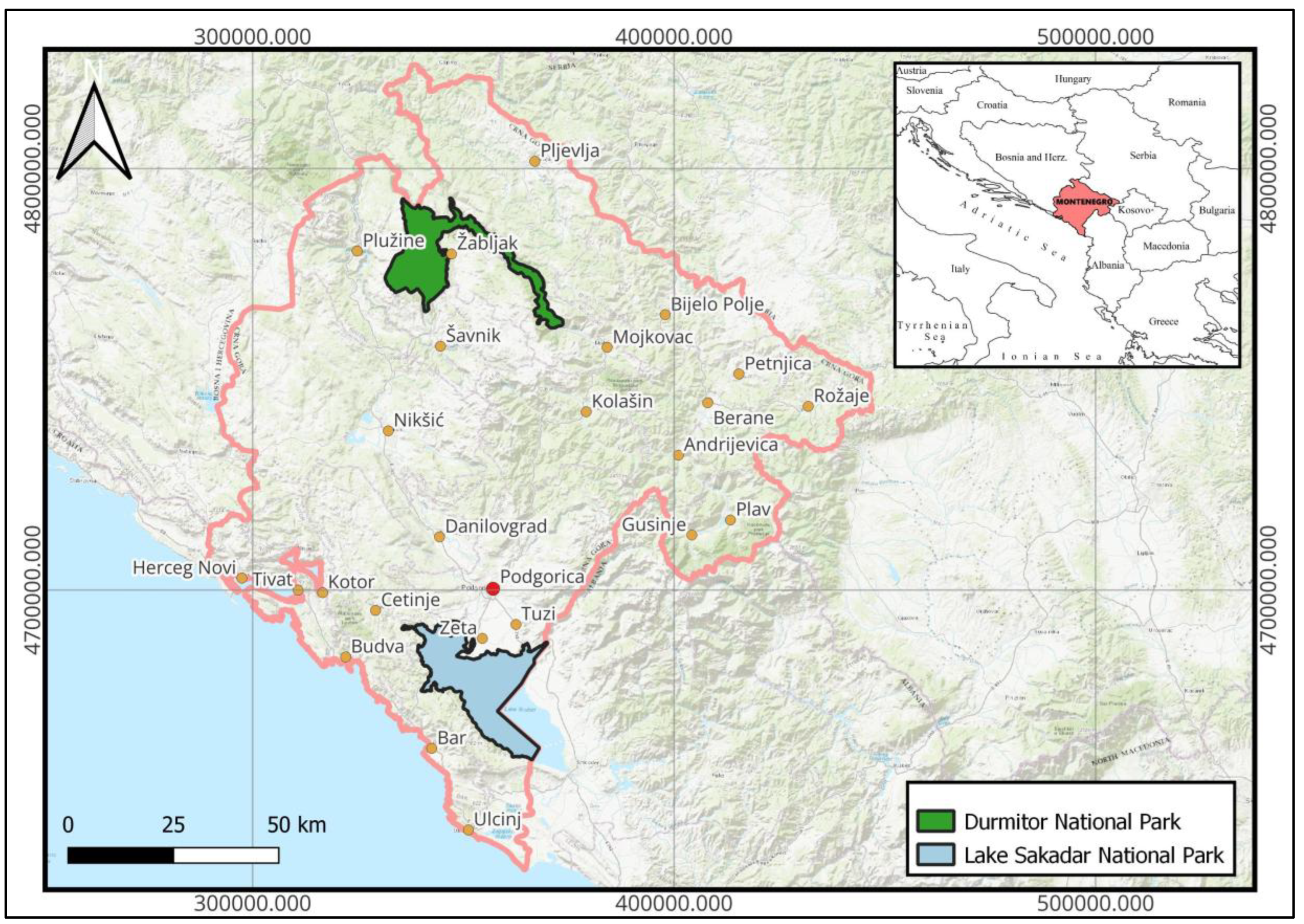
2.1. Study Area
2.2. Sample Characteristics
2.3. Questionnaire Design
2.4. Analyses
3. Results
4. Discussion
5. Recommendation
5. Conclusions
Author Contributions
Funding
Institutional Review Board Statement
Informed Consent Statement
Data Availability Statement
Acknowledgments
Conflicts of Interest
Appendix A
| Statements | Strongly Disagree | Disagree | Neutral | Agree | Strongly Agree |
| Tourism development negatively impacts local residents by altering local culture and traditions. | ☐ | ☐ | ☐ | ☐ | ☐ |
| Tourism development changes traditional behavior patterns of local residents. | ☐ | ☐ | ☐ | ☐ | ☐ |
| Tourism development harms the environment. | ☐ | ☐ | ☐ | ☐ | ☐ |
| The degradation of cultural and historical heritage is a consequence of tourism development. | ☐ | ☐ | ☐ | ☐ | ☐ |
| Tourism development threatens biodiversity. | ☐ | ☐ | ☐ | ☐ | ☐ |
| Tourism development increases employment opportunities. | ☐ | ☐ | ☐ | ☐ | ☐ |
| Tourism development increases the income of the local community. | ☐ | ☐ | ☐ | ☐ | ☐ |
| Tourism development stimulates investment in the local community. | ☐ | ☐ | ☐ | ☐ | ☐ |
| Tourism development requires a preserved environment, thereby enhancing its protection. | ☐ | ☐ | ☐ | ☐ | ☐ |
| Tourism development positively contributes to the preservation of cultural and historical heritage. | ☐ | ☐ | ☐ | ☐ | ☐ |
| Tourism development encourages infrastructure development. | ☐ | ☐ | ☐ | ☐ | ☐ |
| There is support from local government or the state for residents engaged in tourism (loans, subsidies, donations). | ☐ | ☐ | ☐ | ☐ | ☐ |
| Local residents support each other in engaging in tourism. | ☐ | ☐ | ☐ | ☐ | ☐ |
| Local products are utilized in creating tourism offerings. | ☐ | ☐ | ☐ | ☐ | ☐ |
| Statements | Strongly Disagree | Disagree | Neutral | Agree | Strongly Agree |
| When planning tourism development activities, we were consulted in some way by the local government. | ☐ | ☐ | ☐ | ☐ | ☐ |
| When important tourism development decisions were made in our local community, we were active participants in the decision-making process. | ☐ | ☐ | ☐ | ☐ | ☐ |
| Our suggestions and opinions were considered in the tourism development of our local community. | ☐ | ☐ | ☐ | ☐ | ☐ |
| Local residents are sufficiently involved in the tourism development process. | ☐ | ☐ | ☐ | ☐ | ☐ |
| Local residents have been/are currently involved in the development of tourism projects. | ☐ | ☐ | ☐ | ☐ | ☐ |
| Statements | Strongly Disagree | Disagree | Neutral | Agree | Strongly Agree |
| I want my place to be recognized as a tourist destination. | ☐ | ☐ | ☐ | ☐ | ☐ |
| I believe that tourism development can bring many benefits to my local community. | ☐ | ☐ | ☐ | ☐ | ☐ |
| I want to be involved in tourism. | ☐ | ☐ | ☐ | ☐ | ☐ |
| Tourism is the industry of the future. | ☐ | ☐ | ☐ | ☐ | ☐ |
| Statements | Strongly Disagree | Disagree | Neutral | Agree | Strongly Agree |
| Every local resident is equally important for tourism development. | ☐ | ☐ | ☐ | ☐ | ☐ |
| The opinions of local residents must be respected. | ☐ | ☐ | ☐ | ☐ | ☐ |
| Local residents know their local environment best. | ☐ | ☐ | ☐ | ☐ | ☐ |
| Local residents best understand the advantages and disadvantages of their local community. | ☐ | ☐ | ☐ | ☐ | ☐ |
| Local residents receive education in the field of tourism. | ☐ | ☐ | ☐ | ☐ | ☐ |
References
- Brougham, J.; Butler, R. A segmentation analysis of resident attitudes to the social impact of tourism. Annals of Tourism Research 1981, 8, 569-590. [CrossRef]
- Bueno, N.P.; Mejía, M.Á.P.; Ruiz, D.F. Clustering residents of a spanish mining site: when attitudes towards tourism are not linked to perceptions. Investigaciones Regionales - Journal of Regional Research 2024. [CrossRef]
- Davis, D.; Allen, J.; Cosenza, R. Segmenting Local Residents By Their Attitudes, Interests, and Opinions Toward Tourism. Journal of Travel Research 1988, 27, 2-8. [CrossRef]
- Ramón-Cardona, J.; Sánchez-Fernández, M. The Society’s Heterogeneity Regarding Attitudes towards Tourism: A Cluster Analysis of the Ibiza Residents. Societies 2023. [CrossRef]
- Radojičić, B. Geografija Crne Gore-Prirodna osnova; DANU: Crna Gora, Podgorica, 2008.
- Radojičić, B. Crna Gora. Geografski enciklopedijski leksikon; Crna Gora. Filozofski fakultet u Nikšiću, 2015.
- Nikolić, S. Priroda i turizam Crne Gore, Republički zavod za zaštitu prirode, Podgorica. 2000.
- Manojlović, B.; Perošević, N. Turizam opštine Žabljak u svjetlu prirodnog i kulturno-istorijskog bogatstva (potencijali i perspektive); Crna Gora: 2022.
- Borovinić, N. Neolitizacija Crne Gore. 2011.
- Radović Miljan, C.G. Durmitor – priroda i ljudi; Centar za razvoj Durmitorskog područja: Crna Gora, Žabljak, 1995.
- Benner, M. Tourism in the context of smart specialization: the example of Montenegro. Current Issues in Tourism 2020, 23, 2624-2630. [CrossRef]
- Smolović, J.C.; Janketić, S.; Jaćimović, D.; Bucar, M.; Stare, M. Montenegro’s Road to Sustainable Tourism Growth and Innovation. Sustainability 2018. [CrossRef]
- Szymańska, W.; Wiśniewska, A. Changes on the tourism services market in Montenegro in 2007–2017. Journal of Geography, Politics and Society 2019. [CrossRef]
- Bhammar, H.; Li, W.; Molina, C.; Hickey, V.; Pendry, J.; Narain, U. Framework for Sustainable Recovery of Tourism in Protected Areas. Sustainability 2021. [CrossRef]
- Bushell, R.; Bricker, K. Tourism in protected areas: Developing meaningful standards. Tourism and Hospitality Research 2017, 17, 106-120. [CrossRef]
- Job, H.; Becken, S.; Lane, B. Protected Areas in a neoliberal world and the role of tourism in supporting conservation and sustainable development: an assessment of strategic planning, zoning, impact monitoring, and tourism management at natural World Heritage Sites. Journal of Sustainable Tourism 2017, 25, 1697-1718. [CrossRef]
- Mandić, A. Nature-based solutions for sustainable tourism development in protected natural areas: a review. Environment Systems and Decisions 2019, 1-20. [CrossRef]
- Ristić, D.; Vukoičić, D.; Milinčić, M. Tourism and sustainable development of rural settlements in protected areas - Example NP Kopaonik (Serbia). Land Use Policy 2019, 89, 104231. [CrossRef]
- Bello, F.; Carr, N.; Lovelock, B. Community participation framework for protected area-based tourism planning. Tourism Planning & Development 2016, 13, 469-485. [CrossRef]
- Giampiccoli, D. Community-based tourism development model and community participation. 2018.
- Jun, Y. Method of Community-Based Tourism Planning. Tropical Geography 2009.
- Okazaki, E. A Community-Based Tourism Model: Its Conception and Use. Journal of Sustainable Tourism 2008, 16, 511-529. [CrossRef]
- Prentice, R. Community-driven tourism planning and residents’ preferences. Tourism Management 1993, 14, 218-227. [CrossRef]
- Sithole, N.; Giampiccoli, A.; Jugmohan, S. Towards a Spontaneous Community Participation Model in Community-Based Tourism. African Journal of Hospitality, Tourism and Leisure 2021. [CrossRef]
- Gupta, A.; Zhu, H.; Bhammar, H.; Earley, E.; Filipski, M.; Narain, U.; Spencer, P.; Whitney, E.; Taylor, J. Economic impact of nature-based tourism. PLOS ONE 2023, 18. [CrossRef]
- Souza, T.D.V.S.B.; Thapa, B.; Rodrigues, C.; Imori, D. Economic impacts of tourism in protected areas of Brazil. Journal of Sustainable Tourism 2018, 27, 735-749. [CrossRef]
- Canteiro, M.; Córdova-Tapia, F.; Brazeiro, A. Tourism impact assessment: A tool to evaluate the environmental impacts of touristic activities in Natural Protected Areas. Tourism Management Perspectives 2018. [CrossRef]
- Spenceley, A.; Snyman, S. Protected area tourism: Progress, innovation and sustainability. Tourism and Hospitality Research 2017, 17, 3-7. [CrossRef]
- Liu, W.; Vogt, C.; Luo, J.; He, G.; Frank, K.; Liu, J. Drivers and Socioeconomic Impacts of Tourism Participation in Protected Areas. PLoS ONE 2012, 7. [CrossRef]
- Belsoy, J.; Korir, J.; Yego, J. Environmental impacts of tourism in protected areas. Journal of environment and earth science 2012, 2, 64-73.
- Kim, S.; Kang, Y.-J.; Park, J.-H.; Kang, S.E. The Impact of Residents’ Participation on Their Support for Tourism Development at a Community Level Destination. Sustainability 2021, 13, 4789. [CrossRef]
- Hateftabar, F.; Chapuis, J. How resident perception of economic crisis influences their perception of tourism. Journal of Hospitality and Tourism Management 2020, 43, 157-168. [CrossRef]
- Li, R.-P.; Peng, L.; Deng, W. Resident Perceptions toward Tourism Development at a Large Scale. Sustainability 2019. [CrossRef]
- Rasoolimanesh, S.; Roldán, J.; Jaafar, M.; Ramayah, T. Factors Influencing Residents’ Perceptions toward Tourism Development: Differences across Rural and Urban World Heritage Sites. Journal of Travel Research 2017, 56, 760-775. [CrossRef]
- Moghavvemi, S.; Woosnam, K.; Paramanathan, T.; Musa, G.; Hamzah, A. The effect of residents’ personality, emotional solidarity, and community commitment on support for tourism development. Tourism Management 2017, 63, 242-254. [CrossRef]
- Milenković, D.; Cvetković, V.; Renner, R. A Systematic Literary Review on Community Resilience Indicators: Adaptation and Application of the BRIC Method for Measuring Disasters Resilience. Preprints 2024, 2024102277.
- Grozdanić, G.; Cvetković, M.V. Exploring Multifaceted Factors Influencing Community Resilience to Earthquake-Induced Geohazards: Insights from Montenegro. 2024.
- Cvetković, V.M.; Šišović, V. Capacity building in Serbia for disaster and climate risk education. In Disaster and Climate Risk Education: Insights from Knowledge to Action; Springer Nature Singapore Singapore: 2024; pp. 299-323.
- Cvetković, V.M. In-Depth Analysis of Disaster (Risk) Management System in Serbia: A Critical Examination of Systemic Strengths and Weaknesses. 2024.
- Kim, S.; Park, E.; Phandanouvong, T. Barriers to Local Residents’ Participation in Community-Based Tourism: Lessons from Houay Kaeng Village in Laos. 2014, 12, 1045. [CrossRef]
- Lo, Y.-C.; Janta, P. Resident’s Perspective on Developing Community-Based Tourism – A Qualitative Study of Muen Ngoen Kong Community, Chiang Mai, Thailand. Frontiers in Psychology 2020, 11. [CrossRef]
- Sun, J.-X. On the Community Participation in Tourism Planning. 2003.
- Cvetković, V.M.; Tanasić, J.; Ocal, A.; Kešetović, Ž.; Nikolić, N.; Dragašević, A. Capacity Development of Local Self-Governments for Disaster Risk Management. International Journal of Environmental Research and Public Health 2021, 18, 10406.
- Scharf, K. Tourism Development and Nature Conservation: An Austrian Interplay. Journal of Austrian-American History 2024. [CrossRef]
- Carius, F.; Job, H. Community involvement and tourism revenue sharing as contributing factors to the UN Sustainable Development Goals in Jozani–Chwaka Bay National Park and Biosphere Reserve, Zanzibar. Journal of Sustainable Tourism 2019, 27, 826-846. [CrossRef]
- Chung, M.; Dietz, T.; Liu, J. Global relationships between biodiversity and nature-based tourism in protected areas. Ecosystem Services 2018. [CrossRef]
- Nyaupane, G.; Poudel, S. Linkages among biodiversity, livelihood, and tourism. Annals of Tourism Research 2011, 38, 1344-1366. [CrossRef]
- Törn, A.; Siikamäki, P.; Tolvanen, A.; Kauppila, P.; Rämet, J. Local People, Nature Conservation, and Tourism in Northeastern Finland. Ecology and Society 2008, 13, 8. [CrossRef]
- Holovnia, O. Ensuring the Development of Sustainable Tourism in the Face of Global Ecological Challenges. Business Inform 2023. [CrossRef]
- Ong, Y.; Hii, I.; Tham, A. 2nd International Conference on Responsible Tourism and Hospitality (ICRTH) 2022, 1 – 3 September 2022, Kuching, Sarawak, Malaysia. Anatolia 2022, 33, 696-698. [CrossRef]
- Tremblay-Huet, S.; Lapointe, D. The New Responsible Tourism Paradigm: The UNWTO’s Discourse Following the Spread of COVID-19. Tourism and Hospitality 2021. [CrossRef]
- Madaki, K.; Umaru, I.; Umaru, K.I. Local Community Distribution and Participation in Biodiversity Conservation in National Parks: A Case of Gashaka Gumti National Park Safety. International Journal of Humanities, Education, and Social Sciences 2024. [CrossRef]
- Zhang, Y.; Xiao, X.; Cao, R.; Zheng, C.; Guo, Y.; Gong, W.; Wei, Z. How important is community participation to eco-environmental conservation in protected areas? From the perspective of predicting locals’ pro-environmental behaviours. The Science of the total environment 2020, 739, 139889. [CrossRef]
- Murni, N.; Ruki, M.; Antara, D. Model of Community Participation in Environmental Conservation to Support Sustainable Tourism. Proceedings of the International Conference On Applied Science and Technology 2019 - Social Sciences Track (iCASTSS 2019) 2019. [CrossRef]
- Rasoolimanesh, S.; Jaafar, M.; Ahmad, A.; Barghi, R. Community participation in World Heritage Site conservation and tourism development. Tourism Management 2017, 58, 142-153. [CrossRef]
- Martins, L.P.; Ribeiro, S. The enduring political viability of governance models in tourist destinations and their implications for people and planet. Worldwide Hospitality and Tourism Themes 2023. [CrossRef]
- Nyaupane, G.; Poudel, S.; York, A. Governance of protected areas: an institutional analysis of conservation, community livelihood, and tourism outcomes. Journal of Sustainable Tourism 2020, 30, 2686-2705. [CrossRef]
- Siakwah, P.; Musavengane, R.; Leonard, L. Tourism Governance and Attainment of the Sustainable Development Goals in Africa. Tourism Planning & Development 2019, 17, 355-383. [CrossRef]
- Nthiga, R. Governance of tourism conservation partnerships: lessons from Kenya. 2014. [CrossRef]
- Cooke, B.; Pearce, L.; Davison, A. Environmental NGOs and Protected Area Conservation in Australia: The Political Consequences of Aligning with Private Interests. Annals of the American Association of Geographers 2023, 114, 334-351. [CrossRef]
- Gould, J.; Smyth, D.; Rassip, W.; Rist, P.; Oxenham, K. Recognizing the contribution of Indigenous Protected Areas to marine protected area management in Australia. Maritime Studies 2021, 20, 5-26. [CrossRef]
- Nikolakis, W.; Hotte, N. How Law Shapes Collaborative Forest Governance: A Focus on Indigenous Peoples in Canada and India. Society & Natural Resources 2020, 33, 46-64. [CrossRef]
- Schuster, R.; Germain, R.; Bennett, J.; Reo, N.; Arcese, P. Vertebrate biodiversity on indigenous-managed lands in Australia, Brazil, and Canada equals that in protected areas. Environmental Science & Policy 2019. [CrossRef]
- Alam, J.; Alam, Q.N.; Kalam, A. Prospects and Challenges for Sustainable Tourism: Evidence from South Asian Countries. 2022.
- Rahman, S.S.; Baddam, P.R. Community Engagement in Southeast Asia’s Tourism Industry: Empowering Local Economies. Global Disclosure of Economics and Business 2021. [CrossRef]
- Dolezal, C.; Trupp, A.; Bui, H. Tourism and development in Southeast Asia. Tourism and Development in Southeast Asia 2020. [CrossRef]
- Chon, K.S. Tourism in Southeast Asia: A New Direction. 2000.
- Trišić, I.; Nechita, F.; Milojković, D.; Štetić, S. Sustainable Tourism in Protected Areas—Application of the Prism of Sustainability Model. Sustainability 2023. [CrossRef]
- Donici, D.; Dumitras, D. Nature-Based Tourism in National and Natural Parks in Europe: A Systematic Review. Forests 2024. [CrossRef]
- Morse, W. Protected area tourism and management as a social-ecological complex adaptive system. Frontiers in Sustainable Tourism 2023. [CrossRef]
- O’Connor, L.; Pollock, L.; Renaud, J.; Verhagen, W.; Verburg, P.; Lavorel, S.; Maiorano, L.; Thuiller, W. Balancing conservation priorities for nature and for people in Europe. Science 2021, 372, 856-860. [CrossRef]
- Islam, M.W.; Ruhanen, L.; Ritchie, B. Tourism governance in protected areas: investigating the application of the adaptive co-management approach. Journal of Sustainable Tourism 2018, 26, 1890-1908. [CrossRef]
- Font, X.; Garay, L.; Jones, S. Sustainability motivations and practices in small tourism enterprises in European protected areas. Journal of Cleaner Production 2016, 137, 1439-1448. [CrossRef]
- Nyaupane, G. The Role of Tourism in Sustainable Development Within Local-Global Dynamics. Tourism Review International 2023. [CrossRef]
- Sajib, S.; Nicolli, F.; Alietti, A. Problematizing tourism for conservation: An eco-cultural critique on sustainability. 2022, 12. [CrossRef]
- Buckley, R. Sustainable Tourism: Research and Reality. Annals of Tourism Research 2012, 39, 528-546. [CrossRef]
- Zhou, W.; Zheng, B.; Zhang, Z.; Song, Z.; Duan, W. The role of eco-tourism in ecological conservation in giant panda nature reserve. Journal of environmental management 2021, 295, 113077. [CrossRef]
- Swain, S.; Sthapak, S. Socio-demographic analysis of host communitie’s support for tourism development in the heritage destination of puri, INDIA. GeoJournal of Tourism and Geosites 2022. [CrossRef]
- Tuntipisitkul, P.; Tsusaka, T.; Kim, S.; Shrestha, R.; Sasaki, N. Residents’ Perception of Changing Local Conditions in the Context of Tourism Development: The Case of Phuket Island. Sustainability 2021. [CrossRef]
- Papastathopoulos, A.; Ahmad, S.; Sabri, N.A.; Kaminakis, K. Demographic Analysis of Residents’ Support for Tourism Development in the UAE: A Bayesian Structural Equation Modeling Multigroup Approach. Journal of Travel Research 2020, 59, 1119-1139. [CrossRef]
- Mureșan, I.; Harun, R.; Arion, F.; Oroian, C.; Dumitras, D.; Mihai, V.; Ilea, M.; Chiciudean, D.; Gliga, I.; Chiciudean, G. Residents’ Perception of Destination Quality: Key Factors for Sustainable Rural Development. Sustainability 2019. [CrossRef]
- Alrwajfah, M.M.; Almeida-García, F.; Cortés-Macías, R. Residents’ Perceptions and Satisfaction toward Tourism Development: A Case Study of Petra Region, Jordan. Sustainability 2019. [CrossRef]
- Sharma, B.; Gursoy, D. An Examination of Changes in Residents’ Perceptions of Tourism Impacts Over Time: The Impact of Residents’ Socio-demographic Characteristics. Asia Pacific Journal of Tourism Research 2015, 20, 1332-1352. [CrossRef]
- Sharma, B.; Dyer, P. An Investigation of Differences in Residents’ Perceptions on the Sunshine Coast: Tourism Impacts and Demographic Variables. Tourism Geographies 2009, 11, 187-213. [CrossRef]
- Thakker, H.; Kumar, R.; Ganesan, E.; Gupta, S.; Garg, A.; Singla, A.; Kumari, A.; Pathak; Pathak, A.K. Assessing the Influence of Community Involvement on Perceptions of Cultural Heritage Tourism Development. EVOLUTIONARY STUDIES IN IMAGINATIVE CULTURE 2024. [CrossRef]
- Sapkota, K.P.; Palamanit, A.; Techato, K.; Gyawali, S.; Ghimire, H.P.; Khatiwada, B. The Role of Local Community in Enhancing Sustainable Community Based Tourism. Journal of Electrical Systems 2024. [CrossRef]
- Permana, A.F.; Dewi, E.O. Community Participation in Tourism Village Development and Its Impact on Local Community Economies. Proceeding of International Conference on Islamic Economics, Islamic Banking, Zakah and Waqf 2023. [CrossRef]
- Radović, M. Turistička geografija Crne Gore; Fakultet za turizam i hotelijerstvo i trgovinu: Crna Gora, Kotor, 2010.
- Radosavović, M. Uloga turizma u razvoju opštine Plužine; Filozofski fakultet NIkšić: Crna Gora, 2024.
- Golub, B.; Jaković, B. Stavovi turističkih zajednica o uključivanju lokalnog stanovništva u razvoj turizma u zaštićenim područjima prirode: primjer Regionalnog parka Mura-Drava. Oeconomica Jadertina 2019, 9, 3-20.
- Soldić Frleta, D.; Smolčić Jurdana, D. Determinante potpore lokalnog stanovništva razvoju turizma. Zbornik Veleučilišta u Rijeci 2023, 11, 1-13.
- Tepavčević, J.; Blešić, I.; Bradić, M.; Ivkov, M. Stavovi lokalnog stanovništva prema razvoju turizma u Vrbasu. Tims. Acta: naučni časopis za sport, turizam i velnes 2019, 13.
- Krittayaruangroj, K.; Suriyankietkaew, S.; Hallinger, P. Research on sustainability in community-based tourism: a bibliometric review and future directions. Asia Pacific Journal of Tourism Research 2023, 28, 1031-1051. [CrossRef]
- Wondirad, A.; Ewnetu, B. Community participation in tourism development as a tool to foster sustainable land and resource use practices in a national park milieu. Land Use Policy 2019. [CrossRef]
- Dangi, T.; Jamal, T. An Integrated Approach to “Sustainable Community-Based Tourism”. Sustainability 2016, 8, 475. [CrossRef]
- Choi, H.; Sirakaya, E. Sustainability indicators for managing community tourism. Tourism Management 2006, 27, 1274-1289. [CrossRef]
- Joppe, M. Sustainable community tourism development revisited. Tourism Management 1996, 17, 475-479. [CrossRef]
- Andereck, K.; Vogt, C. The Relationship between Residents’ Attitudes toward Tourism and Tourism Development Options. Journal of Travel Research 2000, 39, 27-36. [CrossRef]
- Andriotis, K.; Vaughan, R. Urban Residents’ Attitudes toward Tourism Development: The Case of Crete. Journal of Travel Research 2003, 42, 172-185. [CrossRef]
- Martínez-García, E.; Raya, J.; Majó, J. Differences in residents’ attitudes towards tourism among mass tourism destinations. International Journal of Tourism Research 2017, 19, 535-545. [CrossRef]
- Huo, T.; Huo, M.; Shao, Y.; Li, B.; Li, Z. Does tourism participation affect residents’ educational expectations for the next generation? International Journal of Tourism Research 2024. [CrossRef]
- Stone, M.; Petrick, J. The Educational Benefits of Travel Experiences. Journal of Travel Research 2013, 52, 731-744. [CrossRef]
- Tang, C. The threshold effects of educational tourism on economic growth. Current Issues in Tourism 2020, 24, 33-48. [CrossRef]
- Tomasi, S.; Paviotti, G.; Cavicchi, A. Educational Tourism and Local Development: The Role of Universities. Sustainability 2020, 12, 6766. [CrossRef]
- Brougère, G. Learning the practice, learning from the practice: tourist practices and lifelong education. International Journal of Lifelong Education 2013, 32, 106-193. [CrossRef]
- Cuffy, V.; Tribe, J.; Airey, D. Lifelong learning for tourism. Annals of Tourism Research 2012, 39, 1402-1424. [CrossRef]
- Chau, S.; Ren, L. How Does Educational Travel Promote Lifelong Learning? International Journal of Tourism Research 2024. [CrossRef]
- Toffolo, M.M.; Simoncini, G.; Marchini, C.; Meschini, M.; Caroselli, E.; Franzellitti, S.; Prada, F.; Goffredo, S. Long-Term Effects of an Informal Education Program on Tourist Environmental Perception. 2022, 9. [CrossRef]
- Peters, M.; Romero, M. Lifelong learning ecologies in online higher education: Students’ engagement in the continuum between formal and informal learning. Br. J. Educ. Technol. 2019, 50, 1729-1743. [CrossRef]
- Bahcelerli, N. Strategy for lifelong learning in vocational schools of tourism education. Quality & Quantity 2018, 52, 43-58. [CrossRef]
- Hubel, Ș.-R.; Condrea, E. Age and Perception: Exploring the Influence on Sustainable Tourism. Ovidius University Annals. Economic Sciences Series 2023. [CrossRef]
- Bornioli, A.; Vermeulen, S.; Van Haaren, J.; Valente, R.; Mingardo, G. The Impacts of Tourism Stays on Residents’ Self-Reported Health: A Pan-European Analysis on the Role of Age and Urbanization Level. Sustainability 2022. [CrossRef]
- Ferrer, J.; Sanz, M.; Ferrandis, E.; McCabe, S.; García, J.S. Social Tourism and Healthy Ageing. International Journal of Tourism Research 2016, 18, 297-307. [CrossRef]
- Alén, E.; Losada, N.; Domínguez, T.N. The Impact of Ageing on the Tourism Industry: An Approach to the Senior Tourist Profile. Social Indicators Research 2016, 127, 303-322. [CrossRef]
- Mahendra, D. The Impact of Tourism on the Preservation and Transformation of Cultural Identity in Bali, Indonesia. Studies in Social Science & Humanities 2024. [CrossRef]
- Metodieva, T. Tourism as a prerequisite for changing the national identity. Acta Scientifica Naturalis 2023, 10, 97-100. [CrossRef]
- Fu, Y.; Luo, J. An empirical study on cultural identity measurement and its influence mechanism among heritage tourists. Frontiers in Psychology 2023, 13. [CrossRef]
- Yang, Y.; Wang, S.; Cai, Y.; Zhou, X. How and why does place identity affect residents’ spontaneous culture conservation in ethnic tourism community? A value co-creation perspective. Journal of Sustainable Tourism 2021, 30, 1344-1363. [CrossRef]
- Dashper, K.; Li, S.; He, M.; Zhang, P.; Lyu, T. Ageing, volunteering and tourism: An Asian perspective. Annals of Tourism Research 2021. [CrossRef]
- Aleshinloye, K.; Woosnam, K.; Erul, E.; Suess, C.; Kong, I.; Boley, B. Which construct is better at explaining residents’ involvement in tourism; emotional solidarity or empowerment? Current Issues in Tourism 2021, 24, 3372-3386. [CrossRef]
- Buffel, T. Social research and co-production with older people: Developing age-friendly communities. Journal of aging studies 2018, 44, 52-60. [CrossRef]
- Baldwin, J.; Napier, S.; Neville, S.; Clair, V.W.-S. Impacts of older people’s patient and public involvement in health and social care research: a systematic review. Age and Ageing 2018, 47, 801. [CrossRef]
- Tomljenović, R.; Faulkner, B. Tourism and older residents in a sunbelt resort. Annals of Tourism Research 2000, 27, 93-114. [CrossRef]
- Rastegar, R.; Ruhanen, L. A safe space for local knowledge sharing in sustainable tourism: an organisational justice perspective. Journal of Sustainable Tourism 2021, 31, 997-1013. [CrossRef]
- Bertella, G.; Rinaldi, M. Learning communities and co-creative tourism practices in NGDO projects. Journal of Sustainable Tourism 2020, 29, 639-657. [CrossRef]
- Higuchi, Y.; Yamanaka, Y. Knowledge sharing between academic researchers and tourism practitioners: a Japanese study of the practical value of embeddedness, trust and co-creation. Journal of Sustainable Tourism 2017, 25, 1456-1473. [CrossRef]
- Godinho, S.; Woolley, M.; Webb, J.; Winkel, K. Sharing Place, Learning Together: Perspectives and Reflections on an Educational Partnership Formation With a Remote Indigenous Community School. The Australian Journal of Indigenous Education 2015, 44, 11-25. [CrossRef]
- Cvetković, V.; Nikolić, A.; Ivanov, A. The Role of Social Media in the Process of Informing the Public About Disaster Risks. Journal of Liberty and International Affairs 2023, 9, 104-119.
- Zheng, L. Innovation in Tourism Marketing Based on Social Media. Tourism Management and Technology Economy 2023. [CrossRef]
- Ghorbanzadeh, D.; Zakieva, R.; Kuznetsova, M.; Ismael, A.; Ahmed, A.A.A. Generating destination brand awareness and image through the firm’s social media. Kybernetes 2022, 52, 3292-3314. [CrossRef]
- Yamagishi, K.; Ocampo, L.; Abellana, D.; Tanaid, R.A.; Tiu, A.; Medalla, M.E.; Selerio, E.; Go, C.; Olorvida, R.C.; Maupo, A.; et al. The impact of social media marketing strategies on promoting sustainability of tourism with fuzzy cognitive mapping: a case of Kalanggaman Island (Philippines). Environment, Development and Sustainability 2021, 23, 14998-15030. [CrossRef]
- Susanti, E.; Amelia, D. The Digital Promotion Strategy of Tourism Sector Towards Sustainable Tourism Development. 2021, 36-39. [CrossRef]
- Farhangi, S.; Alipour, H. Social Media as a Catalyst for the Enhancement of Destination Image: Evidence from a Mediterranean Destination with Political Conflict. Sustainability 2021. [CrossRef]
- Sneha, N. Marketing Responsible Tourism Through Social Media. 2020, 40, 177-185.
- Kruczek, Z.; Szromek, A.; Żemła, M. Attitudes towards development of tourism among young citizens of a tourism city. Journal of Tourism and Cultural Change 2022, 21, 677-689. [CrossRef]
- Wuebold, J.; Pearlstein, E.; Shelley, W.; Wharton, G. Preliminary Research into Education for Sustainability in Cultural Heritage Conservation. Studies in Conservation 2022, 67, 326-333. [CrossRef]
- Paschalidou, E.; Fafet, C.; Milios, L. A Strong Sustainability Framework for Digital Preservation of Cultural Heritage: Introducing the Eco-Sufficiency Perspective. Heritage 2022. [CrossRef]
- Yang, H.; Qiu, L.; Fu, X. Toward Cultural Heritage Sustainability through Participatory Planning Based on Investigation of the Value Perceptions and Preservation Attitudes: Qing Mu Chuan, China. Sustainability 2021, 13, 1171. [CrossRef]

| Variable | Category | n | % |
| Gender | Male | 217 | 43.4 |
| Female | 283 | 56.6 | |
| Age | Up to 18 years | 46 | 9.2 |
| 18 to 25 years | 72 | 14.4 | |
| 26 to 35 years | 191 | 38.2 | |
| 36 to 45 years | 90 | 18.0 | |
| 56 and older | 44 | 8.8 | |
| Education | Primary education | 49 | 9.8 |
| Secondary education | 214 | 42.8 | |
| Higher education | 237 | 47.4 |
| Predictor | Tourism development has certain impacts on the local population | The local population is insufficiently involved in tourism development | The local population has a positive attitude towards tourism affirmation | The local population is a significant component of tourism affirmation in skadar lake and durmitor national parks | ||||||||
| B | SE | β | B | SE | β | B | SE | β | B | SE | Β | |
| Education | 0.053 | 0.05 | 1.056 | 0.119 | 0.07 | 1.693 | 0.183 | 0.069 | 2.643 | 0.178 | 0.066 | 2.714 |
| Gender | −0.123 | 0.066 | −1.858 | 0.151 | 0.093 | 1.632 | −0.028 | 0.091 | −0.304 | 0.202 | 0.087 | 2.331 |
| Age | 0.017 | 0.023 | 0.723 | 0.014 | 0.033 | 0.432 | 0.008 | 0.032 | 0.245 | −0.032 | 0.031 | −1.051 |
| R2 () | 0.009 (0.003) | 0.014 (0.008) | 0.014 (0.008) | 0.031 (0.025) | ||||||||
| Variables | r | Sig |
|---|---|---|
| Tourism development has negative impacts on the local population by changing local culture and traditions | 0.096 | 0.031 |
| Tourism development alters traditional behavioral patterns of the local population | 0.09 | 0.045 |
| Tourism development disrupts the environment | 0.061 | 0.174 |
| Degradation of cultural and historical heritage is a consequence of tourism development | 0.021 | 0.645 |
| Tourism development threatens biodiversity | 0.051 | 0.256 |
| Tourism development increases employment opportunities | −0.07 | 0.12 |
| Tourism development increases local community income | −0.096 | 0.032 |
| Tourism development stimulates investment in the local community | −0.131 | 0.003 |
| Tourism development requires a preserved environment, thereby enhancing its protection | −0.068 | 0.127 |
| Tourism development positively contributes to the preservation of cultural and historical heritage | −0.066 | 0.139 |
| Tourism development encourages infrastructure development | −0.118 | 0.008 |
| There is support from local government or the state for residents engaged in tourism (loans, subsidies, donations) | −0.037 | 0.412 |
| The local population helps each other in engaging in tourism | −0.05 | 0.266 |
| Local products are utilized to create a tourism offering | 0.008 | 0.866 |
| During the planning of tourism development activities, we were consulted in some way by the local government | 0.017 | 0.707 |
| When important decisions regarding tourism development were made in our local community, we were active participants in decision-making | 0.047 | 0.29 |
| Our suggestions and opinions were considered in the tourism affirmation of our local community | 0.035 | 0.43 |
| The local population is sufficiently involved in the tourism development process | 0.005 | 0.906 |
| The local population has been/is currently involved in the development of a tourism project | −0.005 | 0.905 |
| I want my place to be recognized as a tourist destination | 0.029 | 0.523 |
| I believe that tourism development can bring many benefits to my local community | −0.0 | 0.992 |
| I want to engage in tourism | 0.055 | 0.218 |
| Tourism is the industry of the future | −0.03 | 0.498 |
| Every resident of the local community is equally important for tourism development | −0.034 | 0.455 |
| The views of the local population must be considered | −0.037 | 0.407 |
| The local population knows their local environment best | −0.033 | 0.467 |
| The local population best understands the advantages and disadvantages of their local community | −0.038 | 0.403 |
| The local population is being educated in the field of tourism | −0.033 | 0.466 |
| Variables | Mean | SD |
| Tourism development has negative impacts on the local population by changing local culture and traditions | 2.24 | 1.08 |
| Tourism development alters traditional behavioral patterns of the local population | 2.51 | 1.13 |
| Tourism development disrupts the environment | 2.54 | 1.18 |
| Degradation of cultural and historical heritage is a consequence of tourism development | 2.41 | 1.08 |
| Tourism development threatens biodiversity | 2.61 | 1.18 |
| Tourism development increases employment opportunities | 3.95 | 1.11 |
| Through tourism development, local community income increases | 3.96 | 1.1 |
| Tourism development stimulates investment in the local community | 3.87 | 1.11 |
| Tourism development requires a preserved environment, thereby enhancing its protection | 3.68 | 1.16 |
| Tourism development positively contributes to the preservation of cultural and historical heritage | 3.61 | 1.13 |
| Tourism development encourages infrastructure development | 3.86 | 1.09 |
| There is support from local government or the state for residents engaging in tourism (loans, subsidies, donations) | 2.96 | 1.14 |
| The local population helps each other in engaging in tourism | 3.18 | 1.07 |
| Local products are utilized to create a tourism offering | 3.32 | 1.1 |
| During the planning of activities related to tourism development, we were consulted in some way by the local government | 2.47 | 1.15 |
| When important decisions regarding tourism development were made in our local community, we were active participants in decision-making | 2.2 | 1.14 |
| Our suggestions and opinions were considered in the tourism affirmation of our local community | 2.22 | 1.11 |
| The local population is sufficiently involved in the tourism development process | 2.28 | 1.14 |
| The local population has been/is currently involved in the development of a tourism project | 2.24 | 1.11 |
| I want my place to be recognized as a tourist destination | 3.81 | 1.18 |
| I believe that tourism development can bring many benefits to my local community | 3.91 | 1.12 |
| I want to engage in tourism | 3.43 | 1.24 |
| Tourism is the industry of the future | 3.76 | 1.13 |
| Every resident of the local community is equally important for tourism development | 3.91 | 1.12 |
| The views of the local population must be considered | 4.06 | 1.08 |
| The local population knows their local environment best | 4.08 | 1.07 |
| The local population best understands the advantages and disadvantages of their local community | 4.06 | 1.07 |
| The local population is being educated in the field of tourism | 3.01 | 1.33 |
| Variables | Skadar lake (M) | Durmitor (M) |
| Tourism development has negative impacts on the local population by changing local culture and traditions | 2.17 | 2.30 |
| Tourism development alters traditional behavioral patterns of the local population | 2.49 | 2.51 |
| Tourism development disrupts the environment | 2.47 | 2.61 |
| Degraded cultural and historical heritage is a consequence of tourism development | 2.34 | 2.47 |
| Tourism development threatens biodiversity | 2.56 | 2.65 |
| Tourism development increases employment opportunities | 3.95 | 3.94 |
| Through tourism development, the income of the local community increases | 3.89 | 4.01 |
| Tourism development stimulates investment in the local community | 3.81 | 3.92 |
| Tourism development requires a preserved environment, thereby enhancing its protection | 3.63 | 3.71 |
| Tourism development positively contributes to the preservation of cultural and historical heritage | 3.54 | 3.67 |
| Tourism development encourages infrastructure development | 3.83 | 3.87 |
| There is support from local government or the state for residents engaged in tourism (loans, subsidies, donations) | 2.90 | 3.01 |
| The local population helps each other in engaging in tourism | 3.12 | 3.23 |
| Local products are utilized to create a tourism offering | 3.27 | 3.36 |
| During the planning of activities related to tourism development, we were consulted in some way by the local government | 2.54 | 2.38 |
| When important decisions regarding tourism development were made in our local community, we were active participants in decision-making | 2.25 | 2.14 |
| Our suggestions and opinions were considered in the tourism affirmation of our local community | 2.26 | 2.17 |
| The local population is sufficiently involved in the tourism development process | 2.35 | 2.20 |
| The local population has been/is currently involved in the development of a tourism project | 2.26 | 2.22 |
| I want my place to be recognized as a tourist destination | 3.88 | 3.73 |
| I believe that tourism development can bring many benefits to my local community | 3.92 | 3.89 |
| I want to engage in tourism | 3.51 | 3.35 |
| Tourism is the industry of the future | 3.76 | 3.74 |
| Every resident of the local community is equally important for tourism development | 3.85 | 3.96 |
| The views of the local population must be considered | 4.02 | 4.10 |
| The local population knows their local environment best | 4.04 | 4.11 |
| The local population best understands the advantages and disadvantages of their local community | 4.02 | 4.10 |
| The local population is being educated in the field of tourism | 3.12 | 2.89 |
| Variables | F | Sig. |
|---|---|---|
| Tourism development has negative impacts on the local population by changing local culture and traditions | 3.49 | 0.03 |
| Tourism development alters traditional behavioral patterns of the local population | 0.04 | 0.96 |
| Tourism development disrupts the environment | 0.15 | 0.86 |
| Degraded cultural and historical heritage is a consequence of tourism development | 1.22 | 0.3 |
| Tourism development threatens biodiversity | 0.33 | 0.72 |
| Tourism development increases employment opportunities | 7.04 | 0.0 |
| Through tourism development, the income of the local community increases | 5.36 | 0.0 |
| Tourism development stimulates investment in the local community | 4.79 | 0.01 |
| Tourism development requires a preserved environment, thereby enhancing its protection | 1.56 | 0.21 |
| Tourism development positively contributes to the preservation of cultural and historical heritage | 0.57 | 0.57 |
| Tourism development encourages infrastructure development | 2.99 | 0.05 |
| There is support from the local government or the state for residents engaged in tourism (loans, subsidies, donations) | 1.71 | 0.18 |
| The local population helps each other in engaging in tourism | 0.37 | 0.69 |
| Local products are utilized to create a tourism offering | 1.97 | 0.14 |
| During the planning of activities related to tourism development, we were consulted in some way by the local government | 2.87 | 0.06 |
| When important decisions regarding tourism development were made in our local community, we were active participants in decision-making | 1.41 | 0.25 |
| Our suggestions and opinions were considered in the tourism affirmation of our local community | 0.97 | 0.38 |
| The local population is sufficiently involved in the tourism development process | 3.33 | 0.04 |
| The local population has been/is currently involved in the development of a tourism project | 1.59 | 0.21 |
| I want my place to be recognized as a tourist destination | 7.29 | 0.0 |
| I believe that tourism development can bring many benefits to my local community | 3.61 | 0.03 |
| I want to engage in tourism | 0.39 | 0.68 |
| Tourism is the industry of the future | 2.52 | 0.08 |
| Every resident of the local community is equally important for tourism development | 4.04 | 0.02 |
| The views of the local population must be considered | 5.87 | 0.0 |
| The local population knows their local environment best | 2.92 | 0.05 |
| The local population best understands the advantages and disadvantages of their local community | 2.95 | 0.05 |
| The local population is being educated in the field of tourism | 3.41 | 0.03 |
| Variables | F | t | Sig. (2-Tailed) | df | Male M (SD) | Female M (SD) |
|---|---|---|---|---|---|---|
| Tourism development has negative impacts on the local population by changing local culture and traditions | 7.73 | 2.65 | 0.008 | 498 | 2.39 (1.13) | 2.13 (1.02) |
| Tourism development alters traditional behavioral patterns of the local population | 3.62 | 2.75 | 0.006 | 498 | 2.66 (1.15) | 2.39 (1.1) |
| Tourism development harms the environment | 0.96 | 1.51 | 0.132 | 498 | 2.63 (1.18) | 2.47 (1.18) |
| Degraded cultural and historical heritage is a consequence of tourism development | 1.78 | 0.62 | 0.534 | 498 | 2.44 (1.08) | 2.38 (1.08) |
| Tourism development threatens biodiversity | 1.84 | 2.94 | 0.003 | 498 | 2.78 (1.21) | 2.47 (1.13) |
| Tourism development increases employment opportunities | 1.37 | −1.72 | 0.086 | 498 | 3.85 (1.15) | 4.02 (1.08) |
| Through tourism development, the income of the local community increases | 1.77 | −1.11 | 0.268 | 498 | 3.89 (1.04) | 4.0 (1.14) |
| Tourism development stimulates investment in the local community | 0.02 | −1.74 | 0.083 | 498 | 3.77 (1.1) | 3.95 (1.11) |
| Tourism development requires a preserved environment, thereby enhancing its protection | 0.39 | −2.0 | 0.046 | 498 | 3.56 (1.16) | 3.77 (1.15) |
| Tourism development positively contributes to the preservation of cultural and historical heritage | 0.0 | −1.88 | 0.061 | 498 | 3.5 (1.08) | 3.69 (1.17) |
| Tourism development encourages infrastructure development | 0.8 | −2.13 | 0.034 | 498 | 3.74 (1.1) | 3.95 (1.08) |
| There is support from the local government or the state for residents engaged in tourism (loans, subsidies, donations) | 0.06 | −1.73 | 0.085 | 498 | 2.86 (1.13) | 3.04 (1.15) |
| The local population helps each other in engaging in tourism | 1.88 | −0.81 | 0.417 | 498 | 3.13 (1.04) | 3.21 (1.09) |
| Local products are utilized to create a tourism offering | 1.0 | −1.35 | 0.179 | 498 | 3.24 (1.07) | 3.38 (1.13) |
| During the planning of activities related to tourism development, we were consulted in some way by the local government | 0.28 | −3.22 | 0.001 | 498 | 2.28 (1.12) | 2.61 (1.15) |
| When important decisions regarding tourism development were made in our local community, we were active participants in decision-making | 0.91 | −1.19 | 0.235 | 498 | 2.13 (1.14) | 2.25 (1.13) |
| Our suggestions and opinions were considered in the tourism affirmation of our local community | 2.71 | −1.93 | 0.054 | 498 | 2.11 (1.07) | 2.3 (1.14) |
| The local population is sufficiently involved in the tourism development process | 1.39 | −1.57 | 0.117 | 498 | 2.19 (1.13) | 2.35 (1.14) |
| The local population has been/is currently involved in the development of a tourism project | 3.99 | −2.27 | 0.024 | 498 | 2.12 (1.08) | 2.34 (1.13) |
| I want my place to be recognized as a tourist destination | 0.55 | −0.25 | 0.8 | 498 | 3.79 (1.21) | 3.82 (1.17) |
| I believe that tourism development can bring many benefits to my local community | 0.11 | −0.04 | 0.97 | 498 | 3.91 (1.1) | 3.91 (1.14) |
| I want to engage in tourism | 3.54 | 2.46 | 0.014 | 498 | 3.59 (1.17) | 3.31 (1.29) |
| Tourism is the industry of the future | 1.31 | 2.82 | 0.005 | 498 | 3.59 (1.12) | 3.88 (1.12) |
| Every resident of the local community is equally important for tourism development | 0.05 | −2.77 | 0.006 | 498 | 3.75 (1.08) | 4.03 (1.13) |
| The views of the local population must be considered | 0.33 | −2.6 | 0.01 | 498 | 3.92 (1.06) | 4.17 (1.08) |
| The local population knows their local environment best | 1.65 | −1.76 | 0.079 | 498 | 3.99 (1.03) | 4.16 (1.1) |
| The local population best understands the advantages and disadvantages of their local community | 1.02 | −2.71 | 0.007 | 498 | 3.92 (1.03) | 4.18 (1.08) |
| The local population is being educated in the field of tourism | 2.7 | −2.0 | 0.046 | 498 | 2.87 (1.26) | 3.11 (1.37) |
| Recommendations | Aspect | Term | Feasibility | Cost | Priority |
|---|---|---|---|---|---|
| Increase local community participation in tourism decision-making processes | Community engagement | Short | High | Medium | High |
| Develop and enforce regulations to ensure sustainable tourism growth | Sustainable tourism development | Long | Medium | High | High |
| Invest in eco-friendly infrastructure and transport systems | Infrastructure improvement | Medium | Medium | High | High |
| Implement conservation programs to minimize environmental impacts | Environmental protection | Long | High | Medium | High |
| Support small local businesses and encourage local entrepreneurship | Economic benefits | Medium | High | Medium | Medium |
| Enhance education programs on tourism benefits and environmental conservation | Education and awareness | Short | High | Low | High |
| Protect and promote cultural heritage through tourism activities | Cultural heritage preservation | Medium | High | Medium | High |
| Strengthen collaboration between government, businesses, and local communities | Stakeholder collaboration | Medium | High | Medium | High |
| Implement visitor capacity management strategies to prevent over-tourism | Visitor management | Short | Medium | Medium | Medium |
| Establish clear policies to balance economic growth with environmental sustainability | Policy and regulation | Long | Medium | High | High |
| Utilize digital tools and smart tourism technologies to improve visitor experience | Technology integration | Medium | High | High | High |
| Develop risk management strategies to mitigate negative impacts of tourism | Risk management | Long | Medium | Medium | High |
| Expand job opportunities in tourism for local residents, especially youth and women | Employment opportunities | Medium | High | Medium | Medium |
| Promote the national parks as year-round tourist destinations to reduce seasonal dependency | Tourism promotion | Short | High | Medium | High |
| Ensure tourism policies align with broader social and environmental sustainability goals | Social and environmental balance | Long | Medium | High | High |
| Encourage local authorities to create advisory boards with resident participation | Resident involvement in tourism governance | Short | High | Low | High |
| Implement green transportation options, such as electric shuttle services within the parks | Sustainable transportation initiatives | Medium | Medium | Medium | High |
| Provide training programs for local businesses and entrepreneurs to improve service quality | Capacity building for local tourism operators | Medium | High | Medium | High |
| Establish conservation zones within the parks where tourist access is regulated | Biodiversity protection measures | Long | High | High | High |
| Develop mechanisms for continuously assessing tourism’s economic, social, and environmental impact | Tourism impact monitoring systems | Medium | Medium | Medium | High |
| Expand the tourism offering with activities like guided nature walks and wildlife observation | Promotion of ecotourism and adventure tourism | Medium | High | Medium | Medium |
| Implement waste reduction initiatives, including recycling stations and sustainable packaging incentives | Waste management strategies for tourism areas | Short | High | Medium | High |
| Ensure emergency response systems within the parks are prepared for medical and environmental risks | Emergency preparedness for tourists | Short | High | High | High |
| Avoid over-commercialization by ensuring tourism respects traditional lifestyles and cultural heritage | Preserving authenticity in tourism development | Medium | Medium | Medium | High |
| Integrate resilience measures in tourism planning to address climate change impacts | Climate adaptation strategies in tourism planning | Long | Medium | High | High |
Disclaimer/Publisher’s Note: The statements, opinions and data contained in all publications are solely those of the individual author(s) and contributor(s) and not of MDPI and/or the editor(s). MDPI and/or the editor(s) disclaim responsibility for any injury to people or property resulting from any ideas, methods, instructions or products referred to in the content. |
© 2025 by the authors. Licensee MDPI, Basel, Switzerland. This article is an open access article distributed under the terms and conditions of the Creative Commons Attribution (CC BY) license (http://creativecommons.org/licenses/by/4.0/).