

Submitted:
18 February 2025
Posted:
19 February 2025
You are already at the latest version
Abstract
Higher education sustainable finance is the financial framework developed with three dimensions of a higher educational institution's (HEI) operational activities including HEI environmental factors, HEI Social factors; and HEI Governance factors. The longitudinal study was conducted to estimate and compare the sustainable finance issues and propose policy-based solutions in Japan, South Korea, and Taiwan. Data collection was conducted to analyze the secondary data from the GRI guideline, THE Ranking, and STARS framework. The research results discovered the most challenging issue is the university governance factor of sustainable finance activities in East Asian higher education. The policy-based solutions proposed as the strategy and sustainable financial policy framework, sustainable evidence-based policymaking, and sustainable educational service business model development. The study implicates higher education to improve sustainable finance at the system level toward higher education for sustainable development in East Asian and Asia Pacific countries.
Keywords:
sustainable governance
; sustainable finance
; challenges
; solutions
; higher education
; East Asia
1. Introduction
The successful implementation of the 2030 Sustainable Development Goals (SDGs) and sustainable development in the long term need sustainable finance globally [1,2]. In 2020, green finance emerged like the structured finance activity at the Green Horizon Summit supported by The World Economic Forum to respond to the global pandemic crisis. Many countries have changed their development strategy to sustainability in which green finance is one of the core elements with nearly 200 countries committed to priority in the national budget to sustainable development especially the United States, China, Germany, and France (see Figure 1). Along with the emerging market of green finance in the United States and European countries, the East Asian region where climate change has been affected directly by the sea level rise, was investing the sustainable finance at the top world leading levels such as South Korea, Japan, Hong Kong SAR, Singapore (Figure 1) and Taiwan with 1.8 US$ billion [3]. Since the 2019 World Economic Forum's Sustainable Development Impact Summit, sustainable finance has been becoming the core development area in the strategy of stability worldwide.
1.1. Global Tendency of Sustainable Finance in Higher Education
The sustainable finance framework in Europe is towards three objectives including the reorientation of capital stream, management of financial risk, and transparency of financial products in the context of sustainable investment to attain tri-goals in terms of governance, environment, and society in financial decision-making [4]. In addition, the governance, environmental and social factors are mentioned as an instrument to develop the economy stably by the Government of Canada [5]. The development of sustainable finance in Higher Education Industry needs to embrace this sustainable framework. Therefore, universities have been kicking off the policy frameworks on the sustainable finance to respond to the development of the finance sector toward the sustainability [6].
In order to meet the SDG goals, many universities are proactive to adapt the sustainable development frameworks to navigate the institutional operation in terms of campus environment, governance, and social activities. In the US, Stanford University is a frontier higher education institution in sustainable finance activities with the Sustainable Finance Initiative [7] released in 2018. In the UK, University College of London launched the UCL green finance framework [8] to execute the entire institutional finance with a priority towards sustainable development. In Asia Pacific, the convergence of green finance implementation in world-class universities are Nanyang Technology University with the sustainability framework merged into the NTU 2025 vision [9], and National University of Singapore with the 2020 Green Finance Framework [10]. In Australia, the Sustainability Financing Framework [11] launched in 2018 is as the commitment of Macquarie University to embrace the environmental and social impacts and the higher education governance toward sustainability.
The sustainable finance has been developed widely in the fields of Business, Management and Accounting with studies related policies and practices. In higher education, the sustainable finance concentrates mainly on the academic activities with research on sustainable studies [12]. Regardless of the limitation of practicing the sustainable finance in universities, it plays crucial role to reinforce the higher education institutions developing sustainably [6] to respond to the UN 2030 Agender for Sustainable Development.
1.2. Challenges of Financing in Higher Education for Sustainable Development
The sustainable financing is impacted negatively by internal and external factors. The influence is original from the local community size and the delivery of lacking public resources. Moreover, the competitiveness of other service fields in public allocation, and the internal enterprise culture of higher education (HE) services contribute to enhancing the serious effect on the finance for sustainability [13].
The financial vulnerability with the macro level of unpowerful countries impact negatively on Higher Education Institutions financing, which the sustainable finance in universities is constricted in making investment decisions. Furthermore, as an entity of the university governance for sustainable development, the limited competency of sustainable financial management in the universities challenges the entire organizational executives [14]. In the higher education, the slow and unstable development of the economy and the rapidly increasing of HE enrollment ratios are challenging to maintain the relevance and sufficiency of public investing level in the HE system [15]. In Asia Pacific, yet, the decline of a number of students in Thailand and South Korea due to the reduction of the birthrate that influences the financial capacity of universities in which sustainable finance is a part of the entire scheme to maintain the total quality of higher education [16,17]. It is noticeable that the financial vulnerabilities could give high pressures for the financial affairs at the universities located in the sensitive regions with the climate changes and sustainable development as East Asian countries in Asia Pacific region.
In Taiwan, the sustainable finance was considered in the university governance toward the sustainability. The responsible investments in finance sectors are transferred into the university's academic activities in order to enhance the in-dept awareness and actions of staff and students according to the NTU Social Responsibility and Sustainability Report [18]. Furthermore, the size of the economic development characterized by the Gross Domestric Product (GDP), the size of universities, and the entire higher education system with the student enrollment issues impact the higher education finance [19] in which the investment decision to improve the environmental impact, to support the society and community will be limited due to the limitation of resources, especially the financial resource of universities.
However, the lack of understanding the entities and nature of sustainable finance and economy exist and limit the financing of universities. This issue is affirmed by the lack of the interest in the green growth in South Korean context [20]. The policy making, practices, and the research and development in environmental, social and governance (ESG) factors and sustainable finance at the macro level did not have spaces to uncover and develop in the ESG global context, so it will challenge the sustainable finance of the higher education system. In addition, the relevant toolkits for measuring the sustainability in higher education causes the dilemmas and troubles of construction [17].
In Japan, the development of green finance network in the public and private area [21] will strengthen the organization financial capacity toward the social responsibility, enhance the environmental impact and governances. In higher education, the universities will take a part of their responsibility as a green finance player to implement the green finance activities.
1.3. Theoretical Framework for Sustainable Finance in Higher Education
The sustainable finance is the interested sectors in organizational finance which attracted researchers and financial and policy experts. The knowledge base in sustainable finance was structured by Kumar, Sharma [22] with the studies focusing on the social impact factors like the social responsibility in investments, environmental influence element like green financing, finance for energy usage, finance for climate change and carbon consumption, and the sustainable financing governance factors. In higher education organizations, the sustainable finance is the core element of higher education governance towards effectively perform the main functions of university including teaching, researching, and education servicing and community supporting [23].
Eventually, conceptual theory of the higher education sustainable finance is the financial framework developed based on the United Unions' definition [24,25,26,27,28,29,30] focusing on 3 elements of a higher educational institution (HEI) operational activities includes: 1) HEI environmental factors, 2) HEI Social factors; and 3) HEI Governance factors. HEI environmental characterizes by the energy, waste leading to the living values surrounding the campus. The Higher Education Environmental Social and Governance (H2ESG) Framework considers that HEI social refers to the relationship between the universities and external social entities to reinforce social citizens and social infrastructures. HEI governance represents the internal executive system is legislated, operated, controlled, and measured by itself meeting the stakeholders' needs (as shown in Figure 2).
The outputs of the H2ESG framework are characterized by the evaluation results of the third partners in terms of the environmental, social, and governance impact factors. In the world partners measuring the sustainable impacts of universities, Time Higher Education, QS Quacquarelli Symonds, Sustainability Tracking, Assessment and Ranking System (STARS), and Global Reporting Initiative (GRI) are the leading prestigious system for higher education institutions worldwide, Global Reporting Initiative (as seen in Table 1). According to De la Poza, Merello [31], the universities utilized the Times Higher Education Impact Ranking (THEIR) to assess their influence on the sustainable development. In THE Impact Ranking for individual Sustainable Development Goals (SDGs), the SGD11 – sustainable cities and communities factor evaluates the contributions and impacts of universities to the sustainable community and society [32]. For the environmental impact measurement, the Global Reporting Initiative (GRI) framework measures the environmental impacts and benefits [33]. In addition, QS World University Rankings - Sustainable Development Goals (QSSDG) with category of environmental impact is to explore and compare the environmental impact factors to respond to the SDGs [34]. For the sustainable governance, the Sustainability Tracking, Assessment and Ranking System (STARS) is the comprehensive framework for evaluating the university sustainability on their campus executions [35]. The STARS mainly focuses on the elements of sustainable leadership and governance evaluated by the categories of the academics, engagement, operation, planning and administration, innovation, and leadership [36,37].
Consequently, the sustainable finance in East Asian countries is lower developing than other OECD countries, especially the five world leading economies such as the US, China, Germany, France and the UK (See in Figure 1). As a result, it could impact the finance for sustainability in higher education institutions in the region. However, few previous scholars explored the issues related to the challenges to constrain and prospose the solutions to promote the development of sustainable finance at universities in the East Asia region under a holistic framework to respond to the ESD factors launched by the United Nations.
2. Research Purposes and Questions
The research aims to explore the challenges and propose the solutions to overcome in terms of the sustainable finance in the higher education institutions in Japan, South Korea, and Taiwan in East Asia. In order to discover the research findings of sustainable finance issues, the study will respond to the below questions:
- 1)
- What are the challenges of sustainable financing in Higher Education in East Asian countries?
- 2)
- What are the proposed solutions for sustainable financing in HEIs in East Asian countries?
3. Research Method
The longitudinal study is conducted to estimate and compare the sustainable finance issues in Japan, South Korea, and Taiwan, which countries have similar political, economic, social, and cultural backgrounds to conduct the research in terms of sustainable finance to respond to the UN 17 SDGs. The research uses the longitudinal approach to analyze the quantitative data along with a literature review to identify the ESG challenges in the period of 2019 – 2022, when THE was first using the impact ranking to evaluate the sustainable factors in 2019. The study organizes and classifies the secondary data from four partners measuring the sustainable impacts of universities, THE, QS, STARS, and GRI, which are the leading prestigious ranking systems for higher education institutions worldwide. Through the theoretical framework of sustainable finance namely the H2ESD framework, the secondary data will interpret whether its components are challenging sustainable finance in the entire higher education system or not. Then, the study propose the solutions based on the literature review to mitigate the dominant challenges to promote the development of sustainable finance in higher education institutions in East Asian countries.
3.1. Data Collection
The research utilized secondary data from various sources including the Global Reporting Initiative (GRI), THE (Times Higher Education) impact ranking, QS World University Rankings - Sustainable Development Goals, and the Sustainability Tracking, Assessment and Ranking System (STARS) to determine the challenging elements based on the theoretical framework of HE. Furthermore, the data collected from these three databases were categorized into three groups of factors, including the HEI environment factor, the HEI social factor, and the HEI governance factor (see Table 1) for analyzing and comparing among countries. The data set was structured by longitudinal data on sustainable finance and sustainable finance in the higher education field at the national level. For example, the study used the THEIR database, particularly the dimension of Sustainable Cities and Communities, to collect the research data for analyzing the HEI Social factor of sustainable finance. For analyzing the environmental factor of sustainable finance, the study exported the environmental impact dimension of the GRI database and the environment impact dimension of the QSDSG database. Regarding the HEI governance factors, the authors collected the governance dimension of the STARTS database for the data analysis. Additionally, the study collected data in 2019 and beyond because the QS ranking database about Sustainability launched later than the other three partners in 2019.
3.2. Data Analysis
The secondary data from various four sources are systematically collected, classified, refined, and analyzed according to the three components of ESG sustainable finance in the context of higher education industry. The descriptive data analysis is addressed comparably and related to the previous literature review to explore the similar challenges and the propose the adoptive policies based on the development context of higher education system in East Asian region.
The research uses GRI database to estimate the environmental impacts in universities. Furthermore, the study addresses data from THE Impact Ranking with the category of sustainable cities and communities to evaluate and compare the social impacts of universities, from QS World University Rankings - Sustainable Development Goals with the group of environmental impact to explore and compare the social impact factors. For the sustainable governance, the research uses the Sustainability Tracking, Assessment and Ranking System (STARS) database to analyze and interpret because this metric mainly focuses on the elements of governance containing the academics, operation, planning and administration, innovation, and leadership.
4. Research Findings
The Challenges of Sustainable Financing in Universities in East Asia
In the THE impact ranking database, the indicator “sustainable cities and communities” characterized the social impact of universities. In the period of 2019 – 2022, the trajectory of East Asian universities developed slower than the global curve (as see in Figure 3). It seems to be that there were more obstacles and challenges on the universities in the region to create the community and social impact. However, the investments of sustainable development were reasonably being interested and improved in the period that were figured by the slight enhancement of universities in the Figure 4. The most challenging in increasing the social impacts belonged to the South Korean higher education with the lowest number of universities in three countries, which achieved the ranking results in the factors of sustainable cities and communities. Even the best achievement of impact ranking of South Korean universities in 2022 only attained 3.76% of the entire universities in South Korea (as see in Table 2). Following South Korean higher education, Japanese universities faced difficulties in the development of social impact demonstrated by the rate as 7.47% of the entire system (as see in Table 2). Nevertheless, Taiwanese institutions had the better social impact, which described by the stable increasing of universities annually. Especially, in 2022, nearly a third of universities achieved the THE impact ranking that demonstrated the significant investment of higher education institutions to influence the global and local community in Taiwan.
The QS ranking with the indicator of environmental impact describes and reflects the investment of universities in the environment factor not having the high interest as seen in Table 3. There are only 12 Taiwanese universities, 21 Japanese universities, and 28 South Korean universities achieve a medal – Gold, Silver, Bronze, or Candidate. In the region, South Korea has the highest numbers of universities attaining the environment impact on their organization performances. However, for the entire higher education system in each country, the numbers of higher education institutions with the good practice in environmental influence gain a small size of the higher education systems with 2.62% (Japan), 6,57% (South Korea), and 9.25% (Taiwan). This result shows the limitation and challenge of the higher education in resolving issues on campuses and external environments of universities in East Asia.
According to the Global Report Initiatives in Table 3, the numbers of universities in Taiwan, Japan, and South Korea applied the GRI standards for their impact being gained the restricted rates, in which Taiwan had the leading impact with 14 institutions (11.11%), while the quantity of Japanese and Korean universities were 11 (1.37%) and 12 (2.82%) correspondingly. It is the fact that the higher education in East Asian did not impact emergingly on the economy and society, institutional operations, especially environment for the sustainable development.
Meanwhile the result of QS environmental impact ranking and GRI impact reporting demonstrated the lack of the systematic investment for higher education in East Asia, the collected data from the START figured the under-investment of universities in the governance for the sustainable development. In the totality of 1088 registered university worldwide, Taiwan was the country achieving the best higher education system for sustainable governance with 7 universities (5.56%) registered to utilize the START Report Tool, in which two universities earned a STARS rating as gold and others achieved the reporter rate. Following the rating, Japan had three universities registered the STARS reports while there were not any South Korean universities listed in the START database (as shown in Table 3). As a result, the limitations of sustainable university governance which characterized by the sustainable factors of education and research, operations, planning, administration and engagement, and innovation at East Asian universities existed, and challenged higher education in the region and worldwide.
5. Discussion
The higher education sustainable finance covers the financial activities in the university with the operation of three dimensions consisting of environmental, social and governance factors. The study aimed to discover the challenges of sustainable financing in higher education in East Asian countries as well as recommend the solutions to improve the sustainable financing in HEIs in the region.
In East Asia, Taiwan is emerging the leading country which achieves the best performance in terms of sustainable finance in higher education in all the dimensions. It is the fact that the country has the relevant policies and practices in higher education to overcome the challenges in the sustainable finance. Because the university finance is always the challenging issue for all the institutions, which is the most key factor deciding the health and development of the higher education organization. In three dimensions, although a third of Taiwanese universities achieve the world universities impact by the THE ranking, the number of universities with the sustainable governance was existing the challenges. Therefore, the leadership commitments in HEIs needs to reinforce for forcing the entire universities moving award in the journey of increasing the competency of the organizational sustainable finance. The top management actions to increase the governance capacities must concentrate on uplifting the obstacles and challenges in legalization, operations, controls, and measurement of universities. As a results, the university will reinforce the leadership and management in the sustainable factors in terms of education and research, operations, planning, administration and engagement, and innovation. Furthermore, the universities should enhance the responsible financial investments in order to transfer the sustainable finance elements into the university's academic activities for improving the in-dept awareness and actions of staff and students. This policy priority could contribute to improve the academic leadership of the universities towards the sustainability, so the public investment will be more effective and dominant with higher public trust and competitiveness for higher education [13]. It’s the fact that these actions were launched by the leading universities according to the NTU Social Responsibility and Sustainability Report [18] in Taiwan and necessary spill over the whole higher education systems in the East Asian region especially the universities in Japan and South Korea. Furthermore, the impact of the leading universities in Taiwan and other leading universities with specifically sustainable finance schemes in Asia Pacific region like MU, NTU, NUS [9,10,11] could have a benchmark and belief of adapting sustainable development in higher education finance for other universities with the similar geopolitical contexts in Asia Pacific region. It will later become a positive movement in higher education for sustainable development to respond to the climate change and global warning issues in the vulnerable Asia Pacific and worldwide.
The impact of environment and social factors in East Asian higher education systems attained better scenarios than the governance. However, the higher education system in Japan faced the most serious challenges in the environmental impact factors and following by South Korean higher education system. It considers that the study explored the issues which can be enrich the statements in terms of awareness of green growth by universities stakeholders’ perspectives. The lack of understanding the entities and nature of sustainable finance and economy exist and limit the financing of universities, which were affirmed by the lack of the interest in the green growth in South Korean context [20]. In addition, the development perspectives [21] of green finance network in the public and private area will strengthen the organization financial capacity toward enhance the environmental impact in Japan context. However, Japan, South Korea, and Taiwan along with other Asian financial centers like Singapore and Hong Kong SAR are in the advantage of the leading countries in the investment of sustainable finance worldwide. It is foundation to improve the investment of sustainable development for higher education finance if the public and private partner investment is more priority to the higher education with top management commitments and long-term visions. It seems that the macro level of higher education systems in the region need to navigate the policy making, practices, and research and development in ESG factors and sustainable finance in order to create more spaces for uncovering and developing in the ESG global context. Consequently, it will decrease the challenges in the sustainable finance of the higher education systems in East Asia. The positive signal of the impact of environment and social factors in East Asian universities would be the convincing evidence to help other higher educational systems in Asia Pacific understand the strategic priority in terms of the sustain finance, which weights directly on the environment issues inside and outside of universities and their missions on social and community development in long-term period. Nevertheless, the shortage of the sustainable governance factor from the research result reminds the top management to promote the commitment and long-term vision of leadership in order to enhance the sustainable governances in the entire university leadership and administration across the Asia Pacific context.
Moreover, the most positive factor in the ESG dimensions in East Asian region is the social impact. Higher education systems were progressive steps to enhance their social and community influence. The contribution in global impacts were identified by the ranking better annually. Nearly a third of Taiwanese universities, and a number of Japanese and South Korean universities achieved the THE global achievement in the influence factor of sustainable cities and communities in 2022. As a result, the universities gradually had the effective sustainable finance investment to achieve global influences in the factor of social impact. It is the fact that the universities in the region reinforced the advantages of available resources, especially the academic size of the leading global higher education systems with the world class universities in research field to support the sustainable finance development. It is not difficult to see the top world ranking map of Taiwanese, Japanese, and South Korean universities in the world ranking database (e.g., THE and QS database). The research clarified the perspective of Chan and Liu [19] in terms of impact factors on sustainable finance in higher education such as the size of universities, and the entire higher education system with the student enrollment rate, and limitation of resources in the investment decision in order to improve the environmental impact, support the society and community. With the similar economic, cultural and social context of countries in the Asia Pacific region, the research could enrich the evidences to help the policymakers, researchers and practitioners of higher education towards to the effective social and community impacts with the long-term vision.
The sustainable governance faced the most challenges in the higher education sector. The limitation in investing sustainably on education and research, operations, planning, administration and engagement, and innovation were the rationale for existing the shortage of universities governance in the region. This result affirmed that the sustainable governance was the global challenge for the universities leadership and management as Alshuwaikhat, Adenle [14] explored the entire universities executives were impacted by the limited competency of sustainable financial management. It is the fact that the internal executive systems need to improve the sustainable governance in terms of the legislation, operations, controls, and measurement by itself to achieve the stakeholders' needs. Moreover, this issue is impacting higher education systems with the low domestic student enrollment rate across the countries in Asia Pacific where the birthrate is low with the decreasing tendency [16,17]. The weight of financial affairs at universities focuses on the internal regular expenditure in short-time period from the main revenue of universities which are from the student tuition fee, so the sustainable governance for long-term benefits will be difficult to achieve and impacted in the policy priority of the universities in the region. Consequently, the university governance for the sustainability is necessary integrated into the university vision and long-term strategic plans with the leader commitments in order to create a shared vision and a policy framework of sustainable finance to navigate all the members in the university acting toward sustainable development of the organization and the culture of sustainability across Asia Pacific.
Proposed Solutions for Improving Sustainable Financing in Higher Education in East Asia
Strategy and sustainable financial policy framework. The development of an entire costing and benefiting strategy and sustainable financial policy framework on campus will drive the universities on track of achieving the sustainable development. This solution is relevant to Alshuwaikhat, Adenle [14] when the challenge of the bias of public delivery due to the unstable economy development and the students’ enrollment ratios that burden on the universities financing towards the sustainability. A sustainable financing framework will be the scaffold to navigate the universities on track of implementing the priorities to make the decision in financial investment in teaching and learning, doing research and addressing the educational service and community activities.
Sustainable evidence-based policy making. Evidence based policy making for sustainable development is the determinant to improve the sustainable financing in the universities [23]. Thus, the necessity of setting the sustainable finance policy targets for higher education need to be consider by the policy makers as well as practitioner in East Asia. As a result of the sustainable finance policy for all the fields that was stated in Schumacher, Chenet [21]’s study, the higher education industry will improve the sustainable investments directly in its own knowledge production business and indirectly impact on the other field by providing the new generations of labor force with the knowledge and competencies related to the sustainable development and sustainable finance.
Development of the sustainable educational service business models. Along with the relevant policy framework for driving the universities in the sustainable investment decision covering the ESG factors, the development of the sustainable educational service business models for universities should be focusing to improve the sustainable governance in higher education institutions. The sustainable educational services will improve the sustainable finance development in which education and research, operations, planning, administration and engagement, and innovation in the universities will be the central of all the educational services management. The sustainable investment in the higher education services could be beneficial in legislation, operation, control, and measurement in higher education institutions by themselves to meet the stakeholders' needs.
Limitation. The study was conducted in the context of universities in East Asian regions by analyzing the results of global impact factors from the database in Global Reporting Initiative (GRI), THE (Times Higher Education) impact ranking, QS World University Rankings - Sustainable Development Goals and the Sustainability Tracking, Assessment and Ranking System (STARS). The several databases were published in the short term, for example the QS just launched the ranking for Sustainable Development Goals in 2022. As a result, the longitudinal study could be occurring the bias in the comparative analysis in the study.
The research concentrated on emerging the challenges and proposing systematic solutions of sustainable finance based on the success factors of sustainable finance as the social impact, environmental influence, and sustainable governance in the higher educational systems. The future studies should explore the empirical results in the specific university level from the perspective of stakeholders (e.g., leaders, administrators, faculty members and students) to propose the practical and technical the solutions for improving the sustainable financial cost and benefit at the university level. Other comparative studies in other similar countries context in the Asia Pacific region could explore the impact level of specific ESG factors in various higher educational systems in order to gain a total viewpoint of ESG impact factors in higher education in Asia Pacific region to respond to the UNESCO SDGs.
For the practical implication of the study to policy makers and practitioners in higher education systems with the similar economic, social and cultural context of major Asia Pacific countries, the suggestions of policy making to respond to the East Asian universities with the sustainable finance could be considered as a policy reference framework in order to help the change makers to benchmark by using the policy borrowing approach to solve the similar issues in their own systems and beyond. Further, a network of higher education policy makers in Asia Pacific could establish with the shared vision and collective leadership in dealing with the sustainable development in education. Therefore, it would be a good policy making model for the sustainable development in the entire region, which is one of the most vulnerable areas by the climate change and global warning issues, towards necessary joint consciousness and actions of all the citizens to address the sustainable development in which higher education plays a key and proactive role in the whole sustainable ecosystem.
6. Conclusions
The higher education sustainable finance characterizes three dimensions consisting of environmental, social and governance factors in the universities. In the East Asian region, the higher education sustainable finance emerged the challenges in university governance factor. In order to improve the higher education finance for sustainability, the universities need to develop policy-based solutions which are the strategy and sustainable financial policy framework, sustainable evidence-based policy making, and development of the sustainable educational service business models. The solutions will implicate the higher education systems in Taiwan, Japan, and South Korea to overcome the challenges at the system level towards the higher education with more sustainable finance activities in East Asia and Asia Pacific region.
Funding
Not applicable.
Institutional Review Board Statement
Not applicable.
Informed Consent Statement
Not applicable.
Data Availability Statement
Not applicable.
Conflicts of Interest
The authors declare no conflict of interest.
References
- Ryszawska, B., Sustainability transition needs sustainable finance. Copernican Journal of Finance & Accounting, 2016. 5(1): p. 185-194. [CrossRef]
- Ziolo, M., I. Bak, and K. Cheba, The role of sustainable finance in achieving Sustainable Development Goals: Does it work? Technological and Economic Development of Economy, 2021. 27(1): p. 45-70.
- Hu, B., Green Finance in Taiwan. 2021: Glasgow.
- European Commission. Overview of sustainable finance. 2024-16-04]; Available from: https://finance.ec.europa.eu/sustainable-finance/overview-sustainable-finance_en.
- Department of Finance Canada. Sustainable Finance. 2022-12-07 [cited 2024 2024-04-16]; Available from: https://www.canada.ca/en/department-finance/programs/financial-sector-policy/sustainable-finance.html.
- Walker, T., et al., Sustainable Practices in Higher Education: Finance, Strategy, and Engagement. Sustainable Practices in Higher Education: Finance, Strategy, and Engagement. 2023. 1-249.
- Heller, T. and A. Seiger, CHANGING THE CLIMATE OF CAPITAL. 2018.
- University College London (UCL). University College London Sustainability Finance Framework. 2021; Available from: https://www.ucl.ac.uk/sustainable/sites/sustainable/files/ucl_-_sustainability_finance_framework.pdf.
- Nanyang Technology University (NTU). Sustainability framework. 2021; Available from: https://www.ntu.edu.sg/docs/default-source/corporate-ntu/ntu-sustainability-framework-2021.pdf?sfvrsn=612773ab_2.
- National University of Singapore (NUS). Green Finance Framework. 2020; Available from: https://www.nus.edu.sg/docs/default-source/corporate-files/about/nus_green_finance_framework.pdf.
- Macquarie University (MU). Sustainability Financing Framework: 2021 Annual Report. 2021; Available from: https://staff.mq.edu.au/support/office-and-property-services/property-services/property-planning-and-management/Sustainable-Financing-Framework-2021-Annual-Report.pdf.
- Purnomo, A., et al. Sustainable finance study of bibliometric overview. in IOP Conference Series: Earth and Environmental Science. 2021. IOP Publishing.
- Renwick, S. and L. Quamina-Aiyejina, Sustainable Funding of Higher Education in Challenging Times: Papers Presented at a Professional Development Seminar Organized by the West Indies Group of University Teachers (WIGUT), St. Augustine, Trinidad and Tobago, 4 March 2011. 2011, WIGUT.
- Alshuwaikhat, H.M., Y.A. Adenle, and B. Saghir, Sustainability Assessment of Higher Education Institutions in Saudi Arabia. Sustainability, 2016. 8(8): p. 750. [CrossRef]
- Jaramillo, A. and T. Melonio, Breaking Even or Breaking Through : Reaching Financial Sustainability while Providing High Quality Standards in Higher Education in the Middle East and North Africa. 2011, World Bank: Washington, DC.
- Kanwar, P.P. and F. Lo, PRIVATIZED HIGHER EDUCATION IN THAILAND: In Pursuit of Legitimacy and Profitability, in The Oxford Handbook of Higher Education n the Asiapacific Region. 2023. p. 815-836.
- Ko, J.W., HIGHER EDUCATION IN THE REPUBLIC OF KOREA, in The Oxford Handbook of Higher Education n the Asiapacific Region. 2023. p. 670-691.
- National Taiwan University (NTU), Social Responsibility and Sustainability Report. 2020.
- Chan, S.-J. and H.-H. Liu, Financing Higher Education in Taiwan: Retrospect and Prospects. Taiwan Higher Education Association, 2015. 10(2): p. 1-29.
- Oh, D. and S.-H. Kim, Green finance in the Republic of Korea: Barriers and solutions. 2018, ADBI Working Paper.
- Schumacher, K., H. Chenet, and U. Volz, Sustainable finance in Japan. Journal of Sustainable Finance & Investment, 2020. 10(2): p. 213-246.
- Kumar, S., et al., Past, present, and future of sustainable finance: insights from big data analytics through machine learning of scholarly research. Annals of Operations Research, 2022. [CrossRef]
- Bamiro, O., Sustainable financing of higher education in Nigeria: Funding models. The future and relevance of Nigerian universities and other tertiary institutions, 2016: p. 48-80.
- EstevesMiranda, V., et al., Incorporating ESG Strategy in DEI for Leadership Roles in Higher Education. 2021.
- United Nations Environment Programme, U., United Nations Environment Programme on Finance Initiative 2005. 2005: Geneva, Switzerland.
- Nuttall, R., W. Henisz, and T. Koller, Five ways that ESG creates value. 2019, McKinsey & Company.
- Ho, V.H., Risk-related activism: The business case for monitoring nonfinancial risk. J. Corp. L., 2015. 41: p. 647.
- Pollman, E., Corporate Social Responsibility, ESG, and Compliance. Forthcoming, Cambridge Handbook of Compliance (D. Daniel Sokol & Benjamin van Rooij eds.), Loyola Law School, Los Angeles Legal Studies Research Paper, 2019(2019-35).
- Gadinis, S. and A. Miazad, Corporate Law and Social Risk. Vand. L. Rev., 2020. 73: p. 1401.
- OECD, OECD Business and Finance Outlook 2020. 2020.
- De la Poza, E., et al., Universities’ Reporting on SDGs: Using THE Impact Rankings to Model and Measure Their Contribution to Sustainability. Sustainability, 2021. 13(4): p. 2038.
- THE. Impact Rankings 2022: sustainable cities and communities. 2022 [cited 2022 June 07]; Available from: https://www.timeshighereducation.com/rankings/impact/2022/sustainable-cities-and-communities#!/page/0/length/25/sort_by/rank/sort_order/asc/cols/undefined.
- Bice, S. and H. Coates, University sustainability reporting: taking stock of transparency. Tertiary Education and Management, 2016. 22(1): p. 1-18. [CrossRef]
- O, C. QS World University Rankings: Sustainable Development Goals. 2021 [cited 2022 June 07]; Available from: https://www.topuniversities.com/university-rankings/world-university-rankings/sustainable-development-goals.
- Shi, H. and E. Lai, An alternative university sustainability rating framework with a structured criteria tree. Journal of Cleaner Production, 2013. 61: p. 59-69. [CrossRef]
- Salvioni, D.M., S. Franzoni, and R. Cassano, Sustainability in the Higher Education System: An Opportunity to Improve Quality and Image. Sustainability, 2017. 9(6): p. 914. [CrossRef]
- Parvez, N. and A. Agrawal, Assessment of sustainable development in technical higher education institutes of India. Journal of Cleaner Production, 2019. 214: p. 975-994. [CrossRef]
Figure 1.
Leading Countries in Terms of Value of Green Bonds Issued Worldwide in 2021 (in billion U.S. dollars). Note. The bar chart shows 10 leading countries in terms of value of green bonds issued worldwide in 2021 (in billion U.S. dollars). From Value of green bonds issued in selected countries worldwide 2021, by Statista Research Department. Statista, 2022, (https://www.statista.com/statistics/1289016/green-bonds-issued-worldwide-by-country/#statisticContainer).
Figure 1.
Leading Countries in Terms of Value of Green Bonds Issued Worldwide in 2021 (in billion U.S. dollars). Note. The bar chart shows 10 leading countries in terms of value of green bonds issued worldwide in 2021 (in billion U.S. dollars). From Value of green bonds issued in selected countries worldwide 2021, by Statista Research Department. Statista, 2022, (https://www.statista.com/statistics/1289016/green-bonds-issued-worldwide-by-country/#statisticContainer).
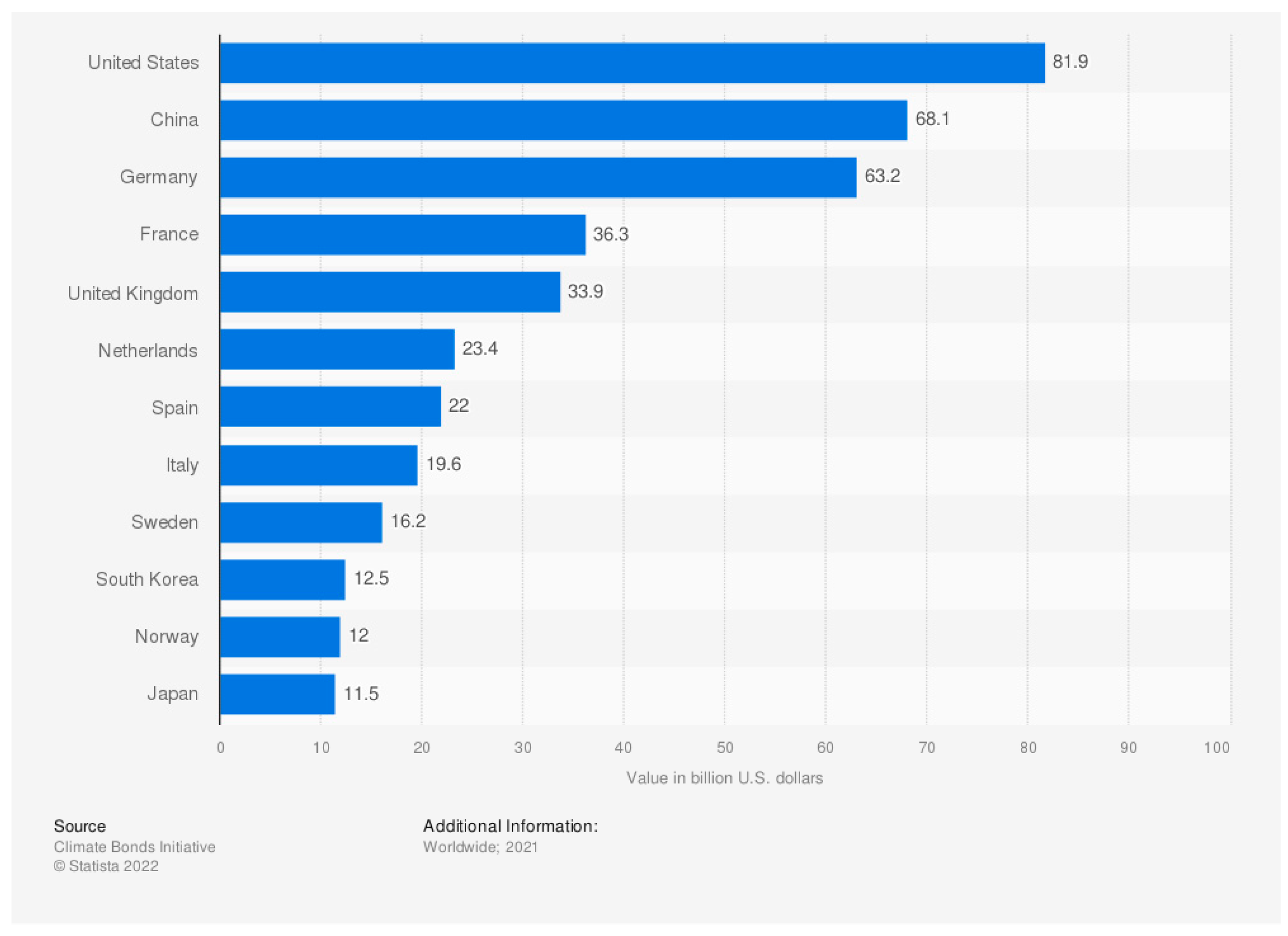
Figure 2.
The Sustainable Finance Framework for Higher Education (H2ESG Framework).
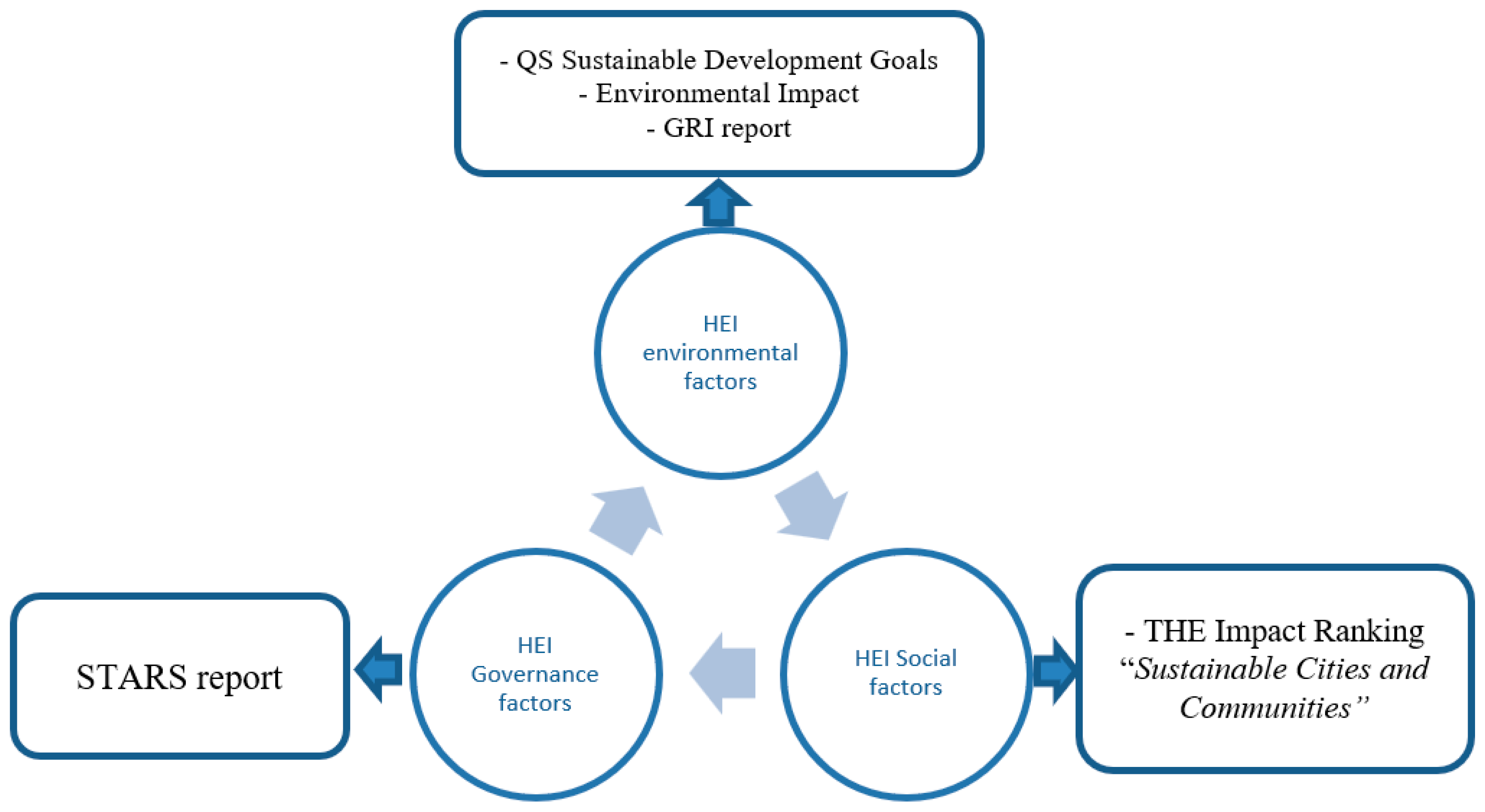
Figure 3.
THE Impact Ranking with the Factor “Sustainable Cities and Communities” In East Asia and Global, The Period of 2019-2022. Note. Blue colour - numbers of universities worldwide, red coulor – numbers of universities in Taiwsn, green colour - numbers of universities in Japan, purple color - numbers of universities in South Korea. From THE web.
Figure 3.
THE Impact Ranking with the Factor “Sustainable Cities and Communities” In East Asia and Global, The Period of 2019-2022. Note. Blue colour - numbers of universities worldwide, red coulor – numbers of universities in Taiwsn, green colour - numbers of universities in Japan, purple color - numbers of universities in South Korea. From THE web.
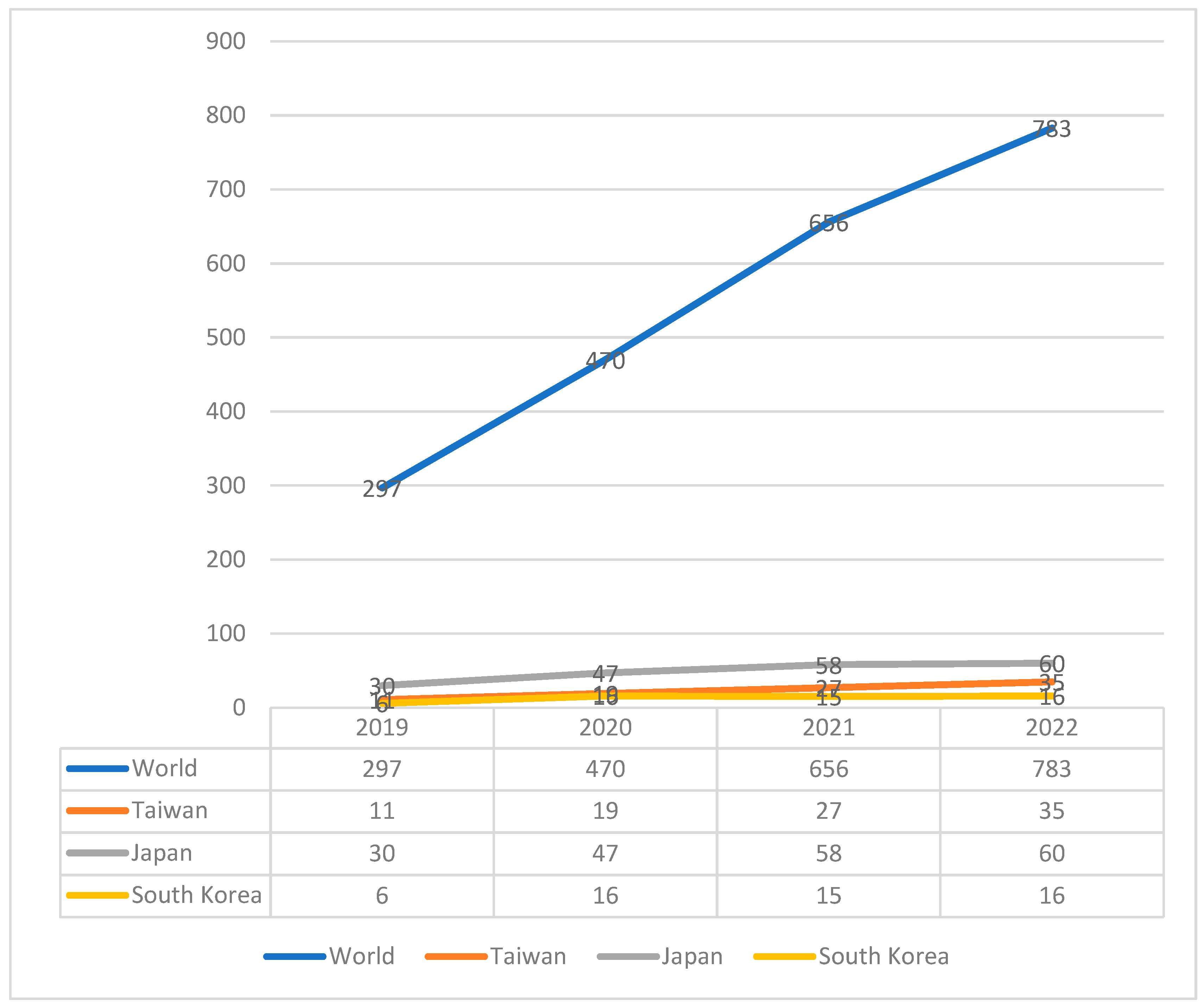
Figure 4.
THE Impact Ranking with the Factor “Sustainable Cities and Communities” in Taiwan, Japan and South Korea, the Period of 2019-2022. Note. Red coulor – numbers of universities in Taiwsn, green colour – numbers of universities in Japan, purple color – numbers of universities in South Korea. From THE website.
Figure 4.
THE Impact Ranking with the Factor “Sustainable Cities and Communities” in Taiwan, Japan and South Korea, the Period of 2019-2022. Note. Red coulor – numbers of universities in Taiwsn, green colour – numbers of universities in Japan, purple color – numbers of universities in South Korea. From THE website.
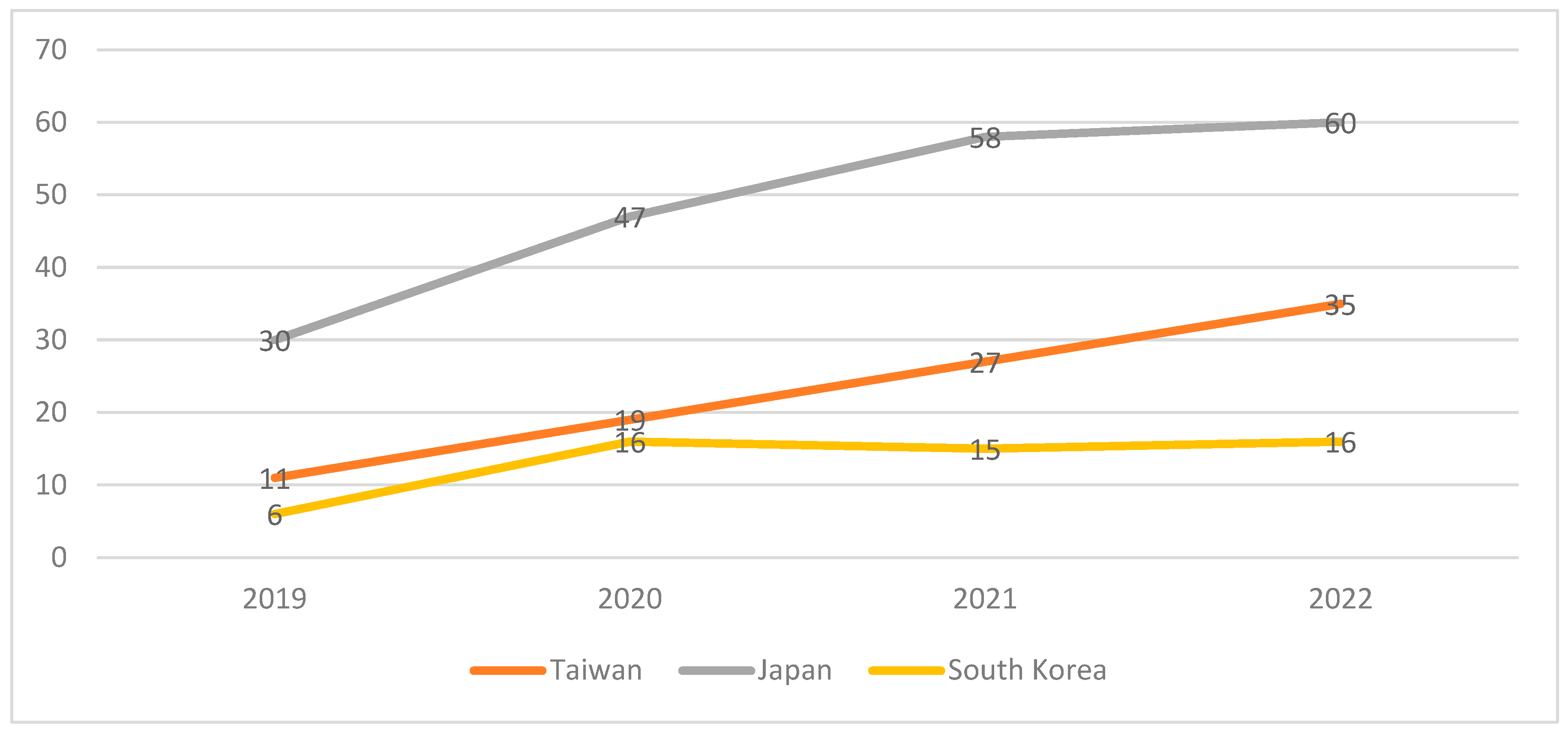

Table 1.
The Sustainable Finance Framework for Higher Education (H2ESG Framework) with the Measurement Components.
Table 1.
The Sustainable Finance Framework for Higher Education (H2ESG Framework) with the Measurement Components.
| H2ESD framework | GRI | QSSDG | THEIR | STARS | |||||
|---|---|---|---|---|---|---|---|---|---|
| Environmental impacts | Environment impact | Sustainable Cities and Communities | Academics | Engagement | Operation | Planning and administration | Innovation | Leadership | |
|
HEI Environmental factors Energy, waste for living values surrounding the campus |
x | x | |||||||
|
HEI Social factors Relationship between the universities and external social entities to reinforce social citizens and social infrastructures |
x | ||||||||
|
HEI Governance factors Internal executive system legislated, operated, controlled, and measured itself meets the stakeholders' needs |
x | x | x | x | x | x | |||
Table 2.
The Longitudinal Statistics of “Sustainable Cities and Communities” Influence Factor in THE Impact Ranking in East Asia, the Period of 2019-2022.
Table 2.
The Longitudinal Statistics of “Sustainable Cities and Communities” Influence Factor in THE Impact Ranking in East Asia, the Period of 2019-2022.
| THE | 2019 | 2020 | 2021 | 2022 | ||||
|---|---|---|---|---|---|---|---|---|
| Number of universities | % | Number of universities | % | Number of universities | % | Number of universities | % | |
| Taiwan | 11/126 | 8.73 | 19/126 | 15.08 | 27/126 | 21.43 | 35/126 | 27.78 |
| Japan | 30/782 | 3.84 | 47/782 | 6.01 | 58/803 | 7.22 | 60/803 | 7.47 |
| South Korea | 6/430 | 1.40 | 16/429 | 3.52 | 15/426 | 3.52 | 16/426 | 3.76 |
| World | 297 | 470 | 656 | 783 | ||||
Note. The database describes the numbers of universities ranked by THE Impact Ranking per total numbers of universities in each country (Taiwan, Japan, and South Korea). From THE website.
Table 3.
East Asian Universities Characteristics in QS Ranking, GRI Registration, and STARS Registration.
Table 3.
East Asian Universities Characteristics in QS Ranking, GRI Registration, and STARS Registration.
| World | Taiwan | Japan | South Korea | ||||
|---|---|---|---|---|---|---|---|
| No | Number of universities | % | Number of universities | % | Number of universities | % | |
| 2022 QS - Environmental impact | 1300 | 12/126 | 9.52 | 21/803 | 2.62 | 28/426 | 6.57 |
| GRI - Environment impact | 778 | 14/126 | 11.11 | 11/803 | 1.37 | 12/426 | 2.82 |
| STARS - Governance | 1088 | 7 | 5.56 | 3 | 0.37 | 0 | 0.00 |
Note. QS Quacquarelli Symonds, GRI – Global Report Initiative; STARS - Sustainability Tracking, Assessment and Ranking System. From QS, GRI, and STARS websites.
Disclaimer/Publisher’s Note: The statements, opinions and data contained in all publications are solely those of the individual author(s) and contributor(s) and not of MDPI and/or the editor(s). MDPI and/or the editor(s) disclaim responsibility for any injury to people or property resulting from any ideas, methods, instructions or products referred to in the content. |
© 2025 by the authors. Licensee MDPI, Basel, Switzerland. This article is an open access article distributed under the terms and conditions of the Creative Commons Attribution (CC BY) license (http://creativecommons.org/licenses/by/4.0/).
Copyright: This open access article is published under a Creative Commons CC BY 4.0 license, which permit the free download, distribution, and reuse, provided that the author and preprint are cited in any reuse.


