
Submitted:
15 February 2025
Posted:
17 February 2025
You are already at the latest version
Abstract
This article postulates that social, emotional and environmental intelligences are interconnected as well as inextricably linked to the principle of relationships. It defines these and goes deeper into explaining the elements of Environmental Intelligence providing real life examples as well as provocative questions. It offers practical and positive examples of how the climate change Titanic may be turned around. Education is seen as the core component of change.
Keywords:
relationships
; education
; environmental intelligence
; competencies
; sustainability
; climate change
; resource depletion
; pollution
; rewilding
; eco-anxiety
; empowerment
1. Introduction
It is easy and right to feel upset, angry and
guilty about the state of our relationship with our planet. The author of this
piece is part of the generation that played a large part in creating the
cumulative, catastrophic crisis in which we find ourselves. For our lifetimes,
we have unknowingly and sometimes deliberately exploited the earth and its
resources not giving much of a thought for tomorrow. Future forecasts on
climate change, resource depletion and pollution are upsetting. They cause
righteous anger from the young and the poor for what the affluent older, richer
generations have done. This should and often does cause guilt in these culprits
of chaos.
It needs to be recognised and “owned”, and the
damage needs to be urgently rectified as much as it can be. Younger and future
generations who have inherited the mess and often have a passion for practical
action to heal the world. There is potential to turn the juggernaut around (or
at least off its current track) if we are smart and active enough to turn the
wheel and put on the brakes.
Fundamentally, the solution lies in relationship –
relationships with the natural world and also with others and with us. These 3
relationships – environment, others and self are intimately connected. We will
not get it right with the natural world unless we get it right with our
neighbours and those the furthest away geographically and with ourselves.
Environmental change comes from and loops back to those other human
relationships.
Our knowledge about relationships in terms of
social and self-intelligence is well established and still developing. But we
seem to have less to guide us in developing and using our intelligence in
relation to our natural world. This article offers an attempt to rectify that.
2. Materials and Methods
This section seeks to briefly unpick what we know
about relationships in terms of ourselves and with others and goes on to
explore their connection with our relationship with our environments. Using
real life examples, it develops a model of Environmental Intelligence and
offers practical examples of how its competences are on display and may be
developed.
2.1. Social and Emotional Intelligence
There is a general recognition that “the ability to
express and manage emotions is essential, but so is the ability to understand,
diagnose, and react to the emotions of others. Psychologists refer to this
knowledge as emotional intelligence, and some experts even suggest that it can
be more significant than IQ in one’s overall success throughout one’s life.”
(Frothingham 2023). We know much about social and emotional intelligence, and
it has had a significant, usually positive impact on human behaviour particularly
in the world of work. As a result, it is a field that has been and is actively
well-ploughed (Thorndike in the early C20, Doll 1935, Wechsler 1939, Gardner
1983, Goleman, Bar-On, Zirkel 2000).
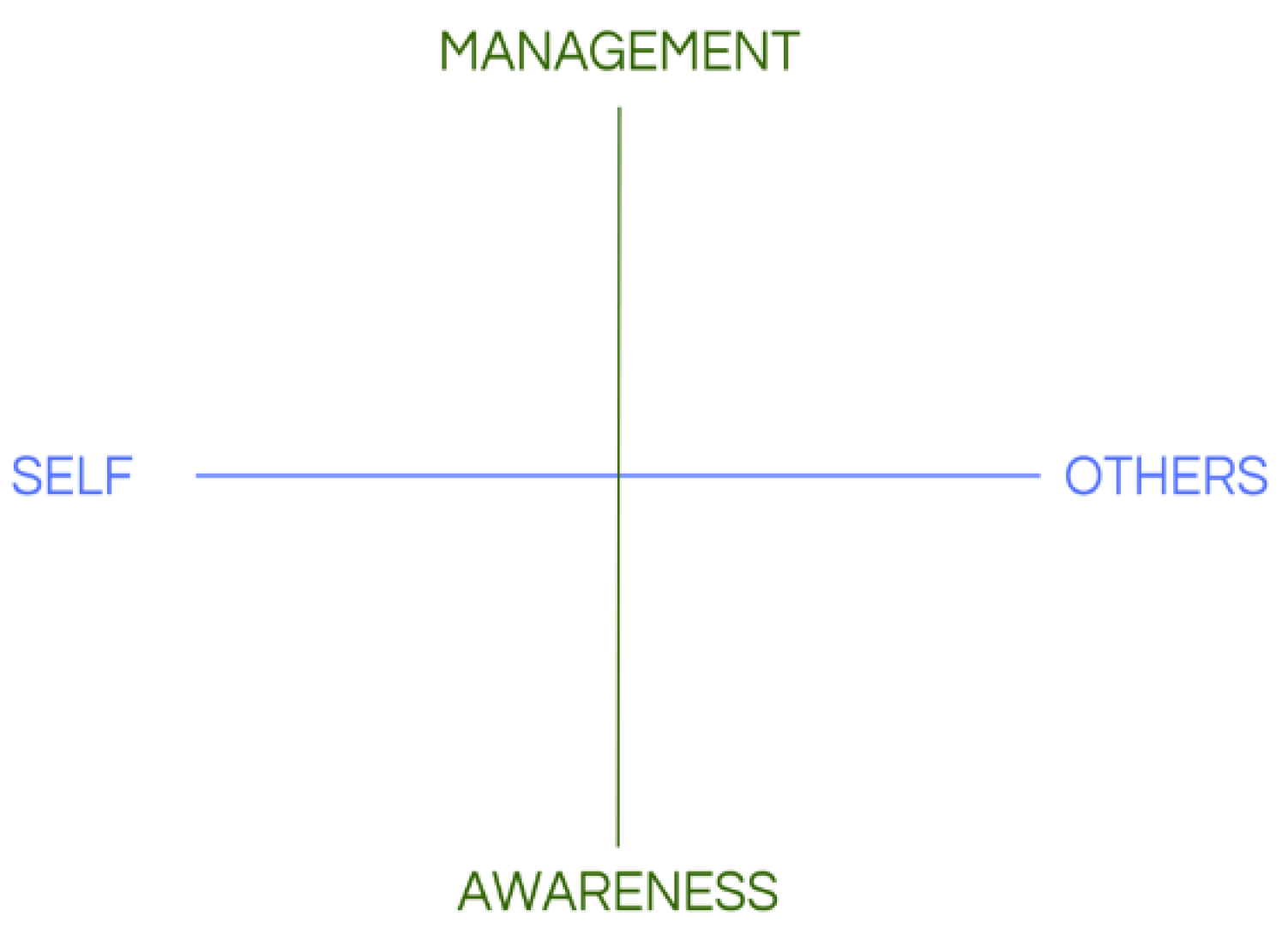
An accepted approach to social and emotional
intelligence is to see 2 axes:
Figure 1.
Model of Emotional and Social Intelligence.
Combined, these generate 4 areas of inter-related
competences:
Figure 2.
Emotional and Social Intelligence Competencies.
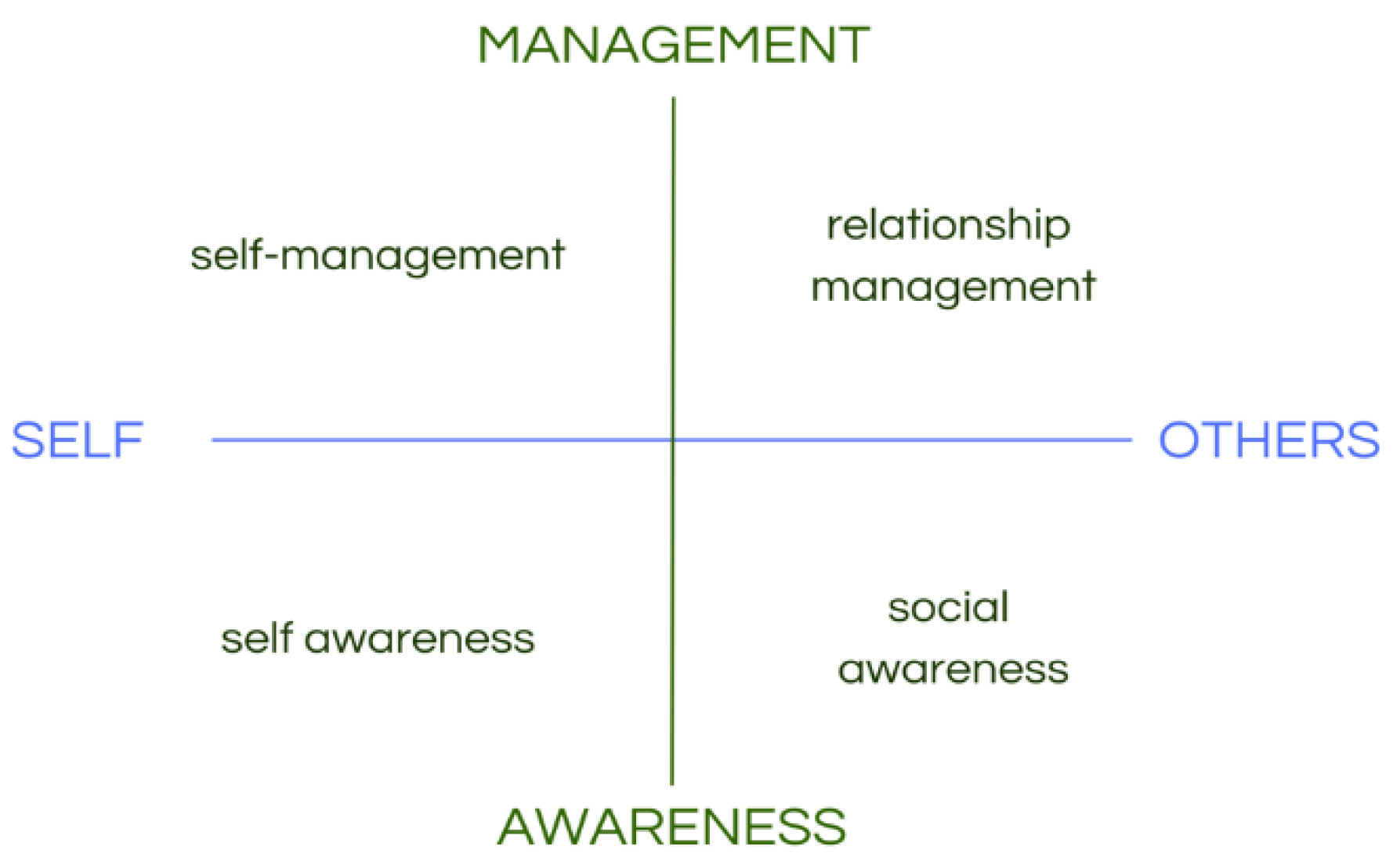
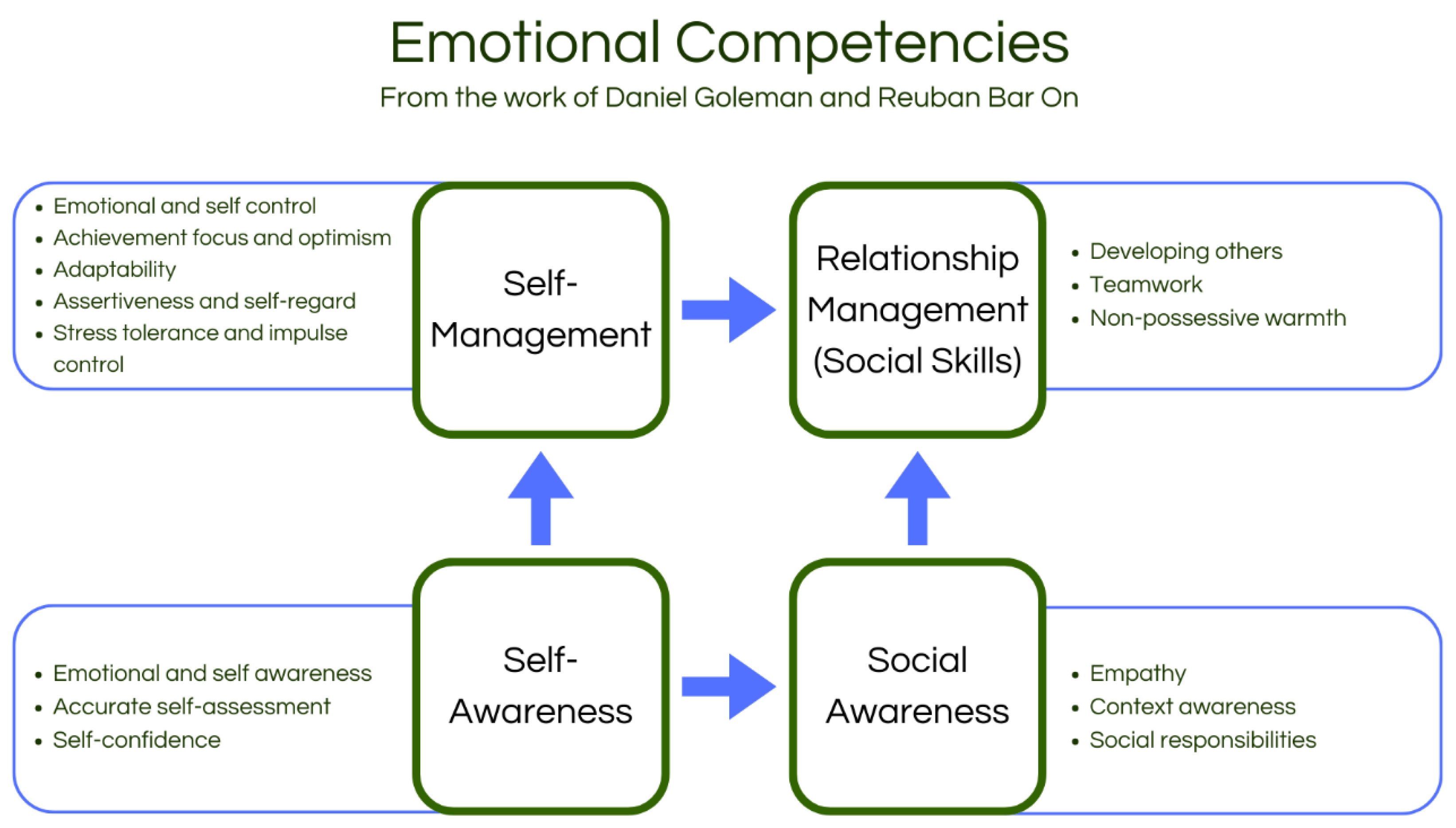
Within each of these four areas, are discernible,
significant yet inter-related competencies. A competency is some
characteristic of a person that is evidenced in patterns of behaviour that
differentiate performance in a given job, role or culture Such behaviour may be
learned (or perhaps may be partly genetic?). They often become habitual and are
usually visible – if looked for. An example is empathy (often confused with
sympathy). Empathy is non-possessive warmth – you want to understand and
support another person but do not take over the ownership of the issue. Empathy
can be displayed in many patterns of behaviour through speech and body language
making it different from sympathy.
Figure 3.
Emotional Competencies.
2.2. Environmental Intelligence
If this is an, albeit simplistic, explanation of
social and emotional intelligence, what about our intelligence in relation to
our natural world? This article takes the view that similar lenses can be used
to both analyse and develop our own environmental intelligence.
Many articulate others, including David
Attenborough, have made the case for our environment being at or near the top
of the human agenda (Gilean 2009) Most of us want to make the right choices as
consumers. But how can anyone individual’s choices make a difference? And, more
importantly, what are the right choices?
McCallum (2017) defines a new way of thinking about
the unprecedented environmental pressures of our day using the concept of Ecological
Intelligence. He offers a compelling argument: that we must think
differently about ourselves and the earth if we are to take seriously the
survival of wilderness areas, wild animals and the human race. He explores the
relationship between humans and nature from both a biological and poetic
perspective, articulating a wild and ethical imperative—an urgent reminder that
we are inextricably linked to the land and that we must not be the creatures of
our own undoing.
Some writers such as Goleman et al. (2012),
referring to Ecological Intelligence,
argue that our consumer thinking about issues such as the environment, health
hazards or child labour has been one-dimensional, focusing on single problems
in isolation from the rest. Our ’green’ awareness is so superficial we often do
more harm than good by ignoring the adverse impacts of the far vaster
proportion of what we buy and do.
Such works as very important but this article’s
preferred term - Environmental Intelligence- recognises that the
environmental is our personal, social and ecological lives
are inextricably inter-twined. As human beings we learn, store and use:
- Knowledge – facts
- Skills – the way we can perform tasks.
- Competencies – those habitual, visible behaviours
Figure 4.
The components of human behaviour.
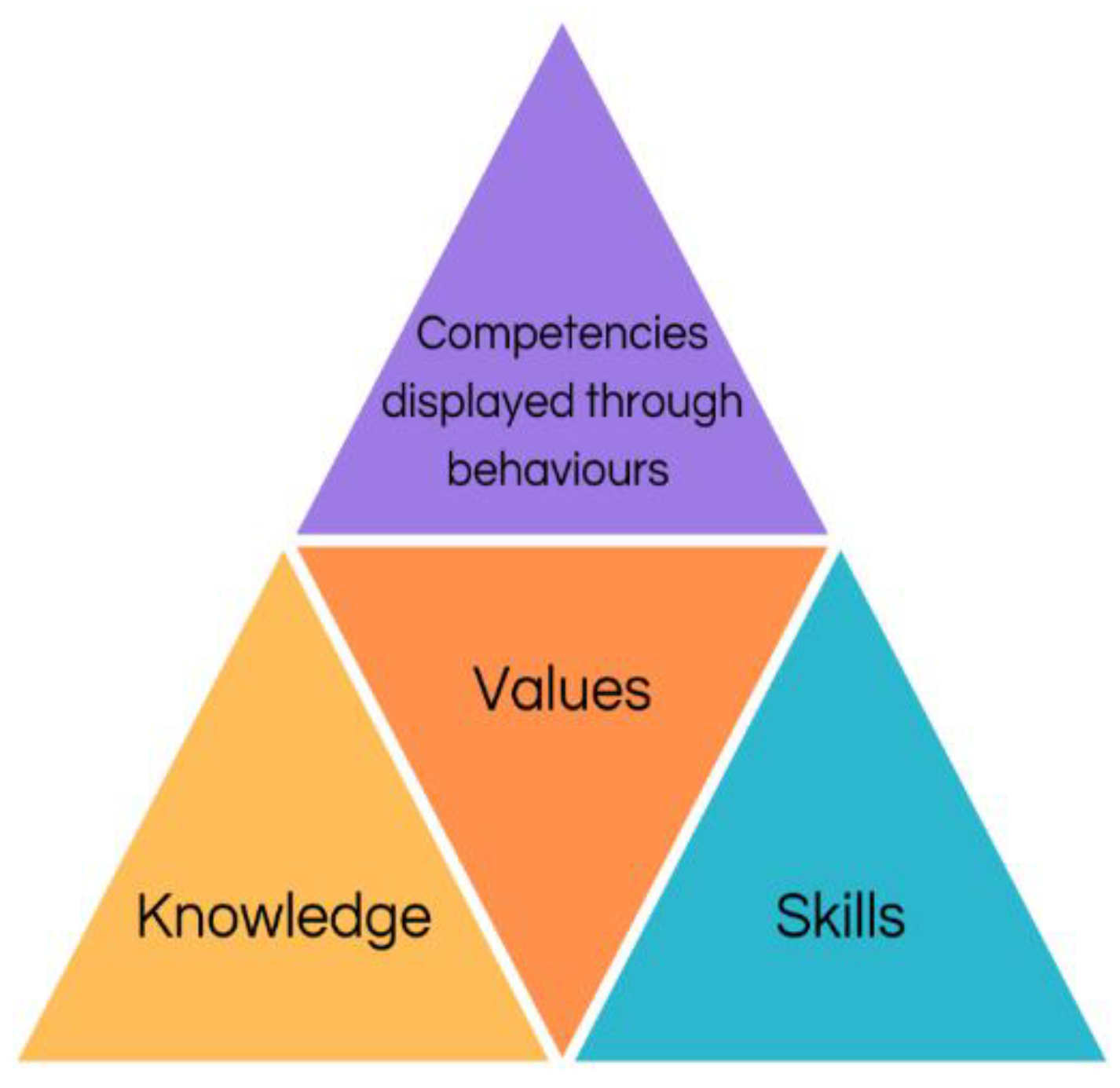
An important starting point is the concept of integrity
meaning what we believe in and think, lines up with what we say and what we do.
This is very difficult, but it is central to of our view on environmental
intelligence. These are underpinned by our values (what we believe in) and
ideally should be watermarked by the tough stuff of integrity.
This attempt to link social and emotional
intelligence to environmental intelligence is shown below:
Figure 5.
Our 3 related Intelligences.
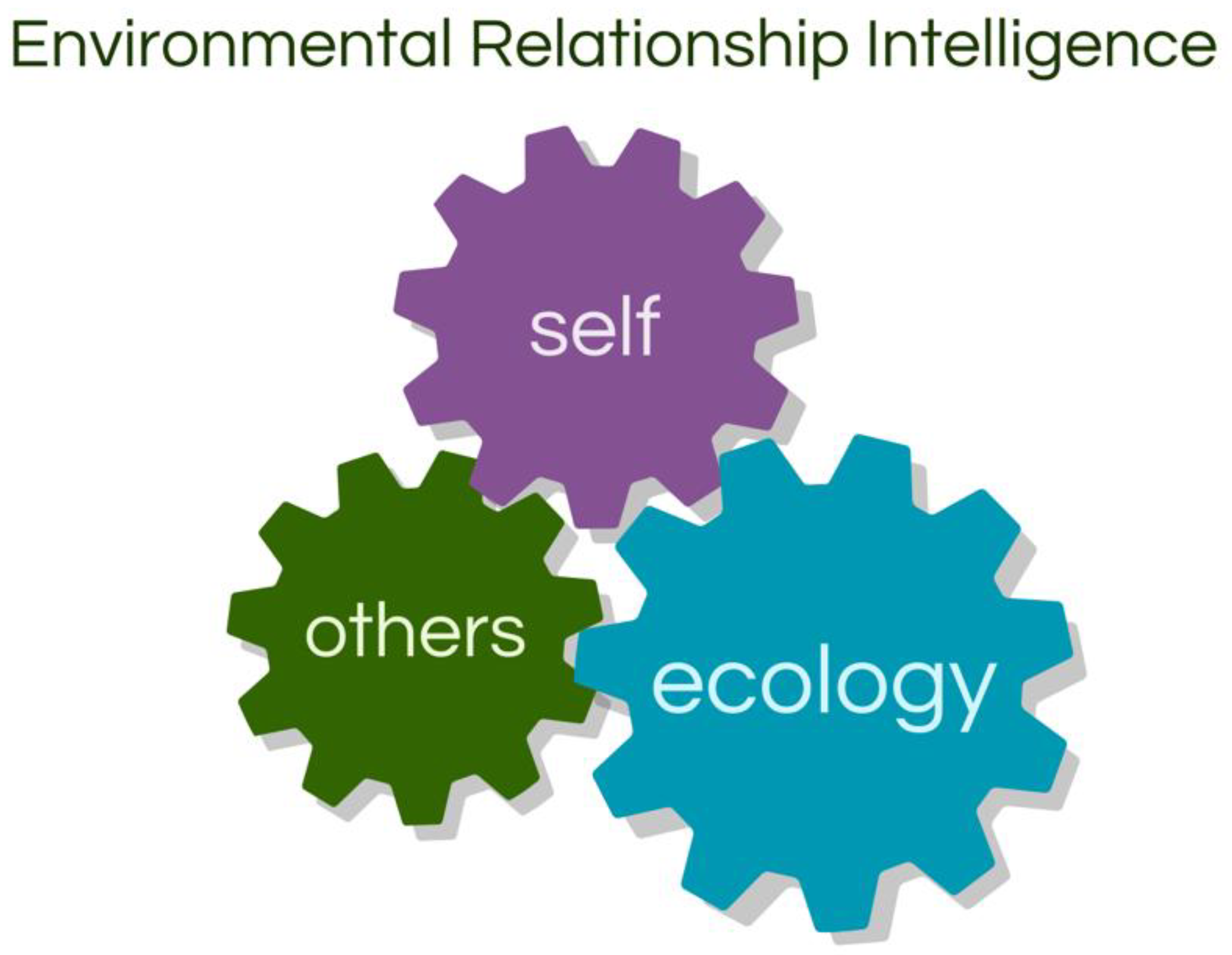
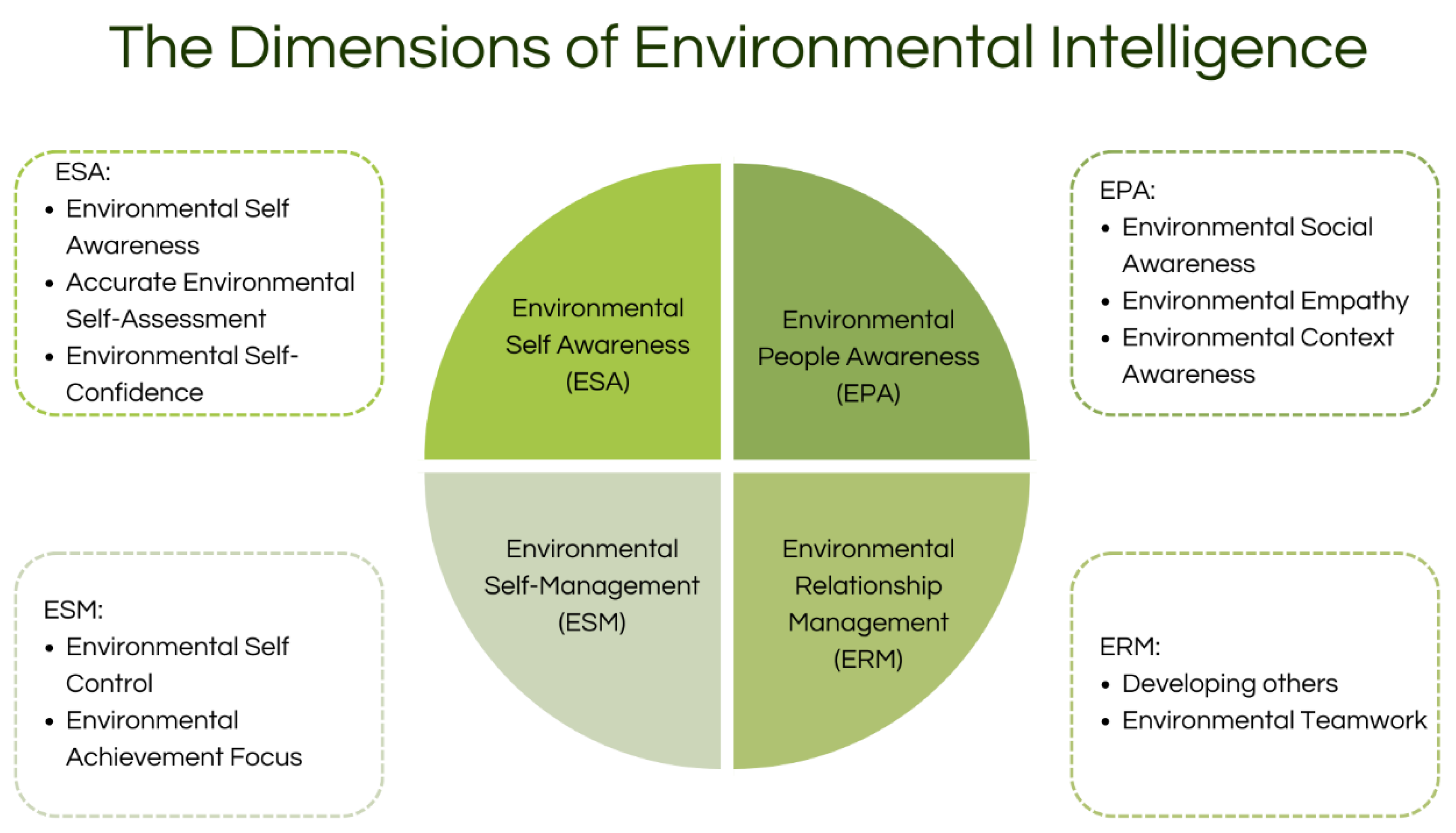
Using the 4 well -researched separate yet
intrinsically linked dimensions we can see Environmental Intelligence in
the same way. It is most important to remember that there is great overlap
between these and in doing one act we use many dimensions. For example, keeping
an Eco-Diary means improving our self-awareness and as we do this we
think and start to self-manage and this in time makes us aware of the behaviour
of others and a desire to share this in some way.
Figure 6.
The Environmental Intelligence Framework.
2.3. Environmental Intelligence in Practice
Every day that we each tread on this earth, we
leave our footprints. We can choose to tread lightly or with heavier pressure.
There are at least 4 areas of our lives where we tread:
- where we live,
- how we travel,
- how we work and
- what we buy.
Figure 7.
Our impact on our planet.
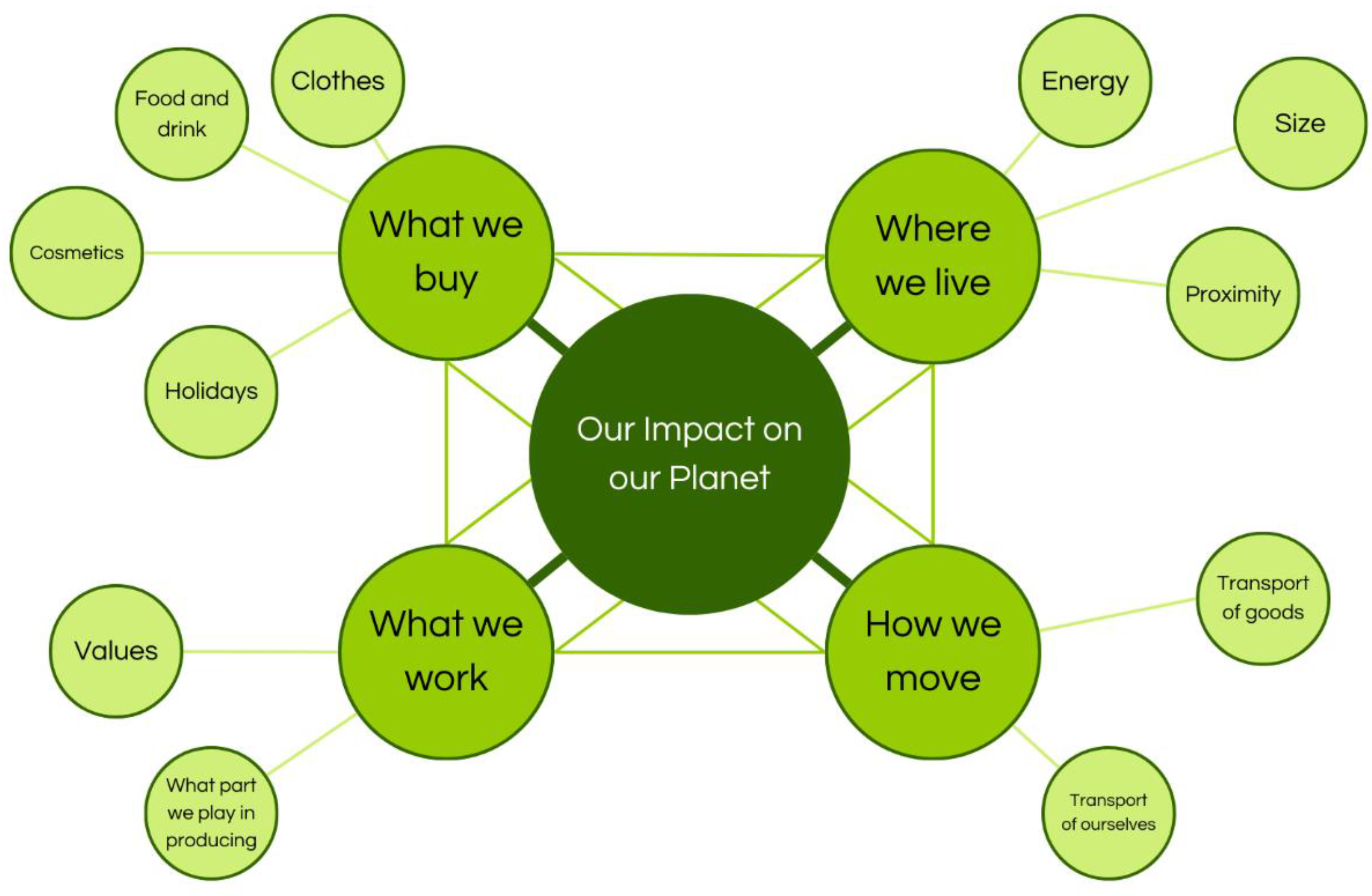
This model (Figure 6) is not all-inclusive
nor complete and that new competencies are emerging in relation to
environmental intelligence. We may well be in a position such that others
control these areas of our lives and change is difficult.
But what can we do in practice using our Environment
Intelligence Framework? Here are some examples:
2.3.1. Environmental Self- Awareness (ESA)
Looking at the competencies in turn gives us some
insights in how they work in practice.
A: Environmental Self Awareness
This entails using and developing our curiosity,
criticality and research skills.
In order to be self-aware about what is happening
on our precious planet we need accurate, up-to date information. Goleman
et al. (2012) calls this radical transparency - the availability
of complete information about all aspects of a product’s history. This is
improving with labelling and use of social media about individual’s experiences
and QR codes and some feel it is about to transform the power of consumers and
the fate of business. Companies will no longer be able to control their own reputations.
For the first time what they say will matter far less than what they actually
do. They will be genuinely accountable.
Arslanalp (2023) et al. in “Data for Greener
World” make the important point that designing effective policies in
relation to carbon emissions requires accurate and reliable data. They examine
offer practical approaches and highlight the value of the IMF Climate
Dashboard Indicators and the need for its extension to all countries.
|
Have you met the Stupendous Swift? The swift is a tiny bird that stays in the UK for only a few months. It sleeps, feeds and mates on the wing and bathes by sailing through the rain. When its chicks are fledged, its meandering begins again through the Mediterranean onto Africa. Swifts breeding in Beijing have a round trip of 26,000 km - over half the circumference of the world. The white throated needletail swift has a top speed of 170km per hour – the fastest bird in level flight (India Bourke New Statesman 231-27 July 2023) What do you think? |
|
Ultra – Processed Foods “Strange as it may seem, food has replaced tobacco as the leading cause of early death globally” (Guardian 13/5/2023) Did you know that…….,much of the food we eat (such as cakes, biscuits and burgers) is UPF (ultra-processed food), engineered so that a balance of sugar, salt and fat is designed to be irresistible (often the ratio of carbs to fats is the same as breast milk). This is called hyper-palatability. It is designed to override our appetites, so we eat so fast we do not notice we are full. UK dentists report more overbites in children because convenience food require so little chewing. It is hoodwinking our senses when we register a big hit of cheese and onion expecting something rich and satisfying but instead get a sad mouthful of starch. Ice cream is too cold to smell so some manufacturers caramel-scent wrappers to prime consumers. Even food that pretends to be healthy may well be UPFs. – nut milks, protein bars, vegan and low sugar-chocolates for example. UPF foods are foods that have undergone complex, industrial processes and are preserved, bulked out or rendered palatable by artificial additives, claims Chris van Tulleken. Some studies link UPF with increased rates of cancer, obesity, depression, dementia, diabetes and inflammatory bowel diseases. Food has replaced tobacco as the leading cause of early death globally. In the USA more people die from illnesses caused by poor diet than were killed fighting in every war in US history combined. In the UK it is equally dire. The average Brit consumes 57% of their calories in the form of UPF and about 8kg of food additive. UK children are not just getting fatter bit also shorter. It is hard to give these addictive foods up. They are convenient and alternatives often take time to prepare and cook and are costly…. did you know that? So, if you are confident that this is true (and how would you know that?) what would you do? |
B: Accurate Environmental Self-Assessment
This involves record keeping, reflection and
honesty. If we are willing and committed, on a day-to-day basis, we can use
a range of techniques to assess how we are doing. Examples are the Eco Diary
Tool (See Appendix A).
C: Environmental Self-Confidence
This means that we develop our self-regard, based
on A and B and have a confidence in seeing ways forward in our
lives.
2.3.2. Environmental Self-Management (ESM)
Again, using the Environment Intelligence
Framework, we can explore in more detail our understanding of what we
can do ourselves.
A: Environmental Self Control – meaning to
pause-think-act.
Although we all want to help the environment, our knowledge of
what are ’green’ choices is often so limited that we can do more harm than
good. But now more availability of information about all aspects of a product’s
history, has the potential transform the power of consumers and the fate of
business. Why does one UK supermarket fly Kent apples
to South Africa to be washed and sprayed with wax and the flown back to the UK
for sale in their stores?
Knowledge is power. By discovering how
to tune your environmental intelligence, we can make better decisions, and a
better world (see Appendix B:
Environmental intelligence in Russia)
B: Environmental Achievement Focus – this is
very much about record keeping and personal goal setting, and rewards,
problem-solving, and motivation.
|
Clothes rail In some countries people are fortunate to have a winter and a summer wardrobe. When the clothes are changed for the season, one idea is to have all the coat hangers facing in one direction. As an item is use, turn the coat hanger round the face the other way and keep it facing that way when putting the item of clothing back in the wardrobe. At the end of the season, when the clothes are being changed, consider giving away those items that have not been used where the coat hangers facing in the original direction. It is now possible to do digital tracking of your clothes as well e.g., “Wearing” “Slowette.com” to prevent overbuying as a part of the Fast Fashion endemic for some in richer nations. Other ideas are buying from Charity shops or “Vinted” “no buy January”, “30 wears” (wearing a piece of clothing at least 30 times to justify its environmental impact |
C: Environmental adaptability
Climate has always been changing. 2024 may have
been hottest year on record. How will we adapt to the catastrophe we are in
already?
|
A World Built on Trash 4 trillion plastic cigarette filters are flicked on the ground annually. 20,000 plastic bottles are sold every second. 2kg of waste is produced every day by the average American. Humans produce waste on a scale never seen before in our history. Much of this waste is shipped at enormous cost from the rich nations to the poor. Those on the margins of society are left to deal with mountains of trash we add every day. Ghazipur landfill in India is a 65-metre-high hill. In the novel “The Years” by Arnie Ernaux (2008) charts the changes in society in the last 60 years or so. The narrator describes the frugal period after the Second World War (from 1945) where “Nothing is thrown away. The contents of the night buckets were used for garden fertiliser; the dung from passing hoses collected for pot plants. Newspaper was used for drying the inside of wet shoes, wrapping vegetables and wiping bottoms”. Then came supermarkets, plastic, and the throwaway society. “People do not question the objects usefulness; they just want to possess them”. Are we coming back full circle? Is a sharing economy growing where we do not need personal ownership? |
D: Environmental assertiveness
Being assertive about our environment links closely
with other competencies such as self-confidence. It requires consciously
building the skills to articulate and lead by example. We need to act with
integrity matching what we do with want we think and believe, with what we say,
and what we do. “See It, Say It, Sort It”. It means building
bridges with others and is very different from aggression which often alienates
others.
|
Changing Regulations for the Worse Since the United Kingdom left the European Union, a large number of the EU regulations to do with environmental standards have changed leaving the UK “facing death by a thousand cuts”* Here are a few: | ||||
| Issue | EU position | Current UK position | ||
| Chemical regulations | The chemical regulation body (EU REACH) bans substances toxic to human health | Dangerous toxins proscribed by the EU continue to be used in the UK | ||
| Pesticides | 36 pesticides banned including thiamethpoxam which is highly toxic for bees | Farmers in UK can use products that have been shown to harm invertebrate and insect populations | ||
| High-carbon goods | The EU has implemented a high tariff on carbon products e.g., cement, iron and steel electricity. Aluminium, fertilisers. Changes begin in 2006 | Not in law in UK and any changes would not happen until 2027 | ||
| Deforestation | EU has legislated to remove all deforestation from its supply chains for producers including wood, palm oil and soy, cocoa, beef, leather and rubber | Britain’s scheme applies only to illegal deforestation | ||
| Battery recycling | Tighter regulations in EU since UK left (digital passport, waste collection targets) | No such recycling policy in place in the UK | ||
|
Genetic modification |
Tight restrictions on GM | Restrictions loosened in the UK for plants and animals | ||
| Social climate fund | This fund protects the most vulnerable from the costs of green transition in the EU | No such support in the UK | ||
| Air pollution | There is an emissions ceiling directive in the EU | Loosening of regulations meaning air in the UK will be allowed to be dirtier than in the EU | ||
| Water quality | Water framework directive has legally binding targets with more regulation planned e.g., for wastewater and PFAS “forever chemicals”, pesticides and pharmaceuticals. | Our rivers and seas will be allowed to be more polluted than in the EU | ||
|
What is your view on this information? How does using our Environmental Intelligence relate to these UK decisions? | ||||
| *The Guardian (20/1/2024) | ||||
E: Environmental Stress Tolerance
The current environmental catastrophe through which we are living, places great pressure on us. This can cause stress or what has become known as “Eco anxiety”. Eco-anxiety is the distress caused by climate change where people are becoming anxious about their future (Coffey et al., 2021). The term ‘eco-anxiety’ is still a poorly understood concept, with many viable definitions; a chronic fear of environmental doom… mental stress of anxiety associated with worsening environmental conditions… anxiety experienced in response to the ecological crisis (Coffey et al., 2021). Watching our natural world change, sometimes combined with feeling personal guilt or witnessing climate indifference from elected powers failing to act with the pace required, can evoke a variety of emotions, from anger and frustration to dread, powerlessness and hopelessness. As the generation that is going to have to deal with the damage and have the most to lose, young people’s anxiety (33.1% of the world are under the age of 20) (Ang, 2021) of the topic of environmental doom is skyrocketing. Even though, eco-anxiety is actively mentioned in the media, there is still a strong lack of research about the various forms of anxieties and about their relation to other psychological impacts of the ecological crisis (Panu, 2020, pg. 1). It is a common assumption that the younger generations are more greatly concerned with global challenges. If this assumption is true, the question of how aware the young people are must be considered, for them to lead the more health-conscious, socially aware and environmentally responsible lifestyle they wish for. This competency of environmental stress tolerance can be developed through many of the other competencies e.g., environmental achievement focus, adaptability and optimism (B, C G)
F: Environmental Impulse Control
It is easy when confronted with large environmental challenges to react on impulse with anger (as mentioned in the Introduction to this article) or wanting quick action and results. It is important that we recognise these impulses but also think about our response and actions carefully whilst recognising the urgency of the need for change.
G: Environmental Optimism
Despite the doom and gloom there is hope. Cop23 led to some albeit fragile agreement among some countries to reduce their carbon emissions. (Natural England carried out “The Children’s People and Nature Survey,” in which ran August 2021, collecting responses from 2,048 children and young people aged 8- to 15-years-old. The main findings included that more than eight in 10 children and young people (85%) agreed that being in nature made them very happy, and 78% of children and young people agreeing that looking after the environment was important to them.
It is possible for each of us to take actions quite quickly that combined can make a big difference. Using our spending power as consumers and voting power as members of an electorate, means we can make suppliers change tack quickly and governments also (although perhaps a bit slower) - witness the rapid demise of diesel cars and increase in electric ones.
H: Environmental Self-Regards
It is important to note where we are in human history. Up until the Industrial Revolution in the UK and elsewhere, humans were in daily touch with nature. They understood it and generally recognised the need to live in harmony with their environment in sustainable ways. Since we moved en masse to develop places we call towns and cities and worked in factories, this has changed and today many people in the world have become de-sensitised to nature – we fear it, or do not understand it, or seek to control it or create artificial re-creational experiences such a parks, wild swimming. We cannot turn the clock back, but we need to recognise that we each have an instinctual passion for life. Wilson called this biophilia (E.O Wilson 1984). When we do stop and observe it appeals to something intrinsic to human desire... an insatiable, limitless and rational and emotional desire for the world and its goodness. It is a curiosity that goes beyond any self-interest. (Bourke 2023)
| Rewilding |
| Some of the work on rewilding in cities lifts the heart. Our modern-day cities might seem to represent our separation from the natural world. In fact, as Ben Wilson (2023) reveals in his re-examination of urban landscapes around the world, nature has always been at the heart of the city. He explores the wild side of cities past, present and future: the middens, abandoned sites and strips of land alongside railway lines. For much of history, wild patches in cities provided essential food, fuel, medicine and places of recreation and escape for city-dwellers, and the dividing line between city and countryside was blurred. Even our post-industrial cities are much wilder places that we imagine, with booming animal and plant populations - if we know where to look. He argues that on today’s urbanised planet, natural forces - be they floods, storms, droughts or pandemics - look set to determine the future of our cities. In a time of climate crisis, cities that once built walls and towers to defend against attack now have to become greener to protect themselves from external threats. |
J: Environmental Self-Actualisation
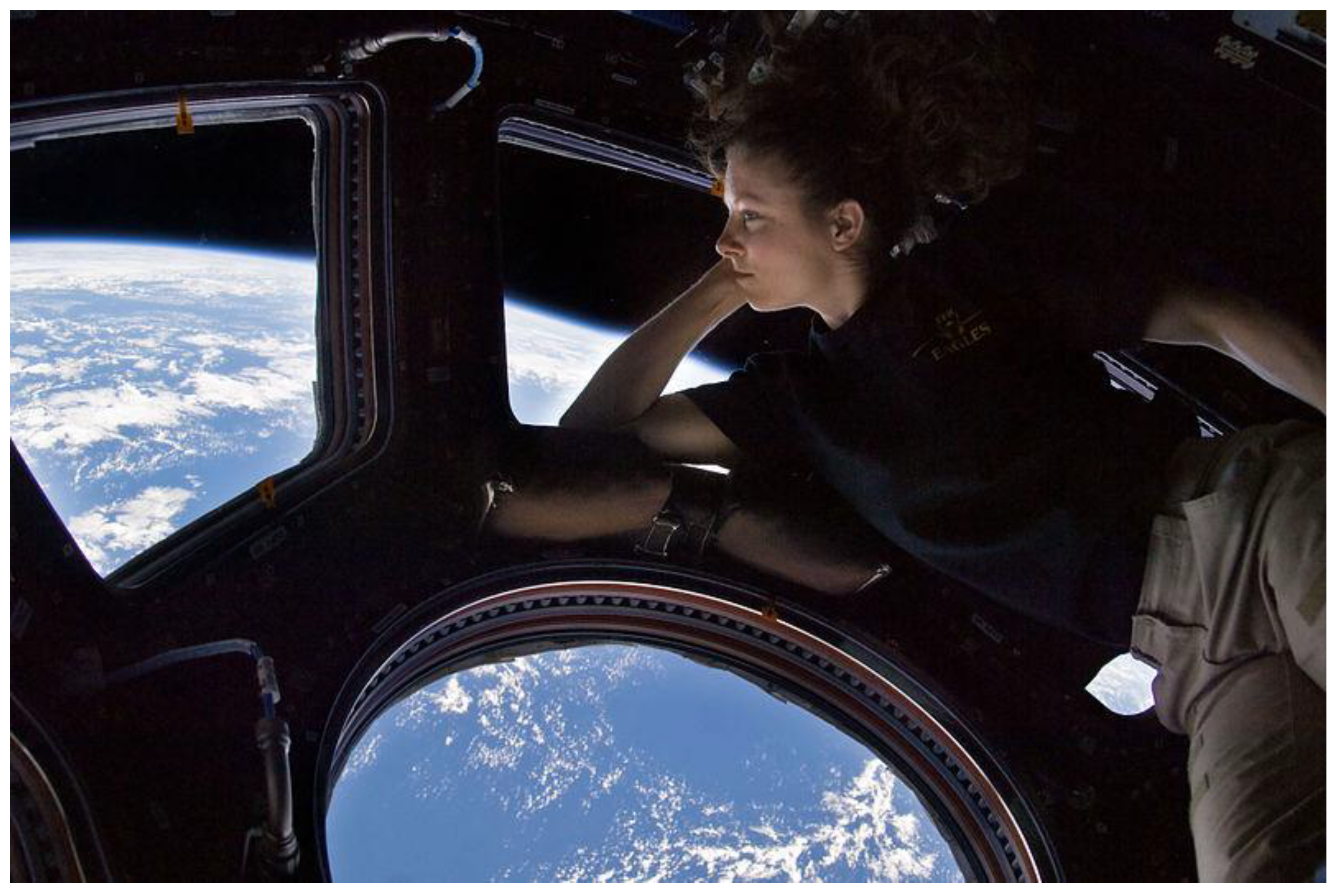
It could be argued that raising our own levels of environmental intelligence leads us closer to self-actualisation (Maslow) – to become the best people we are designed to be. Such yearning can be radicalising. It is a passion that resists fatalism and defies the odds (Seymour R (New Statesman 21-27July 2023). Awe and wonder in response to the environment are part of this and a great example of this is the concept or overview in relation to astronauts.
| Overview | |
| English astronomer Fred Hoyle wrote in 1948 that, “once a photograph of the Earth, taken from the outside, is available, a new idea as powerful as any in history will be let loose”. Author Frank White, who in the 1980s coined the term overview effect after interviewing many astronauts, said that the overview effect is “beyond words”, requiring experience to understand. He said that astronauts’ very first views of the planet were generally very significant, adding that some experience the effect “in a moment” while in others it grows over time; and generally, that the effect “does accumulate”. The overview effect is a cognitive shift reported by some astronauts while viewing the Earth from space. Researchers have characterized the effect as “a state of awe with self-transcendent qualities, precipitated by a particularly striking visual stimulus”. (Yaden et al. (2016)) The most prominent common aspects of personally experiencing the Earth from space are appreciation and perception of beauty, unexpected and even overwhelming emotion, and an increased sense of connection to other people and the Earth as a whole. The effect can cause changes in the observer’s self-concept and value system, and can be transformative. Yaden posited that the overview effect triggers awe through both perceptual vastness (like seeing the Grand Canyon) and conceptual vastness (like contemplating big ideas like infinity). | |
 |
Yaden et al. (2016) write that some astronauts viewing Earth from space “report overwhelming emotion and feelings of identification with humankind and the planet as a whole”. Voski (2020) demonstrated a marked influence on astronauts’ environmental attitudes and behaviours, and a new level of environmental awareness and consciousness. |
| Not all astronauts experience the overview effect. Further, While distinguished experiences in low Earth orbit where the planet takes up most of an astronaut’s view, from experiences on the Moon in which one sees the whole Earth “against a backdrop of the entire cosmos”. He described a “big difference” between professional astronauts, who are focused on their missions—versus people who have recently been going into space “with an intention to have an experience” and who may already be aware of the overview effect.[11] |
 |
| After Apollo 8 astronaut William Anders‘ December 1968 Earthrise photograph of the Earth from lunar orbit, the Apollo missions were credited with inspiring the environmental movement, the first Earth Day being held in April 1970. Hoyle said that people suddenly seemed to care about protecting Earth’s natural environment (although others attribute that awareness to Rachel Carson’s 1962 book Silent Spring and reactions to several environmental disasters in the 1960s.[1]) William Shatner (Blue Origin NS-18, 2021) said immediately after landing that “everybody in the world needs to do this. ... The covering of blue was... the sheet, this blanket, this comforter of blue that we have around us... And then suddenly you shoot through it... as though you whip off a sheet off you when you’re asleep, and you’re looking into blackness, into black ugliness, and you look down, there’s the blue down there, and the black up there and it’s... Mother Earth and comfort, and there is—is there death? I don’t know”. | |
2.3.3. Environmental People -Awareness (Epa)
Environmental Social Awareness – this involves listening, articulating and engaging in dialogue (Foucault called this “reciprocal elucidation” and being prepared to change your mind instead of looking to justify your own pre-held views), allowing people to reflect on their own learning in the light of divergent perspectives and developing questions especially open ones.
- Environmental Empathy – empathy means not taking ownership of others’ environmental responsibilities but rather empowering people to make the decisions to change their own lives in relation to the natural world. It is sometimes called non-possessive warmth.
- Environmental Context Awareness – it is important to see if others are able to locate environmental issues in the context of economic impact and cultural awareness. If we were to stop sending our trash to Kenya or buying cheap fast fashion goods from China, would we help create other jobs for those whose livelihood depends on processing our rubbish?
- Environmental Social Responsibility. The big issue of social justice underpins all of these environmental issues. The rich minority create the environmental problems that impact most on the poor majority.
2.4.4. Environmental Relationship Management (Erm)
- Environmental Development of others – Developing others in terms of the environment means influencing others in ways that do not alienate but rather empower. It involves effective, knowledgeable, persuasive communication. In short, it is education.
| Learning from Sustainable Menus |
| A Michelin Green star and sustainable restaurant in London, stocks an apple and hibiscus gin on their menu and, to reduce wastage, they contacted the supplier to ask for the apples used in the distilling process to be sent along with the gin. The restaurant then uses the old apples to make an apple sauce to serve with the venison. Another also has a sustainable menu. The first course is bread and butter, and the last course is an ice cream and biscuit made from the unused buttermilk from churning the butter, and leftover wheat flour from making the bread - a full circle menu again not wasting any ingredients. This seems to be a growing trend in some areas. |
- B.
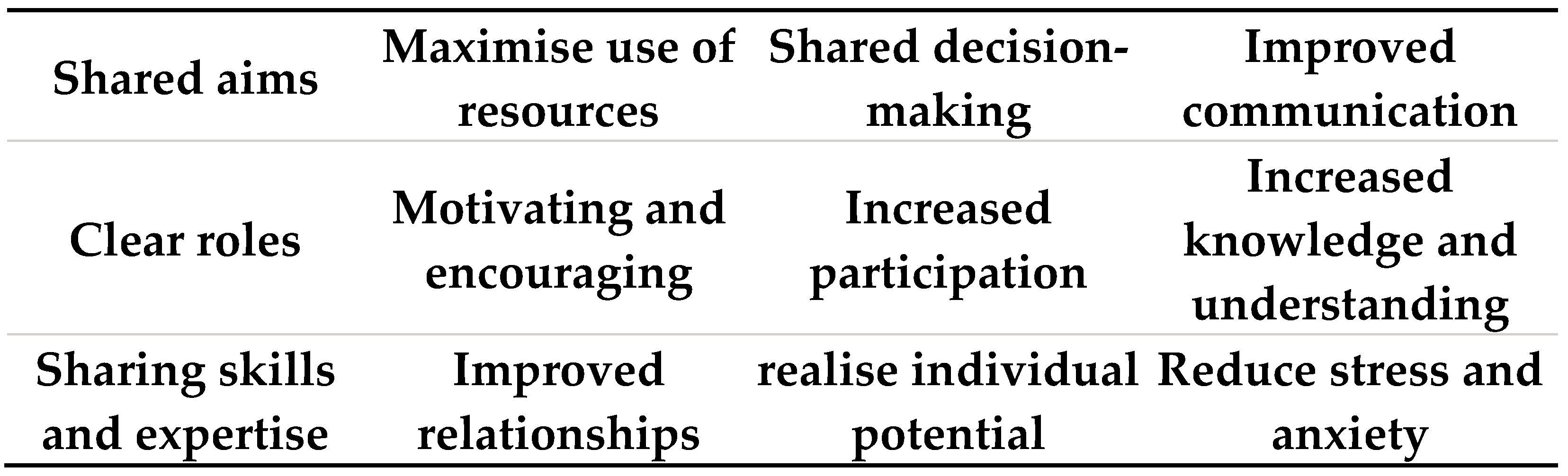
- Environmental Working with others (teamwork) – Effective teamwork is much more powerful than individuals seeking to change others. Campaigns, and lobbying are best done through teamwork as evidenced by Human Scale Education (humanscaleeducation.com).
Figure 8.
Potential Benefits of Teamwork in Environmental relationship management to make a difference.
Figure 8.
Potential Benefits of Teamwork in Environmental relationship management to make a difference.
As humans, Earth is the only home we have. Yet we do not seem to care and continue to exploit it. All the environmental issues we hear on the news may seem like they are just environmental issues, but they are hundreds of years’ worth of human actions and influence. Activists have continuously tried to vocalise the issues of sustainability for many years, such as David Attenborough and Greta Thunberg. These two, and many others, are only a few of the many activists who have worked tirelessly on campaigns to promote sustainability. They have inspired countless others to join their cause and fight for a better future for the planet. Their efforts have helped to raise awareness about the importance of sustainability, and the urgent need for action to protect the environment. This is perhaps, in turn, leading to a shift in public opinion, with more and more people now recognising the need to reduce their consumption and live more sustainability.
An example of a campaign that continues to need support is healthy eating. To be impactful this may need pressure from campaigners for:
- legislation to limit marketing of unhealthy food - especially to children,
- agreement and checking that the food served in institutions such as hospitals, prisons and schools must be healthy.
- warnings about ultra processed food in nutrition guidance (the NHS Eatwell Guide),
- the use of technology to tell us what actually is in what we are eating and from where it has come
| QR Codes and Product Tracing |
| Different studies have been made to assess the effectiveness of QR codes as a means of conveying labelling information and their use as part of a food traceability system. In a field experiment, it was found that when provided free access to a smartphone with QR code scanning app, 52.6% of participants would use it to access labelling information. A study made in South Korea showed that consumers appreciate QR code used in food traceability system, as they provide detailed information about food, as well as information that helps them in their purchasing decision. If QR codes are serialised, consumers can access a web page showing the supply chain for each ingredient, as well as information specific to each related batch, including meat processors and manufacturers, which helps address the concerns they have about the origin of their food. |
3. Discussion: What Should Be Our Priorities?
This Framework for Environmental Intelligence that has been explained and explored, suggests a number of priorities that are urgent, bearing in mind the state of our planet. We focus on 4 main areas that seem to emerge from a rich soup of ideas:
- Bottom Up and Top-Down
There are many complex issues that intertwine and there is a danger of losing a focus on what to change, in what order and how to improve what we do. Underpinning all of this are large moral issues for our world of equity and social justice. Certainly, there is a desperate need for a consensus and, where necessary, legislation at the highest level- nationally and globally.
Just as, perhaps even more important, are grassroots movements. We should not underestimate the power we have as individuals but even more so in like-minded groups, hence the need to understand and grow our own environmental intelligence. Satish Kumar offers a useful image of the mighty river Thames that starts as a few trickles of rain hitting the ground at Thames Head in Gloucestershire and becomes tiny streams, then joins other small rivers, all the time joining more tributaries, inexorably moving downwards through the force of gravity until it becomes a mighty powerful river in London and beyond and joining the North Sea which connects with the seas and oceans of the world. We can be that river for change.
- Accurate information
Knowing the facts is essential to making informed decisions that help our planet. Labelling and making good use of technology are vital either through legislation or, even better, by suppliers doing this themselves. Consumer pressure – US - can make this happen. There are some signs that this is happening. But it is not easy to know what the best environmental decision is to make. For example, look at our understanding the complexity public toilets. Which is better in drying our hands after washing them - paper towels, cloth roller towels, air driers?
- Affordable alternatives
It is important that, as the purchasers we know where more ethical goods and services can be found from (local) producers in restaurants and shops. Technology that is trustworthy again can help but we need to use our environmental intelligence and be inquisitive. This takes time and energy and may not be the cheapest option. We need to be alert to woke washing (practices in business that provide the appearance of social consciousness without any of the substance).
- Education
It is clear that the efforts of many activists are having an impact and have helped to drive change on a global scale. However, the change must include start young people in order to be sustainable. However, nearly 47% of national curriculum frameworks of 100 countries reviewed had no reference to climate change and about 40% of teachers are confident in teaching the cognitive dimensions of climate change but only one in five can explain well how to take action (UNESCO, 2021, pg. 2). Therefore, it is essential to invest in the education system, ensuring that the environmental curriculum is prominent for all and that teachers are confident and equipped with the correct information to teach young people the importance of sustainability and what to do. This can help to empower them to become the agents of change and create a more sustainable future.
The compulsory school curriculum in England (The National Curriculum) does not do justice to raising the environmental intelligence of young people. It appears usually in separately taught and learned subjects such as Biology and Geography but, in reality, our understanding needs to be across almost all disciplines involving for example politics, economics, sociology health, psychology, history, geography, and biology. Moreover, sustainability is an area to be taught through actions, not just words.
When looking at education for sustainability, it is important also to consider organisations outside of schools that provide opportunities for students to join the fight against climate change and sustainability. There are organisations and programmes in which young people can take part. There are many examples in the UK:
| The Duke of Edinburgh’s Award, also known as DofE, is a non-competitive, personal challenge open to all young people aged 14-24. This scheme runs in schools, colleges, youth and sports clubs, prisons and young offender institutions, hospitals, and many more across the UK (The Duke of Edinburgh’s Award, no date). The programme helps young people to build life-long belief in themselves, by supporting them to take on their own challenges, follow their passions and discover talents they never knew they had The Duke of Edinburgh is unique to each participant and their passion. Many participants have used their Volunteering section to focus on the environment and climate change, but the theme of climate change can be used for the Skills, Expedition and Gold Residential too. Within the Volunteering section, participants can take part in the Royal Society for the Protection of Birds, also known as RSPB’s Wild Challenge, to take part in practical activities, or become an Energy Envoy with the National Energy Foundation in order to help others in the community to use energy more wisely or raise awareness about the impact of climate change or the impact of plastic waste in their school or organisation Within the Skills section, the DofE provides a 13-week template on researching environmental issues that participants can follow, or they can investigate the environmental impact of the food industry and try making a range of tasty vegan meals or tell others about the importance of environmental sustainability through a range of media such as radio broadcasts, blogs, films or writing articles. Within the Expedition section, participants can consider how to conduct their expedition in a sustainable way to promote the fight against climate change but choosing locations close to home to reduce travel and emission or plan a plastic free expedition. SOS International (Students Organising for Sustainability International), is an organisation that supports student and youth groups globally to lead on sustainability and social justice. They do this by:
|
Forest Schools (as, for example, in Norway, Estonia, Sweden and increasingly in Egland), can provide a child- centred inspirational learning process, that offers opportunities for a holistic growth though regular session. They take place in a woodland or natural environment to support the development of a lifelong relations between the learner and the natural world. There are also ideas in place to protect forests and woodlands. Beach schools can also play an important part.
| The Danish school putting sustainability on the syllabus |
| A dozen children are sitting in a circle when the bell rings. Instead of rushing to their next class, the children close their eyes. “Raise your hand when you can no longer hear a sound,” says their teacher, holding a pair of bronze cymbals — the kind you might find in a Buddhist temple. One by one, their hands go up. At the Green Free School (Den Gronne Friskole), in Copenhagen, educating children for a world affected by climate change begins with putting them in the right frame of mind — literally. Classes here include urban farming and often start with mindfulness training. “We thought about what kids need to learn to take part in the green transition we’re going to go through,” says Phie Ambo, a Danish filmmaker who founded the school in 2014 with American translator Karen MacLean. “They need to learn to be courageous and take risks. And they need to learn some basic things about the planet and how we as human beings exist together. I couldn’t really see that happening in the Danish school system.” Unlike the country’s regular state-funded schools, the Green Free School — which has 200 pupils aged six to 15 — puts sustainable living at the heart of its syllabus. At first glance, there’s nothing unusual about the Green Free School. It occupies four inconspicuous buildings in a post-industrial neighbourhood southeast of Copenhagen’s centre. Only a woodshed flanking a paint-daubed playground hints at a different kind of institution. Its main building — made entirely of sustainable materials — houses a workshop where pupils learn to sew and use materials such as wood, clay, wax, felt, metal, and plastic. They also learn to compost, repair bicycles, and collect rainwater. In shaping the syllabus, founder Ambo drew inspiration from “systems thinking” — a way of looking at the world in terms of its underlying patterns and interrelated systems. Pupils are encouraged to think about these systems through time spent outdoors exploring the world and gaining hands-on experience growing vegetables, while learning about edible plants and climatic conditions. One 12-year-old pupil said she was “a little nervous about the future” because of the climate crisis, but felt she learned a lot at the school. According to deputy principal Suzanne Crawfurd, the school’s teaching method combines “project-based learning and design thinking.” In other words, you won’t see teachers at blackboards or children in front of screens. Instead, they do hands-on projects that are supervised by several teachers and span different subjects. For example, the children might learn how to forage edible mushrooms, then practice drawing them, before heading into the kitchen to make mushroom soup. Children at the school take part in hands-on projects that span different subjects. Despite its alternative approach, setting up the school was easy, Ambo says. While most schools in Denmark are publicly run, anyone can set up a private “free school,” with the state covering about three-quarters of its costs and the rest being made up by fees. Eco-friendly lessons Tuition at the Green Free School costs 2,600 DKK a month (about €350, $380) — and it sets aside at least 5% of its budget to provide bursaries to children whose parents can’t afford the fees. That means its pupils come from “a wide range of socioeconomic backgrounds” in Copenhagen, says Ambo. By law, a “free school” must follow the national curriculum. In addition to learning to read and write, they study history, maths, and science. But otherwise, it’s permitted to devise its own syllabus, allowing the Green Free School to teach subjects like urban farming and greenwashing. “They [the pupils] need to learn to grow their own food and they need to be able to see through companies that claim they are sustainable — because we don’t have time for that,” Ambo says. The Danish Green Free School isn’t the only educational institution in Europe with an “eco-friendly syllabus.” Berlin’s Hagenbeck high school, for instance, teaches students about the importance of species and ecosystems, successfully incorporating biodiversity throughout its hands-on curriculum. Ambo says she hopes the Danish school will inspire young teachers to apply its approach in other schools in a country where climate change is becoming a growing political focus. Last December, the Danish parliament passed a climate law committing the country to reduce carbon emissions to 70% below 1990 levels by 2030. Green transition and its challenges Still, the school’s founders have faced hurdles. The site that Ambo and MacLean chose for it was polluted with chemicals used to clean ships — a drawback they turned to their advantage. “It used to be one of the most toxic places in Copenhagen, but we decided to make it part of the curriculum,” says Ambo. The school’s inaugural intake of 43 pupils duly learned “what kind of trees and plants can remove chemicals from the earth and how to live in and transform places that are tainted by the old industrial way of thinking.” While the school provides more structure in its teaching today, Ambo admits it isn’t ideal for children with severe learning difficulties. Moreover, its students don’t sit exams. “It’s definitely not for everyone,” Ambo concedes. “Some parents think it sounds good and then they realize there won’t be any tests or exams and withdraw their kids.” At 15 pupils move on to further education at other schools, where they usually gain formal qualifications. Freed from learning geared toward telling examiners what they want to hear, the school aims to equip students to draw their conclusions about the world. But it does have a clear aim of where those conclusions should lead. “We’re saying to the students, ’Be critical, think for yourself, and do what you want — but we want you to make the green transition,’” says Dorthe Junge, principal of the Green Free School. “That’s a challenge.” |
| Wales showing the way |
| The National Curriculum was first introduced in 1988 before on-line shopping, Google and the Cloud. Now, asserts the Welsh government, the world of work is different, technology is different, society is constantly changing. A new curriculum that was rolled out in 2022 that aims to prepare young people to develop higher standards of literacy and numeracy, to become more digitally and bilingually competent, and to be confident, capable and compassionate citizens – citizens of Wales and citizens of the world. With its integrated progressive approach, the curriculum areas bring together familiar disciplines and encourage strong and meaningful links across them. Included in this is responsibility to the environment |
4. Conclusions: So, What?
It is vital that people, especially children, are positive about their future. We need to be agents of change and not victims of change. Eco-anxiety is a real problem, and it is important that we all have hope and are empowered. This involves each of us understanding and consciously developing and improving the elements and the whole of our Environmental Intelligence and its 4 inter-related domains and competencies within us. That is our individual responsibility as well as our social responsibility. And this is more urgent than it has ever been.
Figure 9.
Astronaut Tracy Caldwell Dyson “Earth gazing” in the Cupola module of the International Space Station.
Figure 9.
Astronaut Tracy Caldwell Dyson “Earth gazing” in the Cupola module of the International Space Station.
In the important book “Small is Beautiful: A Study of Economics as if People Matter” published in 1973, E F Schumacher concludes:
“Everywhere people ask, “What can I actually do?” The answer is as simple as it is disconcerting; we can, each of us, work to put our own inner house in order. The guidance we need for this work cannot be found in science or technology. The value of which depends on the ends they serve; but it can still be found in the traditional wisdom of mankind”.
Appendix A

Table A1.
A Case Story: Anna’s Life In London – Eco Diary Tool.
| Area | Subject | Dilemma | Action | Justification | Benefit to me | Cost to me |
| Travel | Flying | Go away or not | Combine trips to fly less, off-set CO2 emissions with donation to Tree Sisters, take other forms of transport where possible | Using less CO2 and airmiles, offsetting when I do | Train, you see more of a country than plane, fewer flights cost less |
Less trip flexibility more work to arrange combination. trips, trains can be more expensive and take much longer so I need to get a flight instead |
| Getting around London | TFL/cab/walk | Walk where possible, then TFL, the cab if I must | Using less resources and contributing to less congestion by walking. If further away than TFL and its cheaper and more eco than cab. Cab if TFL is cancelled or much longer | Better for my health to walk. (more D3, exercise, fresh air and trees), cheaper, sometimes quicker and more reliable. TFL (Transport for London) saves money as opposed to cab |
Sometimes for time consuming, not always possible with heavy bags. Tfl can be unpleasant on hot sticky days or aa rush hour or not running so sometimes resort to a cab |
|
| Travel outside of London | Train/car | Train sometimes, or car share electric car. I share a car and we lease as a friendship group | Car sharing is more eco than private car ownership. It’s good in rail strikes. Good in petrol crisis | Electric car is cheaper per trip than train and convenient as long as there are chargers. EV is cheaper per trip than a train |
Not enough chargers wastes my time, trains are very expensive |
|
| Health | Period products | One use or reuseable | I use a washable moon cup that is usable indefinitely, and period proof pants and reuseable pads which last a year or two. Or organic non-bleached products if I do use traditional | Cutting out the one-use items which go to landfill which don’t biodegrade and have a CO2 and water use footprint to produce | The moon cup is cheaper for me in the long run. and it never runs out, holds more liquid. My health has improved since I stopped. using products containing bleach and chemical scents. |
Storing used products when I’m out inconvenient. If I come on unexpectedly I need to resort to buying more traditional products, the more organic and natural versions of which cost more than ones containing bleach and chemical scents |
| Hot yoga | Hot yoga or regular yoga or other exercise | Even though it uses heaters to generate heat all day I choose to have a hot yoga membership and go 2-3 times per week | The classes are usually full, traditional gyms will use AC, I run cold, and doctors have prescribed sauna sessions to me, so I decided to do two in one | Hot yoga is a great workout and stimulates my metabolism. I walk there and back so I get more energy. There is a social aspect to going there |
I feel bad about the environmental impact of hot yoga! |
|
| Shopping | Where to buy | Online/in shop | In person where possible but online if I can’t get it in person | Cuts down on packaging and CO2 for delivery | I don’t need to spend time and money on sending back |
Can’t always find items I like or what are as eco as I like in person so sometimes revert to new items |
| Condition | New/reused | Used where possible, especially with furniture | Not supporting production of new items which have a high CO2/pollution cost during production, packaging and transportation and making use of beautiful old items | I get something with history that was made to last | Can’t always find items I like or that fit me or the space so sometimes revert to new items |
|
| What are the materials used in the products I buy | Synthetic/recycled/natural | Natural or recycled where possible | Not supporting production of synthetic items that pollute the ecosystem and don’t value workers. Eco conscious companies usually have a mission statement that isn’t just profit, even when ordering something more synthetic | I get something that lasts and can be recycled when finished, and is usually healthier to wear or have in the house e.g., eco paint, or VivoBarefoot shoes which they will repair to extend the life of the shoes |
Items tend to be much more expensive and there is much less choice. Need to be willing to make those sacrifices. Some items e.g., make up doesn’t work when it’s totally natural, gym wear needs to be stretchy so must be synthetic |
|
| Food | Takeaway food | Get or don’t | Taking my own container and cutlery, mug etc | Take away food boxes are single use and take lots of energy to produce, even if biodegradable. Saving trees used for paper food boxes and straws and CO2 used to create and transport them. Saving on the process of creating plastic like Vegeware, which still take 50+ years to decompose | I eat without waste when I remember to take my own items with me, rather than throwing away a single use cutlery and food box and bag. My items are more solid and pleasant to eat with. I’m more likely to cook for myself which feels a more natural and connected process than eating food someone else has prepared. |
It’s a lot of effort to remember, it can be awkward and some places don’t like to use my items, if I forgot then I sometimes just don’t get food as I feel to guilty about the waste if I do |
| Where to food shop | Supermarket, organic shop, market | Planet organic and fruit market when I’m in the area | Planet Organic is more mindful of food intolerances, zero sugar products, fair trade, organic, less packaging, refillable items. Pesticides cause pollution in rivers and damage human gut health | I eat more healthily, and have more choice than a regular supermarket |
It is much more expensive to shop this way, and not always available everywhere so I sometimes need to go to a regular supermarket |
|
| How to avoid excessive packaging | More or less packing | Choosing less/zero packaging where possible i.e., with fresh fruits and vegetables, buying dry beans in bulk not canned | Most packaging ends up in landfill and doesn’t biodegrade. Even recyclable packaging that I recycle, only 10% of that will actually be recycled, the rest will be shipped to Asia where it may be dumped end up in the ocean | I have less packaging to dispose of, and benefit from my food not being stored in plastic. I’m more likely to buy loose raw ingredients and cook from scratch rather than buy a jar or sauce or prepared food |
Not as available in all stores so less convenient, more preplanning required to soak dried beans etc |
|
| What to eat to be more conscious | Meat, fish, dairy, veg | Mostly plant based but with some sustainably sourced fish, chicken or goat yogurt | Large scale animal rearing is detrimental to ecosystems with farm run off polluting waterways, net fishing or dredging results in bi-catch and destruction of ocean floor habitats, dairy is traumatic for animals and bad for most people’s health, with links to tooth decay and osteoporosis | I eat a greater variety of fruit, veg, pulses and spices to create variety in my food which has benefitted my gut bacteria and overall health. I have less inflammation and better cardiovascular health since cutting out cow dairy. |
Not always easy to find healthy meals out as most plant based meals still focus heavily on carbs i.e., potatoes, chips, pasta. More prep time in the kitchen so less convenience. |
Appendix B. Environmental Intelligence and Russia: The Experiences of Elena - A Single Woman in Her 30s Living in Moscow.
Appendix B.1. Traditions and experiences in the USSR
The lifestyle of an individual person is always based on the traditions of the country in which they were born. For very long time, Russia was country that tried to be self-sufficient and provide for itself. It is a huge territory almost twice the size of Canada or China. It is full of wood, farmland, minerals and water, allowing the production of almost everything needed within one country. The USSR was an amazing example of an individual person and the whole country’s environmental intelligence, even if it was not an ideal. There were no factories which produced only one element or item, it was full cycle-production. For example, the production of cotton textiles was based on one factory where you had cotton fields, yarn production, weaving and coloring. The Ivanovo textile company Ivanovo Textile-Haberdashery Factory (itgf.net) started in the 18 century and still works.
Because of very low choice of clothes at shops during USSR times, many women learned how to cut and sew clothes. I remember my mom making beautiful dresses for me when I was little girl. Sometimes she used her own old clothes to alter into new models. Of cause poverty played a big part in many people’s lives but there were always ways to adapt and people were more careful with the things they used. We didn’t throw away old clothes. If they were broken, we repaired them. If it was too small, we gave it to some other member of family (there was even concept of ”for growth ”e.g., when you bought a child bit longer trousers, tuck them in, so you can use it as well when you grow a bit). If the item became very bad it was going to dacha, because who cares what you are wearing when working in the dirt on the land.
The dacha is also a phenomenon known and experienced to, I think, every single person over 30 years old. Basically, a dacha is 600sq.m plot of land where families spent their summers growing local vegetables (potato, carrot, beetroot, cucumbers, tomatoes etc.) and berries (strawberries, raspberries, currant). Autumn was the period of harvest and preparations for winter. Roots were stored in the basement or garages, vegetables turned into pickles and berries and fruits into jams and compotes. This way families could eat food which was grown by themselves all year long. The dacha was a great place for up-cycling. Old furniture was stored there, and after was used as fuel for fire. Plastic bottles were re-used for seeding, tires as fences for flowers, old tights for storage of onion.
Another idea I remember being a child is recycling glass and paper. You could bring glass bottles to special points and get some money for each bottle, a different amount depending on the colour. After the bottles were washed and used again with a new label. Re-cycling paper was obligatory at school. During the year we collected old magazines and used sheets of paper at home, and twice a year brought this pack to school. They were measured by weight, collected all together and sent to a factory which produces cardboard. The money collected was used for our school needs.
Appendix B.2. Moscow 2023 trends and projects
The sanctions against Russia have played a big part in a trend of returning to self-production.
You can find now local wine and cheese everywhere. And they are quite good. Farming is growing, it’s now common for high-end restaurants to have their own farms or support local farmers. Cuisine has become more seasonal and fresher. At some supermarkets they put a QR-code on labels which allows you to trace where food is coming from. When I was traveling around Moscow, I saw a lot of fields full of cereal crops. I was talking to a tractor driver, and he said that last year all of the fields around him were bought and now there is some kind of agro-culture investment. As we know, a country which can’t feed itself can’t be strong.
When big international brands left, it was also an opportunity for small fashion designers to develop themselves, and some, who had production in Korea before, now started to reinvigorate the Russian clothing industry. There are also now young people returning to second-hand shops and swap markets. We resell stuff online or bring it to charity. It’s not an index of poverty but of conscious consumption. For example, www.vtoroe.ru - is a foundation which collects old clothes. There are several containers around the city where you can bring your clothes and after it will go in 3 different ways: recycle, charity or second-hand shop. Right now, I’m sitting at my co-working space, writing this article and waiting for a fashion show where 11 designers visited second-hand shop and produced new collections from used clothes.
Scooters in Moscow are already very common. Most people hate them, but just because of crazy drivers. But as a concept of ecological transport, it works very well, and a lot of people use it.
Other things we use a lot now are car-sharing systems. So, you don’t need your own car, you don’t have to pay for parking (in Moscow it’s around £3-£5 per hour). You just download an app, find the nearest car, use it and leave where it’s comfortable for you.
www.nemuseymusora.ru is a project involving garbage working in several big cities. Its mission is the creation of an infrastructure of educational, technical and cultural opportunities for the realisation of human needs to live consciously and environmentally. They have their own museum, recycling point and guides about sorting. They help businesses to become more ecological and organise lectures at schools.
For garbage we of course have separate containers but, from what I see, when trucks come, they put all together into one truck, so I don’t really believe it works the way it should.
Appendix B.3. My own experience
Food. When I was living with family, boyfriend or friends I usually cooked all the food by myself. But now I live alone and most of the time I get daily made food from the supermarket. It produces quite a lot of plastic garbage but saves me time instead of cooking and money instead of going to restaurants.
Clothes. I rarely buy new stuff. I can wear one jacket for 10 years and if I need something, I buy second-hand clothes at shops or online. I don’t wear synthetic clothes, so I don’t produce micro plastic during laundry.
Water. I try to save water. I wash dishes by myself, not using the washing machine. I bought a special shower head at www.dushalexeeva.com. This is a Russian invention. Many showers use huge amounts of water but this one increases the speed of water, so I need less water and can clean myself without shampoos and shower gels.
Electricity and heating. I don’t use it a lot. I wake up with the sun and go to bed when it’s dark. The only thing that is always switched on is my fridge. I am ok with the low temperature at my flat as well.
Garbage. I produce a lot of daily garbage. I use paper towels, plastic containers for food, different cotton things for women hygiene, so I throw away about one bag of garbage every 2 days.
Travel. I like walking in Moscow as it saves money and time in traffic in a car and it is quite ecological as well.
I think I could live more ecologically if it saves money/time or is healthy but not just to save nature. I could live an eco-friendlier life if I could find other reasons for my actions. I think not many people are ready to do something just for nature but with the right information showing other benefits they could change.
References
- Armstrong McKay, D.I., Staal, A., Abrams, J.F., Winkelmann, R., Sakschewski, B., Loriani, S., Fetzer, I., Cornell, S.E., Rockström, J., Lenton, T.M., (2022) Exceeding 1.5°C Global Warming could trigger multiple climate tipping point. Science.
- Arslanalp S, Kostial K, Quiros- Romero (2023) et al. in “Data for Greener World” (2023) IMF.
- Coffey, Y., Bhullar, N., Durkin, J., Islam, S., Usher, K. (2021) Understand Eco-Anxiety: A Systemic Scoping Review of Current Literature and Identified Knowledge Gaps. The Journal of Climate Change and Health, 3, CD100047.
- Ernaux A (2008): The Years Fitzcarraldo Editions.
- Frothingham B M (2023): Emotional Intelligence (EQ): Definition, Components & Examples Emotional Intelligence (EQ): Components and Examples (simplypsychology.org).
- Gardner H (1983): Frames of Mind: The Theory of Multiple Intelligences Basic Books.
- Goleman D (2020): Emotional Intelligence: 25th Anniversary Edition Bloomsbury.
- Goleman D (2009): Ecological Intelligence: Knowing the Hidden Impacts of What We Buy Can Challenge Everything Taylor and Francis.
- Goleman D (2010): Ecological Intelligence: The Coming Age of Radical Transparency Viginia Tech.
- Maslow A (1943): Hierarchy of Needs: A Theory of Human Motivation.
- Maynard, T., (2007) Forest Schools in Great Britain: an initial exploration. Contemporary Issues in Early Childhood. 8(4).
- 12. McBain S (2023) “The Great Artificial Food Swindle” The New Statesman 5-11 May 2023.
- McCallum I (2017): Ecological Intelligence: Rediscovering Ourselves in Nature PUB?
- Panu P (2020): Anxiety and the Ecological Crisis: An Analysis of Eco-Anxiety and Climate Anxiety. Sustainability 12, no. 19.
- Tulleken (2023) “Ultra-Processed Foods” pub Cornerstone.
- Schmacher E F (1973): Small is Beautiful: A Study of Economics as if People Matter Vintage Books.
- United Nations Educational, Scientific and Cultural Organisation (2021) Getting every school climate-ready: How countries are integrating climate change issues in education. Available at: https://unesdoc.unesco.org/ark:/48223/pf0000379591 (.
- United Nations (2022) The Sustainable Development Goals Report. Available at: https://unstats.un.org/sdgs/report/2022/The-Sustainable-Development-Goals-Report-2022.pdf.
- Wilson B (2023): Urban Jungle: Wilding the City pub Jonathan Cape.
- Zirkel, S. (2000). Social intelligence: The development and maintenance of purposive behavior. In R. Bar-On & J. D. A. Parker (Eds.), The handbook of emotional intelligence: Theory, development, assessment, and application at home, school, and in the workplace (pp. 3–27). Jossey-Bass/Wiley.
Disclaimer/Publisher’s Note: The statements, opinions and data contained in all publications are solely those of the individual author(s) and contributor(s) and not of MDPI and/or the editor(s). MDPI and/or the editor(s) disclaim responsibility for any injury to people or property resulting from any ideas, methods, instructions or products referred to in the content. |
© 2025 by the authors. Licensee MDPI, Basel, Switzerland. This article is an open access article distributed under the terms and conditions of the Creative Commons Attribution (CC BY) license (http://creativecommons.org/licenses/by/4.0/).
Copyright: This open access article is published under a Creative Commons CC BY 4.0 license, which permit the free download, distribution, and reuse, provided that the author and preprint are cited in any reuse.


