
Preprint
Article

This version is not peer-reviewed.

Impact of Radix Astragali and Panax natoginseng on Short-Term Outcomes in Acute Kidney Injury: A Retrospective Study

Submitted:

15 February 2025

Posted:

18 February 2025

You are already at the latest version

Abstract

Background: Acute kidney injury (AKI) is a global health concern with limited treatment options. Radix Astragali and Panax notoginseng, widely used in Chinese herbal medicine, have shown nephroprotective potential. This study evaluated their impact on AKI recovery.Methods: A retrospective study was conducted at our Hospital(2012–2022). Univariate and multifactor logistic regression analyses assessed the effects of Radix Astragali and Panax notoginseng on short-term AKI outcomes.Results: Radix Astragali (RR=0.33, P=0.01, 95%CI:[0.13, 0.53]) and its combination with Panax notoginseng (RR=0.31, P=0.01, 95%CI:[0.11, 0.50]) significantly improved AKI recovery. Other positive factors included albumin levels (RR=0.02, P=0.03), ICU admission (RR=0.43, P=0.01), hemoglobin levels (RR=0.01, P=0.01), and diabetes mellitus (RR=0.22, P=0.04).Conclusion: Radix Astragali and Panax notoginseng enhance AKI recovery, particularly at peak serum creatinine levels, suggesting their potential as therapeutic options for AKI management.

Keywords: 
;  ;  ;  ;  ;  

Introduction

AKI is defined as a sudden decline in kidney function lasting seven days or less, with a significant mortality rate[1]. According to research data, the disease affects 13.3 million people globally each year, causing about 1.7 million deaths annually, and 85% of those affected are in developing countries[2]. Due to its significant impact on human health and the economy, AKI has emerged as a major public health issue around the world.
Various substances, including medicinal drugs, herbs, active chemicals, hormones, cytokines, and growth factors, have been shown to have renoprotective effects in AKI models in the context of mechanistic studies. These agents and approaches protected kidneys in experimental models by modulating inflammation, alleviating mitochondrial dysfunction, and/or preventing tubular cell injury and death[3]. Some herbal medicines, such as Radix Astragali and Panax natoginseng are noteworthy in the treatment of AKI[4]. However, as with the other types of medications discussed previously, research into the protective effects of these two herbs on renal function is still dominated by features of molecular mechanisms.[3, 5]. In the context of universal herbal medicines application, we discovered that Radix Astragali and Panax natoginseng may operate as nephroprotectants in medical conditions. Therefore, we present a study to clarify the relation between Radix Astragali and Panax natoginseng and AKI patients' short-term recovery.

Materials and Methods

Study Population
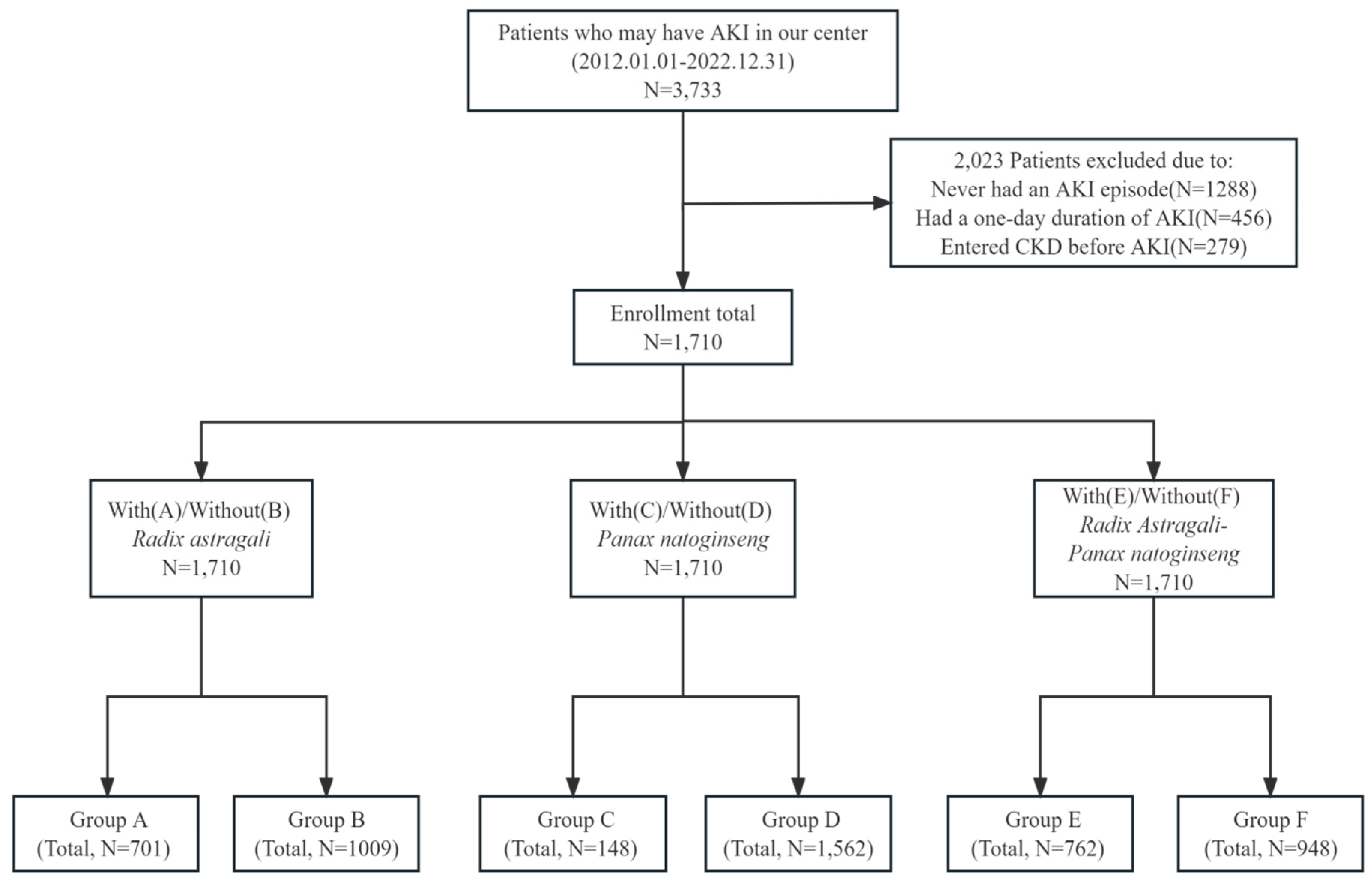
We conducted a retrospective study from January 1st, 2012 and December 31st, 2022 in our hospital. The inclusion criteria were AKI patients who matched the following criteria[6]:
 i. Serum Creatinine (SCr) ≥1.5 times higher than median of all creatinine measures in the 8–365 d before index
 ii. SCr ≥1.5 times higher than the lowest creatinine in the 7 d before or postindex.
 iii. SCr >26 μmol/L higher than the lowest creatinine in the 2 d before or postindex.
 iv. SCr ≥1.5 times higher than median of all creatinine measures in the 8–365 d postindex.
And we define AKI episode with following elements:
i. SCr tests measured within 7 d were grouped into episodes of care.
 ii. If any value within an episode of care was flagged as AKI, then the whole episode was flagged as AKI.
 iii. Within each episode of care, SCr values before and after an AKI case that were greater than a 1.2-fold increase in baseline were included in the AKI episodes and used to determine the start and the end of the AKI episode.
The exclusion criteria were those who had entered chronic kidney disease (CKD) before AKI. According to the CKD-KDIGO guideline, CKD is defined as abnormalities of kidney structure or function, present for >3 months, with implications for health. People who matched the inclusion and exclusion criteria were divided up into 6 groups.(Fig1)
Figure 1. Study flow diagraph.
Preprints 149482 g001

Covariates

Electronic medical records were reviewed to obtain baseline demographic data, comorbidities, and laboratory test results. Demographic data included gender, age, operation before AKI (Operation defined as previous surgical treatment within 10 days prior to the onset of AKI), admission to the ICU when AKI occurs, highest Cr during AKI periods, recovery from AKI in 28 days, use renal replace treatment during AKI period and use decoction during AKI period. Comorbidity of patients including diabetes, and hypertension. Laboratory test results included plasma albumin(g/L), hemoglobin(g/L), hemoglobin A1c (%), serum potassium(mmol/L), serum sodium(mmol/L).

Events

The primary outcome was short-term recovery from AKI. Short-term recovery was defined as a reduction in peak creatinine to less than 1.2 times baseline within 28 days.

Statistical Methods

The baseline characteristics and laboratory tests of patients taking herbal medicines and those who did not were compared. Normally distributed continuous variables were presented as mean SD and t-tests were used for comparison, while skewed data were offered as median and rank and Maan-Witney U test for comparison across groups, with missing data filled with median. The Chi-square test was used to assess categorical variables that were provided as percentages.
Statsmodels in Python was utilized for logistic regression models. Univariate analysis for Radix Astragali, Panax natoginseng from our database was performed by logistic regression; a multivariable model was built considering significant (P < 0.05) variables from the univariate regression, results were shown as RR [95% confidence interval]. All tests were 2-sided, and P value <0.05 was considered statistically significant.

Results

The Baseline Characteristics of the AKI Patients

The study included 1,710 cases with AKI. Table 1 presents the basic characteristics of the Radix Astragali using Group((N=701) and the non-Radix Astragali using Group(N=1,009), define these two groups as group A and group B. The group B included more male than female (645, 63.92%, P = 0.08). The mean ages at which AKI first develops was 58.74±19.97 and 60.21±22.08 years (P = 0.15). The number of patients of operation before AKI and admission to the ICU when AKI occurs were low in both A and B group, but the difference was not significant. And the highest Cr during AKI periods were 483.44 ± 373.22 and 414.97 ± 348.91 μmol/L(P<0.05). In the A group and B group, 51.93% and 43.71% of patients, respectively, recovered from AKI in 28 Days (P<0.05). Neither group A nor group B used RRT at a high rate(16.41% and 12.19%, P<0.05). In both groups, only 20.52% of group B did not use decoction during AKI period(P<0.05). In terms of comorbidity, the patient's characteristics were similar between A and B group. Group A accounts for 32.84% of the diabetes, while B accounts for 33.14% (P = 0.95). Group A has a slightly higher prevalence of hypertension (60.76% and 60.41%, P = 0.94). In terms of laboratory tests, there were no discernible difference in plasma albumin, hemoglobin levels, hemoglobin A1c, serum sodium between these two groups, but there was a significant difference in serum potassium between the two groups (4.42±0.94vs4.30±0.87, P < 0.05).
Table 2 shows the basic characteristics of the Panax natoginseng using Group(N=148) and the non-Panax natoginseng using group(N=1,562), define these two groups as group C and group D. Males still outnumber females in the gender class. The mean ages at which AKI first develops were 63.95 ± 17.97 and 59.20 ± 21.49 years(p<0.05), and the highest Cr during AKI periods were 452.73 ± 465.04 and 442.12 ± 349.20 μmol/L(P=0.73). Other characteristics of group C are all lower than D except “Hemoglobin A1c”, “Serum Potassium” and “Serum Sodium”and only “use decoction during AKI period” and “Serum Sodium”get a P value<0.05.
Table 3 shows the basic characteristics of the Radix Astragali-Panax natoginseng using group(N=762) and the non- Radix Astragali-Panax natoginseng using group(N=948), define these two groups as group E and group F. Data of gender is similar to Table 2, but the data of mean ages at which AKI first develops were different (59.19 ± 19.97 and 59.94 ± 22.22 years(P=0.46)). Patients of operation before AKI were 44 at group E and 68 at group F. Patients of admission to the ICU when AKI occurs were 222 at group E and 302 at group F. And the highest Cr during AKI periods were 478.10±379.97 and 414.86±341.74 μmol/L(P <0.05). Data of “Recover from AKI in 28 Days”, “Use renal replace treatment during AKI period(n)”, “Use decoction during AKI period(n)” and “Serum Potassium” in Table 3 is like Table 1. And the remaining factors were not statistically significant.

Logistic Regression Analyses

The results of univariable analyses and the multivariable logistic regression analyses are shown in Table 4, Table 5 and Table 6. These three tables revealed that items named use Radix Astragali (RR=0.33, P=0.01, 95%CI:[0.13, 0.53]]), use the combination of Radix Astragali-Panax natoginseng (RR=0.31, P=0.01, 95%CI:[0.11, 0.50]), albumin (RR=0.02, P=0.03, 95%CI:[0.01, 0.03]), admission to the ICU when AKI occurs (RR=0.43 VS RR=0.40 VS RR=0.43, P=0.01, 95%CI:[0.16, 0.71] VS 95%CI:[0.12, 0.67] VS 95%CI:[0.15, 0.71]), hemoglobin(RR=0.01, P=0.01, 95%CI:[0.01, 0.01])and diabetes mellitus in Table 4 and Table 6(RR=0.22 VS RR=0.22, P=0.04 VS P=0.05, 95%CI:[0.01, 0.44] VS 95%CI:[0.01, 0.44]) were positively associated with recovery from AKI in short-term; Meanwhile, operation before AKI(RR= -1.18 VS RR= -1.21 VS RR= -0.18, P < 0.01, 95%CI:[-1.77, -0.60] VS 95%CI:[-1.79, -0.64] VS 95%CI:[-1.76, -0.61]), hypertension(RR= -0.37 VS RR= -0.35 VS RR= -0.37, P=0.01, 95%CI:[-0.64, -0.10] VS 95%CI:[-0.61, -0.08] VS 95%CI:[-0.64, -0.10]) were negatively associated with recovery from AKI in short-term. The other factors were not statistically significant.

Discussion Principal Findings

In the present study, as the serum creatinine of AKI patients reached a peak of respective highest level, the treatments involved Radix astragali or the combination of Radix astragali-Panax natoginseng increase the rate of recovery of AKI. In other words, they are protective factors against AKI, consistent with the findings listed below. The findings of Panax natoginseng contradict those of the following studies, which we assume related to sample size.
We discovered two more studies reporting the treatment of AKI with Radix astragali. One is Lu’s study[7], the difference in our study is that the intervention was accomplished using an enema. At the same time, it included patients who had to fit the “spleen and kidney qi deficiency, damp-heat stasis syndrome” criterion,It did not exclude those who had pre-existing CKD, but it did exclude those who need dialysis. The observation is for the duration of the hospitalization. The other is Lei’s study[8], it analyzes sepsis acute kidney injury (stasis resistance type). To determine efficacy, data from key laboratory tests 7 days before and 7 days after the intervention was collected. The present study has several strengths. First, our study had a wider range of participants since we employed a modified algorithm and were not limited to one kind of AKI, but rather included all AKI types. Second, our effectiveness in short-term AKI recovery is more visible due to creatinine changes.
In China, herbal medicines are being used in the treatment of AKI, and in addition to Radix astragali and Panax natoginseng, other herbal medicines have proven efficacy in the treatment of AKI. These medications, however, have not yet been explored in clinical trials. With this present study, we intend to investigate other herbal remedies to expand the therapy options for AKI.

Review of Relevant Molecular Mechanisms

Most past research is centered on the effects of Radix Astragali and Panax natoginseng on AKI regarding cellular pathways. Tang’s study suggests that Astragalus membranaceus and Astragaloside-IV(AS-IV) protect renal tubular epithelial cells against AKI by activating the PI3K/AKT pathway[9]. Sun’s study indicated that Astragalus polysaccharide could alleviate AKI by regulating inflammation, apoptosis, endoplasmic reticulum stress, and epithelial-mesenchymal transition[10]. The two earlier studies used the sepsis-associated AKI model, while the next three used the cisplatin-induced AKI model. Hao’s study suggested that formononetin protects against AKI by activating the PPARα/Nrf2/HO-1/NQO1 pathway[11]. Yan’s study indicates that AS-IV improved AKI by declining both oxidative damage and the inflammatory response, and these protective effects could be attributed to Nrf2 activation and NF-B inhibition[12]. Song’s study shows that AS IV changed blood, urine, and kidney pathways. These metabolic pathways improve the inflammatory reactions, oxidative stress, and energy metabolism, and eventually, improve AKI[13].
Liu’s study demonstrated that Panax Notoginseng Saponins (PNS) can protect against AKI by inhibiting the mitochondrial pathway[14]. Li’s study indicates that PNS via increasing HIF-1α to inhibit mitochondrial apoptosis pathway while improving AKI[15]. Wei’s study shows that Notoginsenoside Fc, through regulating the SIRT3/SOD2 pathway, can alleviate renal tubular injury and mitochondrial dysfunction in AKI[16]. According to Liu et al., Notoginsenoside R1 inhibited I/R-induced increases in proinflammatory cytokine TNF-alpha, myeloperoxidase activity, p38 phosphorylation, and nuclear factor kappaB activation with cell apoptosis in the kidney and enhanced expression of antiapoptosis cytokine bcl-2, ultimately improving AKI[17]. Shou’s study indicated that Panax notoginseng powder reduced renal inflammation in rats and protected them against cecal ligation and puncture-induced septic AKI via preventing the NF-B signaling pathway[18].
Hui’s study demonstrated that Astragalus propinquus Schischkin and Panax notoginseng compound (Astragalus propinquus Schischkin, Panax notoginseng, Angelica sinensis, Achyranthes bidentata, and Ecklonia kurome) prevented the kidney from inhibiting AKI inflammation by downregulating the Mincle pathway in macrophages.[19].

Limitation of the Study

The major limitation of the present study was the inability to fully analyze the cause of AKI in included patients. Due to the huge number of patients and technical constraints, we were unable to discuss all the causes of AKI in every patient and only gathered the two most definitive explanations of the remaining etiologies in the article. The causes of AKI may vary, as may the methods of therapy, and our study was unable to analyze the efficacy of alternative AKI treatments. Even though we averaged the bias by monitoring a vast number of cases, we believe that this bias cannot be ignored.
The second main limitation of the study was incompleteness of data inclusion. The herbal decoction usually incorporates more than one herb. Other herbs' effects on AKI were not completely excluded from this study due to time constraints. To further clarify the impact of herbal medicines on AKI, we suggest that subsequent studies include more herbal medicines.
The last limitation of this study was the insufficient sample size, due to limitations in the region, we did not get enough data on patients who use Panax natoginseng. In the future, multicenter studies could be conducted to increase the sample size.

References

  1. Ostermann M, Bellomo R, Burdmann EA, Doi K, Endre ZH, Goldstein SL, Kane-Gill SL, Liu KD, Prowle JR, Shaw AD et al: Controversies in acute kidney injury: conclusions from a Kidney Disease: Improving Global Outcomes (KDIGO) Conference. Kidney Int 2020, 98(2):294-309. [CrossRef]
  2. Mehta RL, Cerdá J, Burdmann EA, Tonelli M, García-García G, Jha V, Susantitaphong P, Rocco M, Vanholder R, Sever MS et al: International Society of Nephrology's 0by25 initiative for acute kidney injury (zero preventable deaths by 2025): a human rights case for nephrology. Lancet 2015, 385(9987):2616-2643. [CrossRef]
  3. Yang Y, Song M, Liu Y, Liu H, Sun L, Peng Y, Liu F, Venkatachalam MA, Dong Z: Renoprotective approaches and strategies in acute kidney injury. Pharmacol Ther 2016, 163:58-73. [CrossRef]
  4. Li HD, Meng XM, Huang C, Zhang L, Lv XW, Li J: Application of Herbal Traditional Chinese Medicine in the Treatment of Acute Kidney Injury. Front Pharmacol 2019, 10:376. [CrossRef]
  5. Jo SK, Rosner MH, Okusa MD: Pharmacologic treatment of acute kidney injury: why drugs haven't worked and what is on the horizon. Clin J Am Soc Nephrol 2007, 2(2):356-365. [CrossRef]
  6. Hapca S, Siddiqui MK, Kwan RSY, Lim M, Matthew S, Doney ASF, Pearson ER, Palmer CNA, Bell S: The Relationship between AKI and CKD in Patients with Type 2 Diabetes: An Observational Cohort Study. J Am Soc Nephrol 2021, 32(1):138-150. [CrossRef]
  7. Lu H: Clinical study of Erhuang Decoction in the treatment of non-dialysis patients withacute kidney injury and the mechanism of Erhuang Decoction in the treatment ofacute kidney injury based on network pharmacology. phD. Chengdu University of TCM; 2022.
  8. Lei S: Clinical Study on the Treatment of Huaxiancapsule 3 in Sepsis Acute Kidney Injury(Stasis Resistance Type). M.A.: Heilongjiang University Of Chinese Medicine; 2021.
  9. Tang JL, Xin M, Zhang LC: Protective effect of Astragalus membranaceus and Astragaloside IV in sepsis-induced acute kidney injury. Aging (Albany NY) 2022, 14(14):5855-5877. [CrossRef]
  10. Sun J, Wei S, Zhang Y, Li J: Protective Effects of Astragalus Polysaccharide on Sepsis-Induced Acute Kidney Injury. Anal Cell Pathol (Amst) 2021, 2021:7178253. [CrossRef]
  11. Hao Y, Miao J, Liu W, Peng L, Chen Y, Zhong Q: Formononetin protects against cisplatin-induced acute kidney injury through activation of the PPARα/Nrf2/HO-1/NQO1 pathway. Int J Mol Med 2021, 47(2):511-522. [CrossRef]
  12. Yan W, Xu Y, Yuan Y, Tian L, Wang Q, Xie Y, Shao X, Zhang M, Ni Z, Mou S: Renoprotective mechanisms of Astragaloside IV in cisplatin-induced acute kidney injury. Free Radic Res 2017, 51(7-8):669-683. [CrossRef]
  13. Song Y, Hu T, Gao H, Zhai J, Gong J, Zhang Y, Tao L, Sun J, Li Z, Qu X: Altered metabolic profiles and biomarkers associated with astragaloside IV-mediated protection against cisplatin-induced acute kidney injury in rats: An HPLC-TOF/MS-based untargeted metabolomics study. Biochem Pharmacol 2021, 183:114299. [CrossRef]
  14. Liu X, Huang Z, Zou X, Yang Y, Qiu Y, Wen Y: Panax notoginseng saponins attenuates cisplatin-induced nephrotoxicity via inhibiting the mitochondrial pathway of apoptosis. Int J Clin Exp Pathol 2014, 7(12):8391-8400.
  15. Li Q, Zhang Y, Yang Y, Huang S, Zou X, Wei C, Liang T, Zhong X: Panax notoginseng saponins reduces the cisplatin-induced acute renal injury by increasing HIF-1α/BNIP3 to inhibit mitochondrial apoptosis pathway. Biomed Pharmacother 2021, 142:111965. [CrossRef]
  16. Wei M, Gao Y, Cheng D, Zhang H, Zhang W, Shen Y, Huang Q, An X, Wang B, Yu Z et al: Notoginsenoside Fc ameliorates renal tubular injury and mitochondrial damage in acetaminophen-induced acute kidney injury partly by regulating SIRT3/SOD2 pathway. Front Med (Lausanne) 2022, 9:1055252. [CrossRef]
  17. Liu WJ, Tang HT, Jia YT, Ma B, Fu JF, Wang Y, Lv KY, Xia ZF: Notoginsenoside R1 attenuates renal ischemia-reperfusion injury in rats. Shock 2010, 34(3):314-320. [CrossRef]
  18. Shou DW, Yu ZL, Meng JB, Lai ZZ, Pang LS, Dai MH, Yang X, Tu YX: Panax notoginseng Alleviates Sepsis-Induced Acute Kidney Injury by Reducing Inflammation in Rats. Evid Based Complement Alternat Med 2022, 2022:9742169. [CrossRef]
  19. Hui D, Rui-Zhi T, Jian-Chun L, Xia Z, Dan W, Jun-Ming F, Li W: Astragalus propinquus Schischkin and Panax notoginseng (A&P) compound relieved cisplatin-induced acute kidney injury through inhibiting the mincle maintained macrophage inflammation. J Ethnopharmacol 2020, 252:112637. [CrossRef]

Table 1. Baseline Characteristics of Radix Astragali.
name Radix Astragali using group (Group A) Non-Radix Astragali using group (Group B) P
0 Demographic data
1  Total(n) 701(100.00%) 1009(100.00%) 1.00
2  Male(n) 418(59.63%) 645(63.92%) 0.08
3  The mean ages when AKI first develops (years) 58.74±19.97 60.21±22.08 0.15
4  Operation before AKI 36(5.14%) 76(7.53%) 0.06
5  Admission to the ICU when AKI occurs 202(28.82%) 322(31.91%) 0.19
6  Highest Cr during AKI periods(μmol/L) 483.44±373.22 414.97±348.91 <0.05
7  Recover from AKI in 28 Days(n) 364(51.93%) 441(43.71%) <0.05
8  Use renal replace treatment during AKI period(n) 115(16.41%) 123(12.19%) <0.05
9  Use herbal decoction during AKI period(n) 701(100.00%) 802(79.48%) <0.05
10  Diabetes(n) 228(32.52%) 337(33.40%) 0.74
11  Hypertension(n) 444(63.34%) 622(61.65%) 0.51
12 Laboratory tests
13  Plasma albumin(g/L) 33.71±8.86 33.55±8.12 0.71
14  Hemoglobin(g/L) 113.68±28.63 114.15±28.85 0.74
15  Hemoglobin A1c (%) 6.89±2.28 6.74±2.02 0.28
16  Serum Potassium(mmol/L) 4.42±0.94 4.30±0.87 <0.05
17  Serum Sodium(mmol/L) 137.81±7.41 137.54±7.56 0.47
Table 2. Baseline Characteristics of Panax natoginseng.
name Panax natoginseng using group (Group C) Non- Panax natoginseng using group (Group D) P
0 Demographic data
1  Total(n) 148(100.00%) 1562(100.00%) 1.00
2  Male(n) 96(64.86%) 967(61.91%) 0.54
3  The mean ages when AKI first develops (years) 63.95±17.97 59.20±21.49 <0.05
4  Operation before AKI 14(9.46%) 98(6.27%) 0.19
5  Admission to the ICU when AKI occurs 43(29.05%) 481(30.79%) 0.73
6  Highest Cr during AKI periods(μmol/L) 452.73±465.04 442.12±349.20 0.73
7  Recover from AKI in 28 Days(n) 67(45.27%) 738(47.25%) 0.71
8  Use renal replace treatment during AKI period(n) 24(16.22%) 214(13.70%) 0.47
9  Use herbal decoction during AKI period(n) 148(100.00%) 1355(86.75%) <0.05
10  Diabetes(n) 57(38.51%) 508(32.52%) 0.16
11  Hypertension(n) 95(64.19%) 971(62.16%) 0.69
12 Laboratory tests
13  Plasma albumin(g/L) 33.38±7.86 33.64±8.48 0.73
14  Hemoglobin(g/L) 110.05±29.14 114.33±28.69 0.08
15  Hemoglobin A1c (%) 7.01±2.61 6.78±2.08 0.33
16  Serum Potassium(mmol/L) 4.40±0.91 4.35±0.90 0.49
17  Serum Sodium(mmol/L) 139.10±8.16 137.51±7.42 <0.05
Table 3. Baseline Characteristics of Radix Astragali- Panax natoginseng.
name Radix Astragali- Panax natoginseng using group (Group E) Non- Radix Astragali- Panax natoginseng using group (Group F) P
0 Demographic data
1 Total(n) 762(100.00%) 948(100.00%) 1.00
2 Male(n) 463(60.76%) 600(63.29%) 0.31
3 The mean ages when AKI first develops (years) 59.19±19.97 59.94±22.22 0.46
4 Operation before AKI 44(5.77%) 68(7.17%) 0.29
5 Admission to the ICU when AKI occurs 222(29.13%) 302(31.86%) 0.25
6 Highest Cr during AKI periods(μmol/L) 478.10±379.97 414.86±341.74 <0.05
7 Recover from AKI in 28 Days(n) 390(51.18%) 415(43.78%) <0.05
8 Use renal replace treatment during AKI period(n) 125(16.40%) 113(11.92%) <0.05
9 Use herbal decoction during AKI period(n) 762(100.00%) 741(78.16%) <0.05
10 Diabetes(n) 253(33.20%) 312(32.91%) 0.94
11 Hypertension(n) 487(63.91%) 579(61.08%) 0.25
12 Laboratory tests
13 Plasma albumin(g/L) 33.67±8.74 33.57±8.18 0.82
14 Hemoglobin(g/L) 113.70±28.68 114.16±28.82 0.74
15 Hemoglobin A1c (%) 6.96±2.37 6.67±1.90 0.05
16 Serum Potassium(mmol/L) 4.40±0.93 4.31±0.87 <0.05
17 Serum Sodium(mmol/L) 137.96±7.52 137.40±7.47 0.13
Table 4. Univariable and the multivariable logistic regression analyses of Radix Astragali.Univariable logistic regression analyses of Radix Astragali.
RR Std err z P>|z| [0.025 0.975]
Use
Radix Astragali
0.42 0.12 3.53 0.00 0.19 0.65
Intercept -0.37 0.08 -4.71 0.00 -0.53 -0.22
Multivariable logistic regression analyses of Radix Astragali
RR Std err z P>|z| [0.025 0.975]
The mean ages when AKI first develops -0.01 0.01 -1.46 0.14 -0.01 0.01
Gender 0.17 0.13 1.29 0.20 -0.09 0.43
Use
Radix Astragali
0.47 0.12 3.87 0.00 0.23 0.72
Albumin 0.02 0.01 2.12 0.03 0.01 0.03
Hemoglobin 0.01 0.01 3.46 0.01 0.01 0.01
Diabetes mellitus 0.26 0.14 1.79 0.07 -0.02 0.53
Hypertension -0.37 0.14 -2.71 0.01 -0.64 -0.10
Operation before AKI -1.18 0.30 -4.00 0.00 -1.77 -0.60
Admission to the ICU when AKI occurs 0.43 0.14 3.08 0.01 0.16 0.71
Intercept -1.56 0.37 -4.19 0.00 -2.29 -0.83
Table 5. Univariable and the multivariable logistic regression analyses of Panax natoginseng. Univariable logistic regression analyses of Panax natoginseng
RR Std err z P>|z| [0.025 0.975]
Use
Panax natoginseng
-0.07 0.22 -0.33 0.74 -0.49 0.35
Intercept -0.18 0.06 -2.97 0.01 -0.30 -0.06
Multivariable logistic regression analyses of Panax natoginseng
RR Std err z P>|z| [0.025 0.975]
The mean ages when AKI first develops 0.01 0.01 -1.45 0.15 -0.01 0.01
Gender 0.14 0.13 1.07 0.28 -0.12 0.39
Use
Radix Astragali
0.04 0.22 0.19 0.85 -0.39 0.48
Albumin 0.02 0.01 2.18 0.03 0.01 0.03
Hemoglobin 0.01 0.01 3.41 0.01 0.01 0.01
Diabetes mellitus 0.23 0.14 1.61 0.11 -0.05 0.50
Hypertension -0.35 0.14 -2.55 0.01 -0.61 -0.08
Operation before AKI -1.21 0.29 -4.12 0.00 -1.79 -0.64
Admission to the ICU when AKI occurs 0.40 0.14 2.83 0.01 0.12 0.67
Intercept -1.32 0.36 -3.62 0.00 -2.03 -0.61
Table 6. Univariable and the multivariable logistic regression analyses of the combination of Panax natoginseng- Radix Astragali. Univariable logistic regression analyses of the combination of Panax natoginseng- Radix Astragali.
RR Std err z P>|z| [0.025 0.975]
Use the combination of Panax natoginseng- Radix Astragali 0.37 0.12 3.16 0.00 0.14 0.60
Intercept -0.36 0.08 -4.47 0.00 -0.52 -0.20
Multivariable logistic regression analyses of Panax natoginseng- Radix Astragali
RR Std err z P>|z| [0.025 0.975]
The mean ages when AKI first develops -0.01 0.01 -1.46 0.14 -0.01 0.01
Gender 0.16 0.13 1.25 0.21 -0.09 0.42
Use the combination of Panax natoginseng- Radix Astragali 0.43 0.12 3.54 0.00 0.19 0.67
Albumin 0.02 0.01 2.15 0.03 0.01 0.03
Hemoglobin 0.01 0.01 3.48 0.01 0.01 0.01
Diabetes mellitus 0.25 0.14 1.78 0.08 -0.03 0.53
Hypertension -0.37 0.14 -2.71 0.01 -0.64 -0.10
Operation before AKI -1.18 0.30 -4.01 0.00 -1.76 -0.61
Admission to the ICU when AKI occurs 0.43 0.14 3.05 0.01 0.15 0.71
Intercept -1.55 0.37 -4.17 0.00 -2.29 -0.83
Disclaimer/Publisher’s Note: The statements, opinions and data contained in all publications are solely those of the individual author(s) and contributor(s) and not of MDPI and/or the editor(s). MDPI and/or the editor(s) disclaim responsibility for any injury to people or property resulting from any ideas, methods, instructions or products referred to in the content.
Copyright: This open access article is published under a Creative Commons CC BY 4.0 license, which permit the free download, distribution, and reuse, provided that the author and preprint are cited in any reuse.
Prerpints.org logo

Preprints.org is a free preprint server supported by MDPI in Basel, Switzerland.

Subscribe

Disclaimer

Terms of Use

Privacy Policy

Privacy Settings

© 2025 MDPI (Basel, Switzerland) unless otherwise stated