

Submitted:
21 September 2026
Posted:
22 September 2026
You are already at the latest version
Abstract
The dichotomy, which divides an object into two, has wide applications in mathematics, computer science, and philosophy. In this paper, inspired by the method of dichotomy, we propose a theoretical framework to characterize quantum entanglement. The basic idea is to start from the most fundamental physical system and perform binary decomposition step by step to establish different types of entangled states. By dividing a parent system into two subsystems, we investigate the relationships between the subsystems under different states of the parent system. We show that entanglement necessarily exists between the two subsystems when the parent system remains unchanged, whereas it may be absent when the parent system changes. Beyond quantum physics, we demonstrate that the dichotomy also has important implications for classical physics.
Keywords:
dichotomy
; quantum entanglement
; quantum information
; classical physics
1. Introduction
Quantum mechanics provides the fundamental framework for describing microscopic physical systems and challenges classical intuitions in profound ways [1]. Among its most distinctive features are quantum superposition and quantum entanglement, which lie at the heart of quantum information science and numerous quantum technologies [1,2]. Superposition allows a quantum system to exist in a coherent combination of multiple basis states, while entanglement describes non-classical correlations between subsystems that cannot be reduced to independent states. The two phenomena not only distinguish quantum physics from classical physics but also serve as essential resources for quantum computation, communication, and metrology [1,2].
According to quantum superposition, a quantum system can be in a linear combination of two or more basis states[1]. For example, a qubit can be prepared in a state , where and are complex amplitudes satisfying . Generally, until a measurement is performed, the system are not in a single definite state; Instead, its behaviour is governed by the interference between the superposed components. Measurement induces a probabilistic collapse onto one of the basis states, with probabilities determined by the squared amplitudes. Superposition therefore underpins quantum parallelism and interference effects, while its fragility under decoherence makes it a central concern in both fundamental studies and practical implementations.
Quantum entanglement is a uniquely non-classical correlation that arises when the state of a composite system cannot be written as the product of the states of its subsystems [1]. For a bipartite system, the entangled states such as Bell states exhibit correlations that are stronger than any classical local hidden-variable model can reproduce. These correlations violate Bell inequalities [3] and reveal the non-local character of quantum theory. Entanglement plays a crucial role in quantum teleportation, entanglement swapping, dense coding, quantum cryptography, quantum computation, and quantum networks, and considerable progress has been made in both theoretical and applied research [4,5,6,7,8]. However, how entanglement arises remains an open question.
The dichotomy, whose basic idea is to divide an object into two parts, has a wide range of applications in many disciplines including mathematics and computer science [9]. It often appears in binary partitions, recursive algorithms, decision procedures, and conceptual dualities. In this paper, we adopt the dichotomy as a guiding principle to characterize quantum entanglement. Starting from the most elementary physical system, we construct different types of entangled states through three rounds of binary decomposition. By splitting a parent system into two subsystems, we study the relationships between the subsystems under different states of the parent system. We show that when the parent system remains unchanged, there must be entanglement between the two subsystems; On the contrary, entanglement may not exist. Beyond quantum physics, we also demonstrate that dichotomy can spark thought-provoking ideas about classical physics.
2. Theoretical Framework Informed by Dichotomy
What was the initial physical system like? The origin of the universe must be empty, that is, the state of the initial physical system is empty. Therefore, let us use the zero vector to represent the initial physical system. Traditionally, it can be represented in the form of a column vector,
As is well known, there are countless substances and energies in the universe, and there is no doubt that they all originate from the emptiness. Therefore, we can assume that the dimension of system is infinite and denote its dimension by . Inspired by the dichotomy, here we decompose the initial system into two systems, denoted as and , then we have
where
In what follows, we would like to discuss the relationship between and . For the convenience of expression, let us refer to the system as the parent system, and and as subsystems. Under the premise that the parent system remains unchanged, a change in the state of one subsystem will inevitably cause an equal amount of change in the state of another subsystem (in this paper, changes in system states are assumed to be increases or decreases in energy). Specifically, when the energy of the subsystem increases or decreases, the energy of the other system will decrease or increase, with both changes occurring simultaneously and being equal in magnitude. In this case, we can describe the relationship between and as
where the symbols ↑ and ↓ represent the increase and decrease of energy, respectively.
In summary, the state of the parent system is the sum of the states of two subsystems, and we refer to this property as superposition. In addition, due to the simultaneity of the changes in the states of the two subsystems, we refer to this correlation as entanglement. It should be noted that the existence of subsystems and is the result of local observations; if a joint observation is conducted, the parent system is obtained.
Next, let us perform binary decomposition on the subsystems to further investigate the relationships between subsystems. Let us decompose and as
In this case, for ease of expression, we refer to and as parent systems, and , , , as subsystems. Now let us start studying the relationships between the subsystems. As shown in Eq. (4), the changes of the parent systems and include two scenarios, and the relationships between subsystems in the two scenarios are shown in sub-tables (a) and (b) in Table 1, respectively. The symbol in the table indicates that the magnitude of energy increase (decrease) is greater than that of the symbol , and symbol indicates that the energy of a subsystem remains unchanged.
Let us explore the relationships between the subsystems based on Table 1. We will first examine the cases ➀, ➁, ➂, ➃ in the sub-tables (a) and (b). It can be seen that there is no entanglement between and , nor between and , but there is entanglement between one of and one of . For ease of expression, we would like to use the symbol `’ in this paper to represent entanglement between subsystems. In this way, the following entanglement relationships (or entangled states) can be obtained from the four scenarios, respectively,
From the cases ➄ to ➇ in the sub-tables (a) and (b), it can be seen that the four subsystems change simultaneously, which indicates the presence of entanglement between them. We can obtain the entangled state composed of these four subsystems, given by
Through further local observations, three-subsystem entangled states and two-subsystem ones can be obtained, given by
If the symbol `’ is defined as a binary operator, and its operational rules follow the rules of addition, then we can carry out the following calculations to obtain all the entangled states shown above,
where the symbols `’ can be treated as ordinary parentheses during the calculation process. As previously mentioned, the existence of subsystems is the result of local observations; Similarly, through local observations, all the entangled states shown in Eq. (8) can be observed from Eq. (9).
In the same way, from the other cases, we can arrive at
What kind of entangled states will be obtained by decomposing the subsystem again? From the two rounds of decomposition above, it can be seen that the number of cases to be discussed increases exponentially, and the corresponding computational complexity does as well. Obviously, considering all cases is complex and difficult, and thus we would only like to explore four scenarios here. Let us first decompose systems as
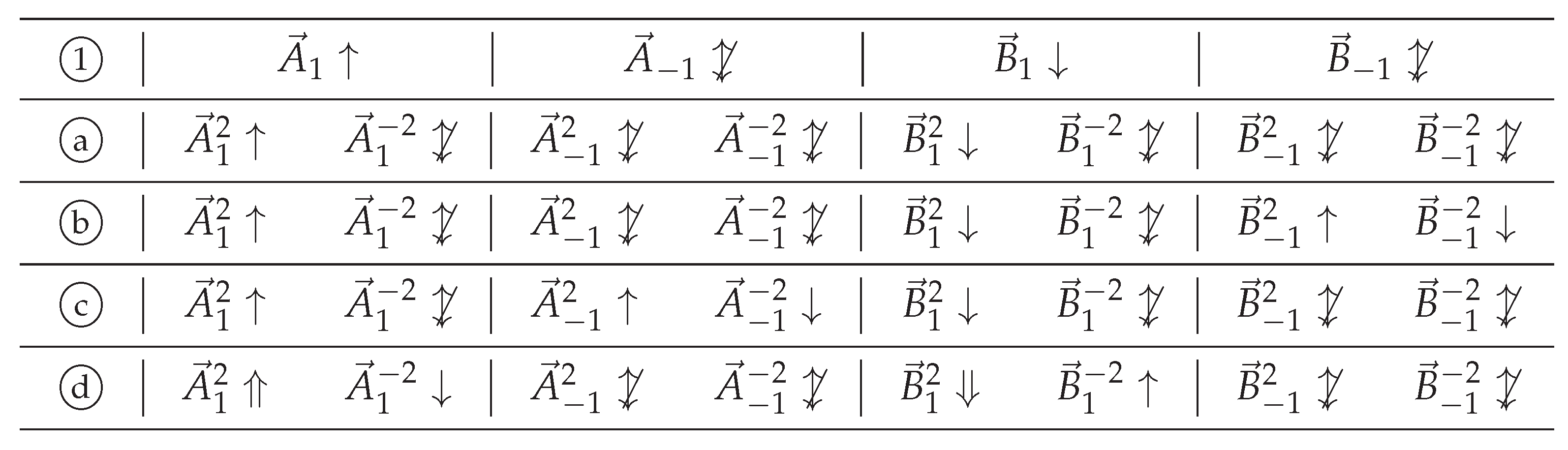
At this point, for ease of expression, we refer to as the parent systems, and C and D as the subsystems. We then only consider, when the parent systems are in the states shown in the case 1 in Table 1, the four cases for the states of the subsystems shown in Table 2.
In the case ➀, the parent system remains unchanged, and thus the corresponding subsystems and ( and ) are independent. From the cases , the following entangled states can be obtained, respectively,
Taking the case ⓓ as an example, the entangled states can also be obtained through the following calculation,
3. Implications for Classical Physics
Inspired by the dichotomy, we have considered quantum superposition and entanglement above. In this section, we consider classical physics based on the dichotomy and present our perspectives. In fact, the existence of all things presupposes the existence of time and space. Without space, time naturally does not exist; Under the premise of the existence of space, if everything remains in a static state, time also does not exist. If we set a starting point for time, then through the division as shown in Eq. 2, there arise two opposites: past and future, with the starting point positioned in between. Conversely, by combining the past and the future, time no longer exists. Similarly, if we consider up and down, left and right, front and back in space comprehensively, space no longer exists.
What inspirations does the dichotomy have for considering conservation laws in classical physics? According to the dichotomy, energy should be divided into two types: positive and negative. From the law of conservation of energy, we can know that the total positive and negative energy constantly convert into each other while always remaining balanced, keeping the total energy at zero. Let us assume that there is an energy with a magnitude of e, which can be divided into
where there are both positive and negative values in . This indicates that positive and negative energy can coexist and be observed simultaneously. Furthermore, as long as the observational conditions are sufficient, any value of energy can be observed from e. Similarly, any amount of charge can be observed from an arbitrary amount of charge; From any microscopic particle, particles with any energy value can be decomposed.
4. Conclusion
Based on the dichotomy, we have proposed a theoretical framework to characterize quantum entanglement and expressed our perspectives on classical physics. Our basic idea is to gradually perform binary decomposition starting from the original physical system, thereby establishing various entangled states. Through the proposed theoretical framework, it can be seen that entanglement is a universal phenomenon, not merely confined to the microscopic world. Since the states of entangled subsystems change simultaneously, we can conclude that there is no information input and output between the subsystems. It should be pointed out that the magnitude of the changes in subsystems varies in different entangled states. How to accurately characterize different types of entangled states mathematically, as well as the computational complexity resulting from multiple rounds of binary decomposition, are important directions for future research.
References
- Nielsen, M. A.; Chuang, I. L. Quantum Computation and Quantum Information; Cambridge University Press, 2000. [Google Scholar]
- Zhang, H. G.; Ji, Z. X.; et al. Survey on quantum information security. China Commun. 2019, 16(10), 1–36. [Google Scholar] [CrossRef]
- Bell, J. S. On the Einstein Podolsky Rosen paradox. Phys. Phys. Fiz. 1964, 1(3), 195. [Google Scholar] [CrossRef]
- Ji, Z. X.; Fan, P. R.; Zhang, H. G. Entanglement swapping for Bell states and Greenberger–Horne–Zeilinger states in qubit systems. Physica A Stat. Mech. Its Appl. 2022, 585, 126400. [Google Scholar] [CrossRef]
- Ji, Z. X.; Zhang, H. G. Entanglement swapping theory and beyond. arXiv 2009.02555v11. 2020. [Google Scholar] [CrossRef]
- Ji, Z. X.; Zhang, H. G. Security proof of quantum cryptography against entanglement-measurement attack. arXiv 2012.14275v3. 2020. [Google Scholar] [CrossRef]
- Ji, Z. X.; Zhang, H. G. Entanglement swapping for quantum information masking. Preprints 2026, 202607.2155. [Google Scholar] [CrossRef]
- Ji, Z. X.; Zhang, H. G. Cosmic quantum network. Preprints 2026, 202605.1256. [Google Scholar] [CrossRef]
- Zhang, H. G.; Tang, M. Introduction to Cryptography; Wuhan University Press, 2023. [Google Scholar]

Table 1.
The states of four subsystems.
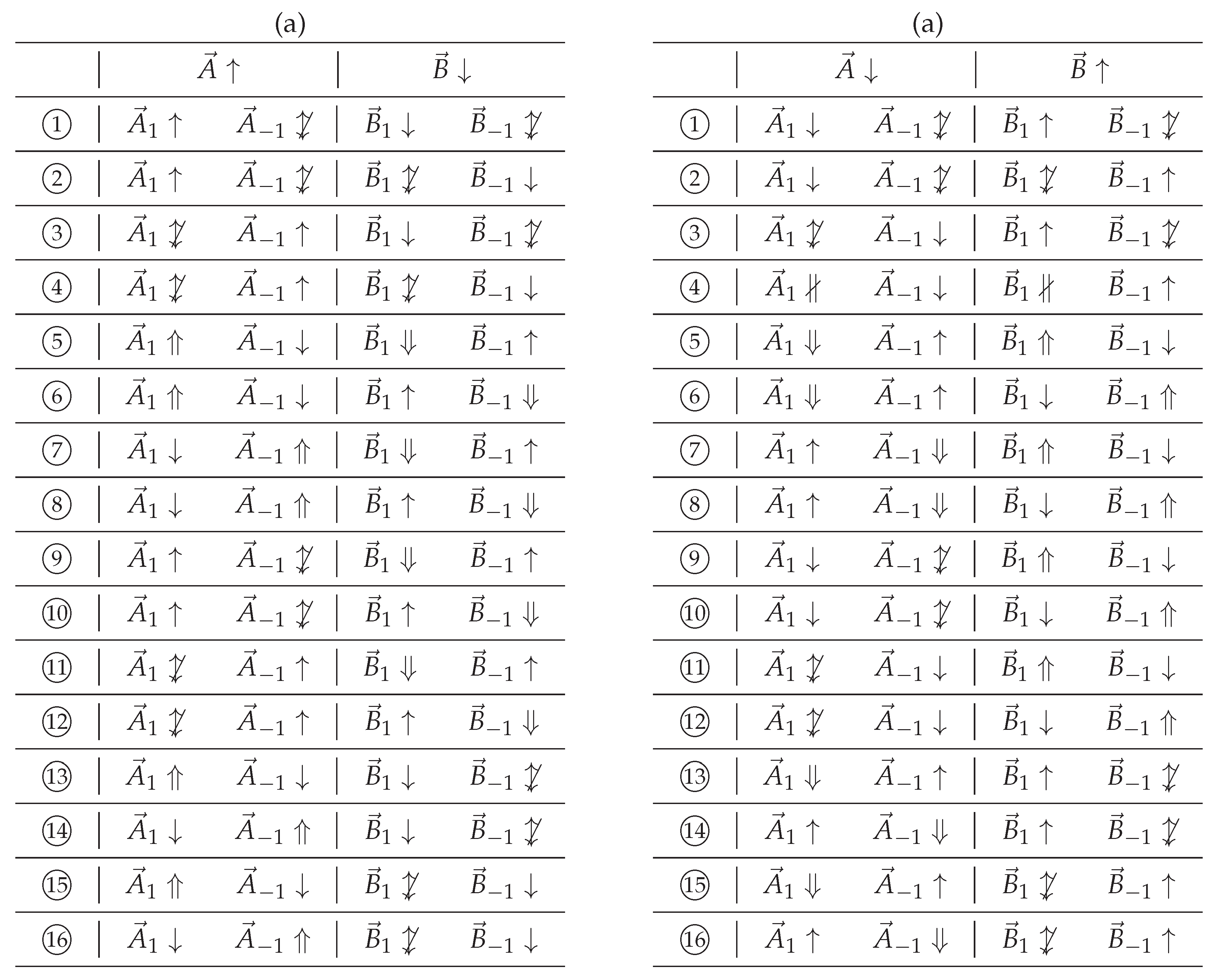
Table 2.
Four different cases for the states of eight subsystems.
Disclaimer/Publisher’s Note: The statements, opinions and data contained in all publications are solely those of the individual author(s) and contributor(s) and not of MDPI and/or the editor(s). MDPI and/or the editor(s) disclaim responsibility for any injury to people or property resulting from any ideas, methods, instructions or products referred to in the content. |
© 2026 by the authors. Licensee MDPI, Basel, Switzerland. This article is an open access article distributed under the terms and conditions of the Creative Commons Attribution (CC BY) license (http://creativecommons.org/licenses/by/4.0/).
Copyright: This open access article is published under a Creative Commons CC BY 4.0 license, which permit the free download, distribution, and reuse, provided that the author and preprint are cited in any reuse.