

Submitted:
15 February 2025
Posted:
17 February 2025
You are already at the latest version
Abstract
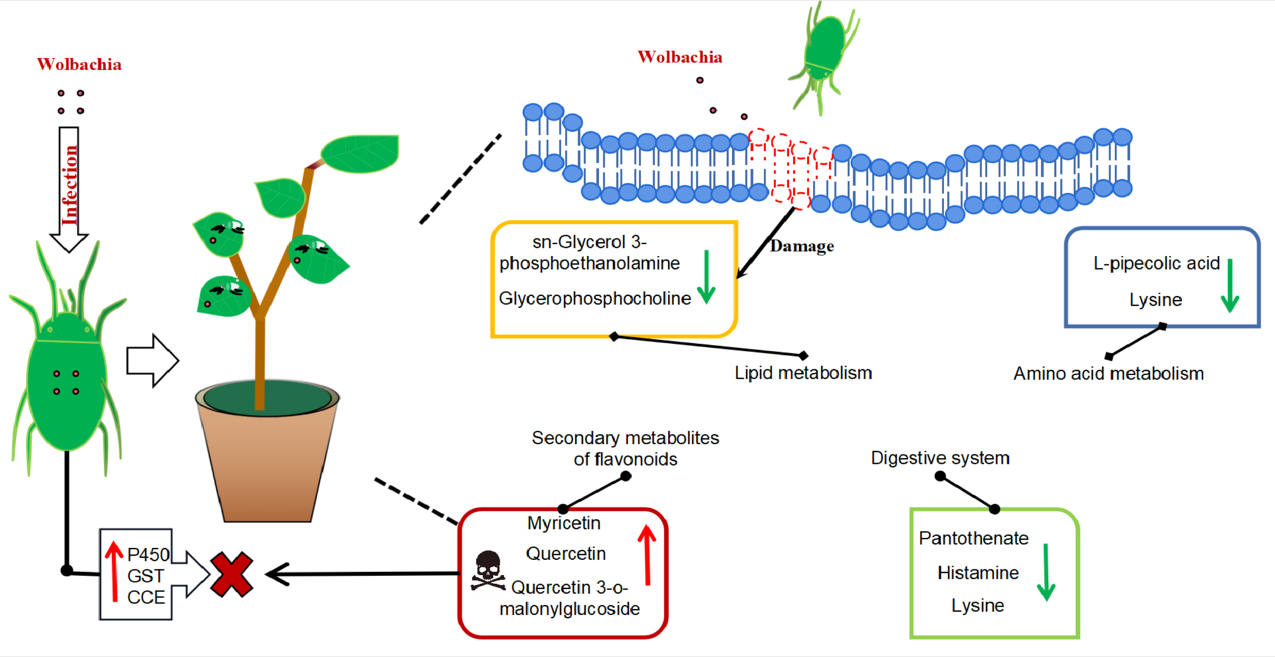
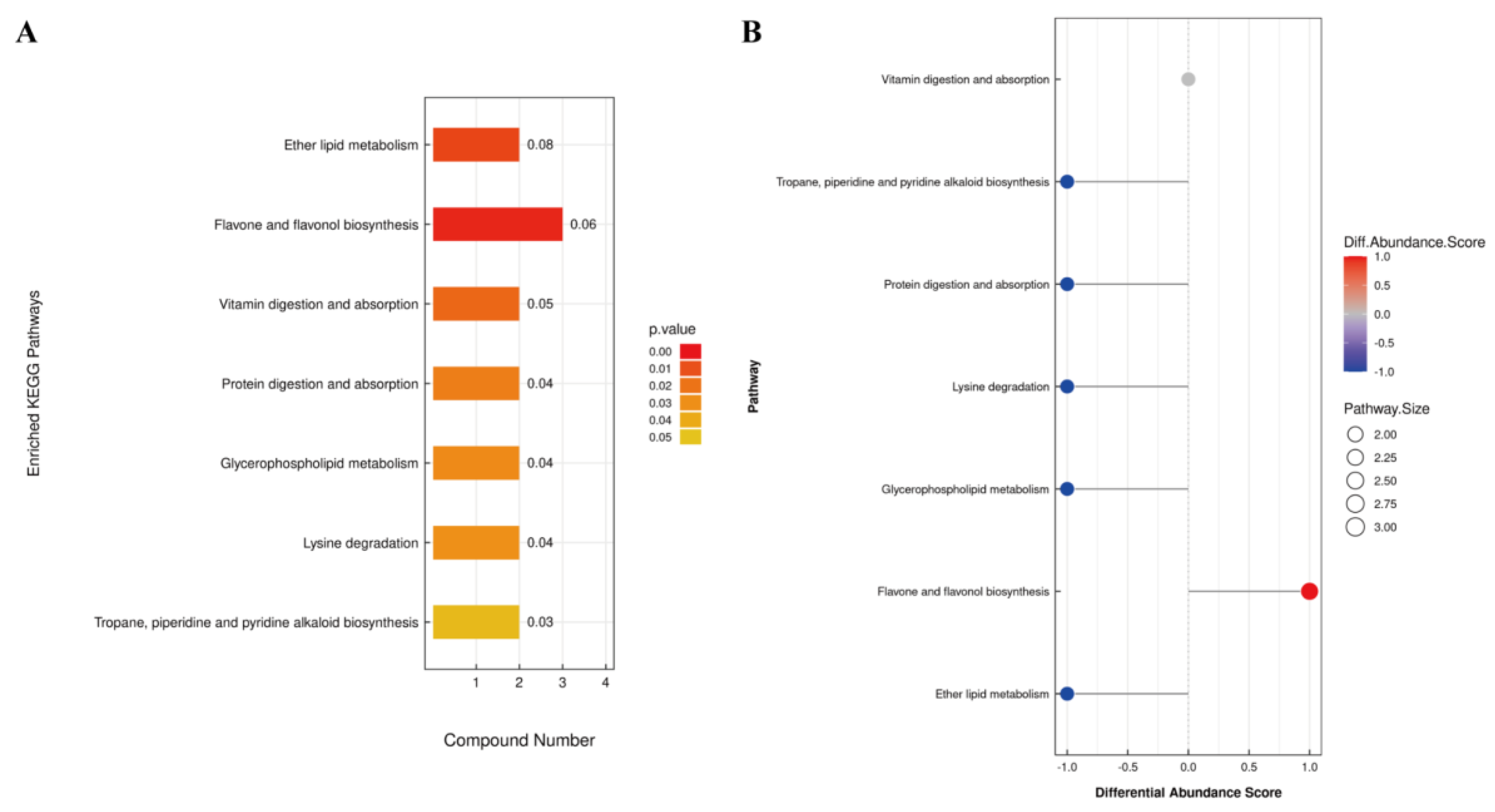
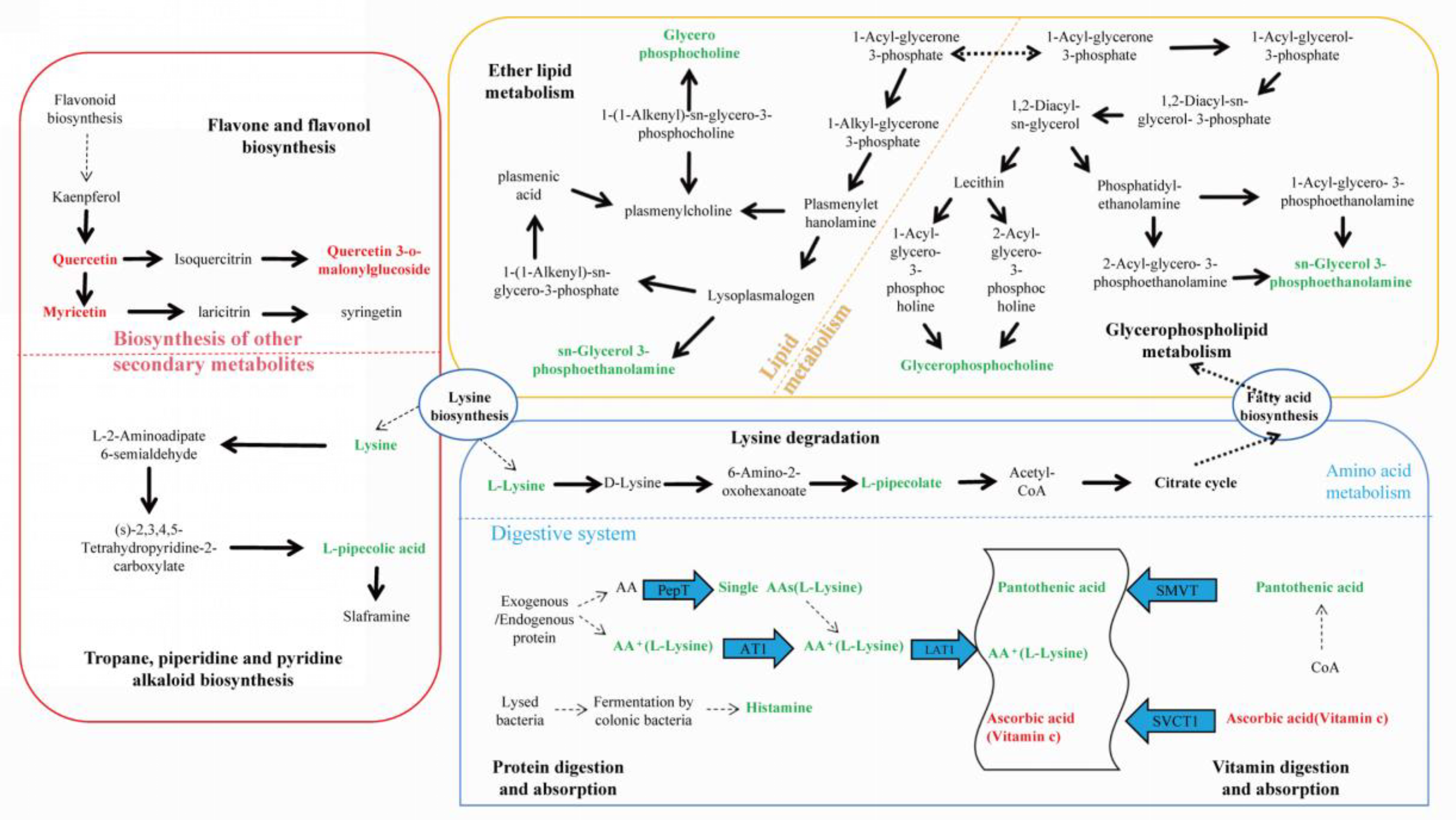
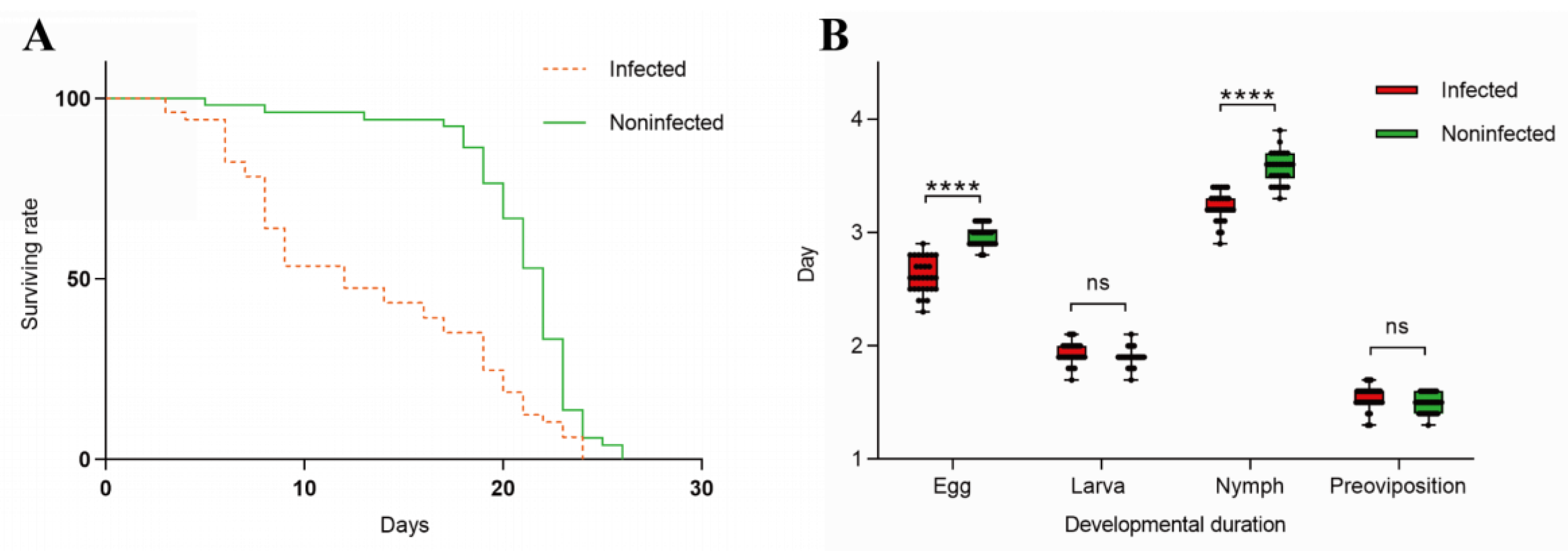
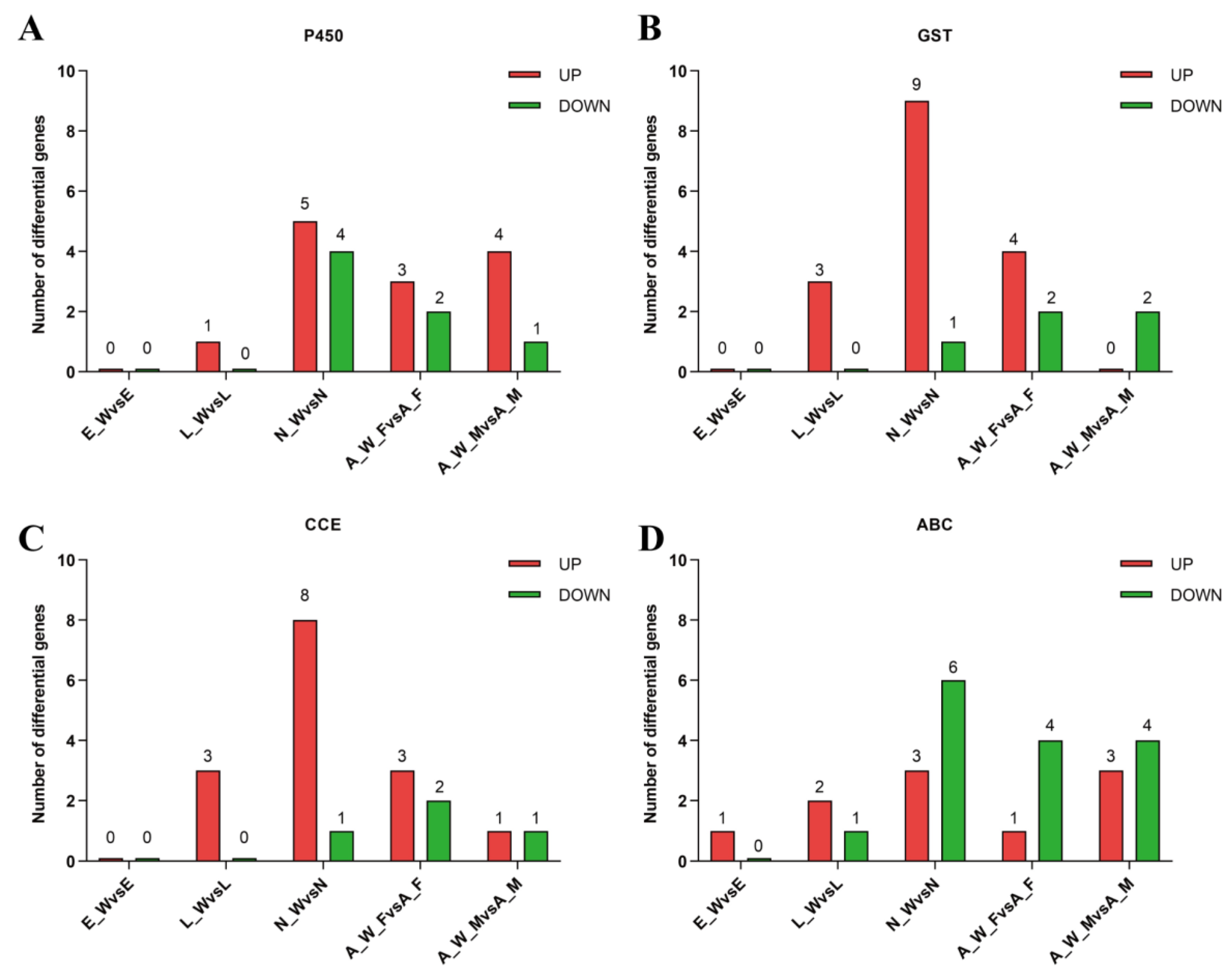
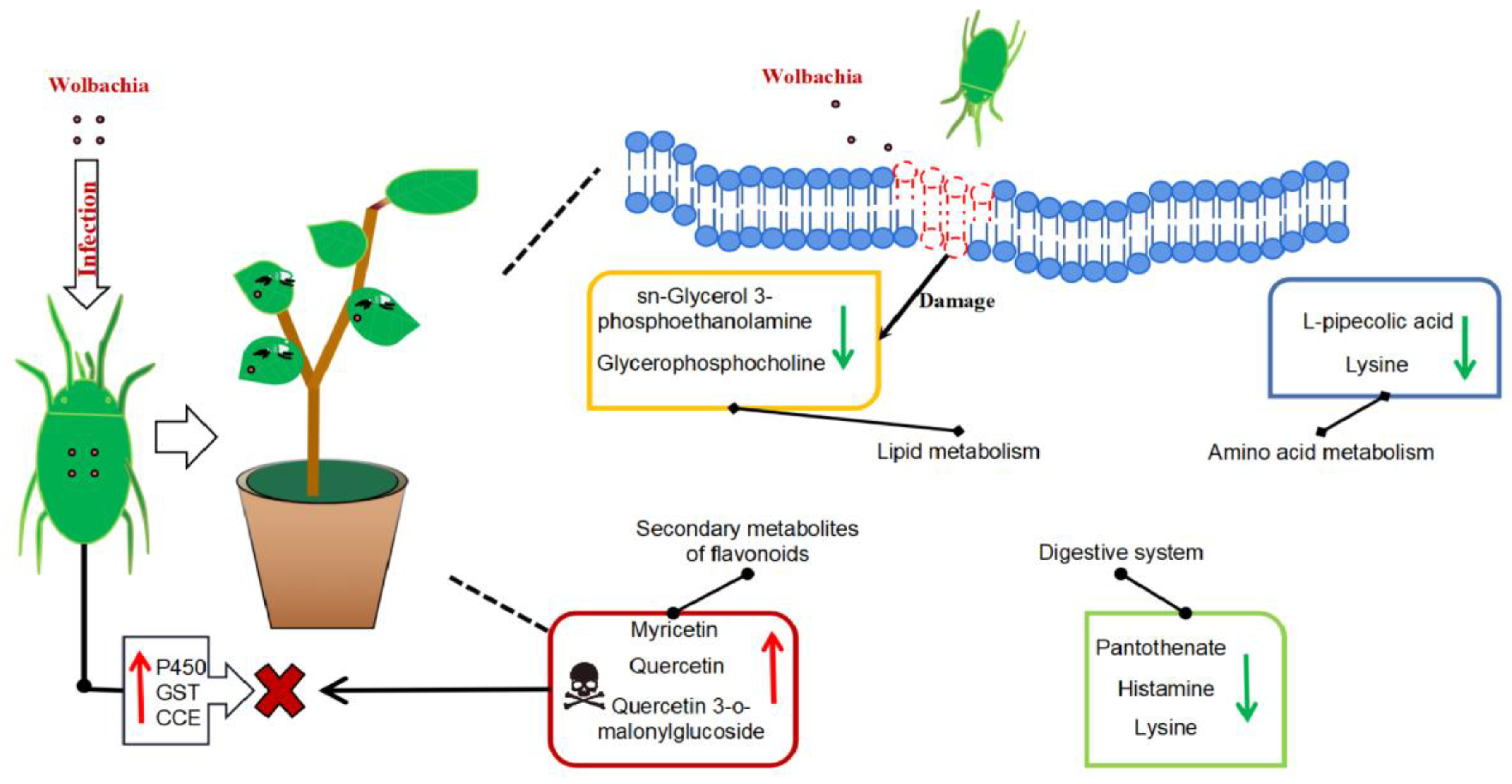
Endosymbiotic bacteria play a significant role in the co-evolution of insects and plants. However, whether they induce, activate, or inhibit host plant defense responses remains unclear. In this study, non-targeted metabolomic sequencing was performed on cotton leaves infested with Wolbachia-infected and uninfected spider mites using parthenogenetic backcrossing and antibiotic treatment methods. A total of 55 differential metabolites were identified, which involved lipids, phenylpropanoids and polyketides. KEGG pathway enrichment analysis revealed seven significantly enriched metabolic pathways. Among them, flavonoid and flavonol biosynthesis, glycerophospholipid metabolism, and ether lipid metabolism showed extremely significant differences. In Wolbachia infected cotton leaves, the flavonoid biosynthesis pathway was significantly upregulated, including quercetin and myricetin, suggesting that the plant produces more secondary metabolites to enhance its defense capability. Glycerophosphocholine (GPC) and sn-glycerol-3- phosphoethanolamine (PE) were significantly downregulated, suggesting that Wolbachia may impair the integrity and function of plant cell membranes. The downregulation of lysine and the upregulation of L-malic acid indicated that Wolbachia infection may shorten the lifespan of spider mites. At various developmental stages of the spider mites, Wolbachia infection increased the expression of detoxification metabolism related genes, including gene families such as cytochrome P450, glutathione S-transferase, carboxylesterase, and ABC transporters, thereby enhancing the detoxification capability of the host spider mite. This study provides a theoretical basis for further elucidating the mechanisms by which endosymbiotic bacteria induce plant defense responses and expands the theoretical framework of insect-plant co-evolution.
Keywords:
1. Introduction
2. Materials and Methods
2.1. Experimental Materials
2.2. Detection of Wolbachia Infection in T. turkestani
2.3. Screening of Mite Strains with Different Wolbachia Infection Status
2.4. Infection Process of Mite Strains with Different Wolbachia Infection Status on Host Plants
2.5. Metabolomics Sequencing of Host Plants
2.6. Transcriptomic Sequencing of T. turkestani
2.7. Influence of Wolbachia on the Lifespan and Developmental Duration of Mites
2.8. Comparison of Leaf Damage Area
3. Results
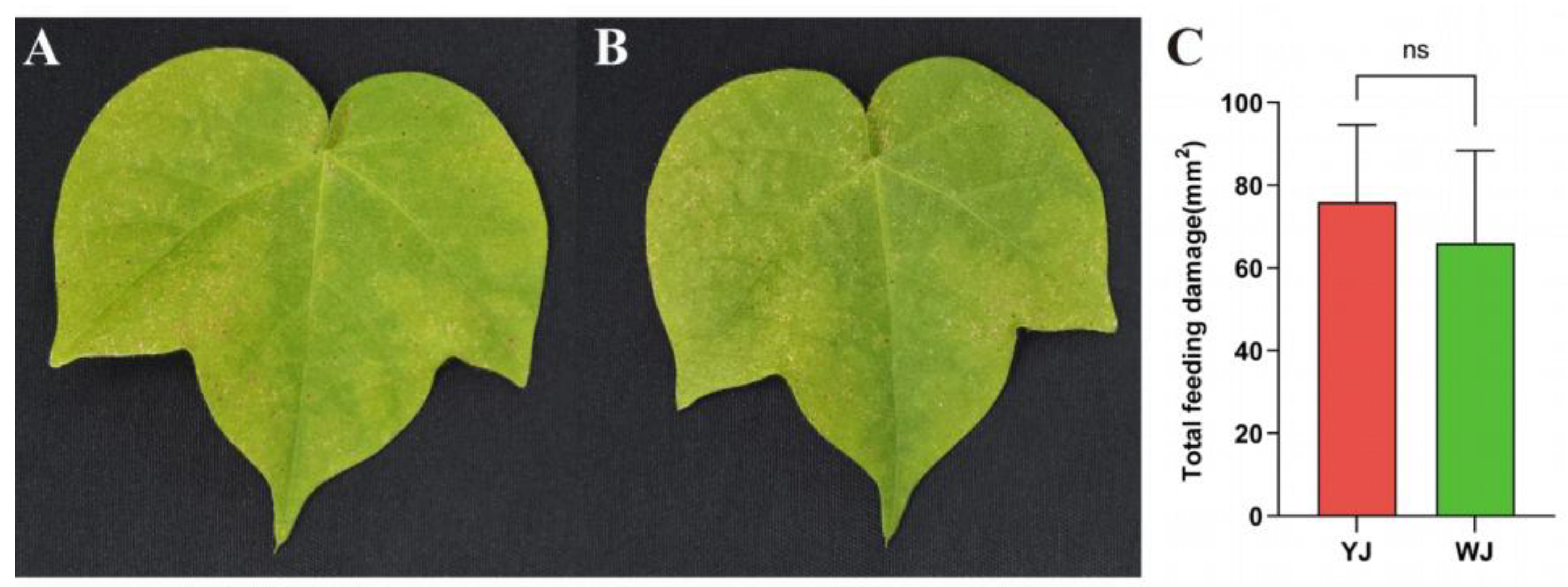
3.1. Phenotypic Analysis of Cotton Leaves Infected by Different Mites
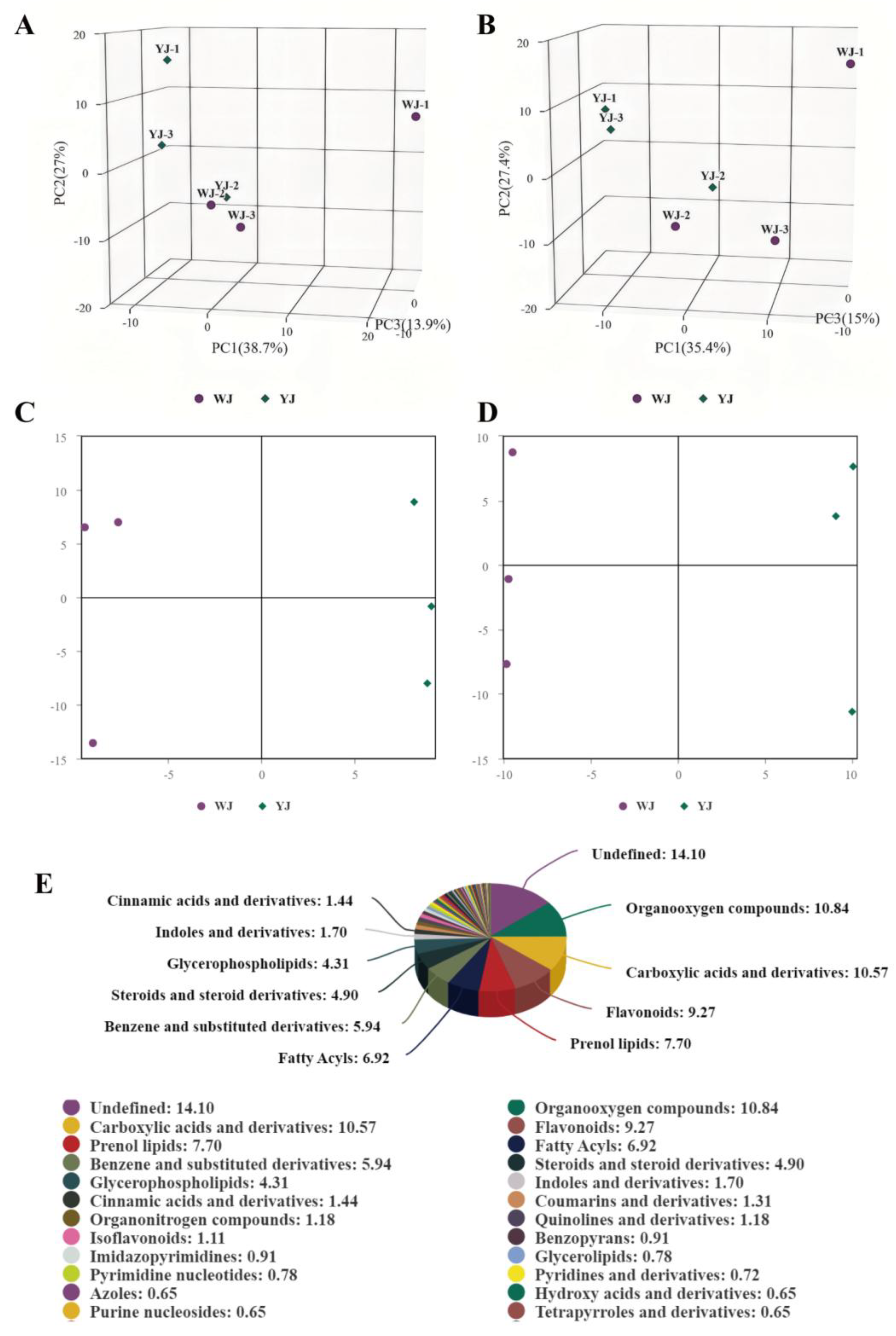
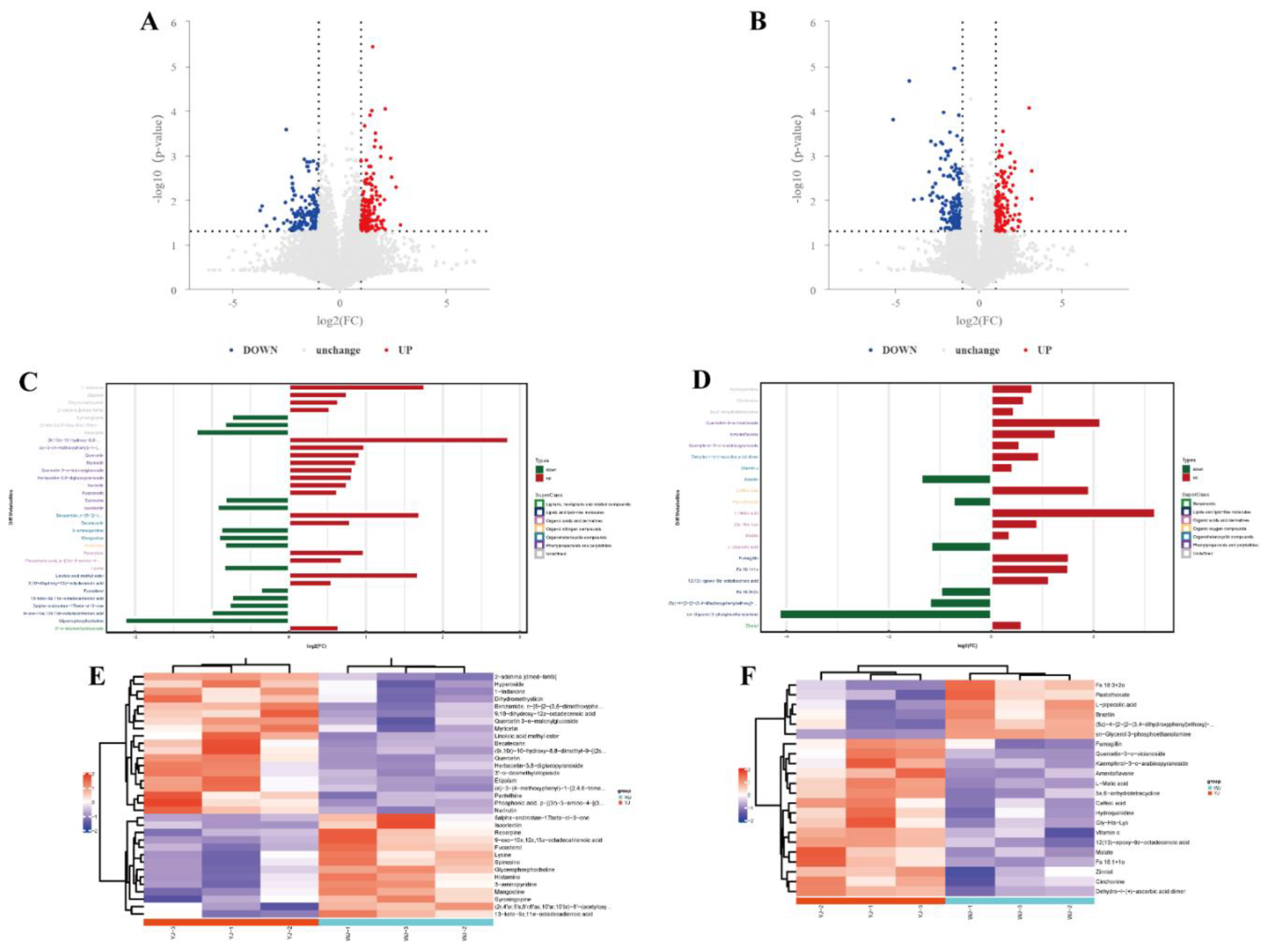
3.2. Metabolomic Analysis of Cotton Leaves Infected by Different Mites
3.3. The Influence of Wolbachia on the Lifespan and Developmental Duration of the Host
3.4. Wolbachia Enhanced the Expression of Detoxification Metabolism Genes T. turkestani
4. Discussion
4.1. Wolbachia Infection Induced the Production of Secondary Metabolites in Cotton
4.2. Wolbachia Infection Impaired the Lipid Metabolism of Cotton
4.3. Wolbachia Infection Disrupts the Growth and Reproduction of Mites
4.4. Wolbachia Infection Enhanced the Detoxification Ability of Mites
Author Contributions
Funding
Data Availability Statement
Acknowledgments
Conflicts of Interest
References
- Duron Olivier;Bouchon Didier;Boutin Sébastien;Bellamy Lawrence;Zhou Liqin;Engelstädter Jan;Hurst Gregory The Diversity of Reproductive Parasites among Arthropods: Wolbachia Do Not Walk Alone. BMC Biol. 2008, 27. [CrossRef]
- A.S. AdamsA.S. Adams;C.R. CurrieC.R. Currie;Y. CardozaY. Cardoza;K.D. KlepzigK.D. Klepzig;K.F. RaffaK.F. Raffa Effects of Symbiotic Bacteria and Tree Chemistry on the Growth and Reproduction of Bark Beetle Fungal Symbionts. Can. J. For. Res. 2009, 1133–1147. [CrossRef]
- Kerry M. Oliver;Patrick H. Degnan;Martha S. Hunter;Nancy A. Moran Bacteriophages Encode Factors Required for Protection in a Symbiotic Mutualism. Science 2009, 992–994. [CrossRef]
- Hosokawa Takahiro;Koga Ryuichi;Kikuchi Yoshitomo;Meng Xian-Ying;Fukatsu Takema Wolbachia as a Bacteriocyte-Associated Nutritional Mutualist. Proc. Natl. Acad. Sci. U. S. A. 2010, 769–774. [CrossRef]
- Sugio Akiko;Dubreuil Géraldine;Giron David;Simon Jean-Christophe Plant-Insect Interactions under Bacterial Influence: Ecological Implications and Underlying Mechanisms. J. Exp. Bot. 2015, 467–478. [CrossRef]
- Enric Frago;Marcel Dicke;H. Charles J. Godfray Insect Symbionts as Hidden Players in Insect–Plant Interactions. Trends Ecol. Evol. 2012, 705–711. [CrossRef]
- Giron David;Glevarec Gaëlle Cytokinin-Induced Phenotypes in Plant-Insect Interactions: Learning from the Bacterial World. J. Chem. Ecol. 2014, 826–835. [CrossRef]
- Simon C. Groen;Parris T. Humphrey;Daniela Chevasco;Frederick M. Ausubel;Naomi E. Pierce;Noah K. Whiteman Pseudomonas Syringae Enhances Herbivory by Suppressing the Reactive Oxygen Burst in Arabidopsis. J. Insect Physiol. 2016, 90–102. [CrossRef]
- Chung Seung Ho;Rosa Cristina;Scully Erin D;Peiffer Michelle;Tooker John F;Hoover Kelli;Luthe Dawn S;Felton Gary W Herbivore Exploits Orally Secreted Bacteria to Suppress Plant Defenses. Proc. Natl. Acad. Sci. U. S. A. 2013, 15728–15733. [CrossRef]
- Qi Su;Kerry M. Oliver;Wen Xie;Qingjun Wu;Shaoli Wang;Youjun Zhang The Whitefly-associated Facultative Symbiont Hamiltonella Defensa Suppresses Induced Plant Defences in Tomato. Funct. Ecol. 2015, 1007–1018. [CrossRef]
- Heike Staudacher;Bernardus C. J. Schimmel;Mart M. Lamers;Nicky Wybouw;Astrid T. Groot;Merijn R. Kant;Massimo Maffei Independent Effects of a Herbivore’s Bacterial Symbionts on Its Performance and Induced Plant Defences. Int. J. Mol. Sci. 2017, 182–182. [CrossRef]
- Zhurov Vladimir;Navarro Marie;Bruinsma Kristie A;Arbona Vicent;Santamaria M Estrella;Cazaux Marc;Wybouw Nicky;Osborne Edward J;Ens Cherise;Rioja Cristina;Vermeirssen Vanessa;Rubio-Somoza Ignacio;Krishna Priti;Diaz Isabel;Schmid Markus;Gómez-Cadenas Aurelio;Van de Peer Yves;Grbic Miodrag;Clark Richard M;Van Leeuwen Thomas;Grbic Vojislava Reciprocal Responses in the Interaction between Arabidopsis and the Cell-Content-Feeding Chelicerate Herbivore Spider Mite. Plant Physiol. 2014, 384–399. [CrossRef]
- Zhu Yu-Xi;Song Zhang-Rong;Song Yue-Ling;Hong Xiao-Yue Double Infection of Wolbachia and Spiroplasma Alters Induced Plant Defense and Spider Mite Fecundity. Pest Manag. Sci. 2020, 3273–3281. [CrossRef]
- Karami-Jamour, T. ;Shishehbor Development and Life Table Parameters of Tetranychus Turkestani (Acarina: Tetranychidae) at Different Constant Temperatures. Acarologia 2012, 113–122. [CrossRef]
- Gong JunTao;Li TongPu;Wang MengKe;Hong XiaoYue Wolbachia-Based Strategies for Control of Agricultural Pests. Curr. Opin. Insect Sci. 2023, 101039–101039. [CrossRef]
- Cui, J.; Li, S.; Baoyin, B.; Feng, Y.; Guo, D.; Zhang, L.; Gu, Y. Maize/Soybean Intercropping with Straw Return Increases Crop Yield by Influencing the Biological Characteristics of Soil. Microorganisms 2024, 12, 1108. [CrossRef]
- Yun Heng Miao;Wei Hao Dou;Jing Liu;Da Wei Huang;Jin Hua Xiao Single-Cell Transcriptome Sequencing Reveals That Wolbachia Induces Gene Expression Changes in Drosophila Ovary Cells to Favor Its Own Maternal Transmission. mBio 2024, e0147324. [CrossRef]
- Yang Kun;Chen Han;Bing Xiao Li;Xia Xue;Zhu Yu Xi;Hong Xiao Yue Wolbachia and Spiroplasma Could Influence Bacterial Communities of the Spider Mite Tetranychus Truncatus. Exp. Appl. Acarol. 2021, 197–210. [CrossRef]
- Yu-Xi Zhu;Yue-Ling Song;Ary A. Hoffmann;Peng-Yu Jin;Shi-Mei Huo;Xiao-Yue Hong A Change in the Bacterial Community of Spider Mites Decreases Fecundity on Multiple Host Plants. MicrobiologyOpen 2019, n/a-n/a. [CrossRef]
- Morimoto Sayaka;Kurtti Timothy J;Noda Hiroaki In Vitro Cultivation and Antibiotic Susceptibility of a Cytophaga-like Intracellular Symbiote Isolated from the Tick Ixodes Scapularis. Curr. Microbiol. 2006, 324–329. [CrossRef]
- E. M. Bakr A New Software for Measuring Leaf Area, and Area Damaged by Tetranychus Urticae Koch. J. Appl. Entomol. 2005, 173–175. [CrossRef]
- Seyed Mohammad Nabavi;Dunja Šamec;Michał Tomczyk;Luigi Milella;Daniela Russo;Solomon Habtemariam;Ipek Suntar;Luca Rastrelli;Maria Daglia;Jianbo Xiao;Francesca Giampieri;Maurizio Battino;Eduardo Sobarzo-Sanchez;Seyed Fazel Nabavi;Bahman Yousefi;Philippe Jeandet;Suowen Xu;Samira Shirooie Flavonoid Biosynthetic Pathways in Plants: Versatile Targets for Metabolic Engineering. Biotechnol. Adv. 2020, 107316. [CrossRef]
- Philippe Jeandet;Claire Hébrard;Marie-Alice Deville;Sylvain Cordelier;Stéphan Dorey;Aziz Aziz;Jérôme Crouzet Deciphering the Role of Phytoalexins in Plant-Microorganism Interactions and Human Health. Molecules 2014, 18033–18056. [CrossRef]
- Sylvain Cordelier;Christophe Clément;Eric Courot;Philippe Jeandet Modulation of Phytoalexin Biosynthesis in Engineered Plants for Disease Resistance. Int. J. Mol. Sci. 2013, 14136–14170. [CrossRef]
- Liu Weixin;Feng Yi;Yu Suhang;Fan Zhengqi;Li Xinlei;Li Jiyuan;Yin Hengfu The Flavonoid Biosynthesis Network in Plants. Int. J. Mol. Sci. 2021, 12824–12824. [CrossRef]
- Agati Giovanni;Tattini Massimiliano Multiple Functional Roles of Flavonoids in Photoprotection. New Phytol. 2010, 786–793. [CrossRef]
- Ana Rita Cavaco;Ana Rita Matos;Andreia Figueiredo Speaking the Language of Lipids: The Cross-Talk between Plants and Pathogens in Defence and Disease. Cell. Mol. Life Sci. 2021, 1–17. [CrossRef]
- Fahy Eoin;Subramaniam Shankar;Brown H Alex;Glass Christopher K;Merrill Alfred H;Murphy Robert C;Raetz Christian R H;Russell David W;Seyama Yousuke;Shaw Walter;Shimizu Takao;Spener Friedrich;van Meer Gerrit;VanNieuwenhze Michael S;White Stephen H;Witztum Joseph L;Dennis Edward A A Comprehensive Classification System for Lipids. J. Lipid Res. 2005, 839–861. [CrossRef]
- Le Couteur David G;Solon-Biet Samantha;Cogger Victoria C;Mitchell Sarah J;Senior Alistair;de Cabo Rafael;Raubenheimer David;Simpson Stephen J The Impact of Low-Protein High-Carbohydrate Diets on Aging and Lifespan. Cell. Mol. Life Sci. CMLS 2016, 1237–1252. [CrossRef]
- Wu Min;Zhao Yitao;Tao Meihan;Fu Meimei;Wang Yue;Liu Qi;Lu Zhihui;Guo Jinshan Malate-Based Biodegradable Scaffolds Activate Cellular Energetic Metabolism for Accelerated Wound Healing. ACS Appl. Mater. Interfaces 2023. [CrossRef]
- Farney Tyler M;Bliss Matthew V;Hearon Christopher M;Salazar Dassy A The Effect of Citrulline Malate Supplementation on Muscle Fatigue Among Healthy Participants. J. Strength Cond. Res. 2019, 2464–2470. [CrossRef]
- Chul Hong Park;Minsung Park;Miranda E Kelly;Helia Cheng;Sang Ryeul Lee;Cholsoon Jang;Ji Suk Chang Cold-Inducible GOT1 Activates the Malate-Aspartate Shuttle in Brown Adipose Tissue to Support Fuel Preference for Fatty Acids. BioRxiv Prepr. Serv. Biol. 2024. [CrossRef]
- Li F;Liu X N;Zhu Y;Ma J;Liu N;Yang J H Identification of the 2-Tridecanone Responsive Region in the Promoter of Cytochrome P450 CYP6B6 of the Cotton Bollworm, Helicoverpa Armigera (Lepidoptera: Noctuidae). Bull. Entomol. Res. 2014, 801–808. [CrossRef]
- Jiang Heng;Meng Xiangkun;Zhang Nan;Ge Huichen;Wei Jiaping;Qian Kun;Zheng Yang;Park Yoonseong;Reddy Palli Subba;Wang Jianjun The Pleiotropic AMPK-CncC Signaling Pathway Regulates the Trade-off between Detoxification and Reproduction. Proc. Natl. Acad. Sci. U. S. A. 2023, e2214038120–e2214038120. [CrossRef]
Disclaimer/Publisher’s Note: The statements, opinions and data contained in all publications are solely those of the individual author(s) and contributor(s) and not of MDPI and/or the editor(s). MDPI and/or the editor(s) disclaim responsibility for any injury to people or property resulting from any ideas, methods, instructions or products referred to in the content. |
© 2025 by the authors. Licensee MDPI, Basel, Switzerland. This article is an open access article distributed under the terms and conditions of the Creative Commons Attribution (CC BY) license (http://creativecommons.org/licenses/by/4.0/).


