Preprint
Article

This version is not peer-reviewed.

Co-variations of Geophysical Agents and Physicochemical Proper-ties of the Skin in Examinees in High Latitudes: Prospects for the Using of Gas-Discharge Visualization Method

Submitted:

14 February 2025

Posted:

14 February 2025

You are already at the latest version

Abstract

The purpose of the study was to estimate the capabilities of the Gas Dis-charge Visualization (GDV) method for detection of effects of geophysical agents (GA) on the human body and to compare it's advantage with Galvanic Skin Response (GSR), usually applied for detection stress. The studies were conducted in 2017 and 2018 years on the Spitsbergen archipelago, and in 2023-2024 - in Apatity, Murmansk region, where daily the GDV and GSR indices were detected along of recruited participants of the study. For the first time, the daily covariations of GA and the GDV indices, mani-festing the physicochemical properties of the skin, were revealed in these studies. It was found, that correlations and their signs between the GA and GDV indices were determined by the intensity of the neutron flux at the Earth's surface, and the variabil-ity of the Solar Wind (SW). The correlations between the GDV and GA indices were reproduced in different years, in the case of comparability of the neutron level at the Earth's surface in the study period. The advantage of the GDV method, in comparing with the GSR was shown. The finding evident that GDV indices are indicators of ef-fects of GA on the human body.
Keywords: 
;  ;  ;  

1. Introduction

Numerous investigations have been devoted to the study of solar and geomagnetic activity effects on human body, starting with the works of A.L. Chizhevsky [1]. These studies were conducted in different countries and at different latitudes [2,3,4,5,6,7,8,9,10,11], as a result of which extensive data base has been obtained, indicating the importance of variations in solar (SA) and geomagnetic activity (GMA) for diverse body systems. It were emerged the effects of SA and GMA on cardiovascular [12,13,14,15,16,17,18,19,20,21,22], on the central and vegetative nervous system, on the functional state of the brain and other systems [23,24,25,26,27,28,29,30,31,32], to which reviews of various years are devoted [for example, 33]. Along with the effects of SA and GMA, the peculiarities of the impact of the secondary component of cosmic rays (CR) on biological systems and the human body were revealed in ground-based experiments [34,35,36,37,38], by comparing long time series data, including the ascending and the descending phase of the solar cycle [39,40,41,42] and other observations [43,44,45]. In the result of these studies, it was established that the human body is ‘inscribed’ in a multifunctional, complex oscillating physical environment, which is controlled by the Sun. This discovery is perfectly illustrated by a quote from A.L. Chizhevsky's book [1]: “numerous functional and organic disturbances in the vital activity and development of biological systems at all levels of their natural organization, from individual organisms to populations and their communities, are caused by a complex of perturbations in the external physical and chemical environment, which has as its source the physical effects of the Cosmic space, in particular perturbations in the Solar activity".
However, in spite of many years of research on solar-terrestrial relations and the effects of space weather [46,47] on various organisms [48], including humans [49,50], there is still a lot unknown in the possible mechanisms mediating the effects of physical and chemical agents of the atmosphere and physical fields associated with the SA on the state of biological systems.
Certain opportunities for a better understanding of the effects of Cosmo physical agents on the human body are provided by studies in high latitudes, where the interaction of the solar wind (SW) with the Earth's magnetosphere generates many physical phenomena that that have the properties of biotropic agents. In this respect, Spitzbergen Archipelago occupies a special place.
The Spitzbergen Archipelago is located between 76° 26' and 80° 50' north latitude and 10° and 32° east longitude. The geophysical peculiarity of the Spitzbergen is its location in the region of cusp [51,52] - a kind of funnel on the day side of the magnetosphere, with a magnetic field value close to zero, where, under certain conditions, the solar wind (SW) can break through with powerful plasma jets [53]. The open lines of the Earth's magnetic field in this region are connected with the lines of the interplanetary magnetic field (IMF), which allows the accelerated plasma of the SW penetrate into the magnetosphere and into the ionosphere [54]. The unobstructed penetration of solar particles in the cusp region leads to multiple geophysical phenomena reflected in the structure-energy characteristics of geomagnetic field variations (GMV) [55,56,57,58,59,60].
Studies carried out on the Spitzbergen Archipelago with participation of volunteers, have allowed to reveal the links between variations geophysical agents (GA) and the dynamics of body state indicators, such as heart rate (HR) variability (HRV), psycho-emotional state, blood coagulation indices, water redox potential and others [61,62,63,64].
A method of the Gas-Discharge Visualization (GDV), detected the skin properties and associated with psychophysiological state [65,66,67,68], for the first time, was tested for emerging the link between variations of GA and the body state on the Spitzbergen Archipelago. During the research, the skin state was also assessed by galvanic skin response (GSR), traditionally used for detection of the stress [69,70,71,72,73,74], and also, recently for emerging association between stress and emission from human skin in the sub THz frequency band [75].
Indication of the effects of GA on the human body by assessing the covariation between GA and skin properties could be make a new contribution to the study of the physical and chemical mechanisms due to GA, associated with SA, could be influence on the human body.
Human skin is the largest organ of the body and the principal interface between organism and environment. It is an important component for realizing processes associated with the immune system, sensory-motor connections, thermoregulation, vitamin production, and emotional communication. The skin is densely innervated by the autonomic nervous system (ANS), and autonomic innervation of sweat glands (SG) reflected in measurable changes of skin conductance at the surface, termed electro-dermal activity (EDA) [69,72,74]. Afferent neurons from the sympathetic axis of the ANS innervate eccrine sweat (sudomotor) glands, and their activity modulates conductance of an applied current. EDA incorporates both slow shifts in basal skin conductance level (SCL) and more rapid transient events, that is, skin conductance responses (SCRs), which have also been referred to as galvanic skin responses (GSR) [69,76,77].
Skin is excreting organ. Various products of nitrogen and carbohydrate metabolism are removed through the skin, among them: carbon dioxide, ammonia, urea, water, mineral salts and others. Such compounds as lactic acid, glucose, and amino acids are also excreted through the skin. [78,79].
The evolutionarily ancient presenters of diffuse endocrine epithelial system, such as melanocytes, locate in the skin. These cells receive information from the external and internal environment of the body and realize biogenic amines and peptide hormones, which perform a wide range of tasks for the body. Their peculiarities makes it possible to consider such cells as an evolutionarily ancient diffusely organized sensory organ [80,81].
The frequency of oscillations of the blood flow in the micro vessels correspond to geomagnetic pulsations of Ultra Low Frequency as ground manifestation of hydromagnetic waves propagating in the magnetosphere with typically range between f≈1 mHz and f≈10 Hz [82]. It was revealed that skin micro vessels oscillate with a frequency of 0.02-0.046 Hz (≈ 0.03-0.04 Hz) and with a frequency of 0.07-0.15 Hz (≈ 0.1 Hz) in dependent on type of regulations. First frequency band associates with sympathetic thermoregulatory genesis; the second band is due to the participation of local oscillatory component of the myogenic tone of arterioles, associates with sensory unmyelinated fibers and the trophic neuropeptides secreted by them [83].
Skin is source of Spontaneous Ultra-Weak Photon Emission [84,85,86,87]. Asymmetry between photon emission in palm and dorsal, left and right locations from human hand were found. It turn out, that mean values for photon emission were higher for palm and right than dorsal and left locations [84]. Experimental evidence has indicated that the spectrum is in the wavelength range between 430 and 650 nm [87,88,89], corresponding to spectra obtained from carbonyl compounds in the excited singlet and triplet states and excited dimers of singlet molecular oxygen [87]. Such compounds are formed during the de-composition of lipid peroxides, which are very common emitters of ultra-weak low emission [84].
Skin can be considered as complex, variable, and multilayered optical medium [88]. Skin has four layers, namely, the stratum corneum (SC), epidermis, dermis, and subcutis with different electromagnetic characteristics [89,90].
The tips of the sweat ducts that expel the sweat from the gland to the pore at the surface of the skin have a helical structure, that was found in studies of the morphology of the skin by optical coherence tomography. This, together with the fact that the dielectric permittivity of the dermis is higher than that of the epidermis it is assumed [91] that the sweat ducts, as electromagnetic entities, could be regarded as imperfect helical antennas with both end-fire and normal modes. It was found that sub-THz frequency range is bandwidth for skin [92]. It was proposed that the ac electric current “activated” in the “duct antenna” would be due to the diffusion of protons via hopping through distributed H-bond networks, existing in biological structures [92,93]. In bulk water, at 100 GHz, ac conductivity was measured and found to be ~100 S/m [94]. There is evidence that in the vicinity of a lipid/water interface, such as on the inner surface of the sweat duct, water is well-structured [95]. In such layers adjacent to the epithelia cells of the sweat duct, the proton diffusion rate increase by a factor of 100 in comparison to that in bulk water [96]. Furthermore sweat ducts constitute an active system, working according to a number of different stimuli (physiological, mental, emotional, or gustatory), not only due to thermoregulation. Consequently, the sub-THz spectra of the reflection coefficient (R) are also functions of skin morphology, the distribution of perspiration activity over the skin surface and the stimuli causing the sweating [91]. It was found, that the skin spectral response in the sub-Terahertz region is governed by the level of activity of the perspiration system and shows the minimum of reflectivity in the frequency band of 75–110 GHz. [91,92].
It was shown that the reflection coefficient in the skin of W-band (75–110 GHz) strongly depends on the physiological stress [97]. Sweat glands are directly controlled by the Sympathetic Nerve System (SNS) [98]. Therefore, GSR, which is a standard approach for estimation changes in the SNS, associated with psychological stress, [99] should be manifest the changes in reflection coefficient in the skin. The results of the study [97] clearly indicate that the reflection coefficient of the human hand in both W (75–110 GHz) and D (110–170 GHz) bands is correlated to universally accepted indicators of mental stress [91].
It was shown the quantitative variations in the skin emissivity between locations, gender, and individuals measured using a 90GHz calibrated radiometer. The mean differences in the emissivity values between dry and wet skin on the palm of hand and back of hand regions were found to be 0.143 and 0.066 respectively. These results confirm that radiometry can, as a non-contact method, identify surfaces attached to the human skin in tens of seconds [100].
It was presented a physiologically plausible human skin model that can represent the electromagnetic role of the human sweat ducts, under the influence of an external impinged electromagnetic field in the subTHz frequency band. The model has been demonstrated the value of the reflection coefficient taken from 13 volunteers in the frequency range of 350–410 GHz. The estimation of the pattern of the stress, which was measured by GSR, revealed the most probable values for the ac-conductivity in the sweat duct. The minimum values of ac conductivity do not exceed the frequency band of sea water and the average and maximal values are correspondent the known increase in proton concentrations observed during stress stimuli. Circular Dichroism (CD) (the predominance of right-handed over left-handed polarization) was also revealed in the reflection coefficient of the palm of the hand [101] CD was demonstrated at 380 GHz but not at 110 GHz [91].
The sweat gland is indeed the dominant structure in the skin governing electromagnetic behavior at these frequencies. Furthermore, the coiled outlet of the eccrine sweat gland acts as a helical antenna in the higher frequency range of 350 up to 600 GHz, when irradiated by an external electrical field [92,102,103]. In the recent study [104], the obtained results demonstrate that human blackbody is having a marked contribution in the sub-mm region, previously not noticed. Furthermore, this contribution is sensitive to the physiological state of the subject [104,105,106]. Radiometric measurements of human subjects in the frequency range 480-700 GHz, demonstrate the emission of blackbody radiation from the body core, rather than the skin surface. The dermis and epidermis can be considered as an electromagnetic bio-metamaterial, whereby the layered structure, along with the topology of the sweat duct, reveals a complex interference pattern in the skin. There is enough evidence to suggest that the combination of the helical sweat duct and wavelengths approaching the dimensions of skin layers could lead to non-thermal biological effects [107].
Thus, the skin is an extremely complex electrical organ of the body, mediating internal processes in the body and external effects by changing the properties of its surface. Therefore, it is an ideal model for studying the effects of GA on the body. Unfortunately, separate data on skin properties have not been generalized and a single model uniting all its properties into a single whole has not been created. But separate studies, including those registering fluctuations of skin properties under the influence of the different agents with known properties, such as GA, will help to contribute to the understanding of the body's reactions to geocosmic impact.
The purpose of the study was to estimate the capabilities of the Gas Discharge Visualization (GDV) method for detection of effects of geophysical agents (GA) on the human body and to compare it's advantage with Galvanic Skin Response (GSR), usually applied for detection stress.

2. Materials and Methods

2.1. Participators of the Studies

The study was conducted in Barentsburg on the Spitzbergen archipelago from July 23 to August 14, 2017 (363 measurements) and from July 30 to August 18, 2018 (162) with recruited volunteers. In addition, the detection of GDV indices was applied in the short measurement of physiological state of young people in 2016 years (11.04 -12.05) and in the more time series detection of GDV indices in 2023-2024 in the Apatity city (67.56°N and 33.40° E), Murmansk region. The study adhered to ethical principles outlined by the UN General Assembly (1992), the Council of Europe Convention on Bioethics (1997), and the Russian Academy of Sciences Council on Bioethics (January 18, 2017). All participants of investigation were informed about the purpose and conditions of the experiment and gave their consent to participate in the study.

2.2. Gas Discharge Visualization

Gas discharge visualization (GDV) method is based on electrical activity of human organism and single cells [65,66,67,68,69,70,71,72,73,74,75,76,77,78,107], when stimulated electrons and photons from the of the skin surface under the influence of pulsed electromagnetic field are extracted. Such process is quite well studied with physical electronic methods and is known as “photoelectron emission” [68,108,109,110]. The particles emitted and accelerated in the electromagnetic field emerge as electronic avalanches on the surface of the glass electrode causing the so-called “sliding gas discharge.” The discharge causes glow due to the excitement of molecules in the surrounding hydrogen, and this glow is what is being measured by the biometric method based on GDV [68]. Therefore, short voltage pulses stimulate the electrophotonic emission concomitantly intensifying this emission in the gas discharge due to the electric field created. The data obtained in the process of measuring of extremely weak “biophoton field” is the scientific information which may reveal the role of some electro-photon processes underlying the functional state of the body [67,68].The stimulation of electrons and photons in the GDV method, is intensified by thousand times and thus it enables measurements under normal environment with ordinary lighting. This plasma emits both light and other electromagnetic fields over a wide frequency band because of the short electrical impulse used (10 microsec) [65,66,67]. The emissions are directly measured by a charge-coupled device (CCD), the state of the art in measuring low-level light that is used in astrophysics and other scientific endeavors. The CCD registers the pattern of photons detected over time. These digital data are transmitted directly into a computer for data processing, and each image (named a GDV-gram) from the light emitted is stored as a graphics file. The analysis of natural electrophotonic emission is based on intensity, fractality, and area of the captured images [111]. Also, GDV provides the integral parameters of entropy and autonomic tone, which are important components in the analysis of human functional state [111]. Entropy is a measure of chaos/disorder, and an increase in entropy has been postulated on the First International Congress of Systemic Medicine as a manifestation of sickness, negative impact of chemical, biological, physical, or emotional stress, and chronic degenerative disease [112]. The GDV, as biometric device is comprised of five components: a sensor, signal processing unit, data storage, a matching algorithm, and a decision process [68,113,114].
In our studies the daily GDV registration was carried out using the GDV-compact pulse analyzer ЕЮУИ 941 0204 00 00ТУ, serial production, "Biotechprogress" LLC, certificate of conformity ΝРООC RU.MH05.H00725, N 0490215. The basis of the analysis is a “snapshot” of the glow that arises around of a fingertip placed in the chamber, the so-called GDV-gram. The GDV-grams are processed using the program «GDV Energy Field» (http://www.ktispb.ru/en/gdvsoft.htm), which converts GDV-grams into such glow indices as glow area (S), form coefficient (K), entropy (E) and symmetry (Sim) indices, presented in three projections: right (r), frontal (f), left (l). The GDV detection was carried out in the next modes of registering GDV-grams of the fingertips: "without filter" (Sr 1; Sf 1; Sl 1; S 1; Er 1; Ef 1; El 1, Е 1; Kr 1; Kf 1; Kl 1; K 1; Sim 1) and "with filter" (Sr2; Sf2; Sl2; S2; Er2; Ef2; El2, Е2; Kr2; Kf2; Kl2; K2; Sim 2) [61,62]. Three projections of each index were averaged and used in exploration of co-variations between geophysical and GDV indices. The mode of registration "without filter" give information about integral characteristic of the body's state, determined by the contribution of the central and autonomic nervous systems (ANS). The use of a filter under GDV allows to cut off the contribution of the ANS to the characteristics of the GDV-gram, recording the basic characteristics of the functional state of the body [113,114].

2.3. Registration of the Galvanic Skin Response (GSR)

Registration of the galvanic skin response (GSR) was carried out using the REACOR complex [Software, 2014]. The galvanic skin response (GSR) (synonyms: psychogalvanic response, galvanic skin reflex, psychogalvanic reflex, Tarkhanov phenomenon) is a change in the potential difference and a decrease in electrical resistance between two areas of the skin surface (for example, the dorsal and palmar surfaces of the hand) during stimuli associated with the emotional reaction of the body. Bioelectrical activity on the skin is caused by the activity of the sympathetic nervous system and the activity of the sweat glands [70,115]. Electrodermal activity (EDA) is now the preferred term for changes in electrical conductance of the skin, including phasic changes that have been referred to as galvanic skin responses (GSR), that result from sympathetic neuronal activity. EDA is a sensitive psychophysiological index of changes in autonomic sympathetic arousal that are integrated with emotional and cognitive states. The studies of patients with discrete brain lesions and functional imaging techniques have clarified the contribution of brain regions implicated in emotion, attention, and cognition to peripheral EDA responses glands [70]. The regulation of sweating is encompassed within the general principles of autonomic control, which includes autoregulatory processes (body temperature, heart rate (HR), blood pressure (BP), and gut motility). These maintain homeostasis of the internal milieu and dynamically modulates these homeostatic functions. “Autonomic arousal” is associated with increased sympathetic drive manifested by increases in HR, BP and sweating, and blood moving from gut toward limb musculature. Sweat gland activity contributes to mechanical friction and thermoregulation. In many animals, including humans, autonomic responses in the skin also serve as emotional expressions and social signals. Sympathetic activity is closely linked to emotion, and EDA is a widely used and sensitive index of emotion-related sympathetic activity [70,115,116,117,118,119,120].

2.4. Geocosmic Agents (GA) Data

Geocosmic agents were reflected in a set of indicators characterizing daily values ​​of solar activity (SA), the state of the interplanetary magnetic field (IMF), the speed and variability of the solar wind (SW), ground indices of geomagnetic activity (GMA), etc. (https://nssdcftp.gsfc.nasa.gov/). Data on variations in the intensity of cosmic rays (CR) near the surface, obtained on the basis of recording the count rate of the ground-based neutron monitor at Barentsburg station, and the calculated CR flux densities in near-Earth space were obtained in the cosmic ray laboratory at the Polar Geophysical Institute of the Russian Academy of Sciences (Apatity, Murmansk Region).

2.5. Statistical Analysis

Descriptive statistics (mean, standard deviation, median, minimum, maximum, and 95% confidence intervals) were computed using STATISTICA 10.0 (StatSoft, Inc., USA) to characterize the time series data. Normality of distributions was assessed using Kolmogorov–Smirnov, Lilliefors, and Shapiro-Wilk tests. Central tendencies and the variance of the quantitative characters with an approximately normal distribution were described using the mean and standard deviation (M±SD). The significance of differences between the daily average values of the all indicators was assessed using nonparametric methods (Mann-Whitney U test, Kolmogorov-Smirnov test) as well as the t-test analysis for independent variable. Correlations between GDV, GA indicator, as significant difference between time series data were considered statistically significant at the p<0.05 level.

3. Results

3.1. Preliminary Results, 2016, Apatity City, Murmansk Region

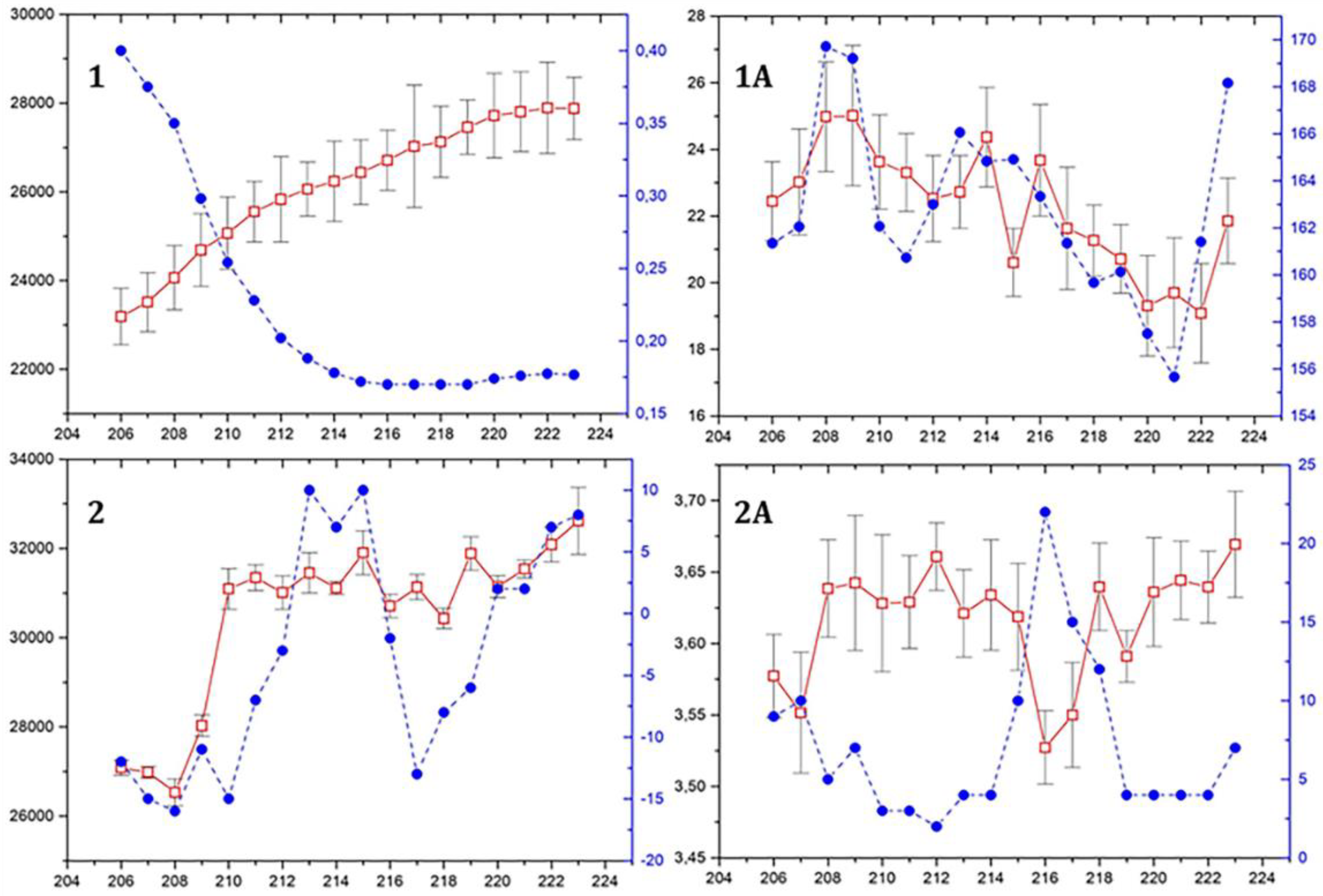
The study of the possibilities of the GDV method for assessing the effect of geophysical agents (GA) on the human body in our studies began in 2016. In April-May 2016, we first used the GDV method to test the psychophysiological state of the participants in our studies, in which we identified the bio efficiency of sea urchin caviar preparations, recruiting student volunteers. The study involved 11 young men and 9 girls who lived in Apatity. Despite the short period of the study, we found a significant correlation between the values of the glow area (S 2) index, in the registration mode with a filter, in young people and the data of the ground-based neutron monitor in Apatity (neutron monitor station of the Polar Geophysical Institute in Apatity), Figure 1(1,2). The correlation coefficient between the GDV indices and the value of the neutron count rate (NCR) in the group of girls, did not reach the significance level of p<0.05, but, it showed a similar trend in the dynamics of the GDV indices and the NCR (Figure 1,2).
Thus, we have assessed the potential possibility of using the GDV method in combined medical-biological and geophysical studies to reveal the effects of geophysical agents on the human body, which is especially relevant for high latitudes, where the manifestation of these agents is extreme.

3.2. 2017 Year, Spitzbergen Archipelago, Barentsburg Settlement

In 2017, we conducted a comprehensive study to assess the effects of GA on the human body in the environment of the Spitsbergen Archipelago, where human body exposure to extreme and specific clusters of arctic physical agents due to the location of the archipelago in the polar cusp region [51]. Despite the relatively short period of stay on the archipelago (from July 25 to August 11, 2017), we were able to reveal a relationship between the daily variations of GA and average daily indices of the psychophysiological state of the participants of the study [66]. Along with ordinary methods of physiological monitoring of the body state, including assessment of heart rate variability (HRV), hemodynamics, questionnaires including assessment of well-being, activity, mood, anxiety and others, we also estimated the cover skin state, by using the methods of galvanic skin response (GSR) and GDV. Our goal was to find correlates between indices of cover skin state and psychophysiological indicators. In addition, we also assessed the closeness of the relationship between the dynamics of daily average values of indicator of skin state and daily variations of GA. The advantage of assessing the relationship between geophysical agents and human body state indicators on the Spitsbergen archipelago was the availability of a scientific base (RSCS) for measuring meteorological and geophysical indicators of the environment, including the ground-based neutron monitor of the Polar Geophysical Institute of the Russian Academy of Sciences, based in the Barentsburg settlement.
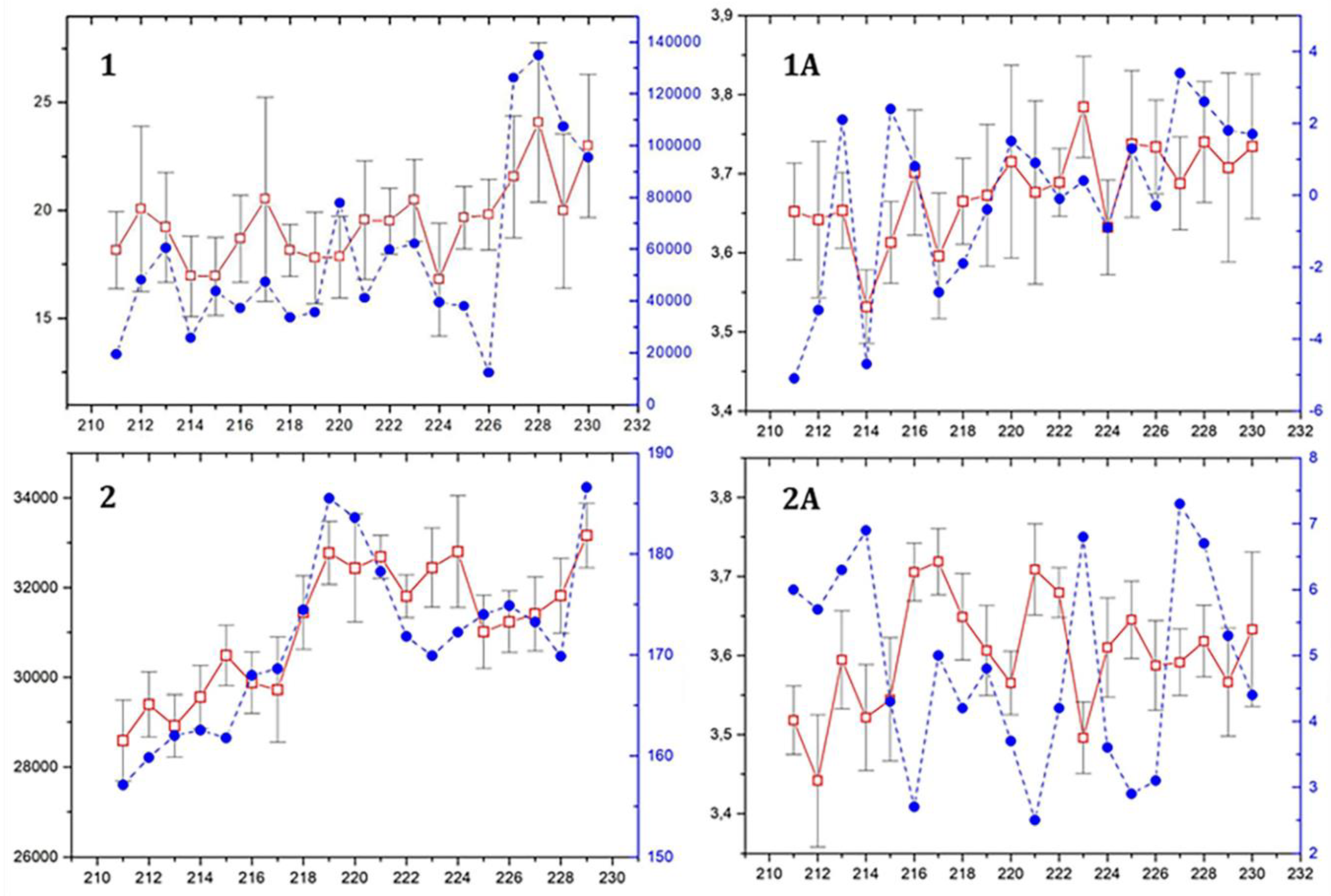
Evaluation of the relationship between the average daily values of GDV indices, based on averaging individual indicators for each date of the study, and daily values of geophysical indices showed that there are significant (p<0.05) correlations between them (Figure 2, Table 1,2).
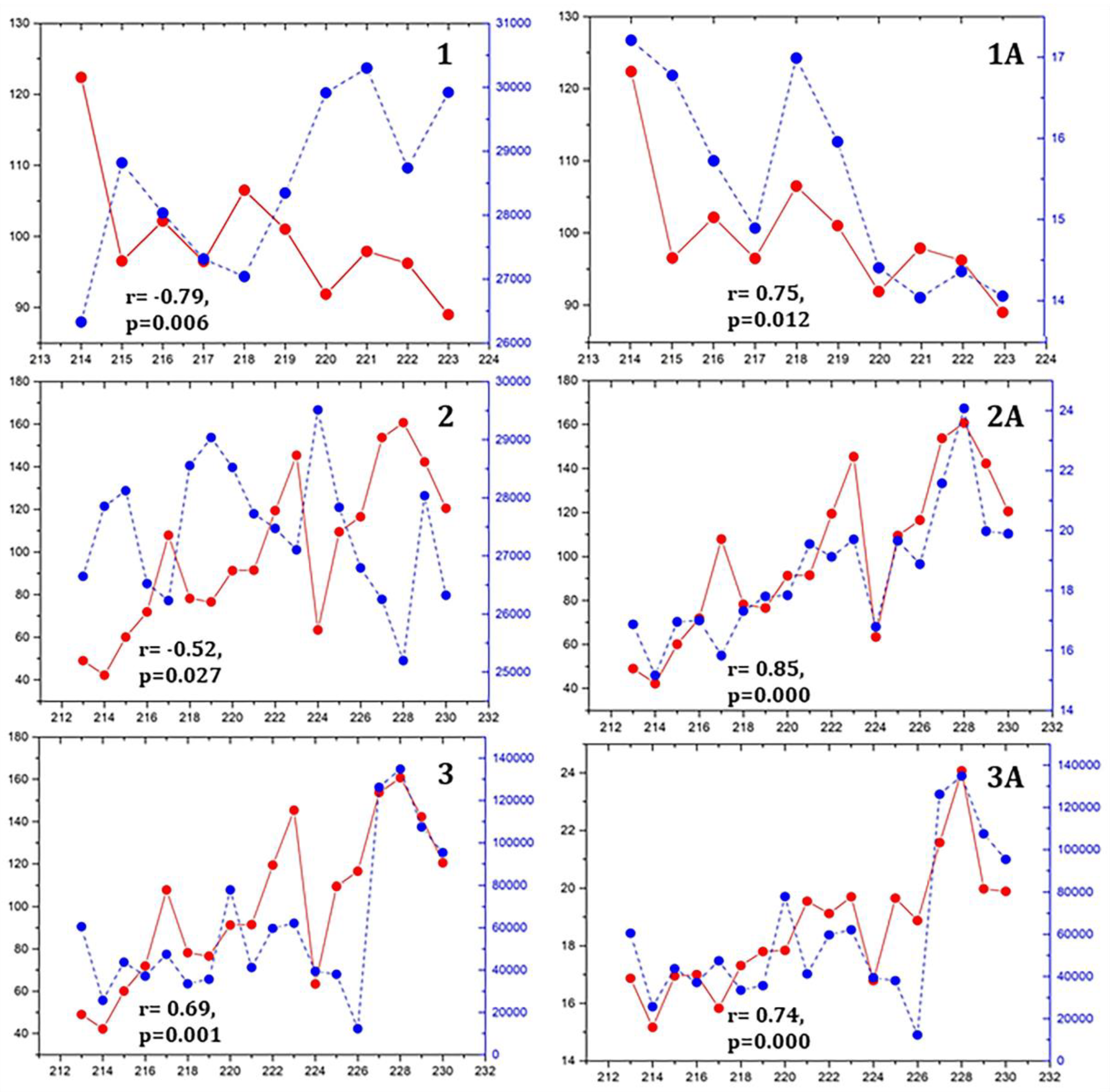
On the Figure 2, one can see the association between dynamics of daily average GDV indices and variations of daily mean of geophysical indicators of the Interplanetary media (IPM) state and ground-based GA. This follows from the correlations between Glow area index (Sr 1), Coefficient of form (Kf 1), detected without filter (1,1A), PROT Flux >10 MeV and NCR (r=0.92, p=0.000, r=0.71, p=0.001, respectively). Also, one can see correlation between GDV indices, detected with filter (2,2A), Glow area index (S2) (Figure 2,1), Entropy index (E 2) (Fig 2, 2A), Dst index and and ap-index (r=0.69, p=0.001, r= -0.74, p=0.000, respectively).
It turned out that in dependent on the mode of registration of GRV indices (without a filter and with a filter), the relationship between GRV and GA indices has its own specificity. In particular, at registration of GRV indices without a filter, significant correlation were found between the glow area indices (Sf 1 and S 1), shape coefficients (Kr 1, Kf 1, Kl 1, K 1) and the NCR near the Earth's surface (Table 1). The glow area indices have a negative correlation with the NCR, while the Coefficients of form have a positive correlation. Figure 2(A) illustrates the association between the dynamics of the daily mean values of the Coefficient of form (Kf 1) and the daily NCR near the Earth's surface. It can also be seen in Table 1 that the glow area indices are positively correlated with the atmospheric pressure at Barentsburg, and negatively - with the DST Index, PR. Flux >10 MeV, PR. Flux >30 MeV, PR. Flux >30 MeV, f10.7index. At the same time, the Coefficients of form indices have a positive correlation with these geophysical indices.
GDV-grams “without a filter” reflect the characteristics of the body’s state, determined by the contribution of the Sympathetic Nervous System (SNS) as the branch of the autonomic nervous systems (ANS) controlling sweet gland. The use of a filter allows to cut off the contribution of the SNS to the characteristics of GDV-gramm indicators, recording the basic characteristics of the functional state of the body [113,114].
Considering the fact that glow area is associated with the activity of sweat glands innervated by SNS, and increasing sweating associates with increase of S1 index, as stress response, the increasing atmospheric pressure and values of Dst index will mean increasing stress. Indeed, the data obtained in this study [62] have shown, that S 1 positively correlates with the anxiety index (r=0.59, p<0.05) and a negatively with the Mood (r= -0.66, p<0.05). On the contrary, the increase of Proton flux with energies of >10 Mev is associated with a decrease of S 1 index, a decrease in the anxiety and an increase in the Mood. The correlation coefficients with Proton Flux are r= -0.82, r=-0.59, r=0.73, respectively, p<0.05. That is, the Glow area coefficient in registration without a filter reflects the effects of GA variations on the mental state and, in fact, is not inferior in informativeness to such a demanded indicator as GSR.
Registration of GRV indices in the mode with filter have revealed similarities and differences in the correlations between GRV indices in registration without and with a filter and GA (Table, Figure 2, B). Thus, the GRV indices (S 1 and K 1) have significant correlations with the ground-based NCR and the atmospheric pressure (Table 1). At registration with a filter, significant correlations between GRV indices and these geophysical indices have not been revealed.
But a significant correlations were found between GDV indices, entropy indices (Er_2 and E 2), solar wind speed (Bulk speed) and GA indices: Kr - index (r= -0.71, -0.72, respectively, p<0.05, not shown in Table 2) and ap-index at registration of GRV indices with a filter. The similarity in correlations between GRV indices at registration without and with a filter and geophysical indices is that GRV indices at registration with a filter also have significant correlations with DST Index, PR. Flux >10 MeV, PR. Flux >30 MeV, PR. Flux >30 MeV, f10.7index. Moreover, all the glow area indices in the registration mode with a filter significant positively correlate with the f10.7 index.
Since the Coefficient of form characterizes unstable body’s state, it can be concluded that all GA positively correlating with the Coefficient form index, can be induce an unstable state of the body. That is, such a state can mean the mental lability or instability.
From this perspective, solar protons that penetrate deeply into the atmosphere in the polar cusp region can serve as indicators of physical processes at the Earth's surface that could act as physical agents modulating the psycho-emotional state of high-latitude residents. Effects of such influence will be dependent on dose of action.

3.3. 2018 Year, Spitzbergen Archipelago, Barentsburg Settlement

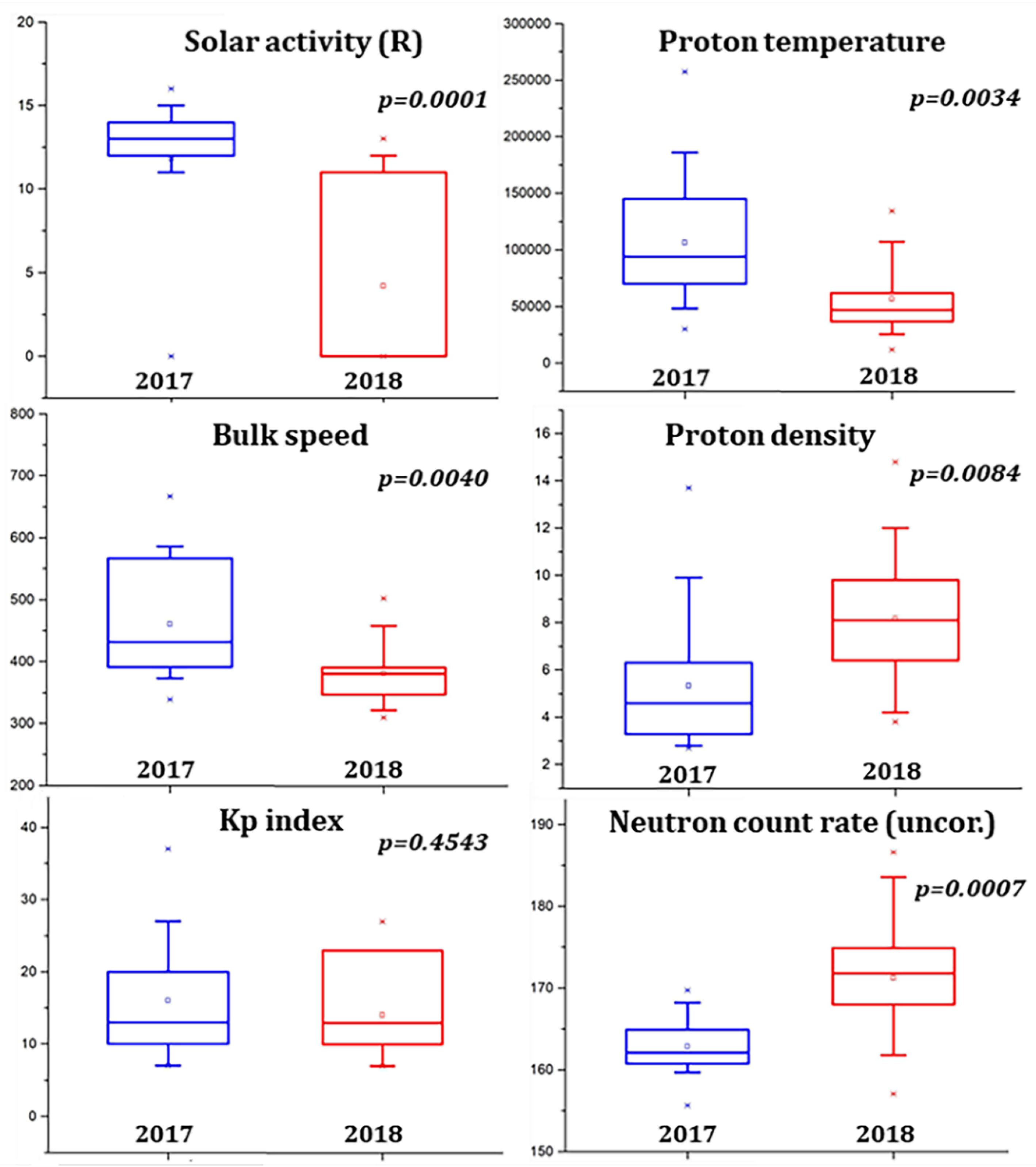
Our investigation on the Spitsbergen archipelago in the Barentsburg settlement was continued in 2018 from July 30 to August 18. The purpose of the study was to confirm the results obtained in 2017 and to emerge new patterns of effects of high-latitude GA on the human body. As in 2017, complex psychophysiological studies were conducted to assess the effects of GA on the state of the human body, which included recording the state of the skin using the methods of GSR and GDV. As in 2017, a significant relationship was found between variations of GA and the dynamics of the psychophysiological state of the study participants. Figure 3 and Table 3 present evidence of the association between skin condition and variations in geophysical agents.
One can see (Figure 3), that GDV indices in the mode detection without (Figure 3,1,1A) and with filter (Figure 3, 2,2A) significant correlate with geophysical indicators of the interplanetary media (IPM) state (Proton temperature, By GSE, Field Magnitude Avg) and ground-based geophysical indices, Figure 3,2A, (NCR). Сo-variations of the GA and GRV indices are confirmed by positive correlations between Kf 1 index and Proton temperature (Pr-T) (r=0.72, p=0.000); between El 1 index and By GSE (r=0.57, p=0.008) and as well as with ap-index (Table 3). The increase of the K and E indices in parallel with the increase of the Proton temperature in the solar wind (SW) and the values of By GSE, could mean a decrease in the stability of the psychophysiological state, since the indices of the entropy (E) and the Coefficient of form (K), as indicators of energy dissipation and instability, increase.
The importance of the correlations between glow area index (Sf 2) and neutron count rate near the Earth's surface (r= 0.85, p=0.000); between indices of Entropy (Er 2) and Field Magnitude Avg,(FM) (r= -0.56, p=0.011), Table 3, it is quite difficult to assess unequivocally. On the one hand, an increase in neutron intensity near the Earth's surface indicates an increase in density-ionizing and low-intensity radiation, the bio effectiveness of which is dose-dependent and can induce DNA damage. On the other hand, low-dose exposure to ionizing radiation may induce hormesis effects and increase the organism's resistance to other damaging agents. In this study, we can only state the fact association between variations in neutron intensity near the Earth’s surface and fluctuations in physicochemical properties of the skin, the indicator of which is the glow area index of the detected in the mode with filter (Sf 2). But the positive correlation between S 2 and the LF/HF index, which we found in this research [65], manifesting the relative contributions of sympathetic and parasympathetic branch of ANS in Heart rate (HR) regulation, evident that with increasing S 2 the contribution of SNS to HR increases. This means the increase of the tension in HR regulation mechanisms with increase of values of S2. Then, increase of NCR will accompany the increase in tension in HR regulation. Indeed, correlation coefficient between NCR and LF/HF indices is r=0.36, p=0.124. It is likely that with longer time series data, the correlation between NCR and LF/HF index could reach a p-value<0.05.
The inverse correlation between the Entropy index (Er 2) and the strength of the interplanetary magnetic field (IMF), characterized by the FM index (Field Magnitude Avg, nT), indicates that with increasing MF, energy dissipation decreases, as well as the variability of energy states of the body. Again, in order to unambiguously assess the result of the association of the body's energy states with the variability of the IMF state indicators, further field studies with more long time series of data are necessary.
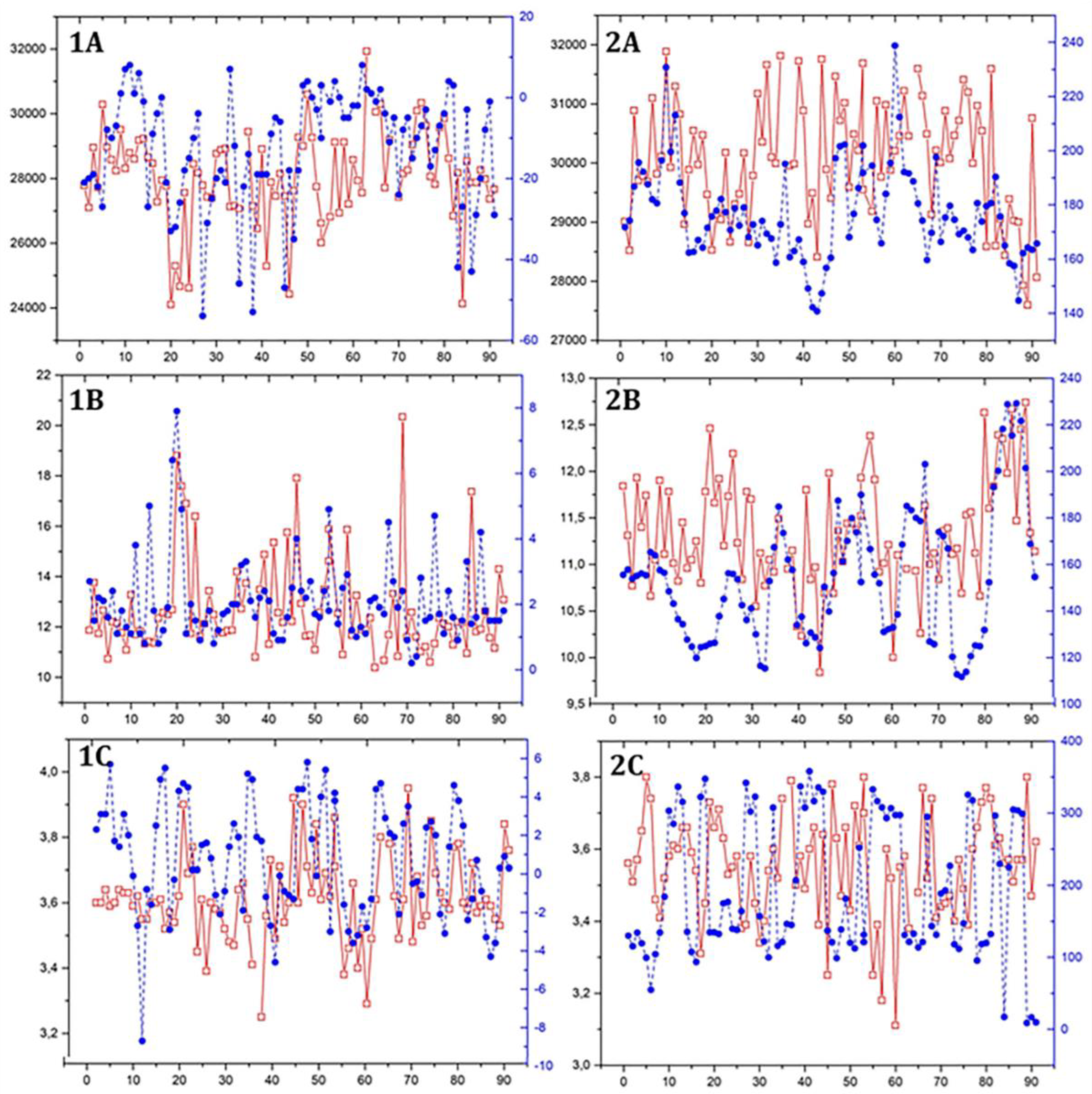
To understand the similarities and differences in the associations between skin state, characterized by corresponding indices, and geophysical indices in 2017 and 2018 years, we compared the average values of geophysical indices over the Barentsburg study periods (Figure 4). In Figure 4, it one can see that solar activity (SA), estimated by Wolf numbers (R), decreased significantly in 2018, as did solar wind (SW) speed. Meanwhile, the Kp-index did not change significantly in 2018 compared to 2017. Moreover, in 2018, such an index of solar proton energy as Proton temperature (PT) decreased significantly in 2018. However, the proton density (PrD) in the SW and the neutron intensity near the Earth's surface (Uncor) increased. Perhaps, these circumstances explain the difference in the nature of the relationship between the glow area indices in 2017, in 2018 and the neutron count rate near the Earth's surface. As the intensity of neutrons near the Earth's surface increases in 2018, there is a clear effect of their influence on the body mediated through the glow area index in the registration mode with a filter (S 2), which manifested the basic features of the functional state of the body.
The characteristics of the links between the indicators of the state of the IPM and ground-based indices provide the additional information on the geophysical features of the research periods (Table 4). In Table 4, it can be seen that in 2017 SA(R) during the study period, does not significantly correlate with either the GMA indicators (DST Index and ap-index), or with Proton fluxes in the SW, or even with another SA indicator - the solar radio emission flux (f10.7_index, (10-22). However, at the same time, the f10.7_index significantly correlates with Proton density (PrD), with Proton fluxes PROT Flux> 10 MeV and PROT Flux> 30 MeV, as well as with the DST index. That is, it is with these geophysical agents that the GDV indices correlate in 2017 year. Such correlation may indicate that during the period of our studies, bio effectiveness geophysical agents near the Earth's surface can be modulated by Solar radio emission and associated with it, Proton fluxes with energies >10 MeV and >30 MeV.
The correlation coefficients between geophysical agents in 2018 indicate a change in the state of the IPM due to changes in the characteristics of SA, and emerging in the Solar wind (SW) indicators. In particular, Figure 4 shows that the SW velocity (Bulk speed) decreases as well as the proton energy (Proton temperature index) in the SW, but the Proton density increases.
It is known, that with increasing of SW, the density of Galactic cosmic rays (GCR) fluxes decreases, which is manifested near the Earth's surface by a decrease in the intensity of the neutron component of secondary CR. This situation is probably characterizes of 2017 year. The decrease in the SW and Proton energy in 2018 leads to an increase in the GCR and, consequently, to an increase in the neutron intensity near the Earth's surface. We see confirmation of this in the inverse sign of the correlation between the NCR and the Proton flux with energies >10 MeV. We can also see that, in contrast to 2017, in 2018 year, CA (R) significant has correlated with the MMF intensity, with the intensity of high-energy protons (Proton temperature), with Bulk speed, with DST, and with the ap-index. However, there is no significant correlation with the Solar radio flux (f10.7_index, (10-22), as in 2017 year.
Comparison of the correlations between GRV and geophysical indices in 2017 and in 2018 years shows that they, to some extent, reflect the correlations between geophysical indices in these years. Thus the NCR and CA(R) indices in 2017 year have no significant correlations with any of the geophysical indices presented in Table 5. Similarly, GRV indices at registration with a filter, manifested the contribution of the physical component of the body state to the glow indices, have no significant correlations with either the NCR or the CA(R) indices.
However, the correlations between the GRV indices and geophysical indices changes with the change in the values of geophysical indices, emerging the change in the characteristics of the IPM state in 2018 year. In particular, the S indices (S 2) at registration with a filter significantly and positively correlate with the NCR, and also with the IMF vector (Magnitude of Average, nT, Field vector, |<B>|, nT) with its Bz component, and with Proton flux with energies >10 MeV. Such correlations, to some to some extent, indicate co-variations between GA and GDV indices and they are evidence effects of GA on the human body. Further studies have been conducted in the Apatity city, Murmansk region in 2023-2024 years.

3.4. 2022-2023 Years, Apatity City, Murmansk Region

The possibility of using GRV indices as indicators of the effects of GA on the human body was also tested in 2023-2024 years in Apatity city. However, it was not possible to obtain continuous time series data of GRV indices without gaps, as it was in 2017 and 2018 years, during the study period due to problems with the recruitment of study participants. Nevertheless, we obtained time series data corresponding to 91 dates of GDV indices registration in 5 study participants. The geophysical indices were selected in accordance with the dates of GRV indices registration that has allowed us to assess the covariance between the daily mean values of GRV indices and daily values of variations of GA. Table 6 and Figure 5 show the results of the estimation of the covariance between GA and GRV indices.
Figure 5, 1A, shows the covariations between Sl 1 and Dst indices (r=0.34, p=0.001), which confirms the correlations between these indices in 2017 (Table 1). The same correlation between of Coefficient form (Kl 1) and sigma-phi-V-indices (r=0.30, p=0.005), detected in 2023-2024 years, was found in the previous studies, when sigma-phi-V-indices index was excluded from consideration due to the level value of significant of correlation coefficient with Kl p >0.05. However, the correlation between Entropy index (El 1) and By GSE (r=0.30, p=0.004) found in 2023-2024 years (Figure 5, 1C) has been revealed between the same indices in 2018 year (Table 3, Figure 3, 1A). The correlation between Glow area index (S 2) and NCR (r= 0.29, p=0.005), Figure 5, 2A, has been also found between the same indices for 2018 (Table 4, Figure 3, 2). Only the correlations between the Coefficient form (Kl 2) and f10.7 (10-22) indices (r=0.41, p=0.000), and between the Entropy (Er 2) and the Long. Angle of avg. Field vector indices (r=0.32, p=0.002) (Figure 5, 2C) have not emerged in the correlations between GRV and geophysical indices in 2017 and 2018 years.
Comparisons of the significant of the differences between the GRV indices, as well as between the GA indices for the study periods in 2017, 2018 and in 2023-2024 years are presented in Table 7. One can see (Table 7), that differences between the Glow area indices (S 1), in registration without a filter, detected in different years and in different groups of the study participants are significant with p<0.05. The Glow area (S 1) indices increase from 2017 to 2023-2024 years. A pairwise comparison of the corresponding Glow area indices, detected in registration with a filter (S 2) in different years has revealed an opposite trend in the values of these indices. The S 2 indices were the lowest in 2023-2024 years, in comparing with values of corresponding indices in 2017 and in 2018 years. Significant differences between these indices were found only for the Sf 2 indices based on the only t-criterion, in 2017 and 2018 years.
In pairwise comparison of E and K indices detected in 2017 and in 2018 in registration modes without and with a filter, significant differences were found only between Kl 1 indices based on the Kolmogorov-Smirnov criterion. However, pairwise comparison of these indices values detected in 2017 and in 2023-2024, in 2018 and in 2023-2024 has revealed significant differences between the all compared indices. Moreover, the Entropy indices values and the Coefficients of form indices were the lowest in 2023-2024.
Comparison between the GRV indices for the study periods showed that the level of stress in 2023-2024 increased compared to 2017 and 2018, as can be seen from the increase in the S1 indices. At the same time, the decrease in the S2 index most likely indicates a decrease in the body's internal ‘energy resources’ in 2023-2024, compared to 2017 and 2018. This is also evidenced by lower values of the Coefficient of form and the Entropy indices in 2023-2024 than in 2017 and 2018. In fact, the values of the Coefficient of form and the Entropy indices signify not only the level of instability of the body, but also its capacity for adaptation. Thus, when assessing Heart Rate Variability (HRV), the criterion of good adaptation of the body to changing environment is a high level of such HRV indicator as the standard deviation of all RR intervals (SDNN). Narrowing of the range of this index serves as an unfavorable prognostic sign. Decrease in the values of the Coefficient of form and the Entropy indices in 2023-2024, in fact, the variability of these indices, can also be regarded as a decrease in adaptation reserves. Thus, on the basis of a comparative assessment of GRV indices we can judge about the reserve capabilities of the body in different periods of time. Since we have revealed covariations between GDV and GA indices, the GA could contribute to the body state and its adaptive capabilities.
Thus, it can be seen that the mean values of GDV indices depend more on the characteristics of the study period when their detection occurred, than on the place of registration and the study participants. Evidence for this statement is the absence of significant differences between E indices and K indices, recorded in 2017 and in 2018 in the Svalbard archipelago, in the different age-gender groups, and similarity in the correlations between identical GDV and geophysical indices, detected in different years, at different locations and with different study participants. This conclusion is supported by the similarity in the correlations between GDV and geophysical indices, manifested by significant positive correlations between Sl 1 and Dst indices, detected in 2017 and in 2023-2024 years; between El 1 and By GSE indices and between S 2 and Uncor indices, detected in 2018 and in 2023-2024 years.
The results of the comparing of the GDV indices in different study periods allow us to assert that difference in the indices is due to the peculiarities of GA effects on the body in the different span of time. Effects of GA on the body manifest in the physicochemical properties of the skin detected by using the GDV method. Hence, it follows that GRV indices are indicators of the impact of GA on the body.
Comparison of the significance of differences between the values of geophysical indices for the study periods in 2017, 2018, in 2023-2024 allows us to explain to some extent the similarities and differences between the GRV indices presented in Table 7. Thus, in Table 7 we can see a significant difference in the values of the NCR (Uncor) in the Spitsbergen archipelago in 2017 and in 2018, which was lower in 2017, than in 2018, and, accordingly, the neutron monitor count rate in Barentsburg in 2017 was also lower, than the neutron monitor count rate in Apatity in 2023-2024.
However, the NCR in Barentsburg in 2018 was not significantly different from that in Apatity in 2023-2024. Comparison of the significance of differences between other geophysical indices in different years within the research periods, shows that the highest SA (R) was recorded in 2023-2024, and the lowest in 2018, while the highest Bulk speed (BS) was found in 2017 year. In 2018 and 2023-2024, there were no found significant differences between the BS within the study periods. The study periods in 2017 year was also characterized by fluxes of high-energy protons (Pr temperature), whose energetic indicators were not significantly different from the proton energies in the SW in 2023-2024.
Thus, we believe that similarities and differences in the doses of GA exposure in different periods of time determine similarities and differences in the GRV indices, which are indicators of the impact of GA on the body.

3.5. Co-Variations of GDV, GSR Indices and GA Revealed in Spitzbergen Archipelago

During the research on the Spitzbergen archipelago in 2017 and 2018, we also recorded the GSR in the study participants, in parallel with the detection of the GDV indices. It turned out that correlations between the GDV and GSR indices were similar in 2017 and 2018 years (Figure 6). Both the Glow area indices in the registration without a filter (S-1) had an opposite correlation signs with the GSR indices in 2017 (Figure 6, 1, 1A) and in 2018 years (Figure 6, 2, 2A), (Figure 6, 1, 2). The Coefficients of form (K 1), on the contrary, positively correlated with the GSR indices (Figure 6, 1A, 2A). Moreover, it turned out that both the GDV and the GSR indices have similar correlations with identical indices of GA. An example of covariations between the KGR, GRV indices and the values ​​of the Proton energy index in the SW, expressed through the Proton temperature (Pr T) index, are shown in Figure 6, 3, 3A.
Thus, we have revealed, for the first time, a correspondence between the dynamics of the GDV and GSR indices, detecting the skin state. It should be emphasized, that such a correspondence was found only for the GDV indices, registered without a filter. Significant correlations between the GSR indices and the geophysical indices indicate the influence of variations in GA on the functional activity of the sympathetic nervous system, since the values ​​of the GSR indices depend on its activity.
We believe that the similarity and difference between GA, characterizing the SA, SW parameters, IMF characteristics, proton energies and densities, terrestrial GMA indicesand NCR explain the similarity and difference in GRV and GSR indices emerging the physicochemical properties of the skin, changing under GA effects. In other words, fluctuations of physicochemical properties of skin covers are coupled with variations of GA and are a ‘mirror’ of complex processes generated and modulated by SA in the IPM, in the atmosphere, and on the Earth's surface. Our studies are the natural observations the dynamics of skin state, detected by two methods in high latitude, where variations of GA express by extreme manner. We have tested the capabilities of the GRV and KGR methods to indicate the bio-effectiveness of GA. Our finding allow us to state that the GDV method can be used to detect the effect of GA on the human body. As for the possibilities of such detection by the GSR method, further research is required to give a definite answer. Thus, the conducted studies have revealed that co-variations of GA and of physicochemical properties of the skin, emerge effects of GA on the human body. The concordance between solar activity (SA) and GDV indices is determined by the level of SA and SW parameters modulating GMA and variability of the intensity of the secondary component of CR near the Earth's surface, expressed in NCR. Under equal conditions of the IPM state and identical characteristics of GA, the character of the correlations between these agents and GDV indices is reproduced irrespective of the time and place of of GDV indices detection. The significant correlations between similar GRV indices and geophysical indices found in studies conducted in the Spitzbergen Archipelago in 2017 and 2018, as well as in Apatity in 2023-2024 support this a statement.

4. Discussion

Studies conducted on the Svalbard archipelago in 2017 and in 2018 years, and in Apatity city in 2023-2024 years allowed us to emerge covariations between geophysical agents (GA) and physicochemical properties of skin in the study participants living in high latitudes. The covariations were revealed by comparing the dynamics of daily mean values of the GDV indices emerging physicochemical properties of skin and variations of daily values of geophysical indices. GDV indices, expressed through glow area (S), Coefficient of form (K) and entropy (E), were registered in the mode without a filter (S 1, K 1, E 1) and with a filter (S 2, K 2, E 2). The difference between values of GDV indices in registration without and with a filter dependent on the ratio of contributions of chemical and physical components in skin properties.
At registration GDV indices without a filter, the integral characteristics of skin surface are determined by contributions of sympathetic nervous system (SNS), regulating skin perspiration through activity of sweat glands [70,121,122], excretion of the body’s metabolism products [78,79,80,81], and also physical properties of skin including surface charge and body emission in different amplitude-frequency range of EMF, including in subTHz range [84,85,86,89,90,91,92,100]. It is assumed [91] that the sweat ducts, as electromagnetic entities, could be regarded as imperfect helical antennas with both end-fire and normal modes. It was found that sub-THz frequency range is bandwidth for skin [92]. It was proposed that the ac electric current “activated” in the “duct antenna” would be due to the diffusion of protons via hopping through distributed H-bond networks, existing in biological structures [92,93].
When GDV indices are detected with using a filter, the contribution of the chemical component to the glow area indices (S 2) is practically cut off, and the glow area indices are determined by the physical properties of the skin. Apparently, it could be electromagnetic radiation in a wide frequency range emitted by the whole body [123,124]. Radiometric measurements of human subjects in the frequency range 480-700 GHz, demonstrate the emission of blackbody radiation from the body core, rather than the skin surface. The dermis and epidermis can be considered as an electromagnetic bio-metamaterial, whereby the layered structure, along with the topology of the sweat duct, reveals a complex interference pattern in the skin. There is enough evidence to suggest that the combination of the helical sweat duct and wavelengths approaching the dimensions of skin layers could lead to non-thermal biological effects [104].
It can assume that GDV indices, in dependent on mode their registration (without or with a filter), will detect changes in different properties of the body, but as a single whole. These properties can be manifested both in the chemical composition of substances and emanations on the skin surface, and in the character of emission from the skin surface, determined by deep electro-chemical processes in the body [123,124,125]. Accordingly to correlations between GDV indices, detected with and without a filter and GA indices, it is possible to study the body’s response on the GA effects.
The study period on Svalbard in 2017 differed from other study periods (in 2018 and in 2023-2024) by minimum values of intensity and variability of neutron flux near the Earth's surface (Figure 4), minimum variability of Wolf numbers as indicators of solar activity (SA), high solar wind speed (SW) and high values of proton temperature (PrT ) (Figure 4). The correlations between the glow area indices in registration without filter (S 1) and the neutron count rate (NCR) were negative during this period, while between K1 indices and NCR were positive (Table 1). At the same time, no significant correlations between NCR and glow area indices at registration with filter (S 2) were found. However, correlations between GDV indices, both at registration without (Sr1, Sf1, Sl1, S1) and with a filter (Sr2, Sf2, Sl2, S2), were found with the Dst-index, with Proton fluxes with energy >10 MeV and >30 MeV, and with the Solar radio-emission indices (f10.7_index, (10-22), These correlations may evident that body state are modulated by ground-based agents, associated with high Solar flux in the radiofrequency range, with high speed of SW, and with Proton temperature to a greater extent, than by neutron flux of low intensity in this study period. The positive correlation between values of the Kf1, Kl1, K1 indices and NCR may emerge the stochastic effect of the low-intensity neutron flux on in the skin surface properties, manifested by more in the detected glow variability, then in its intensity.
However, when the situation changes due to the increase in the intensity of the secondary component of the Galactic cosmic rays in result of the increase in the proton density and the decrease of speed in the SW, the signs of the correlation between GA and GRV indices, detected without and with a filter have changed. The mean value of Wolf numbers (R) becomes in 2018 year even lower, than in 2017, but the neutron intensity near the Earth's surface increases. Such changes in values of GA have led to changes in signs of correlations between S1, S 2 indices and NCR. Correlation coefficients between Sr2, Sf2, Sl2, S2 indices and NCR have reached the significance level of p<0.05 (Table 4).
From the point of view of physiology, these data can be interpreted as a change in the functional state of the body, expressed through the physical and chemical properties of the skin in a result of changes in the qualitative and quantitative effects of GA on the body. For more deep interpretation of these data, it is necessary involve physiological correlates between GRV indices and psychophysiological state of the body, which were emerged in the studies on the Spitsbergen archipelago in 2017 and 2018 years [61,62,63,64,126]. In this study, it is important that skin properties, manifesting in the values of GRV indices, are indicators of the effects of GA on the body. Under changing of the characteristics of geophysical agents, the GRV indices change synchronously with GA, emerging fluctuations in the physicochemical properties of the skin.
Studies conducted in 2023-2024 in Apatity have confirmed the objectivity of data relatively the covariations of GA and GRV indices as signatures of the GA effects on the human body. The advantage of the studies conducted in 2023-2024 were a longer time series data, in comparing with one obtained in 2017 and in 2018. The disadvantages were separate gaps in registration, small number of the study participants and more variable social and physical environment under living on territory with a high level of electromagnetic anthropogenic pollution. Nevertheless, the data obtained in Apatity in 2023-2024 confirmed the main results of the previous studies. In particular, the correlations between the GRV indices (Sr2, Sf2, Sl2, S2) and the NCR have reproduced the same correlations for data have obtained in 2018 in the Spitsbergen archipelago. The similar in the intensity of neutron fluxes in the Apatity (2023-2024) and in the Barentsburg (2018), probably, has determined correlations between GA and GDV indices in 2023-2024 years, despite on dramatic increase of R-index by a factor of 28 and the Solar radio flux by a factor of 2 in 2023-2024 in comparing with 2018 (Table 7). The increase of SA in 2023-2024 has manifested in the significant correlations between indices of SA (R and f10.7_index, (10-22)) and glow area indices in registration with a filter (Sr2-S2). That is, it can assume that the dramatic increase in SA was accompanied by changes of physical characteristics of the whole body, since correlations were significant only between SA and the glow area indices, detected with, but not without a filter. In this case, it is important that under equal exposure to the neutron flux in the Apatity and in the Barentsburg, correlations between the same GRV indices and NCR were reproduced, irrespective of the fact that the studies were carried out at different times, in different location and with different groups of the study participants. Thus, the changes in the exposure to GA change the character of correlations between GA and GRV indices.
A good correspondence was found between GRV and GSR indices [61]. The revealed correlations between GRV and GSR indices make a certain contribution to the understanding of the mechanisms linking the psychophysiological state of the body and the features of the GRV gram. GSR, like GRV, is registered from the skin surface. However, the SNS contribution to the GSR, in case of GRV application, are registered only at registration without a filter. Additional information, which is obtained during registration with a filter, makes the GRV method more informative, than CGR [91,97,98,99,127,128].
In the phenomenon of finger glow, as well as in GSR, a significant contribution is made by biological molecules, the excretion of which by the skin is controlled by SNS. If we turn to the structure of the skin and its functions, we can see that the skin is a source of emissions of various molecules and compounds, the spectrum of which reflects the state of the organism Through the skin various products of nitrogen and carbohydrate metabolism are removed, including those toxic to the organism: carbon dioxide, ammonia, urea and others. In addition to these end products of metabolism, substances necessary for the organism are also excreted through the skin [129,130]. The intensity of the excretion of such molecules depends on the general level of activity and the balance between the ANS links. The parasympathetic and sympathetic links of HR rhythm regulation determine the adaptation resources of the body. We assume that the integral characteristic of the total metabolic processes in the body is manifested in the GRV indices registered with the filter. And moreover, perhaps it is the registration with a filter that characterizes the basic energy level of the body, the variations of which are emerged in the registration of HGV indices without a filter.
It is assumed [131] that in the process of GDV a certain sequence of information transformations is formed in the state of a biological object (BO). These states are characterized by physiological processes, among which physicochemical and emission processes play a determining role, as well as gas emission processes, which depend on changes in the total impedance of the BO, impedance of surface areas, structural and emission properties of the BO. The inhomogeneity of the surface and volume, the processes of emission of charged particles and/or gas emission influence the parameters of the electromagnetic field, due to which the parameters of the gas discharge change. The characteristics of the gas discharge critically depend on the presence of impurities in the gas [132], so this factor also makes a significant contribution to the glow parameters [111,113]. The GRV method is likely to manifested qualitative and quantitative variations in the composition of biological molecules on the skin surface when recorded GDV-gramm in registration without a filter, and the energetic characteristics of the body as whole manifest in the GRV index values recorded with a filter.
Geophysical agents, as physical environmental factors, can influence the course of physicochemical processes in the body, which, in turn, determine the processes of skin emission of biologically active molecules and integral energy characteristics of the body as whole.
The obtained results present a high informational significance of GRV indices as indicators of the effects of GA on the body. Our research for the first time has revealed the phenomenon of covariation between geophysical agents and physicochemical properties of the skin. This gives the possibility to use the GRV method for indication the effects of GA on the human body in the further. Such studies would be help to reveal the molecular, biochemical, physiological and psycho-emotional correlates between GRV indices and the mechanisms due to the GA modulate the functional body state. The using of GDV method expands the possibilities of the forecast influence of space weather on the healthy and sick human body.

5. Conclusion

The purpose of the study was to estimate the capabilities of the Gas Discharge Visualization (GDV) method for detection of effects of geophysical agents (GA) on the human body and to compare it's advantage with Galvanic Skin Response (GSR), usually applied for detection stress. Our studies were conducted in 2017 and 2018 years on the Spitsbergen archipelago, and in 2023-2024 - in Apatity, Murmansk region. In course of the studies, the following finding were obtained:
1. The dynamics of average daily values of the GDV indices and variations in the daily values ​​of the GA indices were coupled in the study periods.
2. The correlations and their signs between the GDV and GA indices in different periods of the study were determined by the intensity of the neutron flux at the Earth's surface, as a secondary component of Cosmic Rays (CR), and the variability of the Solar Wind (SW), largely than SA.
3. The correlations between the GDV and GA indices in studies conducted in different years, with different locations and different groups of study participants were reproduced, in the case of comparability of the neutron level at the Earth's surface, as a secondary component of CR in the study period.
4. The specificity of the correlations between the GDV and GA indices depended on the method of recording GDV: without a filter or with a filter. Similarity between GDV indices and GSR manifested in the cases of GDV registration without a filter.
5. GDV indices could be used instead of the GSR, since the increase of the glow area indices, in registration without a filter, indicates on stress, that usually detected by GSR. Higher possibilities of the GDV method than the GSR concludes in the obtaining of additional data: the glow area index, in registration with a filter, emerges the energy signature of the body, and the Coefficient of form and Entropy indices provide additional information about the adaptive capabilities of the body.
6. The emerged covariations of the GDV and GA indices allows us to consider the GDV indices as informative indicators of the GA effects on the human body.
7. The non-invasiveness of the GDV method, its high informative possibilities, the concordance of the change in the GA and GDV indices allow to use the GDV indices as indicators of the GA effects on the body, and as sources for the physiological interpretations of the GA effects.

6. Limitations

The main limiting circumstances are the duration of the studies, which in the case of the studies on the Spitsbergen archipelago was determined by the duration of the expeditions. In addition, the recruitment of the study participants, who, as a rule, do not have the opportunity to participate in the measurements on a daily basis, is a difficult task. This makes it difficult to obtain long and continuous data series with a sufficient number of participants. Unfortunately, these limitations are a common attribute in observational studies involving volunteers.

Author Contributions

Conceptualization, N.K.B.; methodology N.K.B., N.L.S, T.A.Yu., and R.R.Yu.; validation, N.K.B. and N.L.S.; formal analysis, N.K.B. and N.L.S.; data curation, N.K.B., N.L.S., T.A.Yu. and R.R.Yu.; writing—original draft preparation, N.K.B.; writing—review and editing, N.K.B.; project administration, N.K.B. All authors have read and agreed to the published version of the manuscript.

Funding

Funding was provided on a regular budgetary basis within the framework of Research and Development Programs Project No. FMEZ-2025-0047 (for 2025-2027) approved by the Ministry of Science and Higher Education of the Russian Federation.

Institutional Review Board Statement

This study was conducted in accordance with the WMA Declaration of Helsinki, 1964, amended at the 64th General Assembly of the WMA, 2013, and approved by the Local Bioethics Committee of Research Centre for Human Adaptation in the Arctic, Branch of the Federal Research Center “Kola Science Center of the Russian Academy of Science”(protocol № 2, 10 February 2017) for studies involving humans.

Data Availability Statement

The original contributions presented in this study are included in this article; further inquiries can be directed to the corresponding author/s.

Conflicts of Interest

The authors declare no conflicts of interest.

References

  1. Chizhevsky, A.L. Earth's Echo of Solar Storms. 2nd ed. Preface by O. G. Gazenko. Editorial Board: P. A. Korzhuev (Rev. Ed.) et al. M, ‘Mysl’. 1976, 367. https://fond-svetoslav.ru/upload/000/works/chizhevskiy/2.pdf.
  2. Mavromichalaki, H.; Papailiou, M.; Gerontidou, M.; Dimitrova, S.; Kudela, K. Human Physiological Parameters Related to Solar and Geomagnetic Disturbances: Data from Different Geographic Regions. Atmosphere 2021, 12, 1613.
  3. Papailiou, M.; Ioannidou, S.; Tezari, A.; Lingri, D.; Konstantaki, M.; Mavromichalaki, H.; Dimitrova, S. Space weather phenomena on heart rate: A study in the Greek region. Int. J. Biometeorol. 2023, 67, 37–45.
  4. Babayev, E.S.; Allahverdiyeva, A.A. Effects of geomagnetic activity variations on the physiological and psychological state of functionally healthy humans: Some results of Azerbaijani studies. Adv. Space. Res. 2007, 40, 1941–1951.
  5. Chernouss, S.; Vinogradov, A.; Vlassova, E. Geophysical hazard for human health in the circumpolar auroral belt: Evidence of a relationship between heart rate variation and electromagnetic disturbances. Natural Hazards. 2001, 23, 121-135.
  6. Belisheva, N. K.; Konradov A.A. Significance of the geomagnetic field variations for human organism functional state at high latitude // Geophysical processes and Biosphere. 2005, 4, 1/2, . 44-52. (in Russian).
  7. Oinuma, S.; Kubo, Y.; Otsuka, K.; Yamanaka, T.; Murakami, S.; Matsuoka, O.; Ohkawa, S.; Cornélissen, G.; Weydahl, A.; Holmeslet, B.; et al. Graded response of heart rate variability, associated with an alteration of geomagnetic activity in a subarctic area. Biomed. Pharmacother. 2002, 56, 284–288. 713. [CrossRef]
  8. Palmer, S.J.; Rycroft, M.J.; Cermack, M. Solar and Geomagnetic Activity, Extremely Low Frequency Magnetic and Electric Fields and Human Health at the Earth’s Surface. Surv. Geophys. 2006, 27, 557–595.
  9. Dimitrova, S. Different geomagnetic indices as an indicator for geo-effective solar storms and human physiological state. J. Atmos. Sol.-Terr. Phys. 2008, 70, 420–427.
  10. Mendoza, B.; de la Pena, S.S. Solar activity and human health at middle and low geomagnetic latitudes in Central America. Adv Space Res 2010, 46, 449–459. [CrossRef]
  11. Unger, S. The impact of space weather on human health. Biomed. J. Sci. Tech. Res. 2019, 22, 16442–16443.
  12. Mavromichalaki, H.; Papailiou, M.; Dimitrova, S.; Babayev, E.S.; Loucas, P. Space weather hazards and their impact on human cardio-health state parameters on Earth. Nat. Hazards 2012, 64, 1447–1459.
  13. Giannaropoulou, E.; Papailiou, M.; Mavromichalaki, H.; Gigolashvili, M.; Tvildiani, L.; Janashia, K.; Preka-Papadema, P.; Papadima, T. A study on the various types of arrhythmias in relation to the polarity reversal of the solar magnetic field. Nat. Hazards 2014, 70, 1575–1587.
  14. Mavromichalaki, H.; Preka-Papadema, P.; Theodoropoulou, A.; Paouris, E.; Apostolou, T. A study of the possible relation of the cardiac arrhythmias occurrence to the polarity reversal of the solar magnetic field. Adv. Space Res. 2017, 59, 366–378.
  15. Galata, E.; Ioannidou, S.; Papailiou, M.; Mavromichalaki, H.; Paravolidakis, K.; Kouremeti, M.; Rentifis, L.; Simantirakis, E.; Trachanas, K. Impact of space weather on human heart rate during the years 2011–2013. Astrophys. Space Sci. 2017, 362, 138.
  16. McCraty, R.; Atkinson, M.; Timofejeva, I.; Joffe, R.; Vainoras A.; Landauskas, M.; Alabdulgader, A.A. and Ragulskis M. The Influence of Heart Coherence on Synchronization Between Human Heart Rate Variability and Geomagnetic Activity. Journal of Complexity in Health Sciences. 2018, 1(2), 42-48. [CrossRef]
  17. Alabdulgader, A.; McCraty, R.; Atkinson, M.; Dobyns, Y.; Vainoras, A.; Ragulskis, M.; Stolc V. Long-Term Study of Heart Rate Variability Responses to Changes in the Solar and Geomagnetic Environment. Sci Rep. 2018, 8, 8(1), 2663. PMID: 29422633; PMCID: PMC5805718. [CrossRef]
  18. Mattoni, M.; Ahn, S.; Fröhlich, C.; Fröhlich F. Exploring the relationship between geomagnetic activity and human heart rate variability. Eur J Appl Physiol. 2020,  20(6), 1371-1381. Epub 2020 Apr 18. PMID: 32306151; PMCID: PMC11089572. [CrossRef]
  19. Timofejeva, I.; McCraty, R.; Atkinson, M.; Alabdulgader, A.A.; Vainoras, A.; Landauskas, M.; Šiaučiūnaitė, V. and Ragulskis, M. Global Study of Human Heart Rhythm Synchronization with the Earth’s Time Varying Magnetic Field. Applied Sciences. 2021, 11, Article No. 2935. [CrossRef]
  20. Janashia, K.; Tvildiani, L.; Tsibadze, T.; Invia, N. Effects of the geomagnetic field time varying components compensation as evidenced by heart rate variability of healthy males. Life Sciences in Space Research 2022, 32, 38-44. 718. [CrossRef]
  21. Stupishina, O.M.; Golovina, E.G.; Noskov, S.N.; Eremin, G.B.; Gorbanev, S.A. The Space and Terrestrial Weather Variations as Possible Factors for Ischemia Events in Saint Petersburg. Atmosphere 2022, 13, 8. [CrossRef]
  22. Vieira, C.L.Z.; Chen, K.; Garshick, E.; Liu, E.M.; Vokonas, P.; Ljungman, P.; Schwartz, J.; Koutrakis, P. Geomagnetic disturbances reduce heart rate variability in the normative aging study. Sci Total Environ. 2022, 839, 156235. 721. [CrossRef]
  23. Belisheva, N.K.; Popov, A.N.; Petukhova, N.V.; Pavlova, L.P.; Osipov, K.S.; Tkachenko, S.E.; Baranova, T.I. Qualitative and quantitative assessment of exposure to geomagnetic field variations on the functional status of the human brain]. Biofizika. 1995, 40(5), 1005-12. (In Russ). PMID: 8555283.
  24. Pobachenko, S.V.; Kolesnik, A.G.; Borodin, A.S.; Kalyuzhin, V.V. The contingency of parameters of human encephalograms and Schumann resonance electromagnetic fields revealed in monitoring studies. Biophysics 2006, 51, 480–483. [CrossRef]
  25. Mulligan, B.P.; Hunter, M.D.; Persinger, M.A. Effects of geomagnetic activity and atmospheric power variations on quantitative measures of brain activity: Replication of the Azerbaijani studies. Adv. Space Res. 2010, 45, 940–948.
  26. Persinger, M.A. Brain electromagnetic activity and lightning: Potentially congruent scale-invariant quantitative properties. Front. Integrat Neurosci. 2012, 6, 19.
  27. Soroko, S.I.; Bekshaev, S.S.; Belisheva, N.K.; Pryanichnikov, S.V. Amplitude-frequency and spatio-temporal reorganizations of the bioelectric activity of the human brain with strong disturbances of geomagnetic activity. Vestnik of the Far East Branch of the Russian Academy of Sciences. FEB RAS PublisherCentral Scientific Library. FEB RAS. 2013, 4, 111-122 https://elibrary.ru/download/elibrary_20798925_83288094.pdf.
  28. Saroka, K.S.; Caswell, J.C.; Lapointe, A.; Persinger, M.A. Greater electroencephalographic coherence between left and right temporal lobe structures during increased geomagnetic activity. Neurosci. Lett. 2013, 560, 126–130.
  29. Rozhkov, V.P.; Belisheva, N.K.; Martynova, A.A.; Soroko, S.I. Psychophysiological and cardiohemodynamic effects of solar, geomagnetic, and meteorological factors in humans under the conditions of the Arctic region. Human Physiology. 2014, 40(4), 397-409.
  30. Kanunikov, I.E.; Kiselev, B.V. Influence of the geomagnetic field on recurrence quantification EEG indexes // Ekologiya cheloveka (Human Ecology). 2014, 21(12), 47-54. [CrossRef]
  31. Wang, C.X.; Hilburn, I.A.; Wu, D.A.; Mizuhara, Y.; Cousté, C.P.; Abrahams, J.N.H.; Bernstein, S.E.; Matani, A.; Shimojo, S.; Kirschvink, J.L. Transduction of the Geomagnetic Field as Evidenced from alpha-Band Activity in the Human Brain. eNeur. 2019, 6, ENEURO.0483-18.2019.
  32. Podolská, K. Circulatory and Nervous Diseases Mortality Patterns—Comparison of Geomagnetic Storms and Quiet Periods. Atmosphere 2022, 13, 13.
  33. Krylov, V.V.; Osipova, E.A. Molecular Biological Effects of Weak Low-Frequency Magnetic Fields: Frequency–Amplitude Efficiency Windows and Possible Mechanisms. Int. J. Mol. Sci. 2023, 24, 10989. [CrossRef]
  34. Belisheva, N. K.; Semenov, V. S.; Tolstyh, Yu.V.; Biernat, H. K. Solar Flares, Generation of Solar Cosmic Rays and Their Influence on Biological Systems// Proc. of the Second European Workshop on Exo/Astrobiology Graz, Austria, 16-19 September 2002 (ESA SP-518, November 2002), 429-431.
  35. Belisheva, N.K.; Kuzhevskii, B.M.; Vashenyuk, E.V.; Zhirov, V.K. Correlation between the fusion dynamics of cells growing in vitro and variations of neutron intensity near the Earth's surface. Dokl Biochem Biophys. 2005, 402, 254-7. PMID: 16116763. [CrossRef]
  36. Belisheva, N.K.; Kuzhevskij, B.M.; Sigaeva, E.A.; Panasyuk, M.I.; Zhirov, V.K. Variations in the neutron intensity near the Earth's surface modulate the functional state of the blood. Dokl Biochem Biophys. 2006, 407, 83-7. PMID: 16776072. [CrossRef]
  37. Belisheva, N.K.; Lammer, H.; Biernat, H.K.; Vashenyuk, V.E. The effects of cosmic rays on biological systems – an investigation during GLE events // Astrophys. Space Sci. Trans. 2012, 8, 7–17 www.astrophys-space-sci-trans.net/8/7/2012/doi:10.5194/astra-8-7-2012.
  38. Diatroptova, M.A.; Diatroptov, M.E. Amplitude of One-Minute Fluctuations of Secondary Cosmic Rays as a Marker of Environmental Factor Determining Ultradian Rhythms in Body Temperature of Laboratory Rats. Bull Exp Biol Med. 2021, 172(1), 105-110. Epub 2021 Nov 17. PMID: 34787780. [CrossRef]
  39. Papailiou, M.; Mavromichalaki, H.; Vassilaki, A.; Kelesidis, K.M.; Mertzanos, G.A.; Petropoulos, B. Cosmic ray variations of solar origin in relation to human physiological state during December 2006 solar extreme events. Adv. Space Res. 2009, 43, 523–529.
  40. Papailiou, M.; Mavromichalaki, H.; Kudela, K.; Stetiarova, J.; Dimitrova, S. The effect of cosmic ray intensity variations and geomagnetic disturbances on the physiological state of aviators. ASTRA 2011, 7, 373–377.
  41. Papailiou, M.; Mavromichalaki, H.; Kudela, K.; Stetiarova, J.; Dimitrova, S. Cosmic radiation influence on the physiological state of aviators. Nat. Hazards 2012, 61, 719–727.
  42. Papailiou, M.-C.; Ioannidou, S.; Tezari, A.; Mavromichalaki, H. Geomagnetic and Cosmic Ray Activity Effect on Heart Rate uring the Solar Cycle 24. Atmosphere 2024, 15, 158. [CrossRef]
  43. Stoupel, E.; Babayev, E.; Abramson, E.; Sulkes, J. Days of “zero” level geomagnetic activity accompanied by the high neutron activity and dynamics of some medical events—Antipodes to geomagnetic storms. Health 2013, 5, 855–861. [CrossRef]
  44. Vieira, C.L.Z.; Janot-Pacheco, E.; Lage, C.; Pacini, A.; Koutrakis, P.; Cury, P.R.; Shaodan, H.; Pereira, L.A.; Saldiva, P.H.N. Long-term association between the intensity of cosmic rays and mortality rates in the city of Sao Paulo. Environ. Res. Lett. 2018, 13, 24009. [CrossRef]
  45. Vencloviene, J.; Beresnevaite, M.; Cerkauskaite, S.; Ragaisyte, N.; Pilviniene, R.; Benetis, R. Statistical Associations between Geomagnetic Activity, Solar Wind, Cosmic Ray Intensity, and Heart Rate Variability in Patients after Open-Heart Surgery.Atmosphere 2022, 13, 1330. [CrossRef]
  46. Singh, A.K.; Bhargawa, A.; Siingh, D.; Singh, R.P. Physics of Space Weather Phenomena: A Review. Geosciences. 2021, 11, 286. [CrossRef]
  47. Leamon, R.J., McIntosh, S.W. and Title, A.M. Deciphering Solar Magnetic Activity: The Solar Cycle Clock. Front. Astron. Space Sci. 2022, 9, 886670. [CrossRef]
  48. Nevoit, G.; Landauskas, M.; McCarty, R.; Bumblyte, I.A.; Potyazhenko, M.; Taletaviciene, G.; Jarusevicius, G.; Vainoras, A. Schumann Resonances and the Human Body: Questions About Interactions, Problems and Prospects. Appl. Sci. 2025, 15, 449. https:// doi.org/10.3390/app15010449.
  49. Breus, T.K.; Ozheredov, V.A.; Syutkina, E.V.; Rogoza, A.N. Some aspects of the biological effects of space weather. J. Atmos. Sol.-Terr. Phys. 2008, 70, 436–441.
  50. Messner, T.; Haggstrom, I.; Sandahl, I.; Lundberg, V. No covariation between the geomagnetic activity and the incidence of acute myocardial infraction in the polar area of northern Sweden. Int. J. Biometeorol. 2002, 46, 90–94.
  51. Tsyganenko, N.A.; Russell, C.T. Magnetic signatures of the distant polar cusps: Observations by Polar and quantitative modelling // JGR. 1999, 104, 24, 939.
  52. Baddeley, L.; Lorentzen, D.; Haaland, S. et al. Space and atmospheric physics on Svalbard: a case for continued incoherent scatter radar measurements under the cusp and in the polar cap boundary region. Prog Earth Planet Sci. 2023, 10, 53 . [CrossRef]
  53. Savin, S.P. Magnetic shield of the Earth: plasma gaps. URL: http://www.kosmofizika.ru/popular/savin.htm.
  54. Golikov, Yu.V.; et al. On the nature of low-frequency electromagnetic radiation in the polar cap. Letters in ZhETF. 1975, 22, 1, 3-7.
  55. Manninen, J.; et al. Quasi-periodic VLF emissions,VLF choruses and geomagnetic pulsations of Ps4 (event on 3 April 2011). Geomagnetism and Aeronomy. 2012, 52, 1, 82-92. 5.
  56. Le G.; et al. Electromagnetic Ion Cyclotron Waves in the High Altitude Cusp: Polar Observations. URL: https://ntrs.nasa.gov/archive/nasa/casi.ntrs.nasa.gov/20010028950.pdf.
  57. Bolshakova, O. V.; et al. Long-period geomagnetic pulsations in high-latitude magnetically conjugate regions. Geomagnetism and Aeronomy. 1986, 26, 1, 160-162.
  58. Kleimenova, N. G.; et al. Two types of long-period geomagnetic pulsations near the equatorial boundary of the daytime polar casp. Geomagnetism and Aeronomy. 1985, 25, 1, 163-165.
  59. Kozyreva, O. V.; et al. Long-period geomagnetic pulsations in the quasi-conjugate regions of the Arctic and Antarctic during the magnetic storm of 16-17 April 1999. Geomagnetism and Aeronomy. 2006, 46, 5, 657-670.
  60. Chugunova, O. M.; Pilipenko, V. A.; Engebretson M. Appearance of quasi-monochromatic РсЗ-4 pulsations in the polar cap. Geomagnetism and Aeronomy. 2004, 44, 1, 47-54.
  61. Belisheva, N.K.; Martynova, A.A.; Pryanichnikov, S.V.; Solovievskaya, N.L.; Zavadskaya T.S.; Megorsky V.V. Linkage of Parameters of the Interplanetary Magnetic Field and the Solar Wind in the Polar Cusp with Psychophysiological State of the Residents of Spitzbergen Archipelago. Herald of the Kola Science Centre of RAS. 2018, 4 (10), 5–24 (In Russ.). [CrossRef]
  62. Belisheva, N.K.; Martynova, A.A.; Pryanichnikov, S.V.; Solov'evskaya, N.L.;Zavadskaya, T.S., Dobrodeeva, L.K. and Megorsky, V.V. Bio effectiveness of the geo-space agents at the Spitsbergen archipelago. IOP Conf. Ser.: Earth Environ. Sci. 2019, 263, 012041. [CrossRef]
  63. Solovievskaya, N.L.; Yanovskaya, E.E.; Yusubov, R.R.; Belisheva N.K. Evaluation of psychophysiological effects of exposure to geoscosmic agents using the method of gas discharge visualization (GDV). Proceedings of the Kola Scientific Centre. Heliogeophysics. 2019, 10, 8, 125-137. [CrossRef]
  64. Belisheva, N.K.; Tsetlin, V.V.; Martynova, A.A.; Solovyevskaya, N.L.; Zavadskaya, T.S.; Pryanichnikov, S.V.; Megorsky, V.V. Water as an indicator of cosmophysical impacts on the human body in the conditions of the Svalbard archipelago. Aviakosmicheskaya i Ekologicheskaya Meditsina (Russia). 2020, 54, 2, 96-104. [CrossRef]
  65. Korotkov, K.G.; & Korotkin, D.A. Concentration dependence of gas discharge around drops of inorganic electrolytes. Journal of Applied Physics, 2001, 89, 4732-4736. [CrossRef]
  66. Korotkov, K.G.; Bundzen, P.V.; Bronnikov, V.M.; Lognikova, L.U. Bioelectrographic correlates of the direct vision phenomenon. J Altern Complement Med. 2005, 11, 5, 885-893. PMID: 16296923. [CrossRef]
  67. Korotkov, K.G.; Matravers, P; Orlov, D.V.; Williams, B.O. Application of electrophoton capture (EPC) analysis based on gas discharge visualization (GDV) technique in medicine: a systematic review. J Altern Complement Med. 2010, 16, 1, 13-25. PMID: 19954330. [CrossRef]
  68. Kostyuk, N.; Cole, P.; Meghanathan, N,; Isokpehi, R.D.; Cohly, H.H. Gas discharge visualization: an imaging and modeling tool for medical biometrics. Int J Biomed Imaging. 2011, 2011:196460. Epub 2011 May 19. PMID: 21747817; PMCID: PMC3124241. [CrossRef]
  69. Critchley HD. Electrodermal responses: what happens in the brain. Neuroscientist. 2002, 8(2), 132-42. PMID: 11954558. [CrossRef]
  70. Bari, D.S.; Aldosky, H.Y.Y.; Tronstad, C.; Kalvøy, H.; Martinsen, Ø.G. Electrodermal responses to discrete stimuli measured by skin conductance, skin potential, and skin susceptance. Skin Res Technol. 2018, 24(1),108-116. Epub 2017 Aug 4. PMID: 28776764. [CrossRef]
  71. Bari, D.S.; Aldosky, H.Y.Y.; Tronstad, C.; Martinsen, Ø.G. The correlations among the skin conductance features responding to physiological stress stimuli. Skin Res Technol. 2021, 27(4),582-588. Epub 2020 Dec 30. PMID: 33381876. [CrossRef]
  72. Bari, D.S.; Rammoo, M.N.S.; Aldosky, H.Y.Y.; Jaqsi, M.K.; Martinsen, Ø.G. The Five Basic Human Senses Evoke Electrodermal Activity. Sensors (Basel). 2023 Sep 29;23(19):8181. PMID: 37837011; PMCID: PMC10575214. [CrossRef]
  73. Polat, L. N. Ö.; and Özen, Ş. Evaluation of physiological effect of audiological test based on galvanic skin response. Meas. Sci. Rev. 2023, 23, 92–99. [CrossRef]
  74. Singaram, S.; Ramakrishnan, K.; and Periyasamy, S. Electrodermal signal analysis using continuous wavelet transform as a tool for quantification of sweat gland activity in diabetic kidney disease. Proc. Inst. Mech. Eng. 2023, H 237, 919–927. [CrossRef]
  75. Betzalel, N.; Ben Ishai, P.; Puzenko, A.; Feldman, Y. Emission from human skin in the sub THz frequency band. Sci Rep. 2022, 18, 12(1), 4720. PMID: 35304510; PMCID: P. [CrossRef]
  76. Fowles, D.C.; Christie, M.J.; Edelberg, R.; Grings, W.W.; Lykken, D.T.; Venables, P.H. Publication recommendations for electrodermal measurements. Psychophysiology. 1981, 18, 232–239.
  77. Dawson, M.E.; Schell, A.M.; Filion, D.L. The electrodermal system. In: Cacioppo JT, Tassinary LG, Berntson GC, editors. Handbook of psychophysiology. 2nd ed. Cambridge, MA: Cambridge University Press. 2000, 200–223.
  78. Gurina, E.Yu. Study of excretion of some metabolites of nitrogen metabolism by human skin. Abstract of PhD diss. 2007, Voronezh, 20. file:///C:/Users/Natalia/Downloads/autoref-issledovanie-ekskretsii-nekotorykh-metabolitov-azotistogo-obmena-kozhei-cheloveka.pdf.
  79. Baker, L.B.; Wolfe, A.S. Physiological mechanisms determining eccrine sweat composition. Eur J Appl Physiol. 2020, 120(4), 719-752. Epub 2020 Mar 2. PMID: 32124007; PMCID: PMC7125257.]. [CrossRef]
  80. Iaglov, V.V.; Iaglova, N.V. Novel concepts in biology of diffuse endocrine system: results and future investigations. Vestn Ross Akad Med Nauk. 2012, 4, 74-81. (In Russ.) PMID: 22834332;
  81. Rost, F.W.D.; Polak, J.M. & Pearse, A.G.E. The Melanocyte: Its cytochemical and immunological relationship to cells of the endocrine polypeptide (APUD) series. Virchows Arch. Abt. B Zellpath. 1969, 4, 93–101. [CrossRef]
  82. Ultra Low Frequency Waves in the Magnetosphere. In: Kamide, Y., Chian, A. (eds) Handbook of the Solar-Terrestrial Environment. 2007. Springer, Berlin, Heidelberg. [CrossRef]
  83. Krupatkin, A.I. Blood flow oscillations at a frequency of about 0.1 hz in skin microvessels do not reflect the sympathetic regulation of their tone. Human Physiology. 2009, 35, 2, 183-191. https://elibrary.ru/item.asp?id=13610070.
  84. Cifra, M.l; Van Wijk, E.; Koch, H.; Bosman, S.; and Van Wijk, R.. Spontaneous Ultra-Weak Photon Emission from Human Hands Is Time Dependent. Online. Radioengineering. 2007, 16, 2, 15-19.: http://hdl.handle.net/11012/57282. [cit. 2025-02-02];
  85. Wijk, R.V.; Wijk, E.P. An introduction to human biophoton emission. Forsch Komplementarmed Klass Naturheilkd. 2005, 12(2), 77-83. PMID: 15947465. [CrossRef]
  86. Ignatov, I.; Mosin, O.V.; Niggli, H.; Drossinakis, C.; & Stoyanov, C. Registration of Electromagnetic Waves Emitted from the Human Body. Journal of Medicine, Physiology and Biophysics. 2014, 5, 1-22.
  87. Van Wijk, R.; Schamhart, D.H. Regulatory aspects of low intensity photon emission. Experientia. 1988, 15, 44(7), 586-93. PMID: 3294034. [CrossRef]
  88. Yang, B.; Donnan, R.S.; Zhou, M.; Kingravi, A.A. Reassessment of the electromagnetic reflection response of human skin at W-band. Opt Lett. 2011, 1, 36(21), 4203-5. PMID: 22048365. [CrossRef]
  89. Mogensen, M.; Thrane, L.; Joergensen, T.M.; Andersen, P.E.; Jemec, G.B. Optical coherence tomography for imaging of skin and skin diseases. Semin Cutan Med Surg. 2009, 28(3), 196-202. PMID: 19782944. [CrossRef]
  90. Gabriel, S.; Lau, R.W.; and Gabriel, C. The Dielectric Properties of Biological Tissues: II. Measurements in the Frequency Range 10 Hz to 20 GHz. Physics in Medicine and Biology. 1996, 41, 2251-2269.
  91. Betzalel, N.; Ben Ishai, P.; Feldman, Y. The human skin as a sub-THz receiver - Does 5G pose a danger to it or not? Environ Res. 2018, 163, 208-216. Epub 2018 Feb 22. PMID: 29459303. [CrossRef]
  92. Feldman, Y.; Puzenko, A.; Ben Ishai, P.; Caduff, A.; Davidovich, I.; Sakran, F.; Agranat, A.J. The electromagnetic response of human skin in the millimetre and submillimetre wave range. Phys Med Biol. 2009, 7, 54(11), 3341-63. Epub 2009 May 8. PMID: 19430110. [CrossRef]
  93. Hayut, I.; Puzenko, A.; Ben Ishai, P.; Polsman, A.; Agranat, A.J.; Feldman, Y. The Helical Structure of Sweat Ducts: their Influence on the Electromagnetic Reflection Spectrum of the Skin. IEEE Trans. Terahertz Sci. Technol. 2013, 3, 207–215. [CrossRef]
  94. Ellison, W.J.; Lamkaouchi, K.; Moreau, J.-M. Water: a dielectric reference. J. Mol. Liq. 1996, 68, 171–279. [CrossRef]
  95. Kim, J.; Lu, W.; Qiu, W.; Wang, L.; Caffrey, M.; Zhong, D. Ultrafast hydration dynamics in the lipidic cubic phase: discrete water structures in nanochannels. J. Phys. Chem. 2006, B 110, 21994–22000. [CrossRef]
  96. Brändén, M., Sandén, T., Brzezinski, P., Widengren, J., Localized proton microcircuitsat the biological membrane–water interface. Proc. Natl. Acad. Sci. 2006, 103, 19766–19770. [CrossRef]
  97. Safrai, E.; Ishai, P.B.; Caduff, A.; Puzenko, A.; Polsman, A.; Agranat, A.J.; Feldman, Y. The remote sensing of mental stress from the electromagnetic reflection coefficient of human skin in the sub-THz range. Bioelectromagnetics. 2012, 33(5),375-82. Epub 2011 Dec 14. PMID: 22170380. [CrossRef]
  98. Ohhashi, T.; Sakaguchi, M.; Tsuda, T. Human perspiration measurement. Physiol Meas. 1998, 19(4), 449-61. PMID: 9863672. [CrossRef]
  99. Furedy, J.J. Electrodermal Activity as a Tool for Differentiating Psychological Processes in Human Experimental Preparations: Focus on the Psyche of Psychophysiology. In: Roy, JC., Boucsein, W., Fowles, D.C., Gruzelier, J.H. (eds) Progress in Electrodermal Research. NATO ASI Series. 1993, 249. Springer, Boston, MA. [CrossRef]
  100. Owda, A.Y.; Salmon, N.; & Rezgui, N.D. Electromagnetic signatures of human skin in the millimeter wave band 80-100 GHZ. Progress in Electromagnetics Research B, 2018, 380, 79-99. [CrossRef]
  101. Hayut, I.; Ben Ishai, P.; Agranat, A.J.; Feldman, Y., Circular polarization induced by the three-dimensional chiral structure of human sweat ducts. Phys. Rev. 2014, E 89, 042715. [CrossRef]
  102. Shafirstein, G.; Moros, E.G.. Modelling millimetre wave propagation and absorption in a high resolution skin model: the effect of sweat glands. Phys Med Biol. 2011, 7, 56(5), 1329-39. Epub 2011 Feb 4. PMID: 21297244. [CrossRef]
  103. Usui, M.L.; Mansbridge, J.N.; Carter, W.G.; Fujita, M.; Olerud, J.E. Keratinocyte migration, proliferation, and differentiation in chronic ulcers from patients with diabetes and normal wounds. J Histochem Cytochem. 2008, 56(7), 687-96. Epub 2008 Apr 14. PMID: 18413645; PMCID: PMC2430161. [CrossRef]
  104. Betzalel, N.; Ben Ishai, P.; Puzenko, A.; Feldman, Y. Emission from human skin in the sub THz frequency band. Sci Rep. 2022, 18;12(1), 4720. PMID: 35304510; PMCID: PMC8933490. [CrossRef]
  105. 108. Kochnev, A.; Betzalel, N.; Ben Ishai, P.; and Feldman, Yu. Human Sweat Ducts As Helical Antennas In The Sub-Thz Frequency Range-An Overview. Terahertz Science And Technology, 2018, 11, 3, 43-56.
  106. Baksheeva, K.; Ozhegov, R.V.; Goltsman, G.N.; Kinev, N.V.; Koshelets, V.P.; Kochnev, A.; Betzalel, N.; Puzenko, A.; Ishai, P.B.; & Feldman, Y. Do humans “shine” in the sub THz? 2019 44th International Conference on Infrared, Millimeter, and Terahertz Waves (IRMMW-THz), 1-2. [CrossRef]
  107. Liu, Xian Wei; Yang, Yunze; Wang, Wei; Wang, Shaopeng; Gao, Ming; Wu, Jie; and Tao, Nongjian, "Plasmonic-Based Electrochemical Impedance Imaging Of Electrical Activities In Single Cells" Translational Neuroscience. 2017, 461. https://scholar.barrowneuro.org/neurobiology/461.
  108. King, F.L.; Harrison, W.W. Glow Discharge Mass Spectrometry. In: Marcus, R.K. (eds) Glow Discharge Spectroscopies. Modern Analytical Chemistry. Springer, Boston, MA. 1993. [CrossRef]
  109. Betti, M.; de las Neras, L.A. Glow discharge mass spectrometry in nuclear research. Spectroscopy Europe/World. 2003, 15,3,15-24. https://www.spectroscopyeurope.com/article/glow-discharge-mass-spectrometry-nuclear-research.
  110. Voronov, M.; Hofmann, T.; & Venzago, C. Microsecond pulsed glow discharge source in “element gd” and “vg 9000” mass-spectrometers. Publ. Astron. Obs. Belgrade. 2008, 84, 359 – 360. https://publications.aob.rs/84/pdf/359-360.pdf https://publications.aob.rs/84/pdf/359-360.pdf.
  111. Korotkov, K. G. Human Energy Field: Study with GDV Bioelectrography, Backbone Publishing, Fair Lawn, NJ, USA, 2002.
  112. Olalde Rangel, J. A.; and del Castillo, O. Report on the first international congress on systemic medicine, gas discharge visualization (GDV) and electro-oncotherapy (ECT). Evidence-Based Complementary and Alternative Medicine. 2005, 2, 2, 255–256.
  113. Korotkov, K.G. Principles of GDV bioelectrography analysis. SPb.: "Renome", 2007, 286 p.; ​​.
  114. Provotorov, V.M.; Lyubykh, E.N.; Ovsyannikov, E.S. The role of gas-discharge visualization in assessing the psycho-vegetative status of patients with ventral hernias. Bulletin of experimental and clinical surgery. 2012, 5, 2, 388-390.
  115. Ekhanin S.G. Study of galvanic skin response. Guidelines for laboratory classes on the subject "Biomedical devices and sensors". Tomsk State University of Automated Control Systems and Radioelectronics (TUSUR). 2019, 28 p. (in Russ.). https://edu.study.tusur.ru/publications/9127/download.
  116. Tranel, D.; Damasio, H. Neuroanatomical correlates of electrodermal skin conductance responses. Psychophysiology. 1994, 31, 427–38.
  117. Zahn, T.P.; Grafman, J.; Tranel, D. Frontal lobe lesions and electrodermal activity: effects of significance. Neuropsychologia. 1999, 37, 1227–1241.
  118. Tranel, D. Electrodermal activity in cognitive neuroscience: neuroanatomical and neuropsychological correlates. In: Lane RD, Nadel L, editors. Cognitive neuroscience of emotion. New York: Oxford University Press. 2000, 192–224.
  119. Bartolomé-Tomás, A.; Sánchez-Reolid, R.; Fernández-Sotos, A., Fernández-Caballero, A., Latorre, J.M. Arousal Detection in Elderly People from Electrodermal Activity Using Musical Stimuli. Sensors (Basel). 2020, 25, 20(17), 4788. PMID: 32854302; PMCID: PMC7506973. [CrossRef]
  120. Xu, X.; Zhang, H.; Yan, Y.; Wang, J.; Guo, L. Effects of electrical stimulation on skin surface. Acta Mech Sin. 2021, 37(12), 1843-1871. Epub 2021 Feb 6. PMID: 33584001; PMCID: PMC7866966. [CrossRef]
  121. Krizhanovskyy, E. V.; Korotkina, S. A.; and K. G. Korotkov, S. A. Role of the human central nervous system in the formation of the glow of the skin in high intensity electromagnetic field. in Proceedings of the IXth Annual International Congress “Science, Information, Spirit”, Saint Petersburg, Russia, July 2005.
  122. Cohly, H.; Kostyuk, N.; Isokpehi, R.; and Rajnarayanan, R. “Bio-electrographic method for preventive health care,” in Proceedings of the 1st IEEE Annual Bioscience and BiotechnologyConference, 2009.
  123. Sitko, S.P. Life in the fundamental notions of the physics of the alive. Physics of the Alive. 2011, 19, 2, 59-64. https://cyberleninka.ru/article/n/life-in-the-fundamental-notions-of-the-physics-of-the-alive.
  124. Fröhlich, H. Theoretical Physics and Biology. Biological Coherence and Response to External Stimuli // Ed. by Fröhlich H. – New York: Springer-Verlag, 1988.
  125. Adair, R.K. Vibrational resonances in biological systems at microwave frequencies. Biophys J. 2002, 82(3), 1147-52. PMID: 11867434; PMCID: PMC1301920. [CrossRef]
  126. Belisheva, N.K.; Prianichnikov S.V.; Solovyevskaya N.L.; Megorsky V.V. Svalbard is a Testing Area for Analog Aerospace Research of the Impact of Cosmophysical Agents on Human Organism. Herald of the Kola Science Centre of the RAS. 2017, 4 (9), 22–29. (In Russ.).
  127. Razinkin, S.M., Dvornikov M.V. Physiology and hygiene of a pilot in extreme conditions. Moscow. Publisher: "Scientific Book". 2019, 558. (In Russ.).
  128. Orlov, O.I., Belakovskiy, M.S., Kussmaul, A.R. and Tomilovskaya, E.S. Using the Possibilities of Russian Space Medicine for Terrestrial Healthcare. Front. Physiol. 2022, 13, 921487. [CrossRef]
  129. Gusev, V.G.; et al. Electrical properties of the human skin. Vestnik UGATU Ufa. 2008. 10, 1(26), 180-190.
  130. Drevin, V.E.; Savina, E.G.; Nadezhkina, E.Y.; Savin, G.A. Cutaneous excretion of nitrogenous substances: a monograph Volgograd: FGBOU VPO Volgograd GAU, 2014, 108.
  131. Strukov, E.Yu. Possibilities of the method of gas-discharge imaging in the assessment of the functional state of the organism in the perioperative period. Dissertation for the degree of Candidate of Medical Sciences.14.00.37 - Anaesthesiology and Reanimatology. Military Medical Academy named after S.M. Kirov. St. Petersburg. 2003.
  132. Boyers, D.G., Tiller W.A. Corona Discharge Photography // J. Applied Physics. 1973, 44, 3102-3112.
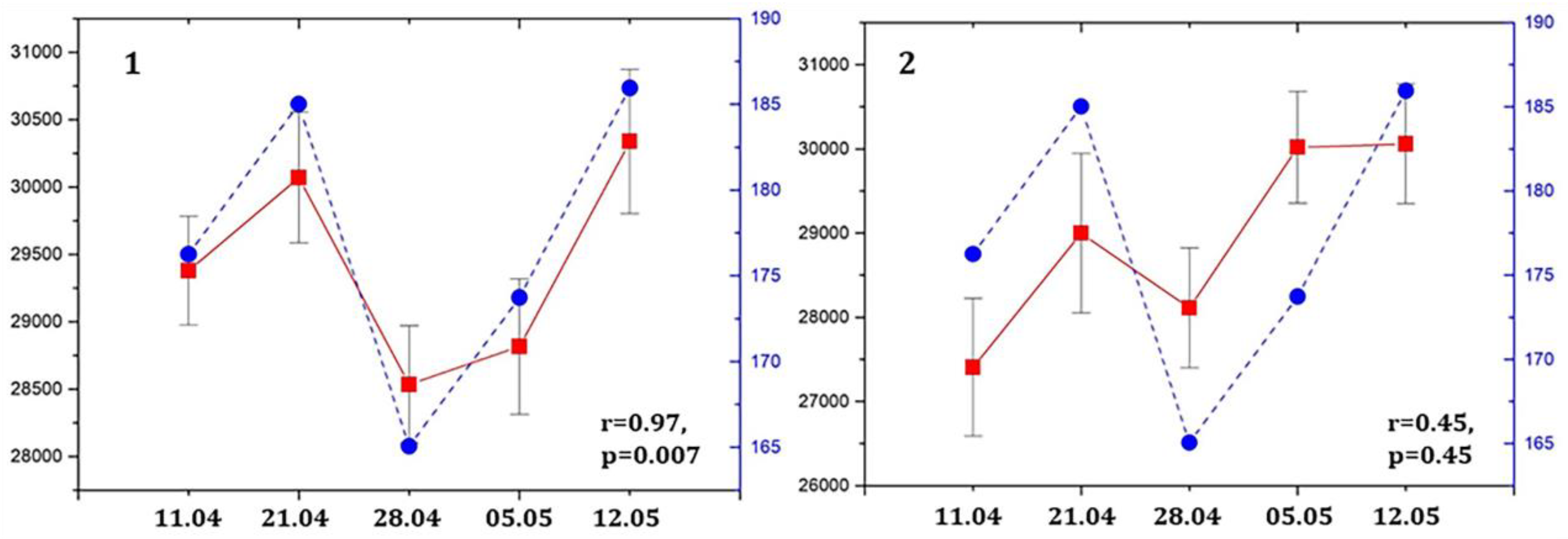
Figure 1. Correlation between glow area indices (in the registration mode with filter) (M±SE), red line, in man (1), in women (2), and neutron count rate near the Earth's surface uncorrected on atmospheric pressure (dash blue line). On the abscissa axis, dates of the study in 2016; on the ordinate axis, left: glow area indices, conventional units; right: neutron count rate, counts/s.
Preprints 149387 g001
Figure 2. Correlations between daily mean of geophysical (dash blue line) and daily average GDV (red line) indices, M±SE, detected without filter (1,1A) and with filter (2,2A). 1: Correlation between Glow area index (Sr 1, smoothing data on 5 points) and PROT Flux >10 MeV; 1A –correlation between Coefficient of form (Kf 1) and count rate of the neutron monitor near the Earth's surface. 2: Correlation between S2 and Dst index; 2A: Correlation between of Entropy index (E 2) and ap-index. On the abscissa axis - days of the 2017 year. On the ordinate axis: 1, left - mean of Sr 1, conventional units; right - mean of PROT Flux >10 MeV, 1/(cm2 sec ster); 1A, left -Kf 1 index, conventional units; right- mean of neutron monitor count rate, counts/s; 2, left - S 2, conventional units; right - mean of Dst Index, nT; 2A, left - mean of E 2, conventional units; right - mean of ap-index, nT.
Preprints 149387 g002
Figure 3. Correlations between daily mean of geophysical (dash blue line) and daily average GDV indices (red line), M±SE, detected without filter (1,1A) and with filter (2,2A). 1: Correlation between indices of Coefficient of form (Kf 1), and Proton temperature (Pr-T); 1A: correlation between Entropy index (El 1) and By GSE. 2: Correlation between glow area index (Sf 2) and neutron count rate near the Earth's surface ; 2A: Correlation between indices of Entropy (Er 2) and Field Magnitude Avg,(FM). On the abscissa axis - days of the 2018 year; on the ordinate axis: 1, left - mean of Kf 1 index, conventional units; 1, right - mean of Pr-T, Degrees, K; 1A , left - mean of El 1 index, conventional units; 1A, right - mean of By GSE, nT. 2, left - mean of Sf 2, conventional units; 2, right - neutron count rate, counts/s; 2A, left- mean of E 2, conventional units; 2A, right - mean of FM, nT.
Preprints 149387 g003
Figure 4. Comparison of average values ​​of geophysical indices for the periods of research conducted in Barentsburg.
Preprints 149387 g004
Figure 5. Concordance between daily values of geophysical (dash blue line) and daily mean values of GDV indices (red line), detected without a filter (1A, 1B, 1C) and with a filter (2A, 2B, 2C). 1A: Glow area index (Sl 1) and Dst Index; 1B: Coefficient form (Kl 1) and sigma-phi-V-index; 1C: Entropy index (El 1) and By GSE. 2A: Glow area index (S 2) and neutron monitor count (NCR); 2B: Coefficient of form (Kl 2) and f10.7_index, (10-22); 2C: Entropy index (Er 2) and index of Long. Angle of avg. Field vector. On the abscissa axis – conventional designations of the days of the year corresponding to the dates of GRV indices registration: numbers from 1 to 49 correspond to period from 29.09.2023 to 25.12.2023; numbers from 50 to 91 correspond to period from 09.01.2024 to 25.04.2024. On the ordinate axis: 1A, 1B, 1C, left - mean of Sl 1, Kl 1, El 1, conventional units; right - mean of Dst Index, nT, sigma-phi-V, deg index, By GSE, nT, respectively. 2A, 2B, 2C, left – mean of S 2, Kl 2, Er 2, conventional units; right – mean of neutron monitor count rate (NCR), counts/s; f10.7_index, (10-22), Watts/meter sq/hertz, Angle of avg. Field vector, Deg (GSE Coords), respectively.
Preprints 149387 g005
Figure 6. Correlation between galvanic skin response (GSR), GRV indices in 2017 (1, 1A), in 2018 (2,2A) years, between GSR (3), GRV (3A) indices and Proton temperature (3,3A) in 2018 year, detected in Barentsburg settlement, Spitzbergen archipelago. 1,1A – red line: GSR, dash line: 1- glow area indices (Sr-1) and 1A – Coefficient of form (Kl 1), detected without filter (1,1A, correspondently). 2, 2A – red line: GSR, dash line: 2- glow area indices (Sl-1) and 2A – Coefficient of form (Kf 1), detected without filter. 3 – red line: GSR; 3A –red line Kf 1; 3,3A – dash line: Proton temperature (Pr T). On the abscissa axis - days of the years: 1,1A -2017; 2,2A, 3,3A -2018. On the ordinate axis: 1, 1A; 2,2A; 3 – mean of GSR indices relatively average values (100%) of data set GSR, %; 3A left – mean of Kf 1index, conventional units; 1,2 right - mean S1 1 index, conventional units;1A,2A right - mean of Kl 1and Kf-1 indices, conventional units; 3,3A right – mean of Pr-T, Degrees, K.
Preprints 149387 g006
Table 1. Correlations coefficients between GDV-indices, in the registration mode without filter, and geophysical indices in 2017 year.
Indices of GDV M SD Uncor, counts/s Pressure, mb, DST Index PR. Flux >10 MeV PR. Flux >30 MeV ap-index, nT, f10.7index, (10-22W)
Sr_1 26988 2226 -0,44 0,50 0,58 -0,84 -0,65 -0,01 0,48
Sf_1 25355 1905 -0,56 0,61 0,53 -0,79 -0,57 0,03 0,45
Sl_1 26001 1946 -0,43 0,49 0,62 -0,80 -0,55 0,05 0,46
S_1 26115 2003 -0,48 0,54 0,59 -0,82 -0,60 0,02 0,47
Er_1 3,76 0,08 0,29 -0,33 0,16 -0,20 -0,31 -0,39 0,18
Ef_1 3,78 0,06 0,24 -0,26 0,22 -0,31 -0,46 -0,28 0,19
El_1 3,71 0,07 0,46 -0,48 0,09 -0,12 -0,30 -0,29 0,00
E_1 3,75 0,06 0,36 -0,39 0,17 -0,22 -0,38 -0,35 0,13
Kr_1 16,51 1,71 0,42 -0,51 -0,63 0,78 0,54 -0,03 -0,38
Kf_1 19,07 2,27 0,71 -0,74 -0,34 0,56 0,33 -0,07 -0,30
Kl_1 16,79 1,89 0,50 -0,59 -0,52 0,61 0,29 -0,13 -0,31
K_1 17,46 1,89 0,58 -0,65 -0,50 0,66 0,39 -0,08 -0,34
Sim_1 0,91 0,02 -0,52 0,60 -0,03 -0,10 0,14 0,43 0,06
Notes: correlation coefficients in bold italics correspond to the level of p<0.05. Uncor, counts/s - an unpressure-corrected neutron monitor account near the Earth’s surface; Pressure, mb,- atmospheric pressure in the Barentsburg settlement; Dst-index - (Disturbance Storm Time Index), describes the intensity of a geomagnetic storm, with increasing storm intensity, the Dst index decreases; PR. Flux >10 MeV, PR. Flux >30 MeV - proton fluxes (number/cm2 sec sr) with energy > 10 MeV, > 30 MeV, respectively; ap-index, nT - used along with the Kp index, equal to the average amplitude of geomagnetic field variations over the globe per day; f10.7index, (10-22W) - characterizes the solar radio emission at a wavelength of 10.7 cm (f = 2800 MHz, solar flux units (s.f.u.), 1 s.f.u. = 10 -22 Watt).
Table 2. Correlations coefficients between GDV-indices, in the registration mode with filter, and geophysical indices in 2017 year.
Indices of GDV M SD Uncor
counts/s
Press,
mb
Bulk speed, km/s DST Index PROT Flux >10 MeV PROT Flux >30 MeV ap-index, nT, f10.7_index, (10**-22)
Sr_2 31043 2117 -0,20 0,25 -0,43 0,69 -0,85 -0,73 -0,16 0,49
Sf_2 30071 1835 -0,32 0,33 -0,40 0,69 -0,87 -0,76 -0,14 0,57
Sl_2 30228 1787 -0,38 0,39 -0,36 0,68 -0,87 -0,74 -0,13 0,55
S_2 30447 1899 -0,30 0,32 -0,40 0,69 -0,87 -0,75 -0,15 0,54
Er_2 3,61 0,07 0,24 -0,11 -0,64 0,11 -0,01 -0,11 -0,71 -0,47
E_2 3,58 0,04 0,03 0,05 -0,58 0,24 0,03 0,01 -0,74 -0,28
Kr_2 12,48 0,76 0,08 -0,09 0,49 -0,55 0,83 0,82 0,18 -0,45
Kf_2 14,52 0,83 0,13 -0,15 0,44 -0,51 0,81 0,79 0,15 -0,45
Kl_2 12,12 0,57 0,17 -0,22 0,43 -0,53 0,81 0,74 0,16 -0,35
K_2 13,04 0,71 0,13 -0,15 0,46 -0,54 0,83 0,80 0,17 -0,43
Sim_2 0,93 0,01 -0,36 0,34 -0,18 0,46 -0,73 -0,60 0,12 0,49
*correlation coefficients in bold italics correspond to the level of p<0.05. Uncor, counts/s - an unpressure-corrected neutron monitor account near the Earth’s surface; Pressure, mb,- atmospheric pressure in the Barentsburg settlement; Bulk speed -speed in solar wind (km/s), ;Dst-index - (Disturbance Storm Time Index), describes the intensity of a geomagnetic storm, with increasing storm intensity, the Dst index decreases; PR. Flux >10 MeV, PR. Flux >30 MeV - proton fluxes (number/cm2 sec sr) with energy > 10 MeV, > 30 MeV, respectively; ap-index, nT - used along with the Kp index, equal to the average amplitude of geomagnetic field variations over the globe per day; f10.7index, (10-22W) - characterizes the solar radio emission at a wavelength of 10.7 cm (f = 2800 MHz, solar flux units (s.f.u.), 1 s.f.u. = 10 -22 Watt).
Table 3. Correlations coefficients between GDV-indices, in the registration mode without filter, and geophysical indices in 2018 year.
M SD Uncorr. Pressure Field vector, |<B>| By,GSE By,GSM Bz,GSM PrT DST Index PROT Flux >60MeV ap-index, nT, f10.7_index, (10**-22)
Sr_1 28094 1193 0,12 -0,12 -0,46 -0,07 -0,09 0,06 -0,43 0,33 -0,12 -0,28 0,31
Sf_1 27279a 1165 0,27 -0,27 -0,52 0,01 0 0,01 -0,32 0,23 -0,2 -0,15 0,12
Sl_1 27409 956 0,06 -0,06 -0,30 -0,06 -0,06 0,12 -0,41 0,39 0,2 -0,24 0,42
S_1 27594 1059 0,16 -0,16 -0,45 -0,04 -0,05 0,06 -0,4 0,33 -0,06 -0,23 0,29
Er_1 3,74 0,07 0,31 -0,32 -0,27 0,37 0,36 -0,32 0,35 -0,41 -0,36 0,22 -0,45
Ef_1 3,75 0,06 0,39 -0,39 -0,39 0,44 0,43 -0,42 0,48 -0,37 -0,37 0,46 -0,55
El_1 3,68 0,06 0,47 -0,48 -0,46 0,57 0,56 -0,61 0,4 -0,47 -0,5 0,35 -0,54
E_1 3,73 0,06 0,43 -0,43 -0,41 0,51 0,5 -0,49 0,45 -0,46 -0,45 0,38 -0,57
Kr_1 15,78 1,60 0,21 -0,21 0,22 0,28 0,29 -0,23 0,62 -0,54 -0,05 0,39 -0,42
Kf_1 18,42 2,11 0,36 -0,35 -0,05 0,61 0,59 -0,67 0,72 -0,74 -0,54 0,61 -0,53
Kl_1 15,72 1,58 0,39 -0,39 0,08 0,40 0,41 -0,33 0,71 -0,70 -0,29 0,54 -0,59
K-1 16,94 1,67 0,34 -0,34 0,11 0,35 0,36 -0,33 0,70 -0,67 -0,21 0,50 -0,55
Sim_1 0,91 0,02 -0,16 0,16 0,07 -0,31 -0,3 0,32 -0,59 0,54 -0,01 -0,4 0,22
Table 4. Correlations coefficients between GDV-indices, in the registration mode with filter, and geophysical indices in 2018 year.
M SD. Uncorr. Pressure Field Magnitude Avg, Field vector, |<B>| Bz,GSM sigma-B sigma-Bz PR. Flux >10 MeV PR. Flux >60MeV ap-index, nT, f10.7_index, (10**-22)
Sr_2 31702 870 0,62 -0,62 -0,29 -0,68 -0,5 0,04 -0,03 -0,53 -0,55 0,4 -0,43
Sf_2 31149 1392 0,65 -0,65 -0,28 -0,67 -0,55 0,03 -0,02 -0,60 -0,58 0,41 -0,35
Sl_2 30614 949 0,56 -0,57 -0,31 -0,63 -0,32 0,01 -0,09 -0,50 -0,43 0,28 -0,17
S_2 31155 1029 0,64 -0,64 -0,3 -0,68 -0,49 0,03 -0,04 -0,57 -0,55 0,38 -0,33
Er_2 3,6 0,07 0,32 -0,32 -0,56 -0,28 -0,35 -0,51 -0,53 0,05 0,24 -0,2 0,2
Ef_2 3,62 0,05 -0,12 0,12 -0,21 0,06 -0,32 -0,34 -0,32 0,07 0,24 -0,19 0,01
El_2 3,54 0,06 0,09 -0,08 -0,21 0,15 -0,32 -0,38 -0,27 0,03 0,05 -0,22 0,17
E_2 3,59 0,05 0,15 -0,14 -0,42 -0,06 -0,4 -0,51 -0,47 0,05 0,22 -0,25 0,16
Kr_2 12,25 0,30 -0,27 0,27 0,17 0,42 0,20 -0,07 -0,02 0,59 0,55 -0,20 0,22
Kf_2 14,45 0,56 -0,25 0,26 0,11 0,34 0,11 -0,09 -0,02 0,46 0,49 -0,23 0,01
Kl_2 12,12 0,49 -0,30 0,31 0,22 0,52 0,04 -0,07 0,03 0,51 0,44 -0,18 0,07
K-2 12,94 0,43 -0,29 0,30 0,17 0,45 0,11 -0,08 0,00 0,54 0,51 -0,22 0,08
Sim_2 0,94 0,01 0,43 -0,43 0,05 -0,26 -0,25 0,21 0,34 -0,35 -0,69 0,53 -0,38
Notes: correlation coefficients with significance level p<0.05 are in bold italics.
Table 5. Correlations coefficients between geophysical indices in 2017 and in 2018 years.
Indices M SD Uncor FM PrT PrD BS R DST PR >10 MeV PR >30 MeV ap f10.7
2017
counts/ 162,84 3,79 1,00 0,31 -0,04 0,25 -0,21 -0,38 0,02 0,17 0,06 0,04 -0,14
FM 5,33 1,94 0,31 1,00 0,51 0,86 0,08 0,23 0,32 -0,17 -0,20 0,68 0,38
PrT 106454 60025 -0,04 0,51 1,00 0,16 0,84 0,26 -0,33 0,18 0,23 0,86 0,19
PrD 5,34 3,05 0,25 0,86 0,16 1,00 -0,24 0,14 0,60 -0,35 -0,35 0,40 0,50
Bulk speed 460,28 99,45 -0,21 0,08 0,84 -0,24 1,00 0,13 -0,56 0,30 0,39 0,73 0,10
Kp*10 16,00 8,68 0,05 0,57 0,85 0,29 0,81 0,17 -0,22 0,09 0,15 0,98 0,34
R 11,83 4,46 -0,38 0,23 0,26 0,14 0,13 1,00 0,27 -0,19 -0,15 0,21 0,22
DST Index -3,44 9,26 0,02 0,32 -0,33 0,60 -0,56 0,27 1,00 -0,60 -0,42 -0,16 0,49
PR >10 MeV 0,23 0,09 0,17 -0,17 0,18 -0,35 0,30 -0,19 -0,60 1,00 0,91 0,02 -0,64
PR >30 MeV 0,10 0,01 0,06 -0,20 0,23 -0,35 0,39 -0,15 -0,42 0,91 1,00 0,05 -0,58
ap-index 7,17 5,15 0,04 0,68 0,86 0,40 0,73 0,21 -0,16 0,02 0,05 1,00 0,37
f10.7_index 73,71 2,20 -0,14 0,38 0,19 0,50 0,10 0,22 0,49 -0,64 -0,58 0,37 1,00
2018
counts/ 172,87 10,90 1,00 -0,32 0,37 -0,44 0,64 0,20 -0,54 -0,55 -0,36 0,39 -0,44
FM 4,82 1,50 -0,32 1,00 0,44 0,57 0,10 0,46 -0,08 0,11 0,17 0,57 -0,18
PrT 57283 34338 0,37 0,44 1,00 -0,17 0,77 0,54 -0,79 -0,23 -0,39 0,77 -0,40
PrD 8,17 3,17 -0,44 0,57 -0,17 1,00 -0,49 -0,06 0,58 0,29 0,29 0,19 0,24
Bulk speed 382,10 52,45 0,64 0,10 0,77 -0,49 1,00 0,52 -0,88 -0,49 -0,32 0,67 -0,51
Kp*10 14,10 6,77 0,40 0,58 0,72 0,28 0,64 0,50 -0,56 -0,29 -0,24 0,97 -0,45
R 4,20 5,89 0,20 0,46 0,54 -0,06 0,52 1,00 -0,48 -0,09 -0,03 0,53 -0,26
DST Index -1,35 9,43 -0,54 -0,08 -0,79 0,58 -0,88 -0,48 1,00 0,37 0,52 -0,65 0,62
PR >10 MeV 0,27 0,01 -0,55 0,11 -0,23 0,29 -0,49 -0,09 0,37 1,00 0,26 -0,29 0,44
PR >30 MeV 0,17 0,00 -0,36 0,17 -0,39 0,29 -0,32 -0,03 0,52 0,26 1,00 -0,36 0,43
ap-index 6,00 3,20 0,39 0,57 0,77 0,19 0,67 0,53 -0,65 -0,29 -0,36 1,00 -0,52
f10.7_index 70,87 1,14 -0,44 -0,18 -0,40 0,24 -0,51 -0,26 0,62 0,44 0,43 -0,52 1,00
Notes: correlation coefficients with significance level p<0.05 are in bold italics.
Table 6. Correlation coefficient between geophysical agents and GDV indices in 2023-2024 years.
n=91 M SD Uncor Press Cor LA avg., FV By,GSE By,GSM sigma-phi-V R DST Index f10.7_index,
Sr_1 28808 1446 0,20 -0,22 0,05 -0,07 0,02 0,04 -0,19 -0,07 0,19 -0,04
Sf_1 28229 1509 0,16 -0,17 0,08 -0,01 -0,04 -0,03 -0,19 -0,04 0,19 -0,04
Sl_1 27993 1511 0,11 -0,11 0,08 -0,06 0,00 0,00 -0,18 -0,04 0,31 -0,01
S1 28343 1406 0,17 -0,17 0,08 -0,05 -0,01 0,00 -0,20 -0,05 0,25 -0,03
Er_1 3,64 0,12 0,02 0,01 0,16 -0,15 0,20 0,19 0,08 -0,04 0,12 -0,07
Ef_1 3,57 0,14 0,02 0,01 0,17 -0,13 0,24 0,26 0,28 -0,08 -0,06 -0,13
El_1 3,61 0,13 -0,04 0,04 0,03 -0,26 0,31 0,33 0,26 -0,05 0,02 -0,10
E1 3,61 0,11 0,00 0,02 0,14 -0,21 0,30 0,31 0,26 -0,07 0,03 -0,12
Kr_1 12,42 1,54 0,01 0,01 0,08 -0,05 0,10 0,09 0,23 0,03 -0,13 -0,01
Kf_1 15,34 2,27 0,00 0,01 0,03 -0,04 0,12 0,11 0,27 -0,02 -0,12 -0,05
Kl_1 12,73 1,96 -0,06 0,06 -0,01 -0,04 0,13 0,12 0,30 -0,04 -0,17 -0,07
Kf1 13,50 1,87 -0,02 0,03 0,03 -0,05 0,12 0,11 0,28 -0,01 -0,14 -0,05
Simf_1 0,93 0,02 0,04 -0,04 0,02 0,10 -0,25 -0,27 -0,37 0,05 0,11 0,09
Sr_2 30166 1146 0,27 -0,29 0,02 -0,01 0,13 0,12 -0,05 -0,24 0,20 -0,16
Sf_2 30218 1102 0,25 -0,26 0,01 0,08 0,02 -0,02 -0,14 -0,25 0,18 -0,24
Sl_2 29746 987 0,28 -0,28 0,07 0,13 -0,01 -0,01 -0,11 -0,35 0,25 -0,33
S2 30043 1006 0,29 -0,30 0,03 0,07 0,05 0,04 -0,10 -0,29 0,22 -0,26
Er_2 3,55 0,14 -0,02 0,04 0,17 -0,32 0,28 0,29 0,21 0,15 -0,03 0,08
Ef_2 3,52 0,12 0,04 -0,02 0,19 -0,16 0,15 0,18 0,25 0,05 -0,01 -0,03
El_2 3,55 0,14 0,02 -0,01 0,24 -0,24 0,16 0,16 0,23 0,06 0,14 0,03
E2 3,54 0,11 0,01 0,00 0,24 -0,30 0,24 0,25 0,27 0,10 0,04 0,03
Kr_2 11,46 0,61 -0,07 0,08 0,13 -0,12 0,04 0,05 0,20 0,16 -0,14 0,11
Kf_2 13,28 0,69 -0,14 0,14 0,07 -0,02 -0,02 0,01 0,25 0,14 -0,13 0,18
Kl_2 11,33 0,60 -0,03 0,00 -0,06 -0,10 -0,02 0,00 0,21 0,33 -0,11 0,41
Kf2 12,02 0,55 -0,09 0,09 0,06 -0,09 0,00 0,02 0,26 0,24 -0,15 0,27
Simf_2 0,94 0,01 0,09 -0,10 0,00 0,16 -0,17 -0,21 -0,18 -0,06 0,09 -0,06
Notes: correlation coefficients with significance level p<0.05 are in bold italics.
Table 7. Comparison of the significance of differences between the indicators of Gas Discharge Visualization (GDV) in participators of the studies and geophysical indices characterizing the physiological state and "space weather" during the periods of the studies conducted in 2017, 2018 (Barentsburg settlement, Spitsbergen archipelago) and in 2023-2024 (Apatity city, Murmansk region).
Indices M, 2017, n=18 SD, 2017 M, 2018, n=20 SD, 2018 p M, 2017, n=18 SD, 2017 M, 2023-2024, n=91 SD, 2023-2024 p M, 2018, n=20 SD, 2018 M, 2023-2024, n=91 SD, 2023-2024 p
Sr_1 26988 2226 28094 1193 0,0609 26988 2226 28612 1993 0,0025 28094 1193 28612 1993 0,2663*
Sf_1 25356 1906 27279 1165 0,0005 25356 1906 27986 2189 0,0000 27279 1165 27986 2189 0,1647*,**
Sl_1 26002 1947 27409 956 0,0068,* 26002 1947 27827 1847 0,0002 27409 956 27827 1847 0,3286*
S_1 26115 2004 27594 1059 0,0066,* 26115 2004 28142 1928 0,0001 27594 1059 28142 1928 0,2221*,**
Er_1 3,8 0,08 3,74 0,07 0,6323 3,8 0,08 3,65 0,14 0,0028 3,74 0,07 3,65 0,14 0,0047
Ef_1 3,8 0,06 3,75 0,06 0,1944 3,8 0,06 3,58 0,16 0,0000 3,75 0,06 3,58 0,16 0,0000
El_1 3,7 0,07 3,68 0,06 0,1714 3,7 0,07 3,62 0,15 0,0218 3,68 0,06 3,62 0,15 0,1121*,**
E_1 3,7 0,06 3,73 0,06 0,2638 3,7 0,06 3,62 0,13 0,0001 3,73 0,06 3,62 0,13 0,0005
Kr_1 16,5 1,71 15,78 1,60 0,1822 16,5 1,71 12,67 2,29 0,0000 15,78 1,60 12,67 2,29 0,0000
Kf_1 19,1 2,27 18,42 2,11 0,3683 19,1 2,27 15,64 3,01 0,0000 18,42 2,11 15,64 3,01 0,0002
Kl_1 16,8 1,89 15,72 1,58 0,0652** 16,8 1,89 12,87 2,17 0,0000 15,72 1,58 12,87 2,17 0,0000
K_1 17,5 1,89 16,94 1,67 0,3751 17,5 1,89 13,72 2,41 0,0000 16,94 1,67 13,72 2,41 0,0000
Sim_1 0,9 0,02 0,91 0,02 0,9429 0,9 0,02 0,93 0,04 0,0899*,** 0,909 0,02 0,925 0,04 0,0831
Sr_2 31044 2118 31702 870 0,2098 31044 2118 30189 1177 0,0174 31702 870 30189 1177 0,0000
Sf_2 30071 1835 31148 1392 0,0477 30071 1835 30244 1169 0,6077 31148 1392 30244 1169 0,0031
Sl_2 30228 1787 30614 949 0,4046 30228 1787 29768 1092 0,1490*,** 30614 949 29768 1092 0,0018
S_2 30448 1900 31155 1029 0,1567 30448 1900 30067 1076 0,2380** 31155 1029 30067 1076 0,0001
Er_2 3,6 0,07 3,60 0,07 0,5653 3,6 0,07 3,55 0,14 0,0723,** 3,60 0,07 3,55 0,14 0,1392
Ef_2 3,6 0,04 3,62 0,05 0,8242 3,6 0,04 3,52 0,12 0,0012 3,62 0,05 3,52 0,12 0,0005
El_2 3,5 0,05 3,54 0,06 0,3293 3,5 0,05 3,55 0,14 0,3479,** 3,54 0,06 3,55 0,14 0,6817
E_2 3,6 0,04 3,59 0,05 0,8592 3,6 0,04 3,54 0,11 0,1128*,** 3,59 0,05 3,54 0,11 0,0792*,**
Kr_2 12,5 0,76 12,25 0,30 0,2181 12,5 0,76 11,47 0,64 0,0000 12,25 0,30 11,47 0,64 0,0000
Kf_2 14,5 0,83 14,45 0,56 0,7435 14,5 0,83 13,28 0,73 0,0000 14,45 0,56 13,28 0,73 0,0000
Kl_2 12,1 0,57 12,12 0,49 0,9990 12,1 0,57 11,32 0,62 0,0000 12,12 0,49 11,32 0,62 0,0000
K_2 13,0 0,71 12,94 0,43 0,5904 13,0 0,71 12,02 0,59 0,0000 12,94 0,43 12,02 0,59 0,0000
Sim_2 0,9 0,01 0,94 0,01 0,1532 0,9 0,01 0,937 0,01 0,0027 0,937 0,01 0,941 0,01 0,0516*,**
Uncor 162,84 3,79 172,87 10,90 0,0007 162,84 3,79 176,70 17,31 0,0010 172,87 10,90 176,70 17,31 0,3462
Pressure 1004,86 3,37 1000,76 8,55 0,0648 1004,86 3,37 988,11 12,57 0,00 1000,76 8,55 988,11 12,57 0,0000
Cor 168,59 1,20 173,46 0,68 0,0000 168,59 1,20 161,43 2,23 0,0000 173,46 0,68 161,43 2,23 0,0000
FM Avg 5,3 1,94 4,82 1,50 0,3650 5,3 1,94 5,96 2,46 0,3100 4,82 1,50 5,96 2,46 0,0491
MFV|<B>| 3,4 1,24 2,81 1,40 0,1644 3,4 1,24 3,88 1,66 0,2653 2,81 1,40 3,88 1,66 0,0083*
PrT 106454 60025 57283 34338 0,0034 106454 60025 89955 59599 0,2862 57283 34338 89955 59599 0,0200
PrD 5,3 3,05 8,17 3,17 0,0084 5,3 3,05 6,30 3,95 0,3334 8,17 3,17 6,30 3,95 0,0516*,**
Bulk speed 460,3 99,45 382,10 52,45 0,0040 460,3 99,45 411,04 77,45 0,0208* 382,10 52,45 411,04 77,45 0,1147
FP 1,9 1,16 2,08 0,73 0,6526 1,9 1,16 1,96 1,24 0,9469 2,08 0,73 1,96 1,24 0,6782
Kp*10 16,0 8,68 14,10 6,77 0,4543 16,0 8,68 17,66 9,27 0,4848 14,10 6,77 17,66 9,27 0,1075
R 11,8 4,46 4,20 5,89 0,0001 11,8 4,46 118,11 52,77 1,1883*,** 4,20 5,89 118,11 52,77 0,0000
DST Index -3,4 9,26 -1,35 9,43 0,4951 -3,4 9,26 -12,58 14,30 0,0107 -1,35 9,43 -12,58 14,30 0,0011
PrF>10MeV 0,2 0,09 0,27 0,01 0,0490
PrF>30MeV 0,1 0,01 0,17 0,00 0,0000
PrF>60MeV 0,1 0,00 0,12 0,00 0,0000
ap-index 7,2 5,15 6,00 3,20 0,4017 7,2 5,15 8,53 6,84 0,4257 6,00 3,20 8,53 6,84 0,1101**
f10.7_index 73,7 2,20 70,87 1,14 0,0000 73,7 2,20 153,84 27,91 0.0000 70,87 1,14 153,84 27,91 0,0000
Notes to Table: The significance of differences between the indicators marked in bold italics corresponds to the level of p<0.05, assessed using three criteria: Mann–Whitney test (*), Kolmogorov-Smirnov (**) and the t-criterion. In case of insignificance of differences according to the t-criterion, the corresponding markers (*, **) are given next to the significance level p, indicating the significance of the differences according to correspondently criteria. Indices of GDV: S- glow area indices, K -Coefficient of form, E – Coefficient of entropy, Sim – symmetry index, which detected in the right (r), frontal (f) and left(l) projections by mode of registration without filter (marker 1) and with filter (marker 2), conventional units. Geophysical indices: Uncor –neutron monitor count rate near the Earth’s surface uncorrected on the atmosphere pressure, count/s; Pressure –atmospheric pressure, nPa; Cor - corrected neutron count rate, count/s; FM Avg - Field Magnitude Avg, nT; MFV|<B>| - Magnitude of Average -nT Field vector, |<B>|, nT; PrT - Proton temperature, Degrees Kelvin; PrD - Proton density (PrD), #N/cm3; Bulk speed –solar wind speed, Km/sec; FP - Flow Pressure, nPa; Kp*10 - 3-hr Kp index of geomagnetic activity (GMA); R - Daily New sunspot Number; DST Index - The disturbance storm time index is a measure in the context of space weather, it gives information about the strength of the ring current around Earth caused by solar protons and electrons, nT; PrF>10MeV, >30MeV, >60MeV - PROT Flux >10 MeV, PROT Flux >30 MeV, PROT Flux >60 MeV, - protons of solar wind, 1/(cm2 sec ster); ap-index - 3-hr ap index of GMA, nT; f10.7_index - f10.7_index, (10-22), - characterizes the radio emission of the Sun at a wavelength of 10.7 cm (f = 2800 MHz, solar flux units (s.f.u.), 1 s.f.u. = 10 -22 Watt),Watts/meter sq/hertz.
Disclaimer/Publisher’s Note: The statements, opinions and data contained in all publications are solely those of the individual author(s) and contributor(s) and not of MDPI and/or the editor(s). MDPI and/or the editor(s) disclaim responsibility for any injury to people or property resulting from any ideas, methods, instructions or products referred to in the content.
Copyright: This open access article is published under a Creative Commons CC BY 4.0 license, which permit the free download, distribution, and reuse, provided that the author and preprint are cited in any reuse.
Prerpints.org logo

Preprints.org is a free preprint server supported by MDPI in Basel, Switzerland.

Subscribe

Disclaimer

Terms of Use

Privacy Policy

Privacy Settings

© 2025 MDPI (Basel, Switzerland) unless otherwise stated