Preprint
Article

This version is not peer-reviewed.

Comparative Analysis of Aroma Emission in ‘Gala’ Apples Stored in Ethanol and Hexanal-Enriched Controlled Atmosphere

A peer-reviewed article of this preprint also exists.

Submitted:

13 February 2025

Posted:

16 February 2025

You are already at the latest version

Abstract

The objectives of this study were to investigate extended exposure of ‘Gala’ apples to con-stant presence of ethanol and hexanal on the production of aroma compounds after long-term CA storage. 'Gala' apples were stored in CA under 2 kPa O2 and 98 kPa N2 at 1.0 ± 0.1 °C with a constant ethanol (CA-et) or hexanal (CA-he) concentration maintained at 50 µgL-1 throughout six month storage period. A total of 25 volatile compounds (VOCs) were identified. The Odor Activity Value (OAV) results showed that 9 VOCs were the key aroma compounds. Among them, hexyl acetate, 2-metyhbutyl acetate, and 1-butanol were the highest. Hexanal increased the production of hexyl acetate, while ethanol increased the production of 2-metyhlbutyl acetate and ethyl 2-methylbutanoate. Both precursors promoted the production of 1-butanol after two months of storage and 1 day of shelf life. Overall, the impact of the precursors on aroma production was more pronounced after two months than after six months of storage. Different storage atmosphere significantly influenced VOCs correlations, suggesting that ethanol and hexanal addition altered aro-ma biosynthesis pathways in ‘Gala’ apples. For varieties like ‘Gala’ that rapidly lose aroma during CA storage, CA-et and CA-he treatments may be beneficial for short-term storage, enhancing key aroma compounds and improving sensory quality.

Keywords: 
;  ;  ;  ;  ;  ;  ;  

1. Introduction

Apple (Malus domestica Borkh.) are an important fruit crop, with a global production of 93.1 million tons, as reported by the Food and Agriculture Organization of the United Nations in 2022 [1]. This enormous production underlines their importance and widespread consumption worldwide.
Along with texture and taste, flavor is one of the most important quality parameters of fruit that significantly influences consumer acceptance, which determine the aroma profile of fruit, contribute directly to the sensory characteristics of smell and taste [2,3].
Although more than 350 volatile aroma compounds (VOCs) have been identified in apples, including alcohols, aldehydes, acids, ketones, terpenoids and esters, a subset of only 20–30 compounds contribute significantly to the characteristic apple aroma [4]. Among these, esters especially those with an even number of carbon atoms, such as combinations of acetic, butanoic and hexanoic acids with ethyl, butyl and hexyl alcohols — dominate the aromatic profile of apples [2,5]. The enzyme alcohol acyltransferase (AAT) is responsible for the final step of ester biosynthesis, which catalyzes the transfer of an acyl group from coenzyme A to an alcohol acceptor [6]. The diversity of esters produced by the action of AAT enzymes can be influenced by the availability of substrates, the specificity of the enzyme and the diversity of genes encoding AAT enzymes [4]. Studies show that fruit aroma diversity is more strongly influenced by substrate availability than by substrate preference of AAT enzymes, which can utilize a wide range of substrates, including butanol, hexanol and 2-methylbutanol [7]. Due to the increasing market demand for fruit outside the growing season and the complexity of supply chains, large quantities of fruit are stored in controlled atmosphere (CA) storage facilities. The storage systems make it possible to maintain and control a low oxygen content at a low temperature, which inhibits the ripening process and extends the shelf life of the apples. However, the limited amount of oxygen affects the availability of precursors and the activity of enzymes, resulting in the loss of the fruit's characteristic aromatic compounds [4,8].
Volatile aroma precursors play a key role in regulating and maintaining the metabolism of aromatic compounds in apples. By adding volatile precursors, we enable the free diffusion of the molecules into the fruit, where the metabolism and synthesis of the aromatic compounds take place. Both hexanal and ethanol are known to extend the shelf life of apples and delay their ripening [9,10]. In addition, they can serve as precursors for the synthesis of hexyl and ethyl esters, which play an important role in improving the aroma of apples [4]. Storing apples for 24 hours at room temperature in a sealed jar with an ethanol-saturated atmosphere has been shown to increase the synthesis of ethyl esters threefold [11]. Ethanol is metabolized in the fruit tissue in two ways: It can be converted to acetaldehyde under the influence of the enzyme alcohol dehydrogenase (ADH) or esterified by the enzyme AAT [12]. Studies have shown that the addition of hexanal can extend the shelf life of various fruits, including bananas, apples, apricots and mangoes [9,13,14,15]. In addition, hexanal in apples is converted to esters, which are important for apple aroma [16,17,18].
Understanding the factors that affect aroma regeneration in apples after cold storage and during shelf life is essential for improving postharvest fruit quality. Previous studies have primarily focused on the impact of single additions of volatile precursors at high concentrations on the formation of VOCs in apples. These studies have provided valuable insights into the mechanisms of aroma production, but they may not accurately reflect the natural processes occurring in ‘Gala’ apples during cold storage and shelf life. There is limited research on how prolonged exposure to lower concentrations of volatile precursors, such as ethanol and hexanal, influences the metabolic pathways and volatile aroma compound profiles in apples during long-term controlled atmosphere storage. To address this gap, further research is needed to investigate the effects of gradual, low-concentration additions of precursors on VOCs formation and regeneration. Exposing apples to volatile precursors after cold storage can help regenerate aroma compounds. Gradual, low-concentration additions of precursors may be more effective than single, high-concentration treatments. Investigating the effects of sustained exposure to volatile precursors at lower concentrations may provide insights into optimizing aroma compound synthesis by allowing the fruit's metabolic pathways to adapt over time.
The aim of this study was to investigate the impact of extended exposure to lower concentrations of ethanol and hexanal on the production of aroma compounds in ‘Gala’ apples after long-term CA storage. As both ethanol and hexanal are known to affect fruit ripening, the aim of this study was to test the effects of the precursors on ethylene production, respiration rate and color development. Since the aroma of apples is influenced not only by the quantity of volatile organic compounds (VOCs) but also by their odor threshold (OT), this study aimed to assess the impact of ethanol and hexanal on aroma potency of Gala apples.

2. Materials and Methods

2.1. Plant material and Storage Techniques

Apple fruits (Malus domestica Borkh.) cv. ‘Gala’ were harvested in the commercial orchard of Sadjarstvo Mirosan (46°13′46″N, 15°11′05″E; 248 m above sea level), at the commercial maturity stage. A total of 140 kg of apples with uniform color and size, free from disease and insect infestation, were selected for the study. Twenty-eight kilograms of the randomly selected apples were stored in three separate chambers, each with a volume of 125 L, under controlled atmosphere (CA) conditions with 2 kPa O2 and 98 kPa N2 at 1.0 ± 0.1 °C. The relative humidity in the CA storage chambers was manually monitored using a humidity sensor and maintained at 94 ± 2% by means of a saturated calcium chloride solution (0.15 kg per chamber), which absorbed excess moisture. Additionally, the control group consisted of twenty-eight kg of apples stored in a normal air atmosphere (NA) at 1 °C.
The chambers were designated as CA, CA-ethanol (CA-et), and CA-hexanal (CA-he), respectively. Hexanal or ethanol were added to two of the chambers to maintain concentrations of 50 µgL-1 throughout the storage period within the chamber atmosphere. Six glass vials, each equipped with a 3D-printed poly(lactic) (PLA) membrane measuring 8 mm in diameter and 200 μm in thickness, were positioned within each storage chamber to deliver the volatile precursors. This configuration maintained steady concentrations of hexanal and ethanol at 50 µgkg-1 fruit in the chambers throughout the storage duration. This concentration was selected because it exceeds the endogenous concentration and does not cause damage to apple tissue. The apples were stored under these conditions for 6 months.

2.2. Ethylene Production and Respiratory Rate

The respiration and the ethylene production rates of the fruit were determined after 1d and 7d of shelf life at 20°C after 2 and 6 months of storage, on the same fruits that were used for VOC analysis. Fruit from each replicate were placed in an airtight jars (0.5 L) at 20 °C and continuously flushed with clear clear air (20 °C). The CO2 released from each jar was measured using a CO2 infrared analyzer (SprintIR®-6S, Gas Sensing Solutions, UK), with results expressed as μg kg−1s−1.
Ethylene production rates were measured by extracting 1 mL air samples from a 0.5 L sealed glass container. Each jar contained one apple, which was purged with clean air at 20°C and a flow rate of 30 mL/min for 30 minutes. The samples were extracted using a 1 mL syringe. The collected air samples were injected into a gas chromatograph (Agilent Technologies 6890 N) fitted with a Carbon plot column (60 m × 0.32 mm × 1.5 µm) and a flame ionization detector (FID). The column temperature was maintained at 60°C, while the injector and detector temperatures were set at 250°C. The ethylene production rate is expressed as µL kg−1 h−1.

2.3. Fruit Color

Color measurements were determined with colorimeter (CR-400; Minolta, Kyoto, Japan). The Commission Internationale de l'Eclairage (CIE) parameters (L*, a*, b*) were determined on the same marked points on 10 fruits from each chamber at the beginning and after 6 months of CA storage. These colour measurements were taken on the yellowest (not red) part of the fruit. L* represents the brightness of the colour, a* represents the position between red (+) and green (-), and b* represents the scale between blue (-) and yellow (+).
The total color difference was calculated according to equation:
Total colour difference (ΔE) = ([Δa*]2 + [Δb*]2 + [ΔL*]2)1/2,
where ΔE is defined as 'very distinct' for ΔE > 3, ‘distinct’ for 1.5 < ΔE < 3, and ‘nondistinct’ for ΔE < 1.5.

2.4. Ethylene Production and Respiratory Rate

The respiration and the ethylene production rates of the fruit were determined after 1 day and 7 days of shelf life at 20°C after 2 and 6 months of storage, on the same fruits that were used for VOC analysis. Fruit from each replicate was placed in an airtight jars (0.5 L) at 20 °C and continuously flushed with clear clear air (20 °C). The CO2 released from each jar was measured using a CO2 infrared analyzer (SprintIR®-6S, Gas Sensing Solutions, UK), with results expressed as μg kg−1s−1.
Ethylene production rates were measured by extracting 1 mL air samples from a 0.5 L sealed glass container. Each jar contained one apple, which was purged with clean air at 20°C and a flow rate of 30 mLmin-1 for 30 minutes. The samples were extracted using a 1 mL syringe. The collected air samples were injected into a gas chromatograph (Agilent Technologies 6890 N) fitted with a Carbon plot column (60 m × 0.32 mm × 1.5 µm) and a flame ionization detector (FID). The column temperature was maintained at 60°C, while the injector and detector temperatures were set at 250°C. The ethylene production rate is expressed as µL kg−1 h−1.

2.5. Sample Preparation and Extraction of Volatile Compounds

Samples of VOCs were collected after 2 and 6 months of storage and after 1 and 7 days of shelf life at 20°C to simulate retail conditions. Because of the shorter shelf-life of apples from the NA group, these apples were analyzed only after 2 months.
A dynamic flow system coupled with a purge and trap technique was employed for sampling VOCs. Four replicate samples, each consisting of one randomly chosen fruit, were placed in 0.5-liter glass containers. Purified air was introduced into these containers using a mass flow controller (SFC4200, Sensirion AG, Switzerland) at a steady rate of 30 ml/min for 30 minutes to achieve volatile equilibrium. The purge and trap system transferred VOCs from the gas phase to a conditioned sorbent tube (TDU, Gerstel, Germany) packed with Tenax TA for following gas chromatograph (GC) desorption. Sampling of the tube occurred at a flow rate of 30 ml/min for 10 minutes, resulting in a total sample volume of 300 ml. The TDU tube was then inserted into the Multi Purpose Sampler tray (MPS, Gerstel, Germany) for analysis.

2.6. Volatile Compunds Identificaton and Quantificicaton

The VOCs were analysed using a 7890A gas chromatograph in conjunction with a 5975C mass spectrometer (Agilent Technologies, Santa Clara, CA, USA). The analytes were desorbed in a thermal desorption unit (TDU, Gerstel, Germany) in low-split mode using a helium flow of 50 mlmin-1 at 250 °C for 10 minutes. A PTV inlet (CIS 4, Gerstel, Germany) at -100 °C, equipped with a glass wool-filled liner, cryogenically traps the desorbed analytes. After desorption, the analytes were transferred to the GC column (DB-Wax, 60 m × 0.32 mm × 1 µm) in splitless mode by rapidly heating the CIS inlet to 275 °C with a 5 min hold time. Helium served as the carrier gas for analyte separation and flowed at 1.5 ml min-1. The column temperature was initially held at 40 °C for 5 minutes, then increased to 230 °C at 4 °C min-1 and held for 2 minutes. The mass selective detector operated in full scan mode and covered a mass range from 30 to 250 mz-1. The ionisation source was set to 70 eV and both the source and the spectrometer interface were held at 230 °C.
Identification of VOCs was performed by comparision of the de-convoluted mass spectrum with the NIST mass spectral database and authentic standards when available.VOCs were quantified by calibrating with a known concentrations of authentic standard mixture of ethyl acetate, ethanol, ethyl propionate, propyl propionate, hexanal, 2-methylbutyl acetate, ethyl hexanoate, 1-hexanol, butyl butanoate, butyl hexanoate, propyl acetate, hexyl 2-methylbutanoate, 2-methylpropyl acetate, pentyl acetate, hexyl hexanoate, ethyl 2-methylbutanoate, hexyl propionate, 2-methylbutyl 2-methylbutanoate, ethyl butanoate, 6-methyl-5-hepten-2-one, hexyl acetate, limonene, butyl 2-methylbutanoate and benzaldehyde. Where no standards were available, quantification was based on the response factor of butyl butanoate. In the case of α-farnesene, the response factor of limonene was used. A detailed list of the volatile organic compounds, including their retention times and the quantitative and qualitative ions used, can be found in Table A1. .

2.7. Calculation of the Odor Activity Values

The odor-active value (OAV) is the ratio between the concentration of the individual compounds and their odor threshold (OT) in the corresponding matrix (Table A2). Since most available data for OT compounds are determined in water, VOC concentrations in the headspace were utilized to estimate their aqueous-phase concentrations using Henry's coefficients. The Henry’s constants applied were averaged from four reported values as per Sander [19].

2.8. Statistical Analysis

Statistical analyses were performed using SPSS software (version 23) and Excel 2022 software. Differences in maturity parameters and VOCs production among the various groups were evaluated using ANOVA, followed by Tukey’s post-hoc test for multiple comparisons. Statistical significance was set at a p-value of less than 0.05, corresponding to a 95% confidence interval. Figures were generated using NCSS software (version 2024).

3. Results

3.1. Ethylene Production and Respiratory Rate

After 2 months of storage plus 1 day of shelf life, 'Gala' apples from the NA exhibited significantly higher ethylene production as compared to those stored under other conditions. However, this significant difference was no longer observed after 7 days of shelf life. Following 6 months of storage, no significant differences in ethylene production were noted between the investigated groups, regardless of whether they were assessed after 1 day or 7 days of shelf life (Table 1).
In contrast to the rate of ethylene evolution, apples stored under CA-et conditions showed a significantly higher respiration rate than apples stored under CA conditions after 6 months of storage plus 7 at 20°C, indicating that ethanol treatments induced higher metabolic activity under CA conditions. Overall, the respiration rate decreased after 6 months storage as compared to the 2-month storage period (Table 1).
These results suggest that low pO2 suppresses ethylene production, which is consistent with previous studies [20]. The reduced ethylene production under low pO2 conditions can be attributed to decreased ACC oxidase activity, which is oxygen-dependent [21]. Moreover, reduced oxygen concentrations in CA conditions slow down metabolism and delay ripening in apples [10,22,23], which aligns with our findings.
Our results indicated that ethanol and hexanal treatments did not significantly affect ethylene production after 2 months of storage, which is in contrasts to several previous studies. Weber et al. reported that ethanol application at concentration 0.3 mL ethanol/kg apples/month after the 8 months storage of ‘Royal Gala’ apples reduced ethylene production after 7 days of shelf life [24]. Similarly, Thewes et al. found that ethanol vapor (500 ppm) inhibited ethylene production in ‘Nicoter’ and ‘Elstar’ apples [25]. The discrepancy in our study may be due to varietal differences, specific storage conditions, or the concentrations of ethanol used. Tiwari and Paliyath demonstrated that hexanal reduces the expression of genes responsible for ethylene biosynthesis when tomatoes are dipped in a 0.01% v/v hexanal solution [26].
Interestingly, ethanol treatment led to a significantly higher respiration rate after 7 days of shelf life following 6 months of storage. This finding is in contrast to Weber et al., who observed that ethanol application during storage decreased both ethylene production and respiration rate in ‘Braeburn’ apples, suggesting its effectiveness in delaying ripening processes [22]. The higher respiration rate observed in our study may reflect a compensatory metabolic response, possibly due to stress induced by ethanol treatment. Also, the impact of hexanal on respiration rates is inconsistent with previous studies on other fruits. For example, Yuan et al. reported that hexanal treatment reduced respiration rates in strawberries [27].

3.2. Fruit Color

Color is an important quality parameter for the evaluation of fruits. Our results showed no statistically significant differences in color parameters (L*, a*, b*) or total color difference (ΔE) between the investigated groups of ‘Gala’ apples after 6 months of storage. All groups showed a ΔE value higher than 3, indicating visible color changes. However, these changes did not differ significantly between the CA, CA-et and CA-he groups (Table 2).
Previous studies have shown that such treatments affect fruit color. For example, ethanol is known to prevent the degradation of green color in apples, which is in contrast to our results as no significant change was observed in the a* value, which represents the red-green color axis [10]. Sharma et al. found that preharvest spraying of sweet cherries with a hexanal solution kept the red color consistently high, while postharvest exposure to hexanal did not significantly improve the color [28]. The sensory analysis in the study by Silué et al. showed that hexanal trematment improved the colour of the mango flesh [29]. In addition, Cheema et al. observed that tomatoes dipped in hexanal solution showed higher L* values, hue angles and lower red color intensity as compared to control fruits during storage, suggesting a delay in ripening [30]. Consistent with our results, Sriskantharajah et al. found that the application of hexanal as a pre-harvest spray did not result in significant differences in color parameters between the treated and control groups [9]. The lack of effects of hexanal and ethanol on color change observed in our study may be attributed to the relatively low concentration of added volatile aroma precursors.

3.3. Volatile Compounds Analysis

The VOCs profile of apples was evaluated after 2 and 6 months of cold storage in CA, in CA with ethanol added (CA-et) and in CA with hexanal added (CA-he) and after 1 and 7 days at 20°C. In addition, an analysis of VOCs of apples stored at normal composition of the air atmosphere (NA) at 1 °C for 2 months plus 1 and 7 days at 20 °C was performed. The results of the production of VOCs (μg kg-1 h-1) are summarized in Table 3.
After 2 months of storage plus 1 and 7 days of shelf life, 25 VOCs were identified in 'Gala' apples from the NA group, including 18 esters, 3 alcohols, and 4 other components. There were notable changes in the production and diversity of VOCs depending on the storage treatment applied.

3.3.1. Total Volatile Compounds

After 2 months of storage plus 1 day of shelf life, the 'Gala' apples of the CA-he group showed significantly higher total VOCs production as compared to other treatments. This trend continued after 6 months of storage plus 1 day at 20 °C, with the CA-he group continuing to produce more VOCs. In both cases, these differences were not detected anymore after 7 days. The apples stored under CA conditions emitted the lowest quantity of VOCs after 2 months of storage and 1 day of shelf life, while no significant differences were observed between the NA group and the CA-et group. Furthermore, after 6 months of storage followed by 7 days of shelf life, the CA-et group demonstrated significantly higher total VOC production compared to the CA group (Figure 1).

3.3.2. Total Esters

Esters contribute the most to apple aroma, and in 'Gala' apples the most important esters are butyl acetate, hexyl acetate and 2-methyl butyl acetate [31]. After 2 months of storage plus 1 day at 20°C, 'Gala' apples from the CA-he group had significantly higher total ester production as compared to apples from the other treatments, while apples from the CA group had the lowest ester production. After 7 days at 20°C, apples from the NA group produced the highest amount of total esters as compared to the other group. Similar patterns were observed after 6 months of storage, although the differences depended on the substrate added. After 1 day of shelf life, apples in the CA-he group had the highest ester production, while the apples in the CA-et group had the highest total ester production after 7 days of shelf life.
Esters are synthesized by the esterification of alcohols with acyl-CoAs, a process catalyzed by AAT. Fatty acids degraded by beta-oxidation or lipoxygenase (LOX) serve as precursors for linear esters such as hexyl acetate, while amino acids lead to branched esters, such as 2-methylbutyl acetate and 2-methylpropyl acetate [32]. After 2 months of storage and 1 day of shelf life, 'Gala' apples from the CA-he group produced significantly higher amount of linear esters. Similarly, apples from the CA-et group exhibited elevated amount of linear esters compared to CA alone, indicating that the addition of hexanal and ethanol enhances linear ester production. However, no significant differences were observed between the CA-et and NA groups. After 2 months plus 7 days at 20 °C, apples in the NA group exhibited the highest amount of linear esters.
After 2 and 6 months of storage, differences in the production of linear esters were observed after 1 and 7 days at 20 °C, with the CA-he group showing the highest production of linear esters, when the CA-et group showed a higher production of linear esters compared to CA after 6 months of storage and 7 days of shelf life. Differences in branched ester production were also observed. After 2 months of storage and 1 day of shelf life, apples from the CA-et group had significantly higher production of branched esters compared to the CA groups, but not higher than other groups. These differences were no longer apparent after 7 days at 20 °C and were not observed after 6 months of storage.

3.3.3. Individual Esters

Following 2 months of storage and 1 day of shelf life, the NA group demonstrated the highest production of linear esters, including butyl acetate, butyl butanoate, propyl acetate, hexyl propanoate, butyl hexanoate, and hexyl butanoate, in comparison to the other groups. These elevated production may be attributed to the increased ethylene production observed in apples from the NA group (Table 1). Given that ethylene production is influenced by pO₂ levels, and ester formation is ethylene-dependent [32], this relationship likely accounts for the observed trend. However, after 7 days at 20 °C, this difference persisted for only a limited range of esters, with no significant differences observed for compounds such as butyl hexanoate, hexyl butanoate, and hexyl hexanoate. This observation suggests that certain enzymes involved in ester synthesis may regenerate following CA storage [33].
Ethyl acetate is predominantly produced in elevated concentrations in apples as a fermentation product under low-oxygen storage conditions. Such an environment restricts oxygen availability, thereby reducing ATP production and leading to the formation of anaerobic metabolites, including ethyl acetate [34]. While high concentrations of ethyl acetate are generally undesirable due to their association with off-flavors and adverse impacts on aroma, low concentrations can enhance apple aroma and flavor, as ethanol serves as a precursor for ethyl acetate synthesis [35]. After 2 months of storage and 1 day of shelf life, apples from the CA-et group showed the highest ethyl acetate production, exceeding that of the NA group by more than 200 times. This observation indicates that ethanol in 'Gala' apples was converted into ethyl acetate via the activity of the AAT enzyme. However, this increased production was no longer detectable after 7 days at 20 °C. Furthermore, no significant differences in ethyl acetate production were observed between the NA and CA groups after 2 months and 1 day of shelf life, indicating that pO₂ levels in CA storage did not induce anaerobic metabolism in the apples. After 6 months of storage and 1 day of shelf life, the CA-et group again exhibited the highest ethyl acetate production, which notably remained elevated even after 7 days at 20 °C.
Pentyl acetate is another ester that showed changes under the influence of ethanol or hexanal during storage in a CA. After 2 months of storage following 1 day at 20 °C, the apples of the CA-he group produced higher amount of this esters compared to the CA. After 6 months of storage with 1 day of shelf life, only the apples from CA-he maintained elevated levels of pentyl acetate. However, these differences did not persist after 7 days of shelf life, regardless of whether the apples were stored for 2 or 6 months. The biosynthetic pathway of pentyl esters from hexanal was explained by Rowan et al. using deuterium-labeled fatty acids, C-6 aldehydes and alcohols in 'Granny Smith' and 'Red Delicious' apples [16]. Their study showed that the oxidation of hexanal in apples leads to the formation of hexanoic acid, which can subsequently undergo α-oxidation to produce pentanoic acid. This pentanoic acid is then used to synthesize pentyl esters and pentanoate esters. Pentyl acetate has an odor threshold of about 43 µgL-1 and is associated with fruity and banana-like notes [36]. Due to these properties, it is often used as a flavoring agent in the food and beverage industry. In particular, it is used to impart a fruity, banana-like flavor to products such as candies, chewing gum and soft drinks. In addition, pentyl acetate is also used as a flavoring agent in the production of perfumes and fragrances, where it contributes to pleasant and refreshing notes [37].
Ethyl hexanoate was detected in apples from the CA-et group only after 2 months of storage and 1 day of shelf life. After 6 months of storage, it was present only in trace amounts across all groups, with no significant differences observed between them, regardless of shelf life duration.
Hexanal was actively converted to aroma volatil-
es by ‘Golden Delicious’ apple fruit as evidenced by enhanced
production rates of hexanol and hexyl esters (
Hexyl acetate was the most abundant ester in this study. The addition of hexanal to the CA significantly increased the production of this ester in 'Gala' apples, so that the production were about 5-fold higher as compared to the NA group after 2 months of storage plus 1 day at 20 °C. Elevated levels remained through 6 months storage. However, these elevated levels did not persist after 7 days at 20°C, when the highest concentration of hexyl acetate was observed in the NA group. While the hexyl acetate concentration decreased after 6 months in all groups, it remained the highest in the CA-he group - apples from the CA-he group had a more than 10-fold higher hexyl acetate concentration than apples stored under CA conditions and about 7-fold higher concentration than apples from the CA-et group. However, after 7 days at 20°C, the differences between the CA, CA-et and CA-he groups were no longer present. This indicates that the effect of hexanal decreased with time and that the enzyme AAT, which is responsible for the formation of hexyl acetate, may have regenerated after 7 days of storage under CA conditions. Hexyl acetate is associated with descriptors such as sweet, fruity and floral and contributes significantly to the aroma of various apple varieties due to its relatively low odor threshold (2 µgL-1) [32,36]. The fruits of the 'Gala' apple variety actively converted hexanal to hexyl acetate, as evidenced by the increased production rates of hexanol and hexyl ester, a phenomenon also observed in 'Golden Delicious' apples [17].
Among the linear esters, the significant influence of hexanal or ethanol was observed also for butyl butanoate, hexyl hexanoate or butyl hexanoate. CA-he increased hexyl hexanoate 3-fold after 6 months storage plus 1 day of shelf life compared to CA. In contrast, apples from the CA-et group emitted the highest amount of butyl butanoate and butyl hexanoate as compared to the other groups after 6 months storage plus 7 days of shelf life.
Ethyl 2-methylbutanoate plays a crucial role in the aroma and flavor of Gala apples, contributing to consumer acceptance and the characteristic apple aroma [38]. The addition of ethanol to CA resulted in the appearance of ethyl 2-methylbutanoate after 2 months of storage and 1 day of shelf life. This ester was subsequently quantified only in the NA group after 2 months storage plus 7 days at 20°C.
2-Methylbutyl acetate is one of the principal esters in 'Gala' apples, as was also confirmed in this study [6]. Moreover, the addition of ethanol to CA resulted in higher production of this ester after 2 months of storage plus 1 day at 20°C, while hexanal had an effect on the increase of this ester after 7 days at 20°C compared to the CA. After 6 months of storage, there were no differences among the groups.
In 'Gala' apples, 2-methylbutyl butanoate was formed within detectable limits only after 6 months of storage, and the effects of both ethanol and hexanal were observed. Notably, hexanal appeared to inhibit the synthesis of this compound after 1 months of storage and 1 day of shelf life at 20 °C, although this group of apples exhibited higher levels of 2-methyl-1-butanol, the precursor of the aforementioned ester, compared to CA during this period. Conversely, ethanol addition resulted in higher production of 2-methylbutyl butanoate after 6 months of storage plus 7 days at 20°C.
Remarkably, the 'Gala' apples from the CA-he group had the highest production of hexyl 2-methylbutanoate after 6 months of storage plus 1 day at 20°C, with values significantly higher than those observed after 2 months of storage plus 1 day at 20°C. This finding is in contrast to the results of Matich and Rowan, who reported that hexyl 2-methylbutanoate production decreased with prolonged storage and was not significantly increased by incubation with d3-hexanol, although low concentrations of d3-hexyl 2-methylbutanoate were detected in 'Red Delicious' apples [39].

3.3.4. Total Alcohols

Alcohols play a crucial role in apple aroma as esters precursors [4]. After 2 months of storage followed by 1 day of shelf life, the CA-et and CA-he treatment groups exhibited significantly higher production of total alcohols compared to the CA and NA groups (Figure 1). However, these differences were no longer observed for hexanal after 7 days at 20 °C, suggesting that hexanal was rapidly converted into alcohol by the enzyme ADH, and that both ethanol and hexanal were subsequently metabolized further. After 6 months of storage followed by 1 day of shelf life, only the CA-he treatment resulted in an increase in total alcohol production. However, no differences in total alcohols were detected between treatments after 7 days at 20 °C.

3.3.5. Individual Alcohols

'Gala' apples from CA-et only emitted higher ethanol production after 2 months of storage followed by 1 day at 20 °C and after 6 months of storage followd 7 days at 20 °C, indicating that the added ethanol was rapidly metabolized into other compounds in the apple tissue. Ethanol is metabolized in fruit tissue via two main pathways: conversion to acetaldehyde by ADH or esterification by the enzyme AAT [12]. Ethanol metabolism in apples is influenced by temperature and cultivar, as temperature affects ADH and AAT activity differently in different apple cultivars. It has been reported that AAT has a different affinity for alcohol substrates depending on the apple variety [12,40]. Higher production of ethanol after 6 months of storage plus 7 days at 20 °C also positively correlated with higher production of ethyl acetate, butyl hexanoate, butyl acetate and 2-methyl butanoate in these apples. The reason of higher concentration of butyl acetate could be explained by the fact that ethanol can be converted into acetaldehyde by the enzyme ADH. Acetaldehyde is then further converted into acetic acid by the enzyme acetaldehyde dehydrogenase (ALDH). The reaction catalyzed by ALDH is also an oxidation process that usually requires oxygen to function efficiently. In the absence of oxygen, acetaldehyde can accumulate, which can lead to toxic effects. The enzyme acetic acid-CoA ligase (ACSL) catalyzes the conversion of acetic acid to acetyl-CoA [4,41]. Acetyl-CoA then serves as an important substrate for the synthesis of esters, which contribute significantly to the aroma of the fruit.
The addition of hexanal to CA storage increased the formation of 2-pentanol in 'Gala' apples after 2 months of storage followed by 1 day at 20°C. After 6 months of storage, higher production of 2-pentanol were observed after 7 days. The elevated concentration of 1-butanol in the CA-et and CA-he groups after 2 months of storage plus 1 day of shelf life indicates that the addition of these precursors influences the metabolism of 'Gala' apples. After 2 months of storage, 1-butanol was no longer detected in either the NA or CA groups after 1 and 7 days at 20°C, presumably due to its conversion into butyl esters such as butyl propionate. These results suggest the activity of AAT, which is responsible for converting 1-butanol into its corresponding ester in these apple groups.
2-Methyl-1-butanol is an important alcohol released by 'Gala' apples [34]. In this study, both ethanol and hexanal were found to stimulate the formation of this alcohol in 'Gala' apples after 2 months of storage plus 1 day at 20 °C. The effect of hexanal was also observed after 6 months storage followed 1 day at 20°C. However, no significant differences were observed after 7 days of shelf life for both periods.
1-Hexanol was the most abundant alcohol after 2 months of storage and 1 day of shelf in the NA group. As expected, the addition of hexanal to CA had a significant effect on the production of this alcohol in Gala apples. Compared to the NA group, the apples of CA-he group produced about five times higher production of 1-hexanol after 2 months of storage plus 1 day of shelf life. After 7 days of shelf life, the levels returned to the original values. This effect was even more pronounced after 6 months of storage, and it was also noticeable after 7 days. These results indicate that hexanal is rapidly converted into the corresponding alcohol in the apple tissue under the influence of the ADH enzyme. 1-Hexanol serves as a substrate for AAT and is involved in the formation of hexyl esters. The higher concentration of 1-hexanol in the CA-he group probably contributes to the characteristically higher production of hexyl acetate, hexyl butanoate and hexyl hexanoate esters observed in this group.

3.3.6. Other Compounds

Regarding the other VOCs, a notable difference was observed in the CA-he group, which showed a significantly lower concentration of total other compounds as compared to the other groups (Figure 1). This was particularly evident after 2 months of storage plus 1 day at 20 °C, mainly due to the lower concentration of α-farnesene.
In apple tissue, hexanal can undergo two different metabolic pathways: it can be reduced to hexanol, which is then transformed into hexyl esters, or it can be oxidized to hexanoic acid, a precursor for hexanoate esters. Additionally, α-oxidation of hexanoic acid results in the formation of pentyl and pentanoate esters, whereas β-oxidation produces butanoic acid along with butyl and butanoate esters [16]. Furthermore, pentanoate esters may undergo hydrolysis to form alcohols, which can then be oxidized to yield ketones such as 2-pentanone or reduced to form 2-pentanol. Two aldehydes were detected in 'Gala' apples: hexanal and benzaldehyde. Apples from the CA-he group accumulated higher production of hexanal only after 1 day at 20°C after 2 and 6 months. Under the influence of ADH, the aldehyde was rapidly converted to alcohol and then to ester by AAT. 2-pentanone was exclusively present in the CA-he group, suggesting that hexanal influences the metabolism of these VOCs.

3.4. The Odor-Activity Values

More than 350 volatile aroma compounds have been identified in apples, but only a group of 20-30 of these compounds contribute significantly to the characteristic aroma of apples [4]. The influence of a particular VOC on the overall aroma depends not only on its concentration but also on its OT. To evaluate the contribution of VOCs to the aroma of ‘Gala’ apple fruit, the concentration of each VOC was divided by the corresponding OT value reported in the literature, known as the odor activity value (OAV) [36]. Since compounds had the OAV grater than 1 it was considered as an important aroma compound. The higher the OAV, the greater the contribution of the VOC to the overall aroma profile. The OT in water for the VOCs identified in ‘Gala’ apples are given in Table A2. The OT for 2-pentanol, propyl hexanoate, butyl octanoate and α-farnesene were not known and were therefore not considered.
The main aroma compounds in 'Gala' apples are esters and aldehydes, with butyl acetate, hexyl acetate and 2-methylbutyl acetate being crucial for the fruity and floral notes [42,43]. Although alcohols have not been identified as major contributors to apple aroma through GC-olfactometry methods [44], their concentrations remain important to consider, as they serve as metabolic precursors to esters, which are key contributors to apple aroma. According to Young et al., a mixture of 1-butanol with 2-methylbutyl acetate and hexyl acetate was found to closely replicate the red apple aroma characteristic of 'Gala' apples [45]. This indicates that alcohols might enhance the overall aroma in combination with other compounds rather than being directly odor-active on their own.
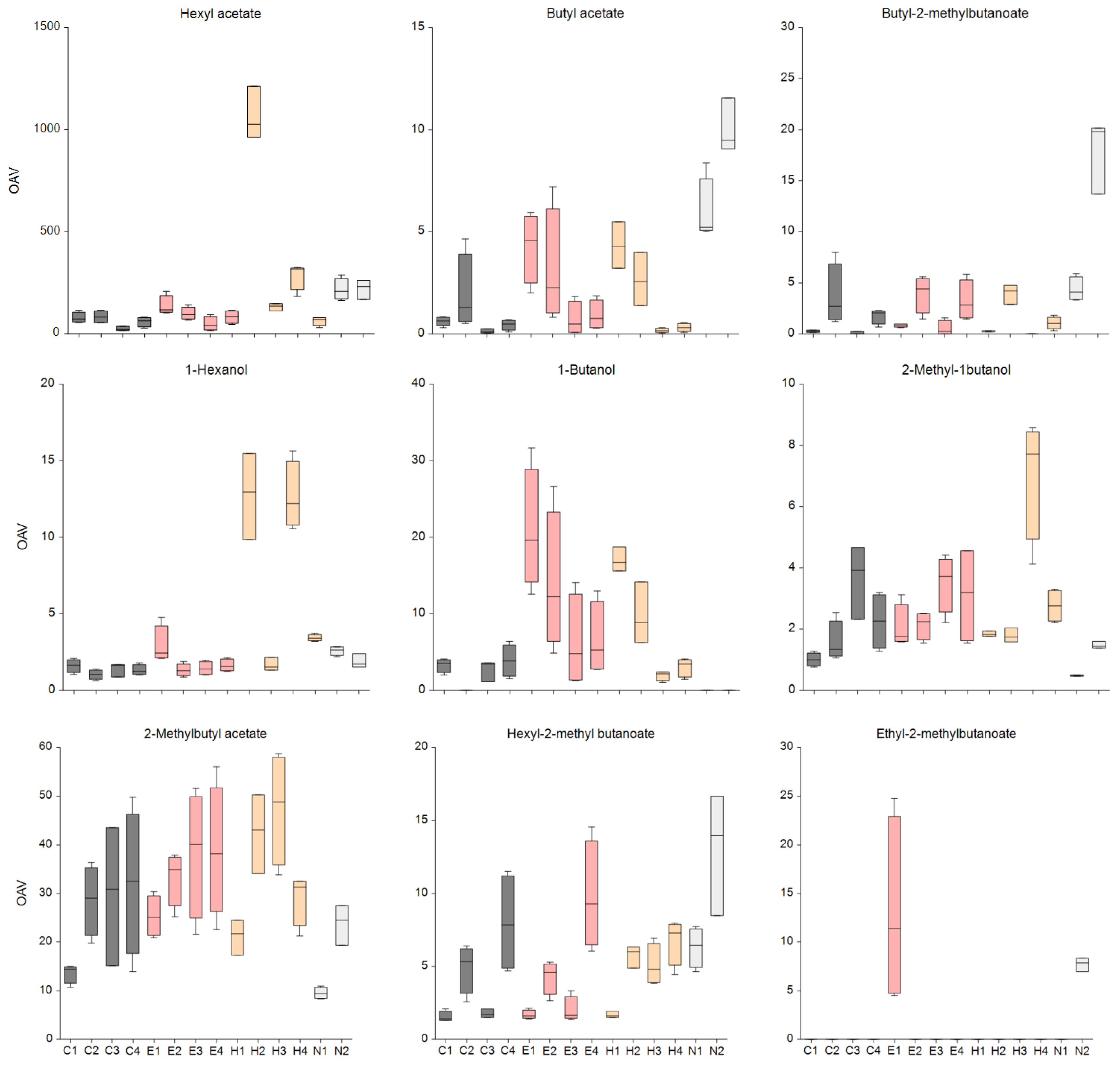
Total 9 among 25 identified VOCs in this study exhibited an OAV exceeding 1 and had the most significant impact on the aroma profile in this investigation. These VOCs were hexyl acetate, 2-methylbutyl acetate, and 1-butanol, followed by butyl 2-methylbutylbutanote, hexyl 2-methylbutanoate, butyl acetate, ethyl 2-methylbutanol, 1-hexanol, and 2-methyl-1-butanol (Figure 2). Storage conditions and treatments exerted an influence on the volatile profile of 'Gala' apples.
In this study, the compound hexyl acetate, which is associated with sweet, fruity, and floral descriptors [4,36], was the primary contributor to the aroma of Gala apples The highest OAV of hexyl acetate was observed in the CA-he group, after 2 and 6 months of storage and 1 day of shelf life. After 7 days, the effect of hexanal on the OAV of hexyl acetate was no longer statistically significant. In the same period, hexanal also had a significantly increased effect on the OAV of 1-hexanol. Additionally, a significant effect of hexanal was also observed on OAV 2-methyl-1-butanol after 6 months of storage and 1 day of shelf life. Primarily due to hexyl acetate, apples from CA-he exhibited an increased total OAV compared to the other groups.
The compound ethyl 2-methylbutanol is characterized by low OT (0.06 µgL-1[31]) and confers a fruity aroma to apples [36]. It has been previously identified as the most preferred compound by consumers in 'Gala' apples [38]. The addition of ethanol to CA resulted in the production of this ester in Gala apples to such an extent that it contributed significantly to the aroma of Gala apples, after 2 months of storage and 1 day shelf life. This ester contributed to the aroma only in NA group, after 2 months and 7 days shelf life. Similarly, ethanol had a significant effect on the increased OAV of 2-methylbutyl acetate, one of the most important aroma compounds of Gala apples after 2 months of storage and 1 day of shelf life. Over the same period, apples from this group also had a greater contribution of aroma from 1-butanol compared to CA.
Butyl acetate, characterized by fruity and apple descriptors and an OT of 66 µgL-1, constitutes an important component of ‘Gala’ aroma [31,36]. Both ethanol and hexanal exhibited a significant effect on increasing OAV of butyl acetate after 2 months of storage and 1 day of shelf life compared to CA alone but not compared to the NA.

3.5. Correlation Analysis for Hexyl Acetate

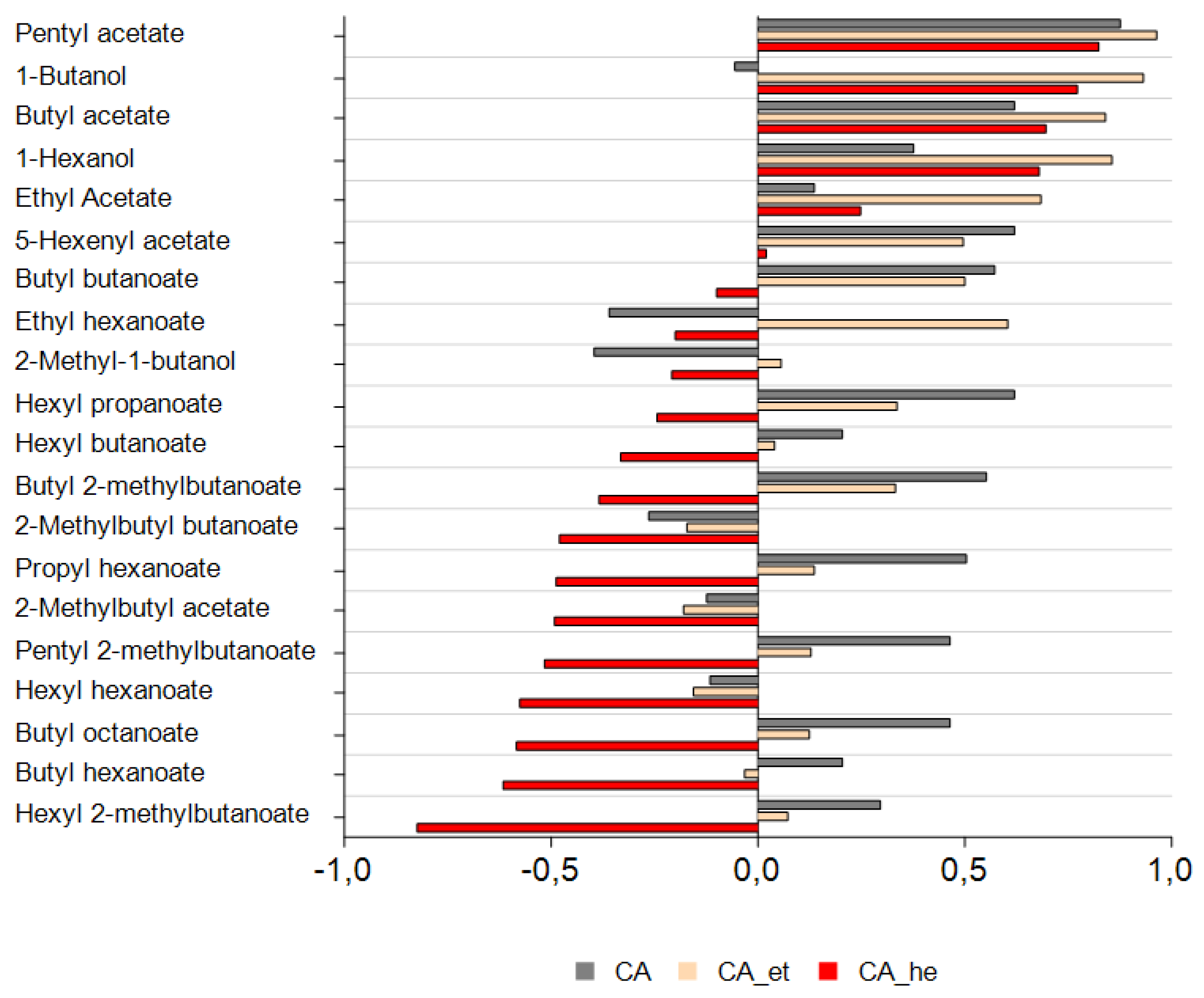
As hexyl acetate was the primary contributor to the aroma of Gala apples in this study, a correlation analysis was conducted for this compound with the remaining VOCs, for each storage atmosphere separately. The Pearson's coefficients for hexyl acetate are presented in Figure 3.
Hexanal exhibited a significant effect on the synthesis of hexyl acetate, which was also reflected in the OAV values. Hexyl acetate demonstrated the strongest positive correlation with the compounds pentyl acetate, 1-butanol, and butyl acetate, and the strongest negative correlation with the compounds hexyl 2-methylbutanoate, butyl hexanoate and butyl ocanoate in the CA-he atmosphere. The positive correlation for hexyl acetate in CA-et was observed for pentyl acetate, 1-butanol, and 1-hexanol, while hexyl acetate was positively correlated with pentyl acetate, hexyl propanoate and butyl acetate in CA.
Figure 3 illustrates a strong positive correlation between hexyl acetate and ethyl hexanoate in the CA-et storage atmosphere, suggesting that an increase in hexyl acetate is accompanied by a corresponding rise in ethyl hexanoate under these conditions. Ethyl hexanoate has been linked to the enhancement of sweetness in apple juice and was identified as one of the key compounds contributing to odor-associated sweetness enhancement [46]. The addition of ethanol into the CA environment may promote the formation of ethyl hexanoate, potentially enhancing the perceived sweetness of apples and apple-derived products.
Figure 3 demonstrates that hexyl acetate exhibited negative correlations with 14 out of 20 VOCs in the CA-he group, whereas in the CA and CA-et groups, it displayed negative correlations with 5 and 4 VOCs among 20 VOCs, respectively. This suggests that the addition of ethanol and hexanal to CA affected the enzymes and synthetic pathways for the formation of aromatic compounds in Gala apples. However, it is important to highlight that hexanal significantly contributed to the overall aroma by enhancing the synthesis of hexyl acetate, a key compound in apple aroma. This increased synthesis played a crucial role in shaping the final aroma profile, ultimately outweighing the negative associations with other volatile compounds, as the CA-he apples always had an increased or equal total OAV compared to the other conditions.
Previous research has demonstrated that CA storage, particularly at lower oxygen levels, reduces the emission of volatile esters and fruity aromas in ‘Gala’ apples [44,47]. Key esters, such as butyl acetate, hexyl acetate, and 2-methylbutyl acetate, which define the characteristic ‘Gala’ apple flavor, are significantly reduced under CA conditions [8,44]. This decrease is attributed to lower enzymatic activity of AAT and LOX [47]. Storage in a standard CA resulted in higher levels of key volatiles (butyl acetate, 2-methylbutyl acetate, and hexyl acetate) compared to fruit stored under dynamic controlled atmosphere (DCA) chlorophyll fluorescence (CF) conditions. However, fruits stored under DCA- respiratory quotient (RQ) 1.5 and RQ 2.0 also showed increased amounts of key volatile compounds, with a notable rise in ethanol and ethyl acetate, though still below the odor threshold [30] . Additionally, Both et al. demonstrated that apples stored at 0.7 kPa O2 had higher levels of 1-hexanol compared to those stored at 0.5 kPa O2 [8]. Since 1-hexanol is a precursor to hexyl acetate [40] , this explains the reduced production of hexyl acetate in fruit stored at lower oxygen levels.
Storage conditions and treatments can influence the volatile profile of 'Gala' apples. In this study, hexyl acetate had the highest OAV and contributed the most to the aroma of 'Gala' apples, as it reached OAV values higher than one in all groups, closely followed by 2-methylbutyl acetate. Importantly, our findings show that the addition of hexanal significantly increased the production of hexyl acetate in apples, whereas ethanol primarily influenced the content of 2-methylbutyl acetate and etyhl 2-metyhlbutanoate, as discussed in Chapter 3.3. In general, hexanal and ethanol exhibited a more pronounced effect on aroma after 2 months of storage compared to 6 months of storage. Considering that the apples consistently had a precursor available, it can be inferred that the limiting factor for aroma synthesis is the enzymatic activity responsible for the conversion of the precursor into aromatic compounds.
Although hexanal exhibited a suppressive effect on the synthesis of certain volatile organic compounds (VOCs), it notably enhanced the production of hexyl acetate, on of the key aroma compounds responsible for the characteristic aroma of 'Gala' apples.

4. Conclusion

In this study, we showed that ethanol and hexanal-enriched CA atmosphere had a significant effect on the formation of aromatic compounds in ‘Gala’ apples without affecting ethylene production and color change. Even at low concentration, ethanol and hexanal storage treatment caused increased VOCs content, especially esters and alcohols, which in turn leads to significant changes in OAV of 'Gala' apple aroma. This approach could be a promising strategy for enhancing apple aroma and improving fruit sensory quality during short-term CA storage.

Supplementary Materials

The following supporting information can be downloaded at the website of this paper posted on Preprints.org, Figure S1: title; Table S1: title; Video S1: title.

Author Contributions

For research articles with several authors, a short paragraph specifying their individual contributions must be provided. The following statements should be used “Conceptualization, X.X. and Y.Y.; methodology, X.X.; software, X.X.; validation, X.X., Y.Y. and Z.Z.; formal analysis, X.X.; investigation, X.X.; resources, X.X.; data curation, X.X.; writing—original draft preparation, X.X.; writing—review and editing, X.X.; visualization, X.X.; supervision, X.X.; project administration, X.X.; funding acquisition, Y.Y. All authors have read and agreed to the published version of the manuscript.” Please turn to the CRediT taxonomy for the term explanation. Authorship must be limited to those who have contributed substantially to the work reported.

Funding

This work was supported by Slovenian Research and Innovation Agency, through research program ≫Integrated food technology and nutrition≪ (P4-0234) and by the Department of Food Science and Technology, Biotechnical Faculty, University of Ljubljana, Jamnikarjeva 101, SI-1000 Ljubljana.

Data Availability Statement

Data is contained within the article.

Acknowledgments

The authors would like to thank the Department of Food Science and Technology, Biotechnical Faculty, University of Ljubljana, Jamnikarjeva 101, SI-1000 Ljubljana.

Conflicts of Interest

The authors declare no conflicts of interest.

Abbreviations

The following abbreviations are used in this manuscript:
VOC Volatile compounds
AAT Alcohol acyltransferase
CA Controlled atmosphere
ADH Alcohol dehydrogenase
CA-et CA-ethanol
CA-he CA-hexanal
NA Normal air atmosphere
CIE Commission Internationale de l'Eclairage
OT Odor threshold
ACSL Acetic acid-CoA ligase
ALDH Acetaldehyde dehydrogenase
OAV Odor-active value
LOX Lipoxygenase
DCA Dynamic controlled atmosphere
CF Chlorophyll fluorescence
RQ Respiratory quotient

Appendix A

Appendix A.1

Table A1. Identification, retention time, quantitative and qualitative ions for volatile compounds used in the study.
Identification Retention Time (min) Quantitative (first) and qualitative ions (m/z)
Ethyl Acetate 10.31 61.0. 70.1, 87.9
Ethanol 11.96 31.1, 45.1
2-Pentanone 13.76 86.2, 71.1, 58.1
2-Methylpropyl acetate 15.05 73.1, 61.1, 86.2, 101.2
Ethyl 2-methylbutanoate 16.62 102.1, 57.1, 85.1, 115.0
Butyl acetate 17.52 61.0, 73.0, 87.0
Hexanal 18.00 72.1, 82.1, 67.1
2-Pentanol 19.17 73.2, 58.1, 87.2
2-Methylbutyl acetate 19.49 70.1, 55.1, 85.1, 101.0
1-Butanol 20.19 56.1, 41.1, 73
Butyl propoionate 20.21 75.0, 87.1, 101.1
Pentyl acetate 21.52 70.2, 61.1, 101.1
2-Methyl-1-butanol 22.61 70.1, 56.1, 42.1
Butyl butanoate 23.22 71.1, 89.1, 101.0, 116.1
Butyl 2-methylbutanoate 23.72 103.1, 85.1, 74.1, 130.1
Ethyl hexanoate 23.82 88.0, 99.1, 60.0, 73.0
2-Methylbutyl butanoate 24.45 71.1, 55.0, 89.0
Hexyl acetate 25.02 84.0, 61.0, 69.0
Propyl hexanoate 26.96 99.0, 117.1, 71.1, 87.0
Pentyl 2-methylbutanoate 27.27 103.1, 85.0, 70.1
5-Hexenyl acetate 27.34 67.0, 82.0, 54.1
Hexyl propanoate 27.69 75.1, 84.1, 69.1, 129.1
6-Methyl-5-heptene-2-one 27.91 108.2, 69.1, 129.1
1-Hexanol 28.03 56.1, 69.1, 84.1
Butyl hexanoate 30.30 99.1, 117.1, 71.1
Hexyl butanoate 30.38 71.1, 89.1, 84.1
Hexyl 2-methylbutanoate 30.72 103.1, 85.1, 69.1
Benzaldehyde 34.98 105.0, 77.0, 55.1, 73.0
Hexyl hexanoate 36.68 117.1, 99.1, 84.1
Butyl octanoate 36.79 127.1, 145.1, 73.0, 200.1
Estragole 39.20 148.1, 121.1 117.1
α-Farnesene 40.86 93.1, 107.1, 119.1, 189.2

Appendix A.2

Table A2. Mean heaspace volatile compunds concentration (n=4) of ‘Gala’ apples.
1 day of shelf life at 20°C 7 days of shelf life at 20°C
NA CA CA-et CA-he NA CA CA-et CA-he
VOC Month of storage avg sd avg sd avg sd avg sd avg sd avg sd avg sd avg sd
Linear esters
Ethyl Acetate (13500a)* 2 0.03a 0.01 0.02a 0.00 6.87b 2.89 0.12a 0.05 0.16a 0.05 0.11a 0.13 0.52a 0.87 0.07a 0.03
6 0.10a 0.05 1.38b 1.16 0.21a 0.09 0.05a 0.02 0.08b 0.05 0.04a 0.01
Butyl acetate (66a) 2 5.28a 1.42 0.53b 0.20 3.78a 1.52 3.83a 1.01 8.88b 1.18 1.71a 1.66 2.77a 2.51 2.34a 1.16
6 0.10a 0.09 0.63a 0.75 0.14a 0.09 0.39a 0.22 0.80a 0.65 0.26a 0.18
Butyl propionate (25g) 2 0.51b 0.11 0.00a 0.00 0.00a 0.00 0.00a 0.00 0.74b 0.07 0.20a 0.17 0.00a 0.00 0.00a 0.00
6 0.00a 0.00 0.00a 0.00 0.00a 0.00 0.00a 0.00 0.00a 0.00 0.00a 0.00
Pentyl acetate (43b) 2 0.45ac 0.13 0.28a 0.05 0.61bc 0.19 0.79b 0.10 0.72a 0.04 0.41a 0.20 0.46a 0.12 0.46a 0.06
6 0.07a 0.04 0.17a 0.13 0.52b 0.13 0.22a 0.10 0.37a 0.20 0.15a 0.09
Butyl butanoate (100la) 2 1.57b 0.55 0.09a 0.04 0.37a 0.07 0.28a 0.10 1.51b 0.16 0.65a 0.46 0.66a 0.26 0.56a 0.10
6 0.04a 0.04 0.18a 0.20 0.00a 0.00 0.40a 0.16 0.70a 0.31 0.27a 0.17
Ethyl hexanoate (22 µg/lb) 2 0.00a 0.00 0.00a 0.00 0.07b 0.04 0.00a 0.00 0.00a 0.00 0.00a 0.00 0.00a 0.00 0.00a 0.00
6 0.02a 0.03 0.00a 0.00 0.00a 0.00 0.00a 0.00 0.02a 0.01 0.01a 0.01
Hexyl acetate (2a) 2 10.77a 2.66 3.93a 1.30 6.78a 2.38 53.07b 6.50 10.95b 2.32 4.07a 1.61 4.90a 1.58 6.51a 0.89
6 1.16a 0.53 2.37a 1.80 14.03b 3.29 2.88a 1.19 4.05a 1.50 3.09a 1.13
Propyl hexanoate (nf) 2 0.02b 0.01 0.00a 0.00 0.01a 0.00 0.00a 0.00 0.10a 0.02 0.08a 0.04 0.07a 0.03 0.06a 0.01
6 0.00a 0.00 0.00a 0.00 0.00a 0.00 0.06a 0.03 0.11a 0.03 0.04a 0.05
Hexyl propanoate (8b) 2 0.35b 0.05 0.02a 0.01 0.04a 0.02 0.09a 0.03 0.35b 0.11 0.15a 0.07 0.16a 0.05 0.14a 0.01
6 0.01a 0.01 0.03a 0.04 0.06a 0.04 0.11a 0.04 0.13a 0.04 0.13a 0.06
Butyl hexanoate (700a) 2 2.20b 1.01 0.21a 0.07 0.58a 0.14 0.13a 0.06 2.44a 0.50 1.88a 0.57 1.62a 0.35 1.88a 0.13
6 0.32a 0.19 0.86a 0.72 0.09a 0.04 3.51a 0.55 6.38b 1.13 2.45a 0.92
Hexyl butanoate (250b) 2 1.33b 0.53 0.23a 0.04 0.37a 0.08 0.66a 0.15 1.13a 0.53 0.66a 0.18 0.57a 0.12 0.64a 0.08
6 0.24a 0.08 0.36a 0.21 0.53a 0.18 1.37a 0.43 1.94a 0.44 1.31a 0.27
Hexyl hexanoate (6400b) 2 1.07b 0.62 0.28a 0.08 0.33a 0.13 0.21a 0.12 1.01a 0.63 1.27a 0.46 0.88a 0.07 1.40a 0.20
6 2.05a 0.74 3.64ab 1.04 6.09b 1.58 14.41a 3.48 21.56a 4.94 17.38a 3.42
Butyl octanoate (nf) 2 0.27b 0.13 0.04a 0.01 0.09a 0.04 0.01a 0.01 0.37a 0.17 0.25a 0.10 0.23a 0.09 0.26a 0.02
6 0.02a 0.02 0.09a 0.07 0.01 0.01 0.22a 0.04 0.42b 0.13 0.16a 0.07
Branched esters
2-Methylpropyl acetate (66a) 2 0.00a 0.00 0.00a 0.00 0.11b 0.04 0.00a 0.00 0.00b 0.00 0.26a 0.13 0.26a 0.04 0.33a 0.04
6 0.00a 0.00 0.00a 0.00 0.00a 0.00 0.00a 0.00 0.00a 0.00 0.00a 0.00
Ethyl 2-methylbutanoate (0.06a) 2 0.00a 0.00 0.00a 0.00 0.02b 0.01 0.00a 0.00 0.01b 0.00 0.00a 0.00 0.00a 0.00 0.00a 0.00
6 0.00a 0.00 0.00a 0.00 0.00a 0.00 0.00a 0.00 0.00a 0.00 0.00a 0.00
2-Methylbutyl acetate (11a) 2 2.03a 0.26 2.91a 0.42 5.41b 0.91 4.52b 0.78 5.08a 0.88 6.10ab 1.54 7.10b 1.19 9.07ab 1.74
6 6.38a 3.04 8.18a 2.79 10.15a 2.48 6.87a 3.19 8.27a 2.92 6.21a 1.15
Butyl 2-methylbutanoate (17e) 2 0.70a 0.19 0.04a 0.02 0.13b 0.03 0.04b 0.01 2.88b 0.59 0.59a 0.49 0.63a 0.29 0.63a 0.16
6 0.01a 0.02 0.08a 0.12 0.00a 0.00 0.28a 0.12 0.52a 0.32 0.17a 0.10
2-Methylbutyl butanoate (17e) 2 0.00a 0.00 0.00a 0.00 0.00a 0.00 0.00a 0.00 0.00a 0.00 0.00a 0.00 0.00a 0.00 0.00a 0.00
6 0.04a 0.01 0.03a 0.02 0.00b 0.00 0.12a 0.01 0.16b 0.02 0.13a 0.01
Amyl 2-methylbutanoate (nf) 2 0.02b 0.00 0.00a 0.00 0.00a 0.00 0.00a 0.00 0.09b 0.03 0.04a 0.02 0.03a 0.01 0.03a 0.00
6 0.00a 0.00 0.00a 0.00 0.00a 0.00 0.03a 0.01 0.04a 0.02 0.01a 0.01
5-Hexenyl acetate (7a) 2 0.06ab 0.02 0.03b 0.00 0.06b 0.02 0.06b 0.01 0.07b 0.01 0.06a 0.01 0.07a 0.01 0.09a 0.01
6 0.02a 0.00 0.03a 0.02 0.08b 0.01 0.05a 0.02 0.09a 0.03 0.05a 0.02
Hexyl 2-methylbutanoate (22d) 2 1.31b 0.29 0.32a 0.08 0.35a 0.07 0.35a 0.05 2.72b 0.87 1.02a 0.35 0.89a 0.24 1.19a 0.16
6 0.36a 0.06 0.42a 0.18 1.06a 0.30 1.66a 0.71 2.04a 0.78 1.41a 0.33
Alcohols
Ethanol (100000a) 2 0.21a 0.08 0.30a 0.08 3.04b 1.32 0.42a 0.19 0.35a 0.32 0.14a 0.05 0.29a 0.15 0.22a 0.05
6 0.43a 0.15 0.45a 0.06 0.55a 0.05 0.54a 0.06 0.85b 0.18 0.52a 0.02
2-Pentanol (nf) 2 0.00a 0.00 0.00a 0.00 0.00a 0.00 0.80b 0.70 0.00a 0.00 0.00a 0.00 1.07a 1.24 0.03a 0.00
6 0.00a 0.00 0.61a 1.12 1.21a 0.26 0.00a 0.00 0.00a 0.00 0.77b 0.11
1-Butanol (500a) 2 0.00a 0.00 0.55a 0.15 3.51b 1.34 2.86a 0.27 0.00a 0.00 0.00a 0.00 2.35b 1.54 1.64b 0.68
6 0.46 0.24 1.05a 1.02 0.32a 0.10 0.65a 0.36 1.10a 0.81 0.52a 0.20
2-Methyl-1-butanol (250a) 2 0.07a 0.00 0.16ab 0.03 0.32c 0.11 0.29bc 0.01 0.23a 0.02 0.25a 0.10 0.33a 0.07 0.28a 0.04
6 0.57a 0.19 0.55a 0.15 1.10b 0.31 0.35a 0.14 0.49a 0.26 0.43a 0.08
1-Hexanol (500a) 2 0.92a 0.11 0.57a 0.16 1.04a 0.44 4.53b 1.00 0.67a 0.17 0.36a 0.11 0.47a 0.14 0.59a 0.16
6 0.50a 0.16 0.51a 0.17 4.49b 0.79 0.47a 0.12 0.57a 0.15 1.22a 0.08
Other VOCs
2-Pentanone (2300c) 2 0.00a 0.00 0.00a 0.00 0.00b 0.00 0.09b 0.03 0.00a 0.00 0.00a 0.00 0.00a 0.00 0.03b 0.01
6 0.00a 0.00 0.00a 0.00 1.06b 0.46 0.00a 0.00 0.00a 0.00 0.21b 0.10
Hexanal (5a) 2 0.00a 0.00 0.00a 0.00 0.00a 0.00 0.05b 0.00 0.00a 0.00 0.00a 0.00 0.00a 0.00 0.00a 0.00
6 0.17a 0.10 0.08a 0.03 0.27b 0.08 0.06a 0.03 0.06a 0.01 0.06a 0.01
6-Methyl-5-heptene-2-one (50a) 2 0.01a 0.00 0.01a 0.00 0.01a 0.00 0.01a 0.01 0.01a 0.00 0.03ab 0.01 0.03ab 0.00 0.04b 0.01
6 0.16a 0.03 0.20a 0.05 0.16a 0.03 0.08a 0.03 0.14b 0.01 0.19c 0.01
Benzaldehyde (150c) 2 0.02a 0.01 0.02a 0.00 0.02a 0.01 0.02a 0.01 0.02a 0.01 0.02a 0.00 0.03a 0.02 0.03a 0.03
6 0.06a 0.00 0.06a 0.00 0.07b 0.00 0.04a 0.00 0.13a 0.16 0.05a 0.01
Estragole (16b) 2 0.22a 0.11 0.38a 0.08 0.45b 0.14 0.19a 0.04 0.59a 0.32 0.78a 0.28 0.76a 0.18 0.61a 0.06
6 0.98a 0.32 0.79a 0.11 0.91a 0.33 0.61a 0.36 0.64a 0.38 0.33a 0.13
α-Farnesene (nf) 2 0.73ab 0.44 1.14a 0.16 0.98a 0.20 0.25b 0.23 1.84a 0.49 2.32a 0.49 1.79a 0.11 2.07a 0.39
6 2.92a 0.44 3.78a 0.29 3.52b 0.84 3.54a 1.20 3.51a 0.40 4.15a 0.09
Means followed by equal letters, in the same month of storage and day of shelf life, do not differ by the Tukey test, at 5 % probability. * Odor Threshold (OT) (μg kg-1), VOC: volatile compund a [31]; b[36]; c[48]; d[4]; e [49]; nf: not found.

References

  1. FAOSTAT. (2022). Crop production data. Available at: https://www.fao.org/faostat/en/#data/QCL (August 2024). Food and Agriculture Organization of the United Nations.
  2. El Hadi, M.A.M.; Zhang, F.J.; Wu, F.F.; Zhou, C.H.; Tao, J. Advances in Fruit Aroma Volatile Research. Molecules 2013, 18, 8200–8229. [Google Scholar] [CrossRef] [PubMed]
  3. Yang, S.; Hao, N.; Meng, Z.; Li, Y.; Zhao, Z. Identification, Comparison and Classification of Volatile Compounds in Peels of 40 Apple Cultivars by Hs–Spme with Gc–Ms. Foods 2021, 10. [Google Scholar] [CrossRef]
  4. Espino-Díaz, M.; Sepúlveda, D.R.; González-Aguilar, G.; Olivas, G.I. Biochemistry of Apple Aroma: A Review. Food Technol Biotechnol 2016, 54. [Google Scholar] [CrossRef] [PubMed]
  5. Yang, S.; Li, D.; Li, S.; Yang, H.; Zhao, Z. GC-MS Metabolite and Transcriptome Analyses Reveal the Differences of Volatile Synthesis and Gene Expression Profiling between Two Apple Varieties. Int J Mol Sci 2022, 23. [Google Scholar] [CrossRef]
  6. Souleyre, E.J.F.; Chagné, D.; Chen, X.; Tomes, S.; Turner, R.M.; Wang, M.Y.; Maddumage, R.; Hunt, M.B.; Winz, R.A.; Wiedow, C.; et al. The AAT1 Locus Is Critical for the Biosynthesis of Esters Contributing to “ripe Apple” Flavour in “Royal Gala” and “Granny Smith” Apples. Plant Journal 2014, 78, 903–915. [Google Scholar] [CrossRef] [PubMed]
  7. Souleyre, E.J.F.; Greenwood, D.R.; Friel, E.N.; Karunairetnam, S.; Newcomb, R.D. An Alcohol Acyl Transferase from Apple (Cv. Royal Gala), MpAAT1, Produces Esters Involved in Apple Fruit Flavor. FEBS Journal 2005, 272, 3132–3144. [Google Scholar] [CrossRef]
  8. Both, V.; Thewes, F.R.; Brackmann, A.; Ferreira, D. de F.; Pavanello, E.P.; Wagner, R. Effect of Low Oxygen Conditioning and Ultralow Oxygen Storage on the Volatile Profile, Ethylene Production and Respiration Rate of ‘Royal Gala’ Apples. Sci Hortic 2016, 209, 156–164. [Google Scholar] [CrossRef]
  9. Sriskantharajah, K.; El Kayal, W.; Ayyanath, M.M.; Saxena, P.K.; Sullivan, A.J.; Paliyath, G.; Subramanian, J. Preharvest Spray Hexanal Formulation Enhances Postharvest Quality in ‘Honeycrisp’ Apples by Regulating Phospholipase d and Calcium Sensor Proteins Genes. Plants 2021, 10. [Google Scholar] [CrossRef]
  10. Thewes, F.R.; Balkees, B.M.; Büchele, F.; Wünsche, J.N.; Neuwald, D.A.; Brackmann, A. Ethanol Vapor Treatment Inhibits Apple Ripening at Room Temperature Even with the Presence of Ethylene. Postharvest Biol Technol 2021, 173. [Google Scholar] [CrossRef]
  11. Berger, R.G.; Drawert, F. Changes in the Composition of Volatiles by Post-harvest Application of Alcohols to Red Delicious Apples. J Sci Food Agric 1984, 35. [Google Scholar] [CrossRef]
  12. Thewes, F.R.; Brackmann, A.; Both, V.; Ludwig, V.; Wendt, L.M.; Thewes, F.R.; Soldateli, F.J. Dynamics of Ethanol and Its Metabolites in Fruit: The Impact of the Temperature and Fruit Species. Postharvest Biol Technol 2023, 197. [Google Scholar] [CrossRef]
  13. Yumbya, P.; Ambuko, J.; Hutchinson, M.; Owino, W.; Juma, J.; Machuka, E.; Mutuku, J.M. Transcriptome Analysis to Elucidate Hexanal’s Mode of Action in Preserving the Post-Harvest Shelf Life and Quality of Banana Fruits (Musa Acuminata). J Agric Food Res 2021, 3. [Google Scholar] [CrossRef]
  14. Nagarajan, V.; Kizhaeral S, S.; Subramanian, M.; Rajendran, S.; Ranjan, J. Encapsulation of a Volatile Biomolecule (Hexanal) in Cyclodextrin Metal-Organic Frameworks for Slow Release and Its Effect on Preservation of Mangoes. ACS Food Science and Technology 2021, 1. [Google Scholar] [CrossRef]
  15. Ranjan, S.; Chandrasekaran, R.; Paliyath, G.; Lim, L.T.; Subramanian, J. Effect of Hexanal Loaded Electrospun Fiber in Fruit Packaging to Enhance the Post Harvest Quality of Peach. Food Packag Shelf Life 2020, 23. [Google Scholar] [CrossRef]
  16. Rowan, D.D.; Allen, J.M.; Fielder, S.; Hunt, M.B. Biosynthesis of Straight-Chain Ester Volatiles in Red Delicious and Granny Smith Apples Using Deuterium-Labeled Precursors. J Agric Food Chem 1999, 47, 2553–2562. [Google Scholar] [CrossRef] [PubMed]
  17. Fan, L.; Song, J.; Beaudry, R.M.; Hildebrand, P.D. Effect of Hexanal Vapor on Spore Viability of Penicillin Expansum, Lesion Development on Whole Apples and Fruit Volatile Biosynthesis. J Food Sci 2006, 71, doi:10.1111/j.1365-2621.2006.tb15632.x.44. Ferenczi, A.; Sugimoto, N.; Beaudry, R.M. Emission Patterns of Esters and Their Precursors throughout Ripening and Senescence in ‘Redchief Delicious’ Apple Fruit and Implications Regarding Biosynthesis and Aroma Perception. Journal of the American Society for Horticultural Science 2021, 146, 297–328, doi:10.21273/JASHS05064-21.
  18. Harb, J.; Streif, J.; Bangerth, F. Response of Controlled Atmosphere (CA) Stored “Golden Delicious” Apples to the Treatments with Alcohols and Aldehydes as Aroma Precursors. Gartenbauwissenschaft 2000, 65, 154–161. [Google Scholar]
  19. Sander, R. : Compilation of Henry's law constants (version 4.0) for water as solvent, Atmos. Chem. Phys. 2015, 15, 4399–4981. [Google Scholar] [CrossRef]
  20. Both, V.; Brackmann, A.; Thewes, F.R.; Ferreira, D.D.F.; Wagner, R. Effect of Storage under Extremely Low Oxygen on the Volatile Composition of “Royal Gala” Apples. Food Chem 2014, 156, 50–57. [Google Scholar] [CrossRef]
  21. Saquet, A.A.; Streif, J. Respiration Rate and Ethylene Metabolism of ‘Jonagold’ Apple and ‘Conference’ Pear under Regular Air and Controlled Atmosphere. Bragantia 2017, 76, 335–344. [Google Scholar] [CrossRef]
  22. Weber, A.; Neuwald, D.A.; Kittemann, D.; Thewes, F.R.; Both, V.; Brackmann, A. Influence of Respiratory Quotient Dynamic Controlled Atmosphere (DCA – RQ) and Ethanol Application on Softening of Braeburn Apples. Food Chem 2020, 303. [Google Scholar] [CrossRef] [PubMed]
  23. Schmidt, S.F.P.; Schultz, E.E.; Ludwig, V.; Berghetti, M.R.P.; Thewes, F.R.; Anese, R. de O.; Both, V.; Brackmann, A. Volatile Compounds and Overall Quality of ‘Braeburn’ Apples after Long-Term Storage: Interaction of Innovative Storage Technologies and 1-MCP Treatment. Sci Hortic 2020, 262. [Google Scholar] [CrossRef]
  24. Weber, A.; Brackmann, A.; Both, V.; Pavanello, E.P.; Anese, R.O.; Schorr, M.R.W. Ethanol Reduces Ripening of ‘Royal Gala’ Apples Stored in Controlled Atmosphere. An Acad Bras Cienc 2016, 88, 403–410. [Google Scholar] [CrossRef] [PubMed]
  25. Thewes, F.R.; Balkees, B.M.; Büchele, F.; Both, V.; Brackmann, A.; Neuwald, D.A. The Isolated and Combined Impacts of Ethanol and Ethylene Application on Sugars and Organic Acids Dynamics in ‘Elstar’ and ‘Nicoter’ Apples. Postharvest Biol Technol 2022, 194. [Google Scholar] [CrossRef]
  26. Tiwari, K.; Paliyath, G. Microarray Analysis of Ripening-Regulated Gene Expression and Its Modulation by 1-MCP and Hexanal. Plant Physiology and Biochemistry 2011, 49, 329–340. [Google Scholar] [CrossRef]
  27. Yuan, H.Y.; Hu, X.L.; Li, X.; Li, Y.H.; Paliyath, G. Effect of Hexanal Treatment on Postharvest Quality of “Darselect” Strawberry (Fragaria ×ananassa Duch.) Fruit. Acta Hortic 2009, 839, 315–321. [Google Scholar] [CrossRef]
  28. Sharma, P.; Dhami, P.; Pandey, P. Flavors of Apple Fruit—A Review. J Nutr Ecol Food Res 2016, 2, 288–291. [Google Scholar] [CrossRef]
  29. Silué, Y.; Nindjin, C.; Cissé, M.; Kouamé, K.A.; Amani, N. guessan G.; Mbéguié-A-Mbéguié, D.; Lopez-Lauri, F.; Tano, K. Hexanal Application Reduces Postharvest Losses of Mango (Mangifera Indica L. Variety “Kent”) over Cold Storage Whilst Maintaining Fruit Quality. Postharvest Biol Technol 2022, 189. [Google Scholar] [CrossRef]
  30. Cheema, A.; Padmanabhan, P.; Subramanian, J.; Blom, T.; Paliyath, G. Improving Quality of Greenhouse Tomato (Solanum Lycopersicum L.) by Pre- and Postharvest Applications of Hexanal-Containing Formulations. Postharvest Biol Technol 2014, 95, 13–19. [Google Scholar] [CrossRef]
  31. Both, V.; Thewes, F.R.; Brackmann, A.; de Oliveira Anese, R.; de Freitas Ferreira, D.; Wagner, R. Effects of Dynamic Controlled Atmosphere by Respiratory Quotient on Some Quality Parameters and Volatile Profile of ‘Royal Gala’ Apple after Long-Term Storage. Food Chem 2017, 215, 483–492. [Google Scholar] [CrossRef]
  32. Anese, R. de O.; Brackmann, A.; Thewes, F.R.; Schultz, E.E.; Ludwig, V.; Wendt, L.M.; Wagner, R.; Klein, B. Impact of Dynamic Controlled Atmosphere Storage and 1-Methylcyclopropene Treatment on Quality and Volatile Organic Compounds Profile of ‘Galaxy’ Apple. Food Packag Shelf Life 2020, 23. [Google Scholar] [CrossRef]
  33. Chen, J.; Zhang, D.; Mi, H.; Pristijono, P.; Ge, Y.; Lv, J.; Li, Y.; Liu, B. Tissue-Specific Recovery Capability of Aroma Biosynthesis in ‘Golden Delicious’ Apple Fruit after Low Oxygen Storage. Agronomy 2022, 12. [Google Scholar] [CrossRef]
  34. Schultz, E.E.; Thewes, F.R.; Wendt, L.M.; Brackmann, A.; Both, V.; Ludwig, V.; Thewes, F.R.; Soldateli, F.J.; Wagner, R. Extremely Low Oxygen with Different Hysteresis and Dynamic Controlled Atmosphere Storage: Impact on Overall Quality and Volatile Profile of ‘Maxi Gala’ Apple. Postharvest Biol Technol 2023, 205. [Google Scholar] [CrossRef]
  35. Wright, A.H.; Delong, J.M.; Arul, J.; Prange, R.K. The Trend toward Lower Oxygen Levels during Apple (Malus × Domestica Borkh) Storage - A Review. Journal of Horticultural Science and Biotechnology 2015, 90, 1–13. [Google Scholar] [CrossRef]
  36. Wu, X.; Bi, J.; Fauconnier, M.L. Characteristic Volatiles and Cultivar Classification in 35 Apple Varieties: A Case Study of Two Harvest Years. Foods 2022, 11. [Google Scholar] [CrossRef]
  37. Sceentree. Amyl acetate. 2024, https://www.scentree.co/en/Amyl_acetate.html (accessed accessed 17th October 2024).
  38. Echeverría, G.; Graell, J.; Lara, I.; López, M.L. Physicochemical Measurements in “Mondial Gala®” Apples Stored at Different Atmospheres: Influence on Consumer Acceptability. Postharvest Biol Technol 2008, 50, 135–144. [Google Scholar] [CrossRef]
  39. Matich, A.; Rowan, D. Pathway Analysis of Branched-Chain Ester Biosynthesis in Apple Using Deuterium Labeling and Enantioselective Gas Chromatography-Mass Spectrometry. J Agric Food Chem 2007, 55, 2727–2735. [Google Scholar] [CrossRef]
  40. Holland, D.; Larkov, O.; Bar-Ya’akov, I.; Bar, E.; Zax, A.; Brandeis, E.; Ravid, U.; Lewinsohn, E. Developmental and Varietal Differences in Volatile Ester Formation and Acetyl-CoA: Alcohol Acetyl Transferase Activities in Apple (Malus Domestica Borkh.) Fruit. J Agric Food Chem 2005, 53, 7198–7203. [Google Scholar] [CrossRef]
  41. Zhang, J.; Wang, Y.; Zhang, S.; Zhang, S.; Liu, W.; Wang, N.; Fang, H.; Zhang, Z.; Chen, X. ABIOTIC STRESS GENE 1 Mediates Aroma Volatiles Accumulation by Activating MdLOX1a in Apple. Hortic. Res. 2024. [CrossRef]
  42. Maria, A.M.L.; Vergara, M.; Bravo, C.; Pereira, M.; Moggia, C. Development of Aroma Compounds and Sensory Quality of “Royal Gala” Apples during Storage. Journal of Horticultural Science and Biotechnology 2007, 82, 403–413. [Google Scholar] [CrossRef]
  43. Ferenczi, A.; Sugimoto, N.; Beaudry, R.M. Emission Patterns of Esters and Their Precursors throughout Ripening and Senescence in ‘Redchief Delicious’ Apple Fruit and Implications Regarding Biosynthesis and Aroma Perception. Journal of the American Society for Horticultural Science 2021, 146, 297–328. [Google Scholar] [CrossRef]
  44. Plotto, A.; Mcdaniel, M.R.; Mattheis, J.P. Characterization of Changes in “Gala” Apple Aroma during Storage Using Osme Analysis, a Gas Chromatography-Olfactometry Technique; 2000; Vol. 125;
  45. Young, H.; Gilbert, J.M.; Murray, S.H.; Ball, R.D. Causal Effects of Aroma Compounds on Royal Gala Apple Flavours. J Sci Food Agric 1996, 71, 329–336. [Google Scholar] [CrossRef]
  46. Brattinga, C.; de Kok, P.M.T.; Bult, J.H.F. Sugar reduction in flavoured beverages: The robustness of aroma-induced sweetness enhancement. Proc. Flavour Sci. 2018, 199–206. [Google Scholar] [CrossRef]
  47. Lara, I.; Echeverría, G.; Graell, J.; López, M.L. Volatile Emission after Controlled Atmosphere Storage of Mondial Gala Apples (Malus Domestica): Relationship to Some Involved Enzyme Activities. J Agric Food Chem 2007, 55. [Google Scholar] [CrossRef]
  48. Kreissl J, Mall V, Steinhaus P, Steinhaus M. Leibniz-LSB@TUM Odorant Database, Version 1.2. Leibniz Institute for Food Systems Biology at the Technical University of Munich: Freising, Germany, 2022 (https://www.leibniz-lsb.de/en/databases/leibniz-lsbtum-odorant-database) (accessed 30 January 2025).
  49. Liu, E. tai; Wang, G. shuai; Li, Y. yuan; Shen, X.; Chen, X. sen; Song, F. hai; Wu, S. jing; Chen, Q.; Mao, Z. quan Replanting Affects the Tree Growth and Fruit Quality of Gala Apple. J Integr Agric 2014, 13, 1699–1706. [Google Scholar] [CrossRef]
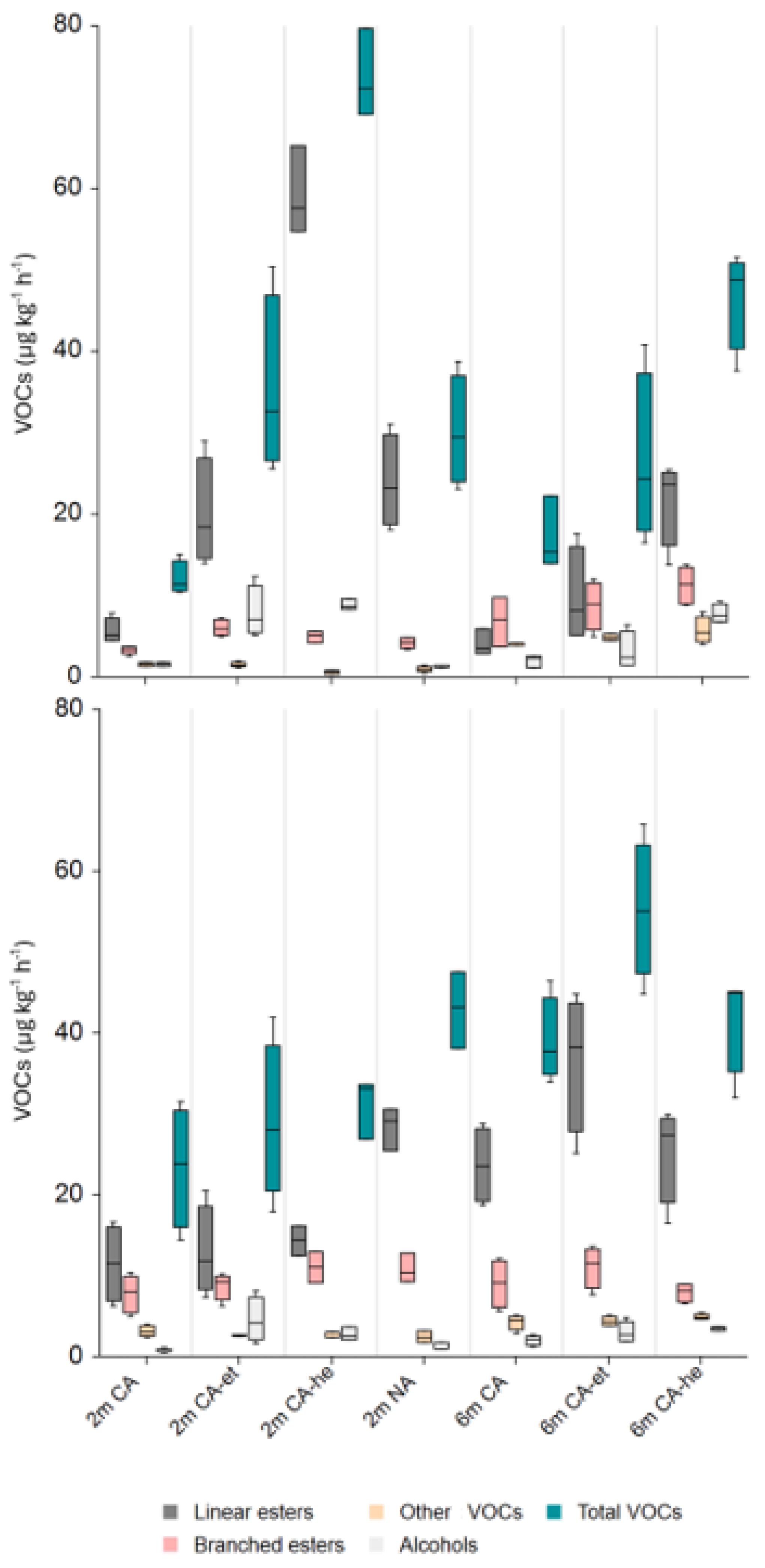
Figure 1. production (μg kg-1 h-1) of the volatile compounds (VOCs) group afer 2 and 6 months of storage followed 1 day (top) and 7 days (bottom) of shelf life.
Preprints 149258 g001
Figure 2. OAV values of the most important VOCs for ‘Gala’ apples. C: Controlled atmosphere; E: Controlled atmosphere with ethanol; H: Controlled atmosphere with hexanal; N: Normal air atmosphere, storage time: 1(2 months of storage + 1 day of shelf life); 2 (2 months of storage + 7 days of shelf life); 3 (6 months of storage + 1 day of shelf life); 4 (6 months of storage + 7 days of shelf life).
Preprints 149258 g002
Figure 3. Pearson correlation coefficients between hexyl acetate and VOCs under different storage conditions.
Preprints 149258 g003
Table 1. Ethylene production rate and respiratory rate (CO2), and flesh firmness of ‘Gala' apples after 2 and 6 months of storage and after 1 and 7 days of shelf life.
1 day of shelf life
Months of storage NA CA CA-et CA-he
avg sd avg sd avg sd avg sd
Etylhene (µL kg−1 h−1) 2 218.03b 73.77 15.12a 26.76 49.55a 24.71 1.51a 0.38a
6 6.74a 1.27 11.32a 6.12 5.09a 1.90a
CO2 (μg kg−1s−1) 2 8.25a 0.25 6.35b 0.36 8.77a 1.11 8.34a 0.60a
6 3.95a 0.77 3.96a 0.58 3.45a 0.50a
7 days of shelf life
NA CA CA-et CA-he
avg sd avg sd avg sd avg Sd
Etilen (µL kg−1 h−1) 2 199.97a 59.45 133.80a 48.52 173.94a 71.52 108.96a 66.79a
6 85.77a 14.44 95.29a 28.28 119.45a 45.40a
CO2 (μg kg−1s−1) 2 10.90a 1.31 11.93a 1.99 10.01a 1.16 11.39a 2.23a
6 7.79a 0.44 10.31b 1.50 8.01a 1.02a
Means followed by equal letters, in the same months of storage and days of shelf, do not differ by the Tukey test, at 5 % probability.
Table 2. CIE (L*, a*, b*) parameters and ΔE for ‘Gala’ apple after 6 months of storage.
CA CA-et CA-he
avg sd avg sd avg sd
ΔL*^2 17.84 24.98 54.90 87.58 48.37 73.66
Δa*^2 27.75 33.53 39.18 47.27 25.17 39.11
Δb*^2 12.78 6.96 10.95 9.94 8.15 7.17
ΔE 5.58 4.26 8.60 4.91 6.38 6.12
Table 3. VOCs production (μg kg-1 h-1) by ‘Gala’ apples (n=4).
1 day of shelf life 7 days of shelf life
NA CA CA-et CA-he NA CA CA-et CA-he
VOC Month of storage avg sd avg sd avg sd avg sd avg sd avg sd avg sd avg sd
Linear esters
Ethyl Acetate 2.00 0.33a 0.16 0.18a 0.04 79.40b 35.82 1.35a 0.62 2.09a 0.84 1.19a 1.31 3.01a 0.52 0.82a 0.31
6.00 1.26a 0.58 16.07b 13.01 2.37a 1.07 0.56a 0.25 0.98b 0.57 0.43a 0.17
Butyl acetate 2.00 65.55a 24.52 6.28b 1.98 43.82a 18.88 44.20a 12.19 112.12b 25.98 18.96a 16.45 32.41a 30.39 26.52a 12.58
6.00 1.25a 1.19 7.42a 8.41 1.64a 1.04 4.71a 2.72 9.42a 7.26 3.09a 2.11
Butyl propionate 2.00 6.23b 1.73 0.00a 0.00 0.00a 0.00 0.00a 0.00 9.31b 1.20 0.00a 0.00 0.00a 0.00 0.00a 0.00
6.00 0.00a 0.00 0.00a 0.00 0.00a 0.00 0.00a 0.00 0.00a 0.00 0.00a 0.00
Pentyl acetate 2.00 5.60ab 2.15 3.33a 0.40 7.07ab 2.43 9.16b 1.69 8.99a 0.81 4.72b 1.81 5.34b 1.56 5.28b 0.48
6.00 0.85a 0.46 2.06a 1.47 5.88b 1.36 2.68a 1.17 4.39a 2.22 1.78a 1.09
Butyl butanoate 2.00 19.27b 7.22 1.12a 0.50 4.24a 0.94 3.19a 1.14 18.80b 0.93 7.42a 4.31 7.62a 3.28 6.47a 0.99
6.00 0.46a 0.45 2.11a 2.28 0.00a 0.00 4.87ab 2.03 8.40a 3.47 3.18b 1.97
Ethyl hexanoate 2.00 0.00a 0.00 0.00a 0.00 0.78b 0.53 0.00a 0.00 0.00a 0.00 0.00a 0.00 0.00a 0.00 0.00a 0.00
6.00 0.20a 0.35 0.00b 0.00 0.00a 0.00 0.00a 0.00 0.18a 0.13 0.06a 0.12
Hexyl acetate 2.00 133.69a 46.37 46.61c 12.91 78.37ac 30.68 608.72b 61.38 135.24b 16.89 47.57a 14.22 56.44a 20.04 74.56a 7.16
6.00 14.22a 6.73 28.02a 20.17 159.55b 32.92 34.95a 13.55 48.30a 16.49 36.12a 14.47
Propyl hexanoate 2.00 0.24b 0.10 0.00a 0.00 0.16a 0.06 0.00a 0.00 1.27a 0.33 0.94a 0.40 0.81a 0.30 0.74a 0.12
6.00 0.00a 0.00 0.00a 0.00 0.00a 0.00 0.77a 0.37 1.30a 0.42 0.49a 0.56
Hexyl propanoate 2.00 4.26b 0.73 0.24a 0.13 0.46a 0.20 0.99a 0.33 4.26b 1.07 1.70a 0.70 1.83a 0.66 1.64a 0.02
6.00 0.17a 0.07 0.36a 0.40 0.64a 0.42 1.35a 0.51 1.55a 0.46 1.52a 0.73
Butyl hexanoate 2.00 26.95b 12.67 2.63a 0.97 6.58a 1.39 1.48 0.78 30.39a 6.04 22.17ab 5.32 18.49b 3.80 21.71ab 2.86
6.00 3.83a 2.42 10.21a 8.36 1.04 0.45 42.92a 6.68 76.26b 9.52 28.53a 11.56
Hexyl butanoate 2.00 16.17a 5.96 2.80a 0.63 4.25a 1.05 7.65a 2.12 13.81a 6.06 7.81ab 1.70 6.58b 1.58 7.35ab 1.46
6.00 2.95a 0.76 4.31a 2.30 5.99a 2.02 16.55ab 4.44 23.15a 3.44 15.26b 4.00
Hexyl hexanoate 2.00 12.92b 7.04 3.42a 1.32 3.73a 1.38 2.47a 1.54 12.57a 7.73 15.22a 5.46 10.07a 0.36 16.18a 2.95
6.00 25.19a 10.09 43.85ab 11.70 69.11b 15.23 176.36a 45.79 256.59a 41.36 201.76a 52.06
Butyl octanoate 2.00 3.29b 1.67 0.45a 0.16 0.99a 0.39 0.17a 0.12 4.63a 2.02 2.92a 0.88 2.68a 0.96 2.98a 0.21
6.00 0.27a 0.27 1.01a 0.76 0.15a 0.07 2.69a 0.55 5.00b 1.32 1.93a 0.86
Branched esters
2-Methylpropyl acetate 2.00 0.00a 0.00 0.00a 0.00 1.27b 0.47 0.00a 0.00 0.00b 0.00 3.04a 1.14 2.99a 0.55 3.76a 0.40
6.00 0.00a 0.00 0.00a 0.00 0.00a 0.00 0.00a 0.00 0.00a 0.00 0.00a 0.00
Ethyl 2-methylbutanoate 2.00 0.00a 0.00 0.00a 0.00 0.22b 0.17 0.00a 0.00 0.14b 0.02 0.00a 0.00 0.00a 0.00 0.00a 0.00
6.00 0.00a 0.00 0.00a 0.00 0.00a 0.00 0.00a 0.00 0.00a 0.00 0.00a 0.00
2-Methylbutyl acetate 2.00 24.99a 5.57 34.80ac 4.43 62.19b 12.89 52.10bc 10.44 63.91a 14.58 71.94a 10.28 81.33ab 14.56 103.47b 13.68
6.00 79.35a 40.76 99.01a 34.09 117.53a 34.65 85.57a 42.23 101.42a 42.39 71.33a 14.97
Butyl 2-methylbutanoate 2.00 8.63a 3.11 0.47a 0.20 1.53b 0.34 0.49b 0.17 35.61a 4.92 6.58a 4.75 7.30a 3.58 7.21a 1.38
6.00 0.16a 0.28 0.97a 1.33 0.00a 0.00 3.45a 1.52 6.13a 3.52 1.96a 1.18
2-Methylbutyl butanoate 2.00 0.00a 0.00 0.00a 0.00 0.00a 0.00 0.00 0.00 0.00a 0.00 0.00a 0.00 0.00a 0.00 0.00a 0.00
6.00 0.47a 0.09 0.38a 0.26 0.00b 0.00 1.48a 0.10 1.98b 0.21 1.50a 0.16
Amyl 2-methylbutanoate 2.00 0.26b 0.05 0.00a 0.00 0.00a 0.00 0.00a 0.00 1.12b 0.33 0.41a 0.18 0.40a 0.13 0.37a 0.04
6.00 0.00a 0.00 0.00a 0.00 0.00a 0.00 0.34a 0.12 0.47a 0.19 0.16a 0.11
5-Hexenyl acetate 2.00 0.69a 0.26 0.38a 0.05 0.69a 0.20 0.74a 0.09 0.85a 0.10 0.76a 0.13 0.79a 0.17 1.05a 0.13
6.00 0.22a 0.01 0.37a 0.18 0.87b 0.11 0.67a 0.26 1.05a 0.29 0.62a 0.29
Hexyl 2-methylbutanoate 2.00 16.10b 4.08 3.84a 0.89 3.99a 0.87 3.96a 0.46 33.52b 9.31 12.04a 3.36 10.23a 2.96 13.74a 2.07
6.00 4.48a 1.02 4.95a 1.89 12.18a 3.60 20.25a 8.73 24.03a 7.35 16.35a 4.82
Alcohols
Ethanol 2.00 2.67a 1.21 3.52a 0.83 35.14b 16.47 4.93a 2.57 4.14a 3.50 1.68a 0.42 3.35a 1.84 2.52a 0.65
6.00 5.21a 1.48 5.42a 1.13 6.38a 0.77 6.61a 1.03 10.13b 1.33 5.99a 0.26
2-Pentanol 2.00 0.00a 0.00 0.00a 0.00 0.00a 0.00 8.90b 7.88 0.00a 0.00 0.00a 0.00 12.10a 14.07 0.32a 0.04
6.00 0.00a 0.00 6.82a 12.42 13.80a 2.08 0.00 0.00 0.00a 0.00 8.81b 1.33
1-Butanol 2.00 0.00a 0.00 6.53a 1.44 40.71b 17.06 33.05a 5.24 0.00a 0.00 0.00a 0.00 27.2b 18.78 18.70b 7.31
6.00 5.49a 2.72 12.39a 11.44 3.68a 1.14 7.95a 4.36 13.05a 9.02 6.03a 2.52
2-Methyl-1-butanol 2.00 0.91a 0.12 1.87ab 0.28 3.69c 1.42 3.32bc 0.39 2.89a 0.28 2.88a 0.88 3.81a 0.81 3.20a 0.34
6.00 6.84a 1.90 6.61a 1.78 12.57v 3.51 4.27a 1.71 5.86a 3.11 5.00a 1.24
1-Hexanol 2.00 11.25a 2.08 6.75a 1.61 12.01a 5.51 52.01b 10.98 8.21a 1.30 4.28b 0.97 5.39ab 1.81 6.78ab 1.67
6.00 6.04a 1.75 6.11a 1.87 51.08b 4.80 5.69a 1.14 6.89a 1.65 14.02a 1.76
Other VOCs
2-Pentanone 2.00 0.00a 0.00 0.00a 0.00 0.14b 0.04 1.11b 0.40 0.00a 0.00 0.00a 0.00 0.00a 0.00 0.38b 0.05
6.00 0.00a 0.00 0.00a 0.00 12.11b 5.09 0.00a 0.00 0.00a 0.00 2.44b 1.14
Hexanal 2.00 0.00a 0.00 0.00a 0.00 0.00a 0.00 0.57b 0.09 0.00a 0.00 0.00a 0.00 0.00a 0.00 0.00a 0.00
6.00 1.99a 0.99 0.98a 0.39 3.13b 1.06 0.78a 0.29 0.78a 0.21 0.66a 0.14
6-Methyl-5-heptene-2-one 2.00 0.15a 0.06 0.12a 0.02 0.16a 0.05 0.09a 0.08 0.17a 0.06 0.40a 0.19 0.35a 0.05 0.44a 0.10
6.00 1.90a 0.47 2.46a 0.69 1.81a 0.35 1.04a 0.45 1.74b 0.16 2.22b 0.31
Benzaldehyde 2.00 0.27a 0.10 0.26a 0.03 0.26a 0.08 0.21a 0.15 0.20a 0.06 0.21a 0.06 0.33a 0.28 0.32a 0.31
6.00 0.68a 0.07 0.70a 0.11 0.80a 0.09 0.46a 0.04 1.58a 2.06 0.53a 0.10
Estragole 2.00 2.61a 1.22 4.62a 1.52 5.23a 1.76 2.17a 0.42 7.38a 3.90 9.20a 2.90 8.72a 2.38 7.00a 0.92
6.00 11.77a 3.30 9.53a 1.89 10.50a 3.78 7.28a 3.97 7.52a 4.17 3.75a 1.40
α-Farnesene 2.00 9.29ab 6.16 13.93a 3.37 11.18ab 2.39 2.95b 2.85 23.28a 7.46 28.26a 7.87 20.53a 1.52 23.90a 5.07
6.00 35.89a 7.59 45.56a 5.45 40.12a 8.78 43.94a 16.46 42.61a 8.02 47.65a 3.57
Means followed by equal letters, in the same month of storage and day of shelf life, do not differ by the Tukey test, at 5 % probability.
Disclaimer/Publisher’s Note: The statements, opinions and data contained in all publications are solely those of the individual author(s) and contributor(s) and not of MDPI and/or the editor(s). MDPI and/or the editor(s) disclaim responsibility for any injury to people or property resulting from any ideas, methods, instructions or products referred to in the content.
Copyright: This open access article is published under a Creative Commons CC BY 4.0 license, which permit the free download, distribution, and reuse, provided that the author and preprint are cited in any reuse.
Prerpints.org logo

Preprints.org is a free preprint server supported by MDPI in Basel, Switzerland.

Subscribe

Disclaimer

Terms of Use

Privacy Policy

Privacy Settings

© 2026 MDPI (Basel, Switzerland) unless otherwise stated