

Submitted:
20 June 2025
Posted:
24 June 2025
Read the latest preprint version here
Abstract
Chemistry knowledge is essential in developing sustainable future. Chemistry teachers have a main role in the process because they are key agents in inspiring young people into the field to promote sustainability. Therefore, there is a great need for skilled chemistry teachers and high-quality chemistry teacher education. This article has two aims. First is to introduce an evidence-based research-oriented chemistry teacher education study program developed and applied at the University of Helsinki (Finland) since 2001. Second is to provide insights for the constant research-based development needed to ensure its relevance in the rapidly changing world. The focus is to report what kind of research resources and research-based development are constantly required to keep an academic chemistry teacher education study program up to date. The research approach is narrative. We aim to produce good practice guidelines by generating narrative insights from selected design-based research projects implemented by our research group. Through this approach the key insight is that there is a need to conduct research-based development on four levels simultaneously: 1) learning resources for courses, 2) pedagogical models and courses, 3) program and university level development, and 4) national and international level projects. What unites these different categories is that they all require a co-design approach to fulfil the needs of all stakeholders. In our case we develop the study program collaboratively with the national and international chemical research community, but also collaborate broadly with society, including stakeholders such as the chemical industry, schools, teacher associations, and museums. The insights provided in the article can serve as a valuable example for teacher education curriculum development around the world.
Keywords:
chemistry education research
; teacher education
; study program
; professional identity
1. Introduction
High-quality chemistry education is extremely important, and this requires chemistry teachers with an extensive knowledge of chemistry and a comprehensive understanding of chemistry as a science. Chemistry is a versatile and rapidly evolving science. It is a massive research field with one of the world's largest industrial sectors – the chemical industry supports over 120 million jobs worldwide.[1] Chemical research is highly multidisciplinary, and chemistry is a key science in developing solutions to all major sustainability challenges, such as climate change, sustainable energy, clean water and a sufficient food supply for all people.[2] Despite its high societal relevance and excellent employment opportunities, the field has a major challenge – there is a massive shortage of skilled workforce.[3] In other words, not enough students are studying chemistry.
The reason behind the lack of students is resulting from at least two factors. The first issue is the lack of experienced relevance. Many scholars have reported that young people do not find chemistry interesting, or more precisely, relevant.[4,5,6,7,8] This affects the overall number of chemistry students, which has been a global concern for decades.[9] Fortunately, the chemistry education research (CER) community is aware of the relevance challenge. In recent years, CER scholars have actively been developing novel evidence-based relevance-oriented learning materials as a solution to the challenge.[10,11,12,13] The second issue is a high dropout rate. In many parts of the world, more than 30% of chemistry undergraduate students fail to finish their degrees.[14,15,16] Efforts to solve the dropout challenge have been made, for example, with enhanced student guidance[17], strengthening the vocational relevance via career weeks[18], job shadowing, industrial site visits[19] and career-oriented inquiry-based activities[20].
We agree that it is important to support higher education chemistry studies by strengthening its vocational relevance. However, it does not solve the first challenge. According to research, an interest in science is created in childhood.[7,21] Therefore, we claim that the most efficient way to improve the situation is to train skilled and enthusiastic chemistry teachers. Chemistry teachers are the key stakeholders in introducing the potential of chemistry to young learners and to inspire them into chemistry careers.[22] Therefore, high-quality chemistry teacher education (CTE) is the cornerstone of developing chemistry both as an academic and industrial field.
Future chemistry teachers are trained in tertiary education through academic study programs. Usually, chemistry teachers graduate from CTE or broader STEM teacher programs. Whatever the specific name, they are usually academic higher education degrees. Therefore, we argue that high-quality academic CTE needs to be evidence-based and research-oriented. At the University of Helsinki (Finland) we have been developing evidence-based CTE and training research-oriented chemistry teachers (ROCTs) for over 20 years.[23]
However, there is a constant need to develop and update the program because chemistry as a science is itself developing rapidly. For example, there have continuously been major advances in sustainable chemistry, modern technology, and material sciences. Future chemistry teachers need an up-to-date understanding of the field so that they can integrate contemporary science into their teaching. This is particularly important because chemistry in schools is being taught predominantly from a historical perspective.[24] This does not seem to appeal to large numbers of learners, which leads to the main challenge in the field, namely that young people do not experience chemistry as relevant.[13] Therefore, there is a special need to strengthen the vocational and societal relevance of chemistry education.[12]
Based on this background, the aim of the article is to report on what kind of research-based development is constantly required to keep an academic higher education study program relevant and up-to-date. The aim is fulfilled by providing narrative insights by analyzing selected design-based research projects that our group has implemented in the past. We start by defining evidence-based CTE and continue by describing the characteristics of ROCTs (Section 2). These are needed to understand the nature and requirements of evidence-based CTE. Then we introduce the applied research methodology (Section 3) and report results (Section 4). The article ends with conclusions and take-home messages (Section 5)
2. Evidence-Based Chemistry Teacher Education
2.1. Definition of the Term “Evidence-Based”
We defined evidence-based CTE by reviewing several “evidence-based” educational terms and crafting a suitable concept for chemistry educational purposes. In the literature scholars have defined “evidence-based” from a content or educational research perspective. Ratcliffe et al.[25] discuss “evidence-based practices” when they refer to the usage of educational research methods for ensuring efficient pedagogical practices. They identified the need for evidence-based teaching through focus-group interviews of educational experts, researchers, policymakers, and teachers. Toom and Husu[26] use the term “research-based” for a similar context. They argue that a research-based orientation in tertiary teacher education is essential. It enables future teachers to engage and understand their teaching profession on a more comprehensive level. The matter is so crucial why the development of a teacher education should be based on systematic research strategy.[27]
Evidence-based practices encourage teachers to think like educational researchers. However, according to Valcke[28], the “teacher as a researcher” analogy does not mean that the teacher professional should be an academic research position. It is more of a practice-oriented approach applying simple research settings to develop their own teaching and learning, taking an inquiry-based approach. For example, an iterative collaborative design approach could be taken to develop local level pedagogical models alongside peer teachers. The decision making could be supported with up-to-date scientific literature and researcher consultation through networks built up during university studies. The solutions developed could be validated using data gathered through observation and feedback questionnaires.[28]
In the context of CTE, the other building block of an evidence-based approach is chemical research. Therefore, in addition to the latest educational research insights, future chemistry teachers need to be able to include up-to-date chemical research in their teaching.[23] This can often be challenging because teachers are not active chemistry researchers, and the current research topics may not be included in their studies or the latest research results will have come after their graduation.[24] Fortunately, there are several ways of including contemporary research in the curriculum. Teachers can participate in in-service training events and courses to update their knowledge base and network[29,30,31] or use recent learning materials developed by CER scholars in collaboration with researchers[12].
2.2. Research-Oriented Chemistry Teacher
The aim of evidence-based CTE is to produce research-oriented chemistry teachers, i.e., ROCTs.[23] It is important to realize that the research component of an ROCT is CER. According to Taber[32], CER can be inherent, embedded or collateral (see Figure 1). The inherent approach focuses on research questions arising from the practices of chemistry education and chemistry as a science. Embedded CER research has a general educational focus that has been conceptualized in the context of chemistry. Collateral CER is educational research where, for example, data has been collected in a chemistry learning context without subject-specific conceptual operationalization. The CER community has a strong consensus that the intrinsic approach is most important for the development of the research field.[32]
2.3. Required Knowledge Components
The ROCT’s expertise is built up from various knowledge areas. To illustrate the diversity of the required knowledge components, we use a technological pedagogical science knowledge (TPASK) framework for modelling them. TPASK is an application of a technological pedagogical content knowledge (TPACK) framework designed especially for supporting the professional development of science teachers by integrating authentic research and nature of science (NOS) into the framework.[33,34] Many scholars consider NOS as central goal in science education.[35] TPACK is a general educational model focusing on content knowledge rather than scientific knowledge.[36] In this regard, TPASK model is more suitable for our needs than TPACK.
TPASK can be visualized with a Venn diagram of technology, science, and pedagogy (see Figure 2). The overlapping knowledge areas are technological science knowledge (TSK), technological pedagogical knowledge (TPK) and pedagogical science knowledge (PSK).[33]
By using the TPASK framework, we can illustrate the diversity of essential knowledge areas required of ROCTs:
PSK: The foundations of an ROCT’s expertise are good chemistry knowledge, excellent pedagogical skills and chemistry educational understanding of how these two are combined meaningfully.[37] In addition, ROCTs care about their pupils’ and students’ learning. This knowledge is PSK because it combines chemistry and pedagogy.[33]
Science: ROCTs understand the (NOS) both in the context of chemistry and educational sciences. This means, e.g., that they understand how science works as an institution and how it is evaluated, how new information is produced and why, what the role of science is in society, sustainability and politics and how science is financed.[38,39] This knowledge is purely science knowledge. Note that the emphasis is on science and not only content. In this regard, the TPASK framework enables a more comprehensive understanding of the required expertise than the TPACK model.[33,36]
Pedagogy: ROCTs have curious minds and are interested in constantly learning new things.[23] To fulfil their learning needs, ROCTs have good meta level skills, and they can evaluate continuous personal learning needs. ROCTs apply an inquiry-based approach to learning and engage with non-formal in-service learning resources, courses and events.[30,31,40]
TSK, TPK, and Technology: Technology is integrated in everything. ROCTs need to master the usage of technology both in chemistry and education as well as in their chemistry educational interface. ROCTs follow the latest chemical, educational and chemistry educational research on both national and international levels. ROCTs are able to integrate contemporary science into the chemistry curriculum and their own teaching.[23] From the TSK and PSK perspective, following the latest research is vital because chemistry is a data-driven rapidly developing instrumental science.[41] Educational technology also takes huge leaps every year. For example, in recent years generative AI has same to chemistry education.[42]
TPASK: ROCTs can develop their teaching via educational research methods on a practical level and disseminate results along the appropriate channels. In the best scenario, research and development projects are conducted in collaboration with peers and members of the personal learning network.[26,43]
2.4. Professional Identities
As mentioned, we aim to train ROCTs that have two professional identities. We claim that chemistry teachers should consider themselves to be not only teachers but also chemists.[23] This is a challenging topic, and teachers might even experience conflict between different identities.[40] Our previous research indicates that for example engaging with non-formal teaching activities during pre-service education effectively supports the development of teacher identity.[44] However, we have also noted that the teacher identity often comes more dominant why we are currently developing ways how to strengthen future chemistry teachers’ chemist identity. If there is no possibility for research training courses or apprenticeships[40], engaging with chemists and up-to-date research seem to be promising work method[45].
Teachers’ professional identity, a complex construct of beliefs, attitudes, and behaviours that define them as educators, is crucial for teachers’ efficacy and adaptability.[46,47] Therefore, this is an essential issue to address in chemistry teacher education, especially from the perspective of the under-represented chemist identity. Our solution is to engage future chemistry teachers with contemporary chemical research in the CER courses offered. In this context, the location within the University of Helsinki Chemistry Department is crucial because this gives us direct access to chemistry scholars and their research groups. As members of the chemical research community, we are able to design our teaching to highlight the precise research focus of the Chemistry Department. The Department’s research areas are materials, energy, health, and environment and we approach these through our research group’s focus areas, which are sustainable chemistry and modern technology. In Figure 3 we illustrate the interaction of different research foci and their contribution to the ROCTs’ professional development.
We argue that engagement with contemporary science supports the relevance challenge. Learning from the latest chemical research and interacting with chemistry scholars develops future teachers’ understanding of relevance holistically. This will strengthen their chemist identity and improve their ability to include up-to-date chemical research in their teaching. Further, engaging young people more with contemporary science could be the solution to the relevance problem that the whole CER community has been seeking for over a decade.[13]
However, it should be noted that, before studying the subject, the teacher must encounter learners as people and create a good learning environment suitable for all. This is a well-known fact and applied in teacher education since the 1980’s.[37,48] In this regard, pedagogical skills are extremely important, even though content knowledge is the core knowledge that every chemistry teacher should master.
3. Methodology
This study is theoretical research that produces qualitative[49] in-depth descriptions of different kind of development needs that our CTE study program has had over the years. These descriptions are narratives insights representing good practices retrieved from our research and 25 years of experience in chemistry teacher education. The narratives are built around our current research foci aligned with the department research strategy (see Figure 3). The production of narratives is guided using the following research questions:
What kind of research resources and strategies are suitable for developing a CTE study program?
What kind of development needs and levels there are for ensuring the relevance of a CTE study program over time?
3.1. Production of Narratives
In this research we define narratives as frameworks that help others to position their stories under an coherent body of knowledge.[50] However, we do not work with stories – our focus are research-based design strategies, needs, objectives and agendas. We have ensured the objectivity by interpreting generated narratives thorough the theoretical framework presented in Section 2. Theory-grounded production of narratives is mentioned important by Smith and Monforte[50] in their methodological article of narrative analysis.
According to Smith and Monforte[50] working with narratives starts with deciding the data source or story. In our case we data sources are the selected research articles we published from research-based development of CTE (see Appendix). After selection, we generated narratives by summarizing the key points of the selected research projects and reflecting them to the reviewed literature.[51] Reference articles are cited as A1, A2 and so on. A refers to appendix and number indicates the order of appearance.
3.2. Research Context: Current Degree Structure and Courses of the Developed CTE
In this section we describe research context including the degree structure and CER courses offered in the CTE under inspection. The aim for introducing the background is to support the validity and reliability of the production of narratives. The narratives are qualitative by nature, so it is important to describe the context accurate that narratives can be applied to other CTE contexts.[49]
The CTE study program at the University of Helsinki has a standard European higher education degree structure. It comprises 300 ECTS credits, consisting of a BSc degree of 180 ECTS and an MSc degree of 120 ECTS (Table 1). The Bachelor’s degree is planned as a three-year study track organized by the Faculty of Science. The Master’s degree is planned to take two years. It is also administered by the Faculty of Science, but a 60 ECTS portion of the MSc degree consists of pedagogical studies organized by the Faculty of Educational Sciences. Pedagogical studies include two teaching practice periods in the University of Helsinki Training Schools. Pedagogical studies are usually conducted in the fourth year. For their fifth and final year, the students return to the Faculty of Science and complete their CER Master’s thesis in the Department of Chemistry. The MSc degree includes at least 75 ECTS of CER studies, which means that at least 25% of the program is allocated to CER. This is important because CER studies are the only way to ensure a research-oriented approach in CTE.
To ensure constant engagement with CER studies, we have divided CER courses evenly through the study years. The curriculum has been iterated for over 20 years in 3 to 4-year curriculum cycles. Courses and course contents are developed and updated to match the current professional needs of chemistry teachers.
In the BSc studies we offer 5 CER courses, a thesis (6 ECTS) and seminar (1 ECTS), and a few general science education courses. At the Master’s level, there are 4 courses, a thesis (30 ECTS), and a CER research seminar (5 ECTS) (see Table 2).
Research skills are at the core of CER expertise. We have designed a course that focuses on methodological issues as well as integrating different skills into every CER course. Research skills range from simple tasks, such as information retrieval and essay writing, to more complex skills, such as case study and design-based research (DBR). The specialized CER course is optional for Master’s students but mandatory for PhD students.
4. Results
4.1. Research Resources and Strategies CER and CTE (RQ1)
World changes all the time and science are progressing rapidly. Therefore, we need to update and re-develop our CTE program constantly. As mentioned, we use DBR as a research approach to ensure that development is based on research. DBR is a research-based development strategy designed to build educational artefacts such learning materials, pedagogical models and courses.[52,53,54] It was originally developed in the 90’s and was initially called design experiments.[55] Then in the last 30 years the methodology has evolved and currently DBR or educational design research (EDR) studies are a widely adopted research strategy used broadly in the educational field.[53]
We follow Edelson’s DBR model where the design process is conducted through empirical and theoretical problem analyses. Edelson’s model is suitable for our needs because it produces practical artefacts (design solutions) that we can use as platforms for empirical studies to generate insights and theories.[52] DBR as a methodology is constantly developing but it is important that research projects are based on authentic needs and design is decisions are validated through empirical studies and grounded to relevant theoretical frameworks.[56] Recent advances in the field emphasizes the collaborative nature of the design projects, why we use a co-design model.[43,57] Co-design is essential because developing up-to-date courses and learning activities require expertise from multiple stakeholders such as chemistry researchers and educational experts. Also, the needs of the end users (teachers and learners) must be included in the need analysis to produce usable solutions.
Usually, chemistry research groups have their own research laboratories. Similarly, during the years we have noted that CER requires a laboratory, but we also need a data interface for conducting the empirical stages of DBR projects efficiently. Therefore, we have built a research and development (R&D) platform called LUMAlab Gadolin.[58] It is a non-formal learning environment co-designed by our research group, research groups from our department, chemical industry companies and LUMA Centre Finland (see Figure 4). LUMA Centre Finland is a science and math education network of Finnish universities. LUMA is an acronym referring to Finnish words science (luonnontieteet) and mathematics (matematiikka).[59]
Our ontological purpose as a research group is to develop novel solutions for supporting the relevance of chemistry education. Derived from our research strategy, we work especially with modern technology and sustainable chemistry education. For example, we explore new educational technology and craft pedagogical models’ suitable chemistry educational contextsA[1]–A[2] or develop new learning materials in collaboration with department’s chemistry research groupsA[3]. We are located inside a department of chemistry not in an educational faculty. The location enables direct collaboration with chemistry research group on a weekly basis. For example, recently we developed laboratory activity on ionic liquids based on authentic research in cooperation with an organic chemistry research groupA[3].
Much of the research is done with international collaborationA[4]–A[7]. Through the DBR approach, the learning materials developed can be used to explore their effect on experienced relevanceA[8]. Every year more than 4 000 learners and teachers make non-formal study visits to Gadolin, and we use this for data gathering.
To support the development of research skills of ROCTs, LUMAlab Gadolin teaching and DBR activities are integrated into every CTE course that we offer. Through Gadolin, future chemistry teachers learn how to teach in a laboratory and how to develop inquiry-based learning materials. This increases the professional relevance of our CTE programA[9]. During the last 15 years we have collected data for over 100 Master’s theses, 15 PhD dissertations and dozens of research articles.
4.2. Development Needs and Levels (RQ2)
Next, we answer the RQ2 by describing different levels of development needs. The levels and needs are reported via narratives that represent authentic research projects conducted in developing the CTE study program.
4.2.1. Level 1: Learning Resources for Courses
Modern technology is one focus area of our research group. In the past, we started with technologies such molecular modellingA[10] and microcomputer-based-laboratoriesA[11]. They represented modern technology in chemistry education back in the time, but recently we have been focusing on educational cheminformaticsA[7], A[12]. Since new technologies are developed and published constantly, we need to iterate technologies integrated in our CER courses through rapid cycles to offer up-to-date education. For example, a few years ago 3D printing was growing in the CER field. In collaboration with an analytical chemistry research group from the Department, we conducted a systematic literature review of the possibilities that it offers for chemistry educationA[2]. Based on this review, we have designed learning activities that are included in one of the CER courses. LUMAlab Gadolin offers state-of-the-art laboratory equipment needed to impel the developed activitiesA[12]. Ensuring technological relevance requires constant development. In the latest research project, we worked with generative chatbot tools and designed activities that teach future chemistry teachers how to use them. TPACK models was used in grounding the activities to a suitable theoretical frameworkA[1].
From another perspective, we can use pupils, students and teachers who visit Gadolin to explore the relevance of our crafted technology. For example, in one study we developed molecular modelling activities for lower-secondary education, and the pupils we studied perceived relevance after engaging with the activity. LUMAlab Gadolin enabled the collection of a quantitative sample size. This research started as a Master’s thesis and led to a full research articleA[8]. We argue that engaging students with authentic research is a good practice to encourage them to pursue PhD studies in CER. However, this needs methodological knowledge why we have included them to every CER course during the studies (see Table 2).
4.2.2. Level 2: Pedagogical Models and Courses
Another focus area of our research group is sustainable chemistry. As an example, we describe an ongoing PhD project that aims to develop a pedagogical model of how to teach systems thinking in the context of sustainable chemistry. We started a course called “Sustainable Chemistry” that is a mandatory Bachelor’s level course offered future chemistry teachers. After a few courses, we noticed that systems thinking is one of the key competences that should be included in the course. To ensure research-based development we started a PhD project around it.
First, a PhD researcher conducted a problem analysis on how sustainability development competences are taught in universities throughout FinlandA[13]. Based on the knowledge acquired, we developed a pedagogical model that was integrated into the course. The model uses authentic sustainable chemistry contexts retrieved from scholars working in the Department or in chemical industry companies. The chemists' perceptions ensured an evidence-based backgroundA[14]. Next, the model was tested empirically in the course. We are currently working on reporting the results of the empirical phase. In this research project, LUMAlab Gadolin served as the communication platform between our research group, scholars from the Department and industry.
4.2.3. Level 3: Program and University Level Development
As described in the research context section (3.2), the CTE program of the University of Helsinki is conducted as a collaboration between two Faculties and four Departments. Because of multiple stakeholders participating in the teaching, it is important to ensure coherence in the study program. In this context, it means that courses and study units are designed to build upon the previous knowledge and all courses contribute to the overall objectives set for the program.[26] In the University of Helsinki we support coherence between different Departments and Faculties through a co-design approach maintained by continuous communication and regular meetings.[43]
Through our research program we have built a strong relation between chemistry, chemistry education and pedagogy courses and the latest research conducted in these fields. Note that this model has been considered one of the explanatory factors in Finland's high PISA rankings earlier. It is crucial that STEM teachers acquire pedagogical knowledge and skills, acquire extensive knowledge of the scientific fields they teach and the nature of scientific knowledge.[60]
4.2.4. Level 4: National and International Level Development
The largest scale of the research-based development our CTE is engaged in focuses on improving the state of science education both in Finland and internationally. This also requires the largest networks and well planned co-design projects.[43] Within Finland, we contribute to the development of STEM education as part of the national LUMA Centre Finland. The LUMA Centre actively applies for national and international funding that enable efficient project lifecycle.[59]
In addition to LUMA projects, our research group also collaborates directly with other CER groups via international R&D projects. For example, Chemical Safety in Science Education (CheSSE) is an ongoing ERASMUS+ project where we develop an educational online resource repository of chemical safety for science teachers and educational decisions makers across Europe. The repository is developed in collaboration with several universities and schools. To promote maximum dissemination materials are published in five languages (EN, FI, SL, SV and NO).[61]
Discussion and Conclusions
Earlier research recommends that academic study programs should base on systematic research and development.[26,27,62] Also, all teaching is based on research. This means that teachers teach topics they focus on in their research, or teaching is based on current research knowledge.[27] In chemistry teacher education, this requires current research in both chemistry and chemistry education.[23,38]
We agree with these recommendations. For example, in the CTE field research strategies can be designed to support the lack of relevance[13,63] via vocational, societal, technological or sustainable contexts.[12,45] Whatever is the focus, in CTE contexts it is recommended to emphasize inherent CER perspective.[32]
Often design contexts require multidisciplinary expertise. Therefore, it seems that collaborative DBR is a valid research approach to develop or update a higher education study program.[43,57] To summarize an answer to RQ1, we recommend that CER groups should design a systematic research program and consider building a similar research infrastructure that our LUMAlab Gadolin is for us. Onsite R&D hub offers many possibilities such as access to constant research participants[58], and a platform to co-design and test new pedagogical inventions.[1,3] In addition, we can use the hub as an learning environment for teacher education and support the development of professional identities.[9]
The analysis producing answers to RQ2 indicated that we develop the CTE program at four levels simultaneously. The design perspective is shifting from internal to external as the levels rise.
- Learning resources for courses: BSc, MSc and small projects focus on learning activities, materials and exercises. On this level the perspective is usually internal, focusing on developing resources to be integrated into the CER courses.[1,2] Note that micro-level activities should be designed to support the development of skills in argumentation and evidence-based decision-making.[27] Especially in the learning resource development frameworks such as TPASK and TPACK are practical tools for ensuring that content knowledge, pedagogical aspects and selected technology are well aligned with each other. [33,36]
- Pedagogical models and courses: PhD dissertations focus on developing larger learning modules or whole courses.[13,14] It is important to keep in mind that ROCTs need to learn academic research skills, such as qualitative, quantitative, and mixed-methods research.[27] Additionally, in chemistry teacher education, students must practice conducting chemistry research to learn about chemistry as a scientific discipline.[23,38] This is also mandatory for ROCTs.
- Program and university level development: Research projects can be used also at levels 1–2 but are especially needed in the CTE program and university level development. To ensure the coherence of a joint program level 3 requires faculty level collaboration inside the university.
- National and international level development: The fourth level is an interaction interface between the program and society. Level 4 focuses on improving science education at the national and international levels, which requires collaboration networks and external funding.[59,61] In general, the need for external funding starts from level 2.
See Table 3 for the overall summary of the different DBR levels. More detailed descriptions of the approach and multiple design examples can be found from references.[43,54]
Overall, this narrative analysis emphasizes the importance of evidence-based CTE in producing research-oriented chemistry teachers. It is necessary because a chemistry teacher is an academic professional who must be able to justify pedagogical decisions based on the latest research insights.[26,64]
Everyone working in CTE should realize that chemistry teachers have two professional identities, i.e., they are both chemists and teachers.[23] Given the importance of professional identities, this must be addressed in the CTE curriculum. Our suggestion is to engage future chemistry teachers with non-formal learning activities throughout their studies to maximize vocational relevance, and to foster interaction with the latest chemical research and scholars.[44] In addition, continuous learning must be supported. To avoid the overemphasis of historical approach, chemistry teachers must be able to follow both chemical and educational research during their career.[24]
Finally, the most important point is to ensure the development of CER skills. CER is the competence that binds together the domains of chemical and educational knowledge. It is at the core of high-quality chemistry education.[32] In our CTE program the development of CER skills is supported by integrating some skills in every CER course. According to our research and over 20 years of CTE experience, we are convinced that it is important to train research-oriented chemistry teachers. They are the key stakeholders in engaging young people in chemistry and solving the urgent challenge of relevance.[22]
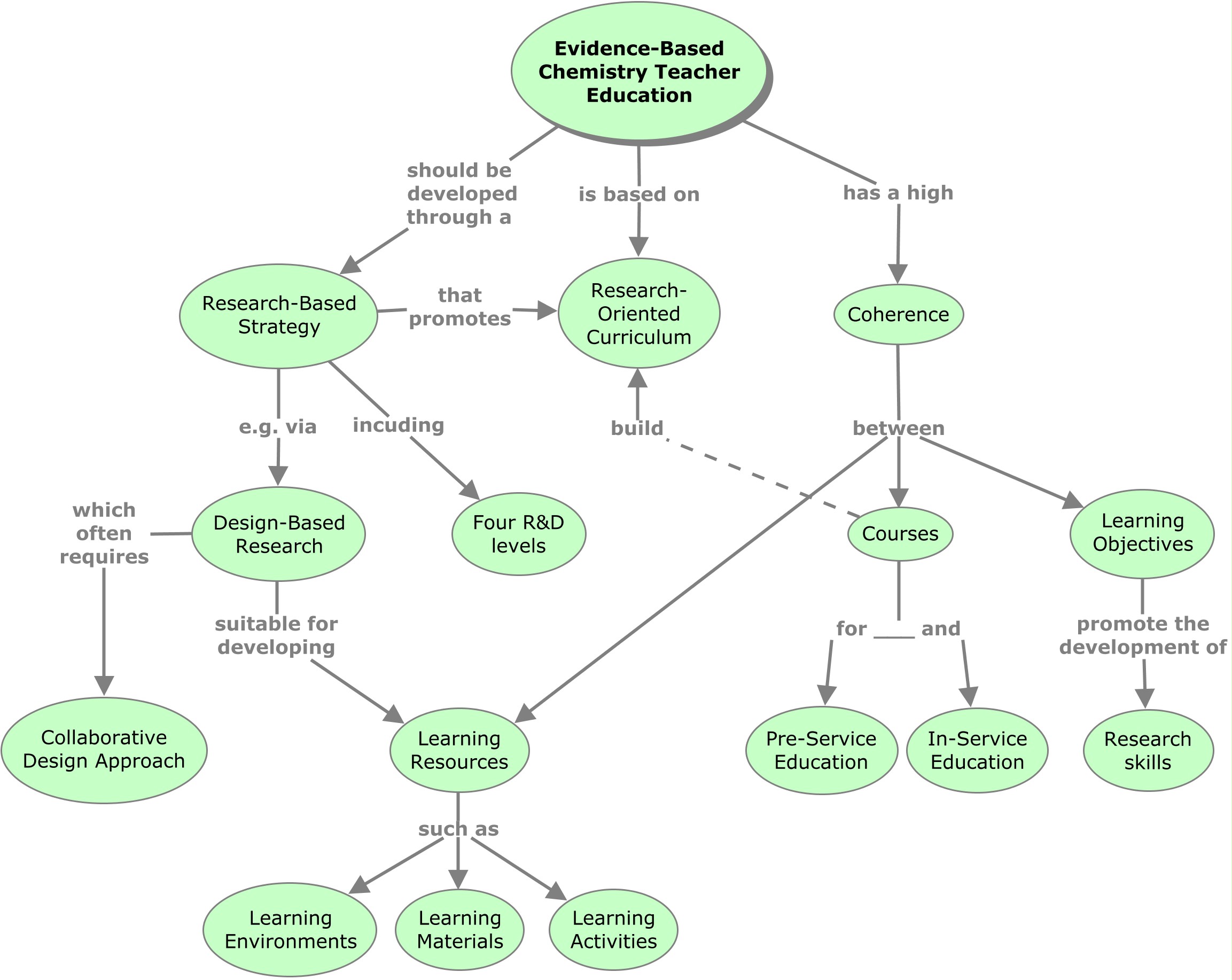
In this article we described an evidence-based research-oriented chemistry teacher education model (see Figure 5). Also, we synthesized good practices by producing narrative insights into what kind of resources and R&D activities it takes to keep a CTE study program relevant in the rapidly developing world. We hope that our curriculum model can serve as a valuable example for local research-based CTE development around the world. For our program the need for further development is constant. There is need for more research from each level why we will next start a level 2 research project on what kind of CER future chemistry teachers conduct in their master’s theses.
Research ethics
Not applicable.
Informed consent
Not applicable.
Author Contributions
Johannes Pernaa has conceptualized the idea of the article, wrote the initial version, prepared all visualizations, revised and worked as the project manager. Maija Aksela and Outi Haatainen have been revising and co-authoring. All authors agree and approve this submission.
Use of Large Language Models, AI and Machine Learning Tools
Generative AI tools have not been used in any stage of research or article writing.
Conflicts of Interest
The author states no conflict of interest.
Research funding
None declared.
Data availability
Not applicable.
Abbreviations
| CER: chemistry education research CTE: chemistry teacher education EDR: educational design research DBR: design-based research NOS: nature of science R&D: research and development ROCT: research-oriented chemistry teacher TPASK: technological pedagogical science knowledge |
References
- Oxford Economics. The Global Chemical Industry: Catalyzing Growth and Addressing Our World’s Sustainability Challenges; International Council of Chemical Associations (ICCA): Washington, DC, 2019; pp 1–29. https://www.icca-chem.org/wp-content/uploads/2019/03/ICCA_EconomicAnalysis_Report_030819.pdf (accessed 2019-08-08).
- Sun, X.; Fan, Y. V.; Lei, Y.; Zhao, J.; Chen, W.; Cao, Z. Towards Decoupling in Chemical Industry: Input Substitution Impacted by Technological Progress. J. Clean. Prod. 2024, 452, 142040. [CrossRef]
- Lightcast. The Future Chemistry Workforce and Educational Pathways: Examining the Data behind the Changing Nature of Jobs and Skills in Chemistry; Interim Report; Royal Society of Chemistry: London, 2023; p 89.
- Aalsvoort, J. V. Activity Theory as a Tool to Address the Problem of Chemistry’s Lack of Relevance in Secondary School Chemical Education. Int. J. Sci. Educ. 2004, 26 (13), 1635–1651. [CrossRef]
- Stuckey, M.; Eilks, I. Increasing Student Motivation and the Perception of Chemistry’s Relevance in the Classroom by Learning about Tattooing from a Chemical and Societal View. Chem. Educ. Res. Pract. 2014, 15 (2), 156–167. [CrossRef]
- Yasin, N. Y. B. M.; Yueying, O. Evaluating the Relevance of the Chemistry Curriculum to the Workplace: Keeping Tertiary Education Relevant. J. Chem. Educ. 2017, 94 (10), 1443–1449. [CrossRef]
- Osborne, J.; Dillon, J. Science Education in Europe: Critical Reflections, Report to the Nuffield Foundation; King’s College London: London, 2008; pp 1–32. http://www.nuffieldfoundation.org/sites/default/files/Sci_Ed_in_Europe_Report_Final.pdf (accessed 2019-08-08).
- Lavonen, J.; Juuti, K.; Uitto, A.; Meisalo, V.; Byman, R. Attractiveness of Science Education in the Finnish Comprehensive School. In Research findings on young people’s perceptions of technology and science education; Technology Industries of Finland: Helsinki, 2005; pp 5–30.
- Archer, L.; Francis, B.; Moote, J.; Watson, E.; Henderson, M.; Holmegaard, H.; MacLeod, E. Reasons for Not/Choosing Chemistry: Why Advanced Level Chemistry Students in England Do/Not Pursue Chemistry Undergraduate Degrees. J. Res. Sci. Teach. 2023, 60 (5), 978–1013. [CrossRef]
- Broman, K.; Bernholt, S.; Christensson, C. Relevant or Interesting According to Upper Secondary Students? Affective Aspects of Context-Based Chemistry Problems. Res. Sci. Technol. Educ. 2022, 40 (4), 478–498. [CrossRef]
- Cáceres-Jensen, L.; Rodríguez-Becerra, J.; Jorquera-Moreno, B.; Escudey, M.; Druker-Ibañez, S.; Hernández-Ramos, J.; Díaz-Arce, T.; Pernaa, J.; Aksela, M. Learning Reaction Kinetics through Sustainable Chemistry of Herbicides: A Case Study of Preservice Chemistry Teachers’ Perceptions of Problem-Based Technology Enhanced Learning. J. Chem. Educ. 2021, 98 (5), 1571–1582. [CrossRef]
- Eilks, I.; Marks, R.; Stuckey, M. Socio-Scientific Issues as Contexts for Relevant Education and a Case on Tattooing in Chemistry Teaching. Educ. Quím. 2018, 29 (1), 9–20. http://dx.doi.org/10.22201/fq.18708404e.2018.1.63680.
- Relevant Chemistry Education: From Theory to Practice; Eilks, I., Hofstein, A., Eds.; Sense Publishers: Rotterdam, 2015.
- Heublein, U.; Schmelzer, R. Die Entwicklung der Studienabbruchquoten an den deutschen Hochschulen - Berechnungen auf Basis des Absolventenjahrgangs 2016 (Eng. The development of dropout rates at German universities - calculations based on the graduate year 2016); DZHW-Projektbericht; Deutsches Zentrum für Hochschul- und Wissenschaftsforschung (DZHW): Hannover, Germany, 2018. https://www.dzhw.eu/en/publikationen.
- Astin, A. W.; Astin, H. S. Undergraduate Science Education: The Impact of Different College Environments on the Educational Pipeline in the Sciences; Final Report; Higher Education Research Institute, Graduate School of Education, University of California: Los Angeles, 1992; p 384. https://eric.ed.gov/?q=Undergraduate+science+education%3a+the+impact+of+different+college+environments+on+the+educational+pipeline+in+the+sciences&id=ED362404 (accessed 2019-10-15).
- Hailikari, T. K.; Nevgi, A. How to Diagnose At-Risk Students in Chemistry: The Case of Prior Knowledge Assessment. Int. J. Sci. Educ. 2010, 32 (15), 2079–2095. [CrossRef]
- Valto, P.; Nuora, P. The Role of Guidance in Student Engagement with Chemistry Studies. LUMAT Int. J. Math Sci. Technol. Educ. 2019, 7 (1), 165–182. [CrossRef]
- Bopegedera, A. M. R. P. STEMming the Tide: Using Career Week Activities To Recruit Future Chemists. J. Chem. Educ. 2005, 82 (10), 1505. [CrossRef]
- Mamlok-Naaman, R.; Blonder, R.; Lavonen, J. M. J.; Holbrook, J.; Rannikmae, M. Supporting Career Awareness through Job Shadowing and Industry Site Visits. Chem. Teach. Int. 2025, 7 (1), 107–120. [CrossRef]
- Espinosa, A. A.; Monterola, S. L. C.; Punzalan, A. E. Career-Oriented Performance Tasks: Effects on Students’ Interest in Chemistry. Asia-Pac. Forum Sci. Learn. Teach. 2013, 14 (2).
- Osborne, J.; Simon, S.; Collins, S. Attitudes towards Science: A Review of the Literature and Its Implications. Int. J. Sci. Educ. 2003, 25 (9), 1049–1079. [CrossRef]
- Avargil, S.; Shwartz-Asher, D.; Reiss, S. R.; Dori, Y. J. Professors’ Retrospective Views on Chemistry Career Choices with a Focus on Gender and Academic Stage Aspects. Sustain. Chem. Pharm. 2023, 36, 101249. [CrossRef]
- Aksela, M. Evidence-Based Teacher Education: Becoming a Lifelong Research-Oriented Chemistry Teacher? Chem. Educ. Res. Pract. 2010, 11 (2), 84–91. [CrossRef]
- Blonder, R.; Mamlok-Naaman, R. Teaching Chemistry through Contemporary Research versus Using a Historical Approach. Chem. Teach. Int. 2019, 2 (1). [CrossRef]
- Ratcliffe, M.; Bartholomew, H.; Hames, V.; Hind, A.; Leach, J.; Millar, R.; Osborne, J. Evidence-based Practice in Science Education: The Researcher–User Interface. Res. Pap. Educ. 2005, 20 (2), 169–186. [CrossRef]
- Toom, A.; Husu, J. Research-Based Teacher Education Curriculum Supporting Student Teacher Learning. In Coherence in European Teacher Education; Doetjes, G., Domovic, V., Mikkilä-Erdmann, M., Zaki, K., Eds.; Springer Nature Ltd., 2024; pp 173–188. [CrossRef]
- Toom, A.; Kynäslahti, H.; Krokfors, L.; Jyrhämä, R.; Byman, R.; Stenberg, K.; Maaranen, K.; Kansanen, P. Experiences of a Research-Based Approach to Teacher Education: Suggestions for Future Policies. Eur. J. Educ. 2010, 45 (2), 331–344. [CrossRef]
- Valcke, M. “Evidence-Based Teaching, Evidence-Based Teacher Education” (Quality of Teachers and Quality of Teacher Education). In Preparing Teachers for the 21st Century; Zhu, X., Zeichner, K., Eds.; Springer: Berlin, Heidelberg, 2013; pp 53–66. [CrossRef]
- Hernández-Ramos, J.; Rodríguez-Becerra, J.; Cáceres-Jensen, L.; Aksela, M. Constructing a Novel E-Learning Course, Educational Computational Chemistry through Instructional Design Approach in the TPASK Framework. Educ. Sci. 2023, 13 (7), 648. [CrossRef]
- Aksela, M.; Lundell, J. Computer-Based Molecular Modelling: Finnish School Teachers’ Experiences and Views. Chem. Educ. Res. Pract. 2008, 9 (4), 301–308. [CrossRef]
- Copriady, J.; Zulnaidi, H.; Alimin, M.; Albeta, S. W. In-Service Training and Teaching Resource Proficiency amongst Chemistry Teachers: The Mediating Role of Teacher Collaboration. Heliyon 2021, 7 (5), e06995. [CrossRef]
- Taber, K. S. Identifying Research Foci to Progress Chemistry Education as a Field. Educ. Quím. 2018, 28 (2), 66-73–73. http://dx.doi.org/10.1016/j.eq.2016.12.001.
- Jimoyiannis, A. Designing and Implementing an Integrated Technological Pedagogical Science Knowledge Framework for Science Teachers Professional Development. Comput. Educ. 2010, 55 (3), 1259–1269. [CrossRef]
- Rodriguez-Becerra, J.; Cáceres-Jensen, L.; Díaz, T.; Druker, S.; Bahamonde Padilla, V.; Pernaa, J.; Aksela, M. Developing Technological Pedagogical Science Knowledge through Educational Computational Chemistry: A Case Study of Pre-Service Chemistry Teachers’ Perceptions. Chem. Educ. Res. Pract. 2020, 21 (2), 638–654. [CrossRef]
- Abd-El-Khalick, F. Examining the Sources for Our Understandings about Science: Enduring Conflations and Critical Issues in Research on Nature of Science in Science Education. Int. J. Sci. Educ. 2012, 34 (3), 353–374. [CrossRef]
- Koehler, M.; Mishra, P. What Is Technological Pedagogical Content Knowledge (TPACK)? Contemp. Issues Technol. Teach. Educ. 2009, 9 (1), 60–70.
- Shulman, L. Knowledge and Teaching: Foundations of the New Reform. Harv. Educ. Rev. 1987, 57 (1), 1–23. [CrossRef]
- Erduran, S.; Dagher, Z. R.; McDonald, C. V. Contributions of the Family Resemblance Approach to Nature of Science in Science Education. Sci. Educ. 2019, 28 (3), 311–328. [CrossRef]
- Kaya, E.; Erduran, S. Comparison of Physics, Chemistry, and Biology Teachers’ Perceptions of Nature of Science and Domains of Science. Sci. Educ. 2024. [CrossRef]
- Varelas, M.; House, R.; Wenzel, S. Beginning Teachers Immersed into Science: Scientist and Science Teacher Identities. Sci. Educ. 2005, 89 (3), 492–516. [CrossRef]
- Ferk Savec, V. The Opportunities and Challenges for ICT in Science Education. LUMAT Int. J. Math Sci. Technol. Educ. 2017, 5 (1), 12–22. [CrossRef]
- Yuriev, E.; Wink, D. J.; Holme, T. A. The Dawn of Generative Artificial Intelligence in Chemistry Education. J. Chem. Educ. 2024, 101 (8), 2957–2959. [CrossRef]
- Aksela, M. Towards Student-Centred Solutions and Pedagogical Innovations in Science Education through Co-Design Approach within Design-Based Research. LUMAT Int. J. Math Sci. Technol. Educ. 2019, 7 (3), 113–139. [CrossRef]
- Haatainen, O.; Pernaa, J.; Pesonen, R.; Halonen, J.; Aksela, M. Supporting the Teacher Identity of Pre-Service Science Teachers through Working at a Non-Formal STEM Learning Laboratory. Educ. Sci. 2024, 14 (6), 649. [CrossRef]
- Vuorio, E.; Pernaa, J.; Aksela, M. Lessons for Sustainable Science Education: A Study on Chemists’ Use of Systems Thinking across Ecological, Economic, and Social Domains. Educ. Sci. 2024, 14 (7), 741. [CrossRef]
- Zhai, Y.; Tripp, J.; Liu, X. Science Teacher Identity Research: A Scoping Literature Review. Int. J. STEM Educ. 2024, 11 (1), 20. [CrossRef]
- Beijaard, D.; Meijer, P. C.; Verloop, N. Reconsidering Research on Teachers’ Professional Identity. Teach. Teach. Educ. 2004, 20 (2), 107–128. [CrossRef]
- Shulman, L. S. Those Who Understand: Knowledge Growth in Teaching. Educ. Res. 1986, 15 (2), 4–14. [CrossRef]
- Tuomi, J.; Sarajärvi, A. Laadullinen tutkimus ja sisällönanalyysi, Uudistettu laitos.; Tammi: Helsinki, 2018.
- Smith, B.; Monforte, J. Stories, New Materialism and Pluralism: Understanding, Practising and Pushing the Boundaries of Narrative Analysis. Methods Psychol. 2020, 2, 100016. [CrossRef]
- Ferrari, R. Writing Narrative Style Literature Reviews. Med. Writ. 2015, 24 (4), 230–235. [CrossRef]
- Edelson, D. C. Design Research: What We Learn When We Engage in Design. J. Learn. Sci. 2002, 11 (1), 105–121. [CrossRef]
- Anderson, T.; Shattuck, J. Design-Based Research A Decade of Progress in Education Research? Educ. Res. 2012, 41 (1), 16–25. [CrossRef]
- Pernaa, J.; Aksela, M. Model-Based Design Research: A Practical Method for Educational Innovations. Adv. Bus.-Relat. Sci. Res. J. 2013, 4 (1), 71–83.
- Brown, A. Design Experiments: Theoretical and Methodological Challenges in Creating Complex Interventions in Classroom Settings. J. Learn. Sci. 1992, 2 (2), 141–178.
- Juuti, K.; Lavonen, J. Design-Based Research in Science Education: One Step Towards Methodology. Nord. Stud. Sci. Educ. 2006, 2 (2), 54–68.
- Kostøl, K. B.; Remmen, K. B.; Braathen, A.; Stromholt, S. Co-Designing Cross-Setting Activities in a Nationwide STEM Partnership Program – Teachers’ and Students’ Experiences. LUMAT Int. J. Math Sci. Technol. Educ. 2021, 9 (1), 426–456. [CrossRef]
- ChemistryLab Gadolin: 15 Years of Inspiring Innovations for Science Education; Aksela, M., Pernaa, J., Haatainen, O. M., Pesonen, R. M., Vuorio, E. S., Eds.; University of Helsinki: Helsinki, 2024.
- LUMA Finland – Together We Are More; Aksela, M., Lundell, J., Ikävalko, T., Eds.; LUMA Centre Finland: University of Helsinki, 2020.
- Välijärvi, J.; Kupari, P.; Linnakylä, P.; Reinikainen, P.; Sulkunen, S.; Törnroos, J.; Arffman, I. The Finnish Success in Pisa – and Some Reasons behind It : 2 Pisa 2003; University of Jyväskylä: Jyväskylä, 2007.
- Tveit, S.; Faegri, K. A New Online Resource for Chemical Safety and Green Chemistry in Science Education. Chem. Teach. Int. 2023, 5 (2), 239–244. [CrossRef]
- Toom, A.; Krokfors, L.; Kynäslahti, H.; Stenberg, K.; Maaranen, K.; Jyrhämä, R.; Byman, R.; Kansanen, P. Exploring the Essential Characteristics of Research-Based Teacher Education from the Viewpoint of Teacher Educators: Annual Teacher Education Policy in Europe Network (TEPE) Conference. Proc. Second Annu. Teach. Educ. Policy Eur. Netw. TEPE Conf. 2008, 166–179.
- Stuckey, M.; Hofstein, A.; Mamlok-Naaman, R.; Eilks, I. The Meaning of ‘Relevance’ in Science Education and Its Implications for the Science Curriculum. Stud. Sci. Educ. 2013, 49 (1), 1–34. [CrossRef]
- Erduran, S.; Kaya, E. Towards Development of Epistemic Identity in Chemistry Teacher Education. In Transforming Teacher Education Through the Epistemic Core of Chemistry; Science: Philosophy, History and Education; Springer International Publishing: Cham, 2019; pp 169–189. [CrossRef]
- Pernaa, J.; Ikävalko, T.; Takala, A.; Vuorio, E.; Pesonen, R.; Haatainen, O. Artificial Intelligence Chatbots in Chemical Information Seeking: Narrative Educational Insights via a SWOT Analysis. Informatics 2024, 11 (2), 20. [CrossRef]
- Pernaa, J.; Wiedmer, S. A Systematic Review of 3D Printing in Chemistry Education – Analysis of Earlier Research and Educational Use through Technological Pedagogical Content Knowledge Framework. Chem. Teach. Int. 2020, 2 (2). [CrossRef]
- Pernaa, J.; Kämppi, V.; Aksela, M. Supporting the Relevance of Chemistry Education through Sustainable Ionic Liquids Context: A Research-Based Design Approach. Sustainability 2022, 14 (10), 6220. [CrossRef]
- Cáceres-Jensen, L.; Rodríguez-Becerra, J.; Jorquera-Moreno, B.; Escudey, M.; Druker-Ibañez, S.; Hernández-Ramos, J.; Díaz-Arce, T.; Pernaa, J.; Aksela, M. Learning Reaction Kinetics through Sustainable Chemistry of Herbicides: A Case Study of Preservice Chemistry Teachers’ Perceptions of Problem-Based Technology Enhanced Learning. J. Chem. Educ. 2021, 98 (5), 1571–1582. [CrossRef]
- Hernández-Ramos, J.; Rodríguez-Becerra, J.; Cáceres-Jensen, L.; Aksela, M. Constructing a Novel E-Learning Course, Educational Computational Chemistry through Instructional Design Approach in the TPASK Framework. Educ. Sci. 2023, 13 (7), 648. [CrossRef]
- Hernández-Ramos, J.; Pernaa, J.; Cáceres-Jensen, L.; Rodríguez-Becerra, J. The Effects of Using Socio-Scientific Issues and Technology in Problem-Based Learning: A Systematic Review. Educ. Sci. 2021, 11 (10), 640. [CrossRef]
- Pernaa, J.; Takala, A.; Ciftci, V.; Hernández-Ramos, J.; Cáceres-Jensen, L.; Rodríguez-Becerra, J. Open-Source Software Development in Cheminformatics: A Qualitative Analysis of Rationales. Appl. Sci. 2023, 13 (17), 9516. [CrossRef]
- Pernaa, J.; Kiviluoto, O. M. O.; Aksela, M. The Relevance of Computer-Based Molecular Modeling and the Effect of Interest: A Survey of Finnish Lower-Secondary Education Pupils’ Perceptions. In Ainedidaktiikka ajassa; Routarinne, S., Heinonen, P., Kärki, T., Rönkkö, M.-L., Korkeaniemi, A., Eds.; Ainedidaktisia tutkimuksia; University of Turku, Faculty of Education, Department of Teacher education, Rauma Campus: Rauma, 2023; pp 33–54.
- Haatainen, O.; Pernaa, J.; Pesonen, R.; Halonen, J.; Aksela, M. Supporting the Teacher Identity of Pre-Service Science Teachers through Working at a Non-Formal STEM Learning Laboratory. Educ. Sci. 2024, 14 (6), 649. [CrossRef]
- Aksela, M.; Lundell, J. Computer-Based Molecular Modelling: Finnish School Teachers’ Experiences and Views. Chem. Educ. Res. Pract. 2008, 9 (4), 301–308. [CrossRef]
- Aksela, M. K. Engaging Students for Meaningful Chemistry Learning through Microcomputer-Based Laboratory (MBL) Inquiry. Educ. Quím. EduQ 2011, No. 9, 30–37. [CrossRef]
- Pernaa, J. Possibilities and Challenges of Using Educational Cheminformatics for STEM Education: A SWOT Analysis of a Molecular Visualization Engineering Project. J. Chem. Educ. 2022, 99 (3), 1190–1200. [CrossRef]
- Vuorio, E.; Pernaa, J.; Aksela, M. Promoting Sustainable Development Competencies and Teaching in Chemistry Education at University. FMSERA J. 2021, 4 (2), 34–55.
- Vuorio, E.; Pernaa, J.; Aksela, M. Lessons for Sustainable Science Education: A Study on Chemists’ Use of Systems Thinking across Ecological, Economic, and Social Domains. Educ. Sci. 2024, 14 (7), 741. [CrossRef]
Figure 1.
The three different research types of CER.[32].
Figure 1.
The three different research types of CER.[32].
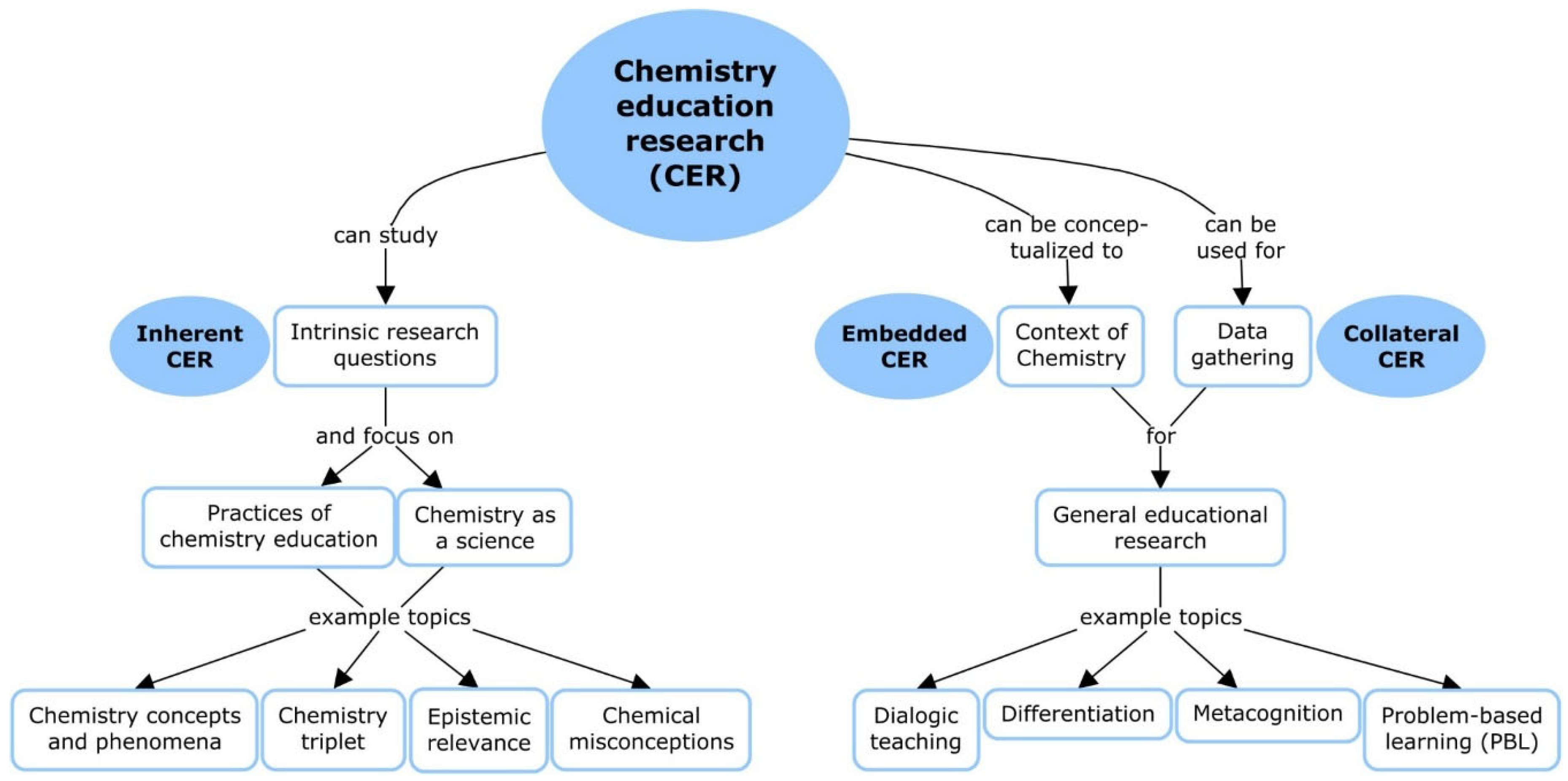
Figure 2.
An overview of the TPASK framework.[33].
Figure 2.
An overview of the TPASK framework.[33].
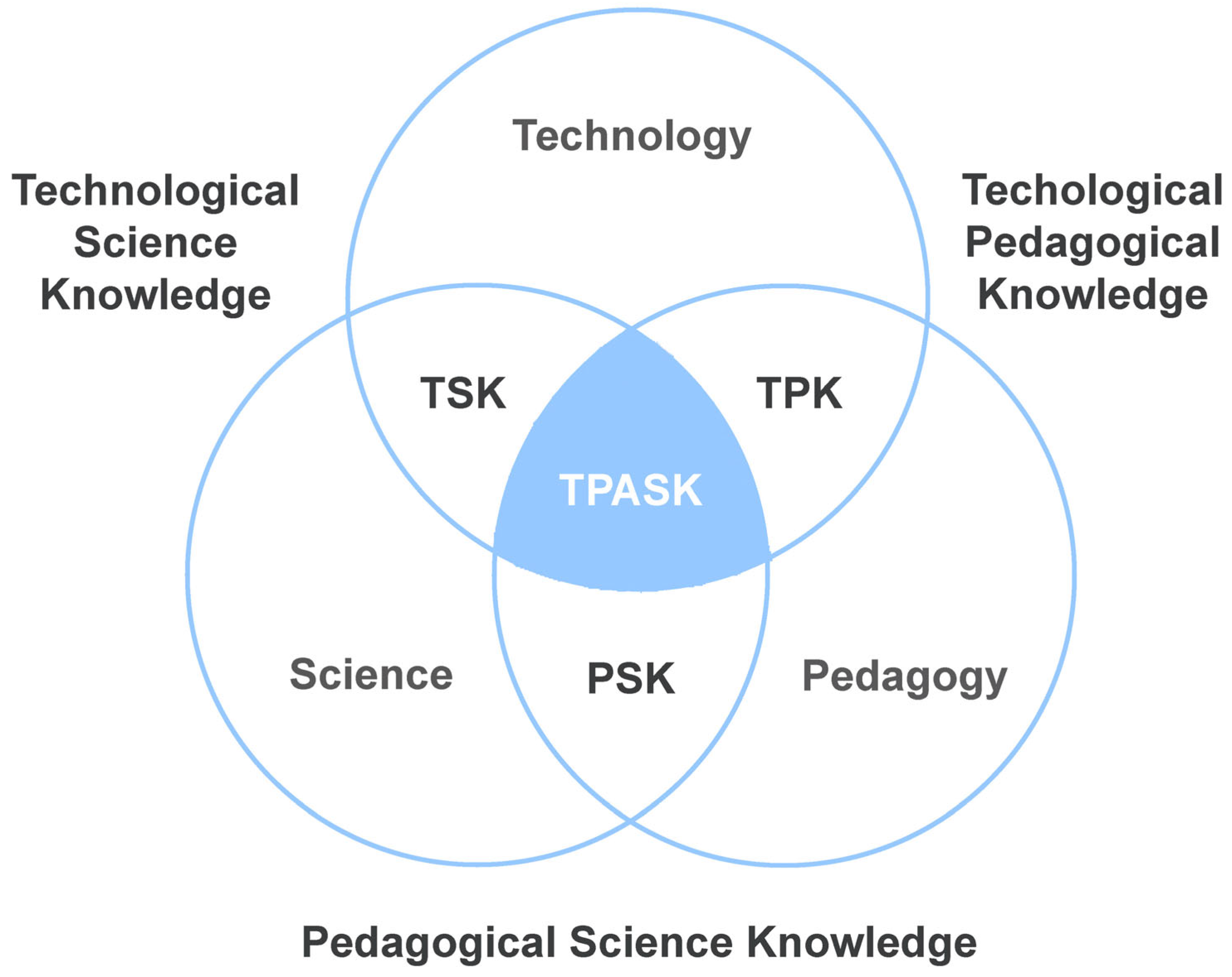
Figure 3.
The Chemistry Department’s research foci and their contribution to CER research foci and CTE study program.
Figure 3.
The Chemistry Department’s research foci and their contribution to CER research foci and CTE study program.
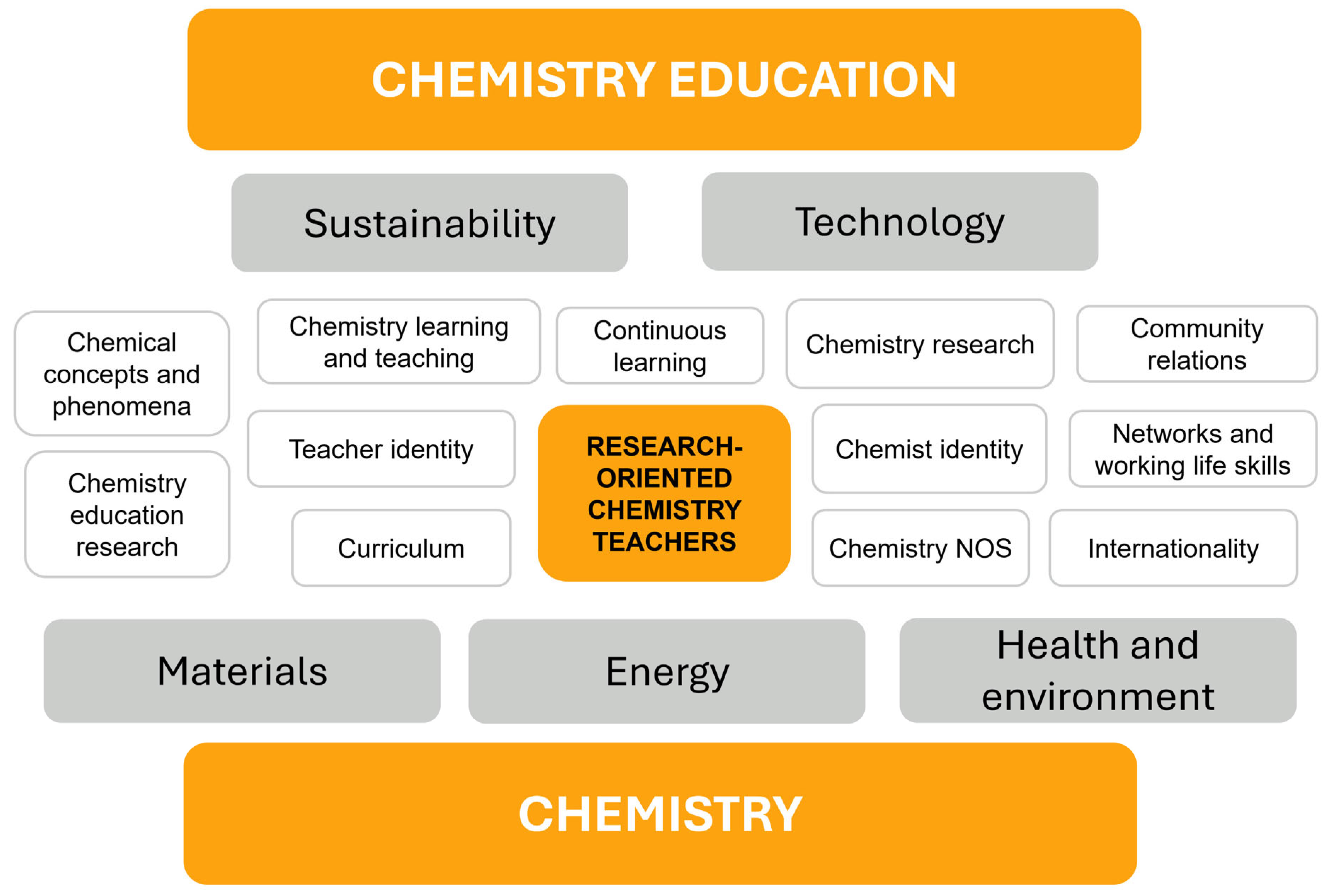
Figure 4.
An overview of LUMAlab Gadolin as a research and development hub.
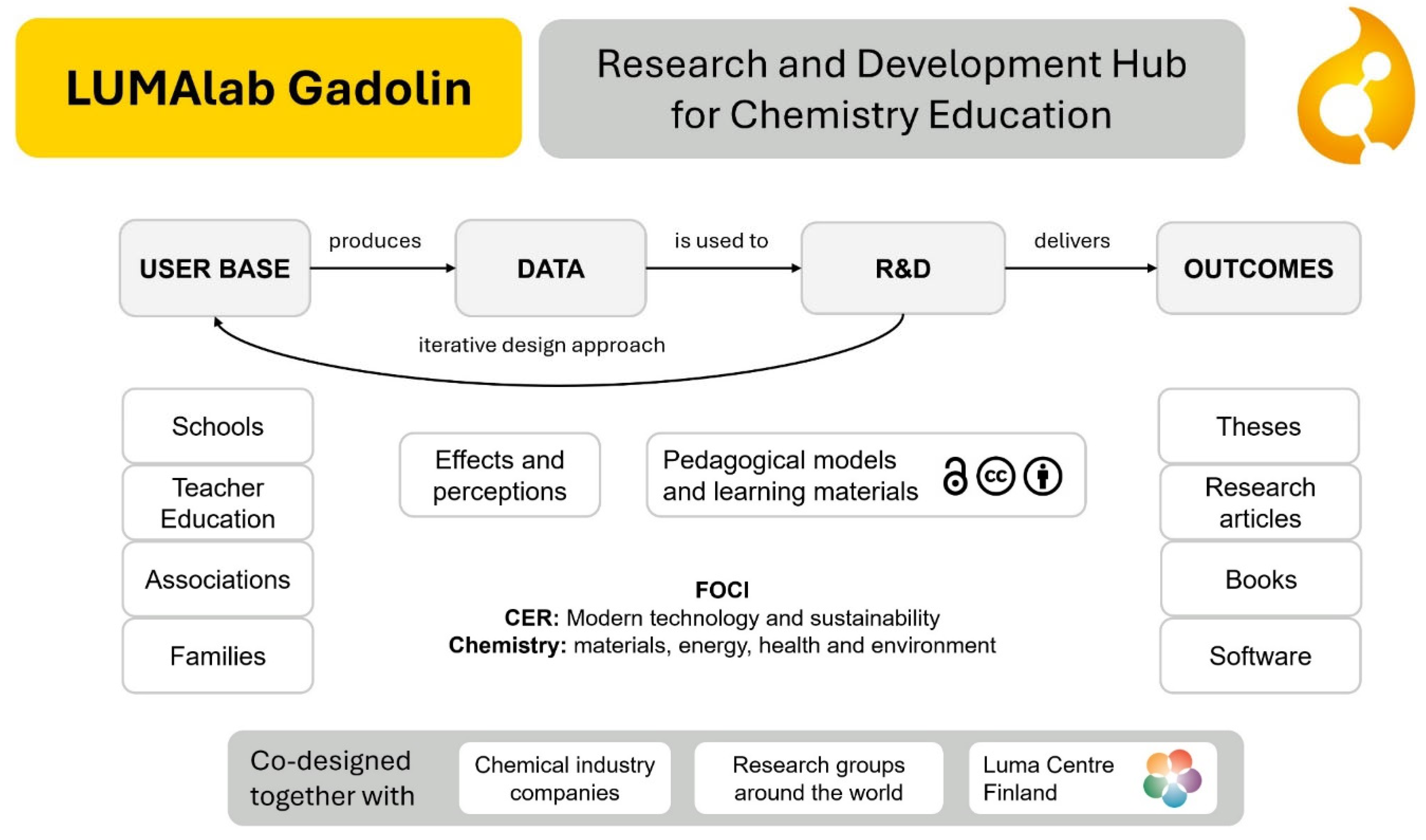
Figure 5.
A summary of characteristics of evidence-based chemistry teacher education. .
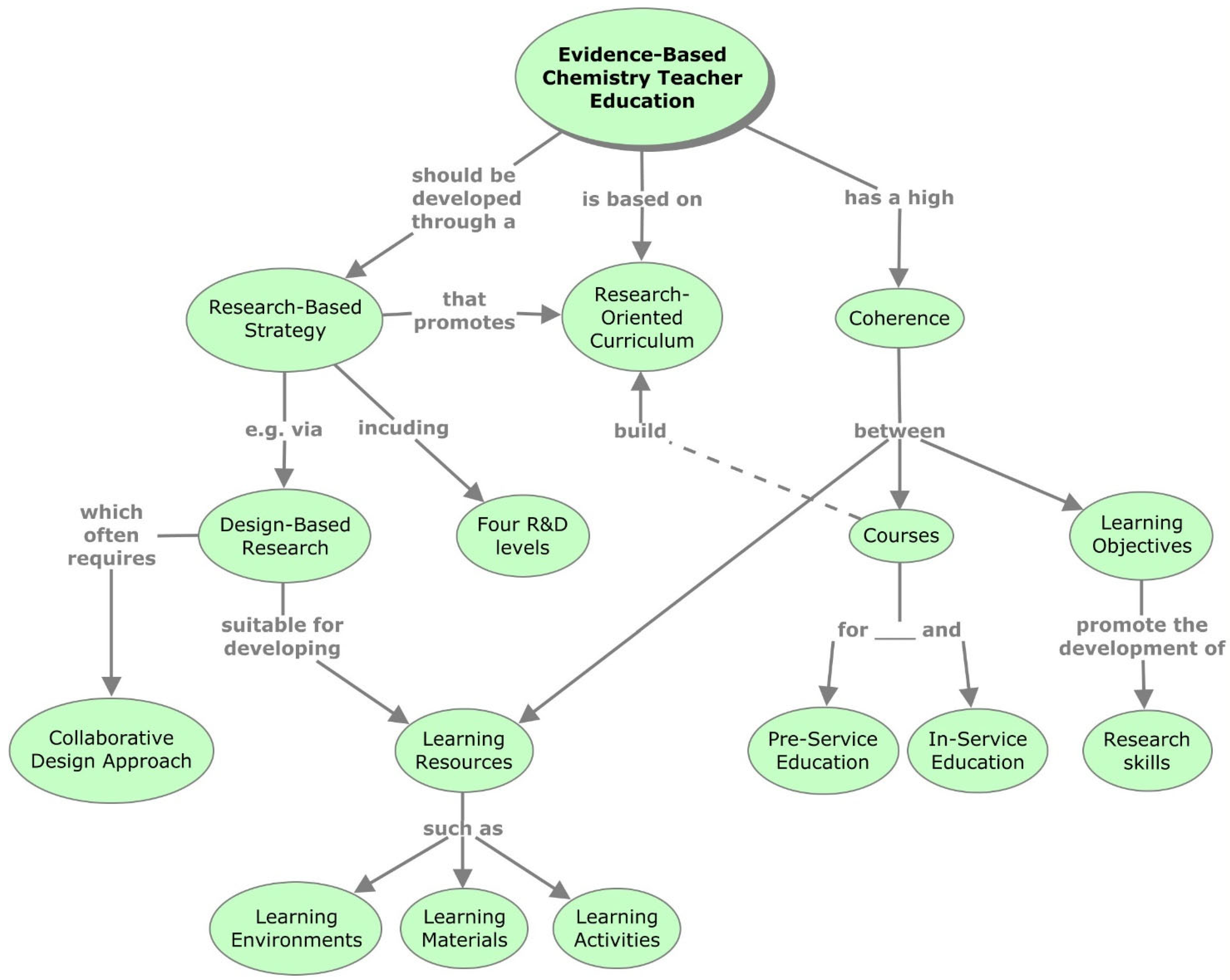

Table 1.
A structure analysis of CTE course allocations.
| Courses | Allocation (ECTS/%) | Notes | |
| BSc | MSc | ||
| Chemistry | 65 / 36% | 0–15/ 0–12.5% |
The MSc degree has 15 elective credits, which can include courses in chemistry |
| Chemistry education |
30 / 17% | 45–60/ 37.5–60% |
At least 75 ECTS of CER studies, including courses, theses and seminars |
| 2nd teaching subject | 60 / 33% | - | Includes 5 to 15 ECTS DBER studies depending on the subject |
| General studies |
25 / 14% | - | Includes academic skills, career courses and language studies |
| Pedagogical studies | - | 60 / 50% | Covers 50% of the MSc degree |
| Sum | 180 / 100% | 120 / 100% | |
Table 2.
An overview of CER courses offered at the University of Helsinki during the curriculum period 2023–2025, with research skills integrated in courses.
Table 2.
An overview of CER courses offered at the University of Helsinki during the curriculum period 2023–2025, with research skills integrated in courses.
| # | Level | Course | Research skills | Year |
| 1 | BSc | Chemistry in Everyday Life, Society and Environment (5 ECTS) | Information retrieval, academic writing (essay) | 1 |
| 2 | BSc | Inquiry-based Chemistry Education (5 ECTS) | Qualitative and mixed method case studies, questionnaires, content analysis, automatic citation tools | 2 |
| 3 | BSc | Concepts and Phenomena in Chemistry Education (5 ECTS) | CER as a field, pre-post measurement of conceptual change | 2 |
| 4 | BSc | Information and Communication Technology in Chemistry Education (4 ECTS) | Artificial intelligence in CER | 3 |
| 5 | BSc | Sustainable Chemistry and Education (5 ECTS) | Modelling of systems thinking | 3 |
| 6 | BSc | Bachelor’s thesis and seminar (6+1 ECTS) | Narrative or systematic literature review or case study | 3 |
| 7 | BSc | Science Education (5 ECTS) | Designing research-based science education activities |
1–3 |
| 8 | BSc | Mathematics and Science in Society (5 ECTS) | NOS | 1–3 |
| 9 | BSc | Contemporary Science and Future of Research (5 ECTS) | NOS | 1–3 |
| 10 | MSc | Integrated Chemistry Education (5 ECTS) | Design-based research and chemical engineering projects | 5 |
| 11 | MSc | Chemistry Now and Future (5 ECTS) |
NOS (chemistry specific), authentic chemistry research and researcher networks |
5 |
| 12 | MSc | Research Methods in Chemistry Education (5 ECTS) | Overview of research methodologies and methods usually applied in CER | 5 |
| 13 | MSc | Sustainable Education in Mathematics and Science Education (5 ECTS) | NOS | 5 |
| 14 | MSc | Master’s thesis and research seminar (30+5 ECTS) | Independent CER research project | 5 |
Table 3.
Different levels of DBR conducted in developing the CTE study program.
| Level | Focus | Research Types | Perspective |
| 1 | Educational resources such as exercises, laboratory activities, web materials, etc. | BSc and MSc theses, small DBR projects | Internal |
| 2 | Pedagogical models and courses | PhD dissertations and research projects | Internal |
| 3 | Program and university level development such as coherence | Research projects | Internal and partly external |
| 4 | National and international level projects that build interfaces with society, e.g., the chemical industry and educational policy decision makers | Research projects | External |
Disclaimer/Publisher’s Note: The statements, opinions and data contained in all publications are solely those of the individual author(s) and contributor(s) and not of MDPI and/or the editor(s). MDPI and/or the editor(s) disclaim responsibility for any injury to people or property resulting from any ideas, methods, instructions or products referred to in the content. |
© 2025 by the authors. Licensee MDPI, Basel, Switzerland. This article is an open access article distributed under the terms and conditions of the Creative Commons Attribution (CC BY) license (http://creativecommons.org/licenses/by/4.0/).
Copyright: This open access article is published under a Creative Commons CC BY 4.0 license, which permit the free download, distribution, and reuse, provided that the author and preprint are cited in any reuse.


