
Submitted:
11 February 2025
Posted:
12 February 2025
You are already at the latest version
Abstract
This paper presents a critical review of existing Zitterbewegung models of the electron, assessing their compatibility with Dirac theory, special relativity, and observed particle physics data. We highlight the strengths and limitations of each model, while also introducing a perspective of the electron based on field dynamics rather than particle concepts. Our aim is to determine whether fundamental properties of the electron—such as spin, charge, mass, and relativistic behavior—can be derived from first principles.
Keywords:
zitterbewegung
; spin
; electric charge
; Schwinger limit
; matter wave
1. Introduction
Since the advent of quantum mechanics numerous scientists have endeavored to establish a realistic interpretation. Of particular interest is the structure of the electron, which has persistently defied classical description. "Intrinsic" spin is not to be visualized. As Frank Wilczek stated in [1], "To understand the electron is to understand the world". According to the standard model, the electron is a point particle, endowed with charge, mass, spin, magnetic moment, and quantum waves. Bohr himself pointed out the shortcomings of his electron model; for example the electron cannot have an extended charge or it would explode due to electrostatic repulsion. Also the electron should radiate energy when orbiting the proton core under Bremsstrahlung and thus should not be stable.
The Zitterbewegung interpretation of quantum mechanics has a long history. In 1930, Schrodinger discovered that the Dirac equation contains a rapid oscillatory motion, the electron appears to move in circles at the speed of light- the "Zitterbewegung" or "Trembling motion" [5]. The Dirac hamiltonian of a free particle is:
with m the mass of the particle, the momentum operator, and where , are related to the Dirac matrices ( and ). The Dirac Hamiltonian describes the relativistic dynamics of spin 1/2 particles (fermions); it is a matrix acting on bispinor . From this Dirac Hamiltonian, the Zitterbewegung oscillatory component of the position operator obtained is, for :
where the frequency of this oscillation is , with E the energy of the particle.
Feynman would later encapsulate this jittery electron movement by postulating an interaction between the electron particle and a sea of virtual particles and photons, what we know as quantum electrodynamics (QED). To some extent all Zitterbewegung-electron models consider the existence of a (point) particle which is moving in specific ways. Some posit toroidal movements, others circular movements, but it is a movement of the electron that is postulated.
1.1. Clifford Algebras and ZitterBewegung
While we focus on highly visual interpretations of the electron’s structure, in terms of particle trajectories, it is crucial to acknowledge the field’s highly mathematical origins. The concept of Zitterbewegung has a long and solid pedigree, beginning with Dirac and his eponymous equation. Dirac initially interpreted the zitter as "oscillations between positive and negative energy states". The evolution of this field has led to the modern application of Clifford algebras, known as "Space Time Algebra" (STA), as developed by Barut [2], Hestenes [3] and Hiley [4]. These mathematical structures have been shown to provide a geometric framework for understanding the Dirac electron, offering a more intuitive grasp of quantum mechanical spinor phenomena. Basil Hiley in particular identified the link between Clifford algebras and ’pilot-wave’ Bohmian models. This mathematical foundation, spanning from Dirac’s initial formulation to modern Clifford algebraic approaches, provides a robust theoretical backdrop for the visual models.
In this essay, we will critically review some existing zitterbewegung particle models, we chose those of Consa, Kovacs and Vassalo, Rivas, Dos Santos and Williamson. The first four belong to the category of "zitter-particle" electron, while the last two go back to the field formalism of electromagnetism, let us call it "zitter-field" electrons. All these models attempt to provide useful pictures to understand QED.
2. Experimental Observations of the Electron
This section adopts a phenomenological approach, reviewing the experimental evidence regarding the electron nature.
2.1. Particle-Wave Duality
In quantum mechanics, elementary particles like the electron have a double nature: particle and wave. The wave nature of the electron is manifested in the de Broglie wavelength . The de Broglie wavelength, interestingly linked to the velocity of the electron, has been observed experimentally, for example in the Davisson-Germer experiment [6]. The features of the electron associated to its particular character are its energy E, mass , momentum and spin angular momentum ; the ones associated to its wave character are its internal frequency and de Broglie wavelength .
2.2. Length Scales of the Electron
Experimental observations have revealed distinct scales associated with the electron: the Compton scale ( m) and the Fermi scale ( m). These scales represent key length dimensions at which the electron exhibits specific behaviors or properties.
Compton Scale
The first experimentally observed inner structure in the electron manifests at the scale of around . This is known as the Dirac scale or Compton scale. The Compton wavelength is evidenced in Thomson scattering and Compton scattering experiments [7]. This scale corresponds to the scale of the "Zitterbewegung" postulated motion. The associated radius is , with the Compton wavelength.
It is also worth noting that the ratio between Compton and Bohr radius - the distance between the nucleus and the electron in a hydrogen atom in its ground state - is the fine structure constant . The presence of is due to the electromagnetic (EM) interaction between the electron and the proton, as is directly linked to the charge of the electron (and the EM forces) via .
Fermi Scale
Thomson elastic scattering also reveals a geometrical cross-section associated with the scale, termed the "classical electron radius" (Fermi scale). The cross-section of represents the physical surface observed during Thomson scattering. Compton scattering observes the Fermi distance through inelastic field interactions. The Klein-Nishina formula [8], which explains these results, is a more complex field-theoretic derivation; its development lacks the immediate geometric intuition of surface Thomson scattering. This formula also incorporates the characteristic "classical electron radius". Significantly, the ratio between the classical electron radius and the Compton radius is around , the fine structure constant . This indicates an electromagnetic relationship between the two distances.
No Further Scale
There are, so far, no further experimental observations of any scale below that of Fermi and this is true down to m. It should be noted that out of and c no further lengths in addition to the Bohr radius can be formed, and the ratio of two such lengths has to be the fine-structure constant, as this the only dimensionless ratio that can be formed out of these four fundamental constants. We will argue in this paper that both e and m are not fundamental but emerge from , the fine-structure-constant.
3. Critical Review of Existing Zitter-Particle Models
There are rather a few particle based zitterbewegung models, which have in common that they interpret the zitterbewegung as a circular motion of the charge, at the speed of light, with an amplitude of the Compton wavelength. Most models separate the center of charge from the center of mass, given that the particle is moving at the speed of light, which would be impossible for a massive object like the electron. This motion generates the quantum properties of the electron of spin and magnetic moment. In this section, we will analyze the existing zitter models. We use the following criteria:
- The electron model should have the dual nature particle and wave;
- Ability to predict the values of zitterbewegung frequency (), spin (, magnetic moment and spin g-factor obtained from Dirac theory;
- Ability to predict the de Broglie wavelength .
- Agreement with the observed "anomalous" Landé factor ;
- Ability to explain the origin of mass and the electric charge;
- Includes both Fermi and Compton scales;
- Agreement with special relativity.
3.1. Consa’s Toroidal Solenoid Geometry
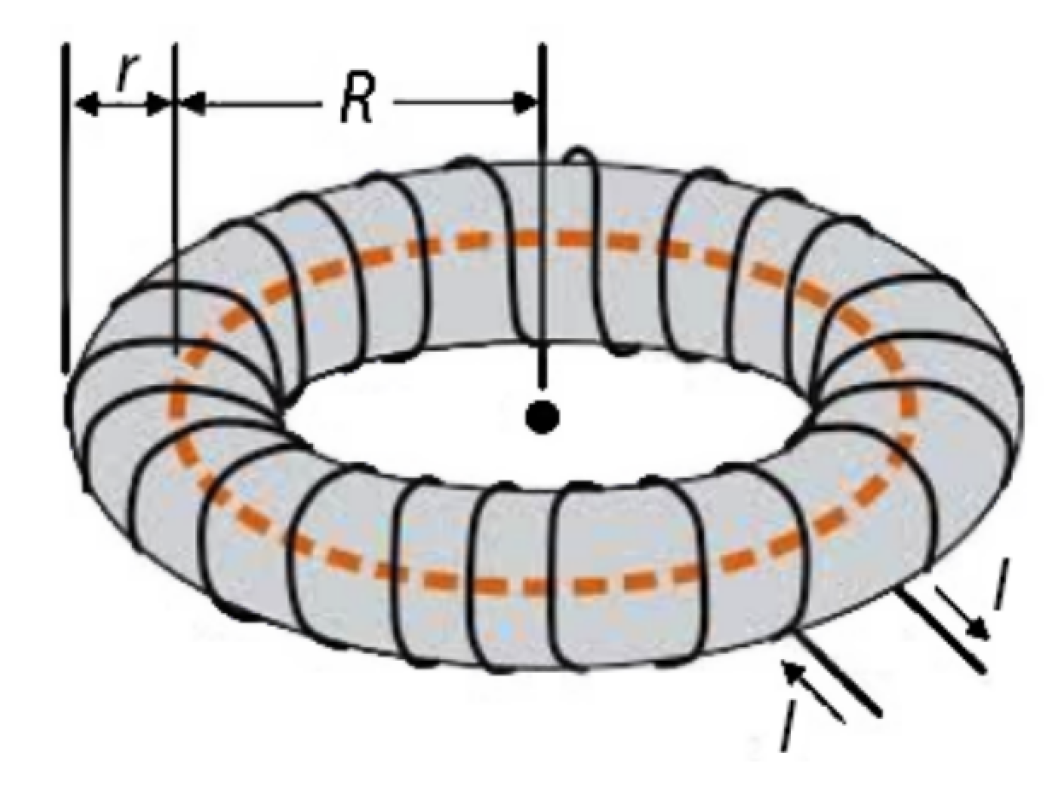
Oliver Consa proposes a model featuring a toroidal solenoid movement of the electron at the classical electron radius [9]. Toroidal solenoid geometry is well known in the electronics field where it is used to design inductors and antennas. This model posits a dual motion: a circular movement at the Compton scale coupled with a toroidal movement about it at the classical electron radius. In this conceptualization, the electron point charge orbits at light speed around a solenoid geometry encompassing both a small radius r radius and a larger Compton radius (see Figure 1). Oliver Consa stipulates that the normal to the small surface is tangential to the circular Compton radius movement. He introduces a g-factor, which is the ratio between the tangential velocity c and the rotational velocity : .
Figure 1.
The toroidal solenoid electron model of Oliver Consa. The electron charge moves at the speed of light along the black line; the trajectory encompasses both a small radius r and Compton radius (noted R in the figure). The electron acts as an antenna, where the resonance frequency coincides with the length of the antenna’s circumference. (Credit: from [9]).
Figure 1.
The toroidal solenoid electron model of Oliver Consa. The electron charge moves at the speed of light along the black line; the trajectory encompasses both a small radius r and Compton radius (noted R in the figure). The electron acts as an antenna, where the resonance frequency coincides with the length of the antenna’s circumference. (Credit: from [9]).
There are several objections one can make
- The frequency of the rotational motion is ,with , which is not compatible with the Zitter frequency ;
- The spin angular momentum obtained is , missing the factor 2 compared to the true value;
- This model only includes an internal motion and doesn’t include a wave, so it doesn’t explain the emergence of de Broglie wave (this fact is highlighted by the author).
- It doesn’t explain the origin of the charge, even qualitatively. It postulates the charge as a point charge.
3.2. Kovacs/Vassalo Model with Spherical Charge
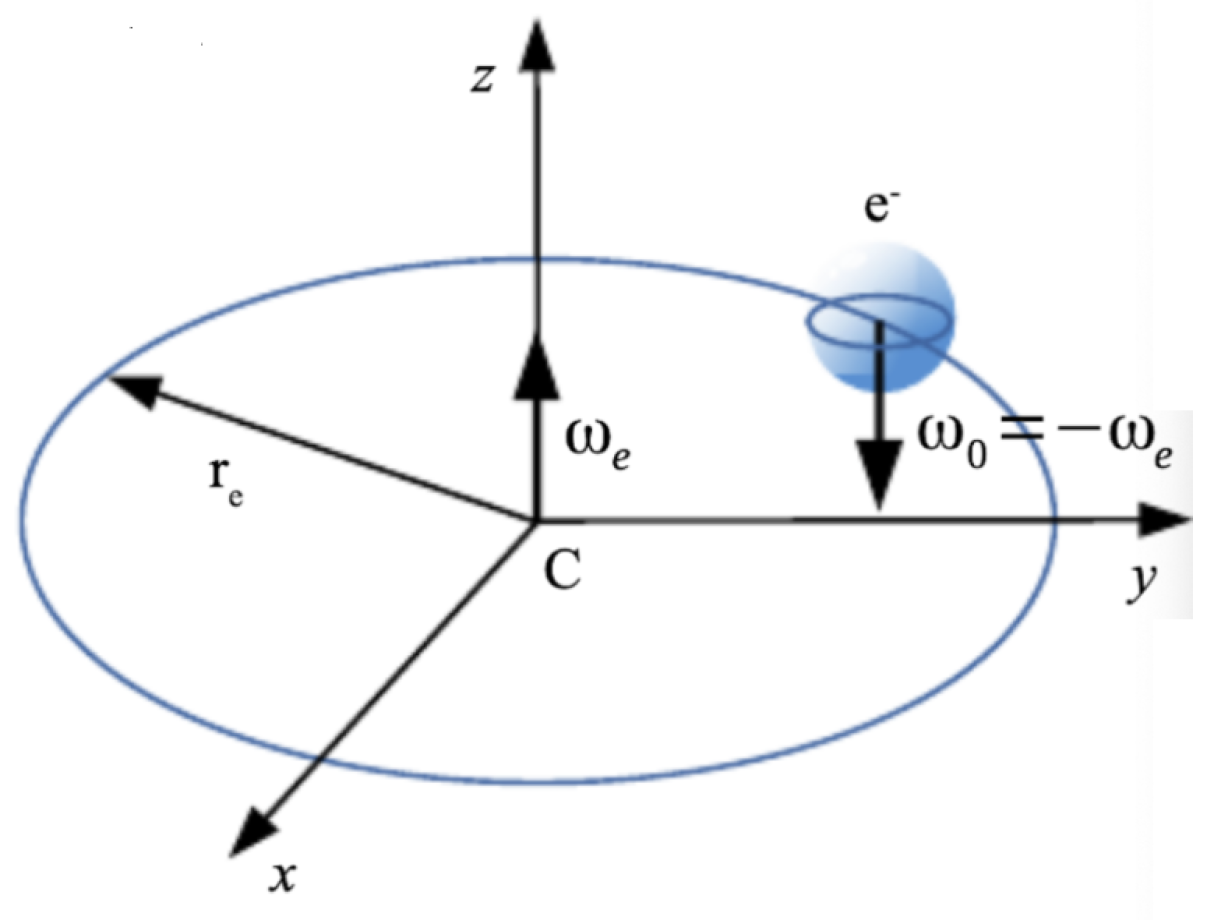
Kovacs et al. in [10] present an alternative modern treatment. Their model posits the electron charge distribution on the surface of a sphere with radius equal to the classical electron radius (). Integration of electromagnetic energy over this geometry yields the electron’s mass-energy of 511 keV, thus fully accounting for the electron mass as electromagnetic field energy. This concept, the equivalence of mass with electromagnetic energy was previously noted by Hestenes. It also aligns with the definition of the classical electron radius: the radius at which electromagnetic field energy equates to the electron’s mass. We observe this scale experimentally, and when we use it in the EM field energy calculation, it gives us precisely an electromagnetic field energy measure of 511 keV. This strongly suggests the electromagnetic nature of mass, and the identification of mass with field energy. While initially counter-intuitive it finds support in Einsteinian relativistic mass-energy equivalence. The fact that the mass of relativistic electrons varies with the Lorentz gamma factor further suggests its electromagnetic character. The flux is quantized and rotates on a circle at the Compton radius, by hypothesis; see Figure 2.
Figure 2.
Zitterbewegung model of Vassalo: a charged sphere of Fermi scale is rotating on the circular trajectory of Compton radius (noted in the figure), with angular frequency . The ball is counter rotating with frequency . (Credit: G. Vassalo from [11]).
Figure 2.
Zitterbewegung model of Vassalo: a charged sphere of Fermi scale is rotating on the circular trajectory of Compton radius (noted in the figure), with angular frequency . The ball is counter rotating with frequency . (Credit: G. Vassalo from [11]).
We have several issues with some aspects of this model:
- The frequency of the rotational motion is , which is not compatible with the Zitter frequency;
- The spin angular momentum obtained is . When asked about this fact, the authors indicate that ℏ is the intrinsic angular momentum of the electron and that is the component of aligned with an external magnetic field . In essence they distinguish between intrinsic spin and measured or projected spin. It is said that the angle between angular momentum and is always or . However, there is no restriction concerning angle experimentally. This angle has been observed to take many values between 0 and (it is determined by the initial orientation of the electron’s magnetic moment when the magnetic field is applied);
- In this model, the magnetic moment obtained is . This is the Bohr magneton that can be obtained from Dirac theory; as the intrinsic angular in this model is , then the Landé factor is , not in agreement with the value that is obtained from Dirac theory and measured experimentally (modulo its anomalies);
- The authors speak of a spherical geometry of the charge distribution. As can be seen in Figure 2 the charge is assumed to be a sphere at Fermi scale. The origin of this spherical charge distribution and confinement is not specified, just postulated. Moreover, such spherical geometry should theoretically explode by electrostatic repulsion.
Clarification on Spin Angular Momentum Measure
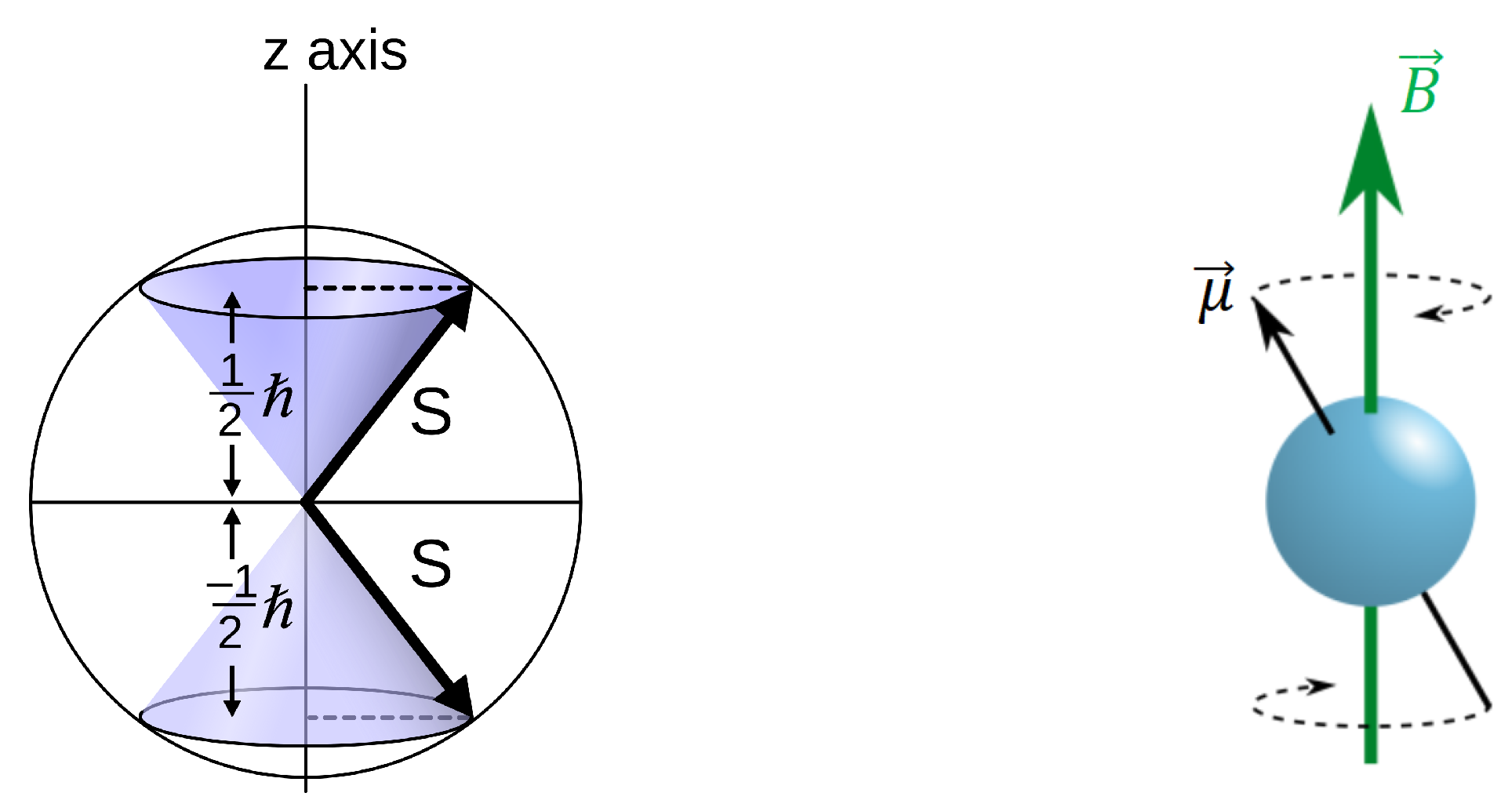
We will focus now on the spin angular momentum in their model (point 2 above). There is a confusion between the projection of the spin angular momentum on a given direction z and the Larmor precession when a magnetic field is applied to the electron (see Figure 3). In QM, the norm of the electron spin angular momentum is , and the quantum projection of this spin in a given direction z is . The angle of this mathematical projection is always the same, around . Moreover, when a magnetic field is applied, there is absolutely no restriction concerning the angle between the magnetic moment of the electron and the magnetic field . The external magnetic field exerts a torque on the magnetic moment, with norm . Some experiments measure values of spin precession angles other than and . For example see [12] with angles and and [13] with angle . These observations are in direct contradiction with the claims of the authors that the angles are fixed.
Figure 3.
Left: quantum projection of the spin vector on a given direction z; Right: Larmor precession (with magnetic moment vector and external magnetic field).
Figure 3.
Left: quantum projection of the spin vector on a given direction z; Right: Larmor precession (with magnetic moment vector and external magnetic field).
3.3. Martin Rivas Spinning Particles Model
Martin Rivas’ model represents one of the few approaches that provides equations of motion for the zitter electron in an electromagnetic field. Rivas postulates a separation between the center of charge and the center of mass [14]. See Figure 4.
Figure 4.
The spinning point particle model of Martin Rivas. The center of charge moves along a circular trajectory of Compton radius (noted r in the figure), generating a spin angular momentum S. The center charge is separated from the center of mass m. (Credit: from [14]).
Figure 4.
The spinning point particle model of Martin Rivas. The center of charge moves along a circular trajectory of Compton radius (noted r in the figure), generating a spin angular momentum S. The center charge is separated from the center of mass m. (Credit: from [14]).
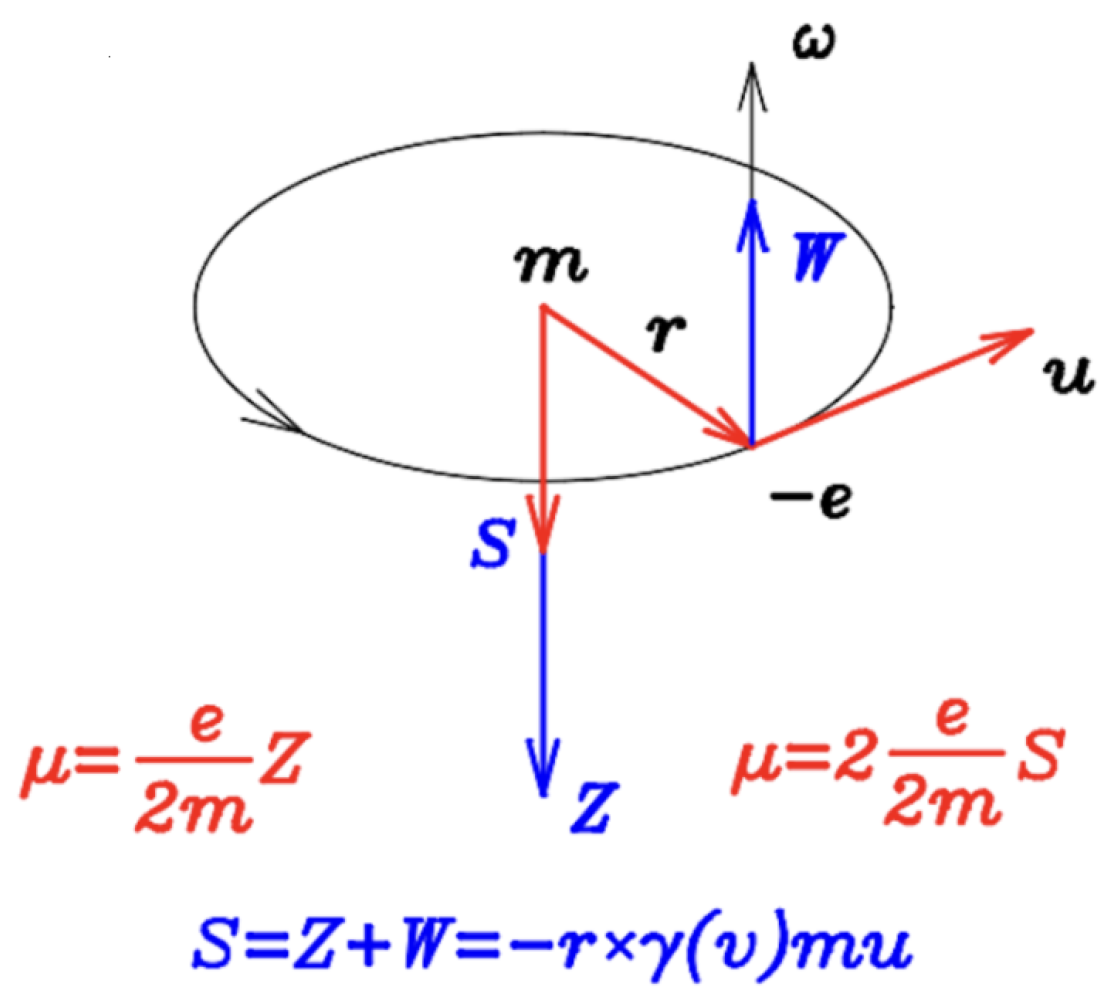
In this model, a point charge moves at light speed around the center of mass, which itself travels at sub-relativistic velocities. The point charge and the point mass are separated by the Compton distance in the rest frame. The model contains relativistic dynamic equations, which is a unique feature among the models. The calculation of the forces is computed at the center of charge but applied to the center of mass, which is treated as a separate point. A unique and remarkable feature of the Rivas model is that it has relativistic equations that show a cycloid emergence under relativistic speeds. One of the present authors (Marc Fleury) has recreated these zitter dynamics in computation.
Mott Scattering in Rivas’ Model
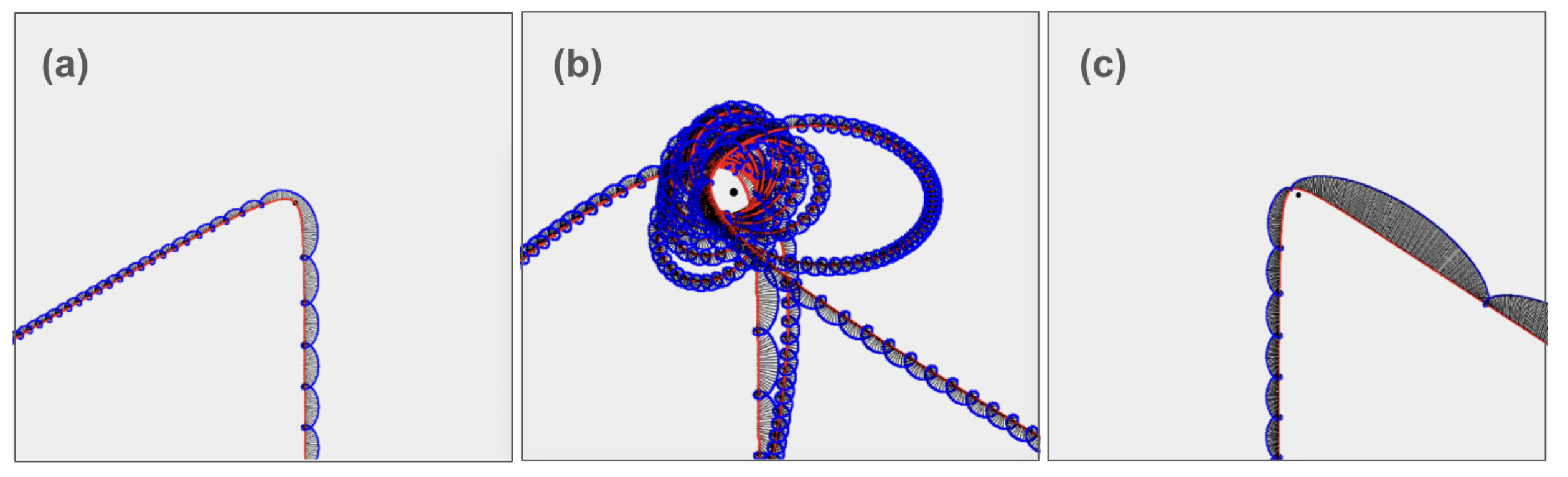
These cycloids are enough to explain the Mott scattering effect visually. Mott scattering, also referred to as spin-coupling inelastic Coulomb scattering, is the separation of the two spin states of an electron beam by deflection on an atomic target. Specific experiments involve 120keV electrons, with coplanar spin +1/2 or -1/2 which orbit a core of gold [15]. We have simulated these orbits with Rivas’s dynamic equations. One can readily observe in Figure 10 that depending on the spin orientation (left or right in the plane) the position of the cusp of the cycloid changes accordingly. A left spin results in a cusp to the left, and a right spin results in a cups on the right. As shown in Figure 5 we now consider the orbit of this electron around a gold atomic core (represented by a small dot in the center on the pictures). The electromagnetic attraction between the orbit and the core varies depending on the position of the cusp. The force is stronger if the cusp is closer to the atom core. Very simply, if the cusp is close, the attraction is stronger, if the cusp is further from the core, the attraction is lesser. This results in a asymmetry of scattering due to the spin orientation. This dependency of Mott scattering on co-planar spin is experimentally observed. See Figure 5 where the cusps of the cycloid interact longer with the atomic core. Thus spin shows up in the scattering effect. In classical QM we account for Mott scattering with various steps involved in the calculations. Here Mott scattering is qualitatively explained with this simple visual cycloid model.
This recreation of Mott scattering through intuitive methods exemplifies the range of quantum mechanical analogies that Zitter models can provide. It demonstrates that, despite certain limitations, Zitter models hold substantial didactic and illustrative value and may even enhance our comprehension of complex quantum phenomena. Specifically, in this non-trivial example, Mott spin-dependent scattering is conceptualized as a cycloidal interaction between electron charge cusps and the atomic core (see Figure 5). In contrast, the conventional quantum mechanical formalism required to compute exact scattering amplitudes involves numerous mathematically intricate steps.
Figure 5.
Cycloid Mott scattering. Electrons come from the bottom up and scatter off a gold core in the center. To the left (a), a left spinning electron scattering at with decreased exit velocity. To the right (c), a right spinning electron scattering at with increased exit velocity. In the middle (b), the Egyptian eye of Ra. An electron enters a semi captive orbit and exits at . Mott asymmetry means there are more in one direction than the other depending on spin. (Credit: Marc Fleury).
Figure 5.
Cycloid Mott scattering. Electrons come from the bottom up and scatter off a gold core in the center. To the left (a), a left spinning electron scattering at with decreased exit velocity. To the right (c), a right spinning electron scattering at with increased exit velocity. In the middle (b), the Egyptian eye of Ra. An electron enters a semi captive orbit and exits at . Mott asymmetry means there are more in one direction than the other depending on spin. (Credit: Marc Fleury).
Despite these remarkable results, some criticisms can be made of Rivas’ model concerning the structure of the electron:
- The author assumes without demonstration that the total spin is by postulating an ad-hoc value for the "intrinsic" spin, this is represented by the value . This intrinsic spin is postulated simply because, like the other circular zitter models, the spin is 1 and does not match the observed value. We believe a precise derivation of the spin angular momentum should be the cornerstone of any Zitterbewegung model;
- The charge is treated as a point charge, and no explanation of why the electron has a negative charge and positron positive charge;
- The author indicates that the electron has a left chirality (L) and the positron has a right chirality (R). However, the Dirac equation, which governs the behavior of fermions, incorporates both left- and right-chiral components for each particle. All electrons, being fermions, inherently possess both left and right-chiral components: [16]. Left- and right-chirality electrons interact electromagnetically, just like any electron. However, note that only the electrons L and the positrons R are coupled to the weak force.
3.4. On the Anomalous Magnetic Moment
Let’s focus here on the magnetic moment of the electron . The Dirac equation predicts for the g-factor. Experimentally, the CODATA value observed for the g-factor and its uncertainty is [17]:
In quantum electrodynamics (QED), the correction of the anomalous magnetic moment comes from the contribution of the virtual electron and photon loops from Feynman diagrams. The selection of which Feynman diagrams go into the computation of corrections have been open to interpretation over time, has evolved over time and is a topic of ongoing debate and research. See [18] for a historical account of the evolution of this important derivation and experimental value. The radiative corrections in QED can be viewed as part of a perturbative series expansion
where the coefficient of the n-loop level comes from the corresponding Feynman diagrams; we have (Schwinger term). This series has been calculated analytically up to order : , with a relative deviation of about compared to the experimental value. The 12 digit agreement between theory and experiment is why QED is considered so successful.
In the zitter models, the authors [9,10,19] derive a value for the anomalous magnetic moment , with a different origin than QED. In those models, the anomalous correction of the magnetic moment comes from the Fermi scale correction to the Compton orbit. More precisely, the Schwinger factor comes from the fact that the ratio between (classical electron radius) and (Compton radius) is . Then, through different derivations, the theoretical value that the authors of zitter models claim to derive is:
with a relative deviation of about compared to the experimental value. They obtain this anomalous factor as a consequence of the geometry of the electron Zitter structure. It is interesting to note that those simplistic geometrical zitter models (at least much simpler than the renormalization process) get a theoretical prediction with a good precision of ; however, they seem to miss something to reach the precision of QED.
It should be noted that this value is often introduced in an ad hoc manner, primarily because they already know that they must ultimately reach the Schwinger factor as a result. If this first-order correction had not been previously established as the Schwinger factor, it is unlikely that the authors would have independently derived it.
3.5. What Do We Learn from the Review of Those Models?
As we have seen, the zitter models have the advantage that they try to re-establish some visualization in classical terms of phenomenon typically considered quantum and beyond visualization in QED in terms of simple electromagnetism. To do so, the models postulate a charge movement responsible for spin. Calculating spin (even if the values are wrong as seen above) becomes a trivial visual matter of calculating a charge flow and a Compton scale surface. We repeat that the Mott Scattering correctly observed in Rivas is remarkable in its visual simplicity. We further point out that a 6 digit precision calculated with the Schwinger factor correction is nothing to sneer at. Yes, QED remains the panacea when it comes to calculating to 12 digit precision, but what we lose in precision, we have gained in intuition. There are great conceptual leaps to be had if one focuses on these (dynamic) images. However there are severe drawbacks to the particle models.
Impossibility to get Dirac Features with Circular Charge Movement
The zitterbewegung models studied until now posit the circular motion of some kind of a charge (either punctual or extended) and moving at the speed of light. However, it is easy to show that circular motion at the speed of light with radius inevitably leads to values of for internal frequency for spin and for Landé factor:
- Circular motion frequency: ;
- Spin angular momentum: ;
- By noting I the electric current, A the surface of the circle and T the time period of the circular motion, we have: . As , we have , with .
So all those models miss the factor 2 that appears in the spin, magnetic moment and zitterbewegung frequency from Dirac theory.
Impossibility of Point Charges and Static Extended Charges
We have seen that both point-like and extended interpretations of electric charge present significant conceptual challenges. Bohr encountered this issue, noting that a static, extended charge distribution is problematic—it would inherently repel itself. Ironically, electrostatic equations actually prevent the existence of stable, extended charges. Nevertheless, this abstraction has undeniable practical utility, as demonstrated in routine electrical engineering calculations. This inconsistency hints at a breakdown of electromagnetic principles at microscopic scales, where the inherent instability in classical electrostatics precludes stable, extended charge formations. Consequently, an electron cannot be a static charge distribution; as we will explore, it may instead be a dynamic one.
At the same time, however, the electron cannot be considered a point charge, as it is difficult to ascribe physical properties to a mere point. As demonstrated in Rivas’s work, additional "intrinsic" spin must be postulated to achieve accurate results, due to the mathematical limitations previously outlined. A point, by definition, lacks any spatial extension and therefore cannot possess the property of charge in any physically meaningful sense. A true point charge appears contradictory, as a point is inherently a mathematical abstraction rather than a physical entity.
On the Necessity of Topological Charges in Fields
The two observations, namely that an electric charge cannot be strictly a point charge nor an extended physical shape, suggest a fundamental issue in the conventional interpretation of the electron charge. Maxwell’s equations can be approached from two causal perspectives. The first, standard in electromagnetic engineering, posits that charges create and modify fields; charges are introduced and manipulated to produce field configurations. The second perspective reverses this causality, instead considering a given field distribution and deriving topological charges within the field. In this interpretation, one examines a displacement field and calculates its divergence according to Maxwell’s equations. Through Gauss’s law, charge can be derived from the field properties themselves. This alternative, yet mathematically equivalent, ontological interpretation is fully compatible with Maxwell’s framework. In this view, the "charge" becomes what can be termed a "topological charge," a concept rooted in scalar fields rather than in discrete entities. Field singularities or topological charges—whether point-like or extended—are thus treated as mathematical abstractions, arising within the field itself. A point charge can topologically exist: it is a singularity of the field.
4. Critical Review of Zitter-Field Models
This naturally brings us back to considering field-based models, such as those in quantum electrodynamics (QED). The charge must be understood as topological in nature. Essentially, this approach revisits QED and standard field theory, but now infused with the intuition derived from zitterbewegung. We begin with the electromagnetic (EM) field, rather than from particle concepts. In this section, we will examine two zitter-field models (in contrast to the zitter-particle models discussed previously). These models are inspired by zitterbewegung, focusing on a classical EM field framework. They all propose a form of "captured light," where the EM field circulates at the Compton scale. From these fields, we derive charge, mass, spin, and magnetic moment, as will be demonstrated.
4.1. Dos Santos’ Toroidal Electromagnetic Field
The models discussed previously are rooted in the particle ontology, positing various circular, helicoidal, or toroidal dimensions and movements of particles. In contrast, Carlos Dos Santos in [19] presents a field-based approach. This model eschews the particle concept, instead focusing on an electromagnetic wave moving at the Compton radius, and by definition at the speed of light, while confined to a torus of small radius , with E and B field amplitudes approximating the Schwinger limits. The model proposes a specific ansatz for the fields E and B, incorporating phases that reflect this helicoidal geometry with azimuthal and toroidal angles. The ansatz is shown to verify Maxwell’s equations and derive a charge in the torus as the divergence of the field. This notion of charge is thus purely topological. This interpretation by Dos Santos uses the reversed causality of Maxwell we alluded to: here fields create (topological) charges. The field is real, the charge is mathematical and it does not matter whether it is a point or a circle or a sphere or a ball, for all practical purposes it is colocated with the fields, in this case it is an electrical flow confined to a Torus of Compton radius and Fermi width. There is only the EM field. See Figure 6.
Figure 6.
The EM torus of dos Santos. An electromagnetic field shown in (d) above, has a electric field (in blue) and magnetic field (in red). The arc length is the classical electron radius, and the angle as shown in (c) and (d). The field is confined to the torus on the figure with small radius . The field is circulating at the Compton radius as shown in (a). (e) shows the component of the centripetal Lorentz force stabilizing this orbit around the center. (Credit: C. Dos Santos from [19]).
Figure 6.
The EM torus of dos Santos. An electromagnetic field shown in (d) above, has a electric field (in blue) and magnetic field (in red). The arc length is the classical electron radius, and the angle as shown in (c) and (d). The field is confined to the torus on the figure with small radius . The field is circulating at the Compton radius as shown in (a). (e) shows the component of the centripetal Lorentz force stabilizing this orbit around the center. (Credit: C. Dos Santos from [19]).
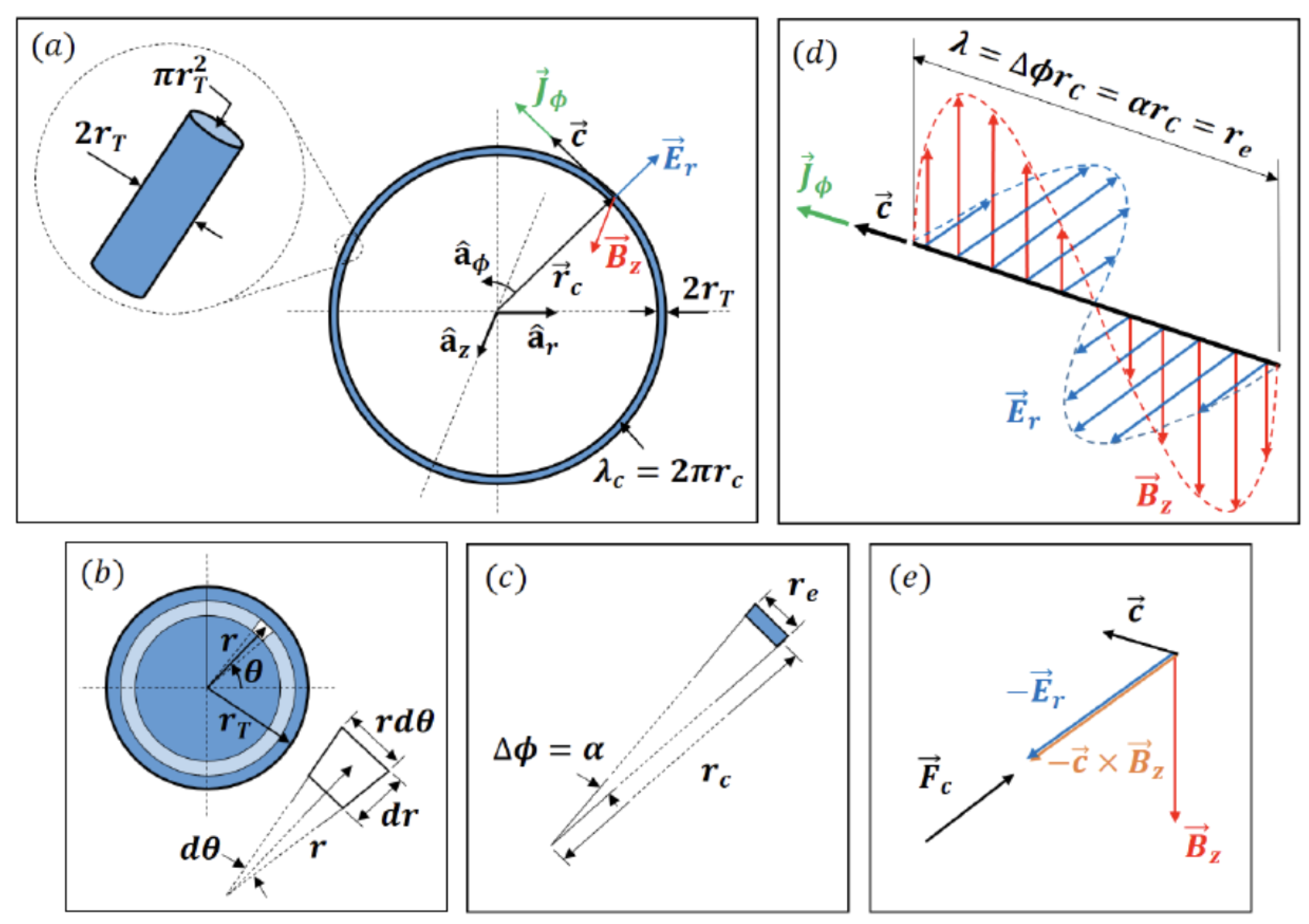
The relation between the electromagnetic wavelength , Compton wavelength, and fine structure constant. In this model, we have: . Compared to the models described in part Section 3, this model of Dos Santos has the advantage of proposing a view of the electron from fundamental fields (the electromagnetic wave) that satisfy the Maxwell equations. In his article, Dos Santos tried to derive the spin and magnetic moment from those electric and magnetic fields, and to explain the orbital motion of the electromagnetic wave with the Lorentz force. There is a reason the electro magnetic wave stabilizes in the Compton orbit: the charge computed from this field is confined to the Torus and is "flowing" in the toroidal tube. The Lorentz force computed explains the stable orbit. However, we note the following things:
- By noting p the momentum of the electromagnetic wave, the spin is , which is not the right value of course (the fine structure constant shouldn’t appear in the value of the spin);
- The frequency of the internal motion is , not in agreement with zitterbewegung frequency;
4.2. Williamson Model
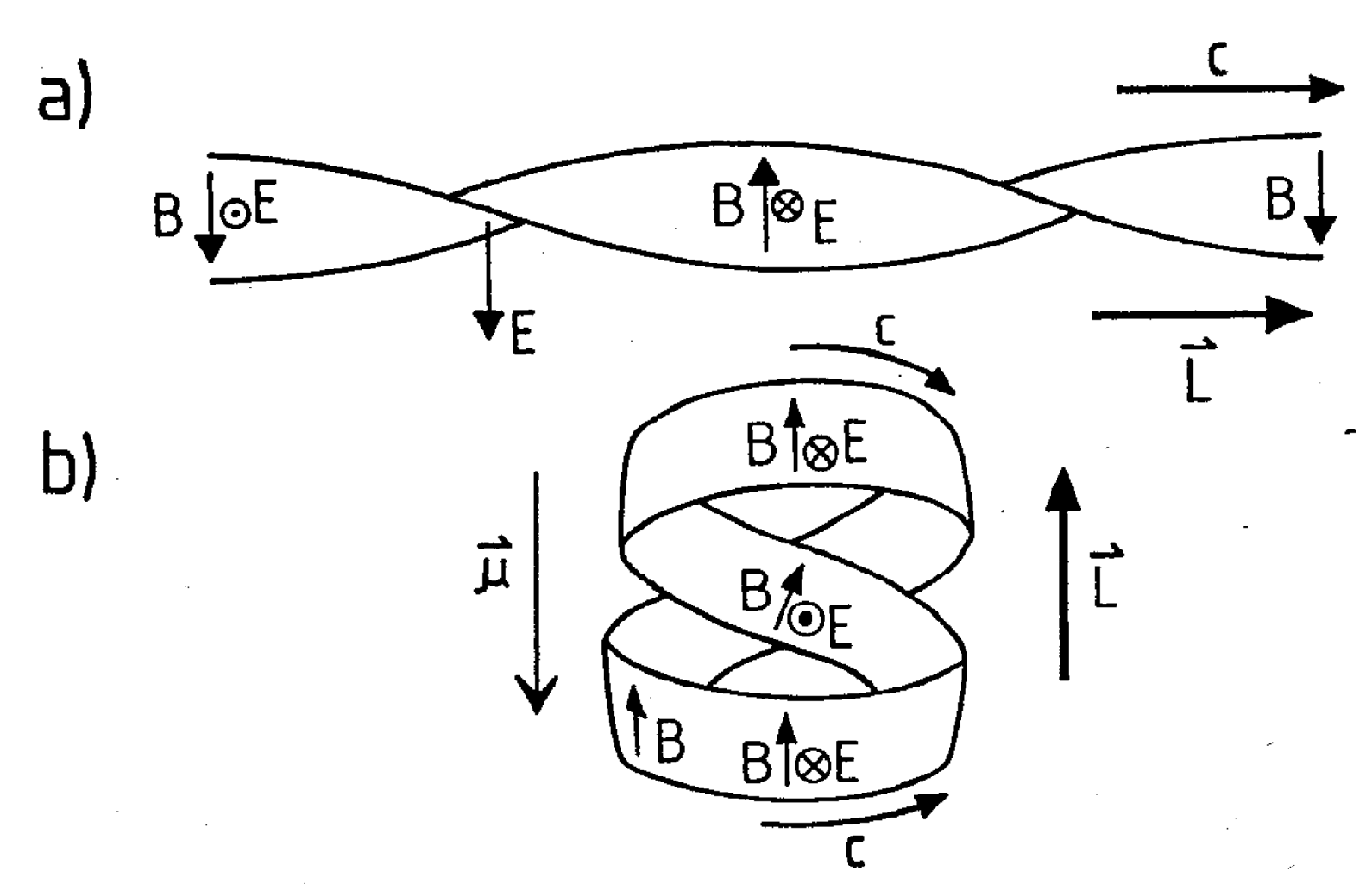
Williamson and Van der Mark [20] described the electron as a photon confined in toroidal topology (double loop). The radius of the double loop is given by , with Compton wavelength (which also corresponds to the wavelength of the internal photon).
The electric charge is directly related to the flux of electric field (), with vacuum permittivity. In the model of Williamson, the electric charge arises from the twist of the electric field of the confined photon (see Figure 7); the resultant electric field always points inwards (for the electron with negative charge) or outwards (for the positron with positive charge). The electric charge then manifests itself as a result of the reconfiguration of the electric field by the confinement topology to be everywhere radial. The internal structure of the particle is cyclic, while the distribution of the electric field is radial at large distances, which explains why the electron appears spherically symmetric experimentally.
Figure 7.
The toroidal model of Williamson. a) free photon with circular polarization of electric and magnetic fields /; b) photon confined on the double loop, making appear the charge, magnetic moment and orbital angular momentum (spin). The toroidal structure is characterised by a radius . (Credit: from [20]).
Figure 7.
The toroidal model of Williamson. a) free photon with circular polarization of electric and magnetic fields /; b) photon confined on the double loop, making appear the charge, magnetic moment and orbital angular momentum (spin). The toroidal structure is characterised by a radius . (Credit: from [20]).
Compared to the models previously seen, this model has the following advantages:
- It explains the zitter frequency: ;
- The value of the spin is obtained: ;
- It leads to the correct factor for the magnetic moment;
- The model explains the origin of the mass from the confinement of the photon on a double loop. Indeed, when a photon is confined it represents confined energy. Trapped light acquires an effective mass.
However, there are some negative points that must to be mentioned:
- The authors weren’t able to derive the exact value of the electric charge from the electromagnetic field;
- They don’t provide the precise origin of the confinement of the photon on a double loop.
4.3. What Do We Learn from the Review of the Models of Williamson and Dos Santos?
In the model of Williamson, the factor 2 that appears in Dirac theory in the spin, magnetic moment and zitterbewegung frequency comes from the fact that we have a double loop (). The spin is not an intrinsic property of the electron, it emerges as a tangible, physical phenomenon arising from the underlying electromagnetic dynamics at the Compton scale.
Moreover in both models, the charge is understood as the divergent signature of a given self-oscillating electromagnetic field. This reinterpretation of charge, as a field signature, aligns with the model of the electron as a self-interacting electromagnetic field, potentially resolving the paradoxes associated with point-like and/or extended charge distributions. The correct value of the Lorentz force in Dos Santos further justifies this "closed orbit" assumption. This perspective suggests that charge and charge density might be emergent properties of field dynamics at the Compton scale, rather than intrinsic properties.
Finally, in this model, and following the lead of D.Hestenes, we identify the electron’s rest mass with its electromagnetic field energy. This concept aligns with Einstein’s equivalence principle (, with c speed of light), positing that mass is purely a form of energy.
Those facts suggest that the fundamental properties of the electron, including spin, charge and mass, may be emergent phenomena arising from the dynamics of electromagnetic fields rather than "intrinsic" properties.
5. Dynamics of the Electron and Special Relativity
In this section, we focus on understanding of how an electron is seen when it moves at speed v relative to a reference frame (laboratory frame). The authors mentioned previously the necessity of introducing a radius of the electron r, of the order of Compton wavelength. Moreover, in their models, the loop motion becomes a helix/cycloid when the particle has a speed v relative to a given frame. Of course, such models must be in agreement with special relativity.
5.1. The Different Dynamical Models
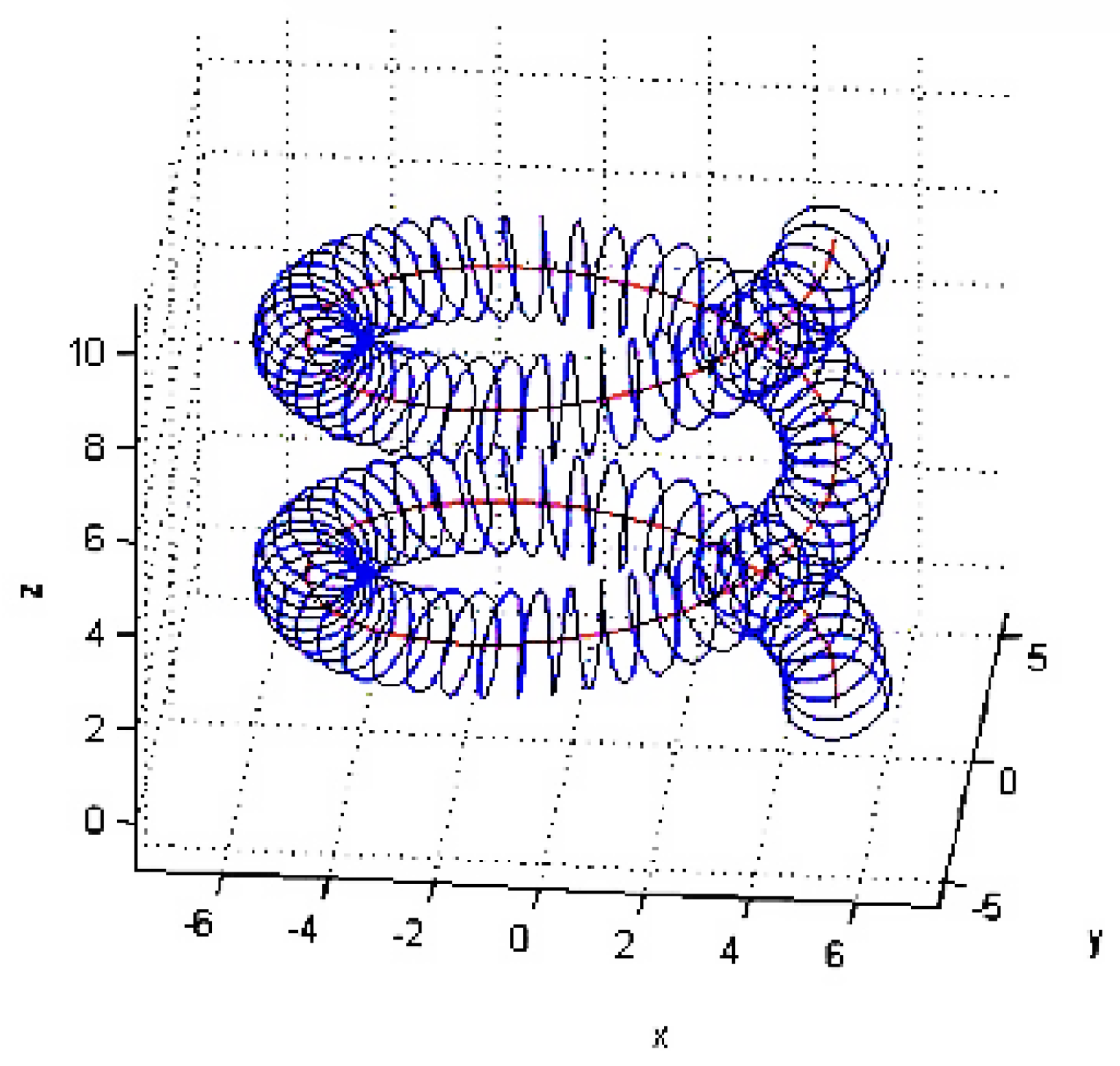
In the model of Oliver Consa, the toroidal solenoid described in part Section 3.1 becomes a helicoidal solenoid for a moving electron, as illustrated in Figure 8. In this model, the helicity is given by the helical translation motion (), which can be left-handed or right-handed. Helicity depends here on the observer, it is not Lorentz invariant. According to Consa, Chirality is given by the secondary helical rotational motion, which can also be left-handed or right-handed. Chirality is here independent of the observer, it is a Lorentz invariant quantity.
Figure 8.
Helicoidal solenoid electron moving in the z direction. (Credit: O. Consa from [9]).
Figure 8.
Helicoidal solenoid electron moving in the z direction. (Credit: O. Consa from [9]).
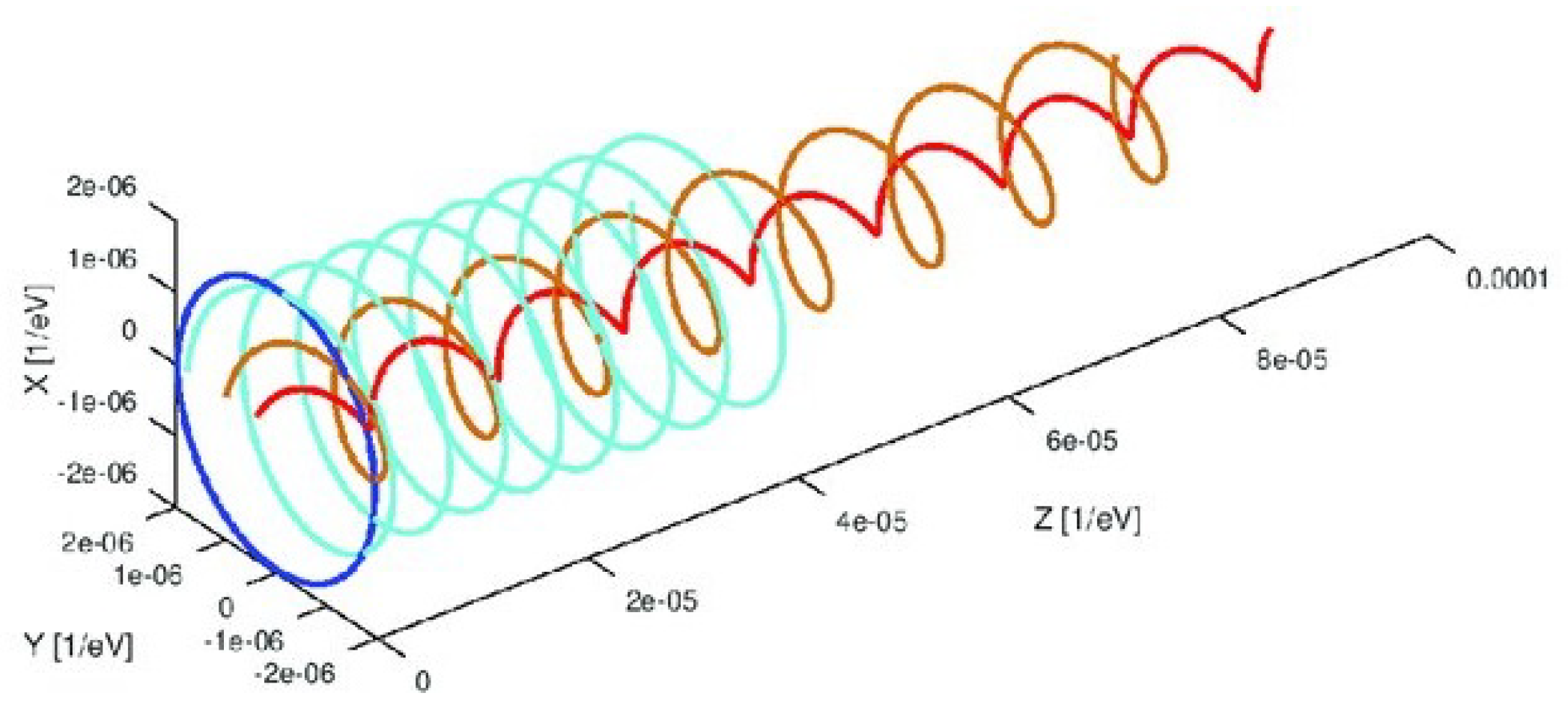
In the model of Kovacs/Vassalo, we also have an helix, where its radius depends on the speed of the particle. See Figure 9.
Figure 9.
Relativistic dynamics of this electron in the model of Kovacs/Vassalo. The radius of the Zitter-internal motion depends on the speed v of the particle (blue color: ; light blue: ; orange: ; red: ). (Credit: G. Vassalo).
Figure 9.
Relativistic dynamics of this electron in the model of Kovacs/Vassalo. The radius of the Zitter-internal motion depends on the speed v of the particle (blue color: ; light blue: ; orange: ; red: ). (Credit: G. Vassalo).
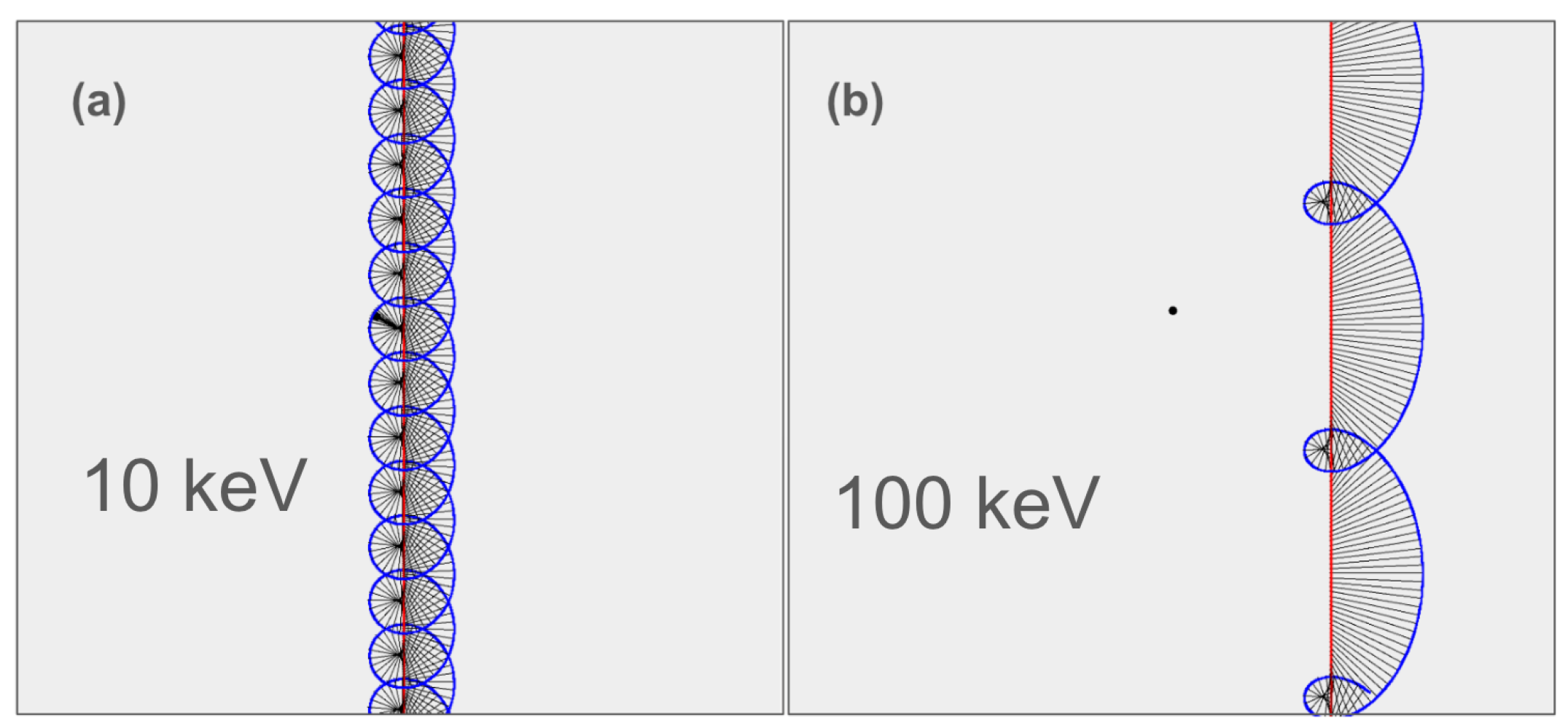
In the model of Rivas, as discussed before, a cycloid emerges when the spin is coplanar with the direction of propagation. The main point to make here is that the radius does not contract like in the case of Vassalo. The typical cycloid of the relativistic dynamics recreated in 2D is shown in Figure 10.
Figure 10.
The Cycloid of Rivas. As energy increases to relativistic speeds, here from (a) on the left to (b) on the right, a cycloid emerges. The electron mass trajectory is in red, it moves from bottom to top. The electron charge position is in blue and orbits about the center of mass. Here the spin is left, the charge moves counter-clockwise around the center of mass. As the center of mass reaches relativistic velocities the cusps appear as the charge is moving counter to the mass. In all these simulations the spin is co-planar to the orbit: the spin is in the plane of the picture. (Credit: Marc Fleury).
Figure 10.
The Cycloid of Rivas. As energy increases to relativistic speeds, here from (a) on the left to (b) on the right, a cycloid emerges. The electron mass trajectory is in red, it moves from bottom to top. The electron charge position is in blue and orbits about the center of mass. Here the spin is left, the charge moves counter-clockwise around the center of mass. As the center of mass reaches relativistic velocities the cusps appear as the charge is moving counter to the mass. In all these simulations the spin is co-planar to the orbit: the spin is in the plane of the picture. (Credit: Marc Fleury).
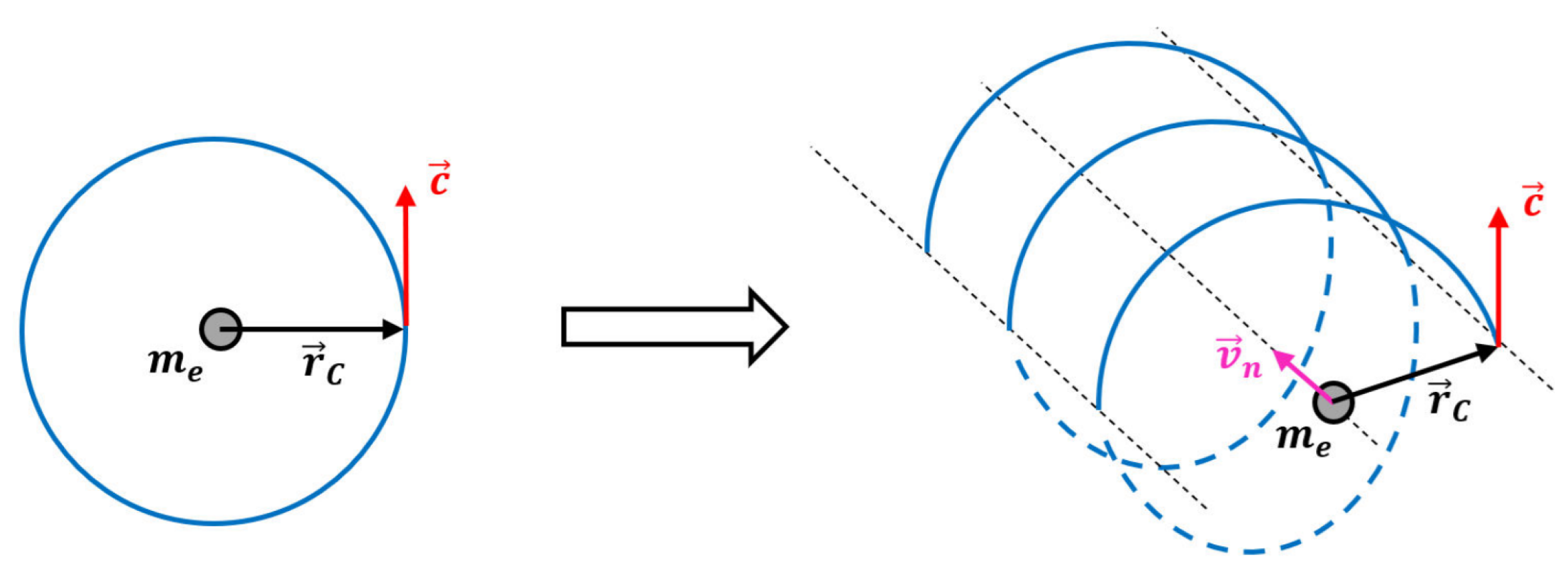
In the Dos Santos model, the internal electromagnetic wave described in Section 4.1 follows a helix path. This is the case, for example, when the electron orbits around the nucleus in the atom, from this nucleus frame (see Figure 11). In this model, the helix is characterized by different parameters: length of a coil D, radius of the helix r, helix pitch P, internal speed c, longitudinal speed v, transversal speed (with Lorentz factor). We have the following relations: and . From this relation between speeds, we have , providing an intuitive explanation of why massive particles cannot go faster than light.
Figure 11.
Left: The electron at rest. It consists of an electromagnetic wave moving a speed c along a circle of Compton radius (noted in the figure). Right: Electron in movement with longitudinal velocity relative to the proton rest frame. (Credit: C. Dos Santos from [22]).
Figure 11.
Left: The electron at rest. It consists of an electromagnetic wave moving a speed c along a circle of Compton radius (noted in the figure). Right: Electron in movement with longitudinal velocity relative to the proton rest frame. (Credit: C. Dos Santos from [22]).
5.2. De Broglie Wavelength
As mentioned we must consider wave particle duality and the emergence of the de Broglie wavelength. As should be clear by now, we have not covered it in any of the models, for the simple reason that the models do not really say anything. The reason for it seems just as straightforward: the zitter models are fundamentally particle models and by focusing exclusively on the particle image, do not provide an explanation for the emergence of distributed waves. No one treats the zitter-particle electron as a radiating antenna, but it is a radiating antenna. We will now show that when we posit physical EM standing waves surrounding this zitter electron, we can arrive quite simply at the emergence of the de Broglie wavelength.
From the laboratory frame, the matter wave manifests a wavelength of . This matter wave has group velocity v and phase velocity . A puzzling feature of the de Broglie wavelength is its dependence on the velocity of the electron (or particle) in the observing frame. How to interpret this wavelength? De Broglie first observed theoretically that a standing wave at the Compton scale would undergo Doppler shifting and exhibit a beating frequency [23]. Crucially, de Broglie demonstrated that the proper wavelength—the de Broglie wavelength—would emerge if and only if the starting wavelength was at the Compton scale.
We consider the waves that are emitted from the particle. In the rest frame, we note the frequency of those waves and their wave vector. From the laboratory frame, the particle moves at speed v in the z direction. Those waves emitted from the particle are Doppler shifted, with frequency with the angle between the wave vector of the wave and the velocity . We want to see what is the superposition of the waves and emitted in the direction of the particle propagation and the inverse direction. We have , with A amplitude, and ; and , with and [24]. The superposition of those two waves is:
The exponential term can be written as . It represents a travelling wave of frequency propagating at phase velocity . The distance in space between two consecutive wave crests is then:
which is the de Broglie wavelength.
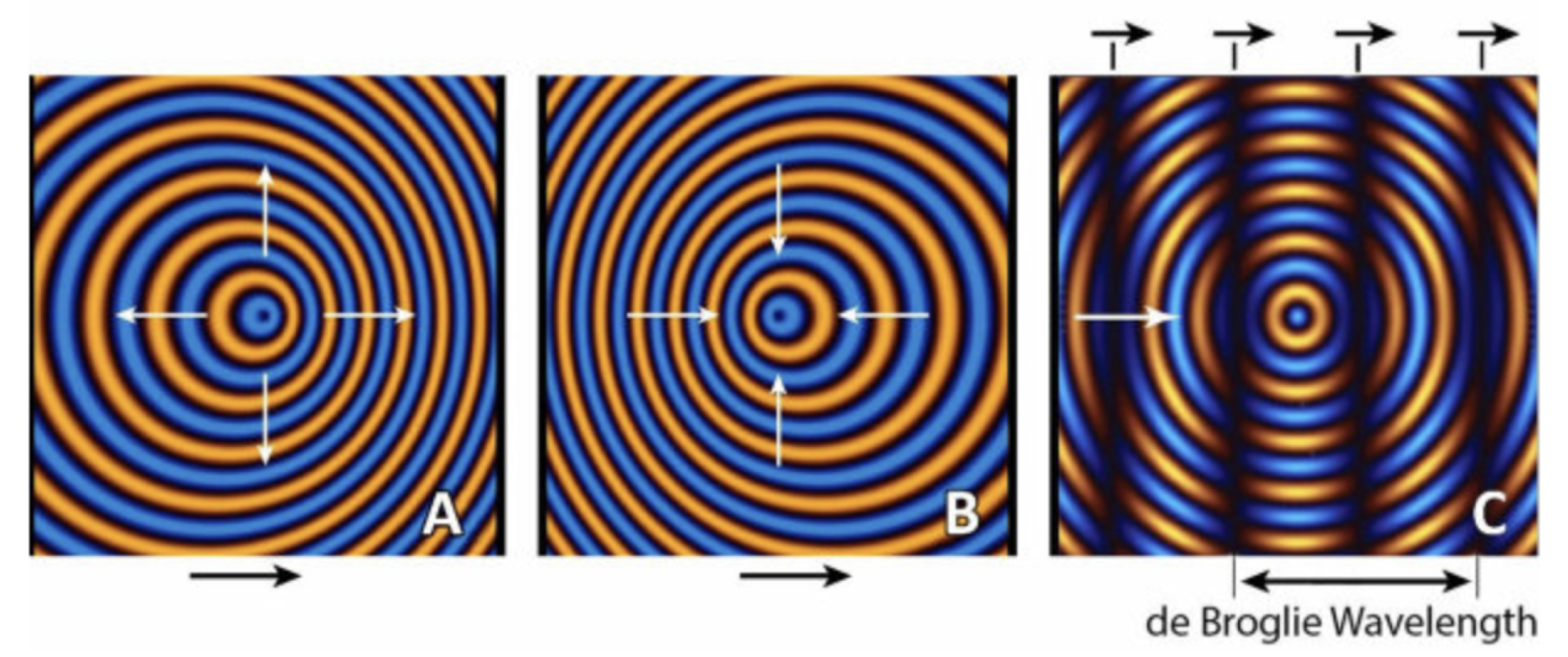
Visually, this phenomenon is readily apparent: a standing wave is the sum of inbound and outbound waves, as illustrated in Figure 12. Under relativistic Doppler shift, each component modulates differently—one dilates while the other compresses. The resulting sum exhibits a beating at the proper de Broglie wavelength. In this interpretation, the de Broglie wavelength is a natural consequence of the relativistic behavior of Compton-scale standing waves associated with electrons.
Figure 12.
A standing wave at Compton scale becomes a traveling wave under Lorentz boost (indicated by the black arrow). The superposition of the waves A and B produces the traveling wave C, which manifests a de Broglie wavelength with phase velocity . (credit: from [25])
Figure 12.
A standing wave at Compton scale becomes a traveling wave under Lorentz boost (indicated by the black arrow). The superposition of the waves A and B produces the traveling wave C, which manifests a de Broglie wavelength with phase velocity . (credit: from [25])
6. Discussion
In this article, we have reviewed Zitterbewegung models concerning the electron. Two primary categories of models emerge in the literature: those that use a physical charge (either point-like or extended) and those based solely on the electromagnetic field. The most promising models appear to be those that describe the electron as a confined electromagnetic field, arranged in a loop or double-loop structure. A field confined at the Compton scale exhibits effective mass and spin, and under specific topological conditions, can carry an electric charge. We believe that the work of Dos Santos and Williamson has laid important groundwork for future research. Such models offer a more intuitive visualization of quantum electrodynamics (QED) results and concepts. In these images, the intrinsic spin of QM can be visualized. The authors are currently developing a Zitterbewegung-inspired model in alignment with Dos Santos and Williamson, specifically focusing on a purely electromagnetic field-based approach.
We have concentrated solely on the electron, following the Einstein-Wilczek view that understanding the electron could provide a foundation for comprehending the physical world; this approach is justified by the electron’s fundamental role in our understanding of matter and its interactions. However, it is important to recognize that our model does not extend to other leptons, such as the muon or tau, nor does it address the structure of the proton. This omission is notable, given the proton’s central role in atomic structure and nuclear physics. Future research would benefit from applying zitterbewegung related models to these other particles.
Funding
The authors are funded by Marc Fleury via LENR Capital III LLC.
Conflicts of Interest
The author declares no conflict of interest.
References
- Wilczek, F. The enigmatic electron. Nature 2013, 498, 31–32. [Google Scholar] [CrossRef] [PubMed]
- Barut, A. O.; Zanghi, N. Classical Model of the Dirac Electron. Phys. Rev. Lett. 1984, 52, 2009–2012. [Google Scholar] [CrossRef]
- Hestenes, D.; Sobczyk, G.; Marsh, J. Clifford Algebra to Geometric Calculus. A Unified Language for Mathematics and Physics. American Journal of Physics 1985, 53, 510–511. [Google Scholar] [CrossRef]
- Hiley, B.; Callaghan, R. The Clifford Algebra Approach to Quantum Mechanics B: The Dirac Particle and its relation to the Bohm Approach. Unpublished 2010. [Google Scholar]
- Schrodinger, E. Uber die kraftefreie Bewegung in der relativistischen Quantenmechanik. Sitz. Preuss. Akad. Wiss. Phys. Math. Kl 1930. [Google Scholar]
- Davisson, C.; Germer, L. H. The Scattering of Electrons by a Single Crystal of Nickel. Nature 1917, 119, 558. [Google Scholar] [CrossRef]
- Compton, A.H. The Size and Shape of the Electron. Physical Review 1917, 14, 20. [Google Scholar] [CrossRef]
- Yazaki, Y. How the Klein-Nishina formula was derived: Based on the Sangokan Nishina Source Materials. Proc. Jpn. Acad. Ser. B Phys. Biol. Sci. 2017, 93, 399–421. [Google Scholar] [CrossRef] [PubMed]
- Consa, O. Helical Solenoid Model of the Electron. Progress in Physics, 2018; 14, 80–89. [Google Scholar]
- Kovacs, A.; Vassallo, G.; O’Hara, P.; Celani, F.; Di Tommaso, A. Unified Field Theory and Occam’s Razor: Simple Solutions to Deep Questions; 1st ed.; World Scientific: Singapore, 2022. [Google Scholar]
- Celani, F.; Vassallo, G.; Di Tommaso, A.O. The Electron and Occam’s Razor. J. Condensed Matter Nucl. Sci. 2017, 25, 76–99. [Google Scholar] [CrossRef]
- Vautrin, C. et al. Low-Energy Spin Precession in the Molecular Field of a Magnetic Thin Film. Annalen der Physik 2020, 533. [Google Scholar]
- Jedema, F.J. et al. Electrical detection of spin precession in a metallic mesoscopic spin valve. Nature 2002, 416, 713–716. [Google Scholar] [CrossRef] [PubMed]
- Rivas, M. Kinematical Theory of Spinning Particles: The Interaction Lagrangian for Two Spin 1/2 Dirac Particles; arXiv: physics/0608089, 2006. [Google Scholar]
- Gay, T.J.; Dunning, F.B. Mott Electron Polarimetry. Rev. Sci. Instrum. 1992, 63, February 1992. Copyright 1992 American Institute of Physics.. 1992, 63. [Google Scholar] [CrossRef]
- Marleau, L. Introduction à la physique des particules. Course Université de Laval, Québec, Canada, 2018. [Google Scholar]
- The NIST Reference on Constants, Units, and Uncertainty. https://physics.nist.gov/cgi-bin/cuu/Value?gem.
- Consa, O. Something is wrong in the state of QED. arXiv, 2021; eprint: 2110.02078. [Google Scholar]
- dos Santos, C.A.M. The Structure of the Electron Revealed by the Schwinger Limits. Preprint, 2023. [Google Scholar]
- Williamson, J.G.; Van der Mark, M.B. Is the electron a photon with toroidal topology? Annales de la Fondation Louis de Broglie 1997, 22. [Google Scholar]
- Conference presentation at the "AGACSE2024: Applied Geometric Algebras in Computer Science and Engineering 2024" conference. 2024.
- dos Santos, C.A.M.; da Luz, M. Bohr postulates derived from the toroidal electron model. Revista Mexicana de Fısica 2024, 70, 1–4. [Google Scholar]
- de Broglie, L. Ondes et Mouvements; Gauthier-Villars: Paris, France, 1926. [Google Scholar]
- Shanahan, D. A Case for Lorentzian Relativity. Foundations of Physics 2014, 44, 349–367. [Google Scholar] [CrossRef]
- Macken, J.A. Oscillating Spacetime: The Foundation of the Universe. Journal of Modern Physics 2024, 15, 1097–1143. [Google Scholar] [CrossRef]
Disclaimer/Publisher’s Note: The statements, opinions and data contained in all publications are solely those of the individual author(s) and contributor(s) and not of MDPI and/or the editor(s). MDPI and/or the editor(s) disclaim responsibility for any injury to people or property resulting from any ideas, methods, instructions or products referred to in the content. |
© 2025 by the authors. Licensee MDPI, Basel, Switzerland. This article is an open access article distributed under the terms and conditions of the Creative Commons Attribution (CC BY) license (https://creativecommons.org/licenses/by/4.0/).
Copyright: This open access article is published under a Creative Commons CC BY 4.0 license, which permit the free download, distribution, and reuse, provided that the author and preprint are cited in any reuse.