

Submitted:
10 February 2025
Posted:
11 February 2025
You are already at the latest version
Abstract
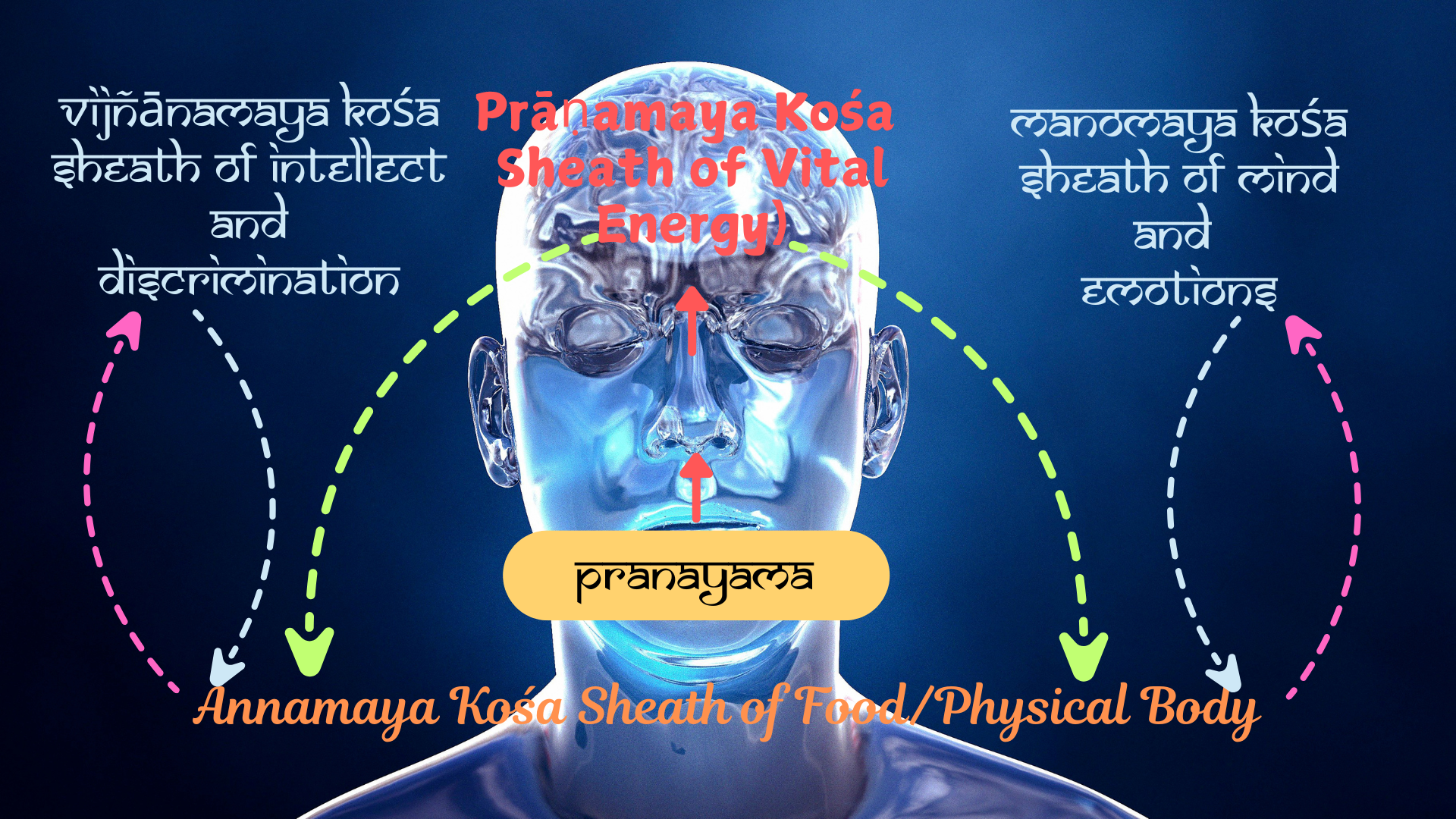
This paper explores the connection between Bhrigu Valli of the Taittiriya Upanishad and Patañjali’s Yoga Sūtras, with a particular focus on Prāṇāyāma as a harmonizing agent between the sheaths (Kośas) described in Bhrigu Valli. The Yoga Sūtras define yoga as the cessation of mental modifications (citta-vṛtti-nirodhaḥ), while Bhrigu Valli outlines a progressive inquiry into reality through five layers of existence, ultimately concluding in ānanda (bliss) as the essence of Brahman. The paper examines Citta within the framework of Patañjali’s Yoga Sūtras and reinterprets its components through an information-processing analogy. By integrating insights from both texts, this study highlights how Prāṇāyāma serves as a critical bridge between the Prāṇamaya Kośa (Sheath of Vital Energy), Anamaya Kośa (physical body) and the more subtle cognitive and intellectual layers (Manomaya and Vijñānamaya Kośas). The cyclic reinforcement of physiological and mental stability through Prāṇāyāma is discussed, along with its documented therapeutic effects on cognition and bodily functions. This paper ultimately positions Prāṇāyāma as a key mechanism for aligning the physical and mental dimensions of human existence, contributing to both yogic and Vedāntic goals of self-realization.
Keywords:
1. Introduction 2
2. Main Concepts 2
2.1. Bhrigu Valli1 2
2.1.1. Four Sheaths 2
2.2. Patanjali’s Yoga Sutras 2
2.2.1. What Is Yoga? 2
3. Pranayama’s Role 3
4. Conclusion 4
1. Introduction
- Samadhi Pada – Focuses on practice and non-attachment
- Sadhana Pada – Prescribes eight practices
- Vibhuti Pada – Unleashing the Power of Consciousness
- Kaivalya Pada – Complete disentanglement of consciousness from the mind and matter, resulting in total freedom
2. Main Concepts
2.1. Bhrigu Valli1
2.1.1. Four Sheaths
2.2. Patanjali’s Yoga Sutras
2.2.1. What Is Yoga?
3. Pranayama’s Role
| Bhrigu Valli | Yoga Sutras - Mind Stuff |
| Annamaya Kośa (Sheath of Food/Physical Body): This is the outermost layer, representing the material body sustained by food. | The organs of sense and action |
| Prāṇamaya Kośa (Sheath of Vital Energy): This layer consists of Prāṇa (life force), responsible for physiological functions like breath, circulation, and digestion. | Yoga Sutras prescribe the practice of Pranayama. Pranayama regulates the Prāṇamaya Kośa’s ensuring efficient physiological functions of the Annamaya Kośa. The efficient functioning of human physiology is inextricably entwined with the functions of mind and intellect - Mens sana in corpore sano. By Regulating the Prāṇamaya Kośa by consistent practice of Pranayama, results in a perfect balance between the three other sheaths. |
| Manomaya Kośa (Sheath of Mind and Emotions): This sheath governs thoughts, emotions, and sensory perception, shaping one’s identity and experiences. It is restless and influenced by external stimuli. | The Controller |
| Vijñānamaya Kośa (Sheath of Intellect and Discrimination): This is the layer of higher knowledge, discernment, and self-awareness, allowing for rational understanding. | The Processor |
4. Conclusion
| 1 | Ankur Sharma, Philosophical Notes on The Dark Yajur Veda:The Findings of Sage Bhrigu (2015). |
| 2 | K Upadhyay and Dhungel, "‘Chitta’, “The Mind-stuff” as a Cognitive Apparatus: Model of mind and process of cognition as in Yogasutra of Patanjali," Nepal Journals Online 2, No 1 (2014), https://doi.org/ https://doi.org/10.3126/jmcjms.v2i1.11390. |
| 3 | Ranil Jayawardena et al., "Exploring the Therapeutic Benefits of Pranayama (Yogic Breathing): A Systematic Review," International Journal of Yoga 13, no. 2 (2020), https://journals.lww.com/ijoy/fulltext/2020/13020/exploring_the_therapeutic_benefits_of_pranayama.3.aspx. |
| 4 | Samiran Mondal, "Proposed physiological mechanisms of pranayama: A discussion," Journal of Ayurveda and Integrative Medicine 15, no. 1 (2024/01/01/ 2024), https://doi.org/https://doi.org/10.1016/j.jaim.2023.100877, https://www.sciencedirect.com/science/article/pii/S0975947623001948. |
| 5 | P. Sengupta, "Health Impacts of Yoga and Pranayama: A State-of-the-Art Review," Int J Prev Med 3, no. 7 (Jul 2012). |
References
- Jayawardena, Ranil, Priyanga Ranasinghe, Himansa Ranawaka, Nishadi Gamage, Dilshani Dissanayake, and Anoop Misra. "Exploring the Therapeutic Benefits of Pranayama (Yogic Breathing): A Systematic Review." International Journal of Yoga 13, no. 2 (2020). https://journals.lww.com/ijoy/fulltext/2020/13020/exploring_the_therapeutic_benefits_of_pranayama.3.aspx.
- Mondal, Samiran. "Proposed Physiological Mechanisms of Pranayama: A Discussion." Journal of Ayurveda and Integrative Medicine 15, no. 1 (2024/01/01/ 2024): 100877. https://doi.org/https://doi.org/10.1016/j.jaim.2023.100877. https://www.sciencedirect.com/science/article/pii/S0975947623001948.
- Sengupta, P. "Health Impacts of Yoga and Pranayama: A State-of-the-Art Review." [In eng]. Int J Prev Med 2012, 3, 444–458. [Google Scholar] [PubMed]
- Sharma, Ankur. Philosophical Notes on the Dark Yajur Veda:The Findings of Sage Bhrigu. 2015. [CrossRef]
- Upadhyay, K, and Dhungel. "‘Chitta’, “the Mind-Stuff” as a Cognitive Apparatus: Model of Mind and Process of Cognition as in Yogasutra of Patanjali." Nepal Journals Online 2, No 1 (2014).
- https://doi.org/10.3126/jmcjms.v2i1.11390.
Disclaimer/Publisher’s Note: The statements, opinions and data contained in all publications are solely those of the individual author(s) and contributor(s) and not of MDPI and/or the editor(s). MDPI and/or the editor(s) disclaim responsibility for any injury to people or property resulting from any ideas, methods, instructions or products referred to in the content. |
© 2025 by the authors. Licensee MDPI, Basel, Switzerland. This article is an open access article distributed under the terms and conditions of the Creative Commons Attribution (CC BY) license (http://creativecommons.org/licenses/by/4.0/).


