

Submitted:
10 February 2025
Posted:
11 February 2025
You are already at the latest version
Abstract
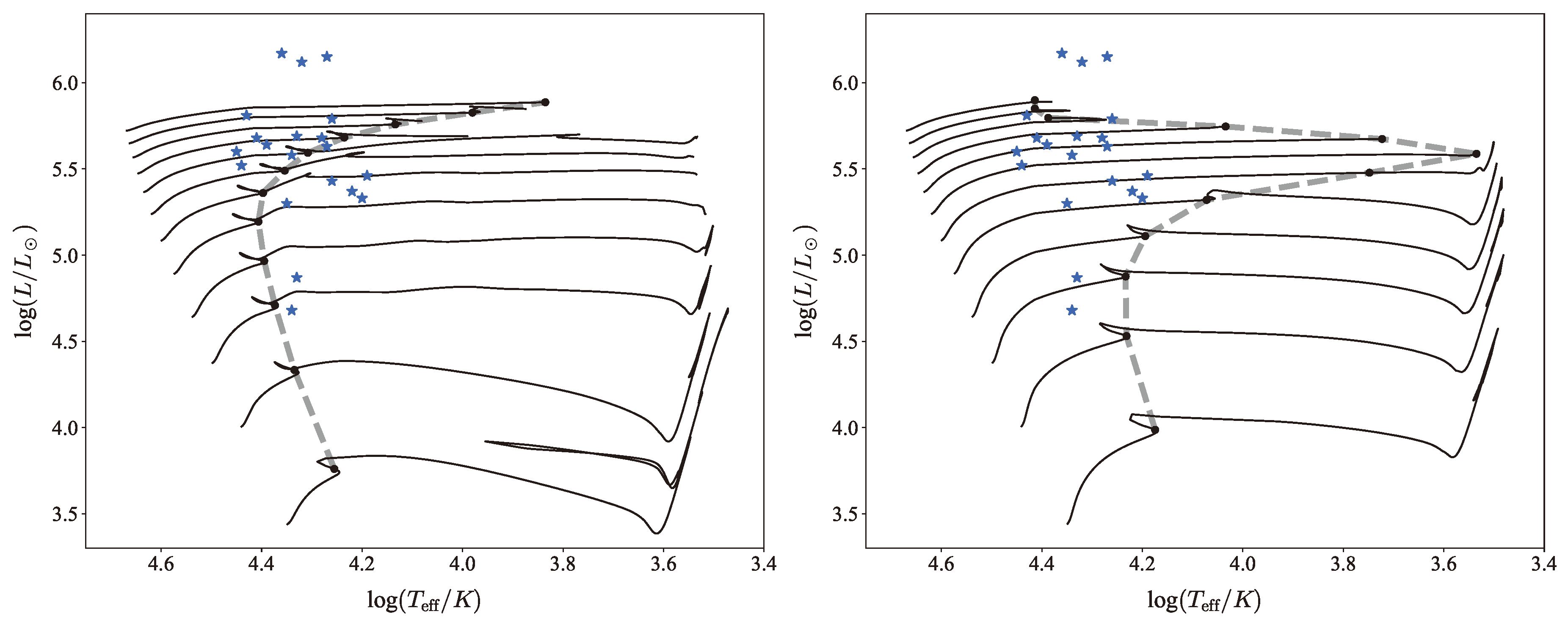
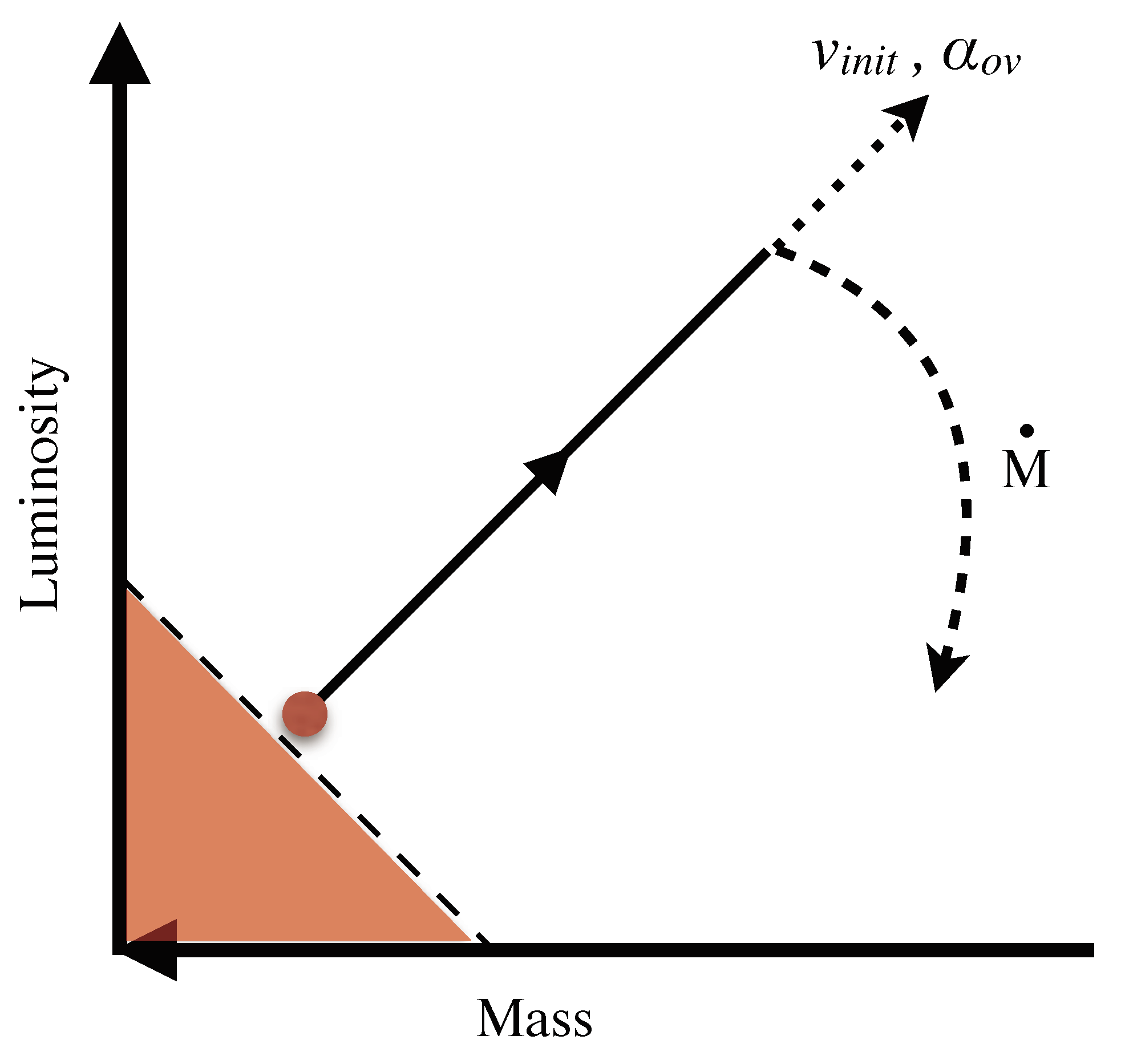
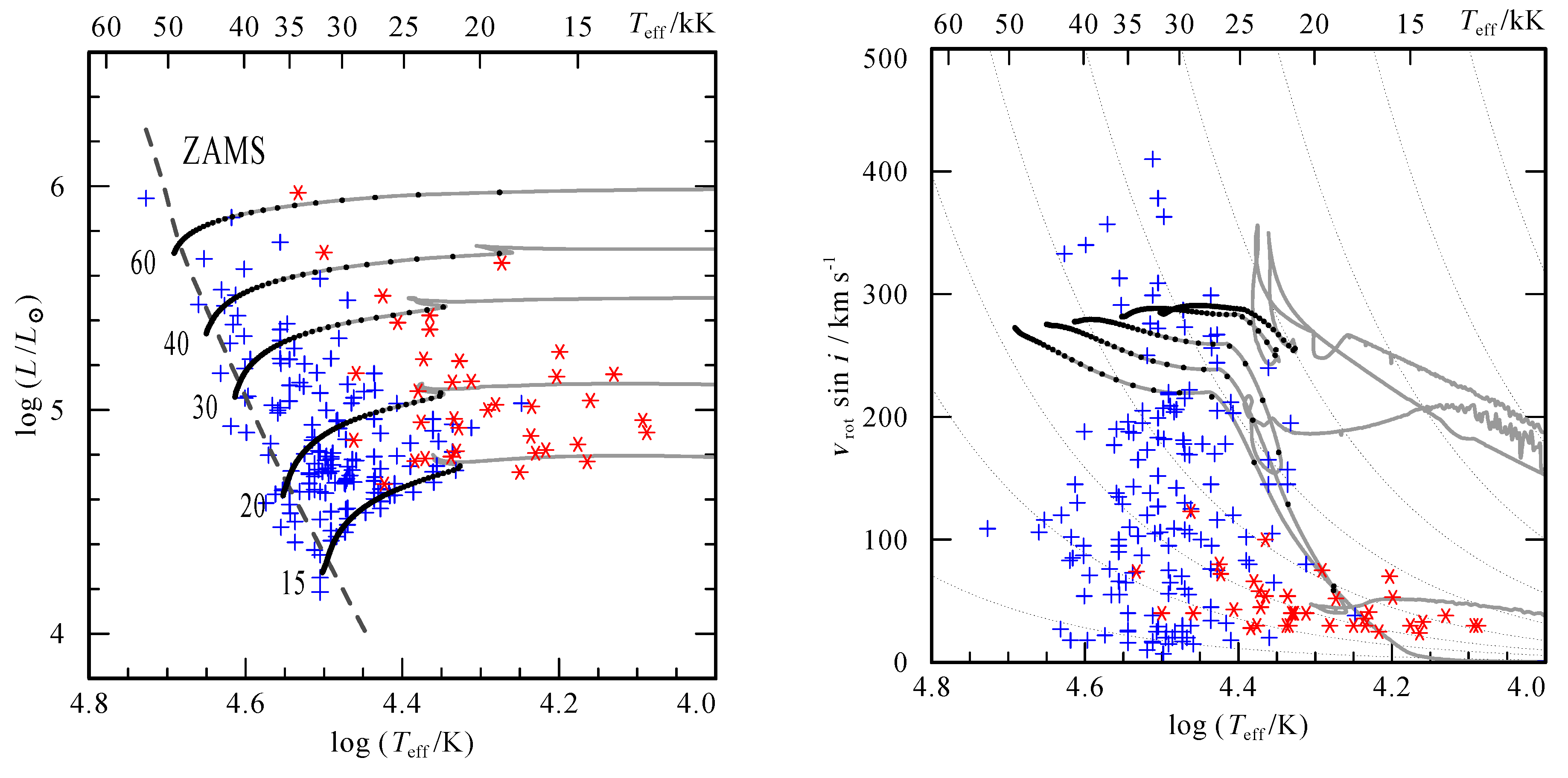
Using Gaia DR3 we derive new distances and luminosities for a sample of Galactic B supergiants which were thought to be post main-sequence (MS) objects from their HR diagram location beyond the terminal-age MS (TAMS). When applying the newer Gaia distances in addition to enhanced amounts of core-boundary mixing, aka convective overshooting, we show that these Galactic B supergiants are likely enclosed within the MS band, indicating an evolutionary stage of steady core hydrogen burning. We discuss the importance of considering enhanced overshooting and how vectors in the mass-luminosity plane (ML-plane) can be used to disentangle the effects of wind mass loss from interior mixing. We finish with the key message that any proposed solution to the BSG problem should consider not only an explanation for the sheer number of B supergiants inside the Hertzsprung gap, but should at the same time also account for the steep drop in rotation rates identified at spectral type B1 -- corresponding to an effective temperature of \(\sim\)21 kK, and for which two distinct families of solutions have been proposed.
Keywords:
1. Introduction on the Blue Supergiant Problem
2. The Related Problem of the Main-Sequence Width
3. Data & Method
4. Mass-Luminosity Plane: Disentangling Mixing and Mass Loss
5. The Importance of Homogeneous Samples and More Diagnostics
6. Final Words
Acknowledgments
Abbreviations
| B[e] | The B[e] phenomenon refers to forbidden emission lines. |
| BSG | Blue supergiant (not to be confused with B supergiant that refers to spectral type) |
| RSG | Red supergiant |
| LBV | Luminous blue variable |
| CBM | Core-boundary mixing |
| ML-plane | Mass-luminosity plane |
| MS | Main sequence |
References
- Smartt, S.J. 2015. Observational Constraints on the Progenitors of Core-Collapse Supernovae: The Case for Missing High-Mass Stars. Publ. Astron. Soc. Aust. 32: e016. [Google Scholar] [CrossRef]
- Kochanek, C.S. 2020. On the red supergiant problem. Mon. Not. R. Astron. Soc. 493: 4945–4949. [Google Scholar] [CrossRef]
- Davies, B., and E.R. Beasor. 2020. The `red supergiant problem’: the upper luminosity boundary of Type II supernova progenitors. Mon. Not. R. Astron. Soc. 493: 468–476. [Google Scholar] [CrossRef]
- Vink, J.S., and G.N. Sabhahit. Exploring the Red Supergiant wind kink. A Universal mass-loss concept for massive stars. Astron. Astrophys. 2023, 678, L3. arXiv arXiv:astro. [CrossRef]
- Hoyle, F. 1960. On the main-sequence band and the Hertzsprung gap. Mon. Not. R. Astron. Soc. 120: 22. [Google Scholar] [CrossRef]
- Kraft, R.P. 1966. Stellar Rotation and Stellar Evolution among Cepheids and Other Luminous Stars in the Hertzsprung Gap. Astrophys. J. 144: 1008. [Google Scholar] [CrossRef]
- Fitzpatrick, E.L., and C.D. Garmany. 1990. The H-R Diagram of the Large Magellanic Cloud and Implications for Stellar Evolution. Astrophys. J. 363: 119. [Google Scholar] [CrossRef]
- Castro, N., P.A. Crowther, C.J. Evans, J.S. Vink, J. Puls, A. Herrero, M. Garcia, F.J. Selman, M.M. Roth, and S. Simón-Díaz. Mapping the core of the Tarantula Nebula with VLT-MUSE. II. The spectroscopic Hertzsprung-Russell diagram of OB stars in NGC 2070. Astron. Astrophys. 2021, 648, A65. arXiv arXiv:astro. [CrossRef]
- Zickgraf, F.J., B. Wolf, O. Stahl, C. Leitherer, and I. Appenzeller. 1986. B(e)-supergiants of the Magellanic Clouds. Astron. Astrophys. 163: 119–134. [Google Scholar]
- Grassitelli, L.; Langer, N.; Mackey, J.; Gräfener, G.; Grin,N.J.; Sander, A.A.C.; Vink,J.S. Wind-envelope interaction as the origin of the slow cyclic brightness variations of luminous blue variables. Astron. Astrophys. 2021, 647, A99. arXiv arXiv:astro-ph.SR/2012.00023. [CrossRef]
- Groh, J.H., D.J. Hillier, and A. Damineli. 2006. AG Carinae: A Luminous Blue Variable with a High Rotational Velocity. Astrophys. J. Lett. 638: L33–L36. [Google Scholar] [CrossRef]
- Podsiadlowski, P., and T.S. Morris I. Massive Binary Mergers: A Unique Scenario for the sgB[e] Phenomenon? In Proceedings of the Stars with the B[e] Phenomenon; Kraus, M.; Miroshnichenko, A.S., Eds., 2006, Vol. 355, Astronomical Society of the Pacific Conference Series, p. 259.
- Pasquali, A., A. Nota, N. Langer, R.E. Schulte-Ladbeck, and M. Clampin. 2000. R4 and Its Circumstellar Nebula: Evidence for a Binary Merger? Astron. J. 119: 1352–1358. [Google Scholar] [CrossRef]
- Vanbeveren, D., N. Mennekens, W. Van Rensbergen, and C. De Loore. Blue supergiant progenitor models of type II supernovae. Astron. Astrophys. 2013, 552, A105, [arXiv:astro-ph.SR/1212.4285]. [CrossRef]
- Justham, S., P. Podsiadlowski, and J.S. Vink. Luminous Blue Variables and Superluminous Supernovae from Binary Mergers. Astrophys. J. 2014, 796, 121, [arXiv:astro-ph.SR/1410.2426]. [CrossRef]
- Menon, A., A. Ercolino, M.A. Urbaneja, D.J. Lennon, A. Herrero, R. Hirai, N. Langer, A. Schootemeijer, E. Chatzopoulos, J. Frank, and et al. 2024. Evidence for Evolved Stellar Binary Mergers in Observed B-type Blue Supergiants. Astrophys. J. Lett. 963: L42. [Google Scholar] [CrossRef]
- Henneco, J., F.R.N. Schneider, S. Hekker, and C. Aerts. Merger seismology: Distinguishing massive merger products from genuine single stars using asteroseismology. Astron. Astrophys. 2024, 690, A65, [arXiv:astro-ph.SR/2406.14416]. [CrossRef]
- Schneider, F.R.N., P. Podsiadlowski, N. Langer, N. Castro, and L. Fossati. 2016. Rejuvenation of stellar mergers and the origin of magnetic fields in massive stars. Mon. Not. R. Astron. Soc. 457: 2355–2365. [Google Scholar] [CrossRef]
- Martinet, S.; Meynet, G.; Ekström, S.; Simón-Díaz, S.; Holgado, G.; Castro, N.; Georgy, C.; Eggenberger, P.; Buldgen, G.; Salmon, S.; et al. Convective core sizes in rotating massive stars. I. Constraints from solar metallicity OB field stars. Astron. Astrophys. 2021, 648, A126, [arXiv:astro-ph.SR/2103.03672]. [CrossRef]
- Crowther, P.A., D.J. Lennon, and N.R. Walborn. 2006. Physical parameters and wind properties of galactic early B supergiants. Astron. Astrophys. 446: 279–293. [Google Scholar] [CrossRef]
- Anders, E.H., and M.G. Pedersen. 2023. Convective Boundary Mixing in Main-Sequence Stars: Theory and Empirical Constraints. Galaxies 2023, 11, 56, [arXiv:astro-ph.SR/2303.12099]. [Google Scholar] [CrossRef]
- Martins, F., and A. Palacios. A comparison of evolutionary tracks for single Galactic massive stars. Astron. Astrophys. 2013, 560, A16, [arXiv:astro-ph.SR/1310.7218]. [CrossRef]
- Ekström, S.; Georgy, C.; Eggenberger, P.; Meynet, G.; Mowlavi, N.; Wyttenbach, A.; Granada, A.; Decressin, T.; Hirschi, R.; Frischknecht, U.; et al. Grids of stellar models with rotation. I. Models from 0.8 to 120 M at solar metallicity (Z = 0.014). Astron. Astrophys. 2012, 537, A146, [arXiv:astro-ph.SR/1110.5049].
- Brott, I., S.E. de Mink, M. Cantiello, N. Langer, A. de Koter, C.J. Evans, I. Hunter, C. Trundle, and J.S. Vink. 2011. Rotating massive main-sequence stars. I. Grids of evolutionary models and isochrones. Astron. Astrophys. 530: A115. [Google Scholar] [CrossRef]
- Higgins, E.R., and J.S. Vink. Massive star evolution: rotation, winds, and overshooting vectors in the mass-luminosity plane. I. A calibrated grid of rotating single star models. Astron. Astrophys. 2019, 622, A50, [arXiv:astro-ph.SR/1811.12190]. [CrossRef]
- Vink, J.S.; Brott, I.; Gräfener, G.; Langer, N.; deKoter, A.; Lennon, D.J. The nature of B supergiants: clues from a steep drop in rotation rates at 22 000 K. The possibility of Bi-stability braking. Astron. Astrophys. 2010, 512, L7, [arXiv:astro-ph.SR/1003.1280]. 2010. [CrossRef]
- Evans, C., I. Hunter, S. Smartt, D. Lennon, A. de Koter, R. Mokiem, C. Trundle, P. Dufton, R. Ryans, J. Puls, and et al. 2008. The VLT-FLAMES Survey of Massive Stars. The Messenger 131: 25–29. [Google Scholar]
- Howarth, I.D., K.W. Siebert, G.A.J. Hussain, and R.K. Prinja. 1997. Cross-correlation characteristics of OB stars from IUE spectroscopy. Mon. Not. R. Astron. Soc. 284: 265–285. [Google Scholar] [CrossRef]
- de Burgos, A.; Simón-Díaz, S.; Urbaneja, M.A.; Puls, J. The IACOB project. X. Large-scale quantitative spectroscopic analysis of Galactic luminous blue stars. Astron. Astrophys. 2024, 687, A228, [arXiv:astro-ph.SR/2312.00241]. [CrossRef]
- Verhamme, O., J. Sundqvist, A. de Koter, H. Sana, F. Backs, S.A. Brands, F. Najarro, J. Puls, J.S. Vink, P.A. Crowther, and et al. Verhamme, O.; Sundqvist, J.; de Koter, A.; Sana, H.; Backs, F.; Brands, S.A.; Najarro, F.; Puls, J.; Vink, J.S.; Crowther, P.A.; et al. X-Shooting ULLYSES: Massive Stars at low metallicity: IX. Empirical constraints on mass-loss rates and clumping parameters for OB supergiants in the Large Magellanic Cloud. Astron. Astrophys. 2024, 692, A91, [arXiv:astro-ph.SR/2410.14937]. [CrossRef]
- Bernini-Peron, M., A.A.C. Sander, V. Ramachandran, L.M. Oskinova, J.S. Vink, O. Verhamme, F. Najarro, J. Josiek, S.A. Brands, P.A. Crowther, and et al. Bernini-Peron, M.; Sander, A.A.C.; Ramachandran, V.; Oskinova, L.M.; Vink, J.S.; Verhamme, O.; Najarro, F.; Josiek, J.; Brands, S.A.; Crowther, P.A.; et al. X-Shooting ULLYSES: Massive stars at low metallicity: VII. Stellar and wind properties of B supergiants in the Small Magellanic Cloud. Astron. Astrophys. 2024, 692, A89, [arXiv:astro-ph.SR/2407.14216]. [CrossRef]
- Heger, A., N. Langer, and S.E. Woosley. 2000. Presupernova Evolution of Rotating Massive Stars. I. Numerical Method and Evolution of the Internal Stellar Structure. Astrophys. J. 528: 368–396. [Google Scholar] [CrossRef]
- Maeder, A. 2000. Chemical enrichments by massive stars and the effects of rotation. New Astron. Rev. 44: 291–296. [Google Scholar] [CrossRef]
- Gaia Collaboration, A.G.A. Brown, A. Vallenari, T. Prusti, J.H.J. de Bruijne, C. Babusiaux, and M.e.a. Biermann. 2021. Gaia Early Data Release 3. Summary of the contents and survey properties. Astron. Astrophys. 649: A1. [Google Scholar]
- Bailer-Jones, C.A.L., J. Rybizki, M. Fouesneau, M. Demleitner, and R. Andrae. 2021. Estimating Distances from Parallaxes. V. Geometric and Photogeometric Distances to 1.47 Billion Stars in Gaia Early Data Release 3. Astron. J. 161: 147. [Google Scholar] [CrossRef]
- Oudmaijer, R.D., E.R.M. Jones, and M. Vioque. 2022. A census of post-AGB stars in Gaia DR3: evidence for a substantial population of Galactic post-RGB stars. Mon. Not. R. Astron. Soc. 516: L61–L65. [Google Scholar] [CrossRef]
- Paxton, B., L. Bildsten, A. Dotter, F. Herwig, P. Lesaffre, and F. Timmes. Modules for Experiments in Stellar Astrophysics (MESA). Astrophys. J. Suppl. Ser. 2011, 192, 3.
- Weßmayer, D.; Przybilla, N.; Butler, K. Quantitative spectroscopy of B-type supergiants. Astron. Astrophys. 2022, 668, A92, [arXiv:astro-ph.SR/2208.02692]. [CrossRef]
- McEvoy, C., P. Dufton, C. Evans, V. Kalari, N. Markova, S. Simón-Díaz, J. Vink, N. Walborn, P. Crowther, A. de Koter, and et al. 2015. The VLT-FLAMES Tarantula Survey-XIX. B-type supergiants: Atmospheric parameters and nitrogen abundances to investigate the role of binarity and the width of the main sequence. Astronomy & Astrophysics 575: A70. [Google Scholar]
- Bowman, D.M.; Burssens, S.; Simón-Díaz, S.; Edelmann, P.V.F.; Rogers, T.M.; Horst, L.; Röpke, F.K.; Aerts, C. Photometric detection of internal gravity waves in upper main-sequence stars. II. Combined TESS photometry and high-resolution spectroscopy. Astron. Astrophys. 2020, 640, A36, [arXiv:astro-ph.SR/2006.03012]. [CrossRef]
- Mahy, L., Y. Damerdji, E. Gosset, C. Nitschelm, P. Eenens, H. Sana, and A. Klotz. A modern study of HD 166734: a massive supergiant system. Astron. Astrophys. 2017, 607, A96, [arXiv:astro-ph.SR/1707.02060]. [CrossRef]
- Tkachenko, A., K. Pavlovski, C. Johnston, M.G. Pedersen, M. Michielsen, D.M. Bowman, J. Southworth, V. Tsymbal, and C. Aerts. The mass discrepancy in intermediate- and high-mass eclipsing binaries: The need for higher convective core masses. [CrossRef]
- Higgins, E.R., and J.S. Vink. 2023. Stellar age determination in the mass-luminosity plane. Mon. Not. R. Astron. Soc. 518: 1158–1169. [Google Scholar] [CrossRef]
- Vink, J.S., G.N. Sabhahit, and E.R. Higgins. The maximum black hole mass at solar metallicity. Astron. Astrophys. 2024, 688, L10, [arXiv:astro-ph.SR/2407.07204]. [CrossRef]
- Castro, N.; Fossati, L.; Langer, N.; Simón-Díaz, S.; Schneider, F.R.N.; Izzard, R.G. The spectroscopic Hertzsprung-Russell diagram of Galactic massive stars. Astron. Astrophys. 2014, 570, L13, [arXiv:astro-ph.SR/1410.3499]. [CrossRef]
- Scott, L.J.A., R. Hirschi, C. Georgy, W.D. Arnett, C. Meakin, E.A. Kaiser, S. Ekström, and N. Yusof. 2021. Convective core entrainment in 1D main-sequence stellar models. Mon. Not. R. Astron. Soc. 503: 4208–4220. [Google Scholar] [CrossRef]
- Ishii, M., M. Ueno, and M. Kato. 1999. Core-Halo Structure of a Chemically Homogeneous Massive Star and Bending of the Zero-Age Main Sequence. Publ. Astron. Soc. Jpn. 51: 417–424. [Google Scholar] [CrossRef]
- Petrovic, J., O. Pols, and N. Langer. 2006. Are luminous and metal-rich Wolf-Rayet stars inflated? Astron. Astrophys 450: 219–225. [Google Scholar] [CrossRef]
- Gräfener, G., S.P. Owocki, and J.S. Vink. 2012. Stellar envelope inflation near the Eddington limit. Implications for the radii of Wolf-Rayet stars and luminous blue variables. Astron. Astrophys. 538: A40. [Google Scholar] [CrossRef]
- Sabhahit, G.N., and J.S. Vink. llar expansion or inflation? Astron. Astrophys. 2025, 693, A10, [arXiv:astro-ph.SR/2410.22403]. [CrossRef]
- Georgy, C., H. Saio, and G. Meynet. 2014. The puzzle of the CNO abundances of α Cygni variables resolved by the Ledoux criterion. Mon. Not. R. Astron. Soc. 439: L6–L10. [Google Scholar] [CrossRef]
- Bellinger, E.P., S.E. de Mink, W.E. van Rossem, and S. Justham. The Potential of Asteroseismology to Resolve the Blue Supergiant Problem. Astrophys. J. Lett. 2024, 967, L39, [arXiv:astro-ph.SR/2311.00038]. [CrossRef]
| 1 | There is a technical difference in terminology between B supergiants, referring to supergiants of a specific spectral type (i.e. B), and blue supergiants (BSG) which is the more generic evolutionary term that distinguishes the hotter and bluer supergiants (hotter than ∼8 kK) from the cooler (3-5 kK) red supergiants (RSGs). |
| 2 | Note that the reality of the bi-stability jump is under debate (Verhamme et al., 2024, [,Bernini-Peron et al., 2024, [) |
Disclaimer/Publisher’s Note: The statements, opinions and data contained in all publications are solely those of the individual author(s) and contributor(s) and not of MDPI and/or the editor(s). MDPI and/or the editor(s) disclaim responsibility for any injury to people or property resulting from any ideas, methods, instructions or products referred to in the content. |
© 2025 by the authors. Licensee MDPI, Basel, Switzerland. This article is an open access article distributed under the terms and conditions of the Creative Commons Attribution (CC BY) license (http://creativecommons.org/licenses/by/4.0/).