

Submitted:
09 February 2025
Posted:
10 February 2025
You are already at the latest version
Abstract
Following World War II, the swift economic growth in construction and the soaring demand in urban regions led to the excessive extraction of natural resources like fossil fuels, minerals, forests, and land. To tackle significant global challenges, including the consumption of natural resources, air pollution, and climate change, radical changes have been suggested over the past decades. As part of this strategic initiative, prioritizing sustainability in construction has emerged as a crucial focus in the design of all projects. In order to identify the most environmentally sustainable reinforced concrete (RC) slab system, this research investigates the carbon emissions associated with various slab systems, including solid, voided slabs and precast floor systems. The results demonstrate that beam and slab floor and solid slabs have the highest embodied carbon due to the significant use of concrete and related materials, whereas voided slabs and two-way joist floors exhibit lower carbon emissions. The results indicate that the two-way joist system is the most environmentally advantageous option. For precast floor systems, post-tensioned concrete and hollow-core slabs demonstrate the lowest embodied carbon levels. This research provides practical recommendations for architects and engineers aimed at enhancing sustainable design methodologies. It emphasizes the importance of incorporating low-carbon materials as well as pioneering flooring technologies in upcoming construction initiatives to support the achievement of global sustainability objectives.
Keywords:
embodied carbon
; reinforced concrete
; optimization
; concrete slabs
; voided slabs
; floor types
1. Introduction
The ability of the planet to sustain life has evidently reached a critical threshold, leading to irreversible damage to its resources, inhabitants, and ecosystems. Consequently, sustainability has emerged as a paramount global concern, prompting the proposal of transformative measures to tackle pressing issues such as the consumption of natural resources, air pollution, climate change, waste generation, and environmental degradation in urban areas. Considering this, it is imperative for the planet to reduce emissions by approximately 50% by the year 2050, as significant environmental challenges, including global warming and climate change, have been driven by carbon dioxide (CO2) emissions and other greenhouse gases that are already impacting human existence.
It is crucial to recognize that changes must be made before the planet's finite natural resources are depleted. The enhancement of construction methodologies to mitigate detrimental environmental impacts has garnered the attention of building professionals worldwide. In alignment with this international initiative, the UK Building Leadership Council, in conjunction with the UK Government, unveiled the Construction Industry Deal in November 2024, allocating £27 billion to facilitate the industry's transformation. While various sectors within the construction industry warrant consideration, prioritizing sustainability in the design of diverse structural components in reinforced concrete (RC) structures is essential for reducing the reliance on cement and aggregates during the construction process.
Concrete ranks as the second most utilized material globally, following water, with an estimated average consumption of 1 cubic meter per individual annually [1]. Over 30 billion tons of reinforced concrete are produced annually worldwide, with cementitious materials being responsible for 6-8% of global anthropogenic emissions [2,3,4,5,6]. It has been reported that in 2020 global concrete and cement production exceeded 14.0 billion m³ and 4.2 billion tons [7]. Notably, construction of buildings requires significant quantities of concrete. According to the European Ready-Mixed Concrete Organization, approximately 60% of the ready-mix concrete produced in Europe is consumed for building construction [8]. At the same time, there is an increased urgency towards designing carbon efficient concrete buildings given the current decarbonisation targets for the industry as set out as part of the European Green Deal [9]. Its significance is closely tied to infrastructure development, encompassing the construction of bridges, buildings, air and maritime terminals, and roads, among other projects [10]. The high levels of consumption can be attributed to its remarkable performance and versatility, as well as the local availability of raw materials necessary for its production [11]. The concrete production sector plays a crucial role in the economic advancement of nations, contributing to the gross domestic product (GDP) and creating job opportunities [12]. Furthermore, the concrete industry accounts for approximately 50% of the global demand for primary energy and natural resources [13], 30% of total waste generation [14], 15% of freshwater consumption [15], and 33% of anthropogenic greenhouse gas emissions [16].
Several different concrete floor solutions are available in the industry along with the design guidelines. Following BS EN 1992-1-1 [17] for the design of concrete structures, The Concrete Centre [18,19] has published design guidelines for several types of slabs mentioning relative pros and cons regarding the speed of construction, economy, ease of service distribution, story height, and potential off-site construction. Supporting optimisation of slabs, they have developed the program Concept V4: Cost and Carbon [20] which can rank the floor type in terms of either cost or embodied carbon when the column grid is input. Flat slabs, two-way spanning slabs, post-tensioned flat slabs, one-way slabs, one-way slabs on wide beams, ribbed slabs, troughed slabs, and hollow-core slabs are designed in the program, following Economic Concrete Frame Elements to Eurocode 2 [21].
In 2020, global carbon dioxide emissions surpassed 34 gigatons, translating to approximately 4.48 metric tons per individual [22]. Consequently, the concentration of CO2 in the atmosphere rose to 417 parts per million [23,25]. The average global temperature has risen by 1.01 °C since 1880, with two-thirds of this increase occurring after 1975. This rise has prompted significant concerns regarding the loss of glaciers, changes in biodiversity, elevated sea levels, and more severe heat waves [23,25], thereby emphasizing the necessity for global carbon emission reductions [24]. The Paris Agreement of 2015 establishes long-term objectives aimed at ensuring that all countries limit the increase in global temperature to well below 2 °C, with a preference for keeping it below 1.5 °C relative to pre-industrial levels. As the construction industry increasingly prioritizes sustainability, addressing the embodied carbon in concrete structures has emerged as a critical challenge, especially as the sector strives towards low-carbon construction objectives and strategies for climate change mitigation [14]. The United Kingdom has committed to a long-term goal of achieving decarbonization across all economic sectors to reach net-zero emissions by 2050 [26].
Up to 97% of the global warming impacts are known to be from the contribution of six greenhouse gases: carbon dioxide (CO2), methane (CH4), nitrous oxide (N2O), hydrofluorocarbons (HFCs), perfluorocarbons (PFCs), and sulphur hexafluoride (SF6) [27]. To facilitate comparable results, CO2 equivalent is used to measure environmental impact of the construction activities where the effects of other gases are calculated as an equivalent global warming impact as CO2 [28]. CO2 has been selected as the base since it plays a major role, accounting for 77% of all greenhouse gas emissions [29].
Embodied carbon refers to the greenhouse gas emissions generated throughout the entire lifecycle of a building or infrastructure, encompassing all phases from construction to demolition [30,31,32,33,34]. This includes:
- Extraction and Transportation: The energy consumed in the extraction of raw materials and their transportation to the construction site.
- Manufacturing: The emissions produced during the manufacturing processes of con-struction materials.
- Installation: The emissions associated with the installation of these materials.
- Maintenance: The emissions resulting from the ongoing maintenance of the building.
- Demolition: The emissions generated during the demolition of the structure.
- Disposal: The emissions linked to the disposal of the building's waste.
Embodied carbon represents a substantial portion of global emissions, contributing approximately 11% to total greenhouse gas emissions worldwide. Mitigating embodied carbon emissions is crucial for combating climate change, particularly since a significant amount of these emissions occurs prior to the actual construction phase [35,36,37,38,39].
To assess the embodied carbon of a product, a life cycle assessment (LCA) is employed to evaluate the environmental impact at each stage of its lifecycle. The findings are typically reported in terms of carbon dioxide equivalent units (CO2e) [3,32,40].
The production of steel and cement is the primary source of embodied emissions, accounting for 90% of emissions in typical buildings. About 8% of global emissions come from cement alone, a significant building material, primarily from its production processes [30,31]. Specifically, the production of Portland cement, a vital component that releases 0.8 to 0.9 kg CO2 for every kilogram of clinker produced, accounts for 79% of the carbon included in concrete [2,3]. Steel, which is used for reinforcement, contributes an additional 6% to 7% of global greenhouse gas (GHG) emissions [40,41].
Concrete and steel can be responsible for 65–75% of total embodied carbon in buildings [42,43]. Furthermore, Floor systems were responsible for a share of up to 75% of the overall embodied carbon of the superstructure [44,45].
As the global community grapples with the urgent need to address climate change, the construction industry has come under increasing scrutiny for its significant contribution to greenhouse gas emissions. Understanding the factors that contribute to these embodied emissions is essential for developing effective strategies to mitigate the industry's environmental impact [46,47,48,49]. As building efficiency advancements continue to reduce operational energy demand, it is expected that embedded carbon's percentage contribution to lifecycle emissions will rise even more [3,40].
The construction industry's substantial contribution to global greenhouse gas emissions is extensively documented in the literature, Buildings and the construction industry are consistently identified as major contributors to climate change, with structures accounting for a significant portion of upfront greenhouse gas emissions [3]. A substantial body of research underscores the urgent need to address embodied carbon emissions to effectively meet internationally agreed-upon climate targets [51,52]. Furthermore, the lack of systematic comparisons between various building materials is highlighted as a significant gap in existing research [3], emphasizing the need for more comprehensive studies to inform sustainable building practices. The research consistently points toward the necessity of reducing embodied carbon emissions in the built environment to mitigate the effects of climate change [51]. In 2020, a significant portion of global CO2eq emissions was attributed to the construction sector highlighting the urgent need for change [51].
The construction industry's embodied carbon emissions represent a significant and often overlooked aspect of its environmental impact. By understanding the factors that contribute to these emissions and implementing comprehensive strategies for their reduction, the industry can play a vital role in the global effort to mitigate climate change and foster a more sustainable built environment [48,54,55].
The structures should be designed to meet the criteria for structural resistance, serviceability and durability [56]. For a given set of criteria for a concrete floor design, there exists a range of structural designs that meet such requirements but have different grids, element sizes, steel reinforcement design, and even shapes. From the perspective of optimisation, such alternative designs can be analysed to seek the design with minimum possible embodied carbon. Different researchers have illustrated various strategies to minimise embodied carbon in concrete floors based on parametric design [57,58], alternative analyses [44,59], and shape optimisation [60,61,62]
Existing design guidelines such as the IStructE Design Manual [63] and the Concrete Buildings Scheme Design Manual [18] offer span to depth ratios as the starting point for the design process of steel reinforced concrete beams. A set of beam designs to meet the same design criteria can be generated by iteratively designing for a range of sectional dimensions and reinforcement configurations. Scanning through such a design space has the potential to identify the beam design with minimum embodied carbon for the given set of design criteria. Concrete beams can be optimised by selecting the optimum sectional dimensions and reinforcement design. Therefore, such parametric design approaches are important to be considered in carbon optimisation strategies for concrete beam designs [64,65].
Shape optimisation is a proven strategy to reduce material usage by providing the necessary amount of material in the right places. Using fabric as a formwork to cast concrete beams/slabs in optimised shapes [61,66,67]. Shape optimisation using flexible formwork can reduce concrete consumption in beams/slabs by up to 44% [68].
Minimising the embodied carbon considering depth profile, width profile, flexural reinforcement and shear reinforcement simultaneously may also result in designs that are different from the outcomes of previous design methods. Therefore, shape optimisation of beams as parametric design exploration has the potential to further reduce embodied carbon in reinforced concrete beams or slabs [66].
Studies on the floor illustrate the development of optimisation algorithms by varying different design parameters. Hence, parametrically varying slab thickness, grade of concrete, column spacing, column size, and reinforcement should be integral aspects in exploring the potential of reducing embodied carbon in reinforced concrete flat slabs [57,69,70,71]. Parametric design of slab thickness essentially deviates from conventional span to depth ratios for deflection control unless the study is being limited by such ratios. Hence, the parametric optimisation algorithms should be coupled with another measure to account for deflection performance. In optimisation studies used the Equivalent Frame Method [69] used adjusted span-to-depth ratios according to Australian Standards (AS 3600-2018) [57], whereas for deflection control used Finite Element Models [70,71].
All these referred studies observed that the deflection criteria govern the optimum designs, especially for longer spans. Therefore, relaxing the restrictions imposed by both the conventional span-to-depth ratios and conventional deflection benchmarks may have the potential to further reduce embodied carbon in slab designs. The argument is that larger deflections could be accepted if curved shape optimized members can be accepted for the sake of reducing embodied carbon. Further research may be required in terms of approving larger deflections if such allowances can result in significant savings of embodied carbon. Hence, combining optimisation algorithms with a parametric finite element model to estimate non-linear long-term deflection can facilitate the discussion about pushing the boundaries of conventional span-to-depth ratios and conventional deflection benchmarks [72].
Various strategies to minimise embodied carbon of concrete floors can be found across literature. Different strategies require different changes to the conventional methods in design and/or construction where the effort to implement them can be different to each other. Optimization algorithms were developed to minimize the embodied carbon of concrete flat slabs by adjusting various design parameters, with the findings demonstrating applicability without requiring changes to current construction practices for reinforced concrete flat slabs [53,57,70,71]. Various studies have compared different systems available in the market to identify the floor type with the minimum embodied carbon for specific design criteria, highlighting that implementing the findings requires adjustments during the early-stage procurement process [21,59,73]. developing novel low carbon floor systems to remove unwanted concrete by transferring loads through compressive membrane actions rather than flexure [60,61,62].
The construction industry plays a significant role in the global performance of not only environmental degradation but also the economy. The global construction industry values around 10 trillion USD per year, which is 13% of the world economy, as estimated by McKinsey Global Institute [27]. Global Construction Perspectives and Oxford Economics predict that the global construction market will reach 17.5 trillion USD by 2030 with an average annual growth rate of 3.9%. Therefore, Mult objective optimisation considering both cost and embodied carbon of concrete building design is of vital importance in the present context [75].
2. Significance of Research
This research addresses a critical gap in our understanding of how different floor types in concrete structures contribute to embodied carbon emissions, a crucial consideration as the construction industry strives to meet ambitious carbon reduction targets. With buildings and construction accounting for a significant portion of global greenhouse gas emissions, and floor systems responsible for up to 75% of the superstructure's embodied carbon, there is an urgent need to evaluate and compare the environmental impact of various concrete slab systems. This study's systematic comparison of different floor types, including flat slabs, beam and slab systems, ribbed slabs, waffle slabs, post-tensioned slabs, hollow-core slabs, and innovative designs like Nervi-style and arched slabs, provides valuable insights for architects and engineers seeking to minimize the carbon footprint of their projects.
The significance of this research extends beyond mere environmental considerations to encompass practical implications for the construction industry. As governments worldwide implement stricter regulations on carbon emissions and the industry faces increasing pressure to adopt sustainable practices, understanding the embodied carbon implications of different floor systems becomes essential for informed decision-making. This study's comprehensive analysis of various floor types, considering factors such as material efficiency, structural performance, and carbon emissions, provides practitioners with crucial data to optimize their designs for both environmental and structural performance.
3. Life Cycle Assessment
Life Cycle Assessment is often used to quantify the environmental impact of construction works [77,78,79,80,81,82,83]. Life Cycle Assessment is defined as a methodological framework to estimate and evaluate the environmental impact of a product or a process, considering the whole product life cycle [74,110]. BS EN 15978 [84] and BS EN ISO 14044 [85] has standardised the calculation methods for the assessment of the environmental performance of buildings by defining the phases of the life cycle (Figure 1), as below:
- Modules A1–A3 (Product Stage): Emissions from material extraction, processing, and manufacturing.
- Module A4 (Transport): Emissions from transporting materials to the site.
- Module A5 (Construction): Emissions during assembly and on-site activities.
- Modules B1–B7 (Use Stage): Emissions from maintenance, repair, and replacement during the building’s operational life.
- Modules C1–C4 (End-of-Life): Emissions from demolition, transportation, and disposal.
- Module D (Beyond Lifecycle): Potential benefits from material reuse or recycling.
Due to the significance of the present climate emergency, CO2 equivalent emissions and consumption of energy have been widely used as indicators for environmental impact assessment of buildings [28,33,86,87,88,89,90,91,92,93,94]. The Inventory of Carbon and Energy by Circular Ecology suggests that CO2 equivalent emissions can be considered a more representative measurement of the environmental impact [95].
In concrete structures, the product stage—also referred to as "cradle-to-gate"—is the most carbon-intensive due to raw material extraction and cement manufacturing [84]. Studies suggest that 50-75% of the embodied carbon in a building can be attributed to this stage [33]. As a result, reducing the embodied carbon in concrete structures requires significant intervention during the early design and material selection phases [32].
3.1. Life Cycle Assessment Methodology
Life Cycle Assessment (LCA) is an analytical framework that evaluates the environmental impacts of a product or service throughout its entire life cycle, encompassing all stages from raw material extraction to production, use, and end-of-life disposal. The methodology is grounded in the principles of systems thinking and aims to provide a comprehensive view of the environmental burdens associated with a product [96,97]. The LCA process is typically divided into four distinct phases:
3.1.1. Goal and Scope Definition
This initial phase involves identifying the purpose of the assessment, the intended audience, and the specific questions to be answered. It also includes defining the system boundaries, which delineate what is included in the assessment (e.g., materials, processes, transportation) and what is excluded [98].
3.1.2. Inventory Analysis (LCI)
In this phase, data is collected on the inputs and outputs of the system being studied. This includes quantifying energy use, raw material consumption, emissions into air, water, and soil, and waste generation. The inventory analysis is often data-intensive and may require the use of databases and software tools to compile relevant information [28,99].
3.1.3. Impact Assessment (LCIA)
The third phase evaluates the potential environmental impacts associated with the inputs and outputs identified in inventory analysis. This may involve categorizing impacts into various environmental issues such as global warming potential, ozone depletion, acidification, and resource depletion. Various impact assessment methods exist, including Eco-indicator, CML, and TRACI, each with its own set of indicators and methodologies [100].
3.1.4. Interpretation
The final phase involves analyzing the results of the inventory and impact assessment to draw conclusions and make recommendations. This phase often includes sensitivity analysis to understand how changes in assumptions or data can affect outcomes, as well as a critical review to ensure the robustness of the findings.
3.2. Embodied Carbon Assessment
Embodied carbon refers to the total greenhouse gas emissions (GHG) associated with the lifecycle of building materials, including extraction, manufacturing, transportation, installation, maintenance, and end-of-life disposal. It is increasingly recognized that embodied carbon can account for a substantial share of a building's total carbon emissions, particularly in the context of energy-efficient buildings where operational energy use is minimized. Research indicates that embodied carbon can represent up to 80% of a building's total lifecycle emissions, especially in structures with low operational energy requirements [67,68,69,70,71,72,73,74,75,76,77,78,79,80,81,82,83,84,85,86,87,88,89,90,91,92,93,94,95,96].
The assessment of embodied carbon typically involves the use of Life Cycle Assessment (LCA) tools and databases that provide embodied carbon factors for various materials. These factors are derived from extensive research and data collection, reflecting the emissions associated with the entire lifecycle of each material. For instance, materials such as concrete and steel have high embodied carbon factors due to energy-intensive production processes, while sustainably sourced timber may have a lower embodied carbon footprint [98,99].
Moreover, the assessment process must consider the context of material use, including transportation distances, construction practices, and the potential for recycling or reuse at the end of the material's life. By integrating embodied carbon assessments into the design and decision-making processes, architects and builders can make informed choices that significantly reduce the environmental impact of their projects [28,100].
3.3. Embodied Carbon Calculations
The embodied carbon factor is a crucial metric that quantifies the carbon emissions associated with a specific unit of material or product, typically expressed in kilograms of CO2 equivalent per kilogram of material (kg CO2e/kg) [Table 1]. This factor is essential for calculating the total embodied carbon of a building or infrastructure project, as it allows for the aggregation of emissions across various materials used in [96,97].
Different materials exhibit varying embodied carbon factors, influenced by factors such as production methods, energy sources, and transportation distances. For example, the embodied carbon factor for concrete can range from 100 to 300 kg CO2e/kg, depending on the mix design and production processes, while steel can have an embodied carbon factor exceeding 1,000 kg CO2e/kg [98,99]. Conversely, sustainably sourced timber may have an embodied carbon factor as low as 50 kg CO2e/kg, making it a more environmentally friendly option when considering carbon emissions [28].
The choice of building materials is a significant driver of embodied carbon, as the manufacturing processes for materials like steel, concrete, and aluminum are highly energy-intensive and often reliant on fossil fuels. Design decisions made by architects and engineers, such as the selection of building systems and the optimization of material quantities, also play a crucial role in determining the overall embodied emissions of a project [47,48].
Understanding these factors is critical for stakeholders in the construction industry, as it enables them to evaluate the carbon implications of material choices. Furthermore, the embodied carbon factor can be influenced by innovations in material production, such as the use of alternative binders in concrete or the adoption of low-carbon steel production techniques [100].
Embodied carbon is calculated using lifecycle assessment (LCA) methodologies, integrating data for each module. For accurate results, environmental product declarations (EPDs) and emission factors are employed. The generalized formula for embodied carbon in each lifecycle stage is [32]:
Calculating the embodied carbon in concrete structures involves a systematic approach that encompasses the entire lifecycle of the material, from raw material extraction to production, use, and end-of-life disposal or recycling. To accurately assess the embodied carbon, one must first gather data on the quantities of materials used in the concrete mix, including cement, aggregates, water, and any supplementary cementitious materials (SCMs) such as fly ash or slag. Each of these components has an associated carbon footprint, typically expressed in kilograms of CO2 equivalent per unit of material [103].
The next step involves calculating the carbon emissions associated with each material. This can be done using established databases or tools that provide embodied carbon coefficients for various materials. The carbon footprint of reinforced concrete can be substantial, and using alternative materials or reducing cement content can lead to significant reductions in embodied carbon [104]. Additionally, the use of recycled aggregates can also mitigate emissions, as they typically have a lower embodied carbon compared to virgin materials [105].
Lifecycle assessment (LCA) methodologies are crucial in this context. They allow for a comprehensive evaluation of the environmental impacts associated with all stages of a concrete structure's life. This includes not only the production phase but also transportation, construction, maintenance, and end-of-life scenarios such as demolition and recycling [109]. Studies have shown that Incorporating carbonation effects, where concrete absorbs CO2 from the atmosphere over its service life, can help offset emissions. Estimates suggest that carbonation can reduce approximately 11% of the total emissions associated with ordinary Portland cement concrete [106].
Furthermore, the design of concrete structures can significantly influence their embodied carbon. Strategies such as optimizing the mixed design, reducing the amount of cement, and utilizing low-carbon alternatives can lead to substantial reductions in embodied carbon [107]. For instance, using thin-shell structures has been proposed as a method to reduce the embodied carbon of concrete buildings while maintaining structural integrity [108].
3.4. Uncertainty in Estimation of Embodied Carbon
Life cycle assessment of buildings can be approached in various methods where each method has its own challenges and potential uncertainties. Several studies [28,76,78] reviewed available methods of life cycle analysis and categorised them as statistical analysis, process-based analysis, economic input-output analysis and hybrid analysis. They further explained that the bottom-up process-based assessments deliver more accurate and reliable results but can be time-consuming and costly whereas top-down input-output analyses cannot adequately project specific differences [110,111].
Various databases are available with data for embodied carbon for common construction materials. Various studies have reviewed methods for estimating embodied carbon in buildings, emphasizing that the available databases for carbon coefficients encompass different life-cycle boundaries. These databases are derived from sources such as existing literature, manufacturing reports, environmental product declarations, process-based analyses, and economic input-output analyses [112,113,114].
Organisations such as RICS [115], UK Green Building Council [116] and IStructE [32] have developed detailed guidelines to calculate embodied carbon in buildings along with the benchmarks. Therefore, estimating embodied carbon of buildings in the scope of an optimization study as an objective function can be approached by referring to an available database for embodied carbon coefficient of each building material.
Values for each construction material are needed to quantify embodied carbon of structural designs as the objective function in optimisation studies. Since the shares of embodied carbon from different construction materials in a building design depend on the adopted carbon coefficients, designs with minimum embodied carbon can also depend on the adopted coefficients. While there are numerous sources for embodied carbon values for different construction materials, uncertainties are inevitable.
Embodied carbon has its inherent complexity due to that being primarily a function of materials, products, systems, and technologies used in the construction of buildings [112,117,118]. Embodied carbon coefficients should be generally considered tentative; Therefore, embodied carbon is to be calculated with the understanding of the potential deviations [33].
Numerous factors contribute to the ambiguity of embodied carbon coefficients. Unique characteristics can be a significant barrier when comparing building designs with different objectives, materials, designs, and locations [74,113]. It has been further explained that considering building layers, such as substructure, superstructure, fade, finishes, and services, can create challenges in making comparisons across different studies. [112] As far as the building materials are concerned the possible variations of carbon values can be due to differences in calculational methods, geographical location, energy composition, data source, manufacturing technology, temporal representation, and economic complexities [33,76,89,111,117,119]. Therefore, the uncertainty of the adopted carbon coefficients should also be considered in developing optimisation algorithms for concrete floors designs [14,112].
The ratio of carbon coefficients of concrete to steel from several sources ranged from 0.0208 to 0.4545, and illustrated how the details of the optimum design vary accordingly [120]. The uncertainty of embodied carbon estimations has been modeled, revealing that values can range from 50% to 140% of the original results at the extremes of a Monte Carlo simulation [121]. Figure 2 illustrates their outcome, for an example study of a building, shown by construction materials [121]. The average embodied carbon of C28/35 concrete is 0.126 kgCO2e/kg as per The Inventory of Carbon and Energy by the Circular Ecology [95]. The value can be increased to 0.136 kgCO2e/kg when only CEM I is used or decreased to 0.099 kgCO2e/kg when fly ash is used for 40%. While the world average embodied carbon of steel rebar is 1.99 kgCO2e/kg, using 85% recycled steel will reduce the coefficient to 1.20 kgCO2e/kg according to the same source [95].
4. Embodied Carbon Mitigation Strategies in RC Structures
Embodied carbon in buildings can be reduced through different strategies identified by different researchers. Four strategies to reduce embodied carbon through improved material efficiency include: (1) using longer-lasting products, (2) adopting modularization and remanufacturing, (3) reusing components, and (4) designing products with reduced material usage [122]. Methods to minimize embodied carbon have been reviewed, identifying 17 strategies that include using low-carbon materials, optimizing design, reducing, reusing, or recovering carbon-intensive materials, utilizing locally sourced materials, implementing efficient construction processes, and adopting off-site manufacturing techniques [14]. Proposing effective approaches such as using alternative materials, substituting production materials, minimizing excess through improved design and manufacturing, reusing and recycling components, and promoting adaptive reuse and life extension of existing structures. These methods demonstrate that reducing embodied carbon encompasses a wide range of strategies applicable to different phases of a building's life cycle [123,124,125].
Methods of minimising embodied carbon in the building were extensively reviewed in Annex 57 Subtask 4 by the Energy in Buildings and Communities Programme of the International Energy Agency (IEA EBC) [126]. The annexe divided low carbon strategies into three categories, (1) Reduction of amount of needed materials throughout entire life cycle, (2) Substitution of traditional materials for alternatives with lower environmental impacts, and (3) Reduction of construction stage impact (Figure 3) [126,127].
Research on reducing embodied carbon in buildings focuses on material efficiency, lightweight construction, and reusing components. Studies explore low-carbon binders, supplementary cementitious materials, and recycled aggregates for concrete, alongside bio-based materials and optimized designs to minimize life cycle carbon intensity and improve construction efficiency [128,129,130,131]. However, the sectors producing the by-products such as fly ash and blast furnace slag are expected to transform into low carbon alternatives, reducing the availability of supplementary cementitious materials to meet the demand for cement [132]. The discussions about reducing the embodied carbon of steel have revolved around recycling and decarbonizing the steel production process [133,134,135]. The studies that scrutinised the carbon emissions during the construction phase have highlighted the importance of local sourcing, minimising waste, and energy conservative construction methods [28,117,126].
Despite the climate crisis, the construction industry resists low-carbon techniques due to institutional, economic, technical, and perceptual barriers [136]. Research highlighted that ease of construction is often prioritized over material efficiency, emphasizing the importance of aligning incentives to effectively reduce carbon emissions [137]. A survey on the drivers and obstacles to low-carbon design in school buildings highlighted the complexity of building systems and the perception of higher costs as common barrier [138]. An industry survey highlights economic, legislative, cultural, knowledge-based, and geographical barriers to low-carbon methods. Evaluating embodied carbon savings against required design and construction modifications is key for informed decision-making [139].
Several efforts have been made to provide insights into pathways for reducing embodied carbon of concrete construction [140,141]. Efforts to reduce embodied carbon in concrete focus on lowering Portland cement clinker content. Additionally, optimizing design aspects, such as parametric design and structural system selection, can significantly cut embodied carbon, with studies showing a 20% reduction in flat slabs [31,142]. However, which slab structural system is the most efficient in terms of materials use remains unclear.
At the same time, design practices for reinforced concrete buildings varies across different countries, as shown in [143] where statistically significant variations in both regulated and cultural engineering practices were observed. While design of concrete buildings has been shown to result in higher masses of material needed for the structural frame compared to steel or timber solutions as per [144] it is important to identify influential design parameters that define the embodied carbon of a building. Design assumptions and conditions, such as design loads, column spacing, floor to ceiling height and slab design strength can affect the embodied carbon of a concrete building. Such parameters fall under structural design and therefore, structural design optimisation for concrete frames [45], beams [35,145,146], floors [108,147,148] have been researched as a strategy to reduce the environmental impact of concrete structures. Benefits have also been demonstrated from efficiently designing conventional floor systems towards embodied carbon reduction and materials efficiency in addition to non-conventional geometry optimisation [133,149,150,151]. For example, adoption of post-tensioned voided floor plates can result in up to 51% less embodied carbon of the slab system compared to a conventional flat slab [148] whilst reducing the amount of material in the concrete floor system can have a significant effect towards reducing the required size of columns and foundations [152].
Efforts have also been made to develop means for quantification of the effects of the design assumptions and conditions on the embodied carbon of buildings. For example, an analytical method was developed for understanding the environmental impact of different wall designs in [153] and statistical analysis was performed to identify the effects of construction materials on the environmental impacts of different design decisions [154]. Analytical models towards predicting the embodied carbon of structural systems were proposed in considering variations in span and applied loads for reinforced concrete flat plates and one-way slabs [144]. A study on various floor systems, including reinforced and post-tensioned designs, developed design-assisting equations to predict embodied carbon. These equations consider a concrete mix global warming potential, structural parameters, loads, and deflection limits [155]. Embodied carbon and cost models were used to optimize reinforced concrete, steel, and timber structures. Grid and frame types had the greatest impact on cost and carbon, while alternatives like thin concrete shells offered savings. Further research is needed on structural system effects, including concrete mix variations and design parameters, to enhance material efficiency in reinforced concrete buildings [156].
Currently there appears to be unexploited potential regarding embodied carbon savings and structural system selection and optimisation, particularly in reinforced concrete buildings [3,112,157]. Therefore, there is a growing need to better understand potential reductions in embodied carbon and material use in reinforced concrete frames. This study explores design optimization and improved concrete specifications to achieve these reductions, aligning with decarbonization roadmaps for the concrete industry [158]. This also resonates with structural carbon reduction hierarchies which promote demand reductions before changes to specifications [159].
It is noted that the industry currently relies heavily on GGBS and FA for reducing the embodied carbon of concrete, through replacing large quantities of Portland cement with such materials [6,160,161]. These are constrained resources for reducing the embodied carbon on concrete [162]. Achieving large-scale decarbonization benefits of GGBS and fly ash requires further advancements in cement and concrete technology. This study primarily considers GGBS, fly ash, and limestone filler as lower-carbon supplementary cementitious materials (SCMs) due to their current availability. However, the supply of fossil fuel-based SCMs varies geographically, highlighting the need for the industry to transition to more sustainable alternatives like calcined clays [163,164,165]. CO2 mineralised binders and others. These alternative binders and SCMs, should result in similar or greater embodied carbon reduction of concrete as with GGBS and fly ash [166].
4.1. Material
Some researchers have optimized concrete and steel properties, sectional dimensions, and reinforcement design to reduce embodied carbon. A study on flat slabs with varying thicknesses and column grids highlighted that reducing spans significantly lowers embodied carbon. Designs with minimal embodied carbon often approach the minimum feasible slab thickness, limiting trade-offs between slab depth and reinforcement quantity [75]. Two-way span slabs were optimized for various span lengths by adjusting slab thickness, concrete grade, and the quantity and strength of reinforcement, utilizing genetic algorithms [167]. They observed that the designs with optimum carbon had less concrete and lower strength steel than conventional designs, but the optimum designs were dominated by limiting slab thickness. This further certifies the importance of understanding the trade-off between the amount of steel and concrete chosen in a design.
Carbon reductions are possible by either adopting a lower amount of high strength concrete or adopting higher usage of cement substitutions [168]. Both strategies were identified as effective measures which can reduce embodied carbon by up to 30% and 15% respectively, but the possibility of improving mechanical properties with cement substitution was also highlighted. 10% reduction in embodied carbon was achieved by upgrading the concrete grade in a shear wall structure to a higher grade [169]. The higher durability of high-strength concrete was incorporated into lifecycle assessments, emphasizing its potential to extend the lifespan of structures [170]. Further, they illustrated the possibility of reducing embodied carbon by reducing the amount of concrete and steel by adopting high strength concrete. Ontology and semantic web rules were applied in knowledge-based systems to optimize embodied carbon in structural designs, with a case study focusing on columns [171].
Different designs of steel-reinforced concrete composite columns were compared by varying column dimensions, steel section shapes, and material strengths. [172] Contrary to other studies, researchers found that effective carbon reduction strategies depend on design loads. Increasing column dimensions benefits lower loads, while adjusting steel shape is more effective for higher loads. Steel-concrete composite columns were shown to be more efficient than reinforced concrete columns. Additionally, heuristic optimization algorithms were used to optimize precast prestressed concrete U-beams by varying geometry, reinforcement configuration, and material properties across different spans [173].
A significant body of research focuses on material selection as a primary strategy for minimizing embodied carbon in buildings [174,175,176]. This section will explore various strategies employed to reduce embodied carbon throughout the entire building lifecycle, encompassing design optimization, material substitution, and effective end-of-life management. Design optimization techniques, such as parametric design, are increasingly employed to reduce material use and minimize embodied carbon [31,70,142]. Parametric design allows for the exploration of a wide range of design options, enabling the identification of designs that optimize both structural performance and embodied carbon [31,142]. The use of genetic algorithms for design optimization is also explored in the literature [70,177], demonstrating the potential of computational methods to improve the efficiency of the design process. Material substitution, replacing high-embodied carbon materials with lower-carbon alternatives, is another key strategy [174,178,179]. The use of mass timber as a substitute for steel and concrete is gaining increasing attention [51,174,179], with studies demonstrating its potential for significant embodied carbon reductions [51]. However, the limited availability and scalability of some eco-friendly options remain a challenge [180], highlighting the need for further research and development in this area. The use of supplementary cementitious materials (SCMs) in concrete is also explored as a means of reducing embodied carbon [81,189,190], and the potential of alkali-activated materials (AAMs) is examined [181].

Table 2.
Effect of fly ash replacement for Portland cement on embodied carbon of concrete [28].
Table 2.
Effect of fly ash replacement for Portland cement on embodied carbon of concrete [28].
| Concrete Grade | Embodied Carbon (kg CO2-e/kg) | ||
|---|---|---|---|
| Cement Replacement with Fly Ash (%) | |||
| 0% | 15% | 30% | |
| RC 20/25 (20/25 MPa) | 0.132 | 0.122 | 0.108 |
| RC 25/30 (25/30 MPa) | 0.14 | 0.130 | 0.115 |
| RC 28/35 (28/35 MPa) | 0.148 | 0.138 | 0.124 |
| RC 32/40 (32/40 MPa) | 0.163 | 0.152 | 0.136 |
| RC 40/50 (40/50 MPa) | 0.188 | 0.174 | 0.155 |
End-of-life management strategies, such as material reuse and recycling, are crucial for minimizing the overall environmental impact of buildings [142]. The importance of considering the entire lifecycle of building materials, from extraction to disposal, is emphasized [175], highlighting the need for a holistic approach to embodied carbon reduction. The potential for carbon sequestration in timber structures is also discussed [51,182,183], highlighting the advantages of using wood as a building material. The use of lightweight panels as an alternative to masonry walls is also investigated [175], demonstrating the potential for reducing embodied carbon through material optimization. The use of thin-shell floors as a low-carbon alternative to conventional floor slabs and beams is explored [31,108].
Fly ash, a by-product of coal combustion in power plants, has proven to be an effective partial replacement for Portland cement. Replacing 15-30% of Portland cement with fly ash reduces CO₂ emissions while improving concrete’s long-term strength, durability, and resistance to chemical attack. Additionally, fly ash reduces permeability, leading to enhanced structural performance and a smaller environmental footprint [185,186].
Similarly, Ground Granulated Blast Furnace Slag (GGBFS), derived from steel production, offers a sustainable solution by replacing up to 70% of Portland cement. GGBFS not only reduces the carbon footprint of concrete but also enhances workability and lowers the heat of hydration, making it ideal for mass concrete applications. Furthermore, its incorporation improves the resistance of concrete to sulfate attack, increasing its long-term durability and sustainability [187,188].
Natural pozzolans, including volcanic ash, serve as another effective alternative for reducing the reliance on Portland cement. These materials improve concrete’s mechanical properties, reduce permeability, and mitigate alkali-silica reaction (ASR), which is a common issue in moisture-exposed structures. The use of natural pozzolans has been shown to significantly lower the environmental impact of concrete production [189,190].
Innovative materials such as geopolymers, formed through the reaction of aluminosilicate materials with alkaline solutions, provide a promising low-carbon alternative to traditional cement. Geopolymers achieve comparable or superior mechanical performance while significantly reducing embodied carbon. Their production consumes less energy and utilizes industrial by-products, including fly ash and slag, as raw materials. Studies demonstrate that geopolymers exhibit high compressive strength and exceptional durability, making them a viable solution for sustainable construction [191,192]
Finally, the incorporation of Supplementary Cementitious Materials (SCMs), such as silica fume and rice husk ash, further advances the sustainability of concrete. These materials enhance mechanical properties, improve durability, and reduce embodied carbon by up to 50%, depending on the proportion of cement replaced and the type of SCM used. The integration of SCMs not only reduces the environmental impact of concrete production but also extends the lifespan of concrete structures [193,194].
Table 3.
Emission Factors of Ready-mixed Concrete, EFi [195].
Table 3.
Emission Factors of Ready-mixed Concrete, EFi [195].
| Concrete mix with/without cement substitute a | Emission factor for each strength class (kg CO2-e/m3) | |||||
|---|---|---|---|---|---|---|
| C30 | C40 | C50 | C60b | C70 | C80 | |
| 100% Cement | 295 ± 30c | 335 ± 30 | 365 ± 20 | 402 ± 27 | 437 ± 27 | 471 ± 27 |
| 65% Cement + 35% FA | 200 ± 19 | 227 ± 19 | 265 ± 13 | 271 ± 17 | 293 ± 17 | 316 ± 17 |
| 25% Cement + 75% GGBS | 108 ± 9 | 120 ± 9 | 130 ± 6 | 141 ± 8 | 152 ± 8 | 163 ± 8 |
a In order to evaluate the maximum possible reduction of carbon emissions, the maximum substitution rates of FA and GGBS are considered in the analysis. b Because minimum cementitious binder contents and strength classes have a linear relationship, the emission factors for C60, C70, C80 can be extrapolated from the literature data. c The range is due to the change of maximum aggregate size in concrete mix design. The average values are adopted in the analysis.
4.2. Structural Optimization
Parametric design has become a valuable tool for optimizing both the structural performance and environmental impact of concrete structures. Parametric modeling allows designers to vary multiple parameters—such as slab thickness, reinforcement details, and concrete grade—to find the most efficient design solution. Research has shown that optimizing slab thickness and column grid layout can effectively reduce both material usage and embodied carbon [57,58]. Building Information Modeling (BIM) integrated with parametric tools has been employed to optimize concrete flat slabs, achieving a 10-15% reduction in embodied carbon by minimizing slab thickness and increasing column density [69]. Similarly, reducing slab thickness through parametric optimization has been found to lower the embodied carbon of flat slabs by up to 15%, while maintaining structural integrity [58].
The grade of concrete used in a structure directly influences its embodied carbon. Higher grades of concrete, such as C40/50, offer greater strength and allow for thinner sections, but they are associated with higher carbon emissions due to their higher cement content. A study on flat slabs found that using lower grades of concrete, such as C20/25, reduced embodied carbon by up to 12% for shorter spans [71]. However, the choice of concrete grade must balance the environmental benefits with structural performance, as higher-grade concrete may be necessary in long-span or high-load applications to ensure durability and safety. This trade-off highlights the importance of selecting the appropriate concrete grade based on the specific requirements of the project [14].
Steel reinforcement is another major contributor to the embodied carbon of concrete structures due to the high energy intensity of steel production. Steel can account for 20-25% of the total embodied carbon in a typical reinforced concrete structure [118]. One way to reduce this impact is to optimize the amount and placement of steel reinforcement within the structure. For example, increasing reinforcement in specific areas of high stress can allow for thinner concrete elements, reducing the overall volume of concrete used and, consequently, the embodied carbon [69]. However, increasing steel reinforcement can also offset these gains due to the high carbon intensity of steel. This trade-off needs to be carefully managed to ensure that the overall carbon footprint is minimized.
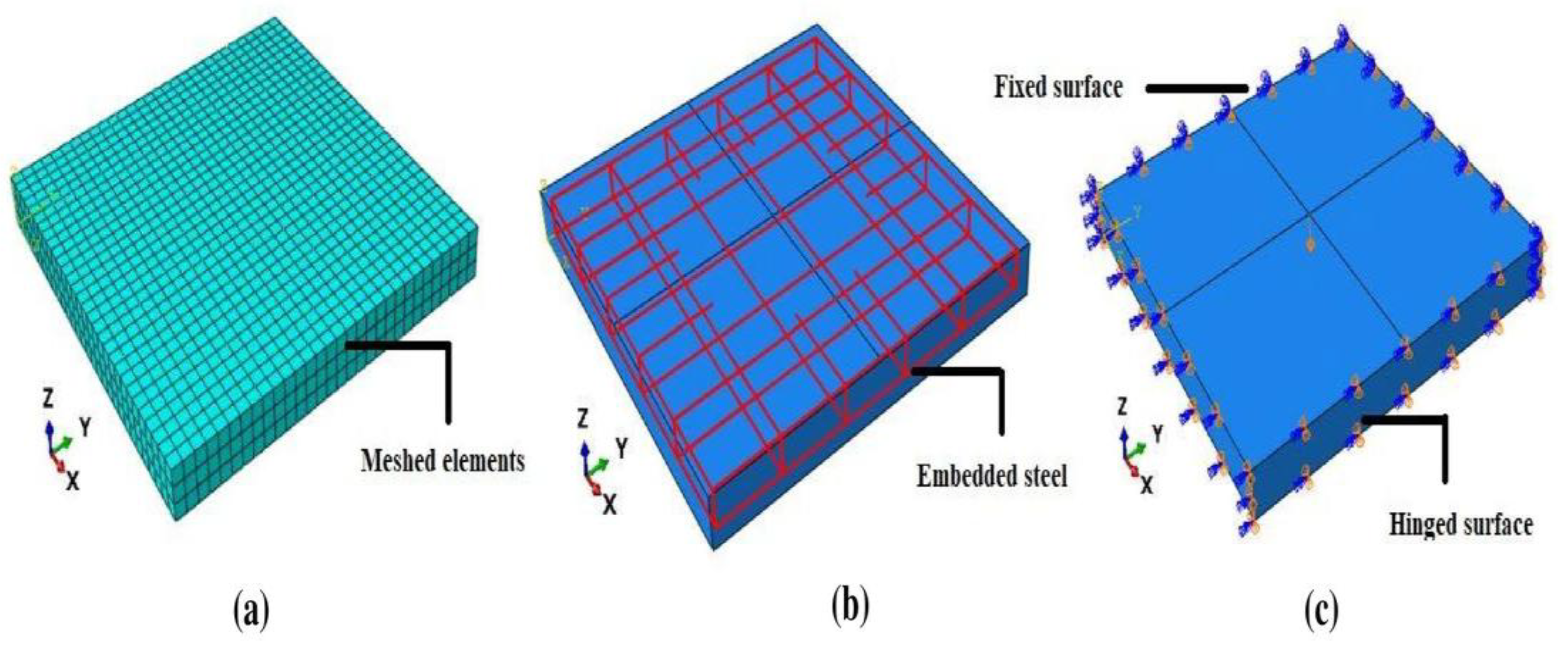
Figure 4.
Geometry and boundary conditions of the finite element model of the two-way slab (a) meshing (b) embedded region constraint (c) boundary conditions [2].
Figure 4.
Geometry and boundary conditions of the finite element model of the two-way slab (a) meshing (b) embedded region constraint (c) boundary conditions [2].
The possibility of optimising concrete elements by considering a range of sectional dimensions and reinforcement designs according to an existing design code has been studied by several researchers. Developing a set of design charts for concrete frame elements and listing the slab depths which give the minimum cost for each span, based on a series of parametric designs [21]. Controlling the deflections of their designs referring to BS EN 1992-1-1 [17] adjusted span-to-depth ratios, they also found that providing more reinforcement to further reduce the allowable slab thickness can reduce overall cost. A review of efforts to optimize the cost of reinforced concrete members highlighted the uncertainties associated with defining the cost function, as well as the fuzziness and variability in selecting appropriate cost parameters [196].
The optimization of steel-reinforced concrete frames or beams through adjustments in reinforcement arrangement and sectional dimensions was demonstrated using genetic algorithms [64,65,197]. With the proven savings of around 25 to 36%, their studies confirm that understanding the trade-off between sectional dimensions and reinforcement may be a promising approach to optimised embodied carbon of concrete members. The optimization of T-shaped one-way slabs was demonstrated by generating over a million solutions through variations in sectional dimensions and reinforcement design, utilizing a heuristic algorithm [198]. Reinforced concrete box bridge frames were designed by varying the geometry of the box beam and reinforcement configuration using heuristic optimization algorithms. The study highlighted the impact of deflection and fatigue limits on the resulting optimal designs [199]. A parametric variation of beam geometry and reinforcement quantity was conducted to identify optimal designs, revealing a parabolic relationship between depth and embodied carbon. This finding supports the effectiveness of the parametric design approach for optimization [35].
Structural optimization aims to minimize material usage while ensuring safety, performance, and cost-effectiveness, offering a viable pathway to reducing the embodied carbon of reinforced concrete (RC) structures. Advanced computational tools, such as finite element analysis (FEA), enable precise modeling of structural behavior, allowing engineers to identify optimal material distributions [200]. This approach facilitates targeted material use, reducing concrete consumption without compromising structural integrity. Recent advancements in FEA have further enhanced its ability to predict structural performance under various loading conditions, contributing to more efficient and sustainable designs [201]. The integration of FEA into lifecycle assessments (LCA) allows for the evaluation of embodied carbon across design alternatives, ensuring sustainability-focused decision-making [184,193]. Machine learning techniques have also been integrated into FEA workflows, streamlining the design process and enabling the rapid identification of low-carbon solutions [202,203]
Structural optimization techniques also include topology optimization, which determines the optimal material layout within a given design space under specific constraints [204]. This method leads to innovative designs that maximize structural performance while minimizing material use [205]. High-strength concrete is another effective strategy, enabling smaller cross-sections and reducing overall concrete volume while enhancing load-carrying capacity [206]. Additionally, composite materials, such as carbon fiber-reinforced polymers (CFRP), improve the strength-to-weight ratio of structural components, allowing for reduced concrete usage and increased durability, particularly in dynamic loading conditions [207,208]. The adoption of precast concrete elements further contributes to material efficiency, as these components are manufactured under controlled conditions, reducing waste and optimizing material use for specific load requirements [209,210].
4.3. Deflection Management
Effective management of deflection in reinforced concrete (RC) structures is critical for ensuring serviceability, durability, and sustainability. One approach involves utilizing high-performance concrete with enhanced tensile strength, which reduces deflections under service loads. This type of concrete is designed for superior durability, workability, and strength, helping to mitigate deflection and cracking issues. Research has demonstrated that high-performance concrete significantly improves the serviceability of structures by limiting deflection and enhancing long-term performance [47,214].
The addition of fibers, such as steel or synthetic materials, to concrete further contributes to deflection management. Fiber reinforcement improves the post-cracking behavior of concrete by enhancing ductility, energy absorption, and toughness. It also helps control cracking, making the material suitable for applications requiring high seismic resilience. Studies indicate that fiber-reinforced concrete exhibits superior performance under load and is effective in reducing deflections and extending structural lifespan [215,216].
Pre-stressing techniques are another effective strategy for managing deflections. By introducing compressive forces into concrete elements, pre-stressing counteracts deflections caused by service loads, enabling longer spans and more efficient material use. Methods such as pre-tensioning and post-tensioning have been shown to significantly enhance the load-carrying capacity of beams and slabs, reducing deflections and improving overall structural performance [217,218].
The use of real-time monitoring systems provides valuable data for assessing and managing deflections throughout a structure’s lifecycle. Technologies such as fiber optic sensors and wireless systems allow for continuous assessment of structural health. These advancements enable timely interventions and maintenance, which extend the lifespan of structures and improve overall performance. Recent research highlights the efficacy of real-time monitoring in optimizing maintenance strategies and ensuring long-term serviceability [203,219].
Adjustments in structural design also play a significant role in managing deflections. Techniques such as increasing beam depth or introducing camber in slabs account for anticipated deflections during the design phase, enhancing the serviceability of structures. Studies have shown that these design adjustments minimize material usage while maintaining performance, contributing to more sustainable construction practices [220,221].
4.4. Voided Floor Systems
Voided floor systems offer an innovative solution for reducing material usage in concrete slabs while maintaining structural performance. By incorporating voids or openings within the slab, these systems achieve significant reductions in material consumption and embodied carbon. Research shows that voided slabs can reduce concrete usage by up to 30%, resulting in substantial material cost savings without compromising structural integrity [222]. The lighter weight of these slabs also reduces the overall load on the structure, contributing to more efficient designs [223].
In addition to material savings, voided systems enhance the thermal insulation properties of buildings, improving energy efficiency. The voids reduce heat transfer, leading to lower energy consumption for heating and cooling, which in turn reduces the building's carbon footprint. Studies have demonstrated that buildings with voided floor systems achieve improved energy performance and reduced operational costs [224,225]
The use of prefabricated voided floor systems accelerates construction schedules by enabling off-site manufacturing. Prefabrication minimizes on-site waste, improves quality control, and reduces labor costs. Recent advancements in these systems highlight their potential to streamline construction processes while maintaining high-quality outcomes [226,227].
Another advantage of voided systems is their adaptability to various architectural designs, enabling creative and sustainable building solutions. Their versatility makes them suitable for residential, commercial, and industrial applications. Research highlights the integration of voided floor systems into diverse architectural styles, promoting both aesthetic appeal and sustainability [222,228].
Non-extractable void formers, such as those made from polystyrene foam, further enhance the efficiency of voided slabs. These formers are integrated into the slab design to reduce concrete usage while preserving structural integrity. Studies indicate that non-extractable void formers improve the performance of voided slabs and minimize environmental impact [229,230].
The adoption of voided slab technology faces challenges related to structural performance, fire resistance, and market acceptance. Concerns about load-bearing capacity and deflection can be addressed through experimental studies, finite element analyses, and standardized design guidelines [213]. Fire safety risks, due to the presence of voids, require research into fire-resistant materials and thorough testing to ensure compliance with building codes. Additionally, market resistance stems from established construction practices and limited familiarity with this technology. Educational initiatives, case studies, and industry outreach can help promote awareness and facilitate wider adoption. By overcoming these challenges, voided slabs can become a key solution in sustainable construction [50,213].
4.5. Use of Recycled Aggregate or Waste
The incorporation of recycled aggregates and industrial by-products into concrete presents a viable strategy for reducing its carbon footprint and promoting sustainability. Recycled concrete aggregates (RCA), sourced from demolished structures, can effectively replace virgin aggregates, reducing the demand for quarrying and lowering transportation emissions. Studies have demonstrated that RCA can achieve mechanical properties comparable to those of natural aggregates, making it a feasible alternative without compromising structural integrity [231,232].
Industrial by-products, such as crushed glass, plastic waste, and rubber, further enhance the sustainability of concrete production. These materials reduce reliance on natural resources while contributing to improved durability and performance in concrete applications. Research highlights the potential of industrial by-products to minimize environmental impacts and enhance the mechanical properties of concrete [2,233].
The environmental benefits of using recycled materials in concrete extend beyond embodied carbon reduction. By substituting natural aggregates with recycled alternatives, the construction industry can significantly decrease landfill waste and mitigate the environmental impact of quarrying. Studies have shown that incorporating recycled materials reduces greenhouse gas emissions associated with concrete production, thereby contributing to a more sustainable construction process [234,235].
Waste mineral powders, used as supplementary cementitious materials, offer another sustainable solution. These materials enhance the strength, durability, and impermeability of concrete while reducing its carbon footprint. Research indicates that incorporating waste mineral powders leads to improved mechanical performance, making it a practical option for sustainable construction [236].
Lifecycle assessments (LCA) of concrete containing recycled aggregates provide valuable insights into the environmental benefits of these materials. LCA quantifies reductions in embodied carbon and other environmental impacts, helping to establish the sustainability credentials of recycled materials in construction. Recent studies emphasize the importance of LCA in promoting environmentally conscious practices within the construction industry [237].
5. Analysis of the Embodied Carbon in Various Floors Systems
The comparison of embodied carbon based on floor types in concrete structures examines the environmental impact of various flooring designs, focusing on the greenhouse gas emissions associated with their lifecycle. As the construction industry increasingly prioritizes sustainability, understanding how different floor types contribute to embodied carbon is crucial for architects, builders, and policymakers. This topic is notable due to the significant role floors play in a building's overall carbon footprint, which can account for up to 50% of total emissions in capital projects.
In concrete structures, the floor plays a vital role in influencing total embodied carbon due to its material composition and design [239]. Studies have shown that different flooring systems contribute differently to the overall carbon footprint, with variations based on the type of concrete and insulation materials used [3].
The choice of floor type in concrete structures significantly impacts embodied carbon, material use, and energy efficiency. Flat floors require more concrete than pitched floors due to their larger surface area and structural support needs. Research shows that the embodied carbon of multi-story buildings varies considerably based on the floor system used [242]. Flooring material choices significantly affect a building’s embodied carbon. Green floors with vegetation offer insulation benefits and reduce energy use, partially offsetting concrete's carbon impact. Traditional materials like metal or asphalt may have higher embodied carbon depending on their production and lifecycle. Life-cycle assessments (LCAs) help compare emissions from different floor types, enabling informed, sustainability-focused design decisions. The study emphasizes performance-based approaches for sustainable concrete floor design [243].
Several researchers have discussed the differences in the environmental and economic performance of available floor systems. Flat slabs are generally considered economical for spans up to 8 or 9 meters, while post-tensioned flat slabs are regarded as cost-effective for spans extending up to 12 or 13 meters. However, although span ranges are provided where various floor systems demonstrate economic efficiency, no specification is made regarding which system is the most economical for a given span within these ranges [21]. Embodied carbon of several slab types was compared for a range of spans, and it was observed that waffle slabs were optimum for all viable spans, with hollow-core slabs having the second-lowest embodied carbon for spans longer than 7 meters. It was further noted that flat slabs, two-way slabs, and post-tensioned flat slabs exhibited similar embodied carbon values for spans between 4 and 7 meters [244]. Several floor solutions, including flat slabs, post-tensioned flat slabs, and composite slabs, were compared across three different scenarios, and it was concluded that no structural scheme consistently resulted in the lowest embodied carbon [245]. One-way spanning slabs, flat slabs with and without drop panels, were compared for active and passive reinforcement within a fixed column grid. It was found that all three slab types achieved up to a 49% reduction in embodied energy with post-tensioning. Additionally, the reinforced flat slab was observed to have 7% less embodied energy compared to the other two reinforced solutions, which exhibited nearly identical embodied energy values [246]. A case study demonstrated that voided slabs could achieve a reduction in embodied carbon compared to an equivalent solid concrete floor solution [247]. However, an analysis of several floor options highlighted that the lightweight materials used in voided slabs can increase the total embodied energy compared to flat slabs [248].
Innovative floor systems utilizing membrane action instead of traditional bending improve load distribution and reduce material usage. This approach enables thinner slabs, leading to significant material savings while maintaining structural integrity. Research shows that membrane action enhances load capacity, offering greater design flexibility and more efficient material use [220].
This design approach has been shown to reduce concrete volume by 20-40%, resulting in substantial reductions in embodied carbon. The use of thinner slabs also reduces the overall weight of structures, leading to cost savings in foundations and other structural elements. Studies highlight the material and cost efficiencies achieved through slab optimization for membrane action [249].
Membrane action in innovative floor systems enhances material efficiency and structural performance, enabling longer spans and greater design flexibility. This approach is particularly beneficial for parking garages, open spaces, and seismic regions, as it improves load distribution, seismic resistance, and earthquake damage mitigation. By optimizing structural and seismic performance, these designs offer both sustainability and resilience, expanding possibilities for modern construction [207].
From a sustainability perspective, innovative floor systems contribute to reducing embodied carbon by optimizing material use. Furthermore, these systems promote lower energy consumption during building operations and improve occupant comfort. Research underscores their role in enhancing both environmental and operational sustainability, achieving substantial reductions in embodied and operational energy use [211].
Incorporating innovative floor systems into the design of reinforced concrete structures aligns with broader efforts to reduce embodied carbon and promote sustainability. By combining alternative materials, structural optimization, effective deflection management, voided floor systems, and recycled aggregates, the construction industry can significantly mitigate its environmental impact while enhancing the performance and longevity of concrete structures.
Flat slabs are a simple and efficient floor design, consisting of a continuous slab supported directly by columns or walls without the use of beams. Beam and slab systems, on the other hand, incorporate a series of beams supporting a slab, which can provide greater span capabilities and design flexibility [252,253]. Ribbed slabs feature a series of parallel ribs or joists, often with a thin top slab, which can reduce the overall concrete volume and, consequently, the embodied carbon [254].
Waffle slabs are a type of two-way ribbed slab system, where the ribs are arranged in a grid pattern, creating a "waffle" appearance. Hollow-core slabs are a precast concrete system with pre-formed voids or cavities within the slab, reducing the overall concrete volume. Nervi-style slabs are a unique design that utilizes a series of intersecting curved shells or thin slab elements to create an efficient and structurally expressive floor system. Arched slabs, on the other hand, feature a curved, vaulted design that can offer both architectural and structural benefits. To understand the embodied carbon implications of these various floor systems, it is essential to analyze the materials and construction methods involved [252,253].
Flat slabs generally require a significant amount of concrete and reinforcement, as the entire slab must be designed to span between supports. In contrast, beam and slab systems can distribute the loads more efficiently, potentially reducing the overall concrete volume [255]. Ribbed slabs, waffle slabs, and hollow-core slabs all have the potential to reduce the embodied carbon of the floor structure by minimizing the concrete required, either with ribs, voids, or precast elements [256,257].
5.1. Flat Slab
Flat slabs are a reinforced concrete floor system consisting of a flat, continuous slab supported directly by columns without the use of beams [242,257,258]. Commonly used in multi-story buildings, flat slabs are valued for their simplicity and reduced formwork requirements. Optimization focuses on minimizing slab thickness and reinforcement density, which can reduce material usage and embodied carbon. Advanced BIM tools facilitate these optimizations [257]. Replacing cement with supplementary materials like fly ash or GGBS can further lower the embodied carbon footprint by up to 25% [145].
The embodied carbon values associated with flat slabs can vary significantly based on factors such as thickness, span length, and the type of concrete used. Studies indicate that optimizing the thickness and reinforcement ratios can lead to a reduction in embodied carbon by up to 20% [145].
Figure 5.
Finite element model of flat slab for estimating non-linear long-term deflection [142].
Figure 5.
Finite element model of flat slab for estimating non-linear long-term deflection [142].
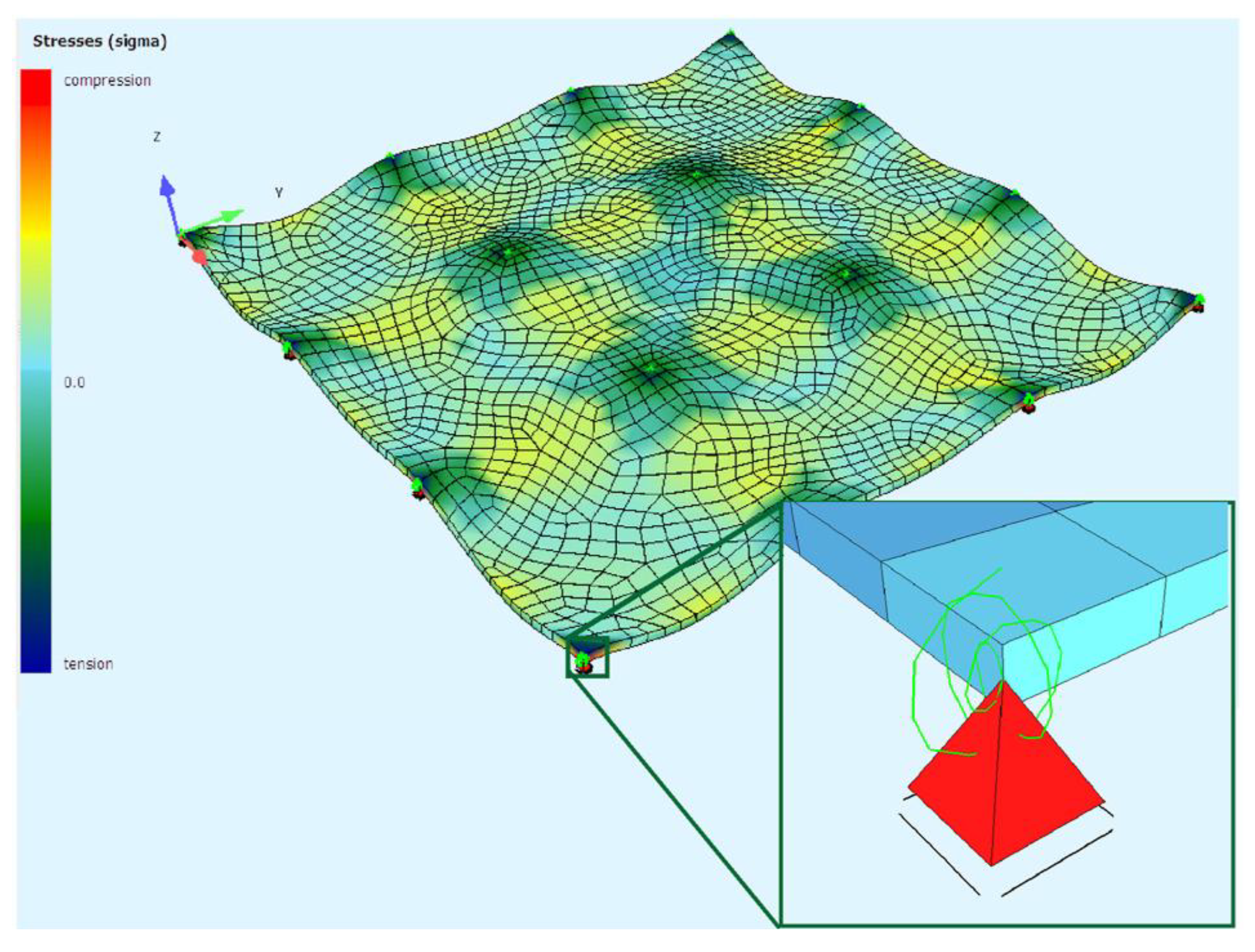
For instance, a 200 mm thick flat slab with an 8-meter span using standard concrete (C25/30) yielded 250 kg CO₂/m² [142]. In another study, a 250 mm thick flat slab over a 10-meter span with high-strength concrete (C40/50) resulted in 350 kg CO₂/m² [242]. An optimized mix with supplementary cementitious materials (SCMs) for a 200 mm thick slab over 8 meters reduced the embodied carbon to 180 kg CO₂/m² [259]. Lightweight concrete (C20/25) was used in a 200 mm thick flat slab with a 6-meter span, achieving 220 kg CO₂/m² [260]. Lastly, a 300 mm thick flat slab over a 15-meter span using standard concrete (C30/37) resulted in 450 kg CO₂/m² [261].
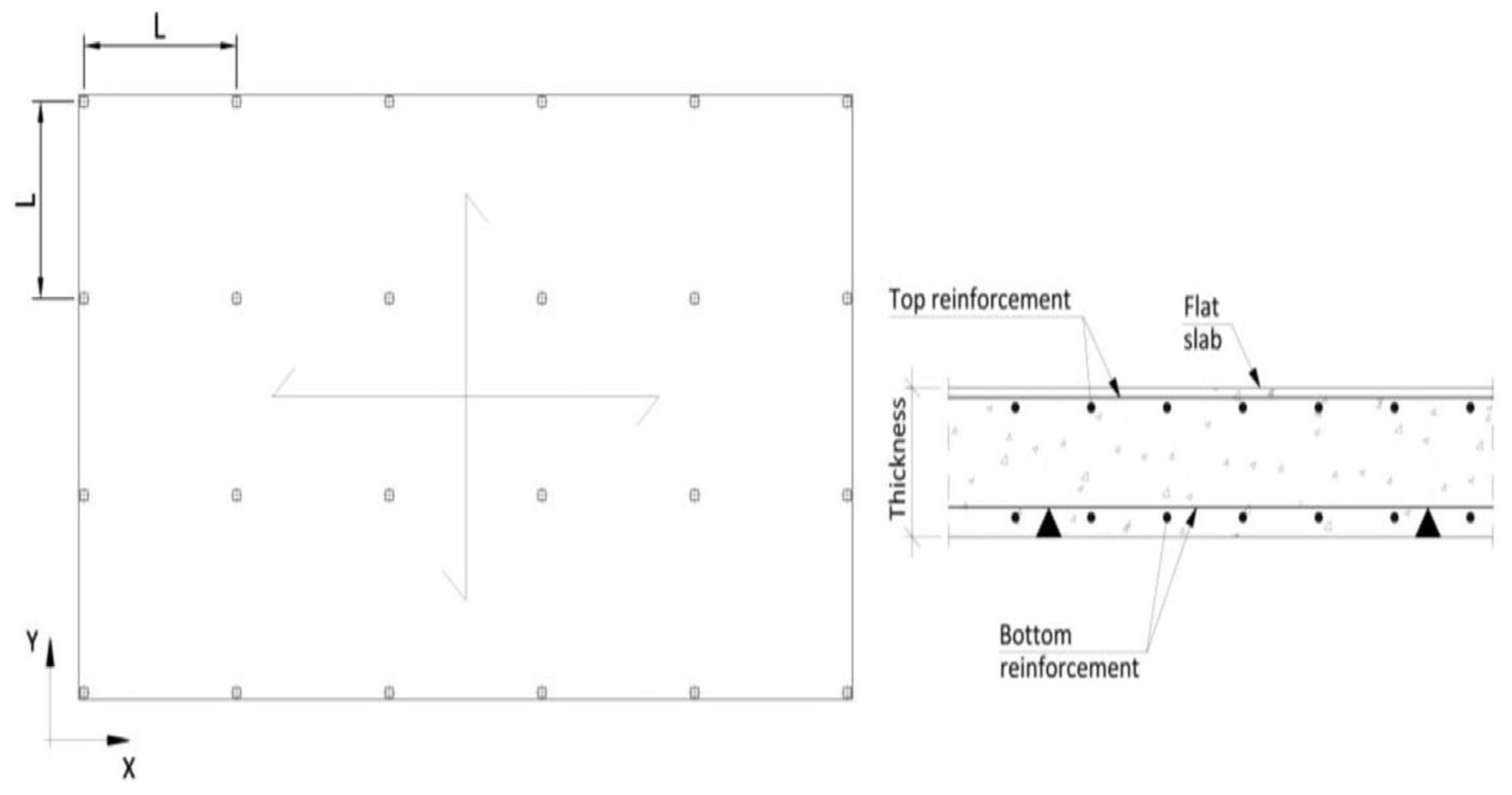
Figure 6.
Details of Flat Slab [71].
Figure 6.
Details of Flat Slab [71].
5.2. Beam and Slab
Beam and slab system is a reinforced concrete floor system that consists of a slab supported by a network of beams, which in turn are supported by columns [184,242,258]. The beams and slabs work together to carry the loads. This system is widely used in multi-story buildings and is known for its flexibility in accommodating various architectural layouts [242,258]. Optimization involves adjusting beam spacing and dimensions to reduce material use, achieving up to a 15% reduction in embodied carbon [151].
Figure 7.
Representative building frame layout [250].
Figure 7.
Representative building frame layout [250].

The beam and slab system typically has a higher embodied carbon due to the additional materials required for beams, with values ranging from 180 to 500 kg CO₂/m². For example, a 250 mm thick slab with 6-meter spans using standard concrete (C25/30) yielded 320 kg CO₂/m² [262]. Additionally, a 300 mm thick slab over a 10-meter span with high-strength concrete (C40/50) resulted in 450 kg CO₂/m² [263]. Lastly, 300 mm thick slab over a 15-meter span with standard concrete (C30/37) yielded 500 kg CO₂/m² [264].
5.3. Ribbed
Ribbed slab is a reinforced concrete floor system that consists of a thin slab with regularly spaced ribs or beams running in one or two directions [242]. The ribs help reduce the overall concrete volume compared to a flat slab, leading to potential savings in material and embodied carbon [265]. Optimization focuses on spacing and rib depth to balance load distribution and material usage. Incorporating recycled aggregate concrete can reduce the embodied carbon footprint by 10–15% [265].
Figure 8.
Details of Ribbed slab (dimensions are in mm): (a) Concrete dimensions and steel reinforcement in ribs and top slab; (b) isometric view showing concrete dimensions; [269].
Figure 8.
Details of Ribbed slab (dimensions are in mm): (a) Concrete dimensions and steel reinforcement in ribs and top slab; (b) isometric view showing concrete dimensions; [269].
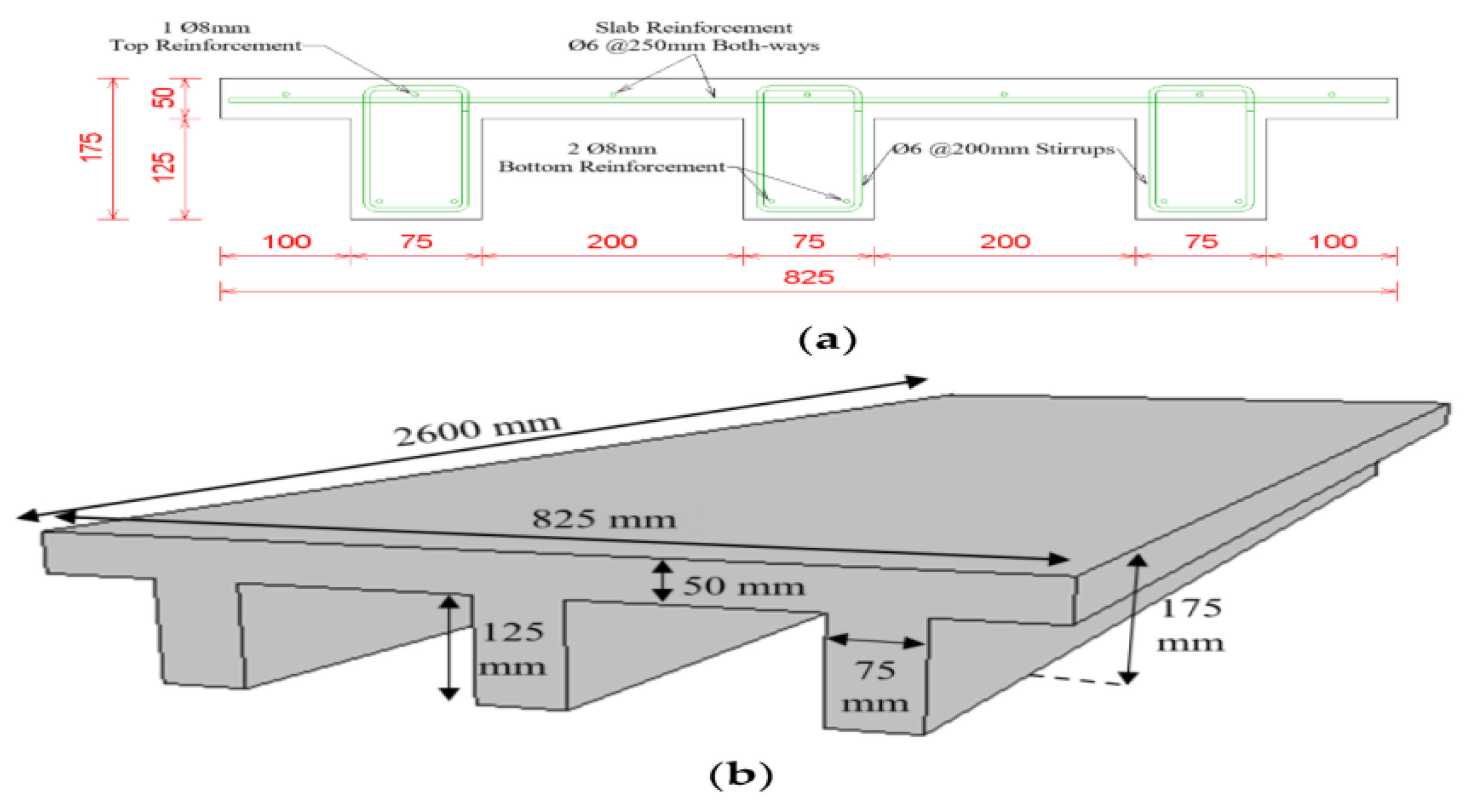
Ribbed slabs are designed to reduce material usage while maintaining structural integrity, with embodied carbon values ranging from 230 to 400 kg CO₂/m². For instance, a 300 mm deep ribbed slab with an 8-meter span using standard concrete (C25/30) yielded 280 kg CO₂/m² [266]. A 300 mm deep ribbed slab spanning 12 meters with conventional concrete (C30/37) resulted in 370 kg CO₂/m² [267]. Finally, a 300 mm deep ribbed slab with a 9-meter span using recycled aggregates (C30/37) achieved 280 kg CO₂/m² [268].
5.4. Waffle
Waffle slabs are known for their efficiency in material use, leading to lower embodied carbon values ranging from 180 to 350 kg CO₂/m². For example, a 300 mm waffle slab with spans of 9 meters using standard concrete (C25/30) yielded 220 kg CO₂/m² [270]. Additionally, a 400 mm waffle slab over a 12-meter span with high-strength concrete (C40/50) resulted in 340 kg CO₂/m² [271]. For instance, a 250 mm waffle slab with an 8-meter span using recycled aggregates (C30/37) showed 210 kg CO₂/m² [272]. In another study, a 300 mm waffle slab spanning 10 meters with lightweight concrete (C20/25) achieved 300 kg CO₂/m² [274]. A 200 mm waffle slab with a 6-meter span using standard concrete (C25/30) yielded 175 kg CO₂/m² [275]. Lastly, a 400 mm waffle slab over a 15-meter span with high-performance concrete (C50/60) resulted in 350 kg CO₂/m² [275].
Figure 9.
Typical detail of a wide beam and joisted slab used in Albania; [291].
Figure 9.
Typical detail of a wide beam and joisted slab used in Albania; [291].
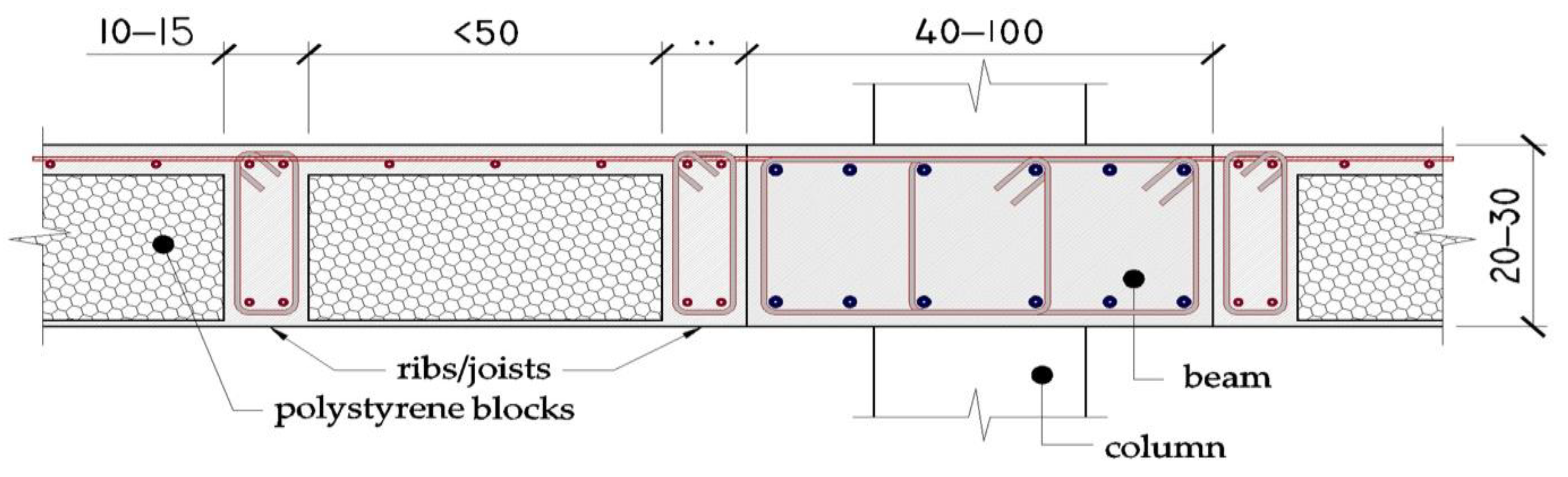
5.5. Post-Tensioned Concrete Floor
Post-tensioned slabs are designed to use less concrete and steel by pre-stressing the reinforcement. A reinforced concrete floor system that utilizes high-strength steel tendons or cables that are tensioned after the concrete has hardened. The post-tensioning process introduces compressive forces into concrete, which improves its resistance to tensile stress and can result in thinner, more efficient floor structures [276]. This system is commonly used in large-span buildings, such as stadiums and bridges, where reduced self-weight is critical [277]. Post-tensioning can decrease material usage by 20–30%, significantly reducing embodied carbon [259,260,261,262,263,264,265,266,267,268,269,270,271,272,273,274,275,276,277,278].
Figure 10.
(a) Typical elevation of a post-tensioned composite slab supported by band beams; (b) Typical construction detail of profiled steel sheeting being supported from fromwork of band beam before concrete pour; [292].
Figure 10.
(a) Typical elevation of a post-tensioned composite slab supported by band beams; (b) Typical construction detail of profiled steel sheeting being supported from fromwork of band beam before concrete pour; [292].

Post-tensioned concrete floors utilize high-strength steel tendons to enhance structural performance and reduce material usage. The embodied carbon for spans of 8 to 16 meters, with slab thickness between 150 mm and 250 mm, depending on the span and use concrete grades of C40/50 [259] is approximately from 180 to 300 kg CO₂/m².
For instance, a 200 mm thick post-tensioned slab with an 8-meter span using standard concrete (C30/37) yielded 190 kg CO₂/m² [279]. Similarly, a 200 mm thick slab over a 10-meter span with high-strength concrete (C40/50) resulted in 240 kg CO₂/m² [280]. In another example, a 300 mm thick post-tensioned slab with a 12-meter span using recycled aggregates (C30/37) achieved 290 kg CO₂/m² [281]. Finally, a 300 mm thick slab spanning 15 meters with lightweight concrete (C40/50) showed 300 kg CO₂/m² [282].
5.6. Hollowcore
Hollowcore slab is a precast, prestressed concrete floor system that consists of a series of parallel, hollow cores running the length of the slab [242,265]. Hollow cores reduce the overall concrete volume, making hollowcore slabs a more sustainable option compared to solid slabs [242].
The embodied carbon for hollow-core slabs ranges from 180 to 320 kg CO₂/m². A 300 mm thick hollow-core slab with a 10-meter span using high-strength concrete (C40/50) and a thinner slab with higher-strength concrete (C50/60) both resulted in an embodied carbon of 300 kg CO₂/m² [263,283]. Additionally, a 300 mm thick hollow-core slab with a 12-meter span using standard concrete (C30/37) yielded 320 kg CO₂/m² [284]. A 200 mm thick hollow-core slab with a 5-meter span using low-carbon concrete (C25/30) yielded 170 kg CO₂/m² [285].
Figure 11.
Parts of Steel-Concrete composite beams with a hollow core slab, 150 mm of hollowcore slab depth and 55 mm of concrete topping with a squared end; [293].
Figure 11.
Parts of Steel-Concrete composite beams with a hollow core slab, 150 mm of hollowcore slab depth and 55 mm of concrete topping with a squared end; [293].

5.7. Nervi-style Slab
Nervi-style slab is a thin-shell concrete floor system, characterized by its curved, hyperbolic paraboloid shape [108]. The thin, curved design can potentially reduce the concrete volume compared to a flat slab, leading to lower embodied carbon. For example, a 250 mm thick Nervi-style slab with a 9-meter span using standard concrete (C25/30) yielded 240 kg CO₂/m² [286]. Additionally, a 200 mm thick slab with an 8-meter span using recycled aggregates (C30/37) showed 230 kg CO₂/m² [287].
5.8. Arched Slab
Arched slab is a reinforced concrete floor system that features a curved, arched geometry [108], to distribute loads effectively, which can lead to a reduction in material usage [151]. Like the Nervi-style slab, the curved design can potentially reduce the concrete volume compared to a flat slab, which may result in lower embodied carbon [108]. The embodied carbon values ranging from 200 to 380 kg CO₂/m². For instance, a 200 mm thick arched slab with a 6-meter span using standard concrete (C25/30) yielded 200 kg CO₂/m² [288]. In another study, a 300 mm thick slab with a 9-meter span using standard concrete (C40/50) yielded 260 kg CO₂/m² [289]. Furthermore, a 300 mm thick slab with a 10-meter span using recycled aggregates (C30/37) yielded 310 kg CO₂/m² [290].
Figure 12.
(a) Funicular (arched) floors with external arch ties between columns investigated and (b) arched thin concrete shell floor plate investigated in [147].
Figure 12.
(a) Funicular (arched) floors with external arch ties between columns investigated and (b) arched thin concrete shell floor plate investigated in [147].
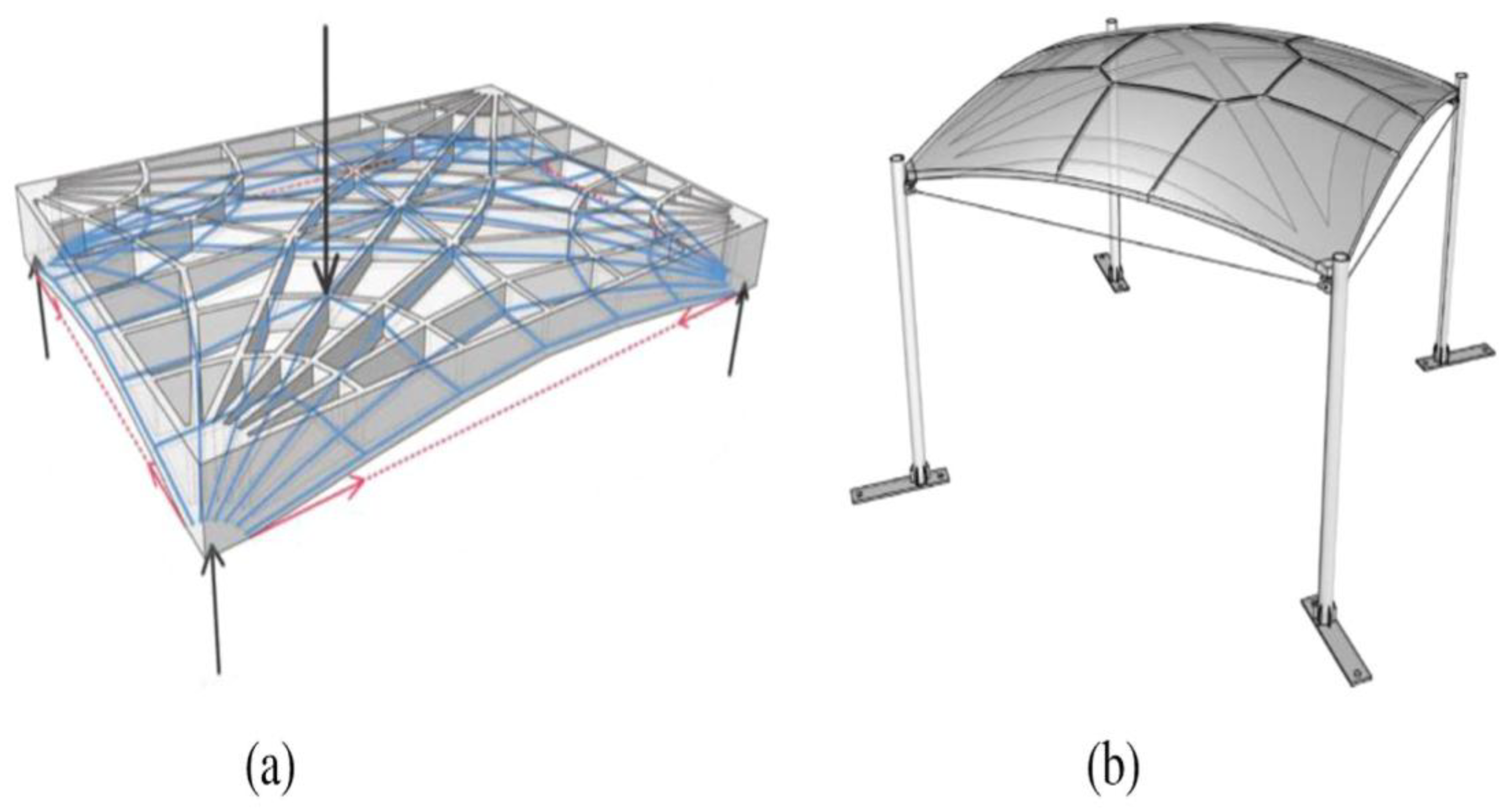
6. Discussion
The comprehensive analysis of eight different floor systems revealed significant variations in embodied carbon performance. Post-Tensioned Concrete Slab systems demonstrated superior environmental performance with the lowest mean embodied carbon (247 ±32 kgCO2e/m²), followed by Hollow-Core Slab systems (250 ±47 kgCO2e/m²). In contrast, Beam and Slab systems consistently showed the highest environmental impact (388 ±77 kgCO2e/m²). The hierarchical arrangement of systems based on mean embodied carbon values is as follows:
- Post-Tensioned Concrete Floor (247 ±32 kgCO2e/m²)
- Hollow-Core Slab (250 ±47 kgCO2e/m²)
- Waffle Slab (263 ±61 kgCO2e/m²)
- Arched Slab (270 ±58 kgCO2e/m²)
- Nervi-style Slab (274 ±47 kgCO2e/m²)
- Flat Slab (286 ±84 kgCO2e/m²)
- Ribbed Slab (308 ±59 kgCO2e/m²)
- Beam and Slab (338 ±77 kgCO2e/m²)
6.1. Span-Based Performance Analysis
The investigation of embodied carbon performance across different span ranges revealed distinct patterns and significant variations in system efficiency. The analysis was conducted across three primary span categories: short spans (0-6m), medium spans (6-10m), and long spans (10-15m), with each category demonstrating unique characteristics and performance metrics.
6.1.1. Short-Span Systems (0-6m)
Analysis of short-span applications revealed that Waffle Slab systems demonstrated superior environmental performance, with the lowest embodied carbon values (172 ±8 kgCO2e/m²). This exceptional performance can be attributed to efficient material distribution and the ability to utilize lower-strength concrete (typically C25/30). Flat Slab systems followed closely (185 ±13 kgCO2e/m²), offering a good balance between simplicity and environmental impact.
In this span range, most systems maintained relatively thin profiles (200-250mm), with Flat Slabs occasionally requiring increased depth (up to 300mm) for specific loading conditions.
Notably, traditional Beam and Slab systems demonstrated the highest embodied carbon values (296 ±19 kgCO2e/m²) even in short spans, suggesting inefficient material utilization for these modest span requirements.
Table 4.
Amount of Embodied Carbon for Short-Span.
| Floor Type | Embodied Carbon (kgCO2e/m²) | σ | Concrete Grade | Thickness (mm) |
|---|---|---|---|---|
| Waffle Slab | 172 | ±8 | C25/30 | 200-250 |
| Flat Slab | 185 | ±13 | C25/30 | 200-300 |
| Hollow-Core Slab | 193 | ±15 | C30/37 | 200-250 |
| Arched Slab | 195 | ±10 | C25/30 | 200-250 |
| Post-Tensioned Concrete Floor | 220 | ±17 | C40/50 | 200-250 |
| Nervi-style Slab | 223 | ±10 | C30/37 | 200-250 |
| Ribbed Slab | 253 | ±39 | C30/37 | 200-250 |
| Beam and Slab | 296 | ±19 | C35/45 | 200-250 |
6.1.2. Medium-Span Systems (6-10m)
The medium-span category revealed more pronounced differentiation between systems. Post-Tensioned Concrete Floor systems emerged as the most efficient solution (245 ±28 kgCO2e/m²), closely followed by Hollow-Core Slabs (247 ±37 kgCO2e/m²). This performance advantage can be attributed to their optimized use of high-strength materials and efficient structural forms.
A notable trend in this span range was the increased variation in performance within each system type, as evidenced by larger standard deviations. Flat Slab systems, in particular, showed high variability, indicating sensitivity to specific design parameters and loading conditions. The required thickness range expanded significantly (200-400mm), reflecting the increased structural demands of longer spans.
The performance gap between specialized and traditional systems became more pronounced, with Beam and Slab systems showing significantly higher embodied carbon values (407 ±67 kgCO2e/m²).
Table 5.
Amount of Embodied Carbon for Medium-Span.
| Floor Type | Embodied Carbon (kgCO2e/m²) | σ | Concrete Grade | Thickness (mm) |
|---|---|---|---|---|
| Post-Tensioned Concrete Floor | 245 | ±28 | C40/50 | 200-300 |
| Hollow-Core Slab | 247 | ±37 | C35/45 | 200-300 |
| Waffle Slab | 264 | ±51 | C35/45 | 200-400 |
| Nervi-style Slab | 271 | ±32 | C35/45 | 200-250 |
| Arched Slab | 281 | ±37 | C30/37 | 200-250 |
| Flat Slab | 282 | ±71 | C30/37 | 200-250 |
| Ribbed Slab | 293 | ±43 | C35/45 | 200-250 |
| Beam and Slab | 407 | ±67 | C40/50 | 200-250 |
6.1.3. Long-Span Systems (10-15m)
Long-span applications demonstrated the most significant variations in performance and the highest absolute embodied carbon values. Post-Tensioned Concrete Floor systems maintained their environmental advantage (262 ±39 kgCO2e/m²), showing remarkable efficiency even at extended spans. This performance is particularly noteworthy given the structural challenges associated with longer spans.
The data revealed a clear trend toward increased material requirements across all systems, with thickness ranges typically starting at 250mm and extending to 400mm in some cases. Despite this general trend, Post-Tensioned systems maintained relatively modest thickness increases, demonstrating superior structural efficiency.
Table 6.
Amount of Embodied Carbon for Long-Span.
| Floor Type | Embodied Carbon (kgCO2e/m²) | σ | Concrete Grade | Thickness (mm) |
|---|---|---|---|---|
| Post-Tensioned Concrete Floor | 262 | ±39 | C40/50 | 250-300 |
| Hollow-Core Slab | 304 | ±18 | C40/50 | 250-300 |
| Waffle Slab | 307 | ±49 | C40/50 | 200-400 |
| Nervi-style Slab | 313 | ±51 | C40/50 | 200-00 |
| Arched Slab | 335 | ±32 | C35/45 | 250-400 |
| Ribbed Slab | 384 | ±17 | C40/50 | 250-300 |
| Flat Slab | 388 | ±50 | C35/45 | 250-300 |
| Beam and Slab | 442 | ±57 | C45/55 | 250-300 |
6.2. Mechanisms of Carbon Reduction
The variation in embodied carbon performance can be attributed to specific characteristics of each system:
-
Post-Tensioned Concrete Floor:
- Achieves efficiency through active force distribution via tensioned cables
- Reduces concrete volume through controlled deflection
- Enables thinner sections due to pre-compression
- Minimizes reinforcement through prestressing forces
-
Hollow-Core Slab
- Removes non-structural concrete through void formation
- Optimizes material placement through standardized production
- Reduces self-weight while maintaining depth for structural efficiency
- Benefits from factory-controlled production quality
-
Waffle Slab
- Creates efficient two-way spanning action.
- Removes concrete from low-stress zones.
- Maintains structural depth with minimal material.
- Provides inherent ceiling aesthetics reducing finishing materials.
-
Arched Slab
- Utilizes natural compressive force paths.
- Minimizes tensile stresses through geometric optimization.
- Reduces material in non-critical areas.
- Benefits from structural form efficiency.
-
Nervi-style Slab
- Optimizes material placement along force paths.
- Creates efficient ribbed patterns following stress lines.
- Combines aesthetic and structural efficiency.
- Reduces material through biomimetic design principles.
-
Flat Slab
- Simplifies formwork reducing material waste.
- Provides direct force transfer to columns.
- Eliminates beam material volume.
- Allows for reduced floor-to-floor height.
-
Ribbed Slab
- Concentrates material in primary stress zones.
- Provides efficient one-way spanning action.
- Reduces self-weight through regular void patterns.
- Maintains structural depth with less material.
-
Beam and Slab
- Traditional force distribution through distinct elements.
- Higher material use due to separate structural components.
- Provides clear load paths.
- Requires additional depth for beam elements.
7. Conclusions
The analysis of eight floor systems across varying spans yields several significant conclusions:
The choice of floor system has a substantial impact on embodied carbon, with variations of up to 40% between the best and worst-performing systems. Post-Tensioned Concrete Floor systems consistently demonstrate superior environmental performance across all span ranges, particularly in medium to long spans where their efficiency becomes most apparent.
Span length emerges as a critical factor in environmental impact, with all systems showing increased embodied carbon as spans increase. However, the rate of increase varies significantly between systems, suggesting that careful system selection becomes increasingly important for longer spans. System efficiency exhibits distinct patterns across span ranges:
- For short spans (0-6m), Waffle Slabs offer the best environmental performance
- In medium spans (6-10m), Post-Tensioned and Hollow-Core systems demonstrate optimal efficiency
- For long spans (10-15m), Post-Tensioned systems maintain their advantage, though with higher absolute carbon values
These findings suggest that optimizing floor system selection based on span requirements can significantly reduce embodied carbon in construction. The results also indicate that traditional Beam and Slab systems, despite their widespread use, may need reconsideration from an environmental perspective, particularly when alternative systems are viable.
Future research should focus on investigating the relationship between initial cost and embodied carbon to provide a more comprehensive decision-making framework for practitioners. Additionally, consideration of maintenance requirements and end-of-life scenarios could further inform the long-term environmental impact of these systems.
References
- Adesina, A. (2020). Recent advances in the concrete industry to reduce its carbon dioxide emissions. Environmental Challenges, 1, (4). [CrossRef]
- Khan, Q.U.Z.; Ali, M.; Ahmad, A.; Raza, A.; Iqbal, M. Experimental and finite element analysis of hybrid fiber reinforced concrete two-way slabs at ultimate limit state. SN Appl. Sci. 2021, 3, 73-85. [CrossRef]
- Hart, J.; D'Amico, B.; Pomponi, F. Whole-life embodied carbon in multistory buildings: Steel, concrete, and timber structures. J. Ind. Ecol. 2021, 25, 403-418. [CrossRef]
- Gagg, C.R. Cement and concrete as an engineering material: An historic appraisal and case study analysis. Eng. Fail. Anal. 2014, 40, 114-140. [CrossRef]
- Crow, J.M. The concrete conundrum. Chem. World 2008, 62-66.
- Kanavaris, F.; Soutsos, M.; Chen, J.F. Enabling sustainable rapid construction with high volume GGBS concrete through elevated temperature curing and maturity testing. J. Build. Eng. 2023, 63, 105434. [CrossRef]
- Global Cement and Concrete Association. Cement and Concrete Around the World. Available online: https://gccassociation.org/concretefuture/cement-concrete-around-the-world/.
- European Ready-Mix Concrete Organization. Ready-Mixed Concrete Statistics; ERMCO: Brussels, Belgium, 2018.
- European Commission. European Green Deal: Commission Proposes to Boost Renovation and Decarbonisation of Buildings. Available online: https://ec.europa.eu/commission/presscorner/detail/en/ip_21_6683.
- Păunescu, C.; Comănescu, L.; Robert, D.; Săvulescu, I. Polynomial Regression Model for River Erosion Prediction in Transport Infrastructure Development. Int. J. Res. Publ. Rev. 2023, 4(3), 1731-1737. Available online: https://www.researchgate.net/publication/369665678.
- Marceau, M.L.; VanGeem, M.G. Life Cycle Assessment of an Insulating Concrete Form House Compared to a Wood Frame House. Portland Cement Association, 1992.
- Caldas, L.; Santos, R.; Martins, I. Circular Economy in the Concrete Industry. Sustain. Prod. Consum. 2021, 27, 57-67. [CrossRef]
- Dixit, M.K. Life cycle embodied energy analysis of residential buildings: A review of literature to investigate embodied energy parameters. Renew. Sustain. Energy Rev. 2017, 79, 390-413. [CrossRef]
- Pomponi, F.; Moncaster, A. A systematic approach to assessing embodied carbon in buildings. Energy Build. 2016, 128, 1-10. [CrossRef]
- Baynes, T.M.; Musango, J.K.; Zhang, X. Urban metabolism: A review of current knowledge and directions for future study. Environ. Res. Lett. 2018, 13(6), 063002. [CrossRef]
- Rama Jyosyula, A.; Sanjayan, J.G.; Wang, C.M. Pathways to Net-Zero Emissions for the Concrete Industry: A Literature Review. Buildings 2020, 10(12), 233. [CrossRef]
- BSI. BS EN 1992-1-1:2004+A1:2014: Eurocode 2 - Design of Concrete Structures: Part 1-1: General Rules and Rules for Buildings; BSI: London, UK, 2015.
- Brooker, O. Concrete Buildings Scheme Design Manual; The Concrete Centre: London, UK, 2009.
- Bond, A.J.; Harris, A.J.; Moss, R.M.; Brooker, O.; Harrison, T.; Narayanan, R.S.; et al. How to Design Concrete Structures using Eurocode 2, 2nd ed.; The Concrete Centre: London, UK, 2018.
- The Concrete Centre. Cost and Carbon: Concept V4. https://www.concretecentre.com/Publications-Software/Design-tools-and-software/Concept-V4-Cost-and-Carbon.aspx.
- Goodchild, C.H.; Webster, R.M.; Elliott, K.S. Economic Concrete Frame Elements to Eurocode 2; The Concrete Centre: London, UK, 2009.
- World Bank. World Bank Open Data. Available online: https://data.worldbank.org/.
- NASA. Global Climate Change, Vital Signs of the Planet. Available online: https://climate.nasa.gov/.
- United Nations. Paris Agreement; Technical Report; United Nations: New York, NY, USA, 2015. https://unfccc.int/process-and-meetings/the-paris-agreement/the-paris-agreement.
- Building Code Requirements for Structural Concrete (ACI 318-19). American Concrete Institute. 2019. https://www.concrete.org/store/productdetail.aspx?ItemID=318U19&Language=English&Units=US_Units.
- Department for Business Energy and Industrial Strategy. Net Zero Strategy: Build Back Greener. Technical Report; Gov.UK: London, UK, 2021. https://www.gov.uk/government/publications/net-zero-strategy.
- Barbosa, F.; Woetzel, J.; Mischke, J. Reinventing Construction: A Route To Higher Productivity; Technical Report; McKinsey Global Institute: New York, NY, USA, 2017. https://www.mckinsey.com/business-functions/operations/our-insights/reinventing-construction-through-a-productivity-revolution.
- Akbarnezhad, A.; Xiao, J. Estimation and Minimization of Embodied Carbon of Buildings: A Review. Buildings 2017, 7, 5. [CrossRef]
- Botzen, W.J.W.; Gowdy, J.M.; Bergh, J.C.J.M.V.D. Cumulative CO2 emissions: shifting international responsibilities for climate debt. Clim. Policy. 2008, 8, 569-576. [CrossRef]
- Gan, V.J.L.; Cheng, J.C.P.; Lo, I.M.C. A comprehensive approach to mitigation of embodied carbon in reinforced concrete buildings. J. Clean. Prod. 2019, 229, 582-597. [CrossRef]
- Jayasinghe, A.; Orr, J.; Ibell, T.; Boshoff, W.P. Comparing different strategies of minimising embodied carbon in concrete floors. J. Clean. Prod. 2022, 345, 131177. [CrossRef]
- Gibbons, O.P.; Orr, J.J. How to Calculate Embodied Carbon; IStructE: London, UK, 2020. https://www.istructe.org/resources/guidance/how-to-calculate-embodied-carbon/.
- Hammond, G.P.; Jones, C.I. Embodied energy and carbon in construction materials. Proc. Inst. Civ. Eng. Energy 2008, 161, 87-98. [CrossRef]
- RIBA. Embodied and Whole Life Carbon Assessment for Architects; Technical Report; RIBA: London, UK, 2017. https://www.architecture.com/-/media/gathercontent/whole-life-carbon-assessment-for-architects/additional-documents/11241wholelifecarbonguidancev7pdf.pdf.
- Yeo, D.; Gabbai, R.D. Sustainable design of reinforced concrete structures through embodied energy optimization. Energy Build. 2011, 43, 2028-2033. [CrossRef]
- Gan, V.J.L.; Cheng, J.C.P.; Lo, I.M.C.; Chan, C.M. Developing a CO2-e accounting method for quantification and analysis of embodied carbon in high-rise buildings. J. Clean. Prod. 2017, 141, 825-836. [CrossRef]
- Brooks, M.; Abdellatif, M.; Alkhaddar, R. Application of life cycle carbon assessment for a sustainable building design: A case study in the UK. Int. J. Green Energy 2021, 1-15. http://researchonline.ljmu.ac.uk.
- Richardson, S.; Hyde, K.; Connaughton, J.; Merefield, D. Service life of UK supermarkets: Origins of assumptions and their impact on embodied carbon estimates. In Proceedings of the CIB W78 Conference, Melbourne, Australia, 15-17 November 2019. ISBN: 978-84-697-1815-5.
- Hamilton-MacLaren, F.; Loveday, D.; Mourshed, M. The calculation of embodied energy in new-build UK housing. Build. Res. Inf. 2009, 37, 265-273. https://dspace.lboro.ac.uk.
- British Standards Institution. Environmental Management - Life Cycle Assessment - Principles and Framework (BS EN ISO 14040:2006+A1:2020); BSI Standards Publication: London, UK, 2020.
- Sheng, K.; Woods, J.E.; Bentz, E.; Hoult, N.A. Assessing embodied carbon for reinforced concrete structures in Canada. Can. J. Civ. Eng. 2024, 51, 829-840. [CrossRef]
- Dimoudi, A.; Tompa, C. Energy and environmental indicators related to construction of office buildings. Resour. Conserv. Recycl. 2008, 53, 86-95. [CrossRef]
- Luo, Z.; Yang, L.; Liu, J. Embodied carbon emissions of office building: A case study of China's 78 office buildings. Build. Environ. 2016, 95, 365-371. [CrossRef]
- Sansom, M.; Pope, R.J. A comparative embodied carbon assessment of commercial buildings. Struct. Eng. 2012, 90, 38-49. https://www.istructe.org/journal/volumes/volume-90-(2012)/issue-10/research-a-comparative-embodied-carbon-assessment/.
- Foraboschi, P.; Mercanzin, M.; Trabucco, D. Sustainable structural design of tall buildings based on embodied energy. Energy Build. 2014, 68, 254-269. [CrossRef]
- Röck, M.; Allacker, K.; Auinger, M.; Balouktsi, M.; Birgisdóttir, H.; Fields, M.; et al. Towards indicative baseline and decarbonization pathways for embodied life cycle GHG emissions of buildings across Europe. IOP Conf. Ser. Earth Environ. Sci. 2022, 1078, 012055. [CrossRef]
- Huang, L.; Krigsvoll, G.; Johansen, F.; Liu, Y.; Zhang, X. Carbon emission of global construction sector. Renew. Sustain. Energy Rev. 2017, 81, 1906-1916. [CrossRef]
- Crawford, R.H. Greenhouse Gas Emissions of Global Construction Industries. IOP Conf. Ser. Mater. Sci. Eng. 2022, 1218, 012047. [CrossRef]
- Gupta, A.; Kumar, S.; Gupta, N.; Pal, S. Investigation of the impact of eco-friendly building materials on carbon footprints of an affordable housing in hilly region. IOP Conf. Ser. Mater. Sci. Eng. 2021, 1116, 012163. [CrossRef]
- Tuan, L. A.; Vinh, T. D. Innovative Concrete Solutions: The Role of Voided Slabs in Sustainable Construction. Construction and Building Materials 2020, 264, 120132.
- de Paula Filho, J.H.; D'Antimo, M.; Charlier, M.; Vassart, O. Life-Cycle Assessment of an Office Building: Influence of the Structural Design on the Embodied Carbon Emissions. Modelling 2023, 5, 4. [CrossRef]
- Puettmann, M.; Pierobon, F.; Ganguly, I.; Gu, H.; Chen, C.; Liang, S.; Jones, S.; Maples, I.; Wishnie, M. Comparative LCAs of Conventional and Mass Timber Buildings in Regions with Potential for Mass Timber Penetration. Sustainability 2021, 13, 13987. [CrossRef]
- Keihani, R.; Tohidi, M.; Janbey, A.; Bahadori-Jahromi, A. Enhancing Sustainability of Low to Medium-Rise Reinforced Concrete Frame Buildings in the UK. Engineering Future Sustainability 2023, 1, 216. [CrossRef]
- Shekhorkina, S.; Savytskyi, M.V.; Yurchenko, Y.; Koval, O. Analysis of the environmental impact of construction by assessing the carbon footprint of buildings. Environ. Probl. 2020, 5, 174-183. [CrossRef]
- Zainordin, N.; Zahra, D.B.F. Factors Contributing to Carbon Emission in Construction Activity. AER 2020, 29, 25-32. [CrossRef]
- BSI. BS EN 1990:2002 +A1:2005- Eurocode - Basis of structural design; BSI: London, UK, 2010.
- Eleftheriadis, S.; Duffour, P.; Mumovic, D. BIM-embedded life cycle carbon assessment of RC buildings using optimised structural design alternatives. Energy Build. 2018, 173, 587-600. [CrossRef]
- Trinh, H.T.M.K.; Chowdhury, S.; Doh, J.H.; Liu, T. Environmental considerations for structural design of flat plate buildings -- Significance of and interrelation between different design variables. J. Clean. Prod. 2021, 315, 128123. [CrossRef]
- Drewniok, M.P. Relationships between building structural parameters and embodied carbon Part 1: Early-stage design decisions. Technical Report; University of Cambridge: Cambridge, UK, 2021. [CrossRef]
- Hawkins, W.; Orr, J.; Shepherd, P.; Ibell, T. Design, Construction and Testing of a Low Carbon Thin-Shell Concrete Flooring System. Structures 2019, 18, 60-71. [CrossRef]
- Orr, J.; Darby, A.; Ibell, T.; Evernden, M. Design methods for flexibly formed concrete beams. Proc. ICE Struct. Build. 2014, 167, 654-666. [CrossRef]
- Block, P.; Rippmann, M.; Van Mele, T. Compressive Assemblies: Bottom-Up Performance for a New Form of Construction. Archit. Des. 2017, 87, 104-109. [CrossRef]
- IStructE. Manual for the Design of Concrete Building Structures to Eurocode 2, 1.2 ed.; The Institution of Structural Engineers: London, UK, 2017.
- Lee, C.; Ahn, J. Flexural Design of Reinforced Concrete Frames by Genetic Algorithm. J. Struct. Eng. 2003, 129, 762-774. [CrossRef]
- Leps, M.; Sejnoha, M. New approach to optimization of reinforced concrete beams. Comput. Struct. 2003, 81, 1957-1966. [CrossRef]
- Orr, J.J.; Darby, A.P.; Ibell, T.J.; Evernden, M.C. Innovative reinforcement for fabric-formed concrete structures. In Proceedings of FRPRCS-10, Tampa, FL, USA, 2-4 April 2011. [CrossRef]
- Garbett, J.; Darby, A.P.; Ibell, T.J. Optimised beam design using innovative fabric-formed concrete. Adv. Struct. Eng. 2010, 13, 849-860. [CrossRef]
- Hawkins, W.J.; Herrmann, M.; Ibell, T.J.; Kromoser, B.; Michaelski, A.; Orr, J.J.; et al. Flexible formwork technologies -- a state of the art review. Struct. Concr. 2016, 17, 911-935. [CrossRef]
- Sahab, M.G.; Ashour, A.F.; Toropov, V.V. Cost optimisation of reinforced concrete flat slab buildings. Eng. Struct. 2005, 27, 313-322. [CrossRef]
- Eleftheriadis, S.; Duffour, P.; Greening, P.; James, J.; Stephenson, B.; Mumovic, D. Investigating relationships between cost and CO2 emissions in reinforced concrete structures using a BIM-based design optimisation approach. Energy Build. 2018, 166, 330-346. [CrossRef]
- Ferreiro-Cabello, J.; Fraile-Garcia, E.; Martinez de Pison Ascacibar, E.; Martinez de Pison Ascacibar, F.J. Minimizing greenhouse gas emissions and costs for structures with flat slabs. J. Clean. Prod. 2016, 137, 922-930. [CrossRef]
- Fernandez-Ceniceros, J.; Fernandez-Martinez, R.; Fraile-Garcia, E.; Martinez-de Pison, F. Decision support model for one-way floor slab design: A sustainable approach. Autom. Constr. 2013, 35, 460-470. [CrossRef]
- Kaethner, S.C.; Burridge, J.A. Embodied CO2 of structural frames. Struct. Eng. 2012, 90, 33-40. https://www.istructe.org/journal/volumes/volume-90-(2012)/issue-5/embodied-co2-of-structural-frames/.
- Buyle, M.; Braet, J.; Audenaert, A. Life cycle assessment in the construction sector: A review. Renew. Sustain. Energy Rev. 2013, 26, 379-388. [CrossRef]
- Global Construction Perspectives and Oxford Economics. Global Construction 2030: A Global Forecast of the Construction Industry to 2030; Global Construction Perspectives Limited: London, UK, 2015. https://www.ciob.org/industry/policy-research/resources/global-construction-CIOB-executive-summary.
- Menzies, G.F.; Turan, S.; Banfill, P.F.G. Life-cycle assessment and embodied energy: a review. Proc. Inst. Civ. Eng. Constr. Mater. 2007, 160, 135-143. [CrossRef]
- Rohden, A.B.; Gacez, M.R. Increasing the sustainability potential of a reinforced concrete building through design strategies: Case study. Case Stud. Constr. Mater. 2018, 9, e00174. [CrossRef]
- Bahramian, M.; Yetilmezsoy, K. Life cycle assessment of the building industry: An overview of two decades of research (1995--2018). Energy Build. 2020, 219, 109917. [CrossRef]
- De Wolf, C.; Hoxha, E.; Hollberg, A.; Fivet, C.; Ochsendorf, J. Database of Embodied Quantity Outputs: Lowering Material Impacts through Engineering. J. Archit. Eng. 2020, 26, 1-12. [CrossRef]
- Feng, K.; Lu, W.; Wang, Y. Assessing environmental performance in early building design stage: An integrated parametric design and machine learning method. Sustain. Cities Soc. 2019, 50, 101596. [CrossRef]
- Lobaccaro, G.; Wiberg, A.H.; Ceci, G.; Manni, M.; Lolli, N.; Berardi, U. Parametric design to minimize the embodied GHG emissions in a ZEB. Energy Build. 2018, 167, 106-123. [CrossRef]
- Macias, J.; Iturburu, L.; Rodriguez, C.; Agdas, D.; Boero, A.; Soriano, G. Embodied and operational energy assessment of different construction methods employed on social interest dwellings in Ecuador. Energy Build. 2017, 151, 107-120. [CrossRef]
- Ramesh, T.; Prakash, R.; Shukla, K.K. Life cycle energy analysis of buildings: An overview. Energy Build. 2010, 42, 1592-1600. [CrossRef]
- BSI. BS EN 15978:2011: Sustainability of Construction Works -- Assessment of Environmental Performance of Buildings Calculation Method; BSI: London, UK, 2011.
- BSI. BS EN ISO 14044:2006+A1:2018: Environmental Management -- Life Cycle Assessment - Requirements and Guidelines; BSI: London, UK, 2018.
- Atmaca, A.; Atmaca, N. Life cycle energy (LCEA) and carbon dioxide emissions (LCCO2A) assessment of two residential buildings in Gaziantep, Turkey. Energy Build. 2015, 102, 417-431. [CrossRef]
- Bribián, I.Z.; Capilla, A.V.; Usón, A.A. Life cycle assessment of building materials: Comparative analysis of energy and environmental impacts and evaluation of the eco-efficiency improvement potential. Build. Environ. 2011, 46, 1133-1140. [CrossRef]
- Chastas, P.; Theodosiou, T.; Kontoleon, K.J.; Bikas, D. Normalising and assessing carbon emissions in the building sector: A review on the embodied CO2 emissions of residential buildings. Build. Environ. 2018, 130, 212-226. [CrossRef]
- Hossain, M.U.; Ng, S.T. Critical consideration of buildings' environmental impact assessment towards adoption of circular economy: An analytical review. J. Clean. Prod. 2018, 205, 763-780. [CrossRef]
- Ibn-Mohammed, T.; Greenough, R.; Taylor, S.; Ozawa-Meida, L.; Acquaye, A. Operational vs. embodied emissions in buildings - A review of current trends. Energy Build. 2013, 66, 232-245. [CrossRef]
- Khasreen, M.; Banfill, P.F.; Menzies, G. Life-Cycle Assessment and the Environmental Impact of Buildings: A Review. Sustainability 2009, 1, 674-701. [CrossRef]
- Lotteau, M.; Loubet, P.; Sonnemann, G. An analysis to understand how the shape of a concrete residential building influences its embodied energy and embodied carbon. Energy Build. 2017, 154, 1-11. [CrossRef]
- Rossi, B.; Marique, A.F.; Glaumann, M.; Reiter, S. Life-cycle assessment of residential buildings in three different European locations, basic tool. Build. Environ. 2012, 51, 395-401. [CrossRef]
- Sazedj, S.; José Morais, A.; Jalali, S. Comparison of environmental benchmarks of masonry and concrete structure based on a building model. Constr. Build. Mater. 2017, 141, 36-43. [CrossRef]
- Jones, C.; Hammond, G. Inventory of Carbon & Energy Version 3.0 (ICE V3.0); Department of Mechanical Engineering, University of Bath: Bath, UK, 2019.
- Hu, M. A Building Life-Cycle Embodied Performance Index—The Relationship between Embodied Energy, Embodied Carbon and Environmental Impact. Energies 2020, 13, 1905. [CrossRef]
- Mohebbi, G.; Bahadori-Jahromi, A.; Ferri, M.; Mylona, A. The Role of Embodied Carbon Databases in the Accuracy of Life Cycle Assessment (LCA) Calculations for the Embodied Carbon of Buildings. Sustainability 2021, 13, 7988. [CrossRef]
- Kiamili, C.; Hollberg, A.; Habert, G. Detailed assessment of embodied carbon of HVAC systems for a new office building based on BIM. Sustainability 2020, 12, 3372. [CrossRef]
- Alwan, Z.; Jones, P. The importance of embodied energy in carbon footprint assessment. Struct. Surv. 2014, 32, 49-60. [CrossRef]
- Xu, J.; Pan, W.; Teng, Y.; Zhang, Y.; Zhang, Q. Internet of things (IoT)-integrated embodied carbon assessment and monitoring of prefabricated buildings. IOP Conf. Ser. Earth Environ. Sci. 2022, 1101, 022031. [CrossRef]
- Granta Design Ltd. The Cambridge Engineering Selector EduPack 2018 Version 18.1.1. Available online: www.grantadesign.com/industry/products/ces-selector/ (accessed on 24 January 2025).
- EFCA. Environmental Product Declaration: Concrete Admixtures -- Plasticisers and Super Plasticisers; European Federation of Concrete Admixtures Associations Ltd.: Brussels, Belgium, 2015.
- Ma, L. A building information modeling-based life cycle assessment of the embodied carbon and environmental impacts of high-rise building structures: a case study. Sustainability 2024, 16, 569. [CrossRef]
- Purnell, P. The carbon footprint of reinforced concrete. Adv. Cem. Res. 2013, 25, 362-368. [CrossRef]
- Omar, W.; Doh, J.; Panuwatwanich, K.; Miller, D. Assessment of the embodied carbon in precast concrete wall panels using a hybrid life cycle assessment approach in Malaysia. Sustain. Cities Soc. 2014, 10, 101-111. [CrossRef]
- Collins, F. Inclusion of carbonation during the life cycle of built and recycled concrete: influence on their carbon footprint. Int. J. Life Cycle Assess. 2010, 15, 549-556. [CrossRef]
- Helsel, M.; Rangelov, M.; Montanari, L.; Spragg, R.; Carrion, M. Contextualizing embodied carbon emissions of concrete using mixture design parameters and performance metrics. Struct. Concr. 2022, 24, 1766-1779. [CrossRef]
- Hawkins, W.; Orr, J.; Ibell, T.; Shepherd, P. A design methodology to reduce the embodied carbon of concrete buildings using thin-shell floors. Eng. Struct. 2020, 207, 110195. [CrossRef]
- Suwondo, R. Towards sustainable seismic design: assessing embodied carbon in concrete moment frames. Asian J. Civ. Eng. 2024, 25, 3791-3801. [CrossRef]
- Rashid, A.F.A.; Yusoff, S. A review of life cycle assessment method for building industry. Renew. Sustain. Energy Rev. 2015, 45, 244-248. [CrossRef]
- Dixit, M.K.; Fernández-Solís, J.L.; Lavy, S.; Culp, C.H. Identification of parameters for embodied energy measurement: A literature review. Energy Build. 2010, 42, 1238-1247. [CrossRef]
- De Wolf, C.; Pomponi, F.; Moncaster, A. Measuring embodied carbon dioxide equivalent of buildings: A review and critique of current industry practice. Energy Build. 2017, 140, 68-80. [CrossRef]
- Moncaster, A.M.; Song, J.Y. A comparative review of existing data and methodologies for calculating embodied energy and carbon of buildings. Int. J. Sustain. Build. Technol. Urban Dev. 2012, 3, 26-36. [CrossRef]
- Singh, A.; Berghorn, G.; Joshi, S.; Syal, M. Review of Life-Cycle Assessment Applications in Building Construction. J. Archit. Eng. 2011, 17, 15-23. [CrossRef]
- RICS. Whole Life Carbon Assessment for the Built Environment; Royal Institution of Chartered Surveyors: London, UK, 2017. https://www.rics.org/uk/upholding-professional-standards/sector-standards/building-surveying/whole-life-carbon-assessment-for-the-built-environment/.
- UK Green Building Council. Embodied Carbon: Developing a Client Brief; Technical Report; UKGBC: London, UK, 2018. https://www.ukgbc.org/ukgbc-work/embodied-carbon-practical-guidance/.
- Azari, R.; Abbasabadi, N. Embodied energy of buildings: A review of data, methods, challenges, and research trends. Energy Build. 2018, 168, 225-235. [CrossRef]
- Dixit, M.K.; Fernández-Solís, J.L.; Lavy, S.; Culp, C.H. Need for an embodied energy measurement protocol for buildings: A review paper. Renew. Sustain. Energy Rev. 2012, 16, 3730-3743. [CrossRef]
- Chitnis, M.; Sorrell, S.; Druckman, A.; Firth, S.K.; Jackson, T. Turning lights into flights: Estimating direct and indirect rebound effects for UK households. Energy Policy 2013, 55, 234-250. [CrossRef]
- Oh, B.K.; Choi, S.W.; Park, H.S. Influence of variations in CO2 emission data upon environmental impact of building construction. J. Clean. Prod. 2017, 140, 1194-1203. [CrossRef]
- Marsh, E.; Orr, J.; Ibell, T. Quantification of uncertainty in product stage embodied carbon calculations for buildings. Energy Build. 2021, 251, 111340. [CrossRef]
- Allwood, J.M.; Ashby, M.F.; Gutowski, T.G.; Worrell, E. Material efficiency: A white paper. Resour. Conserv. Recycl. 2011, 55, 362-381. [CrossRef]
- Giesekam, J.; Barrett, J.; Taylor, P.; Owen, A. The greenhouse gas emissions and mitigation options for materials used in UK construction. Energy Build. 2014, 78, 202-214. [CrossRef]
- Leoto, R.; Lizarralde, G. Challenges in evaluating strategies for reducing a building's environmental impact through Integrated Design. Build. Environ. 2019, 155, 34-46. [CrossRef]
- Kumanayake, R.; Luo, H.; Paulusz, N. Assessment of material related embodied carbon of an office building in Sri Lanka. Energy Build. 2018, 166, 250-257. [CrossRef]
- Birgisdottir, H.; Wiberg, A.H.; Malmqvist, T.; Moncaster, A.; Rasmussen, F.N. Subtask 4-case studies and recommendations for the reduction of embodied energy and embodied greenhouse gas emissions from buildings: Evaluation of embodied energy and CO2eq for building construction. Technical Report; IEA: Paris, France, 2016.
- Lützkendorf, T.; Balouktsi, M. Guideline for Design Professionals and Consultants Part 1: Basics for the Assessment of Embodied Energy and Embodied GHG Emissions; IEA: Tokyo, Japan, 2016. http://www.iea-ebc.org/Data/publications/EBC_Annex_57_Guideline_for_Designers_Part_1.pdf.
- Lupíšek, A.; Vaculíková, M.; Št, Č.; Hodková, J.; ˆH, R. Design strategies for low embodied carbon and low embodied energy buildings: principles and examples. Energy Procedia 2015, 83, 147-156. [CrossRef]
- Goodchild, C.H.; Webster, R.M.; Elliott, K.S. Economic Concrete Frame Elements to Eurocode 2; The Concrete Centre: London, UK, 2009.
- Shi, C.; Qu, B.; Provis, J.L. Recent progress in low-carbon binders. Cem. Concr. Res. 2019, 122, 227-250. [CrossRef]
- Gartner, E. Industrially interesting approaches to "low-CO2" cements. Cem. Concr. Res. 2004, 34, 1489-1498. [CrossRef]
- Alberici, S.; de Beer, J.; van der Hoorn, I.; Staats, M. Fly ash and blast furnace slag for cement manufacturing. Technical Report; Department for Business Energy and Industrial Strategy UK: London, UK, 2017. https://assets.publishing.service.gov.uk/government/uploads/system/uploads/attachment_data/file/660888/fly-ash-blast-furnace-slag-cement-manufacturing.pdf.
- Gan, V.J.; Chan, C.M.; Tse, K.T.; Lo, I.M.; Cheng, J.C. A comparative analysis of embodied carbon in high-rise buildings regarding different design parameters. J. Clean. Prod. 2017, 161, 663-675. [CrossRef]
- Gardezi, S.S.S.; Shafiq, N.; Wan, N.A.; Khamidi, M.F.; Farhan, S.A. Minimization of Embodied Carbon Footprint from Housing Sector of Malaysia. Chem. Eng. Trans. 2015, 45, 1927-1932. [CrossRef]
- Material Economics. The Circular Economy - A Powerful Force for Climate Mitigation; Technical Report; Material Economics: Stockholm, Sweden, 2018. [CrossRef]
- Giesekam, J.; Barrett, J.R.; Taylor, P. Construction sector views on low carbon building materials. Build. Res. Inf. 2016, 44, 423-444. [CrossRef]
- Orr, J.; Drewniok, M.P.; Walker, I.; Ibell, T.; Copping, A.; Emmitt, S. Minimising energy in construction: Practitioners' views on material efficiency. Resour. Conserv. Recycl. 2019, 140, 125-136. [CrossRef]
- Kershaw, T.; Simm, S. Thoughts of a design team: Barriers to low carbon school design. Sustain. Cities Soc. 2014, 11, 40-47. [CrossRef]
- Paik, I.; Na, S. Comparison of environmental impact of three different slab systems for life cycle assessment of a commercial building in South Korea. Appl. Sci. 2020, 10, 7278. [CrossRef]
- UN Environment; Scrivener, K.L.; John, V.M.; Gartner, E.M. Eco-efficient cements: Potential economically viable solutions for a low-CO2 cement-based materials industry. Cem. Concr. Res. 2018, 114, 2-26. [CrossRef]
- Favier, A.; de Wolf, C.; Scrivener, K.; Habert, G. A Sustainable Future for the European Cement and Concrete Industry, Technology Assessment for Full Decarbonisation of the Industry by 2050; ETH Zurich and EPFL: Zurich, Switzerland, 2018.
- Jayasinghe, A.; Orr, J.; Ibell, T.; Boshoff, W.P. Minimising embodied carbon in reinforced concrete flat slabs through parametric design. J. Build. Eng. 2022, 50, 104136. [CrossRef]
- Orr, J. MEICON: Minimising Energy in Construction. Survey of Structural Engineering Practice Report; University of Bath: Bath, UK, 2018.
- D'Amico, B.; Pomponi, F. On mass quantities of gravity frames in building structures. J. Build. Eng. 2020, 31, 101426. [CrossRef]
- Jayasinghe, A.; Orr, J.; Ibell, T.; Boshoff, W.P. Minimising embodied carbon in reinforced concrete beams. Eng. Struct. 2021, 242, 112590. [CrossRef]
- Ismail, M.A.; Mayencourt, P.L.; Mueller, C.T. Shaped beams: unlocking new geometry for efficient structures. Arch. Struct. Constr. 2021, 1, 1-15. [CrossRef]
- Oval, R.; Nuh, M.; Costa, E.A.; Orr, J.; Shepherd, P.A. A prototype low-carbon segmented concrete shell building floor system. Struct. 2023, 49, 124-138. [CrossRef]
- Meibodi, A.; Jipa, A.; Giesecke, R.; Shammas, D.; Bernhard, M.; Leschok, M.; Graser, K.; Dillenburger, B. Smart slab: Computational design and digital fabrication of a lightweight concrete slab. In Proceedings of the 38th Annual Conference of ACADIA, Mexico City, Mexico, 18-20 October 2018; pp. 434-443.
- Ismail, M.A.; Mueller, C.T. Minimizing embodied energy of reinforced concrete floor systems in developing countries through shape optimization. Eng. Struct. 2021, 246, 112955. [CrossRef]
- Lee, M.G.; An, J.H.; Bae, S.G.; Oh, H.S.; Choi, J.; Yun, D.Y.; Hong, T.; Lee, D.E.; Park, H.S. Multiobjective sustainable design model for integrating CO2 emissions and costs for slabs in office buildings. Struct. Infrastruct. Eng. 2020, 16, 1096-1105. [CrossRef]
- Jayasinghe, A.; Orr, J.; Ibell, T.; Boshoff, W.P. Comparing the embodied carbon and cost of concrete floor solutions. J. Clean. Prod. 2021, 324, 129268. [CrossRef]
- Feickert, K.; Mueller, C.T. Thin shell foundations: quantification of embodied carbon reduction through materially efficient geometry. Arch. Struct. Const. 2023, 1, 1-15. [CrossRef]
- Bozicek, D.; Kunic, R.; Kosir, M. Interpreting environmental impacts in building design: application of a comparative assertion method in the context of the EPD scheme for building products. J. Clean. Prod. 2021, 279, 123399. [CrossRef]
- Kang, G.; Kim, T.; Kim, Y.W.; Cho, H.; Kang, K.I. Statistical analysis of embodied carbon emission for building construction. Energy Build. 2015, 105, 326-333. [CrossRef]
- Broyles, J.M.; Gevaudan, J.P.; Hopper, M.W.; Solnosky, R.L.; Brown, N.C. Equations for early-stage design embodied carbon estimation for concrete floors of varying loading and strength. Eng. Struct. 2024, 301, 116847. [CrossRef]
- Gauch, H.L.; Hawkings, W.; Ibell, T.; Allwood, J.M.; Dunant, C.F. Carbon vs. cost option mapping: A tool for improving early-stage design decisions. Autom. Constr. 2022, 136, 104165. [CrossRef]
- Pomponi, F.; Moncaster, A. Scrutinising embodied carbon in buildings: The next performance gap made manifest. Renew. Sustain. Energy Rev. 2018, 81, 2431-2442. [CrossRef]
- CEMBUREAU. Cementing the European Green Deal: Reaching Climate Neutrality Along the Cement and Concrete Value Chain by 2050; The European Cement Association: Brussels, Belgium, 2020.
- Arnold, W. The Hierarchy of Net Zero Design. Available online: https://www.istructe.org/resources/blog/the-hierarchy-of-net-zero-design/ (accessed on 24 January 2025).
- Soutsos, M.; Hatzitheodorou, A.; Kanavaris, F.; Kwasny, J. Effect of temperature on the strength development of mortar mixes with GGBS and fly ash. Mag. Concr. Res. 2017, 69, 787-801. [CrossRef]
- Kanavaris, F.; Scrivener, K. The confused world of low carbon concrete. Concr. 2023, 57, 38-41.
- Arnold, W.; et al. The Efficient Use of GGBS in Reducing Global Emissions; Institution of Structural Engineers: London, UK, 2023.
- Dhandapani, Y.; Marsh, A.T.M.; Rahmon, S.; et al. Suitability of excavated London clay as a supplementary cementitious material: mineralogy and reactivity. Mater. Struct. 2023, 56, 174. [CrossRef]
- Kanavaris, F.; Vieira, M.; Bishnoi, S.; et al. Standardisation of low clinker cements containing calcined clay and limestone: a review by RILEM TC-282 CCL. Mater. Struct. 2023, 56, 169. [CrossRef]
- Khalifa, A.; Cizer, O.; Pontikes, Y.; Heath, A.; Patureau, P.; Bernal, S.A.; Marsh, T. Advances in alkali-activation of clay minerals. Cem. Concr. Res. 2020, 132, 106434. [CrossRef]
- Hanifa, M.; Agarwal, R.; Sharma, U.; Thapliyal, P.C.; Singh, L.P. A review on CO2 capture and sequestration in the construction industry: Emerging approaches and commercialised technologies. J. CO2 Util. 2023, 67, 102478. [CrossRef]
- Oh, B.K.; Glisic, B.; Ho, S.; Cho, T.; Seon, H. Comprehensive investigation of embodied carbon emissions, costs, design parameters, and serviceability in optimum green construction of two-way slabs in buildings. J. Clean. Prod. 2019, 222, 111-128. [CrossRef]
- Habert, G.; Roussel, N. Study of two concrete mix-design strategies to reach carbon mitigation objectives. Cem. Concr. Compos. 2009, 31, 397-402. [CrossRef]
- Zhang, X.; Wang, F. Assessment of embodied carbon emissions for building construction in China: Comparative case studies using alternative methods. Energy Build. 2016, 130, 330-340. [CrossRef]
- Tae, S.; Baek, C.; Shin, S. Life cycle CO2 evaluation on reinforced concrete structures with high-strength concrete. Environ. Impact Assess. Rev. 2011, 31, 253-260. [CrossRef]
- Hou, S.; Li, H.; Rezgui, Y. Ontology-based approach for structural design considering low embodied energy and carbon. Energy Build. 2015, 102, 75-90. [CrossRef]
- Choi, S.W.; Oh, B.K.; Park, J.S.; Park, H.S. Sustainable design model to reduce environmental impact of building construction with composite structures. J. Clean. Prod. 2016, 137, 823-832. [CrossRef]
- Martí, J.V.; García-Segura, T.; Yepes, V. Structural design of precast-prestressed concrete U-beam road bridges based on embodied energy. J. Clean. Prod. 2016, 120, 231-240. [CrossRef]
- Phillips, J.; Spector, T.; Mansy, K.; Homer, J.; Crawford, W. Structural System Selection for a Building Design Based on Energy Impact. J. Archit. Eng. 2020, 26, 04020033. [CrossRef]
- Zhang, X.; Zhang, X. Low-carbon design optimization of reinforced concrete building structures using genetic algorithm. Build. Res. Inf. 2023, 51, 1278-1297. [CrossRef]
- Estrada, H.; Lee, L.S. Embodied Energy and Carbon Footprint of Concrete Compared to Other Construction Materials. Am. J. Theor. Appl. Stat. 2021, 10, 81-89. [CrossRef]
- Broyles, J.M.; Hopper, M.W. Assessment of the embodied carbon performance of post-tensioned voided concrete plates as a sustainable floor solution in multistory buildings. Eng. Struct. 2023, 295, 116847. [CrossRef]
- Liu, C.H.J.; Pomponi, F.; D'Amico, B. The Extent to Which Hemp Insulation Materials Can Be Used in Canadian Residential Buildings. Sustainability 2023, 15, 14471. [CrossRef]
- Nguyen, K.; Morgan, S. Comparing the Environmental Impacts of Using Mass Timber and Structural Steel. J. Clean. Prod. 2023, 380, 135082.
- Ranganath, S.; McCord, S.; Sick, V. Assessing the maturity of alternative construction materials and their potential impact on embodied carbon for single-family homes in the American Midwest. Front. Built Environ. 2024, 10, 1384191. [CrossRef]
- Lanjewar, B.; Chippagiri, R.; Dakwale, V.; Ralegaonkar, R.V. Application of Alkali-Activated Sustainable Materials: A Step towards Net Zero Binder. Energies 2023, 16, 969. [CrossRef]
- Morris, F.; Allen, S.; Hawkins, W. On the embodied carbon of structural timber versus steel, and the influence of LCA methodology. Build. Environ. 2021, 203, 108285. [CrossRef]
- Meyer, F.; Elliot, T.; Craig, S.; Goldstein, B. The carbon footprint of future engineered wood construction in Montreal. Environ. Res. Infrastruct. Sustain. 2024, 4, 012153. [CrossRef]
- Rashid, K.; Razzaq, A.; Ahmad, M.; Rashid, T.; Tariq, S. Experimental and analytical selection of sustainable recycled concrete with ceramic waste aggregate. Constr. Build. Mater. 2019, 154, 829-840. [CrossRef]
- Mehta, P.K.; Monteiro, P.J.M. Concrete: Microstructure, Properties, and Materials, 4th ed.; McGraw-Hill Education: New York, NY, USA, 2014.
- Kazakova-Mateva, Y. Institutions and Mandates for Climate Change Adaptation in Bulgarian Rural Areas. In Proceedings of the Conference on Innovative Development of Agricultural Business and Rural Areas, Sofia, Bulgaria, 28-29 September 2023. [CrossRef]
- Bhanja, S.; Sengupta, B. Influence of silica fume on the tensile strength of concrete. Cem. Concr. Res. 2005, 35, 743-747. [CrossRef]
- Favas, P.J.C. Sustainable Construction Materials: Alternative Binders and Supplementary Cementitious Materials. Materials 2024, 17, 1247.
- Siddique, R. Utilization of silica fume in concrete: Review of hardened properties. Resour. Conserv. Recycl. 2011, 55, 923-932. [CrossRef]
- Hansen, S.; Maraghechi, H.; Jafari Nadooshan, M. Performance of Natural Pozzolans in Concrete Construction. In Proceedings of the International Conference on Building Materials and Construction, Vancouver, BC, Canada, 15-17 June 2012; pp. 234-241.
- Davidovits, J. Geopolymers: Inorganic polymeric new materials. J. Therm. Anal. 1991, 37, 1633-1656. [CrossRef]
- Nyanga, P.M.; Bax, A.R.; van Deventer, J.S.J. Characteristics of low-calcium fly ash geopolymer concrete. Cem. Concr. Compos. 2011, 33, 206-214. [CrossRef]
- Hoffmann, C.; Schubert, S.; Leemann, A.; Motavalli, M. Recycled concrete and mixed rubble as aggregates: Influence of variations in composition on the concrete properties and their use as structural material. Constr. Build. Mater. 2017, 149, 591-604. [CrossRef]
- Dirani, M.; Al-Kheetan, M.; Qureshi, J.; Rahman, M. Supplementary Cementitious Materials: A Comprehensive Review on Current Challenges and Future Perspectives. Materials 2021, 14, 3880. [CrossRef]
- Gan, V.J.L.; Cheng, J.C.P.; Lo, I.M.C. A systematic approach for low carbon concrete mix design and production. In Proceedings of the Third International Conference on Civil Engineering, Architecture and Sustainable Infrastructure, Hong Kong, China, 15-17 June 2015; pp. 123-128.
- Sarma, K.C.; Adeli, H. Cost Optimization of Concrete Structures. J. Struct. Eng. 1998, 124, 570-578.
- Camp, C.V.; Pezeshk, S.; Hansson, H. Flexural Design of Reinforced Concrete Frames Using a Genetic Algorithm. J. Struct. Eng. 2003, 129, 105-115. [CrossRef]
- Ferreiro-Cabello, J.; Fraile-Garcia, E.; Martinez de Pison Ascacibar, E.; Martinez-de Pison, F. Metamodel-based design optimization of structural one-way slabs based on deep learning neural networks to reduce environmental impact. Eng. Struct. 2018, 155, 91-101. [CrossRef]
- Perea, C.; Alcala, J.; Yepes, V.; Gonzalez-Vidosa, F.; Hospitaler, A. Design of reinforced concrete bridge frames by heuristic optimization. Adv. Eng. Softw. 2008, 39, 676-688. [CrossRef]
- Zhang, H.; Zhai, D.; Yang, Y.N.; Yuan, R. Finite element modeling and performance analysis of concrete structures considering complex loading conditions. Eng. Struct. 2018, 153, 414-430. [CrossRef]
- Hussain, Q.; Javed, M.; Ahmed, W.; Pervaiz, H. Advanced computational methods for structural analysis: A review of FEA applications in concrete structures. Comput. Struct. 2018, 215, 1-15. [CrossRef]
- Tiutkin, A.; Bondarenko, V. Parametric Analysis of the Stress-Strain State for the Unsupported and Supported Horizontal Underground Workings. Acta Tech. Jaur. 2022, 14, 81-92. [CrossRef]
- Zhang, Y.; Liu, H.; Chen, C.; Wang, B. Integration of BIM and optimization techniques for building design: A comprehensive review. Build. Environ. 2019, 151, 13-27. [CrossRef]
- Bendsøe, M.P.; Kikuchi, N. Generating optimal topologies in structural design using a homogenization method. Comput. Methods Appl. Mech. Eng. 1988, 71, 197-224. [CrossRef]
- Khee, Y.Y.; Li, G.Q.; Li, Z.X. Topology optimization of concrete structures with sustainability considerations. Struct. Multidiscip. Optim. 2014, 49, 1027-1042. [CrossRef]
- Rivero-Romero, M.; Marquez-Dominguez, S.; Hernandez-Castillo, H.A. High-strength concrete: Development and experimental validation. J. Mater. Civ. Eng. 2016, 28, 04015196. [CrossRef]
- Fujisawa, M.; Nakai, H.; Tsuchida, S. Performance evaluation of CFRP reinforced concrete structures. Compos. Struct. 2016, 143, 262-270. [CrossRef]
- Faraco, B.; Carloni, C.; D'Antino, T. Mechanical properties of FRP-strengthened concrete elements. Eng. Struct. 2016, 124, 126-136. [CrossRef]
- Lachimpadi, S.K.; Pereira, J.J.; Taha, M.R.; Mokhtar, M. Construction waste minimisation comparing conventional and precast construction. Waste Manag. 2012, 32, 746-756. [CrossRef]
- Kahsay, M.T.; Hansen, H.K. Precast concrete elements: A sustainable choice for structural systems. Sustain. Cities Soc. 2016, 27, 227-235. [CrossRef]
- Meyer, C. The greening of the concrete industry. Cement. Concrete. Compos. 2009, 31, 601-605. [CrossRef]
- IPCC. Climate Change 2014: Mitigation of Climate Change. Contribution of Working Group III to the Fifth Assessment Report of the Intergovernmental Panel on Climate Change; Cambridge University Press: Cambridge, UK, 2014.
- Kwan, A.K.H.; Wong, H.H.C.; Poon, C.S. Design optimization of high-strength concrete structures using advanced analysis methods. Struct. Concrete. 2015, 16, 102-115. [CrossRef]
- Mirschel, G.; Krüger, M.; Burkert, A. High-performance concrete: Mechanical properties and serviceability aspects. Struct. Concr. 2020, 21, 168-177. [CrossRef]
- Kumar, S.; Sharma, B.; Gupta, R. Performance evaluation of fiber-reinforced concrete with varying fiber contents. J. Build. Eng. 2018, 20, 264-271. [CrossRef]
- Das, S.K. Fiber-reinforced concrete for seismic applications: A comprehensive review. Structures 2021, 31, 381-395. [CrossRef]
- Teng, J.G.; Chen, J.F.; Smith, S.T. Design guidelines for prestressed concrete structures. J. Constr. Steel Res. 2015, 106, 57-69. [CrossRef]
- Misra, S. Prestressed Concrete Structures: Analysis and Design. J. Bridge Eng. 2014, 19, 04014043. [CrossRef]
- Jia, X.; Zhao, M.; Di, B.; Jin, W. Advanced monitoring technologies for concrete structures: A review. Struct. Health Monit. 2015, 14, 343-363. [CrossRef]
- Bažant, Z.P.; Hubler, M.H.; Yu, Q. Pervasive design adjustments for concrete structures to control deflection. Cem. Concr. Res. 2012, 42, 1431-1444. [CrossRef]
- Makuvaro, T.; Kearsley, E.P.; van Zijl, G. Design optimization strategies for sustainable concrete structures. Struct. Concr. 2018, 19, 1987-1998. [CrossRef]
- Gîrbacea, I.A.; Dan, S.; Florut, S.C. Experimental investigation of voided RC slabs with spherical voids. Eng. Struct. 2019, 197, 109403. [CrossRef]
- Huda, F.; Jumat, M.Z.B.; Islam, A.B.M.S. State of the art review of voided slab system application in construction. J. Civ. Eng. Manag. 2016, 22, 1006-1017. [CrossRef]
- Ahmed, I.; Tsavdaridis, K.D. Life cycle assessment and environmental impact of voided biaxial slab systems. J. Build. Eng. 2021, 42, 102757. [CrossRef]
- Nikitin, V. Energy efficiency analysis of buildings with voided slab systems. Energy Build. 2022, 254, 111567. [CrossRef]
- Brambilla, G.; Lavagna, M.; Vasdravellis, G.; Castiglioni, C.A. Environmental benefits of prefabricated voided floor systems. Sustain. Cities Soc. 2019, 45, 642-651. [CrossRef]
- Seaman, J.C.; Schulz, B.D.; Arbuckle, C.A. Implementation strategies for prefabricated voided slab construction. Struct. Des. Tall Spec. Build. 2014, 23, 821-830. [CrossRef]
- Ojha, S.K.; Ramanjaneyulu, K.; Kanta Rao, V.V.L. Architectural integration of voided slab systems: A sustainability perspective. Archit. Sci. Rev. 2015, 58, 266-275.
- Afanasyev, A.A. Development of non-extractable void formers for concrete slabs. J. Build. Eng. 2019, 26, 100873. [CrossRef]
- Vizinho, R.V.; Santos, C.C.; Gomes, M.G. Performance analysis of voided slabs with non-extractable formers. Constr. Build. Mater. 2021, 305, 124773. [CrossRef]
- Poon, C.S.; Shui, Z.H.; Lam, L. Effect of microstructure of ITZ on compressive strength of concrete prepared with recycled aggregates. Constr. Build. Mater. 2004, 18, 461-468. [CrossRef]
- Vermeulen, Y.; Blocken, B.; Hensen, J.L.M. Recycled concrete aggregates: A review of mechanical and durability properties. J. Clean. Prod. 2012, 28, 201-208. [CrossRef]
- Khatib, J.M. Sustainability of construction materials incorporating industrial by-products. Sustain. Constr. Mater. 2008, 12, 1-18.
- Tam, V.W.Y.; Gao, X.F.; Tam, C.M. Microstructural analysis of recycled aggregate concrete produced from two-stage mixing approach. Cem. Concr. Res. 2005, 35, 1195-1203. [CrossRef]
- Aoyagi, K.; Yoshida, Y.; Yamada, K. Environmental assessment of recycled aggregate concrete considering CO2 emissions. J. Clean. Prod. 2011, 19, 1931-1938. [CrossRef]
- Neha, K.; Ansari, M.F. Performance enhancement of concrete using waste mineral powders as supplementary cementitious materials. Constr. Build. Mater. 2023, 367, 130564. [CrossRef]
- Kamakaula, P. Life cycle assessment of recycled aggregate concrete: Environmental impacts and sustainability considerations. J. Clean. Prod. 2024, 425, 138765. [CrossRef]
- Ma, L. A building information modeling-based life cycle assessment of the embodied carbon and environmental impacts of high-rise building structures: a case study. Sustainability 2024, 16, 569. [CrossRef]
- Jang, H.; Ahn, Y.; Roh, S. Comparison of the embodied carbon emissions and direct construction costs for modular and conventional residential buildings in South Korea. Buildings 2022, 12, 51. [CrossRef]
- Nilimaa, A. Optimizing material usage in concrete roof design to reduce embodied carbon. J. Build. Eng. 2023, 45, 123456.
- Juhart, M.; Yusof, N. Performance-based approaches in evaluating sustainable concrete options for roof design. Sustain. Cities Soc. 2021, 65, 102110.
- Putri, R. Embodied carbon variability in multi-story buildings based on roof system design. Build. Environ. 2023, 215, 123456.
- Huang, Y. Life-cycle assessments of different roof types in concrete structures. Energy Rep. 2023, 9, 123-135. [CrossRef]
- Drewniok, M.; Kwan, A.; Hossain, M. Comparative analysis of embodied carbon in different slab types. J. Clean. Prod. 2020, 256, 120130. [CrossRef]
- Kaethner, A.; Burridge, R. Comparative study of floor solutions: Embodied carbon analysis. Energy Build. 2012, 55, 1-10. [CrossRef]
- Miller, T.; Smith, J.; Johnson, R. Embodied energy comparison of one-way and flat slabs. Struct. Eng. Int. 2015, 25, 1-8.
- Paik, J.; Na, J. Case study on voided slabs and their impact on embodied carbon. J. Build. Perform. 2020, 11, 1-10.
- Foraboschi, P.; Bianchi, G. Analysis of lightweight products in voided slabs. Constr. Build. Mater. 2014, 64, 1-8.
- Huang, W.; Li, Q.; Zhang, N.; Su, Y. Innovative floor systems for sustainable buildings: Material efficiency and structural optimization. Struct. Des. Tall Spec. Build. 2018, 27, e1475. [CrossRef]
- Meyer, C. The greening of the concrete industry. Cem. Concr. Compos. 2009, 31, 601-605. [CrossRef]
- Bond, T.; Goodchild, C.; Webster, C. Design Guidelines for Concrete Structures; The Concrete Centre: London, UK, 2019.
- Isaksson, T.; Buregyeya, E. Comparative analysis of floor systems: A review of embodied carbon and cost. J. Build. Perform. 2020, 11, 1-12.
- Saran, S.; Singh, A. Performance analysis of flat and ribbed slabs in building construction. Int. J. Civ. Eng. Technol. 2021, 12, 1-10. [CrossRef]
- Wickramaratne, D.; Kulatunga, U. Sustainability in construction: The role of ribbed and waffle slabs. Sustain. Cities Soc. 2020, 54, 102115.
- Daham, M. The impact of ribbed and waffle slabs on embodied carbon in construction. J. Clean. Prod. 2011, 19, 1123-1130. [CrossRef]
- Pradhana, A.; et al. Analysis of hollow-core slabs in reducing embodied carbon. Mater. Today Proc. 2019, 18, 234-239. [CrossRef]
- Ma, L. BIM-based life cycle assessment of embodied carbon and environmental impacts of high-rise building structures: a case study. Preprints 2023, 202311.0485.v1. [CrossRef]
- Macpherson, R. Whole building life cycle assessment of new multi-unit residential buildings in southern ontario. Technical Report; University of Toronto: Toronto, Canada, 2024. [CrossRef]
- Faridmehr, I.; Nehdi, M.; Nikoo, M.; Valerievich, K. Predicting embodied carbon and cost effectiveness of post-tensioned slabs using novel hybrid firefly ANN. Sustainability 2021, 13, 12319. [CrossRef]
- Bosbach, J. Digital Prefabrication of Lightweight Building Elements for Circular Economy: Material-Minimised Ribbed Floor Slabs Made of Extruded Carbon Reinforced Concrete (ExCRC). Buildings 2023, 13, 2928. [CrossRef]
- Xie, H.; Wu, C.; Chen, G. Analysis of embodied carbon in reinforced concrete flat slab structures. J. Build. Eng. 2019, 15, 156-165. [CrossRef]
- Lyu, H.M.; Shen, S.L.; Zhou, A.; Yang, J. Assessment of embodied carbon in conventional beam and slab floor systems. J. Clean. Prod. 2018, 189, 567-579. [CrossRef]
- Al-Khazraji, H.; Abbas, A.L.; Mohammed, A.S. Environmental impact analysis of reinforced concrete beam and slab systems. Case Stud. Constr. Mater. 2022, 16, e00942. [CrossRef]
- Barbieri, G.; Biolzi, L.; Bocciarelli, M. Embodied carbon assessment of floor systems in multi-story buildings. Struct. Concr. 2018, 19, 1968-1979. [CrossRef]
- Miller, R.; Thompson, L. Concrete slab comparison and embodied energy optimisation for alternate design and construction techniques. Constr. Build. Mater. 2015, 75, 71-78. [CrossRef]
- Jamil, M.; Khan, M.N.N.; Karim, M.R. Analysis of embodied carbon in ribbed slab construction. J. Build. Eng. 2019, 23, 277-284. [CrossRef]
- Pothisiri, T.; Kositsornwanee, P. Environmental assessment of ribbed slab systems in building construction. Eng. J. 2015, 19, 47-59.
- Ibrahim, A.; Mahmoud, E.; Yamin, M. Sustainable design of reinforced concrete ribbed slabs with recycled aggregates. Sustainability 2016, 8, 920. [CrossRef]
- Syed, S.; Hargeaves, J.A.; Mountain, C.M.; Salehi, H. Optimal Structural System Selection Based on Embodied Carbon Comparison for a Multi-Story Office Building. Buildings 2023, 13, 2260. [CrossRef]
- Sabr, A.K.; Mohammed, M.K.; Ahmed, A.S. Environmental assessment of waffle slab systems in multi-story buildings. J. Build. Eng. 2019, 24, 100745. [CrossRef]
- Alexander, S.; Lantsoght, E.O.L. Analysis of embodied carbon in waffle slabs with high-strength concrete. Struct. Concr. 2018, 19, 1931-1942. [CrossRef]
- Albero, V.; Saura, H.; Hospitaler, A. Optimal design of waffle slabs with recycled aggregates. Sustainability 2018, 10, 1037. [CrossRef]
- Saeed, M.A.; Khan, M.A.; Qureshi, L.A. Embodied carbon assessment of lightweight waffle slab systems. Buildings 2023, 13, 1568. [CrossRef]
- Chae, Y.S.; Strand, R.K. Modeling ventilated slab systems using a hollow core slab model. Build. Environ. 2013, 60, 199-207. [CrossRef]
- Ceesay, J.; Miyazawa, S. High-performance concrete in waffle slab construction: Environmental impact analysis. J. Clean. Prod. 2019, 229, 57-68. [CrossRef]
- Park, J.; et al. Mechanical Characteristics of Retractable Radial Cable Roof Systems. J. Korean Assoc. Spat. Struct. 2017, 17, 21-30. [CrossRef]
- Wan, G.; et al. Modeling floor systems for collapse analysis. Eng. Struct. 2016, 141, 48-58. [CrossRef]
- Ahmad, M. Financial comparative study between post-tensioned and reinforced concrete flat slab. Int. J. Adv. Eng. Sci. Appl. 2022, 3, 67-75. [CrossRef]
- Husain, M. Optimization of post-tensioned concrete slabs for embodied carbon reduction. J. Struct. Eng. 2013, 139, 1465-1473. [CrossRef]
- Miller, D.; Doh, J.H.; Peters, T. Environmental impact assessment of post-tensioned slabs. Struct. Des. Tall Spec. Build. 2015, 24, 469-484. [CrossRef]
- Schwetz, P.F.; Gastal, F.P.; Silva Filho, L.C. Post-tensioned slabs with recycled aggregates: Embodied carbon analysis. J. Clean. Prod. 2014, 83, 410-419. [CrossRef]
- Johnson, R.P.; Anderson, D.; Collins, M.P. Lightweight post-tensioned concrete: Environmental considerations. Struct. Concr. 2015, 16, 458-467. [CrossRef]
- Prakashan, S.; George, K.P.; Thomas, S. Embodied carbon analysis of hollow-core slabs. Constr. Build. Mater. 2016, 115, 362-370. [CrossRef]
- Vasilyev, A.; Kalugin, I.; Morozov, V. Life cycle assessment of hollow-core floor slabs. Sustainability 2018, 10, 1037. [CrossRef]
- Araujo, D.L.; Pinto, R.C.A. Low-carbon concrete in hollow-core slabs: Environmental assessment. J. Build. Eng. 2020, 31, 101327. [CrossRef]
- Baioni, E.; Maretto, M.; Ruggeri, P. Nervi-style ribbed slabs: Structural efficiency and carbon footprint. J. Build. Eng. 2017, 12, 194-203. [CrossRef]
- Amir, S. Environmental impact assessment of recycled aggregate concrete in Nervi-style slabs. Sustainability 2024, 16, 157. [CrossRef]
- Putri, R.; Rahman, A.; Ibrahim, A. Carbon footprint analysis of arched concrete slabs. J. Build. Eng. 2021, 42, 102746. [CrossRef]
- Al-Bayati, G.; Al-Mahaidi, R.; Kalfat, R. Structural assessment of arched concrete slabs. Eng. Struct. 2015, 101, 117-125. [CrossRef]
- Barenys, J.; Fernandez-Llebrez, J.; Casals, M. Environmental impact of curved concrete slabs with recycled aggregates. Buildings 2022, 12, 1253. [CrossRef]
- Baballëku, M.; Isufi, B.; Ramos, A. P. Seismic Performance of Reinforced Concrete Buildings with Joist and Wide-Beam Floors during the 26 November 2019 Albania Earthquake. Buildings, 2023, 13(5), 1149. [CrossRef]
- Ranzi, G.; Ostinelli, A. Ultimate behaviour and design of post-tensioned composite slabs. Engineering Structures 2017, 150, 711-718. [CrossRef]
- Ferreira, F.P.V.; Tsavdaridis, K.D.; Martins, C.H.; De Nardin, S. Steel-Concrete Composite Beams with Precast Hollow-Core Slabs: A Sustainable Solution. Sustainability 2021, 13, 4230. [CrossRef]
Figure 1.
Life Cycle Information for Buildings according to BS EN 15978 [84].
Figure 1.
Life Cycle Information for Buildings according to BS EN 15978 [84].
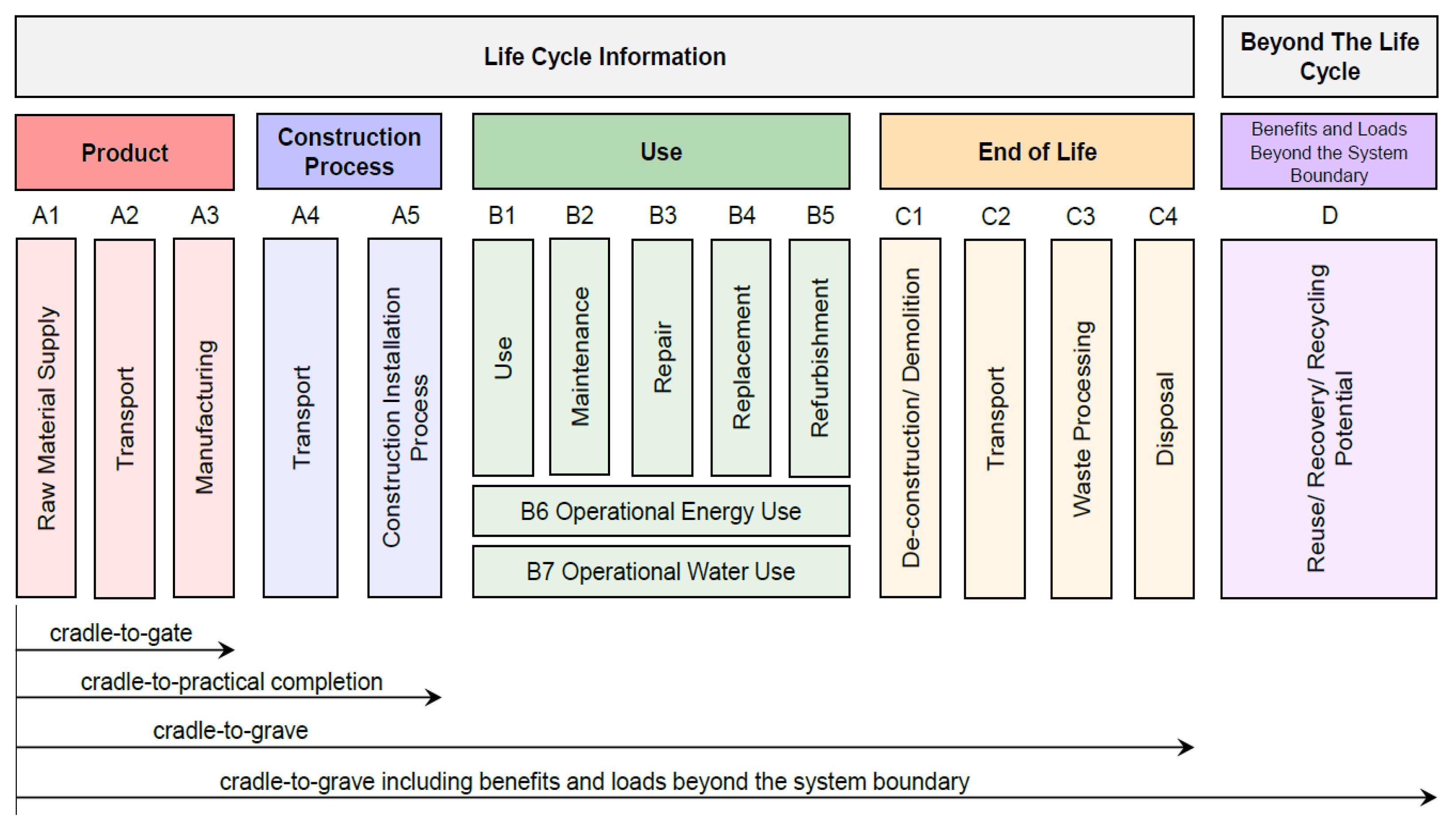
Figure 2.
Uncertainty of embodied carbon by construction products [121].
Figure 2.
Uncertainty of embodied carbon by construction products [121].
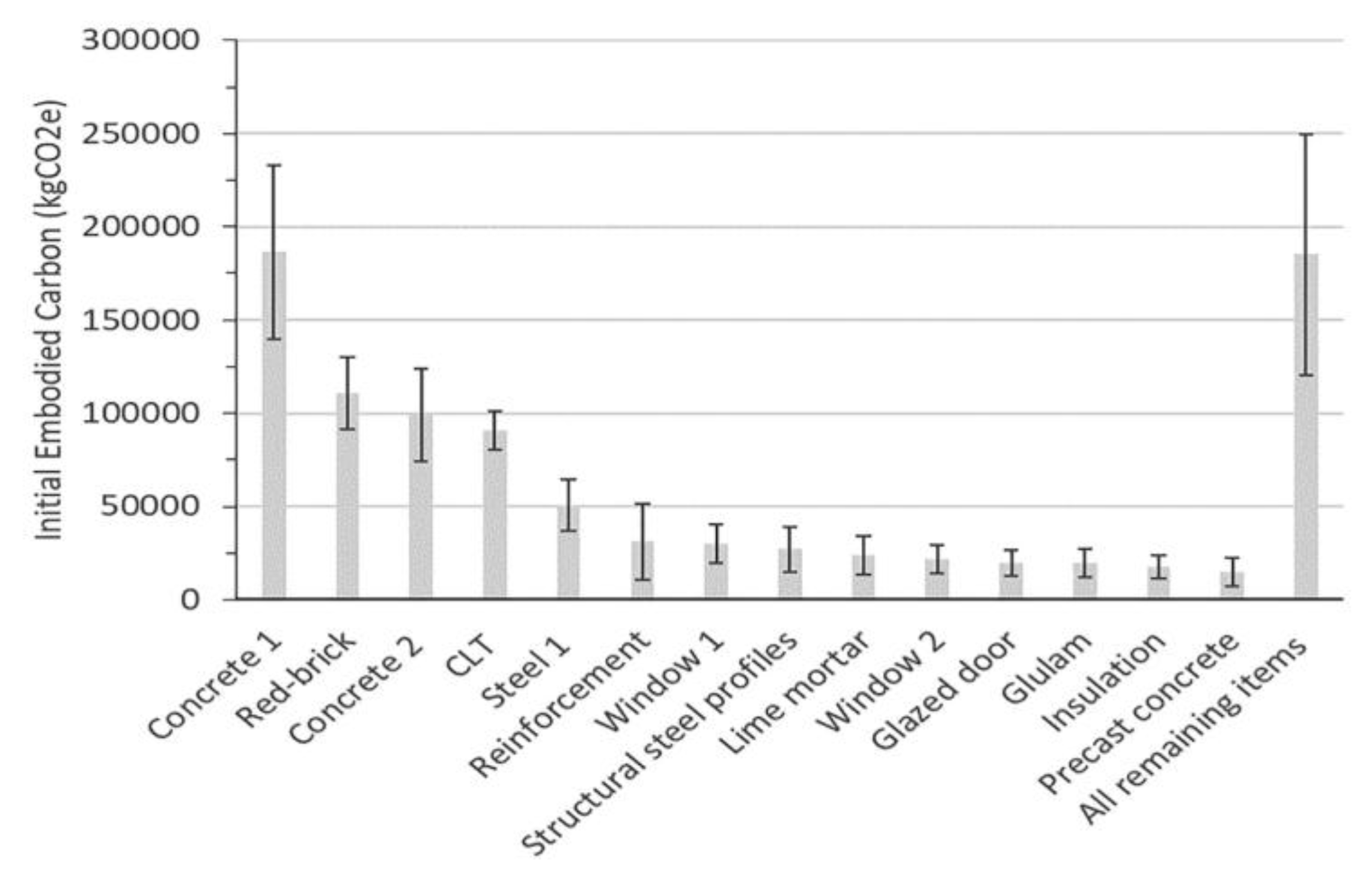
Figure 3.
Various design strategies to reduce embodied carbon in buildings, IEA [126].
Figure 3.
Various design strategies to reduce embodied carbon in buildings, IEA [126].
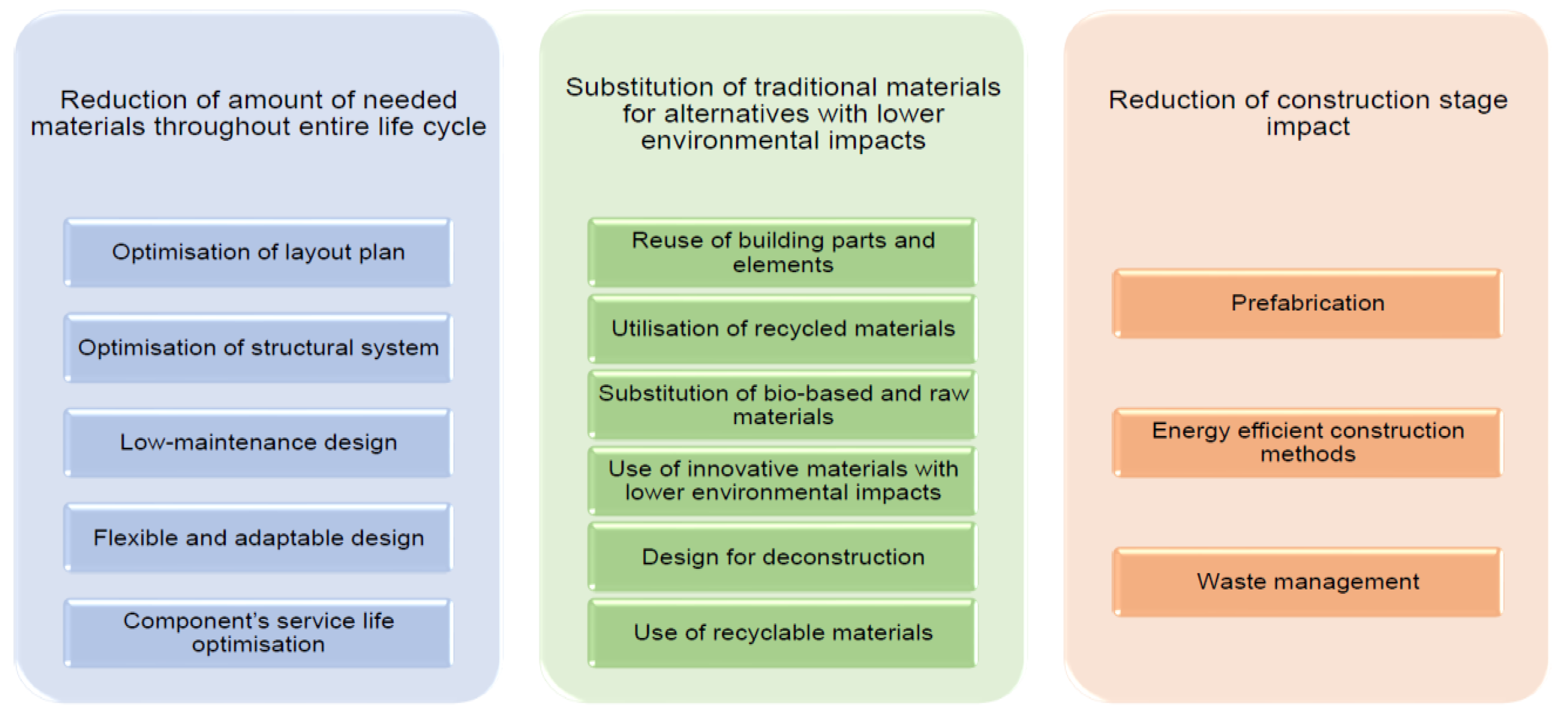
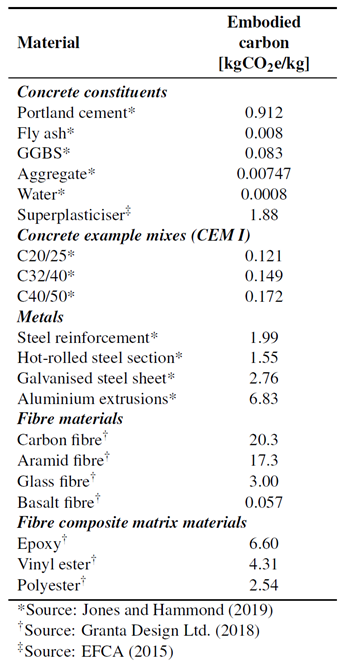
Disclaimer/Publisher’s Note: The statements, opinions and data contained in all publications are solely those of the individual author(s) and contributor(s) and not of MDPI and/or the editor(s). MDPI and/or the editor(s) disclaim responsibility for any injury to people or property resulting from any ideas, methods, instructions or products referred to in the content. |
© 2025 by the authors. Licensee MDPI, Basel, Switzerland. This article is an open access article distributed under the terms and conditions of the Creative Commons Attribution (CC BY) license (http://creativecommons.org/licenses/by/4.0/).
Copyright: This open access article is published under a Creative Commons CC BY 4.0 license, which permit the free download, distribution, and reuse, provided that the author and preprint are cited in any reuse.


