

Submitted:
07 February 2025
Posted:
10 February 2025
You are already at the latest version
Abstract
This article revisits the foundational principles behind the concepts of organization and structure. Defining "organization" is particularly challenging, as existing terminology often fails to fully capture its complexity. Words like "organization" can be interchangeable with terms such as entity, connection, mechanism, social complex, and mode of administration, among others. However, relying solely on synonyms is insufficient, often leading to a cycle of circular definitions. Many interpretations tend to lean toward synonymous or circular explanations. As a result, it is essential to deepen our understanding of key concepts in contemporary society-organization and structure-to ensure conceptual clarity. By exploring these ideas, the article moves beyond mere linguistic equivalents, aiming to provide a comprehensive understanding of their multifaceted nature. The paper also examines the cultural dynamics within European countries and presents several organizational models.
Keywords:
| 1 | Fragments of this material were published as Covaci M., Considerations regarding the influence of entropy in organizations, Psycho-Social View Journal, 2021; Covaci M., Covaci B., The Interconnection of Organization and Organizing in the Cultural Dynamics: A Review, Journal for Freedom of Conscience, 2023; Covaci M. (2019). Doctoral thesis. National School of Political and Administrative Studies; Covaci, M. (2024). Academic satisfaction of students: validity and reliability study. ORAV; Covaci, M (2024). Organizational negentropy-theory and concepts. ORAV; Covaci, M. (2024). Organizational negentropy-regression analysis and correlations. ORAV; Covaci, M. (2024). Organizational negentropy-statistical research. ORAV |
| 2 | Keyton, J., Communication and organizational culture: a key to understanding work experiences, Thousand Oaks, California, Sage Publications, 2005. |
| 3 | Vlăsceanu, M., Organizations
and organizational culture, Iași, Trei, 1999. |
| 4 | Marshall, G., Oxford. Dictionary of Sociology, Bucharest, Encyclopedic Universe, 2003. |
| 5 |
Ibid. |
| 6 |
Ibid. |
References
- COVACI, M., Organizational culture as negentropy, National School of Political and Administrative Studies. Doctoral thesis, 2019.
- COVACI, M., Organizational Negentropy. Theory and concepts, ORAV Austria, 2024.
- COVACI, M., Organizational Negentropy: Statistical Research, ORAV Austria, 2024.
- COVACI, M., Organizational Negentropy: Regression Analysis and Correlations, ORAV Austria, 2024.
- CULDA, L., Organizations, Bucharest, Licorna, 1999.
- DRUCKER, PF, Post-capitalist Society, Oxford, Butterworth-Heinemann, 1993.
- GIBSON, JL et al., Organizations. Behavior, Structure, Processes (ed. 14). New York, The McGraw-Hill Companies, 2012.
- GREENFIELD, BT, Organizations as social inventions. Symposium on Developing Effective Educational Organizations: Concepts, Realities and Strategies for Change (p. 30). New Orleans: Greenfield Department of Educational Administration. Ontario, Institute for Studies in Education, 1973.
- HERNES, T., Understanding Organization as Process: Theory for a Tangled World. Routledge, 2008.
- KEYTON, J., Communication and organizational culture: a key to understanding work experiences. Thousand Oaks, California, Sage Publications, 2005.
- LUHMANN, N. LUHMANN, N., Social Systems (Writing Science), Stanford University Press, 1995.
- MARSHALL, G., Oxford. Dictionary of Sociology, Bucharest, Encyclopedic Universe.2003.
- MORGAN, R., Images of Organization, London, SAGE Publications, 2006.
- RABOCA, HM (no year). Organizational Theory and Behavior. Retrieved from http://www.apubb.ro/wp-content/uploads/2011/02/Curs-Teorii-Organizational-Master.pdf.
- RAFAELI, A. “ What is an Organization? Who are the Members?”, Creating Tomorrow’s Organizations: A Handbook for Future Research in Organizational Behavior, 1996, p. 25.
- ROBBINS, SP, & Judge, TA, Organizational Behavior (15th ed.). New Jersey, Pearson Education, Inc., 2013.
- SCHERMERHORN, JR et al., Organizational behavior (ed. 7). John Wiley & Sons, 2002.
- STEVEN KS et al., “Self-Organization and Social Organization: US and Chinese Constructions,” in TR Tyler, RM Kramer, & OP John, The Psychology of the Social Self (pp. 193-222). Routledge, 1999.
- VLĂSCEANU, M., Organizations and organizational culture, Iași, Trei, 1999.
- VLĂSCEANU, M., Organizations and organizational behavior, Iași, Polirom, 2003.
- ZLATE, M. ZLATE, M., Treatise on organizational-managerial psychology, Vol. I, Iași, Polirom, 2004.
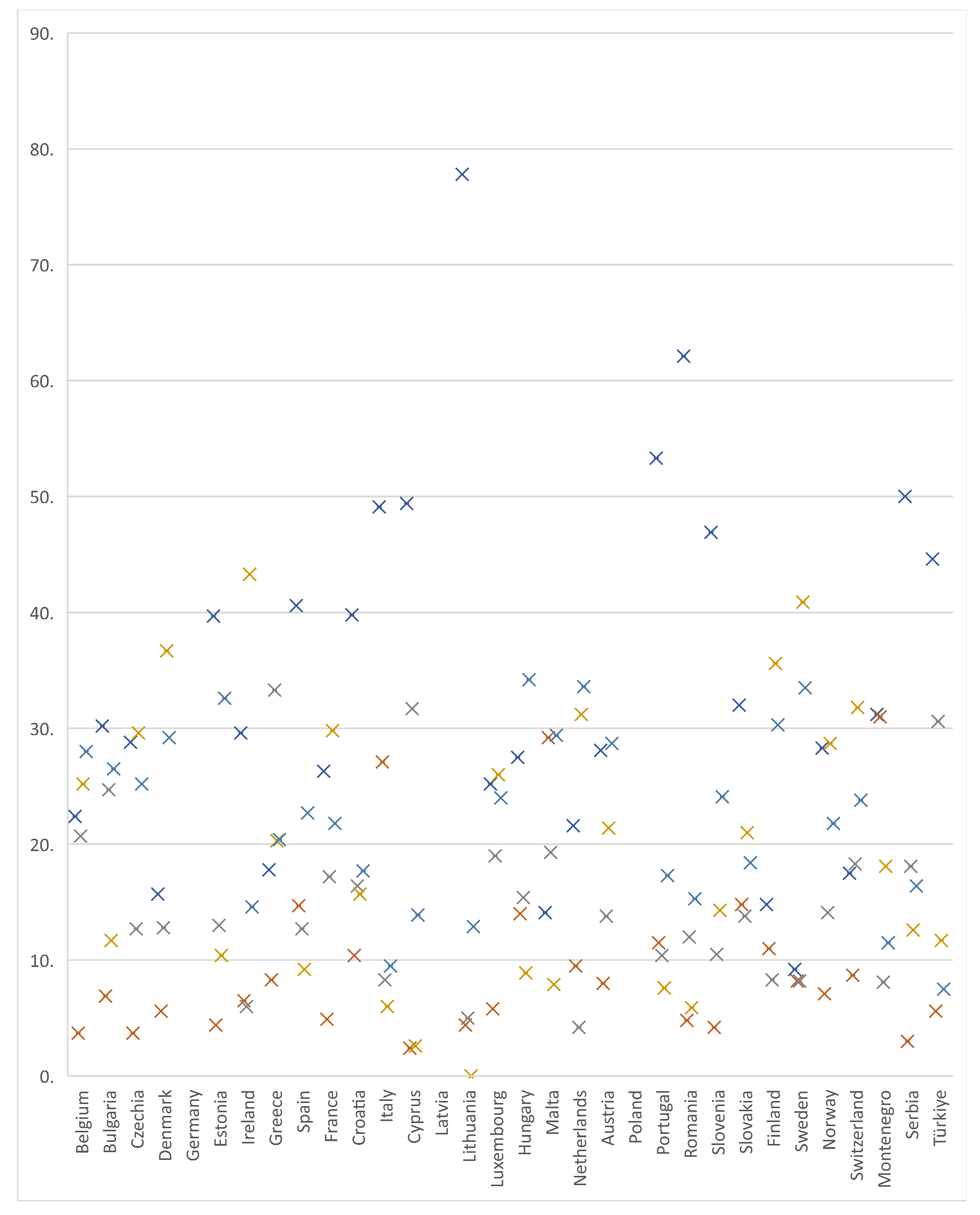
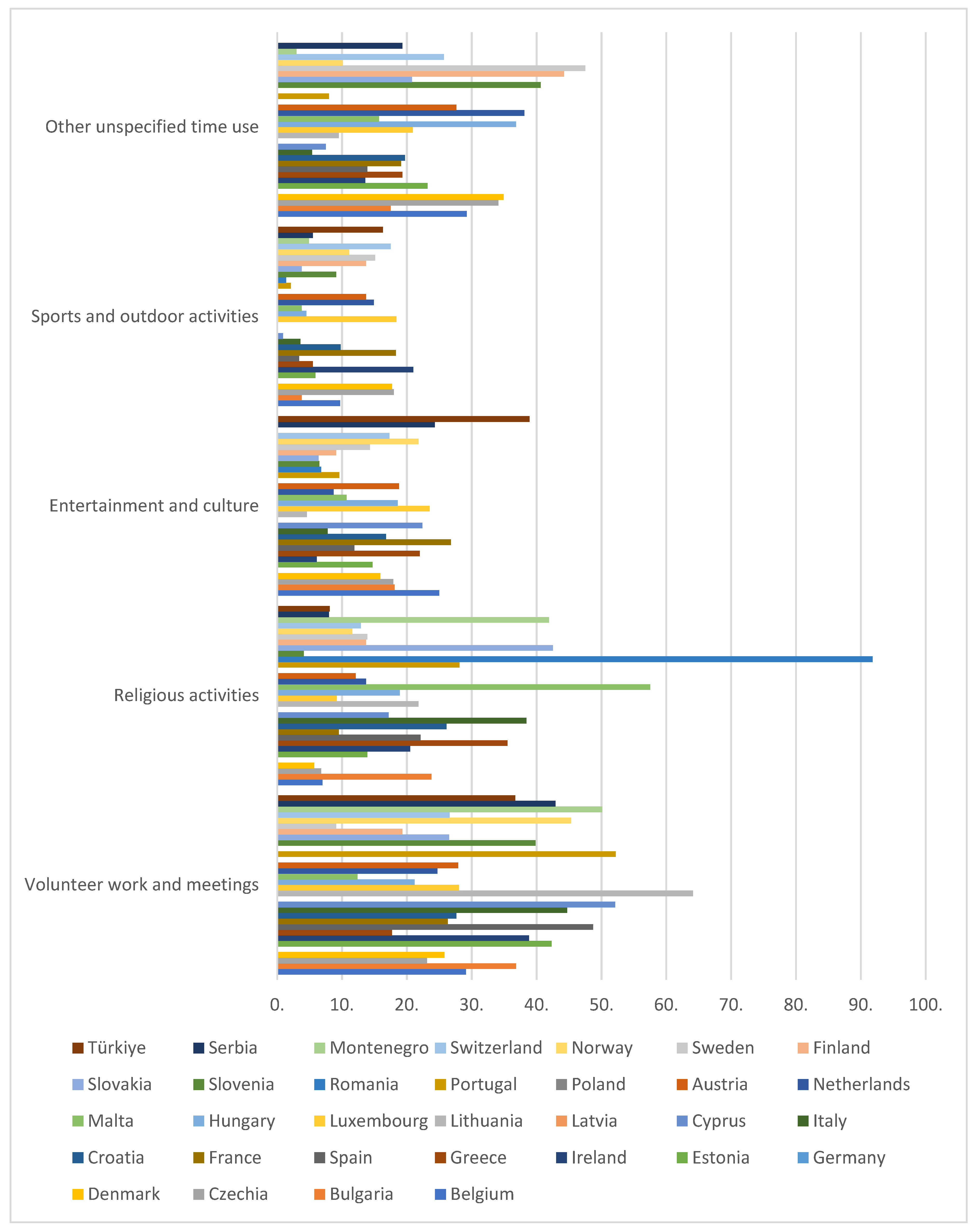

| Volunteer work and meetings (+/-) | Religious activities (+/-) | Entertainment and culture (+/-) | Sports and outdoor activities (+/-) | Other unspecified time use (+/-) | |
|---|---|---|---|---|---|
| Belgium | -6.7 | -3.3 | -4.3 | 15.5 | -1.2 |
| Bulgaria | -6.6 | -16.9 | 6.6 | 7.9 | 9.0 |
| Czechia | 5.7 | -3.1 | -5.2 | 11.6 | -8.9 |
| Denmark | -10.1 | -0.1 | -3.1 | 19. | -5.7 |
| Germany | 0. | 0. | 0. | 0. | 0.0 |
| Estonia | -2.6 | -9.5 | -1.7 | 4.5 | 9.4 |
| Ireland | -9.2 | -14. | -0.1 | 22.3 | 1.0 |
| Greece | 0.1 | -27.2 | 11.3 | 14.8 | 1.1 |
| Spain | -8.1 | -7.4 | 0.8 | 5.8 | 8.8 |
| France | 0. | -4.6 | -9.6 | 11.5 | 2.7 |
| Croatia | 12.2 | -15.7 | -0.4 | 5.9 | -2.0 |
| Italy | 4.4 | -11.3 | 0.5 | 2.4 | 4.1 |
| Cyprus | -2.7 | -14.8 | 9.3 | 1.7 | 6.4 |
| Latvia | 0. | 0. | 0. | 0. | 0.0 |
| Lithuania | 13.7 | -17.4 | 0.4 | 0. | 3.4 |
| Luxembourg | -2.8 | -3.4 | -4.5 | 7.6 | 3.1 |
| Hungary | 6.3 | -4.9 | -3.2 | 4.4 | -2.6 |
| Malta | 1.7 | -28.3 | 8.6 | 4.1 | 13.7 |
| Netherlands | -3.1 | -4.2 | -4.5 | 16.3 | -4.5 |
| Austria | 0.2 | -4.1 | -5. | 7.7 | 1.1 |
| Poland | 0. | 0. | 0. | 0. | 0.0 |
| Portugal | 1.1 | -16.6 | 0.8 | 5.5 | 9.3 |
| Romania | 62.1 | -87. | 5.2 | 4.5 | 15.3 |
| Slovenia | 7.1 | 0.1 | 4. | 5.2 | -16.5 |
| Slovakia | 5.5 | -27.7 | 7.4 | 17.2 | -2.4 |
| Finland | -4.5 | -2.7 | -0.8 | 21.9 | -13.9 |
| Sweden | 0.1 | -5.7 | -6.1 | 25.8 | -14.0 |
| Norway | -17. | -4.5 | -7.7 | 17.6 | 11.7 |
| Switzerland | -9.1 | -4.2 | 1. | 14.3 | -1.9 |
| Montenegro | -18.9 | -10.9 | 8.1 | 13.2 | 8.5 |
| Serbia | 7.1 | -5. | -6.2 | 7.1 | -2.9 |
| Türkiye | 7.9 | -2.5 | -8.3 | -4.6 | 7.5 |
Disclaimer/Publisher’s Note: The statements, opinions and data contained in all publications are solely those of the individual author(s) and contributor(s) and not of MDPI and/or the editor(s). MDPI and/or the editor(s) disclaim responsibility for any injury to people or property resulting from any ideas, methods, instructions or products referred to in the content. |
© 2025 by the authors. Licensee MDPI, Basel, Switzerland. This article is an open access article distributed under the terms and conditions of the Creative Commons Attribution (CC BY) license (http://creativecommons.org/licenses/by/4.0/).


