

Submitted:
05 February 2025
Posted:
07 February 2025
You are already at the latest version
Abstract
The paper starts from the distributed parameter models for both torsional and axial vibrations of the oilwell drillstring. While integrating several accepted features, the considered models are deduced following the Hamilton variational principle in the distributed parameter case. At their turn, these models are now completed in order to take into account the elastic strain in driving signal transmission to the drillstring motions - rotational and axial (vertical). Stability and stabilization are tackled within the framework of the energy type Lyapunov functionals. Since from such “weak” Lyapunov functionals only non-asymptotic Lyapunov stability can be obtained, asymptotic stability follows from the application of the Barbashin-Krasovskii-LaSalle invariance principle. This use of the invariance principle is done by associating a system of coupled delay differential and difference equations, recognized to be of neutral type. For this system of neutral type the corresponding difference operator is strongly stable hence the Barbashin-Krasovskii-LaSalle principle can be applied. Note that this strong stability of the difference operator has been ensured by the aforementioned model completion with the elastic strain induced by the driving signals.
Keywords:
drillstring vibrations
; Hamilton principle
; distributed parameters
; asymptotic stability
; Lyapunov functionals
; invariance principle
MSC: 35L20; 34K20; 34K40; 93D30; 93D15
1. Introduction and Motivation
The problem of vibration quenching of the oilwell drillstring is extremely important from both technological and economic points of view. Oil extraction industry has at least 150-200 years hence it seems senseless to follow the entire literature on the subject. We shall restrict therefore to the last 2-3 decades, when the distributed parameter description was introduced (according to our knowledge). We met this description in [1], then the model occurred in [2], being afterwards adapted in the PhD thesis [3] and in the subsequent papers [4,5,6]. In the same line we can mention the surveys [7,8] and, with Particular reference, the monograph [9]. More recently we can mention the papers [10,11,12]
The aforementioned references deal with the distributed parameter drillstring dynamics and with the feedback control of vibration quenching. It is generally accepted that the (nonlinear) vibrations are induced by the interaction rock-drilling bit which is described by various nonlinear models [7,8,9]. On the other hand, there exist other models of vibration ignition, taking into account the dynamics of the driving motors while considering a lumped parameter dynamics for the drillstring. We can cite here the PhD thesis [13] and the paper [14].
While the idea of discovering hidden oscillations of [14] looks interesting and very useful, we shall focus here on the first class of the aforementioned problems i.e. vibration quenching for distributed parameter models. Our motivations consists in the necessity of completing the model with neglected terms allowing to obtain rigorous mathematical results for vibration quenching and in considering both torsional and axial vibrations. As mentioned in [10], the torsional vibrations are most important for the drillstring. While the model structure allows to consider the two types of vibrations separately, the mathematical aspects are slightly different.
Last but not least, the stability analysis, more precisely the asymptotic stability analysis, requires introduction of the neutral functional differential equations satisfying the well known assumption of J. K. Hale [15] about the asymptotic, even strong stability in the delays, of their difference operator. Throughout the paper it will appear how this assumption is fulfilled within the framework of the model deduction.
Therefore, what is left of the paper is organized as follows. Firstly, it is presented the dynamics of both torsional and axial vibrations as resulting from the application of the Hamilton variational principle [16,17,18], all basic notations being explained in the Appendix. Next, the steady states are defined and computed, the deviations from the state are defined. The systems in deviations are written and the energy-based Lyapunov functionals are associated to them. The properties of the models and of the derivatives of the Lyapunov functionals allow obtaining the uniform Lyapunov stability and global boundedness of the trajectories. These properties are obtained by synthesizing linear feedback controllers with dynamics, making use of the positiveness theory i.e. the Yakubovich-Kalman-Popov lemma [19].
In order to obtain asymptotic stability via the Barbashin-Krasovskii-LaSalle invariance principle, systems of coupled delay differential and difference equations (recognized to be of neutral type [15], p. 301) are associated to the initial models described by partial differential equations of hyperbolic type with derivative boundary conditions. The solutions of the two mathematical objects are shown to be in a one-to-one correspondence and, consequently, any mathematical result obtained for one of them is projected back on the other. Therefore asymptotic stability obtained for the systems of coupled delay differential and difference equations will give the same property for the initial models described by partial differential equations of hyperbolic type with derivative boundary conditions. The asymptotic stability results will be obtained first for each type of vibrations model separately. However the system of torsional vibrations introduces a perturbation in the system modeling the axial vibrations. Consequently the asymptotic stability is afterwards obtained for the coupled systems using a Lyapunov functional which is a linear combination of those used for each system describing the drillstring vibrations (torsional and axial). The paper ends with conclusions and enumeration of possible extensions of the obtained results.
2. The Model of the Coupled Torsional and Axial Vibrations of the Drillstring in Distributed Parameters
The practical experience shows that the torsional vibrations are the dominant vibrations in drillstring dynamics. There exist however a number of notable references displaying both types of vibrations coupled at the level of the drilling bit, with the torsional vibrations acting on the axial ones but without the reverse [7,8,9]. Here we do not intend to compete with them, our aim being to deduce both dynamics from the Hamilton variational principle. For a general explanation of this principle, the reader is sent to such basic texts as [16,20,21,22]. In the following the Hamilton principle will be applied to mechanical systems subject to several external forces and torques. As it will appear in the sequel, the “list” of the external forces and torques is of utmost importance in order to obtain an adequate mathematical model.
2.1 Consider first the torsional - main - vibrations and construct the integral of the Hamilton principle. The rotational kinetic energy is given by
The potential energy due to the elastic strain is given by
Obviously we considered the general case of a space inhomogeneous material i.e depending on - the linear coordinate along the drillstring - see Appendix A with paper’s notations. The “list” of the generalized torques performing torsion and rotation, together with their expressions is also given in the Appendix.
We write down the work of the rotation torques
Consequently the Hamiltonian of the rotational dynamics is defined by
where , are two arbitrary time moments.
2.2 Consider now the axial vibration dynamics. Define the kinetic energy
and the potential energy of the elastic strain by stretching and compression
The list of the generalized forces performing penetration and deformation work on the drillstring (along the vertical) is given in the Appendix.
We now write down the work of the vertical forces as follows
and the Hamiltonian of the axial dynamics
The Hamiltonian of the overall drillstring vibration dynamics will then be
2.3 Consider now the Euler-Lagrange variations of the generalized coordinates as follows
where the bar variables account for a basic motion. Substituting (10) in the Hamiltonians the perturbed Hamiltonians are obtained
as follows
and, analogously
Formulae (12) and (13) show that is quadratic in both and ; however the two -s never mix in the aforementioned expressions.
2.4 We shall recall now the Hamilton variational principle after [16], p.113:
The motion of the mechanical system occurs in such a way that the definite integral (11) becomes stationary for arbitrary possible variations of the configuration of the system, provided the initial and final configurations are given.
The stationarity conditions of the integral are given by
It can be seen also from (12), (13) that the quadratic terms (in and are positive. Therefore the Hessian matrix of is diagonal and positive definite. The stationary “point” defined by (14) is a minimum. Also “prescribed initial and final configurations” means that all variations are 0 for , :
The two integrals and can be discussed separately, as (14) shows. Consider first the integral to find
After the application of Fubini theorem and several integrations by parts, the following equations are obtained for any admissible motion
Substituting the various expressions for the torques in (16), the following boundary value problem is obtained
This is a boundary value problem for a hyperbolic second order partial differential equation. It is a non-standard boundary value problem since the boundary conditions contain derivatives and are coupled to certain ordinary differential equations. The partial differential equation represents the model of a vibrating string. This follows from the choice of the potential energy (2). Other equations, modeling Euler-Bernoulli, Kelvin-Voigt or Timoshenko beams can be obtained by choosing the corresponding forms of the potential energy [23,24,25].
Consider now the integral whose structure is analogous to that of . Again, application of the Fubini theorem, integrations by parts and substitution of the various forces will give the following boundary value problem describing the dynamics of the axial vibrations
A simple examination of (17) and (18) shows that the equations of (17) are quasi-linear because of the term which is nonlinear; they contain the input (control) torque signal which serves to control the torsional vibrations by a feedback control device. The torsional vibrations dynamics is not affected by the axial dynamics and can be examined separately of it. Unlikely, examination of (18) shows that the axial vibrations dynamics system is linear, controlled by the input (control) force signal but is also subject to an external perturbation signal arising from the torsional vibrations dynamics. Consequently, the axial vibrations can also be analyzed separately but taking into account the effect of the perturbation.
2.5 To complete the discussion we shall give some details concerning the load torque at the drilling bit as they can be met in the basic references. One of the simplest form is given in [2]
This expression introduces a coupling between torsional and axial dynamics; the author substitutes by its steady state value, achieving the dynamics decoupling. In [7,8,9] the following expression is used, based on the models including Coulomb friction
where . This expression contains a finite jump at
Little is known about initial boundary value problems for hyperbolic partial differential equations with discontinuous right hand side and, in order to achieve a rigorous mathematical treatment, discontinouous expressions for will be avoided. In those references and surveys previously cited [7,8,9] the discontinuous models of - obtained from the use of various friction models (Coulomb, Karnopp) - were replaced by the following expression, considered to be a suitable approximation of them
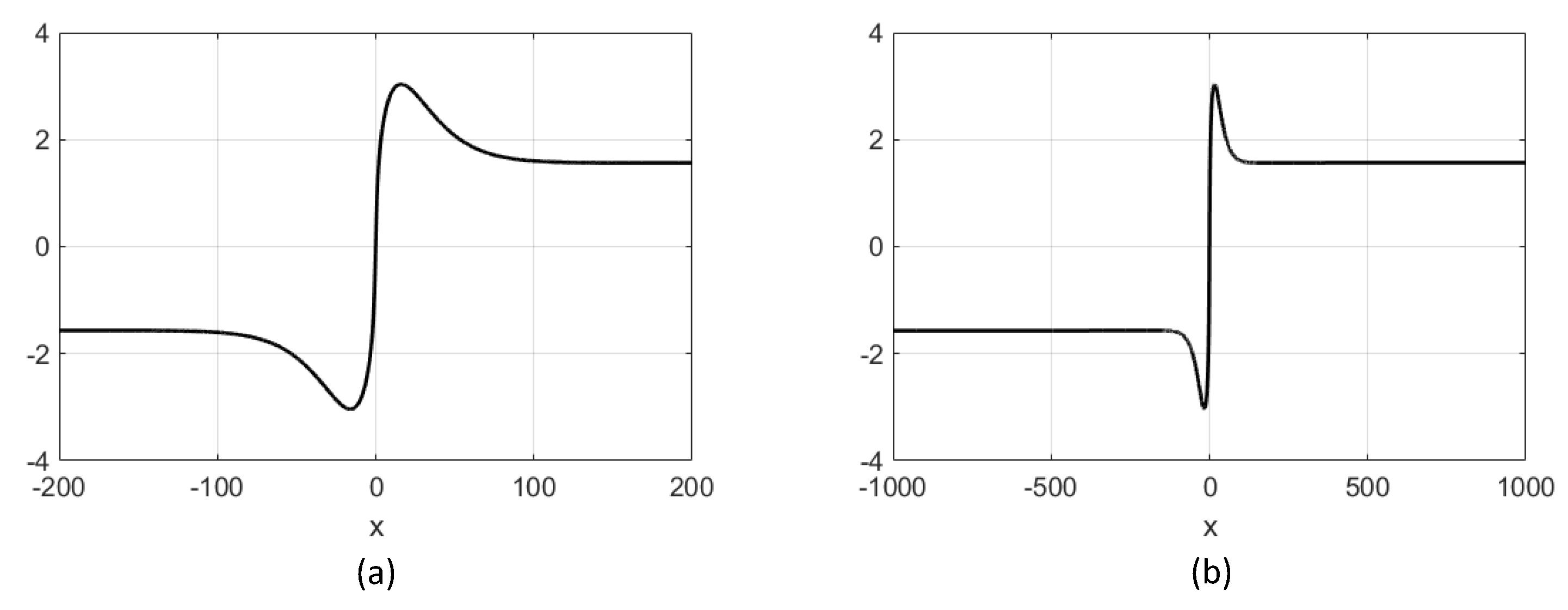
In fact, as its graphical representation shows - Figure 1a, the approximation is suitable around (the discontinuity point) mainly
Indeed, and also
Smaller is k, closer to the discontinuity at is this approximation (p is a scale factor which adjusts the value of the extremum values). However, outside the interval , the slope of changes sign (the graphic approaches slowly 0 asymptotically for ) and can induce instabilities. The underlying idea is that while is subject to a sector (Lurie-type) condition
the condition of the global Lipschitz type that is
which is necessary for the global asymptotic stability of an imposed steady state, is valid only on a bounded interval; consequently asymptotic stability holds only on bounded domains of the state space.
In [26,27] the following expression is used
with . We give below some of its properties. Firstly we observe that hence is an odd function: its analysis for is sufficient, also it suffices to consider . Further
Consider now the derivative
and hence is increasing at least on a certain interval around . The zeros of follow from the equation
and, taking into account the values of given in [26,27], equation (28) has two positive roots. As shown there, given by (26) looks as in Figure 1b, displaying a maximum and a minimum which are quite close, then increasing very slowly up to . It follows that choosing e.g. such that , the following will hold
(after some elementary straightforward manipulation). In fact (29) holds provided not both , are located where the slope of is negative. In practice this condition is always fulfilled since the operating steady state point is defined by - the steady state angular speed - within the interval of the nonlinearity , corresponding to the maximal value of the nonlinear function . In the following we shall refer to (26) for .
3. Cyclic Variables. Steady States. Energy Identity.
3.1 A simple examination of (17) and (18) shows that , , , enter in these equations only by their time derivatives i.e. they are cyclic variables; the equations give information about the derivatives only while the angular and linear positions are irrelevant (the assertion obviously follows from physical considerations). We can therefore introduce the new variables
to obtain the models without the cyclic variables
and
3.2 The equations of the steady states of (31) and (32) are obtained by letting the time derivatives to 0 thus obtaining
and
These two systems are also rather similar. We shall start the analysis with system (33), obtaining firstly that . Next
Therefore
and is re-written as
We have still to examine
that is two nonlinear equations with three unknowns. Usually the angular velocity of the drillstring is imposed from technological considerations. Then the system above becomes a linear one in the unknowns and thus allowing to obtain the steady state values for (31) from (33)
We turn now to (34) where is a known steady state forcing term “arising” from “outside” (the system of torsional vibrations). We have . Here also, the advancement (penetrating) linear velocity is imposed from technological considerations. Repeating the steps of the computation for the torsional vibrations steady state we obtain the steady state values for (32) from (34)
3.3 We shall consider now the energy identities for systems (31) and (32). We start with system (31). Multiply the first partial differential equation by , the second one by , add the two resulting equalities and integrate the with respect to s from 0 to L to obtain the energy identity
In the same way we obtain the energy identity for (32)
4. The Systems in Deviations and Their Control. Stability
The problem which is tackled in this section is the design of the stabilizing feedback controller for the torsional and axial dynamics respectively as well as the achieved in this way stability properties.
4.1 Consider first the dynamics of the torsional vibrations (31) and its steady state (35). Introduce first the deviations from the steady state of the variables in (31)
where is given and , and are obtained from (35). The new variables satisfy the system in deviations below
Identity (43) suggests a feedback controller with its output containing . On the other hand since the driving mechanism of the drillstring is located at , the only possible input - technically speaking - is . We shall thus define the following linear controller
under the following basic assumptions on it: it has inherent stability i.e. is a Hurwitz matrix and the transfer function is an irreducible rational function - equivalently is a controllable pair and is an observable pair.
Taking i.e. a negative feedback connection, the identity (43) becomes Looking at (39) we can write down immediately the analogous identity associated to (42)
We are now in position to define the following Lyapunov functional - written along the solutions of (42)-(44)
where is a symmetric matrix which will be determined in the following. Differentiating and taking into account the identity (45) we obtain
The right hand side of (47) contains obviously negative terms including the term in - see Figure 1b. We have to focus on the first three terms in (47) - the ones in and containing also the symmetric matrix whose choice and properties are yet to be determined. We turn to Yakubovich-Kalman-Popov lemma [19,28] whose useful for our conditions version is given in Appendix 2. In our case and and the lemma reads as follows
There exists a symmetric matrix and a vector of appropriate dimensions such that the identity
holds for any real vector and real scalar if and only if the following frequency domain inequality
holds for all frequencies
Assuming that the controller is such that (49) holds, we take the symmetric matrix in (46) as the one prescribed by (48). Therefore the derivative (47) of the Lyapunov functional (47) is at least non-positive.
We next show that this will imply Lyapunov stability in the metrics induced by the Lyapunov functional itself of the zero equilibrium of the closed loop system in deviations, defined by (42),(44). Therefore we focus again on matrix . From the Yakubovich-Kalman-Popov lemma it is known that (48) holds for any reals and . Assume now that (48) holds, in particular, for some vector and scalar satisfying
even if they are not variables satisfying (42),(44). As a more particular case, assume and integrate (48) between 0 and t to obtain
hence
Since is a Hurwitz matrix, , , thus resulting nonnegative definite because is arbitrary with its initial condition. From and we deduce that
On the other hand, let be components of a solution of (42),(44). Since is a Hurwitz matrix, there exist , such that . Therefore a straightforward manipulation will give
and (51),(52) give the Lyapunov stability of the zero equilibrium of (42)-(44), also global boundedness of the solutions. We have proven in fact
Theorem 1.
4.2 Consider now the dynamics of the axial vibrations. We shall proceed by analogy to the previous case of the torsional vibrations and pointing out the differences. Consider therefore the dynamics of the axial vibrations (32) and its steady state (36). Introduce the deviations from the steady state of the variables in (32)
where is given and , and are obtained from (36). The new variables satisfy the system in deviations below
Identity (56) suggests a feedback controller with its output containing - the deviation from the steady state. On the other hand, since the driving mechanism of the drillstring is located at , the only possible input - technologically speaking - is also . By analogy to the case of the torsional vibrations, we shall define the following linear controller
under the same basic assumptions as in the previous case of the torsional vibrations: it has inherent stability i.e. is a Hurwitz matrix and the transfer function is an irreducible rational function - equivalently is a controllable pair and is an observable pair.
Now, a slight difference with respect to the previous case has to be taken into account: system (55) is subject to an external perturbation “arising” from the dynamics of the torsional vibrations and, as follows from Theorem 1, is bounded for . From now on we shall be interested in the inherent stability of (55) and will assume for a while that this external perturbation is identically zero.
We take - a negative feedback connection and (56) becomes
(the perturbation term is now identically zero). We can now define the Lyapunov functional - written along the solutions of (55),(57)
where is a symmetric matrix prescribed by the Yakubovich-Kalman-Popov lemma. Taking the derivative of combined with the identity (56) - without the perturbation generated term - it follows that
The last identity follows from the application of Yakubovich-Kalman-Popov lemma under the positiveness frequency domain inequality
for all frequencies - see (49) for comparison. FRom now on the development follows the line of the previous, torsional vibrations case. From the fact that is a Hurwitz matrix, we obtain that and, as in the previous cae, it is obtained Lyapunov stability in the sense of the metrics induced by the Lyapunov functional itself. Without reproducing the formulae which are analogous to (51)-(52) we give below the result
Theorem 2.
Consider the closed loop control system (51),(57) of the controlled axial vibrations dynamics under the following assumptions: i) is a Hurwitz matrix; ii) the frequency domain inequality (61) holds; iii) the perturbation term is identically zero. Then the zero solution of (51),(57) is Lyapunov stable in the metrics induced by the Lyapunov functional (59).
5. Asymptotic Stability and Other Asymptotic Properties
The Lyapunov stability property has been obtained in the previous section by using the energy Lyapunov functional. As well known from the publications of the classics of the Lyapunov theory such as N. G. Četaev, the energy Lyapunov function(al) is a “weak” one which is easily constructed but with its derivative along the system’s solutions being only non-positive.(51),(57) - see e.g. [29]. This fact among others led to the Barbashin-Krasovskii-LaSalle invariance principle e.g. [30,31]. In the infinite dimensional case however, its proof and application requires pre-compactness of system’s bounded trajectories [32,33] - not easy to prove (notwithstanding, in the finite dimensional case the bounded trajectories are also compact).
For this reason we shall follow a pathe which goes back to Myshkis [34] and Cooke [35]. Our experience in this approach, summarized in [36] spreads over several decades. It consists in associating to the basic system a system of functional differential equations - in most cases of neutral case - for which the Barbashin-Krasovskii-LaSalle invariance principle holds. Due to the one-to-one correspondence between the solutions of the two aforementioned mathematical objects (the initial-boundary value problem with derivative boundary conditions and the associated system of functional differential equations with deviated argument) the asymptotic stability obtained for one of them (the system of functional differential equations) is automatically projected back on the other. In the following this approach will be applied to the dynamics of the drillstring vibrations.
5.1. Asymptotic stability of the equilibrium in the torsional vibrations case
We may call this aspect asymptotic vibration quenching in the torsional case. Consider the closed loop (with controller) system described by (42),(44) - with - under the assumptions of zero distributed damping i.e. and constant material parameters i.e. , , . We shall thus have the following initial-boundary value problem with constant coefficients
We shall follow the procedure suggested in [35] and fully proven and described in [36]. Introduce firstly the Riemann invariants from
to associate to (62) the partial differential equations of the Riemann invariants
Substituting also (63) in the boundary conditions of (62), the transformed boundary conditions are associated to (64)
(We denoted , the reason will appear in the sequel).
In the next step we shall consider the two families of the characteristic straight lines - the solutions of
and focusing on the two characteristics crossing some point . It is straightforward that the Riemann invariants are constant along the characteristics - along and along . Therefore the following representation formulae are valid
expressing the Riemann invariants as functions of their boundary values. Considering those characteristics which can be extended on the whole interval , we obtain the following relations between the boundary values of the Riemann invariants
and they emphasize why is called the propagation time along the characteristics. Denoting
and substituting in (65) we obtain after some straightforward manipulation
with the propagation time along the characteristics.
This system has the general form
and was introduced in our early papers [37,38] and recognized as reducible to a system of neutral type in [15], p. 301. Besides the development of the second author of this paper - see [36] for a state of the art - this system has recently received a renewed approach e.g [39]. The solution of (70) can be constructed by steps on intervals , (i.e. forward and backward) provided initial conditions are given on . These initial conditions are obtained as follows: , , “migrate” from (62) to (70) and with follow from and , via the converse of (63) - to obtain - and from (67) by considering those characteristics which cannot be extended to the whole segment but cross it for some . In fact, from the constance of the Riemann invariants along the characteristics we shall have, based on (67), the following.From the first equality in (67), considering those characteristics crossing the abscissa , it follows that the crossing takes place at , . Therefore hence . In the same way, in the second equality of (67) we consider those characteristics crossing the abscissa at , . Further we obtain . After a change of variables we obtain finally
It appears that starting from a classical solution of (62) with some initial conditions we associated a solution of system (70) of functional differential equations with the initial conditions with obtained from (71). The converse is also true: considering a solution of (70) defined by some initial conditions with sufficiently smooth e.g. continuously differentiable, then is a classical solution of (62) where migrate from the solution of (70) and are defined, as suggested by (67) and (69)
and , following from (63). The initial conditions of this solution follow by letting in the obtained expressions.
Summarizing we have obtained the following result
Theorem 3.
Consider a classical solution of (62) defined by some initial conditions , where we defined . Then is a solution of system (70), where are obtainedvia(63), (67), (69), is a solution of (70) with the initial conditions where are obtained from (71). Conversely, consider a solution of (70) defined by certain initial conditions with sufficiently smooth, then is a classical solution of (62) with defined from (72) and (63), the initial conditions being obtained by letting in the aforementioned solution of (62).
Now, Theorem 3 establishes a one-to-one correspondence between the solutions of two mathematical objects i.e. (62) and (70) and any result about one of these objects is projected back on the other.
In particular this will allow application of the Barbashin-Krasovskii-LaSalle invariance principle to system (70) to obtain asymptotic stability which will afterwards migrate to (62). To do this we shall associate to (70) a Lyapunov functional which is adapted from (46) - considered in the case of the constant parameters. In fact we have to express the integral in (46) using the representation formulae (72) and (63), recalling that and . The computations are quite straightforward and will give the following Lyapunov functional - written along the solutions of (70)
Differentiating it along the solutions of (70) we obtain, based also on the re-writing of (47), relying on the representation formulae (72)
This shows that the zero solution of (70) is Lyapunov stable in the sense of the metrics induced by the Lyapunov functional (73) itself. Based on Theorem 3 the Lyapunov stability in the sense of the Lyapunov functional (46) of system (42),(44) is also obtained. This last result however has been obtained directly in Section 4 in the more general case of the non-constant material parameters. But here we shall obtain also asymptotic stability by applying the Barbashin-Krasovskii-LaSalle invariance principle for neutral functional differential equations as it is stated in [15], p.293, Theorem 9.8.2.
We have to check firstly that the condition in Theorem 9.8.2 concerning the asymptotic stability of the difference operator is fulfilled. In the case of (70) this property is ensured by the location inside the unit disk of of the eigenvalues of the matrix
whose characteristic equation is
The property is true since . The Barbashin-Krasovskii-LaSalle invariance principle can thus be applied. In the set where vanishes we have
It follows that in this set - the kernel of the derivative functional (74) - the dynamics of (70) is subject to the following system
From the first difference equation above and from (76) - the last equality - we obtain hence in any invariant set belonging to the kernel of the derivative. Therefore , , hence , . Also since , we have within the invariant set hence . Consequently the only invariant set included in the kernel of the derivative functional (74) is the equilibrium at 0. Application of the Barbashin- Krasovskii-LaSalle invariance principle will give, together with the Lyapunov stability already proven, the asymptotic stability of the zero equilibrium of the system of equations with deviated argument follows
From the representation formulae (72) and from the definition of the Riemann invariants (63) it follows that
In fact we obtained asymptotic stability of the zero equilibrium of the system (62), the system of its Riemann invariants (65) and of the system of functional differential equations with deviated argument (70). The results of Section 4 and of SubSection 5.1 can be summarized as follows
Theorem 4.
Consider systems (62), (65), (70) under the following basic assumptions: i) all coefficients occurring in their equations are nonnegative; ii) the nonlinear function is subject to a condition of (25) type; iii) the controller (44) has inherent stability i.e. matrix is a Hurwitz matrix and its transfer function is irreducible i.e. is controllable and is observable; iv) the transfer function satisfies the frequency domain inequality (49). Then the zero equilibrium of the aforementioned systems is globally asymptotically stable.
5.2. Asymptotic Properties of the Axial Vibrations Dynamics
5.2.1 Taking into account the similarities of the two kinds of dynamics, the exposition of the results in this subsection will be less extended than in the previous subsection. The assumptions on constant material parameters and zero distributed damping is valid here also. Consequently the basic closed loop system (i.e. with the synthesized controller) will result as follows
To this system we associate the Riemann invariants by
and the system written in the Riemann invariants
The two families of characteristic lines are solutions of the differential equations
Focusing on the two characteristics crossing some point and taking into account that the Riemann invariants are constant along the characteristics - along and along - the following representation formulae are obtained
giving the Riemann invariants as function of their boundary values. Considering those characteristics which can be extended on the whole interval , we obtain the following relations between the boundary values of the Riemann invariants
and appears as the propagation time along the characteristics. Denoting
and substituting in (82), the following system of coupled delay differential and difference equations is obtained
The solution of (87) can be constructed by steps based on the initial conditions , where migrate from the initial conditions of (80) and , , are constructed starting from as follows
Conversely, starting from a sufficiently smooth solution of (87), defining
and , from (81), then is a classical solution of (80). The mathematical result is like Theorem 3 and reads
Theorem 5.
Consider a classical solution of (80) defined by some initial conditions , , , , , where we defined . Then , , , , where are definedvia(81), (85), (86) is a solution of the system of functional differential equations (87) with the initial conditions , , , , , being obtained from (88). Conversely, consider a solution of (87) defined by certain initial conditions , , , , with sufficiently smooth (e.g. continuously differentiable). Then , , , , is a classical solution of (80) with , defined from (89) and (81), the initial conditions resulting by letting in the aforementioned solution of (80). The forcing term is considered as given, being defined from the system describing the dynamics of the torsional vibrations.
As in the case of Theorem 3, Theorem 5 establishes a one-to-one correspondence between the solutions of two mathematical objects i.e. (80) and (87) and any result about one of these objects is projected back on the other. In particular this will allow application of the Barbashin- Krasovskii-LaSalle invariance principle to system (87) to obtain asymptotic stability which afterwards migrate to (80). Obviously the stability properties will be obtained for the autonomous systems i.e. by taking in (80) and (87).
We shall thus associate to (87) a Lyapunov functional which is adapted from (59) in the case of constant parameters and by taking . Here also we have to express the integral in (59) using the representation formulae (81), (84), (86) and recalling that , . The result will be
Inequality (91) shows that the zero solution of the autonomous (without forcing term) system (87) is Lyapunov stable in the sense of the metrics induced by the Lyapunov functional (90) itself. Based on Theorem 5, the Lyapunov stability in the metrics induced by the Lyapunov functional (59) for the system (80) is also obtained; this last result however was obtained directly in Section 4 in the most general case of the non-constant material parameters. However here we shall also obtain asymptotic stability by applying the Barbashin-Krasovskii-LaSalle invariance principle for neutral functional differential equations as it is stated in [15], p. 293, Theorem 9.8.2. here also, as in the case of the torsional vibrations, we have to check firstly that the condition in Theorem 9.8.2 concerning the asymptotic stability of the difference operator is fulfilled. In the case of system (87) this property is ensured by the location inside the unit disk of of of the eigenvalues of the matrix
whose characteristic equation is
The property is true since . The Barbashin-Krasovskii-LaSalle invariance principle can thus be applied. In the set where vanishes we have
It follows that in this set - the kernel of the derivative functional (91) - the dynamics of (87) is subject to the following system
From the first difference equation in (94) and from the last equality in (93) we obtain hence in any invariant set included in the kernel of the derivative functional. Therefore , , hence , . Also since , being a Hurwitz matrix, we have , therefore .
Consequently the only invariant set included in the kernel of the derivative functional (91) is the equilibrium at 0. Application of the Barbashin-Krasovskii-LaSalle invariance principle will give, together with the Lyapunov stability already proven, asymptotic stability of the zero equilibrium of the autonomous system with deviated argument as follows
From the representation formulae (89) and from the definition of the Riemann invariants (81) it follows that
In fact we obtained asymptotic stability of the zero equilibrium of the autonomous system (80), of the autonomous system (82) in the Riemann invariants and of the autonomous system (87) of functional differential equations with deviated argument. The results from Section 4 and of SubSection 5.2 can be summarized as follows
Theorem 6.
Consider the system (80) under the following basic assumptions: i) all the coefficients occurring in its equations are nonnegative; ii) the forcing exogeneous signal is identically zero; iii) the controller (57) has inherent stability i.e. matrix is a Hurwitz matrix, also its transfer function is irreducible i.e. is controllable and is observable; iv) the transfer function satisfies the frequency domain inequality (61). Then the zero equilibrium of the aforementioned systems (80). (82) and (87) is globally asymptotically stable.
5.2.2 After the stability analysis of the autonomous system (80) and of the associated systems (82) and (87), it is still necessary to tackle the behavior under the perturbation which asymptotically approaches zero. The asymptotics of the perturbed systems has been studied for a long time. We can send the reader to such classical references as [30,31,40,41,42] dealing with stability with respect to persistent perturbations. Rather general and refined results on these topics can be found in the cycles of papers belonging to F. Brauer, A. Strauss and J. A. Yorke [43,44,45,46,47,48,49,50]. All aforementioned results deal with ordinary differential equations and strongly rely on the “good” properties of the associated Lyapunov functions.
Using these results here would probably require their extensions to functional differential equations or giving direct proofs based on the associated Lyapunov functionals. Fortunately, other approach, much simpler, is possible since the perturbing signal in (80) originates from system (62); these systems are connected in series - the signal is fed from (62) to (80) but no feedback exists between these systems. For these reasons we shall consider the composite system (62), (80) and the associated composite systems (65),(82) of the Riemann invariants and (70), (87) of the functional differential equations with deviated arguments. Taking into account the one-to-one correspondence between their solutions, we shall start the stability analysis by focusing on the last composite system of functional differential equations and associate the overall Lyapunov functional written along its solutions
where and are defined by (73) and (90) respectively; also . Taking the derivative of (98) along the solutions of (70) and (87) we shall obtain
A rather elementary discussion, based on the 2nd degree trinomial properties shows that by choosing
the strict positiveness of is ensured provided (25) holds. Consequently and the stability of the composite system (70),(87) in the metrics induced by the Lyapunov functional defined by (97) follows.
For the asymptotic stability we shall turn again to the Barbashin-Krasovskii-LaSalle invariance principle. We examine firstly the asymptotic stability of the difference subsystem of the composite system: from (70) and (87) we can see that the two difference systems which define asymptotically stable difference operators do not interact. The characteristic equation of the difference operator is
and has its roots located on the vertical lines in
Next, the set where is defined in both (76) and (93). In this set - the kernel of the derivative function (98) - the equations of the composite system are defined by (77) and (94) which are decoupled. It follows from the previous development - done for each of these systems separately - that the only invariant set contained in the kernel of the derivative function (98) is the equilibrium at the origin. Asymptotic stability follows from the equilibrium at 0 for (70),(87). From the one-to-one correspondence between the solutions, the same property of the asymptotic stability for the equilibrium at the origin holds for the composite system of the Riemann invariants (65), (82) and for the basic composite system of the vibrations dynamics (62),(80). These results are summarized in the following
Theorem 7.
Consider the composite system of the coupled torsional and axial vibrations dynamics of the drillstring defined by (62),(80), together with the associate composite systems of the Riemann invariants (65),(82) and of the coupled delay differential and difference equations (70),(87) under the assumptions of Theorems 4 and 6. Then the equilibrium at the origin of each aforementioned system is globally asymptotically stable.
Obviously this theorem integrates the results of Theorems 4 and 6, strongly relying on Theorems 3 and 5.
6. Conclusions and perspective research
It was considered the dynamics of the coupled torsional and axial vibrations of the drillstring as obtained by making use of the Hamilton variational principle. A careful listing of the acting forces and torques allowed to complete the models in [36] such that the resulting difference operators of the associated systems of functional differential equations with deviated argument be asymptotically stable. As a consequence, after obtaining uniform stability via the energy like Lyapunov functional, it became possible to obtain asymptotic - even exponential - stability for the associated system of functional differential equations by applying the Barbashin-Krasovskii-LaSalle invariance principle. This property was then projected back on the initial system via the representation formulae for the Riemann invariants of the problem. The paper focused on the dynamics of the axial vibrations since this dynamics was forced by the coupling with the system of the torsional vibrations, the forcing signal approaching zero asymptotically as a consequence of the asymptotic stability of the torsional vibrations system. However, instead of using the results on perturbed dynamical system from e.g. [43,44,45,46,47,48,49,50], there was considered the coupled torsional/axial vibrations dynamics and a Lyapunov functional combined from those used separately. Once again asymptotic stability was obtained by applying the Barbashin-Krasovskii-LaSalle invariance principle for the overall system.
From our point of view the methodology applied in this paper is applicable to more complicated but possibly more adequate modeling containing e.g. nonlinear dependencies of the torques and forces on the state variables and other models of the drillstring viewed as a distributed parameter bar/beam/shaft [23,24]; the choice of the model depends on the choice of the elastic potential energy [25]. Moreover, the aforementioned aspects can be useful in the analysis of other mechanical systems.
Conflicts of Interest
The authors declare no conflicts of interest.
Appendix A Notations
A. In the analysis of the torsional vibrations, the following notations are standard
- - rotation angle of the driving mechanism, rotating the entire drillstring;
- - rotation angle of the drillstring at the cross-section and at ; this angle incorporates the torsion strain ;
- , - inertia moments of the driving system (located at ) and of the drilling bit (located at );
- - mass density of the drillstring at the cross-section ;
- - the polar momentum (geometric quantity) of the drillstring at the cross-section ;
- - the shear modulus of the drillstring at the cross-section .
Next, the list of the torques performing mechanical work of rotation and torsion is as follows
- - the active driving torque supplied by the driving mechanism;
- - the damping torque at the shaft of the driving motor;
- - the torque applied by the driving motor to its load;
- - the load torque at the drillstring drive point (the torques , are virtual torques, occurring when separating the driving shaft from the drillstring at ; they might have equal absolute values if the drillstring were perfectly rigid - zero torsional strain);
- - the distributed damping torque due to the torsional friction; here is the distributed friction coefficient of the drillstring at the cross-section ;
- - the damping torque at the drilling bit;
- - the load torque at the drilling bit; is a nonlinear, possibly discontinuous function.
B. In the analysis of the axial vibrations, the notations are as follows, most of them being standard
- - vertical displacement of the drillstring, imposed by the brake motor of the driving mechanism;
- - vertical displacement of the drillstring at the cross-section and at , incorporating the strain ;
- - inertial mass of the vertical driving;
- - inertial mass of the drilling bit;
- - cross- section area of the drillstring at the cross-section ;
- - elasticity Young modulus at .
The list of the generalized forces performing mechanical work of vertical displacement and axial strain is as follows
- - the active force of vertical penetration supplied by the driving mechanism;
- - the damping force at the shaft of the driving mechanism;
- - the active force applied by the brake motor to its load;
- - the load force at the drillstring driving point (here also and are virtual forces, occurring when separating the drive from the drillstring at ; they also might have equal absolute values if the drillstring were perfectly rigid - zero axial strain);
- - the distributed axial friction force, being the axial friction coefficient;
- - the damping force at the drilling bit;
- - the load rock/bit friction force, induced by the load friction torque at the bit. Here there are denoted
- - the bit equivalent geometric radius;
- - conversion coefficient of the rotation friction into axial one;
- - friction coefficient.
As usual in Mechanics, the dot over the variable denotes time derivative and subscripts s and t of the distributed variables denote partial derivatives.
Appendix B The Yakubovich Kalman Popov Lemma
This result which puts together properties from algebra and ordinary differential equations, stated and proven first by V. A. Yakubovich in 1962 [51] and in a different way by R. E, Kalman in 1963 [52], is now a special case of the general positivity theory due to V. M. Popov [19]. Throughout the paper we use it in the in the very first form from 1962-1963 and it is under this form that we reproduce it below after [19], p. 89
Lemma A1.
Consider the pair where A is a matrix, b - a n-vector and the triple , where κ is a real scalar, ℓ - a n-vector and M - a Hermitian matrix. Except κ all other items have, generally speaking, complex entries. Define
where the asterisk denotes transpose and complex conjugation and . If is a controllable pair then the frequency domain inequality
is necessary and sufficient for the existence of a scalar γ, a n-vector w and a Hermitian matrix N such that the following hold
Moreover, if have real entries, then can be chosen with real entries.
References
- Palmov, V.; Brommundt, E.; Belyaev, A. Stability analysis of drillstring rotation. Dynamics and Stability of Systems 1995, 10, 99–110. [Google Scholar] [CrossRef]
- Challamel, N. Rock destruction effect on the stability of a drilling structure. Journal of Sound and Vibration 2000, 233, 235–254. [Google Scholar] [CrossRef]
- Saldivar, M. Analysis, modeling and control of an oilwell drilling system. PhD thesis, CINVESTAV Instituto Politecnico Nacional, Mexico DF, 2013.
- Saldivar, M.; Mondié, S.; Loiseau, J.; Rasvan, V. Stick-slip oscillations in oillwell drilstrings: distributed parameter and neutral type retarded model approaches. IFAC Proceedings Volumes 2011, 44, 284–289. [Google Scholar] [CrossRef]
- Saldivar, M.; Mondié, S.; Loiseau, J.; Rasvan, V. Exponential stability analysis of the drilling system described by a switched neutral type delay equation with nonlinear perturbations. In Proceedings of the 2011 50th IEEE Conference on Decision and Control and European Control Conference; 2011; pp. 4164–4169. [Google Scholar]
- Saldivar, M.; Mondié, S.; Loiseau, J.; Rasvan, V. Suppressing axial-torsional coupled vibrations in drillstrings. Journal of Control Engineering and Applied Informatics 2013, 15, 3–10. [Google Scholar]
- Saldivar, M.; Boussaada, I.; Mounier, H.; Mondié, S.; Niculescu, S.I. An Overview on the Modeling of Oilwell Drilling Vibrations. IFAC Proceedings Volumes 2014, 47, 5169–5174. [Google Scholar] [CrossRef]
- Saldivar, M.; Mondié, S.; Niculescu, S.I.; Mounier, H.; Boussaada, I. A control oriented guided tour in oilwell drilling vibration modeling. Annual Reviews in Control 2016, 42, 100–113. [Google Scholar] [CrossRef]
- Saldivar, M.; Boussaada, I.; Mounier, H.; Niculescu, S.I. Analysis and Control of Oilwell Drilling Vibrations. A Time-Delay Systems Approach; Advances in Industrial Control, Springer: Cham New York Heidelberg Berlin, 2015. [Google Scholar]
- Auriol, J.; Boussaada, I.; Shor, R.; Mounier, H.; Niculescu, S.I. Comparing Advanced Control Strategies to Eliminate Stick-Slip Oscillations in Drillstrings. IEEE Access 2022, 10, 10949–10969. [Google Scholar] [CrossRef]
- Ammari, K.; Beji, L. Spectral Analysis of the Infinite-Dimensional Sonic Drillstring Dynamics. Mathematics 2023, 11, 2426–2438. [Google Scholar] [CrossRef]
- Faghihi, M.; Tashakori, S.; Yazdi, E.; Mohammadi, H.; Eghtesad, M.; van de Wouw, N. Control of Axial-Torsional Dynamics of a Distributed Drilling System. IEEE Trans. Contr. Technol. 2024, 32, 15–30. [Google Scholar] [CrossRef]
- Kiseleva, M. Oscillations and Stability of Drilling Systems: Analytical and Numerical methods. PhD thesis, Sankt Petersburg State University, Sankt Petersburg Russia, 2013.
- Kiseleva, M.; Leonov, G. ; N.V.Kuznetsov.; Neittaanmaki, P. Drilling Systems: Stability and Hidden Oscillations. In Discontinuity and Complexity in Nonlinear Physical Systems, Machado, J., Baleanu, D., Luo, A., Eds.; Number 6 in Nonlinear Systems and Complexity, Springer Verlag: New York Heidelberg Berlin, 2014; pp. 287–304. [Google Scholar]
- Hale, J.K.; Verduyn Lunel, S. Introduction to Functional Differential Equations; Number 99 in Applied Mathematical Sciences, Springer International Edition, 1993.
- Lanczos, C. The Variational Principles of Mechanics., fourth ed.; Dover Publications, Inc.: New York, 1970. [Google Scholar]
- Akhiezer, N. Variational Calculus (in Russian); Visča Škola: Kharkov(USSR), 1981. [Google Scholar]
- Gelfand, I.M.; Fomin, S.V. Calculus of variations, second ed.; Dover Publications, Inc.: New York, 1991. [Google Scholar]
- Popov, V.M. Hyperstability of Control Systems; Number 204 in Die Grundlehren der mathematischen Wissenschaften, Springer Verlag: Berlin Heidelberg New York, 1973. [Google Scholar]
- Landau, L.; Lifshitz, E. Mechanics; Number 1 in Course in Theoretical Physics, Oxford Univ. Press: Oxford UK, 1976. [Google Scholar]
- Goldstein, H.; Poole, C.; Safko, J. Classical Mechanics, ninth ed.; Pearson, 2013.
- Arnold, V. Mathematical Methods of Classical Mechanics; Springer Verlag: Berlin Heidelberg New York, 1989. [Google Scholar]
- Timoshenko, S.P.; Young, D.H.; Weaver, W. Vibration Problems in Engineering; J. Wiley & Sons: New York London Sydney Toronto, 1974. [Google Scholar]
- Meirovitch, L. Analytical methods in vibrations; Macmillan: New York London, 1974. [Google Scholar]
- Russell, D. Mathematical models for the elastic beam and their control-theoretic implications. In Proceedings of the Semigroups, Theory and Applications (Proceedings Trieste, 1984) vol.II; Brézis, H.; Crandall, M.; Kappel, F., Eds. Longman Scientific and Technical, number 152 in Pitman Research Notes in Mathematics; 1986; pp. 177–216. [Google Scholar]
- Li, L.; Zhang, Q.; Rasol, N. Time-Varying Sliding Mode Adaptive Control for Rotary Drilling System. J. Comput. 2011, 6, 564–570. [Google Scholar] [CrossRef]
- Bresch-Pietri, D.; Krstic, M. Adaptive output feedback for oil drilling stick-slip instability modeled by wave PDE with anti-damped dynamic boundary. In Proceedings of the 2014 American Control Conference. IEEE; 2014; pp. 386–391. [Google Scholar]
- Halanay, A.; Rasvan, V. Applications of Liapunov Methods in Stability; Vol. 245, Mathematics and Its Applications, Kluwer Academic Publishers, 2012.
- Rouche, N.; Habets, P.; Laloy, M. Stability theory by Liapunov’s direct method; Vol. 22, Applied Mathematical Sciences, Springer Verlag: Berlin Heidelberg New York, 1977. [Google Scholar]
- LaSalle, J.P.; Lefschetz, S. Stability by Lyapunov’s Direct Method with Applications; Vol. 4, Mathematics in Science and Engineering, Academic Press: New York and London, 1961. [Google Scholar]
- Barbashin, E.A. Lyapunov Functions [in Russian]; Physical & Mathematical Library of the Engineer, Nauka: Moscow USSR, 1970. [Google Scholar]
- Saperstone, S. Semidynamical Systems in Infinite Dimensional Spaces; Vol. 37, Applied Mathematical Sciences, Springer Verlag: New York Heidelberg Berlin, 1981. [Google Scholar]
- Haraux, A. Systèmes dynamiques dissipatifs et applications; Vol. 17, Recherches en mathématiques appliquées, Masson: Paris-Milan-Barcelone, 1991. [Google Scholar]
- Abolinia, V.; Myshkis, A. Mixed problem for an almost linear hyperbolic system in the plane (Russian). Mat. Sbornik 1960, 50, 423–442. [Google Scholar]
- Cooke, K.L. A linear mixed problem with derivative boundary conditions. In Seminar on Differential Equations and Dynamical Systems (III); Sweet, D., Yorke, J., Eds.; University of Maryland: College Park, 1970; Vol. 51, Lecture Series, pp. 11–17. [Google Scholar]
- Răsvan, V. Augmented Validation and a Stabilization Approach for Systems with Propagation. In Systems Theory: Perspectives, Applications and Developments; Miranda, F., Ed.; Systems Science Series; Nova Publishers: New York, 2014; pp. 125–170. [Google Scholar]
- Răsvan, V. Absolute stability of a class of control systems described by coupled delay-differential and difference equations. Rev. Roumaine Sci. Techn. Série Electrotechn. Energ 1973, 18, 329–346. [Google Scholar]
- Răsvan, V. Absolute stability of a class of control processes described by functional differential equations of neutral type. In Proceedings of the Equations differentielles et fonctionelles nonlineaires; Janssens, P.; Mawhin, J.; Rouche, N., Eds. Hermann, Paris; 1973; pp. 381–396. [Google Scholar]
- Gu, K.; Huan, P.V. External Direct Sum Invariant Subspace and Decomposition of Coupled Differential-Difference Equations. IEEE Transactions on Automatic Control 2024, 69, 1022–1028. [Google Scholar] [CrossRef]
- Malkin, I.G. Theory of Stability of Motion: Translated from a Publication of the State Publishing House of Technical-Theoretical Literature, Moscow-Leningrad, 1952; Vol. 3352, US Atomic Energy Commission, Office of Technical Information, 1959.
- Yoshizawa, T. Stability theory by Liapunov’s second method; Vol. 9, Publications of the Mathematical Society of Japan, the Mathematical Society of Japan, Tokyo, 1966.
- Halanay, A. Differential Equations. Stability. Oscillations.Time Lags; Vol. 23, Mathematics in Science and Engineering, Academic Press: New York and London, 1966. [Google Scholar]
- Brauer, F. Perturbations of Nonlinear Systems of Differential Equations I. J. Math. Anal. Appl. 1966, 14, 198–206. [Google Scholar] [CrossRef]
- Brauer, F. Perturbations of Nonlinear Systems of Differential Equations II. J. Math. Anal. Appl. 1967, 17, 418–434. [Google Scholar] [CrossRef]
- Brauer, F. Perturbations of Nonlinear Systems of Differential Equations III. J. Math. Anal. Appl. 1970, 31, 37–48. [Google Scholar] [CrossRef]
- Brauer, F. Perturbations of Nonlinear Systems of Differential Equations IV. J. Math. Anal. Appl. 1972, 37, 214–222. [Google Scholar] [CrossRef]
- Strauss, A.; Yorke, J.A. Perturbation Theorems for Ordinary Differential Equations. J. Differ. Equ. 1967, 3, 15–30. [Google Scholar] [CrossRef]
- Strauss, A.; Yorke, J.A. Perturbing asymptotically stable differential equations. Bull. Amer. Math. Soc. 1968, 74, 992–996. [Google Scholar] [CrossRef]
- Strauss, A.; Yorke, J.A. Identifying perturbations which preserve asymptotic stability. Proc. Amer. Math. Soc. 1969, 22, 513–518. [Google Scholar] [CrossRef]
- Strauss, A.; Yorke, J.A. Perturbing Uniform Asymptotically Stable Nonlinear Systems. J. Differ. Equ. 1969, 6, 452–483. [Google Scholar] [CrossRef]
- Yakubovich, V.A. Solution of some matrix inequalities met in automatic control theory (in Russian). Dokl. Akad. Nauk SSSR 1962, 143, 1304–1307. [Google Scholar]
- Kalman, R.E. Lyapunov functions for the problem of Lur’e in automatic control. Proc. Nat. Acad. Sci. USA 1963, 49, 201–205. [Google Scholar] [CrossRef] [PubMed]
Figure 1.
Graphics of the rock-bit friction torque expressions: a) rational approximation; b) expo-arctg model.
Figure 1.
Graphics of the rock-bit friction torque expressions: a) rational approximation; b) expo-arctg model.
Disclaimer/Publisher’s Note: The statements, opinions and data contained in all publications are solely those of the individual author(s) and contributor(s) and not of MDPI and/or the editor(s). MDPI and/or the editor(s) disclaim responsibility for any injury to people or property resulting from any ideas, methods, instructions or products referred to in the content. |
© 2025 by the authors. Licensee MDPI, Basel, Switzerland. This article is an open access article distributed under the terms and conditions of the Creative Commons Attribution (CC BY) license (http://creativecommons.org/licenses/by/4.0/).
Copyright: This open access article is published under a Creative Commons CC BY 4.0 license, which permit the free download, distribution, and reuse, provided that the author and preprint are cited in any reuse.


