
Submitted:
05 February 2025
Posted:
07 February 2025
You are already at the latest version
Abstract
Managing an unsolicited proposal during a pre-construction stage involves a multitude of tasks and activities. These tasks and activities otherwise described as operating procedures for managing a USP, however, did not receive the needed academic attention, leading to a gap in knowledge and practice as far as managing USPs is concerned. The paper employed a systematic literature review of extant literature on a USP management to identify operating procedures to follow in managing USPs. Through a content analysis, a total of 27 operating procedures were identified by systematically reviewing 30 publications. Thirteen identified operating procedures were consistently described in 50% or above publications, suggesting importance and consensus of these operating procedures. The 27 identified operating procedures were also extracted, classified and integrated into a framework of four key categories. The categories were concept origination and review, proposal screening and approval, detailed bid preparation and evaluation, and project procurement. The identified operating procedures and the conceptual framework of this study provide a readily available point of reference for PPP practitioners, decision makers and stakeholders interested in managing a USP. The study will guide and broaden the knowledge-base of USP in PPP, which is essential for enhancing its effective management.
Keywords:
Unsolicited Proposals (USPs)
; Public-Private Partnerships (PPP)
; Processes
; Procedures of unsolicited proposals
1. Introduction
In the global infrastructure market, PPP projects can be initiated and referred based on its originator such as; solicited by a public body or unsolicited by a private entity [1,2,3,4,5,6]. Grounded on standard policy and practices, a project either solicited or unsolicited must be managed (i.e., prepared and procured) based on a deep-rooted guidance system, which preserves objectivity, consistency, competition, transparency, fairness and innovation at all times [7]. The concept of an unsolicited proposal arises as a private sector’s own and self-financed initiative to government agencies to solve infrastructure problems of a country [8,9]. It is distinctive, in that, it stems from the independent origin of the proposing party. By practice, a project becomes unsolicited whenever a private entity (i.e., a proponent) takes the leading role upon its own will to identify, propose, independently develop and initiate the necessary processes towards its acceptance with no formal, or open invitation from the government to do so [6,8,9,10,11,12]. And since its emergence, a USP has gained an increasing attention in both developing and developed countries and progressively used to reduce the growing public infrastructure shortage [1,6,13,14,15].
Managing unsolicited PPP proposals in particular is relatively complex and must be taken through a series of activities and tasks that consume resources at pre-construction stage [1,5,9,16]. Since, a USP is confirmed as relatively complex, managing it within a PPP environment requires a deliberately targeted and managed process to improve its effectiveness, minimize allegations of corruption, unfairness, collusion, nepotism and inconsistency and sidestep the application of direct negotiation [1]. These activities and tasks as Williams-Elegbe [17] described, are best practices which are widely-accepted procedures when followed consistently lead to achieve or produce the desired result or goals in a sector of business. The activities and tasks as used in the context of USP process are operating procedures (step-by-step procedures) that must be followed in managing unsolicited projects till the process reaches financial closure. To Hodges and Dellacha [9] and PPIAF [1], these procedures are crucial and must be followed in managing USPs in order to achieve the intended outcome. In a World Bank report, a USP must proceed through a series of best practices called operating procedures [18]. So, in the event that a well-defined operating procedures are not followed a varying degree of allegations such as corruption, unfairness, collusion, nepotism and inconsistency ensued. As further pointed out, the absence of a well-defined operating procedures threatens the sustainable preparation and procurement of USP [1,8]. WBG and PPIAF [19] supported the earlier assertion that the lack of established operating procedures largely disrupts or hinders the application of workflow and operation as far as managing USPs effectively at the pre-construction stage is concerned.
Notwithstanding the efforts and calls to manage a USP effectively, little attention has been geared towards identifying operating procedures (step-by-step procedures) that must be followed in managing unsolicited projects in PPP. This is not to say that there were not studies related to conceptualization of unsolicited proposals. Verma [20], Abdel-Aziz and Nabavi [8], Osei-Kyei et al. [21], Marques [7], Turley [11], Yun et al. [5], Zin Zawawi et al. [6], Nyagormey et al. [22], Osei-Kyei and Chan [3], Mallisetti et al. [23], Moon et al. [2] and Nduhura et al. [24] are some typical studies that have touched on aspects of a USP. However, these studies did not pay enough attention specifically on identifying operating procedures (step-by-step procedures) to follow in managing a USP at the pre-construction stage. The closest contribution on this domain was demonstrated by Hodges and Dellacha [9], where they presented an international experience review on how some countries introduce competition and transparency in unsolicited infrastructure proposals. Subsequent reviews of 17 countries by Public–Private Infrastructure Advisory Facility (PPIAF) [1] and 15 countries by WBG and PPIAF [19], also revealed that no single country (jurisdiction) as reviewed has scientifically proposed or developed a manual of operating procedures to follow in administering USPs. The few operating procedures identified by Hodges and Dellacha [9] were also not empirically tested. There is also a vacuum in terms of consensus in literature on any of the recommended operating procedures to follow in managing a USP. A comprehensive search of academic databases also revealed that there is no literature review paper that focused exclusively on operating procedures for a USP. In fact, this is an area with little empirical research. There is no established and coherent list of best operating procedures available for use. As it is, many PPP practitioners struggle to proceed with a USP [1]. The above issues as far as managing USPs is concerned have created a knowledge gap both in theory and practice which this paper aims to fill. Thus, there is yet to be a study that comprehensively reviews the literature on operating procedures to follow in managing a USP at the pre-construction stage. In fact, an overview of a USP management studies is urgently needed in this era, considering the fact that adoption of a USP is progressively and continued to be welcomed in PPP. It is not surprising researchers and institutions at large have therefore called for a clearly articulated operating procedures to follow in managing a USP so as to strengthen and enhance the performance and capacity of PPP practitioners while managing a USP [8,9,25].
In view of the above, for that matter, the study confined mainly to exploring operating procedures for managing USPs. To achieve the aim, the authors conducted an in-depth literature review of researches on USPs in PPP over the last 20 years. In this regards, the following objectives have been articulated to assist in arriving at the aim of the study; to examine the annual publication trend of operating procedures for USPs; to identify operating procedures to follow in managing USPs; to develop and analyze the emerging and leading working procedures for managing USPs; to develop a conceptual framework based on the identified list of operating procedures for handling USPs; and finally to suggest the future research direction in the field.
A systematic literature review is recommended strongly as it plays a vital role in identifying and evaluating available evidence on a topic and provides a foundation on which new studies can be built [26]. As recommended, it is used to reduce the effects of probabilities and increases the validity and authority of the evidence identified in the review [27]. The study contributes to how to manage unsolicited proposals by providing an in-depth knowledge on operating procedures to follow in handling USPs. The outcome of this study will be a guide for decision makers and stakeholders with the responsibility in managing USPs. It is also believed that the findings would benefit not only other researchers to embark on future researches, but also offer insightful direction to practitioners, policymakers, investors, and academia to be well-informed with operating procedures for handling USPs. Countries that seeks to allow USPs may also find the outcome of this study useful during USPs infrastructure development.
1.1. Basic Concepts of Managing Unsolicited Proposals in PPPs
Management of unsolicited proposals in PPP starts from the moment the private sector proposes the infrastructure project and initiates the process by reaching out to the government [1]. Basically, having the core set of operating procedures would serve as a roadmap which shall be followed in managing a USP in PPP at pre-construction stage. As widely said, following operating procedures contribute a lot towards effective management of unsolicited proposals. The operating procedures as used in this research refer to activities that unsolicited projects proceed through till financial close. They are truly a guide to action and detailed the exact manner in which a certain activity must be accomplished. To Cameron [28] the clear system of procedures becomes a decision-making route which contribute to increasing transparency, consistency and fairness. It helps to foster, maintain, instill confidence and erase the negative judgements among public authority, and private sector in dealing with USPs. It also helps officials to deal with USPs as objectively as possible and ensures successful project delivery [11]. Procedures do not only assist the government in managing USPs, but also help incentivize private sector to invest time, energy, and resources in developing good quality project proposals, and encourage potential competitors to engage in the bidding process [9].
Adopting operating procedures for managing USP at pre-construction stage is often considered to offer significant effects on successful delivery of unsolicited projects. More importantly, managing USPs based on operating procedures has the potential for assuring healthy competition, greater transparency, fairness, consistency, and ethical standards. In short, operating procedures can determine the success of unsolicited proposals in PPP. It follows that one significant source of success for USPs is by making decisions based on standard operating procedures. For example, it is shown that where well-developed operating procedures exist, the private sector is discouraged from undertaking opportunistic business and tends to be more genuinely interested in long-term, value-for money projects [11]. Accra-Kumasi Highway road project is one typical project that failed because it was executed with no recourse to any operating procedure or any sort of screening, evaluation or form of competition to find out if it provides value for money [16]. The consequences of not following operating procedures include; discretionary performance, bias, inconsistency, lack of transparency and competition, unethical decision making, corruption, nepotism, litigation, and acceptance of a poor quality unsolicited project [1,9,11,13,20].
Judging how USPs in PPP are initiated, developed and procured, managing them should be guided by a set of working procedures [1]. By this proposition, countries are urged to have formal and systematic best practices (processes or activities) to follow in managing a USP professionally. In acknowledging this assertion, Joint State Government commission (JSGC) [29] states that unsolicited proposals are best handled guided by structured operating procedures. Verma [20] and World Bank Institute [30] also reported in their papers that USPs are successfully managed by following a streamlined framework of best working procedures. Nova Scotia Procurement [31] also states same position by expressing that managing USPs successfully is dependent on structured best practices including operating procedures. Without a framework of clearly defined best working procedures, it is impossible to manage USPs objectively, fairly, transparently, systematically, and consistently [1]. In short, dealing with a USP, the public including the PPP practitioners should be guided by structured operating procedures. Thus, a quality USP cannot be assured by chance except through an implementation of organized procedures. From the contribution of Hodges and Dellacha [9] on how to manage a USP a set of eleven operating procedures to follow in managing USPs were highlighted. Examples are; submission of proposal, preliminary assessment, completion of detailed studies, submission of detailed proposal, complete proposal approval, among others. Thus, establishment of list of operating procedures is the first step to managing a USP appropriately.
2. Materials and Methods
This study is grounded on a systematic review of the literature that focuses on the previous research on how to manage a USP, particularly operating procedures to follow. This method aligns with similar systematic literature review (SLR) used by Holt [32], Li et al. [33] and Darko et al. [34] method used in construction management research for advancing the body of knowledge on specific topics. Given the widespread of SLR, many researchers including Ke et al. [35], Zhang et al. [36], Yu et al. [37], Nyagormey et al. [22], Tijani et al. [38], Opoku et al. [39] and Chan et al. [40] and Ampratwum et al. [41] have employed it in their studies. This methodology involves an initial search for literature using several databases, filtration of process as well as analyzing the content of the identified literature. Figure 1 depicts the entire research process utilized in this study. In the first stage, a search for the literature was conducted using four databases, including Scopus, Google Scholar, Web of Science and ScienceDirect. In the second stage, a visual examination was carried-out to identify and select the most appropriate publications for this research. In the third stage, a detailed review of valid papers together with a systematic content analysis was conducted to identify the operating procedures to follow in managing a USP. In the final stage, there was a classification of operating procedures into categories to enhance their understanding. The subsequent sub-sections comprehensively elaborate on the four stages utilized in this study.
2.1. Literature Search
The initial search was conducted using the Scopus database. Scopus was used because it has a broader coverage than other databases like Google Scholar, PubMed and Web of Science [42,43,44]. It is also an effectual search engine for literature review [45]. In a similar systematic literature review study by Ke et al. [35], Osei-Kyei & Chan (2015), Darko et al. [34], Nyagormey et al. [22], Ampratwum et al. [41] the Scopus database was used. In order to get a substantial number of papers, a comprehensive search was conducted using keywords under ‘title/abstract/keyword’. The search begun by entering keywords like, TITLE-ABS-KEY (‘Public-Private Partnerships’ or ‘Unsolicited Proposals’ ‘or ‘a USP Processes’ or ‘Procedures for unsolicited proposals’) AND (LIMIT-TO (DOCTYPE, ‘ar’) OR LIMIT-TO (DOCTYPE,’te’) AND (LIMIT-TO (LANGUAGE, ‘English’) into the search engines. During the search, the document type selected was limited to only journal articles or review because they provide the most reputable as well as influential sources of knowledge [46]. Book reviews, letters to the editors, forums, briefing sheets, discussions/forewords as well as introductions, seminar papers, were all excluded in this study. The study also restricted the language type to English language. The search was restricted to the period 2004 to 2024 to ensure that the most recent studies were included. The initial search generated a total of 315 publications. An additional search was carried out using Google Scholar to add to the initially searched publications and yielded 20 institutional gray literature papers. The addition of other publications from Google Scholar was done to ensure that an acceptable number of research papers on the subject matter were captured and used in the study. In addition, it was to ensure that this study did not leave out any relevant literature.
2.2. Selection of Relevant Papers
The researchers critically and comprehensively examined the title and abstract of the 315 papers after stage 1 had been completed. The reason for the examination was to identify those papers that were relevant to the specific research topic. It was also ensured that only refereed journal papers were used in the study to enhance the quality of obtained data [47]. Complete text analysis was carried out if no relevant information was obtained after critically examining the abstracts and conclusions of the potential publications. The publications that did not have the central theme on unsolicited PPP proposals, processes or procedures to follow in managing a USP were eliminated. It should be mentioned that full reading was conducted on articles where the abstracts could not determine the relevance of those articles to this study. Preference was given to publications that clearly mentioned the term unsolicited proposals or outlined the processes in relation to how a USP could be managed in their titles, abstracts and full text. This was done to ensure that only publications that discussed operating procedures were used in this research. As a result, 47 publications were selected for detailed analysis this study. This screening and literature selection process is consistent with many past literature review studies such as Nyagormey et al. [22], Opoku et al. [39] and MacFarlane et al. [26].
2.3. Identification of Operating Procedures
All the 47 papers were subjected to detailed review to extract relevant operating procedures for managing a USPs. Papers that did mentioned at least two operating procedures were considered valid for this study. Going by the stated criterion, only 10 papers satisfied this condition and the operating procedures to be followed in managing USPs were identified from these 10 journal articles. The remaining 37 papers neither outlined any operating procedures nor described the step-by-step procedures to follow in managing a USP in PPP infrastructure development. Simply put, these papers did not touch on procedures to follow as far as managing a USP is concerned at the pre-construction stage. This affirms the paucity of past research studies conducted on how to manage a USP in terms of operating procedures to follow in managing a USP. On account of this, 20 institutional gray literatures were selected through google scholar and added to the 10 articles, making 30 papers in total for further analysis. The details of the final relevant publications with their journal source or publishers and references are depicted in Table 1. The 10 peer-reviewed journal articles were classified as primary documents, whereas, the 20 gray literature documents were supplemental.
The Twenty (20) institutional selected gray literature used in this study include; research and technical reports, working paper and governmental documents. The reports are on policy guidelines for managing unsolicited proposals (USPs) in PPP. The working paper of Hodges and Dellacha [9] focuses on unsolicited proposals; how countries introduce competition and transparency. The government documents cover policies and frameworks for the consideration of unsolicited proposals. Among the organizations that produced these documents are; the World Bank Group (WBG), International Bank for Reconstruction and Development (IBRD), Public–Private Infrastructure Advisory Facility (PPIAF), Australian Capital Territory (ACT) Government, and New South Wale (NSW) Government (see Table 1). In addition, these international organizations continued to provide advisory, technical and managerial assistance to most jurisdictions that consider USPs in PPPs [19]. The selection of these gray literature documents met our content and quality criteria and provided rich, contextual details that informed our review. These papers were analyzed based on their relevance to this study and also their high number of citations.
It can be observed that a USP which is a private sector led proposal is a nascent concept at a developing stage with inadequate publications, hence the result of the small sample size of 30. Similar to previous literature review articles in construction management field, a number of 30 identified papers stand in a better position to provide comprehensive understanding of the issues about USPs for further studies. In some literature reviews, for instance, Osei-Kyei and Chan [63] used 27 papers, Yu et al. [37] employed 26 papers, whereas for Dwaikat and Ali [64] 17 papers were used in their review of empirical evidence on the cost premium of green buildings. Therefore, a total of 30 papers used in this study is deemed suitable and could provide cogent information on the topic. One limitation that the authors have observed despite the conduct of an inclusive search to retrieve the relevant publications on operating procedures for managing a USP in PPP is that, it is not practically possible to select all studies associated with the operating procedures to follow in managing a USP in PPP in a single review paper. It must, therefore, be emphasized that the analysis conducted is purely based on the papers (data) that were obtained from the research methodology employed in this study.
In conducting a content analysis, a four-step approach utilized by Zhang, Oo and Lim [65] was adopted for the study. To Kolbe and Burnett [66] a content analysis is an observational research method used to systematically evaluate symbolic content of all forms of recorded communications. As others put it, a content analysis is a systematic and structured method to put together several textual contents into fewer content categories based on explicit coding rules [67]. In this study all the 30 literature papers were subjected to a full text reading in order to extract the potential operating procedures. To Fellows and Liu (2008) a content analysis is helpful in determining the major textual contents. Helpful this method is; it is adopted in analyzing the operating procedures. Under content analysis, both qualitative and quantitative were used. The qualitative form places emphasis on generating meaning from textual data and grouping these data into categories, whereas the quantitative form extends the qualitative approach by generating numerical values of the categorized data (e.g., frequencies, ratings, and ranking) that may be subjected to statistical analyses [68]. Though no methodical rules exist for analyzing data, the data’s preparation, organization, and reporting are three essential processes in content analysis [69].
The four-step approach used are; Dee-contextualization, Re-contextualization; Categorization and Compilation; and Consistency assessment [65]. De-contextualisation involves the selection of the unit of analysis and deducing meaning from the data. In this case, themes rather than words and sentences are used as the unit of analysis. Codes are used to represent themes that capture already defined criteria. We established an initial standardized code as the procedure to de-contextualize the text. The codebook included identifying the publication year, authors, title of publication, or journal in which the paper was published and the country in which the research was carried-out. Further, the researchers also identified the operating procedures as the major findings and contributions that were clearly stated in the publication. Re-contextualization relates to openly coding through the condensation of the implications of the themes’ unit of analysis. The coding is based on the homogeneity between the major themes. For example, statements that relate to the concept of competitive tendering are coded as project procurement oriented operating procedures. The next step is to categorize and compile the sub-themes. This involves the abstracting and naming of the themes according to content characteristic words. In this stage, similar or dissimilar sub-themes are put together to form broader sub-themes. Finally, the assessment of consistency stage involves the comparison of different judgements to ensure trustworthiness in the process. This eliminates the subjective judgements and possibilities of differences in judgements among various authors.
3. Results and Discussion
This section discusses the research findings derived through the content analysis. The results presented herein are exclusively based on the review of the 30 publications obtained from the sampling approach used above. The succeeding sections explicate the annual trend, the identified procedures and the conceptual framework of operating procedures for handling USPs in PPP.
3.1. Results distribution, Status and credibility
Table 2, reflects the number of papers selected for further analysis. Subsection.
Out of 30 papers, 10 representing 33.33% were peer-reviewed journal articles that described operating procedures to follow in managing a USP. These articles were deemed important as they were written by experts and peer reviewed by independent referees with knowledge and experience in the subject area before they were published. The peer-review was done to ensure the article’s validity, quality and credibility. The remaining 20 are institutional gray literature, two of which are working papers, 7 are technical reports, while the remaining 11 are government policy guides on a USP management. Again, of the 20 documents, six are produced by a World Bank Group. Although these publications do not go through rigorous academic peer-review process, considerable and reliable information could be obtained from them to augment the peer-reviewed papers because they were written by a constituted panel of experts with accumulated professional practices, knowledge, expertise and experience in PPP infrastructure development.
3.2. Annual Publication Trends on Operating Procedures for managing USPs in PPP
Annual publication trend gives a snapshot view of the number of research attentions that a research domain has received. All the valid papers that reflect on the subject matter were categorized on yearly basis with their corresponding number of researchers. As presented in Figure 2, the annual publication trend on aspects of managing unsolicited PPP proposals spanned the period of 2004 to 2024, however, active paper on this topic began in 2006 with one publication.
No publications were recorded in years 2004, 2005, 2008, 2009, 2010 and 2011. The reason can only be assumed that a USP concept was at its infancy stage and was beginning to get acceptance from countries. The subject area in PPPs started to gain popularity just after 2011. There was a progressive increase in the number of relevant papers published annually on how to manage a USP and the number picked up in the year 2012 with two publications. Between 2011 and 2021, a total of 46 active authors collaborated to write and published 27 papers. Again between 2011 and 2021, the number of publications that reflected on operating procedures for handling USPs have experienced several rise and fall, however after 2016, there was a dramatic increase in the number and peaked at 9 papers in 2017. Within this period, the average number of papers per year was approximately three. Based on the analysis, it can be deduced that how to manage a USP in terms of the exact operating procedures to follow in managing a USP in PPP has gained considerable attention among researchers, institutions, organizations and agencies. And this can be attributed to the growing interest and acceptance of a USP by developing countries to reduce infrastructure shortage as the years go by. It must be emphasized that the trend of USPs acceptance by developing countries would continue. This is because other governments are beginning to embrace and implement USPs policy after its success in other jurisdictions [12]. Similarly, the exponential increase in the number of relevant publications showed that researchers and practitioners had recognized the importance of following operating procedures in solving managerial challenges confronting the acceptance of a USP in PPP.
3.3. Contributions of authors and countries to procedures for handling USPs.
The study identified the authors and the countries that were actively involved in the publication of papers on the subject matter. To find the contributions of an author, quantitative method proposed by Howard et al. [70] and used by several earlier researchers to conduct similar review studies was adopted. The proposed method was based on a formula. e contribution of authors to a multi authored paper. The formula produced was based on the assumption that the actual contribution of an author to a multi authored paper varies and that the first author contributes more than the second author and the second more than the third and so on [70]. This formula has been widespread and employed in other literature review studies, for instance, it was used to; ascertain research trend in construction labor productivity [71], research trend in construction and demolishing waste management [72], and identify criteria for evaluating USP projects [22]. The proposed formula is therefore given as:
where n represents number of authors of the paper and i = order of each author. In applying the formula each publication was given one point irrespective of the number of authors. The one point is therefore divided into corresponding parts for each author using the formula. For example, if author ‘X’, from a particular country, has the first and second authorship, respectively, in two different papers, in which there are just two authors, according to the score matrix, author ‘X’ is scored one point (0.6 + 0.4). A detailed score distribution for authors is presented in Table 3 based on the formula.
3.3.1. Most Productive Authors
The study identified 36 prominent researchers whose papers reflect on operating procedures to follow in managing a USP effectively. The analysis used was ‘Co-authorship’ and the unit of analysis was ‘Authors’. From Table 4, the results show that the scholars that have contributed towards the field of PPP infrastructure development were from different parts of the world.
The others were from worldwide organizations or institutions with dedicated time and efforts directed towards the desire to improve the presentation and management of a USP in PPP at the pre-construction stage. To identified the topmost authors based on their contributions, an author with at least one-point score was selected as shown in Table 4. Of the 36 authors, only 15 authors met the threshold, as their contributions’ scores were greater or equal to one (see Table 4). The five topmost active authors as shown in Table 4 are; Public-Private Infrastructure Advisory Facility (PPIAF), World Bank Group (WBG), ACT Government, NSW Government and International Bank for Reconstruction and Development (IBRD) with 5, 5, 4, 2 and 2 number of publications respectively. The authors’ contribution score to the research area stands at 4.00 for ACT Government from Australia followed by PPIAF with 3.20 score, and World Bank Group with 2.60 score. These authors are composed of a team of experts having exposure and repute in the subject area. The authors’ exposure was unlimited to any particular country (i.e., it covers both developed and developing countries), hence, the operating procedures described by these authors have been given an international grounding. This information may serve as valuable references for individuals who are interested in conducting a research on operating procedures for managing a USP in PPP infrastructure development. Again, identifying active authors in unsolicited proposal management research is relevant for PPP researchers and practitioners to form useful collaborations for future research opportunities.
3.3.2. Most Productive Countries
The volume of research publications on a specific research area may be proportioned to the extent of policy and industry practices of the specific research area [63]. The study identified the countries or regions actively involved in the description of operating procedures for managing a USP in PPP. A simple count of papers has been adopted in this section to investigate the most productive countries/regions. From Table 5, it could be seen that 30 publications covered nine countries or regions, which included both developed and developing countries.
The majority of the publications focused on the New South Wales, Australia and Peru, with four, three and two publications. Publications that were not focused on any country was labelled as “multi-country or International”. Sixteen publications focused on multi-country analysis (for instance, USA and Korea, Korea, the Philippines, and Indonesia). Therefore, it can be deduced from the results that most developed countries, such as USA, Australia, and Italy, have the highest number of researchers contributing to the probing of the operating procedures for managing a USP in PPP. In the same vein, developing countries like South Africa, Tasmania and Colombia have also contributed to the processes to follow in managing a USP.
3.4. Operating procedures for managing Unsolicited Proposals
In conducting a content analysis, a similar four-step approach employed by Zhang et al. [65]. was adopted. De-contextualization is the first approach used by the authors to code the themes (words, sentences, phrases) that reflect pre-defined procedures. Re-contextualization – condensing the meaning of themes based on their homogeneity through the open coding process. Stage three is categorization and compilation where abstracting and naming of each theme is performed based on content characteristics; and finally, consistency assessment - comparing of different judgments to reduce intrinsic subjectivity and any potential variance. After completing the four-step approach, a total of 27 operating procedures were derived from the selected papers and presented in Table 6. They were subsequently coded from P1 to P27 (Table 6). In the same Table 6, column 2, are details of corresponding references for the identified procedures. For ease of identification, the references of the operating procedures are labeled numerically. The occurrences of the procedures in the 30 papers are shown in the third column. An operating procedure (P1) appeared ranked first with 27 frequency counts, while P23-Proponent submit declaration to abide by the process and P24-Submission of bid bond by the proponent were both least ranked with 5 frequency counts. Using 50% and above frequency count, eleven operating procedures appeared the most common activities to be performed as far as managing a USP is concerned. The top eight operating procedures with a coding number P1, P2, P3, P7, P4, P5, P6 and P8 was identified 27, 26, 24, 24, 23, 22, 21 and 20 times respectively. These eight operating procedures have their percentage scores ranging from 90% to 66.67%. Although the top eleven operating procedures were common and deemed important, the quantitative evidence (that is, percentage scores) of the top eight shows they are stronger and important as far as managing USPs is concerned. It is worthy to note that few of the identified operating procedures were based on practical evidence.
3.5. Classification of the Operating Procedures to follow in managing a USP
This section consolidated either similar or dissimilar operating procedures into broader higher-order categories. The relationship amongst the operating procedures made it possible to group them under categories. The purpose of the consolidation was to enhance the understanding, clarity and simplicity of the identified operating procedures. Drawn from the arguments of the scholars in the field, an unsolicited proposal cannot progress to construction stage if major operations like concept presentation, initial screening, detailed evaluation and competitive procurement are not performed [1,14,19]. As reported in literature, these four operations occurred under phases like; Concept Origination and Review, Proposal Screening and Approval, Detailed Bid Preparation and Evaluation, and Project Procurement respectively and they were adopted for this study. No matter how complex unsolicited projects processes are, they all can be mapped to these life cycle phases. The study adopted the classification technique utilized by Ghobadi [73]. (2015) and Chan et al. (2022). This technique defines the categories based on four robust codified logics. For instance, Chan et al. [74] adopted this technique to establish a conceptual framework to guiding, determining, and assessing international construction joint ventures’ success. Ghobadi [73] also utilized the same technique for developing a framework for categorizing the drivers for sharing software teams’ knowledge using the organization’s viewpoint of change. Similarly, Tetteh et al. [75] employed it to developed a classification framework for international construction joint ventures performance assessment. The codified logic involves, firstly, identifying the interrelationships between the identified operating procedures. Secondly, comparing the results to ensure consistency within the categorization of the factors. Thirdly, establishing a relationship between classifications of previous studies and the current results and, lastly, the categorization of the operating procedures is validated using focus group discussions. This research resorted to five experts who have extensive knowledge and insights of the management of USPs in PPP to complete the classification of the operating procedures. At the end, 27 operating procedures have been classified into four major categories. These categories include; concept origination oriented procedures, Proposal Screening and Approval, Detailed Bid Preparation and Evaluation, and project procurement-driven procedures. Table 7 shows the four main categories and their associated operating procedures to follow in managing a USP during the pre-construction stage.
For instance, holding Pre-proposal presentation meeting to discuss the proposal’s merits, registration of the pre-concept project by Public Agency, letter of interest to submit pre-concept to Public Agency, private sector identifies and proposes project with accepted needs by the general public, and proponent submit declaration to abide by the process form the Concept Origination and Review Oriented Procedures to be followed in managing a USP in PPP. The conceptual framework for the identified operating procedures’ classification is presented in Figure 3.
It should be noted that the generated categories are not independent of each other since they can directly or indirectly affect the management process of unsolicited projects. The intensity of each procedure was determined based on the number of papers that mentioned it. Using the mean score approach, the severity of each category was determined. The mean score for each category was achieved by summing up the frequencies of individual procedures within a construct and divided by the number of procedures under the construct ‘n’. The construct with the highest mean value was ranked first and followed in that order. For example, Detailed Bid Preparation and Evaluation (DBPE) was calculated using the mean formula below:
∑ (DBPE1 + DBPE2+ DBPE3 + DBPE4+ DBPE5)
𝐶𝑜𝑛𝑠𝑡𝑟𝑢𝑐𝑡 =
𝑛

3.5.1. Concept Origination and Review Oriented procedures (Optional stage)
This is the initial decision making stage; the decision on whether to initiate the bid is very critical. The feedbacks out of the meeting make the OP to weigh whether or not the proposal would eventually meet public interest [10], because once the initial proposal is formally lodged confidence level of the proponent becomes very high. From the analysis, this category is the least ranked among the four categories based on the frequency of citations, with a mean of (9.60). Per the definition of the entire operating procedures, five out of the 27 were classified under this category. Notwithstanding, the operating procedures under this category are still very important for ensuring effective management of the USP. For instance, in practice a proponent is strongly encouraged to have concept presentation meeting with relevant ministries including stakeholders to discuss the merits of the concept prior to pre-proposal submission. This is done in order to gauge its suitability and likelihood to meet the public interest [10,28,52,54]. Considering the relative importance of the variables; holding pre-proposal presentation meeting to discuss the proposal’s merits is ranked 1st with (0.33) score followed by Registration of pre-concept with (0.27) relative value. Letter of interest to submit pre-concept came third with (0.22) value, where declaration to abide by the process ranked the least with (0.11) score. The results of pre-concept presentation meeting to discuss the proposal’s merits, and pre-concept registration by public agency put together can ensure about 49% of the strength of the construct. The top three procedures under this construct have frequency equal to or greater than the construct mean value of 9.60, indicating that they are the most significant procedures. Holding pre-proposal presentation meeting to discuss the proposal’s merits is a key practice that ensures good quality proposal from the beginning [10]. The likelihood of the proposal meeting the public interest guides the proponent’s decision to proceed to undertake pre-feasibility study that ensure the initial proposal complies with the public’s requirements [4].
3.5.2. Proposal Screening and Approval (PSA)
This is the stage where the public body receives the initial proposal from the original proponent for screening. According to the individual citations’ frequencies of the seven operating procedures documented in this review, this category is rated third out of four categories with a mean value of 13.86. On the contrary, it is rated the second category because the first category is described as optional. The first top-two operating procedures are consistently reported in 24 and 23 papers respectively which suggests a strong consensus. In descending order, verify initial submission against compliance criteria and Submit initial review report for approval one (I) and notify proponent of initial decision are both ranked the third highest with relative importance of 0.14 value. The frequency counts of the top four procedures have shown that these procedures are essential in stage one as far as managing a USP is concerned [10,52]. Unless USP management goes through these four operating procedures, public authority cannot determine whether the proposal constitutes a USP, and if sufficient justification exist for further consideration [28]. The initial review primarily serves to ensure that neither the Proponent nor the Government spends resources unduly on a USP that does not warrant further consideration [52].
3.5.3. Detailed Bid Preparation and Evaluation (DBPE)
Per the definition and its theoretical underpinning, a total of five variables were classified under this construct. As compared to other categories, DBPE was ranked first with a mean value of 20.2. The mean score obtained by this category demonstrates that DBPE variables are critical and require due diligence since these variables are human-oriented. Of the five variables that constituted this category, the top two such as Evaluate proposal against critical evaluation criteria, and Proponent Submit detailed proposal for evaluation maintained the topmost position among the 27 procedures extracted from the publications reviewed. Considering the strength of the procedures in terms of their relative importance arranged in descending order, a procedure with an indicator number 3.1 has a frequency citation of 27 and ranked 1st under DBPE category and also ranked 1st among the overall 27 operating procedures. Procedures no. 3.2, 3.3 and 3.4 are ranked 2nd, 3rd and 4th with a frequency count of (26), (17) and (16) respectively. These top four operating procedures are among the top eleven operating procedures identified and considered as very critical procedures as far as managing a USP during the pre-construction stage is concerned. An exclusive indication is that DBPE constitutes important procedures when it comes to managing USPs in PPP. It is believed that any unsolicited proposal passing through these actions is prepared for a successful procurement. However, the acceptance of an unsolicited proposal after detailed evaluation does not, in and of itself, justify the government awarding a contract without providing for full and open competition.
3.5.4. Project Procurement Driven Procedures(PP)
This is a stage where the project is made known to the open market with an intention of pooling potential private firms or investors to submit a competing proposal. All the actions or activities carried under this category are motivated by ensuring competition, transparency and equal treatment. At large, a competitive procurement process contributes to a fair and transparent means to select the right partner to deliver a PPP contract [76,77]. It is stated that, at a minimum, a principle should be that all unsolicited proposals are channeled into a transparent and competitive process where challengers have a fair chance of winning the tender (9). From the analysis, a set of ten operating procedures are important under this category. Per the citations’ frequencies, this category is ranked second among the four categories with a mean score of 16.8. Five out of the ten operating procedures such as; requests for submission of competing proposals (RFP), award of contract to preferred bidder/ financial close, evaluation of comparable proposals submitted by other bidders, issuance of a public procurement notice together with award mechanism applicable during the tendering process, and obtaining final approval from approving authority that the concession meets all requirements (IV) have their respective citation frequencies greater or equal to 50%. Their citation frequencies are also above the overall average mean of 15.33. Secondly, these top five operating procedures under this category are among the top thirteen (13) operating procedures identified as very critical to follow in managing USPs. Comparatively, the mean score of this category made it also one of the leading categories with most variables.
4. Knowledge Gaps and Future Research
A study to identify operating procedures for managing a USP has not received much research attention. Currently, no studies have extensively reviewed literature on this research domain. Though a few studies have mentioned unsolicited proposals, there is no international standard to follow in managing USPs during the pre-construction stage. No developing country has a conceptual framework of operating procedures to follow in managing the USP. The absence of these operating procedures increases the likelihood of a USP failure and negative public perceptions about a USP deal. Inasmuch as this study has conducted an in-depth systematic literature review to identify operating procedures for managing a USP, the following future research directions are proposed;
- The identified procedures have not been empirically tested. Therefore, this study recommends further research using case studies to empirically test the identified operating procedures since most of them are based on the opinions of the researchers whose works have been utilized in the study.
- It is also recommended that future studies conduct thorough empirical surveys from different geographical perspectives to determine the highly ranked operating procedures that necessitate critical attention
5. Conclusions and Implications
The aim of this study was to identify a list of operating procedures to follow in managing a USP effectively. The study identified a list of 27 operating procedures by systematically reviewing 30 publications. The top 5 operating procedures discovered include evaluation of detailed proposal against critical evaluation criteria, submission of detailed (complete) proposal for evaluation, Submit a USP to public agency for preliminary consideration, requests for competing proposals (RFP), and Conduct preliminary screening of the USP against eligibility indicators. A conceptual framework was developed by grouping the identified operating procedures under 4 categories namely; Concept Origination and Review, Proposal Screening and Approval, Detailed Bid Preparation and evaluation, and Project Procurement. This study is a positive step toward adding to literature by unearthing a number of operating procedures that can potentially help to enhance a USP management. By providing a comprehensive review of operating procedures for managing a USP, this research contributes to the extant body of knowledge, particularly in the area of managing unsolicited proposals. Practically, conceptual framework provides a readily available point of reference for PPP practitioners, decision-makers and policymakers interested in managing a USP. It should be mentioned that the operating procedures identified in this study may not cover all the operating procedures that may exist as far as managing a USP is concerned. Nevertheless, there is enough justification since it is not practically possible to reflect all studies associated with the operating procedures to follow in managing a USP in PPP in a single review paper. However, the identified procedures can be considered adequate for further empirical validation. Finally, researchers admit that the selection of pertinent publications as well as the discovering and classification of the operating procedures might have been influenced by subjective judgements. The aforementioned shortfalls, therefore, present possible avenues for future studies and should be taken into consideration when making an inference to the research outcomes. Notwithstanding, this research is groundbreaking as it is the first to identify and present a categorized set of operating procedures to follow in managing a USP in PPP.
Author Contributions
Conceptualization, J.J.N. and G.N.; methodology, J.J.N., B.K.B. and G.N.; formal analysis, J.J.N.; writing—original draft preparation, J.J.N., writing—review and editing, J.J.N., B.K.B. and G.N.; supervision B.K.B. and G.N. All authors have read and agreed to the published version of the
Acknowledgments
This paper forms part of a large-scope PhD research on managing Unsolicited proposals in PPP infrastructure development. The authors acknowledge that this paper shares a similar background and methodology with other related papers, but with different scopes and objectives. The research is undertaken in the Department of Construction Technology and Management, at Kwame Nkrumah University of Science and Technology, Kumasi, Ghana. Finally, the authors are exceedingly grateful to the editors and anonymous reviewers whose invaluable comments and suggestions substantially helped in improving the quality of the paper.
Conflicts of Interest
The authors declare no conflict of interest.
Abbreviations
The following abbreviations are used in this manuscript:
| USP | Unsolicited Proposal |
| PPIAF | Public–Private Infrastructure Advisory Facility |
| WBG | World Bank Group |
| ACT | Australian Capital Territory |
| IBRD | International Bank for Reconstruction and Development |
| PPP | Public–Private Partnership |
| NSW | New South Wales |
References
- Public–Private Infrastructure Advisory Facility (PPIAF). Unsolicited proposals–An exception to public initiation of infrastructure PPPs; An Analysis of Global Trends and Lessons Learned. Washington DC; PPIAF, 2014.
- Moon, W. S.; Ku, S.; Jo, H.; Sim, J. The institutional effects of public–private partnerships on competition: unsolicited proposal projects, Journal of Public Procurement, 2022, 23(1), 56-77.
- Osei-Kyei, R.; Chan, A.P. Management of unsolicited public-private partnership projects. International Best Practices of Public-Private Partnership: Insights from Developed and Developing Economies, 2021,109-126.
- World Bank Group, PPIAF. Policy guidelines for managing unsolicited proposal in infrastructure projects: Main findings and recommendations. Vol (1). World Bank Publications, Washington, DC. 2017a, (Accessed April, 2018).
- Yun, S.; Jung, W.; Han, S. H.; Park, H. Critical organizational success factors for public-private partnership projects – a comparison of solicited and unsolicited proposals, Journal of Civil Engineering and Management, 2015, 21(2), 131-143.
- Zin Zawawi, M. I.; Kulatunga, U.; Thayaparan, M. Malaysian experience with Public-Private Partnership (PPP): Managing unsolicited proposal, Built Environment Project and Asset Management, 2016, 6(5), 508-520.
- Marques, R.C. Empirical evidence of unsolicited proposals in PPP arrangements: A comparison of Brazil, Korea and the USA. Journal of Comparative Policy Analysis: Research and Practice, 2018, 20(5), 435-450.
- Abdel Aziz, A.; Nabavi, H. Unsolicited proposals for PPP projects: Private sector perceptions in the USA. Construction Research Congress, 2014, 1349-1358.
- Hodges, J.; Dellacha, G. Unsolicited infrastructure proposals: How Some countries introduce competition and transparency, PPIAF, 2007, Working Paper No. 1.
- Angus, C. Unsolicited proposals - Issues backgrounders. Parliamentary Research Service e-brief. New South Wales, 2017.
- Turley, L. Unsolicited Proposals in Infrastructure Procurement: A growing reality for governments, requiring robust management frameworks. International Institute for Sustainable Development, Discussion paper, 2015.
- World Bank Group & PPIAF. Guidelines for the development of a policy for managing unsolicited proposals in infrastructure projects. Vol (2). World Bank Publications, Washington, DC, 2017b.
- Bullock, J.; Chêne, M. Corruption and unsolicited proposals, Risks, accountability and best practices; Transparency International, 2019.
- Neves, P.; Kim, D.J. Managing unsolicited proposals in infrastructure: 5 key questions for governments. World Bank Publication, 2017.
- Takano, G. Public-Private Partnerships as rent-seeking opportunities: A case study on an unsolicited proposal in Lima, Peru, Utilities Policy, 2017, 48, 184-194.
- Nwangwu, G. A. comparative analysis of the use of Unsolicited proposal for the delivery of public-private partnership Projects in Africa. Journal of Sustainable Development Law and Policy, 2019.
- Williams-Elegbe, S. A. Comparative analysis of the Nigerian Public Procurement Act against International Best practice, Unpublished paper, Department of Public Law, Faculty of Law, University of Stellenbosh, 2009.
- World Bank Group. Benchmarking Infrastructure Development 2020: Assessing Regulatory Quality to Prepare, Procure, and Manage PPPs and Traditional Public Investment in Infrastructure Projects. World Bank, Washington, DC, 2020.
- World Bank Group, PPIAF. Review of experiences with unsolicited proposals in infrastructure projects, Vol (3). World Bank Publications, Washington, DC, 2017c, (Accessed April, 2018).
- Verma, S. Government obligations in public-private partnership contracts. Journal of Public Procurement, 2010, 10(4), 564-598.
- Osei-Kyei, R.; Chan, A.P.C.; Dansoh, A.; Ofori-Kuragu, J.K.; Oppong, G. D. Strategies for effective management of unsolicited public–private partnership proposals. Journal of Management in Engineering, 2018a, 34(3), 4018006.
- Nyagormey, J. J.; Baiden, B.K.; Nani, G.; Adinyira, E. Review on criteria for evaluating unsolicited public– private partnership PPP proposals from 2004 to 2018. International Journal of Construction Management, 2020.
- Mallisetti, V.; Dolla, T.; Laishram B. Motivations and Critical Success Factors of Indian Public–Private Partnership Unsolicited Proposals, Journal of the Institution of Engineers (India) Series A, 2021.
- Nduhura, A.; Lukamba, M.T.; Nuwagaba, I.; Kadondi, F.; Can, F. Procuring unsolicited bids without losing the innovation ingredient: Implementation lessons for public private partnerships for developing countries, International Public Management Review, 2022,22(1), 91-113.
- International Bank for Reconstruction and Development (IBRD) and World Bank Group. Public-Private Partnerships Reference Guide (Version 3), 2017.
- MacFarlane, A.; Russell-Rose, T.; Shokraneh, F. Search strategy formulation for systematic reviews: Issues, challenges and opportunities. Intelligent Systems with Applications, 2022, 15, 200091.
- Cui, Y.; Luo, L.; Li, C.; Chen, P.; Chen, Y. Long-term macrolide treatment for the prevention of acute exacerbations in COPD: a systematic review and meta-analysis. International journal of chronic obstructive pulmonary disease, 2018, 3813-3829.
- Cameron, H.V.N. Unsolicited Proposals for PPP Projects in Vietnam: Lessons from Australia and the Philippines. European Procurement & Public Private Partnership Law Review (EPPPL), 2017, 12(2), 132-145.
- Joint State Government Commission JSGC. Unsolicited proposals under the commonwealth Procurement code, General Assembly of the Commonwealth of Pennsylvania, 108 Finance Building, Harrisburg, PA 17120, 2006.
- World Bank Institute and PPIAF. Public-Private Partnerships: Reference Guide Version 1.0. © World Bank, Washington, DC. 2012.
- Nova Scotia Procurement. Procurement Process: Submission & Evaluation of Unsolicited Proposals, Updated: October, 2015.
- Holt, G. Contractor selection innovation: examination of two decades’ published research. Construction Innovation, 2010,10(3), 304–328.
- Li, Z.; Shen, G.Q.; Xue, X. Critical review of the research on the management of prefabrication construction, Habitat International, 2014, 43, 240-249.
- Darko, A.; Zhang, C.; Chan, A. P. Drivers for green building: a review of empirical studies. Habitat International, 2017, 60, 34–49.
- Ke, Y.; Wang, S.; Chan, A.P.C.; Cheung, E. Research trend of public-private partnership in construction journals. Journal of Construction Engineering and Management, 2009, 135(10), 1076–1086.
- Zhang, S.; Chan, A.P.C.; Feng, Y.; Duan, H.; Ke, Y. Critical review on PPP Research–A search from the Chinese and International Journals. International Journal of Project Management, 2016, 34(4), 597- 612.
- Yu, Y.; Osei-Kyei, R.; Chan, A.P.C.; Chen, C.; Martek, I. Review of social responsibility factors for sustainable development in public-private partnerships. Sustainable Development, 2018, 26(6), 515–524.
- Tijani, B.; Jin, X.; Osei-Kyei, R. A systematic review of mental stressors in the construction industry. Int J. building pathology and adaptation, 2021, 39(2), pp.433-460.
- Opoku, D.-G.J.; Perera, S.; Osei-Kyei, R.; Rashidi, M. Digital twin application in the construction industry: A literature review. J. Build. Eng. 2021, 40, 102726. [Google Scholar] [CrossRef]
- Chan, A.P.C.; Tetteh, M.O.; Nani, G. Drivers for international construction joint ventures adoption: A systematic literature review. Int. J. Constr. Manag. 2020, 1–13. [Google Scholar] [CrossRef]
- Ampratwum, G.; Tam, V.W.; Osei-Kyei, R. Critical analysis of risks factors in using public-private partnership in building critical infrastructure resilience: a systematic review. Construction Innovation, 2023, 23(2), 360-382.
- Falagas, M.E.; Pitsouni, E.I.; Malietzis, G.A.; Pappas, G. Comparison of PubMed, Scopus, web of science, and google scholar: strengths and weaknesses, The FASEB Journal, 2022, 22 (2), 338-342.
- Hu, Y.; Chan, A.P.; Le, Y.; Jin, R. Z. From construction megaproject management to complex project management: Bibliographic analysis. Journal of Management in Engineering, 2013, 31(4),401-452.
- Hong, Y.; Chan, D. W. Research trend of joint ventures in construction: A two-decade taxonomic review. Journal of Facility Management, 2014, 12(2), 118–141.
- Tober, M. PubMed, ScienceDirect, Scopus or Google Scholar—Which is the best search engine for an effective literature research in laser medicine? Med. Laser Appl. 2011, 26, 139–144. [Google Scholar] [CrossRef]
- Santos, R.; Costa, A.A.; Grilo, A. Bibliometric analysis and review of Building Information Modelling literature published between 2005 and 2015. Autom. Constr. 2017, 80, 118–136. [Google Scholar] [CrossRef]
- Noor, B.A.; Yi, S. Review of BIM literature in construction industry and transportation: Meta-analysis. Constr. Innov. 2018, 18, 433–452. [Google Scholar] [CrossRef]
- International Bank for Reconstruction and Development (IBRD) and World Bank Group. Public-Private Partnerships Reference Guide (Version 2), 2014.
- Australian Capital Territory Government (ACT). The Partnership framework- Guidelines for Unsolicited Proposals, First Revision: March 2015, Canberra City, ACT, 2601, 2015.
- Australian Capital Territory Government (ACT). The Partnership framework- Guidelines for Unsolicited Proposals, Second Edition: July 2016, Canberra City, ACT, 2601, 2016a.
- Australian Capital Territory Government (ACT). The Partnership framework- Guidelines for Unsolicited Proposals, Second Edition: Updated September 2016, Canberra City, ACT, 2601, 2016b.
- Australian Capital Territory Government (ACT). The Partnership framework- Guidelines for Unsolicited Proposals. 3rd edn. Updated in March, 2018, Canberra City, ACT, 2601.
- New South Wales (NSW) Government. Unsolicited proposals: Guide for Submission and Assessment. January 2012, NSW Parliamentary Research Service. Australia, 2012.
- New South Wales (NSW) Government. Unsolicited proposals: Guide for Submission and Assessment. August, 201, NSW Parliamentary Research Service. Australia, 2017.
- Roth, L. Unsolicited proposals. Sydney: NSW Parliamentary Research Service, 2013.
- Chew, A. Use of unsolicited proposals for new projects - the approaches in Australia. European Procurement Public Private Partnership Law Review (EPPPL),2015, 10(1), 29-34.
- Public–Private Infrastructure Advisory Facility (PPIAF). Unsolicited proposals, Note 6. Washington, DC; PPIAF., 2012, [Accessed March 2018].
- Kim, K.; Jung, M.W.; Park, M.; Koh, Y.E.; Kim, J.O. Public–private partnership systems in the Republic of Korea, the Philippines, and Indonesia. Asian Development Bank Economics Working Paper Series, 2018, (561).
- Castelblanco, G.; Guevara, J. Risk allocation in PPP unsolicited and solicited proposals in Latin America: Pilot study in Colombia. In Construction Research Congress 2020, 1321-1329. Reston, VA: American Society of Civil Engineers, 2020.
- Chew, A’; Clarke, R. Want to sell your idea to Government? An unsolicited proposal could be your answer. Corrs Chambers Westgarth, 2014.
- Government of Tasmania (GoT). Unsolicited Proposals: Policy and Guidelines, Department of Treasury and Finance, 2015.
- Ruiz Diaz, G. Unsolicited versus solicited public partnership proposals: is there a trade-off between innovation and competition? Public Sector Economics, 2024, 48(3), 311-335.
- Osei-Kyei, R.; Chan, A.P.C. Review of studies on the Critical Success Factors for Public–Private Partnership (PPP) projects from 1990 to 2013. Int. J. Proj. Manag., 2015, 33, 1335–1346. [Google Scholar] [CrossRef]
- Dwaikat, L. N.; Ali, K. N. Green buildings cost premium: A review of empirical evidence. Energy Building, 2016, 110, 396–403. [Google Scholar] [CrossRef]
- Zhang, Q.; Oo, B.L.; Lim, B.T.H. Drivers, motivations, and barriers to the implementation of corporate social responsibility practices by construction enterprises: A review. J. Clean. Prod. 2019, 210, 563–584. [Google Scholar] [CrossRef]
- Kolbe, R. H.; Burnett, M. S. Content-analysis research: An examination of applications with directives for improving research reliability and objectivity. Journal of Consumer Research, 1991, 18(2), 243-250.
- Drisko, J.W.; Maschi, T. Content analysis. In Pocket Guides to Social Work R; Oxford University Press: New York, NY, USA, 2016. [Google Scholar]
- Fellows, R.; Liu, A. Research methods for construction. 3rd Edn., Blackwell Science, Oxford, UK, 2008.
- Assarroudi, A.; Heshmati Nabavi, F.; Armat, M.R.; Ebadi, A.; Vaismoradi, M. Directed qualitative content analysis: The description and elaboration of its underpinning methods and data analysis process. J. Res. Nurs. 2018, 23, 42–55. [Google Scholar] [CrossRef] [PubMed]
- Howard, G.S,; Cole, D.A,; Scot, M.E. Research productivity in psychology based on publication in the journals of the American Psychological Association. Am Psychol Ass. 1987, 42:975–986.
- Yi, W.; Chan, A. Critical review of labor productivity research in construction journals. J Manage Eng., 2014, 30(2), 214–225.
- Yuan, H.; Shen, L. Trend of the research on construction and demolition waste management. Waste Manage. 2011, 31(4):670–679.
- Ghobadi, S. What drives knowledge sharing in software development teams: a literature review and classification framework. Information Management, 2015, 52(1), 82-97.
- Chan, A.P.; Tetteh, M.O.; Nani, G. Drivers for international construction joint ventures adoption: a systematic literature review. Int. Journal of Construction Management, 2022, 22(8), 1571-1583.
- Tetteh, M.O.; Chan, A.P.; Nani, G. Combining process analysis method and four-pronged approach to integrate corporate sustainability metrics for assessing international construction joint ventures performance. J. Cleaner Prod, 2019, 237:117781.
- Kwak, Y.H.; Chih, Y.; and Ibbs, C.W. Towards a comprehensive understanding of public private partnerships for infrastructure development. California Management Review, 2009, 51(2), 51–78.
- Mohemad, R.; Hamdan, A.R.; Othman, Z.A.; Noor, N.M.M. Decision support systems (DSS) in construction tendering processes, 2010.
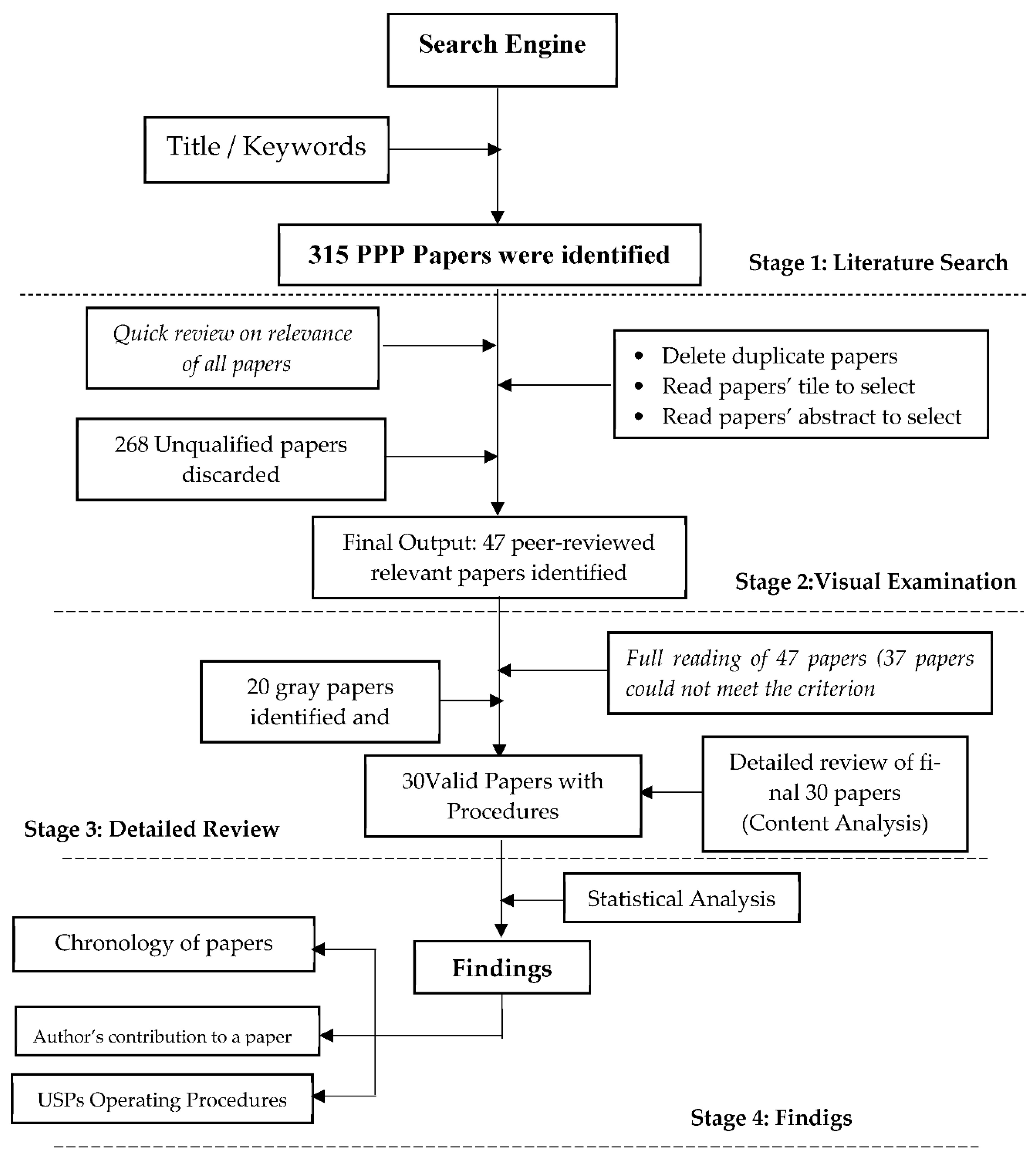
Figure 2.
Trend of Annual publications on operating procedures for handling USPs in PPP.

Figure 3.
A conceptual framework for USPs Operating procedures.
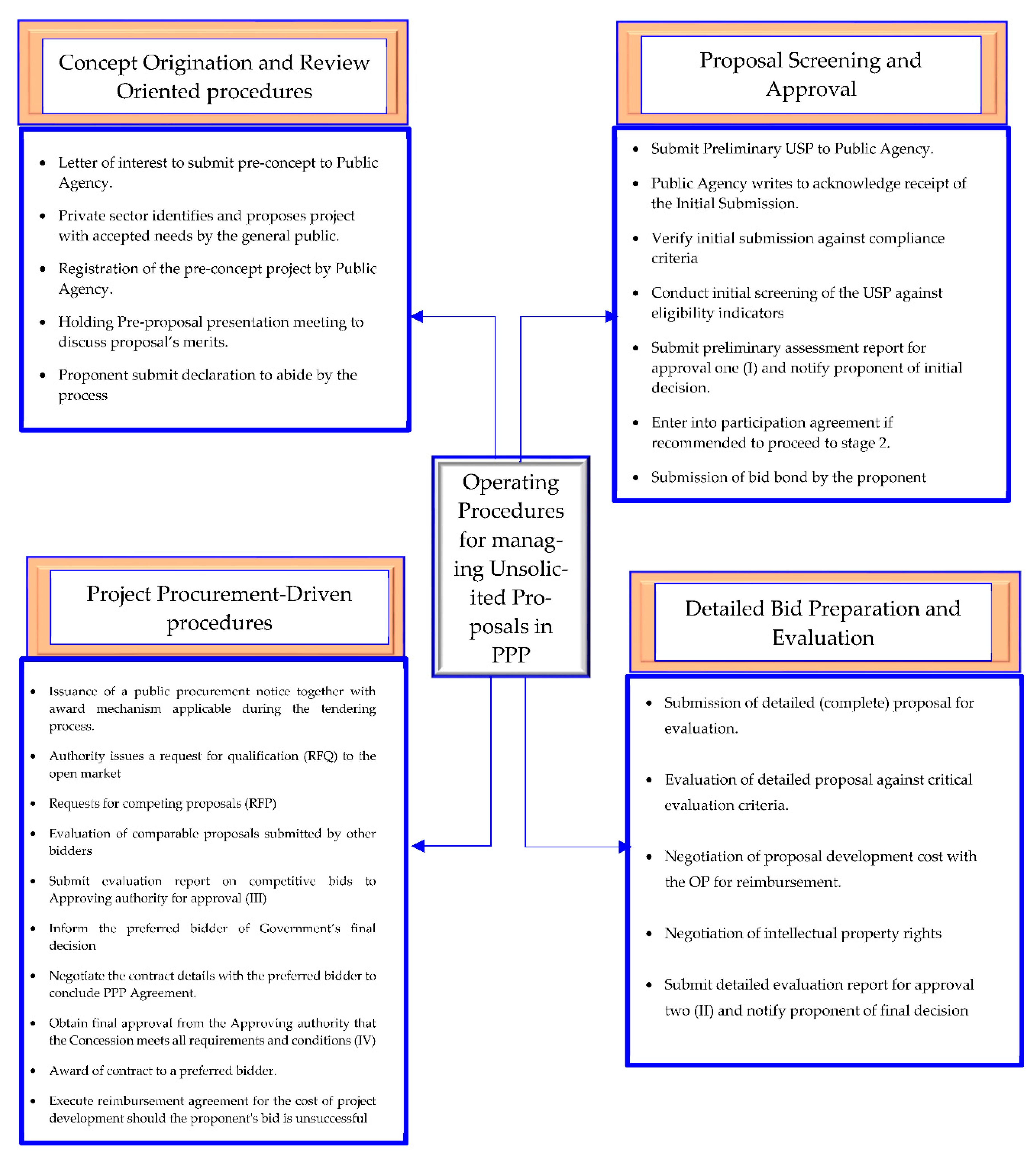
Figure 4.
A Graphical representation of the mean scores of the categories.
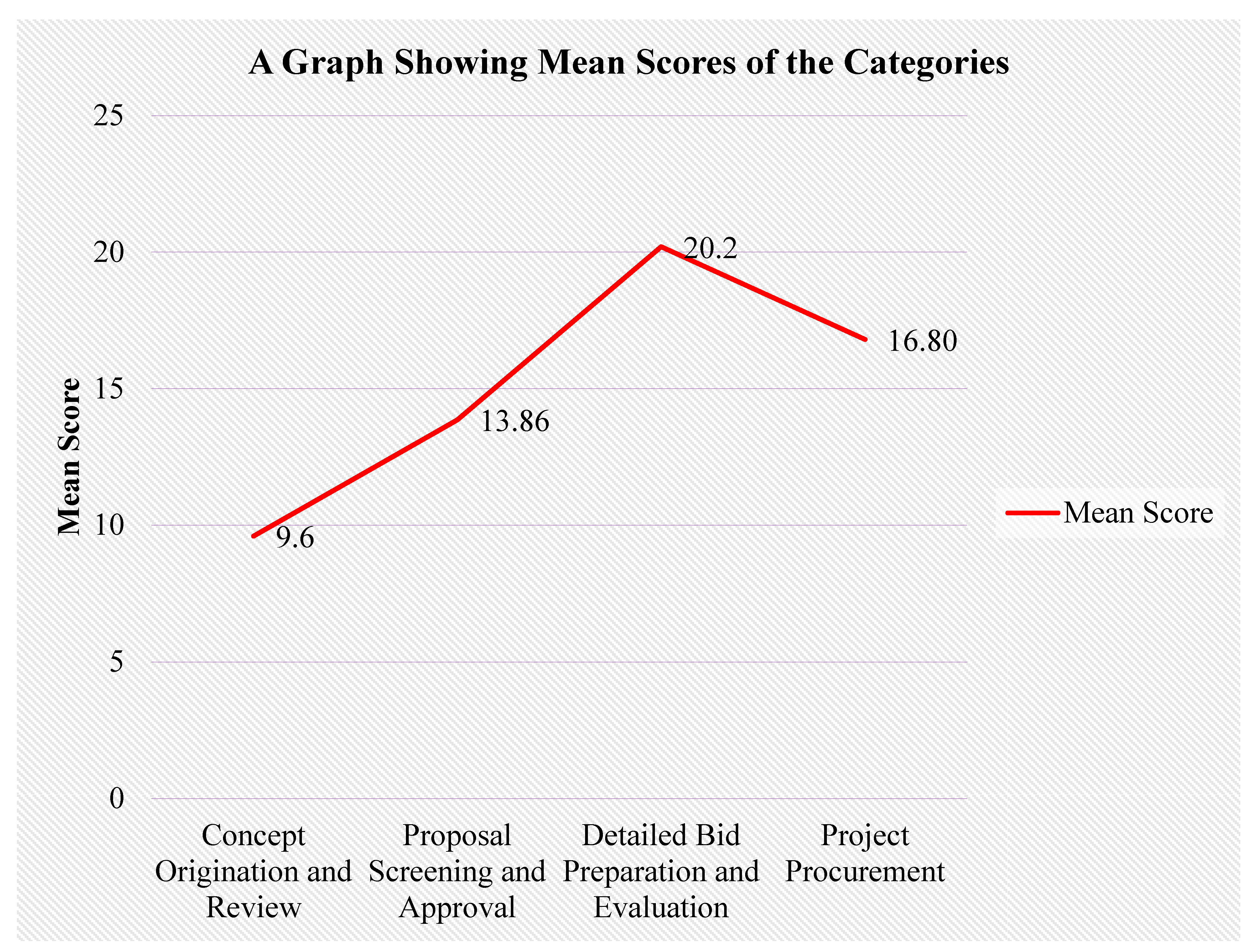

Table 1.
Search results and distribution of relevant publications (from 2004 to 2024).
| Selected Journals / Publishers | Title of final relevant publication for the study | References |
|---|---|---|
| World Bank Publications | Public-Private Partnerships Reference Guide -Version 2 | [48] |
| Unsolicited proposals–An exception to public initiation of infrastructure PPPs; An Analysis of Global Trends and Lessons Learned | [21] | |
| Public-Private Partnerships Reference Guide -Version 3 | [25] | |
| Policy Guidelines for Managing Unsolicited Proposals in Infrastructure Projects, Volume I, Main Findings & Recommendations | [4] | |
| Policy Guidelines for Managing Unsolicited Proposals in Infrastructure Projects, Vol. II, Guidelines for the development of a policy for managing unsolicited proposals in infrastructure projects | [12] | |
| Policy Guidelines for Managing Unsolicited Proposals in Infrastructure Projects, Volume III, Review of experiences with Unsolicited Proposals in infrastructure projects. | [19] | |
| Australian Capital Territory publications | The Partnerships framework: Guidelines for Unsolicited Proposals First Revision: March 2015 | [49] |
| The Partnerships framework: Guidelines for Unsolicited Proposals Second Edition: July 2016; | [50] | |
| The Partnerships framework- Guidelines for Unsolicited Proposals, 2nd Ed. Updated in September 2016 | [51] | |
| The partnership framework - guidelines for unsolicited proposals, 3rd edn. Updated March, 2018. | [52] | |
| NSW Parliamentary Research Service | Unsolicited proposals: Guide for Submission and Assessment | [53] |
| Unsolicited proposals | [55] | |
| Unsolicited proposals - Issues backgrounders; | [10] | |
| Unsolicited proposals: Guide for Submission and Assessment. | [54] | |
| European Procurement Public Private Partnership Law Review (EPPPL | Use of unsolicited proposals for new projects - the approaches in Australia | [56] |
| Unsolicited Proposals for PPP Projects in Vietnam: Lessons from Australia and the Philippines. | [28] | |
| PPIAF publications | Unsolicited infrastructure proposals: How Some countries introduce competition and transparency, PPIAF, Working Paper No. 1 | [9] |
| Unsolicited proposals.” Note 6. | [57] | |
| Asian Development Bank | Public–Private Partnership Systems in the Republic of Korea, the Philippines, and Indonesia | [58] |
| Construction Research Congress | Risk Allocation in PPP Unsolicited and Solicited Proposals in Latin America: Pilot Study in Colombia | [59] |
| Journal of Civil Engineering and Management | Critical organizational success factors for public-private partnership projects – A comparison of solicited and unsolicited proposals. | [5] |
| Utilities Policy | Public-Private Partnerships as rent-seeking opportunities: A case study on an unsolicited proposal in Lima, Peru. | [15] |
| Journal of Comparative Policy Analysis | Empirical evidence of unsolicited proposals in PPP arrangements: A comparison of Brazil, Korea and the USA. | [7] |
| Journal of Management in Engineering | Strategies for effective management of unsolicited public–private partnership proposals | [21] |
| Journal of Sustainable development Law and Policy | A Comparative analysis of the use of unsolicited proposal for the delivery of public-private partnership projects in Africa. | [16] |
| Corrs Chambers Westgarth | Want to sell your idea to Government? An unsolicited proposal could be your answer | [60] |
| General Assembly of the Commonwealth of Pennsylvania | Unsolicited proposals under the commonwealth Procurement code | [29] |
| Transparency International | Corruption and unsolicited proposals, Risks, accountability and best practices; Transparency International. | [13] |
| Department of Treasury and Finance | Unsolicited Proposals: Policy and Guidelines | [61] |
| Public Sector Economics | Unsolicited versus solicited public partnership proposals: is there a trade-off between innovation and competition? | [62] |
| Total number = 30 |
Table 2.
Peer reviewed versus non-peer reviewed papers used in the literature review.
| Papers | Papers that described Operating Procedures for managing USPs | Total | Percent (%) |
|---|---|---|---|
| Peer Reviewed Papers | [5,7,13,15,16,21,28,56,59,62] | 10 | 33.33 |
| Non-Peer Reviewed Papers | [4,9,10,12,19,21,25,29,48,49,50,51,52,53,54,55,57,58,60,61] | 20 | 66.67 |
Table 3.
Score Matrix for Multi-Authored Papers.
| Number of authors | Order of specific author | ||||
|---|---|---|---|---|---|
| 1 | 2 | 3 | 4 | 5 | |
| 1 | 1.00 | ||||
| 2 | 0.60 | 0.40 | |||
| 3 | 0.47 | 0.32 | 0.21 | ||
| 4 | 0.42 | 0.28 | 0.18 | 0.12 | |
| 5 | 0.38 | 0.26 | 0.17 | 0.11 | 0.08 |
Table 4.
Contributions of Authors to USPs research (authors who scored at least one point) .
| Name of Author | Papers | Affiliation | Country | Score | |
|---|---|---|---|---|---|
| ACT Government | 4 | Australia Government | Australia | 4.00 | |
| Public-Private Infrastructure Advisory Facility (PPIAF) | 5 | PPIAF | Multi-country* | 3.20 | |
| World Bank Group (WBG) | 5 | World Bank | Multi-country* | 2.60 | |
| NSW Government | 2 | New South Wales Government | New South Wales | 2.00 | |
| International Bank for Reconstruction and Development (IBRD) | 2 | World Bank | Multi-country* | 2.00 | |
| Chew, A. | 2 | Corrs Chambers Westgarth | Australia | 1.60 | |
| Roth L. | 1 | New South Wales Parliament | New South Wales | 1.00 | |
| Marques, R. C. | 1 | University of Lisbon | Portugal | 1.00 | |
| Joint State Government Commission | 1 | Commonwealth of Pennsylvania | USA | 1.00 | |
| Angus, C. | 1 | New South Wales Parliament | New South Wales | 1.00 | |
| Cameron, H. V. N. | 1 | Queensland University Technology, Brisbane of | Australia | 1.00 | |
| Takano, G. | 1 | University of Lima | Peru | 1.00 | |
| Nwangwu, G. | 1 | Stellenbosch University | South Africa | 1.00 | |
| Ruiz Diaz, G. | 1 | Pontifical Catholic University | Peru | 1.00 | |
| Government of Tasmania | 1 | Tasmania | Tasmania | 1.00 | |
Note: Multi-country* = more than one country of focus.
Table 5.
Distribution of selected papers by country or region.
| No | Country or Region | Number of Selected Papers |
|---|---|---|
| 1 | Multi-country* | 16 |
| 2 | New South Wales | 4 |
| 3 | Australia | 3 |
| 4 | Peru | 2 |
| 5 | Portugal | 1 |
| 6 | USA | 1 |
| 7 | South Africa | 1 |
| 8 | Tasmania | 1 |
| 9 | Colombia | 1 |
| Total | 30 |
Table 6.
Operating Procedures for managing USPs in PPP .
| Identified Operating Procedures | References | Sum | Percent |
|---|---|---|---|
| P1. Evaluates detailed proposal against critical evaluation criteria. | {1,2,3,4,5,6,7,8,10,11,12,14,15,16,17,18,19,21,22,23,24,2 5,26 27,28,29,30) | 27 | 90.00 |
| P2. Submission of detailed (complete) proposal for evaluation. | {1,2,3,4,5,6,7,8,10,11,12,14,15,16,17,18,19,21,22,23,24,2 5,26,27,29,30) | 26 | 86.67 |
| P3. Submit USP to Public Agency for preliminary consideration | {1,2,3,4,5,6,7,8,10,11,12,14,16,17,18,19,20,21,22,23,24,26,28,29) | 24 | 80.00 |
| P7.Authority requests for competing proposals (RFP) | {1,2,3,4,6,7,9,10,11,13,14,16,17,18,19,20,21,22,24,25,26,27,28,29) | 24 | 80.00 |
| P4.Conduct initial screening of the USP against eligibility criteria | {1,2,3,4,5,6,7,8,10,11,12,14,16,17,18,19,20,21,22,23,24,26,29) | 23 | 76.67 |
| P5.Award contract to preferred bidder | {1,2,3,4,5,7,8,10,11,12,13,15,17,18,19,21,20,22,23,25,26,29) | 22 | 73.33 |
| P6.Issue public procurement notice together with award mechanism applicable during the tendering process | {1,3,4,6,7,9,10,11,14,16,17,18,19,21,22,23,24,25,26,27) | 21 | 70.00 |
| P8.Evaluate comparable proposals submitted by other bidders | {1,2,3,4,6,7,9,10,11,13,14,16,17,18,19,21,22,24,25,26,27) | 20 | 66.67 |
| P9.Obtain final approval from Approving authority that the Concession meets all requirements and conditions (IV) | {1,3,4,5,6,7,9,10,11,13,15,17,21,22,23,24,25,26} | 18 | 60.00 |
| P27. Negotiation to protect intellectual property in the bid | {2,3,4,5,6,7,8,11,12,14,15,16,18,19,20,24,27,29} | 17 | 56.67 |
| P14.Submit detailed evaluation report for approval two (II) and notify proponent of final decision | {1,2,3,5,7,8,9,10,13,21,22,23,25,27,28,30} | 16 | 53.33 |
| P10.Hold Pre-proposal presentation meeting to discuss the proposal’s merits | {2,4,5,8,9,10,11,12,14,15,16,17,18,21,30} | 15 | 50.00 |
| P22.Negotiate the cost of proposal development effort with the OP for reimbursement | {1,3,4,5,7,8,11,12,14,15,17,18,19,20,26} | 15 | 50.00 |
| P11.Verify initial submission against compliance criteria | {2,3,5,6,7,8,10,11,12,14,17,19,23,24} | 14 | 46.67 |
| P12.Submit evaluation report on competitive bids to Approving authority for approval (III) | {1,2,3,4,6,7,9,10,11,13,14,21,22,26} | 14 | 46.67 |
| P13.Negotiate the contract details with the preferred bidder to conclude PPP Agreement | {2,3,4,5,6,10,11,12,15,21,22,23,26,27} | 14 | 46.67 |
| P16.Authority issues a request for qualification (RFQ) to the open market | {1,4,6,9,10,13,14,16,18,20,21,22,24) | 13 | 43.33 |
| P19.Submit initial review report for approval one (I) and notify proponent of initial decision | {2,3,5,7,10,11,17,18,20.21,22,26,30} | 13 | 43.33 |
| P15.Inform the preferred bidder of Government’s final decision | {1,2,3,5,8,10,11,17,18,22,23,24} | 12 | 40.00 |
| P17.Registration of the pre-concept project by Public Agency. | {1,4,6,8,10,11,12,15,17,18,21,22} | 12 | 40.00 |
| P18.Enter into participation agreement if recommended to proceed to stage 2 | {1,5,8,9,11,12,13,14,19,23,24} | 11 | 36.67 |
| P20.Letter of interest to submit pre-concept to Public Agency. | {1,5,10,17,18,21,22,23.24,27} | 10 | 33.33 |
| P21.Execute reimbursement agreement for project development cost should the proponent's bid is unsuccessful | {1,3,7,9,13,17,20,26,28} | 9 | 30.00 |
| P26.Public Agency writes to acknowledge receipt of the Initial Submission | {1,5,15,17,21,26} | 6 | 20.00 |
| P25.Private sector identifies and proposes project with accepted needs by the general public | {4,7,11, 16, 28,29) | 6 | 20.00 |
| P23.Proponent submit declaration to abide by the process | {5,6,15,17,22} | 5 | 16.67 |
| P24.Submission of bid bond by the proponent | {3,5,8,15,19} | 5 | 16.67 |
| References are as follows: 1-Joint State Government commission (29); 2-Roth (55); 3- Hodges and Dellacha (9); 4-PPIAF (57); 5-NSW Government (53); 6-IBRD and WBG (48); 7-PPIAF (1); 8-Chew and Clarke (60); 9-Yun et al. (5); 10-ACT Government (49); 11-Chew (56); 12-Cameron (28); 13-Takano (15); 14-Marques (7); 15-Angus (10); 16-IBRD and WBG (25); 17-NSW Government (54); 18-ACT Government (52); 19-Osei-Kyei (21); 20-Nwangwu (16); 21-ACT Government (50); 22-ACT Government (51); 23-WBG and PPIAF (4); 24-WBG and PPIAF (12); 25-Bullock and Chêne (13); 26- WBG and PPIAF (19); 27- Kim et al. (58); 28- Castelblanco and Guevara (59); 29- Ruiz Diaz (62); 30-Tasmanian Government (61) | |||
Table 7.
Typology of Operating Procedures for managing USPs.
| No | Categories | Operating Procedures | Code | Freq. | Mean | Rank |
|---|---|---|---|---|---|---|
| 1.0 | Concept Origination and Review Oriented Procedures | COR | 9.60 | 4th | ||
| 1.1 | Holding Pre-proposal presentation meeting to discuss the proposal’s merits | COR1 | 15 | 1 | ||
| 1.2 | Registration of the pre-concept project by Public Agency | COR 2 | 12 | 2 | ||
| 1.3 | Letter of interest to submit pre-concept to Public Agency | COR 3 | 10 | 3 | ||
| 1.4 | Private sector identifies and proposes project with accepted needs by the general public |
COR 4 | 6 | 4 | ||
| 1.5 | Proponent submit declaration to abide by the process | COR 5 | 5 | 5 | ||
| 2.0 | Proposal Screening and Approval | PSA | 13.86 | 3rd | ||
| 2.1 | Submit initial proposal to Public Agency. | PSA1 | 24 | 1 | ||
| 2.2 | Conduct Initial screening of the USP against eligibility criteria. | PSA2 | 23 | 2 | ||
| 2.3 | Conduct compliance check against schedule of requirements. | PSA3 | 14 | 3 | ||
| 2.4 | Submit initial review report for approval one (I) and notify proponent of initial decision |
PSA4 | 14 | 3 | ||
| 2.5 | Enter into participation agreement if recommended to proceed to stage 2 | PSA5 | 11 | 4 | ||
| 2.6 | Public Agency writes to acknowledge receipt of the Initial Submission | PSA6 | 6 | 5 | ||
| 2.7 | Submission of bid bond by the proposal proponent | PSA7 | 5 | 6 | ||
| 3.0 | Detailed Bid Preparation and Evaluation | DBPE | 20.2 | 1st | ||
| 3.1 | Evaluation of detailed proposal against critical evaluation criteria. | DBPE1 | 27 | 1 | ||
| 3.2 | Proponent Submit detailed proposal for evaluation. | DBPE2 | 26 | 2 | ||
| 3.3 | Negotiation to protect intellectual property in the bid | DBPE3 | 17 | 3 | ||
| 3.4 | Submit detailed evaluation report for approval two (II) and notify proponent of final decision |
DBPE4 | 16 | 4 | ||
| 3.5 | Negotiate the cost of proposal development effort with OP for reimbursement | DBPE5 | 15 | 5 | ||
| 4.0 | Project Procurement Driven Procedures | PPDP | 16.8 | 2nd | ||
| 4.1 | Requests for submission of competing proposals (RFP) | PPDP1 | 24 | 1 | ||
| 4.2 | Award of contract to preferred bidder/ Financial close | PPDP2 | 22 | 2 | ||
| 4.3 | Evaluation of comparable proposals submitted by other bidders | PPDP3 | 21 | 3 | ||
| 4.4 | Issuance of public procurement notice together with award mechanism applicable during the tendering process |
PPDP4 | 21 | 3 | ||
| 4.5 | Obtain final approval from Approving authority that the Concession meets all requirements (IV) |
PPDP5 | 18 | 4 | ||
| 4.6 | Submit evaluation report on competitive bids to Approving authority for approval (III) |
PPDP6 | 14 | 5 | ||
| 4.7 | Negotiate the contract details with the preferred bidder to conclude PPP Agreement |
PPDP7 | 14 | 5 | ||
| 4.8 | Authority issues a request for qualification (RFQ) to the open market | PPDP8 | 13 | 6 | ||
| 4.9 | Inform the preferred bidder of Government’s final decision. | PPDP9 | 12 | 7 | ||
| 4.10 | Execute reimbursement agreement for the cost of project development should the proponent's bid unsuccessful |
PPDP10 | 9 | 8 | ||
| Total average mean | 15.33 | |||||
Disclaimer/Publisher’s Note: The statements, opinions and data contained in all publications are solely those of the individual author(s) and contributor(s) and not of MDPI and/or the editor(s). MDPI and/or the editor(s) disclaim responsibility for any injury to people or property resulting from any ideas, methods, instructions or products referred to in the content. |
© 2025 by the authors. Licensee MDPI, Basel, Switzerland. This article is an open access article distributed under the terms and conditions of the Creative Commons Attribution (CC BY) license (http://creativecommons.org/licenses/by/4.0/).
Copyright: This open access article is published under a Creative Commons CC BY 4.0 license, which permit the free download, distribution, and reuse, provided that the author and preprint are cited in any reuse.


