

Submitted:
06 February 2025
Posted:
07 February 2025
You are already at the latest version
Abstract
When it comes to e-commerce and logistics industry developing rapidly, the location and path planning of green warehousing and logistics have attracted more and more attention, and how to improve efficiency and reduce environmental impact has become the focus of research. This paper presents a new optimization approach based on Deep Neural Network (DNN), which is used to solve the multi-objective optimization problem in the warehouse location and path planning. We propose to use a deep neural network model to optimize the weights and parameters of the network as a whole through the combined PSO method, so that the dynamic and diverse needs of the logistics environment can be better adapted to changes. Unlike traditional methods based on heuristics or simple machine learning models, this paper adopts the principle of minimizing the transportation cost, while achieving the minimization of energy consumption and the limited carbon emissions in path planning, i.e. optimizing the particle swarm of DNN. Empirical results indicate that, when compared to classical optimization techniques, our approach enhances transportation cost and environmental sustainability by 18% and 12%.
Keywords:
Deep Neural Network
; Particle Swarm Optimization
; Multi-objective Optimization
; Path Planning
1. Introduction
This has brought unprecedented development opportunities to the logistics industry due to the drivers of globalization and e-commerce. World logistics industry scale and output value is increasing, especially in Asia, North America and Europe, logistics transportation and warehousing facilities demand show explosive growth, according to the report of the International Monetary Fund. The rapid growth factor is leading to the need to improve logistics efficiency and also putting forward higher requirements for environmental protection. For the logistics industry, price reduction, timeliness improvement, carbon reduction and energy consumption efficiency are of the same importance and have a lot of room for improvement. This increase has caused the utilization of logistics systems to become a key point of concern for both society and government departments [1,2].
Warehouse location and route planning are two major decision-making issues in the logistics system. The warehouse location determines the layout of logistics center and further influences on the transportation cost, distribution efficiency and service quality. Path planning is the process of determining the logistics route of goods from the warehouse to the destination, including transportation efficiency, time cost, energy consumption and other aspects. Logistics strategies, particularly in warehouse location and routing optimization can help cut transportation costs, reduce operating and transportation costs and provide key input to sustainability [3]. Such as the selection of the right warehouse location can reduce transportation distance and carbon emissions, and the path planning can optimize the route to reduce energy waste and reduce the emission of pollution. But, as logistics requirements grow more diverse and complex, conventional methods of warehouse siting and routing.
The diversification of logistics demand, leading to traditional methods being unable to quickly adapt to the new market demand. A full drill down classification on what customers need not only comes from location and time, but the broader scope of factors, including weather, traffic flow, and other unexpected events [4]. However, traditional path planning approaches tend to use heuristic algorithms or greedy algorithms, which, when encountering multiple combinations of paths, may sink to the local optimum solution and lack the capability of global optimization. In addition, in multi-objective optimization, how to balance transportation costs, energy consumption, carbon emissions and other goal directions, and ensure the mutual coordination and compatibility of various goals is also a big problem [5]. In addition, how to take into account these spatio-temporal constraints in path planning, so that the path planning not only complies with the optimal solution, but also has the ability to be adaptively real time, has become a problem that researchers and engineers urgent need to solve.
The logistics industry is facing one of the biggest challenges today: How to reconcile transportation costs with the protection of the environment. In the past couple of decades, logistics companies have been concentrating on lowering costs and increasing operational efficiency, disregarding energy consumption and carbon emissions. However, as global climate change issues have become more prominent and as governments around the world have implemented increasingly stringent environmental protection policies, the focus of the industry has shifted towards minimizing carbon emissions and energy consumption while also optimizing the transportation route.
Along with the impact of environmental factors, the diversification of logistics requirements and the time-space evolution phenomenon all contribute to the complexity of the problem of warehouse localization and routes planning. In particular, traditional path planning methods may not fit the actual needs due to the instability of city traffic flows, changes in weather conditions, and the influence of unexpected events. Existing path planning methods are mainly based on static assumptions and cannot adapt to real-time dynamic changes in the environment. Thus, how to divide the path planning model to include spatiotemporal dynamics and environmental factors is one of the significant challenges this study is dealing with [6].
To make up for the limitations of previous deep learning models, this study tries to integrate deep neural network with particle swarm optimization algorithms, and PSO algorithms are used to optimize the weights and parameters in DNNs. Particle swarm optimization algorithm is a heuristic optimization algorithm, simulating the foraging behavior of birds in nature, which can conduct global search in the global solution space, avoiding the issue that traditional optimization methods easily fall into global optimal solutions. In this work, we come up with PSO and DNN to address the issue of multi-objective optimization in route planning, and our approach can adapt to varying environmental changes while optimizing transportation cost, energy consumption, and carbon emission.
2. Related Work
Pittman et al. [7] Incorporating local knowledge for speedy site selection, Focused on the implementation of multiple-benefit nature-based solutions. By incorporating variables like whether a site is logistically feasible and politically palatable, as well as historical context, the research team developed a rapid site selection process to inform ecological restoration efforts and environmental protection decisions. Xu et al. [8] studied recent logistics information sharing based on blockchain technology in modern logistics systems. The authors showcase the potential benefits of Blockchain adopted through case studies which enhances transparency of information, data security and optimal supply chain management. According to the research the solution to the problem is: Blockchain technology can effectively improve the flow and storage of information in the logistics process, improve operational efficiency, reduce redundancy and errors, especially in warehousing site selection, procurement and distribution.
Kannan et al. [9] proposed a new decision-making method that is the linear diovan equation fuzzy CODAS method for the selection of logistics professionals. Hence, this study integrates fuzzy mathematics with multi-criteria decision analysis including how uncertainty can be managed in the decision-making process. Authors use the point method to evaluate logistics professionals, so as to ensure that the selection is fair and scientific. The combination of Diorfan equation and fuzzy decision theory is innovative in this research, and it provides a new optimization path for decision-making problems in the logistics industry. Deveci et al. [10] proposed a USA based offshore wind farm's siting method using type-2 neutral number based MABAC methods. This study combines multiple evaluation criteria to create a new decision support model, which provides a comprehensive consideration of wind energy resource, geographical conditions, and ecological impact. This method is innovative in that it utilizes type-2 neutrals to manage vagueness and uncertainty, making it a more precise and robust site selection evaluation.
Deveci et al. [11] proposed the CoCoSo model based on Q-cluster pair fuzzy set for floating offshore wind farms siting in Norway. It studies the selection of site for offshore wind power project from a compound shear of multi-dimension environmental, economic, and technological information. The Q-cluster pair fuzzy set theory proposed in this paper can not only deal with the uncertainty and multiple constraints, but also provide a new decision support tool for the siting of offshore wind farms. Mishra et al. [12] proposed a third-party reverse logistics provider selection model based on a Fermatean fuzzy set called CRITIC-EDAS. This approach integrates fuzzy decision theory with conventional evaluation techniques and also takes into account a wide range of evaluation criteria including logistics capacity, environmental impact, and economic feasibility. To handle the ambiguity and uncertainty of the evaluation criteria, the author developed the Fermatean fuzzy set to provide a more accurate decision-making model capable of selecting logistics service providers which meet sustainable development.
Deveci et al. [13] proposed fuzzy log-weighted estimation approach to assess solar PV project site selection criteria. This study offers a scientific framework for site selection decision-making by quantifying different evaluation criterion. Wang et al. [14] proposed a two-phase, multi-attribute decision-making framework for the siting of solar photovoltaic power stations in Taiwan. Through multi-criteria analysis, this study applied Data Envelopment Analysis and Analytic Hierarchy Process to assess many factors that are involved in the site selection of solar PV.
3. Methodologies
3.1. Deep Neural Networks
In conventional deep neural networks, the simplest MLP architecture is used for feature extraction and prediction, however, in complex path planning problems, the network needs to process more spatio-temporal dynamic and environmental constraints. As a result, we will creatively introduce a deep neural network (DNN) adopting a hybrid architecture of convolutional and recurrent neural network (CNN-RNN), that learns multi-scale features for complex path planning behaviors and temporal feature modeling.
Suppose the input feature matrix is , where is the number of samples and is the feature dimension of each sample. For each entry in the input data of the model, the input data not only has basic spatial location and traffic information, but also combines environmental factors such as temperature, humidity, traffic flow, etc., extracts high-dimensional features through the convolutional layer, and then process the temporal data through the recirculating layer. The output layer of the network is the final path planning result, which is expressed as , where represents the target value of path planning, such as the shortest path, the optimal transportation path, etc. Assuming that the number of layers of the network is , and the output of each layer is , the layers are calculated from each layer by the following Equation 1:
Wherein, is an activation function, such as ReLU or Sigmoid. is the weight matrix of -th layer, is the bias term, and is the output of -th layer. For the convolutional layer, we define a convolutional kernel that is applied to spatial features for the convolutional layer, and process time series data using a long short-term memory (LSTM) unit for the recurrent layer, enabling the network to model the complex patterns of spatiotemporal coupling, as shown in Equation2:
For warehouse siting and routing problems, optimization should typically have more than one objective function, it should be a multi-objective function. To properly account for the interaction among transportation cost, energy consumption and carbon emissions, we formula a multi-objective optimization model with a joint objective function considering nonlinear constraints and environmental constraints, as shown in Equation 3:
where is the transportation cost, which is one of the key indicators of route planning, and is expressed as the sum of the transportation costs between nodes on each route. is the energy consumption, which represents the total amount of energy consumed during the path planning process. is carbon emissions, which reflects the carbon footprint brought about by the path planning. is the environmental constraint penalty item, which indicates the environmental policies or resource restrictions (such as road load, green channel restrictions, etc.) that may be violated in the course of route planning, and its formula is as Equation 4:
where is the maximum allowable load threshold, and if the load of a node or a certain section of the path exceeds this value during the path planning process, the penalty item will be increased.
3.1. Multi-Objective Optimization
In the process of training a deep neural network to optimize the model's parameters and improve the model's performance, this paper introduces the particle swarm optimization algorithm into the training process of the deep neural network to optimize the weights of the model. PSO finds the optimal solution by simulating the cooperative behavior of particle swarms in nature. There are one or more particles in one scope, and each particle indicates a weight vector. For each particle, it updates its velocity and position respectively by the Equation 5 and 6 as follows:
where is the velocity of particle in the -generation and is the position of particle . is the historical optimal position of particle , and is the historical optimal position of all particles. and are random numbers, and are acceleration constants, and is the inertia weight. PSO optimises the weight in the DNN by minimising the value of the objective function, where the fitness function of the particle becomes the objective function. The mechanism behind DNN that the update of weights through the particle swarm optimization algorithm constantly looking for weightates, and it keeps improving the performance of DNN. To enhance the stability and convergence speed of the PSO algorithm, we adopt an adaptive particle swarm optimization strategy to update the inertia weight w in the particle swarm velocity update formula dynamically when iterating, in order that the particles are searched more widely in the early stage, expressed as Equation 7:
where is the current number of iterations, is the maximum number of iterations, and and are the initial and final inertia weights, respectively. In order to comprehensively consider multiple optimization objectives, we propose a weighted sum objective function, which not only considers the optimization of a single objective, but also introduces the comprehensive constraints of environmental factors and diverse needs. The traditional weighted sum model often ignores the interaction and dynamic adjustment between the objectives, so we introduce a dynamic adjustment factor into the weighted sum, which adaptively adjusts the weights according to the optimization process of each objective, so that different objectives can be balanced in whole optimization process to obtain more efficient solution, denoted as Equation 8:
where is the -th objective function (e.g., transportation cost, energy consumption, or carbon emissions), is the dynamic weight of objective during the -th generation iteration, and the dynamic adjustment factor is calculated by the following Equation 9. In this way, the system adjusts the impact of each objective function in the overall optimization based on its current values, resulting in a better balance between the different objectives.
4. Experiments
4.1. Experimental Setup
The dataset of public logistics facilities in Beijing was provided by the Beijing Municipal Transportation Commission and related logistics companies, which included detailed information of 150 logistics facilities that included various dimensions. The data is collected with high timeliness and reliability, which is comparatively reflects the actual operation of Beijing's logistics system, especially spatiotemporal properties and multi-objective optimization characteristics. The experiments store data for warehouse siting, path planning and multi-objective optimization, where the particle swarm optimization algorithm is used to optimize the deep neural network model to minimize transportation cost, reduce energy consumption and control carbon emission based on the dataset. The dataset contains 4 dimensions, including: warehouse location information, transportation route information, transportation time, cargo information, and traffic flow (the traffic flow of the transportation route during peak periods reaches 1500 vehicles/hour), and transportation time (the minimum transportation time of the route is 45 minutes and the maximum is 2 hours).
4.2. Experimental Analysis
We choose four representative classical optimization methods for comparison: Genetic Algorithm (GA), Simulated Annealing Algorithm (SA), Particle Swarm Optimization Algorithm (PSO) and Linear Programming (LP). The genetic algorithm has the performance of global search by simulating a natural selection process, but has high computational complexity. Simulated Annealing Algorithm overcomes the problem of local optimal solution by balancing local exploration and global search, through simulation of annealing process, but may not be effective in complex problems. The swarm intelligence-based particle swarm optimization algorithm is flexible, adaptive, and is capable of multi-objective optimization, however, it has the issue of local convergence for large datasets. In contrast, linear programming could handle linear issues with mathematical modeling, which is fast in computation, whereas it was tough to handle nonlinear connections, and complicated mulit-objective constraints.
Initially, the total transportation cost is used as the main evaluation index to analyze the effectiveness of various optimization methods on storage location and route planning. The total transportation cost reflects the difference of the economics of each method in practical operation, considering factors such as the distance of the transportation path, the distribution of storage points, and the transportation volume. From following Figure 1, we can see that as the number of storage points increases, all methods have increased transportation costs to some extent, which is the expansion of the scale of the system leading to an increase in transportation demand. But the growth trend is different for the different optimization methods. Our model has the smallest transportation cost under all tested points and the increase rate is flat, which give a better balance of cost and other objectives through multi-object optimization. On the other hand, while others traditional methods have performed well in the early days, they could not adapt to the complexity of large-scale logistics environment since the cost increased sharply with the number of storage points.
Finally, energy consumption is used to study and investigate the energy proportion of the various optimization method in warehouse siting and route planning. The energy consumption represents the energy demand in the process of transportation, and it is directly related to the sustainability of the logistics system. As shown in Figure 2, the energy consumption of all optimization methods increases from the number of storage points, which is mainly because the increase in transportation volume and distance leads to the increase of energy demand. In addition, when comparing with other traditional methods, the proposed optimization method has advantages in energy consumption with only a slight increase, and the total energy consumption is always low under the number of storage points, indicating the efficiency of the proposed optimization method in optimizing energy consumption.
Warehousing utilization is the measure of efficiency of the warehousing resources utilized at different distances of transportation. Higher storage utilization, meaning that storage space is used more fully, which manages the inventory cost and helps in storage management. We can see from Figure 3 that with the increase of transportation distance, the storage utilization rate of all the methods all show a downward trend, which conforms to the law of the actual logistics system, and usually the longer transportation distance means that the distribution and scheduling of storage resources are more dispersed, resulting in some storage points can not be used efficiently.
In actual training efficiency test: We tried different sizes of dataset and recorded the training time. The model is quick to train on small datasets, taking typically less than half an hour. The training time grows substantially for a medium and large dataset. For instance, when 100,000 samples, which is a medium dataset that the training takes around 1 hour. For 500000 samples, processing takes over 5h per training session. The additional computational cost comes from the combination of PSO optimization and a long training time, especially for complicated optimization tasks where the iterative process of PSO is also included in the overhead.
5. Conclusion
In conclusion, to address the multi-objective optimization problem of warehouse location selection and path planning in logistics system, a novel optimization method based on deep neural network is proposed. According to experimental results, our qualifier achieves a better balance between transportation efficiency and energy sustainability than traditional optimization methods, while ensuring a high utilization of storage resources. In the future, the value of real-time data and dynamic optimization technology can be integrated to expand the research in different dimensions for our model to adapt to logistics demand fluctuations and emergencies.
References
- Ghoushchi, Saeid Jafarzadeh, et al. "Landfill site selection for medical waste using an integrated SWARA-WASPAS framework based on spherical fuzzy set." Sustainability 13.24 (2021): 13950. [CrossRef]
- Zhao, S., Zhang, T., & Li, N. (2024). Machine learning analysis of key features in household financial decision-making. Academic Journal of Science and Technology, 12(2), 1-6. [CrossRef]
- Tripathi, Ashutosh Kumar, Sonam Agrawal, and Rajan Dev Gupta. "Comparison of GIS-based AHP and fuzzy AHP methods for hospital site selection: a case study for Prayagraj City, India." GeoJournal (2021): 1-22. [CrossRef]
- Wang, H. (2025). Joint Training of Propensity Model and Prediction Model via Targeted Learning for Recommendation on Data Missing Not at Random. In AAAI 2025 Workshop on Artificial Intelligence with Causal Techniques.
- Eren, Ezgi, and Burak Yiğit Katanalp. "Fuzzy-based GIS approach with new MCDM method for bike-sharing station site selection according to land-use types." Sustainable Cities and Society 76 (2022): 103434. [CrossRef]
- Mishra, Arunodaya Raj, Pratibha Rani, and Abhijit Saha. "Single-valued neutrosophic similarity measure-based additive ratio assessment framework for optimal site selection of electric vehicle charging station." International journal of intelligent systems 36.10 (2021): 5573-5604. [CrossRef]
- Pittman, Simon J., et al. "Rapid site selection to prioritize coastal seascapes for nature-based solutions with multiple benefits." Frontiers in Marine Science 9 (2022): 832480. [CrossRef]
- Xu, Xiaofeng, and Yangyang He. "Blockchain application in modern logistics information sharing: A review and case study analysis." Production Planning & Control 35.9 (2024): 886-900. [CrossRef]
- Kannan, Jeevitha, Vimala Jayakumar, and Mahalakshmi Pethaperumal. "Advanced fuzzy-based decision-making: the linear diophantine fuzzy CODAS method for logistic specialist selection." Spectrum of Operational Research 2.1 (2025): 41-60. [CrossRef]
- Deveci, Muhammet, et al. "Type-2 neutrosophic number based multi-attributive border approximation area comparison (MABAC) approach for offshore wind farm site selection in USA." Engineering Applications of Artificial Intelligence 103 (2021): 104311. [CrossRef]
- Deveci, Muhammet, et al. "Hybrid q-rung orthopair fuzzy sets based CoCoSo model for floating offshore wind farm site selection in Norway." CSEE Journal of Power and Energy Systems 8.5 (2022): 1261-1280. [CrossRef]
- Mishra, Arunodaya Raj, Pratibha Rani, and Kiran Pandey. "Fermatean fuzzy CRITIC-EDAS approach for the selection of sustainable third-party reverse logistics providers using improved generalized score function." Journal of ambient intelligence and humanized computing (2022): 1-17. [CrossRef]
- Deveci, Muhammet, Umit Cali, and Dragan Pamucar. "Evaluation of criteria for site selection of solar photovoltaic (PV) projects using fuzzy logarithmic additive estimation of weight coefficients." Energy Reports 7 (2021): 8805-8824. [CrossRef]
- Wang, Chia-Nan, Thanh-Tuan Dang, and Julius Bayer. "A two-stage multiple criteria decision making for site selection of solar photovoltaic (PV) power plant: A case study in Taiwan." IEEE Access 9 (2021): 75509-75525. [CrossRef]
Figure 1.
Comparison of Total Transportation Costs for Different Optimization Methods.
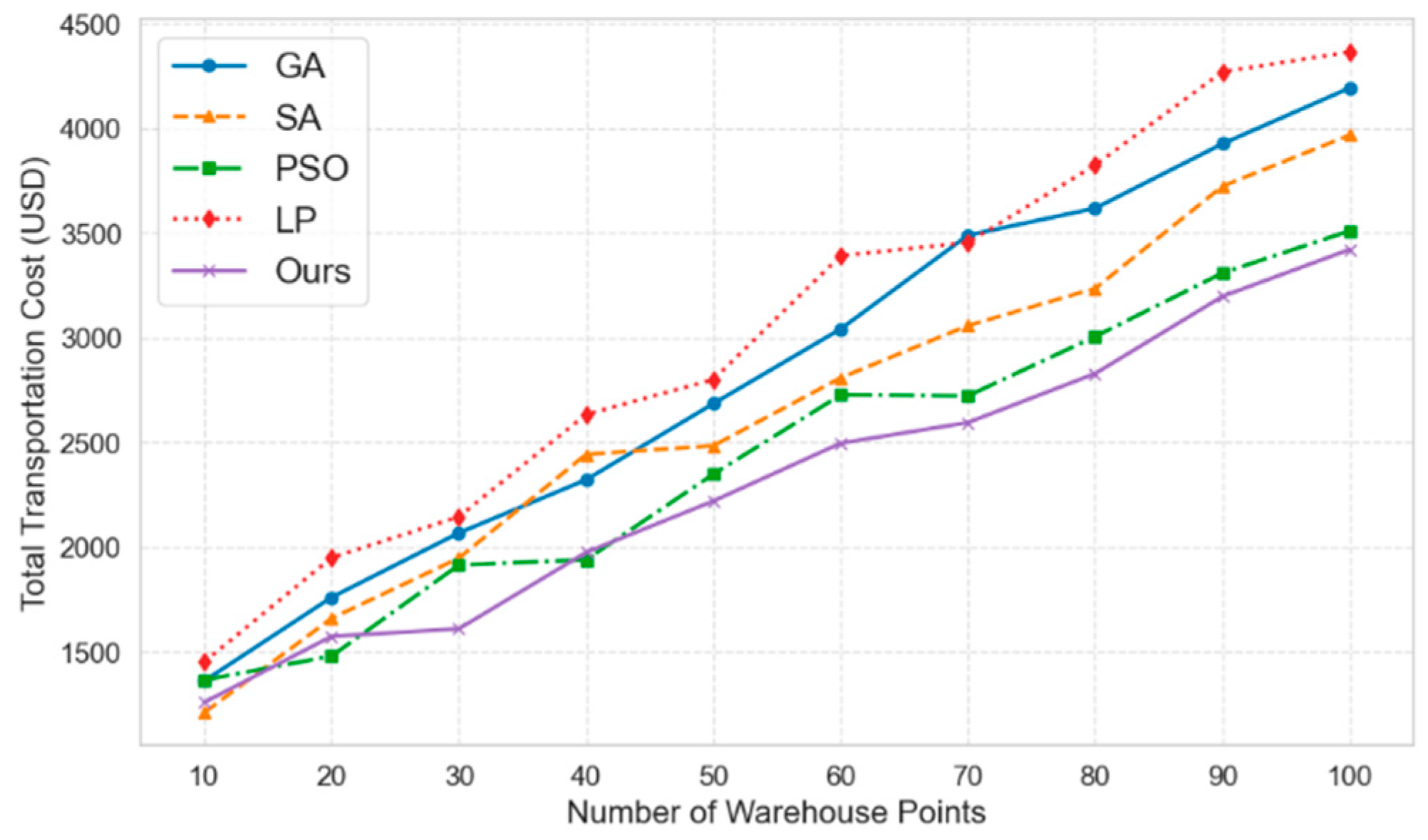
Figure 2.
Comparison of Energy Consumption.
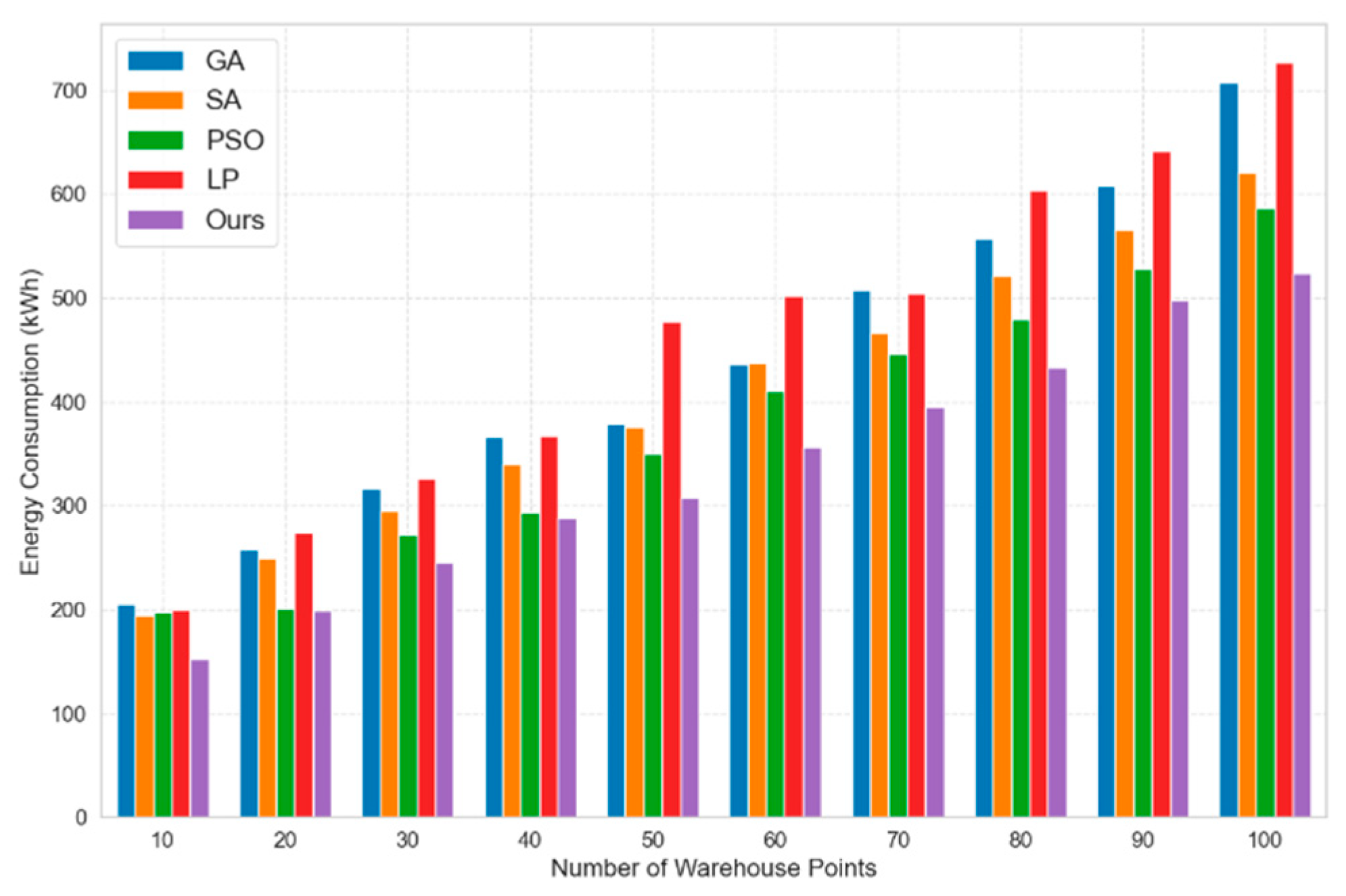
Figure 3.
Comparison of Warehouse Utilization.

Disclaimer/Publisher’s Note: The statements, opinions and data contained in all publications are solely those of the individual author(s) and contributor(s) and not of MDPI and/or the editor(s). MDPI and/or the editor(s) disclaim responsibility for any injury to people or property resulting from any ideas, methods, instructions or products referred to in the content. |
© 2025 by the authors. Licensee MDPI, Basel, Switzerland. This article is an open access article distributed under the terms and conditions of the Creative Commons Attribution (CC BY) license (http://creativecommons.org/licenses/by/4.0/).
Copyright: This open access article is published under a Creative Commons CC BY 4.0 license, which permit the free download, distribution, and reuse, provided that the author and preprint are cited in any reuse.


