

Submitted:
06 February 2025
Posted:
07 February 2025
You are already at the latest version
Abstract
This concept paper proposes a novel two-universe model inspired by ancient Indian cosmology. Our model challenges the traditional notion of a universe destined for heat death and offers a new perspective on the cyclical nature of the cosmos, aligning with ancient Indian concepts of cyclical time and the dynamic interplay of creation and dissolution. It also makes testable predictions that could be investigated through future research, potentially leading to a deeper understanding of the universe's fate. This concept paper provides a compelling framework for future research and encourages further exploration of the connections between ancient wisdom and modern science, potentially leading to a more holistic and nuanced understanding of the universe and our place within it.
Keywords:
Cosmogony
; Cosmology
; Cyclic Universe Model
; Two Universe
; Multiverse
; Mahakalpa
; Mahapralaya
; Brahma
; Indian Cosmic Cycle
1. Introduction
Modern cosmology, despite its remarkable achievements, still grapples with fundamental questions about the nature of dark energy, and the fate of the universe. Current models, predominantly based on the Big Bang theory, often lead to scenarios like the "heat death" of the universe, where all energy is evenly dispersed, and no further work can be done.
However, ancient wisdom traditions, such as Hindu cosmology, offer a different perspective, envisioning a cyclical universe that undergoes recurring cycles of creation and dissolution. These cycles, known as Maha Kalpa and Maha Pralaya, suggest a dynamic and ever-renewing cosmos, where entropy is not merely a one-way street towards heat death but a participant in a cosmic dance of balance and transformation.
This concept paper proposes a novel two-universe model inspired by these ancient Indian cosmological concepts, integrating them with modern scientific understanding of dark energy, and entropy.
Our model challenges the traditional notion of a universe inevitably reaching its demise at “heat death”. Instead, we propose a dynamic interplay between two universes, where entropy is not merely a measure of disorder but a dynamic force that participates in the cosmic dance of creation and dissolution. This perspective offers a new framework for understanding the universe's evolution, potentially resolving long-standing cosmological puzzles and opening up exciting new avenues for research and exploration.i
2. Axioms
- A.
- U1 at Singularity and U2 at Equilibrium:
At the beginning of each cosmic cycle: One universe (U1) exists in a state of singularity (infinitely dense and condensed), while the other universe (U2) is at heat death (maximum entropy and energy dispersion). This synchrony ensures that the time periods of Maha Kalpa and Maha Pralaya remain consistent and aligned.
- B.
- Existence of U2:
The presence of a second universe (U2) is fundamental to the hypothesis. It serves as a complementary counterpart to U1, enabling the dynamic interplay of energy and entropy across cycles.
- C.
- Laws of Physics Are Consistent Across Universes:
The physical laws governing U1 and U2 remain identical, ensuring consistency in energy transfer and cyclic dynamics. This axiom underpins the feasibility of the interplay between the two universes.
3. The Two-Universe Model
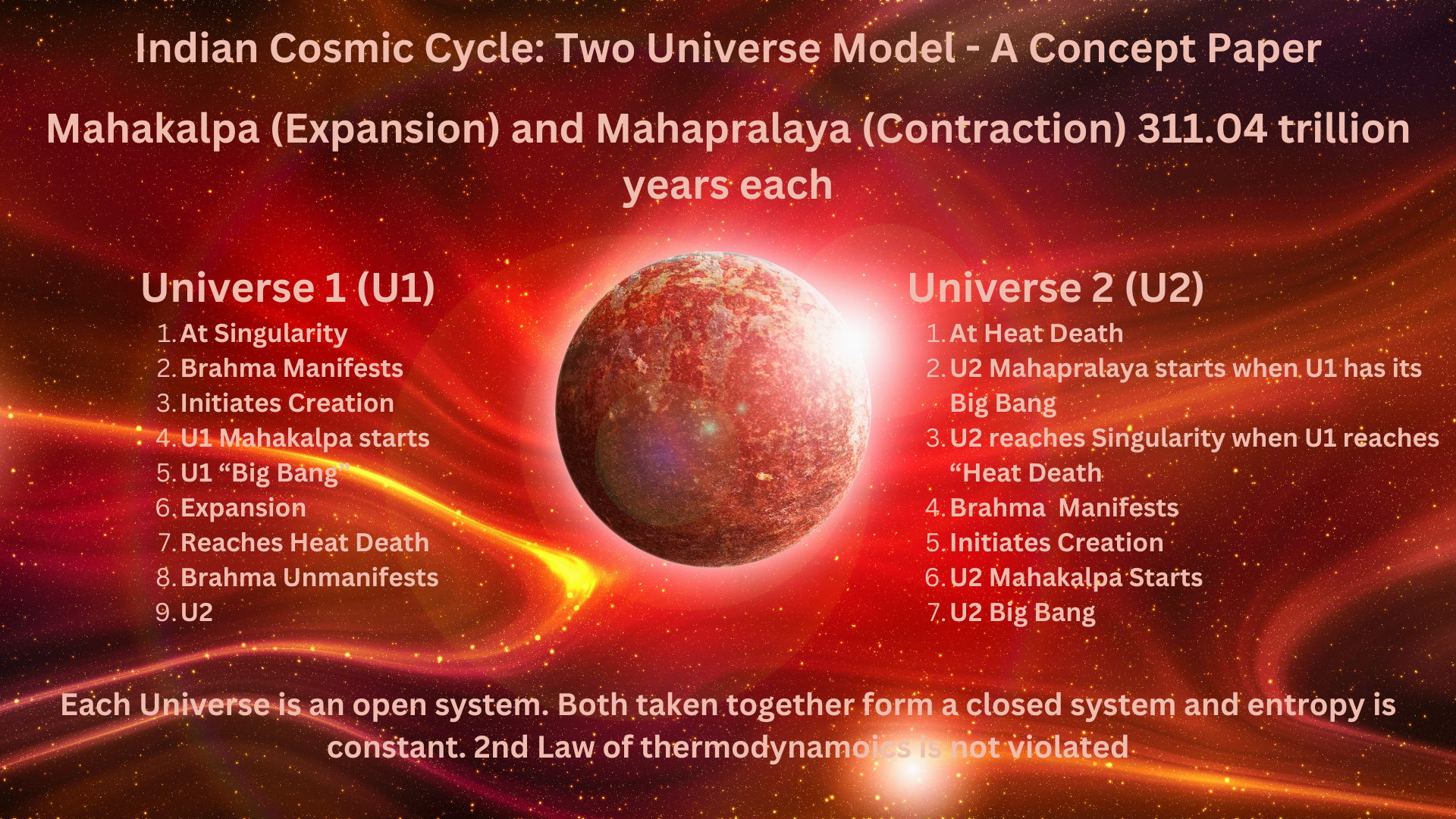
Our model proposes two universes, U1 and U2, each undergoing a cyclical process of expansion, heat death, contraction, and rebirth. This cyclical dynamic is driven by the entropy gradients and quantum entanglement. The steps in the Cycle are detailed in Appendix A
The expansion of U1 leads to a significant increase in its entropy, creating a steep entropy gradient between U1 and U2. This gradient drives a thermodynamic process where U2 contracts to minimize the overall entropy of the system and conserve energy, as dictated by the laws of thermodynamics. This contraction continues until U2 reaches a state of high energy density, eventually collapsing into a singularity and initiating a new Big Bang.
The quantum entanglement between U1 and U2 ensures that these processes occur instantaneously and in a synchronized manner. As soon as U1 initiates its expansion and the entropy gradient is established, U2 responds instantaneously by beginning its contraction phase, maintaining the overall equilibrium and cyclical dynamics of the system.
4. Thermodynamic Equilibrium
During the expansion phase of U1, entropy increases, while during the contraction phase of U2, entropy decreases. The total entropy of the closed system (U1 + U2) remains constant or increases, in accordance with the second law of thermodynamics.
This directional entropy flow prevents both universes from reaching heat death simultaneously. As U1 expands and approaches heat death, U2 contracts and accumulates entropy, eventually reaching a state of high energy density that triggers a new Big Bang, initiating the next cycle.
This dynamic interplay between the universes maintains thermodynamic equilibrium and ensures the perpetual evolution of the cosmos, avoiding the stagnation and ultimate demise predicted by heat death scenarios in current cosmological models.
5. Implications and Predictions
This two-universe model offers several significant implications and predictions that could reshape our understanding of the cosmos and open up new avenues for research.
- A.
- Philosophical Implications
Our theory resonates with ancient Indian cosmology, particularly the concepts of Maha Kalpa and Maha Pralaya, the cycles of creation and dissolution. This alignment suggests that ancient seers had profound insights into the cyclical nature of the universe, potentially anticipating modern cosmological models.
Furthermore, our theory challenges the traditional view of a universe destined for heat death. Instead, it proposes a dynamic and ever-renewing cosmos, where entropy plays a crucial role in maintaining balance and driving cyclical evolution. This perspective offers a more optimistic outlook on the universe's fate, suggesting that it is not a one-way journey towards stagnation but a perpetual dance of creation and dissolution.
- B.
- Scientific Predictions
Our theory makes several testable predictions that could be investigated through future research:
- I.
- Gravitational Waves:
The cyclical expansion and contraction of the universes could potentially generate gravitational waves, which might be detectable with future advancements in gravitational wave astronomy.
- II.
- Cosmic Microwave Background Anomalies:
The interaction between the two universes could potentially leave subtle imprints on the Cosmic Microwave Background (CMB) radiation, which could be investigated through detailed analysis of CMB data.
- III.
- Energy Transfer:
The transfer of energy and entropy between the universes could potentially be detected through subtle gravitational or quantum effects.
6. Future Research
Our theory opens up exciting new avenues for future research, including:
- A.
- Quantum Entanglement and Gravity
Further research could explore the interplay between quantum entanglement and gravity in the context of this theory, potentially leading to new insights into the nature of both phenomena.
- B.
- Theoretical Investigations:
Further theoretical work is needed to refine the model, explore its implications, and develop more specific predictions.
- C.
- Simulations:
Computer simulations could be used to model the dynamics of the two universes and test the predictions of our theory.
7. Conclusion
This concept paper proposes a novel two-universe model inspired by ancient Indian cosmology and challenges the traditional view of a universe destined for heat death and offers a new perspective on the cyclical nature of the cosmos.
Our theory has profound philosophical implications, aligning with ancient Indian concepts of cyclical time and the dynamic interplay of creation and dissolution. It also makes testable predictions that could be investigated through future research, potentially leading to a deeper understanding of dark matter, dark energy, and the universe's ultimate fate.
We believe that this concept paper provides a compelling framework for future research and encourages further exploration of the connections between ancient wisdom and modern science. By integrating these different perspectives, we can potentially gain a more holistic and nuanced understanding of the universe and our place within it.
8. Appendix A
In Vedic cosmology, the initiation of creation is attributed to "Vāk," and Brahma is the Creator who uses “Vak” to initiate Creation and sees it through to Dissolution.
The Rigveda (10.125, Vāk Sūkta) extols Vāk as the creative force that pervades all existence, embodying the unseen energy behind the emergence of the universe. Similarly, the Taittiriya Samhita highlights Vāk’s role in ritual and creation, illustrating its transformative power in aligning the cosmic order.
The ancient seers needed a term that would be understood by ordinary people and therefore used “Speech,” which is sound vibration. It follows logically that they then needed to create an entity capable of "speaking" the universe into existence and to also represent the energy that oversees the Universe till dissolution. Brahma was chosen to personify this entity. This integration of abstract energy with symbolism underscores the seamless blend of metaphysics and cosmology in Vedic thought.
9.1. Terms
Maha Kalpa – (From Creation to Dissolution) 311.04 trillion years. Equals 100 years of a Brahma, his lifespan.
Maha Pralaya – (Contraction) lasts for an equal period – 311.04 trillion years
9.2. One Full Cosmic Cycle
U1 is at Singularity. U2 is at Heat Death.
-
U1’s Maha Kalpa
- U1’s Brahma manifests and initiates Creation using Vak.
- Creation begins. U1 has its Big Bang.
- Expansion of U1 begins.
- Instantaneously, U2 starts Maha Pralaya.
- U1 reaches Heat Death.
- U1’s Brahma unmanifests.
This completes U1’s Creation and Dissolution over 311.04 trillion years.
U1’s Maha Pralaya commences – for 311.04 trillion years.
U2 is at Singularity. U1 is at Heat Death
- 2.
-
U2’s Maha Kalpa
- a)
- U2’s Brahma manifests and initiates Creation using Vak.
- b)
- Creation begins. U2 has its Big Bang
- c)
- Expansion of U2 begins
- d)
- Instantaneously, U1 starts Maha Pralaya
- e)
- U2 reaches Heat Death.
- f)
- U2’s Brahma unmanifests.
This completes U2’s Creation and Dissolution over 311.04 trillion years
U2’s Maha Pralaya commences – Stasis for 311.04 trillion years
U1 reaches Singularity.
9.2. Entropy Dynamics
In each Universe, entropy increases on expansion and decreases upon contraction.
Taken as a whole, in the Two Universe System, thermodynamic equilibrium is maintained.
Disclosure
ChatGPT AI was used for research and to generate some parts of this paper.
References
- Frieman, Joshua A., Michael S. Turner, and Dragan Huterer. "Dark Energy and the Accelerating Universe." Annual Review of Astronomy and Astrophysics 46, no. Volume 46, 2008 (2008): 385-432. [CrossRef]
- Tiwari, Puja, Prof Bandyopadhyay, Satakshi Chatterjee, and Soumendra Bandyopadhyay. "Expansion of the Universe and Its Correlation with Dark Energy." International Journal of Advanced Astronomy 8 (05/15 2020): 10. [CrossRef]
| i. | {Tiwari, 2020, Expansion of the universe and its correlation with dark energy} |
| ii. | Joshua A. Frieman, Michael S. Turner, and Dragan Huterer, “Dark Energy and the Accelerating Universe,” Annual Review of Astronomy and Astrophysics 46, no. Volume 46, 2008 (2008), https://doi.org/10.1146/annurev.astro.46.060407.145243, https://www.annualreviews.org/content/journals/10.1146/annurev.astro.46.060407.145243. |
| iii. | Puja Tiwari et al., “Expansion of the universe and its correlation with dark energy,” International Journal of Advanced Astronomy 8 (05/15 2020), https://doi.org/10.14419/ijaa.v8i1.30599. |
Disclaimer/Publisher’s Note: The statements, opinions and data contained in all publications are solely those of the individual author(s) and contributor(s) and not of MDPI and/or the editor(s). MDPI and/or the editor(s) disclaim responsibility for any injury to people or property resulting from any ideas, methods, instructions or products referred to in the content. |
© 2025 by the authors. Licensee MDPI, Basel, Switzerland. This article is an open access article distributed under the terms and conditions of the Creative Commons Attribution (CC BY) license (http://creativecommons.org/licenses/by/4.0/).
Copyright: This open access article is published under a Creative Commons CC BY 4.0 license, which permit the free download, distribution, and reuse, provided that the author and preprint are cited in any reuse.