

Submitted:
05 February 2025
Posted:
06 February 2025
You are already at the latest version
Abstract
The COVID-19 outbreak caused a significant frequency of mental health conditions in the general population, including acute stress, anxiety, depression, insomnia, and impaired concentration. This study seeks to assess the role of student resilience in reducing the perceived anxiety and stress brought on by the COVID-19 impact in order to maintain or improve students' subjective well-being. It also sought to explore the influence of the devastating occurrences on students' subjective well-being using perceived anxiety and stress as mediators. The sample size consisted of 685 university students from Andorra, Mexico and Spain. Findings revealed that resilience regulates the relationship between students' subjective well-being and how anxious or stressed they believe themselves to be, additionally it lessens long-term detrimental effects of COVID-19 on their overall psychological health.
Keywords:
1. Introduction
1.1. COVID-19 and Its Impact on Subjective Well-Being
1.2. Resilience as Mediator
1.3. The Current Study
2. Materials and Methods
2.1. Participants and Procedure
2.2. Measures
2.3. Data Analysis
3. Results
4. Discussion
4.1. Limitations and Future Avenues
5. Conclusions
Author Contributions
Funding
Institutional Review Board Statement
Informed Consent Statement
Data Availability Statement
Acknowledgments
Conflicts of Interest
References
- AlAteeq, D. A., Aljhani, S., & AlEesa, D. (2020). Perceived stress among students in virtual classrooms during the COVID-19 outbreak in KSA. Journal of Taibah University Medical Sciences, 15(5), 398-403. [CrossRef]
- Allegrante, J. P., Auld, M. E., & Natarajan, S. (2020). Preventing COVID-19 and its sequela: “There is no magic bullet... It's just behaviors”. American Journal of Preventive Medicine, 59(2), 288−292. [CrossRef]
- Alzueta, E., Perrin, P., Baker, F. C., Caffarra, S., Ramos-Usuga, D., Yuksel, D., & Arango-Lasprilla, J. C. (2020). How the COVID-19 pandemic has changed our lives: A study of psychological correlates across 59 countries. Journal of clinical psychology, 77(3), 556-570. [CrossRef]
- Arslan, G., & Allen, K. A. (2021). Exploring the association between coronavirus stress, meaning in life, psychological flexibility, and subjective well-being. Psychology, Health & Medicine, 27(4), 803-814. [CrossRef]
- Auerbach, R. P., Collaborators, W. W.-I., Mortier, P., Bruffaerts, R., Alonso, J., Benjet, C., Cuijpers, P., Demyttenaere, K., Ebert, D. D., Green, J. G., Hasking, P., Murray, E., Nock, M. K., Pinder-Amaker, S., Sampson, N. A., Stein, D. J., Vilagut, G., Zaslavsky, A. M., Kessler, R. C., & WHO WMH-ICS Collaborators. (2018). WHO World Mental Health Surveys International College Student Project: Prevalence and distribution of mental disorders. Journal of Abnormal Psychology, 127(7), 623–638. [CrossRef]
- Blasco-Belled, A., Tejada-Gallardo, C., Torrelles-Nadal, C., & Alsinet, C. (2020). The costs of the COVID-19 on subjective well-being: An analysis of the outbreak in Spain. Sustainability, 12(15), 6243. [CrossRef]
- Bell, D. J., Self, M. M., Davis, C. III, Conway, F., Washburn, J. J., & Crepeau-Hobson, F. (2020). Health service psychology education and training in the time of COVID-19: Challenges and opportunities. American Psychologist, 75(7), 919–932. [CrossRef]
- Byrne, B. (2016). Structural equation modeling with Amos: Basic concepts, applications, and programming (3rd ed.). Routledge/Taylor & Francis.
- Bogolyubova, O., Fernandez, A. S. M., Lopez, B. T., & Portelli, P. (2021). Traumatic Impact of the COVID-19 Pandemic in an International Sample: Contribution of Fatalism to Psychological Distress and Behavior Change. European Journal of Trauma & Dissociation, 5(2), 100219. [CrossRef]
- Bono, G., Reil, K., & Hescox, J. (2020). Stress and wellbeing in urban college students in the US during the COVID-19 pandemic: Can grit and gratitude help?. International Journal of Wellbeing, 10(3), 39-57. [CrossRef]
- Carvalho, P., Moreira, M. M., de Oliveira, M., Landim, J., & Neto, M. (2020). The psychiatric impact of the novel coronavirus outbreak. Psychiatry Research, 286, 112902. [CrossRef]
- Cheng, T. C., Kim, S., & Koh, K., (2020). The Impact of COVID-19 on Subjective Well-Being: Evidence from Singapore. IZA Discussion Paper No. 13702. https://ssrn.com/abstract=3695403.
- Chi, X., Liang, K., Chen, S. T., Huang, Q., Huang, L., Yu, Q., ... & Zou, L. (2020). Mental health problems among Chinese adolescents during the COVID-19: The importance of nutrition and physical activity. International Journal of Clinical and Health Psychology, 100218. [CrossRef]
- Conway, L. G., III, Woodard, S. R., & Zubrod, A. (2020, April 7). Social Psychological Measurements of COVID-19: Coronavirus Perceived Threat, Government Response, Impacts, and Experiences Questionnaires. [CrossRef]
- Diener, E., Oishi, S., & Lucas, R. E. (2002). Subjective well-being: The science of happiness and life satisfaction. In C. R. Snyder & S. J. Lopez (Eds.), Handbook of Positive Psychology (pp. 463–473). Oxford University Press.
- Dhar, B. K., Ayittey, F. K., & Sarkar, S. M. (2020). Impact of COVID-19 on psychology among the university students. Global Challenges, 4(11). [CrossRef]
- Garbóczy, S., Szemán-Nagy, A., Ahmad, M.S. et al. (2021) Health anxiety, perceived stress, and coping styles in the shadow of the COVID-19. BMC Psychol 9, 53. [CrossRef]
- Haider, I., Tiwana, F., & Tahir, S. (2020). Impact of the COVID-19 pandemic on adult mental health. Pakistan Journal of Medical Sciences, 36 (COVID19-S4: COVID-19 Supplement 2020), 1-5. [CrossRef]
- Huang, Y. & Bentler, P.M. (2015) Behavior of Asymptotically Distribution Free Test Statistics in Covariance Versus Correlation Structure Analysis, Structural Equation Modeling: A Multidisciplinary Journal, 22(4), 489-503. [CrossRef]
- International Test Commission. (2017). The ITC Guidelines for Translating and Adapting Tests (Second edition). www.InTestCom.org.
- Kachanoff, F., Bigman, Y., Kapsaskis, K., & Gray, K. (2020, April 2). Measuring realistic and symbolic threats of COVID-19 and their unique impacts on wellbeing and adherence to public health behaviors. [CrossRef]
- Kimhi, S., Eshel, Y., Marciano, H., & Adini, B. (2020). A renewed outbreak of the COVID− 19 pandemic: A longitudinal study of distress, resilience, and subjective well-being. International Journal of Environmental Research and Public Health, 17(21), 7743. [CrossRef]
- Kokkinos, C. M., Tsouloupas, C. N., & Voulgaridou, I. (2022). The effects of perceived psychological, educational, and financial impact of COVID-19 pandemic on Greek university students’ satisfaction with life through Mental Health. Journal of affective disorders, 300, 289-295. [CrossRef]
- Kong, F., Ma, X., You, X., & Xiang, Y. (2018). The resilient brain: psychological resilience mediates the effect of amplitude of low-frequency fluctuations in orbitofrontal cortex on subjective well-being in young healthy adults. Social Cognitive and Affective Neuroscience, 13(7), 755–763. [CrossRef]
- Kong, F., Yang, K., Yan, W., & Li, X. (2021). How does trait gratitude relate to subjective well-being in Chinese adolescents? The mediating role of resilience and social support. Journal of Happiness Studies, 22(4), 1611-1622. [CrossRef]
- Kowal, M., Coll-Martín, T., Ikizer, G., Rasmussen, J., Eichel, K., Studzińska, A., ... & Ahmed, O. (2020). Who is the most stressed during the COVID-19 pandemic? Data from 26 countries and areas. Applied Psychology: Health and Well-Being, 12(4), 946-966. [CrossRef]
- Li, X., Lv, S., Liu, L., Chen, R., Chen, J., Liang, S., Tang, S., & Zhao, J. (2020). COVID-19 in Guangdong: immediate perceptions and psychological impact on 304,167 college students. Frontiers in Psychology, 11, 2024. [CrossRef]
- Labrague, L. J. (2021). Resilience as a mediator in the relationship between stress-associated with the Covid-19 pandemic, life satisfaction, and psychological well-being in student nurses: A cross-sectional study. Nurse Education in Practice, 56, 103182. [CrossRef]
- Laranjeira C, Querido A, Marques G, et al. (2021). COVID-19 pandemic and its psychological impact among healthy Portuguese and Spanish nursing students. Health Psychology Research, 9(1), 24508. [CrossRef]
- Liu, S., Lithopoulos, A., Zhang, C. Q., Garcia-Barrera, M. A., & Rhodes, R. E. (2021). Personality and perceived stress during COVID-19 pandemic: Testing the mediating role of perceived threat and efficacy. Personality and Individual differences, 168, 110351. [CrossRef]
- Luchetti, M., Lee, J. H., Aschwanden, D., Sesker, A., Strickhouser, J. E., Terracciano, A., & Sutin, A. R. (2020). The trajectory of loneliness in response to COVID-19. American Psychologist, 75(7), 897–908. [CrossRef]
- Maia, B. R., & Dias, P. C. (2020). Anxiety, depression and stress in university students: the impact of COVID-19. Estudos de Psicologia (Campinas), 37. [CrossRef]
- Metin, A., Çetinkaya, A., & Erbiçer, E. S. (2021). Subjective well-being and resilience during COVID-19 pandemic in Turkey. European Journal of Health Psychology, 28(4), 152–160. [CrossRef]
- Moret-Tatay, C., & Murphy, M. (2022). Anxiety, resilience and local conditions: A cross-cultural investigation in the time of Covid-19. International Journal of Psychology, 57(1), 161-170. [CrossRef]
- Panter-Brick, C. (2015). Culture and resilience: Next steps for theory and practice. In L. C. Theron, L. Liebenberg, and M. Ungar (Eds.), Youth resilience and culture (pp. 233– 244). Springer. https://link.springer.com/chapter/10.1007/978-94-017-9415-2_17.
- Ogińska-Bulik, N, Zadworna-Cieślak, M (2018) The role of resiliency and coping strategies in occurrence of positive changes in medical rescue workers. International Emergency Nursing, 39, 40–45. [CrossRef]
- Qiu, J., Shen, B., Zhao, M., Wang, Z., Xie, B., & Xu, Y. (2020). A nationwide survey of psychological distress among Chinese people in the COVID-19 epidemic: Implications and policy recommendations. General Psychiatry, 33, e100213. [CrossRef]
- Quintiliani, L., Sisto, A., Vicinanza, F., Curcio, G., & Tambone, V. (2022). Resilience and psychological impact on Italian university students during COVID-19 pandemic. Distance learning and health. Psychology, Health & Medicine, 27(1), 69-80. [CrossRef]
- Ran, L, Wang, W, Ai, M, et al. (2020) Psychological resilience, depression, anxiety, and somatization symptoms in response to COVID-19: A study of the general population in China at the peak of its epidemic. Social Science & Medicine, 262, 113261. [CrossRef]
- Rogowska, A.M., C. Kuśnierz, C., Bokszczanin, A. (2020). Examining Anxiety, Life Satisfaction, General Health, Stress and Coping Styles During COVID-19 Pandemic in Polish Sample of University Students. Psychology Research and Behavior Management, 13, 797-811. [CrossRef]
- Rosen, Z., Weinberger-Litman, S. L., Rosenzweig, C., Rosmarin, D. H., Muennig, P., Carmody, E. R., Rao ST, Litman, L. (2020, April 14). Anxiety and distress among the first community quarantined in the U.S due to COVID-19: Psychological implications for the unfolding crisis. [CrossRef]
- Ryff, C. D., & Singer, B. (2003). Flourishing under fire: Resilience as a prototype of challenged thriving. In C. L. M. Keyes & J. Haidt (Eds.), Flourishing: Positive psychology and the life well-lived (pp. 15–36). American Psychological Association. [CrossRef]
- Sahu, P. (2020). Closure of Universities Due to Coronavirus Disease 2019 (COVID-19): Impact on Education and Mental Health of Students and Academic Staff. Cureus, 12(4), e7541. [CrossRef]
- Satici, S.A., Kayis, A.R., Satici, B. et al. (2020). Resilience, Hope, and Subjective Happiness Among the Turkish Population: Fear of COVID-19 as a Mediator. International Journal of Mental Health Addiction. [CrossRef]
- Smith, B.W., Dalen, J., Wiggins, K. et al. (2008). The brief resilience scale: Assessing the ability to bounce back. International Journal of Behavavioral Medicine, 15, 194–200. [CrossRef]
- Son, C., Hegde, S., Smith, A., Wang, X., & Sasangohar, F. (2020). Effects of COVID-19 on college students’ mental health in the United States: Interview survey study. Journal of medical internet research, 22(9), e21279. [CrossRef]
- Sood, S., & Sharma, A. (2020). Resilience and psychological well-being of higher education students during COVID-19: The mediating role of perceived distress. Journal of Health Management, 22(4), 606-617. [CrossRef]
- Tan, E.J., Meyer, D., Neill, E., Phillipou, A., Toh, W.L., Van Rheenen, T.E.,Rossell, S.L. (2020). Considerations for assessing the impact of the COVID-19 pandemic on mental health in Australia. The Australian and New Zealand Journal of Psychiatry, 54 (11), 1067-1071. [CrossRef]
- Valladolid, V. C. (2021). The role of coping strategies in the resilience and well-being of college students during COVID-19 pandemic. Philippine Social Science Journal, 4(2), 30-42. [CrossRef]
- Van Bavel, J. J., Baicker, K., Boggio, P. S., Capraro, V., Cichocka, A., Cikara, M., Crockett, M. J., Crum, A. J., Douglas, K. M., Druckman, J. N., Drury, J., Dube, O., Ellemers, N., Finkel, E. J., Fowler, J. H., Gelfand, M., Han, S., Haslam, S. A., Jetten, J., Kitayama, S., Mobbs, D., Napper, L. E., Packer, D. J., Pennycook, G., Peters, E., Petty, R. E., Rand, D. G., Reicher, S. D., Schnall, S., Shariff, A., Skitka, L. J., Smith, S. S., Sunstein, C. R., Tabri, N., Tucker, J. A., van der Linden, S., van Lange, P., Weeden, K. A., Wohl, M. J. A., Zaki, J., Zion , S. R., & Willer, R. (2020). Using social and behavioural science to support COVID-19 pandemic response. Nature Human Behaviour, 4, 460-47. [CrossRef]
- Vos, L. M., Habibović, M., Nyklíček, I., Smeets, T., & Mertens, G. (2021). Optimism, mindfulness, and resilience as potential protective factors for the mental health consequences of fear of the coronavirus. Psychiatry Research, 300, 113927. [CrossRef]
- Wang, C., & Zhao, H. (2020). The impact of COVID-19 on anxiety in Chinese university students. Frontiers in Psychology, 11, 1168. [CrossRef]
- Wang, Z., Luo, S., Xu, J. et al. (2021). Well-Being Reduces COVID-19 Anxiety: A Three-Wave Longitudinal Study in China. Journal Happiness Studies 22, 3593–3610. [CrossRef]
- Yafei Huang & Peter M. Bentler (2015) Behavior of Asymptotically Distribution Free Test Statistics in Covariance Versus Correlation Structure Analysis. Structural Equation Modeling: A Multidisciplinary Journal, 22(4), 489-503. [CrossRef]
- Yan, L., Gan, Y., Ding, X., Wu, J., & Duan, H. (2021). The relationship between perceived stress and emotional distress during the COVID-19 outbreak: Effects of boredom proneness and coping style. Journal of Anxiety Disorders, 77, 102328. [CrossRef]
- Yıldırım, M., Arslan, G. (2020). Exploring the associations between resilience, dispositional hope, preventive behaviours, subjective well-being, and psychological health among adults during early stage of COVID-19. Current Psychology. [CrossRef]
- Yu, Y., Yu, Y., & Hu, J. (2021). COVID-19 among Chinese high school graduates: Psychological distress, growth, meaning in life and resilience. Journal of Health Psychology, 27(5), 1057-1069. [CrossRef]
- Yu, Y., Yu, Y., & Hu, J. (2022). COVID-19 among Chinese high school graduates: Psychological distress, growth, meaning in life and resilience. Journal of Health Psychology, 27(5), 1057–1069. [CrossRef]
- Yuan, G, Xu, W, Liu, Z, et al. (2018) Resilience, posttraumatic stress symptoms, and posttraumatic growth in Chinese adolescents after a tornado: The role of mediation through perceived social support. Journal of Nervous & Mental Disease, 206(2), 130–135. [CrossRef]
- Zhang, J, Yang, Z, Wang, X, et al. (2020) The relationship between resilience, anxiety and depression among patients with mild symptoms of COVID-19 in China: A cross-sectional study. Journal of Clinical Nursing 29(21–22), 4020–4029. [CrossRef]
- Zhao, X., Lan, M., Li, H., & Yang, J. (2021). Perceived stress and sleep quality among the non-diseased general public in China during the 2019 coronavirus disease: a moderated mediation model. Sleep medicine, 77, 339-345. [CrossRef]
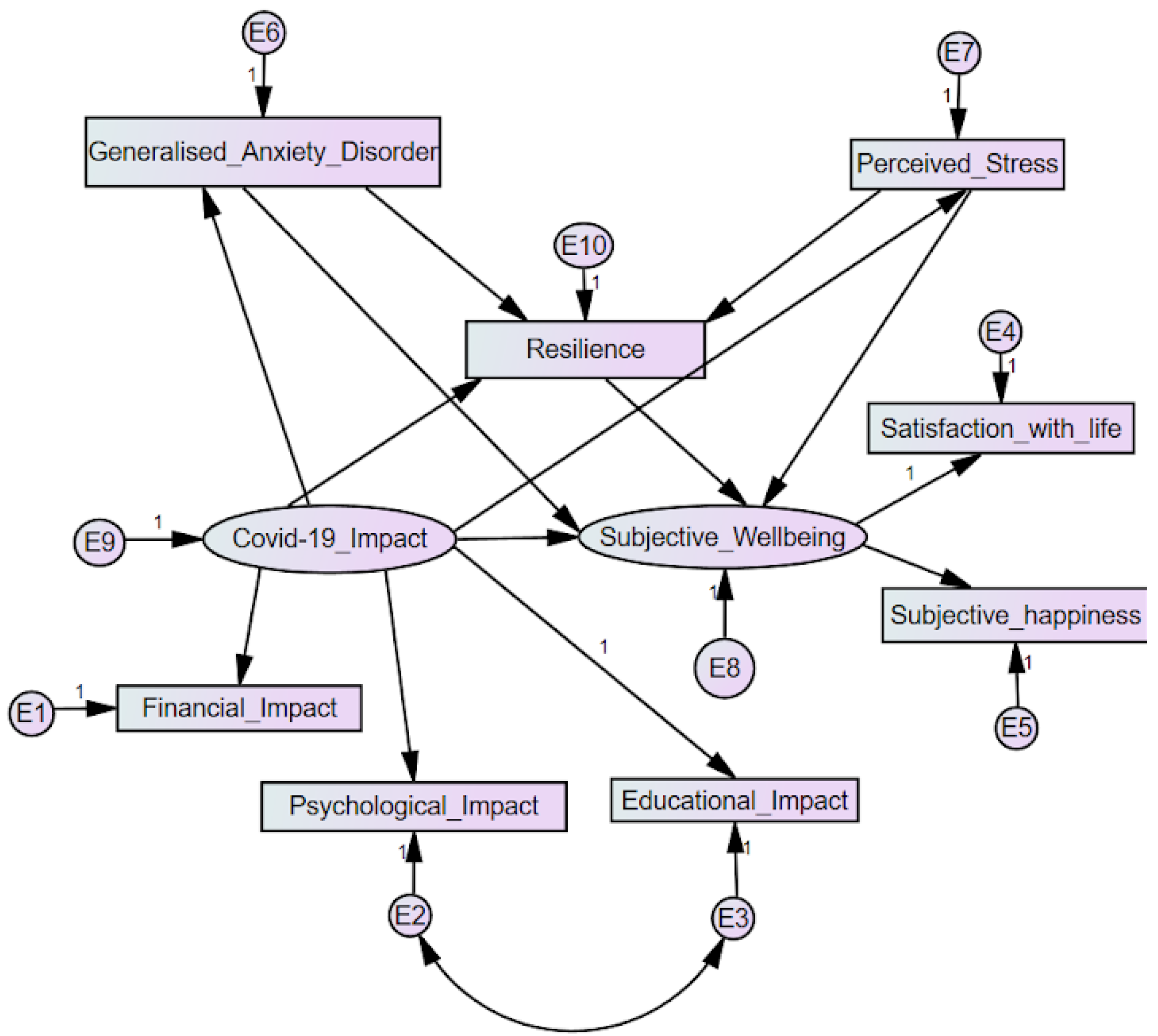
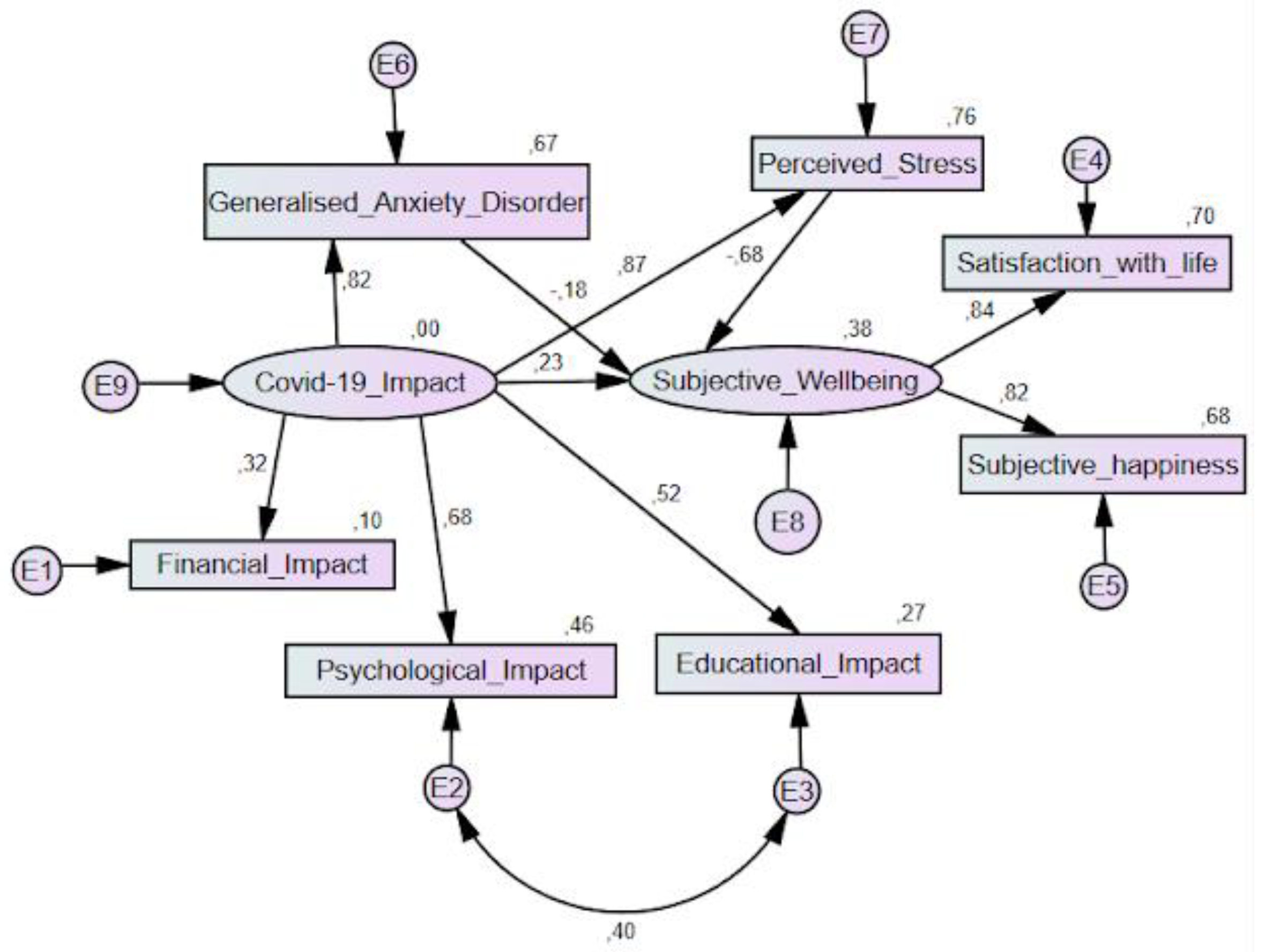
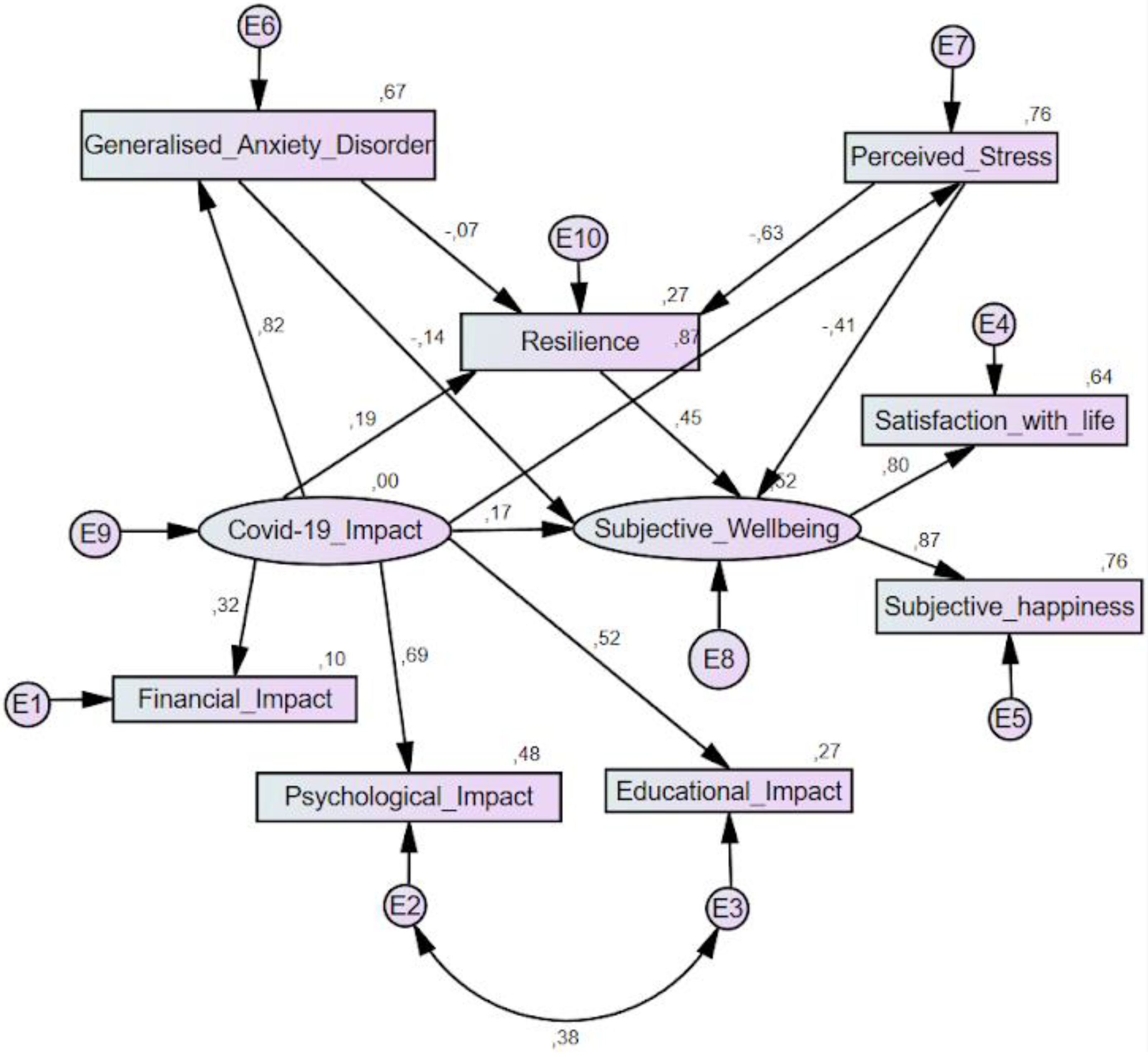

| Variable | M | SD | α | Skewness | Curtosis | 1 | 2 | 3 | 4 | 5 | 6 | 7 |
| 1. Covid Financial Impact | 4.54 | 2.00 | .87 | -.357 | -1.11 | 1 | ||||||
| 2. Covid Psychological Impact | 4.96 | 1.80 | .84 | -.645 | -.635 | .226** | 1 | |||||
| 3. Covid Educational Impact | 5.11 | 1.46 | .90 | -.900 | .152 | .201** | .562** | 1 | ||||
| 4. GAD7 - Generalised Anxiety Disorder | 1.71 | .83 | .91 | -.147 | -.963 | .251** | .561** | .379** | 1 | |||
| 5. Perceived Stress Scale | 2.30 | .81 | .90 | -.382 | -.465 | .259** | .575** | .459** | -.509** | 1 | ||
| 6. SWLS - Satisfaction with Life Scale | 4.46 | 1.33 | .85 | -.147 | -.963 | -.173** | -.249** | -.295** | -.383** | -.509** | 1 | |
| 7. SHS - Subjective Happiness Scale | 4.66 | 1.28 | .80 | -.373 | -.260 | -.139** | -.282** | -.221** | -.410** | -.490** | .681** | 1 |
| 8. Resilience | 2.62 | .66 | .85 | -.281 | -.108 | -.082* | -.277** | -.249** | -.360** | -.501** | .493** | .571** |
| Estimate | S.E. | C.R. | P | Label | |||
| Covid Impact | → | GAD7 | ,913 | ,073 | 12,548 | *** | par_3 |
| Covid Impact | → | PSS | ,957 | ,076 | 12,641 | *** | par_7 |
| Covid Impact | → | Subjective Well-being |
,341 | ,382 | ,894 | ,371 | par_1 |
| GAD | → | Subjective Well-being |
-,238 | ,153 | -1,555 | ,120 | par_2 |
| PSS | → | Subjective Well-being |
-,912 | ,223 | -4,086 | *** | par_8 |
| Covid Impact | → | Psychological Impact |
1,631 | ,120 | 13,576 | *** | par_5 |
| Covid Impact | → | Educational Impact | 1,000 | ||||
| Covid Impact | → | Financial Impact | ,861 | ,127 | 6,772 | *** | par_6 |
| Subjective Well-being |
→ | SWLS | 1,000 | ||||
| Subjective Well-being |
→ | SHS | ,961 | ,059 | 16,323 | *** | par_9 |
| COVID-19 Impact |
Perceived Stress Scale | GAD | Subjective Well-being |
||
| Perceived Stress Scale | Direct | .873 | |||
| Indirect | |||||
| GAD | Direct | .818 | |||
| Indirect | |||||
| Subjective Well-being |
Direct | .232 | -.681 | -.180 | |
| Indirect | -.742 | ||||
| SHS | Direct | .822 | |||
| Indirect | -.419 | -.559 | -.148 | ||
| SWLS | Direct | .836 | |||
| Indirect | -.426 | -.569 | -.151 | ||
| Financial Impact | Direct | .322 | |||
| Indirect | |||||
| Educational Impact | Direct | .523 | |||
| Indirect | |||||
| Psychological Impact | Direct | .681 | |||
| Indirect |
| Estimate | S.E. | C.R. | P | Label | |||
| Covid Impact | → | GAD | .920 | .074 | 12.476 | *** | par_2 |
| Covid Impact | → | Perceived Stress Scale | .960 | .076 | 12.601 | *** | par_13 |
| GAD | → | Resilience | -.056 | .083 | -.683 | .495 | par_7 |
| Perceived Stress Scale | → | Resilience | -.510 | .121 | -4.219 | *** | par_8 |
| Covid Impact | → | Resilience | .167 | .207 | .810 | .418 | par_10 |
| Covid Impact |
→ | Subjective Well-being |
.236 | .322 | .734 | .463 | par_1 |
| Resilience | → | Subjective Well-being |
.719 | .072 | 9.954 | *** | par_9 |
| GAD | → | Subjective Well-being |
-.182 | .127 | -1.432 | .152 | par_11 |
| Perceived Stress Scale | → | Subjective Well-being |
-.529 | .200 | -2.650 | .008 | par_12 |
| Covid Impact | → | Psychological Impact | 1.675 | .124 | 13.524 | *** | par_4 |
| Covid Impact | → | Educational Impact | 1.000 | ||||
| Covid Impact | → | Financial Impact | .864 | .128 | 6.752 | *** | par_5 |
| Subjective Well-being |
→ | SWLS | 1.000 | ||||
| Subjective Well-being |
→ | SHS | 1.063 | .055 | 19.177 | *** | par_6 |
| COVID-19 Impact |
Perceived Stress Scale | GAD | Resilience | Subjective Well-being |
||
| Perceived Stress Scale | Direct | .873 | ||||
| Indirect | ||||||
| GAD | Direct | .818 | ||||
| Indirect | ||||||
| Resilience | Direct | .187 | -.626 | -.071 | ||
| Indirect | -.605 | |||||
| Subjective Well-being |
Direct | .166 | -.408 | -.144 | .452 | .166 |
| Indirect | -.663 | -.283 | -.032 | |||
| SHS | Direct | .870 | ||||
| Indirect | -.432 | -.601 | -.153 | .393 | ||
| SWLS | Direct | .803 | ||||
| Indirect | -.399 | -.555 | -.141 | .363 | ||
| Financial Impact | Direct | .322 | ||||
| Indirect | ||||||
| Educational Impact | Direct | .520 | ||||
| Indirect | ||||||
| Psychological Impact | Direct | .695 | ||||
| Indirect |
| Model | CMIN/DF | CFI | NFI | RMSEA (IC 95%) |
| Unconstrained | 1.921 | .983 | .967 | .037 (.024 - .049) |
| Measurement weights | 1.737 | .983 | .960 | .033 (.021 - .044) |
| Model | DF | CMIN | p | NFI | IFI | RFI | TLI |
| Delta 1 | Delta 2 | Rho 1 | Rho 2 | ||||
| Measurement weights | 12 | 13.691 | .321 | .006 | .006 | -.007 | -.007 |
Disclaimer/Publisher’s Note: The statements, opinions and data contained in all publications are solely those of the individual author(s) and contributor(s) and not of MDPI and/or the editor(s). MDPI and/or the editor(s) disclaim responsibility for any injury to people or property resulting from any ideas, methods, instructions or products referred to in the content. |
© 2025 by the authors. Licensee MDPI, Basel, Switzerland. This article is an open access article distributed under the terms and conditions of the Creative Commons Attribution (CC BY) license (http://creativecommons.org/licenses/by/4.0/).


