

Submitted:
05 February 2025
Posted:
06 February 2025
You are already at the latest version
Abstract
We propose the Ramsey approach for the analysis of the kinematics of the systems built of non-relativistic, motile point masses/particles. The approach is based on the colored graphs theory. Point masses/particles serve as the vertices of the graph. The time dependence of the distance between the particles determines the coloring of the links. The vertices/particles are connected with an orange link, when the particles move away from each other or remain at the same distance. The vertices/particles are linked with the violet edge, when the particles converge. The sign of the time derivative of the distance between the particles dictates the color of the edge. Thus, the complete, bi-colored, Ramsey, temporal graph emerges. The suggested coloring procedure is not transitive. The coloring of the link is time dependent. The proposed coloring procedure is frame independent and insensitive to Galilean transformations. At least one monochromatic triangle will inevitably appear in the graph emerging from the motion of six particles, due to the fact that the Ramsey number R(3,3)=6. The approach is extended for the analysis of the systems, containing infinite number of the moving point masses. Infinite monochromatic (violet or orange) clique will necessarily appear in the graph.
Keywords:
point masses
; particles
; complete graph
; colored graph
; temporal graph
; Ramsey theorem
; Ramsey number
; infinite Ramsey theorem
The approach is extended for the analysis of the systems, containing infinite number of the moving point masses. Infinite monochromatic (violet or orange) clique will necessarily appear in the graph.
1. Introduction
Synthesis of novel fields of mathematics and physics is extremely fruitful, and sometimes generates and even constitutes new fields of investigations [1,2,3]. Nobel Prize winner Eugene Paul Wigner in his seminal paper even spoke about the “unreasonable effectiveness of mathematics in the natural sciences” [1]. One of the most advanced fields of modern mathematics is a graph theory, which was extensively developed in last decades [4,5]. Mathematical graph is a structure used to represent relationships between objects. Simply speaking, graphs represent a set of objects and a set of pairwise relations between them [4,5]. It consists of vertices/nodes, which are the fundamental units or points of the graph and edges/links, which are the connections between the vertices [4,5,6]. One of the varieties of graphs are the so-called colored graphs, which are graphs, where colors are assigned to its elements, typically vertices or edges [6,7]. The classical result in theory of the colored graphs (which is referred as the Ramsey theorem) states that for any given integers r and s, there exists a minimum number called the Ramsey number, such that any graph on at least vertices, with edges colored in two colors (say orange and violet), will contain either: an orange clique of size r (i.e., a complete subgraph where all edges are orange), or a violet clique of size s (i.e., a complete subgraph where all edges are violet) [8,9,10,11,12,13,14]. The graph theory demonstrates a potential for physics; however, applications of the graph theory to physics are scarce until now [15,16,17,18,19,20,21]. We introduce the graph scheme, applicable for the analysis of the motion of the systems of material points, which results, in the temporal, complete, bi-colored graph [22,23,24]. We extend our approach to the infinite systems built of material points.
2. Results
2.1. Coloring Procedure Applicable for the Motion of Point Masses. Bi-Coloring for a Pair of Particles
Let us introduce the coloring procedure, which is applicable for the motion of N point masses The procedure will eventually give rise to the complete, bi-colored, temporal graph. Consider first the simplest system built of two non-relativistic, moving point masses/particles and , depicted in Figure 1.
The Cartesian coordinates of the masses are shown.
The Cartesian coordinates of the point masses and are and respectively; the first index denotes the number of the particle and the second index denotes the number of the Cartesian coordinate (see Figure 1). The time-dependent distance between the point masses is given by Eq. 1:
Now we introduce following coloring procedure: from the pure kinematic point of view two situations are possible: i) the particles get closer/(converge) in a course of their motion, or ii) they move away from each other/remain at the same distance. When the particles move away or remain at the same distance, Eq. 2 takes place:
When the particles converge Eq. 3 is true:
Now we make an instant photograph of the pair of particles and at We adopt the following coloring procedure: if the particles and move away or remain at the same distance and Eq. 2 takes place, they are connected with the orange link (they are “strangers” in the terms of the seminal “party problem” of the Ramsey theory [9,10,11,12]), and when the particles converge, and Eq. 3 is true, they are connected with a violet link (they are considered respectively as “friends” [9,10,11,12]), as shown in Figure 2.
The introduced coloring is time-dependent. It is noteworthy that Eq. 2 and Eq. 3 exhaust all of the possibilities of the relative motion for the given pair of particles. It also should be emphasized, that the introduced coloring is completely based on the kinematic considerations, and it neglects the dynamic details of interaction between the point masses. The coloring scheme is trivially extended for any generalized coordinates of the particles (cylindrical, spherical, etc.). The introduced coloring scheme is frame independent; consider that the particles are non-relativistic, thus, the distance between the particles is invariant in all of the frames, both inertial and non-inertial.
2.2. Coloring for a Triad of Particles. Checking the Transitivity of the Coloring Procedure
Now we apply the introduced procedure for the triad of moving particles and . These particles serve as the vertices of the graph. The coloring procedure is supplied by Eqs. 2-3. It seems from the first glance, that application of the introduced coloring scheme is straightforward for the triad of particles. However, the situation is much more subtle, and the transitivity of the coloring should be carefully examined [25,26,27]. Actually, internal logic of the graph influences its coloring [25,26,27]. Let is illustrate this with the scheme, depicted in Figure 3. Consider the triad of moving particles and , shown in Figure 3. Assume, that particles and converge, i.e. takes place. We also assume that particles and converge, i.e. . Does it necessarily mean, that particles and also necessarily converge? If this is true, the suggested coloring procedure is transitive.
The transitivity of coloring has a crucial importance for the analysis of the emerging graph. It was demonstrated, that the transitive Ramsey numbers are different from those, calculated for non-transitive graphs [25,26,27]. This is quite understandable, indeed, if the coloring is transitive, the monochromatic triangle immediately emerges for any pair of mono-colored, adjacent edges. It is easy to demonstrate that the introduced coloring is not transitive. Distance between particles and is given by:
where are shown in Figure 3. Consider the situation when are the slowly changing, decreasing functions; whereas, is a rapidly growing function. These assumptions may be quantified within the linear approximation: consider the motion in which Routine calculations demonstrate, that when and , is true. Thus, it is possible that the link is orange, when and both of the situations depicted in Figure 4 is possible. When are constant, the coloring is obviously non-transitive: may grow or decrease with time.
Similar reasoning leads to the conclusion that the orange coloring is also non-transitive. We conclude that the suggested colored procedure defined by Eqs. (2-3) is not transitive. And, again, it is frame independent.
2.3. Kinematic Graphs Emerging from the Motion of Multi-Particle Systems
Consider the kinematic graph emerging from the motion of five particles, , presented in Figure 5. The system of the motile particles is not necessarily 2D one; it may be constituted by the 3D set of motile particles. The coloring of the edges is defined by Eqs. 2-3. We consider the hypothetic coloring, presented in Figure 5. As it was already demonstrated, the coloring is non-transitive. No monochromatic triangle is recognized in the graph. This result is consistent with the Ramsey theory, indeed:
No monochromatic triangle is recognized in the graph.
Thus, we conclude, that there exists the physical situation for the system comprised of five particles, in which the triad of converging particles or particles moving away from each other/remaining at the same distance will be absent in the system built of five point motile masses.
Now we address the system built of six point motile masses (it also may be a 3D system of particles).
We address hypothetic coloring, described by Eqs. 2-3, shown in Figure 6. Monochromatic orange triangles and are recognized in the graph. This means that within the triads of point masses and the particles move away each from other or, perhaps, remain at the same distance each from other. Moreover, the Ramsey theorem states that within any graph describing the motion of six particles, we inevitably will find at least one monochromatic triangle. In other words, we always will find the triangle built of three particles, in which the particles will converge or move away each from other/remain at the same distance. Indeed, the Ramsey number It should be emphasized that the Ramsey theorem do not predict what kind/color of triangles will appear in a graph, and this should be established with a brute force method, based on the analysis of the dynamics of the addressed system [9,10,11,12].
Graphs, depicted in Figure 3, Figure 4, Figure 5 and Figure 6 are temporal graphs, and their coloring will change with time [22,23,24]. The total number of mono-colored triangles within the given graph is supplied with
where are the time-dependent numbers of orange and violet monochromatic triangles in a given graphs. It is noteworthy, that are frames independent.
2.4. Generalization for Infinite Systems of Material Points
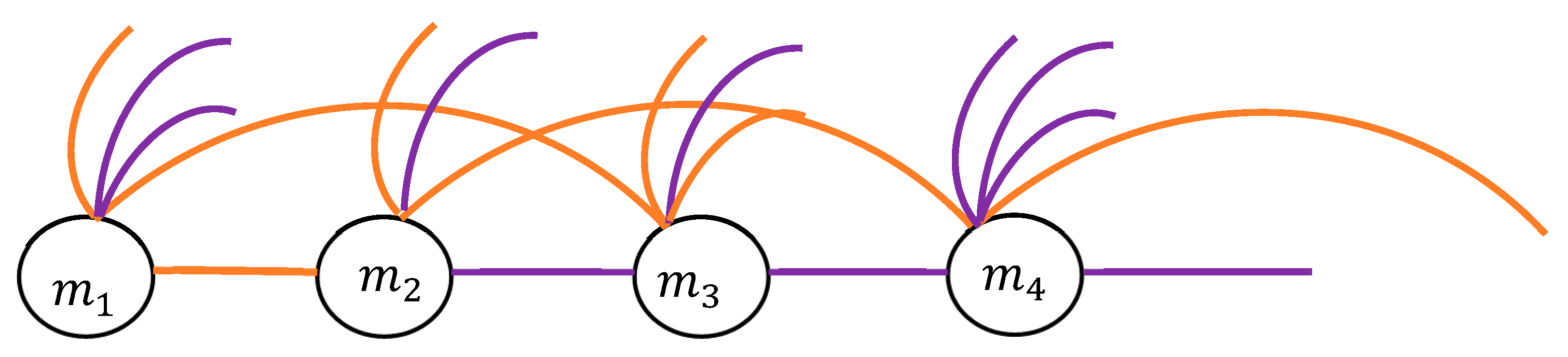
Consider now infinite, however countable system of moving material points/particles . The particles form the vertices of the infinite, bi-colored graph. The vertices/particles are connected with an orange link, when the particles move away from each other/remain at the same distance in a course of their motion (in other words Eq. 2 is true). The vertices/particles are connected with the violet link, when the particles converge (Eq. 3 is correct). Figure 7 represents the graph, corresponding to the instant photo of the motion. According to the Ramsey infinite theorem, the infinite monochromatic (violet or orange) clique will necessarily appear in the graph [12,28].
Let us formulate rigorously the infinite Ramsey theorem. Let denote the complete colored graph on the vertex set N. For every , if we color the edges of with distinguishable colors, then there must be present an infinite monochromatic clique [12]. The infinite Ramsey theorem re-formulates the seminal Dirichlet pigeonhole principle, which states that if there exists n pigeonholes containing pigeons, one of the pigeonholes necessarily must contain at least two pigeons [12]. Thus, the monochromatic clique will necessary appear in the kinematic graph, shown in Figure 7. And. again, the coloring of the graph is time-dependent but frame independent. Infinite Ramsey theorem does not predict the exact color of the monochromatic clique.
3. Discussion
We introduced the mathematic procedure applicable for the analysis of motion of material points/particles. The mathematical scheme is based on the theory of colored graphs and it converts the instant photo of the motion into the Ramsey bi-colored graph [8,9,10,11,12,29]. Particles serve as the vertices of the graph. Coloring of edges/links is based on the time dependence of the distance between the particles. If the distance between a pair of particles grows with time in a course of motion (or remains the same), the edge is colored with the orange color (the vertices/particles are seen as “strangers” [29]); if the distance between the particles is decreased with time the edge is colored with violet (the vertices/particles are seen as “friends”). Thus, the complete, bi-colored, temporal graph emerges. The coloring is time dependent; however, it is frame independent. In our future investigations we plan:
i) to extend the suggested approach to relativistic particles.
ii) to extend the approach to the motion of deformable bodies.
4. Conclusions
We conclude that the graphs theory supplies the powerful tools for the analysis of the motion of the systems of material points/particles. We completely neglected the details of interaction between the particles and we based our analysis on the time dependence of the distance between particles; thus adopting pure kinematic approach. The distance between the motile particles, numbered i and k, denoted may grow with time/remain the same, i.e. , or, alternatively it may decrease with time in a course of the motion of the particles, i.e. takes place. The motile particles, themselves, serve as the vertices of the graph. The distinguishing in the temporal behavior of the function , prescribed by the sign of its derivative, enables bi-coloring of the edges linking the particles. Particles moving away from each other/remaining at the same distance are connected with the orange link; the converging particles are, in turn, connected with the violet link. We demonstrated that the suggested coloring scheme is not transitive. This is important in a view of application of the Ramsey graph theory to the analysis of the complete, bi-colored, complete, temporal graph, emerging from the motion of the particles. The Ramsey number This means that for any physical system built of six particles, will correspond the bi-colored, complete graph, drawn according the aforementioned mathematical scheme, which will contain at least one monochromatic triangle. In other words, the addressed physical system will necessarily contain at least one triad of particles which move away each from other/remain at the same system or converge. The proposed scheme completely ignores the peculiarities of the Hamiltonian/Lagrangian of the system. It is based on the analysis of the temporal behavior of the distances between the particles. The introduced mathematical scheme is time-dependent, the temporal bi-colored graph corresponds to the system [22,23,24,30]. However, the emerging graph is frame-independent. The number of the monochromatic triangles is frame-independent. The extension of the suggested approach to the analysis of the systems built of arbitrary number of point masses is straightforward. However, calculation of large Ramsey number remains the challenging and unsolved mathematical task. Generalization of the suggested approach to the infinite systems of particles is reported. The relativistic extension of the suggested method should be developed.
Author Contributions
Conceptualization, E.B.; methodology, E.B; formal analysis, E. B.; investigation, E.B.; writing—original draft preparation, E.B. All authors have read and agreed to the published version of the manuscript.
Funding
This research received no external funding.
Data Availability Statement
The data are contained within the article.
Acknowledgments
The author is thankful to Dr. Nir Shvalb for fruitful discussions.
Conflicts of Interest
The authors declare no conflicts of interest.
References
- Wigner, The Unreasonable Effectiveness of Mathematics in the Natural Sciences, Mathematics and Science, World Scientific, Singapore, pp. 291-306, 1990.
- Grinbaum, A. The effectiveness of mathematics in physics of the unknown. Synthese 2019, 196, 973–989. [Google Scholar] [CrossRef]
- Plotnitsky, A. On the Reasonable and Unreasonable Effectiveness of Mathematics in Classical and Quantum Physics. Found. Phys, 2011, 41, 466–491. [Google Scholar] [CrossRef]
- Bondy, J. A.; Murty, U.S. R Graph Theory, Springer, New York, 2008.
- Bollobás, B. Modern graph theory, vol 184. Springer, Berlin, 2013.
- Kosowski, A. Manuszewski, K. Classical coloring of graphs, Contemporary Mathematics, 2008, 352, 1–20. [Google Scholar]
- Kano, M.; Li, X. Monochromatic and Heterochromatic Subgraphs in Edge-Colored Graphs - A Survey. Graphs & Combinatorics 2008, 24, 237–263. [Google Scholar]
- Chartrand, G.; Zhang, P. New directions in Ramsey theory, Discrete Math. Lett. 2021, 6, 84–96. [Google Scholar]
- Graham, R. L.; Rothschild, B.L. ; Spencer, J, H. Ramsey theory, 1990. [Google Scholar]
- Graham, R.; Butler, S. Rudiments of Ramsey Theory (2nd ed.). American Mathematical Society: Providence, Rhode Island, USA, 2015; pp. 7–46.
- Di Nasso, M.; Goldbring, I.; Lupini, M. , Nonstandard Methods in Combinatorial Number Theory, Lecture Notes in Mathematics, vol. 2239, Springer-Verlag, Berlin, 2019.
- Katz, M.; Reimann, J. Introduction to Ramsey Theory: Fast Functions, Infinity, and Metamathematics, Student Mathemati-cal Library Volume: 87; 2018; pp. 1-34.
- Erdős, P. Solved and unsolved problems in combinatorics and combinatorial number theory, Congressus Numerantium, 1981, 32, 49–62. 32.
- Conlon, J. Fox, B. Sudakov, Recent developments in graph Ramsey theory, Surveys in Combinatorics, 2015, 424, 49–118. [Google Scholar]
- de Gois, C.; Hansenne, K.; Gühne, O. Uncertainty relations from graph theory. Phys. Rev. A 2023, 107, 062211. [Google Scholar] [CrossRef]
- Xu, Z-P. ; Schwonnek, R.; Winter, A. Bounding the Joint Numerical Range of Pauli Strings by Graph Parameters. PRX Quantum 2024, 5, 020318. [Google Scholar] [CrossRef]
- Hansenne, K.; Qu, R.; Weinbrenner, L. T.; de Gois, C.; Wang, H.; Ming, Y.; Yang, Z.; Horodecki, P.; Gao, W.; Gühne, O. 2024; arXiv:2408.05730.
- Wouters, J.; Giotis, A.; Kang, R.; Schuricht, D.; Fritz, L. Lower bounds for Ramsey numbers as a statistical physics problem. J. Stat. Mech. 2022, 2022, 0332. [Google Scholar] [CrossRef]
- Shvalb, N.; Frenkel, M.; Shoval, Sh.; Bormashenko, *!!! REPLACE !!!* (Eds.) Dynamic Ramsey Theory of Mechanical Systems Forming a Complete Graph and Vibrations of Cyclic Compounds, Dynamics 2023, 3, 272-281. 3.
- Frenkel, M.; Shoval, Sh.; Bormashenko, *!!! REPLACE !!!* (Eds.) Fermat Principle, Ramsey Theory and Metamaterials. Materials 2023, 16, 7571. [Google Scholar] [CrossRef] [PubMed]
- Bormashenko, Ed.; Shvalb, N. A Ramsey-Theory-Based Approach to the Dynamics of Systems of Material Points. Dynamics 2024, 4, 845–854. [Google Scholar] [CrossRef]
- Michail, O. An introduction to temporal graphs: an algorithmic perspective, Internet Mathematics, 2016, 12, 239–280. 12.
- Michail, O.; Spirakis, P.G. Traveling salesman problems in temporal graphs, Theoretical Computer Science, 2016, 634, 1-23. 634.
- Erlebach, T.; Hoffmann, M.; Kammer, F. On temporal graph exploration, J. Computer & System Sciences, 2021, 119, 1–18. [Google Scholar]
- Choudum, S. A.; Ponnusamy, B. Ramsey numbers for transitive tournaments, Discrete Mathematics 1999, 206, 119–129. 206.
- Gilevich, A.; Shoval, Sh.; Nosonovsky, M.; Bormashenko, *!!! REPLACE !!!* (Eds.) , Converting Tessellations into Graphs: From Voronoi Tessellations to Complete Graphs, Mathematics 2024, 12, 2426. 12.
- Choudum, S.A. ; Ponnusamy,B. Ordered Ramsey numbers, Discrete Mathematics 2002, 247, 79–92. [Google Scholar]
- Li, Y.; Lin, Q. Elementary methods of the graph theory, Applied Mathematical Sciences. Springer, pp. 3-44, Cham, Switzerland, 2020.
- Ramsey, F. P. On a Problem of Formal Logic. In: Gessel, I., Rota, GC. (eds) Classic Papers in Combinatorics. Modern Birkhäuser Classics. Birkhäuser Boston, 2009, pp. 264-286.
- Wang, Y.; Yuan, Y.; Ma, Y.; Wang, G. Time-Dependent Graphs: Definitions, Applications, and Algorithms. Data Sci. Eng. 2019, 4, 352–366. [Google Scholar] [CrossRef]
Figure 1.
The simplest system built of a pair of point masses is depicted.
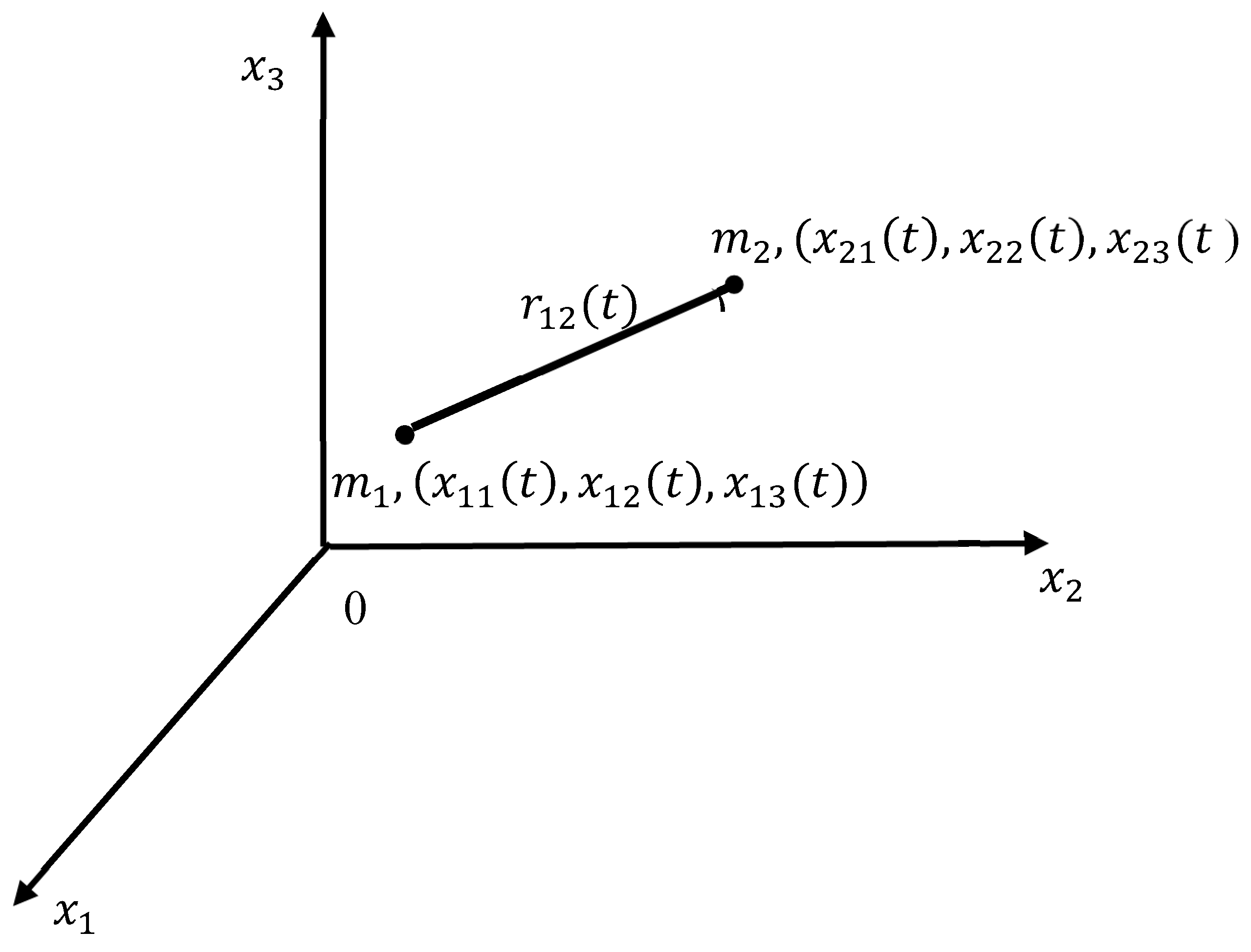
Figure 2.
Coloring procedure is illustrated. A. Particles and move away or remain at the same distance is true. Particles are connected with an orange link. B. Particles and converge, occurs. Particles are connected with a violet link. Green arrows illustrate directions of the particles motion.
Figure 2.
Coloring procedure is illustrated. A. Particles and move away or remain at the same distance is true. Particles are connected with an orange link. B. Particles and converge, occurs. Particles are connected with a violet link. Green arrows illustrate directions of the particles motion.
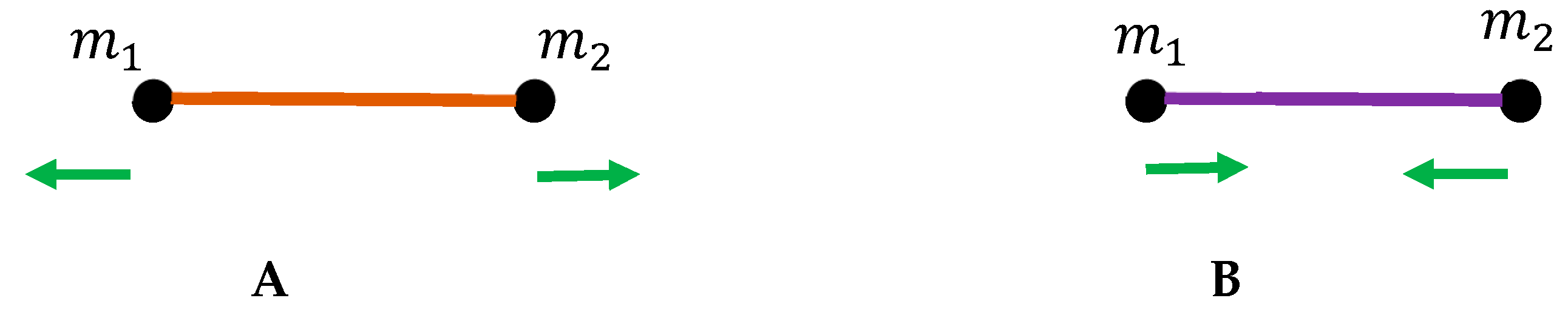
Figure 3.
Coloring for motion of the triad of particles and is demonstrated. Green arrows depict the directions of the particles motion. Coloring is non-transitive.
Figure 3.
Coloring for motion of the triad of particles and is demonstrated. Green arrows depict the directions of the particles motion. Coloring is non-transitive.
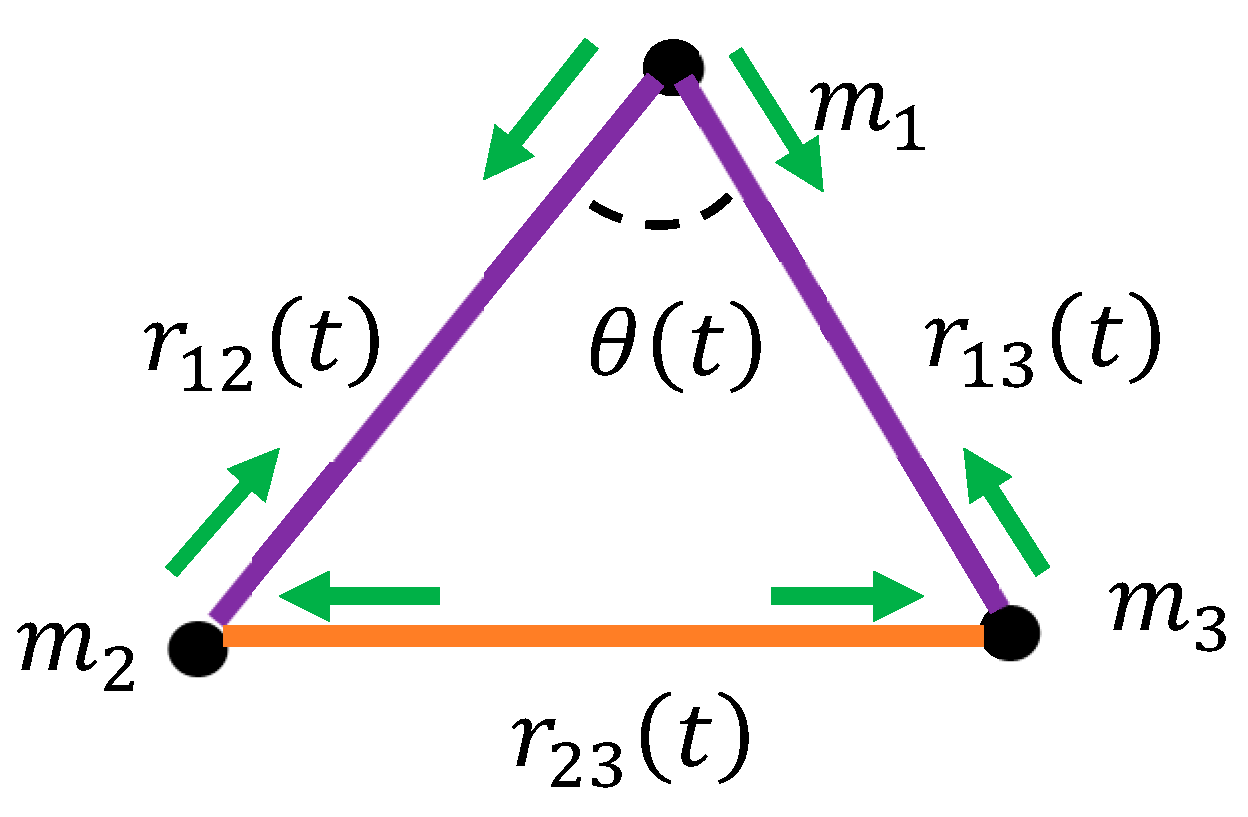
Figure 4.
Possible coloring for motion of the triad of particles and is demonstrated. Green arrows depict the directions of the particles motion. A. The resulting triangle is bi-colored. B. The resulting triangle is mono-colored violet.
Figure 4.
Possible coloring for motion of the triad of particles and is demonstrated. Green arrows depict the directions of the particles motion. A. The resulting triangle is bi-colored. B. The resulting triangle is mono-colored violet.
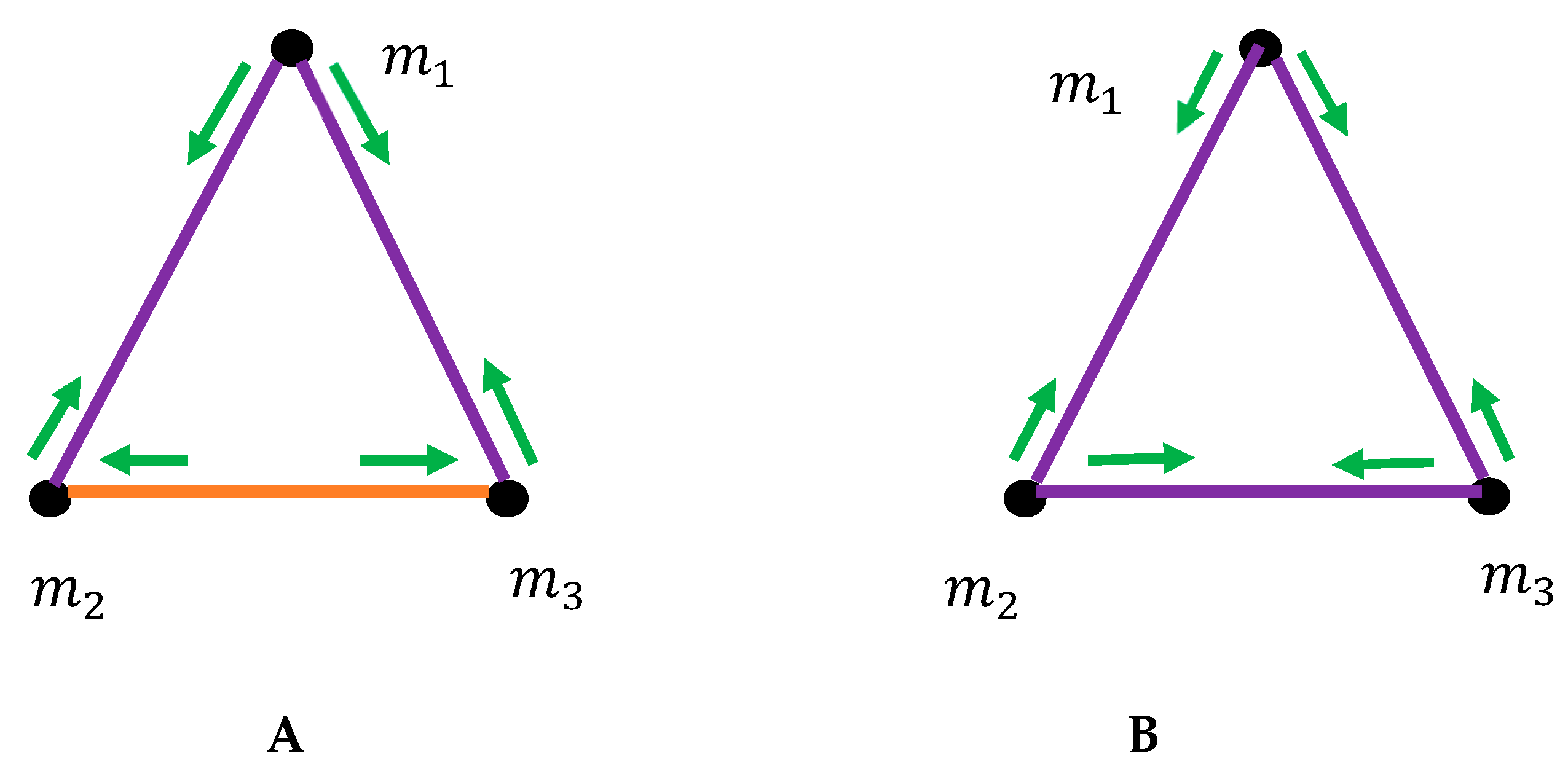
Figure 5.
Kinematic graph emerging from the motion of five, particles,
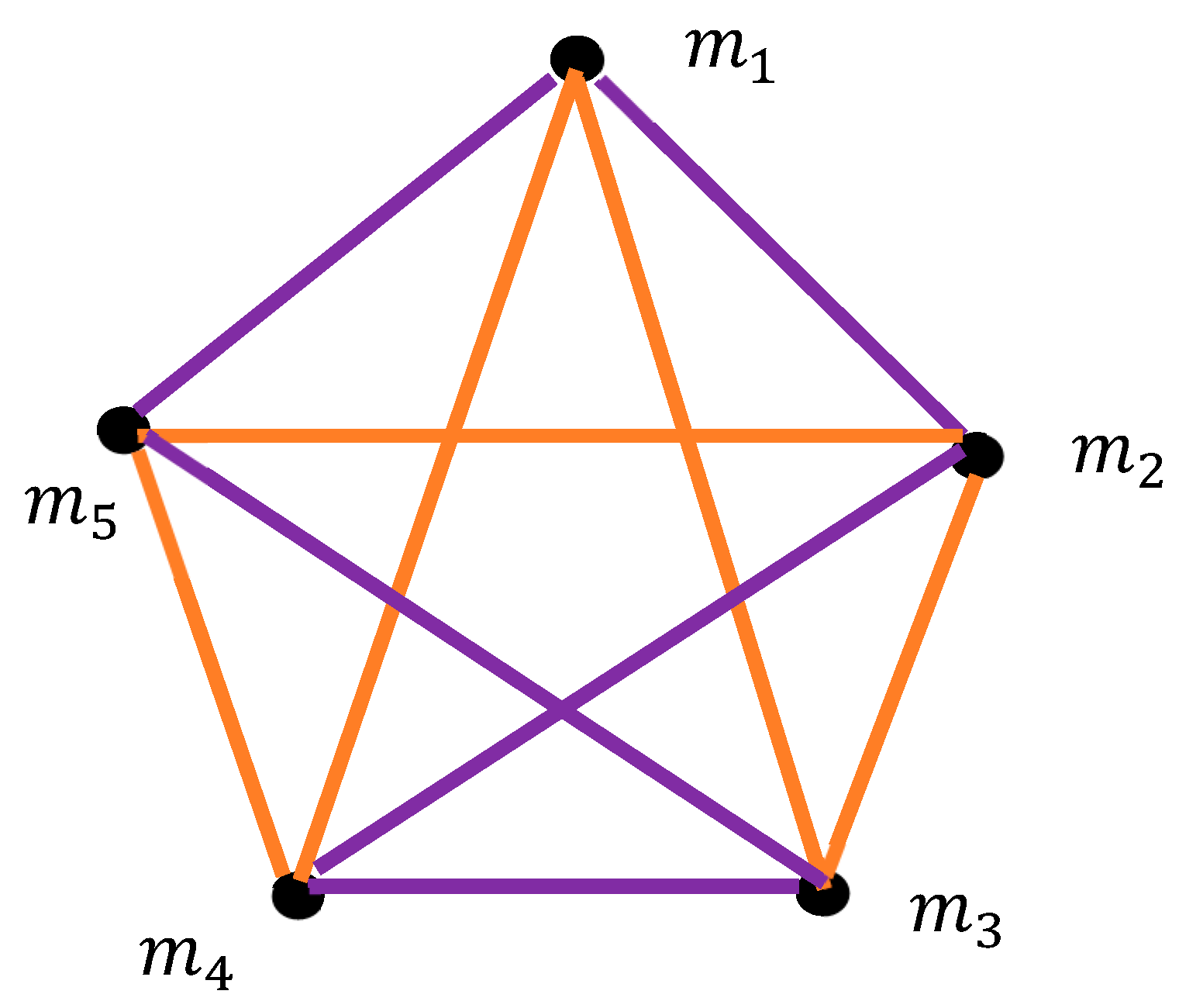
Figure 6.
Kinematic graph emerging from the motion of six motile particles, Monochromatic orange triangles and are recognized in the graph.
Figure 6.
Kinematic graph emerging from the motion of six motile particles, Monochromatic orange triangles and are recognized in the graph.
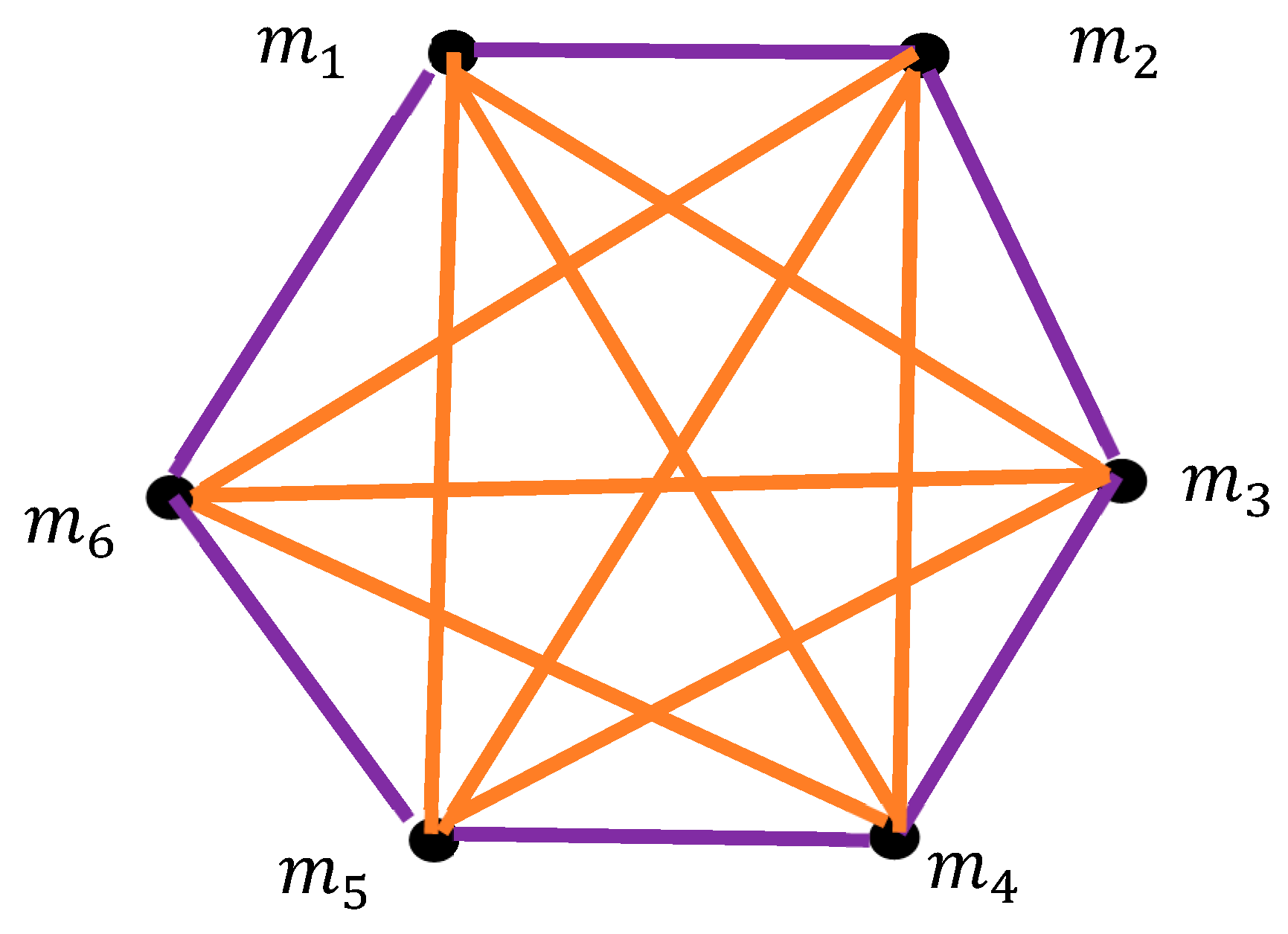
Figure 7.
Infinite, however countable system of moving material points/particles is depicted. The particles form the vertices of the infinite, bi-colored graph. The vertices/particles are connected with an orange link, when the particles move away from each other/remain at the same distance. The vertices/particles are connected with the violet link, when the particles converge. Infinite monochromatic (violet or orange) clique will necessarily appear in the graph.
Figure 7.
Infinite, however countable system of moving material points/particles is depicted. The particles form the vertices of the infinite, bi-colored graph. The vertices/particles are connected with an orange link, when the particles move away from each other/remain at the same distance. The vertices/particles are connected with the violet link, when the particles converge. Infinite monochromatic (violet or orange) clique will necessarily appear in the graph.
Disclaimer/Publisher’s Note: The statements, opinions and data contained in all publications are solely those of the individual author(s) and contributor(s) and not of MDPI and/or the editor(s). MDPI and/or the editor(s) disclaim responsibility for any injury to people or property resulting from any ideas, methods, instructions or products referred to in the content. |
© 2025 by the authors. Licensee MDPI, Basel, Switzerland. This article is an open access article distributed under the terms and conditions of the Creative Commons Attribution (CC BY) license (http://creativecommons.org/licenses/by/4.0/).
Copyright: This open access article is published under a Creative Commons CC BY 4.0 license, which permit the free download, distribution, and reuse, provided that the author and preprint are cited in any reuse.


