
Submitted:
05 February 2025
Posted:
06 February 2025
You are already at the latest version
Abstract
Let V be a vector space of dimension n over a field K and let ω be a trivector of ∧³V. For such trivectors, we can associate three invariants, the automorphism group Aut(ω), the radical polynominal P(ω) and the commutant C(ω). We use the classification of trivectors of rank ≤9, we give a general rule for the standard trivector ω_{3k} in dimension 3k, the trivector with the transitive automorphism group and the trivector with an isotropic hyperplane ω_{2k+1} in dimension 2k+1. We compute their radical polynomials and the sizes of the groups automorphisms. We demonstrate that there exists a vector space V and a trivector ω of ∧³V where C(ω) is not a Frobenius algebra and dimV≤3dimC(ω). Finally, We give a classification of trivectors in dimension 8 over a finite field of characteristic 2 and its applications in the theory of codes.
Keywords:
trivector
; invariant
; isotropy groups
; radical polynomial
; commutant
MSC: Primary 15A69; Secondary 15A75; 05A15; 15A18
1. Introduction
Let V be a vector space of dimension n and let be the third-degree exterior power space of V over the field K. Any element of is named trivector on V. By virtue of the canomical identification , there is no diffrence between trivectors and trilinear alternating form. The classification of trilinear alternating forms is the study of the action of on : . For , this classification was completed for any fields and the number of orbits is finite. In dimension 9, the number of classes of trivectors over is infinite (see [3]) and over is finite (there are 317 classes, see [6]).
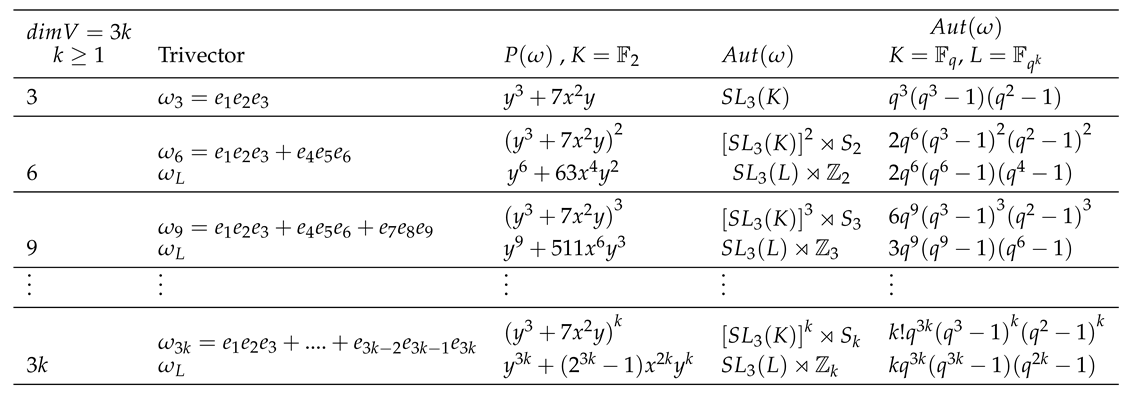
In this paper we examine the general cause for the trivector in dimension , called standard trilinear alternating form, the form of the transitive automorphism group over L in which L is the extension of the field K and the trivector in dimension with the isotropic hyperplane. We computed their groups of automorphisms and their radical polynomials. The main results are the Tables 1, 2, 3, 4 and 5 containing the trivectors and with the sizes of the group of automorphisms, the radical polynomials and the number of orbits of trivectors in dimension eight. The commutant of a trivector with a maximum rank of eight forms a Frobenius algebra with (See [10] Theorem 2.8, p.49), we show that this result is not true for .
The motivation behind this research stems from the graph theory, complexity and cryptography, in which they are interested in the alternating trilenear form equivalence (ATFE) problem and code loops, see [12] and [15]. We note that Frobenius algebras are significant in the algebraic approach.
2. Preliminaries
Let be a trilinear alternating form on a vector space V over a field . The trivector satisfies the equality for every permutation . Two forms and are equivalent, , if there exists a homomorphism bijective of V verifying:
Definition 1.
The group of automorphisms of ω, , is defined by
Example 1.
Let be the trivector , then .
Definition 2.
The set is called the radical of ω and denoted by . If is trivial , then ω is called non degenerate.
Fix and define radical of V as . is a subspace of V. The rank of , is an even number.
Definition 3.
Let be a finite field. The polynomial defined by:
or
where and , is the radical polynomial of ω.
Definition 4.
Two vectors are orthogonal , if . The subspaces and of V are orthogonal , if for all and .
Definition 5.
We say that a non degenerate trilinear alternating form ω on V is decomposable if , and whenever . The restrictions of ω to are denoted by . is compatible with the orthogonal decomposition:
Example 2.
Let be the trivector . The radical polynomial of is equal to
Definition 6.
The commutant of ω, is
Definition 7.
Let A be an algebra of finite dimension over a field K. We say that A is a F.algebra if (isomorphic as A-modules).
Note that if A is finite-dimensional algebra over a field K. Then A is a Frobenius algebra if and only if there is a non-degenerate symmetric bilinear form such that for all .
3. Invariants on Dimension
Standard Trilinear Form
Definition 8.
Let V be a - dimensional vector space over K and let be a fixed basis of V. A standard trilinear alternating form can be expressed as
Since is a decomposable form, then is compatible with the orthogonal decomposition and we have
Proposition 1.
Let be the automorphism of , then it satisfies the exact sequence
i.e.
If
Proof.
The domain where , is invariant i.e. if . So that for permutation , we can define a groups homomorphism.
where
is surjective, we deduce that the sequence
is exact.
Let , then and from the equality , hence
We can write the matrix of f as follows
with then . □
The first Galois cohomology where , is the algebraic closure of K, distinguishes forms over K and .
We consider . If L is the extension of K, there exists a trivector such that and is L-isomorphic to . Let C be the set of orbits of the forms of . Since . The exact sequence of Galois cohomology sets gives us . Where of degree .
We obtain the following lemma
Lemma 1.
The trivector has a K-form with the automorphisms group verify the following exact sequence:
i.e.
If , and .
Since contain and contain the finite cyclic group , then is semi-direct product .
The only non trivial trivector over with a transitive automorphisms group is the trivector arising from the three dimensional determinant over (see J. Hora[6], page 11). So is the only trivector in dimension with the transitive automorphisms group.
The trivector is the only trivector with equal ranks of all non zero vectors v, . Its radical polynomial is equal to
We get the following Table 1.

Table 1.
Automorphisms group and radical polynomial of .
 |
Remark 1.
If , , we have
For , and
For , , and ,
For , , and , . (See J. Hora [6] Appendix A and B page 12-13).
Remark 2.
The trivector has three K-forms , and in which and where .
Proof.
Let L be an extension of degree 3 of K and F is a space of dimension 3 over L. We consider a standard basis of F, the determinant form is defined by: where . The trace form is , we put , is a trivector of rank nine on .
We take with in this case, the basis of V is
.
We can calculate: and otherwise. We obtain
and it follows that
If , where , is a quadratic extension of K, in this case, the basis of V is . Then,
and otherwise.
We obtain
and it follows that
If then , by the same method we obtain . □
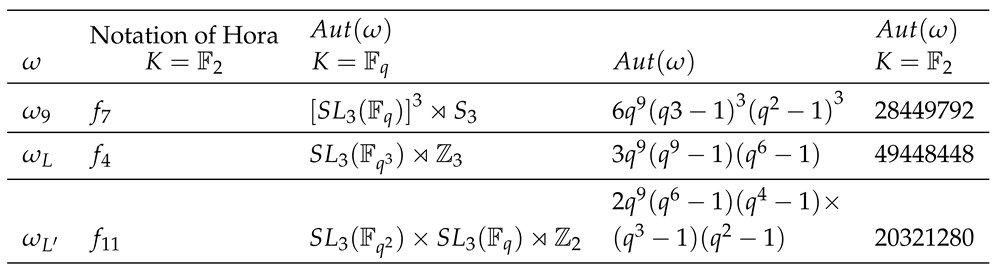
If finite field of order q, and .
We get the following Table 2.
Table 2.
Automorphisms group and its size of
 |
Remark 3.
In dimension , the expression of the trivector seems to be a difficult problem (see Table 1.).
4. Invariants on Dimension
4.1. General Rule for the Non Trivial Forms with an Isotropic Hyperplane
Let V be a vector space of dimension n, and let be a trivector of rank . There exists a basis such that
It is the only trivector in dimension with an isotropic hyperplane (Hyperplane W such that the restriction on W is the zero form).
Proposition 2.
Let be the automorphism of , then it satisfies the exact sequence
i.e.
If , then
Proof.
We consider the set . If ∈, we have , then and , for . Then and there exists / . The matrix of f with a basis must have the form , this we define a group of homomorphism surjective , .
Let : , which means with
. We consider the linear application with the matrix . The homomorphism
defined by , is surjective and . □
While observing the radical polynomial of and , we deduce
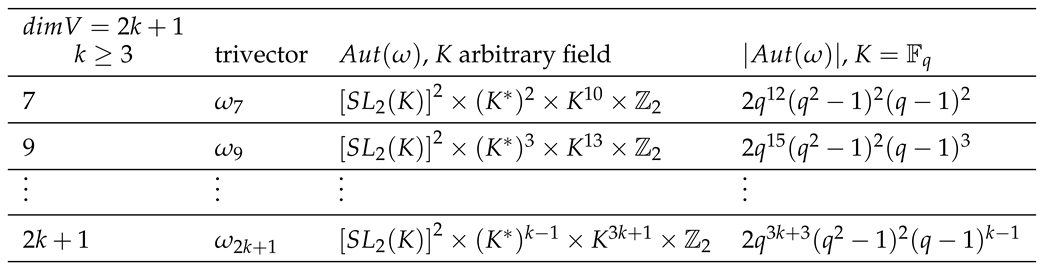
The radical polynomial of is equal to
We get the following Table 3.
Table 3.
Automorphisms group and radical polynomial of
|
Remark 4.
If finite field of order 2, we have:
For , and
For , and
For , and , it is the class with the largest group of automorphisms. (See J. Hora [6] Appendix A and B page 12-13).
4.2. General Rule for the Form of the Type
Let V be a vector space of dimension n, and let be a trivector of rank . There exists a basis such that
Proposition 3.
Let be the automorphism of , then it satisfies the exact sequence
i.e.
If
Proof.
We observe the domain (linear span) is invariant. We obtain
Then therefore, stabilizer each of the two subspaces and
. We can define a group homomorphisms
Then
If , f acts on and as .
We obtain the exact sequence
If f is the identity over and (modulo ),
where , then
, ,...,
is an additive group isomorphic to □
We get the following Table 4.
Table 4.
Automorphisms group and its size of
 |
Remark 5.
Remark 4.If , we have
For , ,
For , , (See J. Hora [6] Appendix A and B page 12-13).
5. Commutant of a Trivector and Frobenius Algebra
Proposition 4.
There exists a vector space V of dimension nine and in which is not a F.algebra and .
Proof.
Let be a trivector of rank nine (See [3] Table 1):
We consider f, an element of the commutant and , the matrix of f, where B is the standard basis, then by direct competitions we have:
Then,
Also we have,
has the form
thus with and the matrices of , , and are presented by
and
By computation we prove that , , and satisfy:
If is a Frobenius algebra, there exists a non-degenerate symmetric bilinear form in which where We put the matrix of in the basis , then
The matrix C is represented by
The rank of , different from 5, hence this contradicts the non-degeneracy of . We conclude that is not a F.algebra and . We deduce that . □
6. Classification of Trivectors in Dimension 8 over a Finite Field of Characteristic 2
For , the classification of trivectors over finite fields, except for characteristic 2 or 3, and over a finite field of two elements has been done in [7] and [5] respectively. More recently a classifications have appeared for a finite field of characteristic 3 [9]. We give the following classification over .
Theorem 1.
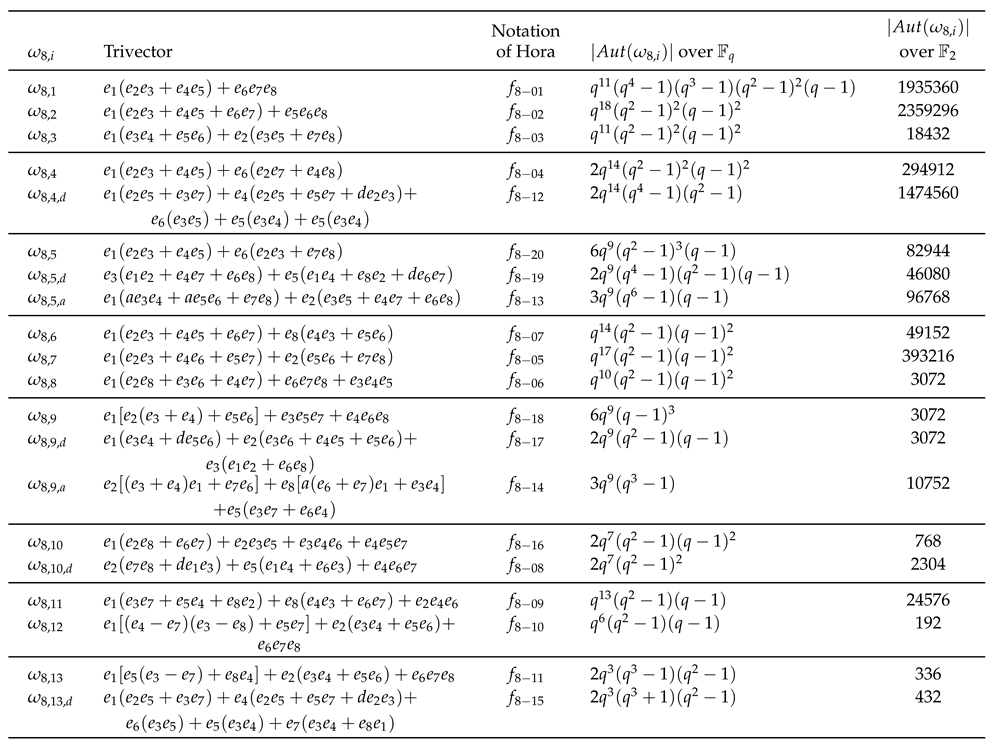
Let V be a vector space of dimension eight over a finite field of characteristic 2, . If m is odd, there are 20 inequivalent trivectors in which are of a full rank.
Table 5.
The cardinality of the automorphisms groups for trivectors of rank 8 over . ,
 |
Remark 6.
This classification was done over (see table 2 page 3468 in [5] or see Appendix A page 12 in [6]).
7. Weight Varieties of a Non-Degenerate Form
We can use the classification of trivectors in the theory of codes (See [13]).
Some undefined terms can be found in [13, page 426-429].
Similar arguments applied in [13] are used for determining the varieties and for some trivectors and we have:
Proposition 5.
The varieties and for are given by:
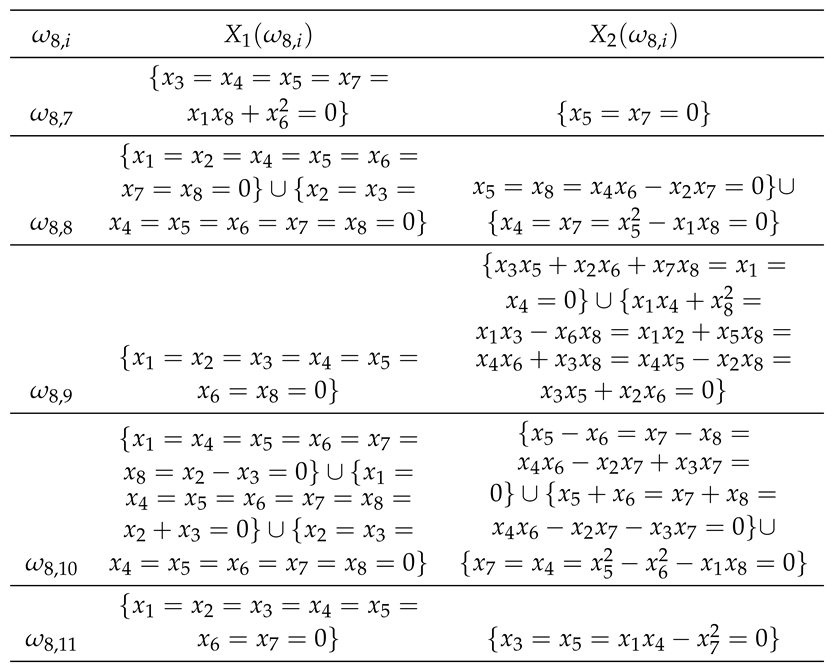 |
8. Conclusions
In this paper, by using the invariants of the trivectors, we deduce the general rule for some trivectors. As a future work, one can calculate the cardinalities of and and use them to fully determine the spectrum of .
References
- A. M. CohenandA. G. Helminck: Trilinear alternating forms on a vector space of dimension 7,Communications in algebra., 16 (1988) 1–25.
- D. Djokovic: Classification of trivectors of an eight dimensional real vector space, Linear Multilinear Algebr., 13 (1983) 3–39..
- A.G. Elashvili and E.B. Vinberg. Classification des trivecteurs d’un espace de dimension 9 ( en russe ). Trudy sem.Vekt ,Tenz. Anlisu XVIII 55 (1978), 197–233.
- G. B. Gurevitch: Foundations of the Theory of Algebraic Invariants, P. Noordhoff Ltd.,Groningen, the Netherlands (1964).
- J. HoraandP. Pudlák: Classification of 8-dimensional trilinear alternating forms over GF(2), Commun Algebra., 34 (2015) 3459–3471.
- J. HoraandP. Pudlák:Classification of 9-dimensional trilinear alternating forms over GF(2), Finite Fields and Their Applications., 70 (2021) 101788.
- N. MidouneandL. Noui: Trilinear alternating forms on a vector space of dimension 8 over a finite field, Linear and Multilinear Algebra., 61 (2013) 15–21.
- N. Midoune, L. Noui. K-forms of 2-step splitting trivectors. Int. J. Algebra 2 (2008), 369–382.
- N. Midoune , M.A. Rakdi . Trilinear alternating forms and related CMLs and GECs. International Journal of Group Theory 12 (2023), 227–235.
- L. Noui and Ph. Revoy. Formes multilinéaires alternées. Linear and Multilinear Algebra 1 (1994), 43–69. Blaise Pascal 1: 43-69.
- L. Noui: Transvecteur de rang 8 sur un corps algébriquement clos,Comptes Rendus de l’Académie des Sciences-Series I-Mathematics, 324 (1997) 611–614.
- E.O’Brien ,P. Vojtěchovskỳ Code loops in dimension at most 8. Journal of Algebra 2017, 473, 607–626.
- M.A. Rakdi , N. Midoune. Weights of the Fq-forms of 2-step splitting trivectors of rank 8 over a finite field. Carpathian Mathematical Publications 11 (2019), 422–430.
- J. Schouten. Klassifizierung der alternierenden Gröszen dritten Grades in 7 Dimensionen. Rendiconti del Circolo Matematico di Palermo (1884-1940) 55(1931), 137–156. [CrossRef]
- G. Tang, D. H. Duong, A. Joux, T. Plantard, Y. Qiao, and W. Susilo. Practical post-quantum signature schemes from isomorphism problems of trilinear forms. In O. Dunkelman and S. Dziembowsk, editors,Advances in Cryptology - EURO- Crypt 2022 - 41st Annual International Conference on the Theory and Applications of Cryptographic Techniques, Trondheim, Norway, May 30 - June 3, 2022, Proceedings, Part III, volume 13277 of Lecture Notes in Computer Science, pages 582-612, Springer, 2022.
- Borovoi, Mikhail, Willem A. de Graaf, and Hông Vân Lê. "Classification of real trivectors in dimension nine." Journal of Algebra 603 (2022), 118-163. [CrossRef]
Disclaimer/Publisher’s Note: The statements, opinions and data contained in all publications are solely those of the individual author(s) and contributor(s) and not of MDPI and/or the editor(s). MDPI and/or the editor(s) disclaim responsibility for any injury to people or property resulting from any ideas, methods, instructions or products referred to in the content. |
© 2025 by the authors. Licensee MDPI, Basel, Switzerland. This article is an open access article distributed under the terms and conditions of the Creative Commons Attribution (CC BY) license (http://creativecommons.org/licenses/by/4.0/).
Copyright: This open access article is published under a Creative Commons CC BY 4.0 license, which permit the free download, distribution, and reuse, provided that the author and preprint are cited in any reuse.


