

Submitted:
03 February 2025
Posted:
04 February 2025
You are already at the latest version
Abstract
Understanding how mammals respond to climate change is critical for predicting future biogeographic shifts and implementing effective conservation strategies. In this study, we applied MaxEnt modeling to identify key determinants of the distribution of the Malabar slender loris (Loris lydekkerianus malabaricus), a nocturnal primate endemic to the Western Ghats of India. Using 416 slender loris sightings, spatially thinned at 0.5 km intervals to reduce spatial autocorrelation, we evaluated 19 present bioclimatic variables alongside 10 additional climatic variables. From these, 14 predictor variables with Pearson correlation values above 0.75 were selected for analysis. Future distribution models employed bioclimatic projections from the CNRM-CM5 global climate models under three Representative Concentration Pathways (RCPs): 2.6, 4.5, and 8.5. The current distribution models identified 23 km² as suitable habitat for slender lorises, with 3 km² suitable for males and 12 km² for females. Projections for 2070 under RCP 2.6, 4.5, and 8.5 scenarios predict habitat reductions of 52%, 13%, and 8%, respectively, signaling significant vulnerability under changing climatic conditions. Precipitation of the warmest quarter, precipitation of the driest month, distance from roads, and elevation were identified as the most influential variables shaping the species' distribution. This study underscores the pressing need for targeted conservation efforts to mitigate habitat loss and fragmentation, particularly in the context of climate change. By providing a detailed analysis of current and future habitat suitability, it lays the groundwork for similar predictive studies on nocturnal small mammals. As climate change accelerates, the integration of species-specific ecological insights and advanced modeling techniques will be vital in guiding conservation actions and preserving biodiversity in vulnerable ecosystems like the Western Ghats.
Keywords:
1. Introduction
2. Materials and Methods
2.1. Study Site
2.2. Data Collection- Loris Surveys
2.3. Habitat Suitability Modeling
2.4. Downloading and Preparing Environmental Variable Layers
2.5. MaxEnt Modeling for Distribution
2.6. Future Climatic Projections and Model Evaluations
3. Results
3.1. Important Environmental Variables
3.2. Predictions in Changes in Habitat Suitability
4. Discussion
4.1. The Present Study and Key Findings
4.2. Habitat Preferences and Variations
4.3. Environmental Drivers and Anthropogenic Impacts
4.4. Projected Habitat Changes and Broader Implications
4.5. Future Directions
5. Conclusions
Supplementary Materials
Author Contributions
Funding
Data Availability Statement
Acknowledgments
Ethical Note:
Conflicts of Interest
References
- IPCC (Intergovernmental Panel on Climate Change). Synthesis report. Contribution of working groups I, II and III to the fifth assessment report of the Intergovernmental Panel on Climate Change Core Writing Team, R. K. Pachauri & L. A. Meyer (Eds.). Climate Change. IPCC 2014, 151 pp.
- Adhikari, D.; Barik, S.K.; Upadhaya, K. Habitat distribution modelling for reintroduction of Ilex khasiana Purk., a critically endangered tree species of northeastern India. Ecol Engin 2012, 40, 37–43. [CrossRef]
- Barnosky, A.D.; Matzke, N.; Tomiya, S.; Wogan, G.O.U.; Swartz, B.; Quental, T.B.; Marshall, C.; McGuire, J.L.; Lindsey, E.L.; Maguire, K.C.; et al. Has the Earth’s sixth mass extinction already arrived?. Nature 2011, 471, 51–57. [CrossRef]
- Worth, J.R.P.; Harrison, P.A.; Williamson, G.J.; Jordan, G.J. Whole range and regional-based ecological niche models predict differing exposure to 21st century climate change in the key cool temperate rainforest tree southern beech (N othofagus cunninghamii). Austral Ecology 2015, 40, 126–138. [CrossRef]
- Waller, N.L.; Gynther, I.C.; Freeman, A.B.; Lavery, T.H.; Leung, L.K.-P. The Bramble Cay Melomys Melomys rubicola (Rodentia:Muridae): A first mammalian extinction caused by human-induced climate change? Wildl Res 2017, 44, 9–21. [CrossRef]
- Radchuk, V.; Reed, T.; Teplitsky, C.; van de Pol, M.; Charmantier, A.; Hassall, C.; Adamík, P.; Adriaensen, F.; Ahola, M.P.; Arcese, P.; et al. Adaptive responses of animals to climate change are most likely insufficient. Nat Comm 2019, 10, 3109. [CrossRef]
- Korstjens, A.H.; Hillyer, A. Primates and climate change: A review of current knowledge The effects of forest degradation on ranging habits and activities of arboreal primates within Sikundur, the Gunung Leuser Ecosystem, northern Sumatra, 2016.
- Gregory, S.D.; Brook, B.W.; Goossens, B.; Ancrenaz, M.; Alfred, R.; Ambu, L.N.; Fordham, D.A. Long-term field data and climate-habitat models show that orangutan persistence depends on effective forest management and greenhouse gas mitigation. PLOS ONE 2012, 7, e43846. [CrossRef]
- Tosi, A.J. Forest monkeys and Pleistocene refugia: A phylogeographic window onto the disjunct distribution of the Chlorocebus lhoesti species group. Zool. J. Linn. Soc 2008, 154, 408–418. [CrossRef]
- Chandran, M.S.; Rao, G.R.; Gururaja, K.V.; Ramachandra, T.V. Ecology of the swampy relic forests of Kathalekan from central Western Ghats, India. Bioremediation Biodivers Bioavailab 2010, 4, 54–68.
- Chetana, H.C.; Ganesh, T. Reconciling natural history and species ecology: Myristica beddomei (Myristicaceae) in the Western Ghats, India. Trop Conserv Sci 2013, 6, 663–673. [CrossRef]
- Priti, H.; Aravind, N.A.; Uma Shaanker, R.U.; Ravikanth, G. Modeling impacts of future climate on the distribution of Myristicaceae species in the Western Ghats, India. Ecol Engin 2016, 89, 14–23. [CrossRef]
- Ramachandran, T.V.; Kumar, U.; Dasgupta, A. Reduction in forest area has led to deficit rainfall, Deccan Herald News paper, 2017.
- Singh, M.; Singh, M.; Kumara, H.N.; Kumar, S.; Gnanaoliu, S.D.; Sasi, R. A review of research on the distribution, ecology, behaviour, and conservation of the Slender Loris Loris lydekkerianus (Mammalia: primates: Lorisidae) in India. J Threat Taxa 2021, 13, 19540–19552. [CrossRef]
- Nekaris, K.A.I. Social lives of adult mysore slender lorises (Loris lydekkerianus lydekkerianus). Am J Primatol 2006, 68, 1171–1182. [CrossRef]
- Sasi, R.; Kumara, H.N. Distribution and relative abundance of the slender loris Loris lydekkerianus in Southern Kerala, India. Prim Conserv 2014, 28, 165–170. [CrossRef]
- Gnanaolivu, S.D.; Singh, M.; Sudarsanam, D. Habitat structure and use of the Malabar slender loris (Loris lydekkerianus malabaricus, cabera 1908) in the Western Ghats, India, in preparation.
- Menon, A.R.R. Vegetation mapping and analysis of Aralam Wildlife Sanctuary using remote sensing techniques. KFRI Res Rep 1999, 168.
- Kass, J.M.; Vilela, B.; Aiello-Lammens, M.E.; Muscarella, R.; Merow, C.; Anderson, R.P. Wallace: A flexible platform for reproducible modeling of species niches and distributions built for community expansion. Methods Ecol Evol 2018, 9, 1151–1156. [CrossRef]
- Phillips, S.B.; Aneja, V.P.; Kang, D.; Arya, S.P. Modelling and analysis of the atmospheric nitrogen deposition in North Carolina. Int J Glob Environ Issues 2006, 6, 231–252. [CrossRef]
- Phillips, S.J.; Dudík, M.; Schapire, R.E. A maximum entropy approach to species distribution modeling, 2004, 83. [CrossRef]
- Elith, J.; Graham, H.C.; Dudík, M.; Ferrier, S.; Guisan, A.; Ferrier, S.; Huettmann, F.R.; Leathwick, J.; Lehmann, A.; Li, J.; et al. Novel methods improve prediction of species’ distributions from occurrence data. Ecography 2006, 29, 129–151. [CrossRef]
- Hernandez, P.A.; Graham, C.H.; Master, L.L.; Albert, D.L. The effect of sample size and species characteristics on performance of different species distribution modeling methods. Ecography 2006, 29, 773–785. [CrossRef]
- Jaynes, E.T. Information theory and statistical mechanics. Phys Rev 1957, 106, 620–630. [CrossRef]
- Phillips, S.J.; Dudík, M. Modeling of species distributions with Maxent: New extensions and a comprehensive evaluation. Ecography 2008, 31, 161–175. [CrossRef]
- Rowe, R.J.; Terry, R.C. Small mammal responses to environmental change: Integrating past and present dynamics. J Mammal 2014, 95, 1157–1174. [CrossRef]
- Fick, S.E.; Hijmans, R.J. WorldClim 2: new 1-km spatial resolution climate surfaces for global land areas. Int. J. Climatol 2017, 37, 4302-4315. [CrossRef]
- Redlands, C.E.S.R.I. ArcGIS Desktop: Release 10.8, 2020.
- Potapov, P.; Li, X.; Hernandez-Serna, A.; Tyukavina, A.; Hansen, M.C.; Kommareddy, A.; Pickens, A.; Turubanova, S.; Tang, H.; Silva, C.E.; et al. Mapping and monitoring global forest canopy height through integration of GEDI and Landsat data. Remote Sens Environ 2020, 253, 112165. [CrossRef]
- Fuller, G.; Raghanti, M.A.; Dennis, P.M.; Kuhar, C.W.; Willis, M.A.; Schook, M.W.; Lukas, K.E. A comparison of nocturnal primate behavior in exhibits illuminated with red and blue light. Appl An Behav Sci 2016, 184, 126–134. [CrossRef]
- Gumma, M.K.; Mohammad, I.; Nedumaran, S.; Whitbread, A.; Lagerkvist, C.J. Urban sprawl and adverse impacts on agricultural land: A case study on Hyderabad, India. Remote Sens 2017, 9, 1136. [CrossRef]
- De Bin, R.; Janitza, S.; Sauerbrei, W.; Boulesteix, A.L. Subsampling versus bootstrapping in resampling-based model selection for multivariable regression. Biometrics 2016, 72, 272–280. [CrossRef]
- Veloz, S.D. Spatially auto correlated sampling falsely inflates measures of accuracy for presence-only niche models. J Biogeogr 2009, 36, 2290–2299. [CrossRef]
- Morales, N.S.; Fernández, I.C.; Baca-González, V. MaxEnt’s parameter configuration and small samples: Are we paying attention to recommendations? A systematic review. PeerJ 2017, 5, e3093. [CrossRef]
- Warren, D.L.; Glor, R.E.; Turelli, M. Environmental niche equivalency versus conservatism: Quantitative approaches to niche evolution. Evolution 2008, 62, 2868–2883. [CrossRef]
- Warren, D.L.; Seifert, S.N. Ecological niche modeling in Maxent: The importance of model complexity and the performance of model selection criteria. Ecol Appl 2011, 21, 335–342. [CrossRef]
- Wordley, C.F.R.; Sankaran, M.; Mudappa, D.; Altringham, J.D. Landscape scale habitat suitability modelling of bats in the Western Ghats of India: Bats like something in their tea. Biol Conserv 2015, 191, 529–536. [CrossRef]
- Reineking, B.; der, B.S. Constrain to perform: Regularization of habitat models. Ecol Model 2006, 193, 675–690. [CrossRef]
- Moss, R.H.; Edmonds, J.A.; Hibbard, K.A.; Manning, M.R.; Rose, S.K.; Van Vuuren, D.P.; Carter, T.R.; Emori, S.; Kainuma, M.; Kram, T.; et al. The next generation of scenarios for climate change research and assessment. Nature 2010, 463, 747-756.
- Sharma, J.; Upgupta, S.; Jayaraman, M.; Chaturvedi, R.K.; Bala, G.; Ravindranath, N.H. Vulnerability of forests in India: A national scale assessment. Environ Manag 2017, 60, 544–553. [CrossRef]
- Collins, M.; Knutti, R.; Arblaster, J.; Dufresne, J.-L.; Fichefet, T.; Friedlingstein, P.; Gao, X.; Gutowski, W.J.; Johns, T.; Krinner, G.; et al. Long-term Climate Change: Projections, Commitments and Irreversibility. In Stocker TF; Qin, D.; Plattner, G.-K.; Tignor, M.M.B.; Allen, S.K.; Boschung, J.; Nauels, A.; Xia, Y.; Bex, V.; Midgley P.M. (Eds.), Climate Change 2013 - The Physical Science Basis: Contribution of Working Group I to the Fifth Assessment Report of the Intergovernmental Panel on Climate Change. Cambridge University Press, 2013, 1029-1136.
- Beaumont, L.J.; Hughes, L.; Poulsen, M. Predicting species distributions: Use of climatic parameters in BIOCLIM and its impact on predictions of species' current and future distributions. Ecol Model 2007, 200, 347–359.
- Kumar, S.; Stohlgren, T.J. MaxEnt modeling for predicting suitable habitat for threatened and endangered tree canopies of the US Great Plains. Ecol Infor 2009, 4, 219–224.
- Gnanaolivu, S.D. Habitat preferences and conservation strategies for the Malabar slender loris (Loris lydekkerianus malabaricus), in preparation.
- Kumara, H.N.; Singh, M.; Kumar, S. Distribution, habitat correlates and conservation of slender loris (Loris lydekkerianus) in Karnataka, India. Int J Primatol 2006, 27, 941–969. [CrossRef]
- Sukumar, R.; Suresh, H.S.; Ramesh, R. Climate change and its impact on tropical forest ecosystems in southern India. J Biogeogr 1995, 22, 533–544.
- Sukumar, R.; Suresh, H.S.; Dattaraja, H.S. Monoculture plantations and their impact on biodiversity in the Western Ghats. Ambio 1998, 27, 579–585.
- Gamage, S.; Liyanage, W.; Weerakoon, D.; Gunwardena, A. Habitat quality and availability of the Sri Lanka red slender Loris Loris tardigradus tardigradus (Mammalia: primates: Lorisidae) in the Kottawa Arboretum. J Threat Taxa 2009, 1, 65–71. [CrossRef]
- Nekaris, K.A.I.; Stevens, N.J. All lorises are not slow: Rapid arboreal locomotion in the newly recognised red slender loris (Loris tardigradus tardigradus) of southwestern Sri Lanka. Am J Phys Anthropol 2005, 40, 156.
- Gamage, S.N.; Padmalal, U.K.G.K.; Kotagama, S.W. Montane slender loris (Loris tardigradus nycticeboides) is a critically endangered primate that needs more conservation attention. Wildlanka 2014, 2, 77–83.
- Sherwin, H.A.; Montgomery, W.I.; Lundy, M.G. The impact and implications of climate change for bats. Mam Rev 2013, 43, 171–182. [CrossRef]
- Kalle, R.; Ramesh, T.; Qureshi, Q.; Sankar, K. Predicting the distribution pattern of small carnivores in response to environmental factors in the Western Ghats. PLOS ONE 2013, 8, e79295. [CrossRef]
- Bhattacharyya, S.; Mungi, N.A.; Kawamichi, T.; Rawat, G.S.; Adhikari, B.S.; Wilkening, J.L. Insights from present distribution of an alpine mammal Royle’s pika (Ochotona roylei) to predict future climate change impacts in the Himalaya. Reg Environ Change 2019, 19, 2423–2435. [CrossRef]
- Thibault, K.M.; Ernest, S.K.M.; White, E.P.; Brown, J.H.; Goheen, J.R. Long-term insights into the influence of precipitation on community dynamics in desert rodents. J Mammal 2010, 91, 787–797. [CrossRef]
- Goosem, M. Fragmentation impacts caused by roads through rainforests. Curr Sci 2007, 93, 1587–1595.
- Benítez-López, A.; Alkemade, R.; Verweij, P.A. The impacts of roads and other infrastructure on mammal and bird populations: A meta-analysis. Biol Conserv 2010, 143, 1307–1316.
- Laurance, W.F.; Goosem, M.; Laurance, S.G. Impacts of roads and linear clearings on tropical forests. Trends Ecol Evol 2009, 24, 659–669.
- Rich, C.; Longcore, T. Ecological consequences of artificial night lighting. Island Press, 2006.
- Gnanaolivu, S.D.; Campera, M.; Nekaris, K.A.I.; Nijman, V.; Satish, R.; Babu, S.; Singh, M. Medicine, black magic and supernatural beings: Cultural rituals as a significant threat to slender lorises in India. People Nat 2022, 4, 734–746.
- N’Goran, P.K.; Boesch, C.; Mundry, R.; N’Goran, E.K.; Herbinger, I.; Yapi, F.A.; Kuhl, H.S. Hunting, law enforcement, and African primate conservation. Conserv Biol 2012, 26, 565-571.
- Rathore, A.; Bhatnagar, Y.V. Threats to wildlife in India: A review of illegal trade and poaching practices. Environ Conserv 2019, 46, 345-357. [CrossRef]
- Williams, J.W.; Jackson, S.T.; Kutzbach, J.E. Projected distributions of novel and disappearing climates by 2100 AD. Proc Nat Ac Sci 2003, 104, 5738–5742.
- Parmesan, C.; Yohe, G. A globally coherent fingerprint of climate change impacts across natural systems. Nature 2003, 421, 37–42.
- Das, J.; De Silva, A. Conservation of Sri Lankan lorises: A review of conservation priorities. Prim Conserv 2005, 20, 67–72.
- Chavan, V.; Rane, S.; Patwardhan, A. Climate resilience strategies for the Western Ghats biodiversity hotspot. Environ Res Comm 2020, 2, 045001.
- IPCC (Intergovernmental Panel on Climate Change). Climate Change 2021: The Physical Science Basis. Contribution of Working Group I to the Sixth Assessment Report of the Intergovernmental Panel on Climate Change, 2021.
- Laurance, W.F.; Goosem, M.; Laurance, S.G.W. Impacts of roads and linear clearings on tropical forests. Trends Ecol Evol 2006, 21, 673–683.
- Rao, A.; Kumar, P.; Bhardwaj, N. Community engagement in forest conservation: Lessons from the Western Ghats. Environ Conserv 2022, 49, 92–101.
- Menon, V. Indian Mammals: A Field Guide. Hachette India, 2020.

| Sl No | Variables | Description |
| 1 | Bio1 | Annual mean temperature |
| 2 | Bio2 | Mean Diurnal Range (Mean of monthly (max temp - min temp)) |
| 3 | Bio3 | Isothermality (BIO2/BIO7) (×100) |
| 4 | Bio4 | Temperature Seasonality (standard deviation ×100) |
| 5 | Bio5 | Max Temperature of Warmest Month |
| 6 | Bio6 | Min Temperature of Coldest Month |
| 7 | Bio7 | Temperature Annual Range (BIO5-BIO6) |
| 8 | Bio8 | Mean Temperature of Wettest Quarter |
| 9 | Bio9 | Mean Temperature of Driest Quarter |
| 10 | Bio10 | Mean Temperature of Warmest Quarter |
| 11 | Bio11 | Mean Temperature of Coldest Quarter |
| 12 | Bio12 | Annual Precipitation |
| 13 | Bio13 | Precipitation of Wettest Month |
| 14 | Bio14 | Precipitation of Driest Month |
| 15 | Bio15 | Precipitation Seasonality (Coefficient of Variation) |
| 16 | Bio16 | Precipitation of Wettest Quarter |
| 17 | Bio17 | Precipitation of Driest Quarter |
| 18 | Bio18 | Precipitation of Warmest Quarter |
| 19 | Bio19 | Precipitation of Coldest Quarter |
| 20 | ASPECT | Derived continuous layer from DEM. Calculated as compass direction of the downslope direction using spatial analyst extension of ArcGIS 10.8 |
| 21 | SLOPE | Derived continuous layer from DEM. Calculated as degrees using spatial analyst extension of ArcGIS 10.8 |
| 22 | ELEVATION | Digital elevation model (DEM) generated from stereo images of Indian remote sensing satellite Cartosat-1 with *30 m resolution |
| 23 | ROAD | Distance from road; derived continuous layer created by calculating Euclidean distance from road using ArcGIS 10.8 |
| 24 | LANDUSE | Distance from croplands; derived continuous layer created by calculating Euclidean distance from road using ArcGIS 10.8 |
| 25 | TREECOVER | Layer showing the treecover of the different forest areas |
| 26 | LIGHT | Light disturbance |
| 27 | VILLAGES | Distance from villages; derived continuous layer created by calculating Euclidean distance from villages using ArcGIS 10.8 |
| 28 | WATERBODIES | Distance from waterbodies; derived continuous layer created by calculating Euclidean distance from waterbodies using ArcGIS 10.8 |
| Variable | Description | Percent contribution | Permutation importance |
| Bio 18 | Precipitation of Warmest Quarter | 59.6 | 62.6 |
| Road | Distance from road | 29.4 | 37.4 |
| Bio 14 | Precipitation of Driest Month | 10.9 | 0 |
| Elevation | Digital elevation model (DEM) | 0 | 0 |
| Suitable Habitat (in km2) | ||||
| Habitat Suitability | RCP 2.6 | RCP 4.5 | RCP 8.5 | |
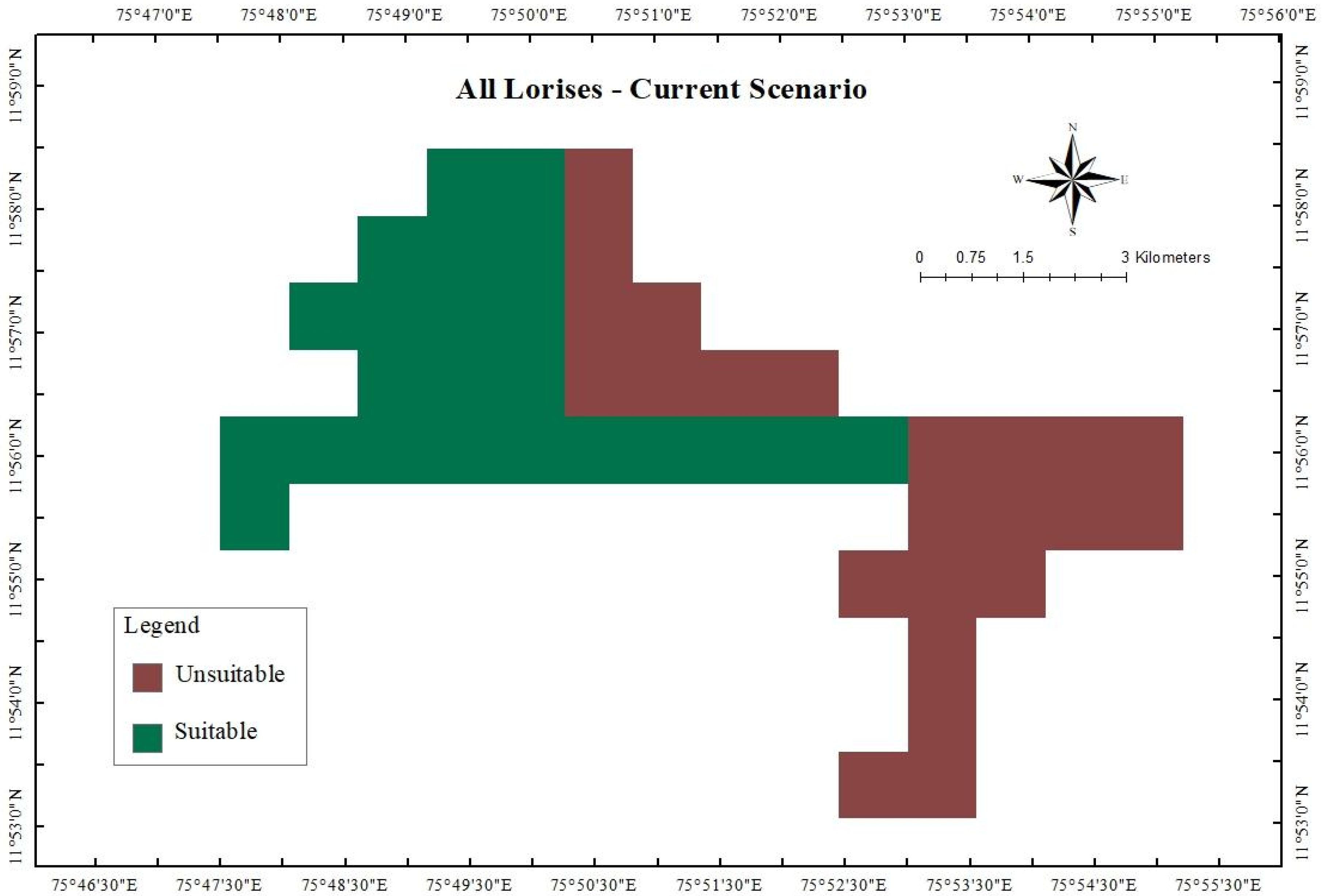
| Current Time (present) | 23 | |||
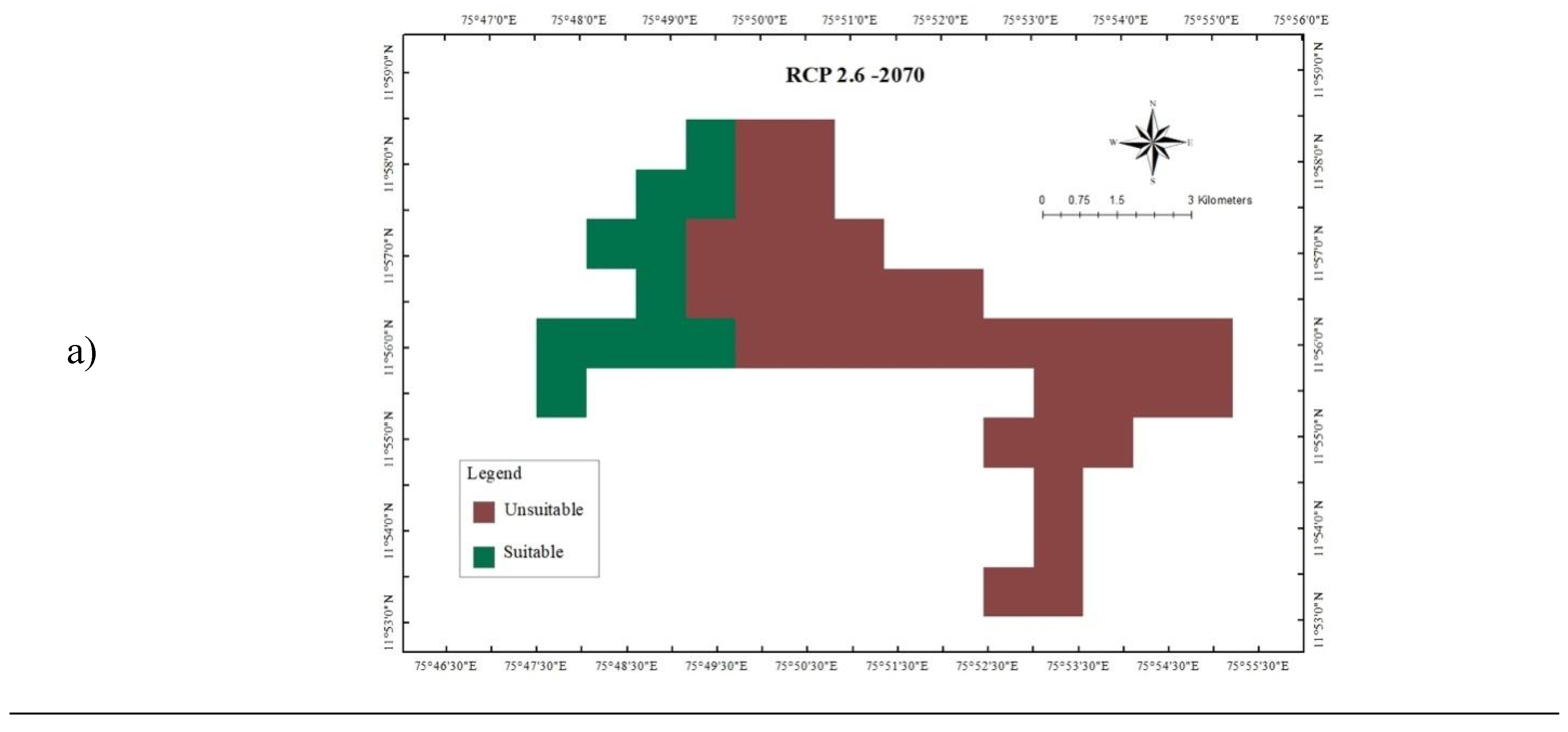
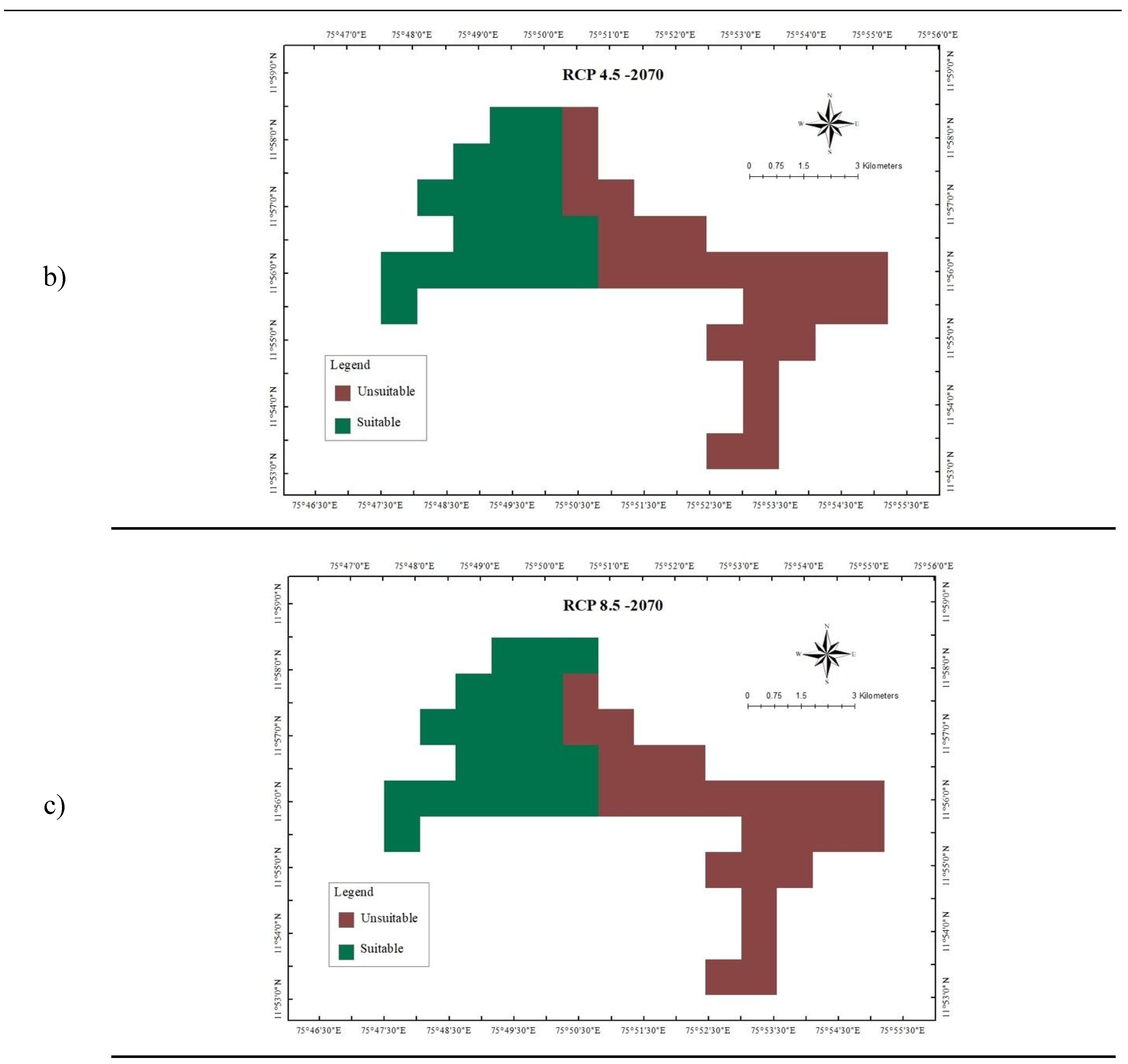
| 2070 | 11(-52.17%) | 20 (-13.04%) | 21(-8.69%) | |
Disclaimer/Publisher’s Note: The statements, opinions and data contained in all publications are solely those of the individual author(s) and contributor(s) and not of MDPI and/or the editor(s). MDPI and/or the editor(s) disclaim responsibility for any injury to people or property resulting from any ideas, methods, instructions or products referred to in the content. |
© 2025 by the authors. Licensee MDPI, Basel, Switzerland. This article is an open access article distributed under the terms and conditions of the Creative Commons Attribution (CC BY) license (http://creativecommons.org/licenses/by/4.0/).