

Submitted:
31 January 2025
Posted:
03 February 2025
You are already at the latest version
Abstract
Length of stay is an important metric for shelters, and studies have identified physical characteristics of dogs, and some behaviors, that predict length of stay. Although many shelters include leash walks when introducing dogs to potential adopters, it is unknown whether behaviors during harnessing and walking influence length of stay. During 707 walks of 120 dogs at a New York shelter, we recorded excitable behaviors, such as jumps on, grabs the leash, and pulls on the leash, whose measures of prevalence were largely unknown for shelter dogs. We also examined whether dog demographic characteristics predicted behaviors and whether behaviors predicted length of stay. During harnessing, jumps on had the highest prevalence (45%) and during walking, pulls on the leash (86%). Although we expected measures of prevalence to be higher for dogs in shelters due to limited space and exercise, we found that measures were similar to or lower than reported for dogs in homes, possibly because dogs in shelters are less comfortable with their handlers. Dog age was the most common demographic predictor of behaviors, with jumps on and total pulls/walk decreasing with age. Grabs the leash predicted length of stay, with longer stays for dogs that displayed this behavior. These two findings suggest that it would be beneficial for shelter staff and volunteers to focus training efforts on younger dogs, and especially those that grab the leash.
Keywords:
jumping
; mouthing
; leash-biting
; pulling on leash
; barking
; sex
; age
; body size
1. Introduction
Animal shelters are challenging environments for dogs due to stressors such as limited exercise and space, and exposure to high noise levels, unfamiliar people, and unfamiliar dogs [1,2]. These stressors can affect shelter dog behavior, physiology, and overall welfare [1]. Length of stay, measured as time elapsed from a dog’s intake to its outcome, is therefore a critical metric for shelters, affecting resident dogs as well as shelter operations, such as population management and staff workload.
Given the importance of length of stay to both dogs and shelters, considerable research has examined factors that might influence this metric. Most research has focused on whether dog phenotypic and demographic characteristics, such as breed, body size, coat color and length, sex, and age predict length of stay [3,4,5,6,7,8,9]. Other studies have examined whether dog behavior directly observed during shelter behavioral evaluations [10,11], in the kennel [6,12,13], or during interactions with potential adopters in out-of-kennel enclosed areas [14] predict length of stay. Although leash walks often are part of dog meets with potential adopters, to our knowledge the question of whether dog behaviors during harnessing and walking influence length of stay has not been examined.
Dogs in homes and shelters sometimes display undesirable behaviors when meeting or greeting people and during harnessing and leash walking. Some of the most frequently reported problematic behaviors at these times include jumps on handler, mouths handler, grabs the harness or leash, and pulls on the leash [15,16,17,18,19,20,21,22,23,24]. Excessive barking is another problematic behavior that can occur during leash walks, and in many other situations as well [17,25,26,27]. Problematic behaviors can result in relinquishment of dogs to shelters, a decision by potential adopters not to adopt after meeting a particular dog, and return of a dog to the shelter post-adoption [14,25,28,29,30].
In this study, conducted at a New York animal shelter, we examined whether behaviors displayed by 120 dogs during meeting/harnessing and leash walking predicted their length of stay. We focused on the behaviors jumps on handler, mouths handler, grabs walking equipment, pulls on the leash, and vocalizes. Given that these behaviors are frequently reported as undesirable in pet dogs, we predicted that dogs displaying them at our study shelter would have longer lengths of stay than dogs not showing them. Understanding the relationship between length of stay and behavior during an activity often included in meets with potential adopters could inform shelter training and management of dog populations. A second objective was to determine prevalence of these behaviors in shelter dogs because almost all studies on prevalence concern dogs living in homes; an exception is prevalence of jumping/mouthing for shelter dogs reported by Marder et al. [22]. Given the limited space and exercise dogs experience in shelters, we expected problematic behaviors to be more prevalent in dogs at our study shelter than reported for dogs in homes. A third objective was to determine whether dog characteristics (sex, age, and body size) predict the display of these behaviors in shelter dogs. Although results vary by study and sometimes characteristic, the most commonly reported pattern for shelter and pet dogs is for undesirable behaviors, such as mouthing and pulling, to be more common in young dogs, so we expected to find this pattern in our data as well [20,21,31]. Almost all studies on prevalence and whether dog characteristics predict the behaviors we studied are based on owner-completed questionnaires or interviews; an exception is work by Shih et al. [31], who used a leash tension meter to measure pulling in shelter dogs. In contrast to studies of pet dogs, our data are from direct behavioral observations of dogs.
2. Materials and Methods
Cornell University’s Institutional Animal Care and Use Committee approved all procedures outlined in our research protocol 2012-0150.
2.1. Study Shelter and Period
We collected behavioral data during harnessing and leash walks of dogs at the Tompkins County SPCA in Ithaca NY, USA. The shelter is no-kill and open-admission with scheduled intake. Adoption counselors meet with potential adopters using a conversation-based (rather than policy-based) approach. There are active volunteer programs for both cats and dogs. Volunteers working with dogs perform the following activities: training, socializing, leash walking, bringing to the outdoor play yard, and occasionally bathing. All authors (three females and one male) volunteered in the dog wing at the shelter (three for 2-3 years each and the first author for 12 years). Formal data collection began in Fall 2023 and ended in Fall 2024; dog walks occurred in all intervening months.
2.2. Care and Housing of Dogs
Intake of dogs occurs in the Rescue Building, where they undergo a veterinary exam (vaccinations, fecal exam, deworming, flea control, and heartworm testing); a complete blood count/chemistry profile is run for older dogs. Dogs receive a microchip, if they lack one. Following the intake exam, dogs are housed in chain link cages with an indoor space (2.2 m2) and an outdoor run (3.5 m2).
Dogs are behaviorally evaluated about three days after intake in the Pet Adoption Center (PAC), which is connected to the Rescue Building via a walkway. Evaluations are conducted by two members of the behavior staff (one evaluator and one scribe), typically last about 30 minutes, and include a variety of tests and subtests [10,32,33]. Dogs are assigned color codes based on history reported by owners or finders, results of the behavioral evaluation, and age: yellow (shy dogs of any age); orange (older dogs without behavioral issues); green (young, energetic dogs); lilac (dogs of any age with mild to moderate behavioral issues, such as fear of strangers); and purple (dogs of any age with more severe behavioral issues, such as human-directed aggression). Dog codes can change based on observations and events following placement on the adoption floor; we report the final codes below (Section 2.3). Depending on level of experience and training at the shelter, volunteers are categorized as green walkers (can walk yellow, orange, and green dogs); lilac walkers (can walk yellow, orange, green, and lilac dogs); and purple walkers (can walk all dogs). Level of dog walker for each author was as follows: BM (purple); BG (lilac); MG (green); and AJ (green).
After behavioral evaluation, dogs move to the adoption floor in PAC where they are housed in cubicles (from 5.2 to 7.3 m2.) containing a bed, blanket, water bowl, toys, and often a crate. All dogs wear collars (buckle or martingale) and outside each dog’s cubicle hangs a harness and leash (at least 1.8 m long). Harnesses, fitted by staff, are usually the PetSafe® EasyWalk® brand (Radio Systems® Corporation, Knoxville, TN, USA). Feeding by staff occurs daily between 08:00 and 09:00 h and between 14:30 and 15:00 h.
Staff and volunteers exercise dogs several times a day. These sessions, which are recorded daily in the dog wing, include either leash walking or spending time in a large outdoor play yard. Additional forms of enrichment include overnight toys stuffed with food, pairs of compatible dogs either walked together or placed in the play yard together, and time spent away from the shelter with volunteers on either day outings or overnight stays. Almost all dogs are individually housed in both the Rescue Building and the Pet Adoption Center. Exceptions are made for puppies from the same litter and dogs from the same household that staff judge would benefit from pair housing.
2.3. Procedures
All authors individually walked dogs and collected behavioral data at the shelter from two to four times a week. Two-hour volunteer dog walking shifts occur at 1200 and 1430, and each Thursday, there is an additional shift at 1700 hours. All data for our study were collected during 1200 shifts. Data collection began when a walker entered a cubicle and greeted and harnessed the dog (hereafter considered together as “harnessing”); this interaction was not timed, but we did document behaviors of interest. Upon exiting the shelter, we began data collection for the first 10 minutes of the leash walk; this interaction was precisely timed. Walks extended from shelter grounds to a field across the street (16.6 ha; 42°28’20”N, 76°26’22”W). The field was mostly grass; other fields, some of which were Cornell research plots, bordered the walking area as well as a creek and forest. We let dogs set the pace of walks and freely investigate their surroundings, but they were not allowed to directly interact with other dogs or people. In both the cubicle and outside the shelter, we used our cell phones to verbally record data (e.g., the voice memo app on an iPhone 12, model MN9G2LL/A, Apple Inc., Cupertino, CA, USA). We photographed each dog, and walked and collected behavioral data on them for as long as they remained on the adoption floor, although new dogs were prioritized over dogs we had walked many times.
During harnessing and walking, we recorded each occurrence of the following five behaviors: jumps on - dog’s front paws leave the ground and at least one contacts the handler [15]; grabs harness or leash - dog uses its teeth to seize walking equipment; when the leash is involved, often referred to as “leash biting” [24]; mouths handler - dog touches handler’s clothing or skin with its teeth [modified from 20]; vocalizes - barks, growls, or whines; and pulls on the leash - leash becomes tight and handler is visibly pulled by the dog [14]. Whereas jumps on, grabs walking equipment, mouths, and vocalizes could occur both in the cubicle during harnessing and outside during walks, pulls on leash only occurred during walks. Whenever possible, we also recorded targets for vocalizes and pulls on leash: dog with another person (e.g., volunteer walking another dog), another person (e.g., visitor to the shelter), parked or moving vehicle (e.g., car, truck, motorcycle, bicycle), and other (e.g., Canada geese in the field). For pulls on leash, smell was also a target, scored when the dog pulled toward an object or location and then stopped to sniff it. If vocalizes and pulls occurred with no apparent target, we recorded “no target.”
We transferred data from verbal recordings of behaviors displayed during harnessing and the first 10 minutes of walks onto paper check sheets. These sheets also included the walker’s name and the following information for each dog: name, identification number, sex, age, body mass, spay/neuter status, source, color code from behavioral evaluation, and walk number. We collected data on 124 dogs, but excluded data from the following four dogs: two juveniles that were housed in the same cubicle and had to be walked together, and one juvenile and one adult that required major surgeries and spent long periods of time recuperating in foster homes. Length of stay at our study shelter is longer for dogs in foster homes than for dogs housed at the shelter [10]. This left 120 dogs for data analyses (9 yellow; 10 orange; 33 green; 54 lilac; and 14 purple). Total number of walks per dog ranged from 1 to 31 (median, 4; mean, 5.9; SD, 5.3) and total number of walks for the 120 dogs was 707. Number of observers that individually walked each dog ranged from 1 to 4, with a median of 1 (1 observer, 83 dogs; 2 observers, 22 dogs; 3 observers, 9 dogs; 4 observers, 6 dogs).
We assigned dogs to the following age classes: juvenile (from 4 months to < 1 year); younger adult (from 1 to 3 years); older adult (> 3 years to < 7 years); and senior ( > 7 years). Body size categories included small (< 11 kg), medium (11-24 kg), and large (> 25 kg). Most dogs are spayed or neutered before arriving on the adoption floor; all are spayed or neutered before entering adoptive homes. Of the 120 dogs walked, 42 of 46 females were spayed for all of their walks and 66 of 74 males were neutered for all of their walks. One female was intact for her first and only walk, two females were intact for their first or first and second walks and spayed for subsequent walks, and another was intact for her first five walks and spayed for subsequent walks. Five males were intact for their first or first and second walks and neutered for subsequent walks, and three were intact for their two or three walks. Sources of dogs observed included surrendered by owner, transferred from another shelter, seized by animal control officers, and picked up as a stray. Table 1 summarizes demographic and phenotypic characteristics of the dogs by sex.
Finally, we retrieved data entered by shelter staff into the PetPoint data management system; such data included intake date, outcome date, length of stay (for our study in which all 120 dogs were adopted, defined as date adoption paperwork signed minus intake date, in days), and whether the dog was returned to the shelter. For dogs returned to the shelter, we used their first length of stay and behavioral data during that stay in statistical analyses. We uploaded all data to Box, a service for data and document sharing and storage.
2.4. Statistical Analyses
We used JMP Pro version 17.0.0 (© 2022, JMP Statistical Discovery, LLC) to calculate prevalence of behaviors. All other analyses were performed in R version 4.4.0. [34] using the following packages: irr [35], lme4 [36], and emmeans [37]. Statistical significance was set at p < 0.05.
For all analyses, we separated behaviors during harnessing and walking. Four behaviors were displayed by only a few dogs or by less than half of the dogs: jumps on, grabs walking equipment, mouths, and vocalizes. We converted our count data for these four behaviors to binary data (displayed; 0 = no; 1 = yes). Pulling on the leash was displayed by most dogs, so we left these data as counts, and also calculated interobserver reliability for this behavior. From a set of 12 videotapes, we randomly selected four. All authors scored number of pulls for these videotaped walks of four different dogs. An intra-class correlation coefficient (ICC) was estimated as 0.90 with a 95% CI of (0.63, 0.99). The ICC was significantly greater than zero (p < 0.001), indicating good interobserver reliability for this behavior.
2.4.1. Prevalence of Behaviors
We calculated prevalence of each behavior during either harnessing or walking as number of dogs showing the behavior at the time of their first walk/120 dogs. When dogs were walked by more than one member of the research team, we used the first walk with the earliest date. We followed the same procedures for vocalizing at and pulling toward specific targets.
2.4.2. Dog Characteristics and Behaviors
Data from all 707 walks were used for these analyses. We summarized data into percents and frequencies for categorical data (jumps on handler, grabs walking equipment, mouths handler, and vocalizes) and means and standard deviations for continuous data (total pulls/walk). Generalized linear models with a binomial distribution were used to model binary behaviors as a function of dog sex, age class, body size, and walk number with random effects of dog ID and walker ID. A generalized linear model with a negative binomial distribution was used to model total pulls during a walk (data were very skewed to the right) as a function of dog sex, age class, body size, and walk number with random effects of dog ID and walker ID. We did not model rare behaviors (i.e., those displayed by < 5% of dogs). We conducted post-hoc pairwise comparisons with a Tukey correction for significant main effects for each model.
2.4.3. Dog Characteristics, Behaviors, and Length of Stay
For the length of stay analysis, we used data from each dog’s first walk because dogs with longer lengths of stay would likely have more walks and therefore more opportunities to display the behaviors monitored. We ran a multivariate linear model to examine log of the length of stay as a function of dog characteristics (sex, age class, and body size), as well as the behavior variables (categorical variables for jumps on handler during harnessing and walking, grabs walking equipment during walking, and vocalizes during walking; and the continuous variable, total number of pulls during the walk). Mouths during harnessing and walking, and grabs walking equipment and vocalizes during harnessing were not included because they were displayed by < 5% of dogs. We conducted post-hoc pairwise comparisons with a Tukey correction for significant effects. One dog had not been adopted two months after the completion of data collection; we used date of data analysis instead of date adoption paperwork signed to calculate his length of stay.
3. Results
3.1. Prevalence
Table 2 shows prevalence of behaviors during first walks. During harnessing, prevalence was highest for jumps on handler, with nearly half of dogs showing this behavior; other behaviors were shown by only a few dogs. During walking, prevalence was highest for pulls on leash, with a majority of dogs showing this behavior, followed by jumps on handler and vocalizes; few dogs grabbed the leash and even fewer mouthed the handler.
The three dogs that vocalized during harnessing were scored as no target, and appeared either stressed by shelter conditions (two German Shepherd Dogs that barked nearly continuously in their cubicles) or anxious to get out for a walk (one Shih Tzu/Husky mix that whined). Of the 26 dogs that vocalized during walking, 21 barked, 3 whined, 1 barked and whined, and 1 barked and growled. Targets of vocalizations during leash walks were as follows (note that these do not equal 26 because some dogs vocalized at more than one target during their walk): dog with another person, 14.2% (17/120); person, 5.0% (6/120), vehicle, 2.5% (3/120), other, 1.7% (2/120), and no apparent target 4.2% (5/120). Targets for pulling on the leash were as follows (targets do not equal 103, the number of dogs that pulled on the leash, because many dogs pulled toward more than one type of target during their walk): dog with another person, 23.3% (28/120), person, 8.3% (10/120), vehicle, 6.7% (8/120), smell, 54.2% (65/120), other, 8.3% (10/120), and no target, 66.7% (80/120). Pulls without an obvious target often involved dogs that lacked leash training or were very excited to be outside and pulled for the first few minutes of the walk before settling down.
3.2. Dog Characteristics and Behavior
Descriptive statistics based on raw data for behaviors in relation to age class are shown in Table 3 and in relation to sex and body size in Table 4.
3.2.1. Jumps on Handler
Dogs jumped on the handler during 300 of the 707 harnessing sessions (42.4%). We found a significant effect of age class for this behavior (X2 = 32.7, d.f. = 3, p < 0.001). Pairwise comparisons revealed the odds of jumping while being harnessed were higher for juveniles (predicted probability of 0.901) as compared to younger adults (predicted probability of 0.464; p < 0.01), older adults (predicted probability of 0.079; p < 0.001), and seniors (predicted probability of 0.042; p < 0.001). Younger adults also jumped more than older adults (p < 0.01) and seniors (p < 0.05). We did not find significant effects of sex (X2 = 3.5, d.f. = 1, p = 0.06), body size (X2 = 4.0, d.f. = 2, p = 0.13), or walk number (X2 = 1.5, d.f. = 1, p = 0.22).
Dogs jumped on the handler in 109 of 707 leash walks (15.4%). No seniors displayed this behavior (Table 3), so this age group was removed from the model. We found a significant effect of age class for jumping during walking (X2 = 14.5, d.f. = 2, p < 0.001). The odds of jumping were higher for juveniles (predicted probability of 0.186) when compared to older adults (predicted probability of 0.004; p < 0.01), and for younger adults (predicted probability of 0.060) when compared to older adults (predicted probability of 0.004; p < 0.05). Tests run to see whether the predicted probabilities of juveniles, younger adults, and older adults were significantly different from zero (seniors) revealed that juveniles and younger adults were significantly more likely than seniors to jump on the handler during walks (p < 0.001 for both comparisons). We also found a significant effect of walk number (X2 = 7.7, d.f. = 1, p < 0.01), with the odds of jumping on the handler decreasing by about 16% with each subsequent walk. We did not find significant effects of sex (X2 = 0.4, d.f. = 1, p = 0.55) or body size (X2 = 3.1, d.f. = 2, p = 0.22).
3.2.2. Grabs Walking Equipment
Dogs grabbed the harness in 15 of 707 harnessing sessions (2.1%); dogs showing this behavior were either juveniles or younger adults (Table 3) and of either medium or large body size (Table 4). Grabbing the harness was not modeled due to its rarity.
Dogs grabbed the leash in 31 of 707 walks (4.4%); dogs displaying this behavior were either juveniles or younger adults (Table 3). Grabbing the leash was not modeled due to its rarity.
3.2.3. Mouths Handler
When being harnessed, dogs mouthed the handler in 27 of 707 sessions (3.8%) and during walks, in 19 of 707 (2.7%). Mouthing during harnessing and walking was exhibited only by juveniles and younger adults (Table 3), and was not modeled due to its rarity.
3.2.4. Vocalizes
During harnessing, 11 of 707 sessions (1.6%) had dogs that vocalized; dogs showing this behavior were all younger adults (Table 3) of medium to large body size (Table 4). Due to its rarity, vocalizing during harnessing was not modeled.
Vocalizing during walking was more common, occurring in 151 of 707 leash walks (21.4%). This behavior was displayed by all age classes (Table 3), both sexes, and all body sizes (Table 4). We found a significant effect of sex for vocalizing during leash walks (X2 = 3.9, d.f. = 1, p < 0.05), with the odds being higher for female dogs (predicted probability of 0.184) than for male dogs (predicted probability of 0.091). Effects of age class (X2 = 3.6, d.f. = 3, p = 0.31), body size (X2 = 1.7, d.f. = 2, p = 0.43), and walk number (X2 = 0.9, d.f. = 1, p = 0.34) were not significant.
3.2.5. Pulls on Leash
Based on raw data, the average number of pulls per walk + SD was 6.1 + 6.3. We found a significant effect for age class (X2 = 12.0, d.f. = 3, p < 0.01), with the general pattern of total pulls/walk decreasing with age (Figure 1a). Juveniles pulled more than seniors (p = 0.02), and there were tendencies for juveniles to pull more than older adults (p = 0.07) and for younger adults to pull more than seniors (p = 0.08; Figure 1a). We also found a significant effect for body size (X2 = 12.0, d.f. = 2, p < 0.01): here, the general pattern was for total pulls/walk to increase with body size (Figure 1b). Medium dogs pulled more than small dogs (p = 0.02) and large dogs pulled more than small dogs (p < 0.01). Effects of sex (X2 = 0.1, d.f. = 1, p = 0.73) and walk number (X2 = 0.8, d.f. = 1, p = 0.38) were not significant.
3.3. Dog Characteristics, Behavior, and Length of Stay
Length of stay based on raw data in relation to dog characteristics is shown in Table 5. There was a tendency for age class to influence length of stay (F = 2.3, df = 3,108, p = 0.08), with younger adults having longer stays than juveniles (p = 0.05; Figure 2a). We found a significant effect of body size on length of stay (F = 3.1, df = 2,108, p < 0.05), with large dogs having longer stays than small dogs (p = 0.04; Figure 2b). Sex did not influence length of stay (F = 0.2, df = 1,108, p = 0.69).
Length of stay based on raw data in relation to whether behaviors occurred during harnessing or walking is shown in Table 6. The very short mean length of stay for the two dogs that grabbed walking equipment during harnessing likely reflects that they were both juveniles, the age class with the shortest stays. The very long mean length of stay and large SD for the four dogs that mouthed the handler during harnessing resulted from one dog that was at the shelter for 416 days before being adopted. Finally, the very short mean length of stay for the three dogs that vocalized during harnessing likely reflects that they were preferred breeds or mixes; two were the German Shepherd Dogs that barked nearly continuously in their cubicles, and one was the Shih Tzu/Husky mix that whined to go outside.
Four behaviors, three during harnessing (mouths handler, grabs walking equipment, and vocalizes) and one during walking (mouths handler) were not included in the model because they occurred in < 5% of dogs during first walks (Table 6). Of the remaining behaviors, grabs walking equipment predicted length of stay (F = 4.0, df = 1,108, p < 0.05), with dogs that grabbed the leash during the first walk having longer stays (emmean + SE, 47.3 + 15.3 days) than those that did not (24.7 + 3.3 days). None of the other binary behaviors during either harnessing (jumps on: F = 0.7, df = 1,108, p = 0.39) or walking predicted length of stay (jumps on: F = 0.02, df = 1,108, p = 0.89; vocalizes: F = 0.01, df = 1,108, p = 0.93). Figure 3 shows total pulls during the first walk based on raw data in relation to length of stay. Total pulls did not predict length of stay (F = 0.3, df = 1,108, p = 0.58).
4. Discussion
4.1. Prevalence
We derived our measures of prevalence from dogs’ first walks and included behaviors displayed during harnessing–which also included meeting the dog for the first time in its cubicle–and leash walking. During harnessing, prevalence was highest for jumps on handler (45%), with other behaviors displayed by less than 4% of dogs (grabs walking equipment, mouths handler, and vocalizes). Our prevalence for jumps on handler during harnessing can be compared to several prevalence measures for jumping on from studies based on owner-completed questionnaires that examined situations similar to our own: 46% of dogs frequently or always jumped on owners when they picked up the leash to take their dog outside [18]; 73% of dogs, at some point in their lifetime, jumped on a household member before going for a walk [15]; and 59% of dogs jumped on a stranger entering their home [16]. Finally, Polian et al. [15] found that jumping on household members before going for a walk was often preceded by canine care-seeking behaviors, such as approaching in a lowered posture with hindquarters wagging, and was more common in dogs walked less than once a day compared to those walked two or more times a day, suggesting that when dogs jump on people they are conveying information about their needs. In the shelter environment, as in a home, these needs would include going outside for elimination, exercise, and cognitive stimulation.
During walking, prevalence was highest for pulls on the leash (86%), followed by jumps on handler (24%), and vocalizes (22%); about 8% of dogs grabbed the leash and between 2 and 3% mouthed the handler. Our prevalence for pulling on the leash is similar to the 83% reported by one study based on owner-completed questionnaires [38] and somewhat higher than the 69% reported by another [17]. The most common targets to which dogs pulled in our study included no apparent target (67%), a smell (54%), or a dog walking with another person (23%). Our prevalence for jumps on the handler during the first walk was similar to that reported by Rezac et al. [16] for dogs jumping on strangers during a walk (27%). Our overall prevalence for vocalizes during a leash walk (22%) is somewhat higher than the 12% reported by Dinwoodie et al. [27] for excessive barking by pet dogs at triggers when outside. We found that about 14% of dogs barked at a dog walked by another person, which is somewhat lower than the 26% of owners reporting that their dog barks aggressively at other dogs on a leash [18].
Whether during harnessing (3.3%) or walking (2.5%), our prevalence measures for mouths handler were lower than reported in studies based on owner-completed questionnaires: 45% of respondents said their dog currently mouths and 21% previously mouthed [20]; 37% of dogs between 11 and 18 months old mouthed [39]; and when owners picked up the leash, 12 to 13% of dogs frequently or always mouthed causing no discomfort, 3% causing discomfort, and 6% grabbing clothing [18]. Although the functions of mouthing are somewhat unclear, 66% of owners reported their dog mouthed during play and 52% when in the presence of an exciting stimulus [20]. Additionally, a study with three pet dogs suggested that dogs mouth either to get their owner’s attention or gain access to tangibles [40], which could include treats, toys, or walks. To our knowledge, the only other report on mouthing by dogs in shelters combined mouthing and jumping (37%) [22]. This makes it challenging for us to put our results in context to determine whether the difference between our findings and those from dogs in homes reflects the lack of a relationship between us and the dogs when we first met, harnessed, and walked them. Some excitable behaviors are more commonly directed at household members than strangers: for example, dogs were 8 times more likely to jump on a household member entering their home than a stranger [16]. It would be interesting to know whether, like jumping on, dogs are more likely to mouth household members than strangers, but to our knowledge this question has not been examined.
4.2. Dog Characteristics and Behavior
We found that dogs jumped on the handler in 42% of harnessing sessions and 15% of leash walks. This pattern is similar to that found by Rezac et al. [16]: dogs were four times more likely to jump up on a stranger entering the home than a stranger while on a leash walk, and 12 times more likely to jump on a household member entering the home than a household member on a leash walk. For both jumps on during harnessing and walking, we found significant effects of age class, with jumps on decreasing with age. Although jumping on people is commonly believed to be associated with dogs of younger ages, our findings may be the first to actually document this pattern. We found no effects of dog sex or body size for jumps on, which is consistent with findings for dogs in homes [15]. Finally, the odds of a dog jumping on the handler decreased by about 16% with each subsequent walk. One possible explanation for this decrease over time is that dogs became more accustomed to the walking routine and schedule at the shelter and felt less of a need to convey what they wanted or needed.
During both harnessing and walking, mouths handler could not be modeled because the behavior occurred in less than 5% of walks, as did grabs walking equipment during harnessing and walking. Nevertheless, our descriptive data showed that all four of these behaviors only occurred in juveniles and younger adults, suggesting they decrease with age. This pattern is similar to that found by Waite et al. [20] for dogs reported by their owners to currently mouth: 80% of dogs < 6 months of age; 83% of dogs from 6 to 11 months of age; 40% of dogs > 12 months of age; and 26% of dogs > 5 years old.
Although vocalizes during harnessing occurred very rarely and therefore could not be modeled (< 2% of walks and limited to 3 younger adults of medium or large body size), vocalizes during walking was more common and could be modeled (21% of walks and displayed by all age classes, both sexes, and all body sizes). We found a significant effect of sex, with the odds of vocalizing during a leash walk (almost all vocalizations were barks) being higher for females than males. Of three studies based on owner-completed questionnaires, one found that female dogs were more likely than males to exhibit excessive barking [41] whereas the other two found no sex difference [42,43].
Age class predicted total pulls on the leash, with a decrease with age as the general pattern (juveniles pulled more than seniors, and there were tendencies for juveniles to pull more than older adults and younger adults to pull more than seniors). We also found a significant effect of body size, with medium and large dogs pulling more frequently than small dogs. Dog sex and walk number did not affect total pulls on the leash in our study. Shih et al. [31] also found that younger dogs pulled more than older dogs; however, larger heavier dogs, despite exerting higher leash tensions, pulled less frequently than smaller lighter dogs in their study. In a separate paper, Shih et al. [44] reported that male dogs exerted higher leash tensions and pulled more frequently than did female dogs. It is possible that some of the differences in findings between Shih’s two studies and our study reflect differences in how pulling was assessed and defined: whereas Shih et al. [31,44] used a leash tension meter and defined a pull event as when the leash tension suddenly spiked above baseline tension, we scored pulling as when the leash became tight, and the handler was visibly pulled by the dog.
4.3. Dog Characteristics, Behavior, and Length of Stay
There was a tendency for age class to predict length of stay in our study, with younger adults having longer stays than juveniles; the lack of a significant effect may reflect our relatively small sample sizes for older adults and especially seniors. In a previous study at this shelter, with a much larger sample size (975 dogs) and only three age classes rather than four, seniors had longer lengths of stay than adults, which in turn, had longer lengths of stay than juveniles [10]. Increases in length of stay with age have been reported by others [4,7,8,11]; one exception concerns a study that did not include dogs over 7 years old [45].
Body size predicted length of stay at our shelter, with large dogs having longer stays than small dogs. Mesarcova et al. [11] also found longer lengths of stay for larger dogs, and Brown et al. [8] and Žák et al. [7] found that both medium and large dogs had longer stays than small dogs. Interestingly, Žák et al. [7] also reported that giant dogs (> 65 cm at withers) had the shortest length of stay of all size groups, possibly because they were so unusual in the three Czech shelters studied (only seven of the 2,261 dogs abandoned and put up for adoption). Our sample size was too small to permit further differentiation of size classes.
Of the behaviors studied, only grabs the leash during the first walk predicted length of stay, with dogs displaying this behavior remaining longer at the shelter than those that did not. Although leash biting is considered a symptom of stress in dogs [24], the only research-related papers that we found on this behavior concerned its display in response to either different head collars [46] or head versus neck collars [47], and only one of the 120 dogs in our study wore a head collar as well as a neck collar. Other behaviors with sufficient measures of prevalence to be included in the length of stay model (jumps on during either harnessing or walking, vocalizes during walking, and pulls on the leash during walking) did not predict length of stay, even though dog owners often report these behaviors as undesirable [15,16,17,18,19,21,27].
In a previous study at our shelter, performance on two of 13 tests/subtests of the behavioral evaluation predicted length of stay, with longer stays for dogs displaying either severe food guarding or dangerous behavior when meeting another dog [10]. Adoption counselors would certainly discuss these extreme behaviors with potential adopters, which may have discouraged some (e.g., those with young children or a resident dog), leading to a smaller pool of potential adopters and longer stays. Although some of the behaviors studied here, such as jumping on, mouthing, and pulling on the leash, can pose risks to humans [16,18,48], the risks associated with these excitable behaviors would seem lower than those associated with either severe food aggression or dog-directed aggression (e.g., when owners try to break up dog fights); this might explain our failure to find a relationship between jumping on and pulling on the leash and length of stay (mouthing was too rare to include in the length of stay model). Jumping on and pulling may also be more amenable to training than severe food aggression and dog-directed aggression, both of which would likely require continuous, careful management by adopters. It is also possible that some adopters view jumping on as a friendly behavior [49] or understand that selection of appropriate walking equipment can help mitigate pulling on the leash [23,50].
When compared to demographic or phenotypic characteristics, which often predict length of stay and adoption decisions for shelter dogs (reviewed in [51]), relatively few behavioral characteristics are predictive. For example, Mesarcova et al. [11] found that age and body size affected length of stay, but none of the four categories of behaviors evaluated by shelter staff influenced time spent at the shelter. Protopopova et al. [12] reported that three of 41 in-kennel behaviors, scored and found to have high inter-observer reliability, predicted length of stay, with longer stays for dogs that stood, faced away from the front of the kennel, or leaned or rubbed on kennel walls. In another in-kennel study, dogs with higher frequencies of inner brow raises, a movement that makes the eyes appear larger in relation to the face (i.e., a pedomorphic feature), had shorter stays than dogs with lower frequencies [13]. Frequencies of eight other facial movements were not associated with length of stay, and durations of tail wagging and spending time in close proximity to the experimenter were weakly associated, but in different ways: whereas more time spent wagging the tail was associated with longer stays, more time spent in close proximity to the experimenter was associated with shorter stays [13]. Some of the behaviors that we studied (mouthing, jumping on, barking, and on-leash pulling), along with 25 other behaviors, were examined with respect to adopter decisions after meeting dogs in enclosed areas away from their kennels, and only two behaviors influenced decisions: dogs that were adopted after the meet spent less time ignoring play initiations by and more time lying in proximity to potential adopters [14]. Finally, Weiss et al. [49] found that adopters of dogs at five different shelters listed physical appearance as the single most important factor in their choice of dog (27%), followed by personality/temperament (16%) and behavior with people (11%). In contrast to these studies, Wells and Hepper [52] found that visitors to a shelter ranked dogs’ temperament (76%) as more important than physical characteristics, such as body size (11%), appearance (4%), and age (2%), when asked to imagine adopting a dog, as did Minnis et al. [53], who surveyed decision making by visitors at eight different shelters (59% chose behavior; 41% age; 34% body size; 16% appearance). In total, these results suggest that dog physical characteristics more routinely predict actual adoption than do most behaviors, whereas visitors to shelters rate behavior as more important than physical characteristics. The reason for this difference between adopters and visitors, at least some of whom are likely potential adopters, is unclear.
4.4. Study Limitations
Our study has several limitations. First, we had a relatively small sample size (120 dogs), especially with respect to older adults and seniors, and small dogs. Second, walkers could not be randomly assigned to dogs due to the necessary walking regulations at the shelter whereby level of walker experience was matched, using the color coding system, with the level of behavioral challenges of dogs. Third, our results are from one shelter and may not generalize to other shelters. In particular, the amount of time that dogs are outside at our study shelter may differ from that at other shelters, and increased exercise frequency and duration are associated with lower levels of excitable behaviors, at least in pet dogs [15,54]. For this reason, we further detail time outside at our study shelter here. When Animal Care Technicians arrive in the morning, all dogs are given a few minutes each outside in a covered play yard. Then during cleaning, the dogs are cycled into one of three locations while their cubicle is cleaned, two indoor vestibules and the covered play yard, such that one third of dogs on the adoption floor also get about 20 minutes of outdoor time during cleaning. When the shelter opens at noon to the public and volunteers, dogs typically get three or four times outside before the shelter closes (either leash walks or time in the large outdoor play yard). Finally, our inter-observer reliability check for pulls on the leash was based on videotaped walks of only four different dogs. A larger number of dogs would have been preferable because it would have allowed us to observe and score more of the variation in the dog population at our study shelter [55].
5. Conclusions
Contrary to our prediction that excitable behaviors associated with leash walking, and considered undesirable by dog owners, would be more prevalent in shelter dogs due to their limited space and exercise, we instead found that most behaviors occurred at similar—or often lower—levels than reported for dogs in homes. One possible explanation for this pattern concerns our necessary use of data from the first walk to calculate measures of prevalence, which resulted in a difference in type of handler: for dogs in our study, handlers were strangers, however for dogs in homes, handlers were household members. Another difference is that our measures of prevalence derive from direct behavioral observations of dogs whereas measures for dogs in homes come from owner-completed questionnaires. To our knowledge, only one other study with shelter dogs reported a combined prevalence for two of our behaviors of interest (jumping/mouthing) and the context in which these behaviors were measured was during a behavioral evaluation and not during harnessing and leash walking [22]. Thus, our data provide new information on prevalence of behaviors in shelter dogs during routine activities.
As we expected based on data from owner-completed questionnaires [20,21,31], dog age class was the most common demographic predictor of behaviors with sufficient occurrence for us to model them (jumps on during harnessing and walking, and total pulls on the leash during walking), with these three behaviors decreasing with age. Consistent with our findings for jumps on and total pulls, our descriptive data for rare behaviors that could not be modeled (mouths handler during harnessing and walking and grabs walking equipment during harnessing and walking) showed these behaviors were displayed by juveniles and younger adults, but not by older adults and seniors, suggesting that these behaviors may also decrease with age. When looking at whether behaviors during the first walk influenced length of stay, grabs the leash predicted time spent at the shelter, with dogs that grabbed the leash having longer stays than those that did not. Our information on dog age, along with our findings regarding grabs the leash, suggest that it might be beneficial for shelter staff and volunteers to focus training efforts on younger dogs, and especially those that display leash-biting.
Supplementary Materials
The following supporting information can be downloaded at the website of this paper posted on Preprints.org, Table S1-Prevalence data for first walks.xlsx, Table S2-Dog demographics and behaviors for all walks.xlsx, and Table S3-Behaviors during first walks and length of stay.xlsx.
Author Contributions
Conceptualization, B.M.; methodology, B.M.; coordination, participation in, and review of statistical analyses, B.M.; data collection, B.M., B.G., M.G., and A.J.; data curation, B.M., B.G., M.G., and A.J.; writing—original draft preparation, B.M.; writing—review and editing, B.M., B.G., M.G., and A.J.; supervision, B.M. All authors have read and agreed to the submitted version of the manuscript.
Funding
This research received no external funding.
Institutional Review Board Statement
This research was conducted under the protocol Behavior of Shelter Dogs 2012-0150, which was approved on September 16, 2021, by the Institutional Animal Care and Use Committee of Cornell University.
Data Availability Statement
All data are available online as Supplementary Materials.
Acknowledgments
We thank Jim Bouderau for giving us permission to conduct research at the Tompkins County SPCA and Emme Hones for providing us with PetPoint data files and always answering our many questions. Stephen Parry, Cornell Statistical Consulting Unit, helped with statistical analyses and Willy Bemis made the figures and read a draft of our paper.
Conflicts of Interest
The authors declare no conflicts of interest.
References
- Protopopova, A. Effects of sheltering on physiology, immune function, behavior, and the welfare of dogs. Physiol. Behav. 2016, 159, 95–103. [Google Scholar] [CrossRef] [PubMed]
- Janeczko, S.; Miller, L.; Zawistowski, S. Canine housing and husbandry for behavioral well-being. In Animal Behavior for Shelter Veterinarians and Staff, 2nd ed.; DiGangi, B.A., Cussen, V.A., Reid, P.J., Collins, K.A., Eds.; John Wiley & Sons, Inc.: Hoboken N.J., USA, 2022; pp. 236–262. [Google Scholar]
- Skrzypek, K.; Zawojska, E. What characteristics of dogs help them stay shorter in shelters? Evidence from a Polish animal shelter. J. Appl. Anim. Welf. Sci. 2024, 1–19. [Google Scholar] [CrossRef]
- Vojtkovská, V.; Voslárová, E.; Vecerek, V. Comparison of outcome data for shelter dogs and cats in the Czech Republic. Animals 2019, 9, 595. [Google Scholar] [CrossRef]
- Bradley, J.; Rajendran, S. Increasing adoption rates at animal shelters: A two-phase approach to predict length of stay and optimal shelter allocation. BMC Vet. Res. 2021, 17, 70. [Google Scholar] [CrossRef] [PubMed]
- Raudies, C.; Waiblinger, S.; Arhant, C. Characteristics and welfare of long-term shelter dogs. Animals 2021, 11, 194. [Google Scholar] [CrossRef]
- Žák, J.; Voslárová, E.; Vecerek, V.; Bedánová, I. Sex, age and size as factors affecting the length of stay of dogs in Czech shelters. Acta Vet. Brno. 2015, 84, 407–413. [Google Scholar] [CrossRef]
- Brown, W.P.; Davidson, J.P.; Zuefle, M.E. Effects of phenotypic characteristics on the length of stay of dogs at two no kill animal shelters. J. Appl. Anim. Welf. Sci. 2013, 16, 2–18. [Google Scholar] [CrossRef]
- Gunter, L.M.; Barber, R.T.; Wynne, C.D.L. What’s in a name? Effect of breed perceptions & labeling on attractiveness, adoptions & length of stay for pit-bull-type dogs. PLoS ONE 2016, 11, e0146857. [Google Scholar] [CrossRef]
- McGuire, B.; Chan, J.; Jean-Baptiste, K.; Kok, P.; Rosenbaum, E. Results of behavioral evaluations predict length of stay for shelter dogs. Animals 2021, 11, 3272. [Google Scholar] [CrossRef]
- Mesarcova, L.; Skurkova, L.; Leskova, L.; Dillingerova, J.; Kottferova, J.; Kottferova, L. Good-looking vs. obedient, Which would you rather take home? Appearance and behavioral predictors affecting the adoption of shelter dogs in Slovakia. J. Appl. Anim. Welf. Sci., 2021, 24, 107–116. [Google Scholar] [CrossRef]
- Protopopova, A.; Mehrkam, L.R.; Boggess, M.M.; Wynne, C.D.L. In-kennel behavior predicts length of stay in shelter dogs. PLoS ONE 2014, 9, e114319. [Google Scholar] [CrossRef]
- Waller, B.M.; Peirce, K.; Caeiro, C.C.; Scheider, L.; Burrows, A.M.; McCune, S.; Kaminski, J. Paedomorphic facial expressions give dogs a selective advantage. PLoS ONE 2013, 8, e82686. [Google Scholar] [CrossRef] [PubMed]
- Protopopova, A.; Wynne, C.D.L. Adopter-dog interactions at the shelter: Behavioral and contextual predictors of adoption. Appl. Anim. Behav. Sci. 2014, 157, 109–116. [Google Scholar] [CrossRef]
- Polian, P.; Koru, E.; Havlicek, Z.; Rezac, P. Dogs jumping on household members before going for a walk. J. Vet. Behav. 2024, 72, 33–39. [Google Scholar] [CrossRef]
- Rezac, P.; Koru, E.; Havlicek, Z.; Pospisilova, D. Factors affecting dog jumping on people. Appl. Anim. Behav. Sci. 2017, 197, 40–44. [Google Scholar] [CrossRef]
- Blackwell, E.J.; Twells, C.; Seawright, A.; Casey, R.A. The relationship between training methods and the occurrence of behavior problems, as reported by owners, in a population of domestic dogs. J. Vet. Behav. 2008, 3, 207–217. [Google Scholar] [CrossRef]
- Shabelansky, A.; Dowling-Guyer, S. Characteristics of excitable dog behavior based on owners’ report from a self-selected study. Animals 2016, 6, 22. [Google Scholar] [CrossRef]
- Marston, L.C.; Bennett, P.C.; Coleman, G.J. Adopting shelter dogs: Owner experiences of the first month post-adoption. Anthrozoös 2005, 18, 358–378. [Google Scholar] [CrossRef]
- Waite, M.R.; Harman, M.J.; Kodak, T. Frequency and animal demographics of mouthing behavior in companion dogs in the United States. Learn. Motiv. 2021, 74, 101726. [Google Scholar] [CrossRef]
- Tamimi, N.; Malmasi, A.; Talebi, A.; Tamimi, F.; Amini, A. Owner complaints of canine behavior in Iran—A preliminary survey. J. Vet. Behav. 2013, 8, 26–31. [Google Scholar] [CrossRef]
- Marder, A.; Ahearn, C.; D’Arpino, S.; Dowling-Guyer, S.; Fantuzzi, J.; Johnston, N.; MacDougall, L.; Melanson, K.; Patronek, G.; Shabelansky, A.; et al. Development and implementation of a unique online portal for collecting data from a standardized behavior evaluation with shelter dogs. J. Vet. Behav. 2013, 8, e40–e41. [Google Scholar] [CrossRef]
- Bradley, J.; Patronek, G.J. Dog behavior and relinquishment to shelters. In Animal Behavior for Shelter Veterinarians and Staff, 2nd ed.; DiGangi, B.A., Cussen, V.A., Reid, P.J., Collins, K.A., Eds.; John Wiley & Sons, Inc.: Hoboken N.J., USA, 2022; pp. 133–152. [Google Scholar]
- Scholz, M.; Von Reinhart, C. Stress in Dogs: Learn How Dogs Show Stress and What You Can Do to Help, 1st ed.; Dogwise Publishing: Wenatchee, WA, USA, 2007: pp. 26–41.
- Wells, D.L.; Hepper, P.G. Prevalence of behaviour problems reported by owners of dogs purchased from an animal rescue shelter. Appl. Anim. Behav. Sci. 2000, 69, 55–65. [Google Scholar] [CrossRef]
- Beaver, B.V. The prevalence of behavior problems in dogs in the United States. J. Vet. Behav. 2024, 76, 34–39. [Google Scholar] [CrossRef]
- Dinwoodie, I.R.; Dwyer, B.; Zottola, V.; Gleason, D.; Dodman, N.H. Demographics and comorbidity of behavior problems in dogs. J. Vet. Behav. 2019, 32, 62–71. [Google Scholar] [CrossRef]
- Patronek, G.J.; Glickman, L.T.; Beck, A.M.; McCabe, G.P.; Ecker, C. Risk factors for relinquishment of dogs to an animal shelter. JAVMA 1996, 209, 572–581. [Google Scholar] [CrossRef] [PubMed]
- Powell, L.; Lee, B.; Reinhard, C.L.; Morris, M.; Satriale, D.; Serpell, J.; Watson, B. Returning a shelter dog: The role of owner expectations and dog behavior. Animals 2022, 12, 1053. [Google Scholar] [CrossRef]
- Hawes, S.M.; Kerrigan, J.M.; Hupe, T.; Morris, K.N. Factors informing the return of adopted dogs and cats to an animal shelter. Animals 2020, 10, 1573. [Google Scholar] [CrossRef] [PubMed]
- Shih, H.-Y.; Georgiou, F.; Curtis, R.A.; Paterson, M.B.A.; Phillips, C.J.C. Behavioural evaluation of a leash tension meter which measures pull direction and force during human-dog on-leash walks. Animals 2020, 10, 1382. [Google Scholar] [CrossRef]
- Sternberg, S. Assess-A-Pet: The Manual. Assess-A-Pet: New York, USA, 2006.
- Bollen, K.S.; Horowitz, J. Behavioral evaluation and demographic information in the assessment of aggressiveness in shelter dogs. Appl. Anim. Behav. Sci. 2008, 112, 120–135. [Google Scholar] [CrossRef]
- R Core Team R: A Language and Environment for Statistical Computing. R Foundation for Statistical Computing: Vienna, Austria. 2024. Available online: https://www.R-project.org/ (accessed on 22 November 2024).
- Gamer, M.; Lemon, J.; , Singh, P. irr: Various Coefficients of Interrater Reliability and Agreement. R package version 0.84.1, 2012. Available online: https://CRAN.R-project.org/package=irr (accessed on 6 December 2024).
- Bates, D.; Maechler, M.; Bolker, B.M.; Walker, S.C. Fitting linear mixed-effects models using lme4. J. Stat. Softw. 2015, 67, 1–48. [Google Scholar] [CrossRef]
- Lenth, R. Emmeans: Estimated Marginal Means, Aka Least-Squares Means. R package version 1.10.4, 2024. Available online: https://CRAN.R-project.org/package=emmeans (accessed on 22 November 2024).
- Townsend, L.; Dixon, L.; Chase-Topping, M.; Buckley, L. Owner approaches and attitudes to the problem of lead-pulling behaviour in pet-dogs. In: Behaviour—A Multidisciplinary Approach. BVBA Study Day 2021.
- Gazzano, A.; Mariti, C.; Alvares, S.; Cozzi, A.; Tognetti, R.; Sighieri, C. The prevention of undesirable behaviors in dogs: effectiveness of veterinary behaviorists’ advice given to puppy owners. J. Vet. Behav. 2008, 3, 125–133. [Google Scholar] [CrossRef]
- Waite, M.; Kodak, T. Owner-implemented functional analyses and reinforcement-based treatments for mouthing in dogs. Behav. Anal. Pract. 2022, 15, 269–283. [Google Scholar] [CrossRef]
- Khoshnegah, J.; Azizzadeh, M.; Gharaie, A. M. Risk factors for the development of behavior problems in a population of Iranian domestic dogs: Results of a pilot study. Appl. Anim. Behav. Sci. 2011, 131, 123–130. [Google Scholar] [CrossRef]
- Didehban, N.; Borujeni, M.P.; Avizeh, R.; Mosallanejad, B. Problematic behaviors in companion dogs: A survey of their prevalence and associated factors. J. Vet. Behav. 2020, 39, 6–13. [Google Scholar] [CrossRef]
- Bennett, P.C.; Rohlf, V.I. Owner-companion dog interactions: Relationships between demographic variables, potentially problematic behaviours, training engagement and shared activities. Appl. Anim. Behav. Sci. 2007, 102, 65–84. [Google Scholar] [CrossRef]
- Shih, H-Y; Paterson, M. B.A.; Georgiou, F.; Pachana, N.A.; Phillips, C.J.C. Who is pulling the leash? Effects of human gender and dog sex on human–dog dyads when walking on-leash. Animals 2020, 10, 1894. [Google Scholar] [CrossRef]
- Protopopova, A.; Gilmour, A.J.; Weiss, R.H.; Shen, J.Y.; Wynne, C.D.L. The effects of social training and other factors on adoption success of shelter dogs. Appl. Anim. Behav. Sci. 2012, 142, 61–68. [Google Scholar] [CrossRef]
- Haug, L.I.; Beaver, B.V.; Longnecker, M.T. Comparison of dogs’ reactions to four different head collars. Appl. Anim. Behav. Sci. 2002, 79, 53–61. [Google Scholar] [CrossRef]
- Ogburn, P.; Crouse, S.; Martin, F.; Houpt, K. Comparison of behavioral and physiological responses of dogs wearing two different types of collars. Appl. Anim. Behav. Sci. 1998, 61, 133–142. [Google Scholar] [CrossRef]
- Rosa, R.; Buckley, R.E. Leash-related injuries associated with dog walking: an understudied risk for dog owners? JAVMA 2024, 262, 973–978. [Google Scholar] [CrossRef]
- Weiss, E.; Miller, K.; Mohan-Gibbons, H.; Vela, C. Why did you choose this pet? Adopters and pet selection preferences in five animal shelters in the United States. Animals 2012, 2, 144–159. [Google Scholar] [CrossRef] [PubMed]
- Johnson, A.C.; Wynne, C.D.L. Comparing efficacy in reducing pulling and welfare impacts of four types of leash walking equipment. PeerJ 2024, 12, e18131. [Google Scholar] [CrossRef] [PubMed]
- Protopopova, A.; Gunter, L.M. Adoption and relinquishment interventions at the animal shelter: a review. Anim. Welf. 2017, 26, 35–48. [Google Scholar] [CrossRef]
- Wells, D.; Hepper, P.G. The behaviour of dogs in a rescue shelter. Anim. Welf. 1992, 1, 171–186. [Google Scholar] [CrossRef]
- Minnis, L.E.; Davis, D.B.; Loftis, K.E. Decision factors considered by potential dog adopters during shelter visitation. J. Appl. Anim. Welf. Sci. 2024, 27, 514–529. [Google Scholar] [CrossRef]
- Panizzolo, G.; Sergi, V. Does walking the dog reduce behavioral problems? Dog Behav. 2019, 5, 33–36. [Google Scholar] [CrossRef]
- Koo, T.K.; Li, M.Y. A guideline of selecting and reporting intraclass correlation coefficients for reliability research. J. Chiropr. Med. 2016, 15, 155–163. [Google Scholar] [CrossRef]
Figure 1.
Predicted total pulls on the leash for the first 10 minutes of walks by shelter dogs in relation to age class (a) and body size (b). Total walks = 707. Juveniles, from 4 months to < 1 year; younger adults, from 1 year to 3 years; older adults, from 4 to < 7 years; and seniors, > 7 years. Small, < 11 kg; medium, 11-24 kg, and large, > 25 kg.
Figure 1.
Predicted total pulls on the leash for the first 10 minutes of walks by shelter dogs in relation to age class (a) and body size (b). Total walks = 707. Juveniles, from 4 months to < 1 year; younger adults, from 1 year to 3 years; older adults, from 4 to < 7 years; and seniors, > 7 years. Small, < 11 kg; medium, 11-24 kg, and large, > 25 kg.
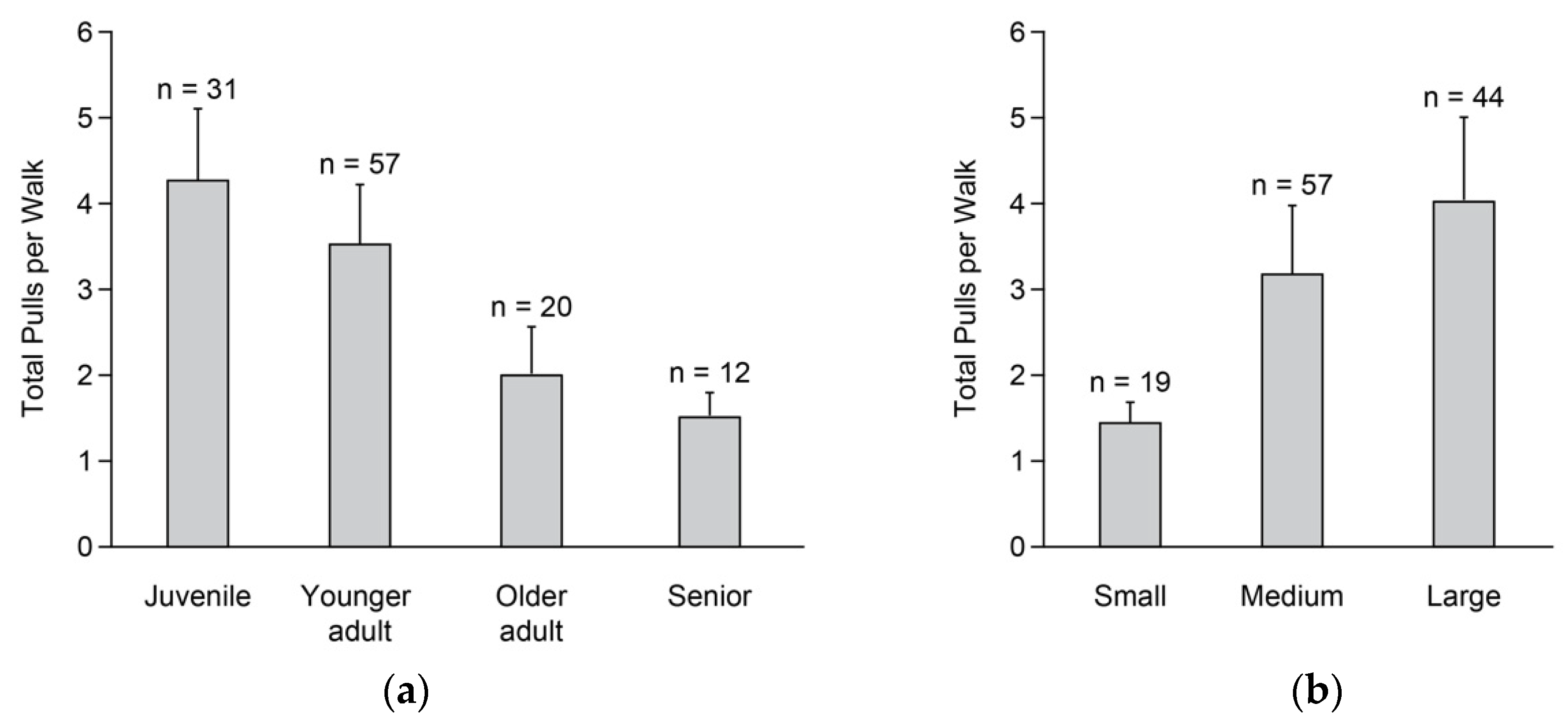
Figure 2.
Predicted length of stay (in days) for 120 shelter dogs placed up for adoption in relation to age class (a) and body size (b). Juveniles, from 4 months to < 1 year; younger adults, from 1 year to 3 years; older adults, from 4 to < 7 years; and seniors, > 7 years. Small, < 11 kg; medium, 11-24 kg, and large, > 25 kg.
Figure 2.
Predicted length of stay (in days) for 120 shelter dogs placed up for adoption in relation to age class (a) and body size (b). Juveniles, from 4 months to < 1 year; younger adults, from 1 year to 3 years; older adults, from 4 to < 7 years; and seniors, > 7 years. Small, < 11 kg; medium, 11-24 kg, and large, > 25 kg.
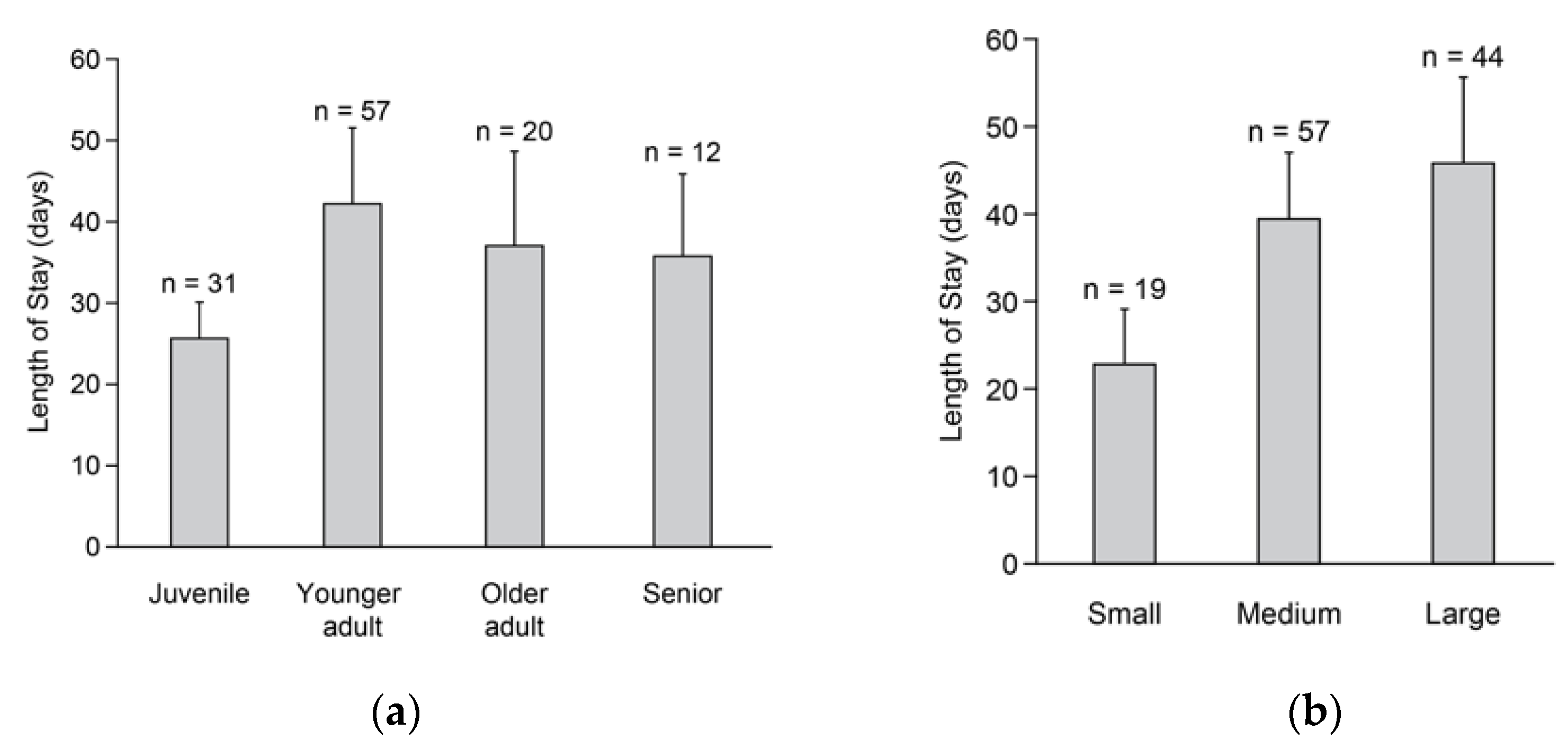
Figure 3.
Length of stay (in days and from raw data) for 120 shelter dogs placed up for adoption in relation to total number of pulls during the first walk.
Figure 3.
Length of stay (in days and from raw data) for 120 shelter dogs placed up for adoption in relation to total number of pulls during the first walk.
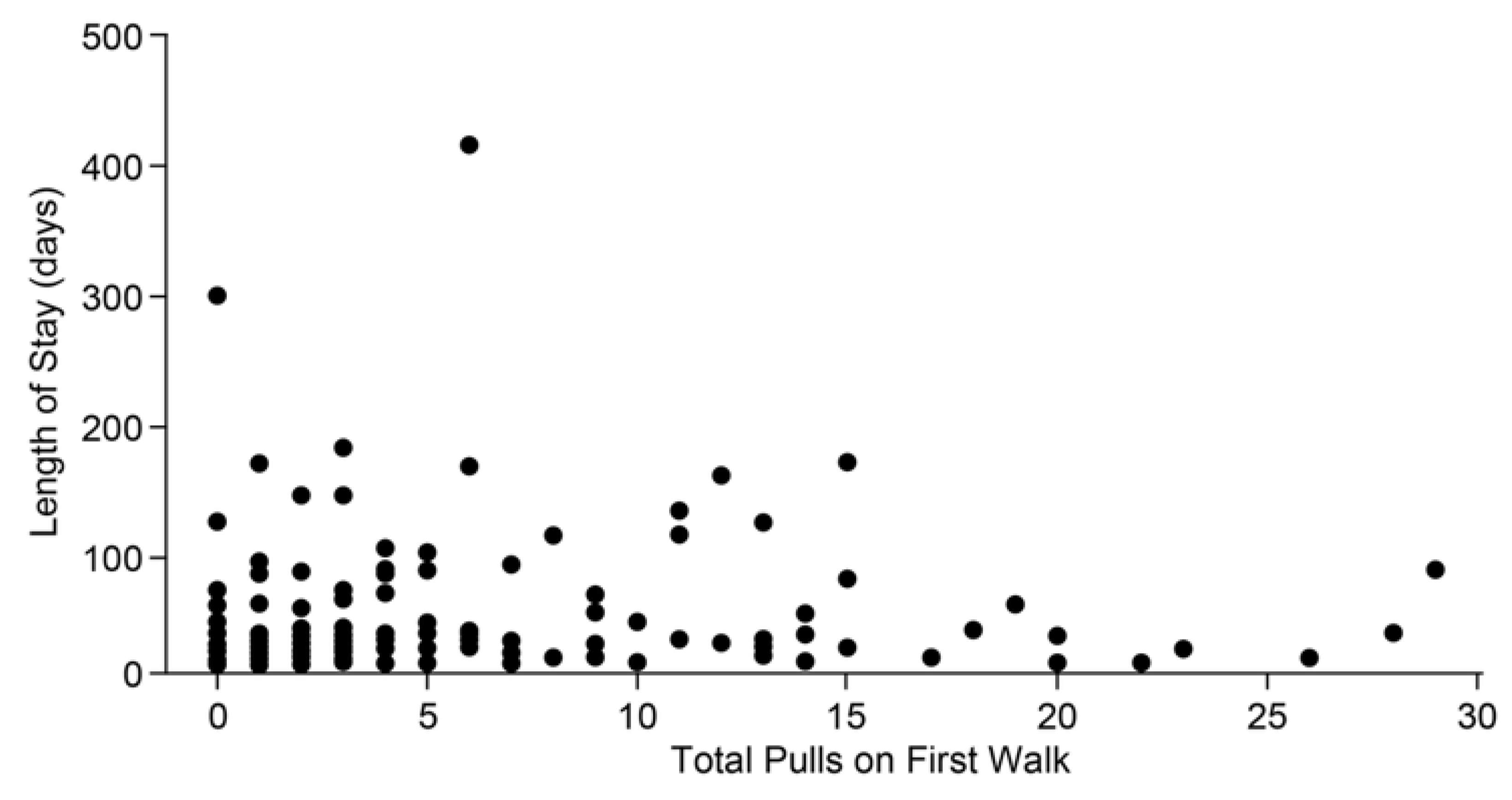

Table 1.
Characteristics of the 120 shelter dogs included in our study.
| Dog characteristics | Females | Males |
|---|---|---|
| Age class 1 | ||
| Juvenile | 10 | 21 |
| Younger adult | 25 | 32 |
| Older adult | 6 | 14 |
| Senior | 5 | 7 |
| Size class 2 | ||
| Small | 7 | 12 |
| Medium | 21 | 36 |
| Large | 18 | 26 |
| Source | ||
| Surrendered by owner | 24 | 43 |
| Transferred from another shelter | 3 | 5 |
| Seized by animal control officer | 4 | 11 |
| Picked up as a stray | 15 | 15 |
1 Juveniles, from 4 months to < 1 year; younger adults, from 1 year to 3 years; older adults, from 4 to < 7 years; and seniors, > 7 years. 2 Small, < 11 kg; medium, 11-24 kg, and large, > 25 kg.
Table 2.
Prevalence of behaviors during the first 10 minutes of first walks.
| Behavior | During harnessing | During walking |
|---|---|---|
| Jumps on handler | 45.0% (54/120) | 24.2% (29/120) |
| Grabs walking equipment | 1.7% (2/120) | 8.3% (10/120) |
| Mouths handler | 3.3% (4/120) | 2.5% (3/120) |
| Vocalizes | 2.5% (3/120) | 21.7% (26/120) |
| Pulls on leash | ----- | 85.8% (103/120) |
Table 3.
Descriptive statistics based on raw data for behaviors in relation to dog age class. H indicates behaviors during harnessing, W during walking. Categorical data are shown as percentages of dogs showing the behavior and continuous data as means and standard deviations.
Table 3.
Descriptive statistics based on raw data for behaviors in relation to dog age class. H indicates behaviors during harnessing, W during walking. Categorical data are shown as percentages of dogs showing the behavior and continuous data as means and standard deviations.
| Behavior | Juvenile | Younger adult | Older adult | Senior |
|---|---|---|---|---|
| Jumps on handler | ||||
| H | 75.0 | 48.4 | 14.2 | 9.1 |
| W | 37.5 | 16.3 | 1.4 | 0.0 |
| Grabs walking equipment | ||||
| H | 2.5 | 3.2 | 0.0 | 0.0 |
| W | 13.3 | 4.0 | 0.0 | 0.0 |
| Mouths handler | ||||
| H | 10.8 | 3.7 | 0.0 | 0.0 |
| W | 6.7 | 2.9 | 0.0 | 0.0 |
| Vocalizes | ||||
| H | 0.0 | 2.9 | 0.0 | 0.0 |
| W | 22.5 | 24.7 | 8.5 | 27.3 |
| Total pulls/Walk | ||||
| W | 6.6 + 6.9 | 6.4 + 6.8 | 6.1+ 5.2 | 3.4 + 3.4 |
1 Juveniles, from 4 months to < 1 year; younger adults, from 1 year to 3 years; older adults, from 4 to < 7 years; and seniors, > 7 years.
Table 4.
Descriptive statistics based on raw data for behaviors in relation to dog sex and body size. H indicates behaviors during harnessing, W during walking. Categorical data are shown as percentages of dogs showing the behavior and continuous data as means and standard deviations.
Table 4.
Descriptive statistics based on raw data for behaviors in relation to dog sex and body size. H indicates behaviors during harnessing, W during walking. Categorical data are shown as percentages of dogs showing the behavior and continuous data as means and standard deviations.
| Behavior | Female | Male | Small | Medium | Large |
|---|---|---|---|---|---|
| Jumps on handler | |||||
| H | 50.4 | 37.9 | 23.3 | 53.6 | 34.7 |
| W | 17.2 | 14.4 | 12.3 | 21.9 | 9.0 |
| Grabs walking equipment | |||||
| H | 3.1 | 1.6 | 0.0 | 2.7 | 2.0 |
| W | 3.1 | 5.1 | 5.5 | 5.1 | 3.3 |
| Mouths handler | |||||
| H | 6.2 | 2.4 | 2.7 | 4.5 | 3.3 |
| W | 2.3 | 2.9 | 2.7 | 3.9 | 1.3 |
| Vocalizes | |||||
| H | 3.5 | 0.4 | 0.0 | 0.6 | 3.0 |
| W | 27.7 | 17.7 | 34.2 | 24.6 | 14.7 |
| Total Pulls/Walk | |||||
| W | 6.7 + 7.0 | 5.8 + 5.9 | 2.7 + 4.1 | 6.7 + 7.1 | 6.3 + 5.6 |
1 Small, < 11 kg; medium, 11-24 kg, and large, > 25 kg.
Table 5.
Length of stay (mean + SD, in days) based on raw data for shelter dogs placed up for adoption in relation to sex, age class, and body size (sample sizes in parentheses).
Table 5.
Length of stay (mean + SD, in days) based on raw data for shelter dogs placed up for adoption in relation to sex, age class, and body size (sample sizes in parentheses).
| Dog Characteristics | Length of stay (days) |
|---|---|
| Sex | |
| Female | 54.3 + 77.6 (46) |
| Male | 44.1 + 40.5 (74) |
| Age class 1 | |
| Juvenile | 24.9 + 18.4 (31) |
| Younger adult | 63.8 + 74.4 (57) |
| Older adult | 48.3 + 42.0 (20) |
| Senior | 32.1 + 24.0 (12) |
| Size class 2 | |
| Small | 23.7 + 20.2 (19) |
| Medium | 52.5 + 72.0 (57) |
| Large | 52.7+ 43.9 (44) |
1 Juveniles, from 4 months to < 1 year; younger adults, from 1 year to 3 years; older adults, from 4 to < 7 years; and seniors, > 7 years. 2 Small, < 11 kg; medium, 11-24 kg, and large, > 25 kg.
Table 6.
Length of stay (mean + SD, in days) based on raw data for shelter dogs placed up for adoption in relation to whether behaviors were shown (absent/present) during harnessing (H) or walking (W; sample sizes in parentheses) during the first walk. * Indicates < 5% of dogs showed this behavior.
Table 6.
Length of stay (mean + SD, in days) based on raw data for shelter dogs placed up for adoption in relation to whether behaviors were shown (absent/present) during harnessing (H) or walking (W; sample sizes in parentheses) during the first walk. * Indicates < 5% of dogs showed this behavior.
| Behavior | Length of stay (days) |
|---|---|
| Jumps on handler | |
| H - no | 54.3 + 69.5 (65) |
| H - yes | 40.5 + 38.3 (55) |
| W - no | 48.7 + 51.2 (91) |
| W - yes | 45.7 + 75.0 (29) |
| Grabs walking equipment | |
| H - no | 48.5 + 57.9 (118) |
| H - yes * | 17.5 + 3.7 (2) |
| W - no | 45.0 + 47.5 (110) |
| W - yes | 81.1 + 123.0 (10) |
| Mouths handler | |
| H - no | 44.5 + 47.1 (116) |
| H - yes * | 121.0 + 197.0 (4) |
| W - no | 48.3 + 58.1 (117) |
| W - yes * | 33.9 + 21.1 (3) |
| Vocalizes | |
| H - no | 48.8 + 58.0 (117) |
| H - yes * | 17.1 + 8.7 (3) |
| W - no | 50.0 + 62.0 (94) |
| W - yes | 40.7 + 37.0 (26) |
Disclaimer/Publisher’s Note: The statements, opinions and data contained in all publications are solely those of the individual author(s) and contributor(s) and not of MDPI and/or the editor(s). MDPI and/or the editor(s) disclaim responsibility for any injury to people or property resulting from any ideas, methods, instructions or products referred to in the content. |
© 2025 by the authors. Licensee MDPI, Basel, Switzerland. This article is an open access article distributed under the terms and conditions of the Creative Commons Attribution (CC BY) license (http://creativecommons.org/licenses/by/4.0/).
Copyright: This open access article is published under a Creative Commons CC BY 4.0 license, which permit the free download, distribution, and reuse, provided that the author and preprint are cited in any reuse.