

Submitted:
30 January 2025
Posted:
31 January 2025
You are already at the latest version
Abstract
Wind energy in Brazil has been steadily growing, influenced significantly by climate change. To enhance wind energy generation, it is essential to incorporate external climatic variables into wind speed modeling to reduce uncertainties. Periodic Autoregressive Models with Exogenous Variables (PARX), which include the exogenous variable ENSO, are effective for this purpose. This study modeled wind speed series in Rio Grande do Norte, Paraíba, Pernambuco, Alagoas, Sergipe, Rio Grande do Sul, and Santa Catarina, considering the spatial correlation between these states through PARX-Cov modeling. Additionally, the correlation with ENSO indicators was used for out-of-sample prediction of climatic variables, aiding in wind speed scenario simulation. The proposed PARX and PARX-Cov models outperformed the current model used in the Brazilian electric sector for simulating future wind speed series. Specifically, the PARX-Cov model with the Cumulative ONI index is most suitable for Pernambuco, Rio Grande do Sul, and Santa Catarina, while the PARX-Cov with the SOI index is more appropriate for Rio Grande do Norte. For Alagoas and Sergipe, the PARX with the Cumulative ONI index is the best fit, and the PARX with the Cumulative Niño 4 index is most suitable for Paraíba.
Keywords:
1. Introduction
2. Methodology
2.1. Pre-Processing
2.1.1. Datasets
2.1.2. Extrapolation of Climate Variables
2.2. Modeling
2.2.1. Periodic Autoregressive Model (PAR)
2.2.2. Periodic Autoregressive Model with Exogenous Variables (PARX)
2.2.3. Covariance (PAR-Cov & PARX-Cov)
- 1.
- Calculation of the Covariance Matrix
- 2.
- Spectral Decomposition
- 3.
- Multivariate Normal Distribution
2.3. Post-Processing
2.3.1. Performance Metrics
2.3.2. Stochastic Simulation of Wind Speed Scenarios
2.3.3. Forecast of Wind Speed
3. Descriptive Analysis of the Data
3.1. Wind Speed
3.2. ENSO
3.2.1. Historical
3.2.2. Forecast
3.3. Relationship Between Wind Speed and ENSO
4. Results
- i)
- Fit the wind speed series for the in-sample period;
- ii)
- Simulate scenarios of the out-of-sample period (using the observed values of climatic variables from the in-sample period);
- iii)
- Compare the forecasted values, calculated as the average of the scenarios, with the observed value;
- iv)
- Record the errors obtained.
5. Conclusion
Author Contributions
Funding
Data Availability Statement
References
- EPE. https://www.epe.gov.br/pt/publicacoes-dadosabertos/publicacoes/balanco-energetico-nacional-ben, 2021. Accessed: 10-05-2023.
- Rigotti, J.A.; Carvalho, J.M.; Soares, L.M.; Barbosa, C.C.; Pereira, A.R.; Duarte, B.P.; Mannich, M.; Koide, S.; Bleninger, T.; Martins, J.R. Effects of hydrological drought periods on thermal stability of Brazilian reservoirs. Water 2023, 15, 2877. [CrossRef]
- Maceira, M.; Melo, A.; Pessanha, J.; Cruz, C.; Almeida, V.; Justino, T. Wind Uncertainty Modeling in Long-Term Operation Planning of Hydro-Dominated Systems. In Proceedings of the 2022 17th International Conference on Probabilistic Methods Applied to Power Systems (PMAPS). IEEE, 2022, pp. 1–6.
- Melo, G.; Barcellos, T.; Ribeiro, R.; Couto, R.; Gusmão, B.; Oliveira, F.L.C.; Maçaira, P.; Fanzeres, B.; Souza, R.C.; Bet, O. Renewable energy sources spatio-temporal scenarios simulation under influence of climatic phenomena. Electric Power Systems Research 2024, 235, 110725. [CrossRef]
- Pinson, P. Wind energy: Forecasting challenges for its operational management. Statistical Science 2013. [CrossRef]
- Ferreira, P.G.C.; Oliveira, F.L.C.; Souza, R.C. The stochastic effects on the Brazilian Electrical Sector. Energy Economics 2015, 49, 328–335. [CrossRef]
- Souza, R.C.; Marcato, A.; Dias, B.H.; Oliveira, F.L.C.; et al. Optimal operation of hydrothermal systems with hydrological scenario generation through bootstrap and periodic autoregressive models. European Journal of Operational Research 2012, 222, 606–615. [CrossRef]
- Noakes, D.; McLeod, A.; Hipel, K. Forecasting monthly riverflow time series. International Journal of Forecasting 1985, 1, 179–190. https://doi.org/10.1016/0169-2070(85)90022-6. [CrossRef]
- EPE. Plano Nacional de Energia - PNE 2050. https://static.poder360.com.br/2020/12/PNE2050.pdf, 2018. Accessed: 20-05-2022.
- do Nascimento Camelo, H.; Lucio, P.S.; Junior, J.B.V.L.; de Carvalho, P.C.M. A hybrid model based on time series models and neural network for forecasting wind speed in the Brazilian northeast region. Sustainable Energy Technologies and Assessments 2018, 28, 65–72. [CrossRef]
- de Mattos Neto, P.S.; de Oliveira, J.F.; Júnior, D.S.d.O.S.; Siqueira, H.V.; Marinho, M.H.; Madeiro, F. An adaptive hybrid system using deep learning for wind speed forecasting. Information Sciences 2021, 581, 495–514. [CrossRef]
- Corrêa, C.S.; Schuch, D.A.; Queiroz, A.P.d.; Fisch, G.; Corrêa, F.d.N.; Coutinho, M.M. The long-range memory and the fractal dimension: A case study for Alcântara. Journal of Aerospace Technology and Management 2017, 9, 461–468. [CrossRef]
- Lima, C.N.N.; Fernandes, C.A.C.; França, G.B.; de Matos, G.G. Estimation of the El Niño/La Niña Impact in the Intensity of Brazilian Northeastern Winds. Anuário do Instituto de Geociências 2014, 37, 232–240.
- Arpe, K.; Molavi-Arabshahi, M.; Leroy, S.A.G. Wind variability over the Caspian Sea, its impact on Caspian seawater level and link with ENSO. International Journal of Climatology 2020, 40, 6039–6054. [CrossRef]
- Xu, Q.; Li, Y.; Cheng, Y.; Ye, X.; Zhang, Z. Impacts of Climate Oscillation on Offshore Wind Resources in China Seas. Remote Sensing 2022, 14, 1879. [CrossRef]
- Coria-Monter, E.; Salas de León, D.A.; Monreal-Gómez, M.A.; Durán-Campos, E. Satellite observations of the effect of the “Godzilla El Niño” on the Tehuantepec upwelling system in the Mexican Pacific. Helgoland Marine Research 2019, 73, 1–11.
- Maçaira, P.; Thomé, A.; Cyrino Oliveira, F.; de Almeida, F. Time series analysis with explanatory variables: A systematic literature review. Environmental Modelling & Software 2018, 107, 199––209. [CrossRef]
- de Mendonça, M.J.C.; Pessanha, J.F.M.; de Almeida, V.A.; Medrano, L.A.T.; Hunt, J.D.; Junior, A.O.P.; Nogueira, E.C. Synthetic wind speed time series generation by dynamic factor model. Renewable Energy 2024, 228, 120591. [CrossRef]
- Ursu, E.; Pereau, J. Estimation and identification of periodic autoregressive models with one exogenous variable. Journal of the Korean Statistical Society 2017, 46, 629–640. [CrossRef]
- Silveira, C.; Alexandre, A.; de Souza Filho, F.; Vasconcelos Junior, F.; Cabral, S. Monthly streamflow forecast for National Interconnected System (NIS) using Periodic Auto-regressive Endogenous Models (PAR) and Exogenous (PARX) with climate information. Brazilian Journal of Water Resources 2017, 22. https://doi.org/10.1590/2318-0331.011715186. [CrossRef]
- Maçaira, P.M.; Oliveira, F.L.C.; Ferreira, P.G.C.; Almeida, F.V.N.d.; Souza, R.C. Introducing a causal PAR (p) model to evaluate the influence of climate variables in reservoir inflows: A Brazilian case. Pesquisa Operacional 2017, 37, 107–128. [CrossRef]
- Huang, X.; Maçaira, P.M.; Hassani, H.; Oliveira, F.L.C.; Dhesi, G. Hydrological natural inflow and climate variables: Time and frequency causality analysis. Physica A: Statistical Mechanics and its Applications 2019, 516, 480–495. [CrossRef]
- Duran, M.J.; Cros, D.; Riquelme, J. Short-term wind power forecast based on ARX models. Journal of Energy Engineering 2007, 133, 172–180. [CrossRef]
- Golia, S.; Grossi, L.; Pelagatti, M. Machine Learning Models and Intra-Daily Market Information for the Prediction of Italian Electricity Prices. Forecasting 2022, 5, 81–101. [CrossRef]
- Iung, A.M.; Cyrino Oliveira, F.L.; Marcato, A.L.M. A review on modeling variable renewable energy: Complementarity and spatial–temporal dependence. Energies 2023, 16, 1013. [CrossRef]
- Atlas, G.W. Available at: https://globalwindatlas.info/en. Accessed on: November 27, 2023.
- de Aquino Ferreira, S.C.; Oliveira, F.L.C.; Maçaira, P.M. Validation of the representativeness of wind speed time series obtained from reanalysis data for Brazilian territory. Energy 2022, 258, 124746. [CrossRef]
- Gruber, K.; Klöckl, C.; Regner, P.; Baumgartner, J.; Schmidt, J. Assessing the Global Wind Atlas and local measurements for bias correction of wind power generation simulated from MERRA-2 in Brazil. Energy 2019, 189, 116212. [CrossRef]
- Olauson, J.; Bergkvist, M. Modelling the Swedish wind power production using MERRA reanalysis data. Renewable Energy 2015, 76, 717–725. [CrossRef]
- Renewables.ninja. Available at: https://www.renewables.ninja/. Accessed on: November 27, 2023.
- Pfenninger, S.; Staffell, I. Long-term patterns of European PV output using 30 years of validated hourly reanalysis and satellite data. Energy 2016, 114, 1251–1265. [CrossRef]
- Staffell, I.; Pfenninger, S. Using bias-corrected reanalysis to simulate current and future wind power output. Energy 2016, 114, 1224–1239. [CrossRef]
- NOAA. Available at: https://www.ncei.noaa.gov/access/monitoring/enso/. Accessed on: March 31, 2024.
- NOAA. Available at: https://www.cpc.ncep.noaa.gov/data/indices/. Accessed on: March 31, 2024.
- Institute, I.R. Available at: https://iri.columbia.edu/our-expertise/climate/enso/. Accessed on: March 31, 2024.
- Barhmi, S.; Elfatni, O.; Belhaj, I. Forecasting of wind speed using multiple linear regression and artificial neural networks. Energy Systems 2020, 11, 935–946. [CrossRef]
- James, G.; Witten, D.; Hastie, T.; Tibshirani, R.; Taylor, J. Linear regression. In An introduction to statistical learning: With applications in python; Springer, 2023; pp. 69–134.
- Hipel, K.; McLeod, A. Time Series Modelling of Water Resources and Environmental Systems; Elsevier, 1994.
- Schwarz, G. Estimating the dimension of a model. Annals of Statistics 1978, 6, 461–464. [CrossRef]
- Vrieze, S. Model selection and psychological theory: A discussion of the differences between the Akaike information criterion (AIC) and the Bayesian information criterion (BIC). Psychological Methods 2012. [CrossRef]
- Makubyane, K.; Maposa, D. Forecasting Short-and Long-Term Wind Speed in Limpopo Province Using Machine Learning and Extreme Value Theory. Forecasting 2024, 6, 885–907. [CrossRef]
- Dismuke, C.; Lindrooth, R. Ordinary least squares. Methods and designs for outcomes research 2006, 93, 93–104.
- Suryawanshi, A.; Ghosh, D. Wind speed prediction using spatio-temporal covariance. Natural Hazards 2015, 75, 1435–1449. [CrossRef]
- Ezzat, A.A.; Jun, M.; Ding, Y. Spatio-temporal short-term wind forecast: A calibrated regime-switching method. The annals of applied statistics 2019, 13, 1484. [CrossRef]
- Jacondino, W.D.; da Silva Nascimento, A.L.; Calvetti, L.; Fisch, G.; Beneti, C.A.A.; da Paz, S.R. Hourly day-ahead wind power forecasting at two wind farms in northeast Brazil using WRF model. Energy 2021, 230, 120841. [CrossRef]
- de Souza, N.B.P.; Nascimento, E.G.S.; Santos, A.A.B.; Moreira, D.M. Wind mapping using the mesoscale WRF model in a tropical region of Brazil. Energy 2022, 240, 122491. [CrossRef]
- Mugware, F.W.; Sigauke, C.; Ravele, T. Evaluating Wind Speed Forecasting Models: A Comparative Study of CNN, DAN2, Random Forest and XGBOOST in Diverse South African Weather Conditions. Forecasting 2024, 6, 672–699. [CrossRef]
- Charbeneau, R. Comparison of the two- and three-parameter log normal distributions used in streamflow synthesis. Water Resources Research 1978, 14, 149–150. [CrossRef]
- Pereira, M.; G, O.; Costa, C.; Kelman, J. Stochastic Streamflow Models for Hydroeletric SYSTEMS. Water Resources Research 1984, 20, 379–390.
- R Core Team. R: A Language and Environment for Statistical Computing. R Foundation for Statistical Computing, Vienna, Austria, 2022.
- Said, S.; D, D. Testing for Unit Roots in Autoregressive-Moving Average Models of Unknown Order. Biometrika 1984, 71, 599–607.
- Perron, P. Trends and random walks in macroeconomic time series. Journal of Economic Dynamics and Control 1988, 12, 297–332. [CrossRef]
- NOAA. Available at: https://www.climate.gov/news-features/blogs/enso/why-are-there-so-many-enso-indexes-instead-just-one. Accessed on: November 27, 2023.
- Bjerknes, J. Atmospheric teleconnections from the equatorial Pacific. Journal of Physical Oceanography 1969, 97, 163–172.
- Barnston, A.; Chelliah, M.; Goldenberg, S. Documentation of a highly ENSO-related SST region in the equatorial Pacific. Atmosphere-Ocean 1997, 35, 367–383.
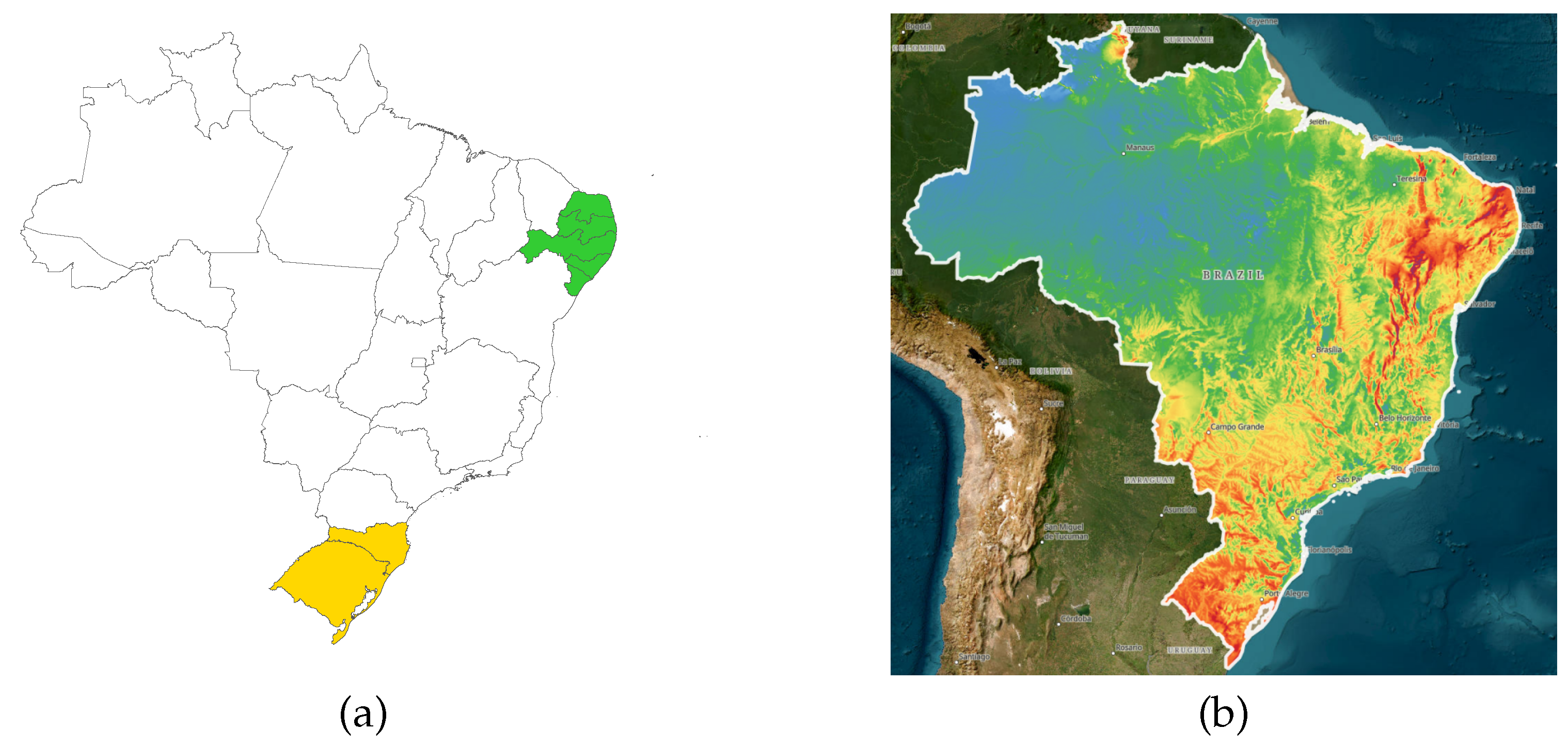
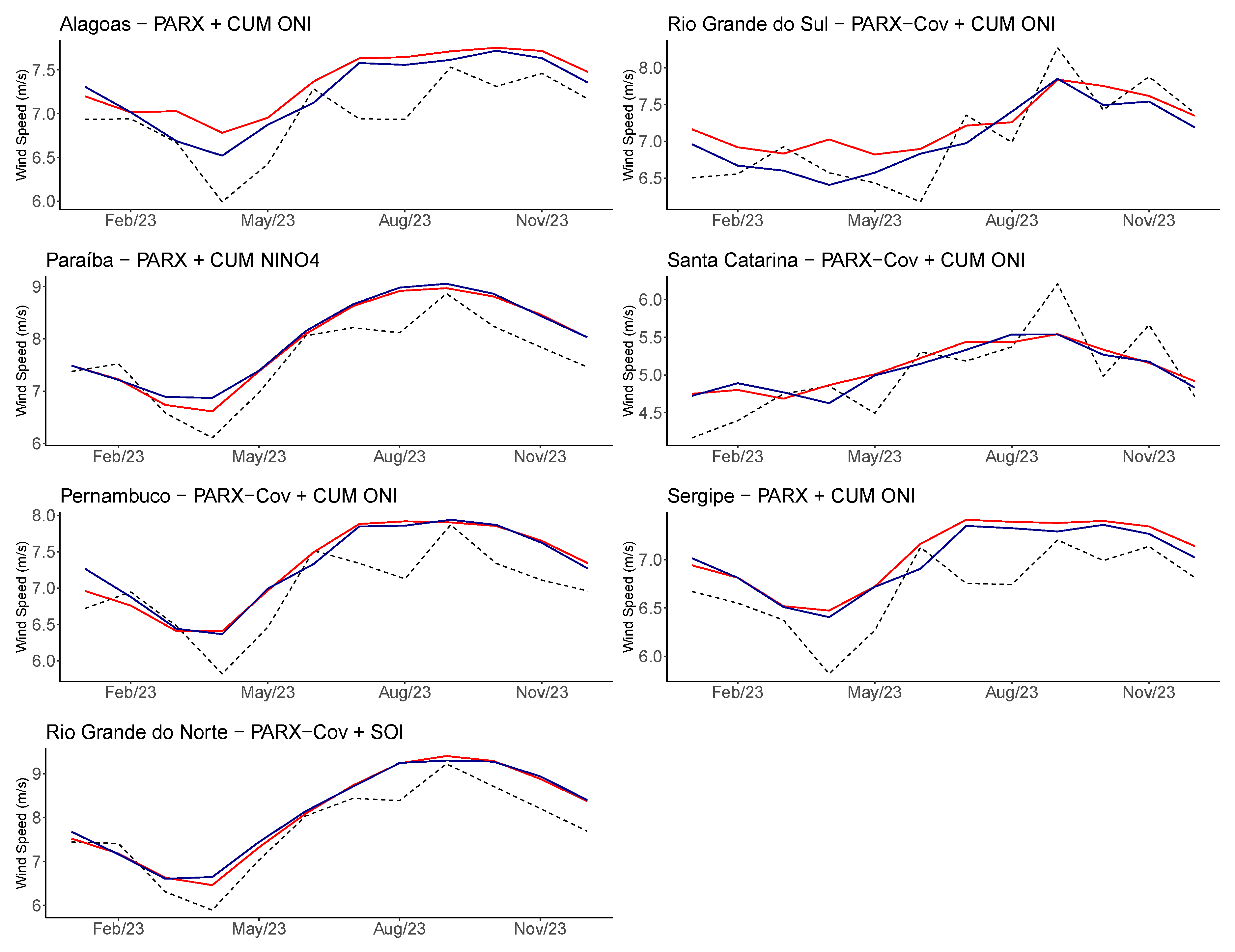
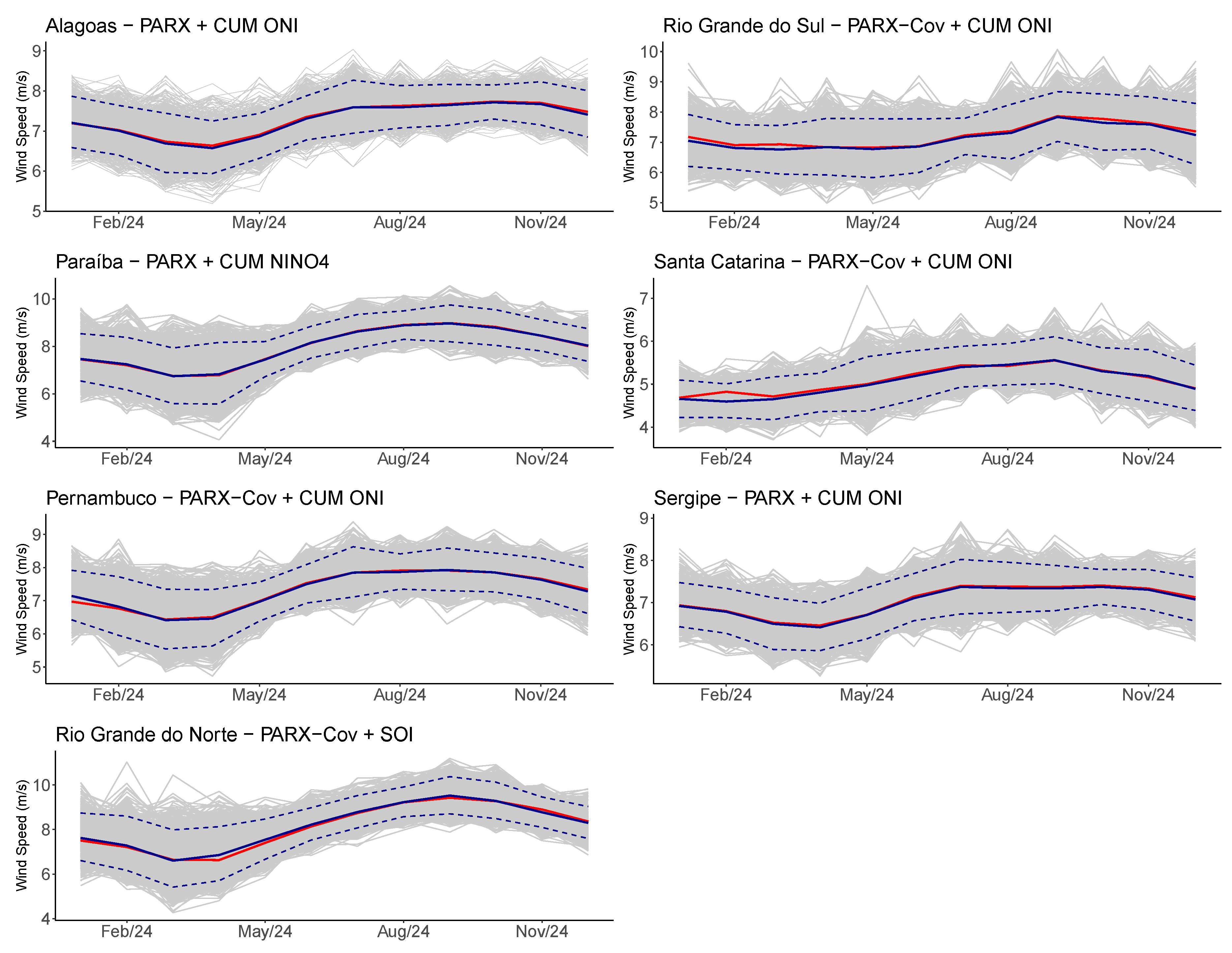
| (a) | (b) |
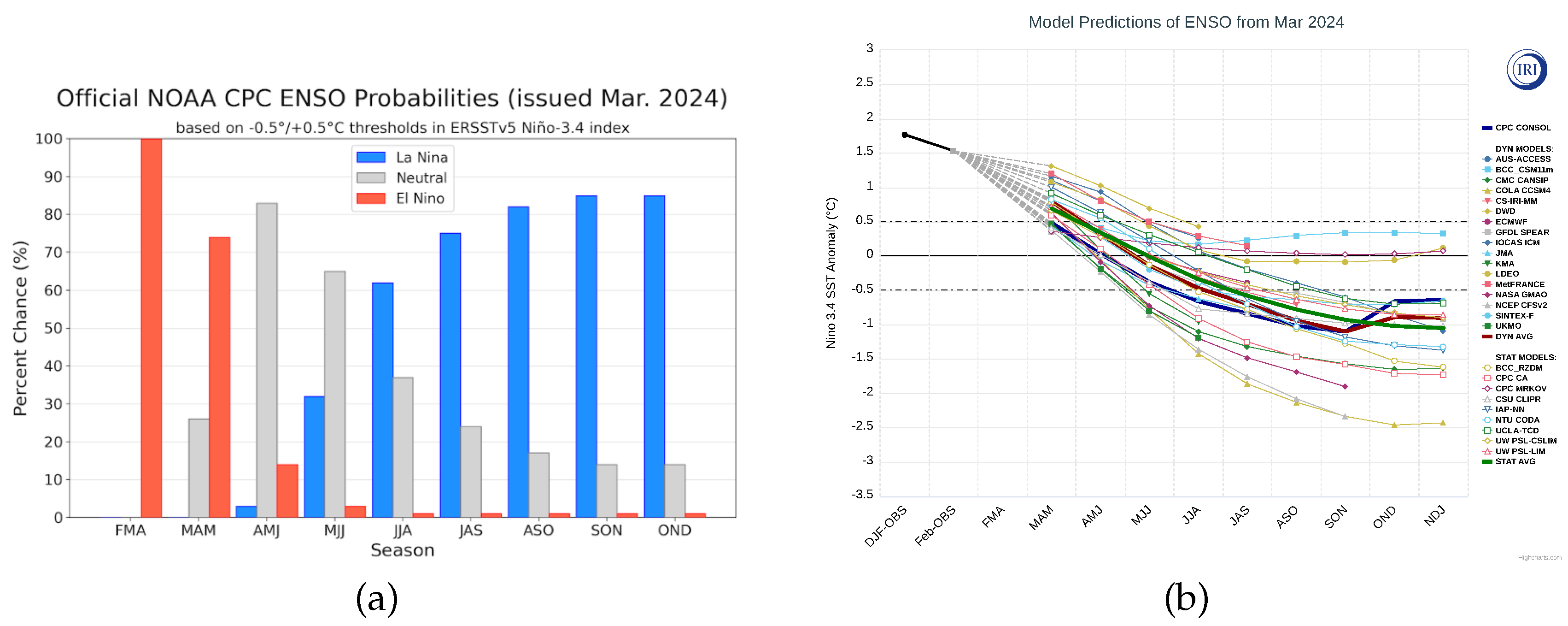
| (a) | (b) |

| State | Mean | Median | Standard Deviation |
Coefficient of Variation |
Skewness | Kurtosis |
|---|---|---|---|---|---|---|
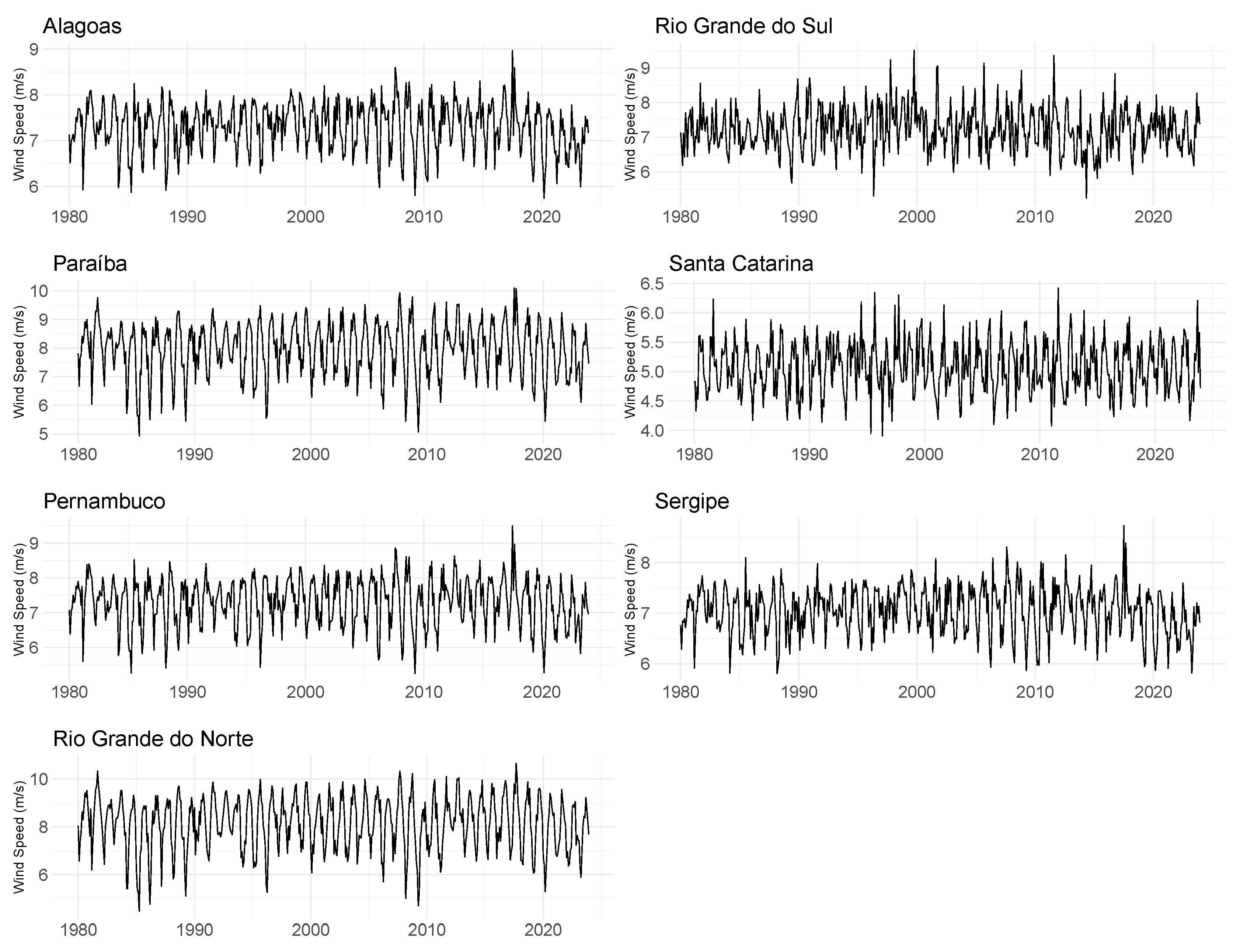
| Alagoas | 7,30 | 7,36 | 0,53 | 0,07 | -0,40 | 2,87 |
| Paraíba | 7,97 | 8,12 | 0,93 | 0,12 | -0,53 | 2,94 |
| Pernambuco | 7,31 | 7,43 | 0,69 | 0,09 | -0,45 | 2,90 |
| Rio Grande do Norte | 8,15 | 8,34 | 1,13 | 0,14 | -0,55 | 2,87 |
| Rio Grande do Sul | 7,23 | 7,21 | 0,64 | 0,09 | 0,24 | 3,36 |
| Santa Catarina | 5,08 | 5,06 | 0,44 | 0,09 | 0,13 | 2,71 |
| Sergipe | 7,05 | 7,12 | 0,48 | 0,07 | -0,21 | 2,94 |
| Index | Coefficients | Estimated Value | Standard Deviation | P-value | R² |
|---|---|---|---|---|---|
| SOI | (Intercept) | 0.275 | 0.036 | ≈ 0 | 0.528 |
| ONI | -1.349 | 0.043 | ≈ 0 | ||
| Equatorial SOI | (Intercept) | 0.001 | 0.017 | 0.938 | 0.701 |
| ONI | -0.909 | 0.020 | ≈ 0 | ||
| Niño 1+2 | (Intercept) | -0.046 | 0.026 | 0.072 | 0.444 |
| ONI | 0.811 | 0.030 | ≈ 0 | ||
| Niño 3 | (Intercept) | -0.046 | 0.011 | ≈ 0 | 0.831 |
| ONI | 0.898 | 0.014 | ≈ 0 | ||
| Niño 4 | (Intercept) | -0.072 | 0.010 | ≈ 0 | 0.792 |
| ONI | 0.728 | 0.013 | ≈ 0 | ||
| Niño 3.4 | (Intercept) | -0.052 | 0.009 | ≈ 0 | 0.882 |
| ONI | 0.837 | 0.010 | ≈ 0 |
| State | SOI | Equatorial SOI | Niño 1+2 | Niño 3 | Niño 4 | Niño 3.4 | ONI |
|---|---|---|---|---|---|---|---|
| Alagoas | 0.426 | 0.93 | 0.123 | 0.801 | 0.662 | 0.801 | 0.645 |
| Yes | Yes | Yes | Yes | Yes | Yes | Yes | |
| Paraíba | 0.262 | 0.918 | 0.013 | 0.312 | 0.097 | 0.197 | 0.788 |
| Yes | Yes | No | Yes | No | Yes | Yes | |
| Pernambuco | 0.587 | 0.73 | 0.02 | 0.168 | 0.117 | 0.204 | 0.682 |
| Yes | Yes | No | Yes | Yes | Yes | Yes | |
| Rio Grande do Norte | 0.065 | 0.852 | 0.023 | 0.787 | 0.193 | 0.26 | 0.609 |
| No | Yes | No | Yes | Yes | Yes | Yes | |
| Rio Grande do Sul | 0.492 | 0.102 | 0.308 | 0.075 | 0.749 | 0.335 | 0.093 |
| Yes | Yes | Yes | No | Yes | Yes | No | |
| Santa Catarina | 0.167 | 0.174 | 0.001 | 0.545 | 0.395 | 0.378 | 0.259 |
| Yes | Yes | No | Yes | Yes | Yes | Yes | |
| Sergipe | 0.466 | 0.89 | 0.099 | 0.494 | 0.354 | 0.925 | 0.755 |
| Yes | Yes | No | Yes | Yes | Yes | Yes |
| Windows | In-sample | Out-of-sample |
|---|---|---|
| 1 | Jan/1980-Dec/2013 | Jan/2014-Dec/2018 |
| 2 | Jan/1980-Dec/2014 | Jan/2015-Dec/2019 |
| 3 | Jan/1980-Dec/2015 | Jan/2016-Dec/2020 |
| 4 | Jan/1980-Dec/2016 | Jan/2017-Dec/2021 |
| 5 | Jan/1980-Dec/2017 | Jan/2018-Dec/2022 |
| 6 | Jan/1980-Dec/2022 | Jan/2023-Dec/2023 |
| 7 | Jan/1980-Dec/2023 | Jan/2024-Dec/2024 |
| State | Metric | PAR | Best Model | Improvement (%) | |
|---|---|---|---|---|---|
| Alagoas | RMSE | 0,4057 | PARX + CUM ONI | 0,401 | 1,15 |
| MAE | 0,312 | PARX + CUM ONI | 0,3077 | 1,36 | |
| R² | 0,476 | PARX + CUM ONI | 0,4878 | 2,48 | |
| Paraíba | RMSE | 0,5013 | PARX + CUM NINO4 | 0,4908 | 2,09 |
| MAE | 0,3867 | PARX + CUM ONI | 0,3782 | 2,19 | |
| R² | 0,7418 | PARX + CUM NINO4 | 0,7522 | 1,4 | |
| Pernambuco | RMSE | 0,4714 | PARX + CUM ONI | 0,4673 | 0,87 |
| MAE | 0,3688 | PARX-Cov + CUM ONI | 0,3632 | 1,49 | |
| R² | 0,6 | PARX-Cov + CUM NINO3.4 | 0,6068 | 1,12 | |
| Rio Grande do Norte | RMSE | 0,52 | PARX-Cov + SOI | 0,5102 | 1,88 |
| MAE | 0,4064 | PARX + CUM ONI | 0,3996 | 1,69 | |
| R² | 0,8045 | PARX-Cov + SOI | 0,8102 | 0,71 | |
| Rio Grande do Sul | RMSE | 0,4888 | PARX-Cov + CUM ONI | 0,4748 | 2,87 |
| MAE | 0,3867 | PARX + CUM ONI | 0,3798 | 1,8 | |
| R² | 0,2263 | PARX-Cov + CUM ONI | 0,27 | 19,29 | |
| Santa Catarina | RMSE | 0,3055 | PARX-Cov + CUM ONI | 0,2974 | 2,65 |
| MAE | 0,2479 | PARX-Cov + CUM ONI | 0,2368 | 4,47 | |
| R² | 0,429 | PARX-Cov + CUM ONI | 0,459 | 6,99 | |
| Sergipe | RMSE | 0,3829 | PARX + CUM ONI | 0,3795 | 0,89 |
| MAE | 0,2931 | PARX + CUM ONI | 0,2887 | 1,53 | |
| R² | 0,422 | PARX + CUM ONI | 0,4321 | 2,4 | |
| Model | Frequency (out of 21) |
|---|---|
| PARX + CUM ONI | 10 |
| PARX-Cov + CUM ONI | 6 |
| PARX + CUM NINO4 | 2 |
| PARX-Cov + SOI | 2 |
| PARX-Cov + CUM NINO3.4 | 1 |
| State | Best model |
|---|---|
| Alagoas | PARX + CUM ONI |
| Paraíba | PARX + CUM NINO4 |
| Pernambuco | PARX-Cov + CUM ONI |
| Rio Grande do Norte | PARX-Cov + SOI |
| Rio Grande do Sul | PARX-Cov + CUM ONI |
| Santa Catarina | PARX-Cov + CUM ONI |
| Sergipe | PARX + CUM ONI |
Disclaimer/Publisher’s Note: The statements, opinions and data contained in all publications are solely those of the individual author(s) and contributor(s) and not of MDPI and/or the editor(s). MDPI and/or the editor(s) disclaim responsibility for any injury to people or property resulting from any ideas, methods, instructions or products referred to in the content. |
© 2025 by the authors. Licensee MDPI, Basel, Switzerland. This article is an open access article distributed under the terms and conditions of the Creative Commons Attribution (CC BY) license (http://creativecommons.org/licenses/by/4.0/).