

Submitted:
29 January 2025
Posted:
30 January 2025
You are already at the latest version
Abstract
More than three decades ago, the Supreme Court of the United States (SCOTUS) ruled that individuals who are not competent (alternatively referred to by the Court as insane) at the time of their scheduled execution cannot be put to death. Despite the years that have passed since the Court’s decision and the literal life or death stakes involved, competency for execution (CFE) remains underexplored in the psychological and legal literature. A number of important legal and ethical issues that arise when a person on death row maintains they are not competent to be executed are still unresolved even after landmark Supreme Court cases such as Ford v. Wainwright (1986), Panetti v. Quarterman (2007), and Madison v. Alabama (2019). In this first-of-its-kind descriptive study, we analyze the demographic and case characteristics of the 28 successful Ford-Panetti claimants—individuals in the United States who have been found to be incompetent to be executed. Our findings reveal some similarities but also some significant differences between these claimants and the general death row population: the successful claimants are exclusively male (in keeping with the general prison population on death row), significantly older, and underrepresented among White and Latinx inmates (i.e., Black claimants are more successful than their White and Latinx counterparts at evading execution). Nearly all (96%) suffer from schizophrenia, with 79% experiencing psychiatric comorbidity, yet only 54% received any significant treatment before or after the criminal offense. The claimants’ cases also involve a higher proportion of child victims, family members, and strangers, as well as more multiple-victim cases (not indiscriminate) and fewer intraracial homicides. Fewer victims are male, and more are female. However, the cases do not align with typical male-on-male violent crimes or femicide patterns, such as those involving sexual or domestic violence. Additionally, psycho-legal deficiencies are prevalent, including a low rate of mental health evidence (61%) presented at trials and some cases lacking psychiatric involvement in CFE evaluations. Temporal influence and drastic state variations on CFE evaluation are also noted. Although the small sample size limits generalizability, this small-scale descriptive study offers a number of important insights into the complexities of CFE decisions and lays the groundwork for future research and policy development.
Keywords:
Competency to be executed
; competency for execution
; death penalty
; mental illness
; legal decision-making
1. Introduction
Competency to be executed, also known as competency for execution (CFE), pertains to assessing an individual’s mental suitability for undergoing state-sanctioned homicide. When an attorney for a condemned person on death row raises a CFE claim, and if the individual is deemed incompetent to be executed, their life is spared (at least temporarily). Conversely, if the courts determine the individual is competent to be executed, and the execution proceeds. Therefore, the outcomes of CFE evaluations have profound implications, as they are literally a matter of life or death. In this respect, CFE is distinct from other criminal competency determinations, and the high stakes and the legal, moral, and ethical questions that arise when assessing an individual’s capacity for execution, CFE is one of the most critical forms of decision-making.
CFE is also sometimes referred to as the “last competency” (Brodsky et al., 2011), as it typically represents the culmination of criminal competency evaluations. It becomes relevant only when a defendant’s guilt has been established, other appeals have been unsuccessfully pursued, and the execution date has been set. Therefore, CFE is the final criminal competency for which evaluations may be requested, conducted, and adjudicated.
1.1. Historical Development of CFE
1.1.1. Common Law and the Eighth Amendment
The English common law tradition, which prohibits the execution of individuals deemed insane, has played a foundational role in shaping modern legal standards regarding competency for execution. As cited at the beginning of the landmark Supreme Court case Ford v. Wainwright (1986), which we will discuss in the next section, Sir William Blackstone stated:
[I]diots and lunatics are not chargeable for their own acts, if committed when under these incapacities: no, not even for treason itself. Also, if a man in his sound memory commits a capital offence, and before arraignment for it, he becomes mad, he ought not to be arraigned for it: because he is not able to plead to it with that advice and caution that he ought. And if, after he has pleaded, the prisoner becomes mad, he shall not be tried: for how can he make his defence? If, after he be tried and found guilty, he loses his senses before judgment, judgment shall not be pronounced; and if, after judgment, he becomes of nonsane memory, execution shall be stayed: for peradventure, says the humanity of the English law, had the prisoner been of sound memory, he might have alleged something in stay of judgment or execution.
In the same vein, Sir Edward Coke (1680, as cited in Ford v. Wainwright, 1986) similarly articulated one of the earliest rationales for this principle:
[B]y intendment of Law, the execution of the offender is for example,…but so it is not when a mad man is executed, but should be a miserable spectacle, both against Law, and of extream inhumanity and cruelty, and can be no example to others.
The foundational principles stated by Sir Blackstone and Sir Coke highlight the English common law’s long-standing commitment to safeguarding insane individuals from being executed, a principle with deep historical roots and a consistent reputation as a “savage and inhuman” practice (Ford v. Wainwright, 1986).
The longstanding common law tradition that has informed much of American law, including provisions such as those reflected in the Eighth Amendment—”Excessive bail shall not be required, nor excessive fines imposed, nor cruel and unusual punishments inflicted”—prohibits the execution of individuals deemed incompetent. While the criterion for CFE can, in some respects, be opaque and also not fully formed, as we will explore in the following section, this criterion has significantly evolved through landmark Supreme Court cases.
1.1.2. Landmark Supreme Court Cases
The “modern” Supreme Court (Perlin & Harmon, 2021) has issued three landmark decisions over the past four decades addressing whether executing the insane violates constitutional protections against cruel and unusual punishment. These cases have incrementally shaped the definition and interpretation of CFE: Ford v. Wainwright (1986), Panetti v. Quarterman (2007), and Madison v. Alabama (2019).
Ford v. Wainwright (1986). Ford v. Wainwright (1986) is the groundbreaking Supreme Court case that addressed, for the first time, the issue of whether it is constitutional to execute an inmate who is insane. The case emerged from the conviction of Alvin Bernard Ford, who was found guilty with three other men of the murder of a police officer and sentenced to death in 1974 after an attempted robbery at a Florida Red Lobster restaurant ended in a fatal shooting.
At the time of the offense, trial, and sentencing, Ford exhibited no obvious signs of mental illness. However, during his years on death row, he developed significant psychiatric symptoms. These included pervasive delusions, such as an obsession with conspiracy theories involving the Ku Klux Klan and, later, a belief that he was Pope John Paul III. In 1983, after 14 months of evaluation, he was diagnosed with paranoid schizophrenia with suicide potential.
Ford’s first death warrant was issued in 1981 but was later halted 14 hours before the execution. When Ford’s second death warrant was issued in 1984, his attorneys contended that his severe mental symptoms rendered him incompetent for execution. Using procedures subsequently deemed inadequate, the Florida courts determined that he was competent, and the lower federal courts that adjudicated Ford’s CFE claim agreed. His attorneys asked the Supreme Court to hear the case, and they agreed to do so, thus bringing to the Supreme Court the unprecedented issue of whether executing an individual who cannot comprehend their execution is constitutionally permissible.
The Supreme Court, in an opinion authored by Justice Thurgood Marshall, concluded that the Eighth Amendment prohibits the execution of individuals who are insane and that Florida’s CFE procedures were inadequate, citing English Common Law and, in his own words, concluding that:
[T]he Eighth Amendment prohibits the State from inflicting the death penalty upon a prisoner who is insane. The reasons at common law for not condoning the execution of the insane -- that such an execution has questionable retributive value, presents no example to others, and thus has no deterrence value, and simply offends humanity -- have no less logical, moral, and practical force at present. Whether the aim is to protect the condemned from fear and pain without comfort of understanding, or to protect the dignity of society itself from the barbarity of exacting mindless vengeance, the restriction finds enforcement in the Eighth Amendment.
Because four Justices dissented, Justice Lewis F. Powell’s concurring opinion providing the fifth vote for vacating Ford’s death sentence, set the Eighth Amendment substantive standard, which he articulated as follows: “[t]he test for whether a prisoner is insane for Eighth Amendment purposes is whether the prisoner is aware of his impending execution and the reason for it.” Thus, Justice Powell established a two-pronged criterion for CFE: (1) an awareness of the execution and (2) an awareness of the reason for the execution. In the wake of Ford, scholars, practitioners, and judges widely discussed and debated this criterion (Dawson & Putnal, 1986; Moore III, 1986; Radelet & Miller, 1992).
Justices William H. Rehnquist and Chief Justice Warren E. Burger disagreed, and on this point, they were joined by Justices Sandra Day O’Connor and Byron R. White, concluding that “[t]he Eighth Amendment does not create a substantive right not to be executed while insane” and disagreed with the view that executing the insane should be deemed unconstitutional. However, Justices O’Connor and Justice White did agree with the majority opinion on the issue of due process, stating that Florida’s procedures located the process totally within the Executive Branch and did not allow attorneys for the person whose competency was in question to provide information or challenge the finding of the Governor’s hand-picked CFE examiners violated due process because: “[i]f there is one fundamental requisite’ of due process, it is that an individual is entitled to an ‘opportunity to be heard.’”
While Ford v. Wainwright (1986) is obviously important, even seminal, given that it established that executing an individual who is insane violates the Eighth Amendment, it did not provide a precise definition of insanity or resolve Ford’s specific CFE. To the extent a standard for assessing CFE claims emerged, it was contained in Justice Powell’s concurrence. The Court also found Florida’s procedures for resolving CFE claims to be constitutionally deficient for the reasons stated above, but for the most part, the Court left it to the states to develop procedures adequate to protect the new Eighth Amendment prohibition against executing persons who are incompetent to be executed.
Ford’s CFE claim was never resolved as he died in prison of natural causes in 1991 before a final legal determination could be made by the Florida court under the Supreme Court’s new guidelines.
Panetti v. Quarterman (2007). The Supreme Court said no more about CFE for nearly two decades when it granted certiorari in Panetti v. Quarterman (2007), which is the next landmark Supreme Court case addressing the execution of the insane.
In 1992, Scott Louis Panetti, who had been hospitalized multiple times for various mental disorders, dressed in camouflage and murdered his estranged wife’s parents in front of his wife and daughter. He then held his wife and daughter hostage for a night before eventually turning himself in.
At his trial in 1995, a court-appointed psychiatrist indicated that Panetti suffered from severe delusions and hallucinations. Despite this, he was deemed competent to stand trial and waive counsel and then represented himself in a “bizarre,” “scary,” and “trance-like” manner (Panetti v. Quarterman, 2007), including appearing in court dressed as a cowboy and attempting to subpoena Jesus Christ, the Pope, John F. Kennedy, and other historical figures. Within two weeks, he was sentenced to death by the jury, and in 2003, a death warrant was issued for his execution in 2004. Panetti’s counsel raised the CFE claim, arguing that he was not competent to be executed due to his severe mental illnesses.
Panetti’s case did not fit squarely within the standard established by Justice Powell in his concurring opinion in Ford v. Wainwright (1986) discussed above. During the motion hearings in district, appellate, and federal courts, the core question was whether, despite his awareness of his impending execution and the state’s stated reasons for it, Panetti’s delusional belief—that his execution was, in fact, part of a satanic conspiracy to keep him for preaching the gospel rather than a punishment for his crimes—rendered him incompetent for execution. This delusion (a false, fixed belief) led his attorneys to argue that Panetti was incompetent because he lacked a rational understanding of the reason for his execution.
Panetti’s claim was rejected by the state and federal courts based on a narrow reading of Justice Powell’s opinion in Ford, but the Supreme Court agreed to hear the case and ruled in a 5-4 decision, rejecting the lower court’s “a flawed interpretation.” The majority opinion, penned by Justice Anthony Kennedy, stated that “[a] prisoner’s awareness of the State’s rationale for an execution is not the same as a rational understanding of it,” asserting that mere awareness of the execution and its reasons is insufficient. The Court emphasized that “awareness of a link between a crime and its punishment in a context so far removed from reality that the punishment can serve no proper purpose,” underscoring that executing individuals who do not have this rational understanding fails to meet the objectives of retribution and deterrence that justify the death penalty. Instead, the Court made clear that a rational comprehension of the crime and the relationship between crime and punishment is an essential element of CFE.
Panetti v. Quarterman was an important doctrinal clarification as it established that states must evaluate both the awareness and rational understanding of death row inmates regarding their comprehension of the crime and the reasons for their execution. However, like Ford, the Supreme Court did not provide a comprehensive Eighth CFE Amendment standard of CFE and specifically stated that it was leaving that issue to address at a later time. This lack of clear guidance has led to varying state procedures and criteria for determining CFE. Additionally, as will be discussed later, contrary to the fear expressed by some conservative judges and scholars, Panetti did not open the “floodgates” to CFE claims. An empirical study indicates that the ruling has not significantly increased the number of CFE claims (Blume et al., 2014).
After the 2007 landmark Supreme Court decision, Panetti’s case was remanded to a lower federal court, which determined that he was incompetent for execution. In 2014, Texas issued a new death warrant, but the Fifth Circuit Court of Appeals intervened at the last minute to halt the execution. More recently, in 2023, a federal district court ruled that Panetti’s mental disorders, including disorganized thoughts, prevented him from rationally understanding the reason for his execution. As a result, he was found incompetent to be executed. The Texas Attorney General’s office did not appeal against that ruling.
Madison v. Alabama (2019). Following Ford v. Wainwright (1986) and Panetti v. Quarterman (2007), Madison v. Alabama (2019) is the Supreme Court’s most recent decision addressing the scope of CFE claims and it is significant because it addressed the issue not in a case involving a person with mental illness, but rather a person on death row suffering from dementia.
Vernon Madison had been on death row for over 30 years for the 1985 murder of police officer Julius Schulte during a domestic dispute. Over the decades, Madison’s health deteriorated significantly due to multiple strokes, including major ones in 2015 and 2016, which led to vascular dementia. After the 2016 stroke, his attorneys argued that his severe vascular dementia, which affected both his memory and cognitive functions, impaired his ability to recall committing the murder and rendered him incompetent to be executed under the Eighth Amendment. They contended that, without any memory of the crime, he could not fully comprehend the justification for his execution.
The case had a tortured procedural history in the state and federal courts, but, in 2019, the Supreme Court, in a 5-3 decision written by Justice Elena Kagan, reaffirmed that under Ford and Panetti, the Eighth Amendment prohibits the execution of individuals who lack a rational understanding of their execution and the reasons for it. The Court also clarified that the Eighth Amendment may permit executing a prisoner even if the individual cannot remember the crime or suffers from dementia or another disorder. The key issue, as stated by the Court, is “whether a mental disorder has had a particular effect.” “If [memory] loss combines and interacts with other mental shortfalls to deprive a person of the capacity to comprehend why the State is exacting death as a punishment, then the Panetti standard will be satisfied.” The Court underscored that memory of the crime, while not an absolute requirement for execution, is a significant factor in assessing whether an inmate can rationally understand the reasons for their punishment. Despite Madison’s awareness of his impending execution and his ability to understand that it was connected to his past actions, his profound cognitive impairments and memory loss raised doubts about his competency under this expanded understanding of rational comprehension.
Madison v. Alabama (2019) is significant as it applied CFE to the rapidly aging U.S. death row population (Stanziani et al., 2020) and has significant implications for the evaluations and treatment of chronically incarcerated, aging, and mentally ill prisoners. The case requires courts to consider how conditions like dementia and Alzheimer’s Disease affect a prisoner’s understanding of and ability to process their punishment and whether such punishment still serves retributive and deterrence purposes.
The Court remanded Madison’s case to the lower courts for additional proceedings to determine whether he was incompetent for execution in light of the Court’s clarification of the role dementia plays in CFE determination. However, Madison passed away in prison in 2020 before he could be evaluated under the Court’s refined CFE standard. Given the aging death row population, we expect additional cases of incompetency due to dementia will arise.
1.2. Empirical Legal Studies
Having briefly reviewed the historical development of the concept of CFE, particularly how its interpretation and application have been shaped by the English common law tradition and subsequent Supreme Court cases, we now turn to empirical studies on CFE, an area that remains significantly underexplored.
Blume et al. (2014) conducted the first systematic empirical study on CFE, analyzing all Ford claims decided by courts from 1986 to mid-2013. Their findings unveiled the black box of CFE and revealed several counterintuitive insights. Notably, as Table 1 shows, they found that, as of their publication, only 141 death row inmates (2% of those sentenced to death between 1986 and 2012) filed incompetency to be executed claims despite 1,280 executions during this period. Furthermore, only 21 of these claims were successful, indicating that the individuals were deemed incompetent. This underscores the underutilization of Ford claims, even among those eligible, as well as the alarmingly low success rate of such claims. In a similar vein, they found no notable differences in the filing rate of Ford claims before versus after the Panetti ruling. The rate remained roughly the same, with 8.4% six years before Panetti (2001-2007) and 7.6% six years after (2007-2013) (Blume et al., 2014, Table 3). Thus, contrary to some expectations, there was no significant increase in filings following Panetti, as the overall filing rate remained consistently low, creating “a dearth of frivolous claims.”
They then investigated the mental health history of the claimants and found that in the cases where courts reached the merits of the CFE claim (92 cases), 62% of the claimants had a documented history of delusions, schizophrenia, or both, while 18% of the cases were suspected of malingering. Additionally, an average of 59.8% of the cases had prior challenges regarding non-CFE competency, mostly related to competency to stand trial. Among the successful Ford claimants, 76.2% had filed previous non-CFE competency challenges, and 23.8% were found incompetent at an earlier point in the proceedings in those cases. In contrast, 54.9% of unsuccessful CFE claimants had filed such challenges in prior litigation, and 11.3% were found incompetent in those previous claims (Blume et al., 2014, Table 5).
Next, they revealed significant disparities in Ford claim outcomes across states. This study highlighted wide-ranging incompetency findings, varying from 0% to 21.9% to 100% among different states (Blume et al., 2014, Table 4), revealing concerning variances in terms of the CFE evaluation between states. Likewise, disparities were found in terms of the race of the claimants (Blume et al., 2014, Table 6). While the filing rate generally reflected the racial composition of the death row population, showing no drastic differences, the success rate revealed that African American claimants were significantly more likely to be deemed incompetent (31.6%) compared to White claimants (11.6%). The driving mechanisms behind this difference remain unclear, though they may be influenced by the larger proportion of White Ford claimants or by other racial disparities in treatment and evaluations.
Blume et al. (2014) underscore the potential influences of demographic, sociopolitical, geographic, and litigation factors on CFE decisions, highlighting the complexities involved in CFE evaluations. The authors also question the number of incompetent CFE claimants, expressing concern that the current “porous” CFE standards inadequately protect mentally ill inmates, and advocate for more rigorous CFE evaluations.
Using a similar approach but from a different perspective, Perlin, Harmon, and their colleagues have published a trilogy of empirical papers on CFE over the past four years. Perlin and Harmon (2021) initially focused on CFE cases within the Fifth Circuit and related district courts, as the Fifth Circuit has been widely criticized for disregarding the Supreme Court’s decision in similar past decisions, such as Atkins v. Virginia (2002) on cases regarding banning executing individuals with intellectual disabilities. Their study examined 13 cases in total, including nine Fifth Circuit cases and four district court cases, and revealed that in the 14 years since the Panetti ruling, no cases in the Fifth Circuit have resulted in a finding of incompetence for execution. Only two “victories” have occurred at the district court level. According to the authors, the unsuccessful CFE cases within the Fifth Circuit were rejected for four primary reasons: (1) the battle of experts, which included issues regarding the credibility of expert witnesses (n = 5) and the inadequacy of expert funding (n = 3); (2) malingering (n = 3), which included issues of suspecting the claimant of feigning symptoms; (3) involuntary restorative treatment (n = 3), which related to synthetic competency; and (4) insufficient presentation of mental illness evidence (n = 2). The findings underscored the Fifth Circuit’s perceived lack of empathy—characterized as having “no soul”—for its failure to deem even a single death row inmate incompetent for execution despite compelling evidence of mental illness.
In their second paper of the trilogy, Perlin, Harmon, and Kubiniec (2022) expanded their review to include all available federal CFE cases, enabling them to compare the Fifth Circuit’s rationale to that of other circuits. In their study, they identified 14 non-Fifth Circuit CFE cases. Among these, only one, which they referred to as an “evanescent victory,” resulted in a finding of incompetency. The case they referred to was Madison v. Commissioner (2017), a previous case filed by Vernon Madison in federal court which resulted in a finding of incompetency which was later vacated on procedural grounds. Madison refiled his CFE claim in the Alabama state courts, and as discussed above, the Supreme Court issued landmark Madison v. Alabama (2019). When examining the majority of the unsuccessful non-Fifth Circuit CFE cases, the reasons for rejecting the Panetti claims were as follows and were similar to the findings in their 2021 paper: 50% of claims involved issues related to the credibility of the experts, 14% were based on concessions made by the defense experts, 14% acknowledged mental illness but found no evidence of a lack of rational understanding linking the crime and execution, and 7% were attributed to malingering. Combined with their findings on cases in the Fifth Circuit, and further dismayed by the harsh decisions regarding CFE in federal courts, Perlin et al. concluded that Panetti “has had absolutely no impact on defendants in federal habeas corpus proceedings” and that the “Supreme Court decisions have turned out to be illusory”.
Most recently, Perlin, Harmon, and Geiger (2023) completed their trilogy and expanded their scope by examining CFE cases in state courts. Their primary analysis included 29 case opinions involving 24 death row inmates who filed CFE claims. Within the cohort of 24 death row inmates with Panetti claims, 5 were successful. Among the rejected cases, the main reasons for rejection were “concessions by defense experts” (n = 7), “defense witness credibility” (n = 7), “malingering,” and “mentally ill but rational,” reflecting findings from the previous two papers. They concluded that “the continued reliance on cognitive-simplifying heuristics and false ordinary common sense—along with a failure to recognize the significance of therapeutic jurisprudence principles—taints the entire area of law,” and that the pattern in the Fifth Circuit and other federal circuits “has been replicated in the state courts.”
Tentatively, as observed in the current limited empirical studies on CFE cases, several trends emerge. First, there is a small number of death row inmates who file Ford-Panetti claims, with outcomes potentially influenced by socio-political factors, as seen in variations across states and racial groups. Second, the success rate is low--and some would argue alarmingly so--with common reasons for rejection including expert witness credibility, malingering, and the stringent determination of “mentally ill but rational.”
1.3. The Present Study
Building on existing empirical CFE studies, we address the gap in research by conducting a detailed analysis of the all-successful Ford-Panetti cases using a novel small-scale descriptive analysis of the sociodemographic and mental health characteristics of the parties. This small-scale study aims to answer the following four significant questions about this unique group: First, the “who” problem examines the successful Ford-Panetti claimants’ demographics. Second, the study investigates the “who” problem concerning the victims, focusing on demographics and victim-defendant relationships. Third, the “what” problem explores the mental condition of successful Ford-Panetti claimants. Finally, the study examines the role of mental health evidence, mental health professionals involved in the CFE evaluations, and other litigation and legal activities in legal proceedings and their impact on securing favorable outcomes in Ford-Panetti claims.
2. Method
2.1. Sample Size
Our study closely examines 28 successful Ford-Panetti claimants, defined as death row inmates who have filed Ford-Panetti claims asking to evaluate their competency for execution and have been deemed incompetent for execution at least once in the United States. Initially, we compiled a list of successful Ford-Panetti claimants from Blume et al.’s (2014) database in mid-2019 (n = 21). We then expanded this pool by consulting scholars, defense attorneys, prosecutorial teams, and non-governmental or non-profit organizations nationwide (n = 7), as corroborated by legal searches, which will be detailed below, resulting in a total of 28 successful Ford-Panetti claimants by mid-2024.
2.2. Data Collection, Coding, and Validation
The research team collected relevant information through legal databases such as Westlaw Edge and Lexis Advance, as well as external resources like news coverage and the Death Penalty Information Center Census Database. We developed a refined coding scheme based on Blume and colleagues’ original scheme (2014). Each case was initially coded by at least one research assistant, followed by proofreading from another research assistant. Any divergence in coding, which occurred rarely, was resolved through group discussions. After coding, two senior research assistants converted the case and claimant information into narratives, which were then provided to the original defense teams, including attorneys and paralegals, for accuracy verification. This double-checking process took place between late 2022 and mid-2024. Most teams responded promptly, allowing for revisions based on their feedback.
2.3. Data Analysis
Data organization, presentation, and descriptive analyses were conducted using Microsoft Excel 365, which has functions and formulas to calculate summary statistics and create charts and graphs. Statistical analyses and figure generation were performed using R version 4.2.2.
2.4. Ethics
We obtained exemption approval from the Institutional Review Board at Cornell University for the data verification process. In accordance with requests from defense attorneys involved in the researched cases, we withheld the names of individual claimants and provided only aggregate results, omitting specific identifiers due to ongoing Ford-Panetti claims or related disputes.
3. Results
Although this is a small-scale descriptive study, it comprises the largest sample of claimants to date and serves as a source of hypotheses for future researchers to pursue as more data becomes available. Before addressing the four main questions outlined above, we first provide an overview of the background of these successful Ford-Panetti claimants and their cases, including the offense year and the jurisdictional state.
3.1. Case Background
3.1.1. Offense Year
The offense year range for the successful Ford-Panetti cases spans from 1974 to 2010. Figure 1 shows that the number of successful Ford-Panetti cases fluctuates annually, ranging from 0 to 2 cases per year. Additionally, we explored the temporal trajectory of successful Ford-Panetti cases, and there has been a noticeable decline in the number of cases over time. Table 2 and Figure 2 illustrate the detailed trend of successful Ford-Panetti claims using a ten-year unit cutoff, highlighting notable differences across decades. In the past decade and a half (2011-mid-2024), no (new) Ford-Panetti claimants were deemed incompetent for execution1. Two successful Ford-Panetti cases occurred in the previous decade (2001–2010), while the decade from 1991–2000 recorded six successful Ford-Panetti cases. The 1980s (1981–1990) documented 15 cases, and from 1974–1980, the earliest period for which we have records, there were five cases. Thus, the majority of successful Ford-Panetti cases involve individuals sentenced to death for crimes committed in the 1980s.
3.1.2. State
Next, we examined the jurisdictional state of these successful Ford-Panetti cases, as presented in Table 3. Out of the 27 states that have retained the death penalty (including five states that still have the death penalty but have paused executions through executive action), 13 have deemed at least one Ford-Panetti claimant incompetent for execution. Texas has the highest number of successful Ford-Panetti cases, totaling 9, followed by Oklahoma with 3. Arkansas, Idaho, Louisiana, Pennsylvania, and South Carolina each have 2 cases. Additionally, Arizona, California, Missouri, Mississippi, North Carolina, and Ohio each have one successful Ford-Panetti case. The remaining 14 states that retain the death penalty and do not have recorded cases of individuals deemed incompetent for execution are Alabama, Florida, Georgia, Indiana, Kansas, Kentucky, Montana, Nebraska, Nevada, Oregon, South Dakota, Tennessee, Utah, and Wyoming. Therefore, around half—13 out of 27, or approximately 48%—of the states that retain the death penalty have found at least one person to be incompetent for execution, while just over half—14 out of 27, or about 52%—have never done so. It is important to note that, as we are only presenting the outcomes of successful Ford-Panetti claims, there may be cases that were ruled on but ultimately denied.
Next, we examined the ratio of the number of successful Ford-Panetti claims in comparison to the number of prisoners on death row and the number of executions in states that have ruled on successful Ford-Panetti claims. Table 4 shows notable variations across states in terms of the ratio of the number of successful Ford-Panetti cases to the number of death row inmates: Arizona reported 1 case, constituting 0.9% of its total death row population. Arkansas had 2 cases, accounting for 7.1%, while California reported 1 case, representing 0.2%. Idaho had the highest percentage, with 2 cases, amounting to 25.0% of its death row inmates. Louisiana and Mississippi each reported 2 cases, representing 3.2% and 2.8%, respectively. Missouri reported 1 case, accounting for 5.6%, and North Carolina and Ohio reported 1 case each, constituting 0.7% and 0.8%, respectively. Oklahoma reported 3 cases, amounting to 7.5%; Pennsylvania reported 2 cases, representing 1.6%; and South Carolina reported 2 cases, accounting for 5.6%. Texas had the highest number of cases, with 9 cases constituting 4.7% of its death row population. Thus, on average, across the states examined, approximately 5% of death row inmates were deemed incompetent for execution in states that have ruled on successful Ford-Panetti claims. However, the variation among states in the percentage of successful Ford-Panetti claims to prisoners on death row is substantial, ranging from a high of 25.0% in Idaho to a low of 0.2% in California.
In the same vein, Table 5 also shows notable variations across states where persons on death row have been found incompetent to be executed in terms of the ratio of the number of successful Ford-Panetti cases to the number of executions: Idaho and Pennsylvania stand out with the highest percentages of incompetent for execution cases at 66.7%, despite having conducted only 3 executions each since 1976. Conversely, Missouri and Texas show relatively lower percentages of incompetence cases at 1.0% and 1.5%, respectively, while reporting significantly higher numbers of executions, totaling 99 and 587, respectively. Other states such as Arkansas, California, Louisiana, Mississippi, North Carolina, Ohio, Oklahoma, and South Carolina display varying percentages of incompetence cases ranging from 1.8% to 7.7%, alongside execution counts ranging from 13 to 124. On average, across the states examined, approximately 13.5% of those who faced executions have secured a Ford-Panetti claim. Hence, we observe a significant variation among states in terms of the ratio of successful Ford-Panetti cases to death row inmates and executions.
3.2. Claimant Demographics
Next, we turn to the first part of the “who” question, focusing on the demographics of the successful Ford-Panetti claimants.
3.2.1. Gender
All 28 successful Ford-Panetti claimants are male.
3.2.2. Race
The racial composition of the successful Ford-Panetti claimants is as follows: White (n = 10; 35.71%), Black (n = 12; 42.86%), Latinx (n = 2; 7.41%), Native American (n = 1; 3.57%), Mixed Race (n = 1; 3.57%), Other (n = 1; 3.57%), and Unknown (n = 1, 3.57%).
3.2.3. Age, Time on Death Row, and Current Status
The current average age of the 25 living successful Ford-Panetti claimants, with two missing data, is 64.7 years (n = 23). Among them, 1 claimant is under 50 years old, 5 claimants are between 50 and 59, 13 are between 60 and 69, and 4 are older than 70. The median age is 65 years, with a range from 49 to 82 years (Figure 3 and Figure 4). The average duration of their time on death row is 34 years, ranging from 12 to 47 years. Additionally, three claimants died on death row from causes unrelated to execution. For these individuals, the average duration of their time on death row was 32 years, with a range from 31 to 33 years.
3.2.4. Education
The educational attainment of successful Ford-Panetti claimants is as follows (n = 18; 10 missing data): none (n = 0; 0%) have completed any college education. The majority (n = 10; 56%) have attained a high school diploma, while 28% (n = 5) have reached the middle school level. Notably, 17% (n = 3) have only completed elementary education.
3.2.5. Employment
The employment status of successful Ford-Panetti claimants is as follows (n = 19; 9 missing data): A significant majority were employed full-time or part-time (n = 14) at the time of the offense, while a smaller number were not employed (n = 2). Additionally, some individuals were in other situations, such as custody or incarceration (n = 3), as the crimes they committed occurred while they were in custody or incarcerated.
3.2.6. Prior Criminal Record
The prior criminal record of successful Ford-Panetti claimants is as follows (n = 19; 9 missing data): The majority had previous criminal convictions (n = 13), while 6 had no prior criminal history.
3.3. Victim Demographics and Claimant-Victim Relationship
Next, we addressed the second “who” question, focusing on the demographics of the victims, including gender, race, and age, as well as the relationship between the victim and the perpetrator.
3.3.1. Number of Victims
The victim counts across the 28 successful Ford-Panetti cases revealed that 13 cases involved a single victim (46%), while 15 cases involved multiple victims (54%), resulting in a total of 60 victims. The distribution of victim cases was as follows: one victim (n = 13; 46%), two victims (n = 11; 39%), three victims (n = 2; 7%), five victims (n = 1; 4%), and 14 victims (n = 1; 4%). (One of the cases involving two victims included an unborn child.) Out of the 60 victims, 56 were deceased, while 4 remained alive after the offense.
3.3.2. Victim Gender
The gender distribution of victims in successful Ford-Panetti cases (n = 59, with one missing data) was as follows: 42% (n = 25) were female, and 57% (n = 34) were male. Fourteen cases involved only male victims, and five involved only female victims. Nine cases involved victims of mixed genders or where the gender was unknown.
3.3.3. Victim Race
The racial breakdown of the victims in successful Ford-Panetti cases was as follows: 5% Black (n = 3), 43% White (n = 26), 12% Latinx (n = 7), 3% Native American (n = 2), 12% Other (including Mixed Race) (n = 7), and 25% Unknown (n = 15).
Collapsing across the 24 available data on the race of both the claimants and victims, 7 of these 24 cases involved intraracial murder (for example, 4 cases with White defendants and White victims), and 17 cases involved transracial murder (such as 8 cases with Black perpetrators and White victims; 1 case involved White perpetrators with Black victims). 1 case involved both interracial and transracial murders.
3.3.4. Victim Age
For victims in successful Ford-Panetti cases with available age data, the mean age at the time of the offense was 25.8 years (SD =19.1), including one case where the age was recorded as 0 for an unborn child. Figure 5 illustrates the age distribution of the victims: 20% (n = 12) were under the age of 12 (including the unborn child), 3.3% (n = 2) were between 12 and 18 years old, 38.3% (n = 23) were between 19 and 49 years old, 8.3% (n = 5) were over the age of 50, and 30% (n = 18) had an unknown age.
3.3.5. Claimant-Victim Relationship
The claimant-victim relationships in the successful Ford-Panetti cases are as follows: 28% (n = 17) of the victims were family members (e.g., spouses, parents, children, siblings, relatives, in-laws); 28% (n = 17) were friends or acquaintances of the claimants; 37% of the victims (n = 22) were strangers to the claimants; and 7% (n = 4) were unknown.
3.4. Claimant Mental Illness
After presenting the findings on the two “who” questions regarding the successful Ford-Panetti cases—namely, the demographics of the claimants, the victims, and their relationships—we now turn to the third section, which addresses the “what” question by examining the claimants’ mental health conditions in greater detail.
3.4.1. Serious Mental Illness
We began by examining the mental health conditions of the claimants. All 28 successful Ford-Panetti claimants were found to have been diagnosed with at least one serious or severe mental illness (SMI)2. Common examples of SMIs include major depressive disorder, schizophrenia, bipolar disorder, obsessive-compulsive disorder, panic disorder, post-traumatic stress disorder, and borderline personality disorder. Among these, we focused specifically on schizophrenia, substance use disorder, and personality disorder, as these SMIs have a long-standing history of involvement in the context of sentencing and the death penalty (French, 1994; Sevilla, 1999; Slobogin, 2000).
Schizophrenia. Schizophrenia “has a complex presentation with a multifactorial cause” (McCutcheon et al., 2020). The latest diagnostic criteria for schizophrenia, as outlined in the Diagnostic and Statistical Manual of Mental Disorders, Fifth Edition (DSM-5), highlights the major symptoms of the disorder, which include delusions, hallucinations, and/or disorganized speech. According to the American Psychiatric Association (APA; 2024), schizophrenia is characterized as a “chronic brain disorder” with positive symptoms (e.g., hallucinations), negative symptoms (e.g., affective flattening, alogia, asociality, avolition, and anhedonia), and disorganized symptoms (e.g., confused thinking, disordered speech, difficulty with logical reasoning, and occasionally bizarre behavior or abnormal movements). Additionally, schizophrenia is marked by episodes during which individuals may be “unable to distinguish between real and unreal experiences.” Similarly, the NIMH notes that while “the course of schizophrenia varies among individuals,” it is “typically persistent and can be both severe and disabling.”
In the present study, among the successful Ford-Panetti claimants with available schizophrenia-related information (n = 25; 3 missing data), 24 claimants were diagnosed with schizophrenia based on the diagnostic criteria at the time of their evaluation, while one claimant was not.
Substance Use Disorders. According to APA (2024), “Substance use disorder (SUD) is a complex condition characterized by the uncontrolled use of a substance despite harmful consequences. Individuals with SUD exhibit an intense focus—sometimes referred to as an addiction—on using a particular substance or substances, such as alcohol, tobacco, or other psychoactive substances, to the extent that their ability to function in daily life becomes impaired.” The latest diagnostic criteria for SUD, as outlined in the DSM-5, represent a significant revision from previous editions (Hasin et al., 2014), classifies SUD under substance-related and addictive disorders and includes disorders related to ten separate classes of substances: alcohol, caffeine, cannabis, hallucinogens, inhalants, opioids, sedatives, hypnotics or anxiolytics, stimulants (including amphetamine-type substances, cocaine, and other stimulants), and tobacco.
In the present study, among the successful Ford-Panetti claimants with available SUD information (n = 22; 6 missing data), 8 claimants were diagnosed with SUD based on the diagnostic criteria at the time, while the remaining 14 claimants did not receive such a clinical diagnosis. Of the non-SUD claimants, at least one was known to be drinking heavily, though they did not meet the criteria for a clinical diagnosis.
Personality Disorders. According to the APA (2024), “Personality disorders are long-term patterns of behavior and inner experiences that differ significantly from what is expected. They affect at least two of the following areas: ways of thinking about oneself and others, ways of responding emotionally, ways of relating to other people, and ways of controlling one’s behavior.” Similarly, the NIMH, citing the DSM-5, describes personality disorders as “an enduring pattern of inner experience and behavior that deviates markedly from the expectations of the individual’s culture,” noting that “these patterns tend to be fixed and consistent across situations and lead to distress or impairment.” The DSM-5 currently identifies ten types of personality disorders: paranoid, schizoid, schizotypal, antisocial, borderline, histrionic, narcissistic, avoidant, dependent, and obsessive-compulsive.
In the present study, among the successful Ford-Panetti claimants (n = 23; 5 missing data), 11 claimants were diagnosed with personality disorders, including at least three cases of antisocial personality disorder, while the remaining 12 had no such diagnoses.
Other SMIs. In addition to schizophrenia, SUD, and personality disorders, we examined whether successful Ford-Panetti claimants were diagnosed with other types of SMIs. Among the successful Ford-Panetti claimants with available data (n = 25; 3 missing data), 20 were diagnosed with SMIs outside the three previously mentioned SMI categories, while 5 were not.
Among the 20 successful Ford-Panetti claimants diagnosed with other SMIs, the most common diagnoses were depressive disorders (n = 8) and neurocognitive disorders3 (n = 6). Other diagnoses included bipolar and related disorders (n = 2), anxiety disorders (n = 1), neurodevelopmental disorders (n = 1), and obsessive-compulsive and related disorders (n = 1).
Psychiatric Comorbidity. After reporting the findings on individual mental illnesses, we examine whether the successful Ford-Panetti claimants have multiple coexisting psychiatric disorders, which is common among individuals with mental illnesses. Of the 28 successful claimants, 22 were diagnosed with more than one SMI. Table 6 presents the psychiatric comorbidity patterns among these claimants: while most have schizophrenia, they are often also diagnosed with one or more SMIs, such as SUD, personality disorders, and others.
3.4.2. Intellectual Disability
Attention now shifts to another central issue in the context of mental health in capital cases: intellectual disability (Ceci et al., 2003; Hritz et al., 2019). Intellectual disability is characterized by “significant limitations in both intellectual functioning and adaptive behavior” (APA, 2024). According to the American Psychiatric Association, “cognitive or intellectual functioning has traditionally been measured through intelligence quotient (IQ) tests, with an IQ of less than 70 recommended for a clinical diagnosis of intellectual disability.” and “adaptive functioning is assessed through standardized measures, along with interviews with individuals such as family members, teachers, and caregivers.”
The imposition of the death penalty on individuals with intellectual disabilities has sparked significant debate, particularly in relation to the Eighth Amendment. Following the Supreme Court’s decision in Atkins v. Virginia (2002), which prohibited the execution of individuals with intellectual disabilities, the categorical exemption has made the evaluation of intellectual disability a critical factor in determining eligibility for the death penalty. However, in the present study, many cases were sentenced prior to the landmark Atkins decision, which makes the discussion of intellectual disability still highly relevant.
Among the successful Ford-Panetti claimants with available intellectual disability information (n = 22; 6 cases with missing data), 6 claimants were diagnosed with intellectual disability (previously referred to as mental retardation), while 15 claimants were not. In one case, the attorney initially presented evidence of the defendant’s intellectual disability but later withdrew it.
3.4.3. Onset of Mental Illness
After providing an overview of the mental health diagnoses of the successful Ford-Panetti claimants, we now turn to the timing of the onset of their mental illness. Specifically, we examine whether the illness began before the offense or developed later, such as during incarceration. In the present study, among the successful Ford-Panetti claimants with available onset timing data (n = 25; 3 cases with missing data), 22 claimants exhibited signs of mental illness before committing their offense, while 3 showed signs only after the offense.
3.4.4. Treatment
After providing an overview of the mental health diagnoses, onset time, and malingering of the successful Ford-Panetti claimants, we now turn to their treatment. Among the 28 successful claimants with available treatment information (n = 22; 6 cases with missing data), 16 claimants received some form of treatment for their mental illness either before the offense or while incarcerated, while six claimants either did not undergo treatment or refused it.
3.5. Litigation and Legal Activities
After addressing the first two “who” questions regarding the claimants’ and victims’ demographics and relationships and the first “what” question concerning the claimants’ mental illnesses—including their diagnoses, onset time, and treatment—we now turn to the final descriptive section of the results. This section addresses the second “what” question: What litigation and legal activities were involved in the prior proceedings and the CFE evaluations in these successful Ford-Panetti claims?
3.5.1. Mental Health Evidence Presentation Histories
First, we examine whether mental health evidence of the successful Ford-Panetti claimants was presented at various phases of legal proceedings: the trial phase, the post-conviction relief (PCR) phase, and the habeas corpus phase (Figure 6; Blume, 2021). The trial phase involves the initial proceedings, including determining guilt or innocence, followed by sentencing and direct appeal. If a defendant is convicted and sentenced to death and the convictions and sentence are affirmed on the first (direct) appeal, the PCR phase allows for challenges to the conviction or sentence in state courts based on claims of legal errors or new evidence. The federal habeas corpus phase provides an opportunity, albeit limited in recent decades by Congress and Supreme Court rulings limiting a federal court’s ability to overturn a state court conviction or death sentence, for persons on death row to ask federal courts to review claims of constitutional error. In theory, together, these phases are intended to ensure a comprehensive review of capital cases, protecting defendants’ rights and upholding the fairness of the judicial system, although there are a number of documented cases where severe injustices were not rectified by state and federal courts in the appeals process.
Figure 6.
Three Phases of the Review of Capital Cases in the United States.
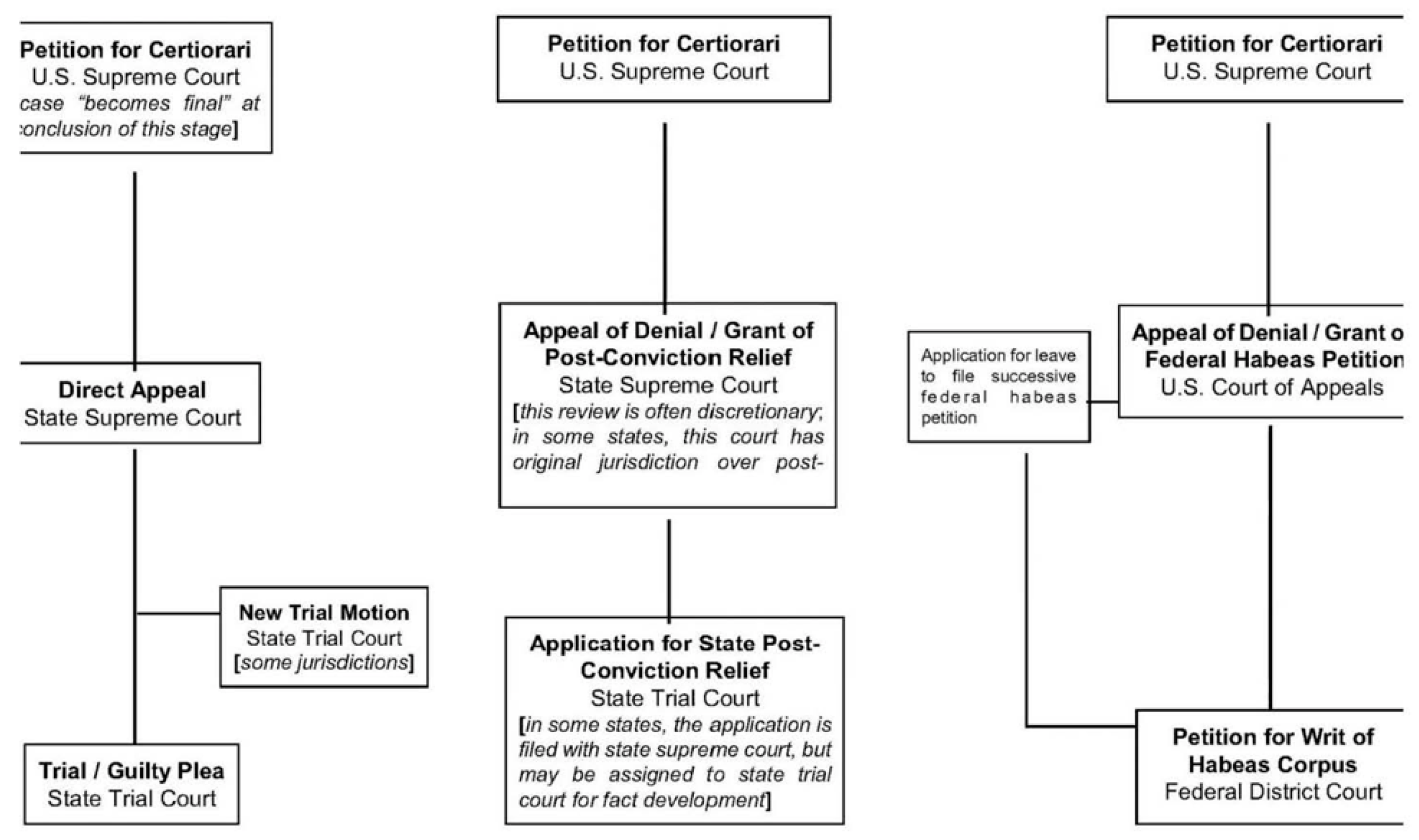
We found that, as Table 7 presents, during the trial phase, among successful Ford-Panetti cases with available mental health evidence data (n = 24, with 4 cases missing data), mental health evidence was presented in 17 cases and absent in 7 cases. During the PCR phase, successful Ford-Panetti cases with available mental health evidence data (n = 19, with 9 cases missing data), mental health evidence was presented in 18 out of 19 cases. During the habeas corpus phase, among successful Ford-Panetti cases with available mental health evidence data (n = 26, with 2 cases missing data), mental health evidence was presented during the habeas corpus phase in all 26 cases.
3.5.2. Malingering
Next, we examine the issue of malingering in the successful Ford-Panetti claims, as malingering is traditionally a central concern in cases involving mental health evidence. In the present study, among the successful Ford-Panetti claims with available malingering data (n = 21, with 7 cases missing data), in six of them, at least one expert, generally an expert retrained by the prosecution, raised directly or indirectly the possibility of malingering. In comparison, the remaining 15 cases did not include any records of issues of malingering.
3.5.3. Competence Litation Histories
Next, we explored whether the successful Ford-Panetti claimants had a history of competency litigation in prior proceedings and, if so, the outcomes of those cases. Among the various types of criminal competencies, we focused on competency to stand trial (CST)4. Defined by the landmark Supreme Court case Dusky v. United States (1960) as the “sufficient present ability to consult with his lawyer with a reasonable degree of rational understanding,” CST remains the most commonly conducted competency evaluation in the United States today (Pirelli et al., 2011; Murrie et al., 2023).
In the present study, among the successful Ford-Panetti claimants with available CST information (n = 23; 5 cases with missing data), 18 claimants were deemed competent to stand trial at least once, while three claimants were deemed incompetent at least once. Two cases demonstrated a shift in competency status: one individual was initially deemed competent but later retroactively found incompetent, while another was first deemed incompetent but subsequently found competent. Notably, in one case where the individual was deemed competent to stand trial, this determination followed a second attempt, as the first resulted in a mistrial.
3.5.4. CFE Evaluation
We now focus on the outcomes and specific evaluation details of the CFE process itself. Among the 28 successful Ford-Panetti claimants, all were declared incompetent for execution at least once. Notably, five claimants were initially deemed competent but later found incompetent, while one was initially deemed incompetent but subsequently declared competent.
Next, we examine the mental health professionals involved in the CFE evaluations for the successful Ford-Panetti claimants. In 23 cases, more than two types of mental health professionals participated in the evaluations. The breakdown, as shown in Table 8, is as follows: psychiatrists (22 cases), psychologists (17 cases), neurologists (2 cases), general practitioners (1 case), counselors (1 case), state hospital personnel (1 case), and social workers (1 case).
4. Discussion
Several observations emerged after closely reviewing the successful Ford-Panetti claimants and their cases. Here we present the case background data, followed by observations on our four main questions: “Who” are the successful Ford-Panetti claimants and their victims, and “What” are the claimants’ mental illnesses, as well as what litigation and legal activities were involved in the Ford-Panetti claims and their prior proceedings.
4.1. Case Background
An examination of the temporal and geographical influences on the successful Ford-Panetti cases reveals some notable trends. Regarding temporal influence, Table 2 and Figure 1 and Figure 2 show that older cases tend to have a higher number of individuals deemed incompetent. One primary speculation for this trend may relate to the death row syndrome (Harrison & Tamony, 2010), which suggests that prolonged incarceration on death row increases the likelihood of manifesting or worsening the claimants’ mental status. As a result, senior death row inmates, who have spent more time under these conditions, may be more frequently deemed incompetent for execution. Note that all claimants had spent over 30 years on death row, which suggests that inmates incarcerated in the 21st century may be increasingly prone to developing or worsening mental statuses, leading to CFE-related issues in their cases. If this trend persists, we anticipate a rise in Ford-Panetti claims among individuals incarcerated after 2000, particularly in the coming decade.
Regarding geographical influence, our initial observation aligns with previous literature (Blume et al., 2014), revealing that the number of successful Ford-Panetti cases is low across all states. As a result, a floor effect may limit the potential for meaningful cross-state comparisons. However, to our surprise, we observed notable variation in the rate of successful Ford-Panetti claims across states when comparing these claims to the number of death row inmates and executions in each state. While we have yet to identify the reasons for these discrepancies, future research needs to investigate the underlying causes and consider whether unifying CFE standards might be an appropriate approach to address these state variations in terms of the vague guidelines offered by the Supreme Court. Additionally, we speculate that the number and ratio of successful Ford-Panetti cases at the state level may not fully capture the extent of severely mentally ill death row inmates in each state, raising the question of what that actual number might be.
4.2. The First “Who” Question: Profiles of Successful Ford-Panetti Claimants
Demographically, the successful Ford-Panetti claimants present a significantly different picture compared to the general death row population, with the most notable differences being age, race, and education. In terms of age, as shown in Table 9 and Figure 7, the successful Ford-Panetti claimants is significantly older than the typical death row inmate, z =5.94, p < .001, with a mean age of nearly 65. Of these, 96% are 50 or older, and 76% are 60 or older. In contrast, national data indicates that the average age of death row inmates is 51, with 60.3% aged 50 or older and 26.5% aged 60 or older (Bureau of Justice Statistics, 2023).
In terms of race, as shown in Table 10 and Figure 8, the racial composition of successful Ford-Panetti claimants differs significantly from that of the general death row population (National Association for the Advancement of Colored People [NAACP], 2022), z = 5.54, p < .001. Specifically, the proportion of successful Black Ford-Panetti claimants (42.9%) closely mirrors that of the general Black death row population (41.0%). Native American claimants (3.6%) are overrepresented compared to the general Native American death row population (1.0%). Conversely, White (35.7%) and Latinx (7.1%) successful Ford-Panetti claimants are underrepresented relative to the general White (42.3%) and Latinx (13.8%) death row populations.
This finding aligns with Blume et al. (2014), who reported that Black Ford-Panetti claimants constitute a significantly larger proportion of those deemed incompetent for execution compared to their White and Latinx counterparts. Similarly, the present study identified a pattern of underrepresentation among White and Latinx claimants.
As shown in Table 11 and Figure 9, successful Ford-Panetti claimants exhibit lower but not significantly different levels of educational attainment compared to the broader death row population. Although the high proportion of missing data limits definitive conclusions, the available evidence reveals notable disparities: none of the successful Ford-Panetti claimants have completed a college degree, and a higher proportion have only completed elementary education. In contrast, among the general death row population in the United States, 9.2% have completed a college degree, and 11.7% have completed only an elementary education, with a median education level of 12th grade (Bureau of Justice Statistics, 2023).
For other demographic characteristics, no particularly surprising findings emerged. Regarding gender, the entirely male group of successful Ford-Panetti claimants mirrors the gender distribution of the death row population, where 97.9% of inmates are male (Bureau of Justice Statistics, 2023). It is worth noting, however, that there have been female Ford-Panetti claimants. Unfortunately, all their claims were unsuccessful, resulting in no female individuals being recognized incompetent for execution to date.
In terms of employment, at least half of the successful Ford-Panetti claimants were employed—full-time or part-time—at the time of the offense. Although national data on the employment records of death row inmates is unavailable for baseline comparison, this finding aligns with previous research suggesting that while employment is often considered a protective factor against crime, it does not necessarily prevent the commission of severe offenses (Lee, 2019).
In terms of prior criminal records, over half of the successful Ford-Panetti claimants had previous criminal convictions. This pattern mimics the broader death row population, where over half of inmates have prior criminal records (Bureau of Justice Statistics, 2023).
Tentatively, in addressing the first “who” question, we observed that successful Ford-Panetti claimants tend to be significantly older, disproportionately less likely to be White or Latinx, and, while they do not exhibit significantly lower levels of education, there appears to be a trend toward lower educational attainment compared to the general death row population in the United States.
4.3. The Second “Who” Question: Profiles of the Victim and Claimant-Victim Relationship
Next, we address the second “who” question: the demographics of the victims in the successful Ford-Panetti cases and the dynamics of the claimant-victim relationship. To preview, our findings present a strikingly different profile of these victims compared to the national samples of victims of homicide in the United States.
Demographically, we examined the number, gender, race, and age of the victims, all of which differ significantly from national patterns and common misconceptions. Regarding the number of victims, as in Table 12 and Figure 10, 46% of successful Ford-Panetti cases involved a single victim, while 54% involved multiple victims. This distribution differs significantly from the national homicide trend (86.6% single-victim cases vs. 13.4% multiple-victim cases, Federal Bureau of Investigation, FBI, 2024, z = 8.63, p < .001, highlighting the higher proportion of multiple-victim cases in successful Ford-Panetti cases. Notably, none of the multiple-victim cases involved indiscriminate violence, such as random mass murders or serial killings. The most concerning case, involving 14 victims and reflecting the pattern of multiple-victim cases in successful Ford-Panetti cases, was primarily directed at the claimant’s family members, including his own children, rather than being a random or indiscriminate attack.
The gender distribution of victims differs significantly between successful Ford-Panetti cases and national homicide data (Table 13 and Figure 11). In successful Ford-Panetti cases, 42% of victims were female and 58% male, compared to 22% female and 78% male in national data (FBI, 2024), indicating a significantly higher proportion of female victims, z = 5.21, p < .0015.
Regarding the race of the victims, Table 14 and Figure 12 reveal statistically significant differences between the successful Ford-Panetti cases and national homicide data. Our analyses revealed a significantly different distribution of victim race in successful Ford-Panetti cases (z =16.39, p <.001), characterized by a much lower proportion of Black victims and a notably higher proportion of Non-Black/White victims and victims of unknown race6. Specifically, in the successful Ford-Panetti cases, the racial composition of victims was as follows: 5% Black, 43% White, 27% Non-Black/White, and 25% Unknown. In contrast, the national homicide data reported 41.2% Black, 52.4% White, 3.3% Non-Black/White, and 3.1% Unknown (FBI, 2024).
When examining the victims’ ages, after excluding cases with unknown data, we found a significant difference from the national pattern (FBI, 2024) (z = 14.58, p < .001). As shown in Table 15 and Figure 13, the victims of successful Ford-Panetti claimants include a much higher proportion of child victims under the age of 12, half of whom are the claimants’ family members, and a substantially lower proportion of adult victims over the age of 18.
Similarly, when examining the claimant-victim relationship by race, we found that contrary to national trends (FBI, 2019), intraracial homicide—typically the majority of homicide cases nationwide—was less prevalent among the successful Ford-Panetti cases. As Table 16 shows, while national data indicate that same-race homicides account for 79% of White victim deaths (White-on-White homicides) and 89% of Black victim deaths (Black-on-Black homicides), in the present study, the pattern was almost reversed, with 32% of cases involving intraracial offenses and 77% of cases involving transracial offenses.
In the same vein, as shown in Table 17 and Figure 14, we examined the claimant-victim relationship in terms of their prior connection, identifying a significant difference from the national data (excluding cases with unknown data) (FBI, 2024), z = 7.72, p < .001. In the present study, a much higher proportion of victims were killed by family members or strangers.
We further examined the claimant-victim relationship by considering their prior relationship and the gender of the victims. Compared to the national data (excluding cases with unknown data) (Bureau of Justice Statistics, 2021), as shown in Table 18, the findings reveal significantly different patterns between the present study and the national trend: z = 3.67, p < .05 for female victims, and z = 5.80, p < .001 for male victims. In the present study, the proportion of female victims murdered by family members is much lower than in the national sample, while the proportions murdered by non-family, non-strangers, and strangers are much higher. Conversely, the proportion of male victims murdered by family members or strangers is higher than in the national sample, whereas the proportions murdered by non-family, non-strangers are much lower.
Taking all these findings into account, we observed that, in almost all aspects examined, the victims in successful Ford-Panetti cases differ significantly from those in general homicide cases in the United States. First, these cases involve more multiple-victim incidents, resulting in a higher average number of deaths per case and indicating more severe consequences compared to general homicides. Furthermore, when considering the demographics of gender, race, and age of the victims, as well as prior relationships between the claimants and victims, a distinct pattern emerges.
General homicides involving male victims are predominantly characterized by young adult intraracial male-on-male violence among people of color, often firearm-related and linked to gang activity. Female victims of homicide (femicide) are frequently the result of domestic violence or sex-crime-related incidents; this pattern is not observed in these cases. To the best of our knowledge, while many cases in the present study involving male victims were associated with violent crimes, none were related to gang-based violence. Instead, the crimes were predominantly individual-based, with many cases not being crime-related. Male victims, in contrast, were more likely to be killed by family members and strangers. Similarly, in cases involving female victims, there were no instances of domestic violence or sexual crime-related deaths, indicating that the female victims in these cases do not fit the typical profile of femicide because non-family members and strangers caused more deaths.
When considering the age of the victims in successful Ford-Panetti cases, there is a higher proportion of child victims under 12. In over half of the child victim instances, the victims are the claimants’ children or family members. Regarding prior relationships, sadly, the claimants killed a disproportionately higher number of their family members.
In sum, the victims of successful Ford-Panetti cases present a very different profile compared to general homicide cases in the United States. The non-gang-related, non-sex crime or domestic violence-related nature of the homicide, the higher number of multiple-homicide, as well as family members and child victims, and the prevalence of transracial crimes all suggest that the choice of victims may not align with typical patterns of general homicide and may instead be linked to crimes driven by mental illness.
4.4. The First “What” Question: Claimant Mental Illness
After discussing the first “who” questions regarding the profiles of the claimants and victims in successful Ford-Panetti cases, we next considered the first “what” question, namely, their mental health status. Several trends are evident.
First, as Table 19 shows, while all claimants have SMIs, there is an alarmingly high rate of specific SMIs among the successful Ford-Panetti claimants compared to the general prison population, with a notably higher prevalence of schizophrenia (86%) compared to the United States state prison population (2% to 6.5%; Prins, 2014) and the general population’s 12-month prevalence (0.33%) and lifetime prevalence (0.48%) (Simeone et al., 2015), personality disorders (39%) compared to the 21% prevalence in the sentenced male population (Rotter et al., 2002) and 9.1% in the general population (Lenzenweger et al., 2007), as well as intellectual disability (21%) compared to 10% prevalence in the young male prisoners (Herrington, 2009) and 1.65% in the general population (Centers for Disease Control and Prevention [CDC], 2023).
We also found that certain SMIs among the successful Ford-Panetti claimants mirror the general prison population’s prevalence: substance use disorders (29%), which mirrors the prevalence among general male prisoners (30%; Fazel et al., 2017), but is much higher than the general population’s 1-year prevalence (6.6%) and lifetime prevalence (13.2%) (Somers et al., 2004), as well as depressive disorders (29%) mirrors that of the prison population (36.9%) (Bedaso et al., 2020) but is much higher than the general population’s prevalence (8.3%) (NAMH, 2024).
In general, the prevalence of successful Ford-Panetti claimants suffering from SMIs (100%) is markedly higher than the 10%-16.7% prisons or jails (Bureau of Justice Statistics, 2006; Steadman et al., 2009), and 6.0% in the general population (NAMH, 2024). Schizophrenia is the most defining feature among the types of SMIs.
In terms of psychiatric comorbidity, 79% of successful Ford-Panetti claimants have more than one SMI, which is significantly higher than the lifetime prevalence in the general population, where 27.7% have two comorbid conditions, and 17.3% have three (Al-Asadi et al., 2015).
In terms of the onset of mental illness, 79% of the claimants presented evidence of SMIs at the time of their offense. In comparison, 11% presented evidence of SMIs for the first time after the offense and after they were sentenced to death. This is likely true for two reasons: first, some SMI’s are not detected at trial due to ineffective counsel; the second cause is due to prolonged incarceration under harsh circumstances —classic examples of death row syndrome. We believe this contrasts with many death row cases, where individuals are typically not mentally ill at the outset but may develop mental health issues over time due to prolonged incarceration.
In terms of treatment, only about half of the successful Ford-Panetti claimants (57%) have ever received any form of treatment, which is slightly lower than the treatment rate for the general SMI population in the United States (66.7%) (NIMH, 2024). This discrepancy may be attributed to the inadequate mental health resources in prisons, as well as the controversy surrounding restored competency, as many claimants and their defense teams may have strategically refused treatment due to concerns about facing the implications of improved mental status.
In summary, an overview of the successful Ford-Panetti claimants’ mental illnesses reveals an extraordinarily high rate of SMIs and psychiatric comorbidity compared to the prison population and the general population. Most of these claimants exhibit early onset of their mental illnesses at the time of the offense, yet they receive low levels of treatment.
4.5. The Second “What” Question: Litigation and Legal Activities
Now, we turn to the second “what” question regarding the litigation and legal activities involved in the CFE evaluations and the prior proceedings of the successful Ford-Panetti cases, and we observed a few interesting results.
First, not all successful Ford-Panetti cases included mental health evidence throughout the different phases of legal proceedings. Although 61%, 64%, and 93% of the cases included mental health evidence at the trial, PCR, and habeas corpus phases, respectively, it is unclear what factors might explain the rate of absent mental health evidence in these cases. Possible explanations include insufficient awareness/training/resources and ineffective counsel. Before the present study, we suspected that, in most of these cases, issues related to the insanity defense and mental health mitigating factors should have been central to the discussion; however, it turns out that this might not have been the case.
Second, we observed that the suspected malingering rate is not far from the 19% base rate of probable malingering and symptom exaggeration in criminal cases (Mittenberg et al., 2002) or the 18.5% rate found in previous CFE findings (Blume et al., 2014).
Third, we examined whether previous competency challenges were relevant to the CFE evaluations in the successful Ford-Panetti cases. It was found that only 22% of successful Ford-Panetti claimants had been deemed incompetent to stand trial at least once, similar to 23.8% in previous studies (Blume et al., 2014). Given that all 28 of the successful claimants were ultimately deemed incompetent to be executed and that most of their mental illnesses were severe at the time of the trial, there may be a gap between the reality of their mental state and the evaluations.
Regarding the CFE evaluations, we could not identify any involvement of psychiatrists in 21% of the successful Ford-Panetti cases. Since psychiatrists are recognized in all states as the only experts qualified to make definitive judgments regarding mental illness diagnoses, this raises concerns. Another observation is the involvement of a diverse range of professionals in the evaluations, which is promising and suggests a more thorough, interdisciplinary approach.
In summary, several findings were surprising. Contrary to our prediction, mental health evidence was inadequately presented at various stages of the legal proceedings, and there was a low rate of claimants being determined incompetent to stand trial. Furthermore, while we appreciate the interdisciplinary, multi-professional teams conducting CFE evaluations, the absence of psychiatrists in many cases is concerning. These findings highlight a significant gap between the reality of the claimants’ mental status, the evidence presented, and the evaluation outcomes. These issues—such as the lack of psychiatric involvement or potential ineffective counsel—underscore the broader concern of insufficient resources and training for legal-psychology professionals.
5. Conclusions
In conclusion, this descriptive study provides the first comprehensive analysis of successful Ford-Panetti claimants, a small yet significant subset of person on death row deemed incompetent for execution within the U.S. legal system. These individuals, found incompetent for execution, embody the intersection of severe mental illness and the death penalty. Despite being spared execution, their prolonged suffering—often exacerbated by systemic failures—reveals shortcomings within the criminal justice system. The claimants, predominantly severely mentally ill, undereducated, and White and Latinx are underrepresented, have spent an average of over 30 years on death row with minimal access to treatment. Nearly all were diagnosed with schizophrenia, with four out of five experiencing co-occurring SMIs, often with early onset before their offense. Furthermore, many of the crimes committed by these individuals occurred during episodes of mental illness, lacking discernible motives or involving motives that defy rational understanding. The victims of these crimes, frequently family members or children, and the atypical nature of these cases highlight the troubling reality of puzzling dynamics, such as multiple-victims, transracial homicides, non-violent male-on-male homicides, non-sexaul femicides, linked to mental illness.
The study also exposes significant procedural deficiencies, including a lack of mental health evidence in at least a third of cases at trial and PCR phases, with evidence of the person’s severe mental illness only emerging at the habeas corpus stage. Competency to stand trial challenges were frequently denied, and not all cases included psychiatric evaluations at critical stages. These inconsistencies, combined with state-by-state disparities, point to the marginalization of mentally ill individuals within the legal process, raising both ethical and procedural questions.
These findings emphasize the need for systemic reforms to address the unique vulnerabilities of this population. As the aging death row population continues to grow, the deterioration of mental health over time raises ethical and legal concerns regarding the execution of individuals with severe mental illnesses. It is crucial that the legal system implements more robust safeguards, including timely access to mental health treatment and comprehensive evaluations throughout the trial process, to prevent further injustices. The recent advocacy for categorical bans on executing individuals with specific mental illnesses must be part of a broader, more psychiatrically-informed approach to criminal justice.
Finally, this descriptive study is not without limitations. The small sample size of Ford-Panetti claimants restricts the generalizability of our findings, and further research with larger, more diverse samples is essential to validate and expand on these conclusions. Future studies should explore the intersection of mental illness and the death penalty in greater depth, considering broader populations and the systemic factors that contribute to the execution of mentally ill defendants. Additionally, a more nuanced understanding of the ethical and procedural dimensions of these CFE cases could inform reforms that ensure fairness and compassion in legal proceedings.
Ultimately, this research serves as a call for a more compassionate and informed approach to capital punishment, one that prioritizes justice and human dignity. The study of successful competency-to-be-executed cases is a vital step in ensuring that legal decisions consider not only the facts of a crime but also the complex mental health issues at play. Moving forward, it is essential that the criminal justice system recognizes and addresses the unique challenges faced by mentally ill individuals on death row, ensuring that justice is both fair and humane.
Author Contributions
Conceptualization, I.A.S. and J.H.B.; Data Curation, I.A.S. and J.H.B.; Formal Analysis: I.A.S.; Funding Acquisition, I.A.S.; Investigation, I.A.S. and J.H.B.; Methodology, I.A.S., J.H.B., and S.J.C.; Project Administration, I.A.S.; Resources, I.A.S. and J.H.B.; Software, I.A.S.; Supervision, J.H.B., and S.J.C.; Validation, I.A.S. and J.H.B.; Visualization, I.A.S.; Writing – Original Draft, I.A.S.; Writing – Review & Editing, J.H.B. and S.J.C.
Funding
This research was funded by the Grant-in-Aid for Graduate Students MacArthur Award from the American Psychology-Law Society.
Institutional Review Board Statement
This project does not meet the regulatory definition of human subjects research, and, therefore, no IRB approval or exemption is required.
Informed Consent Statement
Not applicable.
Data Availability Statement
The de-identified raw data supporting the conclusions of this article will be made available by the corresponding author upon request.
Acknowledgments
We acknowledge the American Psychology-Law Society for funding this research through the Grant-in-Aid for Graduate Students MacArthur Award. We also thank the individuals who reviewed the cases and our research assistants, particularly Hannah T. Drexler, Noah M. Berg, and Raag Venkat, for their contributions to data collection.
Conflicts of Interest
The authors declare no conflict of interest.
References
- Al-Asadi, A. M.; Klein, B.; Meyer, D. Multiple comorbidities of 21 psychological disorders and relationships with psychosocial variables: A study of the online assessment and diagnostic system within a web-based population. Journal of medical Internet research 2015, 17(3), e55. [Google Scholar] [CrossRef] [PubMed]
- American Psychiatric Association. What is intellectual disability? March 2024. Available online: https://www.psychiatry.org/patients-families/intellectual-disability/what-is-intellectual-disability.
- American Psychiatric Association. What is schizophrenia? March 2024. Available online: https://www.psychiatry.org/patients-families/schizophrenia/what-is-schizophrenia#section_1.
- American Psychiatric Association. What is a substance use disorder? April 2024. Available online: https://www.psychiatry.org/patients-families/addiction-substance-use-disorders/what-is-a-substance-use-disorder.
- American Psychiatric Association. What is mental illness? November 2002. Available online: https://ychiatry.org/patients-families/what-is-mental-illness.
- American Psychiatric Association. What are personality disorders? November 2024. Available online: https://www.psychiatry.org/patients-families/personality-disorders/what-are-personality-disorders.
- 7.Atkins v. Virginia, 536 U.S. 304, 2002.
- Bedaso, A.; Ayalew, M.; Mekonnen, N.; Duko, B. Global estimates of the prevalence of depression among prisoners: A systematic review and meta-analysis. Depression Research and Treatment 2020, 2020(1), 3695209. [Google Scholar] [CrossRef]
- 9.Blume, J. H. Johnson, J.H.S., Ed.; Nine steps of direct and collateral review in the U.S. In Blume. In LAW 4051 Death Penalty in America; Cornell Law School., 2021. [Google Scholar]
- Blume, J. H.; Johnson; Lynn, Sheri; Ensler, K. E. Killing the oblivious: An empirical study of competency to be executed litigation. UMKC Law Review 2014, 82(2), 335–358. [Google Scholar]
- Brodsky, S. L.; Zapf, P. A.; Boccaccini, M. T. The last competency: An examination of legal, ethical, and professional ambiguities regarding evaluations of competence for execution. Journal of Forensic Psychology Practice 2001, 1(2), 1–25. [Google Scholar] [CrossRef]
- Bureau of Justice Statistics. Mental health problems of prison and jail inmates. United States Department of Justice, Office of Justice Programs, Bureau of Justice Statistics. 2006. Available online: https://biblioteca.cejamericas.org/bitstream/handle/2015/2829/Mental_Health_Problems_Prison_Jail_Inmates.pdf?sequence=1&isAllowed=y.
- Bureau of Justice Statistics. Female murder victims and victim-offender relationship, 2021. United States Department of Justice, Office of Justice Programs, Bureau of Justice Statistics. 2021. Available online: https://bjs.ojp.gov/female-murder-victims-and-victim-offender-relationship-2021.
- Bureau of Justice Statistics. Capital punishment, 2021–statistical tables. United States Department of Justice, Office of Justice Programs, Bureau of Justice Statistics. 2023. Available online: https://bjs.ojp.gov/document/cp21st.pdf.
- Ceci, S. J.; Scullin, M.; Kanaya, T. The difficulty of basing death penalty eligibility on IQ cutoff scores for mental retardation. Ethics & Behavior 2003, 13(1), 11–17. [Google Scholar] [CrossRef]
- Centers for Disease Control and Prevention. Diagnosed developmental disabilities in children aged 3–17 years: United States;Centers for Disease Control and Prevention. 2023. Available online: https://www.cdc.gov/nchs/data/databriefs/db473.pdf.
- Dawson, P. A.; Putnal, J. D. Ford v. Wainwright: Eighth Amendment prohibits execution of the insane. Mercer Law Review 1986, 38, 949–968. [Google Scholar]
- Death Penalty Information Center. New resource: Bureau of Justice Statistics Reports 2021 showed 21st consecutive year of death row population decline. 2023. Available online: https://deathpenaltyinfo.org/new-resource-bureau-of-justice-statistics-reports-2021-showed-21st-consecutive-year-of-death-row-population-decline.
- 19.Dusky v. United States, 362 U.S. 402, 1960.
- Fazel, S.; Yoon, I. A.; Hayes, A. J. Substance use disorders in prisoners: an updated systematic review and meta-regression analysis in recently incarcerated men and women. Addiction 2017, 112(10), 1725–1739. [Google Scholar] [CrossRef] [PubMed]
- Federal Bureau of Investigation. Crime in the United States annual reports: Expanded homicide tables. Federal Bureau of Investigation. 2024. Available online: https://cde.ucr.cjis.gov/LATEST/webapp/#.
- Wainwright, Ford v. 1986, 477 U.S. 399.
- French, L. A. Early trauma, substance abuse and crime: A clinical look at violence and the death sentence. Journal of Police and Criminal Psychology 1994, 10(2), 64–67. [Google Scholar] [CrossRef]
- Girgenti, A. A. The intersection of victim race and gender: The “Black Male Victim Effect” and the death penalty. Race and Justice 2015, 5(4), 307–329. [Google Scholar] [CrossRef]
- Gonzales, L.; Kois, L. E.; Chen, C.; López-Aybar, L.; McCullough, B.; McLaughlin, K. J. Reliability of the term “serious mental illness”: A systematic review. Psychiatric Services 2022, 73(11), 1255–1262. [Google Scholar] [CrossRef] [PubMed]
- Harrison, K.; Tamony, A. Death row phenomenon, death row syndrome and their affect on capital cases in the US. Internet Journal of Criminology 1 2010, 1–16. [Google Scholar]
- Hasin, D. S.; O’Brien, C. P.; Auriacombe, M.; Borges, G.; Bucholz, K.; Budney, A.; Compton, W. M.; Crowley, T.; Ling, W.; Petry, N. M.; Schuckit, M.; Grant, B. F. DSM-5 criteria for substance use disorders: Recommendations and rationale. American Journal of Psychiatry 2013, 170(8), 834–851. [Google Scholar] [CrossRef] [PubMed]
- Herrington, V. Assessing the prevalence of intellectual disability among young male prisoners. Journal of Intellectual Disability Research 2009, 53(5), 397–410. [Google Scholar] [CrossRef]
- Holcomb, J. E.; Williams, M. R.; Demuth, S. White female victims and death penalty disparity research. Justice Quarterly 2004, 21(4), 877–902. [Google Scholar] [CrossRef]
- Hritz, A. C.; Johnson, S. L.; Blume, J. H. Death by expert: Cognitive bias in the diagnosis of mild intellectual disability. Law & Psychology Review 2019, 44, 61–90. [Google Scholar]
- Lenzenweger, M. F.; Lane, M. C.; Loranger, A. W.; Kessler, R. C. DSM-IV personality disorders in the National Comorbidity Survey Replication. Biological Psychiatry 2007, 62(6), 553–564. [Google Scholar] [CrossRef]
- Lee, A. W. A time-sensitive analysis of the work-crime relationship for young men. Social Science Research 84 2019, 102327. [Google Scholar] [CrossRef]
- Madison v. Alabama, 586 U.S. ___, 2019.
- McCutcheon, R. A.; Marques, T. R.; Howes, O. D. Schizophrenia—an overview. JAMA Psychiatry 2020, 77(2), 201–210. [Google Scholar] [CrossRef]
- Mittenberg, W.; Patton, C.; Canyock, E. M.; Condit, D. C. Base rates of malingering and symptom exeggeration. Journal of Clinical and Experimental Neuropsychology 2002, 24(8), 1094–1102. [Google Scholar] [CrossRef]
- Moore, G. L., III. Ford v. Wainwright: A Coda in the executioner’s song. Iowa Law Review 1986, 72, 1461–1482. [Google Scholar]
- Murrie, D. C.; Gowensmith, W. N.; Kois, L. E.; Packer, I. K. Evaluations of competence to stand trial are evolving amid a national “competency crisis”. Behavioral Sciences & the Law 2023, 41(5), 310–325. [Google Scholar] [CrossRef]
- National Association for the Advancement of Colored People. Death row U.S.A. 2022. Available online: https://www.naacpldf.org/wp-content/uploads/DRUSAWinter2022.pdf.
- National Institute of Mental Health. Mental illness. U.S. Department of Health and Human Services, National Institutes of Health. September 2024. Available online: https://www.nimh.nih.gov/health/statistics/mental-illness.
- National Institute of Mental Health. Personality disorders. U.S. Department of Health and Human Services, National Institutes of Health. n.d. Available online: https://www.nimh.nih.gov/health/statistics/personality-disorders.
- National Institute of Mental Health. Schizophrenia. U.S. Department of Health and Human Services, National Institutes of Health. n.d. Available online: https://www.nimh.nih.gov/health/statistics/schizophrenia.
- 42.Panetti, v. Quarterman, 551 U.S. 930, 2007.
- Perlin, M. L.; Harmon, T. R. “Insanity is smashing up against my soul”: The Fifth Circuit and competency to be executed cases after Panetti v. Quarterman. University of Louisville Law Review 2021, 60, 557–614. [Google Scholar] [CrossRef]
- Perlin, M. L.; Harmon, T. R.; Geiger, M. “The timeless explosion of fantasy’s dream”: How state courts have ignored the Supreme Court’s decision in Panetti v. Quarterman. American Journal of Law & Medicine 2023, 49(2-3), 205–233. [Google Scholar] [CrossRef]
- Perlin, M. L.; Harmon, T. R.; Kubiniec, H. ’The world of illusion is at my door’: Why Panetti v. Quarterman is a legal mirage. New York Law School Legal Studies Research Paper 2022, 4172316. [Google Scholar] [CrossRef]
- Pirelli, G.; Gottdiener, W. H.; Zapf, P. A. A meta-analytic review of competency to stand trial research. Psychology, Public Policy, and Law 2011, 17(1), 1–53. [Google Scholar] [CrossRef]
- Prins, S. J. Prevalence of mental illnesses in US state prisons: A systematic review. Psychiatric Services 2014, 65(7), 862–872. [Google Scholar] [CrossRef] [PubMed]
- Radelet, M. L. Racial characteristics and the imposition of the death penalty. American Sociological Review 1981, 918–927. [Google Scholar] [CrossRef]
- Radelet, M. L.; Miller, K. S. The aftermath of Ford v. Wainwright. Behavioral Sciences & the Law 1992, 10(3), 339–351. [Google Scholar] [CrossRef]
- Rotter, M.; Way, B.; Steinbacher, M.; Sawyer, D.; Smith, H. Personality disorders in prison: Aren’t they all antisocial? Psychiatric Quarterly 2002, 73, 337–349. [Google Scholar] [CrossRef]
- Royer, C. E.; Hritz, A. C.; Hans, V. P.; Eisenberg, T.; Wells, M. T.; Blume, J. H.; Johnson, S. L. Victim gender and the death penalty. UMKC Law Review 2014, 82, 429–464. [Google Scholar]
- Simeone, J. C.; Ward, A. J.; Rotella, P.; Collins, J.; Windisch, R. An evaluation of variation in published estimates of schizophrenia prevalence from 1990─ 2013: A systematic literature review. BMC Psychiatry 2015, 15, 1–14. [Google Scholar] [CrossRef]
- Slobogin, C. Mental illness and the death penalty. Mental & Physical Disability Law Reporter 2000, 24, 667–682. [Google Scholar]
- Somers, J. M.; Goldner, E. M.; Waraich, P.; Hsu, L. Prevalence studies of substance-related disorders: A systematic review of the literature. The Canadian Journal of Psychiatry 2004, 49(6), 373–384. [Google Scholar] [CrossRef]
- Stanziani, M.; Cox, J.; Bownes, E.; Carden, K. D.; DeMatteo, D. S. Marking the progress of a “maturing” society: Madison v. Alabama and competency for execution evaluations. Psychology, Public Policy, and Law 2020, 26(2), 145–153. [Google Scholar] [CrossRef]
- Steadman, H. J.; Osher, F. C.; Robbins, P. C.; Case, B.; Samuels, S. Prevalence of serious mental illness among jail inmates. Psychiatric Services 2009, 60(6), 761–765. [Google Scholar] [CrossRef]
- Ulmer, J. T.; Kramer, J. H.; Zajac, G. The race of defendants and victims in Pennsylvania death penalty decisions: 2000–2010. Justice Quarterly 2020, 37(5), 955–983. [Google Scholar] [CrossRef]
- Williams, M. R.; Demuth, S.; Holcomb, J. E. Understanding the influence of victim gender in death penalty cases: The importance of victim race, sex-related victimization, and jury decision making. Criminology 2007, 45(4), 865–891. [Google Scholar] [CrossRef]
Figure 1.
Successful Ford-Panetti Cases by Offense Year and Temporal Analysis.
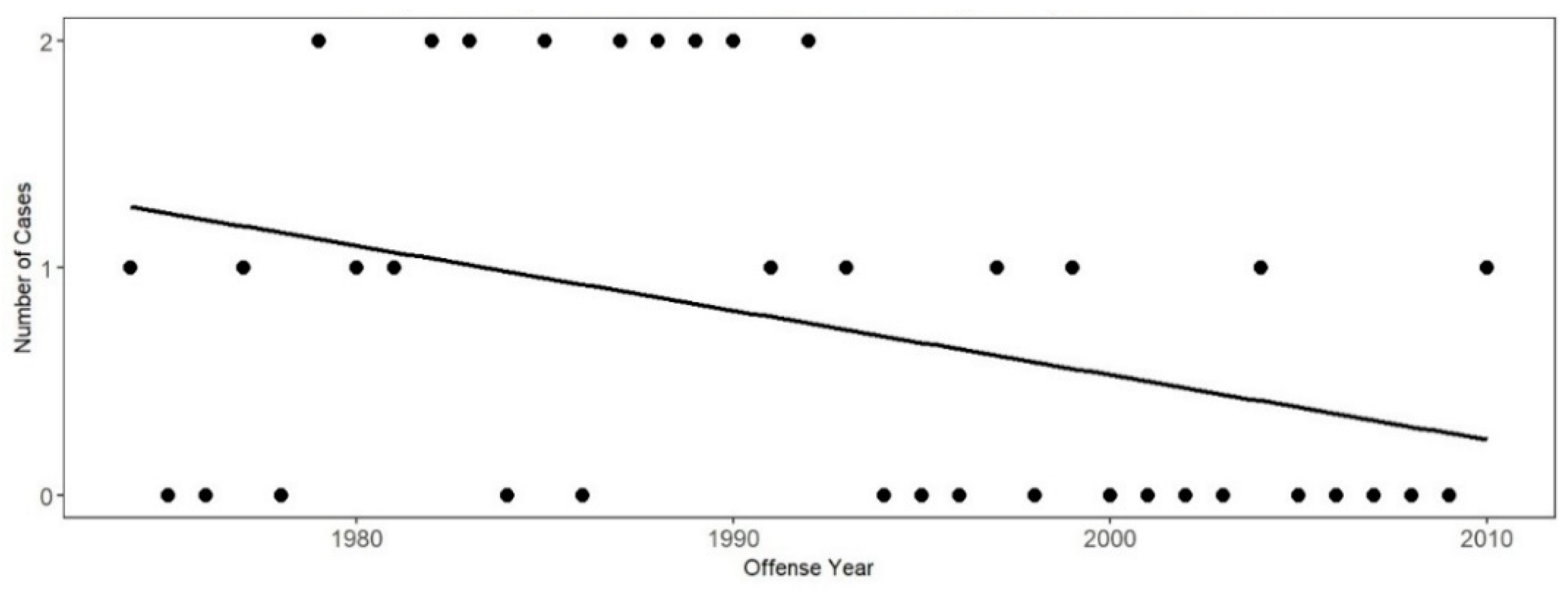
Figure 2.
Successful Ford-Panetti Cases by Offense Year.
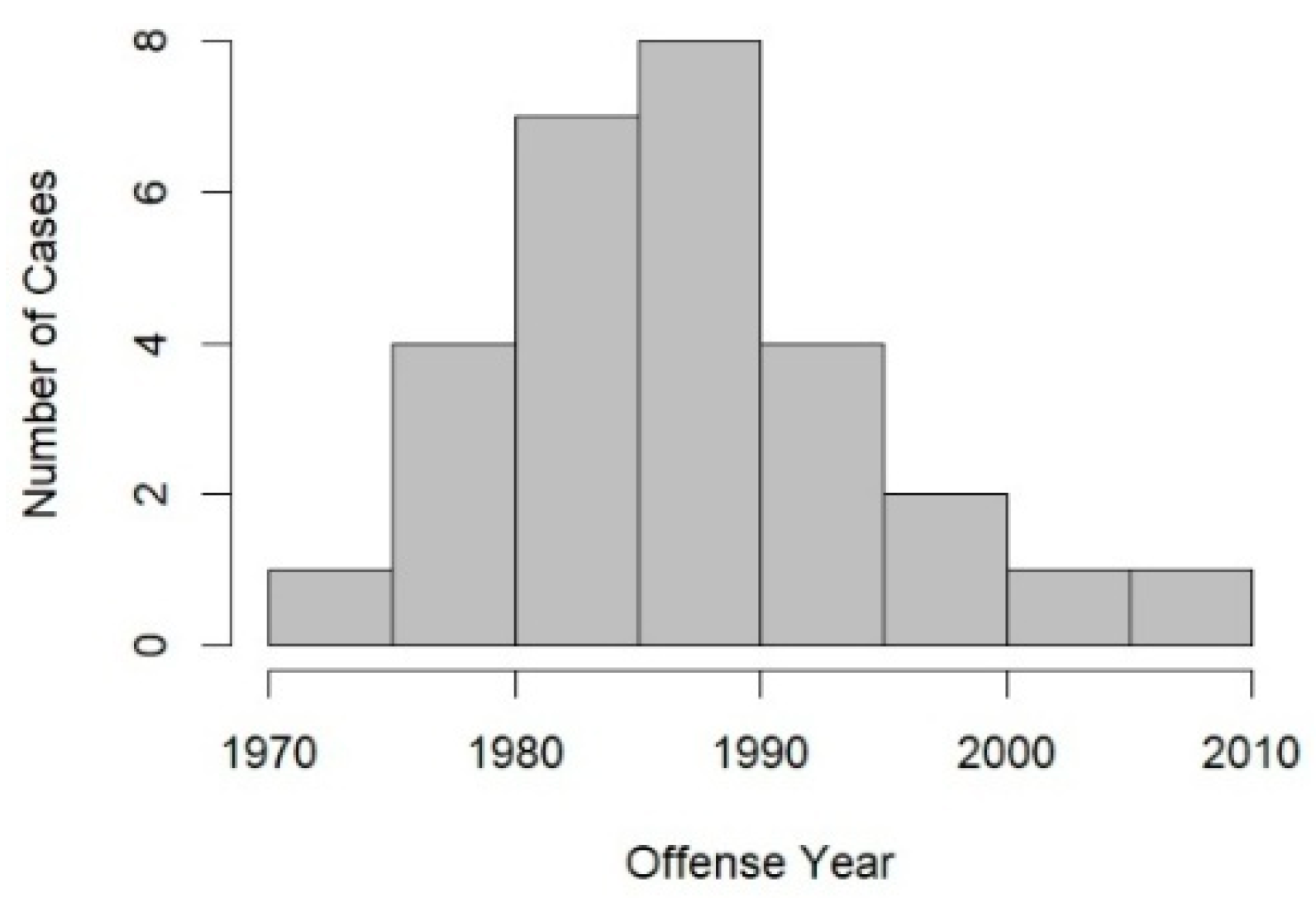
Figure 3.
Successful Ford-Panetti Claimants by Birth Year.
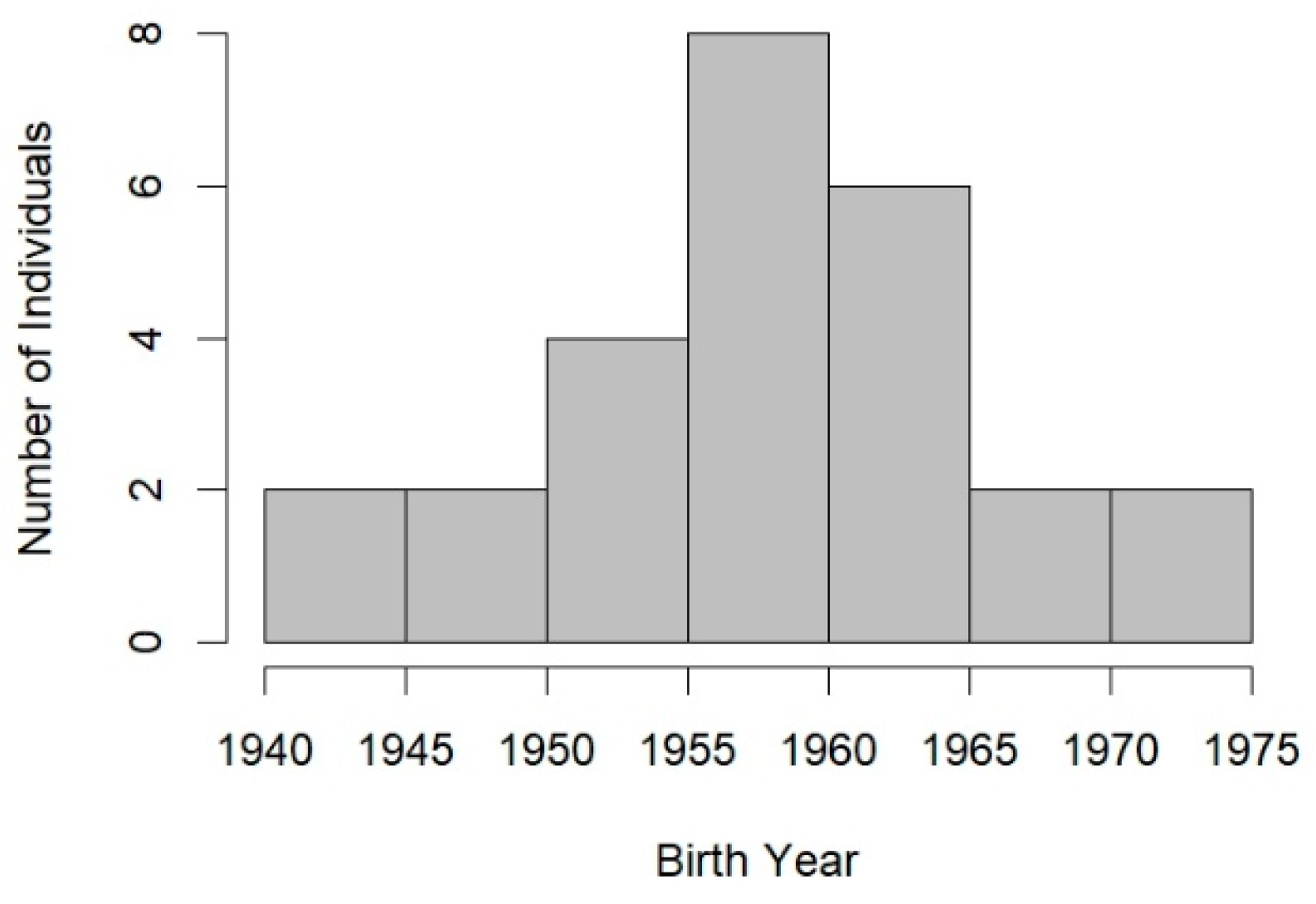
Figure 4.
Successful Ford-Panetti Claimants by Age.
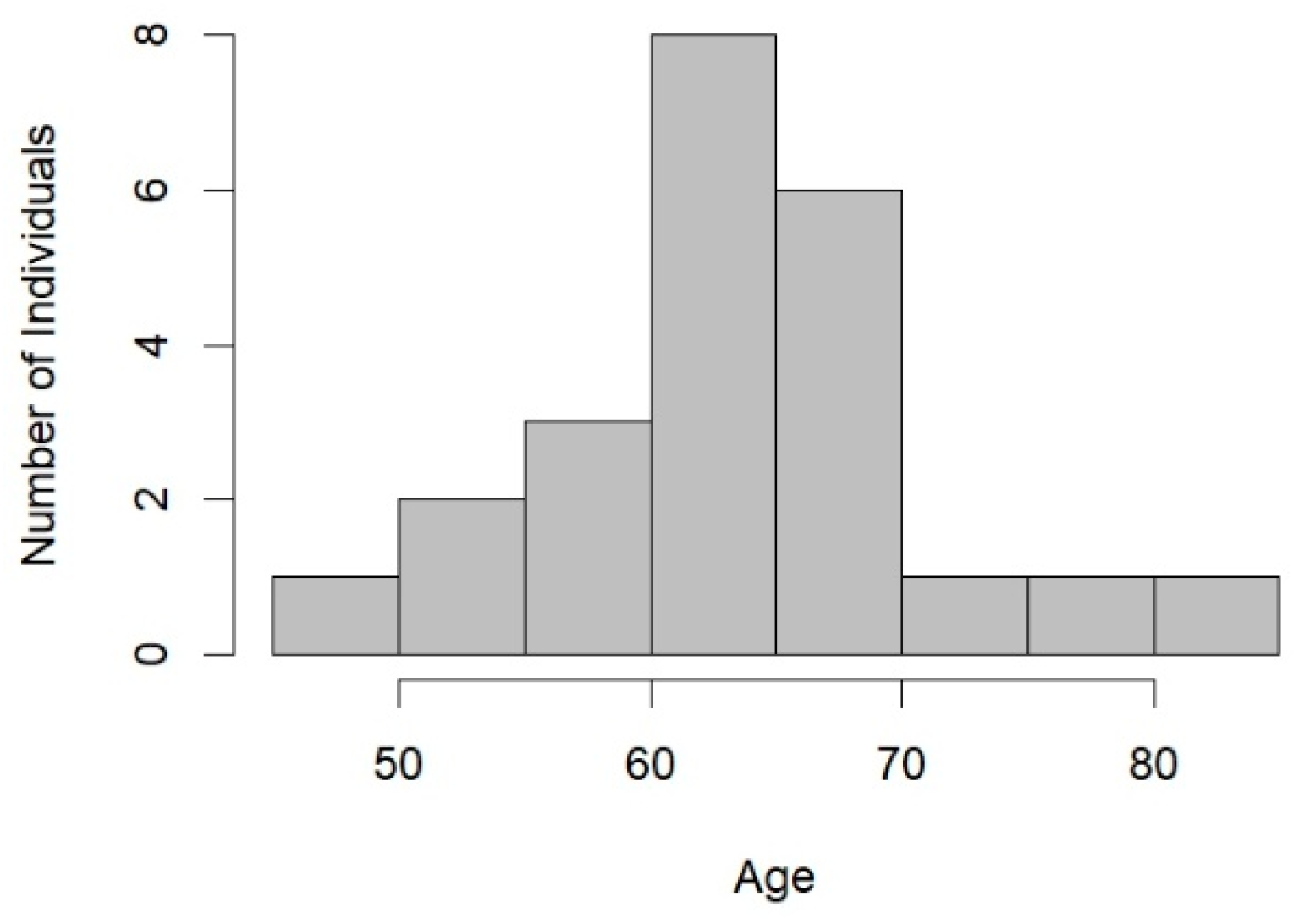
Figure 5.
Victims in Successful Ford-Panetti Cases By Age at the Time of the Offense.
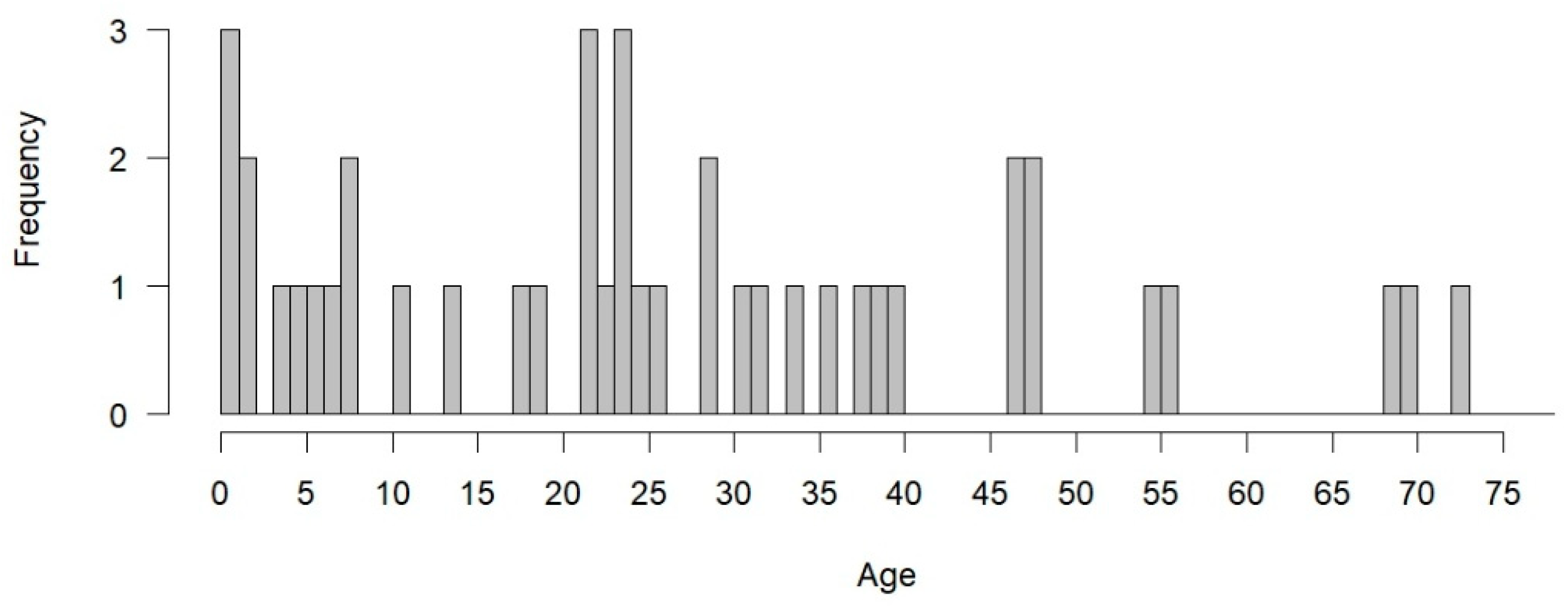
Figure 7.
Successful Ford-Panetti Claimants vs. U.S. Death Row Inmates by Age.
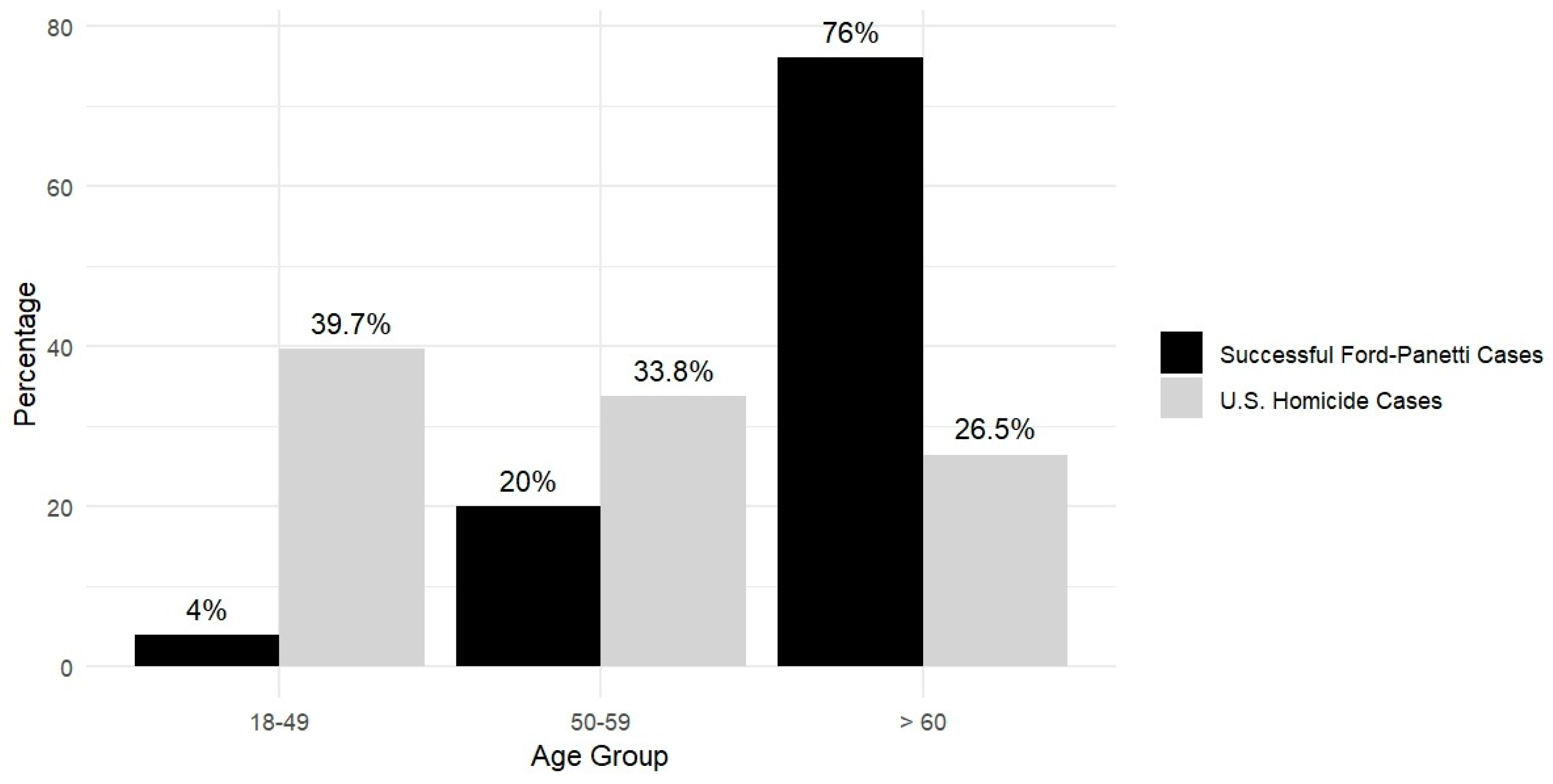
Figure 8.
Successful Ford-Panetti Claimants vs. U.S. Death Row Inmates by Race.
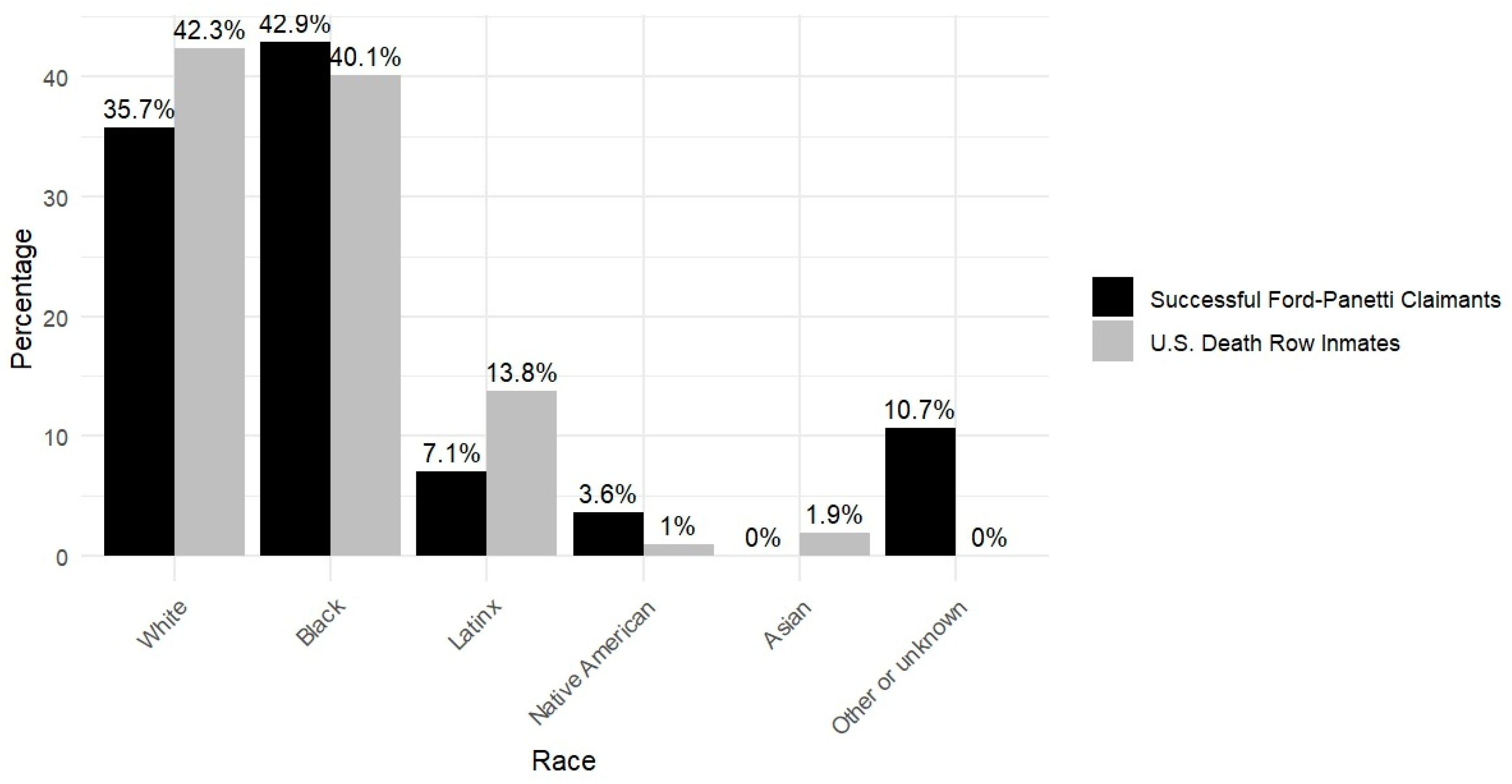
Figure 9.
Successful Ford-Panetti Claimants vs. U.S. Death Row Inmates by Education.
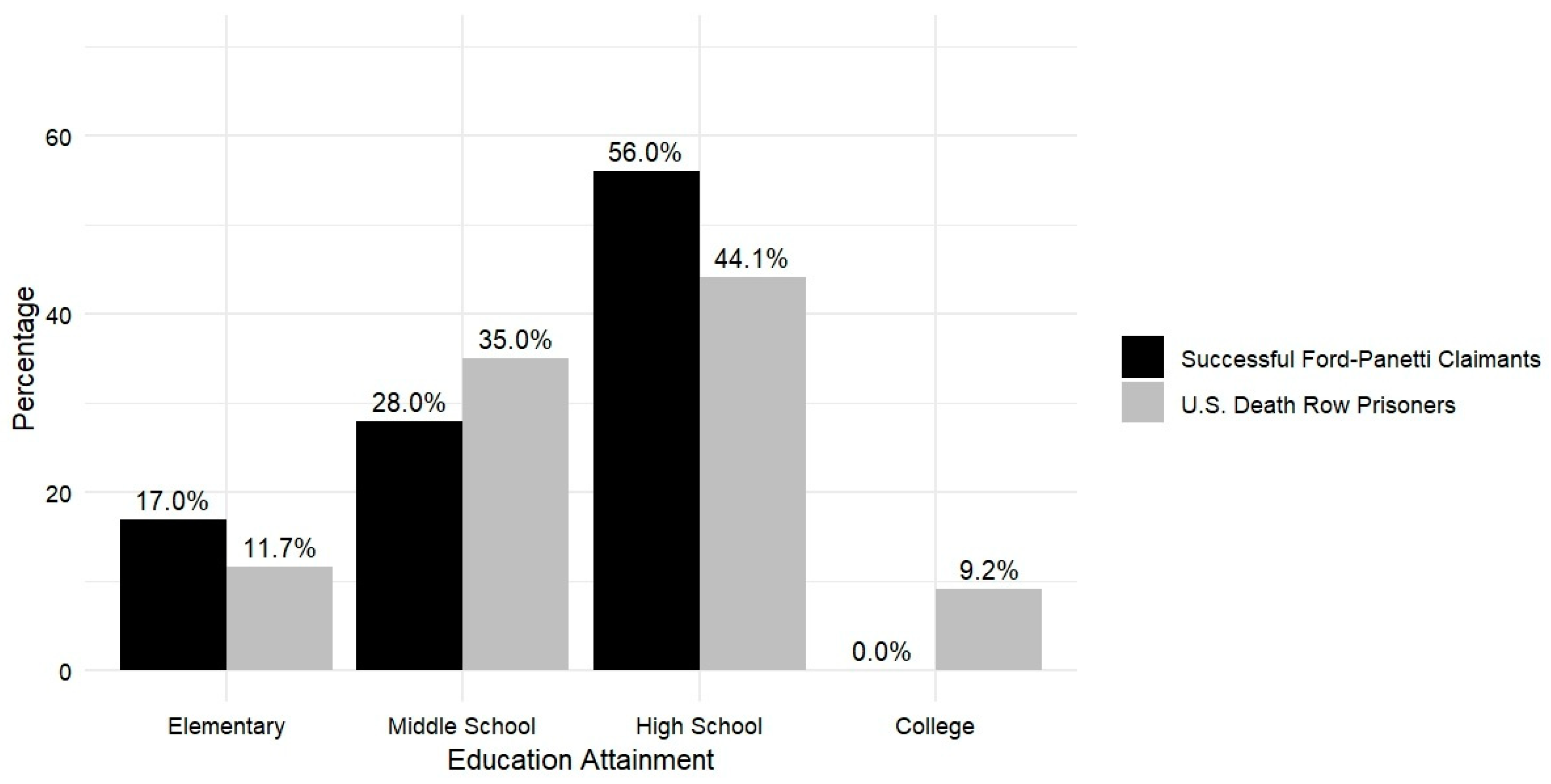
Figure 10.
Victims of Successful Ford-Panetti Cases vs. U.S. Homicide Cases by Number.
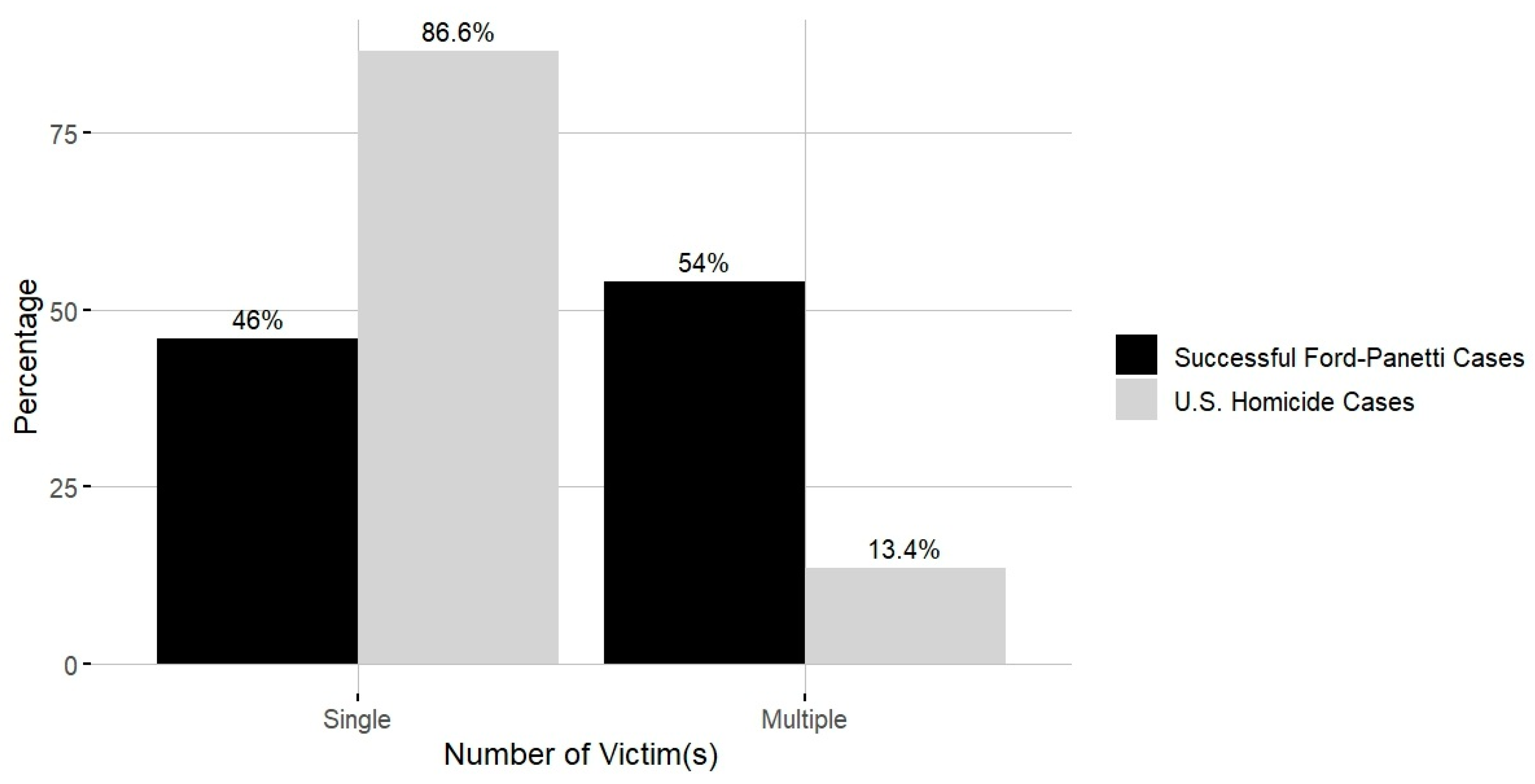
Figure 11.
Victims of Successful Ford-Panetti Cases vs. U.S. Homicide Cases by Gender.
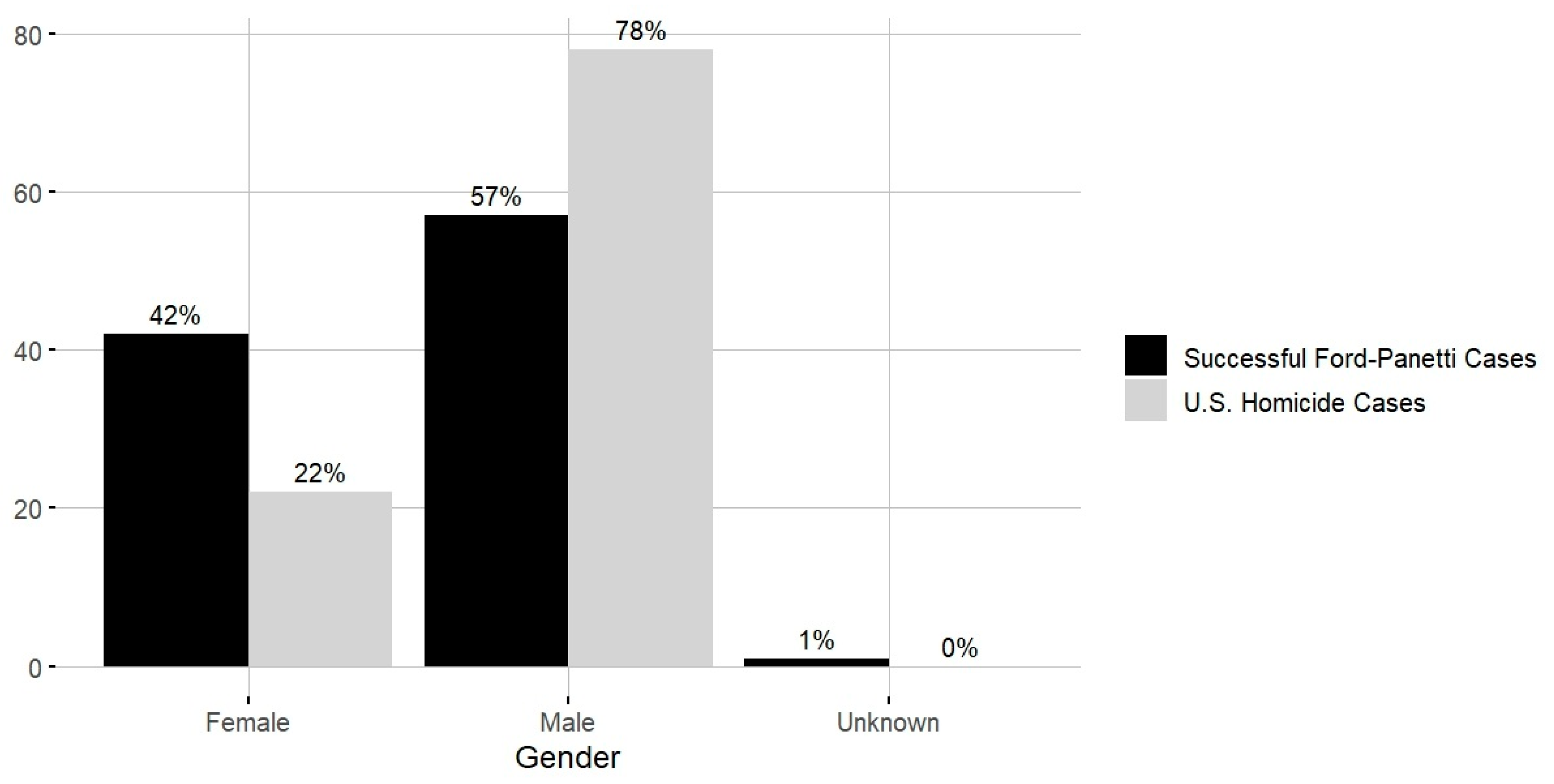
Figure 12.
Victims of Successful Ford-Panetti Cases vs. U.S. Homicide Cases by Race.
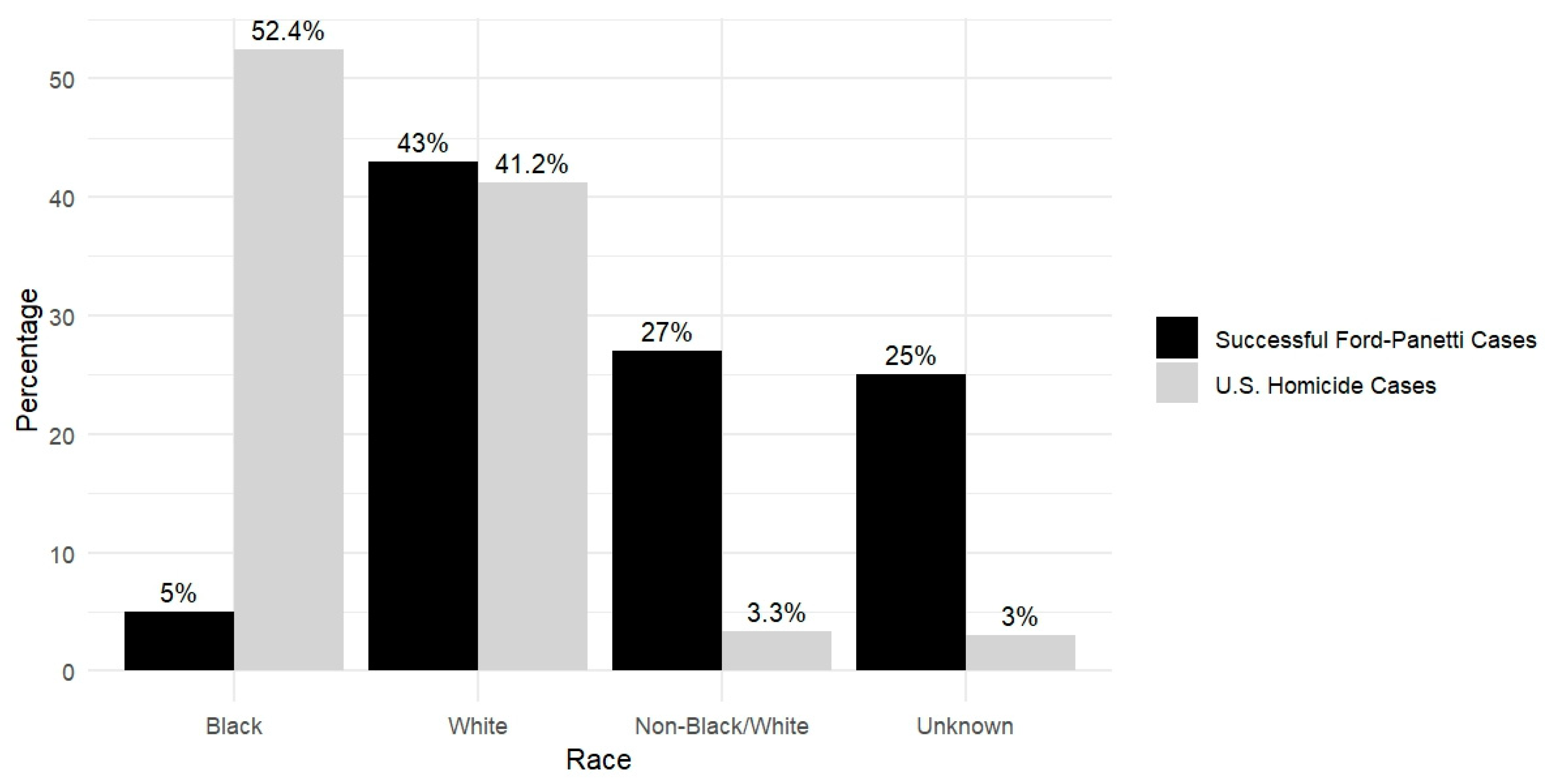
Figure 13.
Victims of Successful Ford-Panetti Cases vs. U.S. Homicide Cases by Age.
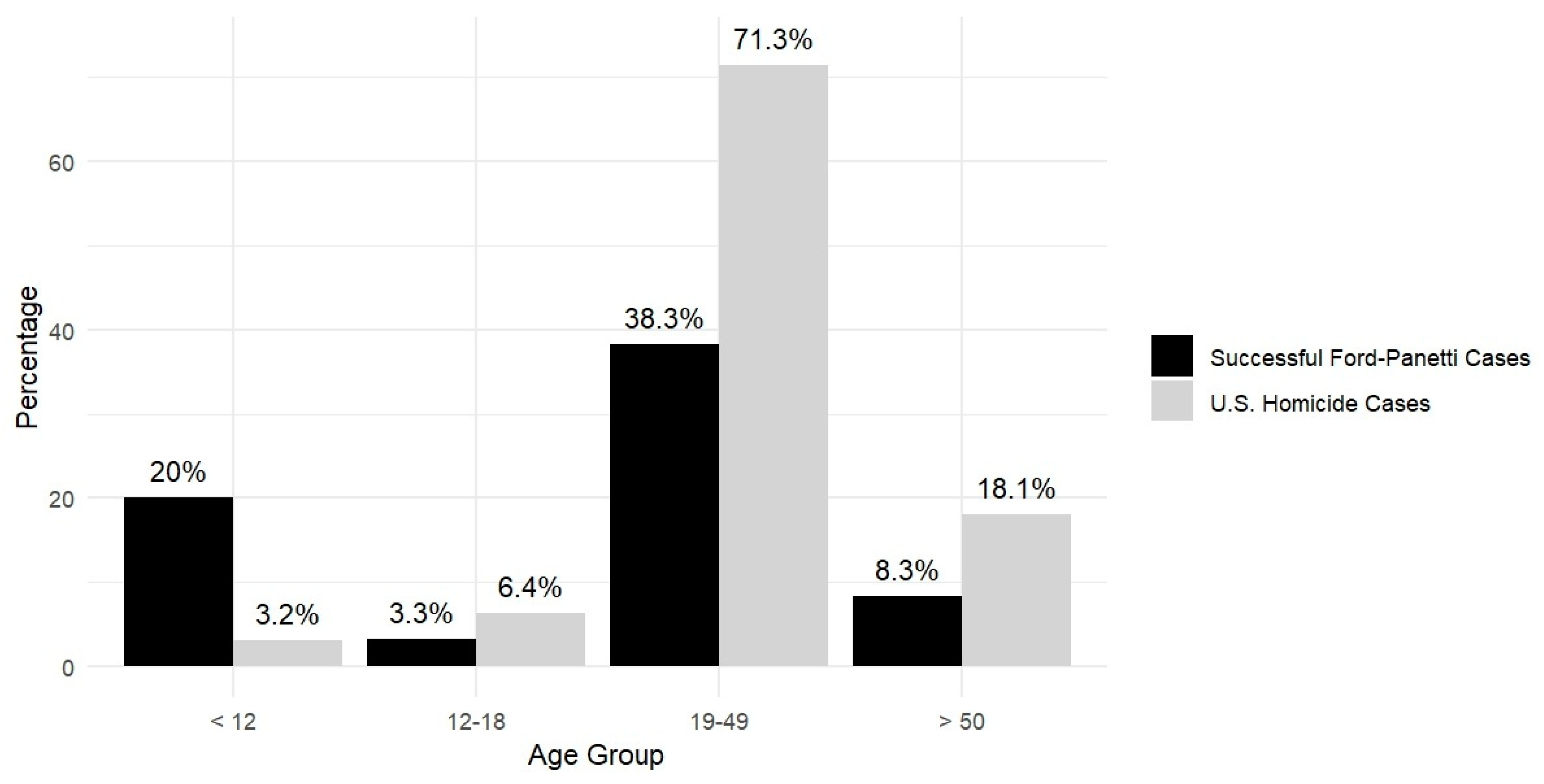
Figure 14.
Offender-Victim Relationship by Prior-Relationship in Successful Ford-Panetti Cases vs. U.S. Homicide Cases.
Figure 14.
Offender-Victim Relationship by Prior-Relationship in Successful Ford-Panetti Cases vs. U.S. Homicide Cases.
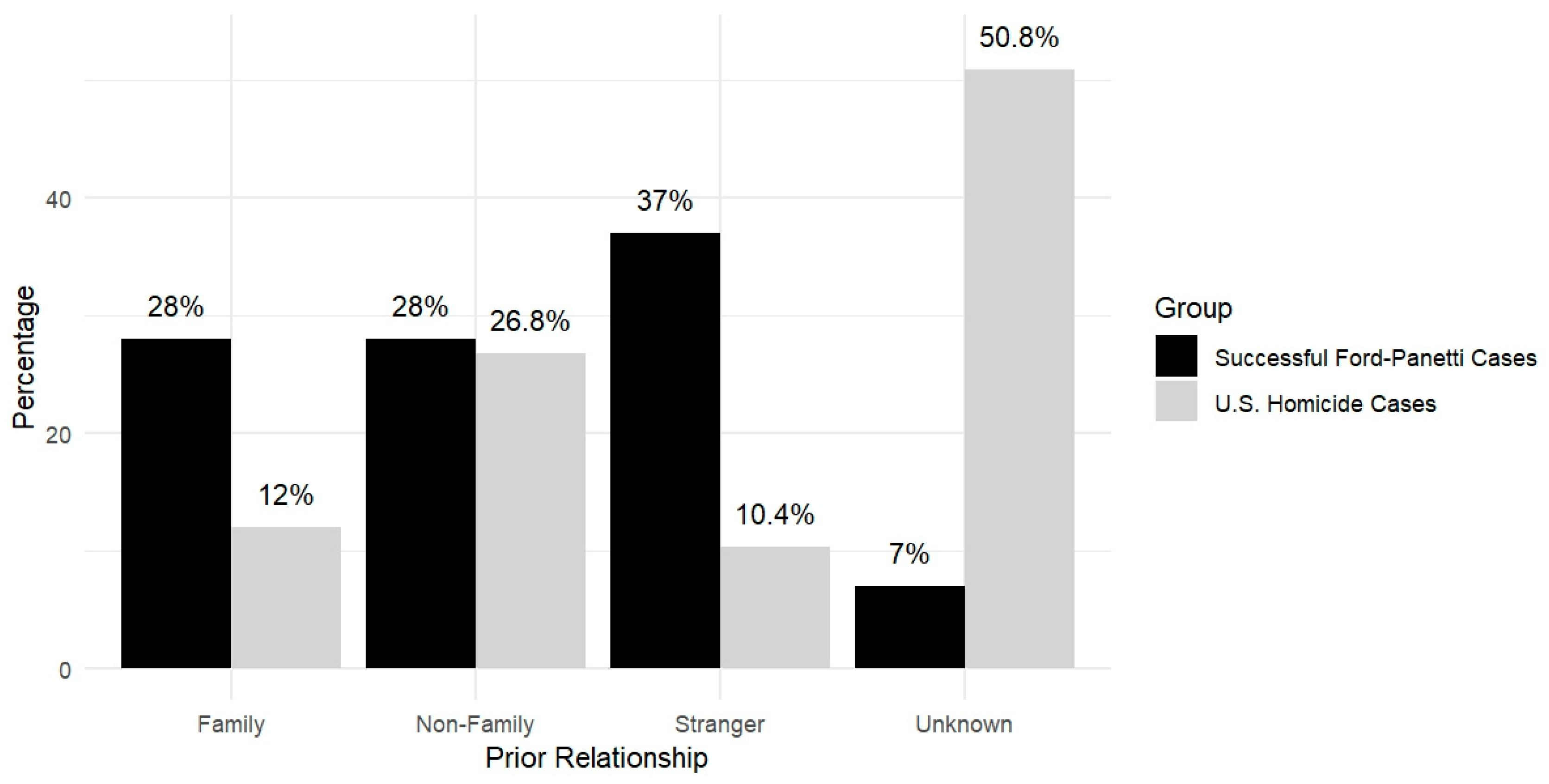

Table 1.
Number of Death-Sentenced Cases, Executions, and Ford-Panetti Claims from 1986 to 2013.
| Case | n |
|---|---|
| Death-Sentenced Cases * | 5724 |
| Executions ** | 1280 |
| Ford Claims | 141 |
| Ford Claims on the Merits | 92 |
| Unsuccessful Ford Claims | 120 |
| Unsuccessful Ford Claims on the Merits | 71 |
| Unsuccessful Ford Claims on the Procedural Grounds | 49 |
| Successful Ford Claims | 21 |
Note. This table is adapted from Blume et al. (2014)’s Table 1. According to the original note: * The number represents the number of death sentences issued from January 1, 1986, through December 31, 2012. This number includes some sentences imposed in 1986 prior to the decision in Ford v. Wainwright on June 26, 1986; however, the available data is not disaggregated by month. ** The number represents the number of executions carried out since the Ford decision through July 28, 2013.
Table 2.
Successful Ford-Panetti Cases by Offense Year.
| Year | n |
|---|---|
| 1974-1980 | 5 |
| 1981-1990 | 15 |
| 1991-2000 | 6 |
| 2001-2010 | 2 |
| 2011-2024 | 0 |
Table 3.
Successful Ford-Panetti Cases by State in States Retaining the Death Penalty.
| State |
n |
State | n | State | n |
|---|---|---|---|---|---|
| Alabama | 0 | Kentucky | 0 | Oregon* | 0 |
| Arizona | 1 | Louisiana | 2 | Oklahoma | 3 |
| Arkansas | 2 | Mississippi | 1 | Pennsylvania* | 2 |
| California* | 1 | Missouri | 1 | South Carolina | 2 |
| Florida | 0 | Montana | 0 | South Dakota | 0 |
| Georgia | 0 | Nebraska | 0 | Tennessee* | 0 |
| Idaho | 2 | Nevada | 0 | Texas | 9 |
| Indiana | 0 | North Carolina | 1 | Utah | 0 |
| Kansas | 0 | Ohio* | 1 | Wyoming | 0 |
Note. * denotes the states that retain the death penalty but have paused executions through executive action.
Table 4.
Comparison of the Number of Successful Ford-Panetti Cases and the Number of Prisoners on Death Row by State in States That Have Ever Ruled Successful Ford-Panetti Claims.
Table 4.
Comparison of the Number of Successful Ford-Panetti Cases and the Number of Prisoners on Death Row by State in States That Have Ever Ruled Successful Ford-Panetti Claims.
| State | Successful Ford-Panetti Casesn | Prisoners on Death Row n |
Ratio of Successful Ford-Panetti Cases to Death Row Inmates % |
|---|---|---|---|
| Arizona | 1 | 114 | 0.9% |
| Arkansas | 2 | 28 | 7.1% |
| California | 1 | 665 | 0.2% |
| Idaho | 2 | 8 | 25.0% |
| Louisiana | 2 | 63 | 3.2% |
| Mississippi | 1 | 36 | 2.8% |
| Missouri | 1 | 18 | 5.6% |
| North Carolina | 1 | 140 | 0.7% |
| Ohio | 1 | 129 | 0.8% |
| Oklahoma | 3 | 40 | 7.5% |
| Pennsylvania | 2 | 123 | 1.6% |
| South Carolina | 2 | 36 | 5.6% |
| Texas | 9 | 192 | 4.7% |
Note. The latest reported data on the number of prisoners on death row across states, sourced from the Death Penalty Information Center (2023), is used as a baseline to illustrate the size of death row populations across states.
Table 5.
Comparison of the Number of Successful Ford-Panetti Cases and the Number of Executions by State in States That Have Ever Ruled Successful Ford-Panetti Claims.
Table 5.
Comparison of the Number of Successful Ford-Panetti Cases and the Number of Executions by State in States That Have Ever Ruled Successful Ford-Panetti Claims.
| State | Successful Ford-Panetti Cases n |
Executions n |
Ratio of Successful Ford-Panetti Cases to Executions % |
|---|---|---|---|
| Arizona | 1 | 40 | 2.5% |
| Arkansas | 2 | 31 | 6.5% |
| California | 1 | 13 | 7.7% |
| Idaho | 2 | 3 | 66.7% |
| Louisiana | 2 | 28 | 7.1% |
| Mississippi | 1 | 23 | 4.3% |
| Missouri | 1 | 99 | 1.0% |
| North Carolina | 1 | 43 | 2.3% |
| Ohio | 1 | 56 | 1.8% |
| Oklahoma | 3 | 124 | 2.4% |
| Pennsylvania | 2 | 3 | 66.7% |
| South Carolina | 2 | 43 | 4.7% |
| Texas | 9 | 587 | 1.5% |
Note. The latest reported data on the number of executions since 1976 across states, sourced from the Death Penalty Information Center (2023), is used as a baseline to illustrate the size of executions across states.
Table 6.
Comorbidity Patterns in Successful Ford-Panetti Cases.
| Case No. | Schizophrenia | Substance Use Disorder | Personality Disorder | Other SMIs |
|---|---|---|---|---|
| 1 | + | - | + | + |
| 2 | + | + | - | + |
| 3 | + | + | - | + |
| 4 | + | + | + | + |
| 5 | + | - | + | + |
| 6 | + | - | - | + |
| 7 | + | + | + | - |
| 8 | + | - | + | + |
| 9 | + | - | + | + |
| 10 | + | - | + | + |
| 11 | + | + | - | + |
| 12 | + | - | + | + |
| 13 | + | + | - | + |
| 14 | + | - | + | + |
| 15 | + | + | - | + |
| 16 | + | - | - | + |
| 17 | + | - | + | - |
| 18 | - | + | - | + |
| 19 | + | - | - | + |
| 20 | + | - | - | + |
| 21 | + | - | - | - |
| 22 | + | - | + | - |
Note. + indicates the presence of an SMI, while - indicates its absence. The case numbers in the table do not convey any specific meaning beyond this, and the case numbers are not relevant to the other tables in this article. Our goal is to present a general trend in the comorbidity patterns without revealing identifiable information.
Table 7.
Successful Ford-Panetti Cases by Mental Health Evidence Presentation Across Phases of Review of Capital Cases.
Table 7.
Successful Ford-Panetti Cases by Mental Health Evidence Presentation Across Phases of Review of Capital Cases.
| Phase | Mental Health Evidence n (%) |
||
|---|---|---|---|
| Present | Absent | Missing Data | |
| Trial | 17 (61%) | 7 (25%) | 4 (14%) |
| Post-Conviction Relief (PCR) | 18 (64%) | 1 (4%) | 9 (32%) |
| Habeas Corpus | 26 (93%) | 0 (0%) | 2 (7%) |
Table 8.
Mental Health Professionals Involved in CFE Evaluations of Successful Ford-Panetti Cases.
| Case No. | Mental Health Professionals | ||
|---|---|---|---|
| Psychiatrists n |
Psychologists n; Details |
Others n; Details |
|
| 1 2 3 4 5 6 7 8 9 10 11 12 13 14 15 16 17 18 19 20 21 22 23 24 25 26 27 28 |
5 2 6 > 1 1 2 - 1 1 1 1 1 1 - > 1 > 1 1 - 1 3 - 1 1 1 1 - 1 - |
- 1 1; Unlicensed 1 1 1 - 1 - - - 2 1 - - > 1 - - 1 1 - - - 1; Forensic Psychologist 1; Clinical Psychologist 1; Psychologist (Ed.D.) 1 - 1 1 |
- - - - - - 1; State Hospital Personnel 1; Social Worker 1; Neurologist - - - - 2; General Practitioners - - 1; Counselor 1; Psychology Expert > 1; Mental Health Professional - 1; Neurologist - - - - - - - |
Note. The case numbers in the table are not intended to convey any specific meaning beyond this context and are irrelevant to the other tables in this article. Our goal is to highlight the general trends in the types of mental health professionals involved in the CFE evaluation process while ensuring that no identifiable information is disclosed.
Table 9.
Successful Ford-Panetti Claimants vs. U.S. Death Row Inmates by Age.
| Age | Successful Ford-Panetti Claimants | U.S. Death Row Prisoners |
|---|---|---|
| 18-49 | 4% | 39.7% |
| 50-59 | 20% | 33.8% |
| 60 or older | 76% | 26.5% |
Table 10.
Successful Ford-Panetti Claimants vs. U.S. Death Row Inmates by Race.
| Race | Successful Ford-Panetti Claimants | U.S. Death Row Prisoners |
|---|---|---|
| White | 35.7% | 42.3% |
| Black | 42.9% | 41.0% |
| Latinx | 7.1% | 13.8% |
| Native American | 3.6% | 1.0% |
| Asian | 0% | 1.9% |
| Other or unknown | 10.7% | 0.0% |
Table 11.
Successful Ford-Panetti Claimants vs. U.S. Death Row Inmates by Education.
| Education Attainment | Successful Ford-Panetti Claimants | U.S. Death Row Prisoners |
|---|---|---|
| Elementary school | 17.0% | 11.7% |
| Middle School | 28.0% | 35.0% |
| High School | 56.0% | 44.1% |
| College | 0.0% | 9.2% |
Table 12.
Victims of Successful Ford-Panetti Cases vs. U.S. Homicide Cases by Number.
| Number of Victim(s) | Successful Ford-Panetti Cases | U.S. Homicide Cases |
|---|---|---|
| Single victim | 46% | 86.6% |
| Multiple victims | 54% | 13.4% |
Table 13.
Victims of Successful Ford-Panetti Cases vs. U.S. Homicide Cases by Gender.
| Gender | Successful Ford-Panetti Cases | U.S. Homicide Cases |
|---|---|---|
| Female | 42% | 22% |
| Male | 57% | 78% |
| Unknown | 1% | 0% |
Table 14.
Victims of Successful Ford-Panetti Cases vs. U.S. Homicide Cases by Race.
| Race | Successful Ford-Panetti Claimants | U.S. Homicide Cases |
|---|---|---|
| Black | 5% | 52.4% |
| White | 43% | 41.2% |
| Non-Black/White | 27% | 3.3% |
| Unknown | 25% | 3.1% |
Table 15.
Victims of Successful Ford-Panetti Cases vs. U.S. Homicide Cases by Age.
| Age Group (in Years) | Successful Ford-Panetti Claimants | U.S. Homicide Cases |
|---|---|---|
| Under 12 | 20% | 3.2% |
| 12-18 | 3.3% | 6.4% |
| 19-49 | 38.3% | 71.3 |
| 50 and older | 8.3% | 18.1 |
| Unknown | 30% | 1.1 |
Table 16.
Offender-Victim Relationship by Race in Successful Ford-Panetti Cases vs. U.S. Homicide Cases: A Focus on Black and White Racial Dynamics.
Table 16.
Offender-Victim Relationship by Race in Successful Ford-Panetti Cases vs. U.S. Homicide Cases: A Focus on Black and White Racial Dynamics.
| Race | Successful Ford-Panetti Cases | U.S. Homicide Cases | ||
|---|---|---|---|---|
| Offender | Victim | |||
| Intraracial | Black | Black | 0% | 89% |
| White | White | 18% | 79% | |
| Transracial | Black | White | 36% | 17% |
| White | Black | 5% | 8% | |
Note. We calculated the ratios using different population numbers. For the present study, we used the total number of available cases with the race of the claimant (offender) and the victim, which amounted to 22 cases. For the U.S. homicide cases, we used the total number of Black deaths to calculate Black-on-Black and White-on-Black homicides, and the total number of White deaths to calculate White-on-White and Black-on-White homicides.
Table 17.
Offender-Victim Relationship by Prior-Relationship in Successful Ford-Panetti Cases vs. U.S. Homicide Cases.
Table 17.
Offender-Victim Relationship by Prior-Relationship in Successful Ford-Panetti Cases vs. U.S. Homicide Cases.
| Prior Relationship | Successful Ford-Panetti Claimants | U.S. Homicide Cases |
|---|---|---|
| Non-Stranger | ||
| Family Member | 28% | 12.0% |
| Non-Family Member | 28% | 26.8% |
| Stranger | 37% | 10.4% |
| Unknown | 7% | 50.8% |
Table 18.
Offender-Victim Relationship by Gender in Successful Ford-Panetti Cases vs. U.S. Homicide Cases.
Table 18.
Offender-Victim Relationship by Gender in Successful Ford-Panetti Cases vs. U.S. Homicide Cases.
| Successful Ford-Panetti Cases | U.S. Homicide Cases | |||
|---|---|---|---|---|
| Victim Gender | ||||
| Female | Male | Female | Male | |
| Non-Stranger | ||||
| Family Member | 28% | 24% | 50% | 16% |
| Non-Family Member | 40% | 18% | 26% | 40% |
| Stranger | 28% | 44% | 12% | 21% |
| Unknown | 4% | 0% | 20% | 33% |
Table 19.
Serious Mental Illness (SMI) in Successful Ford-Panetti Cases Compared to the U.S. Jail/Prison Populations and the General Population.
Table 19.
Serious Mental Illness (SMI) in Successful Ford-Panetti Cases Compared to the U.S. Jail/Prison Populations and the General Population.
| Serious Mental Illness | Successful Ford-Panetti Claimants | U.S. Incarcerated Population | U.S. General Population |
|---|---|---|---|
| Schizophrenia | 86% | 2-6.5% | 0.33-0.48% |
| Personality Disorders | 39% | 21% | 9.1% |
| Intellectual Disability | 21% | 10% | 1.65% |
| Substance Use Disorders | 29% | 30% | 6.6-13.2% |
| Depressive Disorders | 29% | 36.9% | 8.3% |
| Overall SMI | 100% | 10-16.7% | 6% |
| 1 | As mentioned in the Supreme Court cases section, Scott Panetti was once again found incompetent for execution in September 2024, after our analysis had concluded (at the stopping point). If Panetti is included, this would add one additional case to the year 2024. However, in total, only 28 cases are included in the analysis |
| 2 | While operational definitions of SMI vary (Gonzales et al., 2022), they are broadly understood as a “mental, behavioral, or emotional disorder resulting in serious functional impairment that substantially interferes with or limits one or more major life activities” (National Institute of Mental Health [NIMH], 2024). |
| 3 | The neurocognitive disorders encompass cases historically referred to as mild organic brain disorder, organic brain dysfunction, organic brain damage, organic brain syndrome, or brain injury, reflecting changes in diagnostic terminology over time. |
| 4 |
We also examined whether the successful Ford-Panetti claimants filed for other competency challenges, such as competency to plead guilty and competency to waive counsel. Unfortunately, due to a substantial portion of missing data, we could not report meaningful results. However, the following findings emerged:
Competency to Plead Guilty
Among the successful Ford-Panetti claimants, 16 had missing data. Only one individual was ever deemed competent to plead guilty. Notably, in 14 cases, a competency evaluation to plead guilty was not conducted—either because it was not applicable to the case or due to unwillingness.
Competency to Waive Counsel
Of the successful Ford-Panetti claimants, 17 had missing data. Only three individuals were deemed competent to waive counsel, while one case involved a claimant being deemed incompetent to waive counsel on at least two occasions. Additionally, in a subset of seven cases, no competency evaluation to waive counsel was conducted, primarily due to unwillingness.
|
| 5 | Although it is valid to suggest that cases involving female victims are more likely to result in the death penalty (Holcomb et al., 2004; Williams et al., 2007; Royer et al., 2014), which could help explain the difference between the successful Ford-Panetti cases and the national pool of homicide data, it is also important to consider that these cases may present a distinct picture of gendered homicide. Factors such as the presence of sexual victimization, the method of killing, the relationship between the victim and the defendant, and whether the victim had family responsibilities (Royer et al., 2014) may differentiate these cases from other homicide cases, warranting further exploration. |
| 6 | Similar to the previous footnote, although it has long been found that victim race plays a role in the death penalty—particularly with a racial disparity in killings of whites versus blacks, where killings of whites are more likely to result in the death penalty (Radelet, 1981; Holcomb et al., 2004; Ulmer et al., 2020) and, conversely, the 'black male victim effect' (Girgenti, 2015) is associated with being deemed less cruel and less likely to result in the death penalty—our database shows that the number of white victims is similar across the successful Ford-Panetti cases and the national homicide pool. However, there may still be potential differences in the dynamics at play, suggesting that these killings could differ from the national pool of homicide cases. |
Disclaimer/Publisher’s Note: The statements, opinions and data contained in all publications are solely those of the individual author(s) and contributor(s) and not of MDPI and/or the editor(s). MDPI and/or the editor(s) disclaim responsibility for any injury to people or property resulting from any ideas, methods, instructions or products referred to in the content. |
© 2025 by the authors. Licensee MDPI, Basel, Switzerland. This article is an open access article distributed under the terms and conditions of the Creative Commons Attribution (CC BY) license (http://creativecommons.org/licenses/by/4.0/).
Copyright: This open access article is published under a Creative Commons CC BY 4.0 license, which permit the free download, distribution, and reuse, provided that the author and preprint are cited in any reuse.


