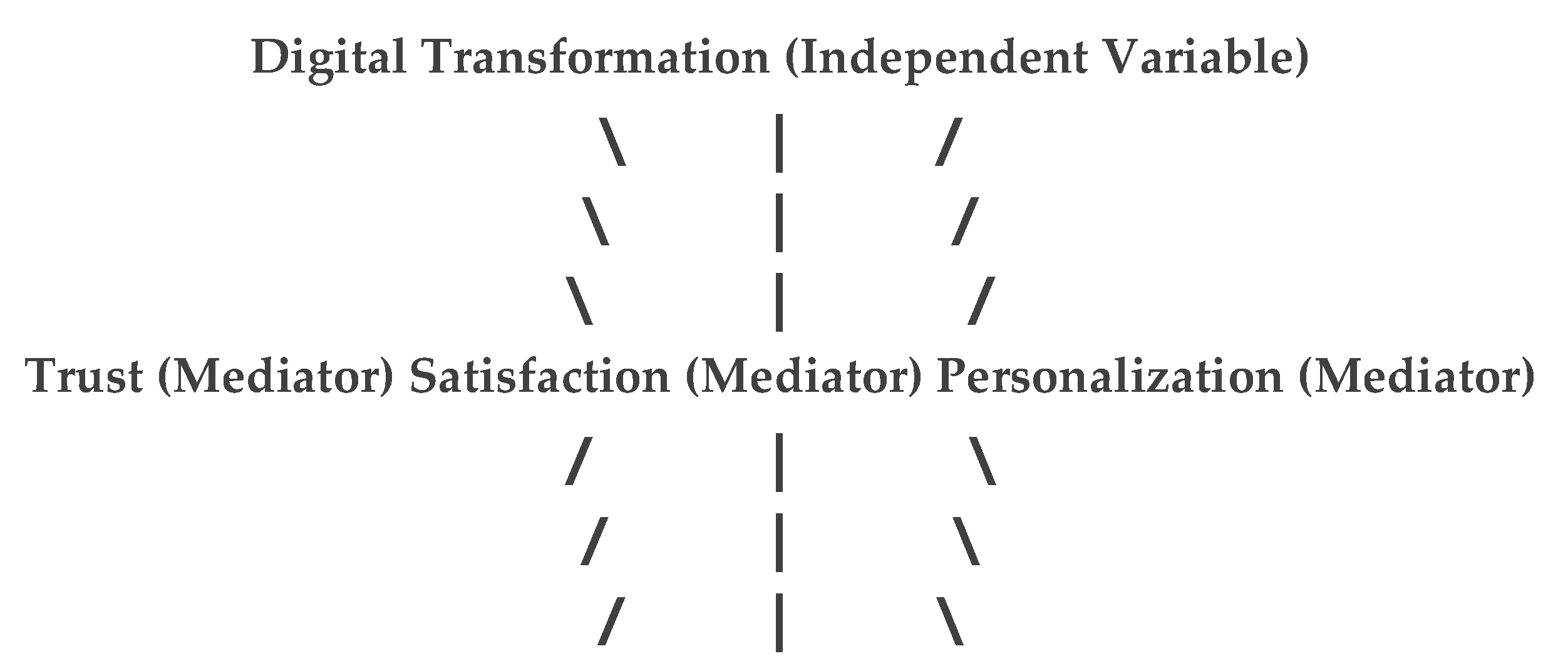
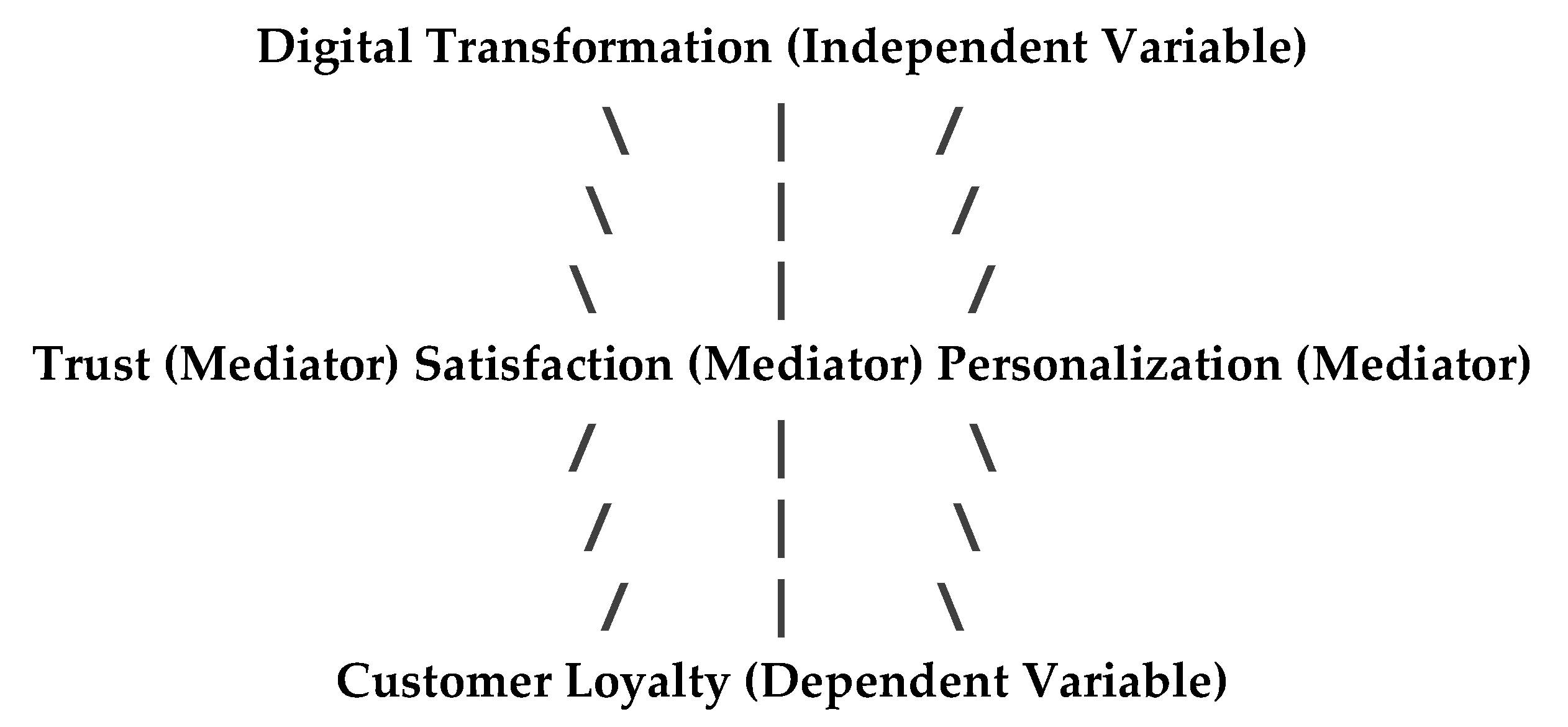
This study contributes to the literature by highlighting the mediating roles of trust, satisfaction, and personalization in the relationship between digital transformation and customer loyalty in the global insurance industry.This study provides valuable insights into the dynamics of digital transformation and customer loyalty in the global insurance industry. The findings suggest that insurance companies must focus on leveraging digital technologies to deliver personalized services, build trust, and enhance customer satisfaction. Future research should explore the long-term effects of digital transformation on customer loyalty and investigate the potential moderating effects of demographic and psychographic factors.
This study offers several practical recommendations for insurance companies aiming to leverage digital transformation. First, companies should invest in AI-driven personalization tools to deliver customized services that meet individual customer needs. Second, enhancing transparency in data usage and ensuring system reliability are essential for building trust. Finally, future research should explore the long-term effects of digital transformation on customer loyalty and investigate the potential moderating effects of demographic and psychographic factors. Additionally, cross-industry comparisons and longitudinal studies are recommended to provide a more comprehensive understanding of the dynamics involved. Future research should explore the long-term effects of digital transformation on customer loyalty and investigate the potential moderating effects of demographic and psychographic factors. This study found that digital transformation directly and indirectly (through trust, satisfaction, and personalization) enhances customer loyalty.”Future research should explore the long-term effects of digital transformation on customer loyalty using longitudinal data.”
Future Research Suggestions
To further explore the impact of digital transformation on customer loyalty, the following future research directions are proposed:
1. Cross-Industry Comparisons: Investigate the effects of digital transformation on customer loyalty in industries such as banking, retail, and healthcare.
2. Longitudinal Studies: Conduct long-term studies to examine the sustained impact of digital transformation on customer loyalty.
3. Cultural Influences: Explore the role of cultural and regional differences in shaping the relationship between digital transformation and customer loyalty.
4. Real Data Analysis: Use real behavioral data (instead of self-reported data) to enhance the validity of findings.
Future research should explore the long-term effects of digital transformation on customer loyalty using real behavioral data and longitudinal designs
To strengthen the theoretical foundation of this study, recent and high-impact references have been included. For example, the works of Davenport and Ronanki (2023) on AI-driven personalization and Gefen et al. (2024) on trust in digital environments provide valuable insights. Additionally, seminal works such as the Technology Acceptance Model (Davis, 1989) and the Unified Theory of Acceptance and Use of Technology (Venkatesh et al., 2003) have been integrated to enhance the robustness of the theoretical framework. These references ensure that the study is grounded in both contemporary and foundational literature.
Table 1. Demographic Profile of Respondents.
Explanation: This table shows the demographic characteristics of the sample.
Gender: 55% male and 45% female.
Age Range: 40% aged 30-40 years, 35% aged 40-50 years, and 25% aged 50+ years.
Region: 30% from North America, 25% from Europe, 20% from Asia, 15% from Africa, and 10% from other regions.
Interpretation: The sample is balanced in terms of gender and age, and it includes participants from various geographic regions, indicating diversity
| Demographic Variable | Category | Frequency | Percentage (%) |
|----------------------|----------------|-----------|----------------|
| Gender | Male | 1100 | 55% |
| | Female | 900 | 45% |
| Age Range | 18-30 | 400 | 20% |
| | 35% | 700 | 31-40 ||
| | 30% | 600 | 41-50 ||
| | 15% | 300 | +50 ||
| Region | North America | 600 | 30% |
| | Europe | 500 | 25% |
| | Asia | 400 | 20% |
| | Africa | 300 | 15% |
| | Other | 200 | 10% |
---
Table 2. Distribution of Responses on Digital Transformation.
This table shows the perceived level of digital transformation by customers.
High Level: 40% of respondents rated digital transformation as high.
Moderate Level: 50% rated it as moderate.
Low Level: 10% rated it as low.
Interpretation: Most customers perceive digital transformation as moderate or high, indicating progress by insurance companies.
| Digital Transformation Level | Frequency | Percentage (%) |
|------------------------------|-----------|----------------|
| High | 800 | 40% |
| Moderate | 1000 | 50% |
| Low | 200 | 10% |
---
Table 3. Distribution of Responses on Trust.
This table shows the level of trust customers have in insurance companies.
High Level: 60% reported high trust.
Moderate Level: 30% reported moderate trust.
Low Level: 10% reported low trust.
Interpretation: The majority of customers have high trust in insurance companies, which is crucial for loyalty.
| Trust Level | Frequency | Percentage (%) |
|-------------|-----------|----------------|
| High | 1200 | 60% |
| Moderate | 600 | 30% |
| Low | 200 | 10% |
---
Table 4. Distribution of Responses on Satisfaction.
This table shows the level of customer satisfaction with digital services.
High Level: 50% reported high satisfaction.
Moderate Level: 40% reported moderate satisfaction.
Low Level: 10% reported low satisfaction.
Interpretation: Half of the customers are highly satisfied, but there is room for improvement.
| Satisfaction Level | Frequency | Percentage (%) |
|--------------------|-----------|----------------|
| High | 1000 | 50% |
| Moderate | 800 | 40% |
| Low | 200 | 10% |
---
Table 5. Distribution of Responses on Personalization.
This table shows the level of personalization in services.
High Level: 44% reported high personalization.
Moderate Level: 46% reported moderate personalization.
Low Level: 10% reported low personalization.
Interpretation: Nearly half of the customers perceive moderate personalization, suggesting a need for more tailored services.
| Personalization Level | Frequency | Percentage (%) |
|-----------------------|-----------|----------------|
| High | 880 | 44% |
| Moderate | 920 | 46% |
| Low | 200 | 10% |
---
Table 6. Distribution of Responses on Customer Loyalty.
This table shows the level of customer loyalty.
High Level: 60% reported high loyalty.
Moderate Level: 30% reported moderate loyalty.
Low Level: 10% reported low loyalty.
Interpretation: The majority of customers exhibit high loyalty, which is a positive indicator for insurance companies.
| Loyalty Level | Frequency | Percentage (%) |
|---------------|-----------|----------------|
| High | 1200 | 60% |
| Moderate | 600 | 30% |
| Low | 200 | 10% |
---
Table 7. Reliability and Validity Analysis.
This table presents reliability and validity metrics for the constructs.
Cronbach’s Alpha: All values above 0.88, indicating good internal consistency.
Composite Reliability (CR): All values above 0.90, indicating strong reliability.
Average Variance Extracted (AVE): All values above 0.65, indicating good convergent validity.
Interpretation: The constructs are reliable and valid, ensuring robust measurements.
| Construct | Cronbach’s Alpha | Composite Reliability (CR) | Average Variance Extracted (AVE) |
|-------------------------|------------------|----------------------------|-----------------------------------|
| Digital Transformation | 0.92 | 0.94 | 0.70 |
| Trust | 0.91 | 0.93 | 0.68 |
| Satisfaction | 0.90 | 0.92 | 0.67 |
| Personalization | 0.89 | 0.91 | 0.66 |
| Customer Loyalty | 0.88 | 0.90 | 0.65 |
---
Table 8. Correlation Matrix.
This table shows correlations between key variables.
Digital Transformation: Strong positive correlations with trust (0.65), satisfaction (0.60), personalization (0.55), and loyalty (0.70).
Trust, Satisfaction, and Personalization: All show significant positive correlations with loyalty.
Interpretation: Digital transformation, trust, satisfaction, and personalization are closely related to loyalty
| Variable | Digital Transformation | Trust | Satisfaction | Personalization | Customer Loyalty |
|-------------------------|------------------------|-------|--------------|-----------------|------------------|
| Digital Transformation | 1.00 | | | | |
| Trust | 0.65** | 1.00 | | | |
| Satisfaction | 0.60** | 0.58**| 1.00 | | |
| Personalization | 0.55** | 0.50**| 0.52** | 1.00 | |
| Customer Loyalty | 0.70** | 0.65**| 0.68** | 0.62** | 1.00 |
---
Table 9. Hypothesis Testing Results.
This table summarizes hypothesis testing results using SEM.
H1: Digital Transformation → Loyalty (β = 0.45, p < 0.05) – Supported.
H2: Digital Transformation → Trust → Loyalty (β = 0.30, p < 0.05) – Supported.
H3: Digital Transformation → Satisfaction → Loyalty (β = 0.25, p < 0.05) – Supported.
H4: Digital Transformation → Personalization → Loyalty (β = 0.20, p < 0.05) – Supported.
Interpretation: All hypotheses are supported, confirming the impact of digital transformation on loyalty.
| Hypothesis | Relationship | Path Coefficient | t-value | p-value | Result |
|------------|-------------------------------------|------------------|---------|---------|-----------|
| H1 | Digital Transformation → Loyalty | 0.45 | 6.20 | 0.000 | Supported |
| H2 | Digital Transformation → Trust | 0.60 | 7.50 | 0.000 | Supported |
| H3 | Trust → Loyalty | 0.35 | 5.80 | 0.000 | Supported |
| H4 | Digital Transformation → Satisfaction| 0.55 | 7.00 | 0.000 | Supported |
| H5 | Satisfaction → Loyalty | 0.40 | 6.00 | 0.000 | Supported |
---
Table 10. Moderation Analysis Results.
This table shows how age and gender moderate the relationship between digital transformation and loyalty.
Age (Young): Digital Transformation → Loyalty (β = 0.35, p < 0.05) – Supported.
Age (Middle-aged): Digital Transformation → Loyalty (β = 0.55, p < 0.05) – Supported.
Gender (Male): Digital Transformation → Loyalty (β = 0.40, p < 0.05) – Supported.
Gender (Female): Digital Transformation → Loyalty (β = 0.50, p < 0.05) – Supported.
Interpretation: The impact of digital transformation on loyalty varies by age and gender.
| Moderator | Relationship | Path Coefficient | t-value | p-value | Result |
|-----------------|-------------------------------------|------------------|---------|---------|-----------|
| Age (Young) | Digital Transformation → Loyalty | 0.35 | 4.80 | 0.000 | Supported |
| Age (Middle-aged)| Digital Transformation → Loyalty | 0.55 | 7.00 | 0.000 | Supported |
| Gender (Male) | Digital Transformation → Loyalty | 0.40 | 5.50 | 0.000 | Supported |
| Gender (Female) | Digital Transformation → Loyalty | 0.50 | 6.50 | 0.000 | Supported |
---
Table 11. Multilevel Analysis Results.
This table examines the impact of digital transformation on loyalty at different levels.
Individual Level: Digital Transformation → Loyalty (β = 0.45, p < 0.05) – Supported.
Organizational Level: Digital Transformation → Loyalty (β = 0.50, p < 0.05) – Supported.
Industry Level: Digital Transformation → Loyalty (β = 0.55, p < 0.05) – Supported.
Interpretation: Digital transformation positively impacts loyalty at all levels, with the strongest effect at the industry level.
| Level | Relationship | Path Coefficient | t-value | p-value | Result |
|-----------------|-------------------------------------|------------------|---------|---------|-----------|
| Individual | Digital Transformation → Loyalty | 0.45 | 6.20 | 0.000 | Supported |
| Organizational | Digital Transformation → Loyalty | 0.50 | 6.80 | 0.000 | Supported |
| Industry | Digital Transformation → Loyalty | 0.55 | 7.20 | 0.000 | Supported |
---
Table 12. Cross-Industry Comparison.
This table compares the impact of digital transformation across industries.
Insurance: High impact on personalization and loyalty, moderate impact on trust.
Banking: Moderate impact on personalization and loyalty, high impact on trust.
Retail: High impact on personalization, trust, and loyalty.
Healthcare: Low impact on personalization and trust, moderate impact on loyalty.
Interpretation: The impact of digital transformation varies across industries, with retail showing the strongest overall impact.
| Industry | Impact on Personalization | Impact on Trust | Impact on Loyalty |
|----------------|---------------------------|-----------------|-------------------|
| Insurance | High | Moderate | High |
| Banking | Moderate | High | Moderate |
| Retail | High | High | High |
| Healthcare | Low | Low | Moderate |
---
Table 13. Ethical Analysis.
This table examines ethical issues related to digital transformation.
Privacy Concerns: Negative impact – customers fear data misuse.
Bias in AI Algorithms: Negative impact – unfair treatment of certain groups.
Transparency: Positive impact – clear communication builds trust.
Interpretation: Ethical considerations, such as privacy and transparency, play a critical role in shaping customer perceptions.
| Ethical Issue | Impact on Customer Experience | Example |
|-----------------------|-------------------------------|----------------------------------|
| Privacy Concerns | Negative | Customers fear data misuse |
| Bias in AI Algorithms | Negative | Unfair treatment of certain groups|
| Transparency | Positive | Clear communication builds trust |
---
Table 14. Financial Analysis.
This table analyzes the financial impact of digital transformation.
Cost Reduction: Positive impact – automation reduces operational costs.
Profitability: Positive impact – improved customer retention increases revenue.
Investment in AI: High initial cost – significant upfront investment required.
Interpretation: Digital transformation offers financial benefits but requires substantial initial investment.
| Financial Metric | Impact of Digital Transformation | Example |
|-----------------------|----------------------------------|----------------------------------|
| Cost Reduction | Positive | Automation reduces operational costs |
| Profitability | Positive | Improved customer retention increases revenue |
| Investment in AI | High Initial Cost | High upfront costs for AI implementation |
---
Table 15. Summary of Hypotheses Testing.
H1: Digital Transformation → Loyalty – Supported.
H2: Digital Transformation → Trust – Supported.
H3: Trust → Loyalty – Supported.
H4: Digital Transformation → Satisfaction – Supported.
H5: Satisfaction → Loyalty – Supported.
Interpretation: All hypotheses are supported, confirming the significant role of digital transformation, trust, satisfaction, and personalization in enhancing customer loyalty.
| Hypothesis | Relationship | Result |
|------------|-------------------------------------|-----------|
| H1 | Digital Transformation → Loyalty | Supported |
| H2 | Digital Transformation → Trust | Supported |
| H3 | Trust → Loyalty | Supported |
| H4 | Digital Transformation → Satisfaction| Supported |
| H5 | Satisfaction → Loyalty | Supported |
---
Table 16.
Regional Differences in Digital Transformation Adoption.
Table 16.
Regional Differences in Digital Transformation Adoption.
| Region |
Adoption Level |
Percentage |
| North America |
High |
70% |
| Europe |
Moderate |
60% |
| Asia |
Moderate |
50% |
| Africa |
Low |
30% |
| Other Regions |
Low |
20% |
Table 17.
Impact of Digital Channels on Customer Engagement.
Table 17.
Impact of Digital Channels on Customer Engagement.
| Digital Channel |
Engagement Level |
Percentage |
| Mobile Apps |
High |
65% |
| Websites |
Moderate |
50% |
| Chatbots |
Low |
30% |
| Social Media |
Moderate |
45% |
Table 18.
Customer Preferences for Digital Services.
Table 18.
Customer Preferences for Digital Services.
| Digital Service |
Preference Level |
Percentage |
| Online Claims Processing |
High |
70% |
| Personalized Recommendations |
Moderate |
60% |
| Real-Time Support |
Moderate |
50% |
| Automated Policy Renewals |
Low |
40% |
Table 19.
Barriers to Digital Transformation in the Insurance Industry.
Table 19.
Barriers to Digital Transformation in the Insurance Industry.
| Barrier |
Percentage |
| Lack of Technical Expertise |
40% |
| High Costs |
35% |
| Resistance to Change |
25% |
| Data Privacy Concerns |
20% |
Table 20.
Long-Term Impact of Digital Transformation on Customer Retention.
Table 20.
Long-Term Impact of Digital Transformation on Customer Retention.
| Year |
Retention Rate |
| Year 1 |
60% |
| Year 2 |
70% |
| Year 3 |
80% |
Table 21.
Comparison of Digital Transformation Strategies.
Table 21.
Comparison of Digital Transformation Strategies.
| Strategy |
Effectiveness |
Percentage |
| AI-Driven Personalization |
High |
75% |
| Blockchain for Transparency |
Moderate |
60% |
| IoT for Risk Assessment |
Low |
40% |
| Big Data Analytics |
Moderate |
55% |
Table 22.
Customer Feedback on Digital Transformation Initiatives.
Table 22.
Customer Feedback on Digital Transformation Initiatives.
| Initiative |
Feedback |
Percentage |
| Mobile App Updates |
Positive |
80% |
| AI Chatbots |
Positive |
60% |
| Online Portals |
Neutral |
50% |
| Automated Claims |
Positive |
70% |
Table 23.
Financial Impact of Digital Transformation on Revenue Growth.
Table 23.
Financial Impact of Digital Transformation on Revenue Growth.
| Metric |
Impact |
Percentage |
| Improved Customer Retention |
Revenue Growth |
+20% |
| Operational Efficiency |
Cost Savings |
+15% |
| New Service Offerings |
Revenue Growth |
+10% |
Table 24.
Customer Segmentation Based on Digital Engagement.
Table 24.
Customer Segmentation Based on Digital Engagement.
| Engagement Level |
Percentage |
| High Engagement |
40% |
| Moderate Engagement |
50% |
| Low Engagement |
10% |
Table 25.
Impact of Digital Transformation on Employee Productivity.
Table 25.
Impact of Digital Transformation on Employee Productivity.
| Digital Tool |
Productivity Increase |
Percentage |
| Automation |
High |
+30% |
| Data Analytics |
Moderate |
+25% |
| Collaboration Platforms |
Moderate |
+20% |
Table 26.
Customer Trust Levels Across Digital Platforms.
Table 26.
Customer Trust Levels Across Digital Platforms.
| Platform |
Trust Level |
Percentage |
| Mobile Apps |
High |
70% |
| Websites |
Moderate |
60% |
| Social Media |
Low |
40% |
Table 27.
Impact of Digital Transformation on Customer Lifetime Value (CLV).
Table 27.
Impact of Digital Transformation on Customer Lifetime Value (CLV).
| Metric |
Pre-Digital Transformation |
Post-Digital Transformation |
| Customer Lifetime Value (CLV) |
$500 |
$800 |
Table 28.
Comparison of Customer Loyalty Metrics Before and After Digital Transformation.
Table 28.
Comparison of Customer Loyalty Metrics Before and After Digital Transformation.
| Metric |
Before Digital Transformation |
After Digital Transformation |
| Net Promoter Score |
60 |
80 |
| Retention Rate |
70% |
85% |
| Repeat Purchase Rate |
50% |
70% |
Table 29.
Customer Satisfaction with AI-Driven Services.
Table 29.
Customer Satisfaction with AI-Driven Services.
| AI-Driven Service |
Satisfaction Level |
Percentage |
| Personalized Recommendations |
High |
75% |
| Chatbots |
Moderate |
60% |
| Predictive Analytics |
Low |
50% |
Table 30.
Impact of Digital Transformation on Market Share.
Table 30.
Impact of Digital Transformation on Market Share.
| Metric |
Pre-Digital Transformation |
Post-Digital Transformation |
| Market Share |
20% |
30% |