
Submitted:
28 January 2025
Posted:
29 January 2025
You are already at the latest version
Abstract
The need to protect the environment against human-induced pollution is no longer to be demonstrated. Radical solutions are expected soon to mitigate the impact of climate change in the first step and then gradually improve the ecological situation in the second step. Several efforts on the part of governments and the scientific community are being deployed to better serve the planet. It is in this sense that this work is registered to bring a contribution to this field of study. What it is particularly intriguing about this work is its critical examination of a well-known software, aiming to underscore a significant finding that has been corroborated by multiple simulations even before this study. These simulations reveal that the so-called "best" proposals generated by the software are not as environmentally friendly as one might expect. While these solutions may be economically advantageous, they often fall short in terms of environmental sustainability. The primary aspiration for this work is that, through certain modifications to the algorithms, the platform can introduce a separate option. This option would cater to individuals who are more concerned with environmental respect, allowing them to take advantage of the benefits offered by the platform alongside those who prioritize profit. This work draws inspiration from a recently published paper titled "Ecological impact due to the implementation of a modeled and optimized hybrid system." In comparison to the previous work, this current study provides a wealth of additional details and aspires to make available to the general public a method that stands as a post-Homer study, while offering solutions tailored to those whose concerns lean more towards the well-being of our planet than financial gains.
Keywords:
I. Introduction
II. Method
- A.
- Situational setting
- 1)
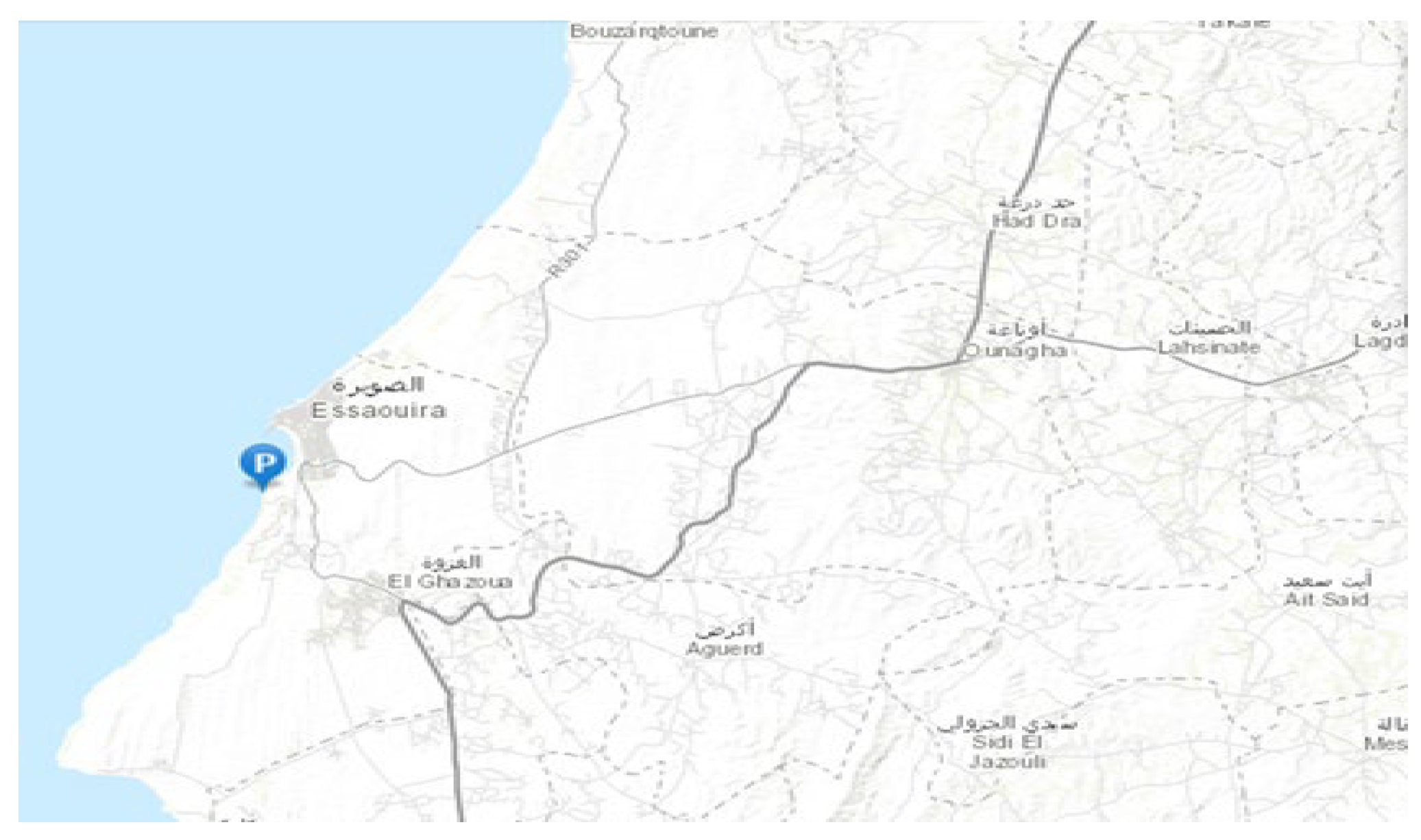
- Geographic data
- ⌘
- Factory A: Brick manufacturing
- ⌘
- Factory B: Manufacture of reinforced concrete pipes
- ⌘
- Plant C: Manufacture of polyethylene pipes
- ⌘
- External area
- ⌘
- Administrative area
- 2)
- Meteorological data
- ⮚
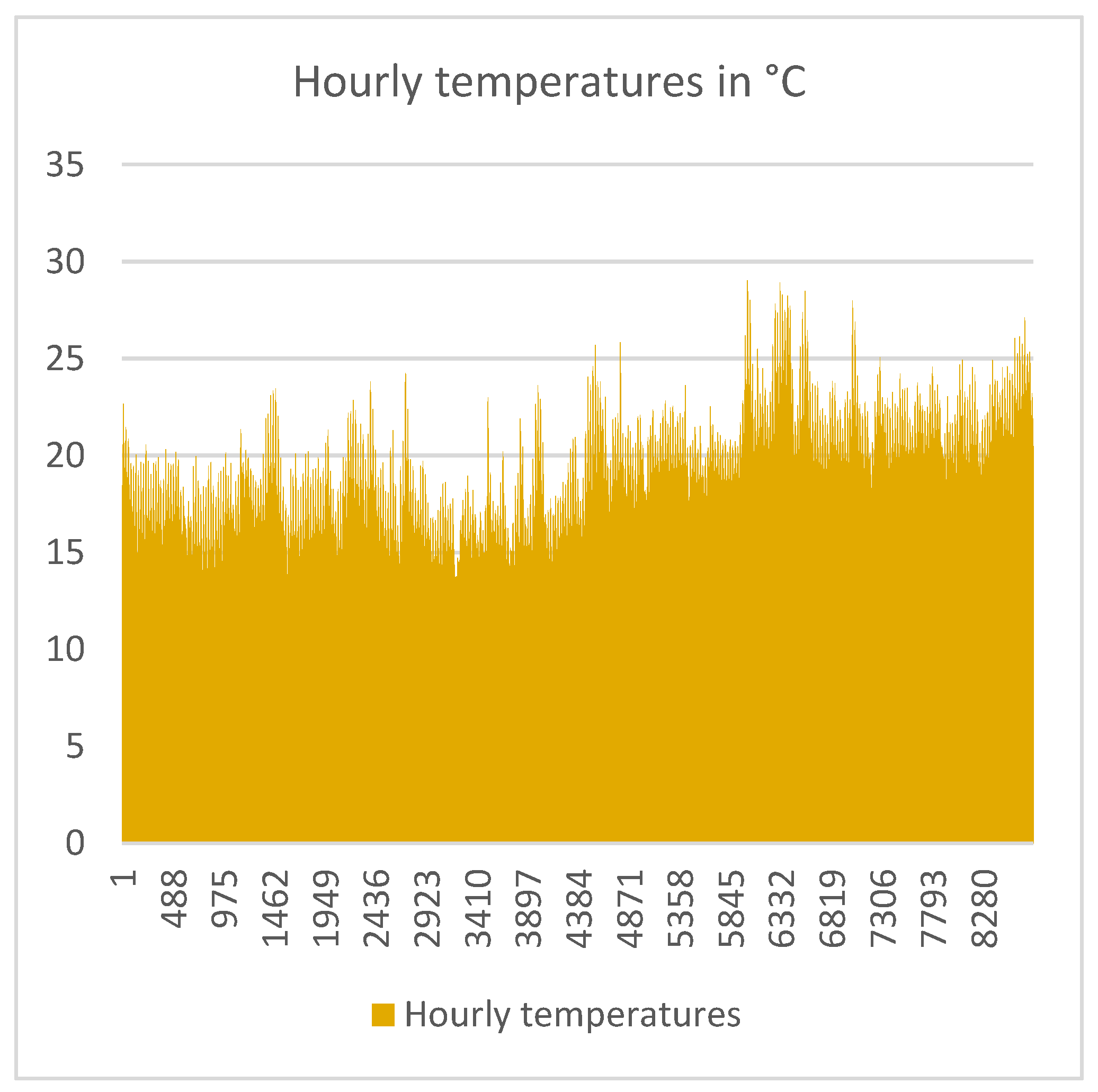
- Profile of the temperature
- ⮚
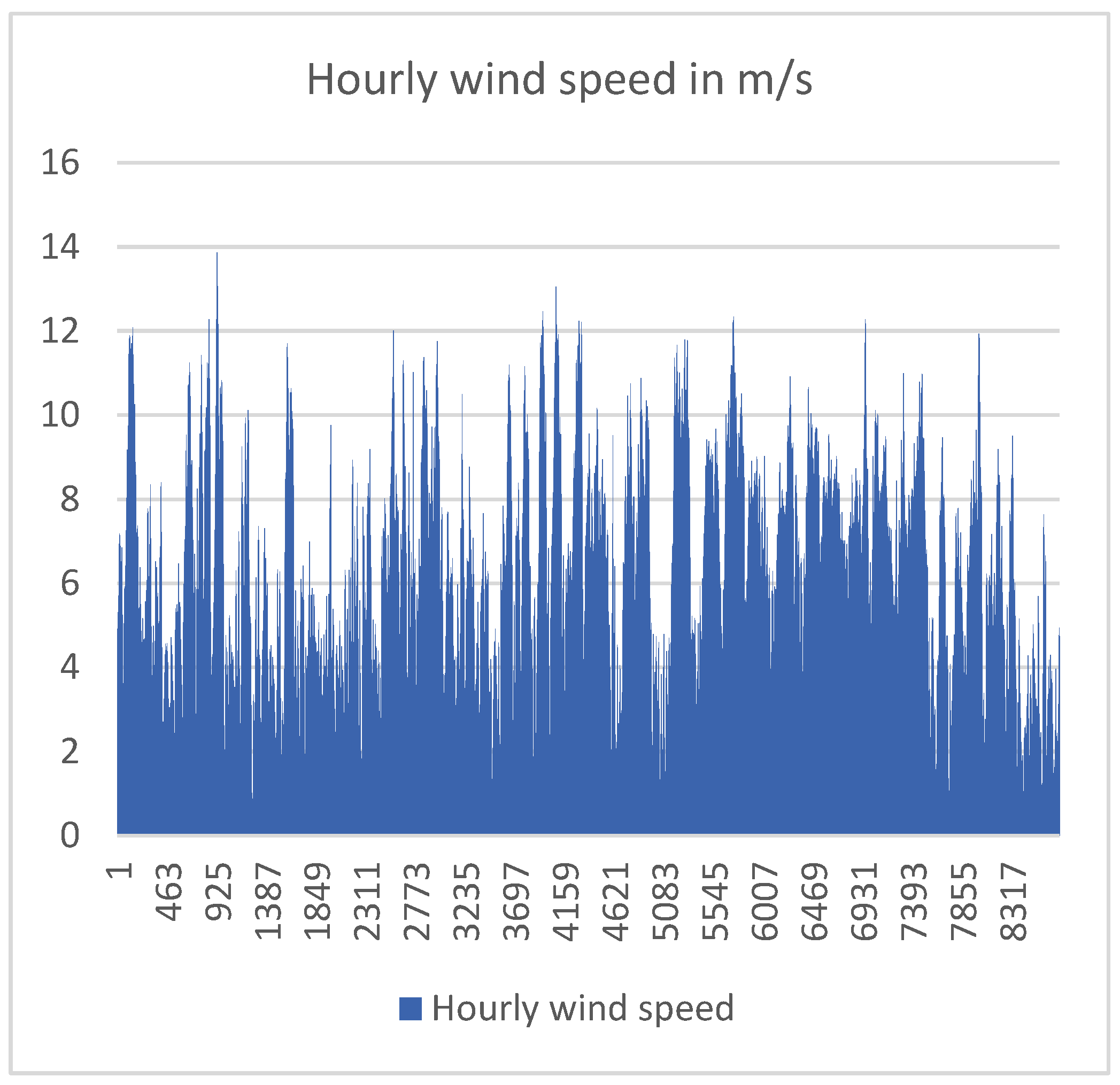
- Wind pattern
- ⮚
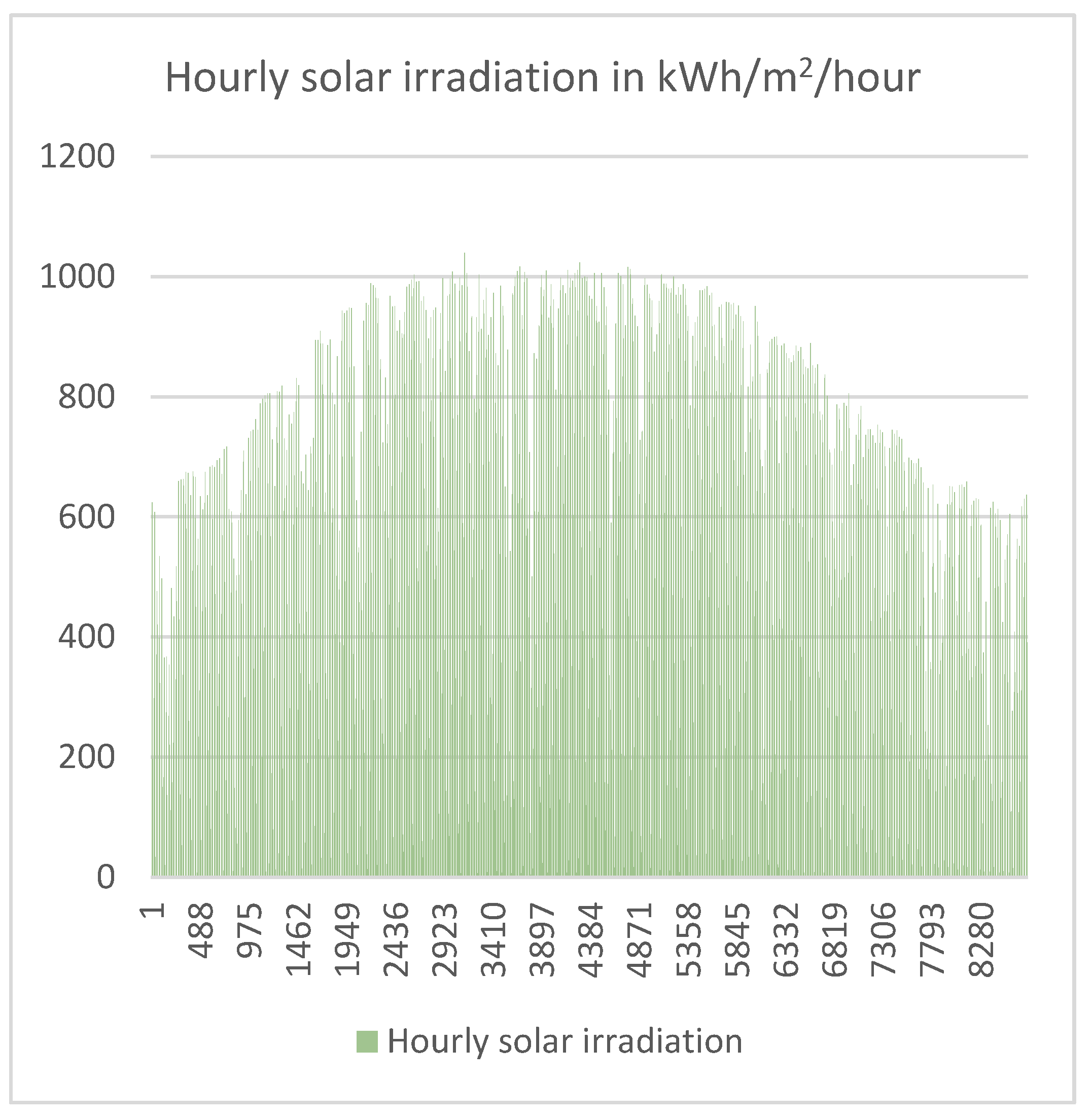
- Solar irradiation profile
- 3)
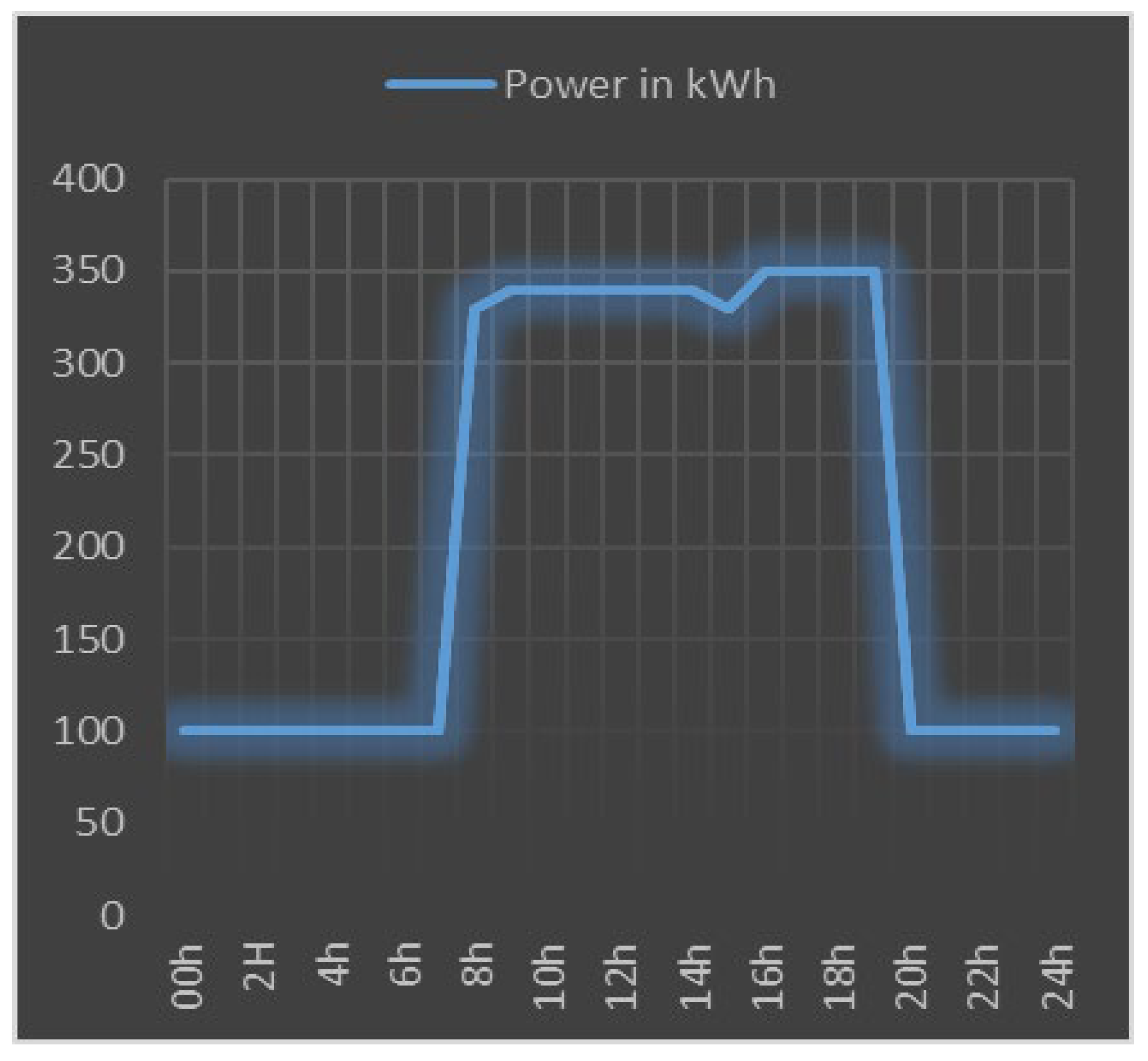
- Consumption profile
- B.
- Optimization of the hybrid system
- 1)
- Technical characteristics of the elements of the system
- ⌘
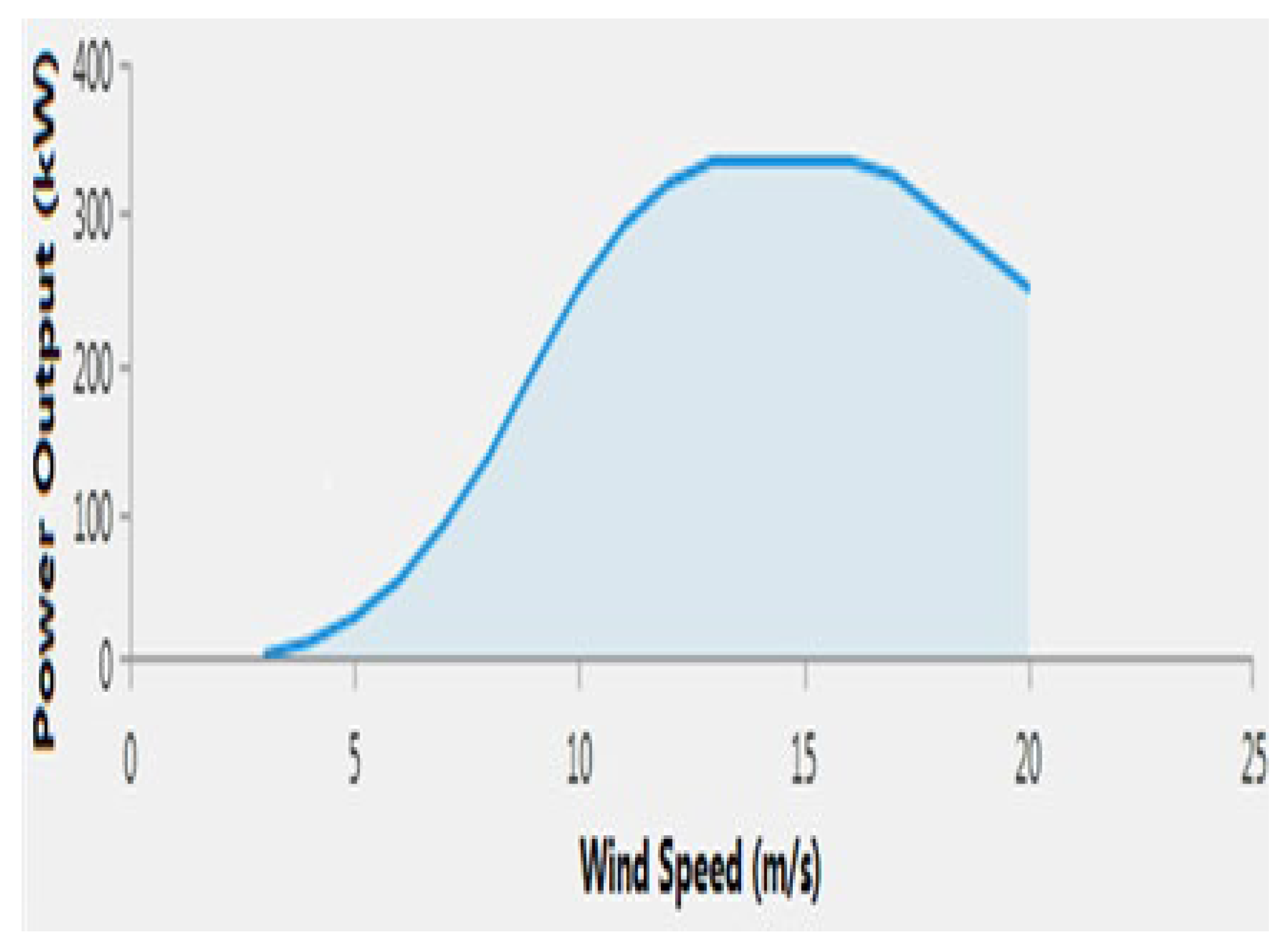
- Wind turbine: For this component, the choice fell on the wind turbine XANT L-33 [330kW], the diameter of its rotor is 33m, the wind turbine power curve is shown in Figure 6 below, and its life span is at least 20 years, while the price of this turbine is 750000 USD.
- ⌘
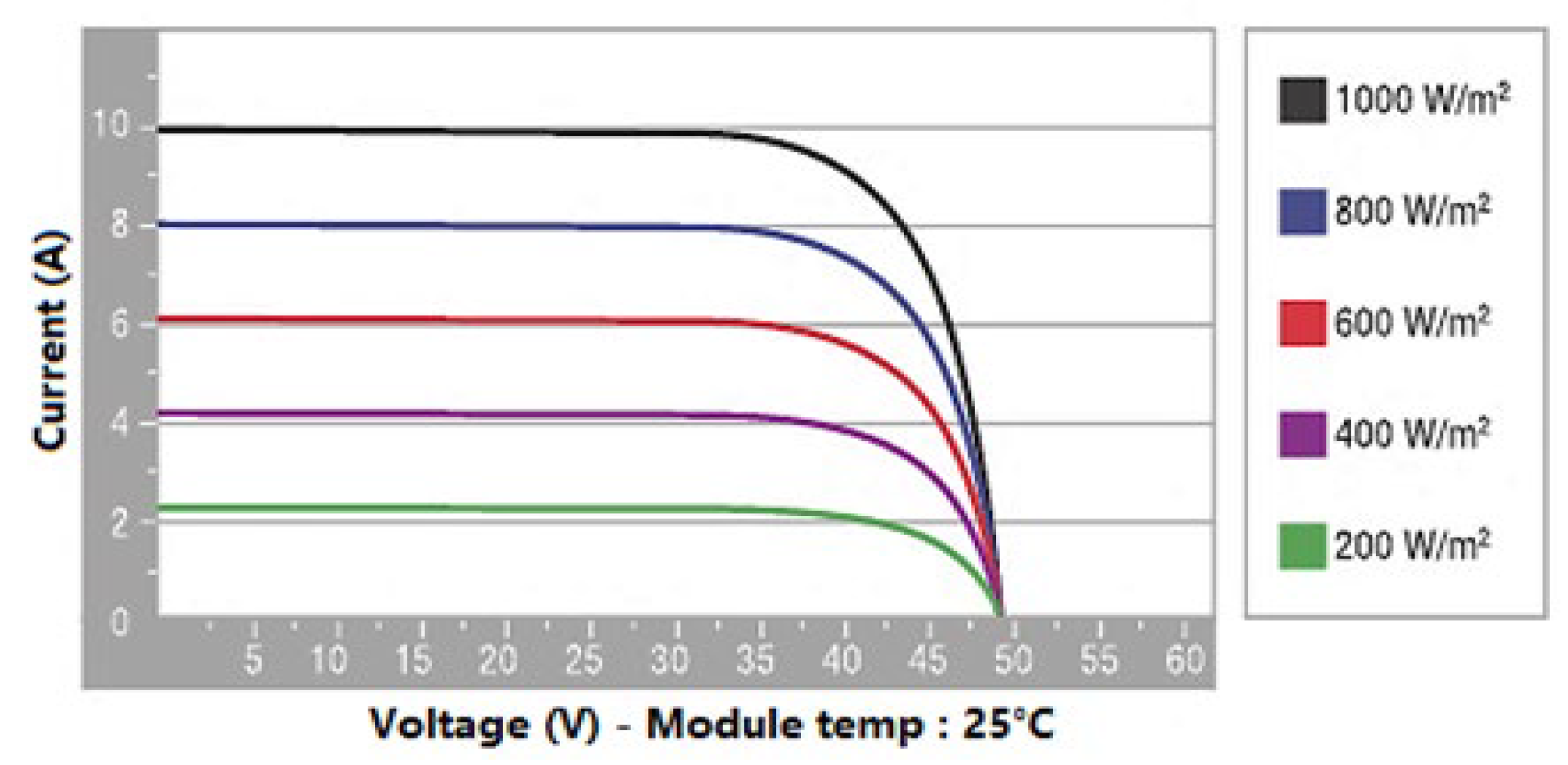
- Photovoltaic panels: The Italian brand PEIMAR was preferred for this element, the chosen model is the SG370M which is composed of 72 cells of monocrystalline type, its nominal output (Pmax) is 380W, the module efficiency is 19,07%, its life span is 30 years, its I-V characteristic for different radiations is shown in Figure 7. Note that it costs 640USD for a kilowatt-hour.
- ⌘
- Storage: Iron Edison LFP 2100Ah was chosen, it’s a Lithium iron Battery, its nominal voltage is 48V, its nominal capacity is 101kWh, its life span is 10 years and it costs 71700USD per unit.
- ⌘
- Grid: The public electricity distributor is here the O.N.E.E affiliated with the Moroccan state, the purchase of 1kWh costs 0.12 USD while the sale of 1kWh costs 0.08 USD (assumption for this study since the sale of electricity is still not allowed in Morocco).
- ⌘
- Converter: The chosen inverter is the Leonics GTP-518HET(P) 680Kw, it’s a PV-dedicated, three-phase, grid-connected, and it has an integrated MPPT, which is generally dictated by one of three well-known algorithms among them the perturbation and observation (P&O) whose algorithm, AC output 680Kw, output 380V_AC, lifetime assumed to be 10 years and it cost 600USD/kW.
- 2)
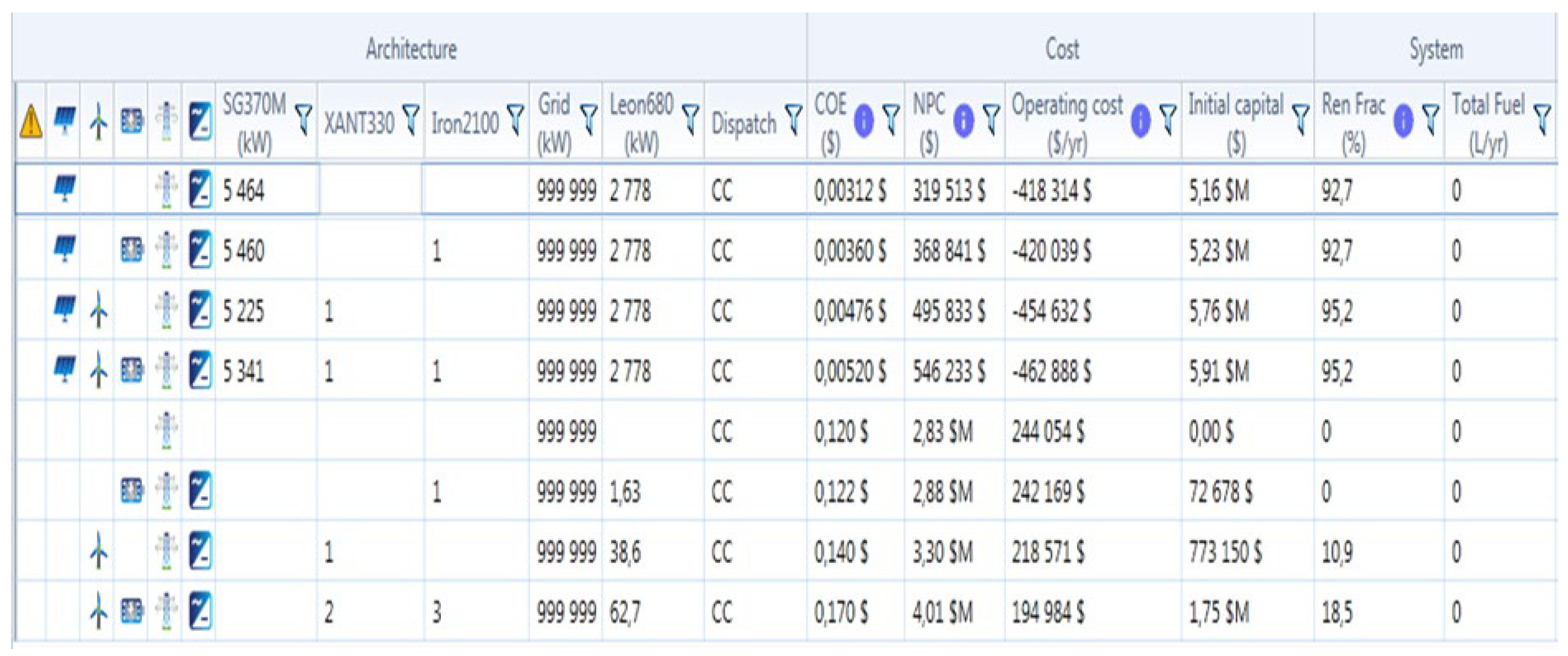
- HOMER simulation
- 3)
- Amount of CO2 avoided
III. Results and Discussion
Conclusion
Funding
Ethics approval and consent to participate
Consent for publication
Competing Interests
Author contributions
Availability of data and materials
References
- C.M. Moreno Rocha, C. Milanés Batista, W.F. Arguello Rodríguez, A.J. Fontalvo Ballesteros, J.R. Núñez Álvarez, “Challenges and perspectives of the use of photovoltaic solar energy in Colombia,” International Journal of Electrical and Computer Engineering (IJECE), 12(5), 4521, 2022. [CrossRef]
- A.N. Hussain, A.J. Ali, F.S. Ahmed, “Power quality improvement based on hybrid coordinated design of renewable energy sources for DC link channel DSTATCOM,” International Journal of Electrical and Computer Engineering (IJECE), 10(5), 5108, 2020. [CrossRef]
- A. Alamsyah, M. Subito, M. Ikhlayel, E. Setijadi, “Internet of things–based vital sign monitoring system,” International Journal of Electrical and Computer Engineering (IJECE), 10(6), 5891, 2020. [CrossRef]
- A.M. Baniyounes, Y.Y. Ghadi, A.A. Baker, “Institutional smart buildings energy audit,” International Journal of Electrical and Computer Engineering (IJECE), 9(2), 783, 2019. [CrossRef]
- Q.-J. Wang, G.-F. Feng, H.-J. Wang, C.-P. Chang, “The influence of political ideology on greenhouse gas emissions,” Global Environmental Change, 74, 102496, 2022. [CrossRef]
- G. Reina, M. Mauledoux, O.A. Aviles, “Simulation of a microgrid for a non-interconnected zone that integrates renewable energies,” International Journal of Electrical and Computer Engineering (IJECE), 11(1), 201, 2021. [CrossRef]
- S.B. Utomo, I. Setiawan, B. Fajar, S.H. Winoto, A. Marwanto, “Optimizing of the installed capacity of hybrid renewable energy with a modified MPPT model,” International Journal of Electrical and Computer Engineering (IJECE), 12(1), 73, 2022. [CrossRef]
- M.A.K. Seyed Mohsen Mousavi Khormandichali, “Optimal placement of wind generation units in order to increase revenues and reduce the imposed costs in the distribution system considering uncertainty,” International Journal of Electrical and Computer Engineering (IJECE), 9(6), 4524–4539, 2019.
- M. Mallek, M.A. Elleuch, J. Euchi, Y. Jerbi, “Optimal design of a hybrid photovoltaic–wind power system with the national grid using HOMER: A case study in Kerkennah, Tunisia,” in 2022 International Conference on Decision Aid Sciences and Applications (DASA), IEEE: 725–729, 2022. [CrossRef]
- M. Purlu, S. Beyarslan, B.E. Turkay, “Optimal Design of Hybrid Grid-connected Microgrid with Renewable Energy and Storage in a Rural Area in Turkey by Using HOMER,” in 2021 13th International Conference on Electrical and Electronics Engineering (ELECO), IEEE: 263–267, 2021. [CrossRef]
- A. Kabulov, I. Saymanov, “Application of IoT technology in ecology (on the example of the Aral Sea region),” in 2021 International Conference on Information Science and Communications Technologies (ICISCT), IEEE: 1–5, 2021. [CrossRef]
- Q. Mei, L. Lin, “Intelligent System of Ecological Civilization Construction based on Communication System Optimization Model,” in 2021 5th International Conference on Trends in Electronics and Informatics (ICOEI), IEEE: 1686–1689, 2021. [CrossRef]
- K. Nagasujatha, V.B. Shalini, “Technical performance evaluation and economic viable solutions using hybrid renewable energy systems,” in 2015 IEEE Power, Communication and Information Technology Conference (PCITC), IEEE: 801–807, 2015. [CrossRef]
- K. Sinitsyna, A. Petrochenkov, B. Krause, “Some Practical Aspects of Electric Power Consumption Time Series Analysis,” in 2019 IEEE 60th International Scientific Conference on Power and Electrical Engineering of Riga Technical University (RTUCON), IEEE: 1–10, 2019. [CrossRef]
- Y. Ruan, F. Liu, “Clustering analysis for building energy benchmarking based on weekly load profile,” in 2021 International Conference on Computer Information Science and Artificial Intelligence (CISAI), IEEE: 380–384, 2021. [CrossRef]
- H. Sommer, M. Winkelkotte, F. Bauer, P. Bretschneider, “Hybrid-approach for unit commitment simulation combining a fundamental model with a neural network,” in 11th Solar & Storage Power System Integration Workshop (SIW 2021), Institution of Engineering and Technology: 174–180, 2021. [CrossRef]
- L.A. Bedadi, M.G. GebreMichael, “Design and optimization of off-grid hybrid renewable power plant with storage system for rural area in Rwanda,” IET Renewable Power Generation, 15(15), 3715–3731, 2021. [CrossRef]
- A. Karthick, V.K. Chinnaiyan, J. Karpagam, V.S. Chandrika, P.R. Kumar, Optimization of PV-Wind Hybrid Renewable Energy System for Health Care Buildings in Smart City, Wiley: 183–198, 2021. [CrossRef]
- G. Vakili-Nezhaad, S.B. Mishra, H. Mousa, H. Ziaiefar, “Simulation and optimization of hybrid green energy systems for desalination purposes,” Environmental Progress & Sustainable Energy, 40(2), 2021. [CrossRef]
- N.A. Aquilas, J.T. Atemnkeng, “Climate-related development finance and renewable energy consumption in greenhouse gas emissions reduction in the Congo basin,” Energy Strategy Reviews, 44, 100971, 2022. [CrossRef]
- D. Ospina, S. Zapata, M. Castañeda, I. Dyner, A.J. Aristizabal, N. Escalante, “Model for Evaluating CO2 Emissions and the Projection of the Transport Sector,” International Journal of Electrical and Computer Engineering (IJECE), 8(3), 1781, 2018. [CrossRef]
- M.D. Abnavi, N. Mohammadshafie, M.A. Rosen, A. Dabbaghian, F. Fazelpour, “Techno-economic feasibility analysis of stand-alone hybrid wind/photovoltaic/diesel/battery system for the electrification of remote rural areas: Case study Persian Gulf Coast-Iran,” Environmental Progress & Sustainable Energy, 38(5), 2019. [CrossRef]
- J. Li, K. Dong, X. Dong, “Green energy as a new determinant of green growth in China: The role of green technological innovation,” Energy Economics, 114, 106260, 2022. [CrossRef]
- K.Y. Chau, M. Moslehpour, Y.-T. Tu, N.T. Tai, N.H. Tien, P.Q. Huy, “Exploring the impact of green energy and consumption on the sustainability of natural resources: Empirical evidence from G7 countries,” Renewable Energy, 196, 1241–1249, 2022. [CrossRef]

| Sources of energy | CO2 emissions per kWh |
|---|---|
| Onshore wind turbine | 12.7g |
| Offshore wind turbine | 14.8g |
| Fossil gas | 490g |
| Coal | 820g |
| Photovoltaic solar | 43.9g |
| Oil | 510g |
| Hydraulic | 43g |
| Concentrating Solar | 22g |
| Sources of energy | Contribution to the production | Emission contribution in one kWh produced |
|---|---|---|
| Coal | 67.6% | 554.32 |
| Oil | 1.5% | 7.65 |
| Onshore wind turbine | 11.6% | 1.47 |
| Fossil gas | 11.8% | 57.82 |
| Hydraulic | 3.2% | 1.37 |
| Concentrating Solar | 4.3% | 0.946 |
| Solar energy production in kWh | Wind power production in kWh | Grid purchases in kWh | |
|---|---|---|---|
| P1 | 9 977 598 | 0 | 644 029 |
| P2 | 9 978 072 | 0 | 644 026 |
| P3 | 9 656 199 | 731 560 | 436 493 |
| P4 | 9 870 781 | 731 560 | 435 518 |
| P5 | 0 | 0 | 2 033 780 |
| P6 | 0 | 0 | 2 033 780 |
| P7 | 0 | 731 560 | 1 811 995 |
| P8 | 0 | 1 463 121 | 1 658 227 |
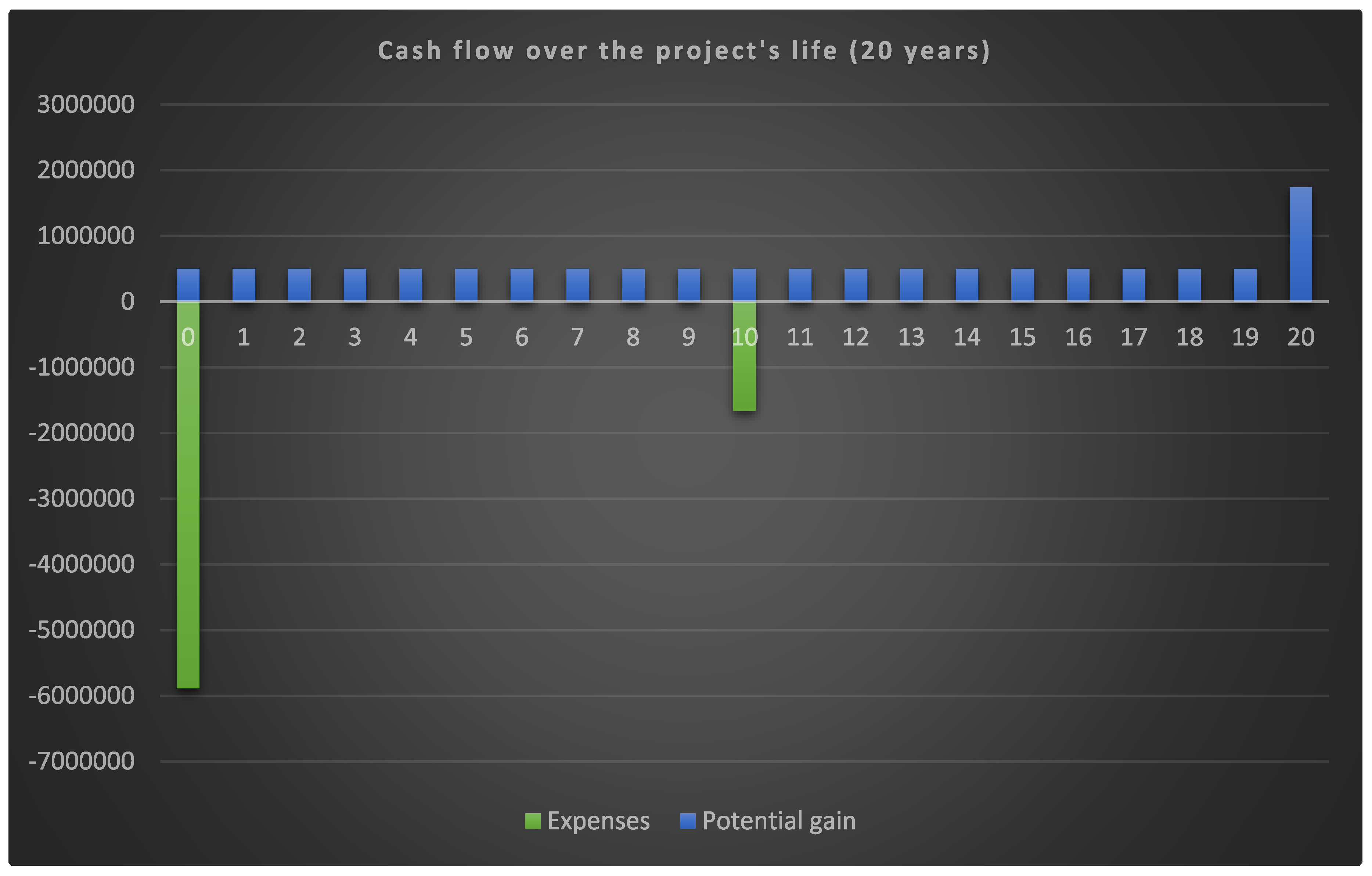
| Investment in USD (A) | The potential financial gain in USD (B) | (A) – (B) in USD | Amount of CO2 avoided over the life of the project in tons | The cost price of one ton of CO2 avoided in USD | |
|---|---|---|---|---|---|
| P1 | 6 788 695 | 10 272 938 | -3 484 243 | 123 708.2 | -28.16 |
| P2 | 6 860 560 | 10 342 459 | -3 481 899 | 125 017.5 | -27.85 |
| P3 | 7 427 400 | 11 056 980 | -3 629 580 | 126 331.6 | -28.73 |
| P4 | 7 573 406 | 11 261 474 | -3 688 068 | 128 807.4 | -28.63 |
| P5 | 0 | 0 | 0 | 0 | 0 |
| P6 | 72677 | 0 | 72677 | 0 | 0 |
| P7 | 796 338 | 0 | 796 338 | 31 536.2 | 25.25 |
| P8 | 1 790 336 | 0 | 1 790 336 | 38 556.4 | 46.43 |
Disclaimer/Publisher’s Note: The statements, opinions and data contained in all publications are solely those of the individual author(s) and contributor(s) and not of MDPI and/or the editor(s). MDPI and/or the editor(s) disclaim responsibility for any injury to people or property resulting from any ideas, methods, instructions or products referred to in the content. |
© 2025 by the authors. Licensee MDPI, Basel, Switzerland. This article is an open access article distributed under the terms and conditions of the Creative Commons Attribution (CC BY) license (http://creativecommons.org/licenses/by/4.0/).