

Submitted:
29 January 2025
Posted:
29 January 2025
You are already at the latest version
Abstract
Environmental challenges are increasing, requiring global attention. In this regard, the role of PR and communication campaigns remains influential. This research also investigates the effect of Public Relations (PR) campaigns and environmental education, attitudes toward environmental sustainability, and behavioral intentions among university students in the United Arab Emirates and Egypt. Theoretically supported by the theory of planned behavior (TPB), structured questionnaires are used for data gathering. Data analyzed by using Partial Least Square- Structural equation modeling (SEM) revealed the positive effect of PR campaigns on providing environmental education and awareness among Emirati and Egypt students. Results also showed a positive effect of PR campaigns on the students’ attitudes towards environmental sustainability. Finally, the effects of PR campaigns on the behavioral intention of the Emirati and Egypt students also remained positive. Overall, the results imply that PR campaigns play a significant role in improving environmental education, shaping positive attitudes toward environmental sustainability, and affecting behavioral intentions among university students in the UAE and Egypt. These results emphasize the significance of PR initiatives in encouraging environmental awareness and promoting pro-environmental behaviors within educational settings. Also, the results highlight the effectiveness of PR campaigns in creating trust between organizations and the public while encouraging social responsibility. Finally, study implications and limitations are discussed.
Keywords:
Public Relations Campaigns
; Environmental Sustainability
; Attitudes
; Environmental Awareness
; Behavioral Intention
1. Introduction
Climate change has become one of the crucial concerns for the global community. Today, global warming is increasing due to the anthropogenic effects on the environment. Different communication efforts and approaches are used to spread awareness and mitigate the effects of global warming (Moser, 2010). However, Junsheng et al. (2019, p. 1) consider the lack of awareness as one of the significant challenges behind overcoming the concerns raised by global as a major environmental challenge. As a result, considerable attention has been given to the relationship between the environment and communication over the past decade. Notably, despite engaging in environmentally destructive practices, some companies attempt to compensate for their image through advertising and PR campaigns focused on environmental awareness. Some critics argue that since the inception of PR in environmental campaigns and awareness, their primary purpose has remained to serve the political interest even if they represent their stance on climate change and preservation.
Consequently, the historical narrative of PR campaigns is only considered as passing the message along with marketing the political agenda (Elareshi et al. 2022; Elbasir et al. 2021; Hadeed et al. 2024; Al Olaimat et al. 2022) These campaigns are deemed as designing, conceptualizing, and executing political campaigns using strategic communication (Brulle, 2021, p. 8). Yet, environmental problems, fueled by events like oil spills, nuclear disasters, i.e., Chornobyl and Fukushima, and the overarching climate crisis, have become prominent in communication studies. The emergence of environmental communication has become a distinct area within the broader field of communication studies (Sönmez, 2022, pp. 511). Two main strategies are evident when examining how mass media communicates about the environment. First, there is a focus on the media's role in sharing information about environmental issues, especially through different traditional and digital platforms like the Internet and social media, which have extended the reach of environmental awareness efforts. Second, the nature and quality of the information are scrutinized, probing the media's stance and underlining concerns about ‘greenwashing,' influencing environmental concerns for profit. Jeong and Park (2017) highlighted the consequential role of PR in shaping public responses to awareness campaigns. Also, it is important to assess the role of PR practices as gatekeeping and skilled communicators. These roles directly influence audiences, especially in environmental campaigns (Al Olaimat et al., 2022; Habes et al., 2023). Thus, this research investigates the causal relationships between Public Relations (PR) campaigns and environmental education, attitudes toward environmental sustainability, and behavioral intentions among university students in the UAE and Egypt. The primary objective is to examine how PR initiatives improve environmental education levels, shape positive attitudes toward environmental sustainability, and impact the student population's behavioral intentions related to environmentally friendly practices. The theoretical gap in this research lies in the narrow investigation of applying the Theory of Planned Behavior (TPB) within the Public Relations (PR) campaigns focusing on environmental awareness among university students. While TPB has been broadly used in understanding behavioral intentions and decision-making processes, its integration with PR strategies in the environmental discipline still needs to be studied. By filling this gap, the research aims to explain how TPB constructs, i.e., attitudes and behavioral intentions, interact with PR approaches to influence environmental education, attitudes towards environmental sustainability, and behavioral intentions among university students (Alhammad et al. 2021; Ali et al. 2021; Habes 2020). By analyzing these cause-and-effect relationships, this research seeks to provide practical insights into the effectiveness of PR strategies in encouraging environmental awareness and stimulating pro-environmental behaviors among Emirati and Egypt University students. The primary question of current research involves.
RQ1. How do PR campaigns affect the environmental awareness and behavioral intentions of university students in the UAE and Egypt?
2. Review of Existing Literature
2.1. Theory of Planned Behavior
This research is theoretically supported by the Theory of Planned Behavior (TPB). The relevant theory Ajzen (2020) indicates that changing behavior is related to shaping behavioral intentions, which are affected by individual attitudes, social norms, and perceived behavioral control (PBC). PBC, describing one's sense of agency, instantly affects behavior when it aligns with factual behavioral control, highlighting the importance of contextual factors. This perspective resonates with the Attitude-Behavior-Context (ABC) model (Umar & Javeed, 2023), implying that behavior is not just dictated by attitudes but also by external conditions, i.e., the availability of resources like recycling bins and influencing agents. Also, the Needs-Opportunities-Ability model of consumer behavior (Zhang, 2013, pp. 1987–2007) highlights the importance of factors like the accessibility of environmentally friendly narratives and individuals' temporal and cognitive abilities. Farrow et al. (2017) expands on this by proposing that explanations of pro-environmental behavior should consider personal abilities and customary preferences in addition to the ABC model. However, Shove (2012) critiques psychological models that treat "context" as an external driver of behavior, arguing that contextual factors are inseparable from the practices that shape behavior. This indicates that communication techniques informed by the Theory of Planned Behavior can effectively affect public attitudes and behaviors concerning the environment's awareness by addressing individual beliefs and acknowledging the importance of contextual factors and customary practices in shaping behavior.
2.2. Environmental Education
The United Nations introduced Sustainable Education or Education for Sustainable Development (ESD) at Stockholm's Conference on Human Environment in 1972. This initiative sought to equip individuals to tackle current challenges by using innovative educational approaches like soft education and edutainment for the well-being of society (Kushwaha, 2015). ESD acknowledges the need for consequential transformations in knowledge, skills, values, and attitudes to succeed in today's democratic society. Its definition encompasses an interdisciplinary learning approach incorporating economic, social, and environmental factors into formal and informal curricula. This indicates a continuous adaptation to the ever-changing world. ESD uses different teaching techniques, i.e., stimulation, motivation, and inspiration, to affect behavior and immediate action. Its effectiveness lies in promoting competencies like critical thinking, decision-making, innovation, and teamwork (Polina et al., 2021). Besides, a plethora of literature highlighted that the role of PR in spreading environmental awareness is essential (Gadenne et al., 2009; Ismail et al., 2018, 2018; Ogunbode & Arnold, 2012).
2.3. Attitudes Towards Environmental Sustainability
Rapidly developing digital technologies over the past two decades have caused major changes in the field of media (Fayez, 2022), Anyone looking at the increasing reliance on public relations will realise that there is a link between this reliance and shaping individuals’ attitudes towards various issues (Al Adwan, M. N., et al., 2024), as PR practices use the public segmentation approach, which proposes several advantages when combined with communication strategic planning. This process helps determine subgroups' differences based on their characteristics, attitudes toward distinct issues, and behavioral retorts (Rossetti & Van Waes, 2022). By embracing this approach, communication practitioners develop targeted directives and strategies for specific groups to affect their behaviors effectively. This approach is also used in environmental management studies, where an attitude-based segmentation strategy helps differentiate different publics based on their environmental attitudes and ensuing behaviors towards pro-environmental activities. The segmentation results allow communicators to prepare campaign messages that resonate with audiences' environmental attitudes, affecting their engagement in pro-environmental behaviors, i.,e., bicycle commuting, and sustainable transport modes (Haustein & Hunecke, 2013; Li et al., 2020).
2.4. Behavioral Intentions
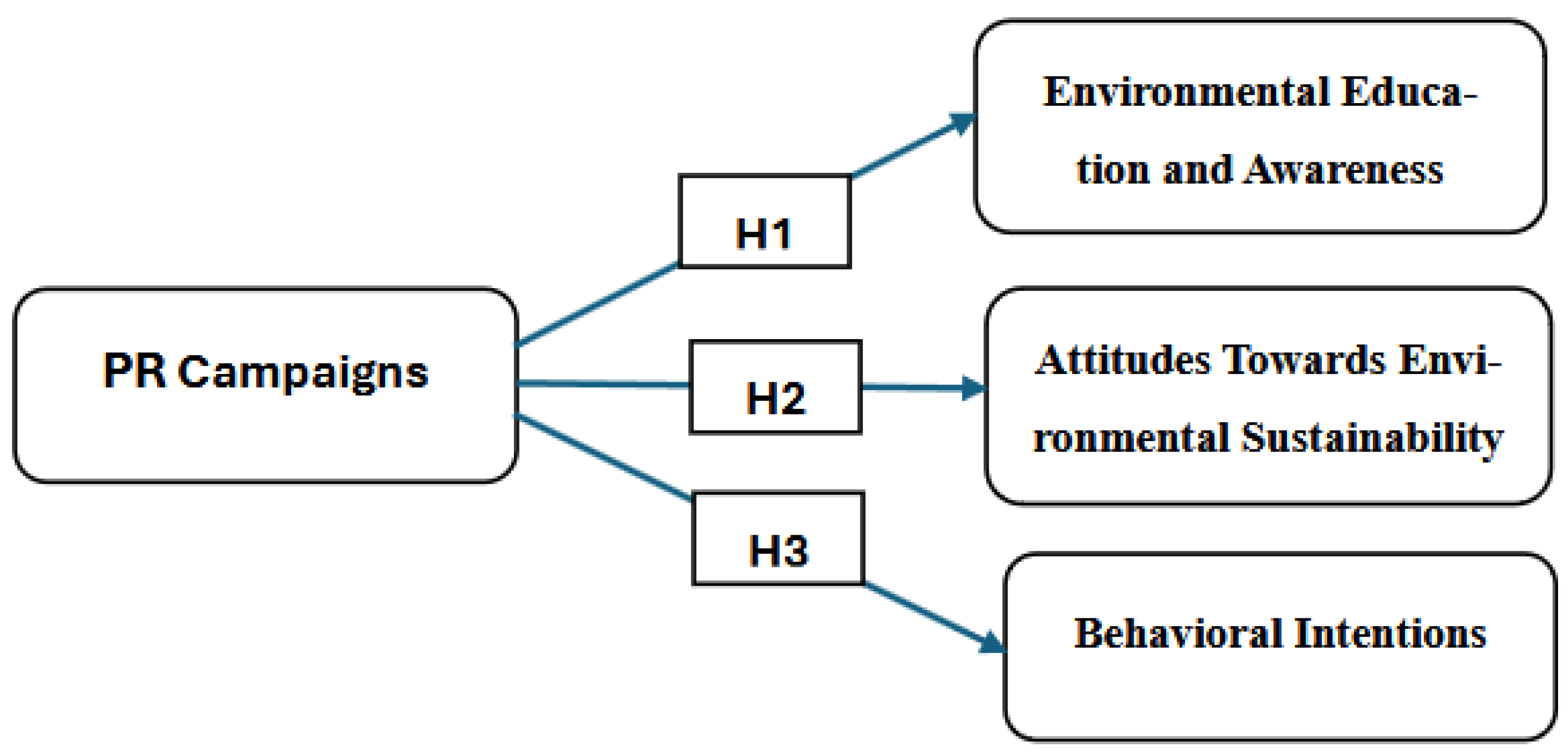
Running environmental awareness campaigns shows the potential of PR to affect audience behavior significantly (Habes et al. 2020, 2022). PR practitioners generally use their strategies for message delivery and play influential roles play a critical role in shaping audience behavior, attitudes, and perspective. This highlights the importance of PR in contributing to the success of current environmental awareness campaigns, mainly through strategic communication (Amir et al., 2019). Hence, today, more PR approaches focus on green sustainability, introducing new ideas tailored for environmentally-conscious consumers, usually featuring environmental appeals (Akbulut & Yıldırım, 2019). In their study, Ramadan et al. (2016) evaluated how the public perceives and responds to an environmental education campaign and identified effective implementation strategies with all stakeholders to ensure its sustainability. The results showed that components of community participation, especially knowledge and perception, significantly contribute to preserving cleanliness and decreasing waste. Statistical analysis revealed a p-value of 0.000 at a 5% significance level, indicating that about 26.4% of public participation can be attributed to the community's knowledge and perception of the environmental education campaign. Based on the cited literature, this research proposes three preliminary hypotheses illustrated by the explanatory framework.
H1. PR Campaigns positively affect Environmental Education and Awareness among university students in the UAE and Egypt.
H2. PR Campaigns positively affect Attitudes Towards Environmental Sustainability among university students in the UAE and Egypt.
H3. PR Campaigns positively affect Behavioral Intentions among university students in the UAE and Egypt.
Figure 1.
Explanatory Framework of Current Study.
3. Research Methods
This research study involves a cross-sectional design based on the short time data gathering, ensuring generalizable results (Abbott & McKinney, 2013). The research employed structured questionnaires for data gathering based on items and scales adopted from the existing studies. Further, data gathering is conducted from January 2024 to March 2024. The questionnaires are shared using physical visits and through emails. The respondents were first provided with the details regarding the current research, aims, and the importance of results. They were also provided the informed consent. The respondents were also told that their participation would be voluntary and their data would only be used for the current research study (Ermine et al., 2004). Once the data is gathered, the questionnaires are carefully evaluated and shortlisted for analysis. Data analysis uses SPSS for the descriptive analysis while, Partial Least Square- Structural Equation Modelling (PLS-SEM).
3.1. Population and Sampling
The population of the current research involves in university students currently enrolled at different levels at Al Ain University in both campuses, And Minia University in Egypt Our research using Yamane's sample selection formula, a sample size of 784 respondents with a 0.05 degree of error is expected (Adam, 2020). The data was gathered, and collected responses were carefully evaluated. The finalized responses were 712, the researchers exclude 72 incomplete responses. The response rate of 90.8% that remained higher than the minimum response rate of 60.0% (Fincham, 2008).
3.2. Data Normality
Before conducting the formal data analysis, data normality is tested. The aim is to evaluate the suitability of selected parametric tests in the current research study (Mishra et al., 2019). Thus, the data normality is assessed using Kolmogorov-Smirnov test. As shown in Table 1, the significant values of each variable are above the threshold of 0.05, suggesting that the data is not normally distributed. Thus, employing parametric tests is suitable for current research.
3.3. Analysis and Findings
The final sample size was (712) individuals From Al Ain University in the Emirates and Minia University in Egypt. As for the sample distribution according to gender, the largest percentage was males at 76.7% and females at 23.3%. Concerning the age group, 65.4% of respondents are 21-25 years old, 34.6% of respondents are 17-20 years old. As for the study major, 57.6% of the participants came from scientific colleges "Applied and Medical Sciences Sector", while 42.4% came from theoretical colleges "Humanities and Social Sciences Sector".
3.4. Structural Equation Modelling
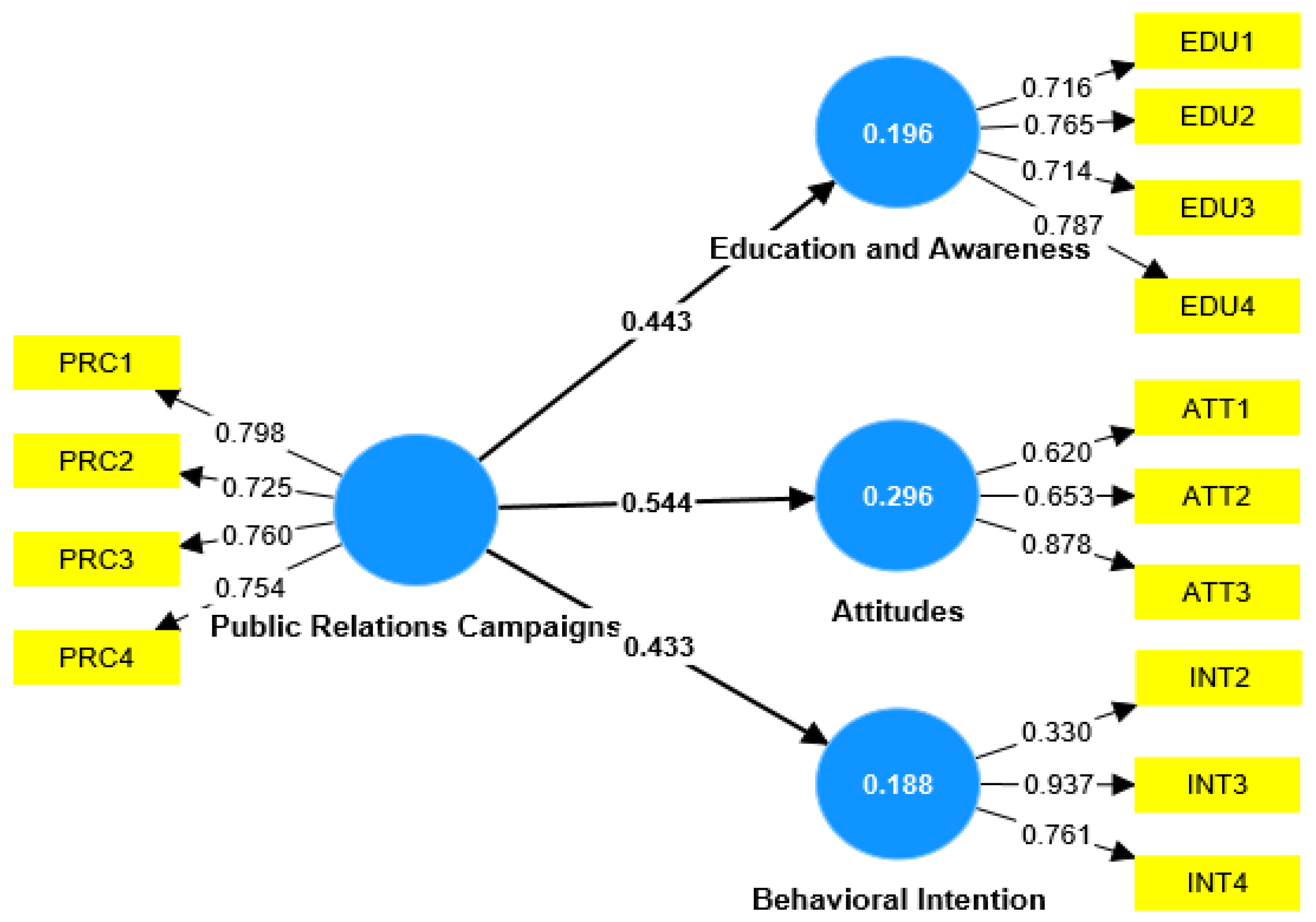
As current research involves Partial Least Square-structural equation Modelling, further analysis is based on two sections, including inner model and outer model analyses (Pesqué-Cela et al., 2021). First, the validity and reliability of the measurement tool are tested using Confirmatory Factor Analysis (CFA). Table 2 represents the results of CFA. As shown, loading values of PR Campaigns (PRC1, PRC2, PRC3, and PRC4) are relatively high, ranging from 0.725 to 0.798, indicating a robust consistency between the constructs. The AVE value of 0.577 implies that the PR Campaigns explain 57.7% of the variance in the observed variables, indicating sufficient convergent validity. The high CR 0.758 and CA 0.845 values further establish the construct reliability. For Environmental Education and Awareness, items EDU1, EDU2, EDU3, and EDU4 show strong loadings ranging from 0.714 to 0.787, demonstrating a strong internal consistency. The AVE value of 0.556 further implies that the construct explains 55.6% of the variance in the observed variables, showing satisfactory convergent validity. In addition, the high CR 0.744 and CA 0.834 values indicate adequate construct reliability. Regarding the Attitudes Towards Environmental Sustainability construct, items ATT1, ATT2, ATT3, and ATT4 show loadings ranging from 0.213 to 0.878. While the loading of ATT4 is somewhat low, the other items indicate strong loadings, suggesting a generally strong internal consistency. The AVE value of 0.527 indicates that the construct explains 52.7% of the variance in the observed variables. Meanwhile, CR 0.722 and CA 0.765 values confirm the construct reliability. Finally, The items regarding Behavioral Intention (INT1, INT2, INT3, and INT4) show loadings ranging from 0.026 to 0.937. While the loading of INT1 is low, the other items show strong loadings. The AVE value of 0.522 implies that the construct explains 52.2% of the variance in the observed variables. The high CR 0.726 and CA 0.742 values establish the construct reliability.
The acquired values for the SEM fit indices exhibit the adequacy of the model fit in this study (Mérigot et al., 2010). The Standardized Root Mean Square Residual (SRMR) value of 0.143 falls below the threshold of 0.85, suggesting an acceptable fit between the proposed model and the observed data. The Tucker-Lewis Index (TLI) value of 2.150 surpasses the threshold of 0.90, indicating a good fit of the model to the data. The Chi-square value of 1.041 is below the threshold of 3.0, indicating a non-significant difference between the model-implied covariance matrix and the observed covariance matrix. Besides, the Normed Fit Index (NFI) value of 0.926 falls within the range of 0 to 1, explaining the variance of the observed data. Altogether, the acquired values indicate a generally acceptable fit of the SEM model to the data. Table 3 represents the findings of goodness of fit.
The discriminant validity is assessed using a two-step approach, including the Fornel-larger criterion and the Heterotrait-Monotrait Ratio scale (Rasoolimanesh, 2022). As shown in Table 4a, the diagonal values describe each construct's square roots of the AVEs. It is found that all diagonal values are more significant than the off-diagonal values, suggesting discriminant validity among the constructs. Further, the HTMT values should be less than 1 to confirm discriminant validity. Here, the HTMT values for all constructs are less than 1, indicating acceptable discriminant validity among the constructs in the model. Table 4 provides the summary of Heterotrait-Monotrait ratio.
Before conducting the path analysis, the predictive power of the independent construct is examined (Nakagawa et al., 2018). As shown in Table 7, Attitudes show that the PR Campaigns explain 29.6% of the variance. For Behavioral Intention, Education, and Awareness, PR Campaigns show 18.8% and 19.6% of the variances, respectively. Overall, moderate variance is explained by the PR Campaigns. The obtained R-square values imply that the independent variable collectively explains moderate variability in the dependent variables. Table 5 represents the findings of the Coefficient of Determination R2.
Finally, the path analysis is conducted to test the proposed effects of PR Campaigns on Environmental Education and Awareness, Attitudes Towards Environmental Sustainability, and Behavioral Intention. As indicated in Table 6, PR Campaigns significantly affect Environmental Education and Awareness (β = 0.443, p < 0.001), implying that PR campaigns affect environmental education and awareness. Concerning the effect of PR Campaigns on Attitudes Towards Environmental Sustainability, the obtained values β = 0.544, p < 0.001 suggest that PR campaigns significantly affect attitudes towards environmental sustainability. Finally, it is found that PR Campaigns significantly affect Behavioral Intention (β = 0.433, p < 0.001), indicating a robust influence of PR campaigns on behavioral intention toward environmental sustainability. Altogether, these results supported assuming the positive effects of PR Campaigns in the current research study.

Table 6.
Coefficient of Determination R2.
| Constructs | R-square |
|---|---|
| Attitudes | 0.296 |
| Behavioral Intention | 0.188 |
| Education and Awareness | 0.196 |
Table 7.
Hypotheses Testing.
| Hypotheses | β | Mean | SD | t | P | |
|---|---|---|---|---|---|---|
| PR Campaigns→ Environmental Education and Awareness | 0.443 | 0.597 | 0.043 | 13.517 | 0.000 | |
| PR Campaigns → Attitudes Towards Environmental Sustainability | 0.544 | 0.706 | 0.061 | 11.403 | 0.000 | |
| PR Campaigns → Behavioral Intention | 0.433 | 0.574 | 0.0754 | 11.635 | 0.000 |
4. Discussion
This study examined the effect of PR campaigns on environmental awareness and behavioral intentions among university students in the United Arab Emirates (UAE) and Egypt. Findings affirmed the influential role of PR initiatives in improving environmental education levels (Megantari et al., 2020), encouraging positive attitudes toward environmental sustainability, and shaping behavioral intentions supporting environmentally friendly practices among Emirati university students (Howell, 2014). The results highlight the effectiveness of PR strategies in supporting environmental awareness and promoting eco-conscious actions among the students, presenting practical insights for improving PR campaigns to facilitate ecological sustainability in educational contexts. Generally speaking, the study respondents agreed that PR campaigns are essential for sustaining positive relationships between organizations and the public. They reported that PR campaigns significantly influence perception and attitudes toward different issues. Respondents further expressed that PR campaigns effectively distribute valid information and build trust between organizations and the public. They also stressed the significance of PR campaigns in addressing societal concerns and promoting social responsibility among organizations and the public.
Regarding the first hypothesis, “PR Campaigns positively affect Environmental Education and Awareness among the university students in the UAE and Egypt," the respondents agreed with the positive role of PR campaigns. According to the respondents, PR campaigns significantly improved awareness about environmental problems and promoted environmentally friendly behaviors. They also implied that sharing information through PR campaigns positively affected environmental education and awareness. Also, respondents noted that PR campaigns engaged and familiarized the public with the importance of environmental conservation and sustainability. The impact of PR campaigns on environmental education and awareness is apparent in the positive changes in public attitudes and behaviors toward environmental preservation, as reported by the respondents. As noted by Sesen (2015), PR liaises between modern communication channels and societal groups, seeking to present concepts to the public's awareness. Prioritizing the environment, PR enables brands, charities, and NGOs to improve their visibility and emphasize their significant efforts to lessen their environmental footprint or promote positive behavior (Higginson, 2021).
Figure 2.
Results of Path Analysis.
The second hypothesis, "PR Campaigns positively affect Attitudes Towards Environmental Sustainability among the university students in the UAE, and Egypt” also remained supported. Study respondents agreed that PR campaigns are critical in shaping positive attitudes toward environmental sustainability and preservation efforts. They noted that the effect of PR campaigns can be observed in the public's adoption of environmentally sustainable behaviors. Also, respondents expressed that PR campaigns encourage a culture of environmental accountability and awareness, leading to augmented support for sustainability initiatives. The information shared through PR campaigns was perceived to affect ecological sustainability attitudes among the respondents positively. These findings are also consistent with the argumentation by current literature (Aronczyk & Espinoza, 2019; Ahmad & Abdullah, 2014). For example, Barter (2019) argues that PR campaigns aim to lead thought processes and actions toward a distinct goal. How individuals internally process the communicated content affects changes in their attitudes, beliefs, and intentions. This inner processing of communication has been a preceding area of interest for social cognition and communication research scholars.
Finally, regarding the third hypothesis, "PR Campaigns positively affect Behavioral Intentions among the university students in the UAE, and Egypt" the respondents agreed that PR campaigns significantly affect their intentions to engage in environmentally friendly behaviors, i.e., recycling and reducing energy consumption. They also revealed that the information provided through PR campaigns positively influences their choices for adopting sustainable lifestyle choices. Besides, respondents expressed that PR campaigns promote translating their positive perspectives toward environmental sustainability into concrete actions. They reported that orientation to PR campaigns enhances their participation in pro-environmental activities, reflecting intentions to contribute to environmental conservation efforts. Thus, these results are consistent with the proposition to run PR campaigns for environmental sustainability and preservation. As Megantari et al. (2020, pp. 544) noted, environmental communication is a rudimentary tool for promoting practical efforts to improve human understanding of the environment and human interactions with nature. It serves as a medium through which environmental issues are created and different societal responses are negotiated (Brulle, 2021).
5. Study Implications and Conclusion
The results of this research hold significant theoretical implications concerning PR (PR) and environmental education. By indicating the effectiveness of PR campaigns in improving ecological awareness among university students, this study contributes to a more in-depth understanding of how communication strategies can affect attitudes and behaviors toward sustainability. Also, incorporating the Theory of Planned Behavior (TPB) within PR initiatives highlights how individuals' attitudes and behavioral intentions are shaped regarding environmental issues. This research underlines the significance of PR strategies as influential tools for advancing environmental education and encouraging pro-environmental behaviors among myriad audiences, especially among university students. Study hypotheses highlight the prospect of strategic communication efforts to positively influence attitudes toward ecological sustainability and encourage meaningful behavioral changes. Finally, this study highlights the applicability of TPB within PR campaigns, expanding the understanding of how communication approaches can effectively navigate environmental awareness and action. By recognizing the interconnectedness between attitudes, behavioral intentions, and PR approaches, scholars and practitioners can develop more targeted and practical strategies to address environmental concerns and encourage sustainable behaviors among stakeholders.
5.1. Study Limitations
Although this research fills a significant gap and provides practical insights, it has some primary limitations. First, the research used a singular methodological technique for data gathering and analysis, which restricts the scope of its findings. Future investigations could aid in adopting a mixed-method approach to extend the scope of the investigation and provide a more extensive understanding of the subject matter. Second, the focus of this study is limited to the United Arab Emirates, which may raise concerns about the generalizability of the results to other regions or cultural contexts. To establish broader applicability, future research could replicate the study in myriad geographical locations, thus improving the robustness and external validity of the results. Finally, this research only focused on awareness, education, studies, and behavioral intentions of university students in the UAE and Egypt, limiting its scope. Future studies can focus on diverse audiences to not only delimit this scope but also gain deeper insights.
References
- Abbott, M. L., & McKinney, J. (2013). Understanding and Applying Research Design. John Wiley & Sons.
- Adam, A. M. (2020). Sample Size Determination in Survey Research. 26(5). [CrossRef]
- Ahmad, J. H., & Abdullah, K. (2014). Adaptation of Four Models of Public Relations in Promoting Green Technology: The Role of Green Public Relation in Malaysia. 2(11). https://citeseerx.ist.psu.edu/document?repid=rep1&type=pdf&doi=3f6ab695aab8615302044086cb602487069b7ed3.
- Ajzen, I. (2020). The theory of planned behavior: Frequently asked questions. Human Behavior and Emerging Technologies, 2(4), 314–324. [CrossRef]
- Akbulut, D., & Yıldırım, G. (2019). The Usage of Green Gamification for Public Interest Function of Public Relations. CTC. https://vrlab.aydin.edu.tr/wp-content/uploads/2019/12/CTC2019.pdf#page=131.
- Al Adwan, M. N., El Hajji, M., & Fayez, H. (2024). Future anxiety among media professionals and its relationship to utilizing artificial intelligence techniques: The case of Egypt, France, and UAE. Online Journal of Communication and Media Technologies, 14(2), e202425. [CrossRef]
- Al Olaimat, F., Habes, M., Al Hadeed, A. Y., & Al Jwaniat, M. I. (2022). Reputation management through social networking platforms for PR purposes: A SEM-based study in the Jordan. Frontiers in Communication, 7. https://www.frontiersin.org/articles/10.3389/fcomm.2022.1009359.
- Alhammad, Khalaf Lafee, Mohamed Habes, Farhan Al Olaimat, and Ismat Haddad. 2021. “Attitudes of Students of the Faculty of Mass Communication at Yarmouk University towards Using Video Platforms in Distance Education.” Review of International Geographical Education Online 11(5):1041–52.
- Ali, Sana, Mohammed Habes, Enaam Youssef, and Muhammad Alodwan. 2021. “A Cross-Sectional Analysis of Digital Library Acceptance, & Dependency during Covid-19.” International Journal of Computing and Digital System.
- Amir, S., Rahim, A., Markom, M., Syed, A., & Alsagoff, S. A. (2019). THE ROLES OF PUBLIC RELATIONS IN AN ENVIRONMENTAL AWARENESS CAMPAIGN: A CASE STUDY OF SWM ENVIRONMENT SDN BHD.
- Aronczyk, M., & Espinoza, M. (2019). Sustainable communication: Green PR and the export of corporate environmentalism, 1989–1997. Environmental Sociology, 5, 1–15. [CrossRef]
- Barter, A. (2019). SHIFTING ENVIRONMENTAL ATTITUDES AND INFLUENCING PRO-ENVIRONMENTAL BEHAVIOUR THROUGH THE PROCESS OF MANAGING HOW, WHEN AND IN WHAT WAY WE COMMUNICATE [Stellenbosch University]. https://scholar.sun.ac.za/server/api/core/bitstreams/1195ea03-7b4a-4baf-9630-70b5dfd38aba/content.
- Brulle, R. J. (2021). The role of public relations firms in climate change politics. Climatic Change, 169(8). https://www.caplancommunications.com/wp-content/uploads/Brulle-Werthman2021_Article_TheRoleOfPublicRelationsFirmsI.pdf.
- Cox, M. J. (2008). Sustainable Communication: A Study of Green Advertising and Audience Reception within the growing arena of Corporate Social Responsibility. Case Study: British Petroleum. 3. https://citeseerx.ist.psu.edu/document?repid=rep1&type=pdf&doi=096fc59f590d6f286756144f0b17f0a6d9731214.
- Ermine, W., Sinclair, R., & Jeffery, B. (2004). The Ethics of Research Involving Indigenous Peoples. [CrossRef]
- Fayez, H. (2022). Awareness of journalists in online journalism to search engine optimization “SEO” and its relationship to the quality of news and marketing services. Egyptian Journal of Public Opinion Research, 21(1), 291. [CrossRef]
- Farrow, K., Grolleau, G., & Ibanez, L. (2017). Social Norms and Pro-environmental Behavior: A Review of the Evidence. Ecological Economics, 140, 1–13. [CrossRef]
- Fincham, J. E. (2008). Response Rates and Responsiveness for Surveys, Standards, and the Journal. American Journal of Pharmaceutical Education, 72(2), 43.
- Gadenne, D. L., Kennedy, J., & McKeiver, C. (2009). An Empirical Study of Environmental Awareness and Practices in SMEs. Journal of Business Ethics, 84(1), 45–63. [CrossRef]
- Godfrey, D. M., & Feng, P. (2017). Communicating sustainability: Student perceptions of a behavior change campaign. International Journal of Sustainability in Higher Education, 18(1), 2–22. [CrossRef]
- Habes, M., Ali, S., Qamar, A., Elareshi, M., Ziani, A., & Alsridi, H. (2023). Public Service Advertisements and Healthcare Attitudinal Changes in Developing Countries: Pakistanis’ Perspectives. In B. Alareeni & A. Hamdan (Eds.), Explore Business, Technology Opportunities and Challenges After the Covid-19 Pandemic (Vol. 495, pp. 433–442). Springer International Publishing. [CrossRef]
- Habes, Mohammed. 2020. “The Influence of YouTube Videos on ELA During the COVID-19 Outbreaks in Jordan.” in In 2020 Sixth International Conference on e-Learning (econf), pp. 133-138. IEEE, 2020.
- Habes, Mohammed, Sana Ali, Said A. Salloum, Mokhtar Elareshi, Abdul-Karim Ziani, and Bahrain Manama. 2020. “Digital Media and Students’ AP Improvement: An Empirical Investigation of Social TV.” International Conference on Innovation and Intelligence for Informatics, Computing and Technologies (3ICT) Program.
- Habes, Mohammed, Mokhtar Elareshi, Enaam Youssef, Sana Ali, and Mohammad Qudah. 2022. “Social Impact of Videos at New Media Platforms on the ELearning Acceptance during the Covid-19.” Information Sciences Letters 11(3):913–23.
- Hadeed, Al, Ali Yahya, Ihsan Maysari, Mohammad Mahmoud Aldroubi, Razaz Waheeb Attar, Farhan Al Olaimat, and Mohammed Habes. 2024. “Role of Public Relations Practices in Content Management: The Mediating Role of New Media Platforms.” Frontiers in Sociology 8:1273371.
- Haustein, S., & Hunecke, M. (2013). Identifying target groups for environmentally sustainable transport: Assessment of different segmentation approaches. Current Opinion in Environmental Sustainability, 5(2), 197–204. [CrossRef]
- Higginson. (2021). Environmental PR - Higginson Strategy. https://higginsonstrategy.com/environmental-pr/, https://higginsonstrategy.com/environmental-pr/.
- Howell, R. (2014). Investigating the Long-Term Impacts of Climate Change Communications on Individuals’ Attitudes and Behavior. Environment and Behavior, 46, 70–101. [CrossRef]
- Ismail, M. H., El-Rafei, M. M. K., & Rania, H. (2018). ATRAINING PROPOSED PROGRAM FOR DEVELOPING DIMENSIONS OF ENVIRONMENTAL RESPONSIBILITY IN PUBLIC RELATIONS SECTOR OF FAYOUM GOVERNORATE. Journal of Environmental Science, 42(3), 153–177. [CrossRef]
- Jeong, J., & Park, N. (2017). Core Elements for Organizational Sustainability in Global Markets: Korean Public Relations Practitioners’ Perceptions of Their Job Roles. Sustainability, 9(9), Article 9. [CrossRef]
- Junsheng, H., Akhtar, R., Masud, M. M., Rana, M. S., & Banna, H. (2019). The role of mass media in communicating climate science: An empirical evidence. Journal of Cleaner Production, 238, 117934. [CrossRef]
- Kushwaha, V. S. (2015). MASS MEDIA IN DISSEMINATING ENVIRONMENTAL AWARENESS. 3(9). https://core.ac.uk/download/pdf/144846643.pdf.
- Li, J.-Y., Overton, H., & Bhalla, N. (2020). Communicative action and supportive behaviors for environmental CSR practices: An attitude-based segmentation approach. Corporate Communications: An International Journal, 25(2), 171–186. [CrossRef]
- Megantari, K., Purwati, E., & Anggoro, A. D. (2020). Management of Environmental Communication from the Perspective of Public Relations. 13(1). http://eprints.umpo.ac.id/5247/1/13147_Megantari_2020_E_R.pdf.
- Mérigot, B., Durbec, J.-P., & Gaertner, J.-C. (2010). On goodness-of-fit measure for dendrogram-based analyses. Ecology, 91(6), 1850–1859. [CrossRef]
- Mishra, P., Pandey, C. M., Singh, U., Gupta, A., Sahu, C., & Keshri, A. (2019). Descriptive Statistics and Normality Tests for Statistical Data. Annals of Cardiac Anaesthesia, 22(1), 67–72. [CrossRef]
- Moser, S. C. (2010). Communicating climate change: History, challenges, process and future directions. WIREs Climate Change, 1(1), 31–53. [CrossRef]
- Nakagawa, S., Johnson, P. C. D., & Schielzeth, H. (2018). The coefficient of determination R2 and intra-class correlation coefficient from generalized linear mixed-effects models revisited and expanded. 11.
- Ogunbode, C. A., & Arnold, K. (2012). A Study of Environmental Awareness and Attitudes in Ibadan, Nigeria. Human and Ecological Risk Assessment: An International Journal, 18(3), 669–684. [CrossRef]
- Pesqué-Cela, V., Tian, L., Luo, D., Tobin, D., & Kling, G. (2021). Defining and measuring financial inclusion: A systematic review and confirmatory factor analysis. Journal of International Development, 33(2), 316–341. [CrossRef]
- Polina, S., Alla, M.-B., Olga, V., & Elizaveta, V. (2021). Social PR campaign in promoting sustainable education within urban environment. SHS Web of Conferences. https://www.shs-conferences.org/articles/shsconf/pdf/2021/09/shsconf_ec2020_05033.pdf.
- Ramadan, B. S., Alam, F. C., & Rahardyan, B. (2016). The influence of environmental campaign on public awareness in maintaining the cleanliness and waste reduction program: A case study of Bandung City. 3(1).
- Rasoolimanesh, S. M. (2022). Discriminant validity assessment in PLS-SEM: A comprehensive composite-based approach. 1–8.
- Rossetti, A., & Van Waes, L. (2022). Accessible Communication of Corporate Social Responsibility: Development and Preliminary Evaluation of an Online Module. Business and Professional Communication Quarterly, 85(1), 52–79. [CrossRef]
- Scholtz, B., & Burger, C. (2016). A Social Media Environmental Awareness Campaign to Promote Sustainable Practices in Educational Environments. In Advances and New Trends in Environmental and Energy Informatics. Springer, Cham. https://link.springer.com/chapter/10.1007/978-3-319-23455-7_19.
- Sesen, E. (2015). Public Relations in Environmental Education: An Example Practice from Turkey. Journal of Social Science Studies, 2(2), 134–147.
- Shove, E. (2012). Putting practice into policy: Reconfiguring questions of consumption and climate change: 9(4). https://www.tandfonline.com/doi/abs/10.1080/21582041.2012.692484.
- Sola, A. O. (2014). Environmental Education and Public Awareness. Journal of Educational and Social Research. [CrossRef]
- Sönmez, S. (2022). New Trends in Social, Humanities and Administrative Sciences. Duvar Publishing. https://www.duvaryayinlari.com/Webkontrol/IcerikYonetimi/Dosyalar/new-trends-in-social-sistem-compressed_icerik_g3532_kjSleynP.pdf#page=510.
- Umar, M., & Javeed, A. (2023). The Impact of Frugality on Green Brand Image. In the perspective of Attitude Behavior Context Theory. Journal of Innovative Research in Management Sciences, 4(1), Article 1. [CrossRef]
- Elareshi, Mokhtar, Mohammed Habes, Enaam Youssef, Said A. Salloum, Raghad Alfaisal, and Abdulkarim Ziani. 2022. “SEM-ANN-Based Approach to Understanding Students’ Academic-Performance Adoption of YouTube for Learning during Covid.” Heliyon 8(4):e09236.
- Elbasir, Mahmoud, Mokhtar Elareshi, Mohammed Habas, Riadh Jeljeli, and Said A. Salloum. 2021. “Media and Non-Media Students’ Feedback and Improvement of University Teaching and the Learning Environment.” Pp. 754–65 in International Conference on Artificial Intelligence and Computer Vision (pp. 754-765). Springer, Cham. Vol. 4.
- Yu, T.-Y., Yu, T.-K., & Chao, C.-M. (2017). Understanding Taiwanese undergraduate students’ pro-environmental behavioral intention towards green products in the fight against climate change. Journal of Cleaner Production, 161, 390–402. [CrossRef]
- Zhang, H. (2013). Household energy consumption in China: 1987-2007 [The State University of New Jersey,]. https://www.proquest.com/openview/b969465717073d34a510537cd99933a1/1?pq-origsite=gscholar&cbl=18750.
Table 1.
Data Normality Testing.
| Variables | Kolmogorov-Smirnova | |
|---|---|---|
| Statistic | Sig. | |
| PR Campaigns | 0.943 | 0.155 |
| Environmental Education and Awareness | 0.935 | 0.127 |
| Attitudes Towards Environmental Sustainability | 0.930 | 0.157 |
| Behavioral Intention | 0.959 | 0.128 |
Table 2.
Confirmatory Factor Analysis (CFA).
| Constructs | Items | Loads | AVE | CA | CR |
|---|---|---|---|---|---|
| PR Campaigns | PRC1 | 0.798 | 0.577 | 0.758 | 0.845 |
| PRC2 | 0.725 | ||||
| PRC3 | 0.760 | ||||
| PRC4 | 0.754 | ||||
| Environmental Education and Awareness | EDU1 | 0.716 | 0.556 | 0.744 | 0.834 |
| EDU2 | 0.765 | ||||
| EDU3 | 0.714 | ||||
| EDU4 | 0.787 | ||||
| Attitudes Towards Environmental Sustainability | ATT1 | 0.620 | 0.527 | 0.722 | 0.765 |
| ATT2 | 0.653 | ||||
| ATT3 | 0.878 | ||||
| ATT4 | 0.213 | ||||
| Behavioral Intention | INT1 | 0.026 | 0.522 | 0.726 | 0.742 |
| INT2 | 0.330 | ||||
| INT3 | 0.937 | ||||
| INT4 | 0.761 |
Table 3.
Goodness of Fit.
| Obtained Values | Criterion | |
|---|---|---|
| SRMR | 0.143 | <0.85 |
| TLI | 2.150 | >0.90 |
| Chi-square | 1.041 | <3.0 |
| NFI | 0.726 | b/w 0-1 |
Table 4.
Fornel Larcker Criterion.
| Attitudes | Behavioral Intention | Education and Awareness | PR Campaigns | |
|---|---|---|---|---|
| Attitudes | 0.326 | |||
| Behavioral Intention | 0.318 | 0.022 | ||
| Education and Awareness | 0.446 | 0.373 | 0.246 | |
| PR Campaigns | 0.244 | 0.333 | 0.443 | 0.076 |
Table 5.
Heterotrait Monotrait Ratio.
| HTMT | |
|---|---|
| Behavioral Intention <-> Attitudes | 0.051 |
| Education and Awareness <-> Attitudes | 0.004 |
| Education and Awareness <-> Behavioral Intention | 0.078 |
| PR Campaigns <-> Attitudes | 0.362 |
| PR Campaigns <-> Behavioral Intention | 0.512 |
| PR Campaigns <-> Education and Awareness | 0.242 |
Disclaimer/Publisher’s Note: The statements, opinions and data contained in all publications are solely those of the individual author(s) and contributor(s) and not of MDPI and/or the editor(s). MDPI and/or the editor(s) disclaim responsibility for any injury to people or property resulting from any ideas, methods, instructions or products referred to in the content. |
© 2025 by the authors. Licensee MDPI, Basel, Switzerland. This article is an open access article distributed under the terms and conditions of the Creative Commons Attribution (CC BY) license (http://creativecommons.org/licenses/by/4.0/).
Copyright: This open access article is published under a Creative Commons CC BY 4.0 license, which permit the free download, distribution, and reuse, provided that the author and preprint are cited in any reuse.


