

Submitted:
28 January 2025
Posted:
29 January 2025
You are already at the latest version
Abstract
In this short paper, we establish the local Noetherian property for the linear categories of Brauer, partition algebras, and other related categories of diagram algebras with no restrictions on their various parameters.
Keywords:
Noetherianity
; Diagram Algebras
1. Introduction
In this paper, we prove the local Noetherian property for the linear categories of Brauer and partition algebras as introduced by Patzt in [1]. Additionally, we extend our results to two related categories of diagram algebras: the Rook-Brauer and Rook algebras. Our results are valid without any restrictions on the various parameters of these algebras.
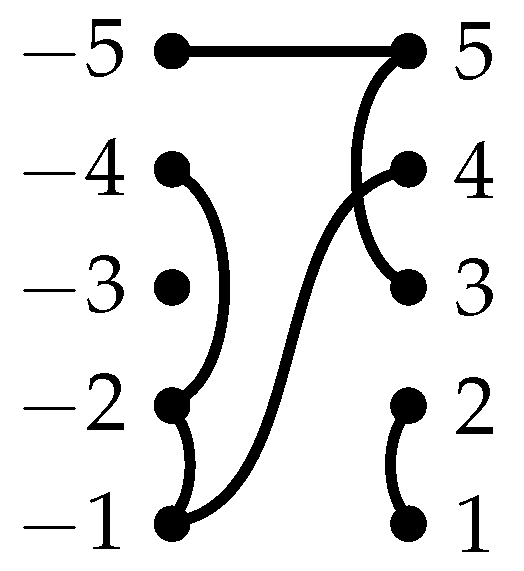
For a commutative Noetherian ring R, the partition algebra with parameter is a free R-module over the basis of all partitions of the union of the sets and . Each basis element of may be visualized by a diagram with two vertical columns of n nodes each, with the nodes on the left representing through and the nodes on the right representing 1 through n, with paths connecting certain nodes. The connected components of indicate the blocks of the corresponding partition; we identify any diagrams whose components contain the same nodes.
Figure 1.
Visualization of the partition .
For partitions p and q, we define the product in the following way. First we conjoin the diagrams p and q by identifying each node k on the right of p with the node on the left of q, thus forming a diagram with 3 columns of n nodes each. We then form a new partition s of in which two elements belong to the same block if and only if the corresponding nodes in the left or right column of the conjoined diagram are connected. We define where r is the number of connected components in the conjoined diagram that only contain nodes in the middle column.
Figure 2.
Multiplication in .

As an example, below we have a multiplication of two basis diagrams in . Note that there is a factor of in the result to indicate a single connected component (shown in red) that only contains nodes in the middle column.
The Brauer algebra is the free subalgebra of generated by partitions that are perfect matchings; that is, the blocks in each partition have size 2. Thus, each basis element is represented by a diagram in which each node is connected to exactly one other node.
Two other diagram algebras related to the partition algebra are the Rook-Brauer algebra and the Rook algebra. For a commutative Noetherian ring R, the Rook-Brauer algebra with parameters is a free R-module with basis consisting of partitions of whose blocks have size . Thus, each basis element is represented by a diagram in which each node is connected to at most one other node. The product of two basis diagrams is defined by where s is the partition obtained as described above, with c factors of for c loops and d factors of for d contractible components in the conjoined diagram that only contain nodes in the middle column (see example below).
Figure 3.
Multiplication in .

Here, the final diagram is multiplied by a factor of for the red loop and a factor of for the isolated node in the middle.
The Rook algebra is the free subalgebra of generated by diagrams without any left-to-left or right-to-right edges (i.e. the invertible diagrams of ). Note that the parameter can be removed as multiplication of diagrams with no left-to-left or right-to-right edges cannot yield any loops in the middle.
2. Main Result
We now introduce the background necessary to discuss our main results. In the following, we fix a commutative Noetherian ring R and parameters .
Following Patzt’s [1] convention, given a nonnegative integer , we will denote by any one of , , , or . For each , there is a canonical choice of a “trivial” -module R on which all invertible diagrams act trivially and which is annihilated by all other diagrams. We denote by the subalgebra of generated by diagrams with horizontal connections for all .
Denote by any one of the sequences , , , or . We define a category enriched over the category of R-modules by the following data:
- The objects of are the nonnegative integers .
- If , we define ; otherwise is the trivial R-module. Note that .
- By [1]*Thm. 2.1, there is a surjectionwhich provides the composition for ; otherwise the composition is 0.
We thereby obtain categories , , , and enriched over the category of R-modules corresponding to the sequences , , , and respectively.
Definition 1.
A-module V is a functor from the category to the category of R-modules. For each , we denote the R-module by .
A -module map is a natural transformation of -modules. Given -modules V to W, if for each n and the map induced by the inclusions is a -module map, then W is a -submodule of V. We say that V is finitely generated if there exists a finite set such that the smallest -submodule of V containing S is V itself.
Definition 2.
A -module V is Noetherian if every -submodule of V is finitely generated. We say is locally Noetherian over R if every finitely generated -module is Noetherian.
We can now state our main result.
Theorem 1.
For , , , or , the category is locally Noetherian.
The local Noetherian property for the categories of partition, Brauer, and Temperley-Lieb algebras, with the parameter chosen such that each algebra is semi-simple, was previously established in [2]. Our result extends this by removing restrictions on various parameters, thereby providing a more general statement.
The crux of the main argument is to establish the existence of a functor from the category to the category when , , or . This implies that any -module, when pulled back, also becomes an -module. Given that the local Noetherianity property is already known for the category [3]*Thm. A, this result consequently extends the local Noetherianity property to the category . Unfortunately, this argument does not hold for the Temperley-Lieb algebra, as there is no nontrivial functor from the category to the category of Temperley-Lieb algebras. Therefore, we leave the reader with an open question.
Question: For any parameter δ, is the category of Temperley-Lieb algebras locally Noetherian?
Acknowledgement: We would like to thank our advisor, Dr. Wee Liang Gan for his useful suggestions and helpful discussion.
3. Proof of Main Result
It is known [1]*Prop. 2.3 that is a free R-module with a basis which may be represented by diagrams with n nodes on the left, m nodes on the right and an “-blob” which is connected to exactly nodes, such that every node is connected to exactly one other node or the blob. Similarly, by [1]*Prop. 2.5, is a free R-module with basis given by the set of all partitions of with “marked” blocks.
We now prove an analogous result for categories of Rook and Rook-Brauer algebras.
Proposition 1.
is a free R-module with a basis consisting of diagrams with n nodes on the left, m nodes on the right and an “-blob” which is connected to exactly nodes, such that every node is connected to at most one other node or the blob.
Proof.
Let be the free R-submodule generated by diagrams which have either an isolated node k with or a right-to-right connection with . Note that J is closed under right multiplication by .
We claim that the image of the map induced by the inclusion is 0. To prove this, we will show that every basis diagram may be written , where and are basis diagrams of and respectively and is non-invertible. Thus we will have
Case 1. Assume has an isolated node k between and n. Since must have an even number of isolated nodes, we can find another isolated node either on the left or right of . Let be the diagram with the connection and all other connections are the same as in . Let be the diagram with a pair of isolated nodes on opposite sides at , with all other connections left-to-right . Then is non-invertible and .
Case 2. Now assume has no isolated nodes between and n. This implies that has a right-to-right connection where . It follows that has either a pair of isolated nodes on the left hand side or a left-to-left connection. Denote this pair or connection by , let be the diagram with connections and with all other connections the same as in . If and are left-to-left connected in , let be the diagram with connections , , and all other connections left-to-right . If and are isolated nodes in , let be the diagram with isolated nodes at , and the connection with all other connections left-to-right . In either case is non-invertible and . This completes the proof of the claim.
The inclusion and projection fit into a short exact sequence
Applying yields the exact sequence
Since is 0, it follows that
Note that the images in of diagrams in such that every node i with is connected to exactly one other node j with form a basis of .
Now let be the free R-submodule generated by all noninvertible diagrams in . Then I annihilates R and . It follows that the action of on R and factors through , where is the subgroup of which acts trivially on and acts by permutation on . Hence
Together, (3.1) and (3.2) imply
Since permutes the basis of , it follows that is a free R-module with the desired basis. The result then follows from (3.3). □
The analogous result for may be obtained by restricting the diagrams to those without left-to-left or right-to-right connections. We adjust the proof slightly to account for this restriction.
Proposition 2.
is a free R-module with a basis consisting of diagrams with n nodes on the left, m nodes on the right and an “-blob” which is connected to exactly nodes, such that every node is connected to at most one other node or the blob, and all connections are left-to-right.
Proof.
Let be the free R-submodule generated by diagrams which have at least one isolated node k with . As in Proposition 1, we claim that the image of is 0. Note that diagrams in Rook algebras must have the same number of isolated nodes on the left as on the right. Let be any diagram in J. To each isolated node k between and n, we may associate a unique isolated node . Let be the diagram where the pairs are connected and all other nodes are connected as they are in . Let be the diagram where all the k and nodes are isolated and all other nodes are connected horizontally. Then is noninvertible and . The rest of the proof is the same, mutatis mutandis, as the proof of Proposition 1. □
Recall the category whose objects are the nonnegative integers and consists of injective maps where ; note that when , we have , the symmetric group on n objects. An -module is a functor from the category to the category of R-modules.
For , , or , define a functor by the following data:
- for all .
- For all , let be the basis diagram with connections for all , and all remaining nodes on the left are connected to the -blob.
Figure 4.
Example of .
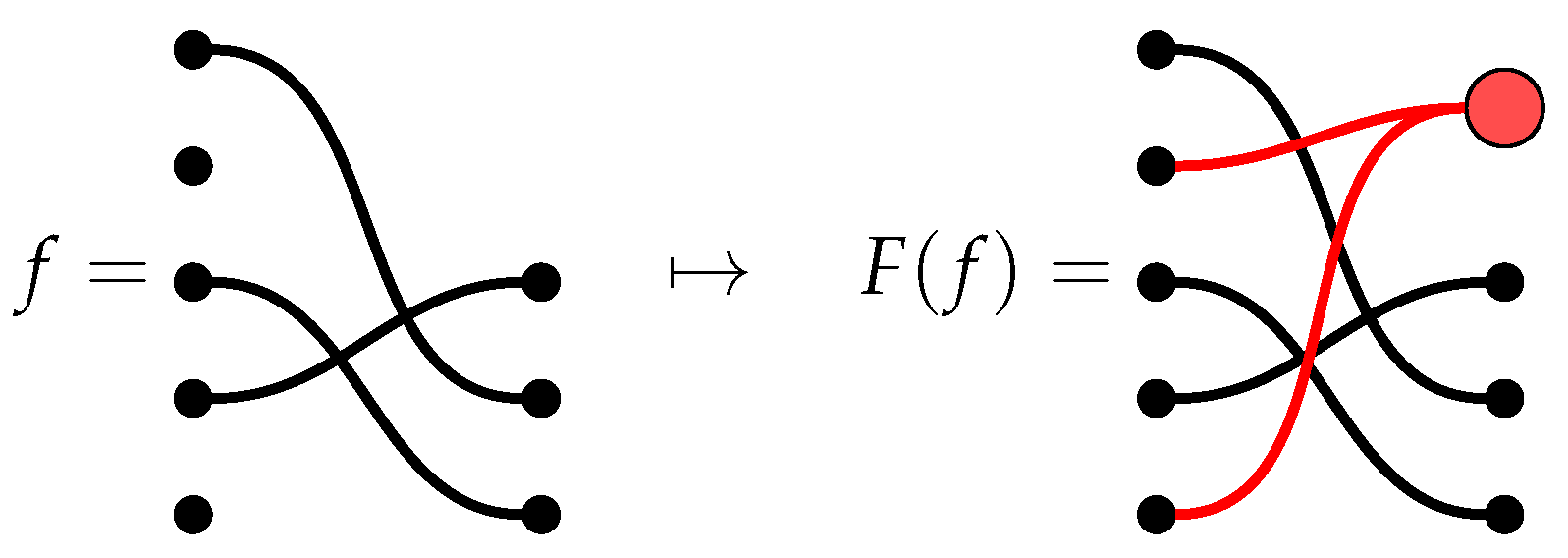
Note that in the above example, the 2 nodes on the left of not in the image of f are connected to the -blob on the right.
When , define the functor by the following data:
- for all .
- For all , let be the basis diagram with connections for each and all the remaining nodes on the left constitute the marked blocks.
Figure 5.
Example of .
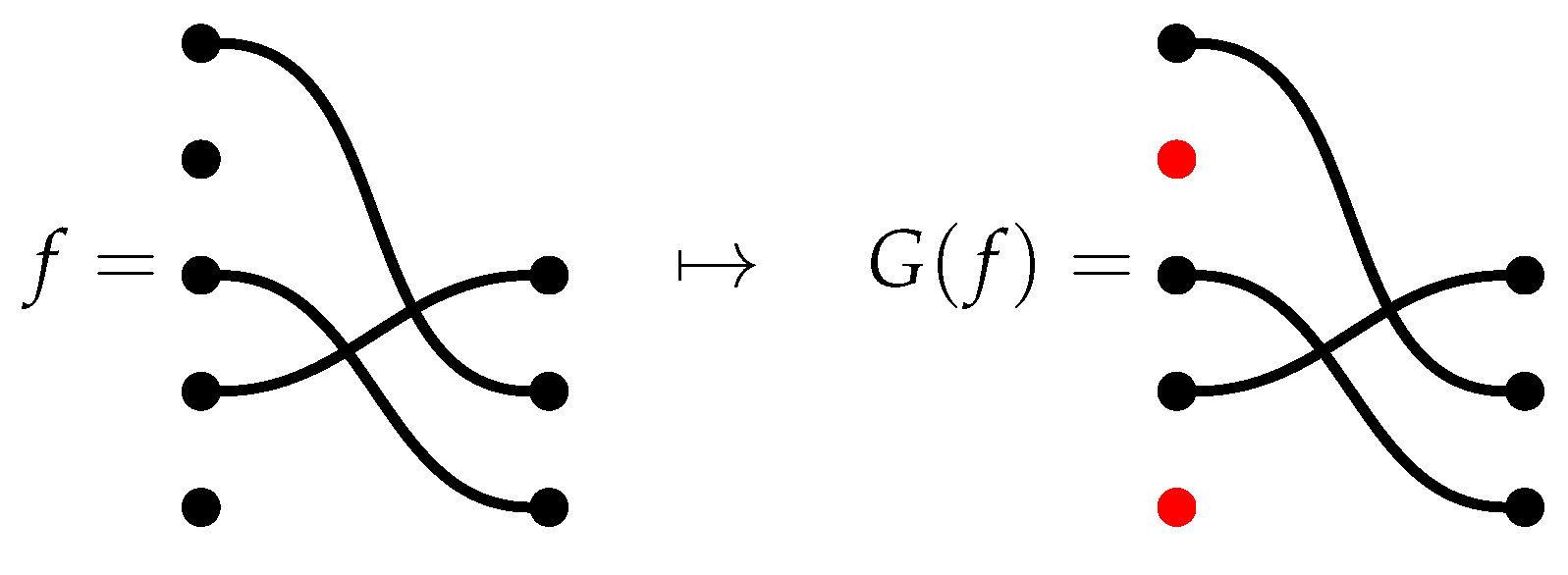
Note that in the above example, has marked blocks (colored red) in the form of two isolated nodes.
With these functors, any -module may be considered as an -module by pulling back along either F or G.
For all , we define the free -module by the following data:
- For all , is the free R-module generated on .
- The action of -morphisms is given by postcomposition; that is, for all , the induced map is defined by for all .
Our objective now is to demonstrate that the free -module is finitely generated as an -module. We start with the case when , for which we establish a quick lemma.
Lemma 1.
If , then any basis diagram has at least marked blocks consisting of a single node.
Proof.
Let b be the number of marked blocks in with a single node. For contradiction, assume . From [1]*Prop. 2.5, contains marked blocks. So there are another marked blocks in , each of which has at least two nodes. Together, these blocks must contain at least nodes, out of the nodes not already in a block. However, since and , it follows that , or equivalently, . So there are not enough nodes to fill all the blocks, a contradiction. □
Proposition 3.
For , is finitely generated as an -module.
Proof.
The result is immediate for ; suppose . We claim that is generated as an -module by basis diagrams of where .
First, we show that is generated by basis diagrams of . By Lemma 1, any basis diagram has at least marked blocks of size 1. Since has only m nodes on the right, there must be a marked block of size 1 on the left of .
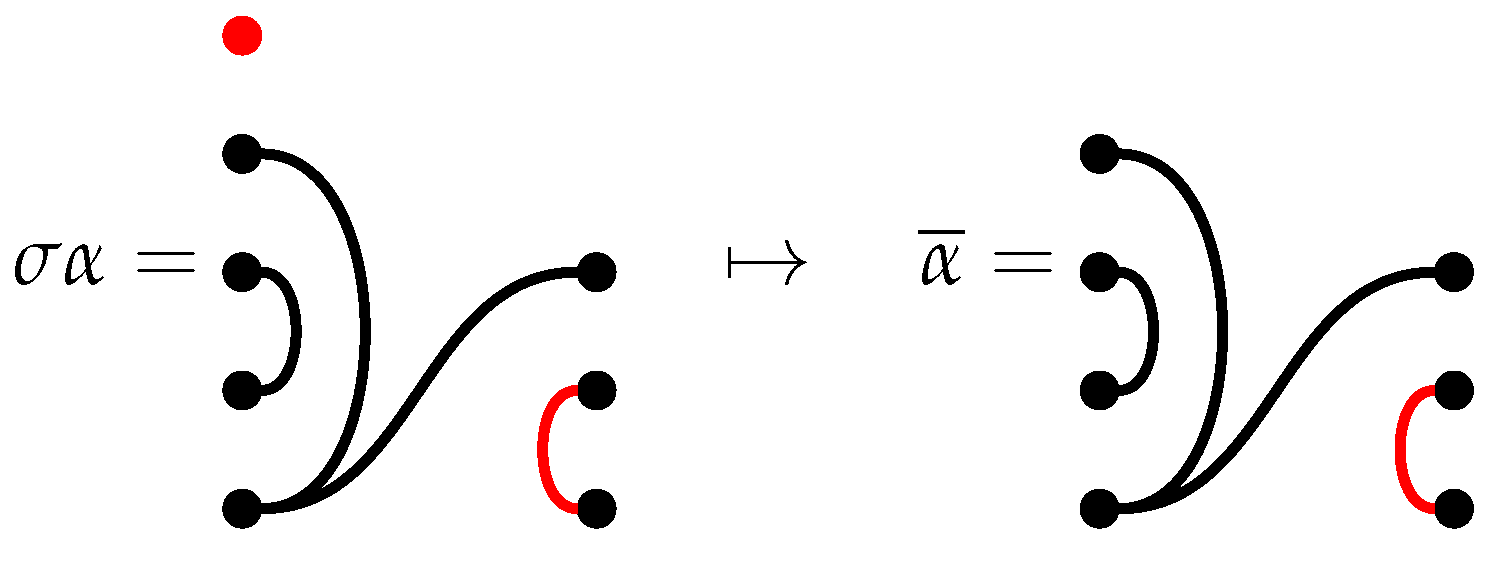
We can find such that has the singe-node marked block on the top left. Let be the inclusion map and be the diagram obtained from by removing the marked block on the top left (see below). Note that and , or equivalently .
Since , we have . Thus with . This implies that is generated by basis diagrams of .
A routine induction now shows that is generated as an -module by basis diagrams of with . Hence, is finitely generated as an -module. □
Figure 6.
.
We proceed to prove a similar result for other categories.
Lemma 2.
For , , or , if , any morphism of has at least a connection from the blob to some node on the left.
Proof.
By [1]*Prop. 2.3 and Propositions 1 and 2 above, any basis diagram of must have exactly connections to the blob. Since and we only have m nodes on the right, there has to be at least one connection from the node on the left to the blob. □
Proposition 4.
For , , or , the free -module is finitely generated as an -module for all .
Proof.
The case is straightforward; assume . We claim that is generated as an -module by basis diagrams of . Let be a basis diagram of . By Lemma 2, there is a connection from the blob to some node on the left of . Furthermore, we can find a such that the top left node of is connected to the blob. Let be the diagram obtained by deleting the top row of , and let be the inclusion map. We have , so that . This establishes the claim.
A standard induction argument then demonstrates that is generated as an -module by basis diagrams of where . □
Finally, we can prove the main result.
Theorem 2.
For , , , or , any finitely generated -module is Noetherian.
Proof.
Since any finitely generated -module V admits a surjection for some finite sequence of nonnegative integers , it suffices to show that is a Noetherian -module for all . Let W be a -submodule of , then W is also an -submodule. Propositions 3 and 4, combined with the local Noetherian property for [3]*Thm. A, establish that W is finitely generated as an -submodule. Consequently, W is also finitely generated as a -submodule, thereby demonstrating that is a Noetherian -module. □
References
- Patzt, P. Representation stability for diagram algebras. arXiv 2020. Available online: https://arxiv.org/abs/2009.06346v2. [CrossRef]
- Gan, W.L.; Ta, K. A noetherian criterion for sequences of modules. Archiv Der Mathematik 2024. [Google Scholar] [CrossRef]
- Church, T.; Ellenberg, J.S.; Farb, B.; Nagpal, R. FI-modules over Noetherian rings. Geom. Topol. 2014, 18, 2951–2984. [Google Scholar] [CrossRef]
Disclaimer/Publisher’s Note: The statements, opinions and data contained in all publications are solely those of the individual author(s) and contributor(s) and not of MDPI and/or the editor(s). MDPI and/or the editor(s) disclaim responsibility for any injury to people or property resulting from any ideas, methods, instructions or products referred to in the content. |
© 2025 by the authors. Licensee MDPI, Basel, Switzerland. This article is an open access article distributed under the terms and conditions of the Creative Commons Attribution (CC BY) license (https://creativecommons.org/licenses/by/4.0/).
Copyright: This open access article is published under a Creative Commons CC BY 4.0 license, which permit the free download, distribution, and reuse, provided that the author and preprint are cited in any reuse.


