
Submitted:
28 January 2025
Posted:
29 January 2025
You are already at the latest version
Abstract
Public sector employees face the profound impact of digital work demands, especially with the advancement of China's digital government construction. This study explores the dual-edged consequence of digital job demands on the work behaviors of public sector employees in China by constructing a dual-path model. Structural equation modeling (SEM) was used to validate the data of 873 public sector employees. This study found that digital job demands increase civil servants' thriving at work, facilitating their job crafting behaviors and increasing their workplace anxiety, leading to their work withdrawal behavior. Furthermore, this study validates the moderating effects of promotion and preventive focus. This study provides managers in the public sector with valuable insights to develop digital job demands managing strategies and for civil servants to adapt their perceptions and behaviors in the digital context.
Keywords:
Digitization-oriented job demands
; Thriving at work
; Workplace anxiety
; Job crafting
; Job withdrawal
; Regulatory focus
1. Introduction
In light of the growing prevalence of digital technology adoption, organizations are embracing technological digital innovations to enhance organizational value [1]. An organization's digital transformation hinges on its members' proficiency [2]. Employees must exhibit greater degrees of creative thinking and computer technical expertise in this setting. In this context, the organizational demands for employees to master digital skills can be defined as digitization-oriented job demands. It has been demonstrated that when perceived as a form of pressure, job demands can considerably influence employees' psychological processes and behavioral responses [3]. In the contemporary era, the rapid iteration and continuous application of digital technologies in organizations have resulted in a more direct and pronounced impact of digitization-oriented job demands on employees [4]. Furthermore, it's critical to recognize that technology has social characteristics and that human workers are essential to its use and interaction [5]. Consequently, employee factors should be a primary consideration when confronted with digitization-oriented job demands [6].
In conclusion, two significant viewpoints of how businesses implementing digital technology affect their workforces come to light. One asserts that prolonged exposure to technology may foster positive attitudes and behaviors [3], including enhanced employee agility [7], innovativeness [8], and other beneficial outcomes [9]. The other proposes that employees may also experience insecurity, incapacity, and stress when confronted with the multifaceted skills and knowledge associated with information technology [9]. This can manifest as a reduction in job resilience [4]. Furthermore, feelings of loneliness have been linked to an increase in negative behaviors such as off-duty insomnia and alcohol consumption [10]. Both work withdrawal and job crafting are significant behaviors that can substantially impact organizational and employee growth [11,12]. The work environment, the work nature itself, and the traits of the individual employee all affect the previously listed aspects [4]. The extant literature suggests that changes in job characteristics and the work environment can encourage specific job crafting behaviors [13] but could also result in a rise in work-related disengagement behaviors. [14]. These studies provide valuable references for our innovative research combining digitalization and employee job demands. The two voices, however, do not communicate well, and a unified vocabulary regarding the overall effects of organizational digitization-oriented job demands on employees has not yet been established [4]. Therefore, this study’s primary objective is to examine how employment expectations associated with digitization affect employee behavior in two ways.
In China, due to the nature of government work and the construction of a digital government, public sector employees will probably be required to undertake a more significant proportion of digitally-oriented tasks. On the one hand, the core duties of workers in the public sector are typically more monotonous and repetitive [15], and the positive impact of digital technology in addressing such job demands is more evident. Conversely, based on the vertical leadership structure of the public sector in China [4], the responsibility for the construction of digital government is distributed vertically to lower levels of government. Consequently, the public sector and its employees must incorporate greater digital effectiveness into their performance. This is accompanied by increased demand, a lack of flexibility in employees' digital work, and a more pronounced negative impact of digitization-oriented job demands.
This study uses the conservation of resources (COR) Theory[16,17] to explain how employee behavior is affected by job expectations that are focused on digitization and the underlying mechanisms. When individuals possess resources, they are motivated to protect what they already have and acquire additional ones. They will defend their resources by taking defensive action [15]. Digitization-oriented job demands facilitate continuous learning and adaptation to new technologies and tools, incentivizing employees to acquire additional knowledge and skills [5], enhance efficiency, and gain more opportunities, collectively contributing to higher thriving at work and a greater likelihood of positive work behaviors [4]. Conversely, it may also result in negative employee behavior aimed at protecting limited resources [5]. Adapting to digitization-oriented job demands, some employees experience difficulties doing so rapidly [15]. They may feel depleted and anxious about the resources at their disposal and may perceive the demands placed upon them as a threat or a potential loss of resources. This may result in the display of defensive attitudes and behaviors [18]. Considering the findings above, this study's second goal was to explore how workplace anxiety and thriving at work mediate the relationship between employee behavior and digitization-oriented job demands.
According to the regulatory focus theory, there are notable discrepancies in the attitudes and behavioral processes individuals adopt in response to external stimuli [19]. When confronted with the same task, individuals with a promotion regulatory focus experience greater emotional pleasure, seek progress and growth, and strive to alter the status quo to achieve success [4]. On the other hand, people with a preventative emphasis are more focused on emotional safety, are afraid of bad things happening, and prefer to keep things the way they are to avert losses [20]. Consequently, when confronted with digitization-oriented job demands, employees with different regulatory focuses will develop different attitudes and behaviors [4]. According to the current study, individuals focused on promotions frequently perceive job responsibilities related to digitalization as brutal. Additionally, they focus more on good things that happen and feel like they are succeeding at work [4], are more enthusiastic about continuing to learn and progress, and are prone to engage in job crafting behaviors. However, individuals who prioritize prevention are more likely to view it as a problematic pressure to handle, which can evoke unpleasant feelings like anxiety, dread, and fear [4]. Avoidance behaviors may ensue from this, which could exacerbate work withdrawal [4,21]. Therefore, the current research's third objective was to examine the possible dual impact of job expectations centered upon digitization on employee behavior, emphasizing the moderating role of regulatory focus.
The current work significantly advances our understanding of theory and practice. Theoretically, the study creates a new dual-path framework for examining how employment expectations focused on digitalization affect employees' psychology and behavior. From a pragmatic perspective, the study provides valuable suggestions to help managers and organizations better grasp the precise effects of job demands driven by digitalization on workers and improve management tactics for encouraging digital adoption.
2. Literature Review and Hypotheses Development
2.1. Job Crafting and Work Withdrawal Behaviors as a Result of Digitization-Oriented Job Demands
Job demands require sustained effort and skills to perform different aspects of a job [22]. These demands can be further characterized as the necessity to update job skills and improve work competencies in light of social and organizational changes, as well as the need to work quickly and hard to finish tasks under high stress and performance expectations [23]. The term "digitization-oriented job demands" is defined as the need for employees to possess specific digital skills [24] to adapt to digital changes within the organization's structure, functions, processes, and mode of operation [25]. "job crafting" refers to people's behaviors to change the relational, cognitive, and physical bounds of work duties to improve their resilience, engagement, and thriving at work [26]. As posited by Petrou et al. (2012), job crafting can be conceptualized as the strategies that individuals reshape their jobs by identifying and leveraging job resources and challenges to enhance their well-being, motivation, and adaptability in the workplace [27]. The term "work withdrawal behaviors" refers to actions taken by employees to keep a psychological or physical distance from their activities and work environment. Integrating digital technologies into the workplace can be valuable for improving workflow management. However, it can also negatively influence employees' work behaviors due to the high demands and stress associated with such technologies [28]. The advent of digitized technology has facilitated convenient access to information, expedited the completion of repetitive and tedious tasks [9], and enhanced work adaptability, improving employee work efficiency, quality, and timeliness [15]. Nevertheless, meeting these demands necessitates time and effort from employees, with some embracing the challenge and others experiencing the adverse effects. To navigate the skills and knowledge related to the new upgrades in information technology [9], individuals may experience stress, anxiety, uncertainty, and incapacity. This can lead to disengaged behaviors like work withdrawal.
According to the COR theory, people are motivated to acquire additional resources and protect those already existing [17]. Individuals are encouraged to invest in themselves and develop more resources when they have them. On the other hand, they will use defensive tactics to protect their current resources when faced with resource depletion [29]. According to COR theory, employment demands focused on digitization can help create a gain path, allowing workers to learn and adjust to new tools and technology continuously. As a result, workers may be inspired to learn more new skills and information. Furthermore, employees with digital competencies will possess many advantages in the workplace, including increased productivity, higher job satisfaction, greater access to opportunities, and a greater likelihood of exhibiting positive work behaviors [4]. Conversely, digitization-oriented job demands can also harm employees' roles and functions through attrition pathways, depleting employees' resources and leading to negative behaviors aimed at protecting limited resources [5]. In response to digitization-oriented job demands, some employees experience difficulty adapting promptly [30]. They tend to regard the demands as a threat or a potential loss of resources, thereby displaying defensive attitudes and behaviors [18]. This research proposes a two-way model (i.e., gain path and loss path) to clarify how digitization-oriented job demands impact employees' work behaviors, considering the conclusions above. We put out the following theories considering the analysis above:
H1a.
Digitization-oriented job demands and job crafting present a positive correlation.
H1b.
Digitization-oriented job demands and work withdrawal present a positive correlation.
2.2. Resource Enrichment Pathways - The Mediating Role of Thriving at Work
The phrase "thriving at work" refers to an individual's level of learning and vitality within the framework of their job. A sense of learning (i.e., a gain in understanding and knowledge) and a sense of vitality (i.e., an increase in energy) [31] are indicators of development and motivation experienced by an individual thriving at work. A good emotional state typified by a sensation of usable energy and a perception of vigor [32] is known as vitality. On the other hand, learning is a cognitive and affective state where knowledge and skills are acquired and applied [33]. Achieving positive job outcomes requires both learning and energization. Workers who lack motivation but are nevertheless dedicated to learning may feel worn out or exhausted. On the other hand, those driven to work but do not have access to learning and development opportunities are more likely to stagnate [30]. Employees flourishing at work are more engaged, focused, and inclined to act better for the company as a whole[34]. However, little study has been done on how thriving at work affects job crafting behaviors in workplaces where workers must deal with demands related to digitalization.
In conjunction with the COR, we put forth the proposition that digitization-oriented job demands have the potential to enhance employees' thriving at work through gainful mechanisms. Firstly, digitization-oriented jobs demand that employees be provided with the necessary skill resources to utilize digital tools to complete tasks more expediently and efficiently, thereby enhancing the sense of vitality in work prosperity. Furthermore, this allows more time dedicated to other, more meaningful, and valuable tasks and increases opportunities for continuous learning [4,7]. Secondly, in organizational demands for digital work skills, digitally literate employees can assume control of their work and develop solutions, enhancing employee autonomy at work [35]. Thirdly, in digitization-oriented job demands, changes in the work environment are reflected in organizations expecting employees to acquire more digital skills and tools [24,25]. Employees perceive this as an opportunity for growth at work.
Employees can experience great feelings from learning new skills by interacting with digital technologies and intelligent machines [4]. This can inspire them to investigate new fields and drive them to further their career development. To sum up, the need for digital competency in the workplace involves using digital technologies to access information, giving workers access to a wealth of resources and data. This enhances their ability to work and confidence in making informed decisions, reinforcing positive experiences and increasing their sense of control [5].
Furthermore, it may be concluded that job crafting habits among employees are positively impacted by thriving at work. When combined with COR, thriving at work reduces resource consumption, allows employees to acquire personal resources, and boosts intrinsic motivation [16,17]. First, workers who have a strong feeling of thriving at work exhibit resilience and adaptive functioning, which empowers them to react positively to changes in the workplace and make the required corrections [31]. In digitization-oriented job demands, prosperous employees are more inclined to mobilize resources and continue to learn and master digital work skills to adjust their work behaviors and content [4]. This is an essential element of job crafting behavior. Secondly, acquiring digital technologies affords employees greater access to new knowledge, information, and other resources, promoting previous job crafting behaviors, enhancing confidence in making a positive impact, and driving innovation in the workplace [8]. Ultimately, thriving at work fosters the creation of a positive state of health and a positive emotional experience [31], thereby providing employees with a valuable resource for navigating the challenges of the modern workplace. Furthermore, digitization-oriented job demands help employees cope with the stresses and challenges that come with the demands of a digitized workplace. Additionally, they help people broaden their focus, thinking, and action [34], which allows them to participate in constructive work crafting activities. Research has indicated that workers who are financially content with their jobs are likelier to exhibit increased concentration and attentiveness when working. These people are likelier to have the drive and energy to sustain their focus and attention span [34,36,37]. We put out the following hypothesis considering the analyses above:
H2a.
Thriving at work mediates the relationship between digitization-oriented job demands and job crafting.
2.3. Resource Loss Pathways - The Mediating Role of Workplace Anxiety
The feeling of unease and apprehension brought on by a perceived threat in an organizational context is known as workplace anxiety, and it shows up as a stress reaction with tension as the primary symptom [38]. It has been shown that task features and workplace anxiety are related [5] in government agencies undergoing digital change [4]. Job demands focused on digitalization highlight the need for workers to be innovative and constantly study to become proficient in various digital technologies [39]. Employees may feel under pressure to adjust quickly and successfully [40], which could lead to negative feelings of worry and job insecurity [4]. According to a recent study, 51% of workers find it difficult to adjust to their companies' quick adoption of digital technologies, which is associated with negative emotions such as anxiety [41].
The present study posits that digitization-oriented job demands may increase employees' workplace anxiety via the resource depletion pathway of resource conservation theory [16,29]. Firstly, digitization-oriented job demands may be perceived as a burden regarding the resources they demand [42]. Governments' utilization of digital technologies has led to the expectation that civil servants will possess a certain level of digital proficiency [43]. To meet the increased demands of their jobs, workers must devote a substantial amount of time and effort to learning the requisite skills and adjusting to new tools and technology [4]. This inevitably results in the consumption of a significant number of personal resources, which can subsequently give rise to feelings of anxiety. Second, employment demands could become a source of stress for workers if they cannot meet digitization-oriented demands or do not have the necessary resources to recover from their efforts [39]. According to COR theory, workplace stressors may result in the development of negative emotions such as anxiety [39]. Ultimately, specific alterations in the working environment may precipitate further stress, thereby depleting employees' physical and psychological resources and intensifying their psychological distress [44]. The advent of digitization-oriented job demands has undoubtedly transformed the traditional nature of work, engendered heightened uncertainty, and changed employees' work. The work environments and job content of civil servants are becoming increasingly challenging and demanding[6], which may impose a psychological burden on employees, depleting psychological resources and increasing workplace anxiety [10].
It can also be deduced that work withdrawal behavior and workplace anxiety are positively correlated. Consistent with COR theory [16,29], workplace stressors have the potential to engender negative emotional states such as anxiety [39] and even result in the depletion of an individual's emotional resources [45]. Anxiety serves as an indicator of stress symptoms and resource depletion, signifying resource depletion to individuals [5]. According to COR, individuals will activate their resource defense mechanisms when faced with resource loss. Minimizing resource loss leads people to conserve their current resources by decreasing proactive behaviors and increasing withdrawal behaviors [10,39,46]. Therefore, when confronted with digitization-oriented job demands, individuals may perceive a scarcity of resources and consequently reduce their investment of resources in their jobs, which may result in an increase in work withdrawal behaviors and a decrease in job crafting behaviors. Additionally, studies have shown a link between lousy job practices and workplace anxiety [38]. Anxiety at work makes workers avoid difficult situations and hinders their ability to absorb information, making them more likely to see unclear situations as dangerous [5]. This tendency increases reactive behaviors in the workplace and reduces organizational loyalty. In conclusion, this study put up the following theories:
H2b.
Work anxiety mediates the relationship between digitization-oriented job demands and work withdrawal.
2.4. The Moderating Role of the Regulatory Focus
Individuals can adapt to changing environments by continually adjusting their cognitive processes and behaviors to reduce the discrepancy between their perceived reality and their desired outcomes, thereby achieving their goals. This process is known as self-regulation [47]. Individuals adopt a specific approach or tendency to self-regulate in pursuit of goals, namely regulatory focus. This is a significant personality characteristic that emerges gradually as people mature. The notable variations in how people react to external stimuli in their behavior indicate this. This further details the traits of people's propensity to avoid injury and gain[19,48]. The various objectives and requirements of people serve as the basis for the classification of regulatory focus. These fall into two categories: preventative focus, which is about safety [49], and promotion focus, which is about progress. For instance, people with a promotion regulatory focus are motivated by the desire for emotional fulfillment, show a higher tendency for advancement, success, and development, and are more likely to succeed by having a significant influence rather than by avoiding failure [4]. People with a preventative focus are worried about accountability, safety, and protection. They prefer to keep things as they are to reduce losses since they are more sensitive to unfavorable consequences [20]. The regulatory focus theory states that a person's regulatory focus is context-sensitive, which means it is affected by the work or circumstance at hand [50,51]. Therefore, Employees' regulatory focus shifts in response to shifting job demands when faced with digitization-oriented ones[4]. Furthermore, studies have shown that regulatory focus affects people's psychological functions, such as mood, memory, and attention, as a motivational variable. Disparate emotional experiences and work actions follow from this [52,53].
Digital work demands can be considered a source of pressure and challenge within a specific context and task. Promotion-focused people are more confident in handling the demands of digitization-oriented jobs and tend to view them as tricky [20,47]. They are more likely to feel like they are thriving at work, more engaged, and more aware of positive events [4]. Additionally, people focused on promotion tend to pay attention to facts or experiences linked to favorable results. They can also actively mobilize or seek out advantageous resources 52 to accomplish desired results. Consequently, people with a promotion emphasis are more motivated and enthusiastic about learning new digital skills and knowledge in the context of digitally oriented job needs, which improves their ability to construct a job. As a result, this study puts forth the following hypothesis:
H3a:
Promotion focus moderates the relationship between digitization-oriented job demands and thriving at work. The positive impact of digitization-oriented job demands on thriving at work is more substantial when the promotion focus is higher.
H4a:
Promotion focus moderates the mediating effect of thriving at work in the positive relationship between digitization-oriented job demands and job crafting. The mediating effect of thriving at work between digitization-oriented job demands and job crafting is more substantial when the promotion focus is higher.
In contrast, individuals with a prevention focus are more likely to experience negative emotions when faced with specific work situations and tasks [4]. Specifically, when confronted with digitization-oriented job demands, they are more likely to perceive the situation as stressful and challenging, which may result in negative emotions such as fear, dread, and anxiety [4]. Secondly, prevention-focused employees, when influenced by negative emotions such as anxiety, tend to either avoid measures or engage in negative behaviors such as work withdrawal. This contrasts proactive engagement with organizational goals, a characteristic of individuals with a promotion-focused mindset [47]. Finally, individuals with a prevention-focused orientation are more concerned with the potential consequences of failure to meet demands and are particularly sensitive to adverse outcomes. This sensitivity can manifest as a lack of energy or reluctance to learn new digital technologies, which may lead to increased work withdrawal behaviors [4,21,39]. Therefore, we propose the following hypothesis:
H3b.
The association between digitization-oriented job expectations and workplace anxiety is moderated by a prevention focus. The positive effect of digitization-oriented job demands on workplace anxiety is more substantial when the prevention focus is higher.
H4b.
The positive association between work withdrawal and digitization-oriented job expectations is mediated by workplace anxiety, which is moderated by a prevention focus. The mediating effect of workplace anxiety between digitization-oriented job demands and work withdrawal is more substantial when the prevention focus is higher.
3. Methods
3.1. Sample and Collection
A questionnaire based on an online survey was distributed to fellow MPA students at universities in Southwest China to recruit civil servants interested in this study. These students then disseminated the questionnaire through snowball sampling, contacting colleagues interested in participating in the study.
This study used a three-wave data collection strategy with two-week gaps between waves to lessen the possible impact of common methodological bias. The mobile phone numbers of the participants were used to match the three sets of surveys. 1,122 questionnaires were received, with 873 deemed valid and representing a valid response rate of 77.81%. This figure excludes incomplete questionnaires, defined as those exhibiting a consistent response pattern and those not matching. The demographic variables, or control variables, are described by the specifications in Table 1.
3.2. Measures
Mature scales were used to measure all variables, and all English scale items were translated into Chinese utilizing a back-translation process in this study. A 5-point Likert scale was used for scoring.
A six-item scale was used to evaluate the digitization-oriented job demands [54]. The regulatory focus was measured using the scale developed by Wallace (2009) et al [55]. There are 12 items on the scale, six representatives, and a focus on prevention and promotion. The workplace anxiety was assessed using an 8-item scale[56]. The Thriving at work was assessed using a 10-item scale[36], the work withdrawal was evaluated using a 12-item scale[57], and the job crafting was assessed using a 6-item scale[58]. The internal consistency coefficients for all scales exceeded 0.7, as detailed in Table 3. This indicates that the selected scales exhibited good reliability. The titles of each scale are provided in Appendix A.
3.3. Data Analysis
The data in this study were analyzed using Amos 24.0 and SPSS 27.0. SPSS 27.0 was used for descriptive statistical analysis, correlation analysis, and reliability testing. Amos 24.0 was used for hypothesis testing and validation factor analysis. Bias correction was applied using 2000 resamples and 95% CI to test and moderate mediation.
4. Results
4.1. Confirmatory Factor Analysis
Using a confirmatory factor analysis (CFA), the discriminant validity of the seven main components was evaluated. With χ2/df=2.72, p<0.001, CFI=0.98, TLI=0.97, RMSEA=0.03, SRMR=0.04, the results demonstrated that the suggested seven-factor model outperformed the other models (Table 2). Based on CFA, these results show that the proposed model is valid.
4.2. Common Method Bias
According to the findings of Harman's one-way analysis of variance, the first principal component factor explained 37.68 percent of the variance, which was less than 40 percent, and the unrotated exploratory factor analysis resolved seven factors, which accounted for 74.68 percent of the total variance explained. Furthermore, the fit superiority of the one-factor model is significantly lower than that of the seven-factor model, as Table 2 illustrates. The findings suggest that this study's common technique bias is insignificant.
4.3. Descriptive Statistics
The mean, standard deviation, and correlation between the research variables and the extracted combination reliability (CR) and average variance extracted (AVE) values are displayed in Table 3.
4.4. Hypothesis Testing
In Amos 24.0, this study used structural equation modeling to evaluate hypotheses. As anticipated, job crafting and digitization-oriented job demands had a positive correlation (B=0.41, p<0.001), supporting hypothesis 1a (Table 4). Work withdrawal was positively correlated with digitization-oriented job demands (B=0.30, p<0.001), supporting hypothesis 1b. The current study employed the conditional indirect effects procedure by Preacher et al. (2010) et al. to confirm the mediation effect of workplace anxiety and thriving at work. Hypothesis 2a was supported by the significant indirect influence of digitization-oriented job demands on job crafting through thriving at work (indirect effect = 0.07, 95% CI = [0.03, 0.15]). Hypothesis 2b was supported by the significant impact of digitization-oriented job demands on work withdrawal through workplace anxiety (indirect effect = 0.14, 95% CI = [0.10, 0.20]).
Table 4 shows the moderating effects of prevention and promotion focus. According to Table 4, the interaction term between digitization-oriented job demands and promotion focus positively correlated with thriving at work (B=0.15, p<0.001). Furthermore, Figure 3 shows that the positive correlation between digitization-oriented job demands and thriving at work became stronger at high promotion focus (B=0.10, p<0.001) compared to the positive correlation between digitization-oriented job demands and thriving at work at low promotion focus (B=0.05, p<0.05), which supports Hypothesis 3a. Furthermore, there was a significant moderating mediator index (B=0.02, p<0.05, 95% CI= [0.01, 0.04]). There was support for hypothesis 4a. Workplace anxiety was positively connected with the interplay between preventative focus and digitization-oriented job demands (B=0.07, p<0.05). Additionally, Figure 2 supports Hypothesis 3b by demonstrating that the positive association between digitization-oriented job demands and workplace anxiety increased at high prevention focus (B=0.16, p<0.001) in contrast to the positive correlation at low prevention focus (B=0.12, p<0.001). Furthermore, there was a significant moderator-mediator index (B=0.02, p<0.001, 95% CI= [0.00, 0.04]). There was support for hypothesis 4b.

Table 5.
Bootstrapping results for testing mediation effect and moderated mediation effect.
| Moderator: PO | JD→TW→JC | ||
|---|---|---|---|
| B | SE | 95% Boot CI | |
| Indirect effect | 0.07** | 0.02 | [0.03, 0.15] |
| Direct effect | 0.41*** | 0.04 | [0.33, 0.48] |
| High(+PE) | 0.10*** | 0.03 | [0.04, 0.15] |
| Low(-PE) | 0.05** | 0.02 | [0.02, 0.09] |
| Index | 0.02** | 0.01 | [0.01, 0.04] |
| Moderator: PE | JD→WA→WD | ||
| B | SE | 95% Boot CI | |
| Indirect effect | 0.14*** | 0.02 | [0.10, 0.20] |
| Direct effect | 0.30*** | 0.02 | [0.25, 0.34] |
| High(+PE) | 0.16*** | 0.02 | [0.11, 0.21] |
| Low(-PE) | 0.12*** | 0.02 | [0.08, 0.16] |
| Index | 0.02** | 0.01 | [0.00, 0.04] |
Note. B Path coefficients; SE=Standardized errors; CI that excludes zero indicates that the indirect effects are significant; Path coefficients are standardized; Number of bootstrap samples is 2000; Level of confidence is 95%; Low refers to one standard deviation below the mean of the moderator; high refers to one standard deviation above the mean of the moderator; **p < .01; ***p < .001.
5. Discussion
5.1. Theoretical Contributions
The present study contributes to existing theoretical frameworks in the following ways.
First, a digital viewpoint was used to investigate how job expectations affected employee behavior. In the larger context of the digital age, the current research on the consequences of job demands on employees 44 has not adequately addressed the associated changes in job expectations and their impact on employees. Considering that work demands at the micro level would also alter due to the macro-level digital transformation, this study adds to the body of knowledge already available on the subject.
Secondly, this study employs the group of civil servants as the research object, verifying that digitization-oriented job demands will impact civil servants' behavior. Given the pivotal role of civil servants in enabling organizational digital transformation and fulfilling public service functions, it is imperative to direct attention toward their cognitive and behavioral responses to digitization-oriented job demands. Nevertheless, when extending the investigation of organizational digital technological innovation to the public sector, previous scholars have concentrated on its organizational-level impacts on departmental performance [15], managerial processes [24], and decision-making efficiencies [25] while disregarding human factors in the public sector, which is addressed by this study.
Thirdly, by addressing the discrepancies found in earlier research [39]and advancing a thorough comprehension of the opportunities and difficulties brought about by digitization-oriented job demands, this study illustrates the dual influence of these demands on the behavior of civil servants. Previous studies on how employees are affected when innovative and digital technologies are applied in organizations have produced contradictory or equivocal results [4,9,39,44]. On the other hand, by clarifying the comprehensive and complex effects of digitization-oriented employment demands, the current study goes beyond the constraints of previous research.
Finally, our study explains the different impact pathways of digitization-oriented job demands from resource depletion and gains perspectives, opens the black box of how digitization-oriented job demands affect employee behavior, and further validates the resource conservation theory [17]. Furthermore, our study illustrates that regulatory focus significantly influences employee work behavior and work outcomes [4,19,20], aligning with existing perspectives and reinforcing the tenets of the regulatory focus theory.
5.2. Practical Implications
Our study demonstrates that digitization-oriented job demands have a dual impact on employees. As has been shown, some employees experience difficulty in adapting to organizational digital changes and the corresponding changes in job skill demands [4,39], which can result in adverse reactions such as technology anxiety [5], job insecurity [44], and other adverse reactions. Therefore, public sector managers should pay attention to the comprehensive impact of digitization-oriented job demands [4] and put forward targeted digitization-oriented job demands based on job characteristics, employee traits, and so on to maximize the benefits of digitization-oriented job demands.
Secondly, public sector managers can further enhance employees' sense of thriving at work [39] and reduce anxiety about digitization-oriented job demands by providing requisite resources [36], thereby strengthening the gain path of digitization-oriented job demands and weakening its resource loss path. For instance, comprehensive digital skills training [59], the provision of requisite hardware support for digitization-oriented job demands, and attention paid to employees' negative emotions and channeling these emotions to enhance employees' competence in digitization-oriented job demands are examples of ways to strengthen the gain path of digitization-oriented job demands.
Furthermore, our study revealed that employees' supervisory focus significantly determines their response to digitization-oriented job demands. Managers should be able to identify and screen employees with a high emphasis on promotion [60] and place them in positions that demand high levels of digital competence. Concurrently, managers should consider strategies to enhance the promotion focus for employees who are preoccupied with prevention.
It is also noteworthy that employee relations are influenced by the presence of work stress [2]. It is incumbent upon public sector managers to encourage those employees who are more adaptable and competent to embrace the demands of digital work, to take the initiative to assist their colleagues, and to foster a culture of support. It is also noteworthy that younger employees are more likely to display positive emotions and behaviors when confronted with the challenges of digital work than their older counterparts. Consequently, it would be prudent to foster a culture of knowledge sharing among younger employees and structure work that aligns with their age-specific characteristics.
5.3. Limitations and Future Research
It is recommended that future research address the following limitations of the present study.
First, employee self-reports were used to determine every variable in this study. Harman's one-factor test might not have adequately solved this problem despite being used to combat CMV. Future research would benefit from using more scientific measures to improve the data's robustness. Second, influencing employees' psychological and work-related behaviors in the digital workplace requires the use of a variety of psychological mechanisms. The current study examined how workplace anxiety and prospering impacted employees' job crafting and withdrawal behaviors. Additional work practices and other ways job expectations impact employees in the digital world could be the subject of future research. In summary, the current study did not look at other possible moderators and instead focused on the moderating effect of defensive/facilitative moderating focus at the person level. Future studies might benefit from looking at the moderating effects of team-level (such as helpful behaviors) and organizational-level (such as leader support) factors on the connection between employee behaviors and digitization-oriented job expectations.
Appendix A
Digitization-oriented job demands (Janssen, 2000)
- I must work in a timely and efficient manner to facilitate my organization's adaptation to the digital age.
- The volume of work required due to digital changes is considerable.
- The effort required to complete tasks related to digital-oriented changes is approximately double that which would otherwise be necessary.
- I am required to complete digitization-related tasks within a minimal timeframe.
- I consider the working environment to be less than ideal for meeting the demands of digitalization.
- I am responsible for dealing with a large backlog of work related to digital change.
Thriving at work (C. Porath et al., 2012)
- At work, I find myself learning often.
- I continue to learn more at work as time goes by.
- At work, I see myself continually improving.
- At work, I am learning.
- At work, I have developed a lot as a person.
- At work, I feel alive and vital.
- At work, I have energy and spirit.
- At work, I do feel very energetic.
- At work, I feel alert and awake.
- At work, I am looking forward to each new day.
Workplace anxiety (McCarthy et al., 2016)
- I am overwhelmed by thoughts of doing poorly at work.
- I worry that my work performance will be lower than others.
- I feel nervous and apprehensive about being unable to meet performance targets.
- I worry about not receiving a positive job performance evaluation.
- I often feel anxious that I cannot perform my job duties in the time allotted.
- I worry about whether others consider me to be a good employee for the job
- I worry that I will not be able to manage the demands of my job successfully.
- Even when I try as hard as possible, I still worry about whether my job performance will be good enough.
Work withdrawal (Lehman & Simpson, 1992)
- I have absenteeism at work.
- I will talk about non-work topics with colleagues at work.
- I have left work for unnecessary reasons.
- I daydream at work.
- I spend work time on personal matters.
- I put less effort into my work than I should.
- I have thoughts of leaving my job.
- I want someone else to do my job.
- I have left work early without permission.
- I have taken lunch or breaks longer than allowed.
- I have taken supplies or equipment without permission.
- I have fallen asleep on the job.
Job crafting (Leana et al., 2009).
- I will take it upon myself to introduce new methods and improve work procedures.
- I will change work procedures that I consider to be unproductive and of secondary importance
- I will seek to change my working methods to make myself more relaxed.
- I tend to rearrange the equipment in my work area by myself.
- I will organize special events at work (e.g., birthday celebrations for colleagues)
- I will bring my additional materials from home for the job.
Promotion focus (Wallace & Chen, 2006)
- I get many things done at work
- I get my work done no matter what
- I can get much work done in a short period
- I am passionate about work activities that make me successful
- I strive to achieve work accomplishments
- I recognize how many tasks I can complete
Prevention focus (Wallace & Chen, 2006)
- I comply with rules and regulations as much as possible.
- I prefer to do my work tasks correctly.
- I try to fulfill my obligations at work to the best of my ability.
- I pay attention to my job responsibilities.
- I try to fulfill my work obligations.
- I care about the details of my work.
References
- Chen:, N. : Zhao: X.; Wang, L. The Effect of Job Skill Demands under Artificial Intelligence Embeddedness on Employees’ Job Performance: A Moderated Double-Edged Sword Model. Behav. Sci. 2024, 14, 974. [Google Scholar] [CrossRef]
- Ghi, T.; Thu, N.; Huan, N.; Trung, N. Human Capital, Digital Transformation, and Firm Performance of Startups in Vietnam. Management 2022, 26, 1–18. [Google Scholar] [CrossRef]
- Hou, Y.; Fan, L. Working with AI: The Effect of Job Stress on Hotel Employees’ Work Engagement. Behav. Sci. 2024, 14, 1076. [Google Scholar] [CrossRef]
- Liu, P.; Zhang, F.; Liu, Y.; Liu, S.; Huo, C. Enabling or Burdening?-The Double-Edged Sword Impact of Digital Transformation on Employee Resilience. Comput. Hum. Behav. 2024, 157, 108220. [Google Scholar] [CrossRef]
- Liu, Y.; Li, Y.; Song, K.; Chu, F. The Two Faces of Artificial Intelligence (AI): Analyzing How AI Usage Shapes Employee Behaviors in the Hospitality Industry. Int. J. Hosp. Manag. 2024, 122, 103875. [Google Scholar] [CrossRef]
- Parker, S.K.; Grote, G. Automation, Algorithms, and beyond: Why Work Design Matters More than Ever in a Digital World. Appl. Psychol. 2022, 71, 1171–1204. [Google Scholar] [CrossRef]
- AlNuaimi, B.K.; Kumar Singh, S.; Ren, S.; Budhwar, P.; Vorobyev, D. Mastering Digital Transformation: The Nexus between Leadership, Agility, and Digital Strategy. J. Bus. Res. 2022, 145, 636–648. [Google Scholar] [CrossRef]
- Riaz, S.; Xu, Y.; Hussain, S. Understanding Employee Innovative Behavior and Thriving at Work: A Chinese Perspective. Adm. Sci. 2018, 8, 46. [Google Scholar] [CrossRef]
- Ingusci, E.; Signore, F.; Giancespro, M.L.; Manuti, A.; Molino, M.; Russo, V.; Zito, M.; Cortese, C.G. Workload, Techno Overload, and Behavioral Stress during COVID-19 Emergency: The Role of Job Crafting in Remote Workers. Front. Psychol. 2021, 12, 655148. [Google Scholar] [CrossRef]
- Tang, P.M.; Koopman, J.; Mai, K.M.; De Cremer, D.; Zhang, J.H.; Reynders, P.; Ng, C.T.S.; Chen, I.-H. No Person Is an Island: Unpacking the Work and after-Work Consequences of Interacting with Artificial Intelligence. J. Appl. Psychol. 2023, 108, 1766–1789. [Google Scholar] [CrossRef]
- Bakker, A.B.; de Vries, J.D. Job Demands-Resources Theory and Self-Regulation: New Explanations and Remedies for Job Burnout. ANXIETY STRESS COPING 2021, 34, 1–21. [Google Scholar] [CrossRef]
- Rosse, J.G.; Hulin, C.L. Adaptation to Work: An Analysis of Employee Health, Withdrawal, and Change. Organ. Behav. Hum. Decis. Process. 1985, 36, 324–347. [Google Scholar] [CrossRef]
- Leana, C.; Appelbaum, E.; Shevchuk, I. Work Process and Quality of Care in Early Childhood Education: The Role of Job Crafting. Acad. Manage. J. 2009, 52, 1169–1192. [Google Scholar] [CrossRef]
- Zhang, J.; Su, D.; Smith, A.P.; Yang, L. Reducing Work Withdrawal Behaviors When Faced with Work Obstacles: A Three-Way Interaction Model. Behav. Sci. 2023, 13, 908. [Google Scholar] [CrossRef]
- Chatterjee, S.; Chaudhuri, R.; Vrontis, D.; Giovando, G. Digital Workplace and Organization Performance: Moderating Role of Digital Leadership Capability. J. Innov. Knowl. 2023, 8, 100334. [Google Scholar] [CrossRef]
- Hobfoll, S.E. Conservation of Resources: A New Attempt at Conceptualizing Stress. Am. Psychol. 1989, 44, 513–524. [Google Scholar] [CrossRef]
- Hobfoll, S.E. Conservation of Resources and Disaster in Cultural Context: The Caravans and Passageways for Resources. Psychiatry Interpers. Biol. Process. 2012, 75, 227–232. [Google Scholar] [CrossRef]
- Wu, J.; Gong, X.; Liu, Y. Research on the Influence Mechanism of Employees’ Innovation Behavior in the Context of Digital Transformation. Front. Psychol. 2022, 13, 1090961. [Google Scholar] [CrossRef]
- Lanaj, K.; Chang, C.-H. “Daisy”; Johnson, R.E. Regulatory Focus and Work-Related Outcomes: A Review and Meta-Analysis. Psychol. Bull. 2012, 138, 998–1034. [Google Scholar] [CrossRef]
- Brenninkmeijer, V.; Demerouti, E.; Le Blanc, P.M.; Hetty Van Emmerik, I.J. Regulatory Focus at Work: The Moderating Role of Regulatory Focus in the Job Demands-resources Model. Career Dev. Int. 2010, 15, 708–728. [Google Scholar] [CrossRef]
- Zhao, S.; Liu, Y. Job Demands-Resources on Digital Gig Platforms and Counterproductive Work Behavior. Front. Psychol. 2024, 15, 1378247. [Google Scholar] [CrossRef] [PubMed]
- Bakker, A.B.; Demerouti, E. The Job Demands-Resources Model: State of the Art. J. Manag. Psychol. 2007, 22, 309–328. [Google Scholar] [CrossRef]
- Li, J.; Yang, H.; Weng, Q.; Zhu, L. How Different Forms of Job Crafting Relate to Job Satisfaction: The Role of Person-Job Fit and Age. Curr. Psychol. 2023, 42, 11155–11169. [Google Scholar] [CrossRef]
- Hess, T.; Matt, C.; Benlian, A.; Wiesböck, F. Options for Formulating a Digital Transformation Strategy. 2016. [CrossRef]
- Vial, G. Understanding Digital Transformation: A Review and a Research Agenda. J. Strateg. Inf. Syst. 2019, 28, 118–144. [Google Scholar] [CrossRef]
- Demerouti, E.; Bakker, A.B.; Gevers, J.M.P. Job Crafting and Extra-Role Behavior: The Role of Work Engagement and Flourishing. J. Vocat. Behav. 2015, 91, 87–96. [Google Scholar] [CrossRef]
- Petrou, P.; Demerouti, E.; Peeters, M.C.W.; Schaufeli, W.B.; Hetland, J. Crafting a Job on a Daily Basis: Contextual Correlates and the Link to Work Engagement. J. Organ. Behav. 2012, 33, 1120–1141. [Google Scholar] [CrossRef]
- Sandoval-Reyes, J.; Acosta-Prado, J.C.; Sanchís-Pedregosa, C. Relationship amongst Technology Use, Work Overload, and Psychological Detachment from Work. Int. J. Environ. Res. Public. Health 2019, 16, 4602. [Google Scholar] [CrossRef]
- Hobfoll, S.E.; Halbesleben, J.; Neveu, J.-P.; Westman, M. Conservation of Resources in the Organizational Context: The Reality of Resources and Their Consequences. In ANNUAL REVIEW OF ORGANIZATIONAL PSYCHOLOGY AND ORGANIZATIONAL BEHAVIOR, VOL 5; Morgeson, F., Ed.; Annual Review of Organizational Psychology and Organizational Behavior; Annual Reviews: Palo Alto, 2018. [Google Scholar]
- Demerouti, E.; Bakker, A.B. Job Demands-Resources Theory in Times of Crises: New Propositions. Organ. Psychol. Rev. 2023, 13, 209–236. [Google Scholar] [CrossRef]
- Spreitzer, G.; Sutcliffe, K.; Dutton, J.; Sonenshein, S.; Grant, A.M. A Socially Embedded Model of Thriving at Work. Organ. Sci. 2005, 16, 537–549. [Google Scholar] [CrossRef]
- Nix, G.A.; Ryan, R.M.; Manly, J.B.; Deci, E.L. Revitalization through Self-Regulation: The Effects of Autonomous and Controlled Motivation on Happiness and Vitality. J. Exp. Soc. Psychol. 1999, 35, 266–284. [Google Scholar] [CrossRef]
- Elliott, E.S.; Dweck, C.S. Goals: An Approach to Motivation and Achievement. J. Pers. Soc. Psychol. 1988, 54, 5–12. [Google Scholar] [CrossRef] [PubMed]
- Yang, Y.; Wang, X.; Bell, C.M. From Thriving to Task Focus: The Role of Needs-Supplies Fit and Task Complexity. Curr. Psychol. 2024, 43, 28988–28998. [Google Scholar] [CrossRef]
- Parker, S.K.; Grote, G. Automation, Algorithms, and beyond: Why Work Design Matters More than Ever in a Digital World. Appl. Psychol.- Int. Rev.-Psychol. Appl.-Rev. Int. 2022, 71, 1171–1204. [Google Scholar] [CrossRef]
- Porath, C.; Spreitzer, G.; Gibson, C.; Garnett, F.G. Thriving at Work: Toward Its Measurement, Construct Validation, and Theoretical Refinement. J. Organ. Behav. 2012, 33, 250–275. [Google Scholar] [CrossRef]
- Porath, C.L.; Gibson, C.B.; Spreitzer, G.M. To Thrive or Not to Thrive: Pathways for Sustaining Thriving at Work. Res. Organ. Behav. 2022, 42, 100176. [Google Scholar] [CrossRef]
- McCarthy, J.M.; Trougakos, J.P.; Cheng, B.H. Are Anxious Workers Less Productive Workers? It Depends on the Quality of Social Exchange. J. Appl. Psychol. 2016, 101, 279–291. [Google Scholar] [CrossRef]
- Chen, N.; Zhao, X.; Wang, L. The Effect of Job Skill Demands under Artificial Intelligence Embeddedness on Employees’ Job Performance: A Moderated Double-Edged Sword Model. Behav. Sci. 2024, 14, 974. [Google Scholar] [CrossRef]
- Verhoef, P.C.; Broekhuizen, T.; Bart, Y.; Bhattacharya, A.; Qi Dong, J.; Fabian, N.; Haenlein, M. Digital Transformation: A Multidisciplinary Reflection and Research Agenda. J. Bus. Res. 2021, 122, 889–901. [Google Scholar] [CrossRef]
- Blanchard, O. On the Future of Macroeconomic Models. Oxf. Rev. Econ. Policy 2018, 34, 43–54. [Google Scholar] [CrossRef]
- Koo, B.; Curtis, C.; Ryan, B. Examining the Impact of Artificial Intelligence on Hotel Employees through Job Insecurity Perspectives. Int. J. Hosp. Manag. 2021, 95, 102763. [Google Scholar] [CrossRef]
- Cetindamar Kozanoglu, D.; Abedin, B. Understanding the Role of Employees in Digital Transformation: Conceptualization of Digital Literacy of Employees as a Multi-Dimensional Organizational Affordance. J. Enterp. Inf. Manag. 2021, 34, 1649–1672. [Google Scholar] [CrossRef]
- Aguiar-Quintana, T.; Nguyen, T.H.H.; Araujo-Cabrera, Y.; Sanabria-Díaz, J.M. Do Job Insecurity, Anxiety and Depression Caused by the COVID-19 Pandemic Influence Hotel Employees’ Self-Rated Task Performance? The Moderating Role of Employee Resilience. Int. J. Hosp. Manag. 2021, 94, 102868. [Google Scholar] [CrossRef]
- Kim, H.J. Hotel Service Providers’ Emotional Labor: The Antecedents and Effects on Burnout. Int. J. Hosp. Manag. 2008, 27, 151–161. [Google Scholar] [CrossRef]
- Bakker, A.B.; Demerouti, E. The Job Demands-resources Model: State of the Art. J. Manag. Psychol. 2007, 22, 309–328. [Google Scholar] [CrossRef]
- Peng, J.; Cao, F.; Zhang, Y.; Cao, Y.; Zhang, Y.; Zhu, X.; Miao, D. Reflections on Motivation: How Regulatory Focus Influences Self-Framing and Risky Decision Making. Curr. Psychol. 2021, 40, 2927–2937. [Google Scholar] [CrossRef]
- Higgins, E.T. Beyond Pleasure and Pain. Am. Psychol. 1997, 52, 1280–1300. [Google Scholar] [CrossRef]
- Higgins, E.T. Promotion and Prevention: Regulatory Focus as a Motivational Principle. In Advances in Experimental Social Psychology; Elsevier, 1998; Vol. 30, pp. 1–46 ISBN 978-0-12-015230-8.
- Friedman, R.S.; Förster, J. The Effects of Promotion and Prevention Cues on Creativity. J. Pers. Soc. Psychol. 2001, 81, 1001–1013. [Google Scholar] [CrossRef]
- Higgins, E.T.; Friedman, R.S.; Harlow, R.E.; Idson, L.C.; Ayduk, O.N.; Taylor, A. Achievement Orientations from Subjective Histories of Success: Promotion Pride versus Prevention Pride. Eur. J. Soc. Psychol. 2001, 31, 3–23. [Google Scholar] [CrossRef]
- Johnson, P.D.; Smith, M.B.; Wallace, J.C.; Hill, A.D.; Baron, R.A. A Review of Multilevel Regulatory Focus in Organizations. J. Manag. 2015, 41, 1501–1529. [Google Scholar] [CrossRef]
- Liu, Z.; Brockner, J. The Interactive Effect of Positive Inequity and Regulatory Focus on Work Performance. J. Exp. Soc. Psychol. 2015, 57, 111–116. [Google Scholar] [CrossRef]
- Janssen, O. Job Demands, Perceptions of Effort-Reward Fairness and Innovative Work Behaviour. J. Occup. Organ. Psychol. 2000, 73, 287–302. [Google Scholar] [CrossRef]
- Wallace, J.C.; Johnson, P.D.; Frazier, M.L. An Examination of the Factorial, Construct, and Predictive Validity and Utility of the Regulatory Focus at Work Scale. J. Organ. Behav. 2009, 30, 805–831. [Google Scholar] [CrossRef]
- McCarthy, J.M.; Trougakos, J.P.; Cheng, B.H. Are Anxious Workers Less Productive Workers? It Depends on the Quality of Social Exchange. J. Appl. Psychol. 2016, 101, 279–291. [Google Scholar] [CrossRef] [PubMed]
- Lehman, W.E.; Simpson, D.D. Employee Substance Use and On-the-Job Behaviors. J. Appl. Psychol. 1992, 77, 309–321. [Google Scholar] [CrossRef]
- Leana, C.; Appelbaum, E.; Shevchuk, I. Work Process and Quality of Care in Early Childhood Education: The Role of Job Crafting. Acad. Manage. J. 2009, 52, 1169–1192. [Google Scholar] [CrossRef]
- Feroz, A.K.; Zo, H.; Eom, J.; Chiravuri, A. Identifying Organizations’ Dynamic Capabilities for Sustainable Digital Transformation: A Mixed Methods Study. Technol. Soc. 2023, 73, 102257. [Google Scholar] [CrossRef]
- Sacramento, C.A.; Fay, D.; West, M.A. Workplace Duties or Opportunities? Challenge Stressors, Regulatory Focus, and Creativity. Organ. Behav. Hum. Decis. Process. 2013, 121, 141–157. [Google Scholar] [CrossRef]
Figure 2.
The moderation effect of PO on the relationship between JD and TW.
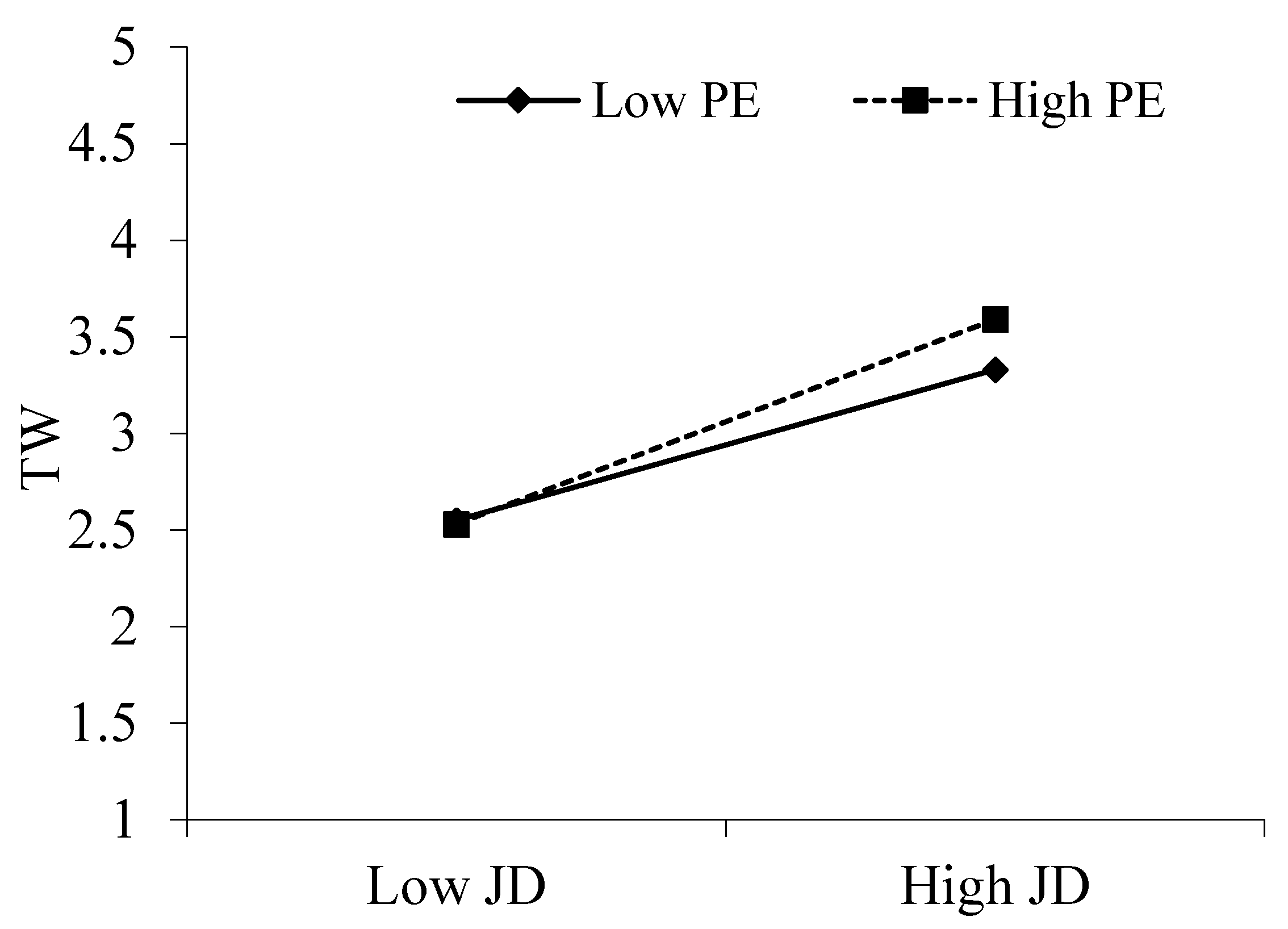
Figure 3.
The moderation effect of PE on the relationship between JD and WA.
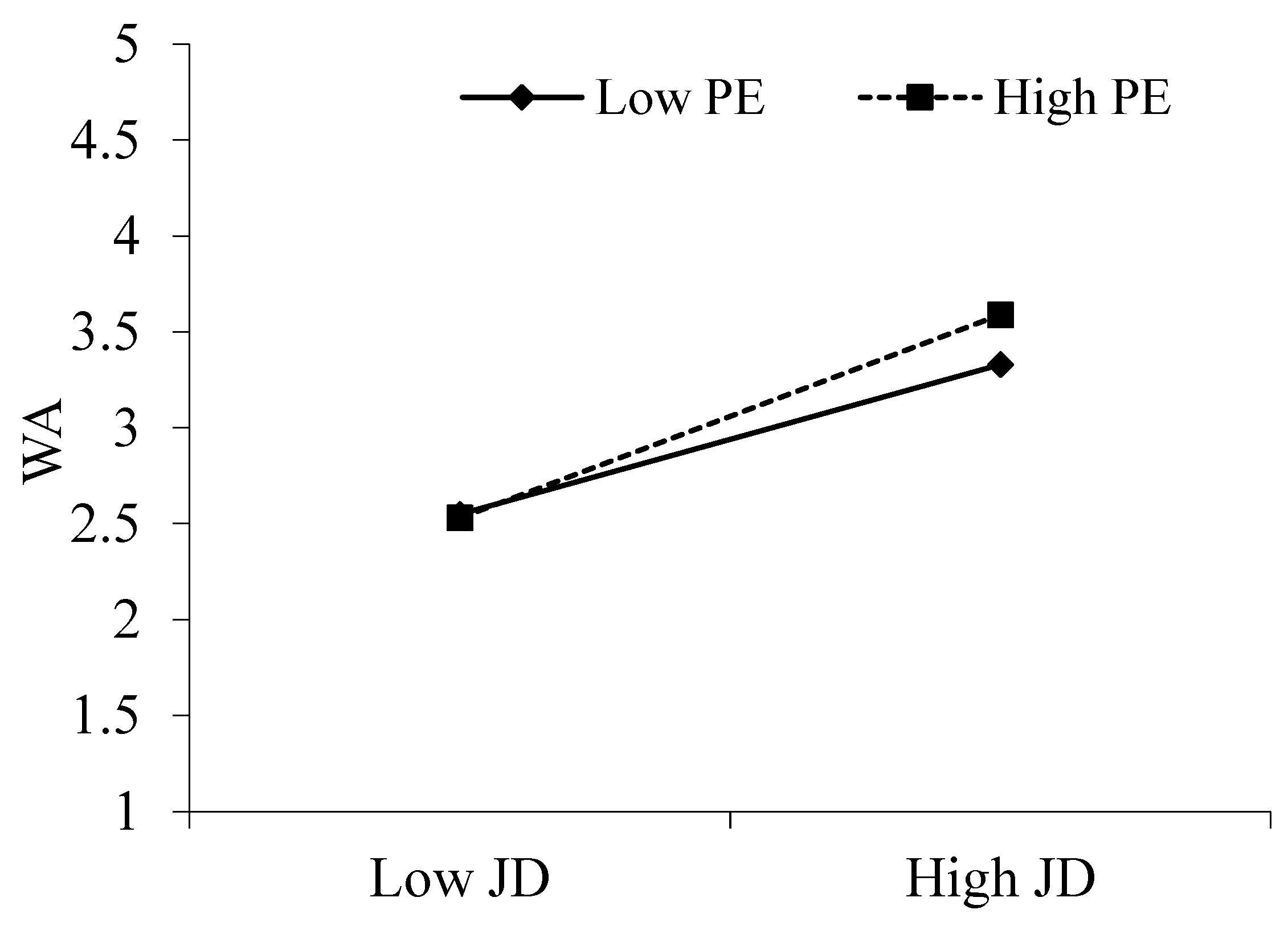
Table 1.
Descriptive statistics of demographic variables.
| Variable | Categories | Code | Frequency | Percentage |
| Sex | Male | 1 | 456 | 52.2 |
| Female | 0 | 417 | 47.8 | |
| Education | College and below | 1 | 47 | 5.4 |
| Bachelor's Degree | 2 | 262 | 30.0 | |
| Master's degree | 3 | 564 | 64.6 | |
| Rank | Section Chief | 1 | 368 | 42.2 |
| Deputy Section | 2 | 291 | 33.3 | |
| Full Section | 3 | 214 | 24.5 |
Table 2.
Results of confirmatory factor analyses.
| Model | Factors | χ2 | df | χ2/df | CFI | TLI | RMSEA | SRMR |
|---|---|---|---|---|---|---|---|---|
| 7-factor model | JD; PO; PE; TW; WA; JC; WD | 2451.70 | 901 | 2.72 | 0.98 | 0.97 | 0.03 | 0.04 |
| 6-factor model | JD+PO; PE; TW; WA; JC; WD | 11642.85 | 1112 | 10.47 | 0.73 | 0.71 | 0.10 | 0.11 |
| 5-factor model | JD+PO+PE; TW; WA; JC; WD | 15991.17 | 1117 | 14.32 | 0.69 | 0.68 | 0.12 | 0.13 |
| 4-factor model | JD+PO+PE+TW; WA; JC; WD | 23544.73 | 1121 | 21.00 | 0.55 | 0.52 | 0.13 | 0.14 |
| 3-factor model | JD+PO+PE+TW+WA; JC; WD | 26717.26 | 1124 | 23.77 | 0.52 | 0.49 | 0.14 | 0.16 |
| 2-factor model | JD+PO+PE+TW+WA+JC; WD | 29345.35 | 1126 | 26.06 | 0.41 | 0.39 | 0.16 | 0.17 |
| 1-factor model | JD+PO+PE+TW+WA+JC+WD | 31257.59 | 1127 | 27.74 | 0.41 | 0.38 | 0.17 | 0.19 |
Note. JD= Digitization-oriented job demands; PO= Promotion focus, PE= Prevention focus; TW= Thriving at work; WA= Workplace anxiety; JC= Job crafting; WD= Work withdrawal.
Table 3.
Means, standard deviations, and correlations of variables.
| 1 | 2 | 3 | 4 | 5 | 6 | 7 | 8 | 9 | 10 | 11 | |
| 1. Gender (T1) | - | ||||||||||
| 2. Age (T1) | 0.07* | - | |||||||||
| 3. Education (T1) | 0.05 | 0.14** | - | ||||||||
| 4. Rank (T1) | -0.08* | -0.16** | -0.05 | - | |||||||
| 5. JD (T1) | -0.11** | 0.01 | 0.04 | 0.04 | 0.76 | ||||||
| 6. PO (T1) | -0.16** | 0.09** | -0.01 | 0.06 | 0.35** | 0.86 | |||||
| 7. PE (T1) | -0.23** | 0.09** | -0.03 | 0.04 | 0.21** | 0.36** | 0.80 | ||||
| 8. TW (T2) | -0.10** | 0.06 | -0.01 | 0.02 | 0.48** | 0.33** | -0.22** | 0.89 | |||
| 9. WA (T2) | -0.12** | 0.06 | -0.01 | 0.03 | 0.49** | -0.37** | 0.23** | -0.48** | 0.89 | ||
| 10. JC (T3) | -0.10** | 0.02 | -0.01 | -0.03 | 0.44** | 0.11** | -0.14** | 0.33** | -0.35** | 0.82 | |
| 11. WD (T3) | -0.17** | 0.04 | -0.04 | 0.04 | 0.56** | 0.40** | 0.27** | -0.52** | 0.57** | -0.62** | 0.73 |
| Mean | 0.48 | 40.53 | 2.59 | 1.82 | 3.83 | 2.57 | 2.55 | 3.64 | 3.64 | 3.73 | 3.83 |
| PE | 0.50 | 9.06 | 0.59 | 0.80 | 0.63 | 0.99 | 1.01 | 0.67 | 0.61 | 0.70 | 0.51 |
| Cronbach’s α | - | - | - | - | 0.95 | 0.96 | 0.96 | 0.98 | 0.92 | 0.92 | 0.89 |
| CR | - | - | - | - | 0.81 | 0.98 | 0.93 | 0.97 | 0.96 | 0.96 | 0.90 |
| AVE | - | - | - | - | 0.58 | 0.74 | 0.64 | 0.80 | 0.80 | 0.67 | 0.53 |
Note. N=873; Bolding indicates the square root of AVE; T1= Time1; T2= Time2, T3= Time3 *p < .05; **p < .01.
Table 4.
Summary of path-analytic results.
| Variables | TW | JC | WA | WD | ||||
| B | SE | B | SE | B | SE | B | SE | |
| JD | 0.46*** | 0.03 | 0.41*** | 0.04 | 0.46*** | 0.03 | 0.30*** | 0.02 |
| PO | 0.08*** | 0.02 | ||||||
| JD×PO | 0.15*** | 0.03 | ||||||
| PE | 0.06** | 0.02 | ||||||
| JD×PE | 0.07** | 0.03 | ||||||
| TW | 0.16*** | 0.04 | ||||||
| WA | 0.30*** | 0.03 | ||||||
| Gender | -0.05 | 0.04 | -0.08 | 0.04 | -0.05 | 0.04 | -0.09** | 0.03 |
| Age | 0.00 | 0.00 | 0.00 | 0.00 | 0.00 | 0.00 | 0.00 | 0.00 |
| Education | -0.03 | 0.04 | -0.03 | 0.04 | -0.03 | 0.03 | -0.05** | 0.02 |
| Type | -0.02 | 0.03 | -0.05 | 0.03 | 0.00 | 0.02 | 0.01 | 0.02 |
Note. B= Path coefficients; SE=Standardized errors; Path coefficients are standardized; **p < .01; ***p < .001.
Disclaimer/Publisher’s Note: The statements, opinions and data contained in all publications are solely those of the individual author(s) and contributor(s) and not of MDPI and/or the editor(s). MDPI and/or the editor(s) disclaim responsibility for any injury to people or property resulting from any ideas, methods, instructions or products referred to in the content. |
© 2025 by the authors. Licensee MDPI, Basel, Switzerland. This article is an open access article distributed under the terms and conditions of the Creative Commons Attribution (CC BY) license (http://creativecommons.org/licenses/by/4.0/).
Copyright: This open access article is published under a Creative Commons CC BY 4.0 license, which permit the free download, distribution, and reuse, provided that the author and preprint are cited in any reuse.


