

Submitted:
27 January 2025
Posted:
28 January 2025
You are already at the latest version
Abstract
There is widespread agreement that the climate is changing. Some dramatic disturbances are reported when the costs are in lives. But to those working the land it is also clear that substantive changes are at hand. The air and ground temperatures are rising, water quality and quantity is changing, insect populations are on the move, and new bacteria and viruses abound. While there is evidence that similar localized perturbations have occurred in the past, the increases in human population and industry are unprecedented. It can be argued that their combined assault on the environment appears to be either the driving force or a major contributor to the deleterious changes. What has happened, and what is happening, in and around vineyards is described.
Keywords:
air and ground temperature
; wildfires
; predators
; terroir
; greenhouse effect
Historically, weather (including rare floods and drought) has been shown to be unpredict-able; climate less so. As a consequence, vintners, farmers, arborists, and others close to plants and the soil, generally took heart even in the most troubling times from the idea that it was possible that “next year” would be better. In some circumstances old vineyards, carefully tended over generations, could be counted upon, year after year, to produce a reliable vintage (albeit some years better than others). The human population has grown and industries have developed to accommodate both growth and affluence, and it has fallen out that, in addition to the occasionally dramatic variation in local weather, the climate is changing.
In 1896 the physical chemist Svante Arrhenius made predictions about the temperature rise at the earth’s surface as a consequence of the greenhouse effect that would result if the increase in carbon dioxide (CO2) in the air continued.1 While not passing judgment about greenhouse gasses, it was clear from his report that temperature rise would occur. Approximations were made as to the extent of the temperature rise as a function of CO2 concentration.
Reality differs from such modeling largely because of the number of variables, not all of which are known, that need to be considered in the case of long term climate or short term weather prediction.2 Indeed, there was a good deal of evidence, only recently noted, that much of the carbon dioxide formed during the industrial revolution was being absorbed by the oceans so that a greenhouse effect would be moderated (while the acidity of the oceans slowly increased).3
Regardless, almost a century after Arrhenius, Kenny and Harrison produced the results of an effort to evaluate effects of climate change on grapes in Europe.4 Although a number of aspects of potential change were considered, they concluded, in part that …“If no significant measures are taken (to) reduce greenhouse gases in the present or over the next two or three decades, then there could be significant disruption to the distribution of viticulture in Europe beyond that time.”
As the new century dawned, the continued emphasis on apparent climate changes about which those involved in wine production would want to be aware was maintained.5 It had already become clear that the changes underway were more substantive than might be accounted for by normal variation in weather. For example, in 1999 it was reported that “…greenhouse gases (were) emerging as the dominant forcing during the twentieth century (where) Northern Hemisphere mean annual temperature for three of the past eight years are warmer than any other year since (at least) AD1400”.6 In the same vein and only a few years later, it was noted that French records of grape-harvest dates in Burgundy could be used to reconstruct spring–summer temperatures from 1370 to 2003 for the Pinot Noir grape. The work suggested that temperatures as high as those reached in the 1990s occurred several times in Burgundy since 1370 but the summer of 2003 appeared to have temperatures that were probably higher than in any other year since 1370.7
The work continued, even moving into the United States.8 By 2010 is was already possible for de Orduña to note in a review article on the effect of climate change associated variables on grape composition that “…it is undeniable that rising temperatures have already had a significant effect on the grape and wine industry.” 9 Some initial greenhouse experiments were done at elevated carbon dioxide, temperature and UV-B radiation levels to show the effect these changes would have on the vines (experiments were done on Vitis vinifera cv. Tempranillo). It was not surprising to learn that the greenhouse grown plants, with elevated carbon dioxide and temperature, had faster ripening. However, contrarily, UV-B delayed ripening, thus counteracting the climate change conditions of higher carbon dioxide concentration.10
So, it has become proper to ask the questions about what, more specifically, are the problems and what is to be done.
Beginning with serious intent in the last decade or so, it has become clear in many wine growing regions11 that habitat loss will require moving vineyards, not necessarily because of air temperature rise but, in part, because the soil temperatures will no longer accommodate microbiota and temperature sensitive nutrients required by the roots of the vines as well as the roots themselves.12,13 Despite arguments that the extent predicted may be too great,14 modifications of currently grown grapes either through traditional crossing methods or by laboratory genetic methods are being considered. There are uncertainties involved and success is questionable.15,16
In the meantime, there are lessons to be learned from the grapevine.17 The timing of the harvest might need to be changed18 and further actions taken, some of which have been summarized in a series of four articles19 and on a website devoted to the time of climate change.20
In addition, it is clear both historically and from the current environment that there is a link between climate change and the extent and severity of wildfires.21
In the early part of this century, Stocks, et al, reviewed the history of large forest fires in Canada during the four decades from 1959 through 1997.22 They pointed out there had been a steady increase in the number of fires in the 1990s and “…recent scientific consensus indicates that climate change impacts will be most significant in the carbon-rich boreal zone.” Their comments followed on a thirty-five year study of wildfires supporting the “growing consensus …that the Earth’s climate will start warming at an unprecedented rate because of increasing amounts of active gases such as water vapor, carbon dioxide, methane, ozone, nitrous oxide and chlorofluorocarbons.” 23 Interestingly, the extent to which such fires might perturb the wine industry was not particularly referenced in the Canadian work nor does it seem to have been of particular concern in Europe or the United States. However, in the developing wine industry in Australia, it had become clear that wild fires could be a problem. Thus, in The Australian Wine Research Institute Annual Report of 200324 it was noted “…During the 2003 vintage…a large amount of time …(was spent)…dealing with the issue of ‘smoky’ taint in grapes and wine resulting from the bushfires that occurred in Victoria and southern New South Wales in January and February 2003.” The initial conclusions from the study of juices and wines with “characters variously described by the …sensory panel as smoky, burnt, ash, ashtray, salami, smoked salmon etc.” were “that guaiacol and 4-methylguaiacol were the most important compounds contributing to the sensory taint.” Guaiacol and 4-methylguaiacol (Figure 1) at very low concentrations, along with a variety of other phenols, are not uncommon in wines held in toasted-oak-barrels as they are formed in the combustion of the oak in the toasting process.
Experiments designed to overcome the consequences of the presence of larger amounts of these unwanted phenols failed. However, the unrecognized (at that time) and yet significant report that “Guaiacol and 4-methyl guaiacol were detected in all of the skin samples but were not detected in any of the pulp samples” awaited the invention of better analytical techniques. Indeed, after much discussion of efforts to ameliorate the problem of the detected phenols the report concluded “…In spite of the fact that this project has greatly increased the understanding of the nature of this problem, solutions remain elusive.”
In 2004, estimates of the likely impacts of climate change on the severity of wildfire in Northern California were investigated.21 Fires affecting vineyards were not considered. In the meantime, because of the proximity of wine regions to bushfires, investigations of grapes affected by smoke were continuing in Australia.25 As noted earlier, it was found that smoke exposure resulted in the presence of the phenols guaiacol and 4-methylguaiacol along with 4-ethylguaiacol, 4-ethylphenol, and eugenol (Figure 1). Also, as previously, it was found that the intensity of the smoke-taint increased during fermentation and now it was suggested that glycoconjugates (Figure 2), formed once the phenols had passed through the skin, were present. Thus, testing the grapes or grape juice for the phenols themselves would fail and only during the fermentation process would the phenols be released in the wines. Similarly, testing the grape juice for the phenols would fail but, when consumed, hydrolysis of the glycoconjugates would again release the phenols producing unwanted flavors. It was concluded that in order to determine if the juice was fit for consumption or fermentation, hydrolytic methods, destroying the glycoconjugates and regenerating phenols, be undertaken. There was no discussion of the possibility of remediation.
Advances in analytical techniques and the overarching desire to understand the consequences of vineyard contamination eventually led to groups at the Australian Wine Research Institute being able produce a summary review on both the phenols and their glycosidic metabolites that had been identified by 2015.26 Indeed, at that time it was noted that “a broad range of organic compounds are emitted as VOCs in wood smoke which may cause contamination of vines and grapes, and contribute to the formation of undesirable smoke-taint into the vine, viz (i) directly by passive diffusion via the berry cuticle and epidermis; (ii) via the stomates in the leaves and then translocated to the grapes via the vascular system; or (iii) through uptake via the roots and translocation to the grapes.” The last being considered least likely given the climate conditions. In addition. the cuticle is considered unlikely to have been breached. Finally, the review26 noted the important contribution found in an earlier Australian report27 that showed that not only was glycosylation occurring but that it was possible to develop and validate a quantitative analytical method for the phenolic glycosides in Shiraz, Chardonnay, Cabernet Sauvignon and Pinot Noir smoke-affected grapes and wine.
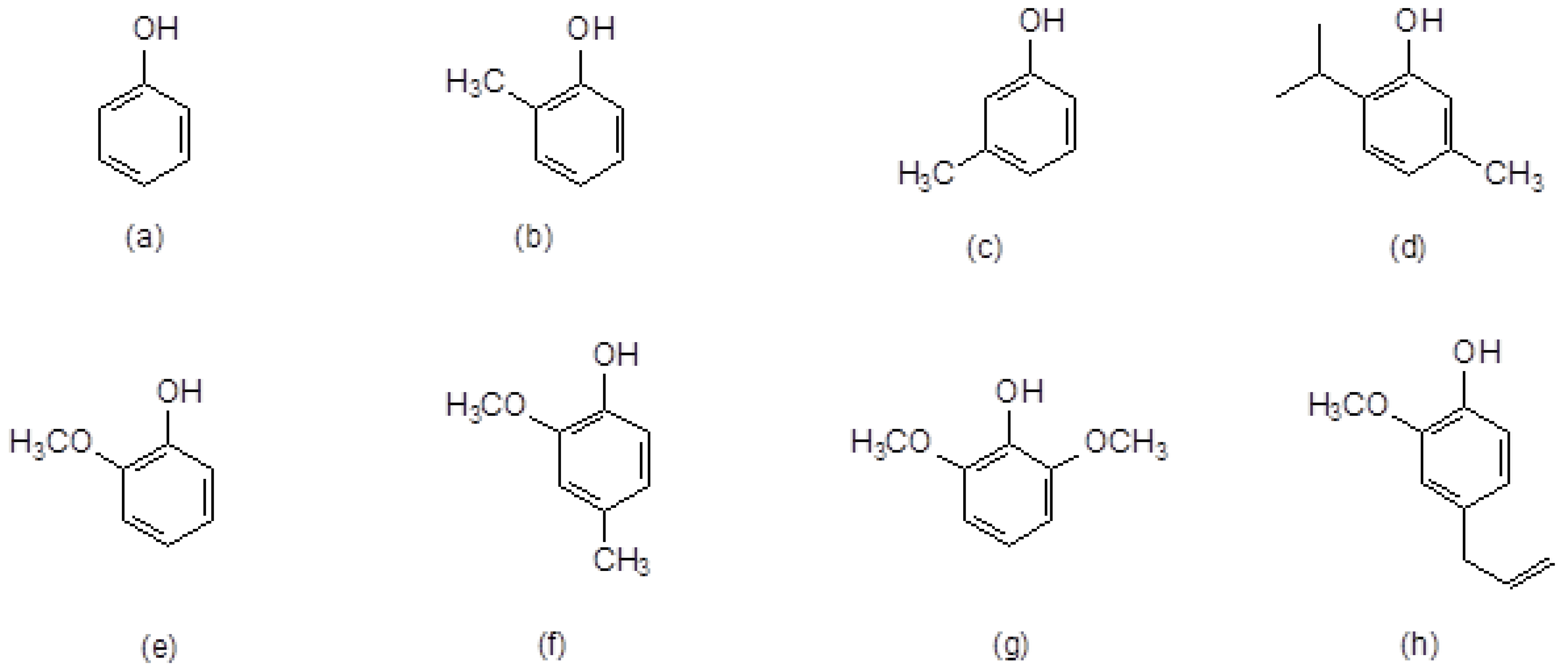
Subsequently, in 2018 the Canadian group of Zandberg and coworkers,28 provided a detailed characterization of a set of independently synthesized (i.e., laboratory prepared) phenolic glycosides and in 2021, Fuentes and coworkers,29 listed the phenols (without the attached sugars) found responsible for causing the grapes and wines affected by bushfires in a variety of local vineyards to be unpalatable (Figure 3).
Then, the 2016-2017 wildfires in California and Oregon befell those communities. In 2022, Crews and coworkers30 were able to undertake a thorough examination of the phenolic diglycosides that were created among eight different Vitis vinifera varietals in the 2017-2021 vintages. Their results were similar to those found earlier and it was ascertained that the diglycosides are stable in wines for more than 2.5 years. However, glycosidases in saliva can “carry out rapid in-mouth phenolic diglycoside biotransformations releasing odorous volatile phenols possessing unpleasant aromas and flavors”.30 The analytical data collected will continue to remain valuable and, in the Supporting Information to the work, Figure S8 provides the structures of thirty-four key volatile phenols isolated and categorized from (a) wildfire smoke; (b) oak barrel toasting, and: (c) grapevines. Some of the phenols of Figure S8 are seen here in Figure 1 and Figure 3 and are reported to replace the 2-methoxyphenol in the diglycosides in Figure 2.
In addition to these changes, everybody knows that we are not alone our our enjoyment of grapes. Along with the many species of leafhopers, cutworms, thrips, spidermites, Japanese beetles and other insects generally attacking plants everywhere, the more specialized Grapeberry moths (Paralobesia viteana), Grape Mealybugs (any of the species in the genus Pseudococcus but maritimus, longispinus, and viburni in particular), Vine Mealybugs (Planococcus ficus) and, the Spotted Lanternfly (Lycorma delicatula)31 have proved to be a problem for us. Recently, an uptick in the bacterium (Xylella fastidiosa) responsible for Pierce's disease.32 and thought to be brought by the glassy-winged sharpshooter (Homalodisca vitripennis).33 has been reported.34 Their fate in the time of climate change appears to be largely unknown. Information on other invasive species that may accompany relocation of vineyards into their new terroir, as well as arising in vineyards that are not moved, but might be susceptible because the invaders move as a consequence of climate change, also needs to be considered.35
In addition, although some local wild yeasts are prized for their contribution to the fermentation process, various mildews, viruses other and occupants of the microbiome have been brought under control (or nearly so),36 it is not clear how climate change will affect both the localization of the current managed pests and their potential speciation. There are hints as to changes that may be in store for the vines, the vintners, and the consumers.37
Interestingly, it now appears airborne imaging38 might be used to observe early detection f the effects of climate change along with mobile ground-based spectroscopic robotics.39
Notes and References
- Arrhenius, S. “On the Influence of Carbonic Acid in the Air upon the Temperature of the Ground” Phil. Mag. J. Sci. 1896, 41, 237, For a more current perspective, see Hatfield, J. L.; Prueger, J. H.”Temperature extremes: Effect on plant growth and development” Weather and Climate Extremes, 2015, 10, 4. 10.1015/wace.2015.08.001. [Google Scholar] [CrossRef]
- Box, G. E. P.; Draper, N. R. Empirical Model Building and Response Surfaces; John Wiley & Sons, New York, NY, 1987. “Essentially, all models are wrong, but some are useful (p 424)…. the practical question is how wrong do they have to be to not be useful (p74)”.
- Revelle, R,; Suess,H, E, “Carbon Dioxide Exchange Between Atmosphere and Ocean and the Question of an Increase of Atmospheric CO2 during the Past Decades” Tellus IX 1957. [CrossRef]
- Kenny, G. J.; Harrison, P. A. “The Effects of Climate Variability and Change on Grape Suitability in Europe” J. Wine Res. 1992, 3, 163. [Google Scholar] [CrossRef]
- Schultz, H. R. “Climate Change and Viticulture: A European perspective on climatology, carbon dioxide and UV-B effects” Aust. J. Grape and Wine Res. 2000, 6, 2, and 18 Schultz, H. R. “Climate Change and Viticulture: Research Needs for Facing the Future” J. Wine Research, 19 2010, 21, 113 (DOI:10.1080/09571264.2919.530093). [Google Scholar] [CrossRef]
- Mann, M.E.; Bradley, R.S; Hughes, M. K. “Global-scale temperature patterns and climate forcing over the past six centuries”. Nature 1998, 392, 779, and also see Mann, M.E.; Bradley,R.S; 23 Hughes, M. K. “Northern Hemisphere Temperatures During the Past Millennium: Inferences, 24 Uncertainties, and Limitations” Geophys. Res. Lett. 1999, 26, 759 (DOI: 10.1029/1999GL900070) as well as 25 Mann, M. E. “Beyond the hockey stick: Climate lessons from the Common Era” Proc. Nat. Acad. Sci. U.S. 26 2021, 118 (DOI: 10.1073/pnas.2112797118) with the time line updated to reflect current changes to the longer 27 term of “…at least the past two millennia and more tentatively, the past 20,000 y(ears)…”. [Google Scholar] [CrossRef]
- Chuine, I.; Yiou, P.; Viovy, N.; Seguin, B.; Daux, V.; Ladurie, E.L.R. ‘Grape ripening as a past climate indicator”. Nature 2004, 432, 289. [Google Scholar] [CrossRef] [PubMed]
- White, M. A.; Diffenbaugh, N. S.; Jones, G. V.; Pal, J. S.; Giorgi, F. “Extreme Heat Reduces and Shifts United States Premium Wine Production in the 21st Century” Proc. Nat. Acad. Sci. U.S., 2006, 103, 11217. [Google Scholar] [CrossRef] [PubMed]
- de Orduña, R. M. ”Climate change associated effects on grape and wine quality and production” Food Res. Internat. 2010, 43, 1844. [Google Scholar] [CrossRef]
- Martinez-Lüscher, J.; Morales, F.; Sánchez-Diaz, M.; Delrot, S.; Aguirreolea, J.; Gomès, E. ; Pascual. I. “Climate change conditions (elevated CO2 and temperatures) and UV-B radiation affect grapevine (Vitis vinifera cv. Tempranillo) leaf carbon assimilation, altering fruit ripening rates” Plant Sci. 2015, 236, 168. [Google Scholar] [CrossRef]
- Some efforts have been made in current wine growing regions in an attempt to estimate what might be done to ameliorate the effects of climate change. For example: (a) A variety of grapes in vineyards across Western Australia were examined for titratable acidity and anthocyanins over a two year period at the end of the decade ending in 2010. (i) Barnuud, N.N.; Zerihun, A.; Gibberd, M.; Bates, B. “Berry composition and climate: responses and empirical models” Int. J. Biometeorol. 2014. 58, 1207. https://doi.org/10.1007/s00484-013-0715-2) and (ii) Barnuud, N.N.; Zerihun, A.; Mpelasoka, F.; Gibberd, M.; Bates, B. “Responses of grape berry anthocyanin and titratable acidity to the projected climate change across the Western Australian wine regions” Int. J. Biometeorol. 2014, 58, 1279. https://doi.org/10.1007/s00484-013-0724-1. The authors suggest more work might be needed since it’s not clear what should be done as the climate changes. (b) In Central Romania, Costea, M.; Lengyel, E.; Stegărus, D.; Rusan, N.; Tăuşan, I. “Assessment of climatic conditions as driving factors of wine aromatic compounds: a case study from Central Romania” Theor. Appl. Climatol. 2019, 137, 239. https://doi.org/10.1007/s007-4-018-2594-2. the belief that climate change will be worthwhile from short term measurements of esters, high (molecular weight) alcohols, volatile fatty acids, aldehydes and terpenes was expressed. (c) Along Lake Neuchatel, Switzerland where, in the decades beginning in 1970 “…the climate in the …vineyards changed from very cool or cool to temperate…” Comte, V.; Schneider, L.; Calanca, P.; Rebetez, M. “Effects of climate change on bioclimaic indices in vineyards along Lake Neuchatel, Switzerland” Theor. Appl. Climatol. 2021, 147, 423. https://doi.org/10.1007/s00704-021-03836-1. and changes in what is grown might be needed. (d) In other wine growing regions in Europe as outlined by Sgubin, G.; Swingedouw, D.; Mignot, J.; Gambetta, G. A.; Bois, B.; Loukos, H.; Noël, T.; Pierl, P.; de Cortázar-Atauri, I.G.; Oliat N.; van Leeuwen, C. “Non-linear loss of suitable wine regions over Europe in response to increasing global warming” Global Change Bio., 2022, 29, 808. https://doi.org/10.1111/gcb.16493) (e) In Argentina it is anticipated that a significant southwestward and higher altitude displacement of winegrowing regions will be needed due to projected warmer climate conditions according to Cabré, F.; Nuñez, M. “Impact of climate change on viticulture in Argentina” Reg. Enverion. Change, 2020, 20, 12. https://doi.org/10.1007/s10113-020-01607-8. 2014; 58, 1207. [CrossRef]
- Hannah,L. ; Roehrdanz, P. R.; Ikegami, M.; Shepard, A. V.; Shaw, R,; Tabor, G.; Zhi, L.; Marquet, P. A.; Hijmans, R. J. “Climate change, wine, and conservation” Proc. Natl. Acad. Sci. U.S. 2013, 110, 6907. [CrossRef]
- Costa, M.; Egipto, R.; Aguiar, F.; Marques, P.; Nogales, A.; Madeira, M. “The role of soil temperature in Mediterranean vineyards in a climate change context” Front. Plant Sci. 2023, 14, 1145137, and Radolinski, J.; Vermec, M.; Wachter, H.; Birk, S.; Brűggemann, N.; Herndt, M.; Kahmen, A.; Nelson, D. B.; Kűbert, A.; Schaumberger, A.; Stumpp, C. Tisslnk, M. Werner, C.; Bahn, M. “Drought in a warmer, CO2-rich climate restricts grassland water use and soil water mixing” Science, 2025, 387, 290. 10.1126/science.ado0734. [Google Scholar] [CrossRef]
- van Leeuwen, C.; Schultz, H.R.; de Cortazar-Atauri, I. G.; Duchêne, E.; Ollat, N.; Pieri, P.; Bois, B.; Goutouly, J. P.; Quenol, H.; Touzard, J. M; Malheiro, A. C. ; Bavaresco, L; Delrot, S. “Why climate change will not dramatically decrease viticultural suitability in main wine-producing areas by 2050” Proc. Natl. Acad. Sci. U.S. 2013, 110, E3051, and subsequently in van Leeuwen, C,; Destrac-Irvine, A.; Dibernet, M.; Duchêne, E.; Gowdy, M.; Marguerit, E.; Pieri, P.; Parker, A.; de Rességuier, L ;Ollat, N. “An Update on the Impact of Climate Change in Viticulture and Potential Adaptations” Agronomy, 2019, 9, 514. 10.3390/agronomy9090514. [Google Scholar] [CrossRef]
- Scheben, A.; Yuan, Y.; Edwards, D. “Advances in genomics for adapting crops to climate change” Curr. Plant Bio. 2016, 6, 2. [Google Scholar] [CrossRef]
- Delrot, S.; Grimplet, J.; Carbonell-Bejerano, P.; Schwander, A.; Bert, P.-F.; Bavaraesco, L.; Costa, L. D.; Di Gaspero, G.; Duche, E.; Hausmann, L.; Malnoy, M.; Morgante, M.; Ollat, N.; Pecile, M.; Vezzulli, S. “Genetic and Genomic Approaches for Adaptation of Grapevine to Climate Change”. In: Kole, C. (ed) Genomic Designing of Climate-Smart Fruit Crops 2020 Springer, Cham. [CrossRef]
- Mosedale, J. R.; Abernethy, K.; Smart, R. E.; Wilson, R. J.; Maclean, I.D. “Climate change impacts and adaptive strategies: lessons from the grapevine” Global Change Biology, 2016, 22,3814. 22. [CrossRef]
- Asproudi, A.; Ferrandino, A.; Bonello, F.; Vaudano, E.; Pollon, M.; Petrozziello, M. “Key norisoprenoid compounds in wines from early-harvested grapes in view of climate change” Food Chem. 2018, 268, 143. 268. [CrossRef]
- The following articles appeared sequentially in the New York times during 2019: (a) Asimov, E. The following articles appeared sequentially in the New York times during 2019: (a) Asimov, E. “Climate change will inevitably transform the way the world produces goods”, 14 October 2019 (https://www.nytimes.com/interactive/2019/10/14/dining/drinks/climate-change-wine.html); (b) Asimov, E. “In Oregon Wine Country, One Farmer’s Battle to Save the Soil”, 17 October 2019 (https://www.nytimes.com/2019/10/17/dining/drinks/climate-change-regenerative-agriculture-wine.html); (c) Asimov, E. “Freshness in a Changed Climate:High Altitudes, Old Grapes” 24 October 2019 (https://www.nytimes.com/2019/10/24/dining/familia-torres-wine-climate-change.html); (d) Asimov, E. “In Napa Valley, Winemakers Fight Climate Change on All Fronts” 31 October 2019 (https://www.nytimes.com/2019/10/31/dining/drinks/napa-valley-wine-climate-change.html.
- ”The Wine Industry’s Climate Action Network” found at https://portoprotocol.com (last accessed January 2025).
- Fried, J S. ; Torn, M. S.; Mills, E. “The Impact of Climate Change on Wildfire Severity: A Regional Forecast for Northern California” Climate Change 2004, 64, 169. [CrossRef]
- Stocks, B. j.; Mason J., A.; Todd, J. B.; Bosch, E. M.; Wotton, B. M.; Amiro, B. D.; Flannigan, M. D.; Hirsh, K. G.; Logan, K. A. ; Martell. D. L.; Skinner, W. R. “Large forest fires in Canada 1959-1997” J. Geophys. Res. 2003, 108, 8149. [Google Scholar] [CrossRef]
- Flannigan, M. D.; van Wagner, C. E. “Climate change and wildfire in Canada” Can. J. For. Res. 1991, 21, 66. [Google Scholar] [CrossRef]
- The report can be found at https://www.awri.com.au › wp-content › uploads › 2003_AWRI_Annual_Report.pdf (last accessed January 2025).
- Kennison, K. R.; Gibberd, M. R.; Pollnitz, A. P. ; Wilkinson, K. L. “Smoke-Derived Taint in wine: The Release of Smoke-Derived Volatile Phenol during Fermentation of Merlot Juice following Grapevine Exposure to Smoke.” J. Agric. Food Chem. 2008, 56, 7379. [CrossRef]
- Krstic, M. P.; Johnson, D. L.; Herderich, M. J. “Review of smoke-taint in wine: smoke-derived volatile phenols and their glycosidic metabolites in grapes and vines as biomarkers for smoke exposure and their role in the sensory perception of smoke-taint” Aust. J. Grape and Wine Res. 2015, 21, 537. [Google Scholar] [CrossRef]
- Hayasaka, Y.; Parker, M.; Baldock, G.A.; Pardon, K.J.; Black, C. A.; Jeffery, D. W.; Herderich, M.J. “Assessing the impact of smoke exposure in grapes: development and validation of a HPLC-MS/MS method for the quantitative analysis of smoke derived phenolic glycosides in grapes and wine” J. Ag. Food Chem. 2012, 61, 25. [Google Scholar] [CrossRef]
- Noestheden, M.; Dennis, E. G.; Romero-Montalvo, E.; DiLabio, G. A.; Zandberg, W. F. “Detailed characterization of glycosylated sensory-active volatile phenols in smoke-exposed grapes and wine” Food Chem. 2018, 259, 247. 259. [CrossRef]
- Summerson, V.; Viejo, C. G.; Pang, A.; Torrico, D. D.; Funetes, S. “Review of the Effects of Grapevine Smoke Exposure and Technologies to Assess Smoke Contamination and Taint in Grapes and Wine. ” Beverages 2021, 7. [Google Scholar] [CrossRef]
- Crews, P.; Dorenbach, P.; Amcerchan, G.; Keiffer, R. F.; Lizama-Chamu, I.; Ruthenburg, T.; McCauly, E. P.; McGourty, G. “Natural Product Phenolic Diglycosides Created from Wildfires, Defining Their Impact on California and Oregon Grapes and Wines” J. Nat. Prod. 2022, 85, 547. [Google Scholar] [CrossRef]
- Information on the Spotted Lanternfly is available from the United States Department of Agriculture (USDA) at https://www.aphis.usda.gov/plant-pests-diseases/slf (last accessed 25). 20 January.
- Pierce’s Disease is a bacterial disease that affects grapevines and other plants. It's caused by the bacterium Xylella fastidiosa, which lives in the plant's water-conducting system. The disease is spread by sap-feeding insects, such as leafhoppers. The California Department of Food and Agriculture's Pierce's Disease and Glassy-winged Sharpshooter PD/GWSS Board) provides funding support to research and outreach projects focused on protecting vineyards, preventing the spread of pests and diseases, and delivering practical and sustainable solutions.
- Information on the glassy-winged sharpshooter is available from the United States Department of Agriculture (USDA) at www.invasivespeciesinfo.gov/terrestrial/invertebrates/glassy-winged-sharpshooter (last accessed January 2025).
- Please see https://agrilifetoday.tamu.edu/2024/09/03/texas-wine-grape-growers-see-uptick-in-pierces-disease/ (last accessed January 2025).
- Current information on invasive species in the time of climate change and about which one should be aware can be found at https://www.invasivespeciesinfo.gov/subject/climate-change (last accessed January 2025).
- Ruuskanen, S.; Buchs, B.; Nissinen, R.; Puigbò, P.; Rainio, M.; Saikkonen, K.; Helander, M. “Ecosystem consequences of herbicides: the role of the microbiome” Trends Eco. and Evo. 2023, 38, 35, and Anthony, M. A.; Bender, S. F.; van der Heijend, M. G. A. “Enumerating soil biodiversity”. Proc. Nat. Acad. Sci. USA 2023, 120, 33, e2304663120. 10.1073/pnas.2304663120. [Google Scholar]
- Please see (a) Raza, M. M.; Bebber, D. P. “Climate change and plant pathogens” Curr. Opinoin Microbio. 2023, 70, 102233, and (b) Singh, B. K.; Delgado-Baquerizo, M.; Egidi, E.; Guirado, E.; Leach, J.E.; Liu, H.; Trivdei, P. “Climate change impacts on plant pathogens, food security and paths forward” Nat. Rev. Microbio. 2023. 10.1038/s41579-023-00900-7. Additionally, although concerned with infectious diseases from which humans might suffer, it is important to realize that the plants may suffer from similar problems.as seen at the National Center for Emerging and Zoonotic infectious Diseases (https://www.cdc.gov/ncezid/topics-programs/climate-infectious-disease.html?CDC_AAref_Val=https://www.cdc.gov/ncezid/what-we-do/climate-change-and-infectious-diseases/index.html) (last accessed January 2025) and Mora, C.; McKenzie, T.; Gaw, I.M; Dean, J.M.; von Hammerstein, H.; Knudson, T. A.; Setter, R. O. ; Smith, C. Z.; Webster, K M.; Patz, J. A.; Franklin, E. C. “Over half of known human pathogenic diseases can be aggravated by climate change. Nat. Clim. Change 2022, 12, 869. 10,1038/s51558-022-01426-1. [Google Scholar] [CrossRef]
- Galvan, F. R.; Pavlick, R.; Trolley, G. R.; Aggarwal, S.; Sousa, D.; Starr, C.; Forrestel, E. J. ; Bolton, S; del Mar Alsina, M.; Dokoozlian, N.; Gold, K. M. “Scalable early detection of grapevine virus infection with airborne imaging spectroscopy”. Phytopathology 2023, 25. [Google Scholar] [CrossRef]
- Wilke, C. Remote sensing for Crops Spots Pests and Pathogens. ACS Central Science, 2023; 9, 339–342. [Google Scholar] [CrossRef]
Figure 1.
Phenols reported to be found after exposure to smoke from Australian brushfires (a) phenol (not reported); (b) 2-methoxyphenol (guaiacol); (c) 2-methoxy-4-methylphenol (4-methylguaiacol); (d) 4-ethyl-2-methoxyphenol; (e) 4-ethylphenol; (f) 2-methoxy-4-(prop-2-en-1-yl)phenol (eugenol). .
Figure 1.
Phenols reported to be found after exposure to smoke from Australian brushfires (a) phenol (not reported); (b) 2-methoxyphenol (guaiacol); (c) 2-methoxy-4-methylphenol (4-methylguaiacol); (d) 4-ethyl-2-methoxyphenol; (e) 4-ethylphenol; (f) 2-methoxy-4-(prop-2-en-1-yl)phenol (eugenol). .
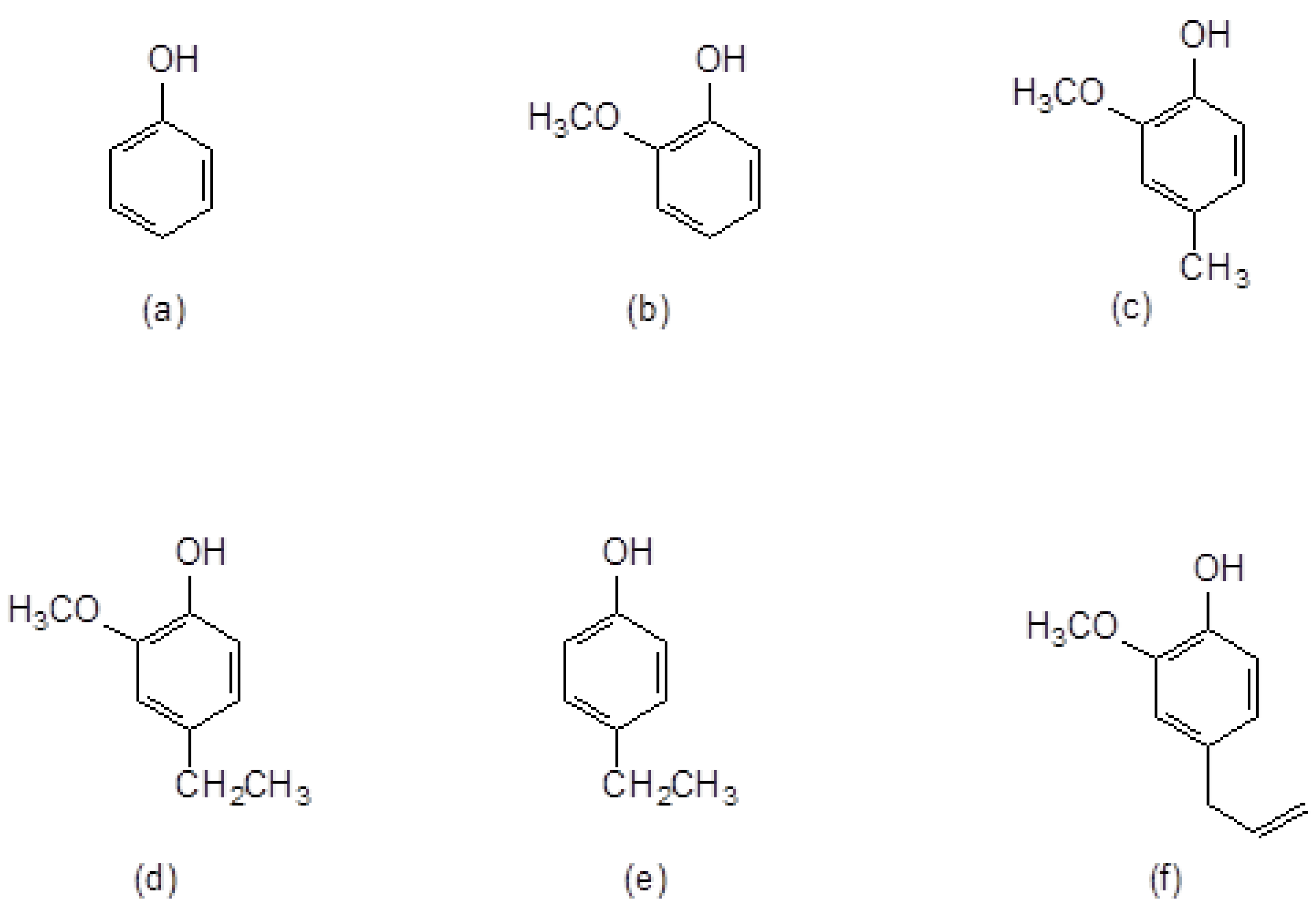
Figure 2.
Representations of two phenolic diglycosides: (a) 2-methoxyphenyl 6-O-β-D-glcopyranosyl-D-glucopyranoside (guaiacol gentiobioside); (b) 2-methoxyphenyl 6-O-(b-deoxy-a-L-manopyranosyl-β-D-glucopyranoside (guaiacol rutinoside). Many other gentiobiosides and rutinosides have been found where the 2-methoxyphenol has been replaced by other phenols.
Figure 2.
Representations of two phenolic diglycosides: (a) 2-methoxyphenyl 6-O-β-D-glcopyranosyl-D-glucopyranoside (guaiacol gentiobioside); (b) 2-methoxyphenyl 6-O-(b-deoxy-a-L-manopyranosyl-β-D-glucopyranoside (guaiacol rutinoside). Many other gentiobiosides and rutinosides have been found where the 2-methoxyphenol has been replaced by other phenols.
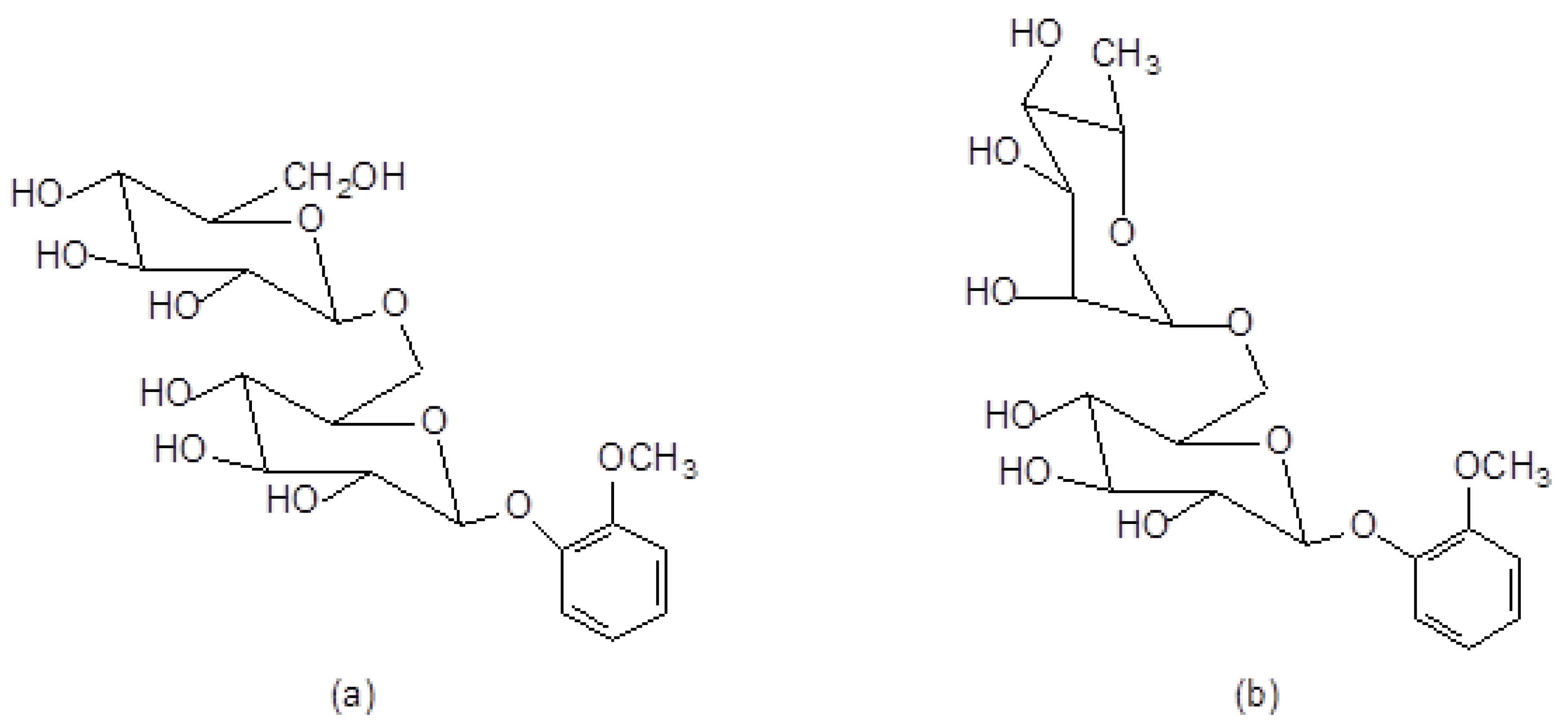
Figure 3.
Phenols reported to be found to be responsible for causing the grapes and wines affected by bushfires in a variety of local Australian vineyards to be unpalatable.29 (a) Phenol; (b) 2-methylphenol (ortho-cresol); (c) 3-methylphenol (meta-cresol); (d) 5-methyl-2-(propan-2-yl)phenol (thymol); (e) 2-methoxyphenol (guaiacol); (f) 2-methoxy-4-methylphenol (4-methylguaiacol); (g) 2,6-dimethoxyphenol (syringol); (h) 2-methoxy-4-(prop-2-en-1-yl)phenol (eugenol). .
Figure 3.
Phenols reported to be found to be responsible for causing the grapes and wines affected by bushfires in a variety of local Australian vineyards to be unpalatable.29 (a) Phenol; (b) 2-methylphenol (ortho-cresol); (c) 3-methylphenol (meta-cresol); (d) 5-methyl-2-(propan-2-yl)phenol (thymol); (e) 2-methoxyphenol (guaiacol); (f) 2-methoxy-4-methylphenol (4-methylguaiacol); (g) 2,6-dimethoxyphenol (syringol); (h) 2-methoxy-4-(prop-2-en-1-yl)phenol (eugenol). .
Disclaimer/Publisher’s Note: The statements, opinions and data contained in all publications are solely those of the individual author(s) and contributor(s) and not of MDPI and/or the editor(s). MDPI and/or the editor(s) disclaim responsibility for any injury to people or property resulting from any ideas, methods, instructions or products referred to in the content. |
© 2025 by the authors. Licensee MDPI, Basel, Switzerland. This article is an open access article distributed under the terms and conditions of the Creative Commons Attribution (CC BY) license (http://creativecommons.org/licenses/by/4.0/).
Copyright: This open access article is published under a Creative Commons CC BY 4.0 license, which permit the free download, distribution, and reuse, provided that the author and preprint are cited in any reuse.


