1. Introduction
After the New York Agreement in 1962 and the implementation of the Act of Free Choice in 1969, which received support from the United Nations (UN), the results are still being debated in international forums. (Zahidi, 2023), especially by supporters of Papuan independence—Indonesia has legally established its sovereignty over the Papua region. Since then, the Indonesian government has assumed responsibility for implementing sustainable development in Papua. However, overall, the Sustainable Development Goals (SDGs) achievement index in Papua and West Papua Provinces is still far below the national average and is the lowest compared to other provinces in Indonesia (BPS in BPK, 2021). Based on observations, several strategic issues, such as security instability, socio-economic inequality, and political dissatisfaction, are of primary concern. Among these issues, security instability is a significant obstacle to efforts to achieve the SDGs in Papua.
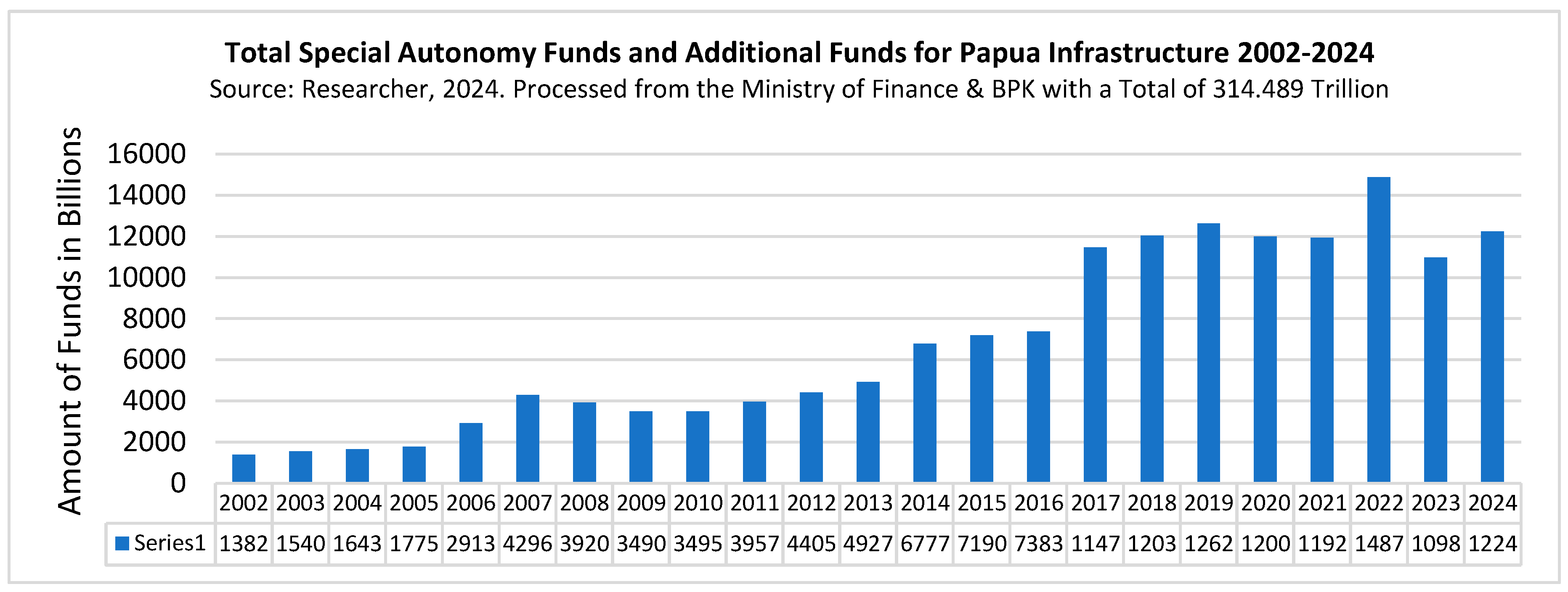
The government has implemented a Special Autonomy (Otsus) policy to accelerate development in Papua since 2002. Until 2024, the government has allocated Special Autonomy Funds and Additional Infrastructure Funds of around Rp. 314.489 trillion. (DJPK Kemenkeu, 2024; BPK RI, 2021). This policy aims to support more inclusive development and narrow regional disparities. However, despite improvements in several development indicators, the achievement of SDGs in Papua is still not significant. Security instability, rooted in the prolonged conflict with the Papuan Separatist Group, remains a significant obstacle. This group threatens national stability and targets strategic infrastructure and civil society, resulting in significant losses in various development sectors.
Figure 1.
Data on Special Autonomy Funds & Additional Infrastructure Funds for Papua 2002-2024. Source: Processed by Researchers from DJPK Kemenkeu, 2024; BPK RI, 2021.
Figure 1.
Data on Special Autonomy Funds & Additional Infrastructure Funds for Papua 2002-2024. Source: Processed by Researchers from DJPK Kemenkeu, 2024; BPK RI, 2021.
The security instability in Papua is primarily caused by the activities of the Papuan Separatist Group, which often targets security personnel, civilians, and public facilities, such as schools and health services. This problem is further exacerbated by socio-economic inequality and controversial political history, including implementing the Act of Free Choice in 1969 (Zahidi, 2023). This instability has a direct impact on the achievement of SDG 16, which emphasizes peace, justice, and strengthening inclusive institutions. Hope (2020) emphasized that security is an important foundation for achieving other SDGs. In Papua, sustainable development depends on creating security stability that can protect the community and strategic infrastructure.
The security approach in Papua has tended to be coercive, such as military operations and law enforcement oriented towards counter-separatism. This approach, which often uses operational models such as in PRRI/Permesta or Aceh, is no longer relevant in Papua's socially and geopolitically complex context. As Wangge and Webb-Gannon (2020) noted, a coercive approach increases local resistance and worsens community and government relations. In addition, Philpott (2018) shows that separatist groups often use the narrative of conflict in Papua to attract international attention through social media, highlighting violations and violence that occur. This approach that ignores socio-cultural aspects is ineffective and strengthens anti-government sentiment in Papua.
Transformation of security policy in Papua is an urgent need. The new policy must prioritize a human security approach, which focuses on protecting civil society, strengthening local institutions, and involving traditional leaders in decision-making. Resosudarmo et al. (2014) describe that involving local communities in development planning and implementation can create a sense of ownership and strengthen public trust in the government. This security strategy must be designed to reduce conflict, strengthen inclusive institutions, and create stability that supports sustainable development. By integrating a humanist approach into the security strategy, tensions can be minimized, and Papua can achieve development equality with other provinces.
Security instability in Papua has become a significant obstacle to achieving the Sustainable Development Goals (SDGs), especially SDG 16, which is the basis for achieving other development goals. The coercive approach applied so far must be replaced with a more inclusive security policy based on local cultural values. The government must ensure that every development policy involves local communities, traditional leaders, and community leaders to create a sense of ownership. As expressed by Krantz & Gustafsson (2021), the success of SDG localization is highly dependent on factors such as effective government structure, leadership, and coordination. Therefore, it is vital for the central government to support local governments, especially regarding regulations, resources, and coordination between related agencies in the context of regional autonomy. With better coordination, the central government can ensure that security and welfare policies in Papua do not conflict but support and complement each other. This approach also ensures that the policies implemented align with local needs and gain broader support from the local community.
3. Results and Discussion
3.1. Challenges and Urgency of Transforming State Security Policy in Papua to Accelerate SDGs Achievement in Papua
Each country's national security has unique characteristics determined by the priority of threats to its national interests, including responses to existential threats in various strategic sectors, not limited to military aspects (Buzan, 1997). In the context of Indonesia, the threat from the Papuan Separatist Group is a serious challenge to national stability and integrity, with broad impacts on community security, vital infrastructure, and sustainable development. The government has implemented policies such as military operations and granting special autonomy status. Steps such as increasing the allocation of funds and special autonomy have also not been fully effective in reducing separatist tensions or accelerating development that is felt to be beneficial by the local community (Resosudarmo et al., 2014). This condition shows that existing policies have not created absolute long-term stability, as reflected in the high intensity of conflict in various regions of Papua. The high intensity of conflict indicates the need to re-evaluate security and development policies to align with the local security and socio-cultural context to create absolute long-term stability.
Security stability in Papua faces complex challenges, especially in achieving the SDGs. Papuan separatist groups have continuously launched attacks that not only threaten the Indonesian National Armed Forces (TNI) and Indonesian National Police (Polri) personnel but also damage important public facilities such as education, health, and economic infrastructure that are vital to the welfare of the community. Attacks on civilians, such as the tragic incident of the murder of 16 construction workers in Nduga (Chauvel, 2019), increasingly threaten the sense of security, create fear in the community, and hinder the pace of development that is much needed in the region. Without solid and sustainable security conditions, efforts to improve the welfare and dignity of the Papuan people, as aspired to in the SDGs, will be challenging to achieve. This security threat emphasizes that stabilization in Papua must be a strategic priority pursued comprehensively and consistently to ensure the creation of inclusive and sustainable development. A human security approach that protects civilians and enforces fair law will be an important foundation for achieving this development goal.
In the context of national and human security, the transformation of security policies in Papua is urgently needed. Increasing security capacity by strengthening the posture of the TNI and Polri, if designed and implemented strategically, can be a tipping point for resolving the prolonged conflict in this region. However, this approach must shift from a coercive policy-oriented solely to a security policy that is inclusive and based on human security. This new approach focuses on protecting civilians and strengthening local institutions, empowering communities, and actively involving traditional and religious leaders in decision-making. Thus, this policy transformation can create a comprehensive sense of security, build community trust in the government, and support the achievement of the Sustainable Development Goals (SDGs) in Papua in a sustainable manner. The urgency of this change lies in the need to address the roots of the conflict and create a stable and inclusive environment for long-term development in the region.
The policy of increasing security capacity by strengthening the TNI and Polri posture may be an unpopular challenge and receive domestic and international rejection. This assumption is reinforced by the still-high publication of pro-independence activists (including human rights activists) on social media to draw global attention to the issue of violence and alleged human rights violations in Papua, which creates a negative spotlight on Indonesia (Philpott, 2018). The addition of troops is often perceived as a contradictory step amid increasing criticism of the dominance of the military and law enforcement approach to dealing with the Papuan Separatist Group, which is considered repressive and similar to the pattern of operations in East Timor in the past (Wangge, 2023). Despite facing resistance, in the author's opinion, increasing the adequate TNI and Polri posture is necessary to create security stability that supports achieving sustainable development goals in Papua. This stability is key to securing the region and serves as a solid foundation to support other sustainable development.
The TNI and Polri posture in Papua must be improved through a comprehensive approach, including increasing the number of personnel and strengthening the organizational structure and infrastructure and more effective operational capabilities. Given the complex geographical challenges of Papua and the ongoing threat from the Papuan Separatist Group, a more resilient, targeted, and structured security strategy is needed. Compared to Java Island, which has a smaller area but is supported by adequate military structure and infrastructure, Papua faces a significant gap in security capacity. Therefore, applying a new paradigm in a more inclusive security approach that focuses on human security is necessary. This approach prioritizes the protection of each individual as the main element and creates a safe and conducive environment to support sustainable development and holistically improve local communities' welfare (Benedek, 2010). This strategy integrating physical and social security is expected to effectively address the complexity of security challenges in Papua.
To overcome the challenge of rejection, security capacity building in Papua must be based on a transparent approach. As a key element in building public trust, transparency is strongly influenced by national cultural values that determine public acceptance of openness (Grimmelikhuijsen et al., 2013). Security enhancement policies must be communicated and socialized to all stakeholders, including local and international communities, through wisely managed media. Transparency must also include humanely implementing protection operations and humanitarian assistance, involving community leaders, civil society organizations, and traditional institutions to build mutual trust. The Ministry of Foreign Affairs, TNI, and Polri must proactively provide credible information about security and development operations to counter negative propaganda that can damage public perception. Without transparent official information, local and international media can potentially spread narratives detrimental to the government's actions. Involving various parties in this process will strengthen the legitimacy of policies and encourage collective support, creating stability that supports sustainable development in Papua.
3.2. Shifting Hard Power Strategic Approach to Moderate Coercive Diplomacy in Handling the Papua Conflict
Hard power, which focuses on coercion and incentives, has a strategic role in security policy (Nye, 2009). In the context of Papua, the hard power approach dominates, with military operations as the main instrument in countering the threat of the Separatist Group (Chauvel, 2021). However, the uneven distribution of security forces is often exploited by the Papuan Separatist Group, which uses rugged geographic terrain to launch attacks on civilians and critical infrastructure. The pattern of military operations and law enforcement implemented to date has not created long-term stability, indicating the need for a comprehensive evaluation of the strategies used. To face this challenge, a more adaptive security strategy must be designed by integrating a robust state security approach and a human security approach that places community protection as the main priority. The synergy of these two approaches is expected to effectively reduce threats while supporting sustainable stability and strengthening public trust in the government.
To overcome the limitations of the distribution of security structures, shifting hard power into a moderate coercive diplomacy framework is necessary, focusing on creating a deterrent effect against threats from the Papuan Separatist Group. Coercive diplomacy, such as the use of economic sanctions by the United States to suppress the policies of the target country (McGillivray & Stam, 2004), aims to change the behavior of parties considered aggressive. The deterrence strategy through moderate coercive diplomacy is hoped to be effective. This deterrence strategy will be successful if it can stop the conflict; the conflict is limited if controlled, and conflict escalation occurs if the conflict continues to increase without control (Zagare & Kilgour, 1998). In Papua, this deterrence strategy aims to strengthen security institutions in conflict-prone areas, protect communities, and secure vital infrastructure from threats from separatist groups. In addition to suppressing direct threats, this approach simultaneously impacts psychological, economic, social, and political pressure on Papuan Separatist Groups (Sanra et al., 2023). With the strategic implementation and based on local needs, this step is expected to reduce threats while creating security stability in Papua as a foundation for inclusive, sustainable development.
Levy (1988) stated that the primary purpose of deterrence is to prevent the opposing party's actions by making them consider that the risks and costs to be borne far exceed the expected benefits. This view is supported by Jervis (1979), who emphasized that deterrence will be more effective if the opposing party is perceived to have aggressive tendencies. In the context of Papua, increasing the TNI and Polri's posture not only strengthens security capacity but also aims to create a situation that can inhibit aggressive actions from the Papuan Separatist Group. This strategic step is expected to support long-term stability in Papua and create an environment conducive to sustainable development that is inclusive and responsive to the needs of local communities. When these community activities and vital facilities are protected, development and community welfare will run more smoothly (Alsayegh et al., 2023).
3.3. Transformation of Security Operation Pattern Approach
To support the creation of sustainable security, the improvement of the TNI and Polri posture needs to be accompanied by a transformation of the operational approach to be more adaptive and progressive. The previous repressive-oriented security pattern must be replaced with a protective approach that places human security as the main priority. The main focus of this approach is to protect critical infrastructure, such as transportation routes, health facilities, and education, which not only support security stability but also become the foundation for sustainable development. This transformation reflects a shift from an authoritarian approach to a human security approach based on democracy, security stability, and economic stability (Sanra et al., 2023). The human security approach emphasizes the protection of individuals and communities by prioritizing strengthening democratic governance and respect for human rights. In addition, this strategy emphasizes the importance of collaboration between the central government, regional governments, and local communities to ensure that the policies implemented follow local needs and values. Thus, this strategy not only functions as a response to security threats, but also becomes a catalyst to encourage inclusive sustainable development, increase public trust, and strengthen the sense of unity in Papua.
A profound transformation is needed in implementing counter-insurgency (COIN) operations patterns to adapt security strategies to modern dynamics. The COIN approach successfully implemented in the 1950s in dealing with the Darul Islam movement is increasingly losing relevance, especially in the context of East Timor and Papua conflicts. A similar approach adopted in Papua still reflects the COIN operations pattern in East Timor and Aceh (Supriatma, 2013). Kilcullen (2006) noted that globalization and increasing international pressure on human rights issues have weakened the effectiveness of conventional tactics. Papua's geographical and political complexity and global media scrutiny reinforce the need for a more contextual approach. Wangge and Webb-Gannon (2020) highlighted that conventional methods often have a more significant negative impact, fueling separatist sentiment rather than community support. Therefore, a fundamental change is needed toward a more adaptive, humanistic, and human security-based operation pattern. This approach places the protection and welfare of civilians as the main priority, increasing operational effectiveness while building stronger public trust. This trust is an important foundation for creating long-term stability and supporting sustainable development in Papua.
COIN transformation must be implemented wisely, selectively, and oriented towards community protection and specific socio-cultural sensitivities. In certain conditions, planned and selective coercive actions can produce significant deterrent effects without triggering a broader conflict escalation. For example, Operation Geronimo, carried out by the United States Navy SEAL Team against Osama bin Laden, is an illustration of the success of selective operations carried out with minimal damage (López-Hermida-Russo & Vargas-Monardes, 2013). In order to remain within the legal and ethical corridor, such operations must be based on the principles of legality, proportionality, and accountability, as mandated in modern law enforcement (Mahardhika, 2023). This approach ensures that any coercive action effectively achieves operational objectives, minimizes the risk of human rights violations, and enhances government legitimacy. Thus, this strategy becomes an integral component in transforming counter-insurgency (COIN) operations, ensuring that security actions remain aligned with democratic values and the long-term goals of sustainable security development.
3.4. Soft Power and Smart Power as a Holistic Approach Strategy in Papua
Soft power is a strategy that uses attraction and persuasion to positively influence people's behavior without relying on direct coercion (Nye, 2021). This concept is increasingly effective when combined with hard power elements within a smart power framework, creating a more efficient, sustainable, and responsive approach to complex security issues (Jansson, 2018; Wilson, 2008). In Papua, a smart power strategy is relevant because it integrates a moderate coercive diplomacy approach with inclusive attention to the local community's social, economic, and cultural aspects. This approach aims to address significant socio-economic disparities, increase community access to essential services such as education and health, and support the creation of sustainable prosperity for all Papuans. By optimizing the use of soft power strategically designed with hard power elements (in a moderate coercive diplomacy approach), this strategy is expected to create more substantial stability. In addition, this approach can strengthen Papua's development within the framework of the integrity and sustainability of the Unitary State of the Republic of Indonesia while increasing local community trust in the government.
Papua faces significant socio-economic disparities, which exacerbate feelings of marginalization among local communities. Limited access to essential services such as education, health, and economic infrastructure exacerbates these disparities. Resosudarmo et al. (2014) explain that although special autonomy funds have been allocated in large amounts, their implementation and distribution are often ineffective, providing an opening for Papuan separatist groups to strengthen narratives of injustice and gain support from the community. To address this challenge, the government has introduced a policy of establishing new autonomous regions (DOB). However, the effectiveness of this policy still requires further improvement and strengthening. Therefore, it is necessary to strengthen the capacity of regional government institutions, including DOB, to provide optimal services through transparent program planning and implementation. This must also involve traditional figures, community leaders, and local communities in decision-making. This involvement aims to create a sense of ownership, strengthen trust in the government, and ensure that the policies implemented genuinely meet the community's needs. Inclusive and responsive public communication is also important to increase policy acceptance among the community. With a participatory and transparent approach, it is hoped that social stability can be created that supports sustainable development in Papua based on the principles of justice and inclusiveness. To create this stability, Papua requires a more holistic approach, which does not only rely on coercive security but also equitable development, both in terms of physical and social infrastructure, in order to reduce existing inequalities (Oyvat & Onaran, 2022).
The Papuan Separatist Group often exploits the instability in Papua as an instrument of terror to instill fear and insecurity among civil society. By exploiting the existing socio-economic disparities, they build support by exploiting public dissatisfaction, spreading narratives that blame the central government, and creating the perception that the government is not paying enough attention to the welfare of Papua. This situation hampers development efforts and strengthens the poverty and regional isolation cycle, making inequality increasingly challenging. Therefore, the government needs to respond quickly by accelerating the implementation of sustainable development supported by stable security conditions. An inclusive government that is responsive to the aspirations and needs of the Papuan people has been proven to be able to reduce the risk of conflict (Hegre & Nygaard, 2015). A fair, inclusive, and equitable development approach is expected to be a long-term solution to creating a peaceful, prosperous, and fully integrated Papua within the framework of the Unitary State of the Republic of Indonesia.
Soft power aims to attract attention and sympathy and profoundly influences public perception through an approach that avoids direct coercion. By relying on soft power, the government can build a reality widely accepted by the public through symbolic representation rather than just based on evidence-based arguments (Boykoff, 2022). Applying this soft power can be optimized through in-depth dialogue and active diplomacy to create harmonious relations between the government and the Papuan people. This strategy includes the participation of community leaders, traditional leaders, the younger generation, and diaspora communities through public diplomacy programs, cultural activities, humanitarian assistance, media, sports, and military diplomacy as an effective means of building a sense of belonging and shared responsibility in maintaining the stability of Papua (Laifer & Kitchen, 2017). By involving various elements of society, the government can strengthen support for the policies implemented while minimizing the destructive influence of groups that threaten stability in Papua.
An intensive and collaborative soft power approach, primarily through dialogue with community leaders, traditional leaders, the younger generation, and diaspora communities, is an important strategy to reduce tensions often triggered by ethno-nationalist sentiments in Papua. The conflict in West Papua, which is often exacerbated by social and economic discontent, often gives rise to ethnic and nationalist sentiments, thus strengthening the potential for intergenerational political violence. A dialogical and non-violent approach with Papuan Separatist Groups is proposed as a strategic solution to break the chain of violent memories and achieve a sustainable, peaceful resolution. Experience in negotiations with the Free Aceh Movement in 2005 showed that intensive dialogue can minimize conflict and reduce violence (Pamungkas & Permana, 2024). When the community feels heard and involved, support for government policies increases while reducing the appeal of groups potentially threatening Papua's stability. This approach supports long-term stability and is relevant to achieving SDG 16, which emphasizes building peaceful, just, and inclusive institutions.
3.5. Relevance of Smart Power Enhancement to SDGs Achievement in Papua
In the context of Papua, the achievement of SDG 16, which emphasizes peace, justice, and strengthening inclusive institutions, is the main foundation for the success of other sustainable development goals. The principles of SDG 16 demand a security approach that not only understands insecurity at the individual level but is also oriented towards meeting the community's real needs without simply viewing it as a threat to the state. Strong security institutions must be responsive to community aspirations, uphold democratic values, and create a safe and just environment for all levels of society (Londras, 2020). Security stability is a fundamental prerequisite for strengthening strategic moderate coercive diplomacy capacity, such as adding security personnel and implementing adaptive operational strategies. Hacker et al. (2014) emphasized that stability achieved through sustainable security policies, which integrate elements of defense, diplomacy, human security, and environmental protection, will support the entire Sustainable Development Goals (SDGs) agenda. Biermann et al. (2017) added that achieving the SDGs can address the roots of conflict by expanding access to essential services in the education, health, and economic sectors as important elements of inclusive development. With stable security conditions, the government can continue development projects without hindrance, so the Papuan people have better access to vital services supporting their welfare.
Within the SDGs framework, conflict is one of the main obstacles to food security and sustainable development (Galabada, 2022). Therefore, SDG 16 is a relevant strategic foundation to ensure that Papua has a safe and stable environment to open access to essential services and opportunities for economic growth (Hope, 2020). Planned security capacity building not only strengthens state security but also protects civil society and supports developing development programs aligned with other SDGs, such as poverty alleviation and environmental protection (Gawlik-Kobylińska, 2021). Moreover, a holistic security approach must include measures to empower local communities, ensure social justice, and create a stronger sense of ownership of the development process. Thus, security is not only an end but a vital instrument for creating a peaceful, inclusive, and prosperous Papua within the national development framework.
Moreover, the United Nations' recognition in the 2030 Agenda for Sustainable Development that violence constitutes a significant threat to the sustainability of global development emphasizes the urgency of adopting a smart power approach, which harmoniously integrates hard and soft power elements (Lee et al., 2016). Within this framework, soft power plays a pivotal role in fostering trust and encouraging the active participation of the Papuan people. This strategy includes expanding access to healthcare services in remote areas and providing local communities with educational facilities and skills training. Such measures improve the quality of life for these communities while simultaneously strengthening their trust and involvement in the development process (Lehoux et al., 2018). This human-centered approach aligns with the goals of SDG 1 (poverty eradication), SDG 3 (access to adequate healthcare services), and SDG 4 (provision of quality education for all).
Furthermore, soft power also plays a significant role in creating security conditions conducive to sustainable development. Harmon (2001) shows that separatist groups often use fear as a tool to disrupt social and political stability. An intensive soft power approach can help address social inequality and build connections with local communities. Once stability is achieved, acceleration of inclusive development must be implemented immediately, including empowering local communities, creating jobs, and expanding market access. These steps support SDG 8, inclusive economic growth, and SDG 10, reducing inequality and strengthening SDG 16, creating a peaceful and just society (Frey, 2017; Milton, 2021). By combining strategic coercive power and a humanist-based persuasive approach, the synergy between hard power and soft power can provide a solid foundation for achieving long-term national stability and sustainable development in Papua.
3.6. Integration of Strategic Culture Approach in Increasing Smart Power Capacity in Papua
The strategic culture approach has been recognized as an important framework for effective security policy. The strategy encompasses multiple dimensions, one of which is culture, which includes ideas, values, traditions, mindsets, and operational methods that are socially formed in a particular community with a unique historical background (Gray, 2020). Strategic culture refers to patterns of habits, thoughts, and values in a community or country that influence how they view and use power and shape their strategic behavior in the context of security. (Johnston, 1999). Culture plays a central role in modern strategy because it influences the strategic behavior of individuals and organizations in determining responses to security threats. Gray and Johnston assert that strategy goals are permanent and universal; however, their application in a particular historical context and cultural behavior provides unique nuances that cannot be ignored.
In the war on terror efforts in Afghanistan, Iraq, and Syria, the United States has implemented a smart power strategy, which combines the use of hard power through military operations with the provision of assistance (soft power). This approach is realized through providing billions of dollars in humanitarian aid and implementing development and reconstruction programs (Shahzad et al., 2020). However, despite the considerable financial support, this strategy faces strong local resistance and has not achieved the expected results. The intervention has also contributed to the spread of terrorism to other regions, mainly due to the lack of attention to the strategic culture of Middle Eastern society. The issue of democratization carried by the US often conflicts with the cultural values and beliefs of the majority Muslim society in the region.
Similar lessons can be learned from Snouck Hurgronje's experience in Aceh during the Dutch colonial period, which provides valuable lessons about the importance of understanding and respecting local culture in security strategies. Hurgronje, one of the first Dutch to visit Mecca and the author of many books on Islam, developed the so-called "Aceh method," which later became the basis for modern Dutch counter-insurgency strategies (McFate, 2019). His study highlights that a deep understanding of local values, traditions, and customs can influence the success of the Dutch East Indies' security strategy. Hurgronje understood and adapted to the local strategic culture, demonstrating the importance of a culture-based approach in dealing with conflict. He highlights that a deep understanding of local values, traditions, and customs can influence the success of a security strategy. However, his controversial manipulative approach still raises ethical questions, so it is not entirely relevant to be applied in the Papuan context.
In Papua, a strategic cultural approach must be implemented sincerely and transparently. The Indonesian government needs to understand and respect local Papuan values to create a compelling and peaceful security strategy. Papua has a rich culture includes cosmological traditions, such as the para-para tradition, the mat tradition, burning stones, and paying heads, which can be the foundation for peace (Pamungkas, 2022). The government has optimally utilized these traditions in dealing with separatist conflicts. This approach requires the involvement of traditional figures and local leaders in the policy process, from planning to evaluation. Traditional figures who are respected and trusted can mediate conflicts, thereby increasing the legitimacy of security policies (Pamungkas, 2022). In addition, the involvement of traditional figures allows for more constructive and trust-based dialogue, thereby reducing community resistance to government policies. Thus, this approach can strengthen a sense of shared ownership of the solutions offered, create more sustainable stability, and support social harmony in Papua.
Strategic culture plays an active role in shaping the state's response and actions in conflict situations, with values, traditions, and historical experiences influencing the formulation and implementation of security strategies (Feng & He, 2021). In this context, Indonesia's strategic culture is based on the principle of "Bhinneka Tunggal Ika," or unity in diversity, derived from the values, traditions, and historical experiences of the Indonesian people, prioritizing respect for diversity and tolerance. This principle allows the Indonesian people to respect, appreciate, and integrate Papuan culture into national cultural diversity. Through an approach that respects differences, Papuan society is not seen as a separate group but as an equal part of Indonesia's diversity. By utilizing a strategic culture based on tolerance and inclusion, Papuan society will not feel marginalized but become an equal part of Indonesia's diversity.
In Indonesian defense and security, strategic culture is crucial in shaping the state's response and actions when facing conflict. Feng and He (2021) emphasize that values, traditions, and historical experiences are fundamental elements that influence the formulation and implementation of national security strategies. The application of strategic culture in Indonesian defense and security is realized through the Universal People's Defense and Security System (Sishankamrata), which prioritizes the principle of cooperation between the TNI, Polri, and all components of society to maintain state sovereignty. This approach emphasizes the importance of togetherness and active community participation in creating sustainable defense and security and ensuring inclusivity in every policy. In addition, this model opens up opportunities for synergy between the government and society, thereby creating more substantial legitimacy in implementing security policies while overcoming complex challenges related to security and sustainable development in Papua.
Through territorial development (binder), as one element of the TNI's strategic culture, the community is not only involved in maintaining regional stability and security. However, it is also empowered as the leading actor in maintaining order. This approach, especially in Papua, has high relevance because it directly involves indigenous communities, creates a sense of ownership and shared responsibility, and strengthens harmonious relations between the community and the government. Sishankamrata not only aims to maintain security but also empowers the community by transferring knowledge and capacity so that they can actively contribute to inclusive and sustainable development. The effectiveness of this approach increases when combined with smart power integrated with strategic culture, which includes norms, values, and cultural identities of the local community (Lantis, 2002). By strengthening hard power to protect the community and vital infrastructure and optimizing soft power through constructive dialogue, involvement of traditional leaders, and development programs based on local culture, the government can create long-term stability. This approach supports the implementation of the SDGs by ensuring that the Papuan community is not neglected in fair, inclusive, and sustainable national development.
4. Conclusions
The conflict in Papua involving the Papuan Separatist Group is a serious threat to Indonesia's national security. This conflict threatens the community's safety, damages vital infrastructure, and hinders sustainable development in the region. The government has made Various efforts, including military operations, law enforcement, and the implementation of special autonomy policies, to reduce this conflict. However, the continuation of the conflict reflects the ineffectiveness of the strategies implemented in creating long-term stability.
In addition to security threats, stark socio-economic disparities, political discontent, and challenges in achieving the Sustainable Development Goals (SDGs) further exacerbate the situation in Papua. Therefore, a more comprehensive, adaptive, multidimensional approach based on human security is needed to address the complexity of this problem as a whole.
Although the government has allocated significantly to the Special Autonomy Fund and Additional Infrastructure Fund, the Papuan people have not fully felt the benefits. Security instability influenced by the actions of the Papuan Separatist Group remains a significant obstacle to achieving the SDGs, especially SDG 16, which emphasizes the importance of peace, justice, and strengthening inclusive institutions as the foundation of sustainable development. A new holistic and humanist approach is needed to create stable, just, and supportive conditions for sustainable development in Papua.
The coercive approach that has dominated security policy so far has failed to address the root of the problem and triggered resistance from local communities and negative attention from the international community. This approach needs to be replaced with a security policy based on human security, prioritizing civil society's protection, local institutions' empowerment, and the involvement of traditional leaders and communities in the decision-making process. In this way, security is seen as an instrument of stabilization and a foundation for promoting sustainable development.
The transformation of security policy in Papua requires integrating hard and soft power strategies through a smart power approach based on human security. This approach combines physical security strategies with coercive diplomacy to create a deterrent effect against armed groups, supported by strategic and proportional improvements in the security posture of the TNI and Polri to ensure adequate protection and supervision for implementing and supervising sustainable development in Papua. In addition, this approach must also include the development of community-based security involving local communities, traditional leaders, and religious leaders to increase a sense of collective security, as well as prioritizing the protection of vital infrastructure such as health facilities, education, and economic infrastructure so that people can access essential services safely. On the other hand, law enforcement that is carried out fairly, selectively, and following international and national legal standards must be able to minimize negative impacts on civilians. This transformation aims to realize SDG 16, which focuses on peace, justice, and strengthening inclusive institutions as the primary foundation for successfully implementing other SDGs and creating sustainable stability and security in Papua.
The government must adopt a strategic culture-based approach that respects local Papuan values. The principle of "Bhinneka Tunggal Ika" can be used to design more inclusive policies by ensuring that Papuans feel like they are an equal part of the framework of the Unitary State of the Republic of Indonesia. Through active community involvement in development policies and strengthening the capacity of local institutions, the government can create a greater sense of ownership of the development process. should discuss the results and how they can be interpreted from the perspec- tive of previous studies and of the working hypotheses. The findings and their implications should be discussed in the broadest context possible. Future research directions may also be highlighted.