Preprint
Article

This version is not peer-reviewed.

Mathematical Modeling for the Optimal Surface of T-Shaped Combined Footing Assuming That the Contact Area with the Ground Woks Partially Under Compression

Submitted:

23 January 2025

Posted:

24 January 2025

You are already at the latest version

Abstract

This study shows an optimal model to obtain the minimum contact surface with the ground for T-shaped combined footings, taking into account that the surface works partially under compression, this is, a part of the surface under the footing in contact with the ground is under compression and the other part the pressure is zero (linear pressure on the ground). There are works that show the minimum surface for T-shaped combined footings, but the surface beneath the footing in contact with the ground works entirely in compression. The model is developed by integration and/or by the geometric properties of a pyramid with a triangular-based to obtain the equations of the resultant force and the two moments (X and Y axes) for the fifteen cases of biaxial bending and three special cases of uniaxial bending (My1 and My2 are equals to zero). Three numerical examples are presented with the same data: Example 1 is for different bending moments; Example 2 is for bending moments Mx1 and Mx2 equals to zero; Example 3 is for bending moments My1 and My2 equals to zero. Also, a comparison is made with the current model (area works completely under compression) and the new model (area works partially under compression). The results show that savings of up to 31.40% can be achieved in the area of ​​contact with the ground. In this way, the minimum surface model will be of great help to foundation engineering specialists.

Keywords: 
;  ;  ;  

1. Introduction

The ground pressure below a footing depends on the type of soil, the relative stiffness of the soil and the footing, and the depth of the foundation at the level of contact between the footing and the ground.
Figure 1 shows the distribution of ground pressure below of the contact surface of a footing depending on the ground type for a rigid footing. Figure 1(a) presents a rigid footing on sandy soil. Figure 1(b) shows a rigid footing on clay soil. Figure 1(c) presents the uniform distribution used in the current design [1].
The proposed model considers that the distribution of the pressures on the ground is linear for T-shaped combined footings subjected to biaxial bending in each column.
The load capacity studies by analytical and/or experimental methods for different types of foundations have been investigated by several authors, such as: Shahin and Cheung [2], Dixit and Patil [3], ErzÍn and Gul [4], Colmenares et al. [5], Cure et al. [6], Fattah et al. [7], Uncuoğlu [8], Anil et al. [9], Khatri et al. [10], Mohebkhah [11], Zhang [12], Turedi et al. [13], Gnananandarao [14], Gör [15].
The most important investigations on rectangular isolated footings for the efficient management of soil-footing interaction problems have been carried out through the use of analytical methods [16,17,18,19,20,21,22,23,24,25], for graphics or design aids [26,27,28], and by analytical methods and graphics or design aids [29,30]. These documents are developed to obtain the axial load capacity and biaxial moment of the footing, or the pressure distribution in the contact area of a rigid rectangular isolated footing resting on the ground, and the dimensions of the footing are obtained through an iterative procedure.
The most important contributions on the studies of combined footings have been investigated by several researchers, such as: For rectangular footings by Maheshwari and Khatri [31], Konapure and Vivek [32], Vivek et al. [33], Ravi Kumar Reddy et al. [34], Kashani et al. [35]; For trapezoidal footings by Al-Douri [36], Luévanos-Rojas et al. [37]; T-shaped footings by Luévanos-Rojas et al. [38,39], Moreno-Landeros et al. [40]; For corner Footings by Aishwarya, K.M.; Balaji [41]; For strap footings by Luévanos-Rojas et al. [42].
The papers more related to this paper are: Luévanos-Rojas et al. [38] investigated an analytical model to obtain the dimensions of the reinforced concrete T-shaped combined footings in contact with the ground. Luévanos-Rojas et al. [39] proposed a design mathematical model to obtain the thickness and reinforcing steel for reinforced concrete T-shaped combined footings. Moreno-Landeros et al. [40] developed an optimal cost design for reinforced concrete T-shaped combined footings. All these works are developed under the criterion that the area of the footing works totally in compression.
Thus, the review of the previous studies shows that there are no works with the current level of knowledge on the minimum area of T-shaped combined footings, considering that the area works partially in compression.
This work presents an analytical model to obtain the minimum area for T-shaped combined footings assuming that the area in contact with the ground works partially in compression, i.e., a part of the footing contact area is subject to compression and another part without pressure (zero pressure). This paper shows the fifteen possible cases of footings subjected to biaxial bending and three special cases of uniaxial bending (My1 and My2 are equals to zero), and the resultant force R and the orthogonal moments on the X and Y axes are obtained by integration and are verified by the properties of a pyramid with a triangular base for biaxial bending and the properties of a triangular prism for uniaxial bending. Three numerical examples are presented in this paper. Example 1 is for biaxial bending; Example 2 is the same example 1, but Mx1 and Mx2 are equals to zero; Example 3 is the same example 1, but My1 and My2 are equals to zero. Each example presents four types of constraints, which are: Constraint 1 is for a footing with unconstrained sides; Constraint 2 is for a footing with one side constrained in column 1; Constraint 3 is for a footing with a side constrained in column 2; Constraint 4 is for a footing with two sides constrained (opposite sides). Also, a comparison is made with the current model (area works completely under compression) and the new model (area works partially under compression) to observe the different.

2. Formulation of the Model

This work makes the following considerations: the footing is supported on an elastic and homogeneous ground and the footing is totally rigid, i.e., the ground pressure on the footing behaves linearly.
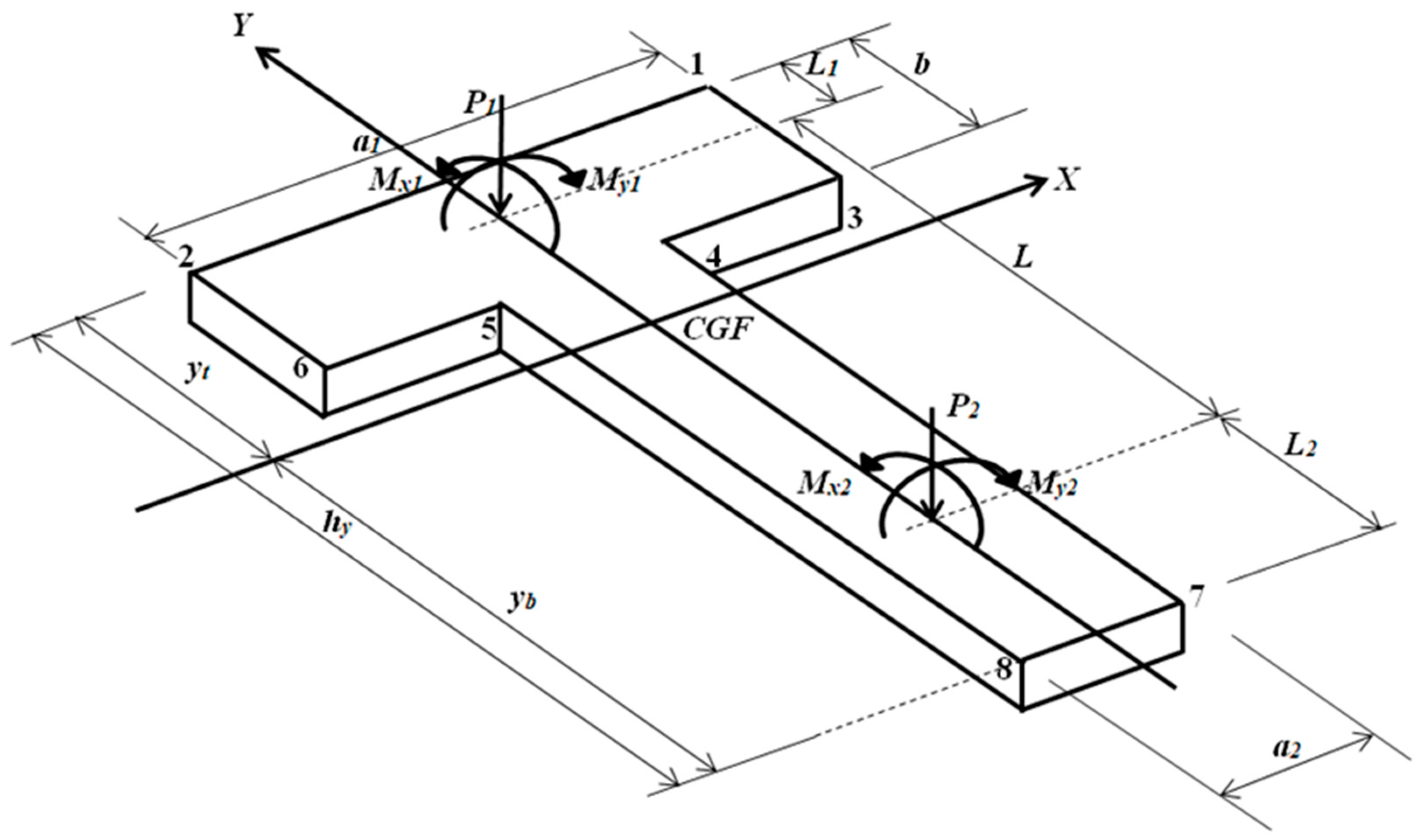
Figure 2 shows a T-shaped combined footing (free sides at its ends) that supports two columns aligned on a Y axis (longitudinal axis), and each column transfers to the footing an axial load and two bending moments on the X and Y axes.
The geometric properties of the T-shaped combined footing viewing in plan are:
A = a 1 a 2 b + a 2 h y ,
y t = a 1 a 2 b 2 + a 2 h y 2 2 a 1 a 2 b + a 2 h y ,
y b = 2 h y b a 1 a 2 b + a 2 h y 2 2 a 1 a 2 b + a 2 h y ,
I x = a 2 h y b a 1 a 2 h y b 2 a 2 h y + b a 1 a 2 4 a 1 a 2 b + a 2 h y 2 + a 1 a 2 b 3 + a 2 h y 3 12 ,
I y = b a 1 3 + h y b a 2 3 12 ,
where: A = Area of ​​the footing in plan (m2), yt = Distance from center of footing to positive end (m), yb = Distance from center of footing to negative end (m), Ix = Moment of inertia about the X axis (m4), Iy = Moment of inertia about the Y axis (m4).

2.1. Biaxial Bending

In this subsection, the fifteen possible cases for a T-shaped combined footing subjected to axial load and two orthogonal bending moments in each column are presented.
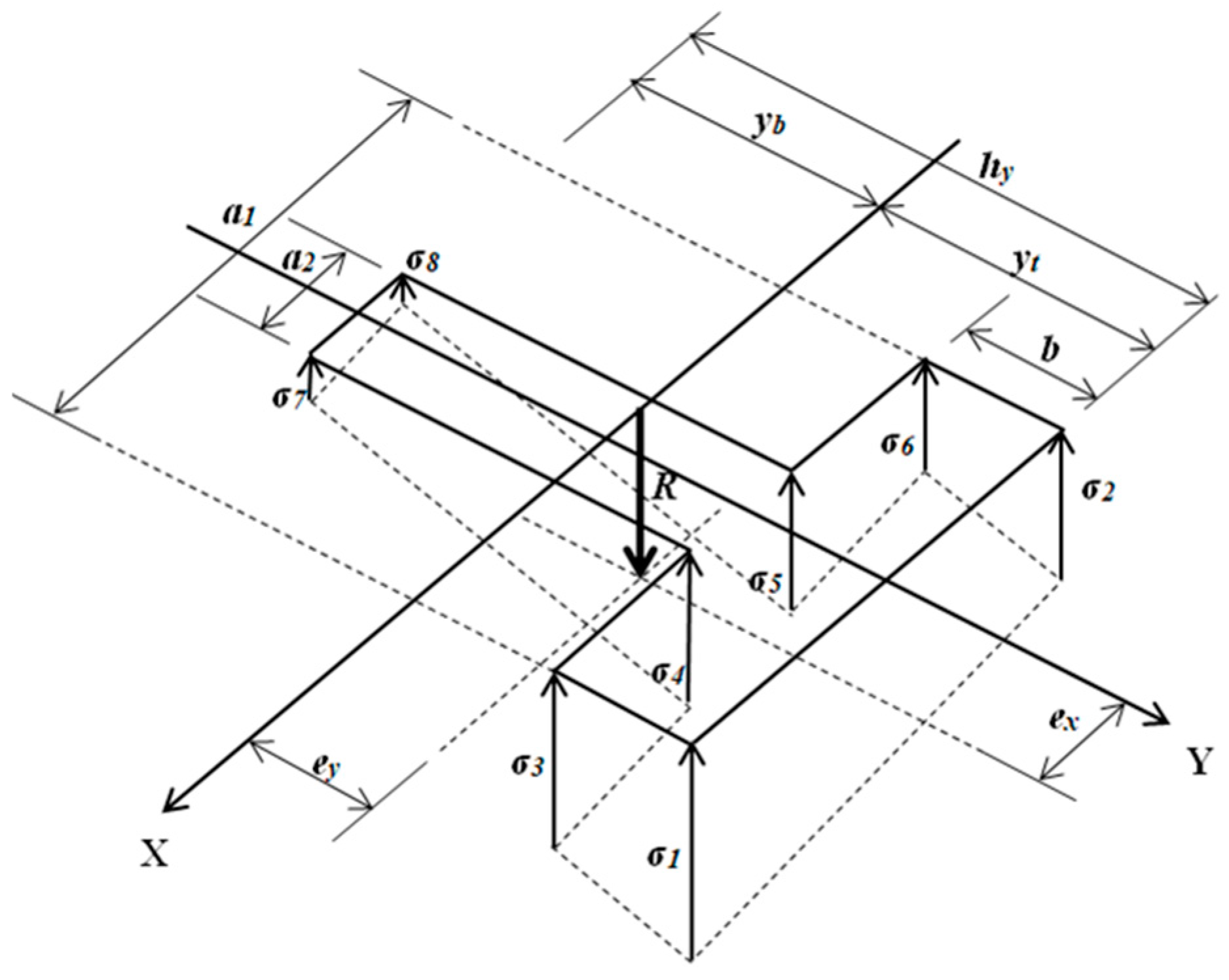
For case I, it is assumed that the entire bottom surface of the footing works under compression. The pressures generated by the ground on the footing are obtained by the following equation (biaxial bending equation):
σ = R A + M x T y I x + M y T x I y .
where: σ = Allowable soil pressure (kN/m2), Mx = Bending moment about X axis (kN-m), My = Bending moment about Y axis (kN-m).
Note: R, Mx and My can be determined as follows:
R = P 1 + P 2 ,
M x T = M x 1 + M x 2 + P 1 y t L 1 P 2 h y y t L 2 ,
M y T = M y 1 + M y 2 .
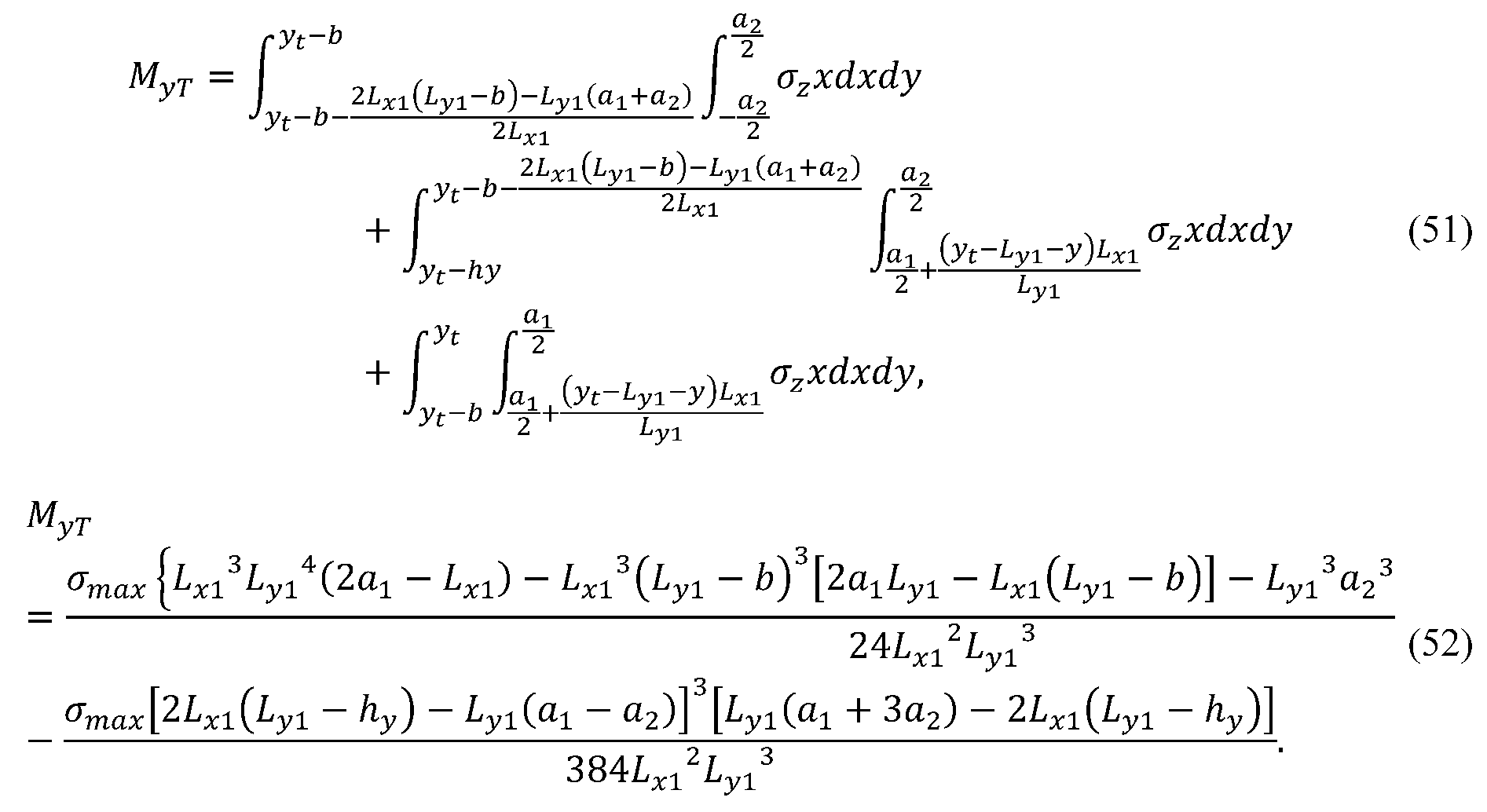
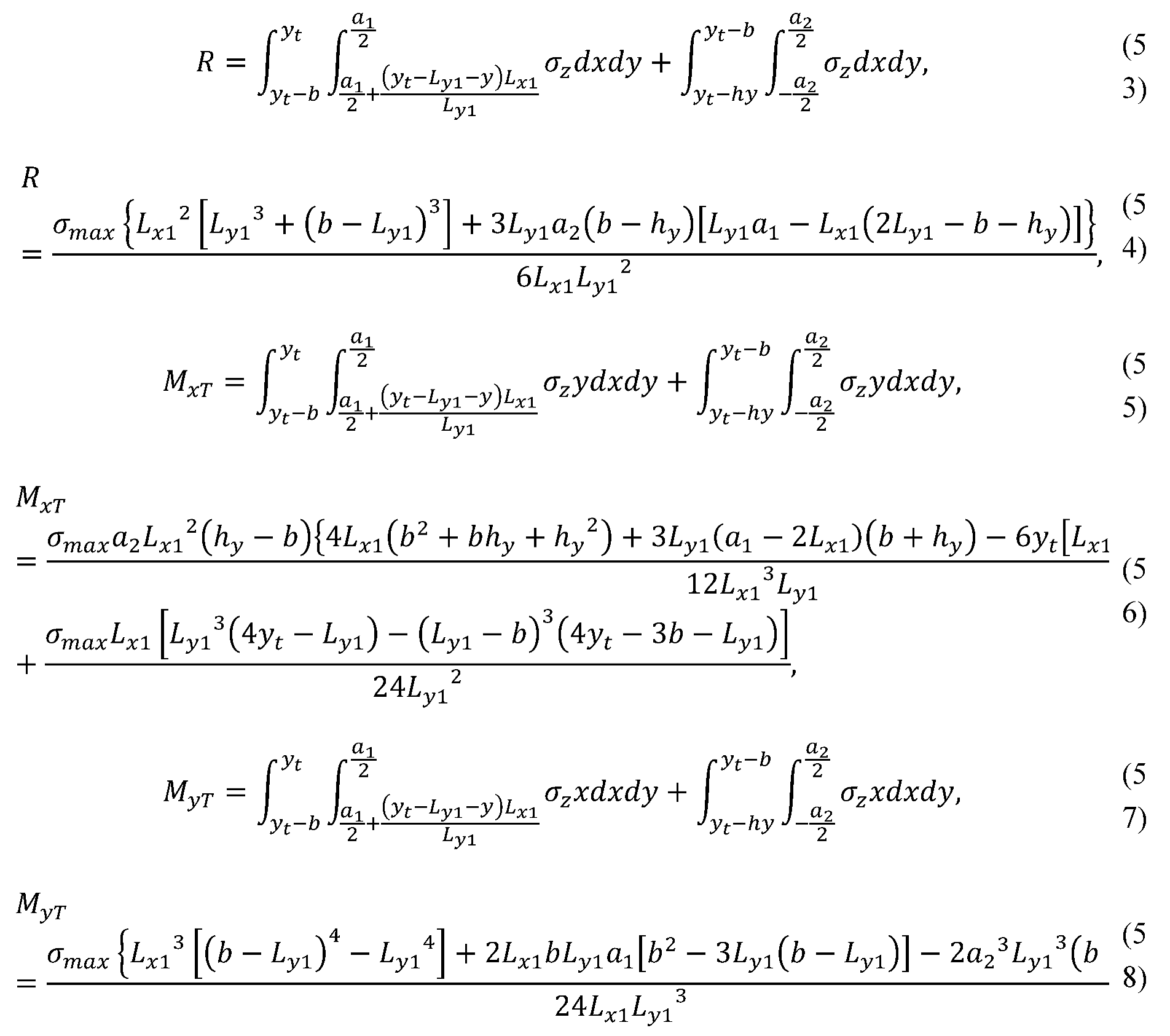
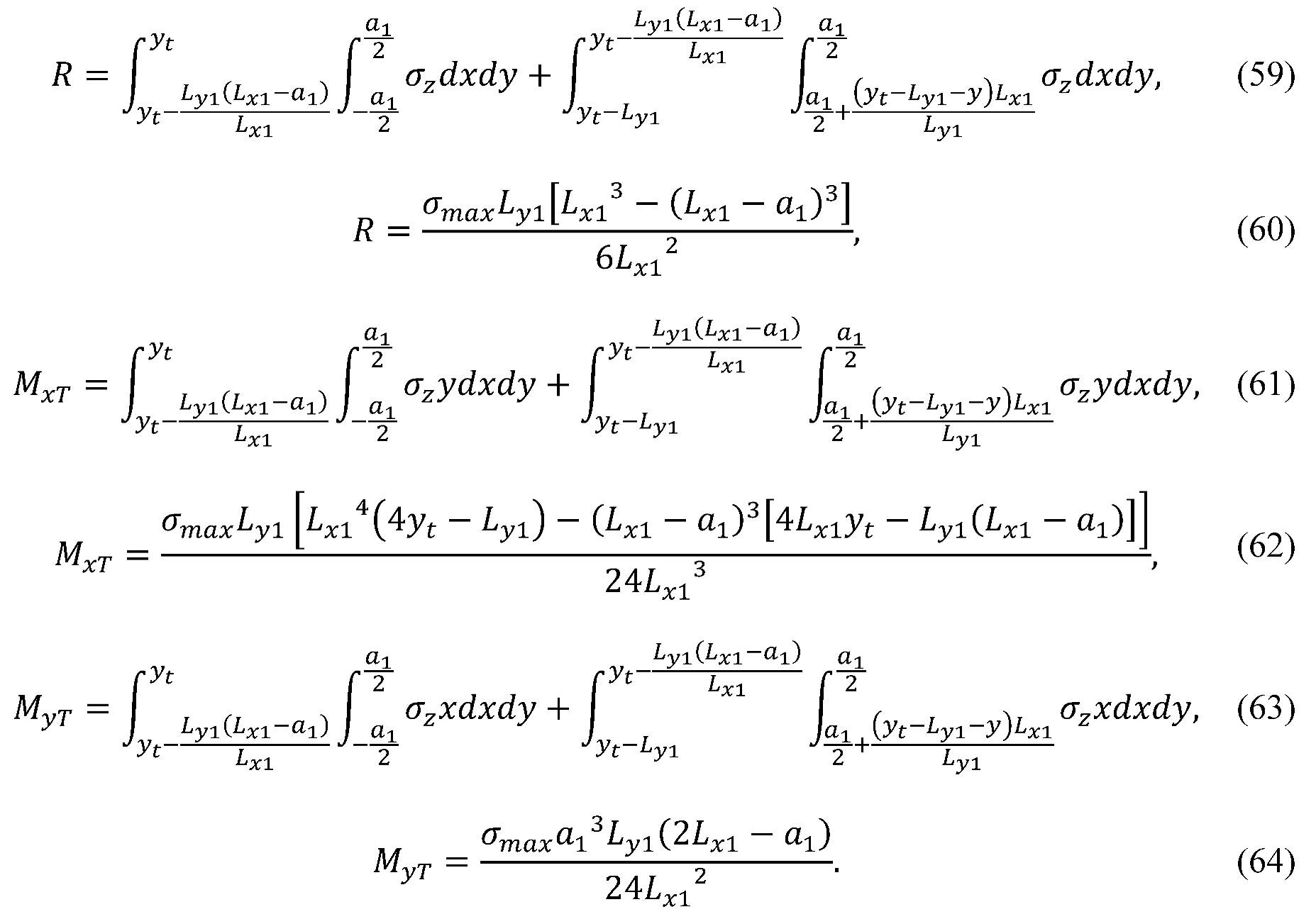
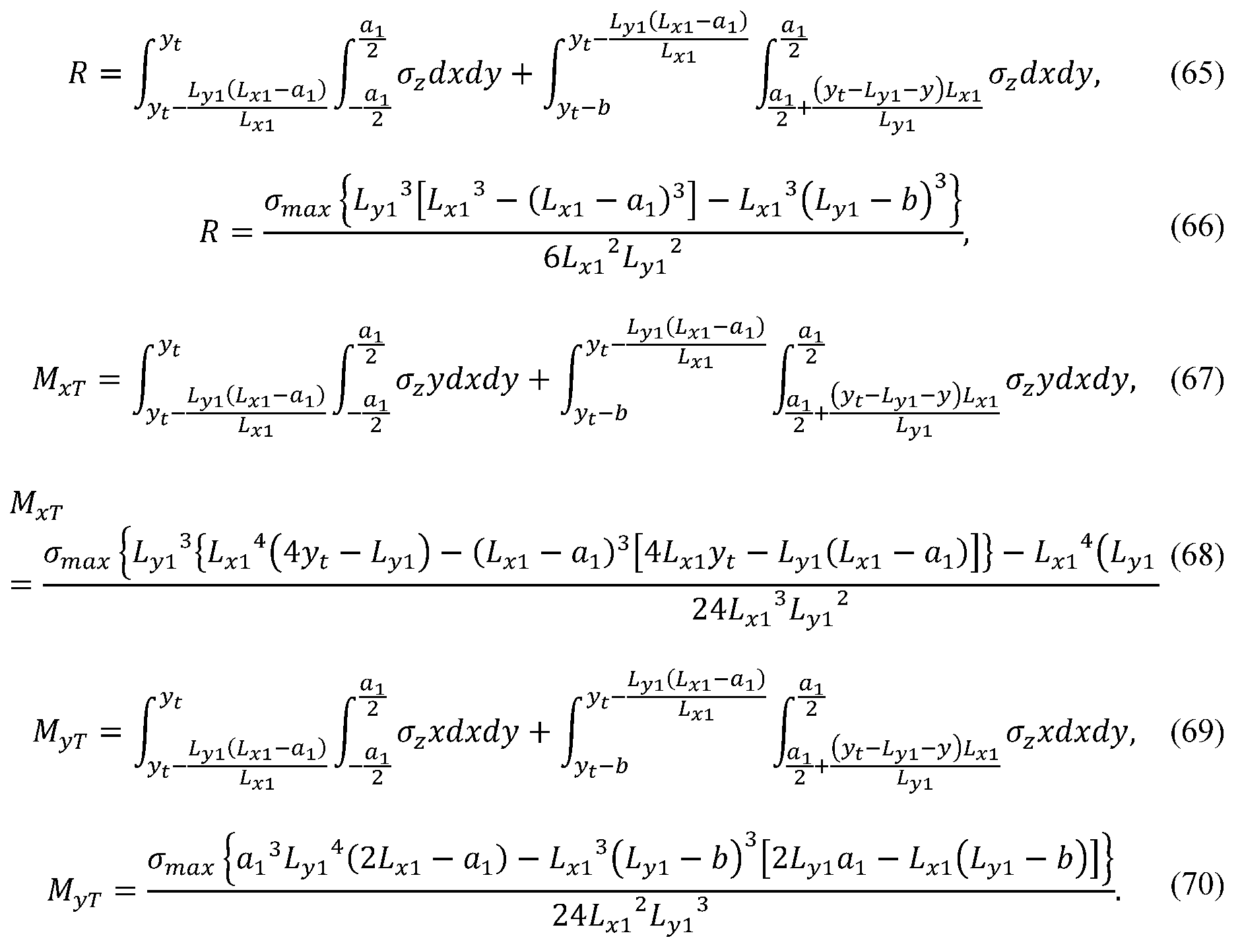
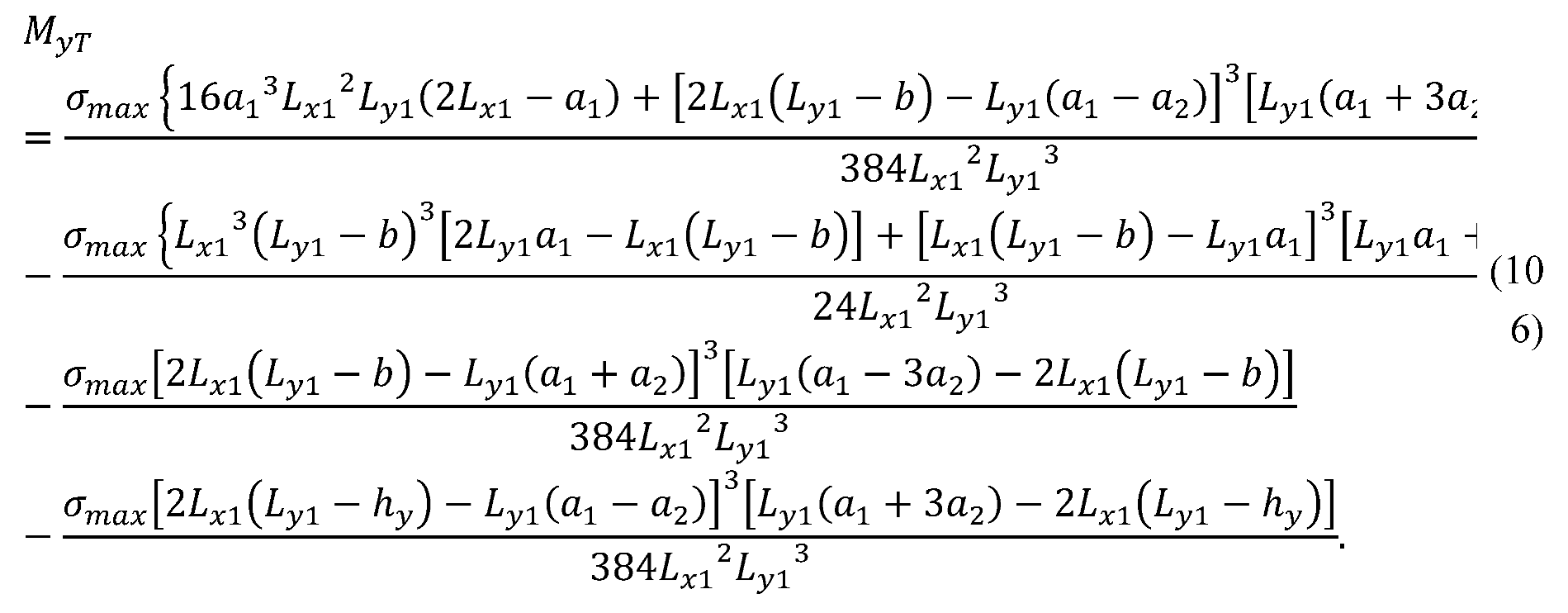
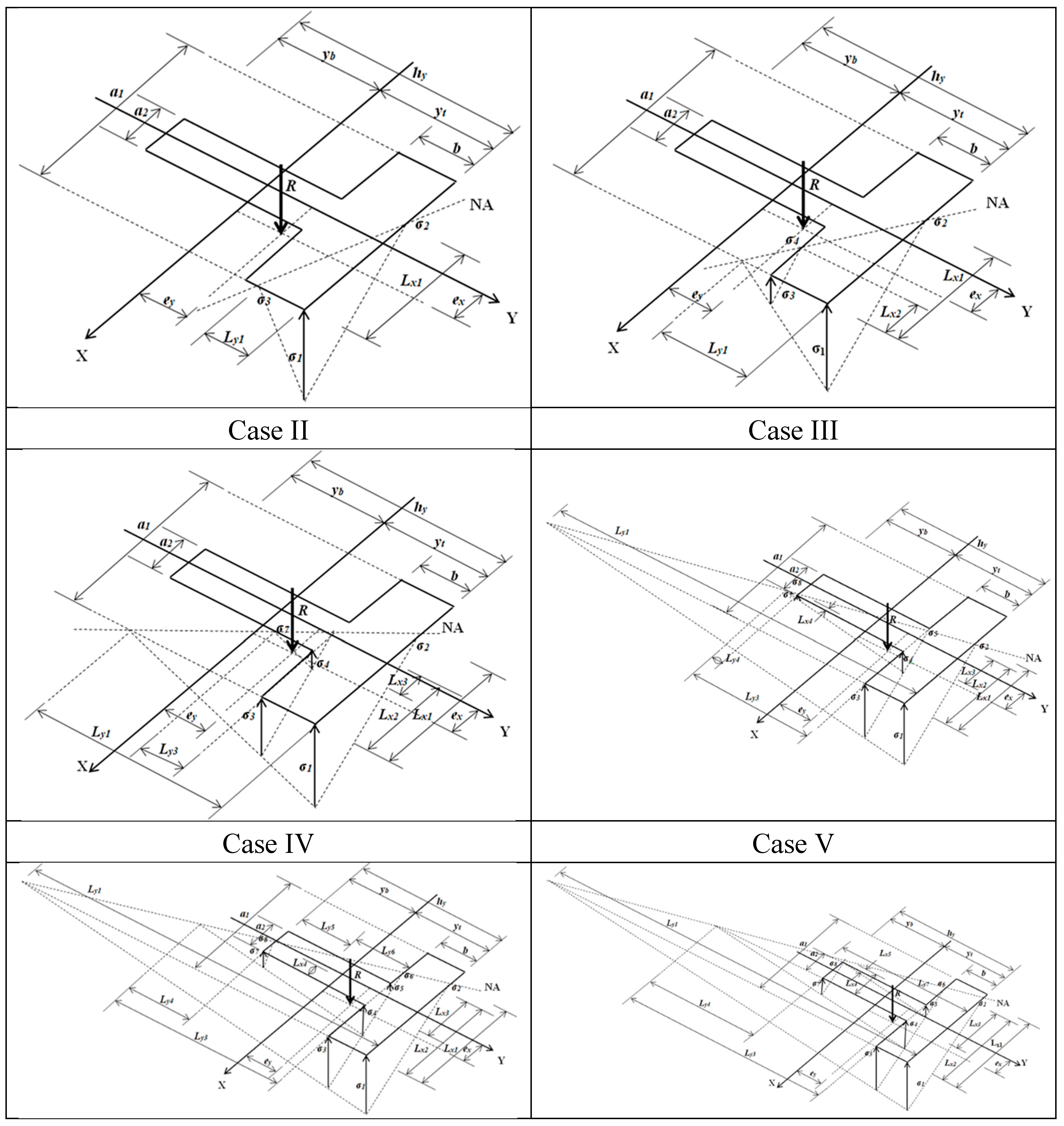
For cases II to XV, it is assumed that the entire bottom surface of the footing works partially under compression, i.e., part of the contact area there is no pressure, and by integration and/or by the geometric properties of a pyramid with a triangular base, the resultant force R, the moment on the X axis MxT and the moment on the Y axis MyT are obtained.
The pressures generated by the ground on the footing are obtained by means of the general equation of the pressure plane, starting from three known points.
The general equation of a 3-D pressure plane of the ground on the footing is:
A x + B y + C σ z + D = 0 .
For cases II to XV, the three known points of the pressure plane are:
p 1 a 1 2 ,   y t ,   σ m a x ;   p 2 a 1 2 L x 1 ,   y t ,   0 ;   p 3 a 1 2 , y t L y 1 ,   0 .
The general equation of the pressure plane is obtained as follows:
x a 1 2 y y t σ z σ m a x a 1 2 L x 1 a 1 2 y t y t 0 σ m a x a 1 2 a 1 2 y t L y 1 y t 0 σ m a x .
Solving the determinant of Equation (12) gives the pressure at any point σz:
σ z = σ m a x 2 L x 1 L y 1 + y y t + L y 1 2 x a 1 2 L x 1 L y 1 .
The equation of the straight line that forms the neutral axis is:
2 L x 1 L y 1 + y y t + L y 1 2 x a 1 = 0 .
Figure 3 shows Case I assuming that the entire bottom surface of the footing works under compression.
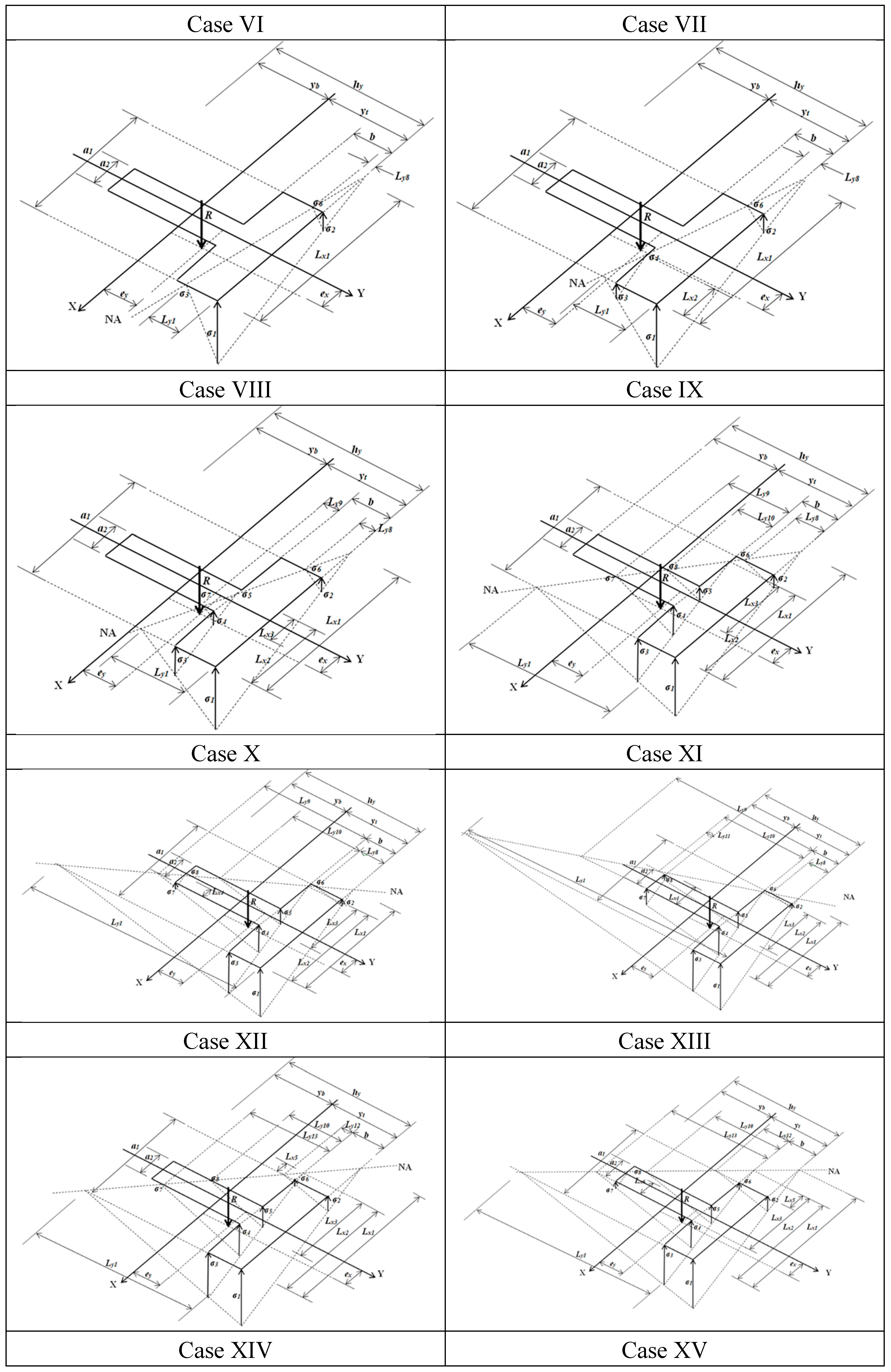
Figure 4 shows Cases II to XV assuming that the entire bottom surface of the footing works partially under compression.

2.1.1. Case I

The general equations for the soil pressure at each vertex of a footing subjected to biaxial bending are obtained from equation (6) as follows:
σ 1 = R A + M x T y t I x + M y T a 1 2 I y ,
σ 2 = R A + M x T y t I x M y T a 1 2 I y ,
σ 3 = R A + M x T y t b I x + M y T a 1 2 I y ,
σ 4 = R A + M x T y t b I x + M y T a 2 2 I y ,
σ 5 = R A + M x T y t b I x M y T a 2 2 I y ,
σ 6 = R A + M x T y t b I x M y T a 1 2 I y ,
σ 7 = R A M x T h y y t I x + M y T a 2 2 I y ,
σ 8 = R A M x T h y y t I x M y T a 2 2 I y .
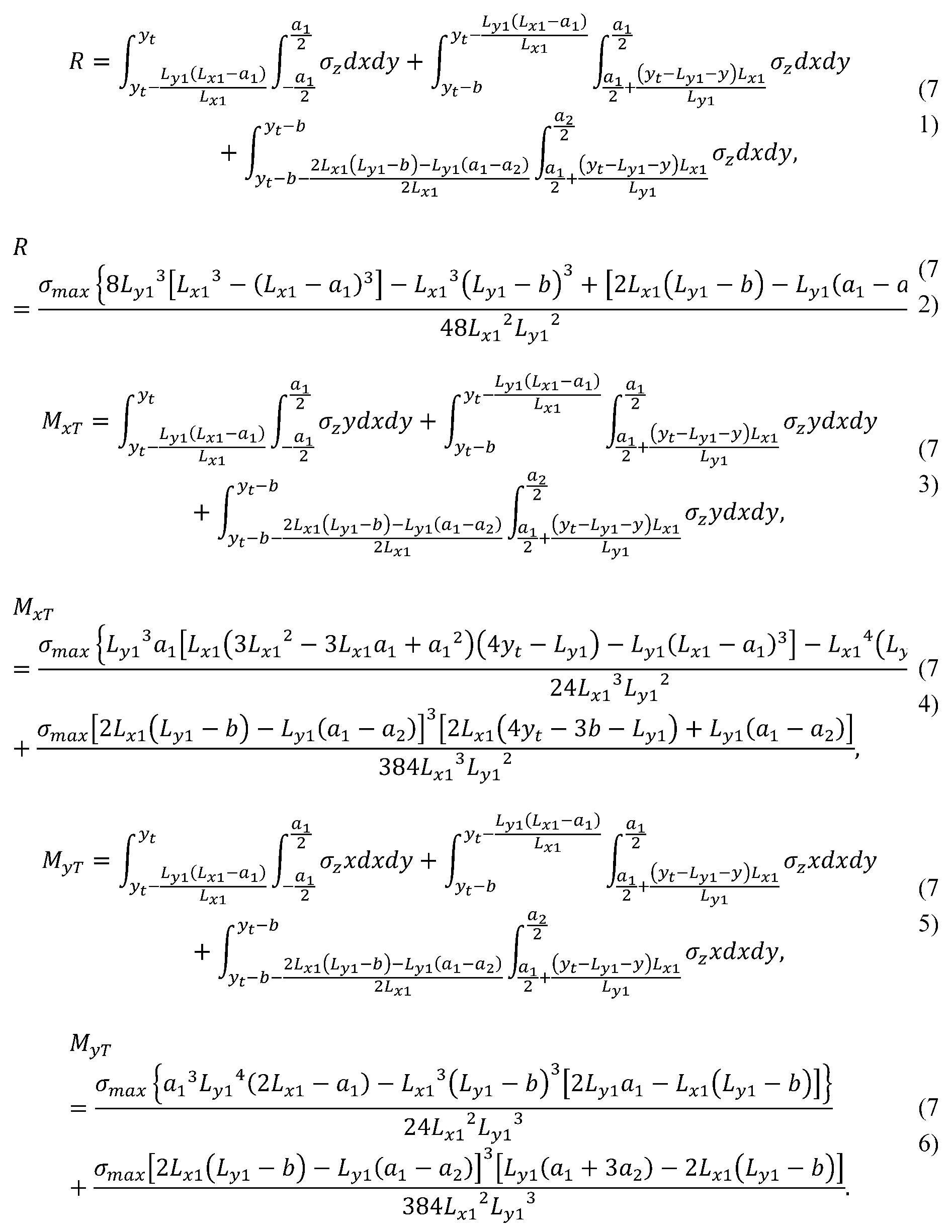
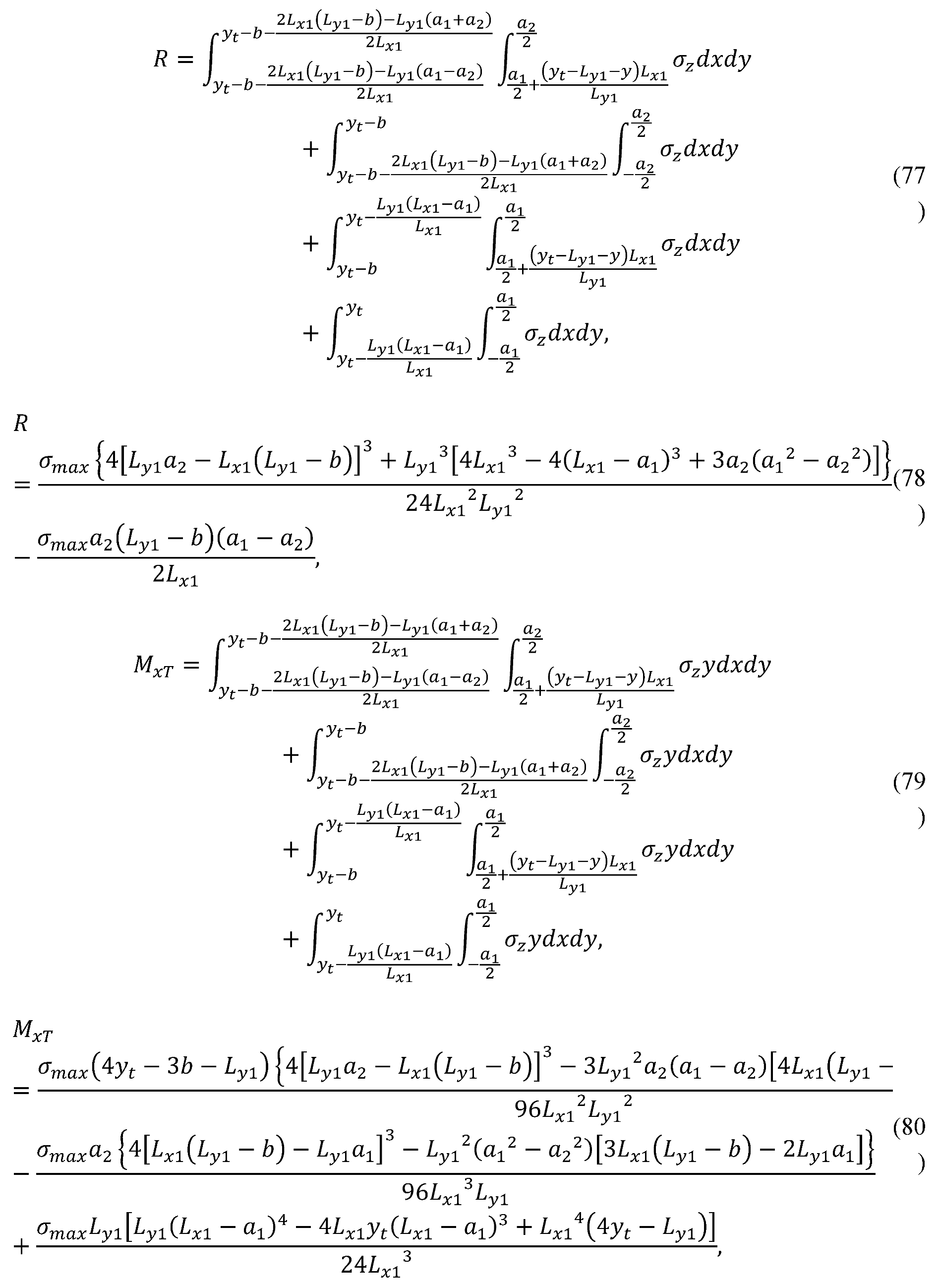
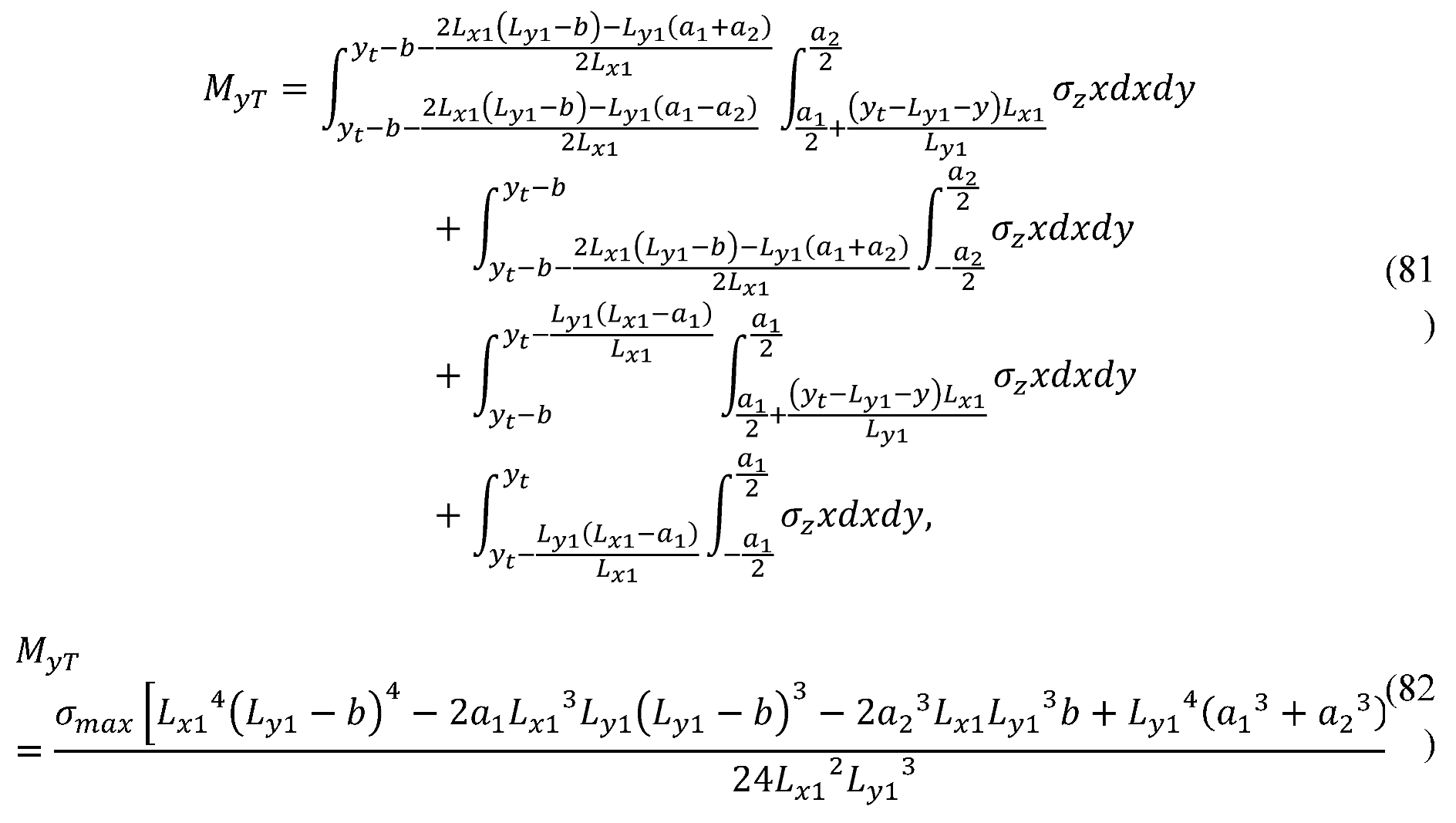
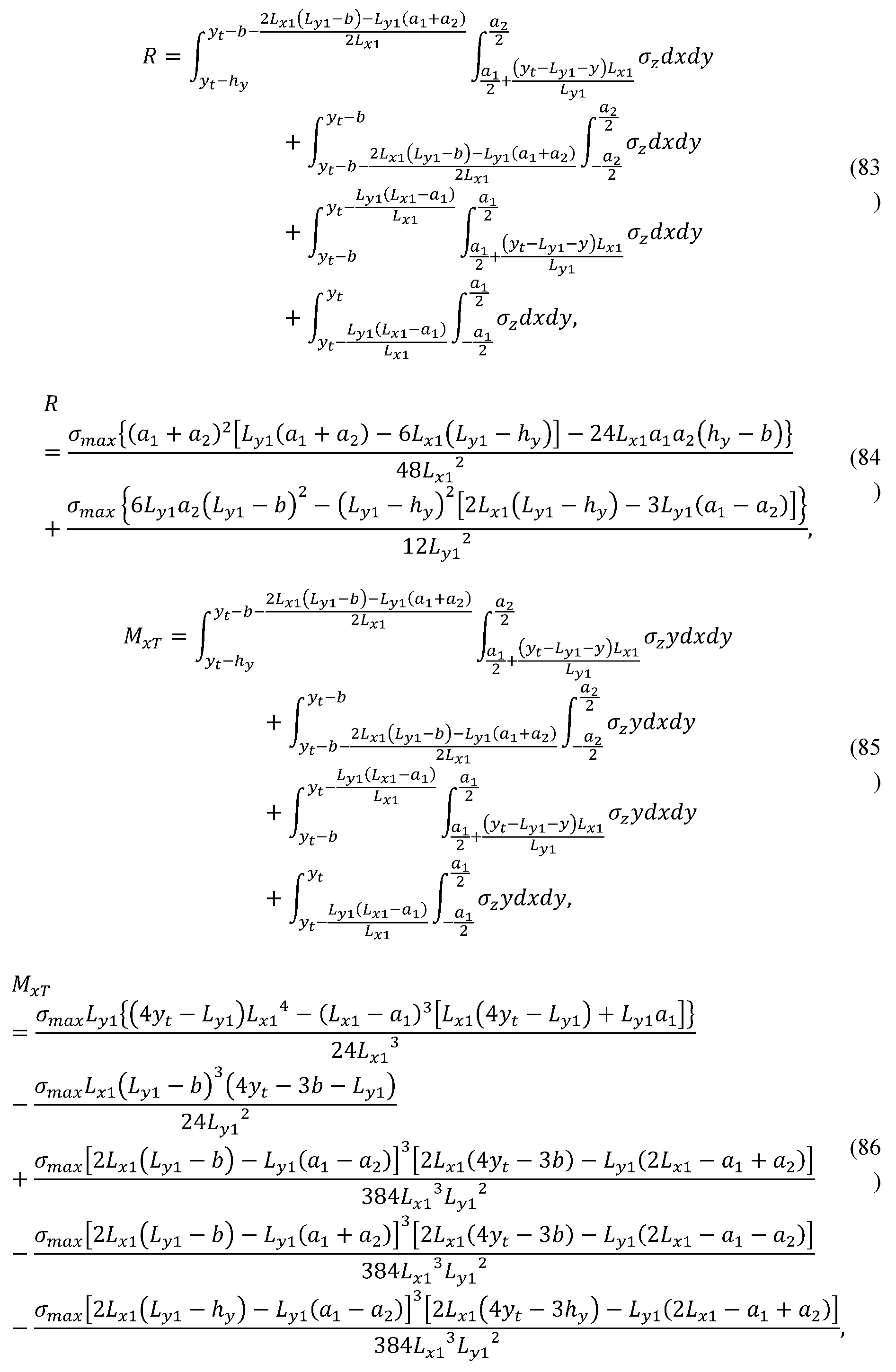
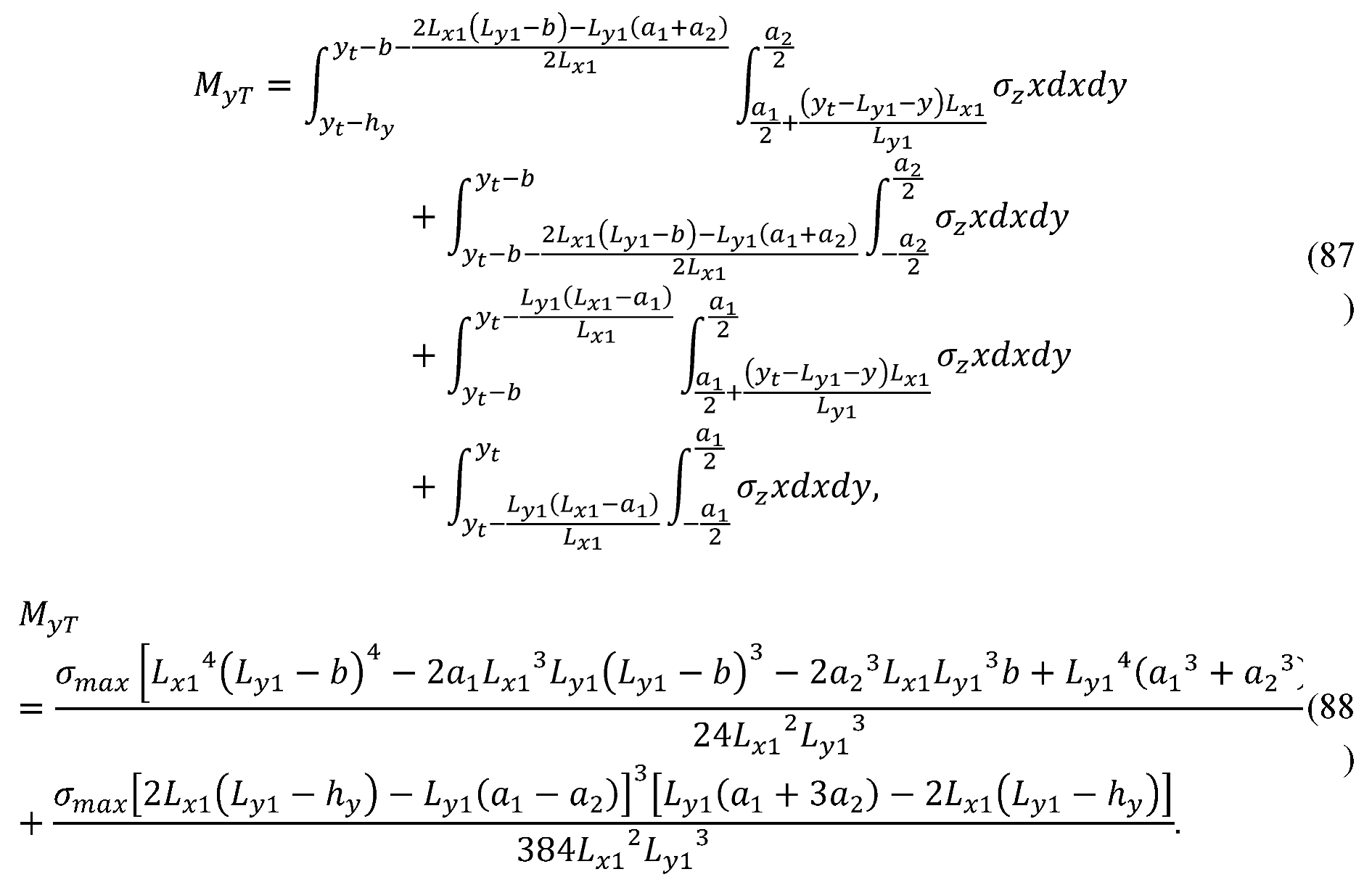
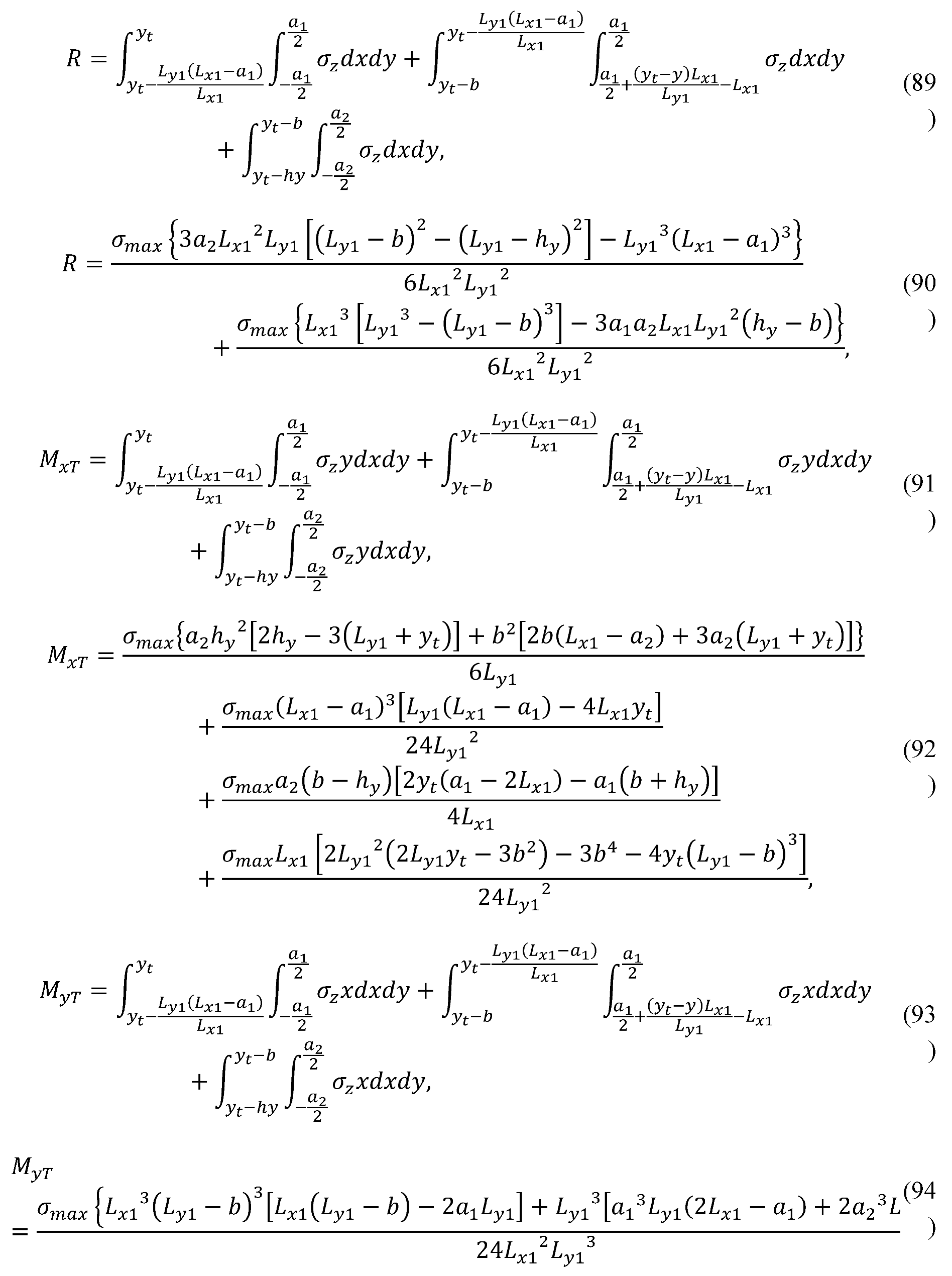
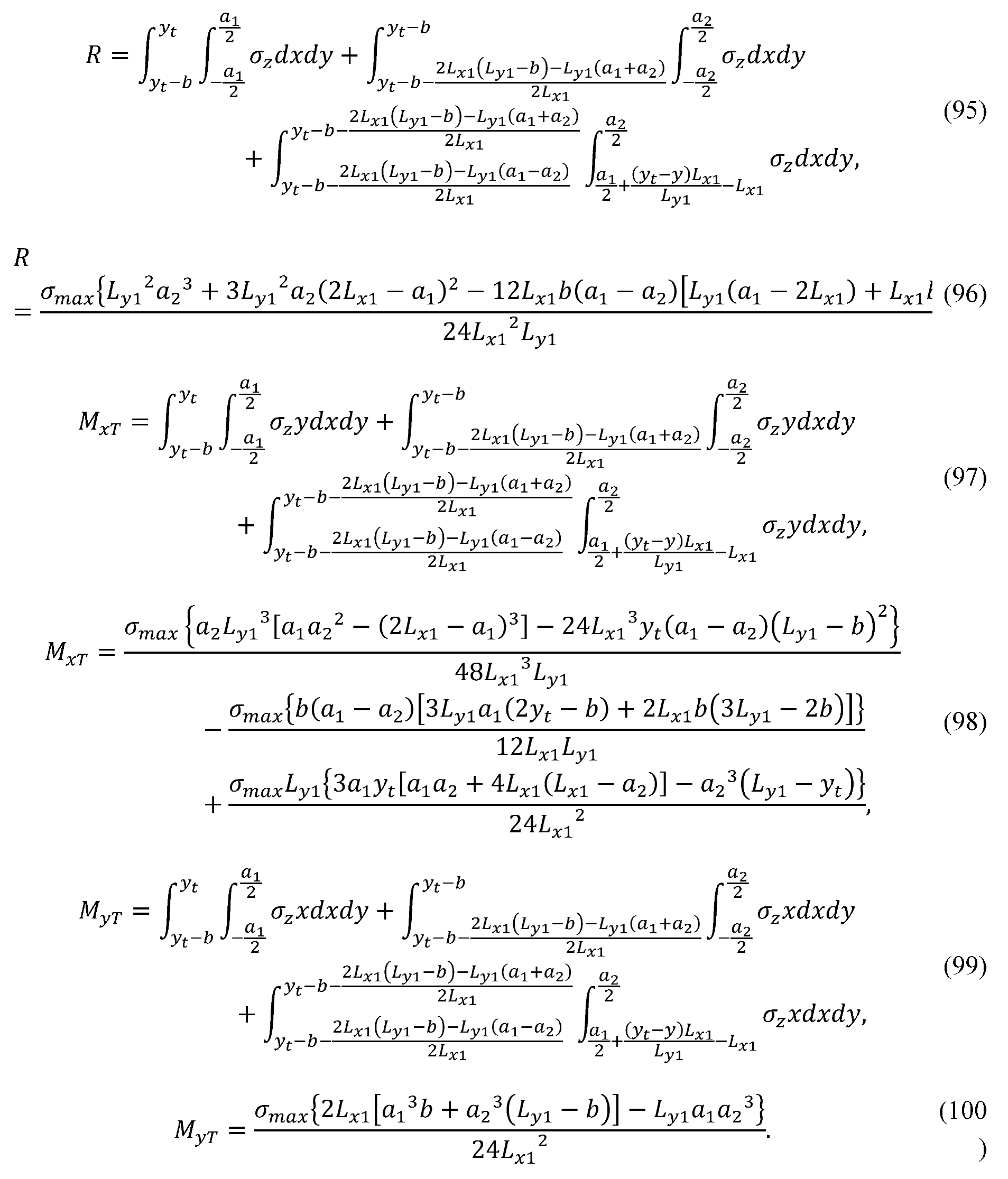
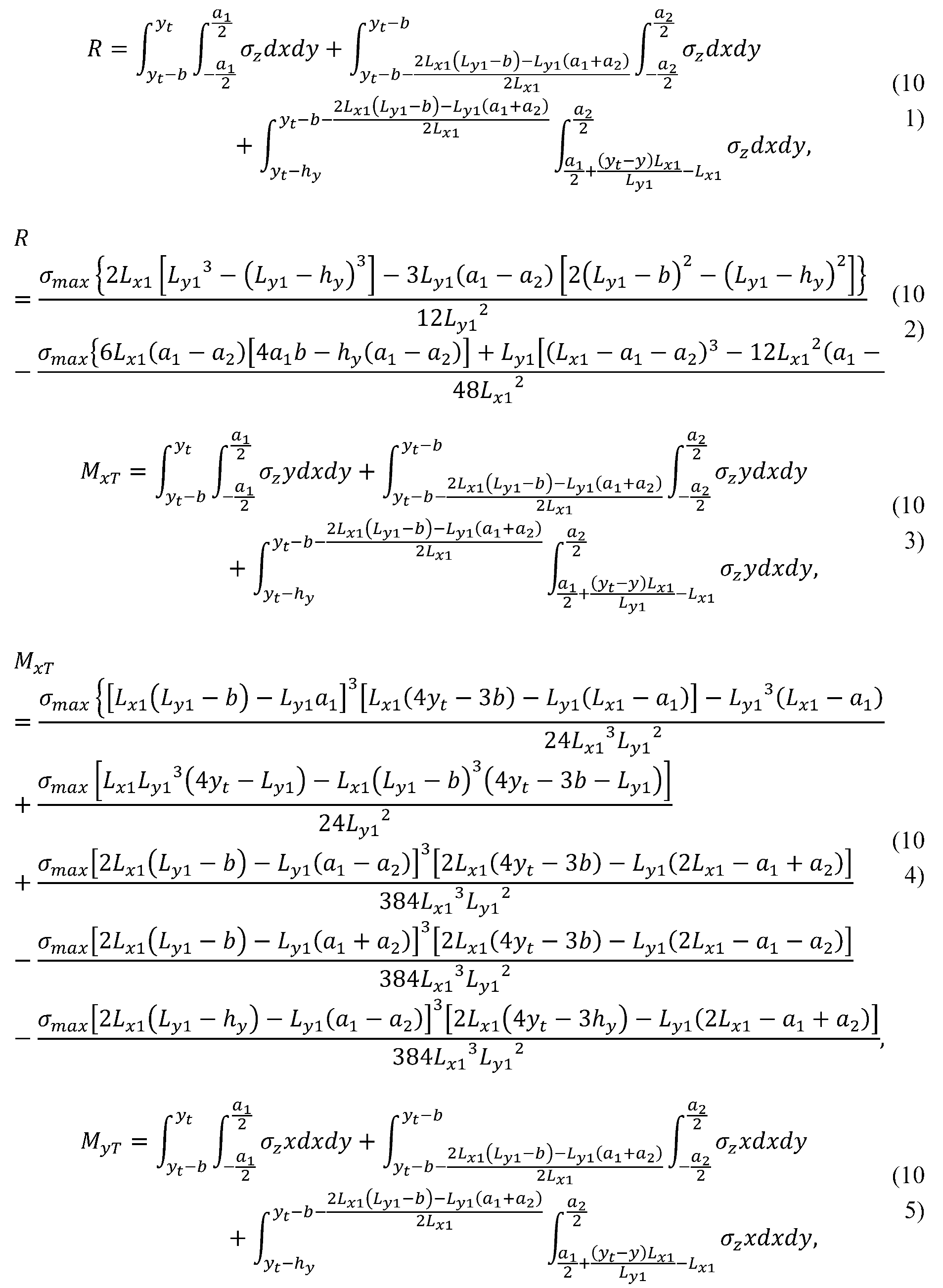
The general equations of R, MxT and MyT for cases II to XV are presented below.

2.1.2. Case II

R = y t L y 1 y t a 1 2 + y t L y 1 y L x 1 L y 1 a 1 2 σ z d x d y ,
R = σ m a x L x 1 L y 1 6 ,
M x T = y t L y 1 y t a 1 2 + y t L y 1 y L x 1 L y 1 a 1 2 σ z y d x d y ,
M x T = σ m a x L x 1 L y 1 4 y t L y 1 24 ,
M y T = y t L y 1 y t a 1 2 + y t L y 1 y L x 1 L y 1 a 1 2 σ z x d x d y ,
M y T = σ m a x L x 1 L y 1 2 a 1 L x 1 24 .

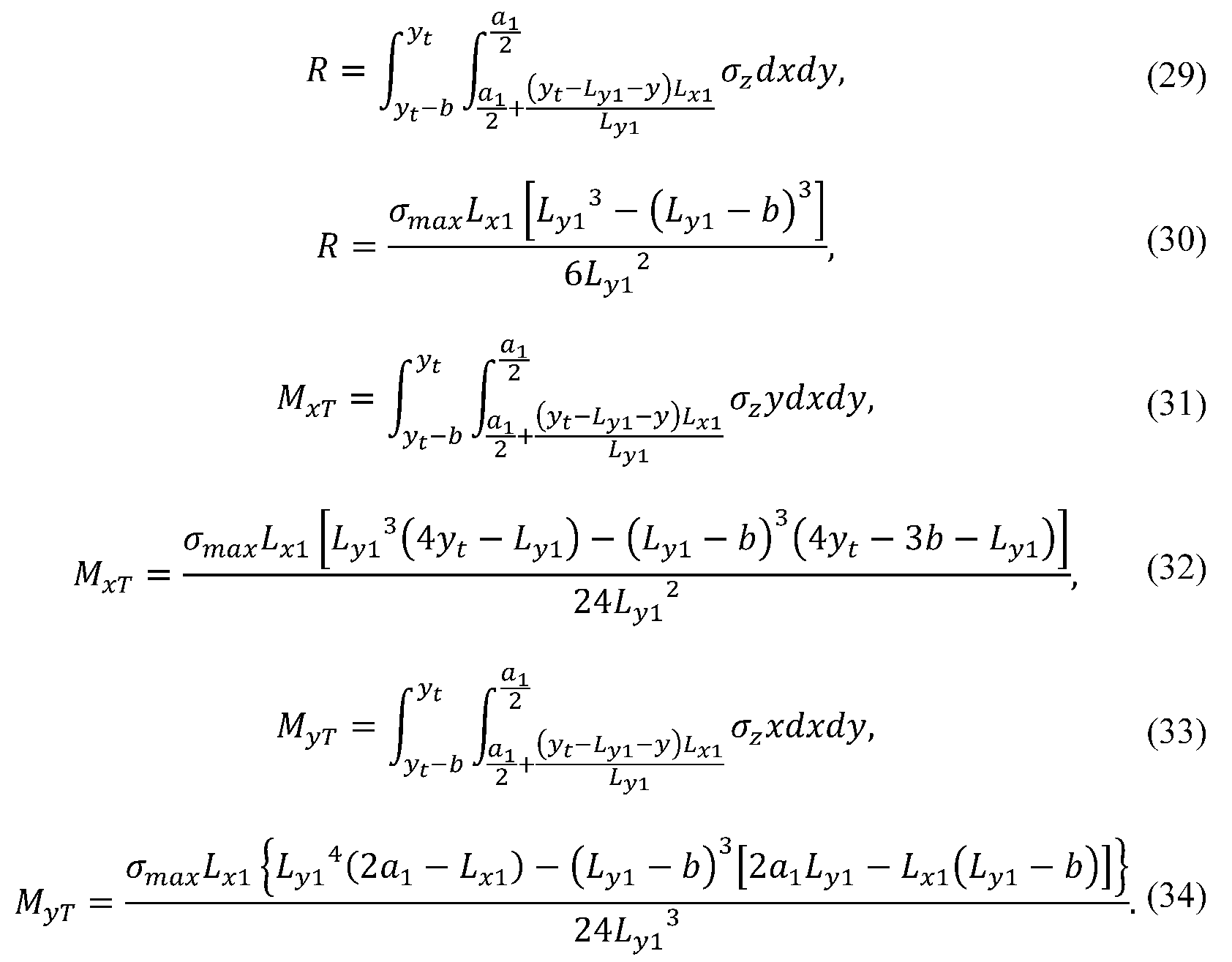
2.1.3. Case III

Preprints 147008 i001

2.1.4. Case IV

Preprints 147008 i002

2.1.5. Case V

Preprints 147008 i003

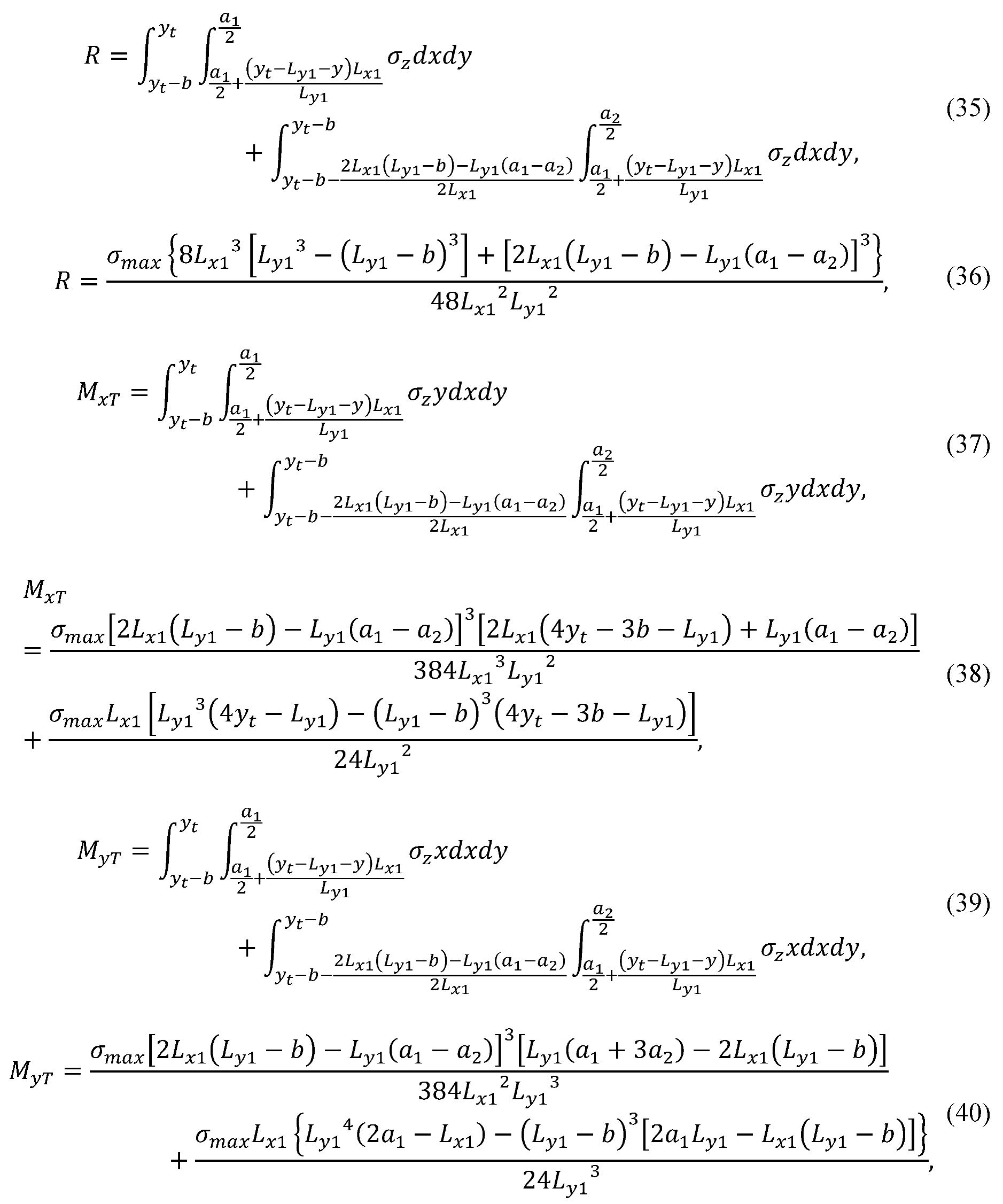
2.1.6. Case VI

Preprints 147008 i004Preprints 147008 i005

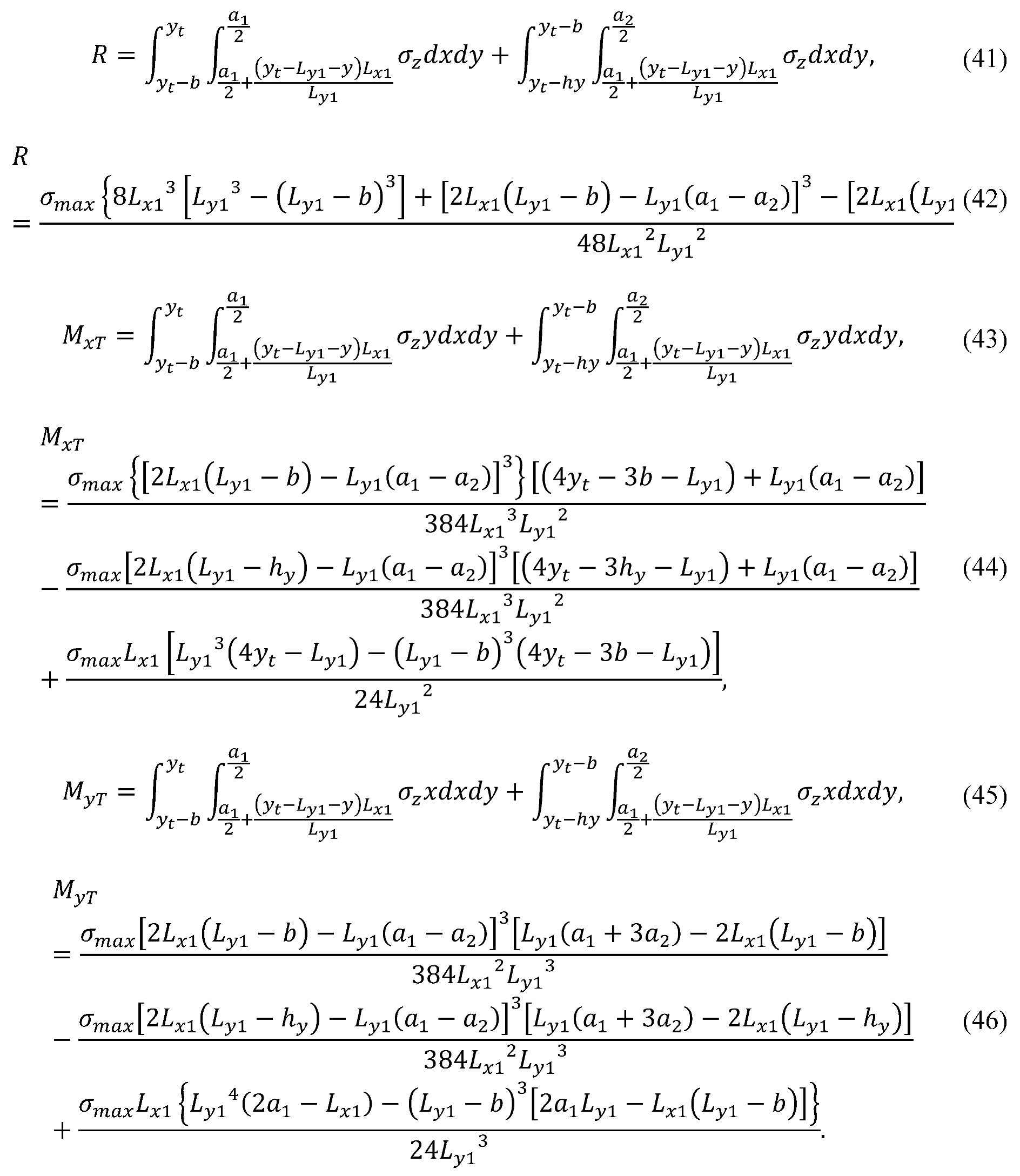
2.1.7. Case VII

Preprints 147008 i006

2.1.8. Case VIII

Preprints 147008 i007

2.1.9. Case IX

Preprints 147008 i008

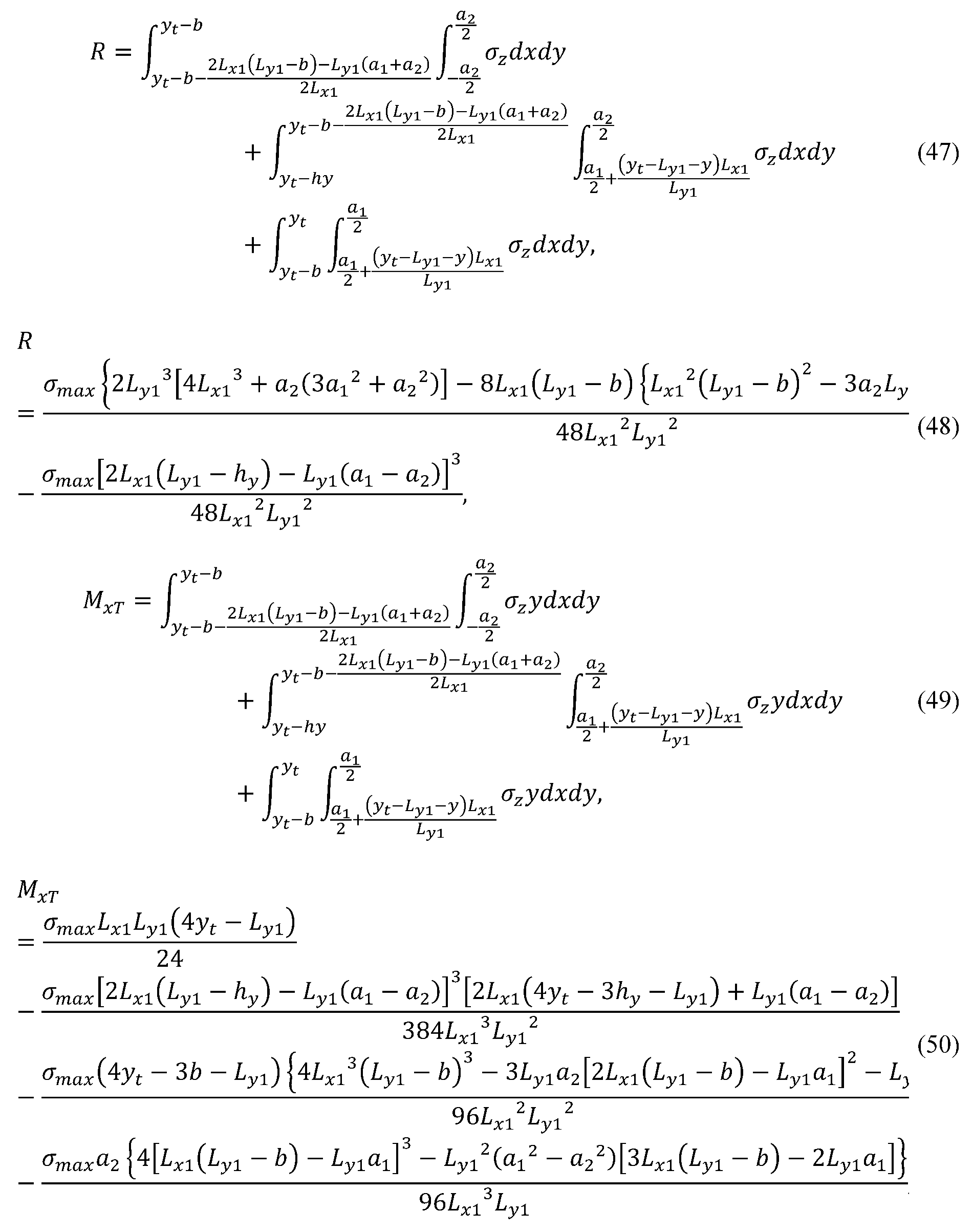
2.1.10. Case X

Preprints 147008 i009

2.1.11. Case XI

Preprints 147008 i010Preprints 147008 i011

2.1.12. Case XII

Preprints 147008 i012Preprints 147008 i013

2.1.13. Case XIII

Preprints 147008 i014

2.1.14. Case XIV

Preprints 147008 i015

2.1.15. Case XV

Preprints 147008 i016Preprints 147008 i017

2.2. Special Cases

There are two cases: Case X) when the moments Mx1 and Mx2 are zero; Case Y) when moments My1 and My2 are zero.

2.2.1. Case Y

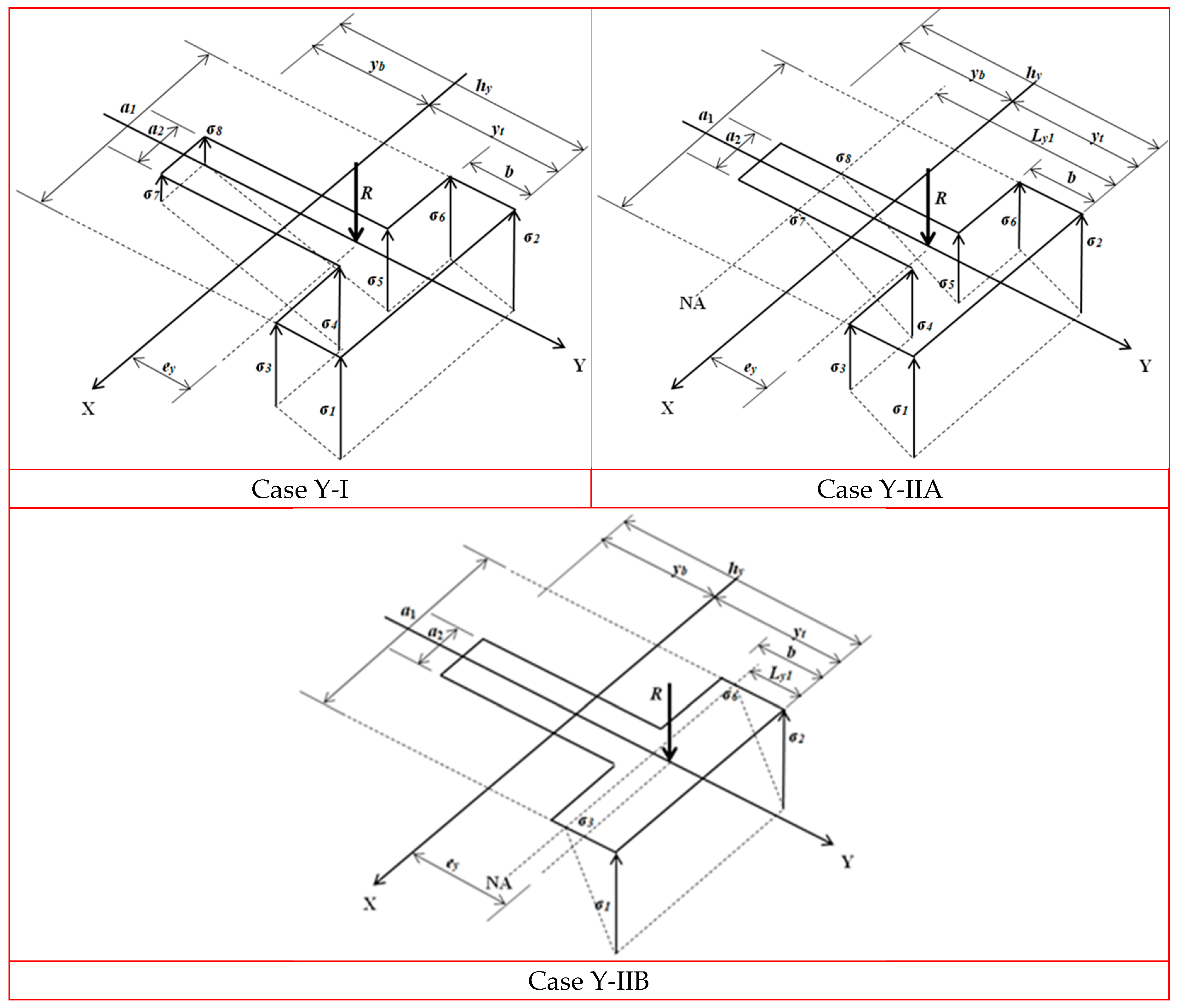
Figure 5 shows the three possible cases for a T-shaped combined footing subjected to axial load and a bending moment around the X axis provided by each column (My1 and My2 are zero).
For case Y-I, it is assumed that the entire bottom surface of the footing works under compression, and equations (15) to (22) are used.
For cases Y-IIA and Y-IIB, it is assumed that the entire bottom surface of the footing works partially under compression
The pressures generated by the ground on the footing are obtained by means of the general equation of the pressure plane, starting from three known points.
Now, the three known points of the pressure plane are:
p 1 a 1 2 ,   y t ,   σ m a x ;   p 2 a 1 2 ,   y t ,   σ m a x ;   p 3 a 2 2 , y t L y 1 ,   0 .
The general equation of the pressure plane is obtained as follows:
x a 1 2 y y t σ z σ m a x a 1 0 0 a 2 a 1 2 L y 1 σ m a x .
Solving the determinant of equation (108) gives the pressure at any point “σz”:
σ z = σ m a x L y 1 y t + y L y 1 .
2.2.1.1. Case Y-IIA
The general equations for R and MxT are:
R = 2 y t b y t 0 a 1 2 σ z d x d y + 2 y t L y 1 y t b 0 a 2 2 σ z d x d y ,
R = σ m a x a 1 b 2 L y 1 b + a 2 L y 1 b 2 2 L y 1 ,
M x T = 2 y t b y t 0 a 1 2 σ z y d x d y + 2 y t L y 1 y t b 0 a 2 2 σ z y d x d y ,
M x T = σ m a x b a 1 a 2 2 b 2 + 6 L y 1 y t 3 b L y 1 + y t 6 L y 1 + σ m a x a 2 L y 1 2 3 y t L y 1 6 L y 1 .
2.2.1.2. Case Y-IIB
The general equations for R and MxT are:
R = 2 y t L y 1 y t 0 a 1 2 σ z d x d y ,
R = σ m a x a 1 L y 1 2 ,
M x T = 2 y t L y 1 y t 0 a 1 2 σ z y d x d y ,
M x T = σ m a x a 1 L y 1 3 y t L y 1 6 .

2.2.2. Case X

For the T-shaped combined footing subjected to axial load and a bending moment around the Y axis provided by each column (Mx1 and Mx2 are zero).
For the case X, all the equations of the biaxial bending must be used, because there are resultant moments MxT.

2.3. Minimum Surface for T-Shaped Combined Footings

Minimum surface (objective function) for all cases is:
A m i n = a 1 a 2 b + a 2 h y .
Table 1 shows the equations of the constraint functions for biaxial bending in each case.
The functions that must be limited in the Y-axis direction are:
Not limited: L1 ≥ c1/2 and L2 ≥ c3/2.
Limited in column 1: L1 = c1/2 and L2 ≥ c3/2.
Limited in column 2: L1 ≥ c1/2 and L2 = c3/2.
Limited in the two columns: L1 = c1/2 and L2 = c3/2.
Note: c1 and c3 are the sides of the columns in the Y direction.
Table 2 shows the equations of the constraint functions for uniaxial bending in each case (Case Y).

3. Numerical Examples

Three numerical examples are shown for T-shaped combined footings supporting two columns, and each example presents four types of constraints, the constraints are: Constraint 1 is for unconstrained sides (L1 ≥ c1/2 and L2 ≥ c3/2); Constraint 2 is for a side constrained in column 1 (L1 = c1/2 and L2 ≥ c3/2); Constraint 3 is for a side constrained in column 2 (L1 ≥ c1/2 and L2 = c3/2); Constraint 4 is for two sides constrained (opposite sides) (L1 = c1/2 and L2 = c3/2). Example 1 is for a T-shaped combined footing subjected to axial load and moments on the X and Y axes due to the columns. Example 2 is for a T-shaped combined footing subjected to axial load and a moment on the Y axis due to the columns. Example 3 is for a T-shaped combined footing subjected to axial load and a moment on the X axis due to the columns.
The data for example 1 are: c1 = 0.40 m, c3 = 0.40 m, P1 = 1250 kN, P2 = 250 kN, Mx1 = 300 kN-m, Mx2 = 150 kN-m, My1 = 200 kN-m, My2 = 200 kN-m, L = 6.00 m, σmax = 200 kN/m2. The data for example 2 are: the same as for example 1, but Mx1 = 0 kN-m, Mx2 = 0 kN-m. The data for example 3 are: the same as for example 1, but My1 = 0 kN-m, My2 = 0 kN-m.
Table 3 shows the results of the example 1.
Table 4 shows the results of the example 2.
Table 5 shows the results of the example 3.

4. Results

The results of the table 3 show the following:
1.- The value of “Amin” is the same for constraint 1 and 3, except in cases II and IV that there is no solution available in constraint 3.
2.- The value of “Amin” is the same for constraint 2 and 4, except in case VI that there is solution available, but it is different.
3.- The minimum areas “Amin” are presented in case VI for constraints 1, 2 and 3, and case XIV for constraint 4.
The results of the table 4 show the following:
1.- The value of “Amin” is the same for constraint 1 and 3, except in cases II and IV that there is no solution available in constraint 3, and also for cases III, VI, VII, XI XII, XV these are different.
2.- The value of “Amin” is the same for constraint 2 and 4, except in cases VI and XV that there is solution available, but these are different.
3.- The minimum areas “Amin” are presented in case XV for constraint 1, in case VI for constraint 2, in case XI for constraint 3 and in case XV for constraint 4.
The results of the table 5 show the following:
1.- The value of “Amin” is the same for constraint 1 and 3.
2.- The value of “Amin” is the same for constraint 2 and 4.
3.- The minimum areas “Amin” are presented in case YIIA for all the constraints.
Table 6, Table 7 and Table 8 show in detail the mechanical and geometric properties of the cases that present the minimum areas of each example.
The results of the table 6 show the following:
1.- All the values are the same for constraints 1 and 3.
2.- The smaller value of “a1” occurs in constraint 2, and the largest appears in constraint 4. All the values of “a2” are the same. The smaller value of “b” occurs in constraint 4, and the largest appears in constraints 1 and 3. The largest value of “hy” occurs in constraint 2, and the smaller appears in constraints 1, 3 and 4.
3.- The minimum area “Amin” is presented in case VI for constraints 1 and 3, and the largest appears in case XIV for constraint 4.
The results of the table 7 show the following:
1.- The smaller value of “a1” occurs in constraint 3, and the largest appears in constraint 4. All the values of “a2” are the same. The largest value of “b” occurs in constraint 3, and the smaller appears in constraint 1, 2 and 4. The largest value of “hy” occurs in constraint 4, and the smaller appears in constraint 4.
2.- The minimum area “Amin” is presented in case XI for constraint 3, and the largest appears in case VI for constraint 2.
3.- The constraint 3 shows a rectangular combined footing.
The results of the table 8 show the following:
1.- All the values are the same for constraints 1 and 3, and for constraints 2 and 4.
2.- The smaller value of “a1” occurs in constraints 1 and 3, and the largest appears in constraints 2 and 4. All the values of “a2” are the same. All values of “b” are the same. The largest value of “hy” occurs in constraints 1 and 3, and the smaller appears in constraints 2 and 4.
3.- The minimum area “Amin” is presented in case YIIA for constraints 1 and 3, and the largest appears in case YIIA for constraints 2 and 4.
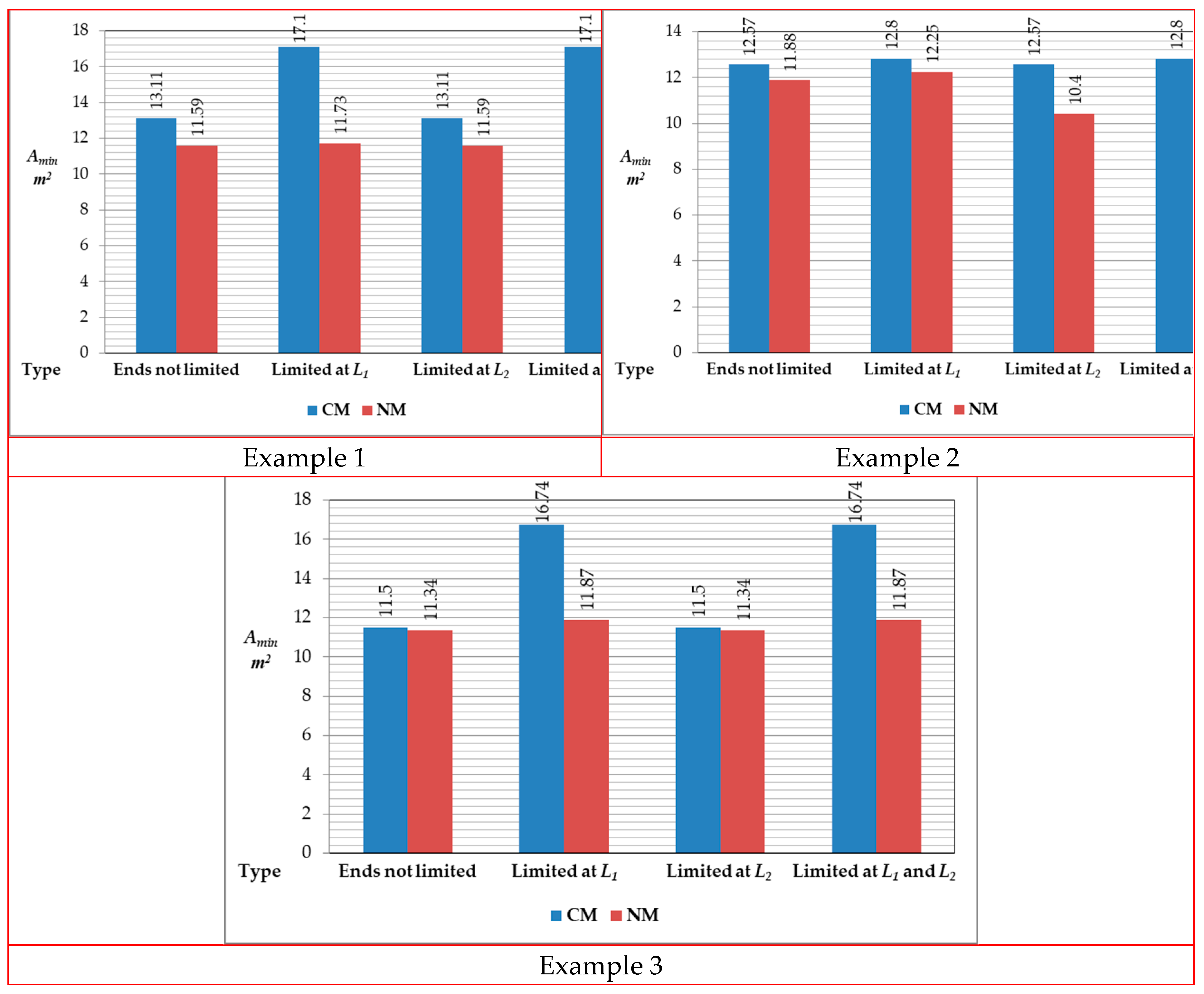
Figure 6 shows a comparison between the CM (current model) and the NM (new model).
In three examples it shows a saving using the NM with respect to the CM. For example 1, largest savings occurs with 31.40% by limiting L1. For example 2, largest savings occurs with 17.26% by limiting L2. For example 3, largest savings occurs with 29.09% by limiting L1, and by limiting L1 and L2.

5. Conclusions

The model presented in this document applies only for minimum area of a T-shaped combined footing that supports two columns aligned on a longitudinal axis. The considerations of this work are: the footing is rigid and the soil that supports to the footing is elastic and homogeneous, that comply with the biaxial bending, i.e., the variation of soil pressure is linear.
This paper concludes the following:
1.- Some authors present equations to find the dimensions of the footing and the minimum surface, but the entire surface of the footing works under compression (see Case I for the three examples).
2.- The proposed model presents the minimum surface and the constraint functions for the fifteen possible cases.
3.- The model can be used as a review of the allowable load capacity of the soil, taking into account the objective function “σmax”, and the same constraint functions for biaxial bending or uniaxial bending.
4.- The proposed model can be used for rectangular combined footings, simply set a1 = a2 and b = hy (see Table 7).
5.- When MxT is zero, the resultant force lies along the X axis (see Table 7).
6.- When MyT is zero, the resultant force lies along the Y axis (see Table 8).
7.- The model can be used for the following considerations:
a) Unconstrained sides (L1 ≥ c1/2 and L2 ≥ c3/2)
b) A constrained side in column 1 (L1 = c1/2 and L2 ≥ c3/2)
c) A constrained side in column 2 (L1 ≥ c1/2 and L2 = c3/2)
d) Two constrained sides (opposite sides) (L1 = c1/2 and L2 = c3/2)
The next investigations can be: 1) Minimum area for corner combined footings assuming that the contact area with the ground woks partially under compression. 2) Minimum area for strap combined footings assuming that the contact area with the ground woks partially under compression.

Author Contributions

E.R.D.-G. contributed to the verification of the model, the written review and the discussion of results. A.L.-R. contributed to the original idea of the article, the mathematical development of the new model and coordinated the work in general. G.S.-H. contributed to the verification of the new model and the programming of the MAPLE 15 software. V.M.M.-L. contributed to the elaboration of the Bibliographic review, the elaboration of the figures and tables. A.E.L.-G. contributed to the application of the proposed model (examples).

Funding

The research was funded by the Universidad Autónoma de Coahuila and Universidad Veracruzana, Mexico.

Data Availability Statement

No new data were created or analyzed in this study. Data sharing is not applicable to this article.

Acknowledgments

The research described in this work was developed at the Universidad Autónoma de Coahuila and Universidad Veracruzana, Mexico.

Conflicts of Interest

The authors declare no conflict of interest.

References

  1. Bowles, J.E. Foundation analysis and design; McGraw-Hill, New York, USA, 2001.
  2. Shahin, M.A.; Cheung, E.M. Stochastic design charts for bearing capacity of strip footings. Geomech. Eng. 2011, 3, 153-167. [CrossRef]
  3. Dixit, M.S.; Patil K.A. Experimental estimate of Nγ values and corresponding settlements for square footings on finite layer of sand. Geomech. Eng. 2013, 5, 363-377. [CrossRef]
  4. ErzÍn, Y.; Gul, T.O. The use of neural networks for the prediction of the settlement of pad footings on cohesionless soils based on standard penetration test. Geomech. Eng. 2013, 5, 541-564. [CrossRef]
  5. Colmenares, J.E.; Kang, S-R.; Shin, Y-J.; Shin, J-H. Ultimate bearing capacity of conical shell foundations. Struct. Eng. Mech. 2014, 52, 507-523. [CrossRef]
  6. Cure, E.; Sadoglu, E.; Turker, E.; Uzuner, B.A. Decrease trends of ultimate loads of eccentrically loaded model strip footings close to a slope. Geomech. Eng. 2014, 6, 469-485. [CrossRef]
  7. Fattah, M.Y.; Yousif, M.A.; Al-Tameemi, S.M.K. Effect of pile group geometry on bearing capacity of piled raft foundations”, Struct. Eng. Mech. 2015, 54, 829-853. [CrossRef]
  8. Uncuoğlu, E. The bearing capacity of square footings on a sand layer overlying clay”, Geomech. Eng. 2015, 9, 287-311. [CrossRef]
  9. Anil, Ö.; Akbaş, S.O.; BabagĪray, S.; Gel, A.C.; Durucan, C. Experimental and finite element analyses of footings of varying shapes on sand”, Geomech. Eng. 2017, 12, 223-238. [CrossRef]
  10. Khatri, V.N.; Debbarma, S.P.; Dutta, R.K.; Mohanty, B. Pressure-settlement behavior of square and rectangular skirted footings resting on sand. Geomech. Eng. 2017, 12, 689-705. [CrossRef]
  11. Mohebkhah, A. Bearing capacity of strip footings on a stone masonry trench in clay. Geomech. Eng. 2017, 13, 255-267. [CrossRef]
  12. Zhang, W.-X.; Wu, H.; Hwang, H.-J.; Zhang, J.-Y.; Chen, B.; Yi, W.-J. Bearing behavior of reinforced concrete column-isolated footing substructures. Eng. Struct. 2019, 200, 109744. [CrossRef]
  13. Turedi, Y.; Emirler, B.; Ornek, M.; Yildiz, A. Determination of the bearing capacity of model ring footings: Experimental and numerical investigations. Geomech. Eng. 2019, 18, 29-39. [CrossRef]
  14. Gnananandarao, T.; Khatri, V.N.; Dutta, R.K. Bearing capacity and settlement prediction of multi-edge skirted footings resting onsand. Ing. Investig. 2020, 40, 9-21. [CrossRef]
  15. Gör, M. Analyzing the bearing capacity of shallow foundations on two-layered soil using two novel cosmology-based optimization techniques. Smart Struct. Syst. 2022, 29, 513-522. [CrossRef]
  16. Chaabani, W.; Remadna, M.S.; Abu-Farsakh, M. Numerical Modeling of the Ultimate Bearing Capacity of Strip Footings on Reinforced Sand Layer Overlying Clay with Voids. Infrastructures 2023, 8, 3. [CrossRef]
  17. Vitone, D.M.A.; Valsangkar, A.J. Stresses from loads over rectangular areas. J. Geotech. Geoenviron. 1986, 112, 961-964. [CrossRef]
  18. Michalowski, R.L. Upper-bound load estimates on square and rectangular footings. Géotechnique. 2001, 51, 787-798. [CrossRef]
  19. Özmen, G. Determination of base stresses in rectangular footings under biaxial bending. Teknik Dergi Digest. 2011, 22, 1519-1535. http://www.imo.org.tr/resimler/dosya_ekler/7b559795bd3f63b_ek.pdf?dergi=472.
  20. Aydogdu, I. New Iterative method to Calculate Base Stress of Footings under Biaxial Bending. IJEAS. 2016, 8, 40-48. [CrossRef]
  21. Girgin, K. Simplified formulations for the determination of rotational spring constants in rigid spread footings resting on tensionless soil. JCEM. 2017, 23, 464-474. [CrossRef]
  22. Al-Gahtani, H.J.; Adekunle, S.K. A boundary-type approach for the computation of vertical stresses in soil due to arbitrarily shaped foundations. World J. Eng. 2019, 16, 419-426. [CrossRef]
  23. Rawat, S.; Mittal, R.K.; Muthukumar, G. Isolated Rectangular Footings under Biaxial Bending: A Critical Appraisal and Simplified Analysis Methodology. Pract. Period. Struct. Des. Const. 2020, 25. [CrossRef]
  24. López-Machado, N.A.; Perez, G.; Castro, C.; Perez, J.C.V.; López-Machado, L.J.; Alviar-Malabet, J.D.; Romero-Romero, C.A.; Guerrero-Cuasapaz, D.P.; Montesinos-Machado, V.V. A Structural Design Comparison Between Two Reinforced Concrete Regular 6-Level Buildings using Soil-Structure Interaction in Linear Range. Ing. Investig. 2022, 42, e86819. [CrossRef]
  25. Lezgy-Nazargah, M.; Mamazizi, A.; Khosravi, H. Analysis of shallow footings rested on tensionless foundations using a mixed finite element model. Struct. Eng. Mech. 2022, 81, 379-394. [CrossRef]
  26. Teng, W.C. Foundation Design; Prentice-Hall Inc.: New Delhi, India, 1979.
  27. Highter, W.H.; Anders, J.C. Dimensioning footings subjected to eccentric loads. J. Geotech. Geoenviron. 1985, 111, 659-665. [CrossRef]
  28. Galvis, F.A.; Smith-Pardo, P.J. Axial load biaxial moment interaction (PMM) diagrams for shallow foundations: Design aids, experimental verification, and examples. Eng. Struct. 2020, 213, 110582. [CrossRef]
  29. Rodriguez-Gutierrez, J.A.; Aristizabal-Ochoa, J.D. Rigid spread footings resting on soil subjected to axial load and biaxial bending. I: Simplified analytical method. Int. J. Geomech. 2013, 13, 109-119. [CrossRef]
  30. Rodriguez-Gutierrez, J.A.; Aristizabal-Ochoa, J.D. Rigid spread footings resting on soil subjected to axial load and biaxial bending. II: Design aids. Int. J. Geomech. 2013, 13, 120-131. [CrossRef]
  31. Maheshwari, P.; Khatri, S. Influence of inclusion of geosynthetic layer on response of combined footings on stone column reinforced earth beds. Geomech. Eng. 2012, 4, 263-279. [CrossRef]
  32. Konapure, C.G.; Vivek, B. Analysis of Combined rectangular footing by Winkler’s Model and Finite Element Method. International JEIT. 2013, 3, 128-132. https://www.ijeit.com/Vol%203/Issue%205/IJEIT1412201311_21.pdf.
  33. Vivek, B.; Arkal, L.S.; Bandgar, R.V.; Kalekhan, F.A.S. Comparative Study on Conventional and Simplified Elastic Analysis of Rectangular Combined Footing. Int. J. Res. Eng. Technol.,¿ 2014, 3, 422-427. https://ijret.org/volumes/2014v03/i04/IJRET20140304076.pdf.
  34. Ravi Kumar Reddy, C.; Satish Kumar, M.; Kondala Rao, M.; Gopika, N. Numerical Analysis of Rectangular Combined Footings Resting on Soil for Contact Pressure. Int. J. Civil Engi. Technol. 2018, 9, 1425-1431. http://iaeme.com/Home/issue/IJCIET?Volume=9&Issue=9.
  35. Kashani, A.R.; Camp, C.V.; Akhani, M.; Ebrahimi, S. Optimum design of combined footings using swarm intelligence-based algorithms. Adv. Eng. Soft. 2022, 169, 103140. [CrossRef]
  36. Al-Douri, E.M.F. Optimum design of trapezoidal combined footings. Tikrit J. Eng. Sci. 2007, 14, 85–115. [CrossRef]
  37. Luévanos-Rojas, A. Optimization for trapezoidal combined footings: Optimal design. Adv. Concrete Constr., Int. J. 2023, 16, 21-34. [CrossRef]
  38. Luévanos-Rojas, A.; López-Chavarría, S.; Medina-Elizondo, M. A new model for T-shaped combined footings Part I: Optimal dimensioning. Geomech. Eng. 2018, 14, 51-60. [CrossRef]
  39. Luévanos-Rojas, A.; López-Chavarría, S.; Medina-Elizondo, M. A new model for T-shaped combined footings Part II: Mathematical model for design. Geomech. Eng. 2018, 14, 61-69. http://dx.doi.org/10.12989/gae.2018.14.1.061.
  40. Moreno-Landeros, V.M.; Luévanos-Rojas, A.; SantiagoHurtado, G.; López-León, L.D.; Olguin-Coca, F.J.; López-León, A.L.; Landa-Gómez, A.E. Optimal Cost Design of RC T-Shaped Combined Footings. Buildings 2024, 14, 3688. [CrossRef]
  41. Aishwarya, K.M.; Balaji, N.C. Analysis and design of eccentrically loaded corner combined footing for rectangular columns. International Conference on Advances in Sustainable Construction Materials, Guntur, India, 18-19 March 2022. [CrossRef]
  42. Luévanos-Rojas, A.; Santiago-Hurtado, G.; Moreno-Landeros, V.M.; Olguin-Coca, F.J.; López-León, L.D.; Diaz-Gurrola, E.R. Mathematical Modeling of the Optimal Cost for the Design of Strap Combined Footings. Mathematics 2024, 12, 294. [CrossRef]
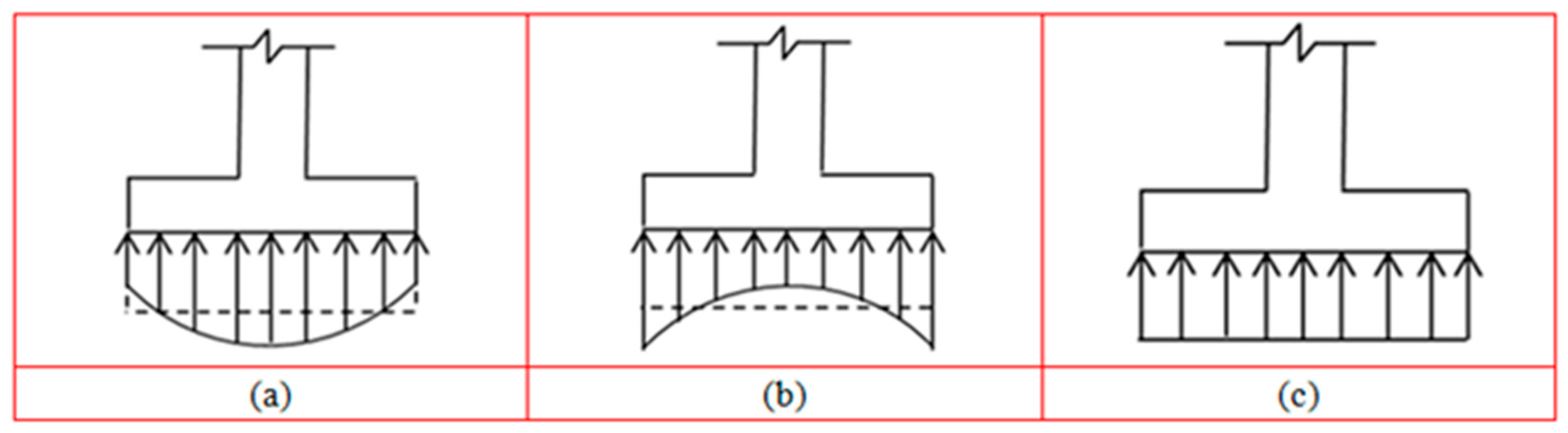
Figure 1. Distribution of the soil pressure below of a footing.
Preprints 147008 g001
Figure 2. T-shaped combined footing with free sides.
Preprints 147008 g002
Figure 3. Case I.
Figure 3. Case I.
Preprints 147008 g003
Figure 4. Cases II to XV.
Preprints 147008 g004aPreprints 147008 g004b
Figure 5. Case Y for T-shaped combined footings.
Preprints 147008 g005
Figure 6. Comparison between the CM and the NM.
Preprints 147008 g006
Table 1. Constraint functions for biaxial bending.
Case Equations
I Equations (1) to (5), (7) to (9), (15) to (22), 0 ≤ σ1 to σ8 ≤ σmax
II Equations (1), (2), (7) to (9), (24), (26), (28), Ly1 ≤ b, Lx1 ≤ a1
III Equations (1), (2), (7) to (9), (30), (32), (34), Ly1 ≥ b, Lx1 ≤ a1
IV Equations (1), (2), (7) to (9), (36), (38), (40), Ly1 ≥ b, Lx1 ≤ a1
V Equations (1), (2), (7) to (9), (42), (44), (46), Ly1 ≥ hy, Lx1 ≤ a1
VI Equations (1), (2), (7) to (9), (48), (50), (52), Ly1 ≥ hy, Lx1 ≤ a1
VII Equations (1), (2), (7) to (9), (54), (56), (58), Ly1 ≥ hy, Lx1 ≤ a1
VIII Equations (1), (2), (7) to (9), (60), (62), (64), Ly1 ≤ b, Lx1 ≥ a1
IX Equations (1), (2), (7) to (9), (66), (68), (70), Ly1 ≥ b, Lx1 ≥ a1
X Equations (1), (2), (7) to (9), (72), (74), (76), Ly1 ≥ b, Lx1 ≥ a1
XI Equations (1), (2), (7) to (9), (78), (80), (82), Ly1 ≥ b, Lx1 ≥ a1
XII Equations (1), (2), (7) to (9), (84), (86), (88), Ly1 ≥ b, Lx1 ≥ a1
XIII Equations (1), (2), (7) to (9), (90), (92), (94), Ly1 ≥ b, Lx1 ≥ a1
XIV Equations (1), (2), (7) to (9), (96), (98), (100), Ly1 ≥ b, Lx1 ≥ a1
XV Equations (1), (2), (7) to (9), (102), (104), (106), Ly1 ≥ b, Lx1 ≥ a1
Note: all cases must include hy = L1 + L + L2, hy ≥ b, L1 ≤ b/2, a2 ≤ a1.
Table 2. Constraint functions for uniaxial bending.
Case Equations
Y-I Equations (1) to (5), (7) to (9), (15) to (22), 0 ≤ σ1 to σ8 ≤ σmax
Y-IIA Equations (1), (2), (7) to (9), (111) to (113), Ly1 ≥ b, Ly1 ≤ hy
Y-IIB Equations (1), (2), (7) to (9), (115) to (117), Ly1 ≤ b
Note: all cases must include hy = L1 + L + L2, hy ≥ b, L1 ≤ b/2, a2 ≤ a1.
Table 3. Example 1.
Table 3. Example 1.
Case Amin
m2
Ends not limited Limited at L1 Limited at L2 Limited at L1 and L2
I 13.11 17.10 13.11 17.10
II 45.00 * * *
III 15.85 * 15.85 *
IV 21.93 * * *
V 15.62 * 15.62 *
VI 11.59 11.73 11.59 15.51
VII 15.53 * 15.53 *
VIII 23.45 22.36 23.45 22.36
IX 12.61 16.78 12.61 16.78
X 14.09 14.46 14.09 14.46
XI 12.98 16.58 12.98 16.58
XII 14.94 * 14.94 *
XIII 12.88 16.46 12.88 16.46
XIV 13.12 13.44 13.12 13.44
XV 12.71 * 12.71 *
Note: * No solution available.
Table 4. Example 2.
Table 4. Example 2.
Case Amin
m2
Ends not limited Limited at L1 Limited at L2 Limited at L1 and L2
I 12.57 12.80 12.57 12.80
II 45.00 * * *
III 15.55 * 15.53 *
IV 21.91 * * *
V 15.26 * 15.26 *
VI 15.37 12.25 12.90 12.90
VII 15.06 * 15.05 *
VIII 22.45 22.45 22.45 22.45
IX 12.56 15.82 12.56 15.82
X 13.61 13.79 13.61 13.79
XI 15.66 15.48 10.40 15.48
XII 13.15 * 13.51 *
XIII 12.56 15.45 12.56 15.45
XIV 12.68 12.82 12.68 12.82
XV 11.88 12.78 11.14 12.16
Note: * No solution available.
Table 5. Example 3.
Table 5. Example 3.
Case Amin
m2
Ends not limited Limited at L1 Limited at L2 Limited at L1 and L2
YI 11.50 16.74 11.50 16.74
YIIA 11.34 11.87 11.34 11.87
YIIB 15.00 18.70 15.00 18.70
Table 6. Mechanical and geometric properties of the cases that present the minimum areas of the example 1.
Case R
kN
MxT
kN-m
MyT
kN-m
L1
m
L2
m
Lx1
m
Ly1
m
a1
m
a2
m
b
m
hy
m
yt
m
Amin
m2
Ends not limited
VI 1500 2034.12 400 0.20 0.20 0.92 6.40 3.38 1.00 2.18 6.40 2.26 11.59
Limited footing at L1
VI 1500 2663.63 400 0.20 1.19 0.92 7.39 3.32 1.00 1.87 7.39 2.68 11.73
Limited footing at L2
VI 1500 2034.12 400 0.20 0.20 0.92 6.40 3.38 1.00 2.18 6.40 2.26 11.59
Limited footing at L1 and L2
XIV 1500 1328.82 400 0.20 0.20 21.83 6.83 8.04 1.00 1.00 6.40 1.79 13.44
Table 7. Mechanical and geometric properties of the cases that present the minimum areas of the example 2.
Case R
kN
MxT
kN-m
MyT
kN-m
L1
m
L2
m
Lx1
m
Ly1
m
a1
m
a2
m
b
m
hy
m
yt
m
Amin
m2
Ends not limited
XV 1500 1095.78 400 0.25 0.20 50.00 5.54 6.44 1.00 1.00 6.45 1.98 11.88
Limited footing at L1
VI 1500 4437.68 400 0.20 3.78 0.92 9.98 3.27 1.00 1.00 9.98 4.16 12.25
Limited footing at L2
XI 1500 0 400 4.20 0.20 8.40 20.05 1.00 1.00 10.40 10.40 5.20 10.40
Limited footing at L1 and L2
XV 1500 1081.82 400 0.20 0.20 38.73 5.50 6.76 1.00 1.00 6.40 1.92 12.16
Table 8. Mechanical and geometric properties of the cases that present the minimum areas of the example 3.
Case R
kN
MxT
kN-m
MyT
kN-m
L1
m
L2
m
Ly1
m
a1
m
a2
m
b
m
hy
m
yt
m
Amin
m2
Ends not limited
YIIA 1500 1476.28 0 0.50 0.20 6.44 5.64 1.00 1.00 6.70 2.18 11.34
Limited footing at L1
YIIA 1500 1582.81 0 0.20 0.20 5.12 6.47 1.00 1.00 6.40 1.96 11.87
Limited footing at L2
YIIA 1500 1476.28 0 0.50 0.20 6.44 5.64 1.00 1.00 6.70 2.18 11.34
Limited footing at L1 and L2
YIIA 1500 1582.81 0 0.20 0.20 5.12 6.47 1.00 1.00 6.40 1.96 11.87
Disclaimer/Publisher’s Note: The statements, opinions and data contained in all publications are solely those of the individual author(s) and contributor(s) and not of MDPI and/or the editor(s). MDPI and/or the editor(s) disclaim responsibility for any injury to people or property resulting from any ideas, methods, instructions or products referred to in the content.
Copyright: This open access article is published under a Creative Commons CC BY 4.0 license, which permit the free download, distribution, and reuse, provided that the author and preprint are cited in any reuse.
Prerpints.org logo

Preprints.org is a free preprint server supported by MDPI in Basel, Switzerland.

Subscribe

Disclaimer

Terms of Use

Privacy Policy

Privacy Settings

© 2025 MDPI (Basel, Switzerland) unless otherwise stated