

Submitted:
21 January 2025
Posted:
23 January 2025
You are already at the latest version
Abstract
The computational complexity of Discrete Fourier Transform (DFT) algorithms plays a pivotal role in signal processing, influencing their applicability in various domains. This paper investigates three prominent Fast Fourier Transform (FFT) algorithms: Radix-2, Radix-4, and Bluestein, with a focus on their computational efficiency and suitability for different sequence lengths. MATLAB implementations were developed to optimize these algorithms, reducing the number of multiplications and additions required during runtime. A comparative analysis reveals that Radix-2 and Radix-4 algorithms are highly efficient for power-of-two and power-offour data lengths, respectively, while the Bluestein algorithm provides unparalleled flexibility for arbitrary sequence lengths, including primes. The study demonstrates the trade-offs associated with each algorithm, highlighting their strengths and limitations. Radix-4 achieves greater efficiency over Radix-2 for longer sequences, while Bluestein eliminates the need for zero-padding at the cost of increased computational complexity. This research offers valuable insights into the selection of FFT algorithms based on application-specific requirements and data characteristics, laying the groundwork for further optimization and hybrid algorithm development. The findings underscore the enduring importance of FFTs in addressing the computational demands of modern signal processing tasks.
Keywords:
1. Introduction
2. Complexity of Radix-2 DIT/DIF Algorithm
3. Complexity of Radix-4 DIT/DIF Algorithm
4. Complexity of Bluestein
5. Theoretical and Mathematical Model of Bluestein Algorithm Using Three FFTs for Convolution
5.1. Formulation of the DFT
5.2. Bluestein’s Reformulation
5.3. Convolution Formulation
5.4. Implementation by Using 3 FFTs
5.5. Complexity Analysis
5.6. Advantages and Considerations
6. Discussion and Conclusion
6.1. Future Work
Acknowledgments
Additional Information
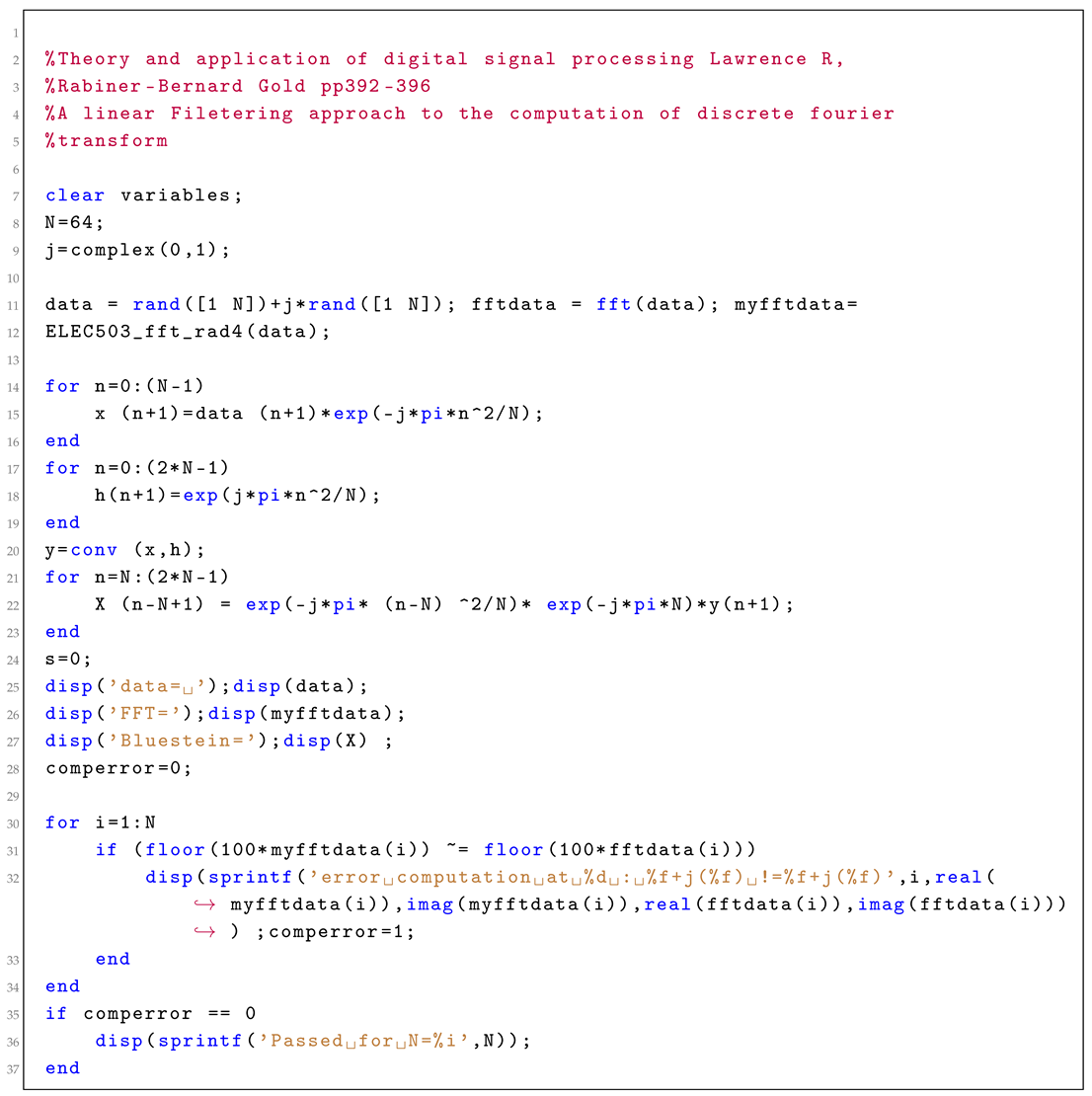
Appendix A. Matlab Code For The Bluestein Algorithm Implementing Convolution
 |
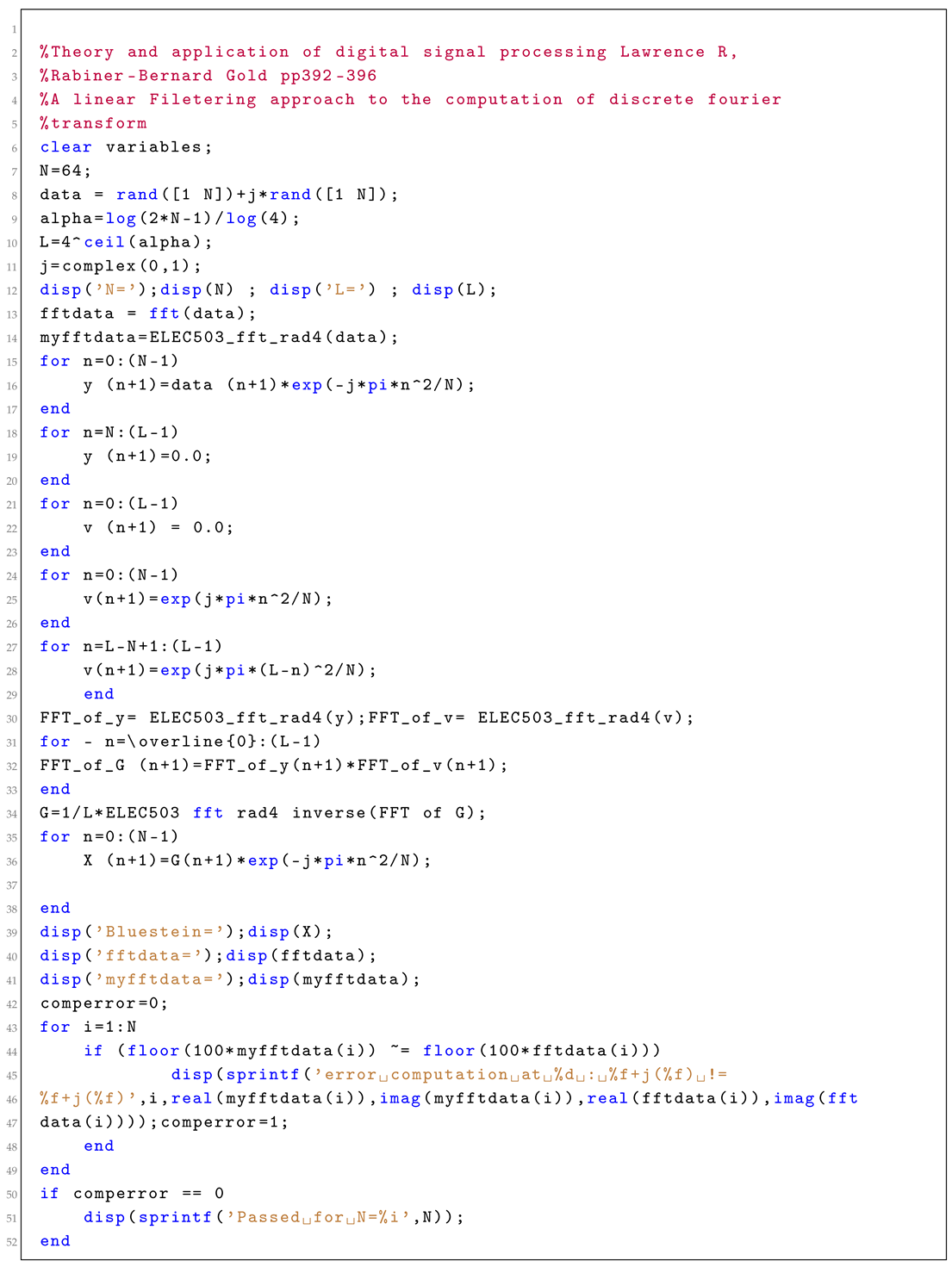
Appendix B. Matlab Code For The Bluestein Algorithm Using Three FFTs To Achieve Convolution
 |
References
- Cooley, J.W.; Tukey, J.W. An algorithm for the machine calculation of complex Fourier series. Mathematics of Computation 1965, 19, 297–301. [Google Scholar] [CrossRef]
- Bluestein, I.L. A linear filtering approach to the computation of discrete Fourier transform. IEEE Transactions on Audio and Electroacoustics 1970, 18, 451–455. [Google Scholar] [CrossRef]
- Winograd, S. On computing the Discrete Fourier Transform. Mathematics of Computation 1978, 32, 175–199. [Google Scholar] [CrossRef]
- MATLAB. MATLAB. https://www.mathworks.com/products/matlab.html.
- Frigo, M.; Johnson, S. The design and implementation of fftw3. Proceedings of the Ieee 2005, 93, 216–231. [Google Scholar] [CrossRef]
- Rabiner, L.R.; Gold, B. Theory and Application of Digital Signal Processing; Prentice Hall, 1975. [Google Scholar]
- Jayaram, K.; Arun, C. Survey Report for Radix 2, Radix 4, Radix 8 FFT Algorithms. International Journal of Innovative Research in Science, Engineering and Technology 2015, 4, 5149–5154. [Google Scholar] [CrossRef]
- Sinchana, G.S.; Padaki, S.; Ravi, V.; Varshini, V.S.; Raghavendra, C.G. Software Implementation of FFT Algorithms and Analysis of their Computational Complexity. In Proceedings of the 2018 International Conference on Electrical, Electronics, Communication, Computer, and Optimization Techniques (ICEECCOT), December 2018; pp. 486–490. [Google Scholar] [CrossRef]
- Moon, S.C.; Park, I.C. Area-efficient memory-based architecture for FFT processing. In Proceedings of the 2003 IEEE International Symposium on Circuits and Systems (ISCAS); 2003; Volume 5, pp. V–V. [Google Scholar] [CrossRef]
- Rennels, D.A. Fault-tolerant computing. In Encyclopedia of Computer Science; John Wiley and Sons Ltd., 2003; pp. 698–702. [Google Scholar]
- Ahamed, S.F.; Laveti, G.; Goswami, R.; Rao, G.S. Fast Acquisition of GPS Signal Using Radix-2 and Radix-4 FFT Algorithms. In Proceedings of the 2016 IEEE 6th International Conference on Advanced Computing (IACC), February 2016; pp. 674–678. [Google Scholar] [CrossRef]
- Jayakumar, D.; Logashanmugam, E. Design of Combined Radix-2, Radix- 4 and Radix-8 based Single Path Delay Feedback (SDF) FFT. Indian journal of science and technology 2016, 9. [Google Scholar] [CrossRef]
- Singh, P.K. Performance Analysis of Associate Radix-2, Radix- 4 and Radix-8 based FFT using Folding Technique. International Journal for Research in Applied Science and Engineering Technology 2021. [Google Scholar] [CrossRef]
- Lee, J.; Lee, H.; Cho, S.I.; Choi, S. A high-speed, low-complexity radix-2/sup 4/ FFT processor for MB-OFDM UWB systems. In Proceedings of the 2006 IEEE International Symposium on Circuits and Systems; 2006; p. 4. [Google Scholar] [CrossRef]
- Johnson, S.G.; Frigo, M. A Modified Split-Radix FFT With Fewer Arithmetic Operations. IEEE Transactions on Signal Processing 2007, 55, 111–119. [Google Scholar] [CrossRef]
- Rader, C.M. Discrete Fourier transforms when the number of data samples is prime. IEEE, 1968; Volume 56, pp. 1107–1108. [Google Scholar] [CrossRef]
- Moon, Y.J.; Kim, Y.I. A mixed-radix 4-2 butterfly with simple bit reversing for ordering the output sequences. In Proceedings of the 2006 8th International Conference Advanced Communication Technology, February 2006; Volume 3. [Google Scholar] [CrossRef]
- Sorensen, H.V.; Heideman, M.T.; Burrus, C.S. On computing the split-radix FFT. IEEE Transactions on Acoustics, Speech, and Signal Processing 1986, 34, 152–156. [Google Scholar] [CrossRef]

| Radix-2 DIT and DIF | |||
|---|---|---|---|
| n | N | Number of Multiplications | Number of Additions |
| 2 | 2 | 0 | 2 |
| 4 | 4 | 2 | 8 |
| 8 | 8 | 6 | 24 |
| 16 | 16 | 24 | 64 |
| 32 | 32 | 64 | 160 |
Disclaimer/Publisher’s Note: The statements, opinions and data contained in all publications are solely those of the individual author(s) and contributor(s) and not of MDPI and/or the editor(s). MDPI and/or the editor(s) disclaim responsibility for any injury to people or property resulting from any ideas, methods, instructions or products referred to in the content. |
© 2025 by the authors. Licensee MDPI, Basel, Switzerland. This article is an open access article distributed under the terms and conditions of the Creative Commons Attribution (CC BY) license (http://creativecommons.org/licenses/by/4.0/).