Preprint
Article

This version is not peer-reviewed.

The Enigma of Sponge-Derived Terpenoid Isothiocyanate-Thiocyanate Pairs. A Proposal for their Biosynthesis

A peer-reviewed article of this preprint also exists.

Submitted:

20 January 2025

Posted:

21 January 2025

You are already at the latest version

Abstract

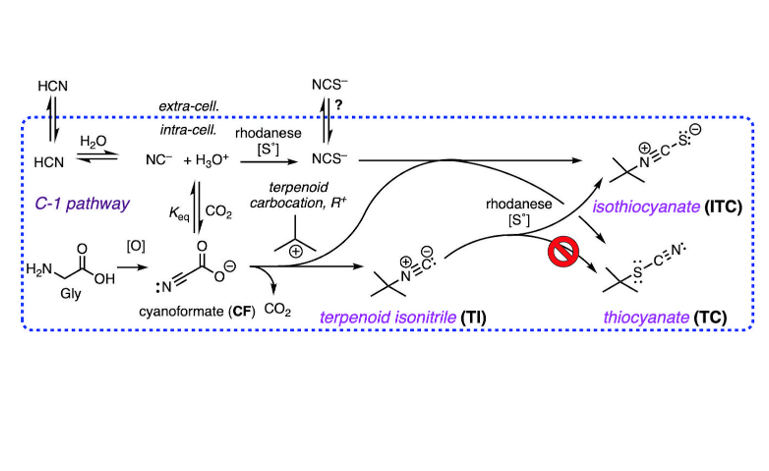
The co-occurrence of rare terpenoid thiocyanates (R-C-SCN), structurally similar to their more common isothiocyanate isomers (R-NCS) remained an enigma that can now be rationalized by consideration of three integrated biosynthetic motifs: terpenoid carbocation capture by cyanoformate, NC-COOH (itself in equilibrium with NC– and CO2), a co-localized rhodanese (a dual-function enzyme that can both convert inorganic NC– to thiocyanate ion, NCS–, and alkyl isonitriles to alkyl isothiocyanate (R-NC –> R–NCS). This scenario explains the preponderance of isothiocyanates, R-NCS as products of a linear reaction path – a-addition of S0 to R-NC – over the minor, less stable thiocyanates, R-SCN, as products of adventitious capture of liberated NCS– by the penultimate terpenoid carbocation precursor. DFT calculations support the proposal and eliminate other possibilities, e.g. isomerization of R-NCS to R-SCN.
Keywords: 
;  ;  ;  ;  ;  ;  ;  ;  ;  ;  

1. Introduction

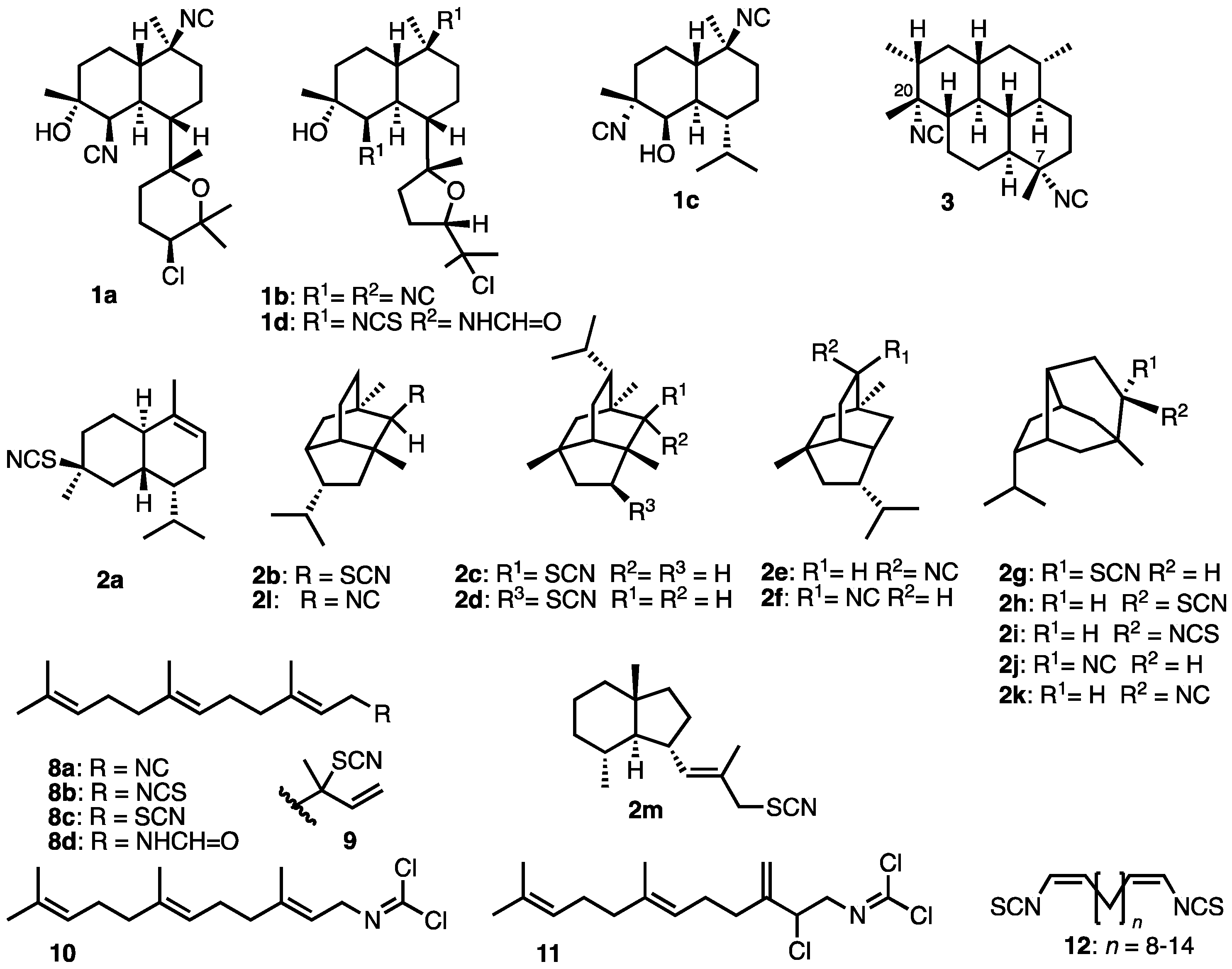
Exotic terpenoid isonitriles (TIs, Figure 1) which occur exclusively within the domain of certain genera of marine sponges (Porifera), e.g. Acanthella, Adocia, Axinella, Axynissa, Cymbastella among others, and the seaslugs (nudibranchs) that prey upon them, have been known since the early 1970s. Marine isonitriles and their derivatives have been extensively reviewed [1,2,3]. Examples of cyclized terpenoid isonitriles and their accompanying α-adducts (1a-c, 2a–l, 3) are depicted in Figure 2. Only recently have certain members (e.g. 7,20-diisocyanoadociane (3) [4], kahilinols A (1a) [5] and B (1b) [6]) been identified and investigated as potential antimalarial therapeutics. Isonitrile 1b exhibits potent activity against the chloroquine-resistant plasmodium, Dd2 (IC50 = 4.6 nM). MED6-189 (2), a synthetic analog developed from 1b, shows promising in vitro antiplasmodial activity (Dd2 IC50 = 47± 7 nM) and strong efficacy in plasmodium-infected mice with no apparent toxicity or hemolytic liabilities [7].
TIs are often accompanied by the corresponding adducts generated by α-addition to the triple -NC bond; amides, carbonimidic dichlorides, and, most commonly, alkyl isothiocyanates [8]. Sponge-derived isonitrile biosynthesis can be rationalized by capture of late-stage terpenoid carbocations arising from C-C cyclizations and Wagner-Meerwein rearrangements of their activated precursors (GPP, FPP and GGPP) and final capture by a biosynthetic ‘NC vector’ [9] to generate isonitriles, R-NC. Isothiocyanates, R-NCS, e.g. kalihinol M 1d) (Figure 2) and 2a follow as the products of sulfur-transfer reaction of low-valent S donors (e.g. glutathione dimer, thiosulfate, etc.) to R-NC. Terpenoid carbon backbones of TIs and related derivatives, including isothiocyanates (ITC, Figure 1) are mostly familiar in plant terpenoids, but notable exceptions are synthesized only by sponges. For example, the common plant sesquiterpene (C15) skeletons of cadinane, drimane, and bisabolane are all represented in the sponge TI, ITC and TC family, but sponges and their predators (nudibranchs) are the exclusive provenance of axinyssane [10,11], pupukeanane [12,13], neopupukeanane and the diterpenes (C20) adociane, [4], amphilectane [14,15], isoneoamphilectane [16] among others.
The startling discovery of co-localized thiocyanates (R-SCN), e.g. 4-thiocyanato-9-cadinene 2a [17], 2b [18] (with the same carbon skeleton as isonitrile 2j [12]), 2c-d [19], with carbon skeletons similar to those of the more common isothiocyanates (R-NCS), 2g,h [20], and 2m [21], presents an enigma [22]: ‘how can a linear biosynthetic pathway of R-NC –> R–NCS accommodate R–SCN?’ While the biosynthesis of allyl thiocyanate, the pungent volatile natural product found in mustard oil, horseradish, garlic and many other cruciferous plants and its isomerized regioisomer, allyl isothiocyanate, has long-been understood (decomposition of the glucosinolate, sinigrin, derived from Met [23]), the origin of sponge-derived thiocyanates is puzzling. Now, this enigma is addressed by consideration of a putative interplay of three integrated biosynthetic sequelae: capture of the terpenoid carbocation R+ by cyanoformate, NC-COOH (i) [9] (itself in equilibrium with NC and CO2 and derived from Gly), reactions promoted by co-localized rhodanese – a dual-function enzyme that can both convert inorganic NC to thiocyanate ion, NCS, and alkyl isonitriles to alkyl isothiocyanate (R-NC –> R–NCS) – and promiscuous terminal interception of terpenoid carbocations by co-liberated inorganic NCS.

2. Results and Discussion.

2.1. Chemistry and Bonding in TC and ITC.

While hundreds of marine-derived TIs, ITCs and FAs have been described., only six TCs are known. The structures of the TCs were examined on a case-by-case basis, with their isomeric or similar isothiocyanates (ITC). ‘Reverse engineering’ of the likely terminal steps in their biosynthesis by probing the thermodynamics of bond-breaking and bond-forming provides insights into what could be possible and what is improbable. For the purposes of informed discussion, a brief review of the chemistry of the cumulated-bond functional group, NCS, in TC and ITC molecules is in order. TC and ITC isomers are easily differentiated spectroscopically by 13C NMR and IR. ITC shows a very intense, broad stretching frequency at ~2100 cm–1, while the TC IR band is of similar frequency, but narrow and of medium intensity. The 13C NMR signal of C at the point of attachment, reflects the difference in electronegativity of S and N: ITC shows C-Nα δ ~ 75 while the C-Sα signal in TC is δ ~ 64 ppm [22].
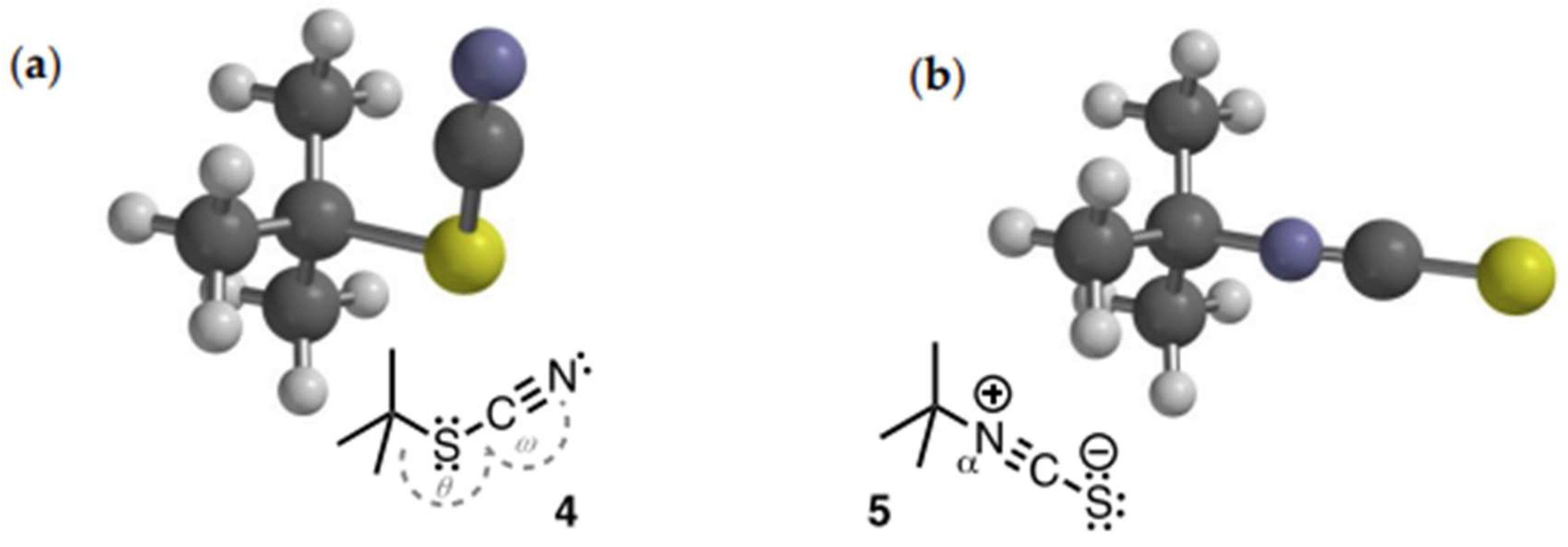
The isomers t-butylthiocyanate (4) and t-butylisothiocyanate (5) (Figure 3) serve as convenient models for comparisons to their terpenoid natural product counterparts. Bonding in the triatomic grouping NCS differs between TC and ITC. DFT calculations of the optimized geometries and energies of each (Figure 1) shows, as expected, the geometry of N-C-S is linear due to sp hybridization at C (ω = 179.8 ˚ and ω = 179.2˚, respectively), isoelectronic with alkyl azides, consistent with X-ray crystal structures of natural product ITCs [24] and TCs [17]. The bondings of the heteroatom attached to the alkyl group C (notated here as the α atom) differ significantly. The corresponding bond angles and bond lengths of 4 and 5 (θ(C-S-C) = 100˚ and (θ(C-Nα- C) = 176.8˚) reflect predominantly sp3 and sp hybridization, respectively, of the α-heteroatom attached to the t-Bu group. The shorter C-Nα bond length in 5 (d2 = 1.44 Å is evident of a stronger σ bond between the t-Bu group and its α-heteroatom compared to 4 (d1 = 1.88 Å), as expected for row 2 versus a row 3 elements, and recapitulates the thermodynamic stability of 5 over 4 [25].
ITCs are electrophilic: like isonitriles they undergo addition reactions at the cumulated bond, even with weak nucleophiles. TCs reluctantly undergo nucleophilic substitution reactions at the attached C when it 1˚ or 2˚, but not 3˚. Both allylic ITCs and TCs may participate in [3,3]-sigmatropic rearrangement (see below).
Three scenarios that may account for generation of TC natural products are considered.

2.2. Dissociation-Reassociation.

The isomerization of TC to ITC was examined as a possible linear pathway linking the corresponding TI (R-NC –> R–NCS –> R-SCN). Of necessity, such an isomerization must follow a unimolecular rate law, R = k[R-NCS] and an SN1 mechanism due to the 3˚ alkyl group that is almost invariably the point of heteroatom attachment in TC and TCI natural products. The leaving group ability of the thiocyano group in R-SCN is at best weak, while in R-NCS, it is considerably poorer due to the stronger R-N bond. For various reasons, the bond dissociation energy in each of the two isomers is not readily calculated, but we can obtain a qualitiative picture from the relative the rates of sigmatropic [3,3] rearrangements of isomeric allylic thiocyanate (e.g. 6) to isothiocyanates (e.g. 7) and the isoelectronic allyl azides (e.g. 8, Figure 4). The equilibrium constants, Keq, of the reactions quantitatively reflect their relative stabilities. While the reaction rates of [3,3] rearrangement of allylic azides (Winstein rearrangement [26]) are fast (most rapidly isomerize at ambient temperatures [27]), CH2=CH-NCS and CH2=CH-SCN interchange more slowly [28]. For example, the isomerization of the latter to the former occurs upon distillation (b.p. 150-2 ˚C) [29]) and is favored for reasons of greater bond-strength in the product (vide supra) [30]. The likely explanation of the slower rate reaction of [3,3]-rearrangement of ITC-TC pairs is poor overlap of row 2 versus row 3 frontier orbitals in the transition state.

2.3. Precedence Strengthens the Role of Adventitious NCS

ITCs are expressed by bacteria from isonitriles by task-specific adapted rhodanese. Rhodanese is distributed widely in the Nature and carries out the important role of scavenging inorganic cyanide formed adventitiously in metabolism, e.g. ‘leakage’ from C-1 tetrahydrofolate metabolism or other cyanide-generating reactions [31,32,33]. A key intermediate, cyanoformate, NC-COOH, CF, is ephemeral in the biosynthesis of the plant hormone ethylene, CH2=CH2 from 1-aminocyclopropane-1-carboxylate [34]. In Burkholderia gladioli that produces the non-terpenoid isonitrile, Hertwick and coworkers showed that rhodanese RhDE, in addition to donating competency in scavenging cyanide NC into thiocyanate, NCS, catalyzes the substrate-specific sulfur transfer reaction R-NC –> R-NCS generating the ITC, sinapigladioside [35], by utilizing thiosulfate as an S donor [36]. Hertwick speculates that the enzyme was recruited from a, “ubiquitous detoxification enzyme for the formation of a bioactive specialized metabolite” [36]. The concept of recruitment of rhodanese, with evolved substrate-specificity to the latter task, may also find support in the biosynthesis of terpenoid ITCs in sponges, and the observation that TIs are not uniformly accompanied by their ITC counterparts.

2.4. Thiocyanate is a competent ambident nucleophile.

Pearson and coworkers compiled relative rates of nucleophilic substitutions of methyl iodide, CH3I, with selected nucleophiles under comparable conditions (25 ˚C) [37]. The second-order rate constant, k2, for reaction with NCS and NC (25 ˚C, Table 1) are similar (Entries 8 and 9: 5.74 x10⁻⁴ and 6.5 x 10⁻⁴ mol–1.sec-1, respectively (for comparison, k2 for the reactions with thiophenoxide PhS, thiosulfate, S2O32– are 1.07 and 0.114 mol–1.sec-1 [37]).
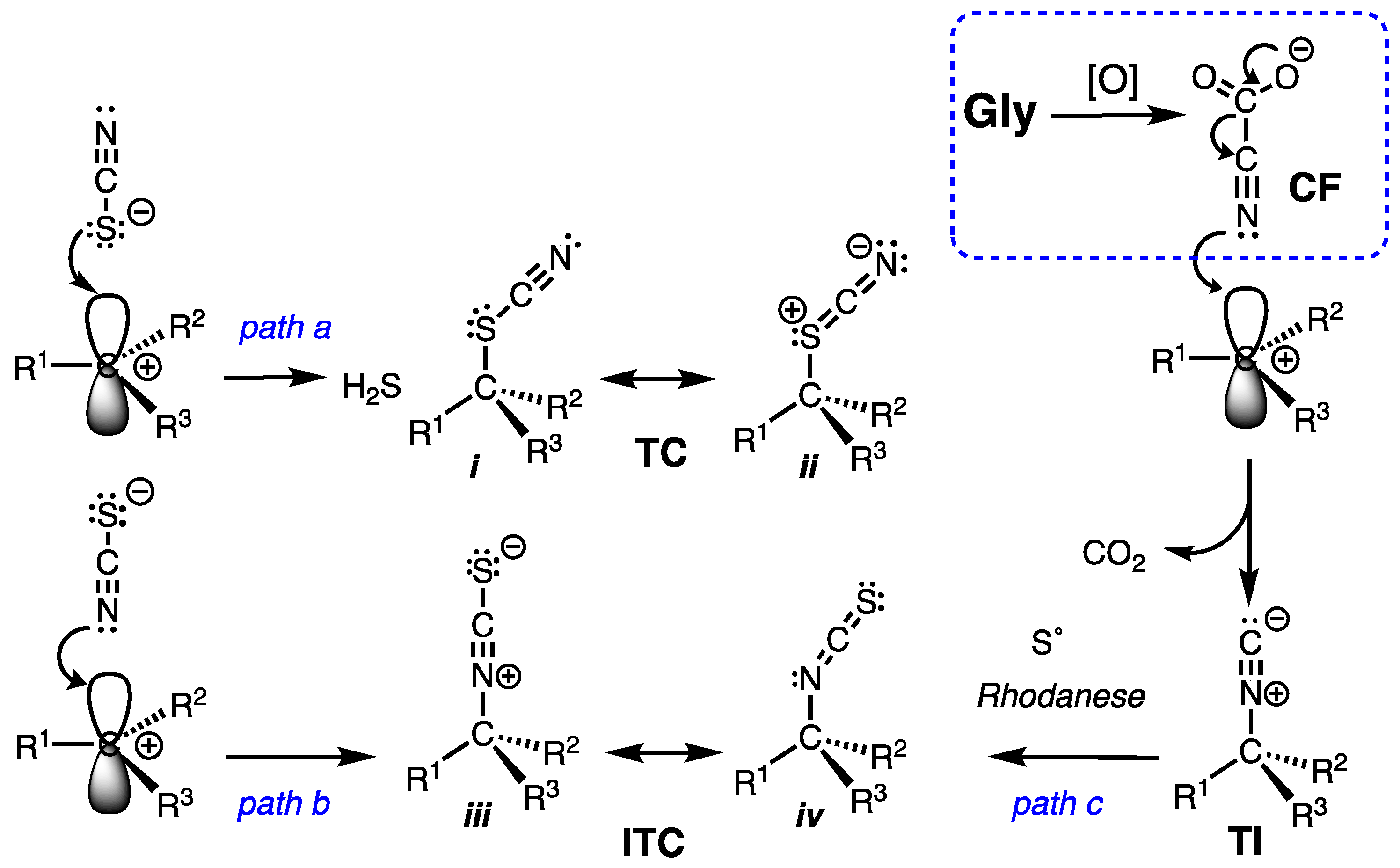
A simplified scenario can be proposed for the terminal step in TC and ITC biosynthesis (Figure 5). SN1 capture of NCS– at S (the more nucleophilic end) gives TC (path a). ITC is formed by SN1 capture at N which contributes to the pool of ITC generated by S addition to the corresponding isonitrile, TI. Experimentally, it would be difficult to estimate the fraction of ITC that arises from paths b and c. As mentioned earlier, the results of radiolabeling experiments by NCS are somewhat equivocal and at this point do not lend insight into the contributions of paths b and c.
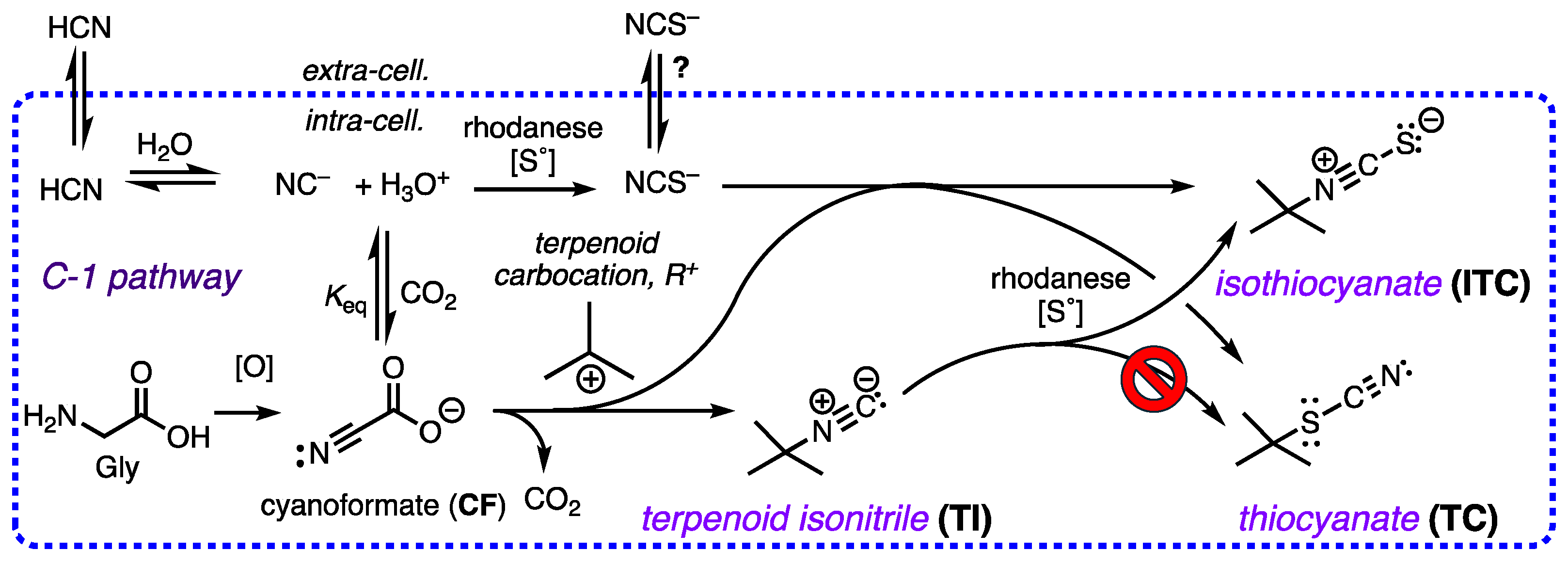
Inspection of the structures of secondary metabolites containing the R-SCN group (TCs) excludes the pre-described enzyme system for tailoring of R-NC to R-CNS, but still supports a role of rhodanese as a generator of the ambident nucleophile NCS. TCs may arise from adventitious capture of thiocyanate at S by SN1 addition, a reaction that would also add to the pool of ITC from the former mechanism (Scheme 1).
The well-known rule of thumb for ambident nucleophilicity holds that the bond-forming reaction occurs at the less negative atom, e.g. enolate reactions with most electrophiles occur at the α-C center instead of O. The rule predicts TCs are kinetically favored over ITCs when NCS reacts with electrophiles, R-X (X= halogen) at S, but typically mixtures of TCs and ITCs are formed. It should be remembered that an extrapolation of the same reaction, but with replacement of NCSwith NC gives only nitriles, R-CN, not isonitriles, by exclusive nucleophilic addition at C [9]. While HCN is a weak Brønsted acid (pKa = 9.25), HSCN is strong (pKa = –0.7 [38]). HSCN is fully ionized at physiological pH. In short, NCS is more an ‘equal opportunity’ nucleophile than NC . At equilibrium, isomerization would favor ITC over TC.

2.5. A Simple Proposal – Thiocyanates Arise Adventitiously.

How do these foregoing data affect interpretation of the provenance and distribution of alkyl isothiocyanate, ITC, versus alkyl thiocyanate, TC? Alkyl TCs are rarer than their isomeric ITCs. Biosynthetically, ITCs mostly arise from a linear pathway of TI –> ITC by addition of low-valent sulfur, the less abundant TCs more likely arise from adventitious nucleophilic capture of free thiocyanate, NCS (delivered by rhodanese) by terpenoid carbocations in a parallel pathway (Scheme 1). A convincing appreciation of this proposition is gained by analysis of reported isolation yields of TCs relative to their analogous conspecific ITCs from the same organism. Like the substitution products of NCS with electrophilic carbocationic precursors, ITCs are found to predominate over TCs. One remaining question is how can exogenous NCS assimilated by sponges that make TC-ITC pairs? While exogenous cyanide can intercept the intracellular dynamic equilibrium of cyanoformate (CF, NC-COOH) by passive diffusion in its neutral form, HCN, the pKa of HSCN would seem prohibitively low (–0.7) for a similar process; a ‘thiocyanate ion transporter’ would need to be invoked [39].Thiohalobacter sp., with induced capacity to metabolize NCS, have been raised by repeated passage in NCS containing culture medium [40].
In each case where analogous TC and ITC pairs do co-occur, the structures of the terpenoid carbon skeletons differ; 2g,h and 2i are the exceptions [20]. An interpretation of this phenomenon is that the last step of SN1 capture to form TI or TC is rate-dependent upon the structure of the incipient carbocation, R+ and determined by its collapse and capture of a NC delivery ‘vector’, as recently proposed (Figure 4, [9]) or, in the latter case, free NCS. If R+ is more persistent (longer half-life), the SN1 capture by ‘off-pathway’ NCS becomes more competitive, leading to product distributions favorable to TC.
Natural product allylic thiocyanates, e.g. farnesyl isothiocyanate and thiocyanate (8b,c, Figure 1), hypothetically obtainable from nucleophilic substitution of farnesyl pyrophosphate, or 8b separately by S-transfer to farnesyl isonitrile (8a, which itself, “remains elusive” [1]), are kinetically labile. TCs in time would be expected isomerize to their more substituted tert-allylic NCS counterparts (e.g. 9). The majority of sponge-derived TCs, however, are ‘fixed’; stabilized by substitution at 3˚ alkyl groups. While farnesyl isothiocyanate (8b) [41] and formamide, 8d, are known [42], but the foregoing reasons make it unlikely the ‘missing’ 8c (or 8a?) will ever be isolated from natural sources as [3,3]-rearrangement irreversibly converts 8c to its isomeric nerolidyl isothiocyanate isomer, 9. The fact that 9 has not been found in Nature suggests that 8c, too, is absent. From the single literature report of syntheses of 8c and its geranyl homolog, the isolated products were invariably found mixed with 9 (8c:9~ 83:17) even after mild vacuum distillation conditions [43,44]. It should be noted the names ‘stylotellane A’ and ‘stylotellane B’ were conferred upon the carbonimidic dichloride 10, and the related 11 [10], from Styletta aurantium [45]. The latter natural product was originally isolated by Wratten and Faulkner from Pseudaxinyssa pitys – the first example of this functional group in a natural product.[10] – along with its chloro-axinyssane analog, 12. Compounds 8b,d and 10 complete the set of known farnesyl N-derivatives. It appears that 2m is the only allylic TC among these marine natural products, with the NCS group substituted at the ‘tail’ of the first isoprene group in the precursor FPP. The unexpected, unbranched long-chain lipids, 13, from Pseudoaxinyssa, containing vinyl-substituted α,ω-bisisocyanato groups, it can be noted, appear to have a different, indeterminate, biosynthesis [46].
One consequence of a strictly unimolecular reaction of NCS with R+ when the product creates a new asymmetric center at the electrophilic C, are diastereomeric mixtures. The product distribution will be dependent upon the usual factors that govern stereofacial preferences of SN1 reactions, e.g. steric hindrance and stereoelectronic factors. For example, in the case of epimeric 2g and 2h, isolated from the sponge Axinyssa aculeata [20], the reported ratio is 3:2 [47], but from local symmetry considerations the two epimers should be about equal in terms of G˚.
When thought of in this way, capture of carbocations by free NCS, is a ‘clock reaction’; a kinetic monitor of the partition of the shunt reaction of cyanoformate, CF (NC-COOH Scheme 1)– dissociation to NC and CO2 – and direct nucleophilic SN1 capture by NCS when the ratios of epimers can be measured. Garson [11,41,48] and others [49] have shown through numerous radiolabeling experiments that inorganic [14C]CN is assimilated into sponge TIs. For example, 7,20-diisocyanoadociane (3) is radiolabeled by [14C]CN [50]. These observations have recently been interpreted as an interception of an equilibrium cyanide pool formed by dissociation of CF, the putative ‘NC’ vector, and exogenous uptaken HCN [9]. In the same study, Garson found no radiolabel incorporation into 3 when the sponge was incubated with [2-14C] Gly or a number of other amino acids [51,52].
The prevailing belief up to now was that inorganic NC is the precursor of TIs, but for several reasons this was shown to be untenable [9]. If it were so, a simple test can be made: the expected labeling of living sponges with [14C]-CN should also induce formation of limiting amounts of R-SCN from rhodanese-promoted conversion to NCS and the kinetic-product distribution of nucleophilic capture, but this has not been observed to date [53]. Garson and coworkers showed that radiolabeled thiocyanate (K[14N]NCS) is assimilated by living sponges into TIs including axisonitrile-3 (notably with a formula lacking S) and two ITCs (axisothiocyanate-3) albeit with far lower specific radioactivities than the same radiolabeled natural products obtained from incubations with Na{14C]CN [54]. Simultaneous labeling of axisonitrile-3 from incubation of the sponge Acanthella cavernosa [55] with K[14N]NCS requires, at the very least, an unspecified interchange of thiocyanate with K[14C]CN [56]. In a separate study, Simpson and Garson found incorporation of both [14C]SCN and [14C]CN into the sesquiterpene thiocyanato group of 2b[18,19], from Axinyssa sp. n. from the Great Barrier Reef [57]; both results are consistent with the adventitious thiocyanate model for TC biosynthesis (Figure 4, Scheme 1)
What could be testable in the field is incorporation of N14C-COOH in sponges producing TIs, ITCs and TCs or N14CS under more controlled conditions. The logistics of this proposed experiment are beyond the scope of this report, but the outcomes would, nevertheless, be compelling.

3. Materials and Methods

3.1. General Experimental Procedures.

DFT Calculations. All DFT calculations were performed using Spartan ’20 (Wavefunction, Irvine, CA) using functional ωB97X-D and basis set 6-31G* (H2O or gas phase). Coordinates for the optimized structures and bond parameters can be found in the Supporting Information. See Supporting Information for complete citation to the DFT product.

4. Conclusions

A proposal is forwarded for the likely origins of the rare sponge-derived terpenoid thiocyanates (TCs) that are decoupled from the biosynthesis of isothiocyanates (ITCs). Isothiocyanates (ITCs) likely arise from a low-valent sulfur-transfer reaction to precursor terpenoid isonitriles (TIs). Adventitious thiocyanate ion, NCS, a competent amphiphilic nucleophile generated by rhodanese, is solely responsible for sponge TC terpenoid natural products in two ways; SN1 addition at S produces TCs. Addition of rhodanese-derived NCS, at N to the incipient terpenyl carbocation R+, contributes to the ITC pool by simultaneous converse SN1 reaction.

Supplementary Materials

The following supporting information can be downloaded at the website of this paper posted on Preprints.org. The following supporting information can be downloaded at: www.mdpi.com/xxx/s1 DFT calculated structures of 4, 5 and 1-isothiocyanato-1-methylcyclohexane (S1).

Author Contributions

T.F.M. carried out the DFT calculations. The manuscript was written by T.F.M.

Funding

This work was not supported by funding.

Institutional Review Board Statement

Not applicable.

Data Availability Statement

Original data will be made available upon reasonable request.

Acknowledgments

The author thanks S. Ohlinger, Spartan, for help with DFT calculations and other individuals over the years for helpful discussions. This is dedicated to my friend Haiyin He whose discovery of the first terpenoid thiocyanate inspired this paper.

Conflicts of Interest

The author declares no conflict of interest.

References

  1. Emsermann, J.; Kauhl, U.; Opatz, T. Marine Isonitriles and Their Related Compounds. Mar. Drugs 2016, 14, 16–83. [Google Scholar] [CrossRef] [PubMed]
  2. Garson, M.J.; Simpson, J.S. Marine isocyanides and related natural products – structure, biosynthesis and ecology. Nat. Prod. Rep. 2004, 21, 164–179. [Google Scholar] [CrossRef]
  3. Chena, T-Y.; Chen, J.; Tang, Y.; Zhou, J.; Guo, Y.; Chang, W-C. Current Understanding Toward Isonitrile Group Biosynthesis and Mechanism. Chin. J. Chem. 2021, 39, 463–472. [Google Scholar] [CrossRef] [PubMed]
  4. Baker, J. T.; Wells, R. J.; Oberhänsli, W. E.; Hawes, G. B. J. Am. Chem. Soc. 1976, 98, 4010–4012. [CrossRef]
  5. Chang, W.J.; Patra, A.; Roll, D.M.; Scheuer, P.J.; Matsumoto, G.K.; Clardy, J. Kalihinol-A, a highly functionalized diisocyano diterpenoid antibiotic from a sponge. J. Am. Chem. Soc. 1984, 106, 4644–4646. [Google Scholar] [CrossRef]
  6. Chang, W. J.; Patra, A.; Roll, D. M.; Scheuer, P. J.; Matsumoto, G. K.; Clardy, J. Kalihinols, multifunctional diterpenoid antibiotics from marine sponges Acanthella sp. J. Am. Chem. Soc. 1984, 106, 4644–4646. [Google Scholar] [CrossRef]
  7. Chahine, Z.; Abel, S.; Hollin, T.; Barnes, G.L.; Chung, J.H.; Daub, M.E.; Renard, I.; Choi, J.Y.; Vydyam, P.; Pal, A.; Alba-Argomaniz, M.; Banks, C.A.S.; Kirkwood, J.; Saraf, A.; Camino, I.; Castenada, P.; Cuevas, J.C.; De Mercado-Arnanz, J.; Fernandez-Alvaro, E.; Garcia-Perez, A.; Ibarz, N.; Viera-Morilla, S.; Prudhomme, J.; Joyner, C.J.; Bei, A.K.; Florens, L.; Ben-Mamoun, C.; Vanderwal, C.D.; Le Roch, K.G. A kalihinol analog disrupts apicoplast function and vesicular trafficking in P. falciparum malaria. Science 2024, 385, 7966–7978. [Google Scholar] [CrossRef]
  8. Cafieri, F.; Fattorusso, E.; Magno, S.; Santacroce, C.; Sica, D. Isolation and Structure of Axisonitrile-1 and Axisothiocyanate-1. Two Unusual Sesquiterpenoids from the Marine Sponge Axinella cannabina. Tetrahedron 1973, 29, 4259–4262. [Google Scholar] [CrossRef]
  9. Molinski, T.F. The Paradox of Antimalarial Terpenoid Isonitrile Biosynthesis Explained. Proposal of Cyanoformate as an NC Delivery Vector. J. Nat. Prod. 2024, 87, ASAP. [Google Scholar] [CrossRef] [PubMed]
  10. Wratten, S.J.; Faulkner, D.J. Carbonimidic dichlorides from the marine sponge Pseudaxinyssa pitys. J. Am. Chem. Soc. 1977, 99, 7367–7368. [Google Scholar] [CrossRef]
  11. Brust, A.; Garson, M.J. Dereplication of complex natural product mixtures by 2D NMR: Isolation of a new carbonimidic dichloride of biosynthetic interest from the tropical marine sponge Stylotella aurantium. ACGC Chem. Res. Commun. 2004, 17, 33–37. [Google Scholar]
  12. Hagadone, M.R.; Burreson, B.J.; Scheuer, P.J.; Finer, J.S.; Clardy, J. Defense Allomones of the Nudibranch Phyllidia varicosa Lamarck 1801. Helv. Chim. Acta 1979, 62, 2484–2494. [Google Scholar] [CrossRef]
  13. Marcus, A.H.; Molinski, T.F.; Fahy, E.; Faulkner, D.J.; Xu, C.; Clardy, J. 5-Isothiocyanatopupukeanane from a sponge of the genus Axinyssa. J. Org. Chem. 1989, 54, 5184–5186. [Google Scholar] [CrossRef]
  14. Wratten, S.J.; Faulkner, D.J.; Hirotsu, K.; Clardy, J. Diterpenoid Isocyanides from the Marine Sponge Hymeniacidon amphilecta. Tetrahedron 1978, 4345–4348. [Google Scholar] [CrossRef]
  15. Molinski, T.F.; Faulkner, D.J.; Van Duyne, G.D.; Clardy, J. Three New Diterpene Isonitriles from a Palauan Sponge of the Genus Halichondria. J. Org. Chem. 1987, 52, 3334–3337. [Google Scholar] [CrossRef]
  16. Avile, E.; Rodriguez, A.D.; Vincente, J. Two Rare-Class Tricyclic Diterpenes with Antitubercular Activity from the Caribbean Sponge Svenzea flava. Application of Vibrational Circular Dichroism Spectroscopy for Determining Absolute Configuration. J. Org. Chem. 2013, 78, 22–11294. [Google Scholar] [CrossRef]
  17. He, H.Y.; Faulkner, D.J.; Shumsky, J.S.; Hong, K.; Clardy, J. A sesquiterpene thiocyanate and three sesquiterpene isothiocyanates from the sponge Trachyopsis aplysinoides. J. Org. Chem. 1989, 54, 2511–2514. [Google Scholar] [CrossRef]
  18. Pham, A.T.; Ichiba, T.; Yoshida, W.Y.; Scheuer, P.J.; Uchida, T.; Tanaka, J.; Higa, T. Two marine sesquiterpene thiocyanates. Tetrahedron Lett. 1991, 32, 4843–4846. [Google Scholar] [CrossRef]
  19. He, H.; Salvá, J.; Caíalos, R.F.; Faulkner, D.J. Sesquiterpene Thiocyanates and Isothiocyanates from Axinyssa aplysinoides. J. Org. Chem. 1992, 57, 3191–3194. [Google Scholar] [CrossRef]
  20. Yasman, Y.; Edrada, R.A.; Wray, V.; Proksch, P. New 9-Thiocyanatopupukeanane Sesquiterpenes from the Nudibranch Phyllidia varicosa and Its Sponge-Prey Axinyssa aculeata. J. Nat. Prod. 2003, 66, 1512–1514. [Google Scholar] [CrossRef]
  21. Fusetani, N.; Wolstenholme, H.J.; Shinoda, K.; Asai, N.; Matsunaga, S.; Onuki, H.; Hirota, H. Two sesquiterpene isocyanides and a sesquiterpene thiocyanate from the marine sponge Acanthella cf. cavernosa and the Nudibranch Phyllidia ocellata. Tetrahedron Lett. 1992, 33, 6823–6826. [Google Scholar] [CrossRef]
  22. He, H.Y.; Salva, J.; Catalos; Faulkner, D.J. Sesquiterpene thiocyanates and isothiocyanates from Axinyssa aplysinoides. J. Org. Chem. 1992, 57, 3191–3194. [Google Scholar] [CrossRef]
  23. Blaževića, I.; Montaut, S.; Burčul, F.; Olsend, C.E.; Burowe, M.; Rollin, P.; Agerbirk, N. Glucosinolate structural diversity, identification, chemical synthesis and metabolism in plants. Phytochemistry 2020, 169, 1–57. [Google Scholar]
  24. Di Blasio, B.; Fattorusso, E.; Magno, S.; Mayol, L.; Pedone, C.; Santacroce, C.; Sica, D. Axisonitrile-3, axisothiocyanate-3 and axamide-3. Sesquiterpenes with a novel spiro[4,5]decane skeleton from the sponge Axinella cannabina. Tetrahedron 1976, 32, 473–478. [Google Scholar] [CrossRef]
  25. The DFT minimized structure of 1-isocyano-1-methylcyclohexane (S1) displays similar bond parameters albeit with a slightly more ‘bent’ C-Na-C (θ = 175.5˚).
  26. Carlson, A.S.; Topczewski, J.J. Allylic azides: synthesis, reactivity, and the Winstein rearrangement. Org. Biomol. Chem. 2019, 17, 4406–4429. [Google Scholar] [CrossRef]
  27. Gagneux, A.; Winstein, S.; Young, W.G. J. Am. Chem. Soc. 1960, 82, 5956–5957. [CrossRef]
  28. Iliceto, A.; Fava, A.; Mazzucato, U. Thiocyanates and isothiocyanates. Equilibrium, kinetics and mechanisms of isomerization. Tetrahedron Lett. 1960, 27–35. [Google Scholar] [CrossRef]
  29. Emerson, D.W. The Preparation and Isomerization of Allyl Thiocyanate. J. Chem. Ed. 1971, 48, 81–82. [Google Scholar] [CrossRef]
  30. At equilibrium in cyclohexane, allyl thiocyanate is undetectable, but in acetonitrile the mol fraction becomes 9-11%, a result consistent with the higher dipole moment of allyl isothiocyanate and an ionic component (dissociative) to the transition state.
  31. Knowles, C.J.; Bunch, A.W. Microbial Cyanide Metabolism. Adv. Micro. Physiol. 1986, 27, 73–111. [Google Scholar]
  32. Harris, R.E.; Bunch, A.W.; Knowles, C.J. Microbial cyanide and nitrile metabolism Sci. Prog., Oxf. 1987, 71, 293–304. [Google Scholar]
  33. Blumer, C.; Haas, D. Mechanism, regulation, and ecological role of bacterial cyanide biosynthesis. Arch. Microbiol. 2000, 173, 170–177. [Google Scholar] [CrossRef] [PubMed]
  34. Hering, C.; von Langermann, J.; Shulz, A. The Elusive Cyanoformate: An Unusual Cyanide Shuttle. Angew. Chem. Int. Ed. 2014, 53, 8282–8284. [Google Scholar] [CrossRef] [PubMed]
  35. Dose, B.; Niehs, S.P.; Scherlach, K.; Shahda, S.; Flórez, L.; Kaltenpoth, M.; Hertweck, C. Biosynthesis of Sinapigladioside, an Antifungal Isothiocyanate from Burkholderia Symbionts. ChemBioChem. 2021, 22, 1920–1924. [Google Scholar] [CrossRef]
  36. Mlotek, M. D.; Bose, B.; Hertweck, C. Bacterial Isothiocyanate Biosynthesis by Rhodanese-Catalyzed Sulfur Transfer onto Isonitriles. ChemBioChem. 2024, 25, No–e202300732. [Google Scholar] [CrossRef]
  37. Pearson, R.G.; Sobel, H.; Songstad, J. Nucleophilic Reactivity Constants toward Methyl Iodide and trans-[Pt(py)2Cl2]. J. Am. Chem. Soc. 1968, 90, 319–326. [Google Scholar] [CrossRef]
  38. Belluco, U.; Cattalini, U.; Basolo, F.; Pearson, R.G.; Turco, A. Nucleophilic Constants and Substrate Discrimination Factors for Substitution Reactions of Platinum (II) Complexes. J. Am. Chem. Soc. 1965, 87, 241–246. [Google Scholar] [CrossRef]
  39. Pedemonte, N.; Caci, E.; Sondo, E.; Caputo, A.; Rhoden, K.; Pfeffer, U.; Di Candia, M.; Bandettini, R.; Ravazzolo, R.; Zegarra-Moran, O.; Galietta, L.J.V. J. Immunol. 2007, 178, 5144–5153. [CrossRef] [PubMed]
  40. Oshiki, M.; Fukushima, T.; Kawano, S.; Kasahara, Y.; Nakagawa, J. Thiocyanate Degradation by a Highly Enriched Culture of the Neutrophilic Halophile Thiohalobacter sp. Strain FOKN1 from Activated Sludge and Genomic Insights into Thiocyanate Metabolism. Microbes Environ. 2019, 34, 402–412. [Google Scholar] [CrossRef]
  41. Simpson, S.; Raniga, P.; Garson, M. J. Biosynthesis of dichloroimines in the tropical marine sponge Stylotella aurantium. Tetrahedron Lett. 1997, 38, 7947–7950. [Google Scholar] [CrossRef]
  42. Li, Z.-Y.; Yu, Z.-G.; Guo, Y.-W. New N-Containing Sesquiterpenes from Hainan Marine Sponge Axinyssa sp. Helv. Chim. Acta 2008, 91, 1553–1558. [Google Scholar] [CrossRef]
  43. Pala, G.; Mantegani, A.; Coppi, G. Terpene Compounds Mono- and Sesquiterpene Thiocyanates and Isothiocyanates J. Med. Chem. 1969, 12, 725–726. [Google Scholar] [CrossRef] [PubMed]
  44. Interestingly, although allyl derivatives 6 and 7 exhibit good antibacterial properties, their geranyl and farnesyl analogs (e.g. 8b,c) showed no antibiotic activity.
  45. Simpson, S.; Raniga, P.; Garson, M. J. Biosynthesis of dichloroimines in the tropical marine sponge Stylotella aurantium. Tetrahedron Lett. 1997, 38, 7947–7950. [Google Scholar] [CrossRef]
  46. Karuso, P.; Scheuer, P.J. Long-chain α,ω-bisisothiocyanates from a marine sponge. Tetrahedron Lett. 1987, 28, 4633–4636. [Google Scholar] [CrossRef]
  47. In Phyllidia varicosa, the nudibranch that depredates A. aculeata and sequesters 2g and 2h, the epimer ratio is altered: in the dorsal mantle it is 1:2, but about equimolar in the digestive organ. Fractionation of secondary metabolites by nudibranchs from their sponge diets (selective metabolism?) has been described before; for example the ratios of trisoxazole macrolides in the Spanish Dancer, Hexbranchus sanginues, are significantly altered from those in its dietary sponge, Halichondria sp. Pawlik, J. R.; Kernan, M. K.; Molinski, T. F.; Harper, M. K.; Faulkner, D. J. Defensive Chemicals of the Spanish Dancer Hexabranchus sanguineus, and its Egg Ribbons: Macrolides Derived from a Sponge Diet. J. Exp. Mar. Biol. Ecol. 1988, 119, 99–109.
  48. Garson, M.J.; Simpson, J.S.; Flowers, A.E.; Dumdei, E.J. Cyanide and thiocyanate-derived functionality in marine organisms—Structures, biosynthesis and ecology. In Studies in Natural Products Chemistry; Atta ur, R., Ed.; Elsevier: Amsterdam, The Netherlands, 2000; Volume 21, Part B; pp. 329–372.
  49. Cimino, C.; De Rosa, S.; De Stefano, S.; Sodano, G. Marine natural products: New results from Mediterranean invertebrates. Pure Appl. Chem. 1986, 58, 375–386. [Google Scholar] [CrossRef]
  50. Garson, M.J. Biosynthesis of the novel diterpene isonitrile diisocyanoadociane by a marine sponge of the Amphimedon genus: Incorporation studies with sodium [14C] cyanide and sodium [2-14C] acetate. J. Chem. Soc., Chem. Commun. 1986, 35–36. [Google Scholar] [CrossRef]
  51. Fookes, C.J.R.; Garson, M.J.; MacLeod, J.K.; Skelton, B.W.; White, A.H. Biosynthesis of diisocyanoadociane, a novel diterpene from the marine sponge Amphimedon sp. Crystal structure of a monoamide derivative. J. Chem. Soc., Perkin Trans. 1 1988, 1003–1011. [Google Scholar] [CrossRef]
  52. It is felt that lack of detection of radiolabeled 3 after incubation with [2-14C]Gly is not paradoxical, but a consequence of below-threshold incorporation and much faster assimilation of these amino acids into the proteins of sponge tissue and other intermediary metabolism.
  53. A counter explanation would be that fraction of exogenous cyanide that is not incorporated into the structures of sponge TIs is rapidly and efficiently converted to NCS by rhodanese in separate cellular compartments, spatially distal from the active sites of TI biosynthetic enzymes, and becomes unavailable for TC or ITC production.
  54. Dumdei, E.J.; Flowers, A.E.; Garson, M.J.; Moore, C.J. The Biosynthesis of Sesquiterpene Isocyanides and Isothiocyanates in the Marine Sponge Acanthella cavernosa (Dendy); Evidence for Dietary Transfer to the Dorid Nudibranch Phyllidiela pustulosa. Comp. Biochem. Physiol. 1997, 118A, 1385–1392. [Google Scholar] [CrossRef]
  55. Simpson, J.S.; Garson, M.J. Tetrahedron Lett. 1999, 40, 3909–3912. [CrossRef]
  56. Human oxyhemoglobin can convert thiocyanate to cyanide. Seto, Y. Oxidative conversion of thiocyanate to cyanide by oxyhemoglobin during acid denaturation. Arch. Biochem. Biophys. 1995, 321, 245–254. [CrossRef] [PubMed]
  57. Simpson, J.S.; M.J. Thiocyanate Biosynthesis in the Tropical Marine Sponge Axinyssa n.sp. Tetrahedron Lett. 1988, 39, 5819–5822. [CrossRef]

Figure 1. Lewis structures (closed shell) of terpene isonitriles (TIs), and isothiocyanates (ITCs) and thiocyanates (TC), carbonimidic dichlorides (CID), formamides (FA) and amines (A).
Preprints 146703 g001
Figure 2. ) Terpenoid isonitriles (TI), related isothiocyanates (ITCs) and thiocyanates (TC) including antimalarial kalihinol B (1d) and synthetic MED6-189 (1c).
Preprints 146703 g002
Figure 3. DFT optimized molecular structures (ωB97X-D 6-31G*), dipole moments, key bond angles, and distances, d of isomeric TC and ITC. (a) t-butylthiocyanate (4): µ = 4.48 D θthio(C-S-C)= 100.0˚, dthio(C–S)= 1.88 Å, and (b) t-butylisothiocyanate (5): µ = 6.56 D, θtiso(C–Nα–C)= 176.8˚, diso(C-Nα) = 1.44 Å. The major Lewis closed shell resonance forms are depicted.
Preprints 146703 g003
Figure 4. Isomerization of allylic pseudohalides, C3H5--NCS and C3H5-N3.(a) Sigmatropic [3,3]-rearrangements: (a) allyl thiocyanate (6) to allyl isothiocyanate (7). (b) Degenerate rearrangement of allyl azide (8).
Preprints 146703 g004
Figure 5. Mechanism of formation of TC (path a), ITC and TI.
Preprints 146703 g005
Scheme 1. Unified proposal for biosynthesis of sponge terpene isonitrile (TI), isothiocyanate (ITC) and thiocyanate (TC) natural products.
Preprints 146703 sch001
Table 1. Second-order rate constant (k2, SN2) of CH3-I with selected nucleophiles (25 ˚C) (Pearson [37]).
Entry Nu: or Nu: 103.k2 /M–1.s–1 Entry Nu: or Nu: 103.k2 /M–1.s–1
1 MeOH 1.3 x 10⁻⁷ 7 PhO 0.073
2 NH3 0.041 8 NCS 0.574
3 N3 0.078 9 NC 0.645
4 Br– 0.0798 10 NCSe 9.13
5 I 3.42 11 PhS 1070
6 (CH3)2S 0.045 12 S2O32– 114
Disclaimer/Publisher’s Note: The statements, opinions and data contained in all publications are solely those of the individual author(s) and contributor(s) and not of MDPI and/or the editor(s). MDPI and/or the editor(s) disclaim responsibility for any injury to people or property resulting from any ideas, methods, instructions or products referred to in the content.
Copyright: This open access article is published under a Creative Commons CC BY 4.0 license, which permit the free download, distribution, and reuse, provided that the author and preprint are cited in any reuse.
Prerpints.org logo

Preprints.org is a free preprint server supported by MDPI in Basel, Switzerland.

Subscribe

Disclaimer

Terms of Use

Privacy Policy

Privacy Settings

© 2025 MDPI (Basel, Switzerland) unless otherwise stated