
Submitted:
17 January 2025
Posted:
20 January 2025
You are already at the latest version
Abstract
Individual distinctiveness is an element of organic diversity. Curious, inventive individuals are of interest in the study of phenotypic variation and its ecological consequences. This brief biographical sketch highlights one such individual, Ozzie, a yellow baboon (Papio cynocephalus) of Amboseli National Park, Kenya. Researchers from the Amboseli Baboon Research Project observed Ozzie across his lifespan. The first two years of Ozzie's life and of his year-class of baboons in Altoʼs Group were both near-drought years. Demonstrably as yearlings and perhaps also as infants, Ozzie and his peers were nutritionally stressed. Of six primary factors known to influence overall baboon survival in Amboseli, Ozzie was at risk for four and very nearly at risk for a fifth. Ozzie, the most playful member of his year-class, consumed an exceptional variety of food items, investigated inanimate objects, including auto tailpipes and fire, and was known for his curiosity. In most respects, Ozzie's adult life appears to have resembled that of most other Amboseli baboon males. His resilience in the face of multiple risk factors for overall survival is noteworthy, however. He survived to age 16 years, an unusually long lifespan for an adult male Amboseli baboon.
Keywords:
play
; creativity
; agency
; habitat
; inventiveness
; Amboseli
; baboon
; foraging
; novel food types
; African ecology
1. Introduction
Individual distinctiveness among nonhuman animals is a key theme of the science of ethology. This article is a biographical sketch of Ozzie, a yellow baboon (Papio cynocephalus) of Amboseli National Park, Kenya. Ozzie’s foraging, curiosity and play as an infant and juvenile were all noteworthy. Observations of Ozzie across his exceptional 16-year lifespan helped Amboseli baboon researchers track his subsequent behavior and development as he emigrated from his natal group as a subadult, joined a new group, and continued as a member of that group and then two others. Observations of Ozzie and of other male Amboseli baboons are now helping to fill many important gaps in the understanding of male baboon ecologies, life histories and behavior [1].
Conducted in Amboseli National Park in southern Kenya, the long-term Amboseli Baboon Research Project now spans more than a half century. This research included behavioral and ecological observations of male baboon Ozzie, the subject of this article. An informative primer [1] summarizes key information on the baboons of Amboseli and on the Amboseli Baboon Research Project. For additional ecological and geographic information on Amboseli and Amboseli baboon research, see [2,3,4,5,6,7,8,9,10,11]. Background information summarized below is based on these sources.
Amboseli National Park (surface area 390 sq km) is primarily an area of semiarid short-grass savanna. It comprises several major habitat types: swamps and springs; remnant fever tree (Vachella xanthophloea, formerly Acacia xanthophloea) forests on moist soil near swamps and springs; umbrella tree (Vachella tortilis, formerly Acacia tortilis) forests on higher ground; and savanna ecotone grading into treeless plains supporting grasses, sedges and low to medium-height bushland. Minor habitat types of Amboseli include a lake-edge vegetation band with regenerating fever trees; volcanic outcroppings; and localized occurrences of other plant species. Amboseli is warm and dry (Köppen climate type Aw, tropical savanna). Temperatures vary little from month to month around an annual average of 23 degrees C on average) but more strongly during the day (typically around 14 degrees morning and evening, 32 degrees midday). Rainfall is heaviest in November and December (the “short rains”) and from February through April or May (the “long rains”) and averages approximately 330 mm a year. Severe or very severe droughts tend to occur once or (rarely) twice every four to six years. In general, rainfall of 150-200 mm has severe ecological consequences in Amboseli, and rainfall of 150 mm or less has catastrophic consequences. Empusel, the original Maa (Maasai language) name of the area, means “dusty and salty plain” or “salty dust” and is an accurate characterization of Amboseli during the dry season, when the soil is laden with saline dust that the wind stirs up to form dust clouds and occasional but spectacular dust storms. During much of the year, Amboseli’s semiarid climate can be harsh and forbidding. Moreover, the Amboseli habitat has changed dramatically over time and space and over multiple temporal scales [9,10,12]. For example, some years before Ozzie’s birth, the fever tree woodland changed to dry savanna as the water table rose, and baboon populations in Amboseli crashed before again stabilizing [8,12].
The baboons of Alto’s Group and of other baboon groups in Amboseli represent an admixed population of yellow baboons Papio cynocephalus and anubis baboons Papio anubis [13,14,15]. When Ozzie was young, the estimated degree of anubis admixture in Alto’s group was still very small, between 2% and 3% cynocephalus-anubis hybrids and with an even smaller fraction of anubis [14] (p. 148).
Baboons share Amboseli with a wide variety of other animals: impalas (Aepyceros melampus), African savanna elephants (Loxodonta africana), giraffes (Giraffa camelopardalis (Giraffa tippelskirchi of some authors)), vervet monkeys (Chlorocebus pygerythrus), warthogs (Phacochoerus africanus), plains zebras (Equus quagga), African lions (Panthera leo), leopards (Panthera pardus), Common Ostriches (Struthio camelus), Southern Ground Hornbills (Bucorvus leadbeateri), and myriad other animal species [3] as well as humans. Amboseli’s flora is characteristic of East African dry savannas. A landscape dominated by acacias and rich in grasses supports a very diverse assortment of food plants used by baboons [3] (pp. 144ff.), [8] (p. 75). “From the ground up” [5]; see [16,17,18], the natural history of Amboseli exemplifies East African ecology.
Play of young Amboseli baboons is a key aspect of their behavior, readily recognizable and distinguishable by trained observers [7] (p. 217), [8] (p. 281-282), [19,20,21]. Common forms of baboon play behavior include chasing, body contact grappling and wrestling, locomotor and rotational solo and social acrobatic and gymnastic activities both on and above the ground [22,23] and additional solo and social activity involving inanimate objects, including flowers (e.g., [24]).
2. Materials and Methods
I reviewed all published information on Ozzie available to me. During his lifetime, Stuart Altmann (verbal communications beginning fall 1974 and for several decades thereafter) kindly furnished primary information on Ozzie based on his own field experience. I also contacted several past and present Amboseli baboon researchers who were also directly familiar with Ozzie from their field observations.
The observations of Ozzie reported here are results from several studies of Amboseli baboons. Each study had a different primary focus: foraging by juveniles [8], mother-infant relationships [7], coalitions and social dynamics [25,26,27,28]; aggression and dominance [19,21]. Amboseli researchers followed Ozzie essentially throughout his lifespan with the exception of three months in early 1982 when he was often difficult to observe as he moved across country from his natal group to a new group.
3. Results
Ozzie was born on December 24, 1974 to Oval, a mid-ranking member of Alto’s Group. He emigrated from Alto’s Group as a 7-year old subadult on February 27, 1982 and immigrated to Hook’s Group on June 1, 1982. Subsequently, he resided first in Hook’s Group (for 3 years and 5 months [30]) and subsequently in two other groups, Stud’s and Olkenya [30]. Ozzie was last seen (disappeared permanently thereafter) at age 16 years 1 month on 1 February 1991 [33].
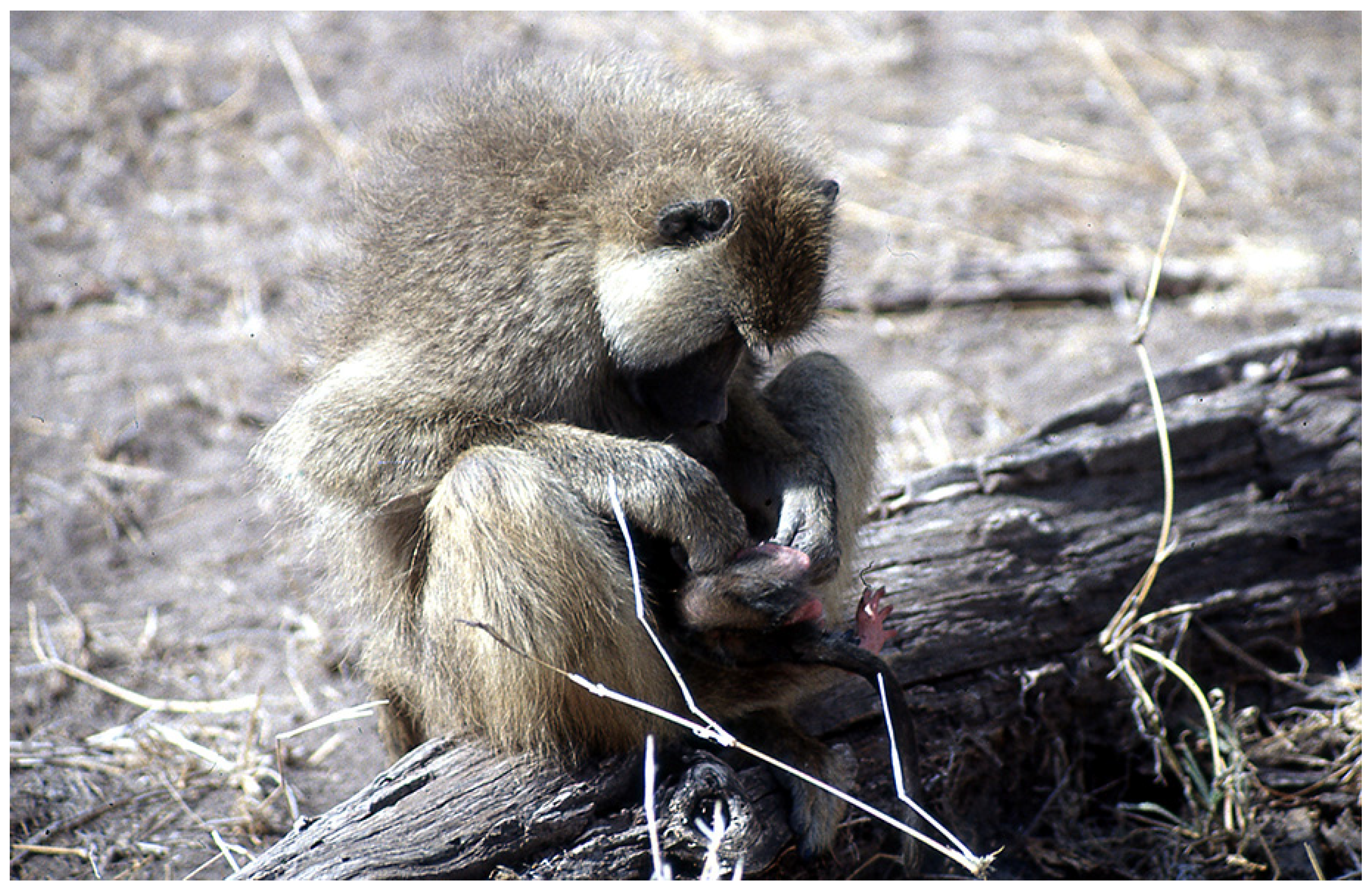
Photographs of Ozzie as an infant appear in [7] Figure 3 (p. 4) and [7] Figure 46 (p. 142). Figure 1 and Figure 2 of the current article show Ozzie as a young adult.
Alto’s Group varied in size during Ozzie’s residence due to births, deaths, emigration and immigration [31]. Group size was 47 on 1 July 1975 and 40 on 31 October 1976 [7] (p. 17-19); 45-53 from 1 January 1981 to 31 December 1982 [34] (p. 40), 50-55 from 1 December 1981 to 31 December 1982, during which period Ozzie emigrated from Alto’s Group to Hook’s Group [28]. Ozzie thus grew up in an “ever-changing social group” within an “ever-changing demographic panorama” [7] (p. 16).
Ozzie’s siblings were Oval’s daughters Fanny (born 21 June 1973) and Oreo (born 28 July 1976) [7] (p. 199). In a small baboon troop like Alto’s, few or no potential playmates are nearly the same age (i.e., born within a few months of each other). Thus, in contrast to the case for larger primate groups, the young of Alto’s Group often played with infants or juveniles who are a year or two younger or older than themselves. For example, when Ozzie was a year old (December 1975), his potential play companions included six females and one male who were 1-2 years older than himself, one male (Pooh) not in good health who was two months older, three females (Alice, Eno and Summer) who were between 8 days and 7 months younger, two males (Bristle and Fred) who were both 7 months younger, and two other individuals who were not in good health and/or died within a few months [7] (pp. 196-202).
a. Rainfall, energy and nutrition
During the study period, Amboseli experienced near-drought conditions, with a total rainfall of 202 mm, 60% of the long-term average, “light even for this arid region” [8] (p. 11). None of the nine yearling baboons for whom play data were available met or exceeded their requirement for protein during this study. All were measurably protein-deprived (for example, Ozzie’s protein intake was 49% of a value considered optimal [8] (p. 509 Table 7.8), and his energy intake was 51% of a value considered optimal [8] (p. 512 Table 7.8).
b. Play, exploration and curiosity
For August 1975–September 1976 [8] (p. 524 Table 8.4), the only period for which detailed quantitative data on Ozzie’s play are available, Ozzie played an average of 4.11 minutes per day, the most of any of the nine yearlings followed during the study. (The three next highest values were male Bristle’s 3.39, female Summer’s 3.23, and male Hans’ 3.23: [8] (p. 524 Table 8.4)). The average duration of Ozzie’s play bouts was 0.18 minutes, by far the greatest for any of the nine yearlings (Bristle was next highest at 0.12 minutes). Ozzie’s average number of play bouts per day, 22.81, was neither unusually high nor unusually low among the nine yearlings [8] (p. 524 Table 8.4). Ozzie’s high levels of play were associated with higher protein consumption relative to protein requirements (77% of requirements) [8] (p. 524 Table 8.4, p. 309 Figure 8.15, p. 524 Table 8.4), a value similar to those for the somewhat less playful Bristle (0.73), Hans (0.77) and Summer (0.75). Ozzie played markedly more than the three next most playful yearlings, even though all four of these individuals had the same relative protein consumption. Summer (1540 kJ/day) and Hans (1970 kJ/day) ranked above Ozzie (1313 kJ/day) in milk consumption [8] (p. 308 Figure 8.14 and p. 525 Table 4). Bristle’s (1240 kJ/day) milk consumption was slightly less than Ozzie’s [8] (p. 308 Figure 8.14 and p. 525 Table 8.4).
Ozzie “was unusually curious” as a yearling [35]. He discovered three foods new to Alto’s Group: “fruit caps of a white mushroom (Agaricus prob. bukavuensis), the underground tuber of a cucucumber-related plant (Cucumis prophetarium), and an unidentified small, red berry” [35]. These instances of food pioneering by Ozzie attracted the attention of other baboons in Alto’s Group [35]. Ozzie had the greatest dietary diversity of any of the studied yearlings [35](Table 7.6E) as measured by his ranking first or second among the yearlings in feeding bout rates (16 food types and tied for second on a 17th; second to Ozzie was Eno with 13 food types). Measured in terms of feeding bout rates, Ozzie’s use of available blossoms and fruits was also noteworthy and remarkable relative to the use of these blossoms and fruits by the other yearlings. Ozzie ranked first or second among the yearlings on four types of blossoms and five types of fruits [8] (p. 502-503 Table 7.6). (Blossoms: umbrella tree blossoms picked from the tree, fever tree blossoms picked from the tree, abscised umbrella tree blossoms picked up from the ground, trumpet flower Lycium “europaeum” blossoms on the bush. Fruits: green fruit of toothbrush bush Salvadora persica, semiripe fruit of toothbrush bush, ripe fruit of toothbrush bush, fruit of Azima tetracantha (ripeness unknown), fruit of Capparis tomentosa.)
When Ozzie was 14 months old, Stuart Altmann [8] (p. 88) was “surprised” to see him explore/play gently with a ripe Sodom apple (Solanum incanum) fruit. Amboseli baboons were not known to eat this plant, but Ozzie “several times pulled at, once sniffed, and perhaps mouthed a Sodom apple still on the plant, but did not eat any of it.” Beginning one minute later, first one and then gradually five more young baboons gnawed or nibbled on Sodom apple fruit. This fruit is more or less toxic (especially when green) and contains a carcinogen. It also resembles the fruit of a different Solanum species, Solanum coagulans, which is consumed.
Ozzie’s curiosity also extended to at least two types of nonfood items: vehicle tailpipes and on one occasion, most remarkably, fire [36].
c. Emigration, immigration and adult life
Ozzie emigrated from Alto’s Group on February 27, 1982 as a seven-year old. Slightly more than three months later, he immigrated to Hook’s group on June 1, 1982. Eight years old is a typical age of emigration for known Amboseli males (median age of emigration 8.45 years, range 6.81–13.42 yr [30] (p. 287). Three months is also not an unusual length of time between known emigration by an Amboseli male from his natal group and known immigration to his next group (such timespans range from a few hours to more than a year, [30] (p. 284)). Little if anything is known about Ozzie’s life during his apparently solitary months, as he was spotted only on occasion and was not again followed systematically until he joined Hook’s Group. It is possible, judging from observations of other young males subsequent to emigration from their natal group [30] (p. 284), that he had occasional contact with other baboons and frequent contact with other Amboseli wildlife.
When Ozzie joined Hook’s Group, he was a strong, healthy young adult and soon became a dominant individual, as is normal for young adult Amboseli yellow baboons soon after they join a new group [26]. He seldom participated in social coalitions. An overall lack of coalition participation is typical of healthy young males joining a new group [25,26,27].
d. Risk and resilience
For both male and female Amboseli baboons, six measurable factors, collectively termed “early life adversity”, accompany differences in lifetime survival [1] These factors are drought (200 mm or less of rainfall in the first year of llfe), maternal loss (the death of the individual’s mother when the individual was less than four years old), high social density (being born into a group in the top quartile of group sizes in Amboseli), low maternal social status (being born to a mother in the bottom quartile of the dominance rank distribution), maternal social isolation (having a mother who was in the bottom quartile of social connectedness to other females in the first two years of the individual offspring’s life) and having a close-in-age younger sibling (the birth of a younger sibling within 1.5 years of the baboon’s own birth) [1].
Ozzie’s standing on each of these six factors is as follows. The notation + in bold face indicates that Ozzie was at risk from this factor. The notation (+) in bold face indicates that Ozzie was very nearly at risk from this factor.
i. (+) Drought. In Ozzie’s first year, rainfall was 220 mm (hydrological year, beginning in November 1994) [37]. During July 1975-June 1976, when Ozzie was observed as a yearling in Stuart Altmann’s foraging study, rainfall was 202 mm [8] (p. 11), “light even for this arid region” [8] (p. 11).
ii. + Maternal loss. Ozzie’s mother Oval died in late March 1978, when Ozzie was three years, three months old [7] (p. 199).
iii. + High social density. During Ozzie’s first eight years, Alto’s Group varied in total size from 46 to 52 individuals (median 50). During these eight years, Alto’s group was larger than each of Hook’s Group, Stud’s Group and the mean value (approximately 20) for all other groups censused [31].
iv. Low maternal social status. Ozzie’s mother Oval was mid-ranking in dominance. When Ozzie was born, she ranked 9th among 17 adult females [8] (p. 524 Table 8.4). During July 1975-October 1976, Oval ranked 8th among 17 adult females [7] (p. 95).
v. Maternal social isolation. Oval’s birth date is not known. She was an adult in Alto’s Group in 1971 [7] (p. 199). Photographs in [7] (p. 4 Figure 3 and p. 71 Figure 18) suggest that Oval was not socially isolated during Ozzie’s early life.
vi. + Close-to-age younger sibling. Ozzie’s younger sibling Oreo was born in late July 1976, when Ozzie was two years old [7] (p. 199).
4. Discussion
Ozzie played, explored and showed marked curiosity and originality under far-from-ideal circumstances, namely, drought and substandard nutrition. His frequencies of play are considerably less than those observed for other young yellow baboons in Alto’s Group in a later study [19,21] conducted during 1981. Pereira found that young juveniles played an average of 1.6% of the time, older juveniles 1.1% of the time. Rainfall during the (hydrological) year beginning in November 1980 and ending in October 1981 was 342 mm, close to the long-term average for Amboseli [38]. These play frequencies, although relatively low compared with some previous data from other field sites (3% to 5% in two field studies of other Papio species [39] (p. 274), are considerably higher than Ozzie’s fraction of one percent.
In the free-ranging yellow baboons in Amboseli studied by the Amboseli Baboon Project researchers, especially high mortality characterizes the first two years of life. On average, slightly less than two-thirds (62%) of liveborn male infants survive to their second birthday [32]. Mortality is markedly less from age 2 throughout the remainder of the juvenile period (to approximately age 4-5 for juvenile females and age 6-8 for juvenile males). For example, in Alto’s Group from July 1971 to July 1978, 72% of infants who were born alive survived to age 1 (28% mortality); 53% of infants born alive survived to age 2 (47% mortality from birth to age 2 and 19% mortality from age 1 to age 2); and approximately 50% of infants born alive survived to age 5 (3% mortality from age 2 to age 5) [7] (p. 35). Mortality risks for “young juveniles” (age 1 to age 2) were thus substantially greater than for “old juveniles” (age 2 to age 3 and thereafter during the juvenile period).
Monthly mortality of young dispersing males is also relatively high (three to ten times greater than monthly mortality of like-aged group-living males [30].
Slightly less than one-half (46%) of study males who were born alive subsequently survived to age 8 [32]. Of those male infants surviving to age 8, less than one third (29%) survived to age 16 or greater. A newborn male infant had a chance of only 14% of surviving to age 16 or greater [32].
Juvenile survival in both male and female Amboseli baboons is potentially a primary target of natural selection, far more so than adult survival or fecundity, as measured by elasticity analysis, a mathematical demographic technique that “provides a measure of the relative strength of selection on vital rates” [32]. In the Amboseli baboons studied, “infant and juvenile survival are under strong selection” [32]. These mathematical demographic modes of analysis do not, in themselves, indicate which components of behavior and ecology of infant and juvenile savanna baboons are likely to make the greatest difference to survival. They highlight the key scientific importance of long-term Amboseli baboon research on individually known animals, including those in life-history stages prior to adulthood, with studies ever since the 1970s of factors that potentially and differentially affect survival of infants and juveniles.
Of six factors believed to place Amboseli baboons at risk of survival, Ozzie faced three (maternal loss, high social density and close-to-age younger sibling) and very nearly faced a fourth (drought). Ozzie beat long odds repeatedly to live 16 years, an advanced age for a male Amboseli baboon. He survived the low-rainfall years 1975-1976 (220 and 205 mm rainfall, respectively), 1982 (211.2 mm), 1984 (157.6 mm) and 1986 (268.8 mm). He emigrated and subsequently immigrated in 1982, one of these low-rainfall years (211.2 mm).
Nevertheless, the risks that Ozzie faced as an infant and juvenile were by no means exceptional for Alto’s Group males born in 1974-1975 [7,8]. In all, six male infants were born in Alto’s Group during these two years: Tom, Ozzie, Screech, Pedro, Bristle and Hans. Three of these six infants, namely, Tom, Screech and Pedro, did not survive until their second birthday. Bristle and Hans both faced near-drought conditions (202 mm of rainfall) in 1975. Bristle’s mother Brush died before Bristle was two years old [7] (p. 202). Hans’ younger sibling Heidi was born when Hans was slightly (three weeks) older than 1.5 years [7] (p. 201). Brush was low-ranking (rank 15) [7] (p. 95). I found no published information on possible social isolation of Brush or Hans’ mother Handle. In summary, Bristle faced three risk factors and near-drought. Hans faced two risk factors and near-drought and came within three weeks of facing a third. Ozzie was one of the three (of six) 1974-1975 infants who survived until at least 1989. Ozzie and the other two surviving infants all faced two or three risk factors plus near-drought.
Male baboons who emigrate from their natal group face serious challenges in addition to possible drought. These challenges include predation, risks associated with unfamiliar terrain, foods, and water sources, parasites, hostile conspecifics and heterospecifics from scorpions to elephants, and disease. The protection and physical and emotional support afforded by membership in an individual’s natal group is no longer available.
Male Amboseli baboons face increased risk if they emigrate. Although some Amboseli males do not emigrate from their natal groups, successful emigration has benefits, often including the opportunity to produce offspring. Emigration might also offer excitement and adventure, along with risk, to a young baboon with insatiable curiosity. Especially for males who emigrate, the challenges of a novel environment and lifestyle may require behavioral plasticity and resilience of precisely the sort that (playful) play is hypothesized to yield based on studies of other mammalian and avian species (e.g., [40]). Nonhuman primate play might also serve in part as developmental scaffolding (page 33) [40,41] to construct subsequent general, versatile communicative and metacommunicative flexibility [42,43,44,45,46,47,48].
5. Conclusions
By all accounts, Ozzie was remarkable. His curiosity and experimentation with diverse and novel foods and with inanimate objects are matters of record. He survived as an infant and juvenile, through emigration, as an adult and through drought and near-drought.
Both directly and through Stuart Altmann’s accounts based on direct personal experience, Ozzie left an indelible impression on many. Even fifty years later, Ozzie’s history contributes to the continuing story of the baboons of Amboseli.
In the study of behavior, individual distinctiveness plays an important role, and certain individuals tend to stand out. Some, like Ozzie, are creative, playful, inventive and curious, with unique qualities and distinctive personalities.
Funding
This research received no external funding.
Data Availability Statement
No new data were created or analyzed in this study. Data sharing is not applicable to this article.
Acknowledgments
I thank the late Stuart Altmann, Susan Alberts, Ronald Noë and Joan Silk for discussions. Special thanks to Ronald Noë also for sharing his photographs of Ozzie and for his kind permission to use selected images in this article.
Conflicts of Interest
The author declares no conflicts of interest.
References
- Tung, J.; Lange, E.C.; Alberts, S.C.; Archie, E.A. Social and early life determinants of survival from cradle to grave: A case study in wild baboons. Neurosci. Biobehav. Rev. 2023, 152, 105232:1–105232:14. [Google Scholar] [CrossRef] [PubMed]
- Struhsaker, T.T. Ecology of vervet monkeys (Cercopithecus aethiops) in the Masai-Amboseli Game Reserve, Kenya. Ecology 1967, 48, 891–904. [Google Scholar] [CrossRef]
- Altmann, S.A.; Altmann, J. Baboon Ecology. University of Chicago Press: Chicago, IL, USA 1970.
- Western, D.; Van Praet, C. Cyclical changes in the habitat and climate of an East African ecosystem. Nature 1973, 241, 104–106. [Google Scholar] [CrossRef]
- Altmann, S.A. Baboons, space, time, and energy. Am. Zool. 1974, 14, 221–248. [Google Scholar] [CrossRef]
- Hausfater, G. Dominance and Reproduction in Baboons (Papio cynocephalus). S. Karger, Basel, Switzerland 1975.
- Altmann, J.Baboon Mothers and Infants. Harvard University Press: Cambridge, MA, USA 1980.
- Altmann, S.A. Foraging For Survival: Yearling Baboons in Africa. University of Chicago Press: Chicago, IL, USA 1998.
- Western, D. A half a century of habitat change in Amboseli National Park, Kenya. Afr. J. Ecol. 2007, 45, 302–310. [Google Scholar] [CrossRef]
- Western, D.; Mose, V.N.; Maitumo, D.; Mburu, C. Long-term changes in the plant ecology of an African savanna landscape and the consequences for ecosystem theory and conservation management. Ecol. Proc. 2021, 10:15:1–0:15:12. [Google Scholar]
- Amboseli Baboon Research Project. About the project: The habitat. Available online: https://amboselibaboons.nd.edu/about-the-project/the-habitat/ (accessed on 15 January 2025).
- Altmann, J.; Alberts, S.C.; Altmann, S.A.; Roy, S.B. Dramatic change in local climate patterns in the Amboseli basin, Kenya. Afr. J. Ecol. 2002, 40, 248–251. [Google Scholar] [CrossRef]
- Samuels, A.; Altmann, J. 1986. Immigration of a Papio anubis male into a group of Papio cynocephalus baboons and evidence for an anubis-cynocephalus hybrid zone in Amboseli, Kenya. Int. J. Primatol. 1986, 7, 131–138. [Google Scholar] [CrossRef]
- Alberts, S.C.; Altmann, J. Immigration and hybridization patterns of yellow and Anubis baboons in and around Amboseli, Kenya. Am. J. Primatol. 2001, 154, 139–154. [Google Scholar] [CrossRef]
- Campos, F.A.; Villavicencio, F.; Archie, E.A.; Colchero, F.; Alberts, S.C. Social bonds, social status and survival in wild baboons: a tale of two sexes. Philos. Trans. R. Soc. Lond. B Biol. Sci. 2020, 375, 20190621–1. [Google Scholar] [CrossRef]
- Milne, G. A soil reconnaissance journey through parts of Tanganyika Territory December 1935 to February 1936. J. Ecol. 1947, 35, 192–265. [Google Scholar] [CrossRef]
- Greenway, P.J. A classification of the vegetation of East Africa. Kirkia 1973, 9, 1–68. [Google Scholar]
- Borden, R.W.; Baillie, I.C.; Hallett, S.H. The East African contribution to the formalisation of the soil catena concept. Catena 2020, 185, 104291:1–104291:7. [Google Scholar] [CrossRef]
- Pereira, M.E.; Altmann, J. Development of social behavior in free living nonhuman primates. In Nonhuman Primate Models for Growth and Development, Watts, E.S., Ed., Alan, R. Liss: New York, USA, 1985; pp. 217–309.
- Altmann, J.; Samuels, A. Upscale baboons. Natural History 1989, 5, 60–63. [Google Scholar]
- Pereira, M.E. Agonistic interactions of juvenile savanna baboons: II. Agonistic support and rank acquisition. Ethology 1989, 80, 152–171. [Google Scholar] [CrossRef]
- Mike; Mollye Travel. Monkeys & Baboons in Amboseli National Park. Available online: https://www.youtube.com/watch?v=8DSc1Dkake8 (accessed on 12 January 2025).
- Amboseli Baboon Research Project. Young baboons playing. Available online: https://www.youtube.com/watch?v=PFJkMFl_Y2E (accessed on 29 June 2024).
- Luft, J.; Altmann, J. Mother baboon. Natural History 1982, 919, 30–39. [Google Scholar]
- Noë, R. A Veto game played by baboons: a challenge to the use of the Pris oner’s Dilemma as a paradigm for reciprocity and cooperation. Anim. Behav. 1990, 39, 78–90. [Google Scholar] [CrossRef]
- Noë, R. Alliance formation among male baboons: shopping for profitable partners. In Coalitions and Alliances in Humans and Other Animals, Harcourt, A.H., de Waal, F.B.M., Eds., Oxford University Press, Oxford, UK, 1992; pp. 285–321.
- Noë, R. A model of coalition formation among male baboons with fighting ability as the crucial parameter. Anim. Behav. 1994, 47, 211–213. [Google Scholar] [CrossRef]
- Noë, R.; Sluijter, A.A. Which adult male savannah baboons form coalitions? Int. J. Primatol. 1995, 16, 77–105. [Google Scholar] [CrossRef]
- Altmann, J.; Altmann, S.A.; Hausfater, G.; McCuskey, S.A. Life histories of yellow baboons: physical development, reproductive parameters, and infant mortality. Primates 1977, 18, 315–330. [Google Scholar] [CrossRef]
- Alberts, S.C.; Altmann, J. Balancing costs and opportunities: dispersal in male baboons. Am. Nat. 1995, 145, 279–306. [Google Scholar] [CrossRef]
- Altmann, J.; Hausfater, G.; Altmann, S. Demography of Amboseli baboons. Am. J. Primatol. 1985, 8, 113–125. [Google Scholar] [CrossRef] [PubMed]
- Alberts, S.C.; Altmann, J. Matrix models for primate life history analysis. In Primate Life History and Socioecology, Kappeler, P., Pereira, M.E., Eds., University of Chicago Press: Chicago, IL, USA 2003; pp. 66–102.
- Alberts, S.C. (Duke University, Durham, NC, USA). Personal communication, 2025.
- Pereira, M.E. Age changes and sex differences in the social behavior of juvenile yellow baboons (Papio cynocephalus). Ph. D. dissertation, University of Chicago, Chicago, IL, USA 1984.
- Altmann, S.A. Fallback foods, eclectic omnivores, and the packaging problem. Am. J. Phys. Anthropol. 2009, 140, 615–629. [Google Scholar] [CrossRef] [PubMed]
- Campbell, A. The baboons of Kenya. University of Chicago Magazine 1995, August. [Google Scholar]
- Moss, C.J. The demography of an African elephant (Loxodonta africana) population in Amboseli, Kenya. J. Zool., Lond. 2001, 255, 145–156. [Google Scholar] [CrossRef]
- Alberts, S.C.; Altmann, J.; Archie, E.A.; Tung, J.; and the Amboseli Baboon Research Project. Rainfall records from the Amboseli Baboon Research Project. Available online: https://amboselibaboons.nd.edu/downloads/ (accessed on 15 January 2025).
- Fagen, R. Animal Play Behavior. Oxford University Press: New York, NY, USA 1981.
- Bateson, P.; Martin, P. Play, Playfulness, Creativity and Innovation. Cambridge University Press: Cambridge, UK 2013.
- Bateson, P. 1981. Discontinuities in development and changes in the organ ization of play in cats. In Behavioral Development, Immelmann, K., Barlow, G.W., Petrinovich, L., Main, M., Eds., Cambridge University Press, Cambridge, UK, 1981; pp. 281–295.
- Altmann, S.A. A field study of the sociobiology of rhesus monkeys, Macaca mulatta. Ph. D. dissertation, Harvard University, Cambridge, MA, USA 1960.
- Altmann, S.A. Abstract: The social play of rhesus monkeys. Am. Zool. 1961, 1, 433. [Google Scholar]
- Altmann, S.A. A field study of the sociobiology of rhesus monkeys, Macaca mulatta. Ann. N.Y. Acad. Sci. 1962, 102, 338–435. [Google Scholar] [CrossRef]
- Altmann, S.A. Social behavior of anthropoid primates: analysis of recent concepts. In Roots of Behavior, Bliss, E.L. Ed., Harper & Bros., NY, 1962; pp. 277–285.
- Altmann, S.A. Sociobiology of rhesus monkeys. II. Stochastics of social communication. J. Theoret. Biol. 1965, 8, 490–522. [Google Scholar] [CrossRef]
- Altmann, S.A. The structure of primate social communication. In Social Communication Among Primates, Altmann, S.A., Ed., University of Chicago Press, Chicago, IL, USA, 1967; pp. 325–362.
- Altmann, S.A. Sociobiology of rhesus monkeys, II. The basic communication network. Behaviour 1968, 32, 17–32. [Google Scholar] [CrossRef]
Figure 1.
Ozzie as a young adult, age 7 (Ronald Noë photo.).
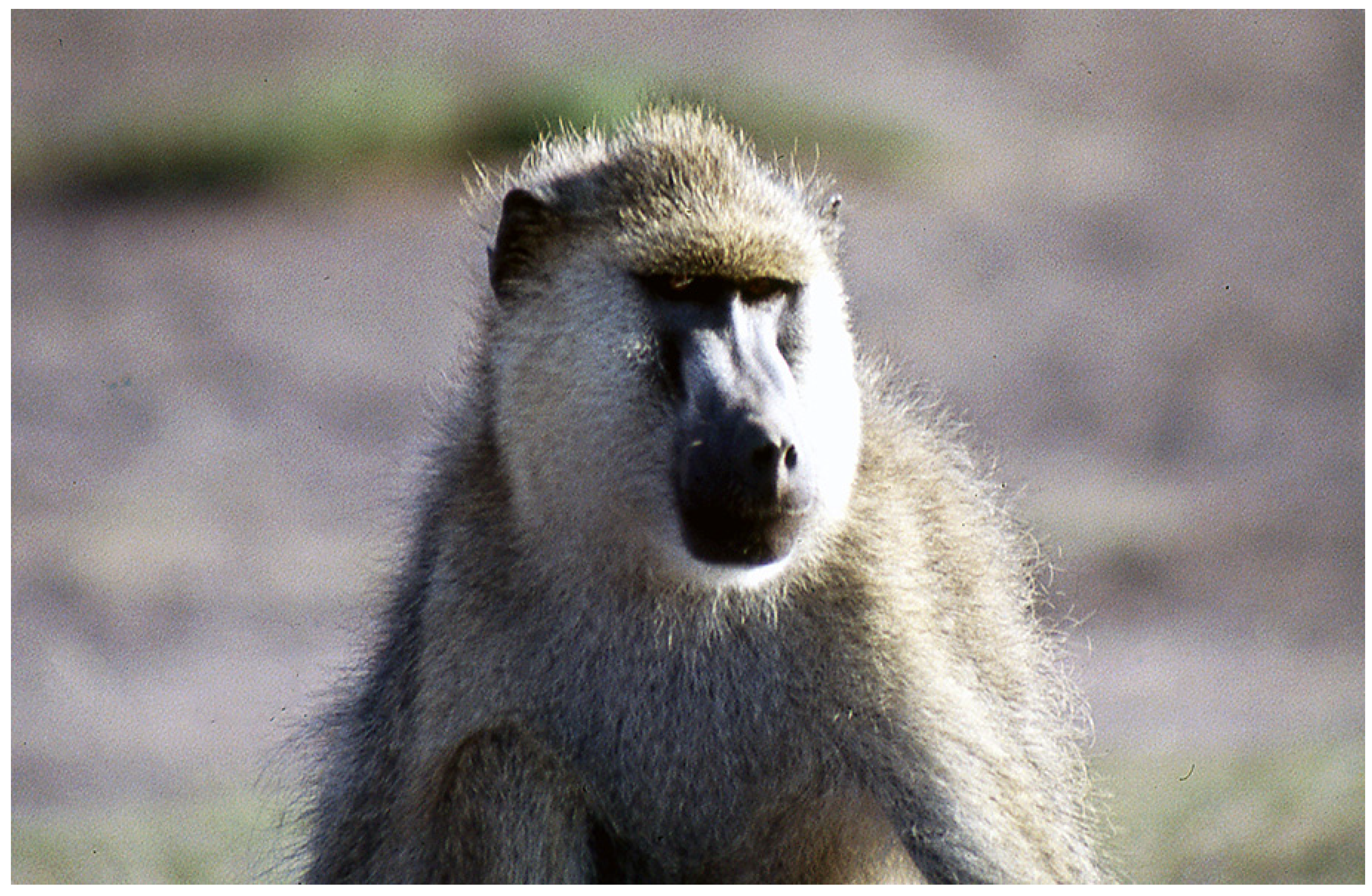
Figure 2.
Ozzie grooms a black infant (Ronald Noë photo.).
Disclaimer/Publisher’s Note: The statements, opinions and data contained in all publications are solely those of the individual author(s) and contributor(s) and not of MDPI and/or the editor(s). MDPI and/or the editor(s) disclaim responsibility for any injury to people or property resulting from any ideas, methods, instructions or products referred to in the content. |
© 2025 by the authors. Licensee MDPI, Basel, Switzerland. This article is an open access article distributed under the terms and conditions of the Creative Commons Attribution (CC BY) license (http://creativecommons.org/licenses/by/4.0/).
Copyright: This open access article is published under a Creative Commons CC BY 4.0 license, which permit the free download, distribution, and reuse, provided that the author and preprint are cited in any reuse.


